MEASURING E-LEARNING SYSTEM SUCCESS
(RESEARCH IN PROGRESS)
Ahmed Younis Alsabawy, University of Southern Queensland,
[email protected]
Aileen Cater-Steel, University of Southern Queensland, [email protected]
Jeffrey Soar, University of Southern Queensland, [email protected]
Abstract
Education is considered to be one of the sectors that have been radically affected by developments in information technology. E-learning is believed to be the main outcome of adopting and using the new and more advanced information technology in the education sector. In spite of this rapid growth in the e-learning field there still exists a range of issues facing the stakeholders of e-e-learning systems. One of the key issues is measuring e-learning system success. Although considerable attention has been paid to the information systems success issue, there remain arguments about the factors which are most effective in measuring information system success. The issue of measuring information system success has an impact on evaluating e-learning systems success as well.
This study aims to fill this void by proposing an evaluation methodology model to assess e-learning systems success. The contribution of this study is the proposed model to assess e-learning systems success. The model is based on a thorough review of the e-learning success literature and existing IS success models. A range of stakeholders such as Academic staff, students, and ICT staff are considered in this model.
1
INTRODUCTION
1.1 Background of study
Information technology (IT) has become an essential factor in organisational success due to its critical role in enabling the achievement of individual and organizational goals. The introduction of IT is no longer limited to back-office business functions but has grown to include the core processes in health, education, transport, banking, and other fields.
The education sector is considered to be one of the sectors that have been radically affected by developments in information technology. Substantial amounts of money have been spent in systematic development of technology infrastructure (Georgina & Olson, 2008).
E-learning is believed to be the main focus of adopting and using the new and more advanced IT in the education sector. These e-learning systems have also been adopted by non-educational organizations to train their employees (Wang & Wang, 2009). The introduction of e-learning systems can enable non-educational organizations to receive valuable benefits. For example, IBM saved USD200 million in 1999, providing five times the learning at one-third the cost of their previous methods (Strother, 2002).
In higher education, using e-learning systems is believed to be one of the most crucial developments due to the use of IT in this arena in the last decade (McGill & Klobas, 2009). In the USA, 90% of 2-year and 89% of 4-year public education institutions offered distance education courses in 2000-2001 with enrolments of 1,472,000 and 945,000 respectively out of total enrolment of 3,077,000 (Holsapple & Lee Post, 2006). Furthermore, learning management systems (LMSs) have been adopted by 95% of all higher education institutions in the United Kingdom (McGill & Klobas, 2009). It is worth mentioning that transnational courses are delivered by most Australian universities through using educational software (Shurville, O'Grady, & Mayall, 2008).
In spite of this rapid growth in the e-learning field there still exists a range of issues facing the stakeholders of e-learning systems. One of the key issues is measuring e-learning system success. In the context of e-learning systems, this issue is considered more complicated because the e-learning term is used with different points of view. Cohen and Nycz (2006) state that “E-learning can be difficult to understand because different authors use the term differently” (p.23). This lack of evaluation of e-learning systems success is believed to be a central concern for the researchers and the stakeholders of these systems. According to Ardito et al. (2006) an effective methodology to evaluate e-learning system success is still unavailable. Furthermore, the issue of lack of an effective methodology to evaluate e-learning system success is no longer restricted to higher education field but now extends to the non-educational organisations. Wang et al. (2007) state that “ Little research has been conducted to assess the success and/or effectiveness of e-learning systems in an organizational context” (p.1792).
1.2 Motivation for study
This direction of research led to scant attention to establishing a comprehensive measurement framework that can evaluate e-learning systems success and ensure the stakeholders achieved their goals. This study aims to fill this void by proposing an evaluation model to assess e-learning systems success. A range of stakeholders such as Academic staff, students, and ICT staff are considered in this model. The diversity of stakeholders who evaluate e-learning systems provides a holistic picture about these systems and their outputs.
1.3 Study problem
A critical issue facing IT projects is their high rate of failure. E-learning systems also encounter the problem of failure. According to Rovai and Downey (2009), the British Government spent $113 million in 2000 to establish an e-learning project called the United Kingdom e-University (UKeU). In 2004, the Government announced that UKeU had failed because it did not meet recruiting targets. In another example, the New York University online closed due to economic conditions. The lack of evaluation is believed to be significant reason for failure e-learning systems. According to McGorry (2003) many educational institutions have not considered this important issue of evaluating e-learning systems. Therefore, these systems need to be assessed continuously to make sure that the outputs meet users’ needs. However, there are some dilemmas in measuring the success of e-learning systems and in determining the most effective technique to undertake this process (McGorry, 2003); ( Wang, et al., 2007); (Ardito, et al., 2006). Thus, two problems are investigated by this research:
1. What are the main factors considered to be important in measuring e-learning system success?
2. Is the model to measure e-learning system success proposed in this study valid and reliable to
evaluate e-learning systems from different points of view (i.e. with different users)?
1.4 Significance of study
The process of evaluating e-learning system success is significant because it assists in managing, maintaining, and developing these systems and in diagnosing the problems that need to be solved. The differences in goals of stakeholders create a difficulty in assessing the success of e-learning systems. Furthermore, most of the previous research that has dealt with the e-learning systems success issue was limited to one type of stakeholder i.e. students, and ignored the other types of stakeholders. The significance of this study is the attempt to identify the factors impacting on the success of e-learning systems and place these factors in a proposed model. Additionally, the model provides an evaluation of the success of e-learning system with different stakeholders through three instruments which have been developed to achieve this purpose. The results of this study are considered significant for the University because they provide University management with a clear picture about e-learning systems in this university through opinions of three groups of stakeholders: academic staff, students, and ICT staff.
1.5 Study contribution and objectives
The contribution of this study is the proposed model to evaluate e-learning systems success. This new model is believed to be holistic because different perspectives have been considered in relation to technical, user attitude, marketing and organisational. Another contribution is related to the net benefits factor. Different views of value are employed to measure the net benefits of e-learning systems dealing with customer value, organizational value, and society value. Finally, IT infrastructure has been included in this model. To this author’s knowledge, this factor has not been used previously as a construct to measure IS success. The validity and reliability of this factor to measure e-learning success is tested in the context of this model.
The objectives of this study are to identify those factors which affect e-learning systems success and place them in a holistic model; to determine the type and power of relationships between those factors in the context of the proposed model, and to measure the direct and indirect effects between constructs of the study model; and to test the validity and reliability of the proposed model and to confirm that the model is suitable to measure the success of e-learning systems from different points of view. After a brief review of the literature, the proposed model is presented, the methodology is described, and the conclusion summarises progress to date and future work.
2
LITERATURE REVIEW
The term e-learning is used by many researchers and consensus on its definition has not been achieved
( Lee, Yoon, & Lee, 2009). Engelbrecht (2005) restricts e-learning to distance-mode delivery: “the use of electronic media (the internet, DVD, CD-Rom, videotapes, television, cell phone, etc.) for teaching and learning at a distance” (p. 218). Whereas in the context of active learning, Lee et al. (2009) do not impose such a restriction, defining e-learning as “Web based learning which utilize web-based communication, collaboration, multimedia, knowledge transfer, and training to support learner’s active learning without the time and space barriers” (p.1321). We accept the latter definition, recognizing that in many institutions, e-learning systems are used by on-campus students as well as distance-mode students.
Different criteria in evaluating e-learning system success have appeared because of differences in approaches adopted by various authors as to the term e-learning (Ozkan & Koseler, 2009). The studies which have dealt with this issue can be classified into four approaches.
2.1 Technology acceptance model approach
The technology acceptance model (TAM) approach is considered to be a common application in the IS field. The main purpose of using this approach is to measure the acceptance of using technology and the success of these technologies. Roca et al. (2006) combined Expectancy Disconfirmation theory and TAM to create a new model to measure e-learning continuous intention. Martinez-Torres et al. (2008) adopted TAM and made essential changes to the constructs of this model. The main purpose of these changes on TAM items is to make them relevant to the e-learning system usage context. The studies which are considered supportive of this approach are conducted by Selim (2007), Abbad et al. (2009), and Ngai et al. (2007).
2.2 User satisfaction approach
User satisfaction has received considerable attention from the researchers in the IS field. This attention included e-learning systems. User satisfaction has been considered as a measurement to assess e-learning system success. Sun et al. (2008) classified the critical factors which drive successful e-learning in six dimensions which are learner, instructor, course, technology, design, and environmental. Studies conducted by Shee and Wang (2008), and Wu et al. (2010) are considered to be supportive of this approach.
2.3 E-learning quality approach
Studies have and still pay considerable attention to e-learning quality. Also, the quality issue has received
attention from educational institutions such as
the
Western Interstate Commission for Higher Educationservice, and outcome. Studies by McGorry (2003), MacDonald and Thompson (2005), and Lee and Lee (2008) are believed to be supportive of this approach.
2.4 DeLone and McLean model approach
The DeLone and McLean model is a common technique used to assess IS success. E-learning systems are considered to be the most important IT projects in universities (Lee, et al., 2009). However, the evaluation of these systems is still facing problems as there is a lack of measurements to evaluate the success of these projects. The DeLone and McLean model is believed to be one of the most important measurements which can be used to address this issue in the e-learning field. Studies conducted by Lin (2007), Holsapple and Lee-Post (2006), and Lee-Post (2009) are believed to be supportive of this model.
3
PROPOSED MODEL AND HYPOTHESES
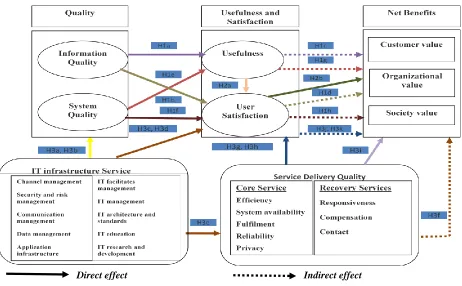
[image:5.612.74.536.295.581.2]A causal approach has been adopted in this study. Based on the components of this approach, a proposed model has been designed. Figure 1 shows this model.
Figure 1. The proposed model to measure e-learning system success.
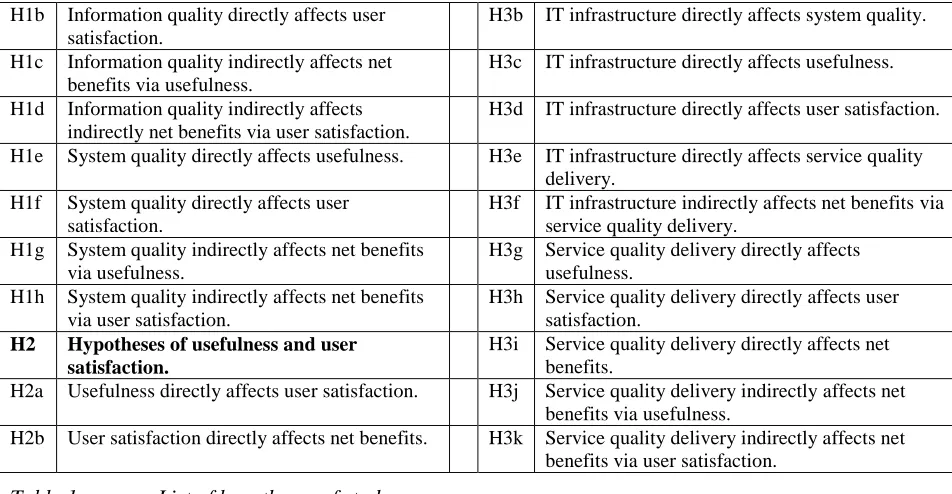
The model of the study has been established based on the relationships between the constructs; therefore, there are 21 relationships to be tested. These relationships are formulated as hypotheses. The hypotheses are listed in Table 1.
Hypotheses of service delivery and IT infrastructure services.
H3 Hypotheses of quality variables.
H1
IT infrastructure directly affects information quality.
H3a Information quality directly affects
usefulness. H1a
IT infrastructure directly affects system quality. H3b
Information quality directly affects user satisfaction.
H1b
IT infrastructure directly affects usefulness. H3c
Information quality indirectly affects net benefits via usefulness.
H1c
IT infrastructure directly affects user satisfaction. H3d
Information quality indirectly affects indirectly net benefits via user satisfaction. H1d
IT infrastructure directly affects service quality delivery.
H3e System quality directly affects usefulness.
H1e
IT infrastructure indirectly affects net benefits via service quality delivery.
H3f System quality directly affects user
satisfaction. H1f
Service quality delivery directly affects usefulness.
H3g System quality indirectly affects net benefits
via usefulness. H1g
Service quality delivery directly affects user satisfaction.
H3h System quality indirectly affects net benefits
via user satisfaction. H1h
Service quality delivery directly affects net benefits.
H3i Hypotheses of usefulness and user
satisfaction. H2
Service quality delivery indirectly affects net benefits via usefulness.
H3j Usefulness directly affects user satisfaction.
H2a
Service quality delivery indirectly affects net benefits via user satisfaction.
H3k User satisfaction directly affects net benefits.
[image:6.612.67.543.71.318.2]H2b
Table 1. List of hypotheses of study.
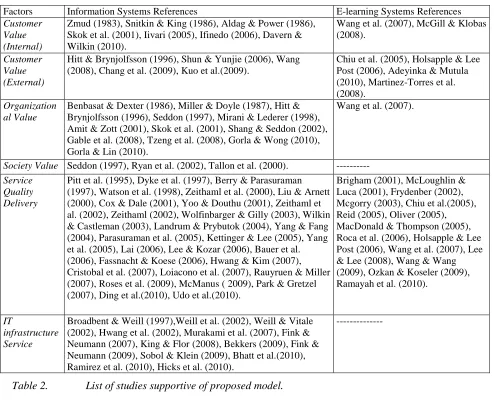
The hypotheses proposed in the model are justified by previous studies as listed in Table 2.
Factors Information Systems References E-learning Systems References
Information Quality
Bailey & Pearson (1983), Miller & Doyle (1987), DeLone & McLean (1992) (2003), Seddon (1997), Skok et al. (2001), Rai et al. (2002), Kahn et al. (2002), Lee et al. (2002), McKinney et al. (2002), Bharati & Berg (2005), Iivari (2005), Byrd et al. (2006), Ifinedo (2006), Nicolaou & McKnight (2006), Stvilia et al.(2007), Stvilia et al. (2008), Price et al.(2008), Gable et al. (2008), Wang (2008), Zhi-yong et al. (2009), Gorla et al. (2010), Gorla & Lin (2010), Landrum et al. (2010).
Holsapple & Lee Post (2006), Roca et al. (2006), Wang et al. (2007), Ozkan & Koseler (2009),Wang & Wang (2009), Ramayah et al. (2010).
System Quality
Bailey & Pearson (1983), Mahmood (1987), DeLone & McLean (1992) (2003), Wang & Strong (1996), Seddon (1997), Skok et al. (2001), Rai et al. (2002), McKinney et al. (2002), Iivari (2005), Bharati & Berg (2005), Byrd et al. (2006), Ifinedo (2006),Wang (2008), Zhi-yong et al. (2009), Gable et al. (2008), Landrum et al. (2010), Gorla et al. (2010), Gorla & Lin (2010).
Holsapple & Lee Post (2006), Roca et al. (2006), Wang et al. (2007), Liaw (2008), Ozkan & Koseler (2009),Wang & Wang (2009), Ramayah et al. (2010),McGill & Klobas (2009).
Usefulness Davis (1989), Seddon (1997), Venkatesh & Davis (2000), Rai et
al. (2002), Hung (2003), Yang (2005), Byrd et al. (2006), Sabherwal et al. (2006), Landrum et al. (2007), Venkatesh & Bala (2008), Larsen et al. (2009), Landrum et al. (2010).
Arbaugh (2000), Pituch & Lee (2006), Roca et al. (2006), Liaw (2007), Martinez-Torres et al. (2008), Lee-Post (2009), Wang & Wang (2009), Abbad et al. (2009).
User Satisfaction
Bailey & Pearson (1983), Ives et al. (1983), Baroudi et al. (1986), Lehman (1996), Doll & Torkzadeh (1988), DeLone & McLean (1992) (2003), Etezadi-Amoli & Farhoomand (1996), Seddon (1997), Skok et al. (2001), Rai et al. (2002), Xiao & Dasgupta (2002), McKinney et al. (2002), Xiao & Dasgupta (2005), Ong & Lai (2007), Wixom & Todd (2005), Iivari (2005), Sabherwal et al. (2006), McGill & Klobas (2008), Wang (2008), Gable et al. (2008), Landrum et al. (2010), Udo et al. (2010).
Factors Information Systems References E-learning Systems References
Customer Value (Internal)
Zmud (1983), Snitkin & King (1986), Aldag & Power (1986), Skok et al. (2001), Iivari (2005), Ifinedo (2006), Davern & Wilkin (2010).
Wang et al. (2007), McGill & Klobas (2008).
Customer Value (External)
Hitt & Brynjolfsson (1996), Shun & Yunjie (2006), Wang (2008), Chang et al. (2009), Kuo et al.(2009).
Chiu et al. (2005), Holsapple & Lee Post (2006), Adeyinka & Mutula (2010), Martinez-Torres et al. (2008).
Organization al Value
Benbasat & Dexter (1986), Miller & Doyle (1987), Hitt & Brynjolfsson (1996), Seddon (1997), Mirani & Lederer (1998), Amit & Zott (2001), Skok et al. (2001), Shang & Seddon (2002), Gable et al. (2008), Tzeng et al. (2008), Gorla & Wong (2010), Gorla & Lin (2010).
Wang et al. (2007).
Society Value Seddon (1997), Ryan et al. (2002), Tallon et al. (2000). ---
Service Quality Delivery
Pitt et al. (1995), Dyke et al. (1997), Berry & Parasuraman (1997), Watson et al. (1998), Zeithaml et al. (2000), Liu & Arnett (2000), Cox & Dale (2001), Yoo & Douthu (2001), Zeithaml et al. (2002), Zeithaml (2002), Wolfinbarger & Gilly (2003), Wilkin & Castleman (2003), Landrum & Prybutok (2004), Yang & Fang (2004), Parasuraman et al. (2005), Kettinger & Lee (2005), Yang et al. (2005), Lai (2006), Lee & Kozar (2006), Bauer et al. (2006), Fassnacht & Koese (2006), Hwang & Kim (2007), Cristobal et al. (2007), Loiacono et al. (2007), Rauyruen & Miller (2007), Roses et al. (2009), McManus ( 2009), Park & Gretzel (2007), Ding et al.(2010), Udo et al.(2010).
Brigham (2001), McLoughlin & Luca (2001), Frydenber (2002), Mcgorry (2003), Chiu et al.(2005), Reid (2005), Oliver (2005), MacDonald & Thompson (2005), Roca et al. (2006), Holsapple & Lee Post (2006), Wang et al. (2007), Lee & Lee (2008), Wang & Wang (2009), Ozkan & Koseler (2009), Ramayah et al. (2010).
IT
infrastructure Service
Broadbent & Weill (1997),Weill et al. (2002), Weill & Vitale (2002), Hwang et al. (2002), Murakami et al. (2007), Fink & Neumann (2007), King & Flor (2008), Bekkers (2009), Fink & Neumann (2009), Sobol & Klein (2009), Bhatt et al.(2010), Ramirez et al. (2010), Hicks et al. (2010).
[image:7.612.60.554.67.473.2]---
Table 2. List of studies supportive of proposed model.
4
RESEARCH METHODOLOGY
4.1 Research philosophy
The paradigm should be considered before selecting the study approach and method. Epistemological and ontological concepts need to be considered in choosing the study approach and methods (Cater-Steel, 2004). Epistemology can be classified as positivist, interpretive, and critical. For this study, the positivist paradigm is adopted to identify the factors affecting learning system success and to evaluate the e-learning system success in higher education. The degree of subjectivity versus objectivity is believed to be the central to the concept of ontology (Cater-Steel, 2004). An objective view is taken in this study by investigating the pertinent factors of e-learning system success, as well as considering various stakeholders’ points of view about the effect of factors on the success of e-learning systems.
4.2 Study approach
E-learning systems are facing the critical problem of measuring success of these systems. Based on that, this study raises a number of research questions to investigate the factors which are affecting e-learning systems success. A model is proposed based on these factors. The proposed model is the theoretical basis
“Theory means a set (or sets) of interrelated causal hypotheses that attempts to explain the occurrence of phenomena, physical, biological, social, cultural, or psychological” (p. 27). Based on this definition of theory, the causality approach is adopted in this study. The main justification to use this approach is that it provides the ability to show causal relationships among the factors of the phenomena occurring in a physical system (Atoji, Koiso, & Nishida, 2002).
4.3 Research sampling
The research is conducted with three stakeholder groups from the author’s University: students, academic staff, and ICT staff. These groups have constant contact with the e-learning system. Their opinions shape a comprehensive picture about e-learning systems. Furthermore, the University is believed to be one of the pioneering universities in the distance education area. The study is limited to this University because studying many different institutions would be prohibitively costly and time-consuming.
4.4 Data collection and analysis
Three online questionnaires are used to collect data from the samples. These instruments are developed using Survey Monkey and the links distributed to the respondents through email. A pilot study is conducted to confirm the structure and content of the survey before conducting the main study. Responses are transferred from Survey Monkey to SPSS and SPSS AMOS. Structural Equation Modelling is the main analysis method to test hypotheses and to identify the direct and indirect effects between the constructs of the proposed model. Furthermore, the reliability of each factor is calculated by using the Cronbach alpha statistic. In addition, Confirmatory Factor Analysis is used to test the validity of the model measurements. Also, the goodness-of-fit overall model is tested.
5
CONCLUSION
E-learning systems are believed to be the most common recent IT applications in higher education institutions. Also, non-educational organisations have adopted these systems to train their employees. However, measuring information systems success is considered to be the main issue in this field. In the context of e-learning systems, this issue is believed to be more complicated because the e-learning term is used with different points of view and from different stakeholders. The previous studies which dealt with this issue used four approaches: TAM, user satisfaction, e-learning quality, and DeLone and McLean model. In spite of these attempts, there remain arguments about the factors which are most effective in measuring e-learning system success.
Based on prior work, a proposed model has been designed to evaluate e-learning system success. Four views have been considered in designing this model: technical, attitude, marketing, and organisational. The causality approach has been adopted to show the causal relationships among the constructs of the model. The study is conducted with three stakeholder groups of the University: students, academic staff, and ICT staff. Three instruments have been designed to collect the data; each one is distributed to a specific stakeholders group. The diversity of their opinions will shape a clear picture about the factors affecting e-learning systems success.
References
Abbad, M., Morris, D., & de Nahlik, C. (2009). Looking under the Bonnet: Factors Affecting Student
Adoption of E-Learning Systems in Jordan. The International Review of Research in Open and
Distance Learning, 10(2), 1-25.
Adeyinka, T., & Mutula, S. (2010). A proposed model for evaluating the success of WebCT course
content management system. Computers in Human Behavior, 26(6), 1795-1805.
Aldag, R., & Power, D. (1986). An empirical assessment of computer-assisted decision analysis. Decision
Sciences, 17(4), 572-588.
Amit, R., & Zott, C. (2001). Value creation in E business. Strategic Management Journal, 22(6 7),
493-520.
Arbaugh, J. (2000). How classroom environment and student engagement affect learning in
Internet-based MBA courses. Business Communication Quarterly, 63(4), 9-26.
Ardito, C., Costabile, M., Marsico, M., Lanzilotti, R., Levialdi, S., Roselli, T., et al. (2006). An approach
to usability evaluation of e-learning applications. Universal Access in the Information Society,
4(3), 270-283.
Atoji, Y., Koiso, T., & Nishida, S. (2002). Information filtering for emergency management, Cybernetics
and Systems, 34(3), 193-206.
Bailey, J., & Pearson, S. (1983). Development of a tool for measuring and analyzing computer user
satisfaction. Management Science, 29(5), 530-545.
Baroudi, J., Olson, M., & Ives, B. (1986). An empirical study of the impact of user involvement on
system usage and information satisfaction. Communications of the ACM, 29(3), 232-238.
Bauer, H. H., Falk., T., & Hammerschmidt, M. (2006). etransQual: A transaction process-based approach
for capturing service quality in online shopping. Journal of Business Research, 59, 866-875.
Bekkers, V. (2009). Flexible information infrastructures in Dutch e-government collaboration
arrangements: Experiences and policy implications. Government Information Quarterly, 26(1),
60-68.
Benbasat, I., & Dexter, A. (1986). An investigation of the effectiveness of color and graphical
information presentation under varying time constraints. MIS Quarterly, 10(1), 59-83.
Berry, L., & Parasuraman, A. (1997). Listening to the customer-the concept of a service-quality
information system. Sloan Management Review, 38(3), 65-76.
Bharati, P., & Berg, D. (2005). Service quality from the other side: Information systems management at
Duquesne Light. International Journal of Information Management, 25(4), 367-380.
Bhatt, G., Emdad, A., Roberts, N., & Grover, V. (2010). Building and Leveraging Information in Dynamic Environments: The Role of IT Infrastructure Flexibility as Enabler of Organizational
Responsiveness and Competitive Advantage. Information & Management, 47(7-8), 314-349.
Brigham, D. (2001). Converting student support services to online delivery. The International Review of
Research in Open and Distance Learning, 1(2), 1-16.
Broadbent, M., & Weill, P. (1997). Management by maxim: how business and IT managers can create IT
infrastructures. Sloan Management Review, 38, 77-92.
Byrd, T., Thrasher, E., Lang, T., & Davidson, N. (2006). A process-oriented perspective of IS success:
Examining the impact of IS on operational cost. Omega, 34(5), 448-460.
Chang., H. H., Wang., Y.-H., & Yang., W.-Y. (2009). The impact of e-service quality, customer
satisfaction and loyalty on e-mrketing: moderating effect of perceived value. Total Quality
Management, 20(4), 423-443.
Chiu, C., Hsu, M., Sun, S., Lin, T., & Sun, P. (2005). Usability, quality, value and e-learning continuance decisions. Computers & Education, 45(4), 399-416.
Cohen, E., & Nycz, M. (2006). Learning objects and e-learning: An informing science perspective.
Cox, J., & Dale., B. G. (2001). Service quality and e-commerce: an exploratory analysis. Managing Service Quality, 11(121-131).
Cristobal., E., Flavian., C., & Guinaliu., M. (2007). Perceived e-service quality (PeSQ) measurement
validation and effects on consumer satisfaction and web site loyalty. Managing Service Quality,
17(3), 317-340.
Davern, M., & Wilkin, C. (2010). Towards an integrated view of IT value measurement. International
Journal of Accounting Information Systems, 11(1), 42-60.
Davis, F., Bagozzi, R., & Warshaw, P. (1989). User acceptance of computer technology: a comparison of
two theoretical models. Management Science, 35(8), 982-1003.
DeLone, W. H., & McLean, E. R. (1992). Information system success: the quest for the dependent
variable Information System Research, 3(1), 60-95.
DeLone, W. H., & McLean, E. R. (2003). The DeLone and McLean model of information system
success: A Ten-Year update. Journal of Management Information System 19(4), 9-30.
Ding., D. X., Hu., P. J.-H., & Sheng., O. R. L. (2010). e-SELFQUAL: A scale for measuring online
self-service quality. Journal of Business Research, Article in Press.
Doll, W., & Torkzadeh, G. (1988). The measurement of end-user computing satisfaction. MIS Quarterly,
12(2), 259-274.
Engelbrecht, E 2005, 'Adapting to Changing Expectations: Post-Graduate Students', Computers and
Education, 45 (2), 217-229.
Etezadi-Amoli, J., & Farhoomand, A. (1996). A structural model of end user computing satisfaction and
user performance. Information & Management, 30(2), 65-73.
Fassancht., M., & Koese., I. (2006). Quality of electronic service: Conceptualizing and testing a
hierarchical model Journal of Service Research, 9(1), 19-37.
Fink, L., & Neumann, S. (2007). Gaining agility through IT personnel capabilities: The mediating role of
IT infrastructure capabilities. Journal of the Association for Information Systems, 8(8), 440-462.
Fink, L., & Neumann, S. (2009). Exploring the perceived business value of the flexibility enabled by
information technology infrastructure. Information & Management, 46(2), 90-99.
Frydenberg, J. (2002). Quality standards in eLearning: A matrix of analysis. The International Review of
Research in Open and Distance Learning, 3(2), 1-15.
Gable, G., Sedera, D., & Chan, T. (2008). Re-conceptualizing information system success: The IS-impact
measurement model. Journal of the Association for Information Systems, 9(7), 377-408.
Georgina, D., & Olson, M. (2008). Integration of technology in higher education: A review of faculty
self-perceptions. The Internet and Higher Education, 11(1), 1-8.
Gorla, N., & Lin, S. (2010). Determinants of software quality: A survey of information systems project
managers. Information and Software Technology, 52(6), 602-610.
Gorla, N., Somers, T., & Wong, B. (2010). Organizational impact of system quality, information quality,
and service quality. The Journal of Strategic Information Systems, 19(3), 207-228.
Hicks, B., Culley, S., McMahon, C., & Powell, P. (2010). Understanding information systems
infrastructure in engineering SMEs: A case study. Journal of Engineering and Technology
Management, 27(1-2), 52-73.
Hitt, L., & Brynjolfsson, E. (1996). Productivity, Business Profitability, and Consumer Surplus: Three
Different Measures of information technology value. MIS Quarterly, 20(2), 121-142.
Holsapple, C., & Lee Post, A. (2006). Defining, Assessing, and Promoting E Learning Success: An
Information Systems Perspective. Decision Sciences Journal of Innovative Education, 4(1),
67-85.
Hung, S. (2003). Expert versus novice use of the executive support systems: an empirical study.
Information & Management, 40(3), 177-189.
Hwang, H., Yeh, R., Chen, H., Jiang, J., & Klein, G. (2002). IT Investment Strategy And IT Infrastructure
Services. The Review of Business Information Systems, 6(2), 55-63.
Hwang, Y., & Kim., D. J. (2007). Customer self-service system: The effect of perceived Web quality with
Ifinedo, P. (2006). Extending the Gable et al. enterprise systems success measurement model: a
preliminary study. Journal of Information Technology Management, 17(1), 14-33.
Iivari, J. (2005). An empirical test of the DeLone-McLean model of information system success. ACM
SIGMIS Database, 36(2), 8-27.
Ives, B., Olson, M., & Baroudi, J. (1983). The measurement of user information satisfaction.
Communications of the ACM, 26(10), 785-793.
James, L., Mulaik, S., Brett, J., & Psychology, A. P. A. D. o. I.-O. (1982). Causal analysis: Assumptions,
models, and data: Sage Beverly Hills, CA.
Kahn, B., Strong, D., & Wang, R. (2002). Information quality benchmarks: product and service
performance. Communications of the ACM, 45(4), 184-192.
Kettinger, W., & Lee, C. (2005). Zones of tolerance: Alternative scales for measuring information
systems service quality. MIS Quarterly, 29(4), 607-623.
King, W., & Flor, P. (2008). The development of global IT infrastructure. Omega, 36(3), 486-504.
Kuo, Y.-F., Wu., C.-M., & Deng., W.-J. (2009). The relationship amongservice quality, perceived value,
customer satisfaction, and post-purchase intention in mobile value-added services. Computer in
Human Behavior, 25, 887-896.
Lai, J. (2006). Assessment of employees' perceptions of service quality and satisfaction with e-business.
International Journal of Human-Computer Studies, 64(9), 926-938.
Landrum, H., & Prybutok, V. (2004). A service quality and success model for the information service
industry. European Journal of Operational Research, 156(3), 628-642.
Landrum, H., Prybutok, V., & Zhang, X. (2007). A comparison of Magal's service quality instrument with
SERVPERF. Information & Management, 44(1), 104-113.
Landrum., H., Prybutok., V. R., & Zhang., X. (2010). The moderating effect of occupation on the
perception of information services quality and success. Computer &Industrial Engineering,
58(1), 133-142.
Larsen, T., Sørebø, A., & Sørebø, Ø. (2009). The role of task-technology fit as users' motivation to
continue information system use. Computers in Human Behavior, 25(3), 778-784.
Lee-Post, A. (2009). e-Learning Success Model: an Information Systems Perspective. Electronic Journal
of e-Learning, 7(1), 61-70.
Lee, B.-C., Yoon, J.-O., & Lee, I. (2009). Learners' acceptance of e-learning in South Korea: Theories
and results. Computer and Education, 53, 1320-1329.
Lee, J., & Lee, W. (2008). The relationship of Learner's self-regulatory efficacy and perception of
e-Learning environmental quality. Computers in Human Behavior, 24(1), 32-47.
Lee, Y., & Kozar, K. (2006). Investigating the effect of website quality on e-business success: an analytic
hierarchy process (AHP) approach. Decision Support Systems, 42(3), 1383-1401.
Lee, Y., Strong, D., Kahn, B., & Wang, R. (2002). AIMQ: a methodology for information quality
assessment. Information & Management, 40(2), 133-146.
Lehman, M. (1996). Laws of software evolution revisited. Software Process Technology, 114, 108-124.
Liaw, S. (2008). Investigating students' perceived satisfaction, behavioral intention, and effectiveness of
e-learning: A case study of the Blackboard system. Computers & Education, 51(2), 864-873.
Liaw, S., Huang, H., & Chen, G. (2007). Surveying instructor and learner attitudes toward e-learning.
Computers & Education, 49(4), 1066-1080.
Lin, H. (2007). Measuring online learning systems success: Applying the updated DeLone and McLean
model. CyberPsychology & Behavior, 10(6), 817-820.
Liu, C., & Arnett, K. (2000). Exploring the factors associated with Web site success in the context of
electronic commerce. Information & Management, 38(1), 23-33.
Loiacono, e. T., Watson., R. T., & Goodhue., D. L. (2007). WebQual: An instrument for consumer
evaluation of Web sites. International Journal of Electronic Commerce, 11(3), 51-87.
MacDonald, C., Stodel, E., Farres, L., Breithaupt, K., & Gabriel, M. (2001). The demand-driven learning
MacDonald, C., & Thompson, T. (2005). Structure, content, delivery, service, and outcomes: Quality
e-learning in higher education. The International Review of Research in Open and Distance
Learning, 6(2), 1-25.
Mahmood, M. (1987). System development methods-a comparative investigation. MIS Quarterly, 11(3),
293-311.
Martinez-Torres, M., Toral Marín, S., Garcia, F., Vazquez, S., Oliva, M., & Torres, T. (2008). A
technological acceptance of e-learning tools used in practical and laboratory teaching, according
to the European higher education area. Behaviour & Information Technology, 27(6), 495-505.
McGill, T., & Klobas, J. (2009). A task-technology fit view of learning management system impact.
Computers & Education, 52(2), 496-508.
McGorry, S. (2003). Measuring quality in online programs. The Internet and Higher Education, 6(2),
159-177.
McKinney, V., & Yoon, K. (2002). The measurement of web-customer satisfaction: An expectation and
disconfirmation approach. Information Systems Research, 13(3), 296-315.
McLoughlin, C., & Luca, J. (2001). Quality in online delivery: what does it mean for assessment in
e-learning environments.Paper presented at the Proceedings of the Annual Conference of the
Australasian Society for Computer in Learning in Tertiary Education, Melbourne, Australia
McManus, J. ( 2009). A perspective om service delivery. Management Services, Winte, 8-11.
Miller, J., & Doyle, B. (1987). Measuring the effectiveness of computer-based information systems in the
financial services sector. MIS Quarterly, 11(1), 107-124.
Mirani, R., & Lederer, A. (1998). An instrument for assessing the organizational benefits of IS projects.
Decision Sciences, 29(4), 803-838.
Murakami, E., Saraiva, A., Ribeiro Junior, L., Cugnasca, C., Hirakawa, A., & Correa, P. (2007). An infrastructure for the development of distributed service-oriented information systems for
precision agriculture. Computers and Electronics in agriculture, 58(1), 37-48.
Naveh, G., Tubin, D., & Pliskin, N. (2010). Student LMS use and satisfaction in academic institutions:
The organizational perspective. The Internet and Higher Education, 13(3), 127-133.
Ngai, E., Poon, J., & Chan, Y. (2007). Empirical examination of the adoption of WebCT using TAM.
Computers & Education, 48(2), 250-267.
Nicolaou, A., & McKnight, D. (2006). Perceived information quality in data exchanges: Effects on risk,
trust, and intention to use. Information Systems Research, 17(4), 332.
Oliver, R. (2005). Quality assurance and e-learning: Blue skies and pragmatism
.
Research in LearningTechnology
,
13(3), 173-187.
Ong, C., & Lai, J. (2007). Measuring user satisfaction with knowledge management systems: scale
development, purification, and initial test. Computers in Human Behavior, 23(3), 1329-1346.
Ozkan, S., & Koseler, R. (2009). Multi-dimensional students' evaluation of e-learning systems in the
higher education context: An empirical investigation. Computers & Education, 53(4), 1285-1296.
Parasuraman, A., Zeithaml., V. A., & Malhotra., A. (2005). E-S-QUAL a multiple-item scale for
assessing electronic service quality. Journal of Service Research, 7(3), 213-233.
Park, Y. A., & Gretzel., U. (2007). Success factor for destination marketing Web sites: A qualitative
Meta-Analysis. Journal of Travel Research, 46, 46-63.
Pérez-Mira, B. (2010). Validity of DeLone and McLean’s Model of Information Systems Success at the
Web Site Level of Analysis. Doctral Dissertation, Louisiana State University.
Pitt, L., Watson, R., & Kavan, C. (1995). Service quality: a measure of information systems effectiveness.
MIS Quarterly, 19(2), 173-187.
Pituch, K., & Lee, Y. (2006). The influence of system characteristics on e-learning use. Computers & Education, 47(2), 222-244.
Price, R., Neiger, D., & Shanks, G. (2008). Developing a measurement instrument for subjective aspects
Rai, A., Lang, S., & Welker, R. (2002). Assessing the validity of IS success models: An empirical test and
theoretical analysis. Information Systems Research, 13(1), 50-69.
Ramayah, T., Ahmad, N., & Lo, M. (2010). The role of quality factors in intention to continue using an
e-learning system in Malaysia. Procedia-Social and Behavioral Sciences, 2(2), 5422-5426.
Ramirez, R., Melville, N., & Lawler, E. (2010). Information technology infrastructure, organizational
process redesign, and business value: An empirical analysis. Decision Support Systems, 49(4),
417-429.
Rauyruen, P., & Miller, K. (2007). Relationship quality as a predictor of B2B customer loyalty. Journal
of Business Research, 60(1), 21-31.
Reid, I. (2005). Quality assurance, open and distance learning, and Australian universities. The
International Review of Research in Open and Distance Learning, 6(1), 1-11.
Roca, J., Chiu, C., & Martínez, F. (2006). Understanding e-learning continuance intention: An extension
of the Technology Acceptance Model. International Journal of Human-Computer Studies, 64(8),
683-696.
Roses, L., Hoppen, N., & Henrique, J. (2009). Management of perceptions of information technology
service quality. Journal of Business Research, 62(9), 876-882.
Rovai, A., & Downey, J. (2009). Why some distance education programs fail while others succeed in a
global environment. The Internet and Higher Education, 13(3), 141-147.
Ryan, S., Harrison, D., & Schkade, L. (2002). Information-technology investment decisions: when do
costs and benefits in the social subsystem matter? Journal of Management Information Systems,
19(2), 85-127.
Sabherwal, R., Jeyaraj, A., & Chowa, C. (2006). Information system success: individual and
organizational determinants. Management Science, 52(12), 1849-1864.
Seddon, P. (1997). A respecification and extension of the DeLone and McLean model of IS success.
Information Systems Research, 8(3), 240-253.
Selim, H. (2007). Critical success factors for e-learning acceptance: Confirmatory factor models.
Computers & Education, 49(2), 396-413.
Shang, S., & Seddon, P. (2002). Assessing and managing the benefits of enterprise systems: the business
manager's perspective. Information Systems Journal, 12(4), 271-299.
Shee, D., & Wang, Y. (2008). Multi-criteria evaluation of the web-based e-learning system: A
methodology based on learner satisfaction and its applications. Computers & Education, 50(3),
894-905.
Shun, C., & Yunjie, X. (2006). Effects of outcome, process and shopping enjoyment on online consumer
behaviour. Electronic Commerce Research and Applications, 5(4), 272-281.
Shurville, S., O'Grady, T., & Mayall, P. (2008). Educational and institutional flexibility of Australian
educational software. Campus-Wide Information Systems, 25(2), 74-84.
Skok, W., Kophamel, A., & Richardson, I. (2001). Diagnosing information systems success:
importance-performance maps in the health club industry. Information & Management, 38(7), 409-419.
Snitkin, S., & King, W. (1986). Determinants of the effectiveness of personal decision support systems.
Information & Management, 10(2), 83-89.
Sobol, M., & Klein, G. (2009). Relation of CIO background, IT infrastructure, and economic
performance. Information & Management, 46(5), 271-278.
Strother, J. (2002). An assessment of the effectiveness of e-learning in corporate training programs. The
International Review of Research in Open and Distance Learning, 3(1), 1-17.
Stvilia, B., Gasser, L., Twidale, M., & Smith, L. (2007). A framework for information quality assessment.
Journal of the American Society for Information Science and Technology, 58(12), 1720-1733. Stvilia, B., Twidale, M., Smith, L., & Gasser, L. (2008). Information quality work organization in
Wikipedia. Journal of the American Society for Information Science and Technology, 59(6),
Sun, P., Tsai, R., Finger, G., Chen, Y., & Yeh, D. (2008). What drives a successful e-Learning? An empirical investigation of the critical factors influencing learner satisfaction. Computers & Education, 50(4), 1183-1202.
Tallon, P., Kraemer, K., & Gurbaxani, V. (2000). Executives' perceptions of the business value of
information technology: a process-oriented approach. Journal of Management Information
Systems, 16(4), 145-173.
Tzeng, S., Chen, W., & Pai, F. (2008). Evaluating the business value of RFID: Evidence from five case
studies. International Journal of Production Economics, 112(2), 601-613.
Udo, G., Bagchi, K., & Kirs, P. (2010). An assessment of customers'e-service quality perception,
satisfaction and intention. International Journal of Information Management, 30(6), 481-492.
Van Dyke, T., Kappelman, L., & Prybutok, V. (1997). Measuring information systems service quality:
concerns on the use of the SERVQUAL questionnaire. MIS Quarterly, 21(2), 195-208.
Venkatesh, V., & Bala, H. (2008). Technology acceptance model 3 and a research agenda on
interventions. Decision Sciences, 39(2), 273-315.
Venkatesh, V., & Davis, F. (2000). A theoretical extension of the technology acceptance model: Four
longitudinal field studies. Management Science, 46(2), 186-204.
Wang, R., & Strong, D. (1996). Beyond accuracy: What data quality means to data consumers. Journal of
Management Information Systems, 12(4), 33.
Wang, W., & Wang, C. (2009). An empirical study of instructor adoption of web-based learning systems.
Computers & Education, 53(3), 761-774.
Wang, Y. (2008). Assessing e commerce systems success: a respecification and validation of the DeLone
and McLean model of IS success. Information Systems Journal, 18(5), 529-557.
Wang, Y., Wang, H., & Shee, D. (2007). Measuring e-learning systems success in an organizational
context: Scale development and validation. Computers in Human Behavior, 23(4), 1792-1808.
Watson, R., Pitt, L., & Kavan, C. (1998). Measuring information systems service quality: lessons from
two longitudinal case studies. MIS Quarterly, 22(1), 61-79.
Weill, P., Subramani, M., & Broadbent, M. (2002). Building IT infrastructure for strategic agility. MIT
Sloan School of Managment, Working Paper
Weill, P., & Vitale, M. (2002). What IT infrastructure capabilities are needed to implement e-business
models. MIS Quarterly Executive, 1(1), 17-34.
Wilkin, C., & Castleman, T. (2003). Development of an instrument to evaluate the quality of delivered
systems.Paper presented at the Proceeding of the 36th Annual Hawaii International Conference,
Big Island, Hawaii.
Wixom, B., & Todd, P. (2005). A theoretical integration of user satisfaction and technology acceptance.
Information Systems Research, 16(1), 85-102.
Wolfinbarger, M., & Gilly, M. C. (2003). eTailQ: dimensionlizing, measuring and predicting etail quality.
Journal of Retailing, 79, 183-198.
Wu, J., Tennyson, R., & Hsia, T. (2010). A study of student satisfaction in a blended e-learning system
environment. Computers & Education, 55(1), 155-164.
Xiao, L., & Dasgupta, S. (2002). Measurement of user satisfaction with web-based information systems:
An empirical study.Paper presented at the Proceedings of the 2002 Americas Conference on
Information Systems,, Dallas, TX.
Xiao, L., & Dasgupta, S. (Eds.). (2005). User satisfaction with Web portals: An empirical Study. United
States of America: Idea Group Publishing.
Yang, Z., Cai, S., Zhou, Z., & Zhou, N. (2005). Development and validation of an instrument to measure
user perceived service quality of information presenting web portals. Information &
Management, 42(4), 575-589.
Yang, Z., & Fang., X. (2004). Online service quality dimensions and their relationship with satisfaction A
content analysis of customers reviews of securities brokerage services. International Journal of
Yoo, B., & Donthu., N. (2001). Developing a scale to measure the perceived quality of an internet
shopping site (SITEQUAL). Quarterly Journal of Electronic Commerce, 2(1), 31-47.
Zeithaml, V., Parasuraman, A., & Malhotra, A. (2000). e-Service quality: definition, dimensions and
conceptual model. Marketing Science Institute, Cambridge, MA, working paper.
Zeithaml, V., Parasuraman, A., & Malhotra, A. (2002). An empirical examination of the service
quality-value-loyalty chain in an electronic channel. University of North Caroline, Chapel Hill, NC,
working paper.
Zeithaml, V. A. (2002). Service excellence in electronic channels. Managing Service Quality 12(3),
135-138.
Zhi-yong, G., Jian-min, G., Fu-min, C., & Lin, G. (2009). Estimation method for manufacturing
information quality based on material constraint relationship. Computer Integrated
Manufacturing Systems, 1, 57-72.
Zmud, R. (1983). The effectiveness of external information channels in facilitating innovation within