OSA Annual Report
2011
Mowden HallStaindrop Road Darlington DL3 9BG
Y K
PMS ??? PMS ??? PMS ??? PMS ???
Non-print 1 Non-print 2 JOB LOCATION: PRINERGY 3 Non-printing
Contents
Section Paragraph
1. Introduction
2. Executive Summary
3. Background 1 - 8
4. Review of the 2010 Report Recommendations 9 - 15
5. Review of the year 2010/2011 16 - 69
6. LA reports 70 - 150
7. Concluding comments 151 - 158
8. Recommendations 159 - 165
9. Appendices
Introduction
I am pleased to be able to present my report on the work of the Office of the Schools Adjudicator for the year 1 September 2010 - 31 August 2011.
This is the twelfth Annual Report of the Chief Schools Adjudicator for England, and my third and final report in the role. On 1 November 2011 I hand over as Chief Adjudicator to Dr Elizabeth Passmore OBE, one of our most experienced adjudicators. I wish her well.
The report generally follows the format of the previous two years – it did not seem sensible to vary it. I’m sure that my successor will have ideas of her own for its future content and style.
I hope that the Secretary of State, and all others who have an interest in our work, will find the report useful.
Ian Craig
Chief Schools Adjudicator October 2011
Office of the Schools Adjudicator Mowden Hall
Staindrop Road Darlington DL3 9BG
Tel: 01325 735303
Email: [email protected]
Executive summary
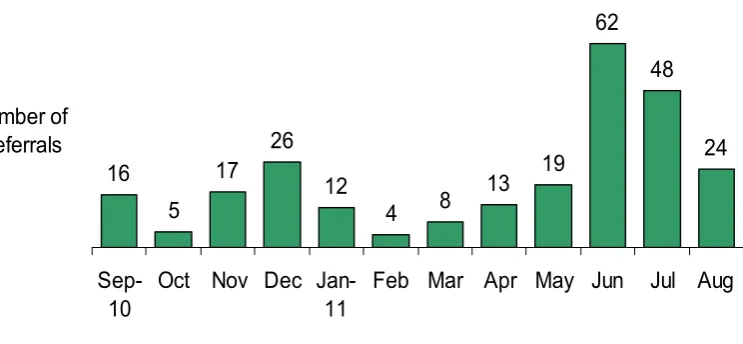
Although 2010/11 was a busy year for the Office of the Schools Adjudicator (OSA), we dealt with only 254 new cases, compared to 539 cases in 2009/10. We have, however again this year noted an increasing sophistication of
referrals, and a high involvement of lawyers supporting them. There has also been an increasing interest in cases by MPs, particularly those newly elected in May 2010. None of our determinations this year were challenged through judicial review.
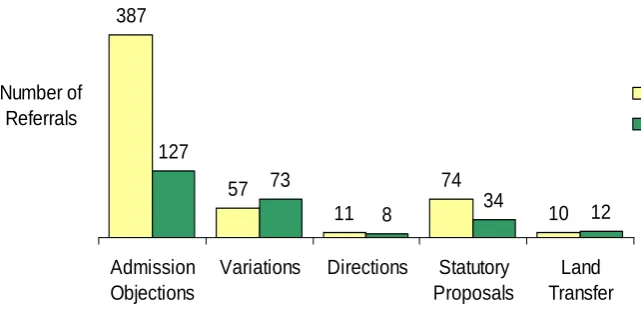
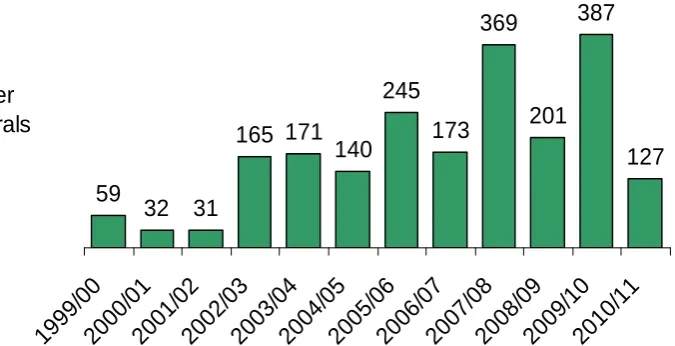
Most of the reduction in referrals related to Admissions where new cases dropped to 127 - one-third of last year’s level, and the lowest number since 2001/02. The majority of referrals (74%) were however still from parents. Since April 2011 we have provided advice on Academy admissions referrals to the Secretary of State via the Young People’s Learning Agency (YPLA), and we have welcomed the direct responsibilities outlined in the Education Bill for our greater involvement in Academy (and Free School) referrals in the future. We have again this year been concerned that many own admission authority (OAA) schools still do not regularly comply with the School Admissions Code by publishing their arrangements on their websites, and even when they do they are often not easily accessed, or are not signposted under obvious headings. Referrals for Variations were at an all time high and followed the same pattern as last year, with roughly two-thirds relating to changes in Published Admission Numbers (PANs) and one-third to other aspects of the arrangements.
Unforeseen pressures on primary school places due to increased primary cohorts, particularly in metropolitan areas, have generated the greatest number of referrals.
Statutory Proposals referred to us this year were, at 34, the lowest since 2004/05. We have no evidence why this should be the case, but it may reflect pressure on local authority (LA) budgets, and the state of the economy
generally. We have only dealt with three competitions for new schools this year, where the LA was one of the bidders, or had a major stake in the bid.
Referrals to us to determine appeals from admission authorities relating to Pupil Directions have, at eight, been at an all-time low which we (and local authorities (LAs)) link to the effective use of local Fair Access Protocols across all LAs.
positions, and the cases have been withdrawn without the need for a legally binding determination to be made.
This is the third year that the 152 LAs in England that have education responsibilities have been required to send Local Authority Reports on
admission arrangements in their areas to the Adjudicator – an arrangement that the Secretary of State has signalled will not be required in the future. Probably for this reason it was extremely difficult to get these reports from a large
minority of LAs by the due date, and even after two months following the due date six LAs had not delivered one, meaning that their data could not be included in this composite report.
The LA Reports suggest that admission arrangements across the country, even in a school system that every day is growing more diverse, are generally
working well to the benefit of parents and their children. Some concerns were however raised about LAs’ confidence in the compliance of admission appeals panels for OAA schools.
For a number of reasons, including the imminent publication of a new
Education Act, School Admissions Code and School Admission Appeals Code, the report ends with only three recommendations. They are:
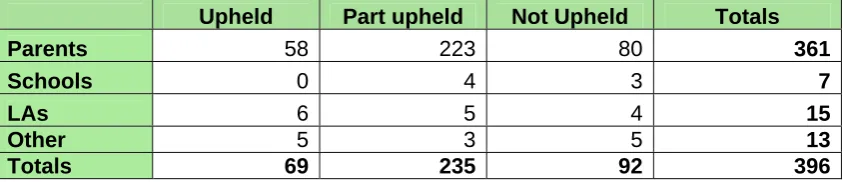
Recommendation 1 - In order to improve consistency, requests to vary the determined admission arrangements of Academies should be referred to the Adjudicator, as they already are with other schools.
Recommendation 2 - In order to reduce issues related to cross-border applications, a national offer date for primary admissions should be identified for future years.
Background
1. The Office of the Schools Adjudicator (OSA) was formed in 1999 as a consequence of the School Standards and Framework Act 1998. The Office has a remit across the whole of England.
2. Adjudicators resolve differences over the interpretation and application of legislation and guidance on admissions and the provision of school places. The five main functions of Schools Adjudicators are to:
determine objections to school admission arrangements;
decide on requests to vary determined admission arrangements;
resolve disputes relating to school organisation proposals (including the provision of new schools);
resolve disputes on the transfer and disposal of non playing field land and assets; and
determine appeals from admission authorities against the direction from a LA to admit a particular pupil.
3. The Chief Schools Adjudicator can also be asked by the Secretary of State for Education to undertake other relevant tasks as appropriate. 4. There are currently ten Schools Adjudicators, including the Chief
Adjudicator. Adjudicators are appointed for their knowledge of the school system and their ability to act impartially, independently and objectively. Their role is to look afresh at all cases referred to them and consider each case on its merits in the light of legislation, Statutory Guidance and the School Admissions Code (the Code). They evaluate and determine cases taking account of the reasons for disagreement at local level and the views of interested parties. In the case of school organisation proposals it is usual practice for adjudicators to hold public meetings, although there is no legal requirement for them to do so. For other cases adjudicators hold meetings if they consider it to be helpful to them as they investigate a case.
6. Adjudicators are supervised by the Administrative Justice and Tribunals Council. They adhere to a Code of Conduct and do not normally take cases in LA areas where they have worked in a substantial capacity in the recent past or where they currently live. Adjudicators will not act where they have previously worked closely with individuals involved in a case or for any other reason if they consider that their objectivity might be compromised.
7. The OSA is a tribunal, and all adjudicators work within tribunal legislation and procedures. Decisions, once published, cannot be challenged other than through the Courts.
Review of the 2010 Report
Recommendations
9. My 2010 Annual Report concluded with five recommendations which received an immediate response (2 November 2010) from the Secretary of State. In the ensuing year some of these have been addressed
through proposals in the Education Bill and the new draft School Admissions Code.
10. The recommendations and their progress to date are as follows: Recommendation 1 – There should be one consistent, independent route through which interested parties can object to the admission arrangements of all state schools for determination.
11. In my view this was the most important of last year’s recommendations, and I am pleased to say that the need for ‘a level playing field’ was acknowledged by the Secretary of State in his letter of 2 November 2010, and this has been followed by consistent action in both the Bill and the draft Code to bring referrals about non-compliance for all state
schools under the same legislation through the Schools Adjudicator. Recommendation 2 – The annual LA Report should have fewer prescribed headings, allowing for its focus to change year by year, to give a better national picture of the issues that are particularly pertinent at the time.
12. In his letter to me dated 2 November 2010 the Secretary of State agreed that LA reporting arrangements needed to be ‘slimmed down...whilst keeping the scrutiny and any remedy as local as possible’. This recommendation has subsequently been addressed in part by the proposal in the Education Bill (and comments by Ministers) that the format of LA Annual Reports in the future will be left to the discretion of LAs, and not prescribed. However, it would seem that the ability of the Secretary of State, the DfE or the Adjudicator to ask for a particular focus to be included in any particular year will be lost.
Recommendation 4 – There should be a requirement for LAs to confirm to the DfE, by mid May each year, that their arrangements and those of all the own admission authorities (OAAs) in their areas (including sixth form arrangements and supplementary information forms), are published on their website in accordance with the Code.
14. In his letter dated 2 November 2010 the Secretary of State agreed that although there was ‘a need for certainty for parents around admission arrangements’, it was also ‘important that we do not impose additional bureaucratic burdens by introducing requirements to inform Government that statutory requirements have been fulfilled’. This recommendation was therefore not accepted.
Recommendation 5 – The annual compliance exercise carried out by adjudicators should be discontinued and alternative arrangements put in place.
15. It was agreed that it was inappropriate for the OSA to carry out an annual compliance exercise, which has therefore not taken place this year and consequently not reported in this Annual Report. So far, alternative arrangements have not been put in place.
Current proposals in the Education Bill remove the requirement for Admission Forums to operate in local authority areas. As a requirement this recommendation is therefore redundant, but where Forums are retained through local agreement, it would be good practice for LA reports in the future to be discussed/reviewed by them.
Review of the year 2010/11
16. Once more the OSA and its Adjudicators have had a busy year. This year discussions about changes to legislation through the publication of a new Education Bill and its passage through Parliament, and the drafting of a new School Admissions Code and its subsequent
consultation process have provided a significant backdrop to our work. 17. As Chief Adjudicator I have continued, when appropriate, throughout
the year to meet with groups and organisations that share an interest in our work, and I have spoken on issues related to our work at a number of conferences.
18. I have continued to have regular meetings with Ministers, DfE and Young People’s Learning Agency (YPLA) officials. I have also met with them at other times when it seemed to any of us that it was
appropriate. I would like to thank all those who have given their time freely, sometimes at short notice, to attend these meetings.
19. Although, rightly, Adjudicators have not been part of the formal process of preparing the draft Code and Bill for publication (clearly the role of Department officials), many issues relevant to our role have been discussed with us and we believe that we have been listened to and possibly have managed to improve the form in which they are finally presented. I am particularly pleased that recommendations from my previous annual reports, for example those relating to Academy
admissions referrals and the treatment of twins and other multiple birth children, have been acted upon.
20. A highlight of the year for me was attending a special session of the House of Commons Select Committee on Education on 2 February 2011, solely to be questioned about my 2010 Annual Report. I found the questioning to be challenging and considered the process to be an important aspect of our democratic system.
21. Because of the uncertainty about future workload for the Adjudicator team due to an imminent Education Act and new Code we have not appointed any new adjudicators during the period covered by this report, nor have we lost any. The team is currently:
Dr Ian Craig (Chief Adjudicator)
Andrew Baxter
Canon Richard Lindley
Janet Mokades
Alan Parker
Carol Parsons
John Simpson
Dr Bryan Slater
Dr Stephen Venner
22. The qualifications and backgrounds of all adjudicators can be found on our website at www.schoolsadjudicator.gov.uk. We clearly display these on our website as one of the ways in which we ensure transparency.
23. Adjudicators (including the Chief Adjudicator) are part-time and are only paid for the time actually spent on cases and related work. Fee rates have remained the same since 2007, and all adjudicators work hard to keep travel and other costs down. The Select Committee was very interested in the average cost of cases. Using figures in the table in Appendix 2 it is easy to provide an average cost per case by dividing the OSA total budget by the number dealt with. This would however be misleading, as every case is different and requires a hugely variable amount of time spent on it. The Select Committee did however consider, as I do, that we provide very good value for money.
24. As part of keeping the cost of adjudications down, we have this year conducted and acted upon a business process review, and once more reduced the number of case managers and support staff based at our Darlington office. This has reduced this year to 4.6 full-time equivalent (fte), from 5.8 fte last year. Experience over the summer months has now led me to believe that this reduction has been too great, and there is a case for considering a slight increase for the coming year.
25. We do not employ full-time legal staff, but instead receive excellent ‘call-off’ support from members of the Treasury Solicitor’s department (TSols) who ensure that our determinations are legally sound. I cannot speak highly enough of these excellent colleagues.
Table 1 – Referrals by type 2009/10 and 2010/11
387
57
11
74
10 127
73
8 34 12
Admission Objections
Variations Directions Statutory Proposals
Land Transfer Number of
Referrals
2009/10 2010/11
Table 2 – Percentages of total referrals by type 2010/11
3%
5% 13%
29%
50%
Admission Objections - 50% (127)
Variations - 29% (73)
Directions - 3% (8)
Statutory Proposals - 13% (34)
Land Transfer - 5% (12)
27. The Select Committee was concerned that my report last year
highlighted that many of our referrals relate to faith schools and asked a number of questions about why that was so.
28. At the time of writing this report there are approximately 6000 separate admission authorities in England. Of these 152 are LAs (responsible between them for approximately 16,000 schools). There are 4246 Voluntary Aided schools which are their own admission authorities (most, but not all of which admit children using faith criteria), and 1416 other types of schools which are their own admission authority, for example Foundation schools and Academies. Although this last
Table 3 – Percentage of total referrals by type of admission authority
20%
22% 58%
Faith schools (VA) - 20% (50)
Other own admission authority schools - 22% (56)
LA's and LA (Community & VC) schools - 58% (148)
29. Pressure on the OSA (adjudicators and office staff) is mainly in the summer months, and this is particularly related to objections to admission arrangements (for which the closing date is currently 31 July). These often come in very late in the school year. This pressure arises at a time when schools are often closed and LA staff members are away on their summer holidays thus delaying many determinations until the beginning of the new school year. At the beginning of the year relating to this report (September 2010) there were 383 cases
outstanding and carried forward from the previous school year. This number was abnormally high due to several large and complex
multiple-referral cases that could not be completed until September, or later.
[image:13.595.116.488.556.728.2]30. The ‘carry-over’ of cases this year is fewer (60 cases) as, unlike last year, the majority of referrals were received earlier and many could be completed before the end of the school year. There were also fewer cases overall this year, so it was possible to make progress at an early stage with more of those that were received in July.
Table 4 – Spread of referrals month by month 2010/11
16 5
17 26 12
4 8 13
19 62
48
24
Sep-10 Oct Nov Dec Jan-11 Feb Mar Apr May Jun Jul Aug Number of
31. Objections to admission arrangements reduced significantly this year to 127 referrals (387 last year), the lowest number since 2001/02. Once more the majority were from parents (74%), although this is a major reduction from the 92% last year. However, I did caution last year that parents often submit multiple objections to the same set of admission arrangements, which last year certainly boosted the percentage attributed to them. Objections from schools have also reduced slightly, but those from LAs and ‘others’ have increased, but again only slightly.
Table 5 – Origins of Admission Referrals
74% 10%
11%
5%
Parents - 74% (94) Schools - 5% (6) LA's - 11% (14)
Other {Appeals Panels, Dioceses, Admission Forums, DfE, LGO, Ind. Schools & other} - 10% (13)
32. There are many views of why overall objections to admission
arrangements have reduced so dramatically this year. As I reported last year, arrangements have got better year on year due to the application of successively more rigorous Codes. The current Code has remained substantially the same for several years now and has therefore become better understood year on year, leading to a reduction in non-compliant arrangements.
33. We have this year noted a trend of more objections coming forward relating to the defining of catchment areas on the grounds of social equity, and more admission authorities moving away from catchment areas to using distance, measured usually by straight lines, as their main oversubscription criterion.
34. Over the last two years I have noted in my annual reports a trend towards the same or very similar objections coming forward for the same schools when arrangements or local circumstances had not changed since a previous adjudication. In line with the general reduction in admission referrals we have also noted a reduction in these types of objections this year.
35. I have also noted over the past two years, the increasing number of issues referred to us relating to aptitude testing. This has also reduced in significance this year, with only 2 cases (2% of the total) referred to us. I would like to think that commenting on this issue in these reports
over the past two years and the inclusion of specific questions about it in the LA Reports this year (see section 6) have raised its profile which has then subsequently been addressed by admission authorities. 36. In my Annual Report last year I also raised the issue of
non-compliance relating to sixth form admissions, usually not directly referred to us, but picked up by adjudicators when considering admission arrangements as a whole (for example in last year’s
Compliance exercise). This led to raising its profile by the inclusion of questions on sixth form admission arrangements in the LA reports this year (see section 6). During the year covered by this report we have only received one referral relating to sixth form admissions.
37. In the press, and at the Select Committee in February 2011, there was great interest expressed about objections to arrangements in faith schools. Of the 127 admissions cases this year, 23 (18%) related to faith schools.
38. Faith schools are permitted by the Code (para 2.46) to use faith-based oversubscription criteria in order to give higher priority in admissions to “children who are members of, or who practise, their faith or
denomination”. It is clear that the faith authorities are generally
providing clear and compliant advice, but there is evidence that some admission authorities are either still not consulting them, or ignoring advice when it is provided.
39. The Local Government Ombudsman has again this year referred some faith based oversubscription criteria to us with reference to their lack of clarity and transparency.
40. I have already welcomed the inclusion in the Education Bill and draft Code of the OSA taking on all admissions referrals directly for
Academies (and Free Schools) in the future. In preparation for this move, since April 2011 the Secretary of State (through the YPLA) has passed all such referrals, 21 up to 31 August (17% of our total
admissions cases for the year), to us and we have dealt with them in much the same way as we deal with all other referrals. The only difference being that instead of making a legally binding
‘determination’, we pass a recommendation to the YPLA for the Secretary of State. Although it is open to the Secretary of State to reject our recommendation, so far all have been accepted unamended. I would like to thank all those officers of the YPLA who have engaged closely with us to ensure that this process has worked.
improved over the past year, but still the majority of the referrals we have received, and upheld, were in the 96% of areas where the LA considered that all schools were compliant. If LAs are truly going to focus on being the champions of children and parents, then they really must put more effort into their ‘policing’ role.
42. Although adjudicators have not carried out a formal compliance exercise this year, in the course of considering each case an
adjudicator typically looks at the admission authority’s website to see their published arrangements. OAA schools regularly do not comply with the Code by publishing their arrangements on their websites, and even when they do they are often not easily accessed, or not
signposted under obvious headings.
43. Several points that I raised as issues in last year’s report relating to admissions have been addressed positively within the draft Code. I am particularly pleased that the Secretary of State has agreed to move the deadline by which admission objections can be received from 31 July to 30 June, and also that one of the recommendations first flagged by me in my report on admission arrangements for ‘twins and children from multiple births’ in August 2009, that such children should be treated as ‘excepted pupils’ with respect to infant class size regulations, has now been accepted.
[image:16.595.90.512.570.661.2]44. I have already mentioned that for a range of reasons, a large number of admissions adjudications that were begun before 31 August 2010 was completed during the period covered by this report. The number of determinations actually published during the year therefore far exceeds the number of referrals received during the year. During the period covered by this report, 396 admission objections were determined, and these determinations published. Of these 69 were fully upheld, 235 partially upheld and in 92 cases the objections were not upheld.
Table 6 – Admission decisions by origin of referral and whether upheld or not
Upheld Part upheld Not Upheld Totals
Parents 58 223 80 361
Schools 0 4 3 7
LAs 6 5 4 15
Other 5 3 5 13
Variations
Table 7 – Admission cases 1999-2011
59 32 31 165 171 140 245 173 369 201 387 127 1999 /00 2000 /01 2001 /02 2002 /03 2003 /04 2004 /05 2005 /06 2006 /07 2007 /08 2008 /09 2009 /10 2010 /11 Number of Referrals
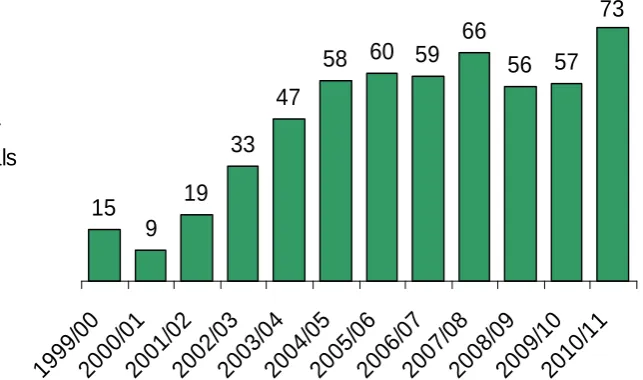
45. During the period covered by this report adjudicators dealt with 73 requests to vary admission arrangements, a little more than the 57 requests in 2009/10 and the highest number ever dealt with by the OSA.
46. Variation requests fall into two categories (i) to change the published admission number (PAN), and (ii) to vary other aspects of the
arrangements. The arrangements, including the PAN, must be set following consultation for a particular year, and a Variation can only be referred where the admission authority considers that there has been a major change of circumstances since the arrangements were
determined.
47. Of the 73 variation referrals received this year 49 (67%) related to changes to PAN and 24 (33%) to other aspects of the arrangements. This one-third/two-thirds ratio is similar to last year.
Table 8 – Breakdown of Variation Cases 2010/11
67%
33%
Changes to PAN - 67% (49)
Other changes to
arrangements - 33% (24)
increases in primary cohorts, particularly within metropolitan areas. As in previous years many of the referrals seemed to be foreseeable, and the best LAs had put plans in place through the normal consultation round in order to meet demand.
49. Earlier in this report I welcomed the proposed transfer of admission referrals for Academies to the Adjudicator. Currently there is no similar proposal for requests to vary determined admission arrangements for Academies to transfer. For consistency, this should happen. This point forms the basis for a recommendation at the end of this report.
[image:18.595.175.497.318.508.2]50. During the period covered by this report 75 Variation referrals were determined and published. Of these 66 were fully approved, one was approved with modifications, and eight were not approved.
Table 9 – Variation cases 1999-2011
15 9
19 33
47
58 60 59 66 56 57 73 199 9/00 2000 /01 2001 /02 2002 /03 2003 /04 2004 /05 2005 /06 2006 /07 2007 /08 2008 /09 2009 /10 2010/ 11 Number of Referrals
Statutory proposals
51. During 2010/11 the numbers of statutory proposals referred to the OSA returned to levels not seen since 2005/6, with 34 referrals (74 last year). The pressure on LA budgets which has reduced capital expenditure, the pressure on the capacity of LAs undergoing
restructuring, the promotion of Academies and the uncertain future of many schools in the Maintained sector are all assumed to have contributed to this reduction in proposals coming forward, and this is supported by comments from some LAs.
52. We have only dealt with three competitions for new schools this year, where the LA was a bidder, or had a major stake in a bid.
expected to be introduced in the Education Act, and planned new regulations. Until now, referrals to the OSA relating to statutory proposals have resulted from disputes over the opening, closing or alteration of maintained schools, usually arising as LAs discharge their duty to ensure that there are sufficient, but not too many, school places to meet the needs of their areas.
54. Changes to the responsibilities of LAs in the provision of school places, the conversion of many existing schools into Academies, and the presumption that most new schools will be Academies, suggest that large scale LA led reorganisations are less likely than in the past to take place, and most formal school organisation decisions will be taken by the Secretary of State as they will relate to Academies. Such
decisions, unlike those relating to LA maintained schools, are not referred to the OSA.
55. It is of course possible for the Secretary of State to use his power to seek Adjudicators’ advice in these circumstances, but it is not a requirement.
[image:19.595.168.494.430.630.2]56. During the period covered by this report 37 statutory proposals were determined and published. Of these 31 were fully approved, one was approved with modifications and five were rejected.
Table 10 – Statutory proposal cases 1999-2011
10
28 28 35 51 29 38 80 70 113 74 34 1999 /00 2000 /01 2001 /02 2002 /03 2003 /04 2004 /05 2005 /06 2006 /07 2007 /08 2008 /09 2009 /10 2010 /11 Number of Referrals
Pupil directions
This is therefore only the fourth year that this has been part of our work.
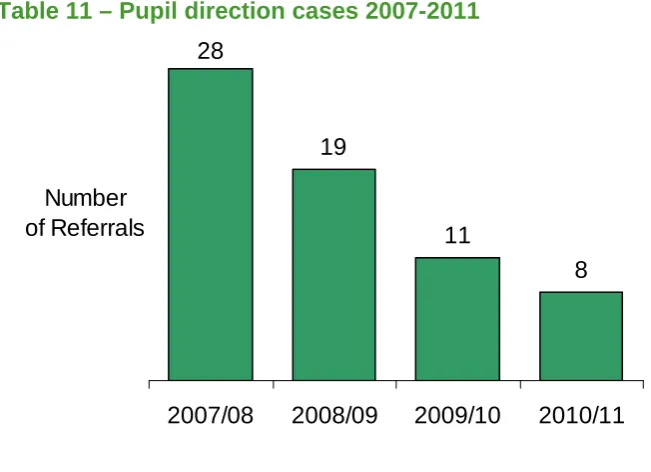
58. During the period covered by this report we have received eight referrals. This continues the year on year reduction from a total of 28 seen during the first year (2007/8). For the last two years my report has linked this continued reduction to the effective use of Fair Access Protocols (FAPs) across all LAs, and I have seen no evidence to support an alternative explanation. This is good news.
59. During the period covered by this report five pupil direction cases were determined and published. All five were upheld.
[image:20.595.117.443.378.614.2]60. In a number of cases adjudicators were unable to make determinations because the LA had not fulfilled the conditions in the legislation before making a referral to the OSA. Part of the explanation for these errors is that the rules governing directions are complex and do not always sit comfortably with procedures adopted under FAPs. Such cases are unfortunate as they lead to children being out of school for much longer than would otherwise be necessary.
Table 11 – Pupil direction cases 2007-2011
28
19
11
8
2007/08 2008/09 2009/10 2010/11 Number
of Referrals
Land transfers
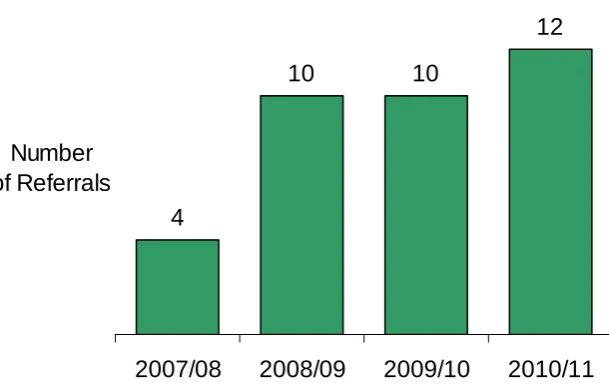
sources, which often takes weeks, sometimes months to collect. The number of cases referred to us has risen slightly this year to twelve due to more schools transferring out of the LA maintained sector, and the inability of the relevant parties to agree on the transfer of assets, or because one of the parties where transfers have not been completed in previous years is now seeking a decision.
62. It is the nature of these cases that by the time the Adjudicator becomes involved, relationships between the parties have often broken down completely, and lawyers are often involved by both/all sides. Once more this year on several occasions the Adjudicator has been able to persuade the parties to come to the table and reconsider their
positions, and the cases have been withdrawn without the need for a legally binding determination being made.
[image:21.595.134.439.362.557.2]63. During the period covered by this report four land transfer referrals were determined and published. A further two were withdrawn without the need for a determination to be made.
Table 12 – Land transfer cases 2007-11
4
10 10
12
2007/08 2008/09 2009/10 2010/11
Other issues
64. The percentage of time spent by adjudicators on different types of cases is very different to the percentage of total referrals shown in Table 2, and is accounted for mainly by the variable time demands of different types of cases.
Table 13 – Percentage of adjudicator time by case type 2010-11
13% 3%
24%
46%
15% Admission Objections - 46%
Variations - 13%
Directions - 3%
Statutory Proposals - 24%
Land Transfer - 15%
65. Concern is sometimes expressed about the perceived ‘lack of consistency’ in determinations. People looking from outside often perceive two cases as being very similar, but resulting in very different decisions. As adjudicators must consider all the evidence available to them before making a decision, and particularly focus on the local issues, what seem to be similar cases are often very different.
Adjudicators always take account of previous similar adjudications, but are not bound by them and must consider each case on its own merits and on its own set of circumstances.
66. Determinations by their nature will not be welcomed by all parties to a dispute. Cases usually only come to us after discussions have broken down locally and usually only one side in an argument will ‘win’. What we must maintain are equitable and fair determinations that can be accepted, if not welcomed, by all parties. Over the year we have only received one complaint about our handling of cases (6 last year). This complaint, which was about an omission made by our office, was thoroughly investigated and resulted in an apology being made to the complainant. The error did not affect the determination that was made. 67. We have again this year noted an increasing sophistication of referrals,
68. I am pleased that following my report last year, and its subsequent publicity, more parents this year have challenged admission authorities who have not published their arrangements on their websites in an appropriate and readily accessible form by 1 May for the relevant year. Admission authorities are required to publish their arrangements by 1 May each year and it is still a matter of concern that many do not do so. I welcome the greater scrutiny by parents of this issue.
69. We have had no judicial review proceedings issued this year, and as well as being a testament to the professionalism of adjudicators and the whole of the OSA team, it is in large part due to the excellent scrutiny and advice we have received from our solicitors (TSols). Judicial review proceedings, even if they result in decisions that favour adjudicators, have a significant cost both in terms of time, public
Local Authority Reports 2011
70. The School Standards and Framework Act 1998 (as amended by the Education and Skills Act 2008) and the School Admissions (Local Authority Reports and Admission Forums) (England) Regulations 2008 (the Regulations) require all LAs to make a report to the Schools Adjudicator about the admission arrangements of schools in their area by 30 June each year. The Regulations (and paragraph 4.9 of the Code) set out the matters that reports must cover. The contents of these
reports are collated to form an element of the Schools Adjudicator’s Annual Report to the Secretary of State, which includes how LAs say that fair access is being achieved locally.
71. In addition to the prescribed information the Secretary of State can ask the Schools Adjudicator to collect additional information to form part of his report. This year additional information was requested on Choice Advice, School Transport, Sixth Form Provision and Selection by Aptitude.
72. This is the third year that these reports have been required within these arrangements. However, the new Education Bill currently going through Parliament is proposing, in Clause 34, to amend the requirements so that in future, although LAs will still be required to produce an annual report, they will be expected to publish it on their websites, but will not be required to send copies to the Schools Adjudicator. It is therefore likely that this will be the last year that the Schools Adjudicator will be able to report on and make a judgement based on a comprehensive survey of LAs’ views across the country as a whole.
73. It is hoped that many LAs will anticipate this requirement by placing this year’s reports on their websites.
74. Although submission of the report by 30 June is currently a legal
requirement, only 88 (58%) LAs did so. Even after considerable chasing by the OSA only 137 (90%) provided their report by the end of July. After further chasing throughout August, 146 (96%) had delivered their report by the end of that month when this report was finalised. Six LAs (Bexley, East Riding of Yorkshire, Kirklees, Lambeth, Liverpool and Portsmouth) do not therefore have their data included in this report.
deliver their reports on time, I am concerned that without ‘policing’ in some way, the new requirement will not be met by all LAs.
76. Once more this year Admissions Managers were asked, if possible, to have the reports ‘signed off’ by their Director of Children’s Services (DCS) or equivalent in order (i) to ensure that only information and
comments approved at senior level were received by the OSA, and (ii) to raise the profile of the return at senior level in every LA. As there are now so many different titles being used for the person with ultimate responsibility for education/children’s services, it was sometimes difficult to decide whether or not the ‘DCS or equivalent’ had signed, but it would seem that this year 97 (66%) were signed off either by this officer, by the Chief Executive or responsible politician, and the remainder by a senior officer, usually at deputy/assistant director level. This was an equivalent percentage to last year.
Fair Access Protocols
77. Again this year the vast majority of LAs (141, 97%) confirmed that they had Fair Access Protocols (FAPs) in place with all schools (including Academies) taking part. This percentage is almost the same as that reported last year when 96% said that they were in place.
78. Of the four LAs that did not have them in place, two commented that it was inappropriate as they each only have one primary school, and two reported that their Protocols had not formally been ratified, one due to a single school still refusing to sign.
79. Although FAPs have been signed in the majority of LAs, and most LAs are positive about their outcomes, with comments again this year like ‘commitment is impressive’, and ‘the process has moved on positively during the past year’, there is still a large number of LAs where some schools are reported to be not cooperating fully with their
implementation, although the number of schools in each of these authorities is small.
80. Concern was expressed by several LAs that paragraph 3.32 of the Code had not been helpful as it allowed schools to ‘refuse’ to admit a child with challenging behaviour, and Academies to ‘refuse’ applications within their first two years of operation. The wording of the FAP paragraphs in the draft Code (at the time of writing this report) is more helpful as it removes the word ‘refuse’ in relation to challenging behaviour and also removes the Academies ‘exception’.
82. Ninety-nine (68%) LAs reported that all primary schools in their areas were maintaining infant class sizes at a maximum of 30, slightly more than last year (66%). Of the remainder, most had schools which were exceeding the class size ‘limit’ with ‘excepted’ pupils (paragraph 2.63 of the Code) or were taking ‘qualifying measures’ (paragraph 2.62 of the Code).
83. A limited number of LAs reported having schools with infant classes of more than 30 that did not fall within these categories.
84. Only two authorities reported having schools that had deliberately and knowingly taken more than 30 children into an infant class early in the school year that were not permitted exceptions, and without taking qualifying measures. In one case a school had taken a 31st child with the intention of employing an additional teacher, but due to recruitment difficulties this had not been possible and the class remained at 31. The LA states that this will however be rectified in the new school year. 85. In two authorities additional non-excepted pupils had been taken into
infant classes late in the school year hoping for a reduction in each case to 30 from the start of the new school year. If this does not happen then these LAs will ensure that qualifying measures are put in place.
86. In two more schools in two different LA areas, although children were initially in ‘compliant’ classes they have been moved mid year within the school due to behaviour or personality difficulties, and this has
unbalanced classes and left some above 30. These classes will be made compliant from the start of the new school year.
87. In three more schools in two LAs, additional pupils missing from
education remain on the class roll at the request of Education Welfare, theoretically taking classes beyond the 30 limit, but with only 30 ever attending.
88. In one further rural authority one school has breached the 30 ‘limit’ in order to keep siblings together. Although not a current ‘exception’ it is noted that this will be allowed by the new draft Code.
89. Where schools have been required to take additional pupils through the decisions of Appeals Panels considering infant class size appeals, for the third year running some LAs have complained about poor quality decision making by some panels and their general lack of awareness about the limited flexibility open to them in such cases.
90. Broadly it would seem that the infant class size requirements are being well met by schools and LAs.
91. In response to paragraph 4.9a(iv) of the Code, LAs were asked whether the independent appeal panels dealing with LA schools complied with the requirements of the Appeals Code. 139 (95%) confirmed that they did, a similar percentage to last year.
92. In the few LAs that said that they did not, inappropriate decisions that do no follow clerks’ guidance were cited by several (and the ensuing cost to the LA and/or school of that decision).
93. Another main issue raised was the difficulty of recruiting suitable Appeal Panel members. This had the consequence of panel members sitting for many years, as well as too few panels being constituted which led to appeals not being heard within the required timescales.
94. When asked the same question about panels operating on behalf of OAA schools, LAs’ responses were not as reassuring. Only 88 (60%) were confident that they were compliant. This is a reduction on last year (69%). As last year only four (3%) had clear evidence that they had panels operating in their area that were non-compliant, acting outside their permitted responsibilities.
95. A further 52 (36%) did not know, a rise from last year (28%). This is a worrying response. As more and more schools become their own
admission authorities, an increasing proportion of LAs consider that they lack the information needed to monitor compliance of ‘independent’ panels, and to carry out their responsibilities as champions of the pupils and parents within their communities.
96. Many LAs believe that if they are to act as the champions of local
children and parents then they should have the powers to monitor these panels, without of course compromising their independence.
Specific Groups
97. As last year all LAs were asked to comment on the extent to which
admission arrangements for schools in their areas served the interests of children in care, children with disabilities,children with special educational needs (SEN) and children from service families.
98. All LAs confirmed that arrangements in their areas were compliant with the Code.
Children in Care
99. Arrangements relating to children in the care of the home authority were generally good, and a number of LAs said that Looked After Children was a standing item on their Admission Forum agendas. Several LAs did however report problems relating to children placed in other authorities,
when ‘receiving’ schools sometimes did not accept the placement, and time was taken up liaising with the receiving LA, or when ‘home’
authorities did not send appropriate information, thus creating delays that disadvantaged the child.
Children with Disabilities
100. Generally it would seem that children with disabilities were not considered to be disadvantaged within admission arrangements, although one LA noted ‘covert dissuasion’ reported to them of at least one school suggesting to parents of a disabled child that the school would be inappropriate for their child due to an ‘inappropriate
curriculum’.
Children with SEN
101. Once more, a positive picture was given by most LAs which reported ‘robust’ procedures in place, many citing the continued positive use of Parent Partnership services. One LA reported an Academy delaying admission to a pupil where the Academy was named in the Statement, which, although ultimately dealt with satisfactorily, led to some
disadvantage to that student. The ‘covert dissuasion’ referred to in the previous paragraph was also reported relating to SEN.
Service Children
102. Applications on behalf of children of service personnel (and other crown servants) vary considerably across the country, with most LAs saying that they had received none, or only one or two applications during the previous year. However, one LA had over two thousand service
personnel and their families, from fifteen nations, relocate to its area during the period covered by this report, and expect a transfer of approximately seven hundred each year for the foreseeable future. Although the majority of these transfers are known and planned for well ahead of time, some are unexpected and mid-year.
103. Some LAs which regularly receive service children include them as a specific category within their FAPs, and most of this group have services liaison officers working closely with them to keep them updated. A
principal route for this liaison has been the Admission Forum which in future may not exist in most authorities. It is hoped that the close working relationships will however continue.
104. There was generous praise given by LAs for the work of services liaison personnel who did excellent work on behalf of service families.
106. One LA, a major recipient of service children, reported that many of its schools may have at any one time many service children seeking places, and giving priority of any sort to one child has implications for others. The proposal, as part of the Military Covenant, to make service children an exception to infant class size may prove to be difficult in some areas of high demand. Service children, particularly in garrison towns, do not always arrive singly!
Effectiveness of Coordination
107. LAs were asked to report on their assessment of the effectiveness of their scheme of coordination for admission of pupils in September 2011. 108. Most LAs considered that their coordination was effective, with both LA
and OAA schools. As last year, the most often mentioned issue was between LAs, usually due to incompatibility of IT systems, which has led to problems exchanging data, and sometimes led to multiple offers being made. Some LAs report that some OAA schools, particularly some Academies, have been reluctant to share data which has also led to problems meeting deadlines.
109. One LA identified a major issue with some schools about the use and content of Supplementary Information Forms.
110. Several, particularly large, LAs commented on the difficulty of in-year coordination, whereas most were positive about it, some making the point that it has been ‘very helpful’. At the time of writing the intention is signalled in the draft Code to abandon in-year coordination. If it is abandoned, several LAs made the point that there needs to be a mechanism enforcing the requirement placed on schools to inform LAs about vacancies and applications they receive to ensure that LAs remain in a position to signpost vacancies to parents, and to track pupil
movement.
111. The main comment drawn from this section of the LA reports is the need signalled by many authorities for a national offer date to be identified for primary school places rather than for it to be left to local agreement (which is impossible to coordinate across a number of local authorities, all of which will border others). This point forms the basis of a
recommendation at the end of this report.
Compliance
112. LAs were asked if the admission arrangements for all schools in their area (including Academies where they exist) complied with the
113. Of the six, two related to Academies that had subsequently been
challenged by LAs and had then, when no progress was made, referred the issues to the DfE and YPLA. The other four relate to Academies and other OAA schools that were still being challenged by the LA before further action took place.
114. This low number of reported incidents of non-compliance does not however accord with the number of arrangements referred to the OSA which are subsequently found to be non-compliant.
115. A view was expressed by a number of LAs that due to reductions in funding, the effort that has previously been expended by LA admission teams working with OAA schools before they agreed their arrangements to ensure that they were compliant may not be possible in the future. This could lead to more non-compliant arrangements being published, and therefore more potential challenges to the Adjudicator.
116. If a future function of the LA is principally to act as the champion of parents and children in its area, then it would seem that checking compliance and challenging where appropriate is a key activity.
Admission Forums
117. LAs were asked for the current details of membership of their Admission Forums. The majority operated with fewer members than the 20
permitted by regulation, but in some (particularly large) LAs they considered that more than twenty members were required. This need was generally served by having sub-Forums operating in parts of the area, but two (1%) this year reported that they exceeded the limit, but only marginally (4% reported doing so last year).
118. Only seven (5%) Forums said that they were submitting their own report to the Schools Adjudicator this year (9% last year).
119. Of the seven that confirmed that they were providing a report, only two were submitted with the LA report, and in time to be looked at as part of this reporting process. Both followed a standard format presenting data broken down at local level, which would be helpful for schools within the LA area. One of the Forums presented data relating to the ‘additional’ headings in last year’s LA report, i.e. Choice Advice and the cost of school uniform at each of the secondary schools in its area. Both ended with very helpful recommendations for the LA on improvements that could be made to the admissions process locally.
121. It is disappointing that so few Forums have decided to submit a report this year, which would suggest that following the proposal in the Education Bill to end the requirement to have Forums, they will not be missed by many. It seems to be a pity that at a time when the number of admission authorities is growing, this vehicle that has the potential to improve arrangements locally is not likely to survive in most LA areas.
Free School Meals
122. LAs were asked to comment on whether the proportions of free school meal (FSM) children had changed since last year, and whether there were any discernable disadvantages being shown to FSM children through the admissions system, particularly in terms of them achieving equal numbers of preferences to others.
123. Most LAs reported that there was no evidence to suggest that social factors, particularly those relating to either eligibility or take up of FSM, affected the success or otherwise of the application for school places. It was noted by many however that as LAs do not request (nor should they) FSM entitlement on their application forms, this information is not stored on the admissions database. It is therefore not a simple task to relate FSM to the success of parental preferences.
124. However, some LAs were able to undertake an analysis which was easier at secondary transfer than at entrance to primary school, as the appropriate data were already on file.
125. For the second year running many LAs recorded significant increases in FSM eligibility and take up during the previous year – in one authority up 25% - and this was generally attributed to the downturn in the economy. 126. A number of LAs also reported that as pressures on school places have increased due to the increased number of live births, more and more late applicants do not get their high preference schools. As many late
applications come from families that are likely to be entitled to FSM, this is working to the disadvantage of such children. LAs report that with the loss of their Choice Advice services, late applications from more
disadvantaged groups are likely to rise.
127. Several LAs noted that schools with the highest number of appeals tend to have the lowest numbers of FSM, and vice versa, and that schools with the lowest percentage of FSM tend to be those that are
oversubscribed.
Other matters affecting fairness
129. The majority of LAs were content with the fairness of admissions in their areas, and did not identify any particular issues. Some issues were raised by LAs that were of particular interest to them in their local contexts, but a number that had wider implications were mentioned by more than one LA. They were:
The high demand on places (particularly primary) in many areas, relating to an increase in live births, and the lack of investment able to be made by LAs in new buildings, was resulting in more parents being unable to obtain their preferences. One LA noted that this had led to several instances of siblings being split between several schools.
There are now national closing dates for both primary and secondary applications. As late applications are a significant issue which further disadvantage the already more disadvantaged groups in society, it would be helpful to have national publicity annually to alert parents of these dates. This point forms the basis of a recommendation later in this report.
A number of LAs also requested that the closing date for primary admissions should be earlier, as the current timescale puts the appeals process very late in the school year which is a problem for some, particularly large, LAs.
A number of LAs also repeated their request in this section of their reports for a national offer date for primary admissions, which would solve a large number of problems relating to, amongst other things, cross border applications. As mentioned earlier, this point also forms the basis of a recommendation at the end of this report.
Choice Advice
130. Last year additional questions were asked about Choice Advice, and this year the same questions were asked again in order to see whether there had been any change in the national picture reported last year.
131. The Code, Appendix 5(6) says that LAs ‘must provide an independent service’, which (paragraph 9) must be…free from any potential conflict
of interest between the need of the local authority to allocate places and the advice that parents receive’.
132. Seventeen (12%) LAs reported that they do not now have an
This is a considerable increase on the six (4%) that said they did not provide such a service last year.
133. The main reason given for this removal of an independent service in these LAs is the removal of the Area Based Grant that supported it previously.
134. Of the 129 (88%) that still provide an independent Choice Advice Service, 96 (74% of those offering an independent service, and 66% of all LAs responding) offer it at the primary admissions stage, against 113 (74%), of all LAs reporting it being offered at this stage last year.
135. Of the 129 (88%) that still provide an independent Choice Advice Service, 99 (77% of those offering an independent service, and 68% of all LAs responding) offer it to in-year applicants. This compares with 114 (75%) of all LAs offering support at this stage last year.
136. Of the 129 (88%) that still provide an independent Choice Advice
Service, 105 (81% of those offering an independent service, and 72% of all LAs responding) offer it at the appeals stage, compared with 137 (91%) of all LAs offering it last year.
137. As can be seen from the comparison of figures over the past two years, there has been a significant fall-off of support being offered by LAs since the reduction of the Area Based Grant announced on 26 June 2010. Many LAs think that this is an unfortunate reduction in an essential service that they are unable to fund from their otherwise stretched budgets.
Transport
138. Last year (2010) an additional question was also asked about Transport to establish whether LAs considered that they complied with paragraph 1.98 of the Code which says that ‘Admission authorities must explain clearly whether or not school transport will be available and, if so, to which school and at what cost (if any). Information about school travel and transport options available to parents must be set out in the composite prospectus’.
139. Nine LAs (6%) said that they did not currently comply fully with this requirement as although they all provided details of transport availability they could not provide costs due to the range and complexity. Each of these authorities provided website and telephone links to enable parents to get appropriate costs for their particular journey and therefore
140. In last year’s report (paragraph 37) concerns were raised about the ignorance of many admission authorities of the need to consult on, and separately determine, arrangements for entry to sixth forms. It was therefore decided that it would be helpful to ask an additional set of questions on this issue this year, amongst other reasons to raise its profile.
141. Almost all LAs had schools with sixth forms within their areas, one having 94 such schools. 13 (9%) said that they had sixth forms with admissions arrangements that they considered did not comply with regulations. In all of these, the LA was in discussion and/or taking
broader action, involving DfE, YPLA or OSA, with the school concerned.
Aptitude
142. For the second year running issues were raised in last year’s report about aptitude testing (paragraph 36). The Code does not generally allow testing for ability (other than in certain restricted cases). Testing for aptitude is allowed, but concern was expressed that there was often confusion as to whether some admission authorities were (usually inadvertently) devising tests of aptitude that really measured ability. It was therefore decided that this year some additional questions would be asked about this issue.
143. It has always been difficult for the OSA and other organisations to identify how widespread selection by aptitude is. Our sample recorded only 154 schools that select by aptitude, in only 52 (36%) of responding LAs. The other 94 (64%) LAs that responded reported that they had no schools that selected by aptitude. This would suggest approximately 160 schools that do so nationally.
144. Only 24 of the 52 (46%) LAs reporting schools in their area selecting by aptitude said that they checked their tests to ensure compliance with regulations. However, many of these LAs confirmed in their Reports that all schools were fully compliant ‘with the mandatory requirements of the Code and admissions law’.
145. It is hoped that all LAs, rather than just under half, will during the next year undertake a survey of admission arrangements in any schools that they have within their areas that admit using aptitude tests to ensure that they are confident that they achieve what they set out to do, rather than inadvertently select by ability.
Other issues
146. The Education Bill currently making its passage through Parliament proposes that LA Annual Reports do not in future come to the Schools Adjudicator for analysis, but are instead published on LA websites.
147. Although I understand Ministers’ reasoning for this, and I did suggest in my report last year (paragraph 140) that maybe the Schools Adjudicator was not the correct recipient of these reports, but I regret the apparent intention that a national summary will not be required. I believe that over the past three years, this exercise being carried out by the OSA
highlighting certain trends nationally, and drawing conclusions from them, has been useful in bringing about improvements to admission arrangements.
148. For example many LAs have reported this year that they, or their
Admission Forums, since last year’s Report highlighted a possible issue, have surveyed all schools in their area to assure themselves that school uniform is not being priced at a level to deter disadvantaged families from applying to certain schools.
149. In the absence in the future of Admission Forums in most LAs, I hope that LAs will not just restrict their Annual Reports to basic facts and figures about admissions, but that they take the opportunity, as the best LAs and Admission Forums have done previously, to explore wider issues relating to fair access, perhaps agreed by a number of LAs in an area. I hope, for example, that the highlighting of sixth form admissions and selection by aptitude will be followed up in many LAs next year. 150. I would like to thank LAs for compiling these reports over the past three
years and particularly thank those that have provided data and
Concluding comments
151. As this report shows, 2010/11 has been another busy year for the OSA. Although referrals have reduced from last year, the cases we have dealt with have been just as complex and varied as before. Consultations on a new Code and the proposed new Education Act, both of which will have major implications for adjudicators, have provided a significant backdrop to a year in which the number of admission authorities has increased rapidly, with many more people now involved in setting admission arrangements for the first time.
152. Our work has been reduced this year by the removal of the requirement for a national Admissions Compliance Exercise to be carried out by adjudicators during the summer months. This has also removed the data for a ‘Compliance’ section in this report. If the proposals in the Education Bill are carried forward there will be no requirement for LA reports to be sent to the Adjudicator next year, which will further reduce workload as they will not need to be analysed. This will in turn potentially further reduce the size and scope of next year’s Chief Adjudicator’s report. 153. This report, as usual, identifies practices and processes that can be
improved. That is its major function. However, this should not mask the very positive messages that the report also contains. The vast majority of schools and local authorities are working hard to ensure that school places are provided at the right time, in the right place and fairly.
154. As I have noted throughout this report, both I, and the adjudicator team, have had the chance to comment on points proposed, and then
published, within the draft Code and the Education Bill. Some of the points we made have certainly been reflected upon by Ministers and officials. I consider that it is inappropriate in this report to repeat any recommendations that have been made during this process and not adopted. The recommendations in this report are therefore limited this year to those that have not formed part of these discussions. I am sure that when the Education Bill is enacted and the new Code adopted, that there will be plenty of evidence coming forward to form the basis of recommendations for the new Chief Adjudicator to put into her report next year.
155. Allen, Coldron and West (2010)* concluded that successive Codes since 2001, and the work of the OSA, have had positive effects on social integration in schools. I believe this. However, cases have continued to be referred where the admission authority has not made its
arrangements compliant with the Code and it has taken a referral to the Adjudicator to achieve compliant arrangements. I believe that there is a
continuing need for both a strong Code and firm, but fair adjudication to support it. The work we do is essential to ensure the fairness of access to school places, and I believe that over the past twelve years, since its formation, the OSA has helped to improve fairness significantly for children and their parents.
156. The expertise shown by adjudicators, by our office staff in Darlington, and by our solicitors, has continued to impress me. It is important that the service we provide retains its credibility by remaining as a tribunal, and independent of the DfE. Clear referral routes for parents and others remain essential.
157. We have been very conscious of costs again this year. All adjudicators are part-time, and are paid for the time that they spend working on casework and related activities – they are not paid a ‘retainer’. Because our support staff in Darlington are also few (probably now too few!), we are very cost effective, and I am pleased that this was recognised by the Education Select Committee in February this year.
Recommendations
159. Since my last report in November 2010 Ministers have undertaken, through the DfE, a major review of legislation and guidance, leading to consultations on changes to admissions and school place provision, the outcomes of which, through a new Education Act and new School Admissions Codes, will have major implications for the work of adjudicators over at least the next few years.
160. The adjudicator team and I have been given the opportunity to comment on these proposals both before and during the formal consultation phase, direct to senior DfE officials and to Ministers, and my recommendations from my past two Annual Reports have been
considered as part of these discussions. I am pleased to say that many of the comments made have been taken on board.
161. Both the Act and the Code will be enacted during the 2011/2012 school year and adjudicators will have to use them to guide their
determinations. Without evidence we cannot speculate on what
additional changes may be needed following the new framework. It will be for my successor (and the Department) to examine the early
evidence from the new processes and practices during 2011/12, and make recommendations as appropriate in the future.
162. This report therefore has only three recommendations:
163. Recommendation 1 - In order to improve consistency, requests to vary the determined admission arrangements of Academies should be
referred to the Adjudicator, as they already are with other schools
164. Recommendation 2 - In order to reduce issues related to cross-border applications, a national offer date for primary admissions should be identified for future years (paragraphs 111 and 129).
165. Recommendation 3 - As there are now set closing dates for both primary and secondary applications for school places, and late
applications are a significant issue, particularly with regard to the most disadvantaged groups in society, there should be national publicity annually to alert parents to these dates (paragraph 129).
Appendix 1 - Case details
2010/11 and 2009/10
Objection to admission arrangements 2010/11 2009/10
Total cases dealt with 486* 520**
Decisions issued: upheld 69 45
Decisions issued: part upheld 235 27
Decisions issued: not upheld 92 79
Decisions outstanding 47 359
Out of Jurisdiction 42 5
Withdrawn 1 4
Not properly made 0 1
* 127 new referrals and 359 decisions outstanding from 2009/10 ** 387 new referrals and 133 decisions outstanding from 2008/09
Variation to admission arrangements 2010/11 2009/10
Total cases dealt with 85* 80**
Decisions issued: approved 66 41
Decisions issued: part approved/modified 1 3
Decisions issued: rejected 8 15
Decisions outstanding 4 12
Out of Jurisdiction 2 1
Withdrawn 4 8
* 73 new referrals and 12 decisions outstanding from 2009/10 ** 57 new referrals and 23 decisions outstanding from 2008/09
Pupil Directions 2010/11 2009/10
Total cases dealt with 11* 11**
Decisions issued: upheld 5 2
Decisions issued: not upheld 0 3
Decisions outstanding 1 3
Out of Jurisdiction 3 0
Withdrawn 2 3
Statutory Proposal 2010/11 2009/10
Total cases dealt with 43* 89**
Decisions issued: approved 31 64
Decisions issued: part approved/modified 1 2
Decisions issued: rejected 5 7
Decisions outstanding 2 9
Withdrawn 4 6
Out of Jurisdiction 0 1
* 34 new referrals and 9 decisions outstanding from 2009/10 ** 74 new referrals and 15 decisions outstanding from 2008/09
Land Transfer 2010/11 2009/10
Total cases dealt with 12* 14**
Decisions issued 4 5
Decisions outstanding 6 0
Out of Jurisdiction 0 1
Withdrawn 2 8
Appendix 2 - OSA Expenditure
2010-11 and 2009-10
1
Category of Expenditure 2010-11 £000
2009-10 £000
Adjudicators' fees 304 401
Adjudicators' expenses 21 27
Adjudicator training/meetings 5 10
Office Staff salaries 179 206
Office Staff expenses 3 5
Legal fees 97 177
Publicity2 38 79
Consultancy fees 0 0
Administration/consumables 8 15
Total 655 920
28%
15% 6% 1%
50%
Adjudicators - 50% (£330k)
Office - 28% (£182K)
Legal & Consultancy - 15% (£97k)
Publicity - 6% (£38k)
Admin/consumables - 1% (£8k)
Notes:
1. This financial information relates to the two last full financial years 2009-10 and 2010-11. This overlaps with the period of this report but does not totally
coincide with it.