What type of future workforce will
the UK need?
By
Professor Rob Wilson & Terence Hogarth
Warwick Institute for Employment Research
October 2013
Contents
Executive summary ...4
1. Introduction...6
1.1 The importance of manufacturing...6
1.2 Manufacturing in the UK...7
1.3 Is UK manufacturing different from its international competitors?...9
1.4 Aims of the study...10
1.5 Structure of report ...11
2. A quantitative assessment of skills demand over the medium-term ...12
2.1 Introduction...12
2.2 Drivers of skill demand ...12
2.3 Working futures projections of employment demand ...14
2.4 Working futures projections of skill demand...18
2.5 A more disaggregated view of skill change ...21
2.6 International comparisons ...22
2.7 Conclusion...23
3. Emerging skill needs over the longer term ...27
3.1 Introduction...27
3.2 Product market strategies, the product lifecycle and skills...27
3.2 Emerging skill needs and occupational profiles ...29
3.4 Emerging skill needs within advanced manufacturing sub-sectors ...33
3.5 Conclusion...36
4. Meeting skill demand ...37
4.1 Introduction...37
4.2 Initial vocational education and training: apprenticeships ...37
4.3 Initial vocational education and training: higher education...39
4.4 The employment destination of students and apprentices ...41
4.5 Continuing vocational education and training...43
4.6 Migration as a source of skills supply...44
Executive summary
The current and future importance of manufacturing
Manufacturing employs around 2.6m people which accounts for approximately 10 per cent of the UK workforce. But this underestimates the true importance of the industry with many jobs in other sectors being dependent upon the supply of goods and services to manufacturing. This is will continue to be the case in to the future.
The UK has longstanding strengths in several advanced manufacturing sectors such as pharmaceuticals and aerospace. And the process of technical change – linked to
developments in, for example, nanotechnology, new materials, and biotechnology - provides the UK with the opportunity to further enhance its advanced manufacturing base. But for this to be realised the skills supply will need to keep pace with skill demand. Increasingly it will be the quality of their respective workforces upon which advanced economies will compete with one another.
The scale of future skill demand
Future skill demand will be dependent upon a number of factors including: technical change; regulation, the ongoing process of globalisation; demographic change, and the strategic choices made by multinational companies relating to where they decide to locate different parts of the manufacturing process (such as R&D, design, manufacture and assembly).
By incorporating, as far as possible, these types of skill drivers within forecasting models, projections of future skill demand suggest the following:
a continuing decline in the overall number of people employed over the medium-term as a consequence of productivity gains. By 2020 there will be 170,000 fewer people employed in the UK’s manufacturing industry;
reflecting the fact that manufacturing will be increasingly concentrated in advanced manufacturing activities, the share of overall employment accounted for by managers, professionals, and associate professional employees will increase;
because the workforce of the industry is relatively aged, there will be a large number of people retiring from workforce over the medium-term. This will result in nearly 800,000 jobs needing to be filled by 2020 many of which will be in skilled trades jobs. Even though overall employment levels are falling, the scale of expected retirement will result in many job openings.
The projected pattern of skill change projected to take place in the UK over the medium-term is one which will be observed across many other European countries with a
More detailed insights into future skill demand
The industry will need to be able to attract people who are at the cutting-edge of
technological developments germane to manufacturing. These skills may be required in small volume but are of critical importance to the future development of the industry. The relative scarcity of these skills often results in employers searching for them in
international labour markets rather than national ones. More generally, future skill demand will be:
in activities increasingly concentrated in high-skill activities such as R&D, design for manufacture, production of prototypes, and low-volume manufacture of complex / high value products;
for people employed in managerial and professional occupations who are capable of managing the R&D process and bringing new products to market. They will also be expected to have the capability to work in networks of organisations which are likely to be spread across several countries;
for people working in associate professional and skilled trades jobs. The role of the technician – which straddles the associate professional and skilled trade occupational groups - has been highlighted as one which may well become increasingly important in the workplace. This reflects the changing nature of production processes and employer preferences for people who have undertaken their initial vocational preparation within the workplace.
Where people are required in the above occupational roles they will be, in many instances, qualified in Science, Technology, Engineering and Mathematical (STEM) disciplines.
The future supply of skills
Given the pace of technical change in manufacturing there is the risk that the supply of skills is always trying to catch up with emerging demand. That said there is a well developed training infrastructure in place at both further education (FE) and higher
education (HE) levels capable of producing the skills – especially STEM skills – which the industry will increasingly need in the future. But two issues will need to be tackled:
the relatively small share of those graduating from HE in STEM subjects who enter the manufacturing sector;
the relatively small share of employers providing the Apprenticeships which will produce the next generation of technicians.
1. Introduction
1.1 The importance of manufacturing
Any history of employment in the UK labour market over the latter part of the 20th century will emphasise the increasing dominance of the service sector as a source of
employment (Lindley, 1981). It will also draw attention to the decline in manufacturing employment with reference to either the total number of people it employs or its percentage of overall employment. But any such history would be wrong to infer the demise of the manufacturing sector as a source of either employment or economic growth. There are at least three principal reasons for this.
1. Manufacturing provides important inputs to other sectors of the economy because it satisfies a range of final and intermediate demands. The OECD illustrates this by examining the share of manufacturing in overall total demand (intermediate and final demand). Data from the mid-1990s for the UK suggest that this was around 35 per cent which is much higher than indicators such as employment or value-added would suggest (OECD, 2006).
2. Manufacturing is a source of productivity growth, driven by investments and new technologies in products and processes, which drives overall economic growth (c.f. Baumol and Bowen, 1966).1
3. The UK has a strong global position in high technology manufacturing sectors
(OECD, 2006). These are sectors which are characterised by relatively high levels of investment in research and development (R&D), have considerable growth potential, and are export orientated.
Public policy has increasingly focussed on how the manufacturing sector, especially the more capital and knowledge intensive parts, can be supported in order to boost economic growth (HM Treasury / BIS, 2010). There are resonances with the past here. Writing in the 1970s Bacon and Eltis (1975, 1976) suggested, somewhat contentiously, that the UK’s relatively weak economic performance and the decline of the manufacturing industry stemmed from the expansion of the public sector. Whilst the precise mechanisms through which the expansion of the public sector might have affected economic performance in the 1960s and 1970s are likely to be different from those nowadays – there are, for example, no nationalised industries today – there are similarities between the exposition of Bacon and Eltis and current policy. This is seen with reference to the aim of rebalancing the economy by reducing its reliance upon public sector investment and encouraging private sector activity, across a range of key sectors, including manufacturing (HM Treasury / BIS, 2010).
Another resonance with the past is the importance given to the role of vocational preparation in bringing about relatively good economic performance. It is apparent that Government has sought over many decades to reform the vocational education and training (VET) system to ensure that it responds more readily to employer skill demand
1
(both current and expected future demand). For instance, the Leitch Review in 2006 - which provided the justification for the present organisation of the VET system in the UK - was just the latest in a series of reviews dating back to the Royal Commission on
Technical Instruction in 1881. The importance, however, of being able to meet the manufacturing industry’s skill needs should not be underestimated. It is apparent that large parts of the manufacturing sector are dependent upon highly skilled people qualified at higher and intermediate levels in science, technology, engineering and
mathematics (STEM) subjects. Increasingly the future of the sector is seen to rest upon a number of mutually reinforcing factors: highly qualified and skilled employees are
required to support relatively high levels of investment in R&D which, in turn, are needed to design the new products and processes capable of capturing a significant share of the high-value added segment of the global market which will generate the funds for further investments in capital and labour (Davis, et al., 2012). Clearly, skills are central to the manufacturing industry’s future success.
1.2 Manufacturing in the UK
As a single sector the industry accounts for around 12 per cent of total output and 10 per cent of employment (2010). Only the financial services sector produces a larger share of output and employment (SEMTA, 2012). Over the ten years between 2000 and 2010 output volumes have not kept pace with those in the economy as a whole and
employment has declined by nearly one and a half million. But these data refer to the manufacturing sector as a whole which encompasses a wide range of economic activities.
Table 1.1: Output and Employment in Manufacturing, 2000 - 2010
2010 level
Growth rate: 2000-2010 (% p.a.)
Changes (absolute)
Output (£2006m) 130,435 -1.2 -17,459
-
Employment 2,638,037 -4.3 1,448,350
Part time
employment 196,518 -4.3 -108,560
Full time
employment 2,239,433 -4.5 1,294,141
Self employment 202,086 -2.0 -45,649
In many respects discussion of the manufacturing sector as a whole can be misleading especially so when the focus of the discussion is upon skills. A cursory glance at the major groups which comprise the manufacturing sector in the Standard Industrial Classification (2007) reveals the mix of high and low-value added activities: 10 Manufacture of food products
11 Manufacture of beverages
12 Manufacture of tobacco products 13 Manufacture of textiles
14 Manufacture of wearing apparel
15 Manufacture of leather and related products
16 Manufacture of wood and of products of wood and cork, except furniture 17 Manufacture of paper and paper products
18 Printing and reproduction of recorded media
19 Manufacture of coke and refined petroleum products 20 Manufacture of chemicals and chemical products
21 Manufacture of basic pharmaceutical products and pharmaceutical preparations 22 Manufacture of rubber and plastic products
23 Manufacture of other non-metallic mineral products 24 Manufacture of basic metals
25 Manufacture of fabricated metal products, except machinery and equipment 26 Manufacture of computer, electronic and optical products
27 Manufacture of electrical equipment
28 Manufacture of machinery and equipment not elsewhere classified 29 Manufacture of motor vehicles, trailers and semi-trailers
30 Manufacture of other transport equipment 31 Manufacture of furniture
32 Other manufacturing
Several of the sectors listed above are relatively low value-added ones - such as food and drink manufacture, manufacture of wood products, etc. Mason (2005, 2011) points out that enterprises with low value-added strategies tend to more reliant upon local and regional markets, are not subject to export competition, and make relatively modest investments in the skills of their workforces. In contrast, enterprises which pursue high value product market strategies are more likely to consider their current and future skill needs and engage in updating the skills of their existing employees.
In looking at how the economy might be rebalanced BIS makes references to the
advanced manufacturing sector (HM Treasury / BIS, 2010) which is classifies as that part of the manufacturing sector which is characterised by:
intensive use of capital and knowledge;
long term investment decisions to develop processes and buy equipment (that can take more than a year to manufacture);
high levels of technology utilisation and R&D and intangible investments (training, improvements to business process) to support innovation;
a flexible workforce with strong specialist skills in the areas of science, technology, engineering and mathematics and design;
In many respects the concepts of high value product strategies and advanced manufacturing are synonymous and both concepts emphasize the role of skills development. Davis et al. (2002) also draw attention to the fact these are dynamic concepts. Being a high value producer or advanced manufacturer requires on-going investments in product design and production processes alongside investments in skills in order sustain that denomination because, eventually, nearly all products are subject to becoming low-value added ones because they become outdated or become mass
market commodities.
At the time of writing the UK’s strengths in advanced manufacturing include:2 Aerospace;
Plastic / silicon electronics; Bio-medical / pharmaceuticals; Composites / new materials; Nanotechnology.
It is also evident that the country’s automotive industry is also performing well especially so in export markets.
1.3 Is UK manufacturing different from its international
competitors?
In the 1970s, Kaldor suggested that UK’s economic development was more advanced than those of other countries and the decline of manufacturing was something which other countries would eventually experience too (Kaldor, 1975). Why employment levels should fall in industries such as manufacturing, other things being equal, was outlined by Baumol and Bowen (1966). Potentially employers in the manufacturing sector have more scope to increase labour productivity by substituting labour with machinery and by
outsourcing various activities including low-value elements of the production process. Parts of the service sector, such as the education and the arts, cannot achieve these types of productivity gain or at least not to the same extent (for example, an orchestra cannot increase its productivity by playing faster or by, for instance, outsourcing the string section to a lower-cost ensemble). But these sectors are in competition, with the ones realising productivity gains, for labour (and skills) and, accordingly, pay wages at least equal to them.3 Manufacturing is able to offset the potential for wage-push inflation by continually raising its productivity levels (and, consequently, reducing the size of its workforce). As will be described later this also has important consequences for the manufacturing sector’s skill needs.
Figure 1.1: Employment in manufacturing as a share of total employment
Source: OECD
Like many other countries in the western world, the UK has developed its niches in advanced manufacturing.
1.4 Aims of the study
If the education and training market is to respond to the needs of the industry it is desirable to have an indication of the scale and nature of future skill needs. This is the purpose of this short paper is as follows:
What is the current skills mix of the UK’s manufacturing workforce (including qualifications (academic and vocational), apprenticeships, and graduates)?
What are the recent employment trends in manufacturing, together with medium-term employment projections, and what do they suggest to us about what the UK’s future manufacturing workforce will look like (in 2020, and as far as possible thereafter, at intervals to 2050) the future?
How is the supply of skills developing and how well placed is it to supply the skills required by manufacturing in the future?
The study will provide medium-term estimates to 2020 but will also consider possible longer-term issues up to 2050.
1.5 Structure of report
2. A quantitative assessment of skills
demand over the medium-term
2.1 Introduction
This chapter looks at changes in the demand for skills over the recent past and the implications of these changes for the future of employment in the manufacturing industry. It draws upon quantitative projections of likely skill demand before, in the next chapter, considering some of the longer-term trends to 2050 based on wider range of evidence about how the industry is likely to develop.
This chapter is based on the projections of skill demand derived from Working Futures for the UK (see Wilson et al., 2012), and Cedefop’s pan European projections which give an indication of skill demand across Member States of the EU (see Wilson et al., 2010). Both the Working Futures and Cedefop projections of skill demand use occupation as a proxy measure of skill. Skill is a multifaceted concept and occupation provides an imperfect measure (Green, 2012), but occupation is one of the few indicators of skill available on a consistent basis over time. Accordingly, the projections of skill demand presented below provide an all important context for the analysis in the following chapters which address the demand for, and supply of, skills in more detail.
2.2 Drivers of skill demand
The demand for skills in the manufacturing industry in the UK will be shaped by changes which will affect:
the structure of the industry (that is, the type of goods which are produced and assembled);
the way the products are produced (including both the use of process technologies and the organisation of work around the use of those technologies).
Both of the above will determine the content of jobs and thereby the skills the industry needs. A number of factors can be identified which are likely to drive change in products and processes and consequently skill demand, including:
technical change;
competition and globalisation; environmental change; regulation;
consumer demand;
firms’ product market strategies and strategic choices; demographic change;
skills supply.
intensive. In a global economy which has seen many trade barriers lowered if not
removed, firms have an increased degree of choice regarding the location of production. With the development of ICT technologies it makes it increasingly possible for a producer to control a system which has design and final assembly located in country x, whilst having the components and sub-assemblies produced in countries a, b, and c. Where companies decide to locate various elements of the production process – such as, research and development, product design, assembly, sales and marketing – is likely to be determined by a range of factors relating to the regulatory environment. It is this environment which will affect production costs (such as labour costs and environmental regulations) but there is also evidence that companies are also sensitive to the issue of maintaining their intellectual property which is better protected in some parts of the world than others. Employers will also choose where to locate different elements of the
production process as a result of corporate strategic choice. Where a company is looking to develop its products in a given market it is likely that they will locate at least some of the more high value-added elements of the production process in that country as a sign of a willingness to do business with that country (Hogarth et al., 2010).
Skills supply will also affect which goods are produced where, and the nature of production systems. A shortage of skilled labour is potentially a major constraint on a firm’s productive capacity. This is particularly important in a sector such as manufacturing where a large part of the workforce is relatively aged and likely to retire over the medium-term. It is also apparent that the nature of skills supply – such as the balance between intermediate and higher level skills supply – will affect how employers choose to organise work on the production line. In the USA the relatively large supply of graduate engineers – alongside other factors too – has allowed employers there to develop production processes which rely more upon first line managers (that is, quasi-professional roles) who supervise assembly workers (typically semi-skilled workers) working on automated production processes (Mason and Finegold, 1999). In contrast those parts of Europe which have a stronger supply of skilled trade workers stemming from their strong apprenticeship programmes tend to rely more upon skilled trade workers in the production process. This, it has been suggested, has given them a better base upon which to develop small-scale batch production of relatively complex, high value-added goods.
The strategic choices made by manufacturing employers regarding the organisation of work can be divided into two following broad categories:
1. The decisions of multinational organisations about where they locate certain
manufacturing industry engaged in the mass production of relatively low cost goods being transferred to low labour cost countries. No matter what productivity gains could be realised within the UK they were nowhere near sufficient to offset the labour cost
advantage which countries such as China possessed. At the same time there is evidence that the country has increasingly specialised in: (a) the high value added elements of the production process such as research, development, and design; and (b) high value, high skill sub-sectors (such as pharmaceuticals, plastics, and aerospace). In other words, it has specialised in those elements of the manufacturing process which can afford to pay the wages which the industry needs to pay in order to attract employees – often highly skilled ones – who would otherwise be attracted to work elsewhere.
In summary, the drivers of change are likely, others things being equal, to increasingly push manufacturing towards the production of relatively high value goods which are produced by an increasingly skill intensive workforce. Parts of the industry are likely to remain engaged in either relatively low value goods (for example, food manufacturing) or medium value-added goods (for instance, motor vehicles) either because production needs to be close to the point of consumption or because firms see strategic advantage in being located in one of their main markets or in a particular country. But the general trend is towards activities being concentrated in those which generate relatively high value-added or, have the capacity to become so where the activity is a new one resulting from the innovation process. This creates a substantial demand for highly skilled labour often qualified in STEM subjects.
2.3 Working futures projections of employment demand
It should be stated at the outset that the Working Futures projections are based on a relatively optimistic outlook for the UK economy over the medium-term. But it needs to borne in mind that as medium-term projections they reflect long-term historical trends in both the national and global economies such that shorter-term fluctuations from the longer-term trend are expected to balance out. The projections assume that GVA grows at around 2 per cent a year over the period 2010 to 2015 with this growth supported by relatively strong output growth in manufacturing over the period as a result of policies designed to rebalance the economy. Growth is expected to be slower over the period 2015 to 2020 which suggests that the rebalancing observed over the period 2010 to 2015 will be reversed. Given the performance of the UK economy over recent years it would now appear more likely that manufacturing output growth will be weaker over the 2010 - 2015 period and stronger over the 2015 - 2020 one. From a medium-term perspective, the outcomes for employment and skill demand will be more or less the same.
It is apparent that the Working Futures projections of employment are dependent upon a renaissance in the UK’s manufacturing sector. This is not reflected in employment levels which are expected to continue to fall in line with their long-term trend. But the sector will continue to make a major contribution to GDP both directly through the value of its
output, and indirectly, given that the sector is a major consumer of products and services from other industries, especially business services. Figure 2.1 shows the long-term trend in output and employment in the UK’s manufacturing industry and Figure 2.2 the trend in manufacturing employment compared with overall employment.
data in large part because of a projected pick up in output over the period to 2030. Should this not materialise then it is likely that employment will fall more quickly. The cyclical nature of employment in manufacturing has implications for skill demand. Blake et al. (2000) in their analysis of skill shortages over the 1960s and 1970s revealed that redundancies during recession resulted in employers losing skilled personnel which they then struggled to recruit during the recovery phase. This occurred in part because employees were unwilling to return to an employer or industry in which they had lost their jobs – especially so when job opportunities were emerging in the service sector – and due to the signal it sent to would-be apprentices and trainees about long-term job
Figure 2.1: Output and Employment in Manufacturing: historical and projected trends 1970 to 2030
0 1000 2000 3000 4000 5000 6000 7000 8000 9000
0 20000 40000 60000 80000 100000 120000 140000 160000 180000 200000
1971 1972 1973 1974 1975 1976 1977 1978 1979 1980 1981 1982 1983 1984 1985 1986 1987 1988 1989 1990 1991 1992 1993 1994 1995 1996 1997 1998 1999 2000 2001 2002 2003 2004 2005 2006 2007 2008 2009 2010 2011 2012 2013 2014 2015 2016 2017 2018 2019 2020 2021 2022 2023 2024 2025 2026 2027 2028 2029 2030
E
m
p
lo
ym
en
t (
0
00s)
G
V
A
(
2006
m
)
GVA
Employment
0 1000 2000 3000 4000 5000 6000 7000 8000 9000 0 5000 10000 15000 20000 25000 30000 35000 40000
1971 1972 1973 1974 1975 1976 1977 1978 1979 1980 1981 1982 1983 1984 1985 1986 1987 1988 1989 1990 1991 1992 1993 1994 1995 1996 1997 1998 1999 2000 2001 2002 2003 2004 2005 2006 2007 2008 2009 2010 2011 2012 2013 2014 2015 2016 2017 2018 2019 2020 2021 2022 2023 2024 2025 2026 2027 2028 2029 2030
Ma nu fa c tu ri n g E m pl o y m e nt (000s ) T o tal E m p lo ym en t ( 000s ) Total Employment
Manuf acturing Employment
[image:17.595.86.766.79.286.2]Source: Cambridge Econometrics MDM
2.4 Working futures projections of skill demand
Section 2.2 summarised the factors which are driving changes in the demand for skills. These factors will result in manufacturing, by 2020, becoming increasingly highly skilled with an increased dependence upon people employed in managerial, professional, and associate professional roles (higher level occupations), with a fall in the number of people employed in skilled trades jobs (those to which entry has been traditionally been through an Apprenticeship) and those in process, plant and machinery operative jobs and
elementary occupations (see Figure 2.3). The manufacturing sector is not unique in this development with a similar pattern of change being observed across all sectors: that is, an increase in the percentage of people working in higher level occupations (those in managerial, professional, and associate professional jobs). The sector will, however, continue employ a relatively large number of people in skilled trades occupations (that is, intermediate level skilled jobs).
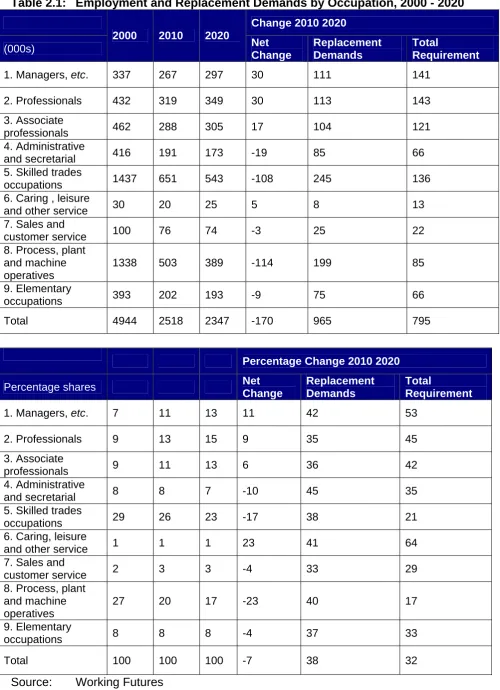
Table 2.1 presents more detail about projected skill change over the period to 2020. It also includes information about replacement demands. Although employment is projected to decline in several occupations and the industry overall, there will also be retirements such that people need to be replaced. Taking replacement demands into consideration, even though the industry is in employment decline, reveals that for most occupations there will be a significant additional demand for labour. So, for example, by 2020 the number of skill trades jobs is projected to fall by 118,000 but replacement demands are likely to be around 245,000 such that there will be 136,000 new job openings which will need filling. This is principally due to the number of people who are expected to retire from the industry in the period to 2020.
It is apparent from Table 2.3 that the key challenge facing the industry is being able to attract relatively skilled people – or those with the potential to become highly skilled – to work in an industry which is projected to show employment decline. This can be
Figure 2.3: Occupational Change in the Overall Economy and Manufacturing, 2000 - 2020
Table 2.1: Employment and Replacement Demands by Occupation, 2000 - 2020
Change 2010 2020
(000s)
2000 2010 2020
Net Change Replacement Demands Total Requirement
1. Managers, etc. 337 267 297 30 111 141
2. Professionals 432 319 349 30 113 143
3. Associate
professionals 462 288 305 17 104 121
4. Administrative
and secretarial 416 191 173 -19 85 66
5. Skilled trades
occupations 1437 651 543 -108 245 136
6. Caring , leisure
and other service 30 20 25 5 8 13
7. Sales and
customer service 100 76 74 -3 25 22
8. Process, plant and machine operatives
1338 503 389 -114 199 85
9. Elementary
occupations 393 202 193 -9 75 66
Total 4944 2518 2347 -170 965 795
Percentage Change 2010 2020
Percentage shares Net
Change
Replacement Demands
Total
Requirement
1. Managers, etc. 7 11 13 11 42 53
2. Professionals 9 13 15 9 35 45
3. Associate
professionals 9 11 13 6 36 42
4. Administrative
and secretarial 8 8 7 -10 45 35
5. Skilled trades
occupations 29 26 23 -17 38 21
6. Caring, leisure
and other service 1 1 1 23 41 64
7. Sales and
customer service 2 3 3 -4 33 29
8. Process, plant and machine operatives
27 20 17 -23 40 17
9. Elementary
occupations 8 8 8 -4 37 33
Total 100 100 100 -7 38 32
2.5 A more disaggregated view of skill change
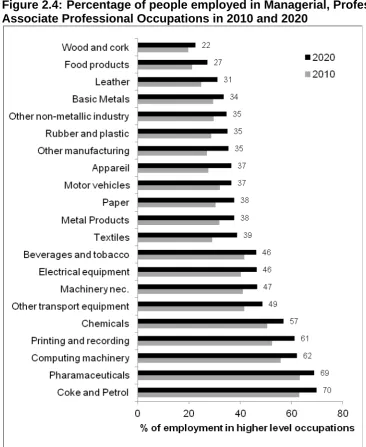
There is a tendency to see the future of the manufacturing sector as a high technology, high skill one when, in reality, manufacturing in the UK comprises a wide range of different activities the skill needs of which vary substantially. Figure 2.4 shows the percentage of people employed in higher level occupations across a range of
[image:21.595.62.429.207.655.2]manufacturing sub-sectors. It ranges from around a quarter in sectors such as wood, food, and leather products, but rises to around two thirds in process sectors such as chemicals and pharmaceuticals and in the computing machinery sector.
relatively less complex products, often uses sophisticated production technologies in its manufacturing process. A key issue is the extent to which these will become increasingly automated over the longer-term such that the skill structure in the sector comes to match in other parts of the industry.
Figure 2.5: Employment in Manufacturing Sub-sectors, 2010
Source: Working Futures
2.6 International comparisons
Across Europe as a whole employment in manufacturing has declined over the past and is projected to do so over the medium-term (see Figure 2.6). The Cedefop projections of skill demand suggest that employment decline between 2010 and 2020 will be around 3 per cent, compared with 6 per cent in GB.4 Rather than provide a comparison with every European country the analysis is limited to that of Germany and Switzerland. Both have relatively strong manufacturing sectors: Germany with its strong machine tools and car manufacturing sub-sectors; and Switzerland with its instrument engineering sub-sector. In both these countries the manufacturing sector accounts for a relatively high share of overall employment – 20 per cent in Germany and 14 per cent in Switzerland compared with 10 per cent in the UK – and both show lower rates of employment decline in their respective manufacturing industries. In Switzerland, for instance, there is projected to be a slight increase in manufacturing employment.
If the occupational structures are compared it is immediately apparent that the UK is characterised by a higher percentage of people in higher level occupations, and in
4
Switzerland and Germany a higher percentage employed in skilled trade occupations (see Table 2.2). Mason (2002) has drawn attention to the fact that in countries such as the UK and USA there is more activity which requires large production runs such that there is less demand for people trained at an intermediate level who might operate in the role of a supervisor or foreman. In contrast, in countries such as Germany workplaces are often engaged more in batch production which requires a cadre of intermediate skilled employees who can, for example, regularly change settings / tools on production systems. This is also allied to the production of relatively high value products, produced more efficiently, than is the case in the UK. In the future, however, production in the UK may well become increasingly smaller-scale, engaged in the production of relatively complex products. Accordingly, there is likely to be an increased demand for people in technician roles – an occupation which overlaps both associate professional and skilled trades occupations in the projections of future skill demand presented above.
2.7 Conclusion
The evidence on the future demand for skills in manufacturing suggests that over the period to 2020 more people, proportionately, will be employed in jobs where typically a degree is required to gain entry (c.f. the proportionate increase in the number of people employed in higher level occupations). These jobs are likely to require in many instances people qualified in STEM subjects. At the same time, there will continue to be relatively strong demand for people employed in skilled trades and operative occupations given the level of replacement demands. In particular, there will be strong replacement demands for skilled trades workers which may well be at a technician level.
Over the longer-term – stretching to 2050 – one can speculate about future skill demand. On the one hand, in various manufacturing sub-sectors, the competitive advantage of the UK will rest in product design and development and, allied to this, the production of prototypes and low volume, high value products. This is already apparent in sub-sectors such as, for example, pharmaceuticals, aerospace, and plastics. The demand here will be increasingly for people to work in professional and associate professional
Figure 2.6: Employment in Manufacturing Industries in Selected European Countries, 2000 to 2020
Table 2.2: Occupational Structure of Manufacturing Industries in Selected European Countries, 2000, 2010, and 2020
EU-27 Switzerland Germany Great Britain
2000 2010 2020 2000 2010 2020 2000 2010 2020 2000 2010 2020
Legislators, senior officials and
managers
7 7 8 2 2 2 5 6 6 16 20 21
Professionals 6 9 12 14 16 19 8 10 13 8 11 12
Technicians and associate
professionals
11 14 15 14 16 17 14 15 15 8 9 11
All higher level
occupations 25 30 35 30 35 38 27 31 35 32 40 44
Clerks 8 8 7 13 8 6 10 11 11 10 8 6
Service workers and shop and market sales workers
2 2 3 3 4 5 3 4 5 1 1 2
Skilled agricultural
and fishery workers 0 0 0 1 1 1 0 0 0 0 0 0
Craft and related
trades workers 33 30 25 37 35 31 36 31 27 24 20 17
Plant and machine operators and assemblers
23 22 22 13 12 12 15 14 14 24 21 19
On the other hand, there are lower-value sectors such as food processing where larger manufacturers utilise sophisticated production technologies which are, currently,
dependent upon people employed in higher level occupations and operatives who work on production lines. It is likely that in this sub-sector of the industry, increased automation will reduce and proportionately, the number of operatives needed. There are, however, a relatively large number of employers – many of them SMEs - operating in relatively low value sectors of the market which are dependent upon labour intensive production processes. It is likely that unless the cost of automated production processes falls
3. Emerging skill needs over the longer
term
3.1 Introduction
The previous chapter, based on Working Futures, provided a quantitative overview of how skill needs are likely to develop over the medium-term. This chapter uses a wider variety of evidence to indicate how skill needs are likely to develop paying particular attention to the types of skill demands which are likely to arise. The manufacturing plant of the future is likely to be much more engaged in R&D, design, production of prototypes and small-scale manufacture of complex high-value added goods. Whilst UK employers may be engaged in mass production, it is likely that that part of the production process will have been increasingly transferred to lower labour cost countries. This is essentially a continuation of the trends which have been observed over the recent past. It is also likely that the employer will be operating in networks of organisations, which are spread out across the world, who are engaged in different elements of the R&D, design, and production processes. The manufacturing sector of the future is also likely to be a dynamic environment where the pace of product and process innovation in critical sub-sectors is relatively fast which means that employers will need to adapt quickly to being able to successfully bring to market new products made possible by technological advances. This applies to the production of goods for both intermediate and final consumption. This all has implications for the types of skill required to (a) manage the process and (b) produce the next generation of high value-added goods. Critical to this process will be the acquisition and utilisation of STEM skills.
In summary, it is likely that manufacturing output will be increasingly concentrated in those parts of the sector which correspond with advanced manufacturing. As noted in the earlier chapter, advanced manufacturing is a dynamic concept since the pace of change is sometimes so fast in key parts of the manufacturing sector that what was considered advanced a few years ago is no longer considered as such. This raises issues in itself about the capacity of employers to manage the process of change.
3.2 Product market strategies, the product lifecycle and skills
The longer-term skill needs of the manufacturing sector will be determined by the capacity of:
others. There are manufacturing sectors which, for one reason or another, tend to be located near to their main markets. Mason (2005) has pointed out that those
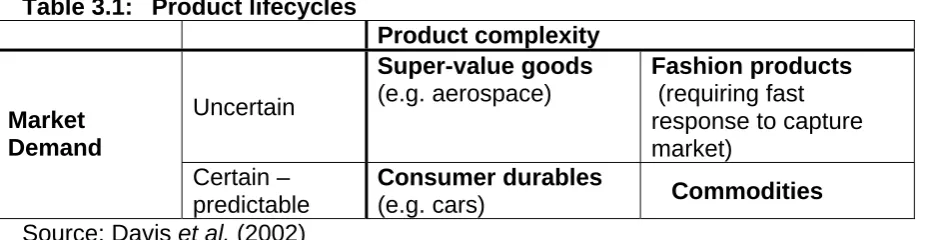
[image:28.595.53.517.341.461.2]manufacturing firms which are dependent principally upon local and regional markets tend to operate in lower value-added markets and are less subject to competition from imports. Other evidence suggests that their position is sometimes precarious, with their markets ultimately being susceptible to takeover by lower cost producers (Wilson and Hogarth, 2003). The productivity gains they require to keep their businesses strong are sometimes inhibited by both a lack of capital to invest in new plant, machinery and equipment, and the skills which would allow them to capitalise upon any investments. If manufacturing activity becomes increasingly concentrated in the design of products, the production of prototypes, and manufacture on a batch-scale, then there is a need to recognise the skills needs which arise in relation to the product lifecycle. In their review of the product lifecycle in manufacturing, Davis et al. (2002) outlined how many products have a tendency to migrate towards being commodities over time (see Table 3.1). The example provided by Davis to indicate the pace with which products could migrate from one product market position to another was mobile phones. Over the course of a few years went from being expensive items (super-value goods) to must-have commodities (though still technically complex products).
Table 3.1: Product lifecycles
Product complexity Uncertain Super-value goods (e.g. aerospace) Fashion products (requiring fast response to capture market) Market Demand Certain – predictable Consumer durables
(e.g. cars) Commodities Source: Davis et al. (2002)
Davis et al. explained how skill needs at all levels of the organisation changed as products shifted their position over the lifecycle – from the emphasis upon design and development and small-volume production of super-value goods (such as aeroplanes) to the need to be able to manage mass production systems in the case of commodities (see Table 3.2). Manufacturers may choose to remain with a given product, in which case they need to adapt their production processes and deployment of skills as it changes its
[image:28.595.48.541.604.761.2]product market position, or look to develop the next range of higher value-added products.
Table 3.2: Product lifecycles and skill needs Product complexity
Uncertain
Project management Research & development Product design skills Craft production skills
Marketing Logistics
Craft production skills
Market Demand Certain – predictable Team working Manufacturing system design Cost control
Manufacturing system design Plant maintenance
Logistics Cell manufacturing
Operatives
The fast pace of change and the development of new vintages of product also created its own skill demands. This tends to create a demand for agility within the workplace to: adapt to the changing product market position of any good (for example, the capacity
to develop systems which can accommodate mass production if a product shifts to becoming a commodity including transferring production abroad);
to develop the next range of products to replace those which in becoming commodities become reduced in value.
These are often formidable challenges for an employer to manage but one view of the future of manufacturing suggests that employers will increasingly need to acquire the skills which will allow them to become agile. This relates in many respects to the quality of management skills and, in particular, the ability to be able to read a market.
3.2 Emerging skill needs and occupational profiles
Given the future direction of manufacturing it is possible to identify emerging skill needs and changing occupational profiles. The previous section indicates that one of the principal skill needs relates to that of management being able to manage change as products move through their lifecycle. The other particular skill sets and occupational profiles which are prominent in the research literature relate to the demand for: 1. STEM skills at intermediate and higher levels which are increasingly required in a
manufacturing environment which is engaged more in R&D, design, manufacturing of prototypes and small-scale production runs of complex products;
2. hybrid skills which relate to (a) workers possessing knowledge of different vintages of a product or technology and (b) workers possessing a combination of technical
competence and a range of generic skills in order to make the production process run efficiently;
3. people able to both manage networks and supply chains which are often complex in character and spread across, in some instances, multiple organisations sometimes located in several different countries;
4. technician level skills where individuals are increasingly required to possess skills which lie between that of a professional engineer / technologist and a skilled trades worker.
Each of these are considered in turn below. STEM Skills
STEM subjects and other subjects. Projections of future skill demand suggest substantial growth amongst those qualified at NQF 4 (equivalent to first degree level). Table 3.3 provides an indication of the scale of demand required over the period 2007 – 2017 including an indication of the total requirement taking into account that people will have retired or left the industry for one reason or another and will need replacing.
The data indicates that over a ten year period the industry will need around a half a million more people with around 300,000 at NQF levels 4 and 5. Table 3.4 provides an indication of the STEM qualifications which the manufacturing sector will require. Overall it suggests that of the quarter of a million more people required at NQF 4 by 2017, around half will need to be qualified in the specific STEM subjects included in Table 3.3. So overall, around 20 per cent of the future total requirement for employment in
[image:30.595.54.516.326.494.2]manufacturing will be made of people qualified in biological, physical, mathematical, and engineering subjects. If this were applied to the total future requirement projected to 2020 this would suggest that an additional 160,000 people will be needed who are qualified in these subjects.
Table 3.3: Projected Future Demand by Qualifications in Manufacturing, 2007 - 2017
2007
% share 2007-2017 2017 % share
Total
Requirement 2007 - 2017 (000s)
NQF 5 4 3 5 50
NQF 4 20 8 25 268
NQF 3 22 -25 19 66
NQF 2 23 -23 21 85
NQF 1 20 -11 22 148
NQF 0 11 -23 10 41
Total 100 -14 100 660 Source: Wilson (2009)
Table 3.4: Projected future demand for people with Selected NQF 4 STEM Qualifications in Manufacturing, 2007 - 2017
2007 (000s)
2017 (000s)
Total requirement 2007 – 2017
(000s)
Biological Sciences 33 49 28
Physical sciences 34 43 21
Mathematics and
computing 30 54 34
Engineering 73 80 32
Technology 12 20 12
Source: Wilson (2009)
[image:30.595.57.513.539.679.2]above indicates that their destinations are much more varied currently and this is likely to remain so principally because of the demand in many sectors to process large amounts of information relating to the operation of their production processes and their customer base. Given this situation, the projections of likely future demand for people with STEM skills suggests that demand will outstrip supply principally as a consequence of the increase in STEM graduates being gradual whereas the demand for STEM graduates has been much more substantial (Wilson, 2009).
Hybrid skills
With respect to managing products over the lifecycle and being able to flexibly shift to the development of the next generation of products, Hendry (2002) has drawn attention to the need for hybrid skills: where people within the organisation have knowledge of different vintages of products. This was first observed in the computer software sector where the rapid take-up of new programming languages required people to be skilled in using the latest languages but also in older languages in order to service older products (this was most pronounced in relation to Y2K where many of the older programmes which were thought to be in danger of crashing at the start of the new millennium had been programmed in Cobalt). In a sector where there is a relatively aged workforce this potentially poses problems over the longer-term unless organisations are able to retain knowledge within the organisation (c.f. the knowledge management factor – see
Scarborough et al., 1999).
Hendry (2002) also drew attention for the need for people to have both technical competence and the capacity to utilise those skills in a commercial environment. This required people, for example, to have the ability to lead teams, work effectively in networks, and such like. This is of critical importance in the manufacturing sector. As SEMTA (2009) point out there is a need for people to have ‘expertise beyond an adequate supply of technical skills’ if new inventions are to be turned into marketable products.
Skills related to working across networks
working in partnership with a larger partner, perhaps even being taken over eventually if the new product proves successful (Davis et al., 2012).
This means that SMEs need to be able to:
ensure that they are able to recover their investments in a new product or technology and that the expertise they develop can be transferred into new projects;
possessing the managerial and communication skills to hold their own in working within a network especially where large partners are involved;
being able to effectively market their expertise and products to a wide variety of potential networks including those overseas. By being able to develop language skills they are likely to be less dependent upon agents.
These are potentially formidable challenges for SMEs and their larger partners if, as is expected, the future of manufacturing is based around the development of SMEs. Technician skills
If changes in the structure of global manufacturing result in activity in the UK being increasingly focused on the production of high value-added goods, then this potentially increases the demand for skilled trades workers operating as technicians often in a supervisory capacity. Smaller scale production tends to place more emphasis on supervisors and first line management to reset machine tools and make suitable amendment to work organisation. Mason’s research suggests that countries such as Germany with a mass Apprenticeship system tend to be relatively well placed to fill these types of job with suitably skilled people. For countries such as the UK, there would
appear to be more of a requirement to get higher education graduates to fill these jobs given the structure of the supply-side which has been, over recent years, increasingly skewed towards the production of graduates (Mason 2005, 2011).
In the past Apprenticeships provided an entry point for people to enter both skilled trades and professional / managerial occupations. Typically completion of an Apprenticeship in, for instance, an engineering discipline provided the base upon which individuals could further develop their skills and acquire further qualifications which would grant entry to being a professional engineer. During the Apprenticeship individuals would be singled out on the basis of their potential for promotion within the company. Those who took up engineering Apprenticeships in manufacturing were sometimes placed in to two groups: (a) those destined to work in skilled trades jobs (for example, as fitters, machine setters, etc.); and (b) those who were considered to have the potential to fill technician level jobs (that is, those jobs which sat between the professional engineers and the skilled trades workers, such as draughtsmen, production engineers, junior design engineers, and such like). Technician level jobs are usually defined as being associate professional jobs in occupational classifications. Based on evidence collected during the 1990s, Hogarth et al. (1996) reported how during the second year of the Apprenticeship, manufacturing employers would select those apprentices considered to have potential to become technicians. They would then undertake a separate programme of training from that of the other apprentices. The technicians’ training took longer to complete and often led to a higher level qualification. It was this group which would have the opportunity to progress into professional and managerial jobs within the workplace which had initially trained them.
professional jobs which had been traditionally filled by technicians graduating from Apprenticeship programmes (Jagger, et al., 2010; Mason, 2012). Whether these jobs when filled by university graduates had the same skill content as when filled by the technicians, or whether the university graduates were able to transform these jobs in to higher level ones, is a moot point. The case study evidence presented by Lewis (2012a, 2012b) suggests that some employers may have become dissatisfied with the
performance of graduates in associate professional level jobs because the training they had received at university lacked the combination of theory and practice which
Apprenticeships provided and which the employers found to be so beneficial to their businesses. Accordingly, employers were once again looking to Apprenticeships to provide them with the technicians who could fill the types of occupations which fell between skilled trades and professional engineers.
Both Mason (2012) and Jagger et al. (2010) demonstrate that those employed in skilled trades and associate professional jobs are relatively old - often in their mid 50s – with the result that many employers are currently, or will be shortly, faced with a pressing need to replace those who are close to retirement. In aggregate, employers cannot resort to the external labour market to recruit experienced skilled trades workers or associate
professional staff since the pool from which they are likely to be recruiting has been getting older and smaller as people retire. The alternative is for employers to provide initial vocational education and training either through Apprenticeships or graduate traineeships. With increases in university tuition fees there is a degree of uncertainty attached to the future supply of graduates from higher education. It should be noted that manufacturing employers, in any case, are able to recruit only around a quarter of those graduating in STEM subjects (SEMTA, 2009). Apprenticeships which provide the
apprentice with the opportunity to earn whilst learning may become an increasingly attractive option to young people - especially where there is the potential to progress on to Higher Apprenticeships - who might have otherwise been tempted to enrol at a
university (Mason, 2012; Hogarth et al., 2012). Accordingly, employers may well increasingly look to Apprenticeships to meet their demand for skills at the technician / associate professional level if the supply of university graduates begins to dwindle.
3.4 Emerging skill needs within advanced manufacturing
sub-sectors
The discussion so far has been about the demand for skills in a generic sense. It is important to consider the specific types of skills which will be needed. SEMTA (2009) identified several advanced manufacturing sub-sectors / technologies which they
considered to be of critical importance to the future of the manufacturing sector in the UK. These were:
and then to manage the process of shifting from prototyping to manufacturing in greater volumes. In some respects this corresponds with the hybrid skills mentioned above (a combination of high technical competence allied to commercial competence).
It is also apparent that at both the development stage and in the process of moving from prototyping to greater volume production, managers, professional scientists, and
Table 3.5: Future skill demands in selected manufacturing sub-sectors and technologies
Management Skills Professional Skills Technical Skills
Aerospace Capacity to negotiate complex global markets
Mix of technical and
business skills required to manage complex projects and international supply chains involved in design and R&D
Engineering (electrical and mechanical) / software (modelling and simulation); knowledge of advanced materials
Plastic and silicon electronics
Ability to bring new products to market and manage the transition from producing prototypes to higher volume production
0. Testing, prototyping and being able to implement new designs. Skills related to using plastic electronics
. Biotechnology Pharmaceuticals
/ . Management of new product development
3. Need for scientists capable of working across boundaries of biology / genetics / chemistry / chemical engineering etc.
4. Technicians capable of working with the new production systems required to produce biotechnology products 5. New materials /
composites
6. Skills related to the
commercialisation of new materials
7. Scientists and technologists are required to develop new
composites applicable to sectors such as automotive, aerospace,
8. Technicians will need to acquire the skills required to work with new materials in their
manufacture 9. Nanotechnology 0. As a new embryonic technology there is a need for managers and
professionals (especially scientists) across the manufacturing sector to identify how nanotechnologies can be incorporated in to products and processes
. Higher level skilled technicians will be required in relation to the handling and use of nanotechnologies.
3.5 Conclusion
This chapter has sought to indicate the principal types of skill which will be increasingly required by the manufacturing sector over the medium- to long-term. There are three broad, inter-related skill needs:
management skills required to chart a sustainable product market strategy with the emphasis upon operating in the high value segment of the market;
the professional skills required in R&D and product and process design; and
the technical skills required to support employers maintain a high value added product market strategy. These will be demanded of managers, professionals, associate professionals and technicians, and skilled trade workers.
It is apparent that as manufacturing employers increasingly make use of emerging technologies such as biotechnology and nanotechnologies there are, to some extent, brand new skill needs arising. In some areas there are likely to be relatively few people within the global labour market who have the skills industry requires. This is especially true with respect to R&D. There are also likely that the existing workforce may need to acquire new skills as, for example, biotechnologies and nanotechnologies become increasing incorporated in to manufactured products. This potentially places a
4. Meeting skill demand
4.1 Introduction
The projections of future employment demand presented in the previous chapter are dependent upon the supply side keeping pace with demand. Since the 1970s at least, Government has sought to boost skills supply to all industries: first through the Manpower Service Commission’s attempts to create vocational pathways through further education other than through Apprenticeship; and then, later, by increasing the percentage of young people entering higher education. The manufacturing industry has always been relatively more dependent upon the vocational education and training (VET) system to supply it with the skills it needs. Whether or not the VET system has been successful in doing so is a moot point, but it is clear in looking to the future that the sector will become increasingly skill intensive. Therefore the supply of skills has the capacity to be either a facilitator or inhibitor of growth and the development of high-skill, high-value segments of the industry.
For reasons of brevity the discussion is limited to initial vocational education and training (IVET) delivered in the further education (FE) and higher education (HE) sectors, along with the continuing vocational training and education (CVET) provided by employers, together with some insights into the role of migration as a source of skills supply.
4.2 Initial vocational education and training: apprenticeships
Historically Apprenticeship has been a principal point of entry for young people wanting to enter skilled employment in the manufacturing sector. Apprenticeship across much of the EU is regarded as conferring benefits on both the employer and the apprentices over and above that which is delivered through school-based vocational learning (Vogler-Ludwig et al., 2012; Beicht et al., 2004; Müehlemann et al., 2007). As noted above, the manufacturing workforces in countries such as Germany and Switzerland comprise proportionately more people who would have been trained via their respective Apprenticeship / dual-training systems.
The evidence from the UK engineering sector indicates that employers recurrently invest in Apprenticeships because they see little alternative to doing so. Apprenticeships are seen as delivering the skills employers need and delivering to learners a rigorous,
practical and theoretical understanding of the trade they have chosen to pursue (Hogarth et al., 2012). Apprenticeships would appear to deliver a win-win insofar as employers obtain the skills they need, and the apprentice obtains relatively good returns with
(Haxby, 1989). The problem endures with a relatively small share of the cohort leaving the compulsory school system each year entering into an Apprenticeship when compared to countries such as Germany (Steedman, 2011). Supporting this view the 2011
Employers Skills Survey revealed that manufacturing was one of the sectors where employers were less likely to take on young people straight from education: 19 percent of establishments in manufacturing having done so in the 12 months prior to the survey compared with 23 percent across all sectors.
Apprenticeship starts are sensitive to the economic cycle and Government attempts to boost their number (see Figure 4.1). Recent data suggests that though a large part of the recent growth in apprentices has been due to existing employees, often aged over 24 years, being trained via the programme rather than new recruits taken on exit from school or college, this is not true of the manufacturing sector. In manufacturing Apprenticeships at both Level 2 (L2) and Level 3 (L3) are delivered to young people entering the labour market for the first time (Winterbotham et al., 2012; Hogarth et al., 2012). They receive structured training over a two to four-year period involving a
[image:38.595.67.521.347.598.2]substantial amount of off-the-job training usually through block- or day-release to a local FE college. The problem remains, however, that participation rates are relatively low compared with other countries.
Figure 4.1: Apprenticeship Starts in England, 2002 - 2012
Source: Data Service Statistical First Releases March and October 2012
Other evidence which has looked more specifically at Apprenticeships in STEM subjects shows some increase in STEM Apprenticeship starts at Level 3 over recent years (Royal Academy of Engineering, 2012).
The key issue, given the aims of this paper, is what will happen to apprenticeship numbers in the future. The increase in university tuition fees may well increase the
attractiveness of Apprenticeships to young people who, in previous years, might not have considered pursuing the form of IVET. Similarly, if there are fewer higher education
graduates of a type manufacturing wants to recruit then they may be tempted to take on more apprentices as a substitute (Hogarth et al., 2011). As noted in the previous
which may well stimulate the demand for Apprenticeships from employers. It may also be the case, given changes in the higher education sector, that both employers and
apprentices look to gain their Level 4 qualifications through Higher Apprenticeships rather than entering university. So over the medium there are signs that the demand for
manufacturing / STEM related Apprenticeships might increase thereby increasing the supply of skilled personnel through this training pathway.
4.3 Initial vocational education and training: higher education
With regard to higher education the evidence reveals that there has been an increase over recent years in the number of students studying science, technology, engineering and mathematics (STEM). These are the subjects which are particularly in demand by manufacturing companies. Table 4.1 shows the change in the stock of full-time
[image:39.595.68.533.297.458.2]undergraduate students in 2011/12 and 2002/3 which shows that there has been a 9 per cent increase in the number of STEM students.
Table 4.1: Supply of people studying for a first degree in STEM subjects (000s)
Current stock of students (000s) F/T Undergraduates
2011/12 2003/04 % change
Biology 123 92 34
Physical Sciences 58 48 23
Computer Science 56 86 -35
Mathematical Sciences 27 19 41
Engineering 86 77 11
All STEM 351 322 9
Source: HESA
Alongside the increase in the stock of students studying towards STEM degrees there has also been a change in the subjects being studied. Figure 4.2 shows the change in the subjects being studied which fall under the engineering and technology category. The principal findings from Figure 4.2 indicate that proportionately fewer people are studying towards obtaining electrical engineering degrees and more are now working towards mechanical and civil engineering degrees respectively. The latter degree is one which is likely to be of more relevance to construction than manufacturing and, importantly, this is the degree subject which accounts for much of the growth in the number of people working towards engineering degrees.
Figure 4.2: Change in the subjects being studied with Engineering and Technology
Source: HESA
Some of the new technologies which are being developed often require research scientists and engineers who are working at the cutting edge in the chosen discipline. Sometimes there are relatively few people who possess the skills required to develop new technologies. This is a potential supply side constraint on the development of
technologies such as biotechnology and nanotechnology (SEMTA, 2009). It also points to the importance of collaborative relationships being developed with higher education institutions in order that the knowledge base in higher education is suitably exploited to the benefit of the economy. The Lambert Report indicated that there are sometimes barriers to effective university-business collaboration taking place, but in the future the development of new technologies and the capacity to take a lead in the development and commercial application of those technologies is likely to require more HE-business
4.4 The employment destination of students and apprentices
Evidence about the employment destination of apprentices tends to be piecemeal, but the information available suggests that upon completion of their training, most
apprentices working towards manufacturing and engineering Apprenticeships stay with the company which trained them (Hogarth et al., 2012; Winterbotham et al., 2012). The evidence indicates that a strong bond is developed between apprentices and their employers in many instances which ensures that the apprentices remain with the company which trained them.
In relation to higher education, HESA statistics indicate that around a quarter of
engineering and technology graduates, six months after completing their degrees, are working in the manufacturing sector (see Table 4.2). Table 4.3 provides a summary of the evidence in Table 4.2 to show that engineering and technology graduates, and STEM graduates generally, have a high likelihood of working in distribution and financial and business services. These are all sectors which are likely to grow in employment over the medium-term. The implications of this are considered below.
People who study STEM subjects reveal a preference for working in areas which will make use of their STEM skills (Connor et al., 2011) and the evidence suggests that where they do so their wage levels are relatively high (Greenwood et al., 2011). Whilst once this would have resulted in many of them moving into manufacturing there are now jobs across a range of sectors which make use of the STEM skills. Therefore a critical issue for the manufacturing industry over the medium-term is for it to become the