Theses
7-2019
Task Scheduling Balancing User Experience and
Resource Utilization on Cloud
Sultan Mira
Follow this and additional works at:https://scholarworks.rit.edu/theses
This Thesis is brought to you for free and open access by RIT Scholar Works. It has been accepted for inclusion in Theses by an authorized administrator of RIT Scholar Works. For more information, please [email protected].
Recommended Citation
Experience and Resource Utilization on
Cloud
by
Sultan Mira
A Thesis Submitted in Partial Fulfillment of the
Requirements for the Degree of
Master of Science in Software Engineering
Supervised by
Dr. Yi Wang
Department of Software Engineering
B. Thomas Golisano College of Computing and Information Sciences
Rochester Institute of Technology
Rochester, New York
The thesis “Task Scheduling Balancing User Experience and Resource Utilization on
Cloud” by Sultan Mira has been examined and approved by the following Examination
Committee:
Dr. Yi Wang Assistant Professor Thesis Committee Chair
Dr. Pradeep Murukannaiah Assistant Professor
Dedication
I dedicate this work to my family, loved ones, and everyone who has helped me get to
Abstract
Task Scheduling Balancing User Experience and Resource Utilization
on Cloud
Sultan Mira
Supervising Professor: Dr. Yi Wang
Cloud computing has been gaining undeniable popularity over the last few years. Among
many techniques enabling cloud computing, task scheduling plays a critical role in both
efficient resource utilization for cloud service providers and providing an excellent user
ex-perience to the clients. In this study, we proposed a priority cloud task scheduling approach
that considers users input to calculate priority, while at the same time, efficiently utilizes
available resources. This approach is designed for the consideration of both user
satisfac-tion and utilizasatisfac-tion of cloud services. In the proposed approach, clients will be required to
input their time and cost preferences to determine the priority of each task. We conducted
our experiments in Python and AWS to best simulate a real-world cloud environment and
compared the proposed approach to a first-come-first-serve approach. We measured the
performance of our approach in terms of average task wait timeAWT, average resource idle
timeaRIT, and the order the tasks were scheduled. The experimental results show that our
approach outperforms the first-come-first-serve approach inAWT, aRIT, and the order the
Contents
Dedication. . . iii
Abstract . . . iv
1 Introduction. . . 1
2 Related Work . . . 4
3 Methodology . . . 10
3.1 Overview . . . 10
3.2 Factors to Be Considered in Task Scheduling . . . 11
3.3 Task Aging . . . 13
3.4 Calculating Priority Score . . . 13
3.5 CPU Utilization . . . 14
3.6 Further Considerations . . . 14
4 Experiment . . . 16
4.1 Single Instance Experiment . . . 17
4.1.1 Overview . . . 17
4.1.2 Results . . . 21
4.2 Multiple Instance Experiment . . . 23
4.2.1 Overview . . . 23
4.2.2 Differences from Single Instance Experiment to Multiple Instance Experiment . . . 25
4.2.3 AWS Instance Specifications and Setup . . . 27
4.2.4 Results . . . 27
5 Discussion . . . 31
5.1 Experiment Results . . . 31
5.3 Future Work . . . 33
5.4 Threats and Limitations . . . 34
6 Conclusion . . . 35
List of Tables
4.1 Single Instance Experiment Randomly Generated Data-set . . . 19 4.2 Single Instance Experiment Priority Scheduler Execution Results (Table
4.1 dataset) . . . 23 4.3 Multiple Instance Experiment Randomly Generated Data-set . . . 28 4.4 Multiple Instance Experiment Priority Scheduler Execution Results (Table
List of Figures
3.1 Approach Process Flow Overview . . . 12
4.1 Python Simulation Overview . . . 16
4.2 Task Class . . . 18
4.3 Task Scheduler . . . 20
4.4 Custom Priority Queue Implementation . . . 21
4.5 Randomly Generated Tasks AWT Python Simulation Results . . . 24
4.6 Multiple Instance Experiment Overview . . . 26
Chapter 1
Introduction
There are many numerous reasons why businesses of all sizes, alongside individual users,
have started moving to the cloud. Some of those users did it for the sake of the flexibility
cloud computing offers, others made the transition hoping to achieve the scalability they
need. Whether users were looking to utilize software applications, storage, or just high
computing power, they find what they are after on the cloud. Using virtualization
technol-ogy, cloud providers are able to separate the physical infrastructure and create resources to
be consumed and utilized by their users. Because of that cloud computing is able to provide
unparalleled services and cater to their customer’s individual needs.
Not just any software, or resources, that can be used over the internet can be called a cloud
computing system. These five characteristics [15] that a system must have to be considered
cloud computing.
1. On-demand self-service: No human interaction required by the consumer to the
ser-vice provider, or providers, when provisioning capabilities such as processing power,
or server time.
2. Network access: The network can be accessed and used by all types of client
plat-forms, such as mobile devices, tablets, and laptops.
3. Rapid elasticity: Computing capabilities are provisioned and released elastically, and
even automatically if needed. The resources and capabilities available for use should
4. Measured service: The usage of resources on the cloud must be monitored and
con-trolled. The reporting of the service and resource usage must be transparent between
the provider and the user.
5. Resource pooling: A multi-tenant model where the computing resources of the
ser-vice provider are pooled to serve more than one user. Generally, users do not possess
knowledge or control over the location of the resources they are utilizing. However,
users may be able to choose a location for their services at a higher level, such as
choosing a state or a country.
Just like any other software, cloud computing is not without issues [21]. One of the most
researched issues today in cloud computing is task scheduling. Users submit their tasks to
the cloud service provider at any given time and it is up to the cloud provider to execute.
Cloud service providers employ scheduling algorithms to ensure proper and efficient
re-source utilization on their end and attempt to achieve customer satisfaction as well.
Typically, all scheduling algorithms have common goals, regardless of whether it was on
a cloud system or not. Those goals include, but are not limited to, resource utilization,
throughput, turnaround time, and fairness. Resource utilization enables the cloud service
provider to maximize their profits by minimizing the idle time of their resources and
al-ways keeping them busy executing customer tasks. Throughput is the measure of how
many tasks were processed on an hourly basis. Turnaround time is the amount of time the
user of the service spends waiting for the output of their task once they have submitted it to
the cloud service provider. The order the incoming tasks are scheduled and the resources
they are assigned also has to be fair, based on the criteria the cloud service provider opts to
follow.
There is a number of different types of task scheduling algorithms. Perhaps one of the
sim-plest ones is the First Come First Serve (FCFS) scheduling algorithm, whereas the name
implies, tasks that are received first, will be scheduled ahead of others. Another type of
scheduling algorithms is Shortest Job First (SJF), where the shortest jobs are scheduled
execution. In addition, there is the Priority Scheduling Algorithm where incoming tasks are
assigned a priority and are executed on the terms of highest priority first. The calculation of
the priority of each task is up to the cloud service provider. Lastly, there is also the Round
Robin Scheduling Algorithm where CPU time is broken down to a small unit of time, often
called time slice. In Round Robin scheduling, jobs are placed in a circular queue and they
are executed for an arbitrary number of time slices until they finished execution.
In this study, we present a priority task scheduling approach that takes into account both
cloud service provider’s aim at efficient resource utilization and user experience. Cloud
computing users depend on the cloud for a verity of different tasks and so those tasks
should not be all treated and scheduled using the same scheme. Scheduling algorithms
are typically out of the user’s control and are completely up to the cloud service provider.
We propose an approach that empowers both cloud service providers and their users. The
approach enables users to contribute to the decision making of the priority of the tasks they
submit to the cloud service provider.
The proposed approach calculates the priority of the incoming tasks to be scheduled based
on several factors that users are able to influence. While cloud service providers can
con-sider other factors when scheduling tasks, the factors we concon-sidered most important to the
users to influence in this study are time and cost. In the proposed approach, users can
indicate how fast they would like their tasks scheduled, and at what cost. We ran two
ex-periments to evaluate this approach, a single machine python simulation as well as a seven
machine cluster on AWS. We compared the proposed approach to a first-come-first-serve
scheduler and the experimental results show our approach outperforming the
first-come-first-serve scheduling approach.
The rest of this thesis will go into a number of related studies done on cloud task scheduling,
discuss the details of the design of the approach, the setup and results of the experiments
Chapter 2
Related Work
While the work done in ”An application framework for scheduling optimization problems”
does not specifically consider cloud environments, it does focus on the process of
sequenc-ing and schedulsequenc-ing [10]. Accordsequenc-ing to the authors, there are five different types of
schedul-ing algorithms that could be considered when dealschedul-ing with a schedulschedul-ing problem. The five
types are: single machine scheduling, job shop scheduling, open shop scheduling, flow
shop scheduling, and parallel machine scheduling. The scheduling algorithms proposed by
the authors have the goal of achieving optimal performance and results. Choosing which
type to choose among those five types will not be an easy task as there are nemours factors
to be considered when making that decision.
In works related to cloud resource allocation and management, authors of ”Resource
Allo-cation in the Cloud: From Simulation to Experimental Validation” [14] realize the benefit
of of having reworld environments for cloud researchers to test new approaches and
al-gorithms and so they presented testbeds and a testbed adapter on physical clouds. The work
and research in their paper makes it possible for cloud research be validated and tested on
actual, physical clouds rather than just running simulations. Researchers would need to
have extensive knowledge on the underlying cloud platform to run an experiment on a real
cloud environment. However, the knowledge many researchers have in the cloud domain
may not be adequate to setup a cloud environment to run research experiments. While it
might be more cost effective and more convenient to run cloud research experiments in
simulated environments instead of real ones, there is always the risk of not considering all
Thaman and Singh present a review on different scheduling techniques in cloud
envi-ronments in their paper ”CURRENT PERSPECTIVE IN TASK SCHEDULING
TECH-NIQUES IN CLOUD COMPUTING: A REVIEW” [19]. The authors state that cloud
software is more of a product than a service due to the way it functions and how clients
in-teract with the software. According to Thaman and Singh, quality of service, power usage,
privacy and security, VM migration, resource allocation, and task scheduling are all critical
existing issues in cloud environments today. In addition, the paper looks into a number of
newly invented and tested scheduling approaches such as Metaheuristics, Greedy, Heuristic
techniques, and genetics.
In 2010, Selvarani and Sadhasivam proposed a cost-based cloud task scheduling in their
paper ”Improved cost-based algorithm for task scheduling in cloud computing” [17]. The
scheduling approach they proposed is similar on what factors it considers to the approach
we are proposing. The authors of the paper realize that unlike traditional scheduling
prob-lems and methods, tasks on the cloud can be associated with different costs. Based on the
costs of the submitted tasks, similar tasks are placed in groups and then are scheduled
to-gether. The algorithm proposed in the paper takes the cost of both tasks and resource into
account when making the task groups.
A study published in 2016 with the title ”Symbiotic Organism Search optimization based
task scheduling in cloud computing environment” [1] looked into a new approach for large
scale cloud task scheduling. The study proposed the search algorithm Discrete Symbiotic
Organism Search (DSOS) and compared it to Particle Swarm Optimization (PSO)
algo-rithm in a simulated environment. According to the authors of the study, (PSO) is a popular
heuristic optimization technique that is typically utilized in task scheduling problems. The
authors state that their proposed approach performs better as the number of incoming tasks
become larger, which makes it a suitable solution for large scale scheduling problems. In
addition, the tests the authors ran show DSOS had a superior performance against PSO for
large datasets.
2012 focuses on the bandwidth requirements for incoming tasks to propose a new approach
for cloud task scheduling [13]. The authors call their proposed algorithm bandwidth-aware
task-scheduling (BATS). To validate the performance of the proposed algorithm, CloudSim
toolkit was utilized. The authors utilized CloudSim to compare the bandwidth-aware
task-scheduling algorithm with few others, including, fair-based task-task-scheduling and
compu-tationonly taskscheduling. The reported results of the algorithm comparison show the
bandwidth-aware task-scheduling algorithm to have better performance.
In 2016, Singh and Chana proposed a survey discussing challenges and problems in task
scheduling titled: ”A Survey on Resource Scheduling in Cloud Computing: Issues and
Challenges” [18]. The survey proposed by the authors methodically analyzed 110 papers
selected out of a 1206 paper pool published in 19 conferences, symposiums, and
work-shops, in addition to 11 outstanding journals. The authors state that it is still difficult for
researchers to address today’s current cloud scheduling problems with the existing resource
allocation policies. The authors also stated literature concerning the thirteen types of
re-source scheduling techniques and algorithms. The study also describes eight different types
of resource distribution policies. The main goal of the study, according to the authors, is to
aid researchers in choosing resource scheduling algorithms most appropriate to their needs
and workloads.
Furthermore, the authors of ”Enhanced Particle Swarm Optimization For Task
Schedul-ing In Cloud ComputSchedul-ing Environments” [3] state that task schedulSchedul-ing is a key factor for
the efficiency of the whole cloud system. The authors define task scheduling as allocating
the best suitable resources to execute a task based on different parameters. Those
pa-rameters include time, cost, reliability, availability, and resource utilization among others.
According to the authors, the majority of task scheduling algorithms do not consider
re-liability and availability in a cloud environment due to the complexity of achieving them.
The study proposes a mathematical model that takes both reliability, availability, execution
time, transmission time, make span, round trip time, transmission cost, and load balancing
authors show the proposed approach can save in make span, execution time, round trip
time, and transmission cost.
Moreover, in 2014 a paper introducing a proven scheduling framework was publish by the
title: ”Apollo: Scalable and Coordinated Scheduling for Cloud-Scale Computing” [4]. The
authors state that it is becoming more challenging and critical at the same time to
effi-ciently schedule tasks over cloud-scale computing as cloud clusters are becoming
increas-ingly large with more diverse characteristics. In this study, the authors introduce Apollo,
scalable cloud scheduling framework. Apollo has been deployed on Microsoft’s
produc-tion clusters scheduling millions of tasks. The authors state that Apollo considers future
resource availability when making scheduling decisions and is able to handle unexpected
system dynamics.
Keshanchi and Navimipour published a study in 2016 with the title: ”Priority-Based Task
Scheduling in the Cloud Systems Using a Memetic Algorithm” [9]. The study introduces a
new algorithm to handle cloud priority scheduling. According to the authors, memetic
al-gorithms have been successfully utilized as evolutionary or population-based global search
approaches to optimize complete problems. Since task scheduling is also an
NP-complete problem, the authors present a new task scheduling algorithm that combines
mul-tiple priority queues and a memetic algorithm. Keshanchi and Navimipour validated their
algorithm on Azure Cloud Service in C# and compared to three other scheduling
algo-rithms, the results show the proposed algorithm preformed better in terms of make span.
Additionally, Lakra and Yadavb published ”Multi-Objective Tasks Scheduling Algorithm
for Cloud Computing Throughput Optimization” [11] in 2015. The authors state that most
cloud scheduling algorithms only consider one factor, execution time, so they introduced a
new multi-objective task scheduling algorithm that considers more than one factor because
they also state that in a cloud environment it is essential to consider various factors. The
authors of the study utilize CloudSim as their simulator to validate their proposed approach.
Similar to the scheduling approach we propose in this study, ”Credit Based Scheduling
to efficiently utilize available resource and provide excellent user experience.
Accord-ing to the authors of the study, cloud service providers focus more on resource utilization
rather than adding more resource to execute user submitted tasks. The authors of the paper
analyzed traditional scheduling algorithms and introduced a new improved scheduling
al-gorithm based on task length and user priority.
Focusing on solving the issue of task execution failure on the cloud, ”Fault tolerance aware
scheduling technique for cloud computing environment using dynamic clustering
algo-rithm” [12] introduced a new algorithm for cloud scheduling. The authors state that task
execution failure is becoming a common occurrence in cloud environment and not much
attention has been paid to this issue by the research community. The experiential results
show the proposed algorithm greatly reduced task execution failure. The validation of the
algorithm included comparing it to the MTCT, MAXMIN, ant colony optimization, and
genetic algorithm-based NSGA-II.
Another study focusing on resource utilization published in 2018, ”A New SLA-Aware
Load Balancing Method in the Cloud Using an Improved Parallel Task Scheduling
Al-gorithm” [2]. The authors of this study proposed a new parallel genetic algorithm-based
method that uses priorities for cloud task scheduling. The main goal of the newly proposed
algorithm is to utilize resources efficiently and reduce wasting resources. Validating the
algorithm, the authors used Matlab to simulate an environment where they compared their
algorithm with two existing techniques, a round-robin based load balancing method, and
a hybrid ant colony-honey method. The proposed algorithm in the study performed better
than the other two methods in terms of lower energy usage, lower migration rate, and better
service level agreement.
Further, in 2018 Gawali and Shinde published ”Task scheduling and resource allocation
in cloud computing using a heuristic approach” [6]. The authors combined a number of
algorithms and methods to propose a new approach to handle cloud task scheduling and
allocated to a resource using. the MAHP process. The newly proposed approach
com-bines BATS [13] and BAR optimization methods to consider the bandwidth as a constraint.
Turnaround time response time were used as metrics in the experiment conducted by the
authors to compare their proposed approach with BATS and improved differential
evolu-tion algorithm, IDEA.
There is a number of other studies focusing on the task scheduling on the cloud, for
ex-ample [16], [5], [7], [22] and [8]; however, their ideas and approaches are quite similar
with the literature discussed previously. Thus, we do not cover their details in this section.
Our approach, to be presented in the following sections, distinguishes itself from the
pre-viously discussed studies by considering the user input and allowing users to contribute to
Chapter 3
Methodology
In this section, we will go over a brief overview of the proposed approach and then go over
the details of each component. This section will also include any assumptions that were
made during the design of the approach.
3.1
Overview
The approach is intended to work as a task scheduler for cloud systems that is extensible
and modifiable. What this study describes serves as guidelines for those who wish to adopt
this scheduling approach. One major contribution in this paper is enabling users to have
more influence in the scheduling of their tasks to improve their user experience while at the
same time maintaining high resource utilization for the provider.
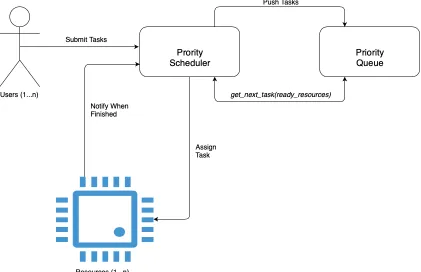
In the proposed approach, users are separate from their tasks so that the same user is able
to submit multiple tasks that do not necessarily have the same priority. Each task is treated
individually when it comes to its priority. When users submit their tasks for execution,
they indicate their time and cost preference for that task and how much resources that task
needs. Each task in the system has an individual priority score. For the sake of simplicity,
the smallest resource is considered to be 1 CPU, so the scheduler will be expecting integers
for task resources. There is no upper limit for how much resources one task can use,
the maximum number of resources per task is only constrained by what the provider has
available.
queue. The priority queue reorders the tasks using their calculated priority score based
on the time and cost factors in descending order. The scheduler will only look for tasks
to execute on a specified time interval. The time interval can be determined based on a
number of factors such as the frequency of incoming tasks and the total number of resources
available. If the scheduler attempts to execute tasks as soon as resources become available,
tasks with higher resource needs risk getting ignored and never getting executed. On the
specified time interval, the scheduler will invoke the priority queue for the next task to be
executed. Once the queue is invoked to return the next task, it will update the age of all the
tasks in the queue and then search for the next task. If the task on top of the priority queue
can be executed using the resources available to the scheduler at the time, the queue will
return it to the scheduler; otherwise, the queue will look for the next highest priority task
that can be executed with the available resources. The scheduler will keep requesting tasks
to schedule until it runs out of available resources, then the scheduler will do wait until it
can execute tasks again.
3.2
Factors to Be Considered in Task Scheduling
While each cloud service provider can determine what factors they wish to consider
deter-mining task priority, in this study we only considered time and cost. Although the approach
we are proposing only considers two factors, more can be added to the implementation of
the approach to further improve and fine-tune the priority scheduling such as the number
of tasks the user submitted in the past.
The allowed values for both time and cost must be in the range. 0.1-1 inclusive. The higher
the value is, the more the user cares about it and vice versa. Using both values of time
and cost for each individual task, a score is calculated to determine that task’s priority in
comparison with other tasks to be scheduled. If more than one task had the same priority
3.3
Task Aging
Since not all tasks will have the same calculated priority score, we implemented task aging
into the proposed approach. The tasks that have lower than average score are at risk of
ending up at the bottom of the queue. With incoming tasks having around the average
score, or higher than average, tasks at the bottom of the queue will be overlooked because
of their low priority and because incoming tasks will consistently have higher priority.
To prevent tasks from being lost and ignored in the queue, we introduced the concept of task
aging. When a task object is instantiated, the age for that task starts at 0. The scheduler will
update the age of all tasks waiting to be scheduled at the beginning of each scheduling time
interval. The age of a task is updated by adding a percentage of the overall task average to
their calculated priority score. In practice, this percentage does have to be fixed and can be
dynamically calculated, based on incoming task traffic, for instance. The more a task’s age
is updated, the higher its priority will become, preventing any tasks from being overlooked
by the scheduler regardless of their original priority. The calculation for the age of one task
is illustrated in formula 3.1, where prepresents the percentage chosen to increase the age
for tasktwithntasks.
aget=aget+ (p×
Pn
n=1scoret
n ) (3.1)
3.4
Calculating Priority Score
The formula is a crucial part of the approach as it takes in the time and cost for each task
and outputs the score determining the priority for that task. Because of the context of the
priority factors, tasks with high time values indicate that users wish for those tasks to be
scheduled quickly, while high cost values indicate users care about cost. So tasks with
high time and low cost values get a high priority because it means the user wishes for fast
scheduling and they are willing to pay for it. The opposite is also true, tasks with low time
tasks get low priority.
scoret=
2timet
costt
(3.2)
3.5
CPU Utilization
The task’s priority queue will sort the tasks by their priority on each insertion of a new
task and after the age of the tasks in the queue has been updated. Maintaining the order of
the tasks enables searching the tasks ready to be scheduled. Searching the tasks becomes
useful when the task with the highest priority needs more resources than the scheduler has
available at that time. When the scheduler has fewer resources than what the task with the
highest priority requires, the queue will search for the next highest priority task that can be
executed using the available resources. Searching for the next highest priority task that fits
the available resources allows for more resource utilization as it is better to utilize available
resources rather than waiting for more resources.
3.6
Further Considerations
There are many aspects in the proposed approach that can be changed or modified to the
provider’s preference and to fit their needs. Some possible modifications are related to the
scheduling time interval, priority score formula, priority factors, priority queue, and tasks
aging. While this approach is heavily customizable by design, there are few aspects to
consider when attempting to customize the approach.
Scheduling time refers to the time the scheduler waits before invoking the queue to
sched-ule tasks. If scheduling time is too short, tasks that require a large number of resources risk
getting overlooked because the scheduler never has enough resources to execute them. If
scheduling time is too long, tasks will start to pile up in the queue and more importantly,
it will lead to poor resource utilization because resources will not be utilized fast enough.
based on their traffic and resources.
The formula we propose gives more importance to the time factor, however; that does not
always have to be the case. The approach is designed to work with any formula as long as a
priority score is generated. There are no constraints on the formula so it is easily modified
or replaced to calculate priority scores differently.
Any number of priority factors can be integrated into the approach. In this study, we
de-cided to focus on time and cost to illustrate how the approach would work and because
they were the most intuitive factors for us to determine priority. Cloud service providers
that wish to adopt this approach can add to the factors we have chosen or replace them
Chapter 4
Experiment
This section will go over the experiments we ran on the approach and the results of those
experiments. We ran a total of two experiments, one experiment was conducted on a single
machine using two processes in Python and the second involved seven instances on AWS
also utilizing Python. The goal of both experiments was to serve as a simulation for a
real-world environment where tasks are coming in at random with random values and a
[image:25.612.93.530.392.539.2]scheduler using the proposed approach to handle them.
4.1
Single Instance Experiment
4.1.1
Overview
In this experiment, we ran the proposed scheduling approach on randomly generated tasks
with a fixed number of simulated resources and compared the results with a
first-come-first-serve scheduling approach. In order to guarantee a valid comparison, the tasks received by
both scheduler, although randomly generated, were the same for each execution. In the
single instance experiment, the aging increments of the tasks was a fixed value of 1 instead
of dynamically calculating it based on the priority score average. The environment and the
components both schedulers used were the same, other than the data structure used to store
the tasks. We implemented a standard queue data structure with the addition of the methods
used in the approach for the first-come-first-serve scheduler while the priority scheduler in
the proposed approach used the custom priority queue implementation as its data structure.
The version of Python that was used for this simulation was 3.7.1. We only made use of
Python’s standard libraries and did not use any third-party libraries. There are four main
components in the simulation:
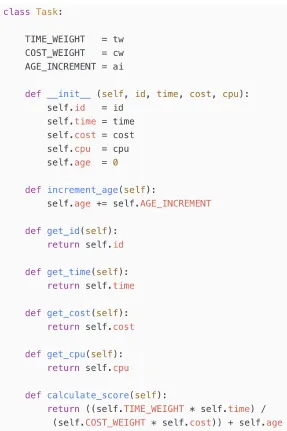
1. Task Class
This class represents a single task in the experiment. The attributes encapsulated in
this class are the task ID, time, cost, needed resources, and age. The task class is
where the priority score is calculated for each task. The priority score is never stored
anywhere and is calculated every time the method is called. The reason for not storing
the priority score is to allow the age of the task to influence the score as it increases. If
the priority score was stored, then the age of the task will not be considered beyond
the initial calculation. Calculating the task priority score repeatedly does not have
any negative impacts on performance since the cyclomatic complexity for the score
calculation is O(1).
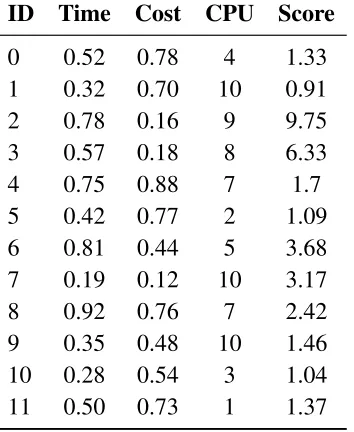
Table 4.1: Single Instance Experiment Randomly Generated Data-set
ID Time Cost CPU Score
0 0.52 0.78 4 1.33
1 0.32 0.70 10 0.91
2 0.78 0.16 9 9.75
3 0.57 0.18 8 6.33
4 0.75 0.88 7 1.7
5 0.42 0.77 2 1.09
6 0.81 0.44 5 3.68
7 0.19 0.12 10 3.17
8 0.92 0.76 7 2.42
9 0.35 0.48 10 1.46 10 0.28 0.54 3 1.04 11 0.50 0.73 1 1.37
The task generator in this experiment was simulating a collection of end-users
sub-mitting tasks to the scheduler. The main job for this component is generating task
objects to simulate real tasks being submitted to the scheduler. The generator keeps
track of the last task ID that was generated and it increments it by one for each new
task. The task generator has a specific time interval to generate the tasks. The time
interval is not static as we changed it every time the simulation executed to simulate
different situations. For example, to simulate heavy traffic of incoming tasks we gave
it the value of 1 second, while for simulating lower traffic it had the value of 8
sec-onds. The values for time, cost and resources needed for each task were generating
using Python’s random library. The time and cost values were generated to be
be-tween 0.1-1 to avoid division by zero and to keep the computation lightweight. The
random values for resources needed by each task were generated to be between 1-10.
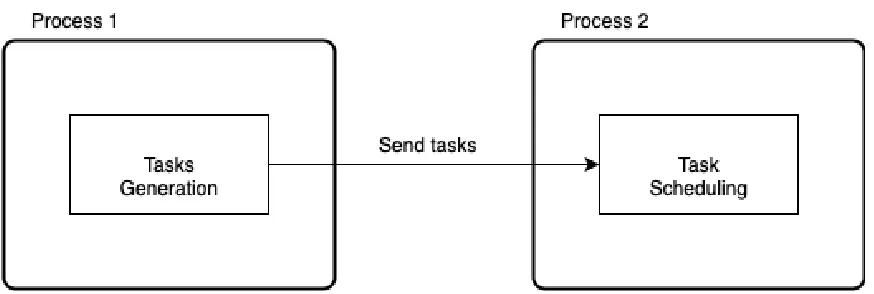
Once a task object is generated, it is then sent to the scheduler using Python’ssocket
andpicklelibraries.
Figure 4.3: Task Scheduler
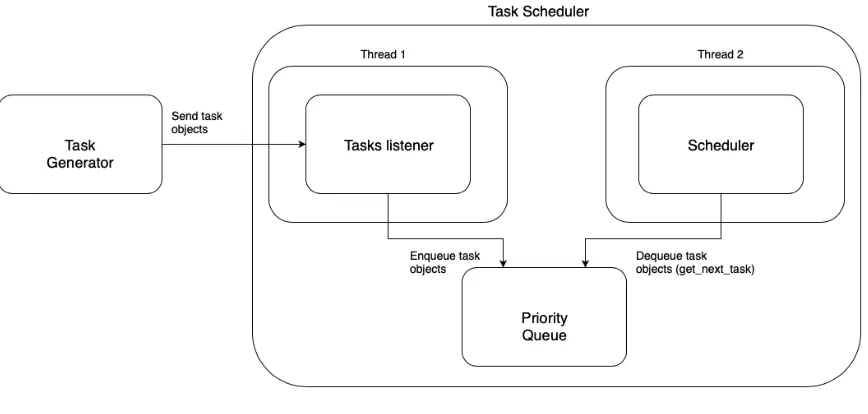
The task scheduler had the responsibility of receiving tasks and simulating resources.
The task scheduler ran on a different process from the task generator to simulate the
separation that naturally exists between the end-user and the cloud service provider.
In addition, we used Python’sthreadinglibrary to run one thread for task scheduling
and resource simulation, and another thread to listen for incoming tasks from the
task generator process. In this experiment, we simulated 10 CPUs available to the
scheduler every 4 seconds. The scheduler will wait for the resources to become
available before attempting to invoke the queue for tasks in order to schedule them.
Before the scheduler attempts to schedule tasks, it will first signal the queue to update
the age of all the tasks waiting to be scheduled by callingupdate tasks age. The goal
of the scheduler was to fully utilize all of the resources it had available. In order to
avoid a race condition, we utilized Python’s threading.Lockto control access to the
shared data between the two threads. The priority queue containing the tasks is the
shared data between the two threads as one of them pushed incoming tasks to it, and
the other thread scheduled tasks from the queue as can be seen in figure 4.2.
4. Custom Priority Queue
Figure 4.4: Custom Priority Queue Implementation
tasks had the same priority score, they will be treated on a first-come-first-serve basis.
When a task object is pushed to the queue, it is first appended to the underlying list
data structure, and then the list is sorted using Python’s sort function. Unlike a
standard queue implementation, we replaced thedequeuemethod withget next task.
The task with the highest priority will not always be fit to be scheduled,get next task
takes in the number of available CPUs to the scheduler as an argument and returns
the next highest priority task that can be executed with the available CPUs.
4.1.2
Results
We compared the two scheduling approaches in terms of average wait time,AWT, per task,
the two schedulers by first using formula 4.1 to calculate the wait time for each task where
swwas the time in seconds that the scheduler had to wait for before attempting to schedule
tasks. Once we knew the wait time for each task we aggregated the wait times in formula
4.2 to compute the average wait time for each scheduling approach forntasks.
wtt=aget×sw (4.1)
AW T = Pt
t=1wtt
n (4.2)
When we ran the experiment with both scheduling approaches, our proposed priority
sched-uler and a first-come-first-serve schedsched-uler with the dataset illustrated in Table 4.1. The task
generator process sent one task every second to both schedulers by the order of their IDs,
starting from task ID 0 to 11. Both schedulers had 10 simulated CPUs available to them
every 4 seconds, which was also their scheduling time interval. When both schedulers
finished execution, the AWT for the priority scheduler was observed to be 10.0, while the
first-come-first-serve scheduler had an AWT of15.66. As for the order the schedulers ex-ecuted the tasks, the first-come-first-serve scheduler exex-ecuted the tasks in the same order
they came in. Table 4.2 illustrates the order our proposed priority scheduler executed the
tasks. The tasks were executed in the correct order based on their priority and when they
were received by the scheduler.
In addition to using a predefined dataset for the single instance experiment, we also
com-pared both scheduling approaches with dynamically generated tasks and measured theAWT
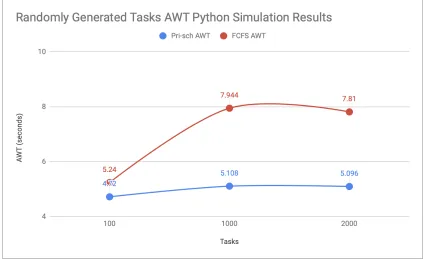
at the end of the execution. We fed both schedulers 100, 1000, and 2000 tasks where the
generator sent 1 task per second and each scheduler had 25 CPUs available every 4 seconds.
TheAWT with 100 tasks for the priority scheduler was4.72while the first-come-first-serve
scheduler scored5.24. As for theAWT of 1000 tasks, the priority scheduler scored5.108
and the first-come-first-serve scored7.944. Lastly, for 2000 tasks, theAWT for the priority
scheduler was5.096and the first-come-first-serve scheduler scored7.81. It can be observed
Table 4.2: Single Instance Experiment Priority Scheduler Execution Results (Table 4.1 dataset)
ID Time Cost CPU Score Age wt
2 0.78 0.16 9 10.75 1 4
1 0.32 0.70 10 1.91 1 4
3 0.57 0.18 8 8.33 2 8
5 0.42 0.77 2 2.09 1 4
6 0.81 0.44 5 5.68 2 8
0 0.52 0.78 4 4.33 3 12
11 0.50 0.73 1 2.37 1 4
7 0.19 0.12 10 6.17 3 12
4 0.75 0.88 7 5.70 4 16
10 0.28 0.54 3 4.04 3 12
8 0.92 0.76 7 6.42 4 16
9 0.35 0.48 10 6.46 5 20
the number of tasks becomes larger.
4.2
Multiple Instance Experiment
4.2.1
Overview
In this experiment, we executed the proposed task scheduling approach in a cloud
environ-ment on AWS using 7 total machines. One machine represented the scheduler handling
Task object generation and scheduling, the other 6 machines represented resources
avail-able to the scheduler. Because we were working with real resources in this experiment,
we implemented a simple python sleep script to simulate the resources being utilized. The
sleep script takes in an integer as a command-line argument for how many seconds it should
sleep the main thread of its process.
We also used Python 3.7.1 as the programming language for this experiment. The
com-munication between the AWS instances was handling using Python’s pickle and socket
Figure 4.5: Randomly Generated Tasks AWT Python Simulation Results
instance experiment. We aggregated the main components from the single instance
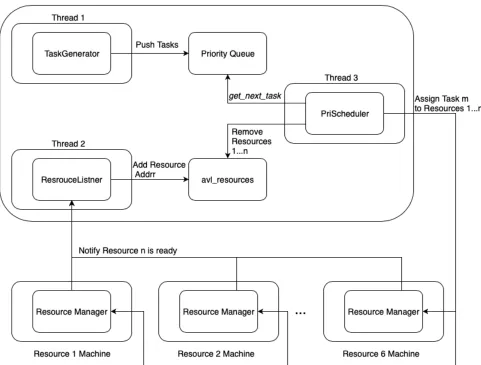
experi-ment into two main components, Task Generation and Scheduling, and Resource Managers.
An overview of the entire system can be seen in Figure 4.8.
There were multiple instances of Resource Managers running in the system, we had one
in-stance on each of the resource machines. The Resource Manager component had the job of
listening to incoming assignments from the scheduler machine, and notifying the scheduler
machine once finished executing the task they were assigned. The incoming assignments
in this experiment were a command to run the sleep script along with the integer value
indicating how many seconds that resource should not be available for use. We utilized the
subprocess library in python to execute the sleep script when assigned. Once a resource
finished executing the sleep script assigned to it by the scheduler, a signal is sent to the
scheduler machine indicating that the resource is ready for another task. Because of the
way Resource Managers operated, we only needed the IP address of the scheduler machine
the resource machines to the scheduler machine. This way the entire system can be scaled
with ease since the Resource Manager component had the responsibility of contacting the
scheduler, which means that adding new resources is just a matter of running the Resource
Manager component on a newly launched instance.
The second main component in the system was responsible for task objects generation, task
scheduling, and keeping track of available resources as they notify the scheduler. To
han-dle those responsibilities smoothly, we implemented 3 concurrent threads using Python’s
threadinglibrary. This component maintained two lists, available resources addresses, and
the priority queue containing the task objects waiting to be scheduled. Thethreading.Lock
library was used to allow the data to be shared between the 3 threads without running into
a race condition or a deadlock. The task object generation and the resource listener threads
append tasks and resources addresses to the tasks priority queue and the list of resources
addresses respectively. The scheduler thread removed tasks and resources from both lists
when it assigned tasks to resources.
4.2.2
Differences from Single Instance Experiment to Multiple Instance
Experiment
For this experiment, we needed to change the Task class. In the single instance experiment,
only indicating how many resources each task object needed to execute was adequate
be-cause we were working with simulated resources and did not need actual execution.
How-ever, we needed to introduce commands to the Task class in the multiple instance
experi-ment because we were assigning tasks to real resources. The Task class impleexperi-mentation in
the multiple instance experiment holds an additional attribute representing the commands
to execute the tasks.
Moreover, unlike the single instance experiment, the number of resources available in this
reason, we could not compare our proposed scheduling approach with another one
simulta-neously and we had to run the experiment with each scheduling approach separately.
How-ever, to ensure fairness in the comparison, both schedulers get the same tasks, we modified
the generation code so it stores the tasks in apklfile using Python’s picklelibrary to store
objects. We changed the generation thread in the scheduler machine to read the already
generated tasks and feed them to the schedulers instead of generating them in real-time.
4.2.3
AWS Instance Specifications and Setup
For this experiment we utilized 7 t2.nano instances on AWS. The computing power
re-quired to conduct our multiple instance experiment was no intensive, which is the reason
we choose the t2.nano instance instead of thet2.micro ort2.small. The specifications for
each of our 7 instances were 1vCPU, and 0.5GB memory.
Once we had our instances reserved on AWS, we had to modify the security groups
con-figuration in order to allow communication between the different nodes in the experiment.
Besides, once we launched the instances and verified that we can establish successful
com-munication among them, we installed our version of Python and cloned our git repository
containing the code base for the experiment.
4.2.4
Results
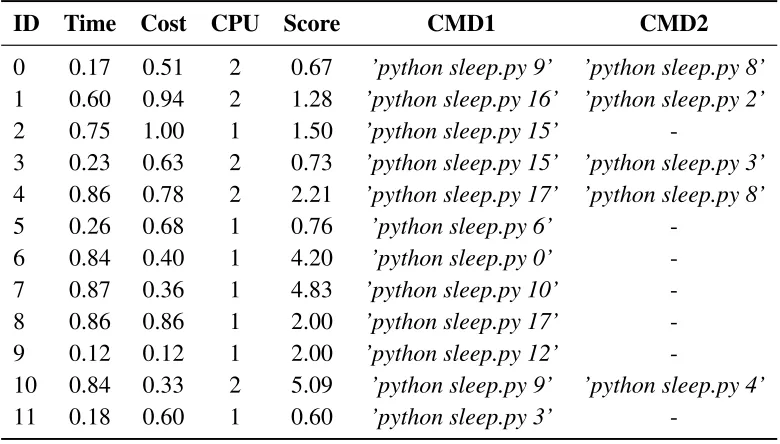
We generated 12 random tasks, Table 4.3, using Python’s randomlibrary. The limits for
both time and cost values stayed the same in this experiment as they were in the Python
one, between 0.1 and 1 inclusive. The fields of CMD1 and CMD2 represent the
execu-tion of their tasks. For instance, the task with ID 0 requires 2 CPUs, one those CPUs will
execute ’python sleep.py 8’ which should occupy it for 8 seconds, and the other required
CPU will execute the second command. The number of seconds eachCMDcould occupy a
resource for were limited to be between 1 and 20 seconds. Each generated task object had
to have at least oneCMD. Also, due to the limited number of resources in this experiment,
Table 4.3: Multiple Instance Experiment Randomly Generated Data-set
ID Time Cost CPU Score CMD1 CMD2
0 0.17 0.51 2 0.67 ’python sleep.py 9’ ’python sleep.py 8’
1 0.60 0.94 2 1.28 ’python sleep.py 16’ ’python sleep.py 2’
2 0.75 1.00 1 1.50 ’python sleep.py 15’
-3 0.23 0.63 2 0.73 ’python sleep.py 15’ ’python sleep.py 3’
4 0.86 0.78 2 2.21 ’python sleep.py 17’ ’python sleep.py 8’
5 0.26 0.68 1 0.76 ’python sleep.py 6’
-6 0.84 0.40 1 4.20 ’python sleep.py 0’
-7 0.87 0.36 1 4.83 ’python sleep.py 10’
-8 0.86 0.86 1 2.00 ’python sleep.py 17’
-9 0.12 0.12 1 2.00 ’python sleep.py 12’
-10 0.84 0.33 2 5.09 ’python sleep.py 9’ ’python sleep.py 4’
11 0.18 0.60 1 0.60 ’python sleep.py 3’
-We fed the data in Table 4.3 to two different scheduling approaches, our proposed approach
and the first-come-first-serve approach on two separate runs. We measured the AWT for
both approaches using the same formulas detailed in the results of the single instance
ex-periment, section 4.1.2. We configured the generator to simulate a new task coming into
both schedulers every 2 seconds and the schedulers to have a 4 seconds time interval for
scheduling attempts. The age increments for the tasks were also 1 in this experiment and
was updated once per scheduling attempt, every 4 seconds. After execution of both
sched-ulers with the predefined dataset, the calculatedAWT was6.66for our proposed approach and 6.33for the first-come-first-serve scheduler. The first-come-first-serve scheduler dis-patched the tasks in the order they came in, while the proposed approach’s order of dispatch
can be seen in Table 4.4.
Moreover, we executed the experiment focusing on resource utilization with larger datasets.
We configured our dataset generation to allow each task to require up to 3 CPUs, and to
only occupy each CPU for the range of 1-4 seconds. The scheduling time interval for this
execution was 2 seconds while the task generation was at 1 second. We ran the experiment
Table 4.4: Multiple Instance Experiment Priority Scheduler Execution Results (Table 4.3 dataset)
ID Time Cost CPU Score CMD1 CMD2
0 0.17 0.51 2 1.67 ’python sleep.py 9’ ’python sleep.py 8’
2 0.75 1.00 1 2.50 ’python sleep.py 15’
-1 0.60 0.94 2 2.28 ’python sleep.py 16’ ’python sleep.py 2’
4 0.86 0.78 2 3.20 ’python sleep.py 17’ ’python sleep.py 8’
6 0.84 0.40 1 5.20 ’python sleep.py 0’
-5 0.26 0.68 1 1.76 ’python sleep.py 6’
-7 0.87 0.36 1 5.83 ’python sleep.py 10’
-10 0.84 0.33 2 6.09 ’python sleep.py 9’ ’python sleep.py 4’
8 0.86 0.86 1 4.00 ’python sleep.py 17’
-9 0.12 0.12 1 4.00 ’python sleep.py 12’
-3 0.23 0.63 2 6.73 ’python sleep.py 15’ ’python sleep.py 3’
11 0.18 0.60 1 2.60 ’python sleep.py 3’
-aRIT. We added a timestamp to the resource listener thread in scheduler’s machine to record
when each resource became available. Each time a command was assigned to a resource,
that resource’s timestamp was subtracted from the current time. For example, if resource
R1 notified the scheduler that it is ready at (20:20:20), that timestamp is recorded along
with the resource’s address as a Python tuple in the available resources list. At(20:21:00),
the scheduler assigned R1 to execute a command, the time R1 has spent idle is exactly
1.20 seconds. Since this only calculates theRIT for one resource, we utilized the formula
illustrated in 4.3 to calculate the averageRITfornassignments.
aRIT = P6
r=1RITr
n (4.3)
After running the experiment with the larger datasets, the priority scheduler had an average
RIT of1.6677seconds, and the first-come-first-serve scheduler had2.2186seconds for 100
tasks. Additionally, for 500 tasks, the proposed priority scheduler scored an average of
1.5176 seconds and the first-come-first-serve scored2.0055 seconds. Lastly, for the 1000
Figure 4.7: Randomly Generated Tasks Average RIT AWS Multiple Instance Experiment Results
Chapter 5
Discussion
In this section, we will discuss the reported results of both the single instance and multiple
instance experiments. In addition, we will also discuss some alternative solutions to solve
the same problem that our proposed approach tackles along with a brief discussion on
future work and threats and limitations to the study.
5.1
Experiment Results
While having a short AWT is good for any scheduling approach, the priority of the tasks
take precedence in the proposed approach. It is true that for the predefined dataset the
proposed approach scored a better AWT than the first-come-first-serve approach did in the
single instance experiment, but more importantly, it also performed better when it came to
the order of the tasks that were scheduled. Table 4.2 shows what order the proposed
sched-uler executed the tasks from Table 4.1 along with their final attributes at execution time.
When we compared the proposed priority scheduler to the first-come-first-serve scheduler
in a simulated heavy task traffic situation and measured AWT the proposed scheduler
per-formed consistently better than the first-come-first-serve. Figure 4.7 shows the results of
executing the single instance experiment utilize both scheduling approach for 100, 1000,
and 2000 tasks. The proposed approach proved it can be scaled to keep up with the demand
of heavy incoming task traffic. TheAWTresults calculated for the proposed approach with
larger dataset shows the value to be stabilizing as the number of incoming tasks becomes
dataset, Table 4.3. While both scheduling approaches performed similarly in that regard,
the proposed scheduling approach performed better in the order of the scheduled tasks,
Ta-ble 4.4. Tasks that were supposed to be executed promptly, based on their user’s preference,
were in fact executed before others, providing better user experience in comparison with
the first-come-first-serve scheduling approach.
To validate how scalable the resource utilization efficiency of the proposed approach in
a cloud environment we compared the first-come-first-serve scheduling approach to the
proposed approach with 100, 500, and 1000 randomly generated tasks. We measured the
aRIT, average resource idle time at the end of each approach’s execution. Figure 4.10
shows how the proposed approach repeatedly had better resource utilization efficiency than
the first-come-first-serve approach. The graph in Figure 4.10 shows the tendency for
re-source utilization of the proposed approach to perform even better as the size of the dataset
increases while that tendency is absent in the first-come-first-serve scheduler’s results.
5.2
Alternative Solutions
There are a number of different solutions to this priority scheduling problem. For instance,
dynamic programming could be used in a weighted scheduling algorithm to perhaps
pro-vide similar results. The weight of the tasks could be their calculated priority scores and
the dynamic programming algorithm would be tasked to schedule tasks giving the priority
to the ones that are associated with higher profits. This will ensure appropriate priority
scheduling of the incoming tasks and will also attempt to stratifying the user by giving
weight to their time and cost preference input.
However, typically for a dynamic programming weighted task scheduling algorithm to
work, each task should also be associated with a start and an end time. Adding more
information to each task object, while doable, will add more complexity to the solution.
The added complexity will not only be in processing more information per task, but also
in determining the start and end for each task. Not all tasks are going to be the same and
5.3
Future Work
In the future, we plan to validate the approach after adding the capability of considering a
larger number of priority factors simultaneously. A considerable part of adding more
pri-ority factors is in the formula which also has the potential to be modified in the future. We
plan to modify the formula so it is more complex and supports more priority factors that the
ones we proposed at this time. Increasing the number of priority factors and modifying the
formula means more accurate priority scores for the tasks and therefore, more effective
pri-ority scheduling and more efficient resource utilization. Adding more pripri-ority factors will
also allow cloud service providers to further customize the proposed scheduling approach
to better fit their needs. Some priority factors that we did not consider at this time but might
consider in the future include user preference on the geolocation of execution and user task
submission history.
In addition, we also plan to modify the generation of the tasks. The task generation we
implemented to validate the proposed approach did not follow a specific distribution. We
plan to modify the tasks generation in the future to follow a set distribution, in terms of task
priory scores, such as the normal distribution. Following different statistical distributions
to generate tasks could help simulate different contexts as well, such as heavy traffic of
incoming high priority tasks or the opposite. Some cloud service providers might benefit
from following a set distribution to generate the tasks as that will show how the approach
will handle those tasks.
Furthermore, the concept of the task aging could be replaced by a task timeout policy where
the original priority of the tasks is not modified. In a task timeout policy tasks are allowed
a certain time in the priority queue, once a task has timed out and stayed in the queue for
too long, it has to be scheduled next. This could result in simpler priority score calculations
and less required processing power by the approach to operate which is worth considering
5.4
Threats and Limitations
While we performed two experiments in this study to validate the proposed approach, it is
still not a replacement for validating in a real-world environment. There were a number
of parameters in both of the experiments we discussed that we changed to mimic different
real-world situations. There is the threat of edge cases we missed or parameters we
con-figured incorrectly as the approach has only been tested in an environment we controlled
entirely. Placing the proposed approach under test in a real-world environment with real
tasks being submitted by actual end-users could give us a better understanding of how the
user experience could improve to satisfy users better.
In addition, the AWS experiment was conducted with large datasets to validate scalability,
however, it was not tested with larger numbers of resources. This poses the danger of cases
that were not accounted for when it comes to the approach’s scalability. Validating the
approach with heavy incoming traffic and allow it access to more resources has the
poten-tial of uncovering facts that may have been missed or overlooked regarding the approach.
Moreover, the system parameters configured, such as task generation and scheduling time
intervals, for the large scale AWS experiment executions were constrained by how many
Chapter 6
Conclusion
To conclude, we proposed a new priority task scheduling approach on the cloud that strives
to achieve excellent resource utilization for cloud service providers and seamless user
ex-perience for the end-users. The proposed approach utilizes the end-users time and cost
preference input to calculate the priority of each task individually. All the tasks waiting
to scheduled are placed in a proposed implementation of a priority queue where they are
ordered by their calculate priority scores. The scheduler then invokes the queue to retrieve
the next highest priority task that can be executed with the resources the scheduler has
available. The approach attempts at scheduling as many tasks as possible at scheduling
time to efficiently utilize the resources.
Moreover, we also placed the proposed approach under test in a simulated cloud
envi-ronment programmed in Python and compared it to a first-come-first-serve scheduling
ap-proach. We executed both schedulers with randomly generated tasks and measured the
average wait time, AWT and observed the scheduling order for each scheduler. The
pro-posed approach performed better than the first-come-first-serve scheduler by having less
AWT and dispatching the tasks in the correct order of their priority score. Furthermore, we
evaluated the proposed approach against the first-come-first-serve scheduler on AWS
utiliz-ing 7 machines, where one machine represented the scheduler and the other 6 represented
resources. For the AWS cloud experiment, we shifted our focus on measuring the average
resource idle time during the execution of each of the two schedulers,aRIT. The reported
results showed the proposed approach to perform better and will continue to perform well
Bibliography
[1] Mohammed Abdullahi, Md Asri Ngadi, et al. Symbiotic organism search optimization
based task scheduling in cloud computing environment.Future Generation Computer
Systems, 56:640–650, 2016.
[2] Mehran Ashouraei, Seyed Nima Khezr, Rachid Benlamri, and Nima Jafari
Nav-imipour. A new sla-aware load balancing method in the cloud using an improved
parallel task scheduling algorithm. In 2018 IEEE 6th International Conference on
Future Internet of Things and Cloud (FiCloud), pages 71–76. IEEE, 2018.
[3] AI Awad, NA El-Hefnawy, and HM Abdel kader. Enhanced particle swarm
opti-mization for task scheduling in cloud computing environments. Procedia Computer
Science, 65:920–929, 2015.
[4] Eric Boutin, Jaliya Ekanayake, Wei Lin, Bing Shi, Jingren Zhou, Zhengping Qian,
Ming Wu, and Lidong Zhou. Apollo: scalable and coordinated scheduling for
cloud-scale computing. In11th {USENIX} Symposium on Operating Systems Design and
Implementation ({OSDI}14), pages 285–300, 2014.
[5] Yiqiu Fang, Fei Wang, and Junwei Ge. A task scheduling algorithm based on load
bal-ancing in cloud computing. InInternational Conference on Web Information Systems
and Mining, pages 271–277. Springer, 2010.
[6] Mahendra Bhatu Gawali and Subhash K Shinde. Task scheduling and resource
allo-cation in cloud computing using a heuristic approach. Journal of Cloud Computing,
[7] Lizheng Guo, Shuguang Zhao, Shigen Shen, and Changyuan Jiang. Task scheduling
optimization in cloud computing based on heuristic algorithm. Journal of networks,
7(3):547, 2012.
[8] Shaminder Kaur and Amandeep Verma. An efficient approach to genetic algorithm
for task scheduling in cloud computing environment. International Journal of
Infor-mation Technology and Computer Science (IJITCS), 4(10):74, 2012.
[9] Bahman Keshanchi and Nima Jafari Navimipour. Priority-based task scheduling in
the cloud systems using a memetic algorithm. Journal of Circuits, Systems and
Com-puters, 25(10):1650119, 2016.
[10] O˘guzhan Kocatepe. An application framework for scheduling optimization problems.
In2014 IEEE 8th International Conference on Application of Information and
Com-munication Technologies (AICT), pages 1–4. IEEE, 2014.
[11] Atul Vikas Lakra and Dharmendra Kumar Yadav. Multi-objective tasks scheduling
algorithm for cloud computing throughput optimization. Procedia Computer Science,
48:107–113, 2015.
[12] Muhammad Shafie Abd Latiff, Syed Hamid Hussain Madni, Mohammed Abdullahi,
et al. Fault tolerance aware scheduling technique for cloud computing environment
using dynamic clustering algorithm. Neural Computing and Applications, 29(1):279–
293, 2018.
[13] Weiwei Lin, Chen Liang, James Z Wang, and Rajkumar Buyya. Bandwidth-aware
divisible task scheduling for cloud computing. Software: Practice and Experience,
44(2):163–174, 2014.
[14] Pieter-Jan Maenhaut, Hendrik Moens, Bruno Volckaert, Veerle Ongenae, and Filip
De Turck. Resource allocation in the cloud: From simulation to experimental
valida-tion. In 2017 IEEE 10th International Conference on Cloud Computing (CLOUD),
[15] Peter Mell, Tim Grance, et al. The nist definition of cloud computing. 2011.
[16] Suraj Pandey, Linlin Wu, Siddeswara Mayura Guru, and Rajkumar Buyya. A particle
swarm optimization-based heuristic for scheduling workflow applications in cloud
computing environments. In 2010 24th IEEE international conference on advanced
information networking and applications, pages 400–407. IEEE, 2010.
[17] S Selvarani and G Sudha Sadhasivam. Improved cost-based algorithm for task
scheduling in cloud computing. In 2010 IEEE International Conference on
Com-putational Intelligence and Computing Research, pages 1–5. IEEE, 2010.
[18] Sukhpal Singh and Inderveer Chana. A survey on resource scheduling in cloud
com-puting: Issues and challenges. Journal of grid computing, 14(2):217–264, 2016.
[19] Jyoti Thaman and Manpreet Singh. Current perspective in task scheduling techniques
in cloud computing: A review. International Journal in Foundations of Computer
Science & Technology, 6(1):65–85, 2016.
[20] Antony Thomas, G Krishnalal, and VP Jagathy Raj. Credit based scheduling
algo-rithm in cloud computing environment. Procedia Computer Science, 46:913–920,
2015.
[21] Chun-Wei Tsai and Joel JPC Rodrigues. Metaheuristic scheduling for cloud: A
sur-vey. IEEE Systems Journal, 8(1):279–291, 2013.
[22] Chenhong Zhao, Shanshan Zhang, Qingfeng Liu, Jian Xie, and Jicheng Hu.
Inde-pendent tasks scheduling based on genetic algorithm in cloud computing. In 2009
5th International Conference on Wireless Communications, Networking and Mobile