Children’s Social Care Innovation Programme Evaluation Report 44
1Project Crewe
Research report
July 2017
2
Contents
List of figures 4
List of tables 5
Executive summary 7
Summary of findings 8
Implications and recommendations 9
Introduction 11
Project Crewe Overview 11
Method 12
Evaluation aims 12
Quantitative design 13
Qualitative design 13
Risk analysis method 14
Improving outcomes for CIN 16
Summary of findings 16
CIN case outcomes 16
Likelihood of closing cases 17
Closing cases more quickly 19
Decreasing re-referrals 20
Attendance 20
Behaviour Scores 21
Risk 22
Qualitative analysis of CIN outcomes 28
Summary of findings 28
Map of qualitative findings 28
The effect of the Family Practitioner 30
Frequent contact 31
Flexible contact 34
Solutions-focused approach 36
Giving control to families 37
3
Relative success in addressing different types of problems 39
Parents are levers for, and inhibitors of, change 40
Project delivery 41
Cost-benefit analysis 41
Qualitative findings of project delivery 42
Alleviating pressure 43
Internal processes within Project Crewe 43
Communication 47
Limitations 49
Implications and recommendations 50
Implications for policy 50
Implications for evaluation and research 51
Conclusion 52
References 53
Appendix 1: Qualitative sample information 56
Appendix 2: Detailed sample outline 58
Appendix 3: Risk analysis framework 61
Appendix 4: Qualitative evaluation methodology 63
Appendix 5: Consent forms 64
Appendix 6: Quantitative evaluation methodology 67
Appendix 7: Solutions-focused brief therapy 75
Appendix 8: Project Crewe staffing model 76
Appendix 9: Cost benefit analysis 77
Appendix 10: Evaluation outcomes and measurements 81
4
List of figures
Figure 1: Likelihood of closing cases 18
Figure 2: Likelihood of a case closing across the pilot 19
Figure 3: CIN absences from school 21
Figure 4: Box and whisker for CEC cases at referral, and then using latest information 24 Figure 5: Box and whisker for Project Crewe cases at referral, and then using latest
information 24
Figure 6: Change in average total risk score at the point of referral to latest update,
between Project Crewe and CEC CIN cases 25
Figure 7: Change in average risk factors between Project Crewe and CEC CIN cases 26 Figure 8: Change in average protective factors scores between Project Crewe and CEC
CIN cases 26
Figure 9: Map of the most common themes in the qualitative data 29
Figure 10: CIN picture of their family and Family Practitioner 30
Figure 11: Bar chart of average number of total visits to a CIN case over a month as
described by families and frontline staff 31
Figure 12: Distribution of NHS stress scores across CEC and Project Crewe in
5
List of tables
Table 1: Summary of sample 14
Table 2: Comparison of risk occurence in PC cases with national figures 15
Table 3: Sample overview by case outcome 57
Table 4: Detailed CIN case study sample information 58
Table 5: Detailed sample: non-CIN case study 60
Table 6: Illustrative average cost per case 77
Table 7: Illustrative individual benefits of Project Crewe and Cheshire East to the CIN 78
Table 8: Illustrative analysis of cost of re-referral per case 79
Table 9: Benefit of reducing escalations to child protection 79
6
Acknowledgements
7
Executive summary
Raising children is challenging. Some parents and carers, through a combination of circumstance and motivation, find it easier than others. A gap can exist between a parent’s intentions and actions: when this gap threatens the wellbeing of a child, children’s services become involved. In 2016, 394,400 children were referred to social care and assessed as ‘children in need’ (CIN), the first rung of formal state intervention. Of those children, around 12 per cent needed increased intervention at ‘child protection’ or ‘looked after’ level (DfE, 2016).
Across several dimensions, children with child protection plans experience worse
outcomes than other children. In 2014/5, only 49 per cent of primary-aged CIN achieved level 4 or above in writing compared to the 80 per cent average and only 15 per cent achieved 5 A*-C GCSEs including English and Maths, compared to 54 per cent national average (Morse and Arkell, 2016: 37).
In 2014, the Department for Education funded the Social Work Innovation Fund, which aimed to encourage new thinking in how children’s services support young people. The Behavioural Insights Team (BIT) have conducted an evaluation of one pilot funded
through the Innovation Fund, Project Crewe. It aimed to close CIN cases and divert them from being re-referred or escalated by offering more intensive support early on. This innovative model was tested using a randomised controlled trial (RCT), in which young people were assigned either to receive the Project Creweworking model (the ‘treatment’ group), or the business as usual local authority service (the ‘control’ group).
This RCT methodology allowed us to identify the specific impact of Project Crewe. Unfortunately, a smaller than anticipated sample size led to us being unable to draw any statistically significant conclusions. Instead, the results can only offer indications of potentially promising impact.We find that, compared to the more traditional model of support, cases assigned to the treatment group were closed more frequently (particularly for families with a history of social support) and experienced a greater increase in factors associated with lower risk of escalation. However, despite closing more cases, we found that the average case duration was shorter in the control than in Project Crewe. These results, based on data from the first 14 months of the pilot, do contain some early positive signs. The benefit of the RCT is that Cheshire East Council can continue to monitor these promising indications to measure the longer-term outcomes of these groups, as well as explore theories raised in the qualitative analysis.
Within this intervention, in-depth interviews with frontline staff and case families led us to isolate several elements we believe to be most effective in generating positive results for Project Crewe. Personalised and frequent support was offered to families using a
solutions-focused approach: in the first instances Family Practitioners worked with
8
traditional model of support, and used feedback tools to visualise their progress. It is striking that those who had previously experienced traditional care before were the most positive about this innovative approach: Project Crewe was able build and re-establish relationships with families who may have had negative experiences in the past.
From an organisational perspective, Project Crewe demonstrated that a staffing model not wholly reliant on social work qualified staff could achieve positive outcomes for CIN. The novel approach to the staffing model, using family practitioners, volunteers and a pod support system, was highly valued by staff who felt supported to enact sustainable change with their families. CEC and Catch22 senior leaders have continued to reflect together upon the lessons of the pilot to improve their joint ways of working.
Despite a smaller than anticipated sample size, which restricted the confidence we can place in the results, this evaluation is important methodologically: it is the first known successful randomised controlled trial to be conducted in social care in the United
Kingdom. This has important implications for the future What Works intervention in social care: when children’s services have finite budgets and resources, it is essential to
understand whether an intervention works, and which elements within it are effective. Combining this respected evaluation approach with in-depth qualitative research allowed us to ascertain that Project Crewe was effective, and to determine the mechanisms within it that appear to be most effective at improving CIN outcomes.
Summary of findings
We outline the evidence of impact, mechanisms of impact and project delivery findings below. Project Crewe appears to have had some positive impact on CIN outcomes. However, these results were not statistically significant and should be read as positive indications, as opposed to concrete evidence of impact.
Evidence of impact
• Project Crewe (PC) pilot closed more Child-In-Need (CIN) cases than the cases which remained with Cheshire East Council (CEC)
• Project Crewe appears most effective in closing cases with a previous history of social care
• Although they closed fewer cases, where CEC social workers did close cases, it was quicker than PC
9
• Project Crewe suggests that CIN cases can be supported positively by non-social work qualified staff
Mechanisms of Impact
• Project Crewe families were visited 3 times more frequently, and offered
personalised flexible support. This was seen to develop stronger, more trusting relationships between the staff and their cases more quickly
• The solutions-focused approach (SFA) was valued by Project Crewe families. They felt empowered through being given ownership of their problems. Using feedback tools in conjunction with SFA enabled families to visualise their progress
• SFA suited some families more than others: it appeared to be less effective with families in acutely stressful or chaotic situations, and required the CIN case parents to acknowledge their situation as problematic
• The model may be particularly valuable for families with a history of social care as it offers them a fresh start and a chance to re-set their relationship with social support
Project Delivery
• Project Crewe has a strong culture of collaboration and support built through the innovative pod structure and supported by the buddy system. A responsive training programme allows frontline staff to access the information they need to support their families
• Project Crewe staff displayed lower levels of stress than their counterparts
• Project Crewe created space for social workers to focus on more complex child protection cases. It did not reduce overall social worker caseload as the CIN cases diverted to PC were typically replaced by additional referrals
• Embedding the model has taken time, and there have been issues with communication at the referral, handover and escalation stages. Although
substantial efforts are being made to overcome these, this is an ongoing challenge
Implications and recommendations
Implications for policy10
• Working to resolve parent and carer issues, especially around their
self-confidence and practical ability to parent, is fundamental to generating positive outcomes for CIN
• Altering the way of working with families with a history of social care, such as the solutions-focused approach, may improve case closure
• Diverting some low risk CIN caseload from SWs may allow them to focus on the more complex child protection cases
• Innovative models of social care are difficult to integrate within pre-existing social services. Good communication and collaboration between senior leaders and frontline staff on both sides is essential
• Better data need to be made available to improve monitoring in this sector, linking CIN status with other longer term outcomes such as employment and health
Implications for evaluation and research
• Randomised Controlled Trials can be implemented effectively in social care evaluations and should be prioritised in future commissioning decisions
• It is possible to successfully create and implement a counterfactual through
randomisation in children’s social care which can help us understand the impact of the intervention
• These results show promising indications of impact. The data for this analysis were collected at a nascent stage, and it is recommended that Cheshire East and Catch22 continue to monitor the longer-term outcomes, especially around re-referrals, of the ‘control’ and ‘treatment’ groups
11
Introduction
Catch22 and Cheshire East Council worked closely with the Behavioural Insights Team to evaluate an innovative model of social care services for Children in Need: “Project Crewe”. The pilot, funded through the Department for Education’s Social Work Innovation Fund, is named after the town where the majority of children receiving social care in Cheshire East reside. This report outlines the findings from the evaluation conducted by the Behavioural Insights Team, that consists of a randomised control trial combined with an in-depth qualitative evaluation.
Project Crewe Overview
Project Crewe (PC) is a pilot model of support for children assessed as being a Child In Need (CIN)1. It was developed and delivered by Catch22 (C22), in conjunction with Cheshire East council (CEC). Catch22 is a social business which provides a range of services from cradle to career and, for 12 years, has delivered services in Cheshire East, with whom they partnered to co-produce the pilot. The project aims to improve the
outcomes for CIN by offering a more personalised and intensive model of support, as recently recommended by the Troubled Families evaluation (Blade et al, 2016).
Logistically, Project Crewe is allocated cases assessed by Cheshire East social workers to be CIN. The CIN case is managed and delivered by non-social work qualified staff, a model which has shown promise in the United States (Peacock et al, 2013). Specifically, Project Crewe aims to reduce re-referrals to social care and escalations to child
protection and looked after status. It was also hoped that diverting cases from social workers would reduce their caseload, allowing them to focus on the most urgent cases while maintaining confidence that lower risk CIN were still receiving high quality support. The intervention we evaluated consists of several elements that are distinct from the traditional, business as usual support offered by CEC social workers. These are:
• qualified Social Work Consultants (SWC) hold the statutory responsibility for cases and manage a team of Family Practitioners
• primary front-line staff, Family Practitioners, are non-social work qualified
• these staff have a diverse range of backgrounds in education, youth work, substance misuse and the early years
• their role is to develop and deliver the CIN plan; working with families to help them identify signs of relapse, build resilience and maintain long term positive change
12
• frontline staff use a solutions-focused approach with their cases, this is based on Solution-Focused Brief Therapy (SFBT) which has shown to be effective in early input interventions (Bond, 2013). See Appendix 7
• the tailored model of support was designed to be more intensive, with frequent and flexible contact time with CIN cases, including early mornings and weekends. Intensive support for families was shown to have a positive impact in a Catch22 pilot (Catch22, 2014)
• alongside Family Practitioners, volunteer Peer Mentors and Family Role Models work with children and parents to support families to sustain positive change after case closure2
• pod teams, where one SWC supports 4 FP, are structured to formalise and encourage collaboration, skill building and sharing best practice. See Appendix 8
• personalised family budgets are used to help a family achieve the goals outlined in the CIN plan, such as a trip or a reward
Considering all these elements of the intervention, this evaluation analyses the model as a whole in the quantitative analysis, and draws on qualitative measures to understand which components within this multifaceted approach are perceived to be most effective.
Method
Evaluation aims
The evaluation aimed to assess the effectiveness of the PC approach, compared to the business as usual CEC approach. This was achieved by employing a mixed method approach, using a quantitative RCT design in conjunction with an in-depth qualitative inquiry, which was combined with the quantitative research during the analysis phase. This is known as a convergent parallel mixed method approach (Creswell, 2013). Triangulating findings during the analysis helped us explore which aspects of this complex intervention were most likely to lead to success if replicated elsewhere. It addressed this overall purpose through the following areas:
• whether Project Crewe improved outcomes for CIN when compared to the control group; in particular,
• had better social care outcomes
• reduced risk factors in the CIN cases
2 To date (November 2016), 2 parents previously supported by Project Crewe have become volunteer
13
• better academic and behavioural outcomes
• how participants experienced the intervention
• how the intervention is delivered and its effect upon staff
• the intervention’s operational costs in comparison to the control
Please refer to Appendix 10 for a detailed outline of the evaluation outcomes and measurement strategy.
Quantitative design
The evaluation of Project Crewe is centred on a randomised controlled trial (RCT), which ran from August 2015 to March 2016. Cases were eligible for the evaluation if they were categorised as CIN, and Cheshire East staff felt they would benefit from intensive
intervention. Of the 132 cases that were recommended by CEC staff, two-thirds (70%) were allocated to the Project Crewe (PC) pilot, termed the ‘treatment’ group, and one-third (30%) remained with Cheshire East, termed the ‘control’ group. The RCT was structured to ensure that all children within a family were allocated to the same service – this made implementation easier for the delivery organisations as it prevented families being supported by both interventions at the same time. The randomised 132 cases (individual CIN) consisted of 326 sibling children and young people. For the analysis, we had to exclude 6 cases, as their outcome information was incomplete. The final sample therefore consists of 126 cases.
For the RCT design please see Appendix 6
Qualitative design
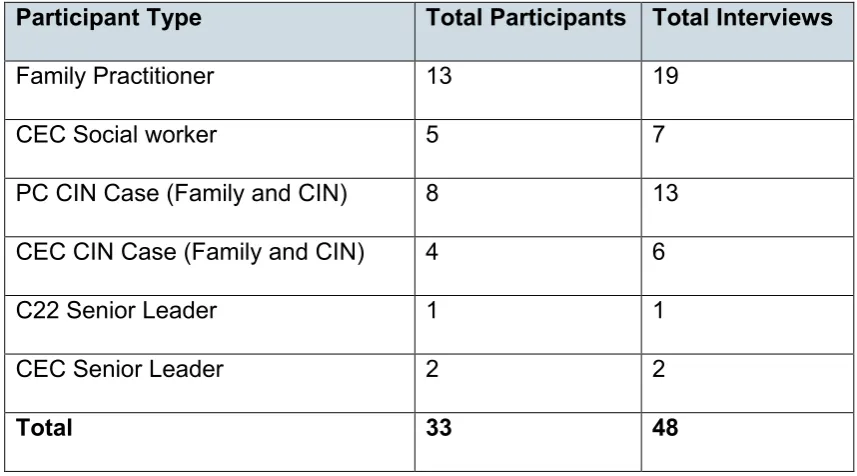
Data for the qualitative work were collected through semi-structured interviews, which either took place over the phone, or in families’ homes. 48 interviews were conducted with 33 families, frontline staff and leaders from both Cheshire East and Project Crewe across 2 time periods: November 2015 and April 2016. This enabled us to capture how the experience and delivery of the intervention evolved or altered for both staff and
14
Table 1: Summary of sample
Participant Type Total Participants Total Interviews
Family Practitioner 13 19
CEC Social worker 5 7
PC CIN Case (Family and CIN) 8 13
CEC CIN Case (Family and CIN) 4 6
C22 Senior Leader 1 1
CEC Senior Leader 2 2
Total 33 48
It is worth noting that a lapse of nearly 10 months occurred between data collection and reporting and the Project Crewe delivery model evolved in this time. Where possible, changes to the approach have been highlighted alongside the analysis. A detailed outline of the qualitative methodology is found in Appendix 4.
Consent
For the randomised controlled trial, families were offered opt-out consent and allowed time to decide whether to take part. For the qualitative study, opt-in consent was sought from both the parents and their children. Participation was voluntary, and no pressure was placed upon the families: those who chose to withdraw from the study were respected. Both consent forms can be found in Appendix 5.
Risk analysis method
A qualitative risk analysis was conducted to understand from the case notes whether, and to what extent, risk changed over time in both the control and treatment group. 30 randomly selected cases from CEC and Project Crewe were manually coded against a risk framework and subsequently analysed. The framework was developed by the research team, based on systematic reviews and meta-analyses of factors which correlate with increased or reduced likelihood of harm recurring in children. (Wilkins, 2015; Barlow et al, 2012; White et al, 2015; Hindley et al, 2006). The matrix can be found in the Appendix 3.
Each case was coded and scored against 3 categories: risk factors (low school
15
Each protective factor was marked positively, whilst risk factors were coded negatively. Engagement was rated on a sliding scale between -2 (dissents, lies or avoids) to +2 (strong engagement with social care). This generates 2 overall scores which show the difference and change in risk between the 2 points: time of referral and latest case information.
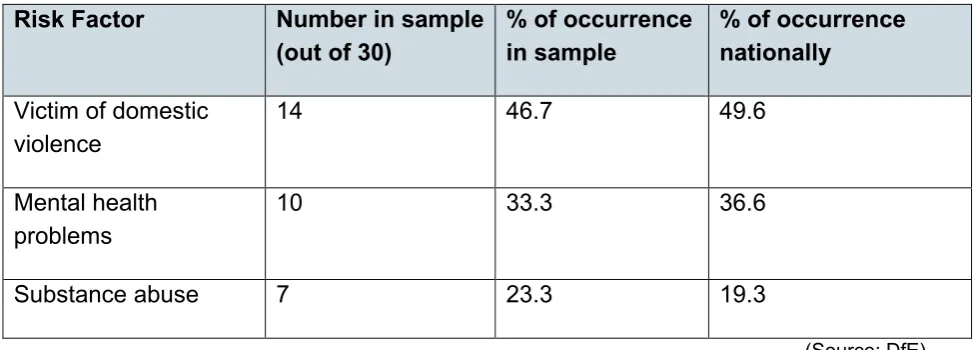
[image:15.595.50.538.238.413.2]Despite being a small sample of 30 randomly selected cases (15 PC, 15 CEC), the types of risk factors that occur, in the risk analysis were similar to the national data on factors in CIN cases.
Table 2: Comparison of risk occurence in PC cases with national figures
Risk Factor Number in sample
(out of 30) % of occurrence in sample % of occurrence nationally
Victim of domestic violence
14 46.7 49.6
Mental health problems
10 33.3 36.6
Substance abuse 7 23.3 19.3
(Source: DfE)
16
Improving outcomes for CIN
This section outlines our quantitative results which compared the CIN outcomes from the control (CEC) and treatment (PC) groups. Despite finding some positive indications, we were unable to find any statistically significant results because our sample size was 50% smaller than expected. To compound this, the re-referral outcome needed more time to more accurately reflect how a programme might influence a case longer term. The findings should therefore be considered as positive indications of impact, as opposed to concrete evidence of effect.
Summary of findings
• Project Crewe appears more effective at closing cases than CEC. However, due to the small sample size and lack of significance, this finding should be treated with caution
• PC may be particularly effective for families that have a previous history of CIN involvement
• Despite closing fewer cases, CEC appears to close cases more quickly
• We find no difference in school attendance rates between children assigned to PC and CEC
• Project Crewe CIN appear to have better behaviours compared to their CEC counterparts at one point in time, however due to data collection issues we cannot say whether the intervention had any impact on behaviour
• Both interventions seem to be effective at reducing risk scores over the course of trial period. Project Crewe cases have a higher reduction as Project Crewe
improved average levels of protective factors more than CEC
CIN case outcomes
17
1. Referral dates open before the PC pilot started are re-coded to correspond to the PC timeline. Therefore, if a case was open prior to this date, we re-coded the referral date to 1st August 2015
2. If the family received CIN support prior to 1st August 2015, we marked their case with a ‘history of social care’ indicator
3. We only classified cases as re-referrals if they were closed and re-referred during the PC pilot timeline (1st August 2015 - 1st November 2016)
4. We only classify those cases which were stepped down by the end of the pilot
timeline (1st November 2016) as ‘closed’. Cases that closed during the pilot but were
re-referred were not categorised as closed
Likelihood of closing cases
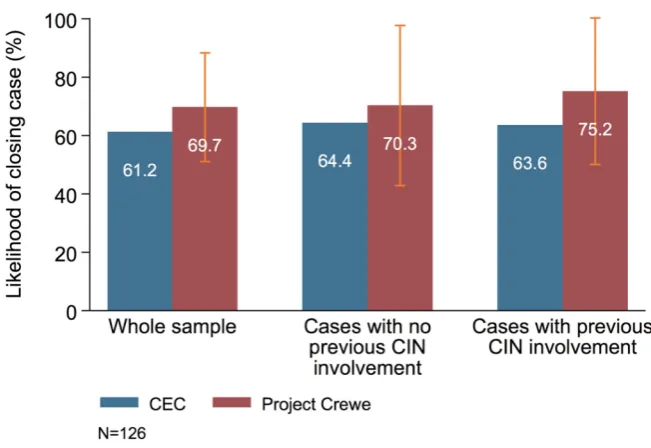
• The Project Crewe programme appears more likely to close a case compared to CEC by 8.5%. This result, however, is not statistically significant
• The Project Crewe programme appears 12% more likely to close cases for families with a history of social care involvement
Our primary analysis used an ordinary least squares (OLS) regression approach to understand how likely each programme was to close a CIN case This method allows us to account for differences between cases, such as gender and age of the CIN and their history of social care, effectively removing those factors from influencing the findings. Appendix 6 provides a more detailed overview of the analysis strategy, specification and assumptions made.
18
Because findings from the qualitative data suggest that families with prior experience of CEC support were much more positive about their PC experience, we were also keen to see whether having a history of social care affected the likelihood of case closure. Interestingly, although again not statistically significant, Project Crewe has a greater effect on closing cases with a history of social care involvement. Our results indicate that these cases are 20 percentage points more likely to be closed with Project Crewe,
suggesting it may be particularly effective for these families. These results are presented in Figure 1. The thin orange lines, confidence intervals, represent the range of
[image:18.595.138.464.294.518.2]uncertainty around our estimated effect of Project Crewe on the likelihood of closing cases. The asterisks displayed below the figure are used to report statistical significance of estimates. As these orange lines overlap and no asterisks are present on the graph, this signifies no statistically significant results.
Figure 1: Likelihood of closing cases
When interpreting the findings, one hypothesis could be that families with a history of social care are reacting positively to a change in the type of support received after being allocated to Project Crewe. These families could be responding well to a novel approach and a chance to re-set their relationship with frontline staff. This theory concurs with both the “fresh start effect” literature (Dai, Milkman and Riis, 2014); and qualitative analysis, which found families with previous experience of traditional social care were most
19
Closing cases more quickly
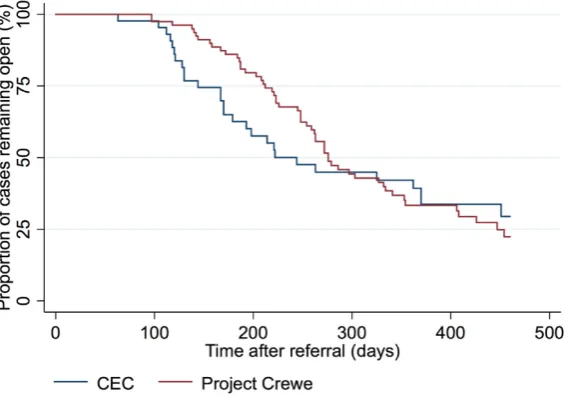
• Although Project Crewe appears to close more cases by the end of the trial period, CEC appears to close its allocated cases faster than Project Crewe
• Due to the smaller than anticipated sample size, the evidence is not conclusive The time it takes to close and resolve the related issues of a CIN case is important for the stability of the family, and has financial and resource implications for children’s
services. We were therefore keen to understand the length of time each programme took to close a case. We used a statistical method known as survival analysis to estimate this, which accounts for the fact that not all cases were closed at the end of the study (see Appendix 6 for further details of the model, specification and assumptions).
[image:19.595.155.439.534.733.2]The likelihood of a case being open after referral, in each intervention, is shown in Figure 2. The Y axis depicts the chance of a case being open, and the X axis is time (in days) elapsed since the pilot commenced. We can therefore see that, at time 0, all cases are open for both interventions. Over time, the likelihood of a case being open decreases at differing rates for Project Crewe cases and Cheshire East. The data suggest that CEC closes cases more quickly. This is represented by the sharper decline in probability of a case remaining open between 100 and 300 days after referral. Despite Project Crewe closing more cases by the end of the trial period (represented by the lower proportion of cases remaining open at the end of the study period), CEC tend to close cases faster. Contributing factors may be the slower disengagement procedures employed by Project Crewe, and the continued support from Family Role Models after case closure. Several Family Practitioners felt that gradually reducing the intensity of support helped families maintain their positive change (see page 29).
20
Decreasing re-referrals
Although closing CIN cases is an important measure, it was essential to capture whether the positive change made with families was sustained. Re-referrals are a problem for local authorities across the country, with many families bouncing in and out of the system over a number of years. Anecdotal evidence from Cheshire East suggest Project Crewe had helped resolve several of these complex ongoing cases for them. One family of 9, who have been known to CEC since 2010, with multiple referrals, had been stepped down in November 2015 and not been re-referred (as of December 2016). Another family of 3, with 5 separate episodes of involvement, including child protection, has remained closed since March 2016 and as of December 2016 had not re-opened.
We attempted to examine the effect of each intervention on reducing re-referrals to social care after being closed. However, due to a lack of occurrence of re-referrals in the data, and not enough time elapsing between the trial and analysis of data, the findings are inconclusive. There were only 8 observed occurrences of re-referrals (after the case had been opened and closed within the trial period) in our dataset, and we are therefore not able to analyse this outcome in any meaningful way. There were 5 re-referrals in PC and 3 in CEC, which, when accounting for the 2:1 ratio of control and treatment, is a 0.7% difference. However, the available data is far too small to analyse. It will be important to continue to track this sample, to monitor longer-term impact on re-referral rates.
Attendance
Although it is important to consider direct case outcomes, examining CIN’s education helps us understand the intervention in a more holistic way. The section below uses the National Pupil Database (NPD) to assess whether CIN receiving PC support have different school attendance rates to those receiving CEC support. Attendance is an important metric as it correlates with decreased likelihood of a child experiencing harm (Hindley, 2006), and stronger academic attainment (DfE, 2015). If an intervention
improves stability and routines within the household, we might expect levels of absence to decrease.
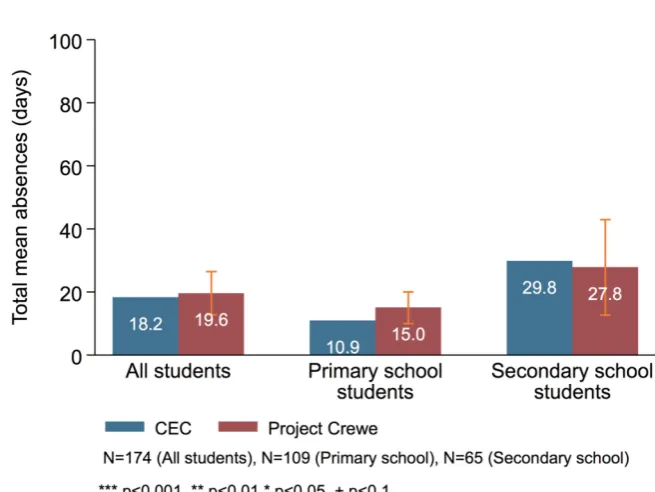
Our analysis uses the total number of absences, measured in days, over the first 2 terms of the school year (summer term 2016 absence data was unavailable at the time of analysis). We used OLS regressions to examine whether there were significant
21
Figure 3 shows the difference in attendance of CIN between the Project Crewe and CEC, broken down by level of schooling. It presents predicted average attendance for CINs in each programme, of which none of the observed differences are substantive or
[image:21.595.135.463.217.463.2]statistically significant. We observe that CINs in Project Crewe had a marginally higher absence rate than their counterparts in CEC across the whole sample. This trend is also seen in the primary school sample, with CEC having a lower absence rate than PC. However, CIN of secondary school age supported by Project Crewe have a better attendance rates compared to those supported by CEC.
Figure 3: CIN absences from school
Behaviour Scores
• Project Crewe CIN appear to have better behaviours compared to their CEC counterparts at one point in time.
• This only provides a one-off snap shot due to issues with data collection - it is therefore impossible to say whether there was a change in behaviour due to the intervention
Understanding how CIN behaviour changes over time can be a useful metric to assess broader improvements at home and at school. We hoped to examine these changes by using a strengths and difficulties behaviour questionnaire (SDQ), which would be
22
As the scoring of the SDQ does not follow a linear pattern, we use the Mann-Whitney U test in our analysis to account for the irregular distribution of scores. This compares whether there are any significant differences between SDQ scores for children in the PC intervention relative to the CEC intervention. The SDQ measures 5 sub-categories; emotional symptoms; conduct problems; hyperactivity (inattention); peer problems and pro-sociality. These are aggregated into a total behaviour score. We observe no
significant differences between groups in any of these measures: however, Project Crewe CIN appeared to have slightly better behaviour at the time the survey was
completed. For future studies, we recommend ensuring surveys are simple enough to be completed multiple times, which would allow the impact of the intervention on behaviour to be assessed.
Risk
• This is a novel methodology for measuring risk but due to the very small sample size, results must be taken as promising indicators which require further in-depth research
• Biases may be present in reporting style differences between CEC and Project Crewe which may also have influenced results
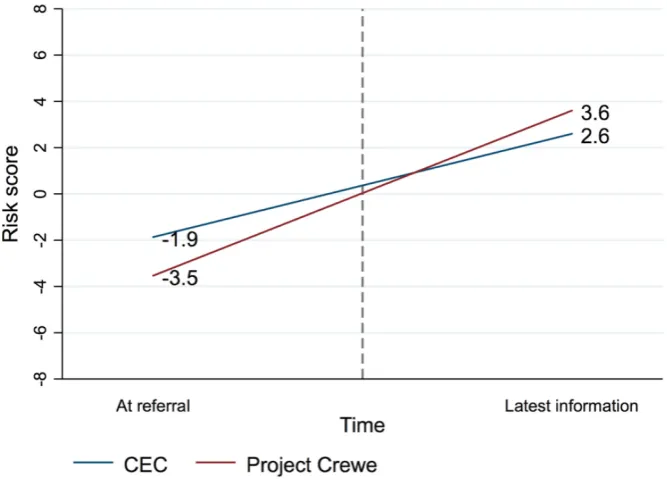
• Both CEC and Project Crewe led to decreases in risk over the course of the trial period, though there appears to be a larger reduction in risk for cases assigned to Project Crewe (when comparing the level of risk at the time of referral and at the most recent case information)
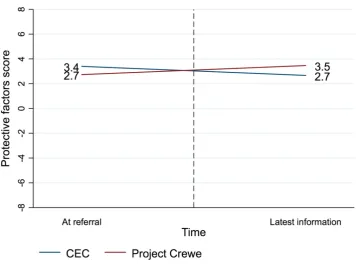
• Both interventions have a similar positive effect on risk factors. However, Project Crewe appears to be more effective at improving protective factors
• This may indicate that future re-referral is less likely as more factors which are strongly associated with reduced risk of future harm are present
Risk factors and protective factors associated with an increased or decreased likelihood future harm in children have been well documented (Wilkins, 2015; Barlow et al, 2012; White et al, 2015; Hindley, 2006). Understanding how these factors occur in cases is crucial to understanding the efficacy of Project Crewe compared to CEC.
23
findings are only based on 30 cases – a very small sample. We had intended to code the case notes of the entire sample but, as mentioned in the methods section, were unable to secure a data sharing agreement. Alongside the biases which may be present in the qualitative coding, we cannot generalise these findings and must only interpret them as positive indications of impact which require future exploration with a larger sample.
Risk analysis findings
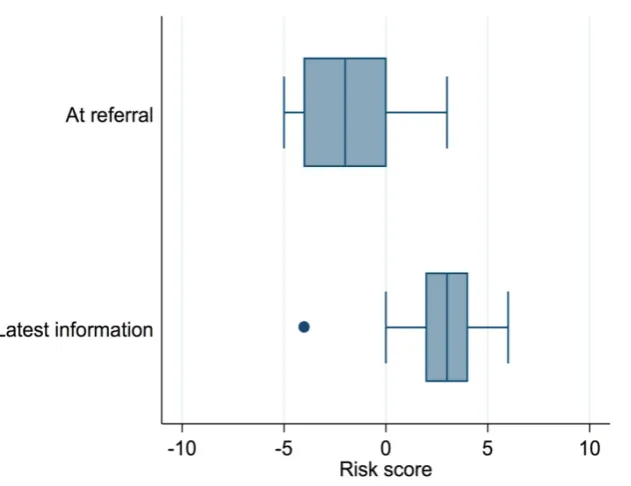
This analysis first outlines the differences in total risk score (risk score, protective score and engagement score summed) between Project Crewe and CEC case across the 2 time points. As risk is coded negatively and protective factors coded positively, a score becoming more positive demonstrates that there is less risk present in the case. Box and Whisker plots outline the spread of risk data, the median average risk score and how the risk scores are distributed. The ‘whiskers’ show the range: the highest and lowest risk scores across the sample. The line that strikes through the box denotes the median risk score. The edges of the box show the median in the lowest and highest halves of the data – this splits our data into four quartiles – the bottom quartile ranging from the whisker to the edge of the box. A dot on a graph represents an outlier, which is a risk score that is abnormal compared to the rest of the scores. The median and range of total risk scores can be found for CEC in Figure 4 and for Project Crewe in Figure 5. The box and whiskers compare the average risk scores in cases at the point of referral and with the latest case information. In both programmes, there is a positive shift and a reduction in risk over time as the scores at ‘latest information’ become more positive. This indicates that cases have fewer risk factors and more protective, or positive engagement, factors present at the end point compared to the initial referral.
24
Figure 4: Box and whisker for CEC cases at referral, and then using latest information
Figure 5: Box and whisker for Project Crewe cases at referral, and then using latest information
[image:24.595.149.470.425.667.2]25
To try to unpick what accounted for the difference in improvement, we broke down the total risk score into 2 categories: protective factors and risk factors. Protective factors are associated with the prevention of future harm, such as CIN engagement in school,
[image:25.595.129.463.115.359.2]supportive familial networks and parental employment. Risk factors correlate with an increased likelihood of future harm, such as parental substance abuse, poor mental health or domestic violence. As outlined in Figure 7, the improvement in risk factors is similar between Project Crewe and CEC suggesting that both interventions have a similar impact on these factors. Conversely, we observe a small decrease in average protective factors for 15 CEC cases, which increases in 15 Project Crewe cases. Figure 8 indicates that the Project Crewe model of support may be more effective at increasing protective factors. This seems to be what accounts for the greater improvement in average total risk scores for cases receiving Project Crewe support.
26
Figure 7: Change in average risk factors between Project Crewe and CEC CIN cases
[image:26.595.105.462.353.623.2]27
28
Qualitative analysis of CIN outcomes
Understanding how both Project Crewe and the CEC model of support were experienced and perceived, both by those who both received the intervention and those who delivered it, can help us identify what elements were most effective. This next section outlines the findings from in-depth interviews with families and frontline staff, who were spoken to at 2 points across the pilot year.
Summary of findings
• A Family Practitioner visited a case overall on average 3 times more frequently than a social worker. This was seen by FPs to develop stronger and more trusting relationships between the staff and their families more quickly
• The flexibility of the Family Practitioner role, visiting at specific times or to do tailored activities, allowed the frontline staff to differentiate their support, which again developed relationships and supported the sustainable stepping down process
• The solutions-focused approach (SFA) was valued by parents as it engendered a sense of control.
• Feedback tools allowed families to visualise their progress and supported their engagement with the change process and with their Family Practitioner
• For SFA to be effective, parents had to recognise the need for change
• SFA appears to be less effective for families with the most chaotic or stressful issues
• These positive findings lead us to suggest that, despite not having formal social-work qualifications, improving CIN outcomes is equally possible through this pilot’s approach and structure
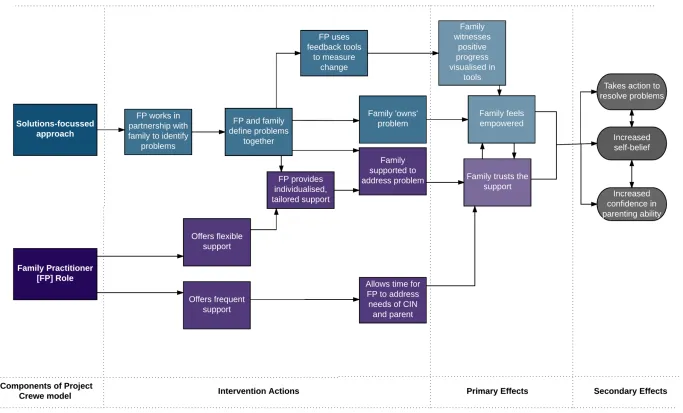
Map of qualitative findings
Figure 9, overleaf, shows how the themes that emerged from the qualitative research appear to interact. This is not a theory of change which defines a problem and outlines the pathways to achieve it, but a process map that draws out the most common themes in the qualitative data. It outlines how these themes interact and connect in this complex intervention and aims to give a sense of the chronological or causal flow. It highlights 2 central themes that emerged from the interviews: the role of the Family Practitioner, and the solutions-focused approach they used, were perceived as highly valuable by the families and frontline staff interviewed. Some elements of the pilot are not referenced due as the flow chart is focussed on the most common themes across the qualitative
29
30
The effect of the Family Practitioner
This section outlines how the frequent and flexible nature of the Family Practitioner role helps relationships develop with families and provide differentiated support.
The Family Practitioner (FP)role is at the heart of the Project Crewe model. They are multi-disciplinary workers, without social work qualifications; and work with up to 12 CIN at any one time. They work with the family to identify strengths and what already works well, and then agree what needs to change. They then help to make plans to achieve this, as well as identifying any risks and concerns. The Family Practitioner offers both administrative and frontline support; completes Child in Need plans and updates Liquid Logic (case information). They are organised into a pod system and managed by a Social Work Consultant (SWC) who holds statutory responsibility for the cases.1 At times
[image:30.595.163.366.340.502.2]the FP will work alongside the SWC and may also be supported by Peer Mentor and Family Role Model volunteers.
Figure 10: CIN picture of their family and Family Practitioner
Figure 10 shows a picture drawn by a CIN in the Project Crewe group. The narrative which accompanies the drawing shows the positivity the young person felt and that they considered the FP alongside their family:
CIN: ‘This is me (far left), my brother and sisters, my mum and my FP’. Interviewer: What do you do with your FP?
CIN: Go to the park, go boxing. Interviewer: Do you enjoy it? CIN: Yeah.
31
Frequent contact
Family Practitioners visited a CIN case family 11 times a month on average in autumn and 9 in spring - almost 3 times more often than their CEC counterparts. Types of visit varied between one-to-one sessions with the CIN; family visits; and one-to-one sessions with the parents. Visits also took place at different times of day, depending on the need. The families and staff felt that this frequency of contact underpinned Project Crewe, and that it was a pre-requisite to quickly building trusting relationships and to providing personalised care.
[image:31.595.62.475.311.453.2]FP11: ‘I think we get quicker results than they (CEC) can because of their time restriction - we can see them [their cases] as and when they need.’
Figure 11: Bar chart of average number of total visits to a CIN case over a month as described by families and frontline staff
The benefits of frequent contact
If the PC model is increasing the frequency of contact between practitioners and families, compared to CEC, it is worth considering why we might expect this to be positive. We understand that frequent contact positively influences the intervention in 2 ways:
• frequent contact was believed to resolve cases more quickly as families trust their family practitioner and are open about their issues. This is counter to the data analysis, where a survival analysis found that CEC resolved cases faster than PC
• frequent contact can help build stronger relationships between families and practitioners more quickly, which appears to be especially important for families who have previously had negative experiences of social care
32
SW6: ‘I think the outcome would have been the same longer term, but that the decision would have been made quicker if we could have offered that intensive support and maybe we would have closed the case by now…It’s definitely not impacted upon the child, but we would have probably drawn the case to
conclusion quicker. On the whole I think Project Crewe have gone really well… and sped things up for lower level cases.’
This frequency also allows the Family Practitioners to build relationships quickly, and provide extensive out of hours support. Several case families cited that FPs increased or decreased support as was required, and were always available on the phone.
Conversely, CEC families described support that was more structured with appointments set in advance, and procedures for contacting their social worker.
Being readily available for the families built their trust in their Family Practitioner. This trust is important, as several families interviewed had negative experiences with social care beforehand and resented the way the social worker had approached their case, or errors that had been made relating to them. Interestingly, these families were the most positive about the PC model of support. Rebuilding this trust was a pre-requisite to engaging with the family practitioner, as one mother relates:
Mother, CIN case 8: ‘Because when I saw her first I thought ‘ah here we go again, another one, going back to square one again.’ And it wasn’t. And they’d read up on the file before they came in. Before I’d had social workers come in who hadn’t even read the Liquid Logic [system which stores case information] …. And started ringing up their dad in front of the kids (father has a restraining order against and is not allowed any contact with family due to violence and domestic abuse). That’s just ridiculous. I phoned them up and said don’t you dare come around my house again, you make things worse. But no Project Crewe’s been really good. I get along with them and the manager [SWC] is also really nice. I met her before when I was in pre-proceedings so already knew her which helped. They [FP and Social Work Consultant] are really funny and the children like them and that’s really important for me. Because if the kids don’t like you we ain’t going to work with you.’
The initial trust that developed between the family practitioner and their family was a pre-requisite to meaningful support. This trust could provide the bedrock from which to address highly personal or sensitive issues related to the parent or CIN. One parent explained how the relationship was so strong that she felt comfortable to open up about her financial difficulties and illiteracy.
33
it's more...I can read but it's more the understanding, some big words I don't understand...’
The intensive style of support appears to allow Family Practitioners the space to be able to develop strong, trusting relationships with the families who are open to sharing some of their most personal problems. On its own, frequency of support has been shown to have multiple benefits, but primarily it provides a base from which other positive interventions, such as the flexibility of the support, and the SFA, can be realised. It is interesting to note that, although several staff perceived the frequency of visits would close cases quicker, this was not supported in the data analysis. It may also have side effectd on Family Practitioners, outlined below.
Side effects of frequent support
Despite the frequency of support being considered a positive and integral attribute of the PC model, it did create 2 negative side effects, which appear to be well managed by the delivery team. These are important to recognise as challenges which could occur if the project was scaled:
• the increased administrative work generated by frequent visits was hard to juggle on top of other responsibilities
• the intensive model can be emotionally draining for the frontline staff, who drew upon the strong pod support model for respite
Capacity is a significant concern in the social care field: the Munro Review (2011). advised that heavy caseloads were an obstacle to good practice. Several Family
Practitioners worried that taking on more cases would impact on the sustainability of the Project Crewe model. Despite the caseload being capped at 12 (whereas a social worker typically has 18-21 (ADCS, 2016)), they worried whether documenting visits, completing CIN plans and conducting frequent visits would still be possible.
FP2: ‘If caseload were to increase we wouldn't have that availability. The fact we have that time available, we're able to do all sorts of things. I do worry that the constraints of the system will override our flexibility at some point.’
However, we found no evidence of expanding caseloads, and the intervention has been running for over a year with a cap of 12 as an optimum number of cases.
The frequency of visits does appear to create a large amount of paperwork. Several articulated that they struggled to balance the administrative duties on top of regular visits:
34
At the time of interviewing, Family Practitioners were not at capacity – in November 2015 there was an average of 7 cases per practitioner, in April 2016 there were 9 cases and in November 2016 there were 11. No additional concerns about caseload were raised, and FPs had lower stress levels than SWs (see page 44), but it is important to monitor
considering the current social care context.
Flexible contact
It is not just the frequency of visits that appears to benefit the families, but the flexibility to develop a relationship that responds to the needs of the family and the CIN. Compared to the business as usual condition, it is worth considering why we might expect this to be positive. There are 3 main reasons:
• Family Practitioners can tailor and personalise the support for each CIN case
• this flexibility creates space for creativity which FPs find personally fulfilling
• flexibility helps mitigate issues around families becoming dependent upon support by allowing supportive detachment from cases which were closing or being escalated
The Family Practitioner model of care allowed for visits to be differentiated according to the needs of the family. This enabled the service they provided to be both tailored and responsive.
FP9: ‘There's no average visit... each visit is totally different.’
Alongside flexible visits, Family Practitioners could also draw upon a family fund to support the delivery of the CIN plan.
Mother, CIN case 7: ‘And recently, she took them to the ice cream farm.’ Interviewer: The ice cream farm! What’s that?
CIN: It’s got animals and ice cream…. I had marshmallow, chocolate pistachio mixed all together.’
However, this financial assistance is unique to the intervention and is not available to families in with CEC, which may affect engagement:
CEC Senior Leader 1 ‘We use charities, recycling and Church organisations, as we don't have a pot of money to delve into. You've always got to be mindful that families aren't just saying “I'll go there because I'll get a new cooker.”
35
line with the purpose of the PC budgets, to be used as an enabler to build family bonds and achieve the CIN plan. This suggests the primary incentive to engage in the
intervention was not financial and was used by Family Practitioners as an added benefit to the support, as opposed to a motivation to engage in it.
Creativity
The current flexibility (perhaps a consequence of relatively low caseload) allows the family practitioner freedom to be creative, something which many valued:
FP3: ‘Policy and procedure helps us to be creative and you don't have to do everything the same way. They (PC Senior staff) are open to new ideas.’
Several cited that they felt motivated and empowered by the flexibility they were allowed within the role, as well as it contributing to their wellbeing. One Family Practitioner implied they had more autonomy than their colleagues in CEC and felt supported.
FP11: ‘She (manager) doesn't get involved like regular social workers and allows me to manage my time and case and I ask for support when I need it.’
However, one social worker felt that this flexibility did not sit neatly next to the CEC’s more procedural way of working and the services should be more similar in approach.
SW6: ‘(I)t’s not about you have this and we have this but having a proper procedure and process that benefits children and families.’
This may indicate more collaborative and shared ways of working are needed between Cheshire East social workers and Project Crewe SWC and FPs.
Family dependency and closing cases
There is a risk that, when a family receives intensive social care, they become dependent upon the supportive environment, believing it to be necessary for sustaining the positive changes (Barber, 1986).
FP1: ‘That’s an issue with an intensive service like ours…you have to be careful about how you manage back for that family to be independent.’
However, the flexibility model of support appears to mitigate that risk by allowing FPs to gradually disengage from cases.
36
Sometimes a volunteer continues to support a family prior to and following case closure. Both the families involved in this process, CIN cases 1 and 2, and their Family
Practitioners, cited they were happy with the support.
This gradual approach to disengagement was equally beneficial for cases being
escalated up to Child Protection, meeting the parents and attending meetings up until the official handover. The mother in CIN case 10 was known to be particularly vulnerable so the Family Practitioner arranged her other commitments around this ongoing support, whilst slowly disengaging from the one-to-one interaction with the CIN in school. The frequency of the visits to Project Crewe families appears to lead to strong, trusting relationships developing between the FP their families. To avoid this trust being broken, it is strongly recommended the intervention continue to allow for slow and sustainable disengagement once a case is closed, to help families manage change and retain trust in social care support.
Solutions-focused approach
FP2: ‘It's an approach you can take in any walk of life, really.’
Across the interviews, the solutions-focused approach was appreciated by both staff and families as a way of engaging and tackling problems. This section outlines how the solutions-focused approach (SFA)3 appeared to be effective through the following
features:
• it gave parents a sense of control and ownership over their problems, which helped them take responsibility for them
• feedback tools were motivational and helped parents understand and document the progress they made
• the approach appeared more effective with certain types of problems and less effective in families in acutely stressful or chaotic situations
• the parent or CIN needs to recognise their issue and acknowledge they have a problem before this approach can be effective
The solutions-focused element of the intervention was the most positively cited aspect of the Project Crewe intervention. Many Family Practitioners stated it felt natural and
something I'd always done without knowing it. Meanwhile, families praised the approach for being different and supportive.
37
The approach draws on Solution Focused Brief Therapy. It involves identifying, and working towards, a goal; and focuses on the problems that families raise themselves, working in partnership with the Family Practitioner to resolve them. One parent compared SFA to the more traditional model of support she had previously encountered. The
excerpt below exemplifies the difference families felt in the way PC approached them, and how it initially focused on the positives, as opposed to highlighting the problems which need resolving.
Mother, CIN case 1: ‘Their ways [CEC social workers] were very hard, coming into my house going “You need to change that, you need to change this”. I had a million things I needed to do and I was coming in and out of hospital...in their mind I was failing as a mum but in my mind, I was doing everything I could, the children didn’t want for anything. But obviously difference of opinion and things spiralled and they were saying I wasn’t doing what I was supposed to. Having sepsis, it doesn’t take weeks, it takes months to get over. I’m still trying to get over it now. And then it was within 3 weeks when they [PC] came in... even in that time my confidence changed, they said, “Right we know you’re a good mum, what do you feel you can do?” and I said, “I can do this and this,” and it was the way that they spoke that was totally different. The first 2 [CEC SW] I couldn’t get to know. Whilst the others [PC] came at it from a…we can do this in a good way, “What can you do?” They could see we were good people.’
Giving control to families
The SFA supports families to identify and address their issues. By holding families responsible for identifying their issues, it ensures accountability for those issues remains with the family. The majority of Family Practitioners interviewed stated that this approach had a positive effect on families who had previously received CEC support where many felt they had power and control taken away from them. FP2
FP15: ‘One family was really disengaged and hostile to support, we broke down these barriers and she thanked us after as she wasn't being told what she should or shouldn't be doing.’
Project Crewe families articulated that they felt they were listened to compared to those who were supported through the CEC support, which takes a more directive approach. The difference between these 2 approaches is exemplified by the quotes below. In the first example the social worker takes a positive, but direct instruction approach:
38
How the social worker approaches resolving a situation is different from the Family Practitioner in this example of an SFA approach, as one parent articulates:
CIN case 7, Mother: ‘They ask me what I wanted. It sounds silly and small but they were thinking about what I needed not what they thought I needed. It makes a massive difference. The first thing she said when she came in was, “This isn’t about what we want, it’s about what you want and you need and how we help you going forward.” The minute she said that it changed my opinion.’
One aspect of this was asking families what they wanted to improve in their home and then supporting them to achieve their own goal. This ownership motivated and engaged parents and carers to improve.
FP7: ‘Listening to what she wanted, not telling her what I think she needs because that’s not my role. I don’t live her life; she lives it. But listening to what she wanted, what she wanted to change and her telling me how I could support her and how I could support the kids.’
This concept of ownership underpins the Family Practitioner approach and is supported by tools which help to visualise this progress.
Feedback mechanisms
FP11: ‘Families can be experts in their own lives and they like that.’
The tools used by the Project Crewe pilot enabled families to understand the change they made through visualising the impact. The Time Wheel, Outcomes Star and Scaling, where families ranked themselves against certain criteria, were cited as particularly effective for families. This was also highly motivational for Family Practitioners as it gave them concrete evidence of the impact they'd had.
CIN case 1, Mother: ‘We've had a goal, every day and we've stuck to it - it's been like that for the last 6 months. Even today, going into town with 4 kids is my goal, it's good to have a plan of action and stick to it.’
Visualising measurable change was cited positively by almost all the Family Practitioners. Studies on the effect of feedback on performance support this view:
feedback that is specific and task-related leads to greater improvements in performance than general feedback such praise for the person (Hysong, 2009). Setting measurable goals helps motivate families to continue along this path, as well as providing
documentation for follow-up support once the case has been closed.
39
As well as a motivational force, the measurement tools had practical implications for parents. Theories on motivation for behaviour change acknowledge the importance of monitoring and diagnosis of problems (Carver & Schreier, 1998). The interviews suggest that measurement tools provided this function to parents.
FP11: ‘I do scaling quite a lot, especially with parents with mental health
difficulties, it's useful to get them to scale where they are each day, on 1-10, to see if there are any patterns or sometimes whether they need to see a GP.’ One family practitioner cited an underlying reason for this efficacy: they enabled parents to understand their situation.
FP10: ‘They can be experts in their own lives and they like that.’
Relative success in addressing different types of problems
Despite SFA receiving very positive feedback from families and Project Crewe, in some cases it wasn’t uniformly successful, particularly in chaotic cases.
FP10: ‘I’ve had a few cases that have had quite significant safeguarding concerns and it’s difficult to work in a solutions-focused way as you’re kind of passing it back to them asking how they would manage it. Sometimes if it’s safeguarding you need to say: right, we need to do this to ensure your child is safe. So that can be difficult.’
Frontline staff needed to distinguish when to use the SFA approach when high-risk incidents arose. This family practitioner explained how they deviated from SFA to
manage a high-risk incident when the CIN attacked the mother, whilst continuing to use it for lower risk situations.
FP10: ‘We did work with mum around removing the knife and keeping them safe. Any safeguarding things that come up or anything that’s risky we’ll work with that straight away because we need to. The other stuff we’ll work in a solution focused way and try and get them to look at their resources and get them to manage it themselves.’
It is worth noting that the case referred to above was appropriately escalated. Similarly, several Family Practitioners felt that SFA was ineffective for families who FP10: ‘couldn’t engage with it’ or who FP15: ‘destructive…trying to sabotage everything we put in place’.
FP7: ‘Some families just don’t get SFA at all, they’re in too much chaos that that SFA just doesn’t work out for them.’
40
certain types of issues or family situations are more receptive to the intervention and enable the CEC and PC to provide more targeted referrals.
Parents are levers for, and inhibitors of, change
For good and for ill, parents have been shown to be instrumental in the efficacy of the Project Crewe model as the mechanisms for change.
CIN case 3, Mother: ‘She (Family Practitioner) has opened a lot of doors, say 6 months ago, I was a different person, even as much as chatting to people, I couldn't do it, even a lot of my own family, and a lot of my friends didn't know she was involved, have …noticed a change in me.’
With many of the cases, improving how parents acted and felt about themselves and their parenting abilities often appeared to have a noticeable effect upon case outcomes, especially as so many of the CIN were under 11.
CIN case 2, Mother: ‘The kids have come on so strong and that's one thing I will say, if they see me being positive that sets an example for them.’
A plausible reason for the change is that the Project Crewe pilot addresses the needs of the parent as well as the CIN. Across the interviews, a salient difference between CEC and Project Crewe cases was the impact they appeared to have on the parents. Although both schemes alter how the parents and CIN act and behave, Project Crewe cases also improved parental socio-emotional wellbeing. Families interviewed cited that their
confidence to parent and address issues had improved, as had their sense of belief in their improving circumstances.
CIN case 8, Mother. ‘Yeah it makes a massive difference because I want to work with them…. now I feel better. I can see us getting somewhere, getting actually to an end and actually getting to a place where the house is calmer.’
This may be an effect of giving ownership of the issues to the parents, by altering the power relationship between the frontline practitioner and family: SFA shifts the position of the parents from one of submission to one of control, and they become agents in
resolving their situation.
41
families involved in the qualitative research, a small minority failed to recognise they had an issue in the first place. All these cases failed to make any progress, or worsened, in the time between the 2 interviews. In all 3 PC CIN cases which escalated or where there was no change between November and April, either the parent or CIN failed to
acknowledge the problems they faced. This was sometimes through their own
vulnerabilities where they were too passive4 to engage in the support: one parent did not
recognise their actions were harmful to their children; another parent was too passive to engage in the process through her vulnerability; and in the final case a teenage CIN had vulnerabilities that led her to not want to stop her risk-taking behaviour.
It is worth exploring this theme further and putting measures in place to identify those CIN cases where they initially fail to recognise the issues for which they were referred. This needs to be considered in the CIN plan.
Project delivery
This report now moves onto focus on the wider processes that supported the
intervention. It first analyses the cost effectiveness and then moves on to outline the qualitative findings on the delivery of Project Crewe.
Cost-benefit analysis
To assess feasibility of scaling such an initiative, it is important to understand the cost effectiveness compared to the traditional model of support. However, due to insufficient data, the analysis in this section cannot support any firm conclusions about the relative benefit of Project Crewe compared to Cheshire East. It is important to consider this cost- benefit analysis (CBA) as an illustrative exercise and an example of an approach that could be improved by better data. This is a challenge faced across the social care section, as there is a lack of data linking CIN outcomes to any other metrics, aside from education (Morse and Arkell, 2016). We base our figures on comparative re-referral rates between Project Crewe and Cheshire East and compare escalation rates in PC with national trends. It needs to be highlighted that the data used has significant limitations and are not statistically significant. Moreover, we have limited observations on re-referrals (8 observations) for both Project Crewe and Cheshire East and escalation information for Project Crewe only (2 observations). Therefore, all figures estimated below must be considered illustrative. Please refer to Appendix 9 for an outline the costs of the programme per case and then itemised the benefits to the individual CIN and the Local Authority. All these estimates only relate to our sample and cannot be generalised. It may be better to consider this CBA as illustrative and an example of a method that could be improved by better data.
42
Qualitative findings of project delivery
This section of the report outlines how the project was delivered for an operational
perspective. It first focuses on how Project Crewe implemented the intervention - training and supporting their staff. It secondly looks at the interaction between Project Crewe and Cheshire East Council, to explore how the intervention was nested within children’s services.
From our qualitative research, several common themes emerge from interviews
conducted with 18 frontline staff and 3 senior leaders from both CEC and Project Crewe. This section aims to summarise these themes which have supported the pilot
intervention. Finally, we consider the challenges of integrating an innovative project into a more established system.
Implementing an innovative pilot within a pre-existing structure has challenges. This section outlines several features of the intervention that differed from how they were intended.
• caseload from CEC was not alleviated as expected by Project Crewe as the cases which were removed were replaced by others
• CEC reported that they had more time to focus on more complex cases
• cases referred to Project Crewe were of greater risk than expected
• issues with communication between CEC and PC meant frontline staff encountered challenges at the referral, handover and escalation stages
It is demanding to assimilate an agile and flexible way of working within a more traditional and structured model: and many of the issues highlighted below stem from this structural difference. However, senior leaders within both CEC and Project Crewe are continually working to address these issues and to improve the way they work together.
PC Leader: ‘I suppose it’s about better cross-working really. If it was more seen as working in partnership with one another really rather than…a step-down service or a lesser service in some way because we’re not.’
Sustainable and conscious organisational culture change takes time and requires a readiness to accept the change (Todnem By, 2005). Successful implementation arises from continuing to develop measures to overcome unexpected challenges or unintended consequences of implementation, which the delivery team continues to work towards. The lessons that are learned through this process will be of importance to local
43
Alleviating pressure
Due to the demands on the system, the CIN case families reallocated to Project Crewe were almost instantaneously replaced by other families. The relief that Project Crewe was expected to provide to SWs did not therefore transpire. This finding supports evidence that suggests there is a great deal of latent demand for the system that will arise whenever the space is created (NSPCC, 2014; BASW, 2013).
Cheshire East Senior Leader: ‘The impact might not be quite what we had
imagined at the beginning if I'm honest, but, the impact is 'how would you manage with another 145 cases more than we're currently holding?’
Despite limited visible evidence of reducing caseload, another senior leader within
Cheshire East felt that Project Crewe had created a space for her team to focus on some of their enduring, complex cases.
Cheshire East Senior Leader: ‘With PC picking up cases which would have probably ended up in child protection case conferences, we've been able to turn around the team and use this space to concentrate on our hard child protection cases and conclude what we will do with them, so we've been able to drill down on some of the more worrying cases we've previously not be able to get a grip of.’ Despite being harder to demonstrate, this suggests Project Crewe has allowed for the use of resources with those children who are most in need of support. Ongoing
monitoring of the re-referral rates of the families in the control and treatment will help provide more accurate long-term estimates as to the reduction in pressure on the council services.
Internal processes within Project Crewe
Project Crewe does not only pilot innovative ways of working with CIN case families, but new systems to support frontline staff. From the interviews, several practices emerged which were found to be particularly effective in supporting and motivating staff.
• embedding the solutions-focused approach into the internal operational system supported staff in their work with families
• the pod and buddy system supported a strong culture of collaboration across CIN cases
• a responsive training programme allowed Family Practitioners to access information they needed to support their families