Rochester Institute of Technology
RIT Scholar Works
Theses Thesis/Dissertation Collections
2008
Application of Project Management Methodology
From Idea Generation to New Bundle
Development in Personal Care Packaging Projects
Fikri BilirFollow this and additional works at:http://scholarworks.rit.edu/theses
Recommended Citation
Application of Project Management Methodology
From Idea Generation to New Bundle Development
in Personal Care Packaging Projects
by
Fikri Bilir
A Thesis
Submitted to the
Department of Packaging Science
Collage of Applied Science and Technology
In partial fulfillment of the requirements for the degree of
Master of Science
Rochester Institute of Technology
Department of Packaging Science Collage of Applied Science and Technology
Rochester Institute of Technology Rochester, New York
CERTIFICATE OF APPROVAL
M.S. DEGREE THESIS
The M.S. degree thesis of Fikri Bilir has been examined and approved by the thesis committee as satisfactory
for the requirements for the Master of Science Degree
6.3.2. SUN CARE Project Scope of Work Document ... 35
6.3.3. SUNCARE Shampoo Packaging Renovation Project Responsibility Matrix ... 39
6.3.4 Work Breakdown Structure (WES) ... 41
6.3.5 Timeline ... 42
6.3.6 Tools and Techniques for Schedule Development ... 42
7.0 CONCLUSION AND RECOMMENDATIONS ... 45
9.0 REFERENCES ... 47
APPENDIX A: CONCEPT-SCREENING MATRIX EXAMPLE FOR BOTTLE DESIGN ... 49
ACKNOWLEDGEMENTS
First, I would like to thank Gerardo Navia, Project Manager from CP Global Packaging, for his supervision, encouragement, and support of me throughout the course of this study.
I want to express my gratitude to Dr. Tom Voss for his willingness to be my thesis advisor and for his valuable support and guidance.
I also appreciate Deanna M. Jacobs and Don Appleton for their participation on my committee and their support and encouragement.
DEDICATION
Abstract
The purpose of this study was to conduct an analysis of the current packaging development process used by Colgate-Palmolive sub-country teams and to provide suggestions for implementing an improved process. The analysis of the current approach to packaging
development and project management in the personal care business category was done using a shampoo packaging change case study. A new Stage-Gate approach, which used project
TABLE OF CONTENTS
LIST OF FIGURES ... X
LIST OF TABLES ... xi
1.0 INTRODUCTION ... 1
1.1 BACKGROUND ... 1
1.2 PROBLEM DEFINITION ... 1
1.3 PURPOSE ... 3
1.4 AIM ... 3
1.5 SCOPE AND LIMITATIONS ... 4
2.0 METHODOLOGY ... 5
2.1 RESEARCH DESIGN ... 5
2.2 QUANTITATIVE AND QUALITATIVE METHODS ... 6
2.2.1 Quantitative Research ... 6
2.2.2 Qualitative Research ... 6
2.2.3 The Thesis ... 7
3.0 PRODUCT DEVELOPMENT AND PROJECT MANAGEMENT PRINCIPLES ... 8
3.1 PRODUCT DEVELOPMENT AND DESIGN PROCESSES ... 8
3.1.1 A Generic Development Process ... 8
3.1.2. Stage-Gate Process for New Product Development ... 9
3.1.3 A General Design Structure ... 12
3.2. PROJECT MANAGEMENT APPROACHES ... 13
3.2.1 Definition of Project and Project Management ... 13
3.2.2. History of Project Management ... 13
3.2.3. Project Phases and Project Life Cycle ... 14
3.2.4 Project Organization Structures ... 16
4.0 CURRENTLY USED PACKAGING DEVELOPMENT PROCESS ... 18
4.1 PRODUCT AND PACKAGING DEVELOPMENT PROCESSES IN COLGATE PALMOLIVE TURKEY. 18 4.2. ORGANIZATION & STRUCTURE ... 22
5.0 NEW (PROPOSED) PACKAGING DEVELOPMENT PROCESS ... 24
5.0 NEW (PROPOSED) PACKAGING DEVELOPMENT PROCESS ... 24
5.1 PACKAGING DEVELOPMENT PROCESS ... 24
5.1.1 Packaging Idea Generation ... 26
5.1.2 Technology Match and Feasibility ... 26
5.1.3 Concept Engineering and Design ... 27
5.1.4 Packaging Concept Validation ... 27
6.0 CASE STUDY: SUNCARE SHAMPOO PACKAGING RELAUNCH ... 29
6.1 NEW PACKAGING DEVELOPMENT PROCESS FOR SUN CARE BRAND SHAMPOO ... 29
6.2 METHODOLOGY ... 29
6.3 SUN CARE SHAMPOO PACKAGING RENOVATION CASE STUDY: PROJECT DOCUMENTS ... 30
Figure 1.
Figure 2.
Figure 3.
Figure 4.
Figure. 5.
Figure 6.
Figure 7.
Figure 8.
Figure 9.
Figure 10.
Figure 11.
Figure 12.
Figure 13.
Figure 14.
Figure 15.
Figure 16.
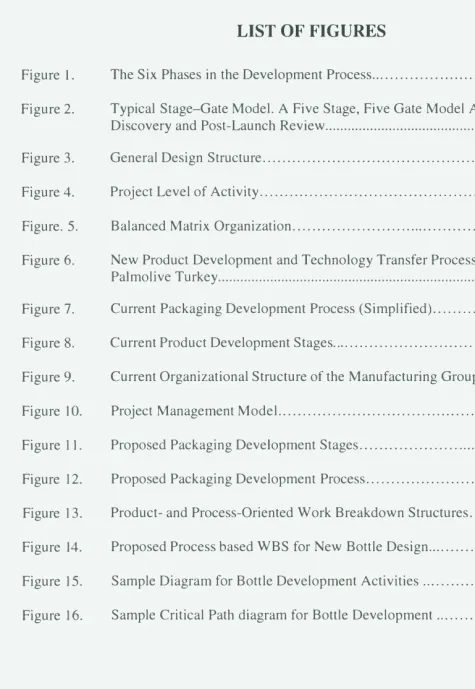
LIST OF FIGURES
The Six Phases in the Development Process ... 8
Typical Stage-Gate Model. A Five Stage, Five Gate Model Along With Discovery and Post-Launch Review ... 11
General Design Structure ... 12
Project Level of Activity ... 15
Balanced Matrix Organization ... 17
New Product Development and Technology Transfer Process in Colgate Palmolive Turkey ... 20
Current Packaging Development Process (Simplified) ... 21
Current Product Development Stages ... 22
Current Organizational Structure of the Manufacturing Group ... 22
Project Management Model. ... 24
Proposed Packaging Development Stages ... 25
Proposed Packaging Development Process ... 25
Product- and Process-Oriented Work Breakdown Structures ... .41
Proposed Process based WBS for New Bottle Design... 42
Sample Diagram for Bottle Development Activities ... .43
[image:11.756.64.540.83.773.2]Table 1.
Table 2. Table 3.
LIST OF TABLES
Systemic Issues Identified by Colgate Palmolive for New Packaging
Development... 2 Summary of Proposed Packaging Development Process With Four Stages ... 28
[image:12.761.51.542.6.774.2]1.0 INTRODUCTION
1.1 Background
The consumer products and cosmetics industry is one of the most highly competitive markets with endless pressure to reduce the time-to market and costs. Therefore, it is of major importance for companies to shorten product and packaging development times. A firm with a more rapid development process than its competitors can start a new product development project at the same time as its competitors, but introduce the product to the market much sooner. Reduced development times can give a company advantages such as higher volumes and margins, sustained technological leadership and corporate image, and reduced design costs. (Hill 1995)
Today's competitive market has created a highly challenging environment for product
development. Companies are under increasing pressure to sustain their competitive advantages by reducing product development time and cost while maintaining a high level of quality. These needs drive companies to focus on implementing a well-coordinated development plan to organize their processes and resources (Eppinger and Cho 2001).
Packaging development is often thought of as an integral part of the new product development process. Alternatively, development of a package (or component) can be a separate process, but must be linked closely with the product to be packaged. Package design starts with the
identification of all the requirements: structural design, marketing, shelf life, quality assurance, logistics, legal, regulatory, graphic design, end-use, environmental, etc. The design criteria, time targets, resources, and cost constraints need to be established and agreed upon by all
stakeholders.
1.2 Problem Definition
Packaging development projects also vary greatly in complexity. Some sort of formal project planning and project management methodology are required for all but the simplest package design and development programs. Some packaging projects can be quite simple, while others can need a lot of planning, research, testing, and modifications. Many packaging development projects experience problems such as elongated project duration, scope creep, and budget overruns due to systemic issues such as the following:
• Project expectations and goals are not clear.
• Roles and responsibilities are not well defined at the beginning of the project. • The complexity level of the project and the importance of stakeholders' inputs are
underestimated.
• There is a lack of communication.
• There is poor strategic alignment with company targets.
The most frequently encountered systemic issues in packaging development at Colgate
Palmolive are listed in Table 1.
Table 1 Systemic Issues Identified by Colgate Palmolive for New Packaging Development (Navia 2007)
SYSTEMIC ISSUES FROM NEW PRODUCT LAUNCHES %
I Critical path lines are not established/adjusted as project processes 95
2 Technical / Commercial Project Management Teams are not assigned 80
3 Do not consistently define global standardization requirements up-front 75
4 Delays in senior management decision making 75
5 Improve global/divisional/regional alignment 70
6 Project Briefing is not thorough 70
7 Contract manufacturers are not contractually required to meet the quality standards 70
8 Graphic approvals are typically delayed 70
9 Do not review successful brands/market segments to create "new" combinations 65
10 Do not identify and plan for "knowledge" gaps upfront 65
11 Project Charters are not established and updated as project progresses 55 12 Lack of communication of learning's between lead and follower markets 55
13 Hesitancy to evolve the equity roadmap to grow the franchise 50
14 Lack of consistency in raw materials 50
One of the main problems for packaging development teams is gathering all the requirements at the right time and in the right order from the stakeholders involved. Without this information it is impossible to design a cost effective package and to perform a quick development process
efficiently. Many times it can be impossible to implement a useful suggestion or
recommendation because it has been received too late in final stages of development. To assure the collection of these inputs from all related parties, special attention should be paid to the idea generation and concept development stages. These stages also require more planning and
coordination. Additionally, according to Hari and Weiss (1999), almost 95% of product life cycle costs are locked in concept development and design stages
In the packaging development procedure currently in place at Colgate Palmolive Turkey, each stage of the packaging development process has almost equal weight. The involvement of all stakeholders is generally neither straightforward nor obvious, and no special tools or templates are used to check on their inclusion in the packaging development chain. Therefore, the existing packaging development process has to be reviewed, and a new, more structured and focused process to idea generation and concept development should be proposed.
1.3 Purpose
The purpose behind this thesis is to conduct an analysis of the current packaging development process used by Colgate Palmolive sub country teams to ensure optimal package design with minimum time-to-market and minimal total cost.
1.4Aim
The aim of this thesis is to provide the Packaging Development Department at Colgate Palmolive with suggestions for implementing an improved Stage-Gate development process which will apply the principles of project management to successfully complete projects on time and within budget. The application of project management principles from the very beginning stages of packaging development projects can eliminate the problem of stakeholder inclusion and can lead to the creation of a series of templates/tools applicable to other packaging development projects. The proposed packaging development process will include activities ranging from idea
• Packaging idea creation
• Technology match and feasibility
• Engineering and design
• Packaging concept validation
1.5 Scope and Limitations
To fulfill the aim of this thesis, an observation of the development and implementation process of a new shampoo packaging for SUNCARE brand at Colgate Palmolive Turkey was made. The assumption was that the process of designing the bottle and cap was representative of all
2.0 METHODOLOGY
For this thesis, exploratory research and qualitative case studies were studied. In this chapter, different types of research designs and methods are described to provide a better understanding of the research methodology that was selected.
2.1 Research Design
A research design is the basic plan that guides the data collection and analysis phases of a research project. The research objective logically determines the characteristics desired in the research design, and this is dependent upon the stages of the decision making process for which information is needed (Kinnear and Taylor 1979). Three types of research in case studies are identified by Yin (2003):
• Exploratory research
• Explanatory research
• Descriptive research
These classifications are made according to the objective of the research. In some cases the research will fall into one of these categories, but in other cases different phases of the same project will fa]] into different categories.
In this study, the exploratory research method has been used because the research is based upon the gathering of data and information from people in the organization who are very familiar with the company's new product and packaging development procedures. The various steps and stakeholders in the development process have been examined and mapped to help evaluate the existing process and propose a solution to the identified problems.
2.2 Quantitative and Qualitative Methods
Quantitative and qualitative researches are two major approaches to research methodology.
2.2.1 Quantitative Research
Quantitative studies emphasize the measurement and analysis of casual relationships between variables, not processes. Quantitative methods are rather formalized and structured. The method also defines which answers are conceivable. Disposition and planning is characterized by selectivity and a distance in relation to the source of information (Holme and Solvang 1996)
2.2.2 Qualitative Research
The world qualitative implies an emphasis on processes and meanings that are not rigorously examined or measured in terms of quantity, amount, intensity, or frequency. Qualitative
2.2.3 The Thesis
By the nature of the investigations carried out for this thesis, the qualitative method proved to be the most efficient and suitable approach. The aim of this research was to gain an understanding of the following:
• Which functions and variables are involved in the packaging development process?
• Who are the stakeholders involved in the early stages of the packaging development process?
• How can the early involvement of related stakeholders be assured? • What is the effect on the time-to-market preparation period and cost?
3.0 PRODUCT DEVELOPMENT AND PROJECT MANAGEMENT
PRINCIPLES
3.1 Product Development and Design Processes
In product development processes, it is important to work in a thoughtful and structured way to achieve a more effective, flexible, and quick solution to problems presented. In this section, three well known and accepted theoretical models will be described.
3.1.1 A Generic Development Process
Ulrich and Eppinger (2001) propose a generic six phase development process within product design. These phases are planning, concept development, system-level design, detail design, testing and refinement, and production ramp-up (Figure 1)
PhaseO
Planning Phase 1 Concept Development
Phase 2
System Level Design
Phase 3
Detailed Design
Phases Te sting and) Production
[image:20.756.95.500.341.388.2]Refinement Rump-up
Figure 1. The Six Phases in the Development Process (Ulrich and Eppinger 2001)
• Planning: This is the phase where the project gets approved and the product development process starts. The output specifies the target market for the product, business goals, key assumptions, and constraints.
• Concept Development: The needs of the target market are identified, alternative product concepts are generated and evaluated, and one or more concepts are selected for further development and testing. It is very important to focus on the requirements from the customers in this phase.
• System-Level Design: In the third phase, focus is put on the products architecture and the definition of it. The product is divided into its constituent parts. The final assembly scheme is normally defined in this phase.
• Detailed Design: This phase includes the complete specification of the geometry,
all of the standard parts to be purchased from suppliers. An establishment of a process plan is made and tools are designed for each part to be produced within the production system.
• Testing and Refinement: In this phase multiple preproduction types of the product are constructed and evaluated. The prototypes can be divided into alpha or beta prototypes. Alpha prototypes are not necessarily fabricated by means of the actual processes to be us�d in production. Beta prototypes are usually built with parts supplied by the intended production process. The testing makes it possible to refine the product before the start of production.
• Production ramp-up: The last phase in Ulrich and Eppinger's six phase development
process consists of training the work force and resolving all remaining problems in the production process. This usually means gradual intensifying up to the start of production.
3.1.2. Stage-Gate Process for New Product Development
R. G. Cooper developed an operational roadmap into the Stage-Gate process that has become widely used in the development of new products. Stage-Gate processes are increasingly accepted as the most effective option for product development. Today, around 60% of companies have adopted this approach in some way. The goals of using Stage-Gate, according to Cooper, are to introduce discipline into an ordinarily chaotic process, focus attention on quality of execution, and speed up the process (Cooper 2001)
The Stage-Gate concept has been developed and applied primarily for New Product
Development (NDP) projects. However, the essential philosophy of Stage-Gate is based on a common-sense approach that can be readily applied to almost any type of project. The typical new packaging development project consists of a series of steps starting with project conception and leading to product delivery/launch. These steps can usually be grouped into a series of phases. Each phase will have a number of activities, possibly performed in multiple disciplines.
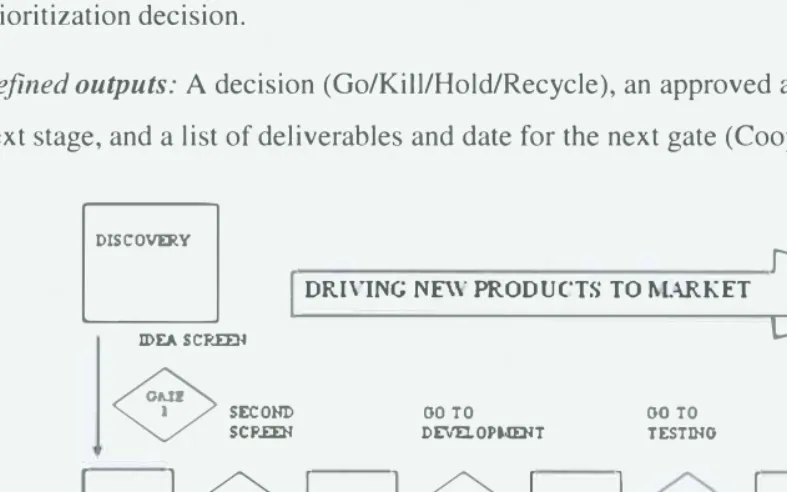
In the Stage-Gate process, each phase (called a Stage) is separated by a decision point (called a Gate). As described by Cooper for the NPD environment, Stage-Gate is applied across the entire
project lifecycle. Conditions for passing through a gate are defined. At the end of a stage, a cross-functional team evaluates the status against the pass and no pass conditions (Cooper 2001).
According to Cooper's model, typical key phases of NPD project are as follows:
• Discovery: Pre-work designed to discover opportunities and to generate new product ideas.
• Stage 1 (Scoping): A quick, preliminary investigation and scoping of the project. This stage provides inexpensive information-based largely on desk research-to enable the field of projects to be narrowed before Stage 2.
• Stage 2 (Build the Business Case): A much more detailed investigation involving preliminary research-both market and technical-leading to a business case. This is where the bulk of the vital homework is done and most of the market studies are carried out. These result in a business case that includes the project definition, the project
justification, and project plan.
• Stage 3 (Development): The actual detailed design and development of new packaging,
along with some testing work. The deliverable at the end of Stage 3 is an 'alpha-tested' or 'lab-tested' product. Full production and market launch plans are also developed in this potentially lengthy stage.
• Stage 5 (Launch): Commercialization-the beginning of full operations or production, marketing, and selling. Market launch, production/operations, distribution, QA, and post launch monitoring plans are executed.
The Governance Council is the 'gate-keeper'. The Governance Council is made up of senior representatives of the functions responsible for business success. Evaluations are made against pre-determined criteria. Decisions are made by comparing the metrics to those criteria. At each gate, it will be looked for the following:
• A set of required deliverables: What the project leader and team must bring to the gate decision-point. These deliverables are visible, are based on a standard menu for each gate, and are decided at the output of the previous gate.
• Criteria: Against which the project is judged in order to make the Go/Kill and prioritization decision.
• Defined outputs: A decision (Go/Kill/Hold/Recycle), an approved action plan for the next stage, and a list of deliverables and date for the next gate (Cooper 2001).
EJ
I DRl\"ING NEW PRODUCTS TO •L-IRKET>
IDEA SCREDI
0
SECONDSCREEN DEVD.OPtJENT 00 TO 00 TO TESTING LAUNCH 00 TO
I "�··
101 "� ..
10
1
"� .. I ��
I":·· 1
01
,,�··
I
SCOPING BUD.D
BUSINESS CASE DEVllOPME:N"T VALIDATION n:STING.t LAUNCH
[iJ
POST
LAUNCH
[image:23.756.135.529.406.652.2]REWrEW
3.1.3 A General Design Structure
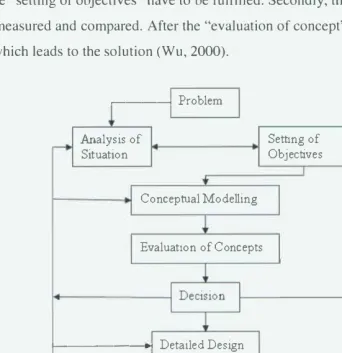
Wu (1994) presents a general design structure within manufacturing systems design (Figure 3). Wu emphasizes that each phase is dependent on the successful completion of the previous phase. The first two phases "analysis of situation" and "setting objectives" are within the manufacturing strategy field. The analysis phase includes current markets, future prospects, and those of
potential markets. The "conceptual modeling and "detail design" phases will form the framework to accomplish the desired results. It is in the design phase that the transformation from the
current to the desired state renders possible. To be able to make a decision of the best alternative in the phase "evaluation of concepts," two sets of criteria are assessed. First, the requirements determined in the "setting of objectives" have to be fulfilled. Secondly, the financial
performance is measured and compared. After the "evaluation of concept" is made, the decision could be made which leads to the solution (Wu, 2000).
�---i Problem
Analysis of Situation
Conceptual Modelling
Evaluation of Concepts
1-------.i Detailed Design
Evaluation of Concepts
Solution
[image:24.756.175.518.335.688.2]Setting of Objectives
3.2. Project Management Approaches
3.2.1 Definition of Project and Project Management
A project is a temporary endeavor undertaken to create a unique product or service. Temporary
means that every project has a definitive beginning and a definitive end. The end is reached when the project's objectives have been achieved, or when it becomes clear that the objectives will not or cannot be met and the project is terminated (Wikipedia [c] 2007).
Unique means that the product or service is different in some distinguishing way from all similar products or services. The presence of repetitive elements does not change the fundamental uniqueness of overall effort. Because the product of each project is unique, the characteristics that distinguish the product or service must be progressively elaborated. Progressively means
'proceeding in steps; continuing steadily by increments' while elaborated means 'worked out with care and detail; developed thoroughly'. Progressive elaboration of product characteristics must be carefully coordinated with proper project scope definition. When properly defined, the scope of the project-the work to be done-should remain constant even as the project
characteristics are progressively elaborated (Wikipedia [c] 2007).
Project management is the application of knowledge, skills, tools, and techniques to project activities in order to meet or exceed stakeholder needs and expectations and invariably involve balancing competing demands among the following:
• Scope, time, cost, and quality
• Stakeholders with different needs and expectations
• Needs (identified requirements) and expectations (unidentified requirements)
3.2.2. History of Project Management
his study of the work and management of Navy ship building. His work is the forerunner to many modern project management tools, including the work breakdown structure (WBS) and resource allocation (Wikipedia [c] 2007).
The 1950's marked the beginning of the modern project management era. Again, in the United States, prior to the 1950's, projects were managed on an ad hoc basis using mostly Gantt Charts, and informal techniques and tools. At that time, two mathematical project scheduling models were developed: (1) the "Program Evaluation and Review Technique" or PERT, developed as part of the United States Navy's (in conjunction with the Lockheed Corporation) Polaris missile submarine program; and (2) the "Critical Path Method" (CPM) developed in a joint venture by both DuPont Corporation and Remington Rand Corporation for managing plant maintenance projects. These mathematical techniques quickly spread into many private enterprises (Wikipedia
[c] 2007).
1n 1969, the Project Management Institute (PMI) was formed to serve the interest of the project management industry. The premise of PMI is that the tools and techniques of project
management are common even among the widespread application of projects from the software industry to the construction industry. In 1981, the PMI Board of Directors authorized the development of what has become The Guide to the Project Management Body of Knowledge, containing the standards and guidelines of practice that are widely used throughout the profession (Wikipedia [c] 2007).
Project stakeholders are individuals and organizations who are actively involved in the project, or whose interests may be positively or negatively affected as a result of project execution or successful project completion. The project management team must identify the stakeholders, determine what their needs and expectations are, and then manage and influence those
expectations to ensure a successful project. Key stakeholders on every project include Project Manager, Customer, Performing Organization, and Sponsor (PMBOK 2004)
3.2.3. Project Phases and Project Life Cycle
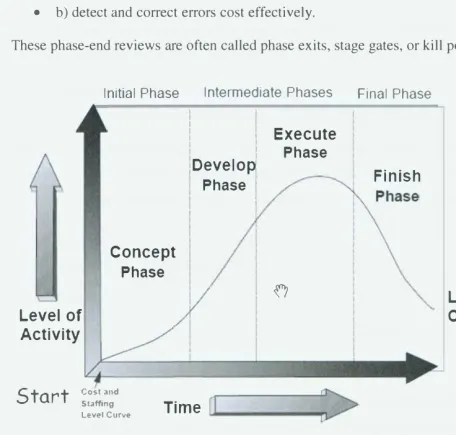
Each project phase is marked by completion of one or more deliverables. A deliverable is a tangible, verifiable work product such as a feasibility study, a detail design, or a working prototype. The deliverables, and hence the phases, are a part of a generally sequential logic designed to ensure proper definition of the product of the project. The level of activities increases until the end of execution process, and it decreases at the finishing phase as shown in Figure 4.
The conclusion of a project phase is generally marked by a review of both key deliverables and project performance in order to
• a) determine if the project should continue into its next phase and
• b) detect and correct errors cost effectively.
These phase-end reviews are often called phase exits, stage gates, or kill points.
Level of
Activity
Initial Phase
Concept
Phase
Intermediate Phases
I I I
I I
I I
:
:
Develop:
IPhase
Execute
Phase
n
Start
Cost and StaffingLevel Curve Time
Final Phase
Finish
Life
Cycle
[image:27.756.65.521.328.763.2]Finish
The project life cycle serves to define the beginning and the end of a project. The project life cycle definition will determine whether the feasibility study is treated as the first project phase or as a separate, stand-alone project. Project life cycles generally define
• What technical work should be done in each phase
• Who should be involved in each phase
3.2.4 Project Organization Structures
According to Ulrich & Eppinger (2001), Project-based organizations are those whose operations consist primarily of projects. These organizations fall into two categories:
• Organizations that derive their revenue primarily from performing projects for others: engineering firms, consultants, construction contractors, etc.
• Organizations that have adopted management by projects. These organizations tend to
have management systems in place to facilitate project management.
Non-project-based organizations (manufacturing companies, financial service firms, etc.) seldom have management systems designed to support project needs efficiently and effectively. The absence of project-oriented systems usually makes project management more difficult.
Organizational structures can be characterized as spanning a spectrum from functional to projectized, with a variety of matrix structures in between:
• Functional organizations
• Matrix organizations : Weak, Balanced, and Strong Matrix types
• Projectized organizations
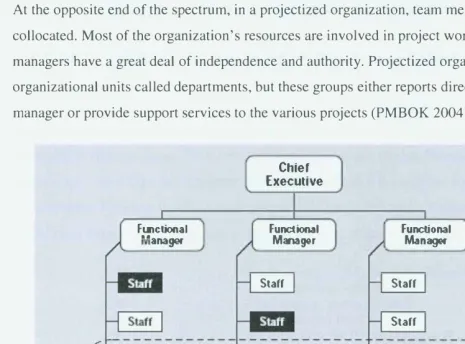
At the opposite end of the spectrum, in a projectized organization, team members are often collocated. Most of the organization's resources are involved in project work, and project managers have a great deal of independence and authority. Projectized organizations often have organizational units called departments, but these groups either reports directly to the project manager or provide support services to the various projects (PMBOK 2004).
� ,
I \
Fmclional ··anag«
Chief Executive
Functional Mana99r
Stafr
Functional Managl!(
Starr
Starr
'
\---
--
_.,,, [image:29.756.65.530.86.430.2](Black boxes re!=fesent stnff engagoo in j:'Oject activities.) Pro_Fct Coordinlltion
Figure 5. Balanced Matrix Organization (PMBOK 2004)
4.0 CURRENTLY USED PACKAGING DEVELOPMENT PROCESS
4.1 Product and Packaging Development Processes in Colgate Palmolive
Turkey*
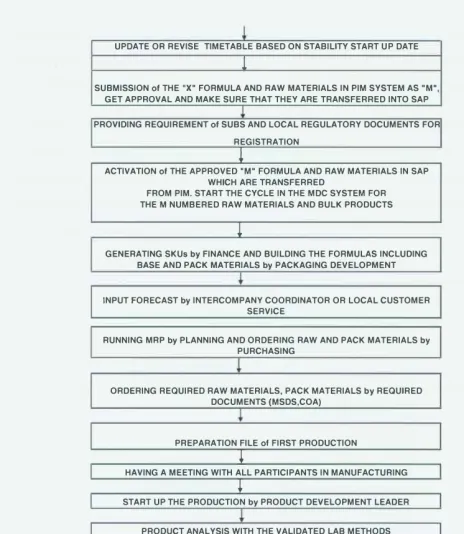
Since a significant part of new packaging development needs are generated at the same time with new product requests, most of the project briefs are concurrently define packaging and product, generally in separate parts. "New Product Development and Design Procedure" is mainly focused for formulation development and validation since it is an earlier stage than packaging development. The New Product Development and Design Process at Colgate Palmolive Turkey is shown in Figure 6. The abbreviations below are used in the figure.
MMCM CIC GPS PIB PMPS RMPS QAL R&D PIM SAP MDC EMO FRPL APET X
M
UGL UGM CBS
Manufacturing and Marketing Coordination Meeting Category Innovation Center
Global Project Briefing System Project Initiation Brief
Packaging Material Purchasing Specification Raw Material Purchasing Specification Quality Assurance Lab
Research and Development Product Integrity Management
Software
Material Database Center Industrial Manufacturing Test First Review Prior to Launch
Antimicrobial Preservative Efficiency Test Test Formulation
Production Formulation
Product Development Leader
Product Development Engineer Cross Border Sourcing
* This project was carried out under the auspices of the Packaging Development Department
NEW PRODUCT DEVELOPMENT AND TECHNOLOGY TRANSFER FLOW
BRIEFING THE PROJECT TO PRODUCT DEVELOPMENT by MARKETING
ASKING R&D FOR REFERENCE PIM# OR GENERATING FORMULA ONE OF THE EXISTING BACKBONE
!NOT FEASIBLE IF THE PRODUCT IS LOCAL FORMULA ; RUNNING PRELIMINARY COST BASED ON1---
PROJECT BRIEF
I
I"'"'"' I
PREPARATION of GPS/PIB (Project Initiation Brief) by MARKETING OR CIC
APPROVAL of GPS by GLOBALLY OR PIB by LOCAL MANAGEMENT
PREPARATION of TIMETABLE AND DISTRIBUTIONS TO RELATED DEPARTMENTS
i
COORDINATION MEETING (TECHNICAL SERVICES, MARKETING, PURCHASING,
MANUFACTURING, REGULATORY)
FINAL EVALUATION of THE FORMULA FOR LOCAL FORMULA
l
COLLECTING ALL REQUIRED DOCUMENTS PRIOR TO SUBMISSION of THE FORMULAS IN PIM
l
SUBMISSION of THE NEW FORMULA AND RAW MATERIALS IN PIM SYSTEM AS
"X", GET APPROVAL AND MAKE SURE THAT THEY ARE TRANSFERRED INTO SAP
ACTIVATION of THE APPROVED FORMULA IN SAP WHICH IS TRANSFERRED FROM PIM. START THE CYCLE IN THE MDC SYSTEM FOR
THE NEW RAW MATERIALS AND BULK PRODUCTS
l
GIVING THE PRODUCT SPECS of RAW MATERIALS TO THE PURCHASING TO ORDER SUFFICIENT QUANTITY OF THE RAW MATERIALS AND ASK FOR RELATED
DOCUMENTS (MSDS,CoA,PSDS) of EACH IN ORDER TO MAKE LAB TRIAL OR EMO
INSERTING MSDS of NEW CHEMICALS INTO MSDS DATABASE !
GIVING ANALYSIS METHOD of ANALYTICAL TESTS TO QA LAB
IF LAB TRIAL IS NEEDED ; PERFORM IT BY PRODUCT DEVELOPMENT ENGINEER, RECORD THE RESULTS INTO LAB NOTEBOOK.
IF EMO IS NEEDED; PREPARING THE SPI FORM, FILL IN F-QAG-015 FORM AND GIVE "ON THE JOB TRAINING" TO THE OPERATORS PRIOR TO EMO AND
PERFORM IT BY PRODUCT DEVELOPMENT LEADER
APPL YING ANALYTICAL TESTS TO THE PRODUCT of LAB TRIAL OR EMO
1
�I
I NEGATIVE I
r
UPDATE OR REVISE TIMETABLE BASED ON STABILITY START UP DATE
l
SUBMISSION of THE "X" FORMULA AND RAW MATERIALS IN PIM SYSTEM AS "M",
GET APPROVAL AND MAKE SURE THAT THEY ARE TRANSFERRED INTO SAP
PROVIDING REQUIREMENT of SUBS AND LOCAL REGULATORY DOCUMENTS FOR
REGISTRATION
i
ACTIVATION of THE APPROVED "M" FORMULA AND RAW MATERIALS IN SAP
WHICH ARE TRANSFERRED
FROM PIM. START THE CYCLE IN THE MDC SYSTEM FOR THE M NUMBERED RAW MATERIALS AND BULK PRODUCTS
!
GENERATING SKUs by FINANCE AND BUILDING THE FORMULAS INCLUDING BASE AND PACK MATERIALS by PACKAGING DEVELOPMENT
INPUT FORECAST by INTERCOMPANY COORDINATOR OR LOCAL CUSTOMER
SERVICE
RUNNING MRP by PLANNING AND ORDERING RAW AND PACK MATERIALS by PURCHASING
ORDERING REQUIRED RAW MATERIALS, PACK MATERIALS by REQUIRED DOCUMENTS (MSDS,COA)
PREPARATION FILE of FIRST PRODUCTION
I
HAVING A MEETING WITH ALL PARTICIPANTS IN MANUFACTURING
+
START UP THE PRODUCTION by PRODUCT DEVELOPMENT LEADER
PRODUCT ANALYSIS WITH THE VALIDATED LAB METHODS
!
PREVALIDATION FOR THE FIRST 3 BATCHES
+
FOLLOW UP OF cp-cpk AND VALIDATION DURING THE FIRST 30 BATCHES
UPDATE AND PUBLISH OF THE PROCESS SOP AND PUBLISH OF THE QUALITY I
[image:32.756.58.523.62.596.2]PLAN
Figure 6 New Product Development and Technology Transfer Processes in Colgate
Palmolive Turkey
In Figure 8, the main stages of a new product development process are shown. Currently, the Packaging Development Team generally starts to work on projects at the very last part of the concept development stage or within the bundle development stage. This is a problem because this late start by the packaging team reduces the chance of benefiting from their knowledge.
Idea Concept Bundle Final Go to
f--. Post Launch
Generation f--+ Dev. I--+ Dev.
_..,
Validation---.
Market ReviewFigure 8. Current Product Development Stages
Currently, it is not an accustomed situation to invite to the new product idea generation and concept development meetings such departments as Logistics and Customer Services who are at the end of the Supply Chain. However, restrictions and requirements originating from these departments' operations should be considered in the early stages of product development. The Packaging Development Team, having considerable experience in Logistics and Transportation operation limitations and requirements, could be a good candidate for sharing such information in the early concept development meetings. Shifting the identification of logistics requirements to earlier stages of product development could reduce development time and cost.
4.2. Organization & Structure
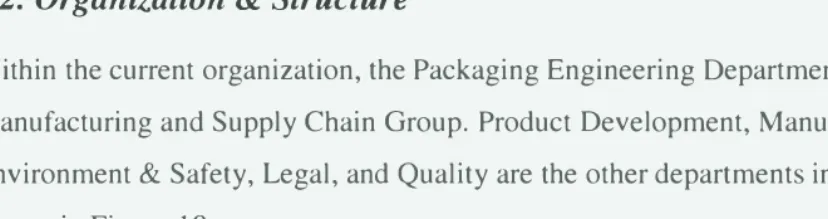
Within the current organization, the Packaging Engineering Department is a member of the Manufacturing and Supply Chain Group. Product Development, Manufacturing, Purchasing, Environment & Safety, Legal, and Quality are the other departments in the organization as shown in Figure 10.
Manufacturing Director
I
I
I
I
I
I
Packaging Product Operation Quality Env. Safety Legal
[image:34.764.59.523.160.224.2]Dev. Mng Dev. Mng. Manager Manager Manager Manager
[image:34.764.89.503.530.639.2]Since the current organization is clearly a functional one, most of the projects are handled by each function separately. The main customer of new products; Marketing, can communicate a request or information to different departments at the same time. To coordinate the
5.0 NEW (PROPOSED) PACKAGING DEVELOPMENT PROCESS
5.1 Packaging Development Process
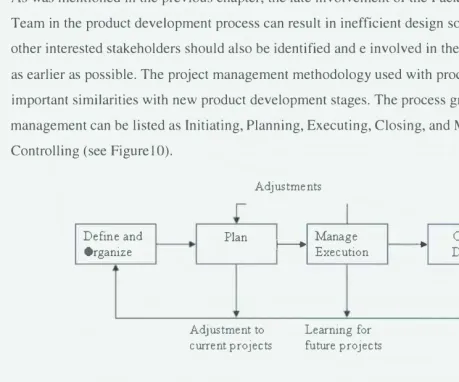
As was mentioned in the previous chapter, the late involvement of the Packaging Development Team in the product development process can result in inefficient design solutions. In addition, other interested stakeholders should also be identified and e involved in the development process as earlier as possible. The project management methodology used with process groups has important similarities with new product development stages. The process groups for project management can be listed as Initiating, Planning, Executing, Closing, and Monitoring and Controlling (see Figure IO).
Define and
Organize
Initiating
Processes
Adjustments
Plan
Adjustment to current projects
� Planning Processes
Manage
--.
ExecutionLearning for future projects
Execution
Processes
Monitoring and Controlling Processes
Close
:: Down
[image:36.756.67.527.183.566.2]Closing Processes
• Packaging Idea Generation
• Technology Match & Feasibility
• Concept Engineering Design
• Packaging Concept Validation
These four stages of packaging development work would be conducted in parallel with the first two stages of the overall product development process as shown in Figure 11.
Idea Generation
Packaging Ideation
Concept
Dev. Bundle Dev
Tech. Match & Feasibility
Final Validation
Concept Eng. Design
Go to
Market Post Launch Review
[image:37.761.75.516.238.399.2]Pack Concept Validation
Figure 11. Proposed Packaging Development Stages
To assure a flawless execution of each stage, it was proposed that project management
methodology be used at each stage. Initiating, Planning, Execution, and Closing processes have specific documentation formats, and they would be used at gate evaluations at the end of each stage. The new packaging development process will have four stages and four gates. Each stage will have inputs to be processed, and the output from each gate will be an input to following stage (Figure 12). Each stage and gate is explained in the following sections; Table 2 at the end of the section provides a summary.
Packaging Idea Generation
Technology Match & Feasib1ltty
Concept Eng
Design Valtdation Concept
EJ
� � � [image:37.761.79.505.566.684.2]5.1.1 Packaging Idea Generation
A consumer's insight top idea list and a competition benchmark analysis (packaging, market, and product) can be listed as the main inputs of this first stage. The assignment of a packaging
engineer for the project is also recommended at this stage.
Preliminary concept scoring should be listed as one of the first steps of this stage process (Pugh 1981). Concept screening and selection matrixes are widely used in new product and packaging development projects. Although there are other more complicated and detailed templates for concept screening and scoring, it is recommended not to continue to the lower level of the process, and to postpone it to later stages. Otherwise, the concept screening and selection will become a very detailed, tedious, and ineffective process with functional analysis (Friedmann et al. 2004). Sample screening and scoring matrixes were created for a shampoo bottle development and are shown in Appendix A and B.
Technology landscaping and joint development with outside partners are other two important steps in the first stage. These two research investigations should be handled by the assigned packaging engineer. In addition, the base or premium product or packaging decision should also be done immediately within this stage. Packaging development can initiate the investigation of primary packaging, decoration, and printing technology accordingly.
The outputs of the first gate should be the selection of the leading concepts and concept brief documents.
5.1.2 Technology Match and Feasibility
Selected lead concepts from the previous stage (Packaging Idea Generation) will be inputs for the second stage. To determine the technical requirements of selected concepts, involvement of inside and outside experts is important and needed. Preliminary cost and timing estimates should be done at the same time, and the capabilities and readiness of suppliers should be checked.
example would be proposing a new printing technique for primary packaging without a clear benefit, when the flexography technique is mostly used and well established on the supplier side.
Developing a master testing plan for new packaging is recommended at this stage. The gate outputs should include the concepts promoted from the design stage, a project charter with an assigned project manager, and a project scope document. Samples of these documents are provided in the next chapter for the case study.
5.1.3 Concept Engineering and Design
Approved and technically feasible designs will be input to this stage. A Work Breakdown Structure is a deliverable-oriented hierarchical decomposition of the work to be executed by the project team to accomplish the project objectives and create the required deliverables. Within this stage, it is recommended that the WBS be defined as well as a preliminary project timeline. For the SUNCARE Shampoo Packaging Renovation Case Study presented in the next chapter, a graphical form of a WBS was prepared, which is suitable for showing high level deliverables and work packages.
Rapid prototypes which are non-functional models (not produced from a unit cavity) should be prepared in order to conduct customer tests and check the actualization of expectations of the Marketing and Sales Departments. Following this, unit cavity and prototype moulds can be prepared, and the preliminary stability and functional studies completed. The next step will be refining a master test plan and preparing preliminary specifications. Cost and time estimates also can be refined once more.
The gate output will be a preliminary project plan (WBS and timeline). In addition, project scope will be refined and an approved design will be submitted to the final stage for validation.
5.1.4 Packaging Concept Validation
After completion of the tests and cost and timeline estimates, design specifications can be refined, and a concept validation report can be issued.
[image:40.759.53.540.195.736.2]The final gate outputs to Bundle development should be a final project scope statement, a revised WBS and timeline, and a validated concept.
Table 2. Summary of Proposed Packaging Development Process With Four Stages
STAGE Packaging Idea Technology Match and Concept Engineering Concept Validation
Generation Feasibilitv and Design
INPUT -Consumer Insights -Selected Lead Concepts Approved Technically - Approved Concept
top selected list Feasible Concepts Design for
-Competitive Validation
benchmark analysis
PROCESS -Preliminary Concept -Link with inside and - Define WBS and - Validation (master
Scope outside experts preliminary Timeline test) protocol
-Technology -Determine Concept - Engineer functional - Build Unit cavities
Landscaping Technical requirements design Consumer Insights
-Conceptual "new -Lead concepts tech - Materials /Design and Testing
product" feasibility analysis and testing - Master Test Plan
development report - Rapid prototype non- (formula/
-Joint Development -Preliminary Cost /Time functional models (not packaging and
with Outside Estimates from unit cavity yet) others)
-Partners -Disruption to Supply - Design Functional
-Preliminary concept Chain Analysis - market cavity /prototype Ergonomic and
artwork/decoration segmentation moulds Aesthetic Testing
-Base / Premium -Vendors/Supplier - Develop product Validation plan
decisions Readiness aesthetics and execution & Report -Consumers -Identify Plant customer - consumer screen - Refine
assessment Draft Business Need - Preliminary Stability Cost/Timeline
-Strategy fit and functional studies estimates
(Decoration/Dispensing/ - Reline Master - Refine design
Premium) Testing Plans specs
-Consumers Insight - Preliminary - Preliminary P&L
-Develop Master Testing Specifications - Concept Validation
Plan - Refine Cost I Time Report
-Reline Concept Scope estimates
GATE -Promote Lead -Concepts promoted for - Preliminary project - Project scope
OUTPUT Concepts to next Design stage plan (WBS/ timeline) statement (final)
stage -Project Charter (project - Revised Project Scope - Revised project
-Concept Brief manager appointed) - Approve Designs for plan doc (WBS /
Document -Preliminary Scope next stage Timeline)
6.0 CASE STUDY: SUNCARE SHAMPOO PACKAGING RELAUNCH
6.1 New Packaging Development Process for SUNCARE Brand Shampoo
The scope of this case study is described in more detail in the Statement of Work below. The scope defines what is included, what is excluded, and the assumptions agreed upon. The focus of this case study was a multinational corporation with major manufacturing operations in personal care liquid products, in particular shampoo products.Recent feedback from consumer insights on shampoo products indicated that consumers regarded the current packaging as "old fashioned;" also, complaints about the shampoo flip top caps had increased, particularly regarding a "broken hinge." The company decided to initiate a re-launch project to resolve these complaints.
6.2 Methodology
This case study will show how the early involvement of the Packaging Development Team in the product development process and the application of both project management and Stage-Gate methodologies will benefit the corporation and result in a product re-launch occurring on time.
To provide a sufficiently detailed example, a re-launch and line extension project for a shampoo product line was selected. Even though many re-launch and line extension projects may have limited changes, in this case it was assumed that almost all design and transportation
specifications had been changed. The parameters included shape, dimensions, color, label graphics, suppliers, shelf requirements, transportation, and warehousing conditions. It was also assumed that the packaging suppliers and product formulations were changed at the same time. The detailed scope of the project is defined in the Scope of Work (SOW) document in Section
6.3.2.
The standard project management processes needed to initiate, plan, execute, monitor and control, and close a project have been recognized as good practice on most projects. These processes apply globally and across industry groups. This does not mean, however, that the knowledge, skills, and processes described should always be applied uniformly on all projects. The project manager, in collaboration with the project team, is always responsible for
determining what processes are appropriate, and the appropriate degree of rigor for each process, for any given project.
6.3 SUNCARE Shampoo Packaging Renovation Case Study: Project Documents
6.3.1. Project Charter
SUNCARE SHAMPOO PACKAGING RELAUNCH PROJECT CHARTER
1. SUNCARE Shampoo Packaging Renovation Project
2. Document Version
Status and Author Summary of Distribution Distribution
Version no Changes Date Group
Initial Project Project Sponsor,
Draft 1.00 Fikri Bilir Charter 10.02.2004 Project Manager,
and Team
3. Project Summary: Background and Description
Recent feedback from consumer insights regarding SUNCARE shampoo products indicated that consumers regard current packaging as "old fashioned." Also, complaints about shampoo flip top caps have increased, particularly regarding "broken hinges." The company has decided to initiate a re-launch project to resolve these complaints.
Global sales of shampoos are estimated to be approximately $14 billion, growing at a rate of 2-3% per annum. Conditioner sales, on the other hand, are estimated to be $6 billion and are the fastest growing .segment in the category. Shampoo accounts for 54% of hair care sales,
Hair care has become more noticeably competitive over the past few years as illustrated by the following:
1. Increases in media support levels behind key players and brands 2. Trend towards more cosmetic and stronger end benefits
3. Summarized and communication of benefits by attractive, highly-effective packaging, not
only in terms of graphics but also in bottle structures
The global key players and brands, and even regional family and value brands, have
contemporized and upgraded their presentations over the past 2 years, both graphically as well as structurally. Given the rapid and dramatic changes in the shampoo/conditioner structures,
SUN CARE is clearly outdated and in need of a new bottle structure ASAP
4. Purpose and Benefits
The project seeks to contemporize and harmonize shampoos and conditioners with new bottles and label graphics. The intent is to create consistent equity communication and a common look across all SUNCARE businesses.
5. Alignment and Justification
The hair care category is one of the priorities of the SUNCARE Company, and the shampoo sales volume is a driver in that category. Sales of shampoos are estimated at approximately $14 billion, growing at a rate of 2-3% per annum.
6. Organizational Readiness
SUNCARE has considerable experience in developing new product bundles including shampoo. The cooperation of the Technical Centers, Business Development & Graphics, and Brand Design Teams with key suppliers is a strength of company in regard to the project. Management
7. Customer Readiness
In a Qualitative Exploratory Study held in Europe, the current SUNCARE Shower Cream/Gel bottle was seen as SUNCARE 's unique, identifying feature represented by its round, small, very feminine "petal shape." The SUNCARE petal-shape presents a perfect combination of elements: balance of shapes (modern yet classical), proper dimensions, femininity, "evocative potential," and easy to hold.
Additionally, in a shelf test conducted for hand and body lotion, the petal version generated good scores, beating competitors in terms of purchase intent and concept fit. It has also posted high ratings for quality and modernity.
8. Goals and Objectives
Marketing
• Grow the SUNCARE franchise to a $900 MM business, delivering a 5% value share by 2007
• Improve SUNCARE Hair Care image
• Strengthen communication of natural equity positioning while increasing differentiation versus competition
• Enhance synergies and equity coherence of SUNCARE lines across all categories
Technical
• The design must be revolutionary versus the current bottle. It must be aesthetically competitive (impact and size impression) with the leading market brands as well as local/regional brands.
• The design must exude cosmetic values without alienating family usage and must be consistent with personal beauty care imagery.
• The design must be ''petal-like."
9. Scope
A Project Charter, Work Breakdown Structure, Responsibility Matrix, packaging specifications for a new bottle and cap, new label graphics files, documentation of transportation and shelf requirements, and a Project Closure Document are the major deliverables of the project.
Detailed cost calculations of the new packaging items and negotiations with design agencies and suppliers are out of scope activities.
10. Stakeholders
Stakeholders Name Title, Department, Contact Information
Organization
Project Claire Simond Category Management, 00 1 212 728 00 90 ext.
Sponsor 155
Project Katalina lvanova Packaging Development 00 1 212 728 00 90 ext.
Manager Leader 212
Business Armando Flores 00 1 212 728 00 90 ext.
Development 190
Packaging Jean-Luc Nelissen Packaging Engineer 00 1 212 728 00 90 ext.
Development 200
Design Arnold Fernandes 00 1 212 728 00 90 ext.
211
R& D Monica Erel R&D Engineer 00 1 212 728 00 90 ext. 330
Procurement Valery Purchasing Manager 00 1 212 728 00 90 ext.
Dobrovolsky 340
QC and Andrey Ovchinsky QA Leader 00 1 212 728 00 90 ext.
Regulatory 403
Division Karen Behl Marketing Director 00 1 212 728 00 90 ext.
Management 420
Technical Peter Miller R&D Specialist 00 1 212 728 00 90 ext.
Center 370
Consumer Patrice Dehan Research Specialist 00 1 212 728 00 90 ext.
Research 110
Local Toby Biers Manufacturing Manager 00 1 212 728 00 90 ext.
Manufacturing 124
Local Juan Advincula Brand Manager 00 1 212 728 00 90 ext.
11. Reviews and Approvals
Milestones / Deliverables Target Date Review Responsible Approval
required Responsible
Project Team Creation 06.01.2007 Project Manager Project Sponsor Project Kick off Meeting 06.15.2007 Project Manager Project Sponsor
Bottle and cap design 12.30.2007 Packaging Project Manager
development and selection Development and Team
Graphics development 04.30.2008 Marketing Project Manager
and Sponsor
Bottle and cap color 02.30.2008 Marketing and Project Sponsor
development and selection Packaging Dev.
Testing and Validation of 09.30.2008 Packaging Project Manager
initial samples Development
12. Communication and Control
Distribution Details Communication Medium Target Date Group or (Expected
Description or Frequency Attendees Content or
Agenda)
Project Office Meeting 2 weeks PM, Team
Coordination
Meeting
Project Timeline e-mail 2 weeks Project Team,
Shareholders Project Status Announcement Continuous All parties related
Board with Project
13. Assumptions
• New bottle and cap should be in line with current cost of goods/net sales ratio.
• Current Global 400 ml and 200 ml sizes will be kept.
750 ml, 350 ml, and 100 ml. Regional sizes will be developed for shampoo. 350 ml and 300 ml sizes will be developed for conditioner.
• All designs are to be developed to fit within 8-station capabilities worldwide including hot-stamping and varnish.
6.3.2. SUN CARE Project Scope of Work Document
SUNCARE Shampoo RL Case Study Project
Statement of Work - SOW
Project Manager: F. Bilir
Sponsor: G. Navia
Revision date Revised by Approved by Description of change
10.01.2007 Fikri Bilir Gerardo Navia Project T earn list update
Purpose
The purpose of this case study is to design a new bottle, a new cap, and label graphics for a
re-launch and line extension project which targets improved competitiveness, more functionality, and a modern appearance for shampoo packaging.
This brief addresses the Hair Care "Petal-shape" Bottle and Graphics Design targeted for launch in Ql 2008. It seeks to contemporize and harmonize shampoos and conditioners with new bottles and label graphics. The intent is to create consistent equity communication and a common look across all SUNCARE businesses.
Background
Sales of shampoos are estimated to be approximately $14 billion, growing at a rate of 2-3% per annum. Conditioner sales, on the other hand, are estimated to be $6 billion and represent the fastest growing segment in the category. Shampoo accounts for 54% of hair care sales, with conditioners at 24% and styling aids at 22%. Hair care has become more noticeably competitive over the past few years, illustrated by:
4. Increases in media support levels behind key players and brands
5. Trend towards more cosmetic and stronger end benefits
6. Summarized and communication of benefits by attractive, highly-effective packaging, not
only in terms of graphics but also in bottle structures
Scope (Major Project Activities)
1. Identify and define a cross-functional project team which can include a variety of internal and external members (design agencies, suppliers, converters, engineers, consumers, distribution channel members, and consultants).
2. Design new "petal-shaped" shampoo bottles and caps for better consumer acceptance and modern appearance. New bottle design should carry the following brand communication objectives:
• Inspired by flowers
• Contemporary in beauty care
• Sensorial experience
• Natural attractiveness
• Shelf appeal
3. New design should present enhanced overall aesthetic appeal being modern, and cosmetic with unisex appeal. It should be clearly competitive in size impression and should have higher shelf impact versus key competition. Eucalyptus and coconut are considered Global benchmarks.
4. Achieve premium and modern graphics appearance: change graphics of labels and use silk screen, hot foil printing techniques with clear PP label material. To create and
implement a perceptual change, the new graphics needs to reflect the following paradigm shift.
Current:
Dull
Old-fashion Cheap
Basic Cleansing Somewhat feminine Natural but stodgy
Future: Vibrant Contemporary High quality Hair care expertise
5. Develop new colors for bottles and caps. Test and validate that these new bottle colorants are compatible and conformable with new product formulations.
6. Check and validate that new primary and secondary packaging designs are suitable for production lines, local and global shipments, and shelf requirements.
Out of scope activities that are critical to the success of the project:
1. Detailed cost calculations of new packaging items
2. Negotiation with design agencies and suppliers
Deliverables:
1. Work Breakdown Structure
2. Responsibility Matrix
3. Packaging specifications of new bottle and cap.
4. New label graphics files.
5. Documentation of transportation and shelf requirements.
Project Cost Estimates:
Cost Type
Development-Design
Development-Models
Development-Quantitative Tests
Unit Cavity (Pilot tool)-HDPE, PET, and caps
Implementation-Bottle and cap molds, line change parts
Amount($)
40.000 10.000
120.000
85.000
Schedule Overview:
Estimated Project Completion Date: 12/30/08 Major Milestones
Project team creation 06/01/07
Project kick off meeting and 06/15/07
Bottle and caps design development and selection 12/30/07
Graphics files development and approval 04/30/08
Bottle and cap color selection 02/30/08
Testing and Validation of initial packaging samples 09/30/08
Preparing draft specifications for purchasing 10/30/08 External Milestones Affecting the Project
Completion of Packaging Design Brief 06/15/08
Packaging Supplier selection for mass production 12/30/07
Stakeholder Analysis:
Name & Role Major Responsibility or Contribution
Customer Preparing Packaging Design Brief
Sponsor support of Management. Guidance of Project Team and providing them
Hair Care Evaluation at each stage of project and take go/no go
Management decisions.
Packaging Execution of bottle and cap design development and
Development validation activities.
Corporate Execution of label design development activities. Design
Technical Defining, Planning, and management of Project
Chain of Command:
Project Team:
PROJECT SPONSOR
PROJECT MANAGER
I I
BUSINESS PACKAGING TECHNICAL CENTER CORP ARA TE DESIGN
DEVELOPMENT DEVELOPMENT
Customer Approval Chain:
HAIR CARE CATEGORY MANAGEMENT
BUSINESS DEVELOPMENT
CORP ARA TE DESIGN PACKAGING DEV. TECHNICAL CENTER
6.3.3. SUNCARE Shampoo Packaging Renovation Project Responsibility Matrix
A Responsibility Assignment Matrix (RAM) can be used to illustrate the connections between work that needs to be done and project team members. The below matrix is a type of RAM called a RACI chart because the names of the roles being documented are
Responsible(Execution), Accountable, Consult, and Inform.
• R(E)-Responsibility: Stakeholder is responsible for getting the work done. Not
necessarily a decision maker, but drives the group to make decisions in a timely manner. • A-Accountable: Final approval on accepting the outcome of this activity. Makes
decisions.
• I-Inform: Informed after a decision is made. Wants to stay updated on progress of this activity
Below is the proposed Responsibility Matrix for the Shampoo Packaging Case Study.
Main Activities / Milestones
1. Definition of project scope and objectives
2. Identification of possible cross
functional project team members and required sources
3. Allocation of
corporate resources to project
4. Prepare draft forms of project brief, timeline, and budget
Main Activities / Milestones
5. Get approval and commitment of senior management
6. Get everyone to agree on project objectives
7. Assign Project Manager & leading department
8. Select project team members
9. Organize project kick off meeting
10. Conceptual design study for creating alternative packaging for consumer test
...
- 0 u 1/)
.!!!. C: 0 0 ... C. a. Cl)
A
A
A
...
- 0 u 1/).!!!. C: 0 0 ... C. a. Cl)
E C E A C
...
- G) u Cl .!!!. cu 0 C: ... cu a. :l:E
E
E
E
...
- G) u Cl .!!!. cu 0 C: ... cu a. :l:
E
E
E
E
1/) 'E 1/) G)
a, E C: C. ·- 0 11)-::s G) al> G) C
E
C
C
-1/) C:1/) G) a, E C: C. ·- 0
11)-::s G)
al a:;
C
E
en
C: en cu > .:,,:. G) c.,C
cu a. C C en C: '5, cu
>
G) �ccu a. E C: en 'iii G) C C C C: en 'iii G) C E C � a: C � a:
-
C: G) E � ::s ue
a.-
C: G) E G)...
::s u 0...
a. cu u ...·- G) C: -� C: u G) {!!.o
C
C
cu u ... ·- G)C: -� C: u
G)
{!!_0
E
...
G) � E �::s cu 1/) G) C: 1/) 0 G) 0 a:
...
G) � E � ::s cu 1/) G) C: 1/) 0 G) 0 a:
11. Conducting consumer research &
test for identifying C A C E
mostly preferred packaging design
alternatives
12. Unit/ pilot mold
preparation and sample A I E I
production for validation 13. Develop a
performance criteria A E E E
and testing program
14. Conducting initial
validation tests and A C E
completinq approvals.
15. Transferring bundle I C E
to sub countries
16. Controlling project A E
execution
6.3.4 Work Breakdown Structure (WBS)
The Work Breakdown Structure is a deliverable-oriented hierarchical decomposition of the work to be executed by the project team to accomplish the project objectives and create the required deliverables. WBS can be either product oriented or process oriented. In Figure 13, samples of both are given for the shampoo packaging renovation project.
I
PRODUCT -ORIENTEDSHAMPOO PACKAGING
RElAUNCH
Management Bottle
&Planning Cap I Label 11 Graphics 11 r�tem
[ PROCESS -ORIENTED
,-SHAMPOO
PACKAGING
RElAUNCH
Management Design Purchas Fabrica
I
�arketi 11 Assembly 11 Acceptance
[image:53.756.63.532.37.355.2]Decomposition may not be possible for a deliverable or subproject that will be accomplished far into the future. The project management team usually waits until the deliverable or subproject is clarified so the details of the WBS can be developed. This technique is sometimes referred to as rolling wave planning. A sample process-based WBS of the new bottle design project is shown in Figure 14.
1.0 New Shampoo Bottle
1.1. Concept Dev. l .2. Desip,. 1.3. Manufacturing 1.4. Cost
1.1.1. Idea Gmention l.'..l.l. Prepm 2D & 3D 1.3 .1 Pilit tool 1. 4 .1. Cost. ertim.a1i=
1.1.2. TeO'lical Feasibility u .'..l Mo� up s�le 1.3 .'..l. Real tool 1. U . SUpplier Selection
1.1.3. Select Concept 1. '..l.3 . Fmal Validation 1.3.3. at.rt up 1.4.3. Fmal Cost.
[image:54.764.67.534.122.392.2]1.1. 4 . Validue cone ept
Figure 14. Proposed Process-based WBS for New Bottle Design 6.3.5 Timeline
The Project Time Management processes include Activity Definition, Activity Sequencing, Activity Resource Estimating, Activity Duration Estimating, Schedule Development, and Schedule Control. The Project Schedule includes at least a planned start date and planned finish date for each schedule activity. A project timeline with bars representing activities shows activity start and end dates as well as expected durations. Bar charts are relatively easy to read and
frequently used in management presentations.
For this case study, a Project Timeline was prepared where each stage of the packaging
development process was considered a unique work package including different activities. See the Appendix C for the proposed SUNCARE Shampoo Packaging Development Project Timeline.
6.3.6 Tools and Techniques for Schedule Development
dates, and scheduled start and finish dates for the uncompleted portions of project schedule activities. A sample diagram of bottle development activities is shown in Figure 15.
Start
BOTILE DESIGN - SAMPLE DIAGRAM