This is a repository copy of Proposition structure in framed decision problems: A formal representation..
White Rose Research Online URL for this paper: http://eprints.whiterose.ac.uk/2590/
Monograph:
Wickham, P. (2007) Proposition structure in framed decision problems: A formal representation. Working Paper. University of Leeds , Leeds, UK.
Working Paper 591
[email protected] https://eprints.whiterose.ac.uk/
Reuse See Attached Takedown
If you consider content in White Rose Research Online to be in breach of UK law, please notify us by
White Rose Research Online
http://eprints.whiterose.ac.uk/
Institute of Transport Studies
University of Leeds
This is an ITS Working Paper produced and published by the University of Leeds. ITS Working Papers are intended to provide information and encourage discussion on a topic in advance of formal publication. They represent only the views of the authors, and do not necessarily reflect the views or approval of the sponsors.
White Rose Repository URL for this paper: http://eprints.whiterose.ac.uk/2590/
Published paper
Philip Wickham (2007) Proposition structure in framed decision problems: A formal representation. Institute of Transport Studies, University of Leeds, Working Paper 591
UNIVERSITY OF LEEDS
Institute for Transport Studies
ITS Working Paper 591
July 2007
Proposition structure in framed decision problems: A
formal representation
Philip A. Wickham
Proposition Structure in Framed Decision Problems:
A Formal Representation
Philip Wickham
Institute of Transport Studies University of Leeds
Leeds, LS2 9JT [email protected]
Abstract
Framing effects, which may induce decision-makers to demonstrate preference description invariance violation for logically equivalent options varying in semantic emphasis, are an economically significant decision bias and an active area of research. Framing is an issue inter alia for the way in which options are presented in stated-choice studies where (often
inadvertent) semantic emphasis may impact on preference responses. While research into both espoused preference effects and its cognitive substrate is highly active, interpretation and explanation of preference anomalies is beset by variation in the underlying structure of problems and latitude for decision-maker elaboration. A formal, general scheme for making transparent the parameter and proposition structure of framed decision stimuli is described. Interpretive and cognitive explanations for framing effects are reviewed. The formalism’s potential for describing extant, generating new stimulus tasks, detailing decision-maker task elaboration. The approach also provides a means of formalising stated-choice response stimuli and provides a metric of decision stimuli complexity. An immediate application is in the structuring of stated-choice test instruments.
Keywords
Introduction
Risk taking behaviour of individuals, small groups and organisations is subject to two avenues of research. A normative tradition that informs management science and operations analysis deduces optimal decisions from assumption of instrumental rationality, utility maximisation and Bayesian information efficiency. A complementary descriptive tradition takes a positive approach to the reality of decision-making. Contrasting findings between the two reveals that real decision-making is cognitively ‘rich’ with actual choice and preference demonstrating a series of systematic deviations – referred to as decision biases or anomalies - from normative precepts. One anomaly that has been extensively researched under both laboratory and ecological conditions is the ‘framing effect’ (Tversky & Kahneman 1981; 1986) where rating of a single option or preference between available options (usually, but not inevitably a pair) is reversed depending on the semantic emphasis of the outcome description even though those presentations are, at face, logically equivalent. This represents an ostensible violation of expected utility description invariance.
This paper addresses a lacuna by developing a formal, rigorous and quite general logical representation of decision problems proposed to be subject to the framing effect in earlier literature. It complements Levin, et al’s (1998) tubular representation of framing problem structure. Such formalism is practical and has value in the analysis of extant decision problems and creation of well-defined novel problem stimulus, including those in stated-choice instruments. The formalism makes clear that the scope for stimulus problem
construction is far greater than those currently subjected to experimental investigation. The formalism is also of use in revealing decision construal in ecological settings and can inform the development of prescriptive technologies to debias and enhance professional decision-making. It also makes explicit logical and outcome / risk facets of problem structure that have been suggested to be of import to framing effects and are called upon as a basis for their explanation. The distinction between risky choice, attribute and goal framing highlighted by Levin, et al (1998) is emphasised. Examples of framed decision stimuli from a transport context are developed.
The paper is structured as follows. First an outline of Prospect Theory, which provides the primary conceptual platform for explaining framing effect, is presented. Its predictions are contrasted with those of normative expected utility theory (EUT). This is followed by a brief review of framing effects in which investigation of business arena decisions, framing
typology (a distinction between risky choice, attribute and goal framing), proposed
explanations and outstanding research issues are discussed. This discussion makes a strong case for the relevance and value of the proposed formalism. The formalism is then expiated. Elements common to all three types of framing problem are discussed first with elements specific to the formalisation of risk choice, attribute and goal framing following. The paper concludes with comments on how the formalism may be extended to accommodate more general and ecologically relevant features of stated-choice decision challenges.
Prospect Theory: An overview
subjective risk respectively on the basis of a set of consistency axioms and a target of expected utility maximisation. Decision-makers are presumed be computationally efficient, logically omniscient and properly Bayesian in deriving beliefs from available information. This tradition informs much management science, finance theory and operations analysis. It provides a platform for stated-choice methodologies.
The empirical predictions of normative theory have stimulated a tradition of experimental and ecological evaluation of human decision making under a variety of situations to assess the extent to which it is truly ‘rational’ on an aggregated and (increasingly) individual level. This descriptive tradition has generated extensive evidence that actual decision-making rarely meets with normative precepts. Further, preference deviations are not random but tend to be distorted in a systematic and consistent way. This has led to the development of descriptive models of decision-making under risk that generalise expected utility theory in an attempt to better map the reality of choice and preference (Reviews are offered by Schoemaker (1982), Sugden (1986), Weber & Camerer (1987), Machina (1987), Fishburn (1988a ; 1988b), Camerer (1989), Munier (1989), Camerer & Weber (1992), Starmer (2000).
Of these generalisations, Prospect Theory (Kahneman & Tversky 1979; Tversky &
Kahneman 1992) has proved to be the most successful in stimulating research and providing a basis of descriptive accounts of practical decision-making. Prospect theory has a number of postulates that distinguish it from expected utility theory. Consider a decision-maker facing a prospect, , that is a set of discrete outcomes
x⊂X , x = (x1 ,…, xn) , to which the decision-maker assigns a utility U : X→ over a
probability distribution p = (p1 ,…, pn) , p ∈ [0 , 1] , i pi = 1 . Prospect Theory suggests that
decision-makers evaluate potential changes in asset position, x = (x – r) relative to an initial reference point, r , rather than final asset position. Such changes are psychologically coded as gains ( x > 0) or losses ( x ≤ 0). It further proposes that the utility function has a specific shape (S-shaped: concave in gains, convex in losses discontinuous at the reference point) such that gains tend to induce preference for risk averse options while losses induce preference for risk seeking options. Further, probabilities are not entertained unmodified, but are weighted as a function w(p) with w(0) = 0 and w(1) = 1 but with a typical pattern of low probabilities, p<<
being overweighted and moderate to high probabilities, p> being underweighted
w(p<<) > p<< , w(p>) < p> .
In total, whereas expected utility theory suggests a prospect should be (rationally) valued as VEUT( ) = u(y , 1) = i u(xi) pi , Prospect Theory proposes that the prospect is valued as
VPT( ) = u(y , 1) = i v( xi)w(pi) , where v is the value function that has the properties of a
utility function over asset changes.
The switch from risk aversion in gains to risk seeking in losses is manifest as two distinct (though often confused, see Fagley 1993 and Li 1998) decision phenomena. The reflection effect occurs when a decision-maker prefers one (usually the less risky) of two prospects +s
+
r when gains are involved (∀x > 0) , but refers the other (usually the riskier) option when
gains are reflected to losses (∀x → -x) ⇒ -s -r . As the gain and loss prospects are
logically distinct, this reversal in preference might reflect consistent preferences and so is not necessarily irrational. The framing effect, on the other hand, relates to an inversion of
preference between options differing in risk when logically identical pairs of prospects are presented with descriptions that differ only in semantic emphasis: if the description is in terms of affectively positive aspects or outcomes (gains, opportunities, improvement or attractive features) then risk aversion usually results; if the description is in terms of affectively
when the two versions are presented to the same individual on different (cognitively isolated) occasions and inter-participant when the reversal is manifest as a shift in modal preference between comparable groups.
The two descriptions are logically equivalent assuming that the negative description is antonymic to the positive and reference to set partitions switched. Hence the preference reversal is ostensibly irrational (the need for this qualification will become apparent later). Prospect Theory accounts for the framing effect as a consequence of the decision-maker psychologically coding positive descriptions as gains and negative as losses so inducing risk averse and risk seeking preferences respectively.
Framing effects: Typology, examples and explanations
Explicit attention to framing effects was first drawn by Tversky & Kahneman (1981) with the now canonical ‘Asian Disease’ problem. An initial semantically common context was set with:
“Imagine the US is preparing for the outbreak of an usual Asian disease, which is expected to kill 600 people. Two alternative programs have been prepared to combat the disease have been proposed. Assume that the exact scientific estimates of the consequences of the programs are as follows:”
Two versions of the choice set (two options, forced choice) then follow, one with a ‘positive’ frame emphasising ‘lives saved’:
“If Program A is adopted, 200 people will be saved.
If Program B is adopted, there is 1/3 probability that 600 people will be saved and 2/3 probability that no people will be saved”
The other with a ‘negative’ frame emphasising ‘deaths’:
“If Program C is adopted, 400 people will die.
If Program D is adopted, there is 1/3 probability that nobody will die and 2/3 probability that 600 people will die.”
Assuming that ‘die’ and ‘saved’ are complete and mutually exclusive, and that
‘die’ ≡ ‘(not) saved’ and ‘saved’ ≡ ‘(not) die’ then the consequences of Program A ≡ Program C and Program B ≡ Program D. Under expected utility theory it is presumed that such
invariance should not influence preference. Yet Tversky & Kahneman (1981) found that when presented to different participant groups 72% (n = 152) preferred the ‘safe’ (certain outcome) Program A (coded as gains) and 78% (n = 155) preferred the ‘risky’ (probabilistic outcome) Program D (coded as losses). Given the assumptions above, this inter-participant preference reversal is an ostensible violation of strategic invariance.
(1994) for employment, Schoorman, et al (1994) for company acquisition and disposal and Chang, et al (2002) for accounting decisions. These studies largely confirmed the framing effect as found by Tversky & Kahneman (1981; 1986) and demonstrated that professional decision makers are as subject to it as naive. Real financial incentives do not eliminate the effect and may even exacerbate it (Camerer, 1995:635; Kühberger, et al, 2002). Highhouse, et al (1996) demonstrated contrast effects in the framing of business issues as opportunities or threats. Decision-makers exposed to unequivocal opportunities framed equivocal issues as threats and vice versa.
A meta-study by Kühberger (1998) of 136 published experimental studies found the gain – risk averse to loss – risk seeking violation of invariance to be robust. However, subtle variations in problem structure such as problem arena, framing by reference point shift or outcome salience, response mode (forced choice or rating), qualitative or quantitative risk description and single or multiple initiator events were influential on the extent of the effect. All of these issues are relevant to stated-choice survey instruments. So too was whether the effect was measured on an inter- or intra-participant basis (see also Stanovich (1999:107) for discussion of divergence between the two). Zickar & Highhouse (1998) summarise
outstanding issues in decision framing research as including individual differences in
susceptibility, frame response consistency and framing arena effects. The formalism proposed in this paper makes transparent subtle variation in problem structure, parameters and logic and can support investigation into these issues.
The Asian Disease problem (and those using it as a logical template) represents choice over alternative options varying in risk. However, as Levin, et al (1998) point out in a major review of framing effects, the issue of framing has been extended (often without overt recognition) to two other types of problem that are of quite different structure: attribute framing in which (logically, but not semantically equivalent) alternative descriptions of salient characteristics of an item (item set) impact on object selection or rating and goal framing in which the
consequences of action or inaction are framed with the persuasiveness of the message to undertake action being influenced.
The simplest form of attribute framing will be familiar to marketers who prefer to label a food product as ‘90% fat free’ rather than (the logically equivalent) ‘contains 10% fat’. As might be expected, description in terms of the positive attribute description is usually rated more highly than that with the negative description. Levin & Gaeth (1988) found that for a beef product not only was the positively labelled product rated more highly, but also that in gustatory tests consumers actually reported that it tasted better.
A number of studies have been conducted to ascertain the impact of attribute framing for problems with this template have been conducted. These include decisions in resource allocation (Duchon, et al 1989; Dunegan 1993; 1995; Dunegan, et al 1995), penalties for deceptive advertising (Dunegan 1996), financial control systems (Emby 1994) and joint business ventures (Highhouse & Yüce 1996).
A more complex example of attribute framing (one that involves pairwise choice rather than rating, multiple attributes and probabilistic rather than certain attributes) might be as follows:
In the positive frame:
08:30 train: There is a 95% chance that you will arrive on time, and a 60% chance that you will get a seat for the entire journey.
09:00 train: There is an 85% chance that you will arrive on time, and an 80% chance that you will not get a seat for the entire journey.
09:30 train: There is an 80% chance that you will arrive on time, and a 90% chance that you will get a seat for the entire journey.
Which train would you prefer?
In the negative frame:
08:30 train: There is a 5% chance that you will be late, and a 40% chance that you will not get a seat and have to stand for the entire journey.
09:00 train: There is a 15% chance that you will be late, and a 20% chance that you will not get a seat and have to stand for the entire journey.
09:30 train: There is a 20% chance that you will be late, and a 10% chance that you will not get a seat and have to stand for the entire journey.
Which train would you prefer?
Such a stimulus might be used to investigate how individuals were willing to play off arrival time risk against journey comfort. These descriptions are equivalent given that the attributes ‘arrive on time and ‘be late’ and ‘get a seat’ and ‘have to stand’ both constitute exclusive and complete sets. The proposed formalism captures more general problems of this type with the ‘single item rating – certain attribute’ template a sub-type.
Levin, et al (1998) define goal framing as ‘a positive emphasis on the goal of obtaining a positive consequence as opposed to the negative emphasis on avoiding a negative
consequence’. In both cases the same action (referred to as a project in this formalism) and consequence is being promoted. However the persuasiveness of the message is frame
sensitive. It is usually the case that the action presents some short-term cost or inconvenience to the decision-maker. A simple example of goal framing in the travel choice arena is, in a positive frame:
“Leaving earlier increases your chance of arriving on time”;
Versus the negative frame:
“Not leaving earlier increases your chance of being late”.
This template of ‘for a single project: do and achieve good – not do and face bad, (with certainty)’ is dominant in goal framing studies. This does however represent only a small subspace of possible goal framing problem types. The generalisation within the proposed formalism occurs along three dimensions. First the possibility of selecting between alternative projects rather than just accepting (rejecting) or rating a single project is entertained;
regarded as symmetric in that they can prevent the delivery of (negative) consequences as well as help ensure those with a positive (projects might have a negative instrumentality as well as positive).
For example, in the arena of congestion charging:
In a positive frame:
Would you support a congestion charge of £5 between the hours of 07:00-09:00 in your city centre if it had a 90% chance of reducing your travel time of at least 15 minutes and a 60% chance of reducing your travel time by at least 30 minutes?
Yes, no?
And in a negative frame:
Would you support a congestion charge of £5 between the hours of 07:00-09:00 in your city centre if it had a 10% chance of not reducing your travel time by up to 15 minutes and a 40% chance of not reducing your travel time by up to 30 minutes?
Yes, no?
Goal framing has not received the same level of research attention as risky choice framing in the most decision arenas. Health choice is perhaps an exception where the impact of health improvement messages is important. Goal framing effects have not always been found, but where they have, the negative frame usually has the greater impact on espoused behavioural intention. Two management arena studies are McCusker & Carnevale (1995) for resource deployment and Newberry et al (1993) for tax practitioner behaviour. While risky choice framing has capitalised the attention of theorists, the latter two types of framing are likely to be of increasing interest in empirical investigation of the practical impact of descriptive valence variation on travel choice.
Levin, et al (1998) make it clear that interpretation of causes into framing effects will be hindered if these three types of stimulus problem are not clearly delineated. As revealed by the proposed formalism, the logical structure of these three types of framing problem is quite distinct.
Explaining framing effects
A number of explanations have been proposed for framing effects that do not call upon Prospect Theory’s postulation of value function convexity-concavity. These largely centre on problem interpretation, elaboration or comprehension.
An immediate possibility is that individuals do not integrate outcome and probability data in a way consistent with expected utility theory, but focus on one particular dimension. If the outcome dimension is prioritised in the Asian Disease problem, then the ‘600 saved’ of B might be attended in the positive frame while the ‘nobody dies’ of D is attended to in the negative frame, thus not inducing (at a perceptual level) invariance violation. If the risk dimension is attended to however then preference would be frame sensitive as it is the
positive frame and C in the negative. This pattern of preferences is however counter to that of the Prospect Theory prediction usually observed. Zickar & Highhouse (1998) develop an Item Response Theory (IRT) approach to analysing framing effects. This establishes the
probability of an individual affirming or rejecting a particular item. Applied to four problems with the Asian Disease template they found consistent inter-participant preference for the risk averse option in the positive frame and risk seeking in the negative (albeit with some
statistical anomalies for the original problem). 40% of variance could be accounted for by a single factor the authors refer to as preference for risk.
The suggestion of invariance violation is presupposed on the decision-maker sharing the problem constructor’s logical intentions of the completeness and exclusivity of descriptive antonyms and negations. The constructor also supposes that the decision-maker will regard the described outcome conditions as final and not available for elaboration. If the decision-maker does not share these assumptions then a violation of invariance may not be occurring within her interpretation of the problem.
For example, Gigerenzer (1991) suggests that decision-makers do not take the problem information at face (Bayesian) value. Rather they construct a Local Mental Model (LMM) of the described scenario based on the information provided. Within the LMM of the Asian Disease problem, for example, the decision-maker may (reasonably) include the idea that ‘die’ is a final and unambiguous condition whereas the ‘not saved’ condition (which is not made explicit in the problem, it being presumed the decision-maker deduces this and so increasing its available for elaboration) is ambiguous and includes the possibility that given time and new developments some of these people might be saved later. Further, the decision-maker may (intuitively) doubt the veracity of the number dying and supposing that it is a lower estimate with more people dying later. Both presumptions can remove the burden of invariance violation. In a naturalistic context, a ‘buy more time’ strategy rather than (immediate) utility maximisation might be considered reasonable.
Reyna & Brainerd (1991) and Reyna & Ellis (1994) apply Fuzzy-Trace Theory (FTT) to the framing issue. FTT proposes that rather than processing quantitative data, decision-makers develop a qualitative representation of the problem. For the Asian Disease problem this might take the form: Program A – ‘Some people will be saved’; Program B – ‘Some people will be saved or no one will be saved’; Program C – ‘Some people will die’ and Program D –
‘Nobody will die or some people will die’. Given that ‘Some people will be saved is common to A and B, the unique ‘…no one will be saved’ in B shifts preference to A, while with C and D, the ‘(…) some people will die’ is common while the unique ‘Nobody will die’ shifts preference to of D.
These competing explanations for the framing effect make specific predictions in relation to the influence of changing problem structure, parameters (relative outcome value and
probabilities), and explicitness of logical assumptions. The proposed formalism is of value in that it makes these aspects of the decision problem transparent. Further, it clearly
distinguishes between risky choice, attribute and goal type problems. The formalism can be used to construct decision stimulus problems with specific structural, parametric and logical properties.
Further, consultants and researchers developing prescriptive technologies that enhance managerial decision-making are concerned with ‘de-biasing’ technologies that reduce or eliminate susceptibility to framing effects. Proposed techniques include development of causal cognitive maps of the problem (e.g. Hodkinson, et al 1999), imposing justification for the decision made (e.g. Takemura 1994) or evaluation the credibility of the evidence that underpins the decision (e.g. Emby & Finley 1997). The formalism provides a tool for developing debiasing techniques and empirical evaluation of their performance.
Formal description of framed decision problems
After a common initial generalisation, the three types of framing are subject to different formalisations. This reflects the divergence in their logical structures.
Framed decision problem common structure
A decision problem, can be regarded as consisting of three information sets: a context setting introduction, K , a set of explicit decision options, A and a set of instructions, T . Thus:
= K∧A∧T . The context is a set of propositions that instigates the nature and terms of the problem. The amount of information in K will vary. A distinction might be made between propositions including information that is relevant to the normative interpretation favoured by the problem constructor KN and normatively irrelevant ‘filler’ information KD , which may be
intended to colour interpretation, distract or provide complexity load, so K = KN ∧KD .
The instruction set T is concerned with directing the decision-maker’s response, for example: to select one from a set of ≥2 options (forced choice), to accept or reject a single option, to rank options in order of preference or to rate option attractiveness on a numerical or verbal scale. A number of studies indicate that such alternative approaches to revealing preference may impact on stated preferences in decision in general (Hershey, et al 1982; Farquar 1984) and framing in particular (Kühberger, 1998).
Framing is introduced by generating two versions of the decision problem:
= K∧A∧T , = K∧A∧T
reflecting articulation of the decision-problem in terms of positive and negative valence descriptors of the option set respectively. Note that the change in framing usually only
impacts on the description of options, not the context set K (though potential for manipulating context remains). Under positive framing a positive valence lexical term, g and (potentially) its negation ¬g (where ¬ indicates logical negation) are used in the outcome description propositions; under negative framing a negative valence lexical term b and (potentially) its negation¬b are used in the outcome description propositions. Positive valence terms imply gain, opportunity, improvement and/or attractiveness. Negative valence lexical terms imply loss, threat, depreciation and/or unattractiveness.
Risky option framing
Under a risky option problem, the decision-maker is presented with a set of N items (which may be individuals or a divisible sum of money or other commodity). These items are in an initial condition, S0(N) . The item set faces the possibility of an event, E (which may be
certain or occur with a probability pE ). This event will distribute the items to a partition of
new conditions, = {S1 ,…, Sm}, Si∩ Sj = ∅
E(pE) : S0(N) →
It is supposed that the decision-maker has a preference structure 〈 , 〉 over these
conditions, ordering such that: S1 S2 ,…, Sm , where indicates a complete, transitive
weak ordering. In general, the partitioning of items occurs over a discrete probability distribution, p = {p1 ,…, pz}, ∀p ∈ [0 , 1] , ipi = 1.
The decision maker is presented with a set of options (acts) A = {A1 ,…, Ay} that might ameliorate the partitioning of items into these conditions. It is normally assumed that the options are discrete and only one may be taken.
Thus:
(E(pE) | Aj) : S0(N) → {(nj11⊕ nj21⊕ …⊕ njm1); p1} +
{(nj12⊕ nj22⊕ …⊕ njm2) ; p2} + ….. +
{(nj1z⊕ nj2z⊕ …⊕ njmz ; pz}
Where, following Luce’s (2000:23) convention the symbol ‘⊕’ represents joint receipt and ‘+’ probabilistic combination. The term njki should be read as the number of items out of the set
S0(N) apportioned to condition Sk , at probability pi given that action Aj has been taken in
response to, or anticipation of event E with knjki = N and i pi = 1 . This partitioning is
dependent on E occurring. It is assumed that if E does not occur, then the action taken has no impact and all items remain in So(N) .
Each option Aj∈A might then be regarded as being described in terms of a linear combination of atomic propositions:
[Aj+] ≡∧ki [E(pe) | Aj⇒ (njki , S+k , pi)]
[Aj-] ≡∧ki [E(pe) | Aj⇒ (njki , S-k , pi)]
Which can be read as “Given that event E occurs (and its probability is pe) and action Aj is
taken then there is a probability pi that njki items will be transferred to condition S+/-k”. The
+/-superscripts indicate that a positive or negative valence term may be used to describe the condition to create the positive and negatively framed problem respectively. The full description of act [A j] is a linear combination of propositions over all conditions and probabilities [1].
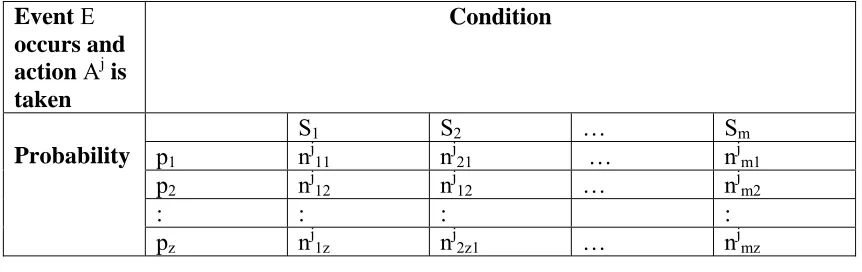
The numeric distribution to conditions consequential on E given Aj∈A can be depicted by a matrix representation (figure 1).
[1]
Note that in this and all following, Aj , etc. refers to an option while [Aj] , etc. refers to a
Event E
occurs and action Aj is taken
Condition
S1 S2 … Sm
p1 nj11 nj21 … njm1
p2 nj12 nj12 … njm2
: : : :
Probability
[image:14.595.78.509.70.206.2]pz nj1z nj2z1 … njmz
Figure 1
Matrix representation of the probabilistic apportioning of items in S0(N) to conditions on
event E given amelioration by act Aj
Some problem presentations neglect to explicitly present an apportioning to a consequence state on the grounds that this is logically implied by the consequence states that are presented (this is so with the original Kahneman-Tversky ‘Asian Disease’ problem). It is presumed that the decision-maker will recognise this, but it may impact on the latitude for decision-maker to elaborate a Local Mental Model of the problem (Gigerenzer, et al, 1991). In this case the modal operator ‘’ (‘is necessarily the case’) is used to indicate this condition within the formalism. Thus:
[E(pe) | Aj⇒ (njki , S+/-k , pi)]
Implies the decision-maker is left to deduce this proposition.
The framing effect occurs if there is a violation of invariance with a reversal in preferences:
As+ , Ar+ , As - , Ar-∈A As+ Ar+ and Ar- A
s-With indicating strict preference.
Attribute framing
Attribute framing relates to choice over an item or set of items in which the decision-maker is called upon to either accept or reject and option, to select a preferred option from a set or rate an option given a description of the option (or option set) on the basis of a description of the attributes of the option set.
The decision concerns a set, G of N ≥ 2 of items Gj∈G , where Gj may itself be a set of objects. Gj may be described in terms of gi , bi∈F with F a set of decision-salient attributes
where g has a positive and b a negative valence
The decision-maker is called upon to accept or reject an option Gj∈G , rate its
(un)attractiveness on a numeric or verbal scale or express preference for ∃Gj∈G. Again. it is presumed that ∀i gi≡ bi , bi≡ gi and gi bi = ∅ . gi and bi are quantified for ∀Gj∈G at a
be represented more meaningfully to the decision-maker as a percentage or numerical ratio. For ∀Gj∈G the attribute g at level qj(g) may be definite or, more generally, it may occur over a probability distribution (qj(gi) , pj(gi)) . ∀g , b ∈F , p(gi) = p(bi) . By implication, the
distribution of the negative valence attribute for Gj is (gj(bi) , pj(bi)) = ((1 – gj(gi)) , pj(gi)) . It
is presumed that the decision-maker has monotonic preferences over ∀Gj∈G , qj(g) ≥ qk(g) , pj(g) ≥ pk(g) ⇒ Gj Gk . Each option Gj∈G is then described by a proposition of the form:
[Gj+] = ∧i [Gj , qji(g) , pji(g)]
[Gj-] = ∧i [Gj , (1 - qji(b)) , pji(b))]
This may be read as, for the positive frame “[Option Gj+ has a (positive valence) attribute g at a level qji(g) with probability pji(g)]” or for the negative frame “[Option Gj- has a (negative
valence) attribute b at a level (1 - qji(b)) with probability pji(b)]”. The full description of the
choice option combines linearly over probabilities. The expectation of the positive attribute for Gj+ is then E(Gj(g)) = i gj(gi)) . pj(gi)) . Normatively, a rational decision-maker might be
expected to maximise this.
The framing effect occurs if Gj+ is accepted, while Gj- is rejected (or vice versa), if the relative (un)attractiveness rating of Gj+, Gj- is consistently different or that over pairwise preference Gj+ Gj- reverses to Gj+ Gj- .
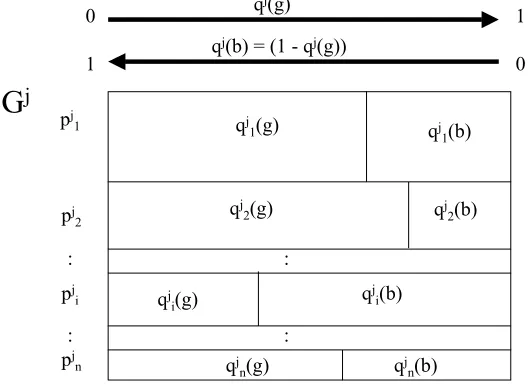
A graphical representation of the options in G is illustrated in figure 2. In this the horizontal bars normalised to a length of unity are divided into lengths representing the level of positive and negative attribute, qji(g) and qji (b) = (1 – qji (g)). The height of the bar represents pji (g) =
pji (b) . The area i gj(gi)) . pj(gi)) is proportional to the expectation of the positive attribute
for Gj .
: qj(g)
qj(b) = (1 - qj(g))
[image:15.595.169.433.432.627.2]0 1 1 0 qj 1(b) qj 2(b) qj i(b) qj n(b) qj 1(g) qj 2(g) qj i(g) qj n(g) pj 1 pj 2 pj i pj n :
G
j : : Figure 2Graphical representation of the parameter space for an attribute framing problem
Goal framing
behalf of another individual or organisation) is in an initial condition S0 . The individual or
item will transit to a new condition out of a partitioned set
= {S1 ,…, Sm}, Si∩ Sj = ∅ over a probability distribution p = {p1 ,…, pz}, ∀p ∈ [0 , 1] . It
is supposed that the decision-maker has a preference ordering over these conditions, ranked such that: S1 S2 ,…, Sm , where indicates a complete, transitive weak ordering.
The decision-maker has available a set of projects P = {P1 ,…, Pn} that ameliorates the probability of the individual or item transiting to the conditions in . I.e.:
P : S0→
It is supposed that a null project (‘do nothing’) P0 is available (though this may not be presented as an option to the decision-maker), thus S0∈ , P0 : S0 → S0 .
The instrumentality of a project Pi in achieving a condition Sj for the individual or item is
defined as:
I(Pi , Sj) = p(Sj | Pi) + p( \Sj | ¬PP i
) - 1
Which might be read as ‘[If project Pi is undertaken, then there is a probability p(Sj | Pi) that
state Sj will occur and if project Pi is not undertaken then there is a probability p( \Sj | ¬PP i
) that state S will not occur]’. The ‘not undertake Pj i action, ¬PiP may be defined in terms of do
nothing, P0 , undertake an alternative project, Pj (thus indicating opportunity cost of Pi versus
PP j
) or, potentially, some weighted sum of alternative projects (Pk≠i). The instrumentality metric takes a value of +1 if instigating Piguarantees the delivery of Q to condition S , if Pj i is
not undertaken then it is definite that S will occur; at I = -1 the project guarantees that Q will not be in condition S (otherwise it will) and at 0 the project has no influence on whether Q will be in condition S or not (the project has no instrumentality). By definition ∀S ∈ , I(P
j j
j j
0
, S ) = 0 . The ‘inherent’ probability of S is specified as p(S | Pj j j 0) . The overall structure
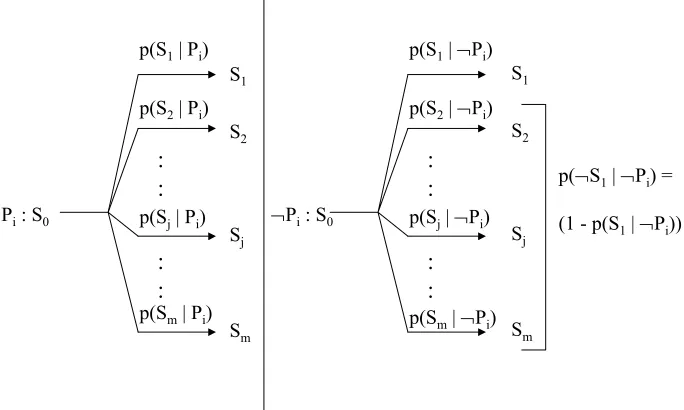
of the problem may be depicted schematically as in figure 3.
Each project Pj∈P might then be regarded as being described in terms of a combination of atomic propositions of the form:
[Pj+]≡∧j [p(Sj+ | Pi) ∧ p( \Sj+ | ¬PP i
)] [Pj-]≡∧j [p(Sj- | Pi) ∧ p( \Sj- | ¬PP
i
)]
Which might be read as a linear combination over all potential states of propositions of the form “[Given that project Pi is undertaken then the item will transit to condition Sj with a
probability p(Sj+/- | Pi) ; if the project is not undertaken, then the item will not transit to
condition Sj (that is, will go to some other condition) with a probability p( \Sj+/- | ¬PP i
Figure 3
Graphical representation of the parameter space for a goal framing problem
p(Sg|Pi)
p(Sb|¬Pi)
0 1
1 1
I(Sg, Pj) = 0
P(Sg| P0)
The +/- superscript indicates that an positive or negative valence term
may be used to describe the condition to create the positive and negatively framed problem respectively.
The framing effect is said to occur if Pj+ is indicated as acceptable and Pj- is indicated as unacceptable (or vice versa) or if Pj + Pk + and Pj - Pk- .
Figure 4
Map of the parameter space for a two-state goal framing problem
Pi: S0
S1
S2
Sj
Sm
: :
: :
p(S1| Pi)
p(S2| Pi)
p(Sj| Pi)
p(Sm| Pi)
¬Pi: S0
: :
: :
p(S1| ¬Pi)
p(S2| ¬Pi)
p(Sj| ¬Pi)
p(Sm| ¬Pi) S1
S2
Sj
Sm
p(¬S1| ¬Pi) =
(1 - p(S1| ¬Pi))
It is worthwhile to consider the restricted case of Q transiting to one of three conditions, retention in S0 or transit to a ‘good’ state Sg or a ‘bad’ state Sb with
Sg S0 Sb . The ‘do nothing’ option is not available. This represents the majority of goal
framing decision problems and has an interesting graphical representation. Consider figure 4. This represents a graph of p(Sg | Pi) against p(Sb | ¬PP
i
[image:17.595.151.493.490.695.2]bottom-left diagonal represents the instrumentality of project Pi on a scale of [-1 , +1] and the bottom-left – top-right diagonal represents the inherent probability of S , p(S | Pg g 0) on a scale of [0 ,
1] .
The full set of project options, P is then represented by a map of points within the graph. Points above the top-left – bottom-left instrumentality diagonal reflect projects with a positive instrumentality that contribute to the delivery of Sg while points below the diagonal have a
negative instrumentality and hinder delivery of Sg .
Potential extensions of the formalism
The formalism developed here has potential for extension into problems where probabilities are vague or where receipt is complicated by factors other than or in addition to risk.
Ambiguity represents a decision condition in which probabilities are available but (in contrast to the condition of strict risk) these are not precisely known or there is reason to doubt their veracity. Ambiguity is a more common condition than risk in many decision contexts and is known to influence decision-making in a number of ways that violate expected utility theory independently of risk (Ellsberg, 1961; 2001; Einhorn & Hogarth, 1986). Hogarth & Einhorn (1990) develop a model that integrates ambiguous probabilities into prospect theory
probability weighting. A series of studies of framing under ambiguous probabilities (indicated by either probability ranges or adjectival qualifiers to definite probabilities) conducted by Kuhn (1997) suggests that (with some order effect qualifiers) under negative frames, preference for vague probability options increased. As probabilities (with clear
distinction between probabilities of event occurrence, outcome likelihood or option character) are made explicit within the formalism it is straightforward to integrate vague probabilities be they specified by probability range, adjectival qualifier, second order probability distribution or fuzzy set representation.
Many project decisions do not consider specific projects in isolation, but rather as tactical contributions to an overall strategic goal. This means that projects must be considered in the way in which they support or hinder each other, as well as the way in which they reflect upon each other as opportunity costs. The formal description of goal framing can accommodate this by invoking the instrumentality of two (or more) concurrent or sequential projects in relation to delivering specific preferred states.
In addition to risk decision-makers are often called upon to make choices under conditions where receipt is delayed (intertemporal choice) [2], options must be evaluated in terms of a number of desirable or undesirable attributes (multiattribute choice) or the decision-maker holds concern for the distribution of outcomes to others as well as self (social choice). In all cases, receipt may be under conditions of risk or certainty.
Reflecting the tradition of distinct research streams into these different decision dilemmas, framing research has been largely concerned with immediate, single-attribute non-social choice under risk. Progression of research into the impact of framing on decision with
complexity other than, or extra to, risk remains an opportunity. The potential for extending the formalism into describing decision problems in these areas is recognised.
[2]
Conclusions
Framing effects offer a clear indication of (ostensibly irrational) psychological effects in economic and personal decision-making. They have been demonstrated in a number or
References
Camerer, C. F (1989) “An experimental test of several generalised utility theories”, Journal of Risk and Uncertainty, vol. 2, pp. 61-104.
Camerer, C. F. (1995) “Individual decision making” in J. Kagel and A. Roth (Eds) The Handbook of Experimental Economics, Princeton University Press, Princeton, NJ.
Camerer, C. F. and Weber, M. (1992) “Recent developments in modelling preferences: Uncertainty and ambiguity”, Journal of Risk and Uncertainty, Vol. 5, pp. 325-370.
Chang, C. J., S.-H. Yen and R.-R. Duh (2002) “An empirical examination of competing theories to explain the framing effect in accounting decisions” Behavioral Research in Accounting, Vol. 14, pp. 35-64.
Duchon, D., K. J. Dunegan and S. Barton (1989) “Framing the problem and making decisions: The facts are not enough”, IEEE Transactions on Engineering Management, February, pp. 25-27.
Dunegan, K. J. (1993) “Framing, cognitive modes and image theory: Towards and understanding of a glass half full”, Journal of Applied Psychology, Vol. 78, pp.491-503.
Dunegan, K. J. (1995) “Image theory: Testing the role image of compatibility in progress decisions”, Organizational Behavior and Human Decision Processes, Vol. 62, pp. 79-86.
Dunegan, K. J. (1996) “Fines, frames and images: Examining formulation effects on punishment decisions”, Organizational Behavior and Human Decision Processes, Vol. 68, pp. 58-67.
Dunegan, K. J., D. Duchon and D Ashmos (1995) “Image compatibility and the use of problem space information in resource allocation decisions: Testing a moderating effects model”, Organizational Behavior and Human Decision Processes, Vol. 64, pp. 31-37.
Einhorn, H. J. and R. M. Hogarth (1986) “Decision making under ambiguity”, Journal of Business, Vol. 59, No. 4, Part 2, pp.S225-S250.
Ellsberg, D. (1961) “Risk ambiguity and the Savage axioms”, The Quarterly Journal of Economics, 75:643-669.
Ellsberg, D. (2001) Risk, Ambiguity and Decision, New York: Garland.
Emby, C. (1994) “Framing and presentation mode effects professional judgement: Auditors’ internal control judgements and substantive testing decisions”, Auditing: A Journal of Theory and Practice, Vol. 13(Suppl.), pp. 102-115.
Emby, C. and Finley, D. (1997) “Debiasing framing effects in auditors’ internal control judgements and testing decisions”, Contemporary Accounting Research, Vol. 14, No. 2, pp. 55-77.
Farquhar, P. H. (1984) “Utility assessment methods”, Management Science, Vol. 30, pp.1283-1300.
Fishburn, P. C. (1988a) “Expected utility: An anniversary and a new era”, Journal of Risk and Uncertainty, Vol.1, pp. 267-283.
Fishburn, P. C (1988b) “Retrospective on the utility theory of von Neumann and Morgenstern”, Journal of Risk and Uncertainty, Vol. 2, pp.127-158.
Giggerenzer, G., U. Hoffrage and H. Kleinbölting (1991) “Probabilistic Mental Models: A Brunswikian theory of confidence”, Psychological Review, Vol. 98, pp. 506-528.
Hershey, J. C., Kunreuther, H. C. and Schoemaker, P. J. H. (1982) “Sources of bias in assessment procedures for utility functions”, Management Science, Vol. 28, No. 8, pp. 936-954.
Highhouse, S., P. W. Paese and T. Leatherberry (1996) “Contrast effects on strategic issue framing”, Organizational Behavior and Human Decision Processes, Vol. 65, pp.95-105.
Highhouse, S. and P. Yüce (1996) “Perspectives, perceptions and risk taking behavior”, Organizational Behavior and Human Decision Processes, Vol. 65, pp. 159-167.
Hodgkinson, G. P., Bown, N. J., Maule, J. A., Glaister, K. W. and Pearman, A. D. (1999) “Breaking the frame: An analysis of strategic cognition and decision making under uncertainty”, Strategic Management Journal, Vol. 20, pp. 977-985.
Hogarth, R. M. (1989) “Ambiguity and competitive decision making: Some implications and tests”, Annals of Operations Research, Vol. 19, pp. 31-50.
Hogarth, R. M. and H. J. Einhorn (1990) “Venture Theory: A model of decision weights” Management Science, Vol. 36, No. 7, pp. 780-803.
Kahneman, D. and A. Tversky (1979) “Prospect theory: An analysis of decision-making under risk”, Econometrica, Vol. 47, pp.263-291.
Kühberger, A., M. (1998) “The influence of framing on risky decisions: A meta-analysis”, Organizational Behavior and Human Decision Processes, Vol. 75, pp. 23-55.
Kühberger, A., M. Schulte-Mecklenbeck and J. Perner (2002) “Framing decisions:
Hypothetical and real”, Organizational Behavior and Human Decision Processes, Vol. 89, pp. 1162-1175.
Kuhn, K. M. (1997) “Communicating uncertainty: Framing effects on responses to vague probabilities”, Organizational Behavior and Human Decision Processes, Vol. 71, pp. 55-83.
Levin, I. P. and G. J. Gaeth (1988) “Framing of attribute information before and after consuming the product”, Journal of Consumer Research, Vol. 15, pp. 374-378.
Li, S. (1998) “Can the conditions determining framing effects be determined?” Journal of Economic Psychology, Vol. 19, pp.133-15.
Luce, R. D. (2000) Utility of Gains and Losses: Measurement Theoretical and Experimental Approaches, Lawrence Erlbaum, Mahwah, NJ.
Machina, M. J. (1987) “Choice under uncertainty: Problems solved and unsolved” Economic Perspectives, Vol. 1, No. 1, pp. 121-154.
McCusker, C. and P. J. Carnevale (1995) “Framing in resource dilemmas: Loss aversion and the moderating effects of sanctions”, Organizational Behavior and Human Decision
Processes, Vol. 61, pp. 190-201.
Munier, B. (1989) “New models of decision under uncertainty: An interpretative essay”, European Journal of Operational Research, Vol. 38, pp. 307-317.
Newberry, K. J., P. M. J. Reckers and R. W. Wyndelts (1993) “An examination of tax practitioner decisions: The role of preparer sanctions and framing effects associated with client condition”, Journal of Economic Psychology, Vol. 14, pp. 439-452.
Neale, M. A. and M. H. Bazerman (1985) “The effects of framing and negotiator
overconfidence on bargaining behaviors and outcomes”, Academy of Management Journal, Vol. 28, pp. 34-49.
Prelec, D. and G. Loewenstein (1991) “Decision making over time and under uncertainty: A common approach”, Management Science, 37(3):770-786.
Qualls, W. J. and C. P. Puto (1989) “Organization climate and decision framing: An
integrated approach to analysing industrial buying decisions”, Journal of Marketing Research, Vol. 2, pp.179-192.
Reyna, V. F. and C. J. Brainerd (1991) “Fuzzy-Trace theory and framing effects in choice: Gist extraction, truncation and conversion”, Journal of Behavioral Decision Making, Vol. 4, pp. 249-262.
Reyna, V. F. and S. C. Ellis (1994) “Fuzzy-Trace Theory and framing effects in children’s risky decision making”, Psychological Science, Vol. 5, No. 5, pp. 275-279.
Savage, L. J. (1954) The Foundations of Statistics, Wiley, New York.
Schneider, S. L. and L. E. Eble (1994) “Framing and goal contingencies: Changes in framing effects with changes in risky options”, Unpublished Manuscript, University of South Florida, Tampa.
Schoemaker, P. J. H. (1982) “The expected utility model: Its variants, purposes, evidence and limitations”, Journal of Economic Literature, Vol. 20, pp. 529-563.
Schurr, P. H. (1987) “Effect of gain and loss decision frames on risky purchase negotiations”, Journal of Applied Psychology, Vol.72, pp.351-358.
Stanovich, K. E. (1999) Who Is rational? Studies in Individual Differences in Reasoning, Lawrence Erlbaum, Mahwah, NJ.
Starmer, C. (2000) “Developments in non-expected utility theory: The hunt for a descriptive theory of choice under risk”, Journal of Economic Literature, Vol. 38, pp. 332-382.
Sugden, R. (1986) “New developments in the theory of choice under uncertainty”, Bulletin of Economic Research, Vol. 38, No. 1, pp. 1-24.
Takemura, K. (1994) “Influences of elaboration on the framing of decision”, The Journal of Psychology, Vol. 128, No. 1, pp. 33-39.
Tversky, A. and D. Kahneman (1981) “The framing of decisions and the psychology of choice”, Science, Vol. 211, pp. 453-458.
Tversky, A. and D. Kahneman (1986) “Rational choice and the framing of decisions”, Journal of Business, Vol. 59 No. 4, Part 2, pp. S251-S278.
Tversky, A & D. Kahneman (1992) “Advances in prospect theory: Cumulative representation of uncertainty”, Journal of Risk and Uncertainty, Vol. 5, pp.297-323.
Von Neumann, J. and O. Morgenstern (1947) The Theory of Games and Economic Behavior (2nd edition), Princeton University Press, Princeton, NJ.
Weber, M. and Camerer, C. F. (1987) “Recent developments in modelling preferences under risk “, OK Spektrum, Vol. 9, pp. 129-115.