Data
James Hannan, Editor
•
Contributors To This Volume
James W. Conard
C6nard Associates, Costa Mesa CA
Pete Moulton
ColumbiaMD
Thomas J. Murray
SUNGARD Technical Consultant, Sun Information Services Company Philadelphia PA
Richard Parkinson
Senior Consultant, Consultec Canada Limited, Vancouver BC
Joseph St. Amand
QED Information Services, Wellesley MA
Mark Strangio
Communications Analyst, Codex Corporation, Mansfield MA
Dr. Rein Turn
Professor, California State University, Northbridge CA
Gary Zielke
A
AUERBAC~
~
Data
Communications
Management
Edited by James Hannan
AUERBACH Publishers Inc
Pennsauken NJ
VAN NOSTRAND REINHOLD COMPANY
Library of Congress Catalog Card Number 82-11335
ISBN 0-442-20918-5
All rights reserved. No part of this work covered by the copyright hereon
may be reproduced or used in any form or by any means-graphic,
electronic, or mechanical, including photocopying, recording, taping,
or information storage and retrieval systems-without written
permis-sion of the publisher.
Printed in the United States of America
Published in the United States in 1982
by Van Nostrand Reinhold Company Inc
135 West 50th Street
New York NY 10020 USA
16 15 14 13 12 11 10 9 8 7 6 5
Library of Congress Cataloging in Publication Data
Main entry under title:
A Practical guide to data communications management.
(Auerbach data processing management library; v. 3)
1. Data transmission systems. 2. Computer networks.
I.
Hannan, James, 1946-
. II. Series.
TK5105.P7 1982
001.64'404
82-11335
Preface
viiIntroduction
ixChapter
1
Trends in Data Communications Technology
Mark Strangio • • • • • • • • • • • • • • • 0 • • • • • • • • • • • • • • • • • 1
2
Perspective on Digital Communications
Richard Parkinson ...
.
173
Formulating Network Requirements
Pete Moulton • • • • • • • • • • • • • • • • • • • • • • • • • • • • • • • 0 • • 29
4
Applications
of Data
Communications
Protocol Standards
James W. Conard • • • • • • • • • • • • 0 • • • • • • • • • • • • • • • • • 47
5
The RS-449 Interface
Richard Parkinson ... 63
6
Introduction to SNA
Pete Moulton ... 75
7
SNA-like Architectures and Capabilities
Joseph St. Amand • • • • • • • • • • • • • • • • • • • 0 • • • • • • • • • • 93
8
Encryption for Data Security
Dr. Rein Tum ... 105
9
Network Control Systems
Gary Zielke • • • • • • • • • • • • • • • • • • • • • • • • 0 • • • • • • • • • • 119
10
Disaster Recovery Planning
In its relatively brief existence, the computer has emerged from the back rooms of most organizations to become an integral part of business life. Increasingly sophisticated data processing systems are being used today to solve increasingly complex business problems. As a result, the typical data processing function has become as intricate and specialized as the business enterprise it serves.
Such specialization places a strenuous burden on computer professionals. Not only must they possess specific technical expertise, they must understand how to apply their special knowledge in support of business objectives and goals. A computer professional's effectiveness and career hinge on how ably he or she manages this challenge.
To assist computer professionals in meeting this challenge, AUERBACH Publishers has developed the AUERBACH Data Processing
Management Library. The series comprises eight volumes, each addressing the
management of a specific DP function:
A Practical Guide to Data Processing Management A Practical Guide to Programming Management
A Practical Guide to Data Communications Management A Practical Guide to Data Base Management
A Practical Guide to Systems Development Management A Practical Guide to Data Center Operations Management A Practical Guide to EDP Auditing
A Practical Guide to Distributed Processing Management
Each volume contains well-tested, practical solutions to the most common and pressing set of problems facing the manager of that function. Supplying the solutions is a prominent group of DP practitioners-people who make their living in the areas they write about. The concise, focused chapters are designed to help the reader directly apply the solutions they contain to his or her environment.
AUERBACH has been serving the information needs of computer professionals for more than 25 years and knows how to help them increase their effectiveness and enhance their careers. The AUERBACH Data
Processing Management Library is just one of the company's many offerings in
this field.
James Hannan Assistant Vice President AUERBACH Publishers
The astonishing advances in transportation and communica-tions technology during the past several decades have made the world smaller and its resources more accessible. New patterns of social and business inter-course have consequently emerged to create what one analyst has termed a "global village." Within the confines of that village businesses and govern-ments have intensified their competition for a share of the world's markets. In such an atmosphere, decisions must be made expeditiously-even though the complexity and location of decision-making information often render the process difficult. As a consequence, the need to locate and transmit accurate and timely information has become more urgent.
The growing importance of communications in the conduct of business and governmental affairs has increased the visibility of the data communications function. This presents data communications managers with both an opportunity and a challenge. They have the opportunity to make a substantive contribution to their organizations' strategic planning and decision making. But in order to do so, they must understand and harness the rapidly changing communications technology as well as apply proven management and planning techniques to their operations. This volume of the AUERBACH Data
Processing Management Library is designed to help data communications
managers meet that challenge.
We have commissioned an outstanding group of communica-tions practitioners to share the benefits of their extensive and varied experience. Our authors have written on a carefully chosen range of topics and have provided proven, practical advice for managing the data communications function productively.
In Chapter One, Mark Strangio discusses the trends in commu-nications technology that the data comm manager must be aware of to plan effectively and make informed decisions. He treats such areas as data commu-nications equipment, transmission facilities, network management and control, and the distribution of information and communications capabilities to remote sites.
A much-discussed trend in recent years is that toward all-digital communications. Although some skeptics might argue that this trend is more apparent than real, the shrewd data comm manager should at least understand the technology and what is and will be possible. In "Perspective on Digital Communications, " Richard Parkinson discusses the background, cur-rent status, and future of the telecommunications industry.
While knowledge of industry and technology trends can help data comm managers in long-range planning, they need additional tools for operational-level planning. A key operational issue is network planning and design. In formulating network requirements, data comm managers cannot rely solely on the projected data transmission loads of the network sites because implementation status and applications priorities change. To accommodate these changes, Pete Moulton presents in Chapter Three a methodology for formulating network requirements and provides cataloging forms that can be used in the process.
Another important operational-level planning issue is choos-ing communications standards. Improperly applychoos-ing standards or ignorchoos-ing their impact can lead to chaotic compatibility problems. In Chapter Four, James W. Conard focuses on the application of protocol standards and offers practical advice on selecting standards. In Chapter Five, Richard Parkinson describes one of the newer standards-RS-449. He discusses the standard's evolution, functions, and capabilities (as well as those of its companion standards, RS-422 and RS-423) and draws appropriate parallels to RS-232C.
A network architecture that has become a de facto standard since its introduction in the mid-1970s is ffiM's System Network Architecture (SNA). SNA comprises both hardware and software components and provides a common approach for centralized as well as decentralized applications. In Chapter Six, Pete Moulton provides a sound fundamental understanding of SNA product offerings. In Chapter Seven, Joseph St. Amand discusses SNA-like architectures and capabilities and suggests ways to achieve SNA func-tionality with non-ffiM hardware and software.
Because so many organizations have become vitally dependent on their data communications networks, it is incumbent on data comm manag-ers to address such crucial issues as data security, network reliability and availability, and disaster recovery. In "Encryption for Data Security," Dr. Rein Tum provides an introduction to the purposes, principles, and applica-tions of cryptography in data security. Gary Zielke discusses network control systems that can aid the manager in maintaining a high degree of network availability and reliability in Chapter Nine. And in Chapter Ten, Thomas J. Murray examines network disaster planning, detailing the steps and strategies required to implement and maintain a disaster recovery plan.
~
Trends in Data
Communications
Technology
INTRODUCTION
by Mark Strangio
As communications technologies become increasingly important to the success of many organizations, gains in productivity that can be attributed to the new technologies will, in turn, fuel the demand for further improvements. A number of potential gains can be identified:
• Decreased costs for DP and communications hardware
• Improved intra- and intercorporate communications through electronic mail/message systems, teleconferencing, and digital facsimile systems • The elimination of redundant or time-consuming tasks through
communicating/distributed WP systems
• The reduction of voice network costs through speech-digitizing tech-nologies
• Improved man-machine interfaces through distributed graphics and color terminals
• Improved record storage, retrieval, and integrity through distributed data base systems
• Improved circuit efficiencies through data traffic management, circuit switching, and resource selection systems
This chapter examines the technological advances that will make these gains possible and discusses trends in technology and vendor offerings as well as major issues of concern to the data communications manager. No attempt is made to quantify, however, or to predict when or to what degree changes may occur.
BACKGROUND
In the area of private data networks, the introduction of time division multiplexors and, more recently, statistical multiplexors has greatly improved the bit-per-dollar transportation ratios associated with multiple remote termi-nals. In essence, the multiplexor has eliminated the individualized circuits over which frequently inactive terminals communicated with a centralized host processor. Additional multiplexor-based innovations (e.g., data com-pression, sophisticated error protection schemes, and network/traffic analysis features) have further enhanced circuit efficiencies and control capabilities. The evolution of efficient front-end-based communications protocols (from simplex to bisynchronous to truly full-duplex bit-oriented protocols) has improved the performance of multipoint configurations. These protocols have decreased the response time and, in tum, permitted expansion of the multipoint circuit in terms of the number of drops or devices per circuit.
Both domestic and international public data networks have similarly real-ized greater efficiencies by introducing packet-switching technologies. The X.25 standard, for example, allows multiple users to share high-speed trans-mission facilities that would otherwise be prohibitively expensive (given the low volume of an individual user's traffic). One key to the continued success of X.25 public data networks will be the ease with which private (non-X.25) networks can be interfaced with the public networks. A primary· benefit here is that as public data networks proliferate and become increasingly standard-ized, thereby permitting easy access, they will complement rather than re-place the private data network, facilitating both intra- and intercorporate communications.
At the present time, the conventional data communications network con-sists of modems, multiplexors, concentrators, front-end processors, data-matrix switches, monitoring/control/management equipment, and various leased and switched terrestrial and satellite transmission facilities. These com-ponents are organized into combinations of point-to-point, multipoint, star, and delta topologies. Connected to this network are central processing units, peripheral storage devices, cluster controllers, Teletype-equivalent terminals, intelligent terminals, and other miscellaneous ancillary devices. The intrica-cies of interdevice and intra-/intemetwork communications are handled using combinations of standard hardware interfaces, software protocols, and spe-cialized network control applications packages.
Several significant technological innovations will increasingly affect con-ventional data communications network topologies and network component integration: the proliferation of distributed OP, the integration of non-OP functions within the data communications network, and the incorporation of application-independent teleprocessing and resource-sharing/switching sys-tems. The trend toward distributed OP capabilities is propelled, typically, by a number of key factors, including the need to:
• Optimize and/or preserve the host's performance-DDP, accompanied by careful data base management and the high connectivity of central and remote processors (through software and hardware standardiza-tion), should diminish central site degradation and enhancement costs. • Implement high-performance technologies-Intelligent terminals,
con-trollers, and minicomputers with previously unattainable price/ performance ratios will continue to create savings through gains in
productivity and decreases in communications costs. Ultimately, the organization's DP communications managers and users will seek to distribute computation and data base resources closest to those areas where the work is performed or the information needed. In the area of circuit performance, the data communications network manager will seek to:
-Eliminate from the circuit all data and data control bits that are not crucial to the transportation of information
-Eliminate idle circuit time or space by packing the circuit with useful information, optimizing network design, and implementing efficient network/circuit/link control software (e.g., HDLC)
Network Topologies and Component Integration
The effects of these forces upon the network topology will be measured, for example, in terms of the proliferation of high-speed backbone circuits that support interprocessor communications. Increasingly, the conventional net-work will consist of a mainframe, multiple mainframes at a central site, or multiple mainframes at multiple sites. These processors will support multiple distributed minicomputer systems that, in turn, support multitiered (second-, third-, and fourth-level), multiplexed, point-to-point, and multipoint circuits.
It will be necessary to ensure that hardware and software are relatively com-patible and that compatibility exists with integrated subsystems whose pur-pose is, for example, to observe or to monitor, control, and manage the network. As networks become more complex in distributed DP, such subsys-tems must be capable of being extended to or through all components and levels of the network. For larger networks, multiple points can facilitate efficient network operation. The subsystem must also be able to provide a high degree of functionality while remaining transparent and nondisruptive to the primary network function: data and information transportation. Other factors that will influence network architectures include:
• The integration of new systems and technologies, such as electronic mail/message switching (EMS) or digital facsimile transmission with DP networks
• The integration of previously nondigital communications systems or functions (e.g., voice)
add a dedicated lower-speed circuit to the remote site, it would be desirable to provide time slots for EMS by statistically multiplexing the existing circuit. This may be especially preferable where interactive and low-utilization single-purpose terminals predominate at the remote site. Alternatively, for the remote site that accommodates fewer terminals or serves as the hub of lower-level or tail circuits, it would be appropriate to dedicate frequency slots for EMS by using multiplexor modems. These are ideal for providing multiple application-independent channels where the aggregate traffic does not exceed the limits of a 3002 voicegrade channel (a total of 9,600 bits per second).
Integrating Voice and Data
An average corporation must currently maintain at least two separate com-munications networks: one or more for data and one for voice. As pressures mount for greater efficiency in both kinds of networks, the demand to add at least some voice traffic to the data network will increase. Voice (which is analog) is transmitted over the 3,000 Hz bandwidth of the voicegrade tele-phone circuit. Historically, combining analog and digital traffic has been technically and administratively difficult. One solution, however, is to digi-tize the voice at a sufficiently low data rate (preferably 2,400 bits per second), allowing the digitized voice traffic to be treated like any other data stream in the data network. Given the demand for this capability, therefore, it is likely that the following trends will become increasingly important:
• Speech-digitizing technology for transmission at 2,400 bits per second will improve in quality, reliability, and flexibility such that digitized voice traffic will represent a greater percentage of the total data net-work traffic.
• Digitized voice traffic will be integrated by allocating time slots to voice-digitizing terminals through statistical multiplexing.
• The ability to share these terminals among specified corporate users and switch the digitized voice traffic over the data network to compati-ble remote sites will become common as interfaces to computerized private branch exchanges evolve.
• Packetizing digital voice traffic for transmission over X.25 networks will facilitate the acceptance and use of voice-digitizing technologies. • The ability to encrypt digital voice traffic will facilitate the use of voice
all-digital long-haul facilities (e.g., Bell's DDS) have been and continue to be implemented in the U.S., there is virtually no local digital distribution system between the subscriber and the central telephone office. Alternative solutions, such as the use of optical fibers or bypassing underground cable systems with satellite and microwave facilities, will be implemented. Cost factors, how-ever, will confine these alternatives to backbone/high-speed networks and, in general, very large scale networks.
Data Communications Hardware and Software
The evolution of data communications hardware and software will primar-ily focus on modulation products (modems), network technologies (advanced statistical multiplexing, concentration, and circuit switching), carrier sys-tems, and network management and control systems. It should be noted that developments in each of these areas are affected significantly by advances in component technology and software development.
The trend in component technology (e.g., LSI and VLSI components) has been toward markedly decreasing unit costs. Because of the great demand, low supply, and high manufacturing costs associated with advanced micro-processor chips (e.g., the 16-bit micromicro-processor), however, it is likely that there will be a diminution in the rate at which hardware costs decline. Simi-larly, the demand for modifiable software will drive up development costs and exacerbate development problems. If this trend offers any advantage to the user, it will be in the degree to which standardized software will be used and software documentation made available.
Modulation Products
Technological changes and/or trends in modulation products are likely to be implemented in several ways, as is discussed in the following paragraphs. The essential criterion to the user will be device reliability.
• High-, medium-, and low-speed and short-haul modems will increas-ingly be integrated with, and central to, network monitoring, testing, and control functions. Device functionality in monitoring and testing analog and digital parameters and interfaces will become paramount to the network operator. Device and circuit backup and restoration from a central control point will be essential for most networks in which component failure is synonymous with large revenue losses.
• Improvements in high-speed modem performance (e.g., transmission at speeds greater than 9,600 bits per second over voicegrade lines) will be modest. Modulation schemes for greater speeds will be inordinately complex and expensive; moreover, problems associated with circuit quality and retransmission/error correction may diminish the
cost!
performance benefits.
ap-plication, however, will be one in which inbound transmissions are short; circuit performance and response times will be optimized by lower-cost devices that provide lower inbound speeds with short turn-around times.
• Dial modems with automatic fallback to lower bit transmission and audio signaling rates will enhance operation at 9,600 bits per second. • Two-wire full-duplex modems operating at speeds from 1,200 to 4,800 bits per second will become increasingly popular for use in switched networks.
• Modems that use a secondary or sideband channel(s) to transmit net-work control and telemetry information will have the continued advan-tage of operator functionality without imposing overhead on, or inter-fering with, the primal)' channel.
• High-speed modems with built-in smart multiplexors, automatic re-transmission of (erroneous) data, encryption, and other optional fea-tures are likely to appear.
• Most modem manufacturers will use a combination of custom LSI and VLSI and microprocessor technologies, resulting in devices that are more expensive to develop, less expensive to manufacture, simpler to modify, and capable of implementing more sophisticated algorithms and operating modes.
• Programmability in modems will permit the accumulation of application-specific as well as standard data related to device and facil-ity (e.g., circuit) performance and utilization.
Network Management and Control
The following changes or trends are likely to occur in the field of network management and control:
• Intelligence will continue to be distributed to network devices and will serve the control and management function. Modems, terminals, mul-tiplexors, and nodal processors will fall within the domain of this function.
• Capabilities for surveillance or monitoring of digital and analog param-eters will become more sophisticated, leading to faster identification and resolution of component malfunctions.
• All network components will be evaluated in terms of their ability to complement the control and management function.
• Remote switching and backup capabilities will become common in point-to-point as well as multipoint and multitiered configurations. • Equipment and circuit performance data, derived from the control and
management system, will become more central to the design and plan-ning process.
• Greater emphasis will be placed upon simplifying the operator inter-face.
Network Products
Network products or technologies are commonly defined as systems that package and compress data/information units, perform and manage data link! circuit routing, provide protocol conversion and/or an effective interface be-tween processing systems and varied transmission facilities, and provide cir-cuit, terminal, and resource selection and switching.
The demand for advanced statistical multiplexing, concentrating, and cir-cuit switching and nodal processors will continue to increase in both private and public data networks, and these technologies will continue to evolve. Optimum network performance may be achieved by implementing systems (using multiplexors or nodal processors) that are transparent to the applica-tion, enabling greater numbers of diverse applications to share the same network facilities. Some users, however, may prefer a concentrator-based network or multiple networks because of the efficiencies associated with applications to which the network systems/facilities are dedicated. The objec-tives for the network manager may include:
• Improved performance by increased data throughput and line utiliZation and by distributing data bases, thus lowering data ftle access times • Improved management analysis features, such as line utilization
statis-tics and error retransmission reports
• Minimizing growth costs by procuring modular equipment that is capa-ble of growth
• Minimizing downtime costs and lowering productivity by procuring reliable systems that provide backup or redundant capabilities The major trends associated with network technologies can be briefly summarized as follows:
com-plex and using statistical multicom-plexing, concentration, and circuit-switching technologies. There will be an increasing demand to inter-face the private and public data networks, which will be accomplished through the development of firmware- and software-based network gateways.
• As processing/computation power and information storage and retrieval capabilities are distributed to remote sites, users and network operators will become increasingly aware of the benefits of terminal-to-terminal communications, such as electronic message switching or telecon-ferencing. This will be incorporated most efficiently by adding circuit-switching technologies that are independent of the DP function or equipment. This trend will be accompanied by, or be a result of, the transition from dumb to intelligent multifunctional terminals. With systems that provide hard-copy and online storage capabilities, benefits will typically include improved intracorporate communications, en-hanced problem-solving capabilities, and faster information dissemina-tion.
• Network-oriented hardware and software components will be devel-oped to accommodate office functions and applications (e.g., WP, facsimile, electronic mail, and message switching). The implication is that the circuit-switching technologies themselves must be capable of disassembling and preas sembling data units (e.g., packets, frames, blocks) created by many dissimilar terminals, while preserving proto-col integrity. The protoproto-col conversion function, therefore, will become embedded within circuit-switching equipment.
• Public data networks based on packet-switching X.25 technologies will continue to grow in Europe and will become far more common in North America.
• Voice and data network managers will seek to accommodate voice traffic in the digital networks. Multiplexing and circuit-switching tech-nologies will incorporate voice-digitizing capabilities or, at a mini-mum, provide an effective interface to voice traffic. Voice message switching may emerge as a key value-added feature of public data networks.
• Network and data security will become increasingly important. Net-work technologies that accommodate the transmission of telemetry data (e.g., through the secondary channels) and/or encrypted data will be in high demand in such industries as banking.
• Network technologies will increasingly require remote/central-site ac-cess for control purposes and will, therefore, become more integrated with network management and control equipment.
• Redundancy and backup switching capabilities will become increas-ingly important at sites where equipment failure can be catastrophic.
VENDOR TRENDS
marketplace. Over the long term, these forces will have a significant impact on the independent data communications equipment vendors and carriers as well as on mainframe, minicomputer, and office equipment manufacturers, whose systems will become increasingly linked to communications. Data communications equipment and services suppliers will be affected in a num-ber of areas.
Structure and Orientation. The growth in number, size, and complexity of integrated multifunctional networks, coupled with the increasing ability of vendors to supply such networks, will increase vendor responsiveness to present as well as potential customers. Vendors will, for example, be called upon to provide such consulting services as product or network design and planning studies that are specific to the customer's network requirements. The vendor's organizational structure will increasingly be geared toward provid-ing timely technical and management solutions to unique networkprovid-ing specifi-cations. The vendor's market research staff and function will become more crucial in assessing trends in order to optimize the degree to which products and families of products will evolve and/or remain functional, upgradable, and enhanceable over extended periods.
It is also expected that data communications professionals will need to become more knowledgeable about DP hardware and software as well as the technologies that traditionally were not within their domain. Such knowledge should include distributed data base technologies, communicating word pro-cessors, integrated digital voice and data switching systems, and so on. Simi-larly, DP manufacturers will be under increasing pressure to understand and orient their products toward sophisticated communications technologies.
Research and Development. In order to meet the needs of broadened network/systems requirements and their concomitant technical complexities, vendor R&D departments will require larger development teams. These teams will be charged with the responsibilities of enforcing design-to-cost and designed-in-reliability development disciplines, providing total data commu-nications systems solutions and ensuring technical/functional synergy be-tween individual products, developing products to meet both domestic and international standards and specifications, providing capabilities for future enhancements, building serviceability into the product(s) via improved design and manufacturing techniques, and doing all of these while incorporating and gaining competence in leading-edge VLSI and microprocessor technologies.
It must be emphasized that efficient software development will be increas-ingly critical to the success or failure of data communications products.
made available to the customer for building, designing, implementing, inte-grating, and supporting customized data communications subsystems. This position, as a primary customer interface, will be ideal for providing feedback on emerging customer requirements to R&D and corporate planning groups and will ensure development efforts that are responsive to market require-ments and trends.
International and Domestic Distribution and Field Service. A discerni-ble trend associated with user network growth is the evolution from national to international networks and/or more frequent interfaces with foreign or international networks. The effects upon the vendor are quite clear: the appro-priate steps must be taken in product development to ensure that both domes-tic and international specifications are met; distribution and field service agreements must be developed for each country in which the vendor wishes to conduct business. Vendors must also ensure that foreign distributors and maintenance personnel are reliable, adequately supplied with parts, and suffi-ciently trained in operation, diagnostics, maintenance, and, in some cases, field repair of the products.
It should be obvious that the same criteria apply to vendors who choose third-party distribution, installation, and maintenance agreements for domes-tic operations. It is important to note here that users may occasionally evaluate a vendor's ability to service products solely on the number of field service locations-a somewhat restrictive criterion. Problems for the user (and the vendor) may arise because the third party is not sufficiently committed to the product, and direct service personnel inevitably receive better information and training.
Component/System Design. The demand for data communications com-ponents and complete systems from users with unique networking require-ments and problems will underscore the need for vendors to adopt a holistic approach to product/systems planning and development. In the case of net-work products such as statistical multiplexors, vendors must ensure that a unit is cost-effective for the widest possible range of applications and can be upgraded to meet growing network requirements (e.g., number of terminals, traffic, throughput). Modular design will assuage user apprehensions of fre-quent large-capital outlays. Vendors will benefit by incurring fewer develop-ment projects and costs, greater manufacturing efficiencies, fewer (and less frequent) upgrade issues to resolve, and lower recycling and refurbishing costs.
Complexity
that vendors will attempt (or be forced) to cover the spectrum of data commu-nications components and ensure connectivity of the entire product line. The domain of the network management and control system, for example, will eventually be expanded to include multiplexors, front-end/nodal communica-tions processors, data-switching systems, and terminals. More specifically, including the network/nodal processor requires that interpretive capabilities exist within the device, hardware/firmware/software-based interfaces exist, and the network/nodal processor and the management and control system be able to communicate over primary and/or secondary channels.
Software Complexity. Costs for hardware and software development pro-grams have exhibited and will continue to exhibit dissimilar, if not opposite, behaviors. Hardware development and procurement costs tend to decelerate. Traditionally, this has been attributed to enhanced manufacturing processes, greater competition, increased or surplus supplies (e.g., 8-bit microproces-sors), or the fact that much hardware cannot be altered. Software, on the other hand, is the perfect candidate for alteration. Software is never complete, it is never entirely debugged, it is inevitably not as efficient as originally intended-and its development is very difficult to contain. In order to manage software development programs more effectively, vendors will be forced to:
• Provide time-saving development tools • Improve documentation practices
• Improve program definition and specification
ISSUES OF CONCERN TO THE DATA COMMUNICATIONS MANAGER
Although this chapter deals with trends in the various data communications technologies, there are issues relating to the management of networks, the technical expertise of personnel, and the like that are of great concern to the data communications manager. These issues can become a major determinant of the daily information transportation operations.
The Manager's Function and Responsibilities
voice communications, data communications, and DP tend to inhibit the differentiation of management responsibilities and functions.
Another problem will be the continued or increasing shortage of profes-sionals who have technical and administrative expertise in communications systems, who understand the implications of an integrated system, and who can develop creative solutions that will lead the organization along the best path. This shortage is directly related to the lack of communications courses and programs in higher and technical educational institutions. As a result, many managers will be forced to hire entry-level people, provide them with in-house training programs, and/or subsidize external seminars. The data communications manager will also be faced with other training-related prob-lems, including:
• The accumulation of technical information from publications and con-sultants
• Obtaining information on existing, new, and future products and objec-tives from vendors
• Translating and disseminating to nontechnical user groups information pertaining to the function, operation, and, in some cases, maintenance of existing equipment as well as new systems as they are integrated Further complicating the manager's life will be the responsibility for all of these problems while responding effectively to the daily network problems that inevitably occur in a crisis-driven environment. It must be emphasized that the manager is (and will continue to be) the person responsible should the network fail. Businesses that depend on a real-time data communications network will increasingly measure the cost of network downtime in terms of lost revenue.
The Increasing Complexity of Networks
It is possible to define greater network complexity in terms of more cir-cuits, greater numbers of more diverse types of terminals, and the integration of more intelligent remote communications network processors. Network components must be able to accommodate circuit or terminal growth. The addition of circuits and terminals that interface with a network processor usually results in increased traffic and, in turn, demands more of the network processor's throughput and buffering capabilities. The addition of processor modules is a preferred solution when evaluating such costly and disruptive alternatives as adding a smaller device, replacing the device with one that is bigger, adding another (redundant) network, or restricting the growth of the network and (in tum) the organization's business functions.
bisynchro-nous, and full-duplex capabilities. Systems that can downline-Ioad software revisions to unattended remote communications processors will be preferred. The growth in X.25-based public data networks will increase the demand for interfaces that permit cost-effective communications between private and public networks. For example, the use of a public data network facility to add on a remote low-traffic terminal may be preferred to dial-up or leased facilit-ies. Network processors or concentrators must, therefore, be capable of add-ing a packet assembly-disassembly module.
Increased network complexity translates directly into greater dissimilarities in network topologies, components, and applications. The data communica-tions manager will attempt to optimize network performance, operation, ex-pandability, and functionality, while maximizing the use of standard modular equipment and minimizing costly special development or customization proj-ects. The manager will have to deal with such considerations as:
• Backup or redundant transmission facilities for large multipoint and multiprocessor networks and networks that use high-speed, wideband, or digital backbone circuits
• Sharing and switching facilities to backup host and front-end processors • Extended network control through concentrator/distributed processor
sites to lower-level/tail circuits
• Integrated networks using DP and communications equipment from multiple vendors
The demand to incorporate technological innovations will make the net-work more complex from both a technical and a management perspective, as follows:
• Voice-digitizing technologies-These will increase the demand to transport voice traffic over the data network. High-quality speech-digitizing technologies at a low bit rate will allow the transmission of several separate voice conversations over a single circuit. The growth of the data network's transmission facilities and circuit-switching capa-bilities will accelerate. Digitizing technologies may be integrated with a digital CBX or be implemented in separate systems or terminals that can be interfaced with the CBX.
• Encryption and network security devices-The need to encrypt both data and digitized voice traffic will increase. Encryption mechanisms will be capable of single-channel as well as bulk encryption. Such industries as banking will require the capability to transmit telemetry data along with primary channel and network control data.
• Integrated voice/data digital switching systems-Mechanisms that can perform the circuit/link-switching function for both voice and data networks will become available.
and nodal processors with circuit-switching, resource selection, and protocol conversion capabilities.
• Intelligent multifunctional tenninals-As tenninals become more intel-ligent and multifunctional, they will tend to become self-contained data/word processing, mail/message, and graphics systems. Tenninal-system architectures will support various tenninal protocols (27801 3780/HASP, 3270, TWX, telex, Teletex, X.2S).
• Local distribution systems-Many organizations are currently con-fronted with the problem of providing low-, medium-, and high-speed transmission facilities in large complexes and buildings. While limited-distance modems or line drivers do provide and will continue to pro-vide a cost-effective solution to this problem, the network manager will become involved with planning for fiber optic, digital microwave, and satellite and radio systems. Ideally, input for communications require-ments should be solicited in the planning process for new buildings; it is much less expensive to install cable properly during construction.
Network Control and Management
It can be assumed that many organizations will become more dependent upon their integrated communications networks for successful business opera-tions. It will therefore be incumbent upon the network manager to plan the growth of the network so as to optimize the integration of management and control systems. This task will be complicated by the greater number of choices in DP, transmission facility, and data communications equipment. As previously stated, a greater portion of a network's components will be brought within the network management and control system. With respect to the elements that have traditionally served this application (modems and the network controller), the network control function could be incorporated by upgrading or replacing PC boards with compatible modular-design modems and adding either an external-to-the-host hardware and software system or internal-to-the-host software. Increasingly, however, switching systems, mul-tiplexors, nodal processors, and terminals will have optional management and control features, such as circuit traffic statistics, that necessitate communica-tions with the network controller by way of the modems. All these elements must be designed to allow addition of the enabling components at the lowest possible cost.
with an instruction to disconnect the malfunctioning tenninal from the line, thereby restoring the line for other devices. In the case of the excessive bit error rate, the operator would first execute a series of remote diagnostic loop tests (outbound, inbound, end to end) to isolate the problem and, subse-quently, effect corrective action, such as:
• Substituting a dial-up link for a malfunctioning circuit
• Instructing modems to fall back to lower data transmission and audio signaling rates
• Remotely switching in a spare modem
Network management, on the other hand, is more forward looking and is concerned with such issues as cost and application effectiveness of the net-work; the need for network expansion; overall network reliability and avail-ability; the effect of the data communications investment on profitability, productivity, or costs; and the utilization patterns of various corporate depart-ments. The primary activity of network management systems is the collection of data generated in the network and the processing of that data to yield infonnation that is useful to management. This infonnation can then be used to support decisions concerning the data communications investment and corporate infonnation flow in general. The system might, for example, cap-ture data related to tenninal utilization, including resources (host, application, data base) accessed by tenninal and by user, average session duration, and so on. This data could be processed and analyzed to help management deal with such issues as allocation of terminal resources by department, allocation of DP overhead costs by department, and detennining which data files to distrib-ute to remote processors for planned DDP networks.
In selecting a network management and control system as well as the components and/or subsystems integral to the system, the network manager must ensure that the following features exist or can be incorporated as require-ments or technologies evolve:
• Monitoring-the ability to observe or listen to the critical components of the network and to report degradations or failures as they occur. This function will increasingly include the monitoring of terminal, circuit, processor, and data base/file utilization.
• Testing/diagnostics-the ability to invoke procedures to isolate degrad-ing or failed components.
• Control/restoration-the ability to effect corrective action.
• Management/reporting-the ability to process monitoring, testing/ diagnostic, and control/restoration data.
CONCLUSION
~
Perspective
on Digital
Communications
INTRODUCTION
by Richard Parkinson
The North American telephone system, with its rich, innovative history, provides the best telephone service in the world. The system has grown from Alexander Graham Bell's telephone that was patented in March 1876 to the vast network of today, encompassing nearly 150 million telephones in the United States and Canada.
To date, the major use of the telephone network has been the transmission of analog signals-human speech. An analog signal is one that continuously varies; its three characteristics are:
• Amplitude-the power, or loudness, of the signal, measured in decibels, a logarithmic ratio of power
• Frequency-the pitch of the signal, measured in Hertz (cycles per sec-ond)
• Phase-a particular point along the sine wave, measured in degrees Humans detect the amplitude or frequency of a voice as the loudness or the pitch of a sound, respectively. Phase changes cannot be detected by human ears, but they can be detected by electronic equipment.
Transmission Hierarchy
As communicating over long distances became more popular, an alternative to stringing hundreds of copper wires over hundreds of miles was needed. The approach taken was to tind a method of using one pair of copper wires to accommodate two or more voice channels at once. Multiplexing several voice channels required understanding the characteristics of speech and the capacity of the open (uninsulated) copper wire in common use.
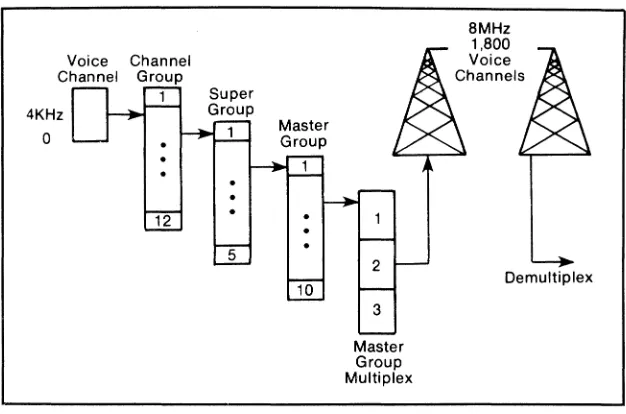
advent of microwave radio transmission in the late 1940s brought the fonnula-tion of a hierarchy of multiplexing, using frequency division to carry several hundred individual voice channels on a very high bandwidth radio frequency (see Figure 2-1).
Voice Channel Channel Group
4KHz o
1
12
5
Master Group
1
10 3
Master Group Multiplex
BMHz 1 ,BOO Voice Channels
[image:29.414.57.370.119.326.2]Demultiplex
Figure 2·1. Bell System Multiplexing Hierarchy
Switching Hierarchy
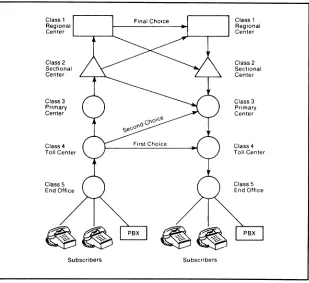
Class 1 Final Choice Regional
Center
Class 2 Class 2
Sectional Sectional
Center Center
Class 3 Class 3
Primary Primary
Center Center
Class 4 First Choice Class 4
Toll Center Toll Center
Class 5 Class 5
End Office End Office
[image:30.414.48.357.68.351.2]Subscribers Subscribers
Figure 2·2. North American Switching Hierarchy
Evolution of Switching Technology
The technology used in these exchanges has been marked by three evolu-tionary milestones. The first automation of telephone switching is credited to Almon Strowger, who patented a switching technique in 1892. The step-by-step method of switching that evolved from this design is still used in many Class 5 offices. A rotary dial generates direct-current pulses to the switches, which sequentially route the call from switch to switch until a final switch (a connector) is reached, providing access to the dialed telephone. The constant wiping action of the wiper arm used to search for a free circuit makes this technique unsuitable for data transmission; it should thus be avoided when possible.
Initially, the control logic used hard-wired logic circuits; it has since evolved to the use of special-purpose computers that control the crossbar mechanism or the newer reed relays, correeds, ferreeds, or solid-state switches that setve as
cross-points.
Third Generation. In the third generation of switching, the concept of computerized common control involves digitizing voice by means of pulse-code modulation, delta modulation, or the like. Time-division multiplexing techniques, in which time slots are matched at high speed, are used to connect two lines. Although this switching method has been used more widely in PBX designs than in telephone central offices, this situation is changing rapidly as an increasing number of digital telephone exchanges are being installed.
The technological evolution of the PBX in all its various forms-basic switchboard setvice, centrex setvice, direct inward dial setvice-has paralleled that of the central offices. The transition from second to third generation was a mid-1970s phenomenon that has seen explosive growth during the past few years, offering new and exciting concepts in communications.
THE TELECOMMUNICATIONS NETWORK TODAY
As previously stated, the telephone network was designed primarily to transmit an analog signal-the human voice. During the past 15 years, the trend has been increasingly to convert the human voice into a digital bit stream so that it can be switched and transmitted digitally. Pulse-code modulation is the most popular method of converting a voice signal to a digital signal. Figure 2-3 shows the three basic steps involved in analog-to-digital conversion. The desire
Step 1
Sample the 4kHz voice signal at twice its bandwidth.
Step 2
Quantize the resulting 8,000 pulse amplitude samples per second to 128 discrete levels.
Step 3
Convert the quantized PAM signals to 7-bit binary words (plus 1 bit for signaling).
[image:31.414.58.368.363.565.2]Binary Representation of Signal Amplitude at Sampling Instants
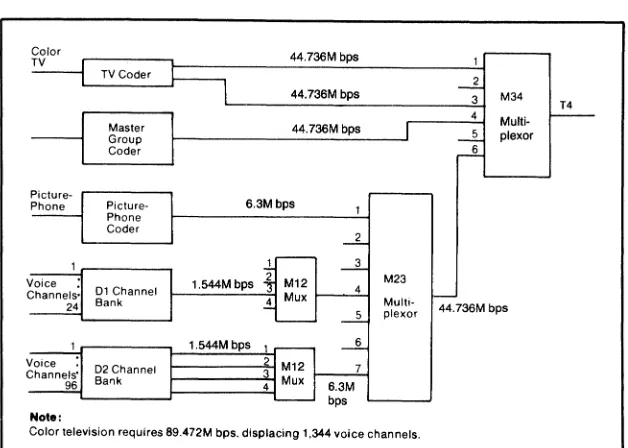
to multiplex multiple voice channels over copper wire (and ultimately micro-wave radio and satellite) using digital transmission (see Table 2-1) led to the development of a new multiplexing hierarchy (see Figure 2-4).
Table 2-1. Digital Carriers
Carrier Bit No. of Voice
Description Rate Channels
(bps)
64K 1
T1 1.S44M 24
T2 6.312M 96
T3 44.736M 672
T3a 89.472M 1,344
T4 274.176M 4,032
Current Use of Digital Technology
The trend to digital transmission and switching has been accelerating at an ever-increasing rate. At a recent network symposium, an AT&T network-planning vice-president cited some statistics concerning the Bell System's current status in using digital transmission and switching:
• Approximately 100 million circuit miles of twisted-pair, coaxial, or fiber-optic T -carrier cable are now in use.
• Approximately 5 million circuit miles of digital radio links use micro-wave and satellite technology .
• Approximately 250,000 subscriber-carrier local loops now use digital transmission.
• Approximately 100 toll-switching offices and 900 Class 5 end offices now use digital time-division switching systems.
This use of digital technology by the Bell System is paralleled, in varying degrees, by carriers outside the United States. Users should be aware that the vast analog systems and the capital investment in these holdings preclude any rapid change to all-digital technology. Although such changes are currently underway and will increase, the initial changes will remain limited in scope.
Network Signaling
Note:
02 Channel
Back
44.736M bps
44.736M bps
44.736M bps
6.3Mbps
M12 1---'--71 Mux
1.544Mbps
4
3
4 M23 Multi·
plexor
Color television requires 89.472M bps. displacing 1.344 voice channels.
2 3 M34 4
Multi·
5 plexor
6
[image:33.414.53.367.60.284.2]44.736M bps
Figure 2-4. U.S. and Canadian Digital Hierarchy
T4
Currently, the Bell System is using CCIS signaling for 25 to 30 percent of the connections in its toll network; Bell is committed to extending such use further into the switching hierarchy (including PBXs) as rapidly as possible. A CCITT recommendation (No.7 [1]) should stimulate compatible worldwide support forCCIS.
PBXsToday
Supplying digital PBX equipment has become a fiercely competitive busi-ness, and several dozen domestic and foreign manufacturers are producing an ever-increasing number offeatures-faster than the user community can absorb them. Whether the PBX is a standalone system or part of a corporate network, it is increasingly considered for use in switching data as well as voice communi-cations. Most digital PBXs are designed for the characteristics of voice tele-phone use: three to five minutes holding time, approximately half internal and half external calling, and an average busy-hour use per instrument of 10 minutes. These characteristics have allowed PBX designers to have concentra-tion levels within the switching network at typically a 3: 1 ratio. Calling patterns that differ from the normal voice application, as they do with data transmission, frequently cause service degradation.
applications, as an alternative to using port contention devices. It is essential to understand the full cost and operational implications of using a PBX designed with network contention for data switching. The cost equation should include such items as:
• Wiring and cable.
• Hardware in the PBX common equipment cabinets.
• Hardware at the user terminal location. A more costly telephone set, for example, might be necessary to connect the data terminal equipment (DTE).
• The software upgrade required to support data transmission.
• Reduction of the quantity of lines and trunks to minimize congestion in the switching matrix.
Current Corporate Networks
When two or more PBX systems are connected to allow voice calling between them, organizations often rent dedicated lines to connect the PBXs, thereby providing an alternative to regular long-distance service. These tie lines (or trunks) allow a local on one PBX to call a local on the other by dialing fewer digits than would be involved in direct distance dialing-and without operator involvement.
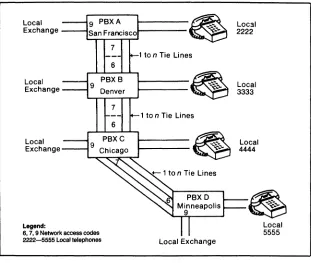
The following call set-up example, illustrated in Figure 2-5, indicates how calls are currently routed over more private networks. PBX local 2222 in San Francisco would use the following dialing procedure to call local 5555 in Minneapolis: dial 7, wait for dial tone from the Denver PBX; dial 7, wait for dial tone from Chicago; dial 7, wait for dial tone from Minneapolis; then dial local 5555. Obviously, if any link between San Francisco and Minneapolis were busy, the call would be blocked and the caller would have to hang up and try again or use some alternate route. These tie lines are still predominantly analog, necessitating the use of modems when lines are used for data transmis-sion.
Some of the Bell Systems' very large customers use specially designed network services such as the enhanced private switching communications service (EPSCS). Special Bell switching equipment is used for EPSCS, and such enhanced features as uniform numbering and automatic alternate routing are provided. The line interface, however, is still generally analog between the customer's on-site equipment and the Bell exchange.
Other Communications Technologies
... --.--r-T ...
----~
Local Exchange
Local Exchange
Local Exchange
Legend:
6, 7, 9 Network access codes 2222-5555 Local telephones
7
1 to n Tie Lines 6
7
1 to n Tie Lines 6
Local Exchange
Locsl
2222
Local 3333
Local
[image:35.414.58.369.68.331.2]4444
Figure 2-5. Typical Current Corporate Network
THE FUTURE TELECOMMUNICATIONS NETWORK
Local
5555
As the demand for increased bandwidth grows, so does the trend toward all-digital transmission, with the telephone network well on its way to becoming totally digital. The concepts and services of this evolving digital network should be considered in current planning for networks that are to be imple-mented during the next two to three years. Networks of the future will encom-pass switching, local area networking, and the integration of voice and data.
Packet Switching
Packet-switching networks have, of course, been in use for several years. The CCITT X.25 Recommendation serves as a common base for the design of generally compatible software and hardware. The two U.S. public packet-switched networks, Telenet and TYMNET, provide such service as a cost-effective alternative to dedicated or switched service from the Bell System or equivalent common carriers. GTE-Telenet, Tymnet, and several other suppli-ers of communications processors also market private packet-switching work hardware and software that allow companies to use private packet net-works for data transmission.
industry people feel an acceptable-quality packet voice switch is at least seven to ten years away. For example, approximately 250 packets per second per conversation would need to be processed, and large amounts of memory are required to store packets in transit. The variable delay in a network would affect the intonation and meaning of some phrases, and during periods of network congestion, delays of several hundred milliseconds would occur, causing considerable negative user reaction.
Packet-switched voice is an appealing concept that is worth watching; it
offers the theoretical potential to double the use of long-distance facilities. Studies have shown that a typical voice conversation involves 40 percent talking, 10 percent thinking, and 50 percent listening. The traditional circuit-switched network (whether analog or digital) requires a physical full-duplex path through the network. Thus, while one person is talking, the return path from the listener is idle. Packetized voice would permit use of this return path, effectively doubling the path's utilization.
Local Area Networks
Local area networks (LANs) are currently the subject of considerable research and many technical papers. Conceptually, a local area network is a common highway over which data between two devices is routed. Such networks are currently being used in such small geographic areas as manufac-turing complexes and universities, connecting a few-or thousands of-terminals. Although most local area networks are still considered experimental, several companies, such as 3M and Amdax, are now offering turnkey systems. The LAN interface unit provides both network protocol and terminal device support. This concept will require three to four years before it matures to the level of packet switching.
Integration of Voice and Data
It has become essential for users to maximize efficiency and minimize costs with their telecommunications networks. Traditionally, the voice network lines and switching equipment have been minimally used for data transmission. Voice lines are used during off-hours, or the lines are used alternately for voice and data. Most data transmission today uses dedicated analog or digital lines, packet networks, or other specialized common-carrier services designed spe-cifically for data transmission. Electronic mail, store-and-forward message switching, facsimile, and other such services generally use equipment designed for that purpose.
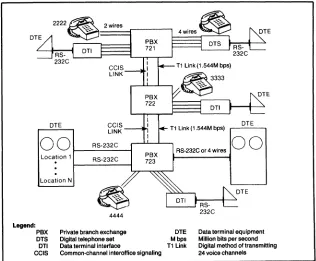
Figure 2-6 shows some of the components that will be part of corporate networks of the future, including the following key items:
• Sophisticated interface units to connect and support: -Analog rotary and Touch-Tone™ telephones
-Digital telephones, with or without data terminal support capability (a digital telephone includes an analog-to-digital conversion codec) -A data terminal interface unit to serve many protocols, codes, and
asynchronous and synchronous devices (including a packet assembler-disassembler function, if required)
-A Tl-compatible interface to multiplex 24 or more voice channels directly onto a Tllink
• Sophisticated software products to provide:
-Statistical multiplexing or packet switching over the inter-PBX digital links
-Support ofCCITT Recommendations X.25, X.2S, X.29, and/or X.3, plus the software necessary to perform the functions of a packet-switched node (e.g., flow control, congestion control, alternate rout-ing)
-Support of the CCIS signaling system for voice and possibly data switching
2222 ~ 2wires
DTE
~====~---l
~~
DTI RS-232C
DTE
O 0
RS-232C .--...I...L--'----,1 - - - 1
Legend:
RS-232C Location 1
.
Location N
4444
PBX
DTS
DTI
Private branch exchange Digital telephone set
CCIS
Data terminal interface
Common-channel Interoffice signaling DTE Mbps T1 Unk
00
OTE
Data terminal equipment Million bits per second Digital method of transmitting 24 voiCe channels
[image:37.414.58.374.306.567.2]The major cost will be for hardware and the associated software to support the multitude of terminals using the integrated network, ranging from ASCII-asynchronous to SNA-synchronous devices, each requiring unique handling.
In terms of cost, it must be realized that the value of the PBX or controller supporting the network is in the elimination of separate switching hardware and the potential for reduced wiring to each terminal location. Using the PBX for data switching will provide the enhanced reliability traditionally available with telephone switching systems. With the use of redundant processors, memories, and the like, a figure of 15 to 20 years between catastrophic failures is commonly quoted.
Today's network designers must understand switching concepts, transmis-sion techniques, engineering, data transmistransmis-sion concepts, link protocols, computer-network architectures and design concepts, and traffic engineering-in addition to beengineering-ing able to accommodate user needs. Unfortunately, such a superperson does not exist, and a team effort is required to incorporate these essential disciplines into any major network plan.
The lack of T 1 digital links is the major impediment to effective integration of voice and data, and users must put pressure on the common carriers to provide such links between all their corporate network locations. A few of the reasons for this lack of Tl interface connections are valid, most are unwar-ranted, and all are resolvable.
The Value of Digital Communications
Users frequently ask what will benefit them in the trend toward digital communications. The answers to this question depend on the availability of hardware and/or facilities from the telecommunications vendors. (In some cases, the provider benefits directly, with the user reaping secondary benefits.) The advantages of digital communications include the following:
• LSI and VLSI circuitry is inexpensive and compact, allowing reductions in size of several orders of magnitude.
• Digital circuitry is less complex and more reliable than the equivalent analog circuitry .
• Digital transmission is less sensitive to signal fading caused by such things as differing moisture and temperature layers, attenuation from fog or rain, and reflections from buildings. It can also use portions of the radio spectrum that analog transmission cannot.
• Digital signals are regenerated rather than amplified (as with analog signals). This eliminates noise accumulation and provides users with a higher-quality voice signal.
CONCLUSION
The move from analog to digital communications continues to expand and accelerate. Digital technology offers the advantages of smaller packaging, higher reliability, superior transmission quality, better utilization of resources, and, what may be most important, far greater adaptability to new demands for services.
eelS
signaling, for example, vastly improves call set-up time, and, as digital Tllinks become more readily available, data transmission users will be able to obtain a 64K-bit-per-second transmission path for the same price now paid for a 4KHz, 9,600-bit-per-second path, providing greater speed at lower cost.As costs for higher bandwidth decrease, it may be possible to set up teleconferencing connections as easily as today's three-party voice conference. Another valuable service made possible by digital technology is voice mail, using every telephone as an I/O device. As with electronic mail, users can input to and receive messages from a "mailbox." Voice messages are digitally encoded and stored for delivery as appropriate. Although memory require-ments are high (a lO-second message requires the storage equivalent of 80,000 characters), decreasing memory costs are making this service economically feasible.
The opportunities that will eventually be made possible by all-digital tele-communications technology are just now beginning to appear. What the future will bring may be limited only by the imagination.
Note: