Article
PDMS Material Models for Anti-fouling Surfaces
Using Finite Element Method
Kotchakorn Thanakhun
aand Tumrong Puttapitukporn
b,*Department of Mechanical Engineering, Faculty of Engineering, Kasetsart University, Bangkok 10900, Thailand
E-mail: a[email protected], b[email protected] (Corresponding author)
Abstract. Ecofriendly anti-fouling surfaces are usually produced by lithographic techniques which will
fabricate micropillar-like surfaces made of low surface energy materials such as Polydimethylsiloxane (PDMS). The purposes of this research were to investigate the most suitable Polydimethylsiloxane (PDMS) material model available in ANSYS APDL program to simulate structural behaviors of micropillars subjected to shear loading and to develop micropillar with improved lateral strength. In this research, PDMS material models were derived from experimental data from uniaxial tensile test. The accuracies of
the PDMS material models, which were the Neo-Hookean, Mooney-Rivlin 3and 5 parameters, Ogden (1, 2,
3 terms), Yeoh (1st, 2nd, 3rd order) and Arruda-Boyce material models, were evaluated and compared to experimental data from uniaxial tensile test and punch-shear test. Moreover, micropillars made of a pure PDMS and a Polyurethane Acrylate (PUA) core coated with PDMS were studied to compare their lateral strength under shear loading. We found that the most accurate material model to simulate both the uniaxial tension and shear loading was the Yeoh 3rd order material model; however, these accuracies would valid for small strain range. The lateral strength of a micropillar made of PUA core coated with PDMS was 8.67-time of the one made of pure PDMS. The optimal coating thickness was 100 nm because of its lateral strength and manufacturing cost.
Keywords: Hyperelastic material models, finite element analysis, ANSYS, PDMS,
micropillar.
ENGINEERING JOURNAL Volume 23 Issue 6
1.
Introduction
FE results of loads and displacements relationship correlated well with the experimental data. Gajewski, Szczerba and Jemiolo [15] modelled the elastomeric bridge bearing with the steel reinforcement subjected to compressive and shear loadings in ABAQUS program. The Neo-Hookean and Yeoh material models were used to curve fitting both uniaxial tension and simple shear test data to evaluate the most suitable material model. The authors found that the Yeoh material model showed the best prediction on the mechanical behaviors of the elastomeric bridge bearing. PDMS material is generally characterized as the hyperelastic material since PDMS material has nonlinear elastic response and Poison’s ratio being nearly 0.5. Rathod et al. [16] used the finite element method to compare predictions of calculated tractions for PDMS micropillar geometries with different aspect ratios using linear and nonlinear constitutive models in ABAQUS program. The Neo-Hookean and Arruda-Boyce material model were studied and the author showed that the Neo-Hookean material model obtained the most accurate results. Carlescu, Prisacaru, and Olaru [17] studied silicone elastomer films made of PDMS material subjected to uniaxial tension. The PDMS material model was curved fitting to the experimental data from uniaxial tensile test using the Neo-Hookean, Mooney-Rivlin, Yeoh, Ogden, Arruda-Boyce and Van de Waals Models in the ABAQUS program. Their results showed that Mooney-Rivlin, Ogden 2 terms and Yeoh 3rd order were obtained as the most accurate results. Kim, Kim and Jeong [18] studied the most appropriate FE model for a PDMS material in MSC Marc program. Here, the PDMS material models were the Neo-Hookean, Mooney-Rivlin 3 parameters and Ogden 2 terms material model. The authors showed that Ogden 2 terms obtained the most accurate results. Nunes [19] proposed the new PDMS material model used to study mechanical behaviors of PDMS bonding between two steel A36 plates. The author showed that for shear loading, his PDMS material model was more accurate than ones of the Mooney-Rivlin material model.
The objectives of this research were to investigate accuracies of PDMS material models available in ANSYS APDL program for analyzing mechanical behaviors of micropillars subjected to shear loading and to develop micropillars with improved lateral strength. The PDMS material models were curved fitting to uniaxial tensile test data. After that, we evaluated the accuracies of the PDMS material models on tensile and shear loading with experimental data. Finally, mechanical behaviors of micropillar fabricated from a core made of a PUA material coated with a PDMS material, were studied and compared its lateral strength to one made of a pure PDMS material under the shear loading.
2.
Theory
Hyperelastic material models are developed to describe a non-linear stress-strain relationship of hyperelastic materials either elastomers or rubbers. The constitutive material models are under an assumption of non-linear stress-strain relationship in which the material is capable to reverse into the previous shape after unloaded. The flexibility does not rely on strain rate and the material is an isotropic and incompressible [20]. The typical strain energy density function W can be written in terms of the stretch ratios and invariants
I as follows:
2
1 2
1 1
1
( 3) ( 3) ( 1)
N N
i j k
ij
i j k k
W C I I J
d
(1)where C are material constants, ij dk are constants of material compressibility, J is determinant of the elastic deformation gradient, Nis the number of terms in the equation and invariants I are
2 2 2
1 1 2 3
I (2)
2 2 2 2 2 2
2 1 2 2 3 3 1
I (3)
2 2 2 3 1 2 3
The stretch ratio in the i-direction can be written as
1
i
i i
O i
L
L
(5)where
L0 i, Li and
i are the initial length, the instantaneous length and the engineering strain in thei-direction respectively. The principal stress
in the i-direction is derived from the strain energy function asi i i W (6)
2.1. Hyperelastic Material Models
A hyperelastic material model is a type of constitutive model for nonlinearly elastic materials for which the stress–strain relationship can derive from a strain energy function.
2.1.1. Neo-Hookean material model
The Neo-Hookean model is the simplest form of the strain energy function W which is modified from
Hooke’s law. The Neo-Hookean material model can be written by Eq. (7) as
2
1
1
3 1
2
W I J
d (7)
where W is strain energy per unit reference volume, I is the first deviatoric strain invariant, 1 is an initial
shear modulus of the material, d is material incompressibility parameter and J is determinant of the elastic deformation gradient, F.
2.1.2. Mooney-Rivlin material model
The Mooney-Rivlin material model has been developed from the Neo-Hookean material model in which the function of strain energy density depends on the first and second invariants. There are several forms of these material models which are 2, 3, 5 and 9 parameters being available in ANSYS program which can be expressed as Eq. (8-11).
The Mooney-Rivlin 2 parameters can be expressed as
2
10 1 01 2
1
3 3 1
C I C I J
d
W (8)
The Mooney-Rivlin 3 parameters can be expressed as
2
10 1 01 2 11 1 2
1
3 3 3 3 1
C I C I C I I J
d
W (9)
The Mooney-Rivlin 5 parameters can be expressed as
2 2 2
10 1 01 2 20 1 11 1 2 02 2
1
3 3 3 3 3 3 1
C I C I C I C I I C I J
d
The Mooney-Rivlin 9 parameters can be expressed as
2 2 3
10 1 01 2 20 1 11 1 2 02 2 30 1
2 2 3 2
21 1 2 12 1 2 03 2
3 3 3 3 3 3 3
1
3 3 3 3 3 1
C I C I C I C I I C I C I
C I I C I
d C
I I J
W
(11)
where W is strain energy per unit reference volume, C10, C01, C20, C11, C02, C30, C21, C12 and C03 are material constants characterizing the deviatoric deformation of the material, I is the first deviatoric strain 1
invariant, I is the first deviatoric strain invariant, d is material incompressibility parameter and J is 2
determinant of the elastic deformation gradient, F.
2.1.3. Ogden material model
The strain energy density function of the Ogden model can be expressed by Eq. (12). There are 3 forms of the Ogden models being available in ANSYS program which are Ogden 1, 2 and 3 terms.
22
1 3
1 1
1
3 1
i i i
N N
k i
i i k k
J d W
(12)where W is strain energy potential, p(p=1, 2, 3) = deviatoric principal stretches, defined as
1 3
p J p
while pis principal stretches of the left Cauchy-Green tensor, J is determinant of the elastic deformation gradient,
i,
i and dk are material constants and N imply the number of terms in the equation which are usually below 3.2.1.4. Yeoh material model
The Yeoh material model expresses the strain energy density function depending on only first invariant as shown in following equation, Eq. (13). There are 3 forms of the Yeoh models which are Yeoh 1st, 2nd and 3rd order.
2 0 1
1 1
1
( 3) ( 1)
N N
i k
i
i i k
W C I J
d
(13)where W is strain energy potential, I is the first deviatoric strain invariant, J is determinant of the elastic 1
deformation gradient, Ci0and dkare material constants and Nimply the number of terms in the equation which are usually below 3.
2.1.5. Arruda-Boyce material model
The Arruda-Boyce material model, known as 8-chain model, which was developed based on a molecular chain network (hexahedron) and only first invariant is expressed in the material model as shown in Eq. (14).
2 3
1 2 1 4 1
2
4 5
1 1
6 8
1 1 11
[ ( 3) ( 9) ( 27)
2 20 1050
1
19 519 1
( 81) ( 243)] (
7000 673750 2 ln )
L L
L L
W I I
where W is strain energy potential, I is the first deviatoric strain invariant, 1 is an initial shear modulus of
the material,
Lis the limiting network stretch, d is material incompressibility parameter and J is determinant of the elastic deformation gradient.2.2. Accuracy of Finite Element Material Models
The comparison of constitutive material models in ANSYS program were evaluated by Pseudo R-squared method which can be calculated with Eq. (15).
N
2
i i
2 i 1
Efron N
2 i i 1
ˆ ( y )
R 1
( y y )
(15)
Where, y is the stress from the laboratory, i ˆ is the stress from finite element analysis, i y is the mean of the stresses from the laboratory andNis a total number of data.
3.
Methodology
3.1. Uniaxial Tension
3.1.1. Laboratory experiment of uniaxial tension test
The uniaxial tensile tests were performed on the Servo-Hydraulic Universal Testing Machine (UTM Instron 5501R). The tests were conducted on 3 dumbbell-shaped specimens (based on ASTM D412 Die C) at
room temperature of 25°C. Specimens were made of a PDMS material having the PDMS monomers to a
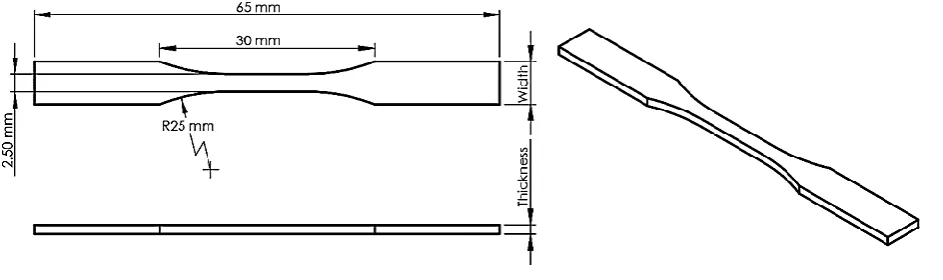
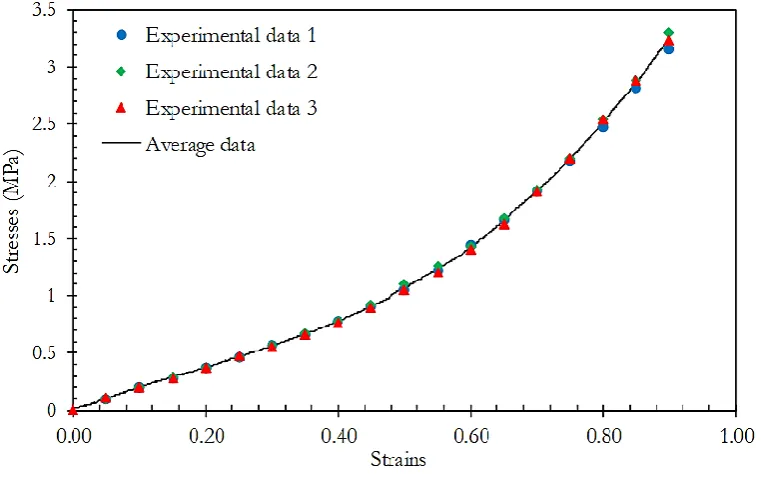
curing agent ratio of 10:1. Figure 1 illustrates the PDMS specimen size which had the gage width of 2.5 mm, the total specimen length of 65 mm, the gage length of 30 mm and the curvature radius of 25 mm. The actual specimens were cut by a CO2 laser and their dimensions are shown in Table 1. The stress-strain relationships were obtained as shown in Fig. 2.
Fig. 1. Dimension of tensile specimens.
Table 1. The actual sizes of tensile specimens.
Specimen number Width (mm) Thickness (mm)
1 6.028 1.426
2 6.016 1.290
[image:6.595.67.539.488.628.2] [image:6.595.84.505.683.736.2]3.1.2. Finite element analysis of a uniaxial tension test
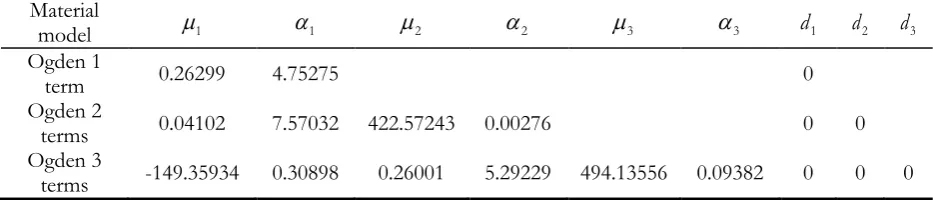
The finite element analyses were performed to determine accuracies of hyperelastic material models which were available in ANSYS Mechanical APDL program. The finite element modelhad only a gage length portion to prevent numerical difficulties which had 2.5-mm wide, 30-mm long and 1.313-mm thick as shown in Fig. 3. The FEM were meshed using the SOLID186 element which was a higher order 3-D 20-node solid element. This model was consisted of 64214 20-nodes with 13650 elements. The hyperelastic material models were used the Neo-Hookean, Mooney-Rivlin 3 and 5 parameters, Ogden (1, 2, 3 terms), Yeoh (1st, 2nd, 3rd order) and Arruda-Boyce material models where the material constants were illustrated in Table 2-6. The boundary conditions were that one end was fixed in all degree of freedom while the nodes attached to other end were constrained displacement in the z-direction and were gradually applied the displacement of 30 mm.
Fig. 2. Plot of stresses vs strains of experimental data and the average data from uniaxial tensile test.
[image:7.595.108.492.246.485.2] [image:7.595.123.476.527.746.2]Table 2. The Neo-Hookean material model.
Material model d
Neo-Hookean 0.91156 0
Table 3. The Mooney-Rivlin material model.
Material model C10 C01 C11 C20 C02 d
Mooney-Rivlin 3 parameters -0.54115 0.97146 0.49612 0
Mooney-Rivlin 5 parameters -0.46701 0.88163 -3.91278 1.54142 3.11667 0
Table 4. The Ogden material model.
Material
model
1
1
2
2
3
3 d1 d2 d3Ogden 1
term 0.26299 4.75275 0
Ogden 2
terms 0.04102 7.57032 422.57243 0.00276 0 0
Ogden 3
terms -149.35934 0.30898 0.26001 5.29229 494.13556 0.09382 0 0 0
Table 5. The Yeoh material model.
Material model C10 C20 C30 d1 d2 d3
Yeoh 1st order 0.45578 0
Yeoh 2nd order 0.33845 0.16787 0 0
Yeoh 3rd order 0.36428 0.07036 0.05307 0 0 0
Table 6. The Arruda-Boyce material model.
Material model
L dArruda-Boyce 0.19003 0.97357 0
3.2. Punch-Shear Test
3.2.1. Laboratory experiment of the punch-shear test
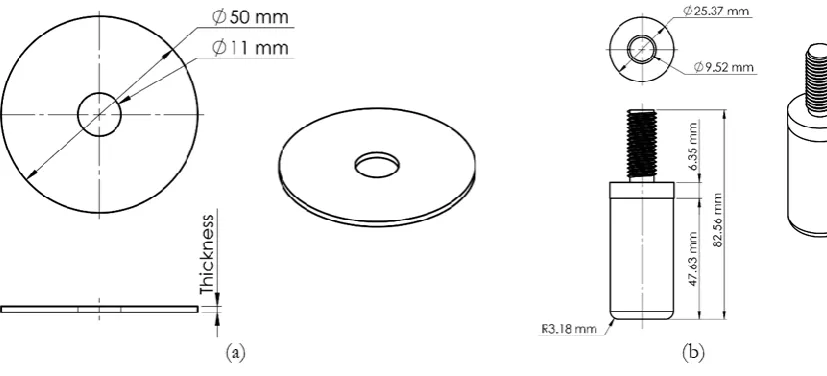
[image:8.595.63.534.184.229.2] [image:8.595.64.531.268.368.2] [image:8.595.86.509.406.464.2]Fig. 4. Dimension of (a) punch-shear specimens; (b) a punch.
Table 7. Thickness of punch-shear specimens.
Specimen number Thickness (mm)
1 1.84
2 1.50
3 1.44
4 1.45
Fig. 5. Plot of compressive forces vs vertical displacements of experimental data and the average data on punch-shear test.
3.2.2. Finite element analysis of a punch-shear test
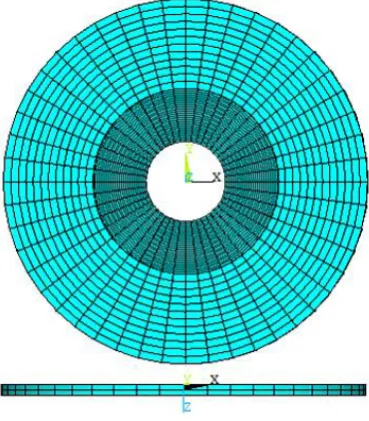
[image:9.595.92.510.80.691.2] [image:9.595.84.498.92.280.2] [image:9.595.106.496.331.657.2]of 50 mm, an inner diameter of 11 mm and a thickness of 1.56 mm.The FE models were meshed using the SOLID186 element which was a higher order 3-D 20-node solid element. This model was consisted of 19776 nodes with 3648 elements. The hyperelastic material models consisted of the Mooney-Rivlin 5 parameters, Ogden 3 terms, Yeoh 3rd order and Arruda-Boyce material models where their material constants were illustrated in Table 3-6. The FE model of the punch-shear specimen was divided into 2 volumes along the inner hole of the lower stationary box as shown in Fig. 6b. The volume A was fixed in all DOF while all nodes on the volume B were coupled displacements in the z-direction except those nodes on the outer diameter of the volume B. Moreover, the contact areas between volumes A and B were set as an initially bonded contact and all nodes on the contact area of the volume B was fixed in the radial direction.The pressure of 0.7 MPa was gradually applied on top of the volume B.
Fig. 6. (a) Assembly drawing of a Punch-shear fixture; (b) Simplified FE model.
[image:10.595.112.489.218.474.2] [image:10.595.203.388.525.736.2]3.3. Finite Element Analyses of a Micropillar
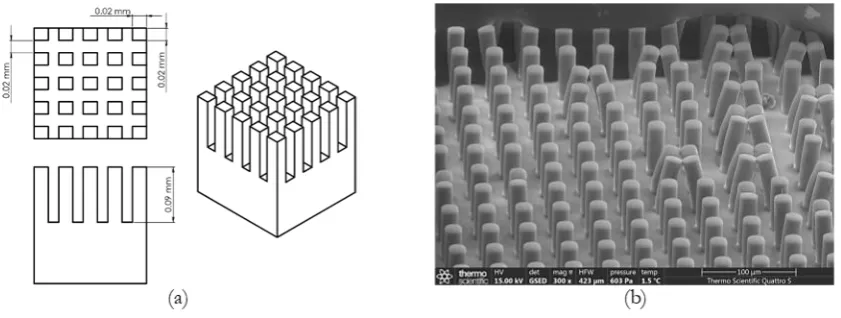
The anti-fouling surface was fabricated from a PDMS material by Thai Microelectronics Center (TMEC) as shown in Fig. 8. However, this anti-fouling surface was not a robust structure and was easily to deform under small compressive or shear loads. Figure 8b illustrates the self-mating of micropillars resulting from shear loading. This research aimed to improve thelateral strength of micropillars to withstand higher shear loads by fabricating an anti-fouling surface which made of PUA core coated with PDMS micropillar [6]. The PDMS material models used in this study was the Yeoh 3rd order material model.
Fig. 8. (a) Dimension of an anti-fouling surface; (b) Self-mating of micropillars under shear loading.
3.3.1. Pure PDMS micropillar
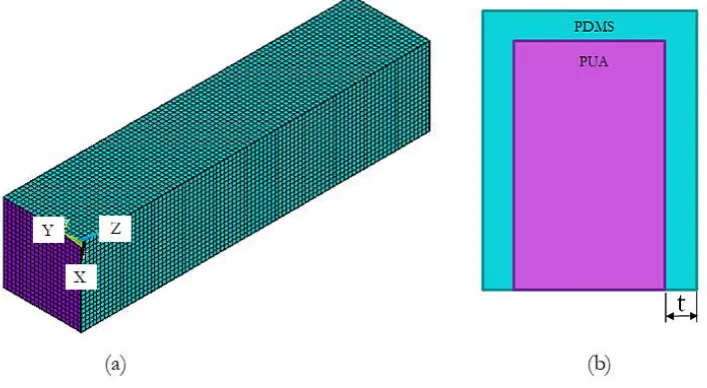
The FE model of a micropillar had dimension of 20 μm x 20 μm x 90 μm and was meshed by the SOLID185 (8 nodes) element as shown in Fig. 9. This model was consisted of 40131 nodes with 36000 elements. The displacement of 20 μm along the x-direction was gradually applied on all nodes attached to top of the micropillar while all nodes attached to bottom of the micropillar were fixed in all DOF.
[image:11.595.77.498.204.363.2] [image:11.595.130.474.494.741.2]3.3.2. PUA Core coated PDMS micropillar
The micropillar composed of a core made of PUA having dimension of 20 μm x 20 μm x 90 μm and was coated with the PDMS material for thickness t of 100 nm, 125 nm, 150 nm, 175 nm and 200 nm respectively as shown in Fig. 10. The FE model was meshed by the SOLID185 (8-node) element. This model was consisted of 48668 nodes with 44044 elements. Furthermore, the displacement in the x-direction of 20 μm was gradually applied at all nodes attached to top of the micropillar while all nodes attached to bottom of the micropillar were fixed in all DOF. The material properties of PUA were Young’s modulus of 19.8 MPa and Poison’s ratio of 0.4 [7].
Fig. 10. (a) The FE model of a PUA core coated PDMS micropillar; (b) a section view.
4.
Results and Discussion
4.1. Finite Element Results of a Uniaxial Tensile Test
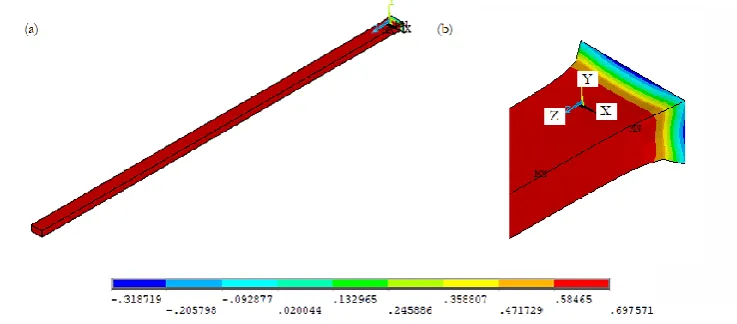
The plot of far field true stresses versus true strains for various hyperelastic models were shown in Fig. 11. The accuracies of FE material models were evaluated from Pseudo R-squared which was illustrated in Table 8. The Ogden 3 terms, Arruda-Boyce, Mooney-Rivlin 5 parameters and Yeoh 3rd order material models obtained the accurate FE results which had Pseudo R-squared of 0.99998, 0.99991, 0.99986 and 0.99909 respectively. Figure 12 and 13 showed the contour plot of the stresses and strains in z-direction of the FE model using the Ogden 3 terms material model and the pulling displacement of 30 mm respectively. Furthermore, the maximum stress in the z-direction was 8.592 MPa found near the fixed location.
Table 8. Pseudo R-squared of the curve fitting of ten models under uniaxial tensile loading condition.
Hyperelastic material models Pseudo R-squared
Neo-Hookean 0.73842
Mooney-Rivlin 3 parameters 0.99580
Mooney-Rivlin 5 parameters 0.99986
Ogden 1 term 0.99591
Ogden 2 terms 0.99906
Ogden 3 terms 0.99998
Yeoh 1st order 0.64881
Yeoh 2nd order 0.98772
Yeoh 3rd order 0.99909
[image:12.595.119.473.228.422.2] [image:12.595.148.447.634.773.2]Fig. 11. Plot of true stresses vs true strains of each material models compared to experimental data.
Fig. 12. Contour plot of (a) stresses in the z-direction; (b) stresses in the z-direction at the fixed location.
4.2. Finite Element Results of a Punch-Shear Test
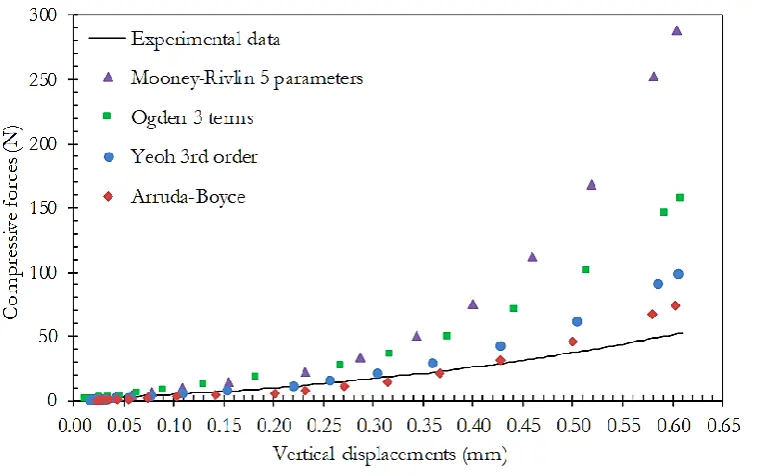
The plot of compressive forces versus vertical displacements for various hyperelastic models was shown in Fig. 14. The accuracies of hyperelastic material models were evaluated by Pseudo R-squared which were illustrated in Table 9. Moreover, a warning message of material instabilities appeared on the Mooney-Rivlin 5 parameters FE model which could lead to have an unusual result. Nonetheless, the Yeoh 3rd order models obtained the most correlate and accurate FE results under the low strain region (
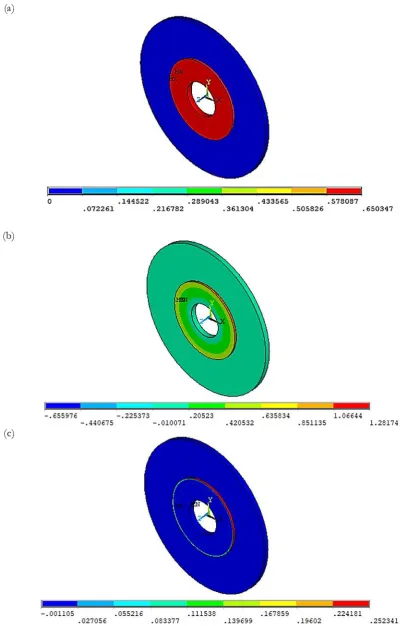
z0.19) which had [image:14.595.111.490.210.448.2]Pseudo R-squared of 0.98141 as shown in Fig. 15. Figure 16 shows contour plots of FE results using the Yeoh 3rd order material model at applied pressure of 0.24 MPa.
[image:14.595.110.488.503.730.2]Fig. 14. Plot of compressive forces vs vertical displacements comparing FE results to experimental data from the punch-shear test.
Table 9. Pseudo R-squared of the curve fitting of four models under punch-shear loading condition.
Hyperelastic material models Pseudo R-squared
Mooney-Rivlin 5 parameters -0.88354
Ogden 3 terms -0.30512
Yeoh 3rd order 0.98141
Arruda-Boyce 0.65322
[image:16.595.149.446.105.170.2]4.3. The Strength Comparison of Micropillars under Shear Loading
Table 10 illustrates shear forces required to displace top ends of micropillars to distance of 20 μm in the x-direction. We found that the shear force on the PUA core coated PDMS material was slightly decreased as the thickness of coated material increases. This might be resulted from the relative soft coat compared to the core material. Moreover, the pure PDMS micropillar needed 3.041 μN while the PUA core coated with 100-nm PDMS micropillar needed 26.369 μN. This was about 8.67 times of the one of the pure PDMS micropillar. Figure 17 shows contour plots of the stresses in z-direction of the pure PDMS micropillar and the PUA core coated with 100 nm–thick PDMS. Figure 18 shows contour plots of the strains in z-direction of the pure PDMS micropillar and the PUA core coated with 100 nm–thick PDMS. The maximum stress and strain were found on the fixed end.
Fig. 17. Contour plot of stresses in z-direction (unit in MPa) of (a) pure PDMS; (b) PUA core coated with 100 nm – thick PDMS.
[image:16.595.104.478.328.503.2] [image:16.595.101.478.550.724.2]Table 10. Shear force required to displace the top end to a distance of 20 μm in x-direction on micropillar.
Pure PDMS PUA core coated with PDMS
Shear force (μN)
Thickness of PDMS (nm)
100 125 150 175 200
3.041 26.369 26.261 26.161 26.068 25.982
5.
Conclusions
The PDMS material models could derive from experimental data of uniaxial tensile test and could be used to simulate PDMS structures subjected to uniaxial-tensile and punch-shear loading. The most accurate PDMS material model for investigating both uniaxial-tensile and punch-shear loading was the Yeoh 3rd order material model with Pseudo R-squared of 0.99909 (for uniaxial-tensile loading) and 0.98141 (for punch-shear loading). However, if the Yeoh 3rd order material model was used to simulate punch-shear loading, FE results would be valid only for low strain range (
z0.19). The PUA core coated with 100nm-thick PDMS micropillar illustrated better lateral strength than one of the pure PDMS micropillar since it could be capable of withstanding up to 8.67-time of the shear force found on the pure PDMS micropillar. Moreover, the thickness of coated PDMS had not showed a significant effect on lateral strength of the composite micropillar. Finally, the 100 nm-coated PDMS micropillar showed both the best lateral strength and cost reduction for production.
Acknowledgment
The authors gratefully acknowledge Dr. Nithi Atthi, researcher at Thai Microelectronics Center (TMEC), for valuable support and provision of PDMS experimental data.
References
[1] D. Gomes, N. Souza. and J. Silva, “Using a monocular optical microscope to assemble a wetting contact angle analyser,” Measurement, vol. 46, pp. 3623-3627, Jul. 2013.
[2] D. Armani, C. Lui, and N. Aluru, “Re-configurable fluid circuits by PDMS elastomer micromachining,” in Twelfth IEEE International Conference on Micro Electro Mechanical Systems, 1999, pp. 222-227.
[3] G. D. Bixler and B. Bhushan, “Biofouling: lessons from nature,” Philos T R Soc A., vol. 370, pp. 2381-2417, May 2012.
[4] Z. Wang, A. Volinsky, and N. Gallant, “Crosslinking effect on polydimethylsiloxane elastic modulus measured by custom-built compression instrument,” Journal of Applied Polymer Science, vol. 131, no. 9, May 2014.
[5] A. Mata, A. J. Fleischman, and S. Roy, “Characterization of polydimethylsiloxane (PDMS) properties for biomedical micro/nanosystems,” Biomedical Microdevices, vol. 7, no. 7, pp. 281-293, Dec. 2005. [6] W. Bae, M. K. Kwak, H. E. Jeong, C. Pang, H. Jeong, and K. Suh, “Fabrication and analysis of
enforced dry adhesives with core–shell micropillars,” Soft Matter., vol. 9, no.20, pp. 1422-1427, Nov. 2012.
[7] Y. Rahmawan, S. M. Kang, S. Y. Lee, K. Suh, and S. Yang, “Enhanced shear adhesion by mechanical
interlocking of dual-scaled elastomeric micropillars with embedded silica particles,” Macromolecular
Reaction Engineering, vol. 7, no. 10, pp. 616-623, 2013.
[8] F. Xie, H. Zhou, W. Zhao, and L. Huang, “A comparative study on the mechanical behavior of intervertebral disc using hyperelastic finite element model,” Technology and Health Care, vol. 25, pp. 177-187, 2017.
[9] R. Tobajas, E. Ibarz, and L. Gracia, “A comparative study of hyperelastic constitutive models to characterize the behavior of a polymer used in automotive engines,” in Proc 2nd International Electronic
Conference on Materials, April 2016, pp. 2-16.
[image:17.595.63.523.105.160.2][11] A. Nomoto, H. Yasutaka, S. Oketani, and A. Matsuda, “2-dimensional homogenization FEM analysis of hyperelastic foamed rubber,” Procedia Engineering, vol. 147, no. 14, pp. 431-436, Jan. 2016.
[12] D. Huri and T. Mankovits, “Comparison of the material models in rubber finite element analysis,”
IOP Conference Series: Materials Science and Engineering, vol. 393, no. 15, 2018.
[13] J. Phromjan and C. Suvanjumrat, “A suitable constitutive model for solid tire analysis under quasi-static loads using finite element method,” Engineering Journal, vol. 22, no. 2, pp. 141-155, Mar. 2018. [14] B. J. Munroe and J. A. Sherwood, “Finite element modeling of a baseball,” Procedia Engineering, vol. 34,
no. 16, pp. 610-615, Jan. 2012.
[15] M. Gajewski, R. Szczerba, and S. Jemiolo, “Modelling of elastomeric bearings with application of Yeoh Hyperelastic Material Model,” Procedia Engineering, vol. 111, no. 17, pp.220-227, Jan. 2015. [16] M. L. Rathod, N. Pareek, S. Agrawal, S. Jaddivada, D. W. Lee, and N. Gundiah, “Engineered ridge
and micropillar array detectors to quantify the directional migration of fibroblasts,” RSC Advances, vol. 7, no. 18, pp. 51436-51443, Oct. 2017.
[17] V. Carlescu, G. Prisacaru, and D. N. Olaru, “FEM simulation on uniaxial tension of hyperelastic elastomers,” Applied Mechanics and Materials, vol. 659, no. 1, pp. 57-62, May 2014.
[18] T. K. Kim, J. K. Kim, and O. C. Jeong, “Measurement of nonlinear mechanical properties of PDMS
elastomer,” Microelectronic Engineering, vol. 88, no. 4, pp. 1982-1985, Aug. 2011.
[19] L. C. S. Nunes, “Mechanical characterization of hyperelastic polydimethylsiloxane by simple shear test,”
Materials Science and Engineering, vol. 528, no.19, pp. 1799-1804, Jan. 2011.
[20] A. Ali, M. Hosseini, and B. B. Sahari, “A review of constitutive models for rubber-like materials,”