arXiv:1802.00914v1 [cs.LO] 3 Feb 2018
Arrow Update Synthesis
Hans van Ditmarsch
∗,†, Wiebe van der Hoek
‡,
Barteld Kooi
§, Louwe B. Kuijer
¶Abstract
In this contribution we presentarbitrary arrow update model logic(AAUML). This is a dynamic epistemic logic or update logic. In update logics, static/basic modali-ties are interpreted on a given relational model whereas dynamic/update modalimodali-ties induce transformations (updates) of relational models. In AAUML the update modal-ities formalize the execution ofarrow update models, and there is also a modality for quantification over arrow update models. Arrow update models are an alternative to the well-known action models. We provide an axiomatization of AAUML. The ax-iomatization is a rewrite system allowing to eliminate arrow update modalities from any given formula, while preserving truth. Thus, AAUML is decidable and equally expressive as the base multi-agent modal logic. Our main result is to establisharrow update synthesis: if there is an arrow update model after which ϕ, we can construct
(synthesize) that model fromϕ. We also point out some pregnant differences in up-date expressivity between arrow update logics, action model logics, and refinement modal logic, and we provide a novel axiomatization for refinement modal logic.
Keywords: modal logic, synthesis, dynamic epistemic logic, expressivity
1
Introduction
Modal logic In modal logic we formalize that propositions may not be merely true or
false, but that they are necessarily or possibly true or false, or that they may be desirable, or forbidden, or true later, or never, or that they areknown. A common setting is for such modal propositions to be interpreted in relational models, also known as Kripke models. They consist of a domain of abstract objects, called states or worlds; then, given a set of labels, often representing agents, for each such agent a binary relation between those states; and, finally, a valuation of atomic propositions on the domain, typically seen as a
∗ReLax/LORIA, CNRS, France/India,[email protected]
†Hans van Ditmarsch is corresponding author. We acknowledge support from ERC project EPS 313360. ‡Computer Science, University of Liverpool, United Kingdom,[email protected] §Department of Philosophy, University of Groningen, the Netherlands,[email protected]
unary relation, i.e., a property satisfied on a subset of the domain. The truth of a modal proposition is relative to a state in the relational model, called the actual state or thepoint
of the model. The unit of interpretation is thus a pointed model: a pair consisting of a relational model and an actual state.
If a pair (s, s′) in the relation fora this can mean that after executing actionain state
s the resulting state is s′. But it can also mean that agent aconsiders state s′ desirable in
case she is in state s. The interpretation that we focus on, is that of information. That is, it is consistent with a’s information in state s that the state would be s′. In state s it
is true that agent a knows ϕ (or believes ϕ, depending on the properties of the relation), notation ✷aϕ, if the formula ϕ is true in all states s′ accessible from s, i.e., for all s′ with
(s, s′
) in the relation fora. The modal logics using that kind of interpretation of modalities are called epistemic logics [6, 24].
As an example, consider two agents a, b (commonly known to be) uncertain about the truth of a propositional variable p. The uncertainty of a and b can be pictured as follows. We ‘name’ the states with the value of the variable p. The actual state is framed. Pairs in the accessibility relation are visualized as labelled arrows. In the actual state: pis true, agent a does not knowpbecause she considers a state possible wherein pis false (formally
¬✷ap), agent a also does not know ¬p because she considers a state possible wherein p is
true (formally ¬✷a¬p, also written as ✸ap), and similarly for agent b. Agent a also knows
that she is ignorant aboutp, as this is true in both states that she considers possible. The accessibility relations fora and b are both equivalence relations. This is always the case if the modalities represent knowledge.
¬p ab p
ab ab
p
Update logic In this work we focus on modal logics that are update logics. Apart from
the modalities that are interpreted in a relational model, they have other modalities that are interpreted by transforminga relational model (and by then interpreting the formulas bound by that modality in the transformed model). If the modal logic is an epistemic logic, update logics are called dynamic epistemic logics. To distinguish them we call the former static and we call the latter dynamic.
the valuation of a model is also known asfactual change [26, 21]. Update involving factual change is an interesting topic, but it is outside the scope of the current paper.
Public announcement logic The basic update for states is the model restriction, and
the basic update operation interpreted as a model restriction is a public announcement. The logic with epistemic modalities and public announcements is public announcement logic (PAL) [18, 5]. A public announcement of ϕ restricts the domain to all states where the announced formula ϕ is true, thereby decreasing the uncertainty of the agents. As a result of the domain restriction, the relations and the valuation are adjusted in the obvious way. A condition for the transformation is that the actual state is in the restriction. This means that the announcement formula is true when announced.
As an example, after the public announcement of p, both a and b know that p:
¬p ab p
ab ab
⇒
pab
Arrow update logic The basic update for relations is the relational restriction, i.e.,
a restriction of the arrows: a pair in the relation is called an ‘arrow’. This leaves all states intact, although some may have become unreachable. Inarrow update logic (AUL), proposed in [15] we specify which arrows we wish to preserve, by way of specifiying what formulas should be satisfied at the source (state) of the arrow and the target (state) of the arrow. This determines the model transformation. Such a specification is called an arrow update. The logic AUL contains modalities for arrow updates.
Given initial uncertainty aboutpwith both agents, a typical arrow update is the action wherein Anne (a) opens an envelope containing the truth about p while Bill (b) observes Anne reading the contents of the letter. We preserve all arrrows satisfying one of p →a
p,¬p→a ¬p, and⊤ →b ⊤. Therefore, only two arrows disappear, ¬p→ap and p→a¬p.
¬p ab p
ab ab
⇒
¬p b pab ab
The boundary between state elimination and arrow elimination is vague. Ifpis true, the following arrow update with⊤ →ap,⊤ →b pis the same update as a public announcement
of p. This is because there is no arrow from the p state to the ¬p state after the update. Therefore, if p is true, the ¬p state does not matter. In another formalism this arrow update is known as the arrow elimination semantics of public announcement [11, 14].
¬p ab p
ab ab
⇒
¬p b pGeneralizations In PAL and AUL the complexity (the number of states) of the rela-tional model cannot increase. By generalizing the mechanism underlying state elimination and arrow elimination we can achieve that, and thus express more model transformations. This increases their update expressivity. From the perspective of information change, this adds uncertainty about what is happening. We obtain action models [5] as a generaliza-tion of public announcements, and arrow update models [16] as a generalization of arrow updates.
Action model logic Action model logic (AML) was proposed by Baltag, Moss and
Solecki in [5]. An action model is like a relational model but the elements of the domain are calledactions instead of states, and instead of a valuation apreconditionis assigned to each domain element. The transformed relational model is then the modal product of the relational model and the action model, restricted to (state,action) pairs where the action can be executed in that state. We refer to Section 6 for a formal introduction.
An example is the action as above wherein Anne reads the contents of a letter containing
p or¬p, but now with the increasing uncertainty that Bill is uncertain whether Anne has read the letter (and that they are both aware of these circumstances). The action model is not depicted (details are in Section 6). The model transformation is as follows. In the resulting framed state,aknows thatp, butb considers it possible thatais uncertain about
p, i.e., ✷ap∧✸b¬(✷ap∨✷a¬p). In the figure we assume transitivity of the relation forb.
¬p ¬p ab p
ab ab
⇒
¬p p¬p p
ab b
b b
ab ab
ab ab
Similar logics (or semantics) for action composition are found in [22, 13, 21, 2, 32]. Action model logic is often referred to as (the) dynamic epistemic logic. As said, we use the latter more generally, namely to denote any update logic with an epistemic interpretation.
Arrow update model logic Generalized arrow update logic[16] is a (indeed)
Quantification over information change Another extension of update logics is with quantification over updates. Arbitrary public announcement logic (APAL) adds quantifi-cation over public announcements to PAL [4]. Arbitrary arrow update logic (AAUL) [28] extends arrow update logic with quantifiers over information change induced by arrow up-dates: it contains dynamic modalities formalizing thatthere is an arrow update after which
ϕ. Arbitary action model logic (AAML) by Hales [12] add quantifiers over action models to AML. In arbitrary arrow update model logic(AAUML), the topic of this paper, we add quantifiers over arrow update models to the logical language. It is like Hales’ arbitrary action model logic. Refinement modal logic(RML) [8] has a modality representing quantifi-cation over updates, but does not have (deterministic/concrete) update modalities in the object language to quantify over. We will show that the AAML and AAUML quantifier behaves much (but not quite) like the refinement quantifier in RML. Section 7 is devoted to it.
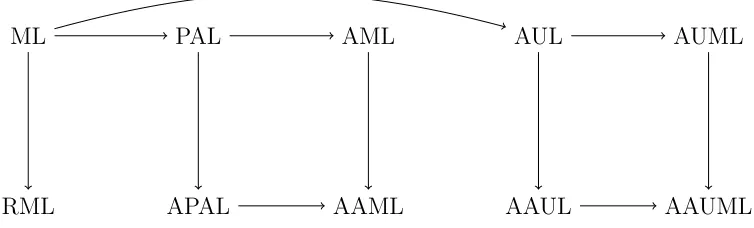
Figure 1 gives an overview of the different logics discussed in the paper, in their relation to AAUML. The four logics in the left square are based on state manipulation, the four logics in the right square are based on arrow manipulation. Entirely on the left we find the base modal logic ML and the logic RML, that is also arrow manipulating.
All these logics are equally expressive as ML and are decidable, which can be shown by truth-preserving rewriting procedures to eliminate updates (for AAUML this is one of the results of the paper), except for APAL and AAUL, which are more expressive and undecidable [4, 9, 28, 29]. However, the logics greatly differ in update expressivity, as the typical examples above already demonstrated. See also Sections 5 — 7.
There are many other updates and update logics that we do not consider in this paper. In particular we do not consider updates X that can only be defined as pointed model transformers (that is, they cannot begloballydefined on the entire model; they are defined
locally: how they transform the model depends on the actual state). If such were the definition of an update, even the interpretation of a static modality can be seen as an update, namely transforming the model with point s into the model with point s′, where
the point has shifted given a pair (s, s′
) in the relation for an agent. Such local update logics are often more expressive than modal logic, are often undecidable, and may lack axiomatizations. Examples are [20, 3, 1]. In [1] not only relationalrestrictionis considered but also relationalexpansion(‘bridge’) and relationalchangethat is neither restriction nor expansion, such as reversing the direction of arrows (‘swap’). It should finally be noted that the distinction between static modalities, interpreted in a model, and dynamic modalities, interpreted as updates, is not rigid: unifying perspectives include [21].
Synthesis For these update logics we can ask whether there is an update that achieves
a certain goal. For the logics without quantification this question cannot be asked in the object language but only meta-logically. That is, we can ask whether there is an update
X such that hXiϕ is true. For the update logics with quantification this question can be asked in the object language. Let h?i be (the existential version of) that quantifier. Then
ML
RML
PAL
APAL
AML
AAML
AUL
AAUL
AUML
[image:6.612.113.490.118.232.2]AAUML
Figure 1: An overview of update logics discussed in the paper. Horizontal arrows informally represent more complex updates. Vertical arrows informally represent quantification over
updates. The arrows can be interpreted as syntactic extensions (modulo the names of quantifiers) or as semantic generalizations. Assume transitive closure.
Only knowing whether there is an update that achieves a goal is not very satisfying; we would also like to know which update, if any, achieves the goal. So we would like to know not only whether the goal is achievable but also how it can be achieved. The process of constructing this update that achieves the goal is known as synthesis.
Formally, the synthesis problem for a given type of update takes as input a formula ϕ, and gives as output an updateX of that type such that, wheneverϕ can be achieved, then
X achieves ϕ. In symbols, this is the validity of h?iϕ→ hXiϕ.
This is a rather strong goal. We do not consider it sufficient to find, for every pointed model (M, s), an updateX(M,s) such that (M, s) satisfies h?iϕ → hX(M,s)iϕ. We want one
single update Xϕ that achieves ϕ in every model where ϕ is achievable. Because this goal
is so strong, there is, in general, no guarantee that synthesis is possible.
For PAL this strong kind of synthesis is impossible. If (M1, s1) satisfies hψ1iϕ and
(M2, s2) satisfieshψ2iϕ, so ifϕcan be achieved in two different situations using two different
public announcements, then there is typically no unifying public announcementψsuch that (M1, s2) satisfies hψiϕ and (M2, s2) satisfies hψiϕ.
For example, consider the four-state model below; p means thatp is false in that state, etc. Both states where p, q, r are all true satisfy that h?i(✷ap∧ ¬✷bp). In the top-left
pqr-state this is true because hqi(✷ap∧ ¬✷bp) is true, whereas in the bottom-right pqr
-state this is true because hri(✷ap∧ ¬✷bp) is true. However, there is no announcement ϕ
such that hϕi(✷ap∧ ¬✷bp) is truth in both pqr-states. Assuming that there were such an
announcement easily leads to a contradiction.
pqr a pqr
b b
For AUL this strong kind of synthesis is also not possible. But, somewhat surprisingly, in [12], Hales showed that this synthesis is possible for AML. This result was surprising for the following reason. Hales obtained his synthesis result with refinement modalities as quantifiers. It was already known that finite action model execution results in a refinement of the current relational model, but also that the other direction does not hold: there are refinements (i.e., updates) that can only be achieved by executing an infinite action model [25]. However, as the synthesis is with respect to making a given formula ϕ true, a finite syntactic object, synthesis for AML was after all possible.
In this contribution we show that synthesis is also possible for AUML. That is, for a given goal formula ϕ, we can construct an arrow update model X such that
For all (M, s): there is an arrow update model Y such that (M, s) satisfies
hYiϕ, if and only if (M, s) satisfies hXiϕ.
In AAUML we also have a quantifier over arrow update models. Therefore, in that logic the synthesis translates to the above-mentioned validityh?iϕ→ hXiϕ. In AUML / AAUML we synthesize a (single-)pointed arrow update model, whereas for AAUML Hales synthesizes a
multi-pointed action model, and it can be easily shown that this cannot be single-pointed.
Results in the paper In this contribution we presentarbitrary arrow update model logic
(AAUML), that further extends arrow update model logic AUML, namely with dynamic modalities formalizing that there is an arrow update model after which ϕ. For this logic AAUML we obtain various results. We provide an axiomatization of AAUML. The ax-iomatization is a rewrite system allowing to eliminate dynamic modalities from any given formula, while preserving truth. Thus, unlike AAUL, AAUML is decidable, and equally expressive as multi-agent modal logic. We establish arrow update model synthesis: if there is an arrow update model after which ϕ, we can construct (synthesize) that model from
ϕ. We define a notion of update expressivityand we determine the relative update expres-sivity of AAUML and other arrow update logics and action model logics. Finally, we also compare AAUML to RML, where we provide a novel axiomatization for RML.
Overview of content Section 2 presents the syntax and semantics of arbitrary arrow
2
Arbitrary arrow update model logic
Throughout this contribution, letAbe a finite set ofagentsand letP be a disjoint countably infinite set of propositional variables(or atoms).
2.1
Structures
A relational model is a triple M = (S, R, V) with S a non-empty domain of states, R a function assigning to each agenta ∈Aanaccessibility relationRa ⊆S×S, andV :P →S
a valuation function assigning to each propositional variable p ∈ P the subset V(p) ⊆ S
where the variable is true. For s ∈ S, the pair (M, s) is called a pointed relational model, and for T ⊆S, the pair (M, T) is called a multi-pointed relational model.
Let two relational models M = (S, R, V) andM′ = (S′, R′, V′) be given. A non-empty
relationR⊆S×S′ is a bisimulation if for all (s, s′)∈Rand a ∈A:
atoms s ∈V(p) iff s′ ∈V′(p) for all p∈P;
forth for all t∈S, ifRa(s, t), then there is at′ ∈S′ such thatR′a(s
′, t′) and (t, t′)∈R;
back for all t′ ∈S′, ifR′
a(s′, t′), then there is a t∈S such thatRa(s, t) and (t, t′)∈R.
We write M↔M′ (M andM′ are bisimilar) iff there is a bisimulation betweenM and M′,
and we write (M, s)↔(M′, s′) ((M, s) and (M′, s′) are bisimilar) iff there is a bisimulation
between M and M′ linking s and s′. Similarly, (M, T)↔(M′, T′) iff for all s ∈ T there is
s′ ∈ T′ such that (M, s)↔(M′, s′), and vice versa. A total bisimulation is a bisimulation
such that all states in the domain and codomain occur in a pair of the relation.
We will now define arrow update models. We can think of them as follows. If you remove the valuation from a relational model you get arelational frame. We now decorate each arrow (pair in the accessibility relation for an agent) with two formulas in some logical language L: one for a condition that should hold in the source (state) of the arrow and the other that should hold in the target (state) of the arrow. The result is called anarrow update model.
Definition 1 (Arrow update model) Given a logical languageL, anarrow update model
U is a pair (O, RR) where O is the set of outcomes and where RR is an arrow relation
RR:A→ P((O× L)×(O× L)). ⊣
For each agent a, the arrow relation assigns to a pair (o, o′) of outcomes in the domain
a pair (ϕ, ϕ′) of formulas. We write RR
a for RR(a), and we write (o, ϕ) →a (o′, ϕ′) for
((o, ϕ),(o′
, ϕ′
)) ∈ RRa, or even, if the outcomes are unambiguous, ϕ →a ϕ′. Formula ϕ
known as well as arrow update. There is no confusion with the arrow updates of AUL [15], as those correspond to singleton pointed arrow update models.
Arrow update models are rather similar to theaction modelsby Baltag et al.[5]. They are compared in Section 6.
2.2
Syntax
We proceed with the language and semantics ofarbitrary arrow update model logic(AAUML).
Definition 2 (Syntax) The language of AAUML is inductively defined as
L ∋ ϕ::= p| ¬ϕ|(ϕ∧ϕ)|✷aϕ |[U, o]ϕ|[↑]ϕ
where p ∈ P, a ∈ A, where U is a finite arrow update model with source and target conditions of typeϕ, and o∈ D(U). ⊣
The source and target conditions in U are thus lower in the inductive hierarchy: think of [U, o]ϕ as an n-ary operator where not only the formula bound by [U, o] is of type ϕ but also all the source and target conditions in U. We read [U, o]ϕ as ‘after executing arrow update (U, o), ϕ (holds), and [↑]ϕ as ‘after an arbitrary arrow update, ϕ (holds)’. Other propositional connectives and dual diamond versions of modalities can be defined as usual by abbrevation: ✸aϕ := ¬✷a¬ϕ, hU, oiϕ := ¬[U, o]¬ϕ, and h↑iϕ := ¬[↑]¬ϕ. Expression
ϕ[ψ/p] stands for uniform substitution of all occurrences of pin ϕ for ψ.
The propositional sublanguage is called Lpl and the language with additionally the
modal construct ✷aϕ isLml (the language of modal logic). In the languageL of AAUML,
(modalities for) multi-pointed arrow update models are defined by abbreviation as [U, Q]ϕ:=
V
o∈Q[U, o]ϕ, and we informally allow them as primitive modalities in the logical language.
However, in later sections we wish to compare the logic with only modalities for single-pointed arrow update models to the logic with modalities for multi-single-pointed arrow update models. Let us therefore call the former AAUML1.
When doing synthesis, we will put formulas in disjunctive normal form. Since we are working in a modal logic, the definition has to be adapted from the usual one in propositional logic. We say that a formula ϕ ∈ L is in disjunctive normal form (DNF) if every subformula of ϕ is a disjunction of conjunctions of formulas ψ1, . . . , ψn, where each
ψi is an atom, or the negation of an atom, or has one of a,♦a,[U, o],hU, oi,[↑] or h↑i as
main connective. Note that the requirement is that all subformulas are such disjunctions of conjunctions. In particular, this means that formulas have to be in DNF at every modal depth. So, for example, p∨(q∨(♦p∧ ¬q)) is in DNF, while p∨(q∨ ¬(¬♦p∨q)) is not. It is easy to see that every formula is equivalent to a formula in DNF.
2.3
Semantics
Definition 3 (Semantics) Let a relational modelM = (S, R, V), a states∈S, an arrow update model U = (O, RR), an outcome o ∈O, and a formula ϕ∈ L be given.
M, s|=p iff s∈V(p)
M, s|=¬ϕ iff M, s6|=ϕ
M, s|=ϕ∧ψ iff M, s|=ϕ and M, s|=ψ M, s|=✷aϕ iff M, t|=ϕ for all (s, t)∈Ra
M, s|= [U, o]ϕ iff M ∗U,(s, o)|=ϕ where M∗U is defined in (♯)
M, s|= [↑]ϕ iff M, s|= [U, o]ϕ for all (U, o) satisfying (♯♯)
(♯): M ∗U = (S′, R′, V′) is defined as
S′ = S×O
((s, o),(s′, o′))∈R′
a iff (s, s′)∈Ra,(o, ϕ)→a(o′, ϕ′), M, s|=ϕ, and M, s′ |=ϕ′
V′(p) = V(p)×O
(♯♯): (U, o) is an arrow update model with all source and target conditions in Lml. ⊣
Validity in a model and validity are defined as usual.
The restriction of arrow formulas to Lml in the semantics of [↑]ϕ is to avoid circularity
of the semantics, as [↑]ϕ could otherwise itself be one of those arrow formulas. However, because we will prove that AAUML is as expressive as basic modal logic, we also have
M, s|= [↑]ϕ iff M, s |= [U, o]ϕ for all (U, o)
without any restriction on the source and target conditions of U. We will prove this property in Proposition 13, later.
2.4
Example
First consider the action of the introductory section of Anne reading a letter containing the truth about p while Bill remains uncertain whether she performs that action. The arrow update model producing the resulting information state is depicted below. In the figure, an arrow → labelled with ϕ i ϕ′ and linking outcomes o, o′ stands for the arrow
ϕ →i ϕ′ between these outcomes, i.e., ((o, ϕ),(o′, ϕ′)) ∈ RRi; ϕ ij ϕ′ stands for ϕ →i ϕ′
and ϕ →j ϕ′.
In the resulting model Bill considers it possible that Anne knows p, that she knows¬p, and that she still is uncertain about p: ✸b(✷ap∧✷a¬p∧ ¬(✷ap∨✷a¬p)).
¬p ab p
ab ab
∗
•◦
⊤ b ⊤
⊤ ab ⊤
p a p
¬p a ¬p
⊤ b ⊤
=
(¬p,•) (p,•) (¬p,◦) (p,◦)ab b
b b
ab ab
ab ab
¬p ab p
ab ab
∗
•◦
⊤ b ⊤
⊤ ab ⊤
⊤ a p
=
(¬p,•) (p,•) (¬p,◦) (p,◦)ab a
b b
ab ab
a
3
Arrow update synthesis
The goal of synthesis is to find, given a goal formula ϕ, an arrow update model (U, o) that makesϕtrue. There are at least three ways in which we could interpret this goal, however.
Definition 4 (Synthesis)
• Thelocal synthesis problem takes as input a pointed model (M, s) and a goal formula
ϕ. The output is an arrow update model (U, o) such that M, s |=hU, oiϕ, or “NO” if no such arrow update model exists.
• The valid synthesis problem takes as input a goal formulaϕ. The output is an arrow update model (U, o) such that |= hU, oiϕ, or “NO” if no such arrow update model exists.
• Theglobal synthesis problem takes as input a goal formulaϕ. The output is an arrow update model (U, o) such that for every pointed model (M, s), if there is some (U′, o′)
such that M, s|=hU′, o′iϕ, then M, s|=hU, oiϕ. ⊣
3.1
Reduction axioms for arrow update models
We start by considering the reduction axioms for the [U, o] operator.
Lemma 5 ([16]) Let (U, o) be an arrow update model, p∈P,a∈A andϕ, ψ ∈ L. Then
the following validities hold:
|= [U, o]p↔p
|= [U, o]¬ϕ↔ ¬[U, o]ϕ
|= [U, o](ϕ∧ψ)↔([U, o]ϕ∧[U, o]ψ)
|= [U, o]aϕ ↔ ^
(o,ψ)→a(o′,ψ′)
(ψ →a(ψ′ →
[U, o′
]ϕ))
Proof The first three validities follow immediately from the semantics of [U, o]. The fourth
validity also follows from the semantics, in the following way
M, w|= [U, o]aϕ ⇔M∗U,(w, o)|=aϕ
⇔∀(w, o)R(w′
, o) :M ∗U,(w′
, o′
)|=ϕ
⇔∀(o, ψ)→a(o, ψ′)∀wRw′ : if M, w |=ψ, M, w′ |=ψ′
then M ∗U,(w′
, o′
)|=ϕ
⇔∀(o, ψ)→a(o, ψ′) : ifM, w |=ψ
then M, w |=a(ψ′ →
[U, o′
]ϕ)
⇔M, w |= ^
(o,ψ)→a(o′,ψ′)
(ψ →a(ψ′
→[U, o′
]ϕ))
Note that, in particular, |= [U, o]¬ϕ ↔ ¬[U, o]ϕ implies that [U, o] is self-dual: we have
|= [U, o]ϕ ↔ hU, oiϕ. This, of course, does not extend to the arbitrary arrow update operator: 6|= [↑]ϕ↔ h↑iϕ.
3.2
Reduction axioms for the arrow update model quantifier
We can also write similar reduction axioms for [↑]. In practice, however, it turns out to be slightly more convenient to write them for the dual operatorh↑i.
Lemma 6 For every ϕ ∈ L and every a∈A, we have
Proof LetM, w be any pointed model, and suppose that M, w |=h↑i♦aϕ. Then there is
some (U, o) such that M ∗U,(w, o)|=♦aϕ. So (w, o) has an a-successor (w′, o′) such that
M ∗U,(w′, o′)|=ϕ.
This implies that M, w′ |= hU, o′iϕ and therefore M, w′ |= h↑iϕ. Since w′ is an a
-successor ofw, we obtain M, w|=♦ah↑iϕ.
Now, suppose that M, w |= ♦ah↑iϕ. Then there is an a-successor w′ of w such that
M, w′ |= h↑iϕ. As witness for this h↑i statement there must be some U′, o′ such that
M, w′ |=hU′, o′iϕ.
Let (U, o) be the arrow update model obtained by adding one extra world o toU′, and
a transitions (o,⊤)→a (o′,⊤). Note that (M ∗U′,(w′, o′)) is bisimilar to (M∗U,(w′, o′)),
and therefore M ∗U,(w′
, o′
)|=ϕ. Finally, note that (w′
, o′
) is an a-successor of (w, o), so we have M ∗U,(w, o)|=♦aϕ and therefore M, w |=h↑i♦aϕ.
Note that the proof is constructive. That is, if we find (U′, o′) such thatM, w|=♦
ahU′, o′iϕ
then not only do we know thatM, w |=h↑i♦aϕ, we can also find a specific (U, o) such that
M, w |=hU, oi♦aϕ.
Next, we consider a slightly stronger lemma.
Lemma 7 For every ϕ1,· · · , ϕn∈ L and every a∈A we have
|=h↑i ^
1≤i≤n
♦aϕi ↔ ^
1≤i≤n
♦ah↑iϕi
Proof The left to right direction is obvious, so we show only the right to left direction. So
suppose thatM, w |=V♦ah↑iϕi. Then there are a-successorsw1,· · · , wn ofwand pointed
arrow update models (U1, o1),· · · ,(Un, on) such thatM, wi |=hUi, oiiϕi for all i.
Now, let (U, o) be the arrow update model obtained by taking the union of all Ui and
adding one extra outcomeo, and adding arrows (o,⊤)→a (oi,⊤) for every oi.
For everyi, (M∗Ui,(wi, oi)) is bisimilar to (M∗U,(wi, oi)), so we haveM∗U,(wi, oi)|=
ϕi. Finally, (wi, oi) is an a-successor of (w, o) for every i. As such, we have M, w |=
hU, oiV♦aϕi and therefore M, w |=h↑i
V
♦aϕi.
Again, the proof is constructive, so given (Ui, oi) for all i, we can find the model (U, o).
Note also that the ϕi need not be consistent with each other
Some reflection may be in order as to why Lemma 7 holds. Suppose that M, w |=
V
♦ah↑iϕi. So for every i, there are some world wi that a considers possible as well as
some event Ui and outcome oi such that of (Ui, oi) were to happen in wi, then ϕi would
become true.
Now let us look at the arrow update model (U, o) that we constructed. Effectively, this arrow update model represents us telling athat “we are performing one of the actions
Ui, oi, but we are not telling you which one.” Now, for every iagent a considers it possible
that wi is the actual world, and that (Ui, oi) is the event that happened. As such, after we
execute our event we are in a situation where every ϕi is held possible by a.
Lemma 8 For every ϕ1,· · · , ϕn, ψ ∈ L and every a∈A, we have
|=h↑i( ^
1≤i≤n
♦aϕi∧aψ)↔ ^
1≤i≤n
♦ah↑i(ϕi∧ψ)
Proof The left to right direction is obvious, so we only show right to left. So suppose that
M, w |=V♦ah↑i(ϕi∧ψ). Then for every 1≤i≤n, there are Ui, oi and ana-successor wi
of w such thatM, wi |=hU,oii(ϕi∧ψ).
Now, let (U, o) be the model obtained by taking the union of allUi, and adding a single
outcome o with arrows (o,⊤)→a(oi,hUi, oiiψ) for everyi.
Now, consider (M ∗ U,(w, o)). By assumption, M, wi |= hUi, oiiψ, so (wi, oi) is an
a-successor of (w, o) in (M ∗U). Furthermore, M ∗ U,(wi, oi) |= ϕi. It follows that
M ∗U,(w, o)|=♦aϕi.
Additionally, note that for every outgoing a-arrow in (U, o) the postcondition of the arrow is hUi, oiiψ, and that (M ∗U,(wi, oi)) is bisimilar to (M ∗Ui,(wi, oi)). For every
(wi, oi) that is an a-successor of (w, o), we therefore have M ∗U,(wi, oi) |=ψ for all i. It
follows that M ∗U,(w, o)|=aψ.
Taken together, the above shows that M, w |= hU, oi(V♦aϕi ∧aψ), and therefore
M, w |=h↑i(V♦aϕ1∧aψ) as was to be shown.
Once again, the proof is constructive. Note that on the right-hand side we have eliminated theaconnective. This is a consequence of the fact that as the designer of the arrow update modelU, we have the freedom to informa that certain worlds, which she might previously have considered possible, are not in fact the actual world. This results in the removal of the a-arrows to these worlds. So if we want to makeaψ true after the application of U, then we can simply havea eliminate all successors where ψ would otherwise become false. In the construction used in the lemma, we do this using the postconditionhUi, oiiψ.
In the preceding three lemmas, we only considered ♦a and a operators for one single agent a. However, when constructing (U, o) we can place arrows for different agents in-dependently, so the same construction works for multiple agents at the same time. This yields the following lemma.
Lemma 9 For every a ∈ A, let Φa ⊆ L be a finite set of formulas, and let ψa ∈ L be a
formula. Then
|=h↑i^
a∈A
( ^
ϕa∈Φa
♦aϕa∧aψa)↔
^
a∈A
^
ϕa∈Φa
♦ah↑i(ϕa∧ψa)
Lemma 10 For very ϕ1, ϕ2 ∈ L and every ϕ0 ∈ Lpl, we have
|=h↑i(ϕ1∨ϕ2)↔(h↑iϕ1∨ h↑iϕ2)
and
|=h↑i(ϕ0∧ϕ1)↔(ϕ0∧ h↑iϕ1).
The proof of this lemma is rather trivial, so we omit it. It is, however, important and non-trivial to note that the disjunction case can be made constructive.
Suppose that we have already synthesized (U1, o1) and (U2, o2) such that |= h↑iϕ1 ↔
hU1, o1iϕ1 and |= h↑iϕ1 ↔ hU2, o2iϕ2. So we have two arrow update models that make
ϕ1 and ϕ2 true whenever possible. This does not, however, immediately give us a single
-pointed arrow update model (U, o) that guarantees ϕ = ϕ1 ∨ϕ2 whenever possible.1 In
order to find this (U, o), we have to combine (U1, o1) and (U2, o2). We do this in the
following way.
First, we take the set of outcomes of U to be the union of the sets of outcomes of U1
and U2, plus one extra outcome o. Then, we add arrows as follows to U.
For every (o1, ψ)→a (o′, ψ′) ofU1, add an arrow (o, ψ∧h↑iϕ1)→a(o′, ψ′). Then,
for every (o2, ψ)→a (o′, ψ) of U2, add an arrow (o, ψ∧ ¬h↑iϕ1)→a(o′, ψ).
When executed in a h↑iϕ1 world, this arrow update model (U, o) will act as (U1, o1), since
we added all arrows from o1 with an extra h↑iϕ1 precondition. When executed in any
¬h↑iϕ1 world, (U, o) acts as (U2, o2). As long as either h↑iϕ1 or h↑iϕ2 holds, we therefore
have hU, oi(ϕ1∨ϕ2).
More formally, we have the following lemma.
Lemma 11 Let ϕ1, ϕ2 ∈ L, and for i= 1,2 let (Ui, oi) be such that |=h↑iϕi ↔ hUi, oiiϕi,
where Ui = (Oi, RRi). Furthermore, let U = (O, RR) be given as follows:
• O ={o} ∪O1∪O2,
• RR contains exactly the following arrows:
1. (o′, ψ′)→
a(o′′, ψ′′)∈RRi, for i= 1,2,
2. (o, ψ∧ h↑iϕ1)→a(o′, ψ′) where (o1, ψ)→a(o′, ψ′)∈RR1,
3. (o, ψ∧ ¬h↑iϕ1)→a(o′, ψ′) where (o2, ψ)→a (o′, ψ′)∈RR2.
Then |=h↑i(ϕ1∨ϕ2)↔ hU, oi(ϕ1∨ϕ2). ⊣
Proof The right to left direction is obvious. We show the left to right direction. Suppose
therefore that M, w |=h↑i(ϕ1∨ϕ2). Then, by Lemma 10, we have M, w |=h↑iϕ1∨ h↑iϕ2.
We continue by a case distinction.
1
First, suppose that M, w |= h↑iϕ1. Then none of the (o, ψ ∧ ¬h↑iϕ1) →a (o′, ψ′)
arrows are applicable in w. The (o, ψ∧ h↑iϕ1)→a (o′, ψ′) arrows, on the other hand, are
applicable if and only if (o1, ψ)→a(o′, ψ′) applies. It follows thatM∗U,(w, o) is bisimilar
toM ∗U1,(w, o1), so M, w |=hU, oiϕ1.
Suppose then that M, w 6|= h↑iϕ1. Then we must have M, w |= h↑iϕ2. In this case,
the (o, ψ∧ h↑iϕ1)→a (o′, ψ′) are inapplicable while the (o, ψ∧ ¬h↑iϕ1)→a (o′, ψ′) arrows
apply if and only if (o2, ψ)→a(o′, ψ′) does. SoM∗U,(w, o) is bisimilar to M∗U2,(w, o2),
and therefore M, w |=hU, oiϕ2.
3.3
Reduction
In Section 3.1, we showed that [U, o] commutes with ¬, distributes over ∧ and, in a some-what complicated way, commutes with a. Finally, whenever we encounter a formula of the form [U, o]p, we can simply remove the part [U, o]. So if ϕ is a formula of modal logic (and therefore doesn’t contain [U′, o] or [↑] operators), then we can transform [U, o]ϕ into
an equivalent formula ϕ′ of modal logic.
Additionally, in Section 3.2, we showed that h↑i commutes, in a very complicated way, with Boolean combinations of modal formulas. Also, like [U, o], a h↑i operator disappears once it encounters a propositional atom. So if ϕ is a formula of modal logic, then we can transform h↑iϕ into an equivalent formula ϕ′ of modal logic.
By successively eliminating the innermost [U, o] orh↑ioperators, we can transform any formula of AAUML into an equivalent formula of modal logic. In other words, we have the following theorem.
Theorem 12 For every ϕ ∈ L there is a formulaϕ′ ∈ L
ml such that |=ϕ ↔ϕ′. ⊣
For the next section, it is important to keep in mind that the reduction axioms not only guarantee the existence ofϕ′, but also enable us to find it.
Theorem 12 also allows us to prove a claim that we made in Section 2.3. There, we defined M, s |= [↑]ϕ by
M, s |= [↑]ϕ iff (M, s |= [U, o]ϕ for every arrow update model (U, o) that has source and target conditions only in Lml).
Now that we have shown that every formula of L is equivalent to a formula of Lml, it
follows immediately that the requirement of the source and target conditions being inLml
is unnecessary.
Proposition 13 For every ϕ∈ L and every pointed model (M, s), we have
Procedure Synth(ϕ)
Input: ϕ∈ L.
Output: (Uϕ, oϕ) such that|=h↑iϕ↔ hUϕ, oϕiϕ.
1. If ϕ 6∈ Lml, then use the reduction axioms to find a formula ϕmodal ∈ Lml
such that |=ϕ↔ϕmodal, and return Synth(ϕmodal). Otherwise, continue.
2. If ϕ is not in disjunction normal form, compute the DNF ϕDNF ofϕ and
return Synth(ϕDNF). Otherwise, continue.
3. If ϕ =ϕ1∨ϕ2, then compute Synth(ϕ1) and Synth(ϕ2), and combine
the two arrow update models as in Lemma 11. Return the combined arrow update model.
4. If ϕ is not a disjunction, then since it is in DNF it must be a conjunction,
where each conjunct is (i) a literal, (ii) of the form ♦aψ, or (iii) of the form aχ. Assume w.l.o.g. that for every a there is exactly one conjunct aχa.
For every ♦aψ, compute Synth(ψ∧χa). Then use Lemma 8 to combine
the arrow update models, and return the result. If there are no ♦a operators for any agent a, return the trivial arrow update model with one outcome and no arrows.
Table 1: Synthesis procedure
3.4
Synthesis
Recall that our goal, when performing synthesis, is to find, for givenϕ ∈ L, an arrow update model (Uϕ, oϕ) such that|=h↑iϕ↔ hUϕ, oϕiϕ. Using Theorem 12, we can transformϕ into
an equivalent formula of modal logic. Then, using the procedure outlined in Section 3.2, we can find (Uϕ, oϕ). The procedure is found in detail in Table 1.
3.5
Example
In order to gain better understanding of Synth(ϕ), let us consider an example. Suppose
ϕ =♦abp∧♦b(♦aq∧♦ar)∧bp). We want to perform synthesis for this ϕ.
Goal: find Synth(♦abp∧♦b(♦aq∨♦ar)∧bp).
Because ϕ ∈ Lml, ϕ is in DNF and ϕ is not a disjunction, we continue past steps 1, 2
and 3. In step 4, it is assumed that for every agent there is exactly one conjunct. This means we need to add a trivial conjunct a⊤.
Of the conjuncts ofϕ, two have♦as primary operator. So we need to perform synthesis
for two more formulas; because of ♦abp and a⊤ we need to find Synth(bp∧ ⊤), and because of ♦b(♦aq∨♦ar) andbpwe need to find Synth((♦aq∨♦ar)∧p).
Subgoal 1: find Synth(bp∧ ⊤).
model in step 4.
Subgoal 2: find Synth((♦aq∨♦ar)∧p). In step 2, we need to put the formula
in DNF. We therefore continue with (♦aq∧p)∨(♦ar ∧p). In step 3 we are then instructed to perform synthesis for the two disjuncts.
Sub-subgoal 2.1: find Synth(♦aq∧p).
We continue up to step 4. There, we first add a a trivial conjunct a⊤. Then, we are instructed to find Synth(q∧ ⊤).
Sub-sub-subgoal 2.1.1: find Synth(q∧ ⊤).
We proceed to step 4. There, since there are no ♦ operators in q∧ ⊤, we return the trivial arrow update model (U0, o0).
Now, in order to find Synth(♦aq∧p), we take the trivial arrow update model found in sub-sub-subgoal 2.1.1, and add one extra outcome. Then, we connect this extra outcome to the trivial model by a⊤ →a hU0, o0i⊤arrow. The source
condition of this arrow is⊤because step 4 uses the construction from Lemma 8, and that construction always gives precondition ⊤. The arrow is for agent a, because we started with a ♦a operator. Finally, the postcondition is hU0, o0i⊤
because the arrow update model that the arrow points to is (U0, o0) and thea
conjunct wasa⊤.
In other words, we obtain the following arrow update model, where the framed state indicates the designated outcome:
⊤ a hU0, o0i⊤
Sub-subgoal 2.2: find Synth(♦ar∧p).
Replacing the q of ♦aq∧p for an r does not change the arrow update model that we end up with. So in this sub-subgoal we find the same model as in sub-subgoal 2.1.
Now, in order to findSynth((♦aq∧p)∨(♦ar∧p)), we need to combine the models found in sub-subgoals 2.1 and 2.2. Since we are working with a disjunction, we combine them as described in Lemma 11. That, is, we take copies of the two (identical) models and add one extra outcome. Then, we add two more arrows: every world that is reachable from the origin world of the model from sub-subgoal 2.1 by ψ1 →a ψ2,
becomes reachable from the extra world by aψ1∧h↑i(♦aq∧p)→aψ2arrow. Likewise,
every world reachable by ψ1 →a ψ2 from the origin of the model from sub-subgoal
⊤ a hU0, o0i⊤
⊤ a hU0, o0i⊤
⊤ ∧h↑i
(♦aq∧
p) a hU0, o
0i⊤
⊤ ∧ ¬h↑i(♦
aq ∧p)
a h
U0 , o0i⊤
Now, all that is left to do is to combine the arrow update models found in subgoals 1 and 2. The model we obtain is
⊤ a hU0, o0i⊤
⊤ a hU0, o0i⊤
⊤ ∧h↑i
(♦aq∧
p) a hU0, o
0i⊤
⊤ ∧
¬h↑i(♦aq ∧p)
a h
U0 , o0i⊤
⊤ a hU0, o
0i⊤
⊤ b hU1, o
1ip
where (U1, o1) is the model that we found in subgoal 2. The root of the model is the leftmost
outcome. Note that the depth (i.e., the maximum path length) of this arrow update model is 2, just like the depth (i.e., the maximum number of nested or ♦ operators) of ϕ. In general, the depth of the synthesized arrow update model is bounded by that of the formula for which synthesis is performed.
Also, note that the arrow update model that we obtained can quite easily be modified to obtain a smaller model that is still sufficient. In particular:
• the two outcomes that are not reachable from the root can be eliminated,
• the formulas hU0, o0i⊤, hU1, o1ip, ⊤ ∧ h↑i(♦aq ∧p) and ⊤ ∧ ¬h↑i(♦aq∧p) can be
• the three leaf outcomes can be merged into one,
• and ♦aq∧p→a⊤ and ¬(♦aq∧p)→a ⊤can be merged into one ⊤ →a⊤ arrow.
With these optimizations, we get the more aesthetically pleasing arrow update model
⊤ b
p
⊤
a ⊤
⊤ b ⊤
4
Axiomatization
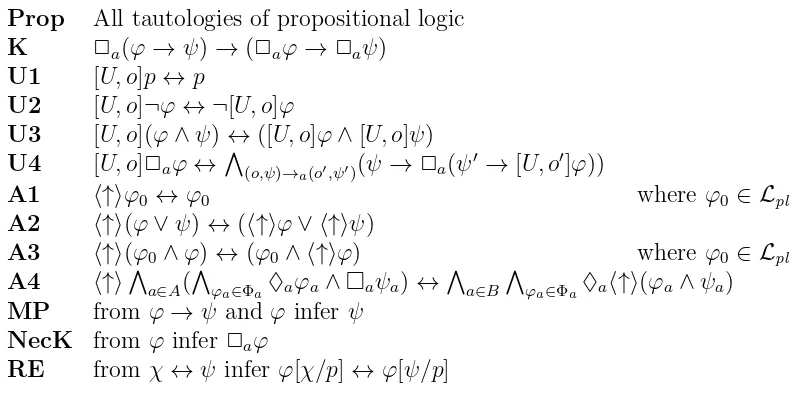
Using the reduction axioms introduced before, we can find an axiomatization for AAUML.
Let AAUML be the axiomatization shown in Table 2. In this section we show that the
axiomatizationAAUMLis sound and complete, and we give some derivable (well-known) axiom schemata.
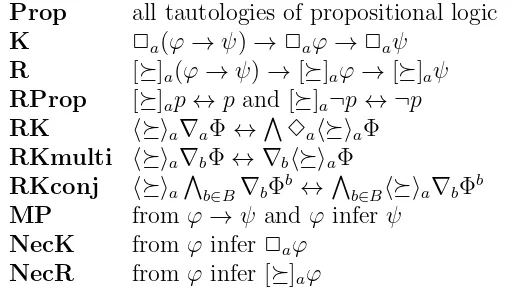
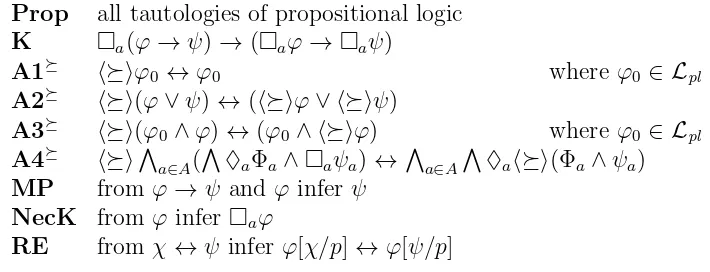
Prop All tautologies of propositional logic
K ✷a(ϕ→ψ)→(✷aϕ →✷aψ)
U1 [U, o]p↔ p
U2 [U, o]¬ϕ↔ ¬[U, o]ϕ
U3 [U, o](ϕ∧ψ)↔([U, o]ϕ∧[U, o]ψ)
U4 [U, o]✷aϕ↔
V
(o,ψ)→a(o′,ψ′)(ψ →✷a(ψ
′ →[U, o′]ϕ))
A1 h↑iϕ0 ↔ϕ0 where ϕ0 ∈ Lpl A2 h↑i(ϕ∨ψ)↔(h↑iϕ∨ h↑iψ)
A3 h↑i(ϕ0∧ϕ)↔(ϕ0∧ h↑iϕ) where ϕ0 ∈ Lpl
A4 h↑iVa∈A(Vϕa∈Φa
♦aϕa∧aψa)↔Va∈BVϕ
a∈Φa
♦ah↑i(ϕa∧ψa) MP fromϕ →ψ and ϕ infer ψ
NecK fromϕ infer✷aϕ
[image:20.612.102.507.415.616.2]RE fromχ↔ψ infer ϕ[χ/p]↔ϕ[ψ/p]
Table 2: The axiomatization AAUML of the logic AAUML
Lemma 14 Axiomatization AAUML is sound for the logic AAUML. ⊣
demon-It is important to note that U1—U4and A1—A4 are so-called reduction axioms for the operators [U, o] and h↑i, respectively, as mentioned in the previous section. This means that they are equivalences, where the formula inside the scope of the [U, o] orh↑i operator on the left-hand side is more complex than the formulas inside the scope of that operator on the right-hand side.
The derivation rule RE is important as our reductions are inside-out, not outside-in. Without it, for example, the validity [U, o][U, o](p∨ ¬p) would not be derivable.
The axioms A1—A4 could just as well have been formulated with the [↑] dual of the modality h↑i, e.g., A2′ [↑](ϕ∧ ψ) ↔ ([↑]ϕ ∧[↑]ψ). We prefer the h↑i versions as they
match our usage of these axioms in synthesis. Further note that there is no reduction of shape h↑i¬ϕ ↔ . . .. We assume that subformulas bound by h↑i are first massaged into disjunctive normal form before a further reduction can take place (and again, for this, the derivation rule RE is essential).
Lemma 15 Axiomatization AAUML is complete for the logic AAUML. ⊣
Proof Letϕ ∈ L be valid. Using an induction argument, we can eliminate all [U, o] and
h↑i operators from it: ϕ must be provably equivalent to a formula ϕ′ ∈ L
ml. As ϕ′ must
also be valid (Theorem 12), ϕ′ is provable in modal logic. From the provable equivalence
betweenϕ andϕ′ and the derivation ofϕ′ we construct a derivation ofϕ inAAUML.
We have now shown that:
Theorem 16 Axiomatization AAUML is sound and complete for the logic AAUML. ⊣
In the proof system AAUML, we do not have necessitation for the [U, o] and [↑] operators. Such necessitation rules are derivable, however.
Proposition 17 The following two rules are derivable in AAUML.
• NecU: from ϕ infer [U, o]ϕ;
• NecA: from ϕ infer [↑]ϕ. ⊣
Proof First, note that the rule
U1′ [U, o]ϕ
0 ↔ϕ0 where ϕ0 ∈ Lpl
is derivable, using Prop, U1–U3 and MP. It is also convenient to use a variant of MP
directly on bi-implications, instead of first converting the bi-implication to a single impli-cation.
MP′ from ϕ↔ψ and ϕ infer ψ, and from ϕ ↔ψ and ψ inferϕ.
This MP′ is, of course, also easily derived. Using U1′ and MP′, we can derive NecU in
1. ϕ premise 2. ϕ→(ϕ ↔ ⊤) Prop
3. ϕ↔ ⊤ MP(1,2) 4. [U, o]⊤ ↔ ⊤ U1′
5. ⊤ Prop
6. [U, o]⊤ MP′(5,4)
7. [U, o]⊤ ↔[U, o]ϕ RE(3) 8. [U, o]ϕ MP′(6,7)
A derivation of NecA can be found in a similar way. Here, too, it is convenient to first derive an auxiliary axiom.
A1′ [↑]ϕ
0 ↔ϕ0 where ϕ0 ∈ Lpl
This [↑]-version of A1 is of course derivable. We can then derive NecA analogously to how we derived NecU, with the application of U1′ replaced byA1′.
5
Update expressivity
5.1
Expressivity
Recall that we are considering the basic modal logic ML and the update logics PAL, APAL, AML, AAML, AUL, AAUL, AUML, AAUML, and RML, as shown in Figure 1 on page 6. One natural thing to do with such related logics is to compare their power. The most straightforward way to make such a comparison is to compare their expressivity.
Formally, a language L1 is at least as expressive as a language L2 if for every formula
of L2 there is an equivalent formula ofL1. Havingequal expressivityorhigher expressivity
(by which we always mean strictly higher expressivity) can be defined from the “at least as expressive” relation in the usual way. If neither language is at least as expressive as the other, we say that they are incomparablein expressivity.
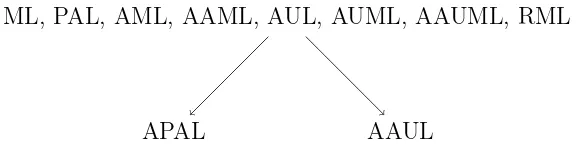
In [18] that introduced PAL it was shown that PAL is equally expressive as ML (on the class of relational models where all accessibility relations are equivalence relations, but this does not matter for the reduction), and in [5] that introduced AML it was also shown that AML is equally expressive as ML. It is trivial to show that PAL and AML are at least as expressive as ML, as they extend the logical language. That every formula of PAL or AML is equivalent to a formula in ML, was shown by reduction axioms and rules. Similarly, AUL [15], AUML [16] and AAML [12] were shown to be equally expressive as ML, and therefore also equally expressive as PAL and AML. In [8] it was shown that RML is equally expressive as ML. Here, in Theorem 12 in Section 3, we showed that AAUML is also equally expressive as ML.
ML, PAL, AML, AAML, AUL, AUML, AAUML, RML
[image:23.612.158.448.109.184.2]APAL AAUL
Figure 2: The relative expressivity of the update logics discussed in the paper. Arrows indicate increasing expressivity. Absence of arrows indicates incomparable expressivity.
5.2
Update expressivity hierarchy
There is something a bit strange about this comparison, however. Although AML and PAL have the same expressivity, AML is clearly in some sense more powerful, since action models represent a far larger class of updates than public announcements. In order to capture the sense in which AML is more powerful than PAL, we use the term update expressivity. This concept was introduced asaction equivalence in [31] (and its precursors) and also subsequently used in that sense in [16]. The definitions from [31, 16] do not deal very well with multi-pointed update modalities and with arbitrary update modalities, however, so we use a slightly adapted version.
The updatesX we consider are relational model transformers and such transformations are defined by pairwise relating pointed models, so an updateXshould be seen as a relation between pointed relational models. In fact, three different things are called update: the
update relation between pointed models, theupdate modality in a logical language, and, in some sense, the update object, often a name, that can be associated with the modality or the relation, such as an arrow update (U, o). To simplify the presentation in this section we call the relations X, Y, . . . and the modalities [X],[Y], . . . and we do not consider the update objects separately: we identify them with the update relations.
A relation between pointed relational models can be a one-to-one relation, i.e., a func-tion or a partial funcfunc-tion, a one-to-finitely-many relafunc-tion, and a one-to-infinitely-many relation. For example, it is a function for a pointed arrow update model, a partial func-tion for a public announcement, a one-to-many relafunc-tion for a multi-pointed arrow update model, and a one-to-infinitely-many relation for an arrow update quantifier. In the first place, one would now like to say that update relations X and Y are the same (are equiv-alent) if they define the same relation between pointed models, modulo bisimulation. In the second place, we also want to compare an update X that is a partial function to an update Y that is a total function (or similarly for relations with restricted domains). In that kind of situation one would maybe like to say that updates X and Y are the same if
the pointed relational models resulting from executing (i) and (ii) are bisimilar, as in the example. But whenpis false, (ii) can be executed but not (i). So (i) and (ii) are equivalent on condition of the truth of the announcement. In view of these considerations, we propose the following definition. ForX(M, s) read{(M′, s′)|((M, s),(M′, s′))∈X}, and let D(X)
be the domain of X, i.e.,D(X) ={(M, s)|X(M, s)6=∅}.
Definition 18 (Update equivalence, update expressivity) Given updatesX andY,
X is conditionally update equivalent to Y, if for all (M, s) such thats ∈ D(X),X(M, s)↔
Y(M, s). Further, X is update equivalent to Y, if X is conditionally update equivalent to Y, and Y is conditionally update equivalent to X. Update modalities [X] and [Y] are (conditionally) update equivalent, if X and Y are (conditionally) update equivalent.
A language L is at least as update expressive as L′ if for every update modality [X] of L′ there is an update modality [Y] of L such that X is conditionally update equivalent
to Y; L is equally update expressive as L′ (or ‘as update expressive as’) if L is at least as
update expressive as L′ and L′ is at least as update expressive as L. ⊣
We define ‘(strictly) more update expressive’ and ‘incomparable in update expressivity’ as usual. We also extend the usage of ‘update expressive’ to the logics for the languages that we compare. Instead of ‘update equivalent’ we may use ‘equivalent’ if the context is clear. If updates X and Y are update equivalent, then [X]ϕ↔[Y]ϕ is valid. This may not hold in the other direction! In Section 7 we give a counterexample.
We should stress that we do not claim that our definition is appropriate for all situations, merely that it gives an accurate view of the strengths of the different logics that we consider in this particular paper.
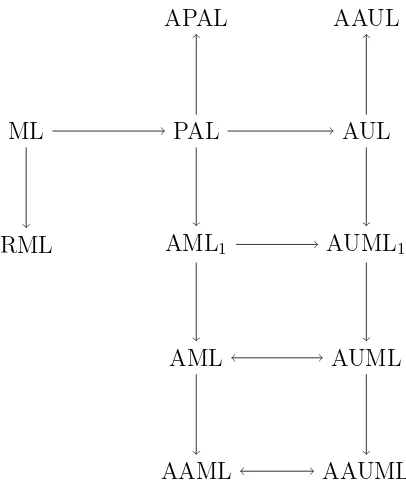
Let us now fill in the expressivity hierarchy for our target logics. The update expressiv-ity of AUL is higher than that of PAL, and lower than that of AML [15]. The comparison between AML and AUML that we will address in Section 6 is less straightforward than that. In [16] it was shown that AML and AUML have the same update expressivity. That result does not distinguish between single-pointed and multi-pointed action models and arrow update models, however. Here, we therefore provide an alternative proof of their results that makes that distinction. Specifically, we show that the result from [16] only applies to the multi-pointed case, but that single-pointed arrow update models are more update expressive than single-pointed action models.
APAL AAUL
ML PAL AUL
AML1 AUML1
AML AUML
[image:25.612.199.402.108.351.2]AAML AAUML RML
Figure 3: The relative update expressivity of the update logics discussed in the paper. We assume transitive closure of arrows. AML1 and AUML1 are the single-pointed versions.
6
Arrow updates versus action models
6.1
Action model logic
Arrow update model logic AUML is equally expressive as action model logic AML and their update expressivity relates in interesting ways. We build upon the results known from [16] but our constructions and proofs are slightly different. First we need to define action models and their execution in relational models. An action model [5] is a structure like a relational model but with a precondition function instead of a valuation function. Executing an action model into a relational model means computing what is known as their restricted modal product. This product encodes the new state of information, after action execution. These are the technicalities:
Anaction modelE = (S,R,pre) consists of adomainSofactionse, f, . . ., anaccessibility function R : A→ P(S×S), where each Ra is an accessibility relation, and a precondition
function pre:S→ L, where L is a logical language.
Let additional to a pointed action model (E, e) as above a pointed relational model (M, s) be given where M = (S, R, V). Let M, s |= pre(s). The update (M ⊗E,(s, e)) is the pointed relational model where M⊗E = (S′, R′, V′) such that
S′ = {(t, f)|M, t|=pre(f)}
((t, f),(t′, f′))∈R′
a iff (t, t′)∈Ra and (f, f′)∈Ra
Action model modalities [E, e] are interpreted similarly to arrow update modalities but unlike arrow update modalities are partial and not functional. Their execution depends on the truth of the precondition of the actual action (point) e in the actual state s:
M, s|= [E, e]ϕ iff M, s|=pre(e) implies M⊗E,(s, e)|=ϕ
Similarly to arrow update modalities we can conceive a modal logical language with [E, e]ϕ
as an inductive language construct, for action models E with finite domains. The logic is called action model logic AML. And also similarly we can define multi-pointed action model by notational abbreviation, or if we wish to rule that out call the logic AML1.
Also similarly to AUML ([16], and Section 4) there is a complete axiomatization, that is a rewrite system allowing to eliminate dynamic modalities [5, 27]. If we further extend the logical language with a quantifier [⊗] over action models, such that
M, s|= [⊗]ϕ iff M, s|= [E, e]ϕ for all action models (E, e) satisfying (∗)
where (*) requires all preconditions of actions inE to be in Lml, we get the language and
logic ofarbitrary action model logic AAML. Hales showed in [12] that the (*) requirement can be relaxed, similarly to our Proposition 13.
Example action models that are update equivalent to the example arrow update models of Section 2 are as follows. We also depict their execution. The actions are given their preconditions as names. Note that the pointed relational model resulting from the (second) action of Anne privately learning that pis bisimilar to the four-state model in Section 2.
¬p ab p
ab ab
⊗
⊤¬p p
b b
b
ab ab ab
=
(¬p,⊤) (p,⊤) (¬p,¬p) (p, p)ab b
b b
ab ab
ab ab
¬p ab p
ab ab
⊗
⊤p
b
ab a
=
(¬p,⊤) (p,⊤) (p, p)ab
b b
ab ab
a
6.2
From action models to arrow updates
LetE = (S,R,pre) be given. Arrow update modelU(E) = (O, RR) is defined as: O =S, and for all agents a and actions e, e′, (e,pre(e)) →
a (e′,pre(e′)) iff (e, e′) ∈ Ra.2 We can
now show that (E, e) is update equivalent to (U(E), e), on condition of the executability of the action e, i.e., restricted to the denotation of pre(e).
Proposition 19 ([16]) (E, e) is conditionally update equivalent to (U(E), e). ⊣
Proof Let M = (S, R, V). To distinguish E from U(E) in the proof, let us ‘prime’
the actions in the domain of U(E): e′, f′, . . . instead of e, f, . . .. Define relation R : D(M ⊗E)→ D(M ∗U(E)) as R: (s, e)7→(s, e′), for all s∈S and e∈S. The full modal
product M ∗U(E) will typically have a larger domain than the restricted modal product
M⊗E (only states wherein actions in Scan be executed, survive). We will now show that this does not matter, as the surplus of (state,action) pairs are unreachable.
Let M, s|=pre(e). Then R: (M ∗E,(s, e))↔(M ⊗U(E),(s, e′)).
Let ((s, e),(s, e′)) ∈ R. The atoms clause is trivially satisfied as the states s match
(and as update do not change facts). We now consider forth. Let ((s, e),(t, f)) ∈ R′
a,
whereR′
a is the accessibility relation fora inM⊗E. Given the definition of action model
execution, ((s, e),(t, f))∈R′
a iff (s, t)∈Ra, (e, f)∈Ra,M, s|=pre(e), andM, t |=pre(f).
We claim that pair (t, f′) in M ∗ U(E) satisfies the requirements of the bisimulation.
Firstly, ((s, e′),(t, f′))∈R′′
a (in M ∗U(E)) because (e
′,pre(e′))→
a(f′,pre(f′)). Secondly,
(t, f),(t, f′)) ∈R by the definition of R. The proof of back is like forth, with the main
important difference that the assumption in theback step that a pair (t, f′) in M∗U(E)
is a-accessible, means that we are in the ‘good’ part of the domain of M ∗U(E), as this implies that (e′,pre(e′))→
a(f′,pre(f′)), so that in the construction ofM⊗E, actionecan
be executed in s and action f in t. So (t, f) exists in M ⊗E and this obviously satisfies
the requirement for back.
Corollary 20 LetF ⊆ D(E). Then (E, F) is conditionally update equivalent to (U(E), F).⊣
From Proposition 19 follows that, for all ϕ ∈ Lml, [E, e]ϕ is equivalent to pre(e) →
[U(E), e]ϕ. See also [16][Cor. 3.9]. This can be used as a clause in an inductively defined translation from the language of AUML to the language of AML. In Corollary 20 the condition for update equivalence is We∈Fpre(e).
The arrow update models constructed by the above procedure from the action model for Anne reading the letter containing p while Bill may notice her doing so, and for Anne privately learning p, are as follows. Note that they are update equivalent (namely on their domain of execution) to the arrow update models for these actions presented in Section 2. In the figure, by ϕ ab ϕ′ we mean the two arrows ϕ →aϕ′, ϕ →b ϕ′. On the left, the dual
arrows for b between outcomes have not been labelled. They are as expected: ⊤ →b ¬p,
p →b ¬p, p →b ⊤. (They are update equivalent to the example arrow update models in
Section 2.4.)
2
In [16], arrows (e,⊤)→a(e′, ϕ′) instead of (e, ϕ)→a(e′, ϕ′) are stipulated. Both constructions deliver
⊤
¬p p
⊤ b p
¬pb ⊤
¬pb p
⊤ ab ⊤
pab p
¬p ab ¬p
⊤
p
pb ⊤
⊤ab ⊤
p a p
6.3
From arrow updates to action models
A given arrow update model can be transformed into an update equivalent action model by conditionalizing in each outcome over any possible ‘valuation’ of (any subset of) the source and target conditions of all outcomes. This leads to an exponential blowup. (See [16, Theorem 3.7]. Our construction and subsequent proof are different.) We proceed with the construction.
Let U = (O, RR) be given. Let Φ be the collection of all source and target conditions occurring in U:
Φ ={ϕ |there are a∈A, ϕ′ ∈ L
, o, o′ ∈
O s.t. (o, ϕ)→a (o′, ϕ′) or (o, ϕ′)→a(o′, ϕ)}.
We consider the formulas in Φ as ‘atomic constituents’ over which we consider ‘valuations’
v ∈ 2Φ (lower case, to distinguish it from the relational model valuation V, upper case).
The characteristic formula of a valuation is δv := Vϕ∈Φϕ, where ϕ = ϕ if v(ϕ) = 1 and
ϕ =¬ϕ if v(ϕ) = 0. Action model E(U) = (S,R,pre) is now such that:
S = O×2Φ
((o, v),(o′, v′))∈R
a iff ∃ϕ, ϕ′ : (o, ϕ)→a (o′, ϕ′), v(ϕ) = 1, v′(ϕ′) = 1
pre(o, v) = δv
Further, given (U, o), its single point o becomes a set of actions E(o) := {o} ×2Φ. The
corresponding action model (E(U), E(o)) is therefore multi-pointed (unless Φ = {⊤} or Φ ={⊥}). We note that the preconditions of actions need not be consistent formulas, just as source and target conditions of arrows need not be consistent formulas. Our construction is therefore different from that in [16], wherein only v ∈2Φ are considered for which δ
v is
consistent. That construction is more economical, but computational efficiency is not our goal. We can now show that (U, o) is update equivalent to (E(U), E(o)). Note that they both can be executed on the entire domain.
Proposition 21 (U, o) is update equivalent to (E(U), E(o)). ⊣
Proof Let (M, s) be given. We show that for some (o, v)∈ E(o), (M ∗U,(s, o))↔(M ⊗