This is the
Accepted Version
of a paper published in the
Proceedings of the 13
thInternational Conference on
Cooperative Design, Visualization and Engineering
Hardy, Dianna, Forest, Elizabeth, McIntosh, Zoe, Gertz, Janine, and Myers,
Trina (2016)
Co-creation of a digital game to support language revitalisation.
In: Proceedings of the 13th International Conference on Cooperative Design,
Visualization and Engineering, pp. 181-184. From: CDVE 2016: 13th
International Conference on Cooperative Design, Visualization and Engineering,
24-27 October 2016, Sydney, NSW, Australia.
http://dx.doi.org/
10.1007/978-3-319-46771-9_24
© 2015. This manuscript version is made available under
the CC-BY-NC-ND 4.0 license
http://creativecommons.org/licenses/by-nc-nd/4.0/
adfa, p. 1, 2011.
© Springer-Verlag Berlin Heidelberg 2011
Co-creation of a digital game to support language
revitalisation
Dianna Hardy, Elizabeth Forest, Zoe McIntosh, Janine Gertz, Trina Myers
James Cook University, Townsville, Australia
{dianna.hardy, elizabeth.forest, zoe.mcintosh, janine.gertz, trina.myers}@jcu.edu.au
Abstract. Many Aboriginal languages are becoming extinct due to lack of flu-ent speakers. Computer games offer a way to help teach these languages in a fun and engaging way. However, computer games like all technology objects are based in the culture of their creators. In this paper we describe a project where we co-designed a language application for mobile phone with the Gugu Badhun, an Aboriginal community from north Queensland Australia. The par-ticipatory action research process allowed our Aboriginal partners to embed their own culture in the games, leading to a product that supported their goals and aspirations for language renewal. This collaboration has not only provided a way to sustain their language, but also added capacity to their community in ICT development.
Keywords: participatory action research ∙ game based learning ∙ cooperative design ∙ Indigenous research methods
1
Introduction
Every day, ICT professionals are required to bridge the communication divide that exists between technologists and everyday users of technology [1, 2]. When the research team is working with members of marginalised cultures such as Indigenous peoples, this requirement becomes more challenging [3]. Much of the previous research conducted with Aboriginal people has pro-vided little benefit to the communities involved [4], and so any new projects must ensure positive outcomes for Aboriginal people for the time they invest in the research [5].
group). The purpose of the project was to develop a smart phone based lan-guage teaching game that both children and adults of the group could use to learn their original language in order to aid its preservation.
The language game is an Android application created using
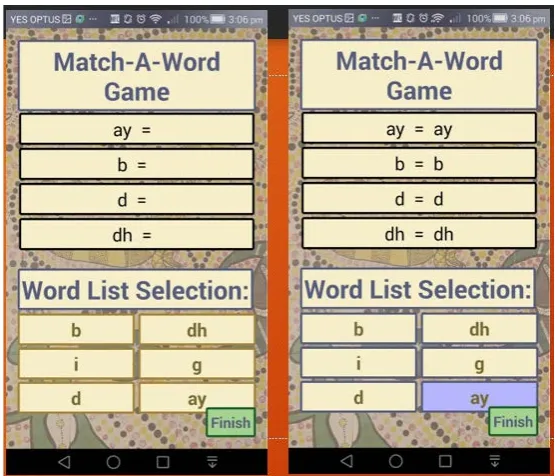
[image:3.595.123.401.306.544.2]Android Studio. The game contains a login screen, a dictionary with audio pronunciation of words, a game demo, and 34 levels which contain 270 words in all. The android application developed was created using Android Studio with Java SE 8’s JDK targeting Android 4.0.3 (Kit Kat) to Android 5.0 (Lollipop). A SQLite database was used to store the dictionary of language words, the user’s details, and any other data.
Fig. 1. Match a word functionality in game
The main features of the game are the dictionary and the levelling system. The dictionary contains all of the language words used in the application and their English translations. Further information can be discovered about each word, such as the words definition and an audio example of the pronuncia-tion. The application is broken into 34 levels, with each 5th level a revision
2
Methods
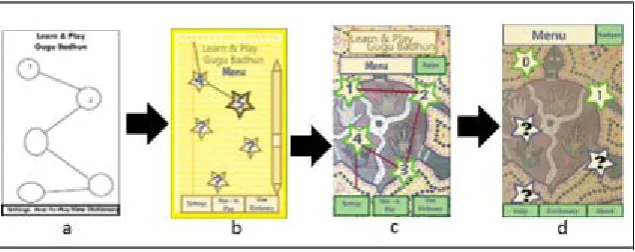
[image:4.595.133.451.316.442.2]Information from interviews with the participants was used to create two pa-per prototypes which were then evaluated by the group. After analysis of the playtesting with the paper prototypes, a high fidelity version of the game was created and tested by the group. The final product developed was a small android game, which taught users a few words at a time and re-en-forced this knowledge with a word-match game. Once a black and white sto-ryboard showing potential functionality was approved then two paper proto-types were developed and then presented to the group. The best aspects of each paper prototype were combined in a final version of the game.
Fig. 2. Development process from sketches through high fidelity application
3
Findings
4
Conclusion
Digital games, like all other technology objects reflect the culture of their cre-ators. Salen and Zimmerman [8] emphasize that “games are culture…The Sims is not merely a simulation of suburbia, but a representation of cultural interaction that relies on an ideological reality located beyond the scope of actual game play” (p. 507). By involving a group in the design of a game that reflects their culture, we help ensure that the underlying norms of that cul-ture are embodied within it [9]. Co-making a game with a cultural focus, i.e. a game that focuses on the culture of a given group avoids the problem of ste-reotypical representation in the larger non-indigenous society. Indeed, Shaw suggests that while complete non-representation in the video game market is better than stereotypical representation this lack of presence leads to the increasing invisibility and lack of voice in the wider gaming community [9]. Facilitating Indigenous partners to create games that reflect their own cul-ture, gives them increased “voice” and presence in the dominating culture.
1. Stappers, P.J. (2009). Designing for other people's strengths and motivations: Three cases using context, visions and experiential prototypes. Advanced engineering informatics, 23(2):174-183.
2. Koskinen, I., Battarbee, K., Mattelmäki, T. (Eds.), Empathic Design, IT Press, Helsinki (2003).
3. Madden, D., Cadet-James, Y., Watkin-Lui, F. and Atkinson, I. (2012). Healing through ICT: enhancing wellbeing in an Aboriginal community. Journal of Tropical Psychology, 2(1-9). 4. Smith, L.T. 2012. Decolonizing methodologies: Research and indigenous peoples. 2nd ed.
New York;London;: Zed Books.
5. Bull, J.R. (2010). Research with Aboriginal Peoples: Authentic Relationships as a Precursor to Ethical Research. Journal of Empirical Research on Human Research Ethics: An Interna-tional Journal, 5(4), 13-22.
6. Sutton, P. (1973). Gugu-Badhun and its neighbours: A Linguistic Salvage Study. (MA Mas-ter Thesis), Macquarie University, Sydney.
7. Van Rijn, H., Stappers, P.J. Motivating users in a codesign process, in: Participatory Design Conference, 2008.
8. Salen, K. and Zimmerman, E. (2004). Rules of Play: Game Design Fundamentals. Cam-bridge:MIT Press.