"I have read this thesis and in my opinion, it is suitable in term of scope and quality for the purpose of awarding Bachelor Degree in EJectronic Engineering ( Industrial
Signature
Name of Supervisor Date
ELECTROMAGNETIC LEVITATION DEMONSTRATOR
RUSMEYATIB~INORDIN
This Report Is Submitted In Partial Fulfillment Of Requirements For The Bachelor Degree of Electronic Engineering ( Industrial Electronic)
Fakulti Kejuruteraan Elektronik dan Kejuruteraan Komputer
Kolej Universiti T ekrnlcal Kebangsaan Malaysia
Jl
"I hereby declare that this thesis is the result of my own effort except as clearly stated in the sources of reference"
Signature
Writer
Date
Rusmeyati binti Nordin
llJ
First and foremost, I would like to express my deepest gratitude to my supervisor Mr. Ho Yih Hwa for his supervision and invaluable guidance throughout this work.
I am most grateful to my lovely parents for being understanding and supportive in whatever decision I made.
JV
ABSTRACT
Electromagnetic Levitation System had become a fast develop technologies
providing environmentally benefit solutions for industry and transportation. This project
is develop a Electromagnetic Levitation Demonstrator consist of two photo-detector and
one lifting coil. It is demonstrated how an electromagnetic can floating I pulls a steel ball
upward Wltil it interrupts a light beam that falJs on the photo-detector and how the coil
effect to electromagnetic levitation demonstrator but this system can only reach out a
few short centimeter and anything further might as well be infinity. This device need a
design and construct the circuit such as the coil driver and the different amplifier circuit,
Infrared emitter and Photo-detector ciicuit, the reference voltage and phase lead network
v
ABSTRAK
Sistem Pengapungan Elektromagnetik menjadi satu tecknologi yang berkembang
pesat dan menyediakan pelbagai faedah penyelesaian untuk industri dan pengangkutan.
Projek ini menunjukkan Sistem Pengapungan Elektromagnetik yang terdiri daripada dua
pengesan cahaya dan satu gegelung pengangkat Ia menunjukkan bagaimana
elektomagnetik tersebut boleh mengapungkan
I
menarik bebola Jogam naik ke atashingga biasan sinar cahaya terhadap pengesan cahaya yang akan menjatuhk:annya dan
bagaimana gegelung pengangkat akan memberi kesan kepada penunjuk Sistem
Pengapungan Elektomagnetic
ini
.
Sistemini
hanya boleh digunakan untuk jarak yang.
pendek iaitu dalam beberapa sentimeter dan sebarang tambahan jarak seterusnya akan
menjadi ifiniti. Projek ini memerlukan rekaan dan susunan litar seperti litar pemacu
gelung, htar penguat pembezaan, litar pemancara inframerah, litar pengesan cahaya, litar
untuk voltan rujukan, litar penunjuk fasa dan memerlukan rekaan bagi gegelung
CONTENT
CHAPTER
TITLE
PROJECT TITLE ACKNOWLEDGEMENT DEDICATION ABSTRACT ABSTRAK CONTENT
LIST OF TABLE
LIST Of FIGURE
I
INTRODUCTION
l.l Introduction
1.2 Project Objective
1.3 Scope Project
n
LITERATURE REVIEW
2.1 Introduction
2.1
.
1 Background of magnetic levitation
demonstrator
2
.
2.2
ElectromagneticLevitation
VII
m
ELECTROMAGNETIC MODULE3.1 Introduction 9
3.2 Flow Diagram of Electromagnetic
Levitation System 12
3.2.1 Input 12
3.2.2 Emitter 13
3.2.3 Signal Detector 14
3.2.4 Reference Detector 15
3.2.5 Difference AmpJifier 16
3.2.6 Loop Control 17
3.2.6.1 Benefit of Feedback 18
3.2.7 Loop Equations 19
3.2.7.1 Loop Gain 20
3.2.7.2 Transfer Function 21
3.2.8 Non Inverting Amplifier 22
3.2.9 Coil Driver 23
3.2.9.1 Specification for Lifting Coil 25
3.2.9.2 Coil Core 25
3.3 Power Supply 26
3.3.1 Coil Driver Supply 27
3.4 List of Component 28
3.4.1 Integrated Circuit IC LM741 30
VlJJ
IV RESIJLT
4.1
Introduction33
4.1.1
Bode Plot of Phase Lead Network33
4
.
2
Measurement35
4
.
3
Design circuit at Printed Circuit Board36
4
.
4
Casing36
4
.
4
.
1
Material List3
7
4.4
Electromagnetic levitation demonstratedoperation
38
4.5
How the Coil Wor1cs39
v
DISCUSSION AND CONCLUSSION5
.
1
Discussion41
5.1.1
Winding Wire41
.
5
.
1.2
Weight of the steel ball4
2
5
.
2
Conclusion42
5
.
3
Future Development4
3
REFERENCE
45
IX
LIST OF TABLE
NO.
TITLE
PAGE3.1 Voltage Requirements 27
3.2 List of Component and Equipment in
Electromagnetic Levitation System 29
3.3 The Absolute Maximum Rating of LM741 31
3.4 Absolute Maximum Rating of Transistor
NPN2N3055 32
X
LIST OF FIGURE
NO
TITLE
PAGE2.1 An Electromagnetic 7
3.1(a) Overall Process Flow 10
3.1(b) Flow Process ofElectromagnetic Levitation System 11
3.2 Flow Diagram of Electromagnetic Levitation System 12
3.3 Emitter Circuit 13
3.4 Signal Detector circuit 14
.
3.5 Flow Diagram For Signal Detector to
Voltage Follower 15
3.6 Reference Detector Circuit 15
3.7 Difference Amplifier Circuit 16
3.8 Feedback Control System 19
3.9 Transfer function Circuit 21
3.10 Non Inverting Amplifier circuit 22
3.11 Coil Driver Circuit 23
3.12 Transistor NPN 2N3055 24
3.13 Coil Core 26
3.14 Power Supply separated 28
3.15 Connection Diagram ofLM741 30
3.16 Internal Schematic Diagram of Transistor
NPN2N3055 32
XI
4
.
2
Phase Lead Network Circuit34
4
.
3
Signal and Reference Detector Measurement35
4.4 Casing
37
4.5 Electromagnetic Levitation demonstrated
39
CHAPTER I
INTRODUCTION
1.1
INTRODUCflON
.
This thesis report on the design of the controller for keeping a steel ball
suspended in the air. In the ideal, the magnetic force produced by current from an
electromagnetic
will
counteract the weight of the steel ball. Nevertheless, the fixed electromagnetic force is very sensitive, and there is noise that creates acceleration forceon the steel ball, causing the balJ to move into the unbalance region. The main function
of this controller is to maintain the balance between the magnetic force and the ball, s
weight According to the analytical method, the mathematical models of this magnetic
levitation system were established with the goal of designing the control system. System
linearization and phase lead composition were employed to design the controller of this
unstable nonlinear system. The algorithm proposed in this thesis provides a robust
closed-loop magnetic levitation system which can stabilize the system over a large range
of variations of the suspended mass. The design methods of this system are presented on
this thesis and the hardware is implemented for the scientific demonstration. Presented
photo-2
detector as a signal and reference, and a ljfting coil to produce magnetic field current to
pull a steel baH floating in the air.
1.2
PROJECT OBJECTIVE
The project objective is to demonstrated the concept of electromagnetic
levitation system by using two photo-detector and lifting coil and to produces the low
cost of electromagnetic levitation demonstrator. This electromagnetic levitation system
is selected and was build by follow their specification. The specification are to build a
magnetic coil which can produce an electromagnetic force carries with 2A of current,
and to definitely with Jess current the steel ball will move downward and when the high
current the steel baiJ will move upward
1.3
SCOPE PROJECT
This project built to studies and construct the emitter circuit, reference detector
circuit, photodetector circuit, different amplifier circuit, design the lifting coil, design the
signal detector circuit, design the non inverting amplifier circuit and design the phase
CHAYrER
n
LITERATURE REVIEW
2.1
INTRODUCTION
This chapter discuss about how the steel ball can float in the air by using the
lifting coil and two photodetector which produce the magnetic force into this device.
The magnetic levitation demonstrator is the simple structure an is based on
electromagnetic science by Sarnuel Earnshaw Theorem. In his theorem expressed the
perversity of inanimate of magnetic objects.
When we hold two permanent magnets close together, you see that one of them will
jump strongly toward from the other. It explains this frustrating behavior will
always prevent you from suspending otze permanent magnet above or below
another, no matter how one arranges the two magnets. However, an active control
circuit can get around this problem by rapidly adjusting the magnet's strength.
4
The basic principles is to used a current to manipuJate electromagnetic power
which can counteract the weight of the steel ball and keep it suspended
in
the air.2.1.1 BACKGROUND OF MAGNETIC LEVITATION DEMONSTRATOR
This magnetic levitation demonstrator is a technological advances in areas offer
the possibility of generating high electromagnetic fields with high efficiency. The
magnetic levitation was build to give the advance mode of surface high speed
transportation whereby a vehicles gliding above a guide way is suspended, guided and
propeJJed by magnetic force, which without the magnetic levitation the speed will be
slow, take a long time and high cost but with magnetic levitation. the speed become fast
and the time is Jess for example the Maglev trans-rapid Maglev is the short form for
magnetic levitation which
means
the trainwill float
at the guide way using the basicprinciples of magnet to replace the old
steel
wheel and train tracks. Maglev trains floaton a cushion of air, eliminating friction. This lack of friction and the trains
aerodynamic design allow the trains to reach unprecedented ground transportation speed
of more that 3
J
Om ph. Besides that the magnetic levitation is a good technologies thatcan reduce the pollution such as reduce air and highway congestion, air pollution and
5
2.1.2 ELECTROMAGNETIC LEVITATION
The electromagnetic system keeps a steel ball suspended in the air by countering
the balls weight with electromagnetic force which can be expressed as the dynamic
following formula in an upward direction according to Newton's law.
F=mg (2.1)
where m is the weight of the ball, g as a gravitational constant and F is the force produce
from electromagnetic coil. The magnetic field generated by current and calculated from
Ampere's Law or Biot-Savart Law are characterized by magnetic field Band the unit is
in Testa. When the generated field pass through the magnetic materials which contribute
internal magnetic field, ambiguities can arise a part of the field from external current and
the materials. The magnetic ·field strength had defined as another magnetic field quantity
designated as H, and the relation ship is:
H=B/Jlo (2.2)
and if the value of unambiguous designated the driving magnetic influence from extend
current in a material, independent of the material magnetic response. The relationship of
8 can be written in the equivalent form:
6
Hand M wiJI have the same units, amperes'/meter. The relationship in eq. (2.3) holds
for all material whether they are linear or not For linear materials, M in (Aim) depends
linearity on H such that
M =XmH (2.4)
where Xm is a dimensionless quantity ( ratio of M to H ) called magnetic susceptibility
of the medium. It is more or less a measure of how susceptible or sensitive the material
is to a magnetic field Substituting eq. (2.4) into eq. (2.3) yields:
B=JJQ(J +Xm)H= Jili (2.5)
or
B
=
JJQ 14H (2.6)The quantity J.1
=
JJo J.lr is called the permeability of the material and is measured inhenry's/meter, the henry is the
unit
of inductance and will be defined a little later. Thedimensionless quantity Jlr is the ratio of the permeability of a given material to that of
free space and is known as a relative permeability of the material and JJQ being the
magnetic free space permeability J.1o
=
4n x l 0 -7. The magnetic force will produce theelectromagnetic flux for the magnetic circuit The magnetic force produce flux with I
which called as flux path.
7
for a circular path :
/=27tr
H=IN
I
21tr
(2.8)Force on magnetic material is the practical interest to determined the force that a
magnetic field exert on a piece of magnetic material
in
the field. This is useful inelectromechanical system such as electromagnetic levitation system. An electromagnet
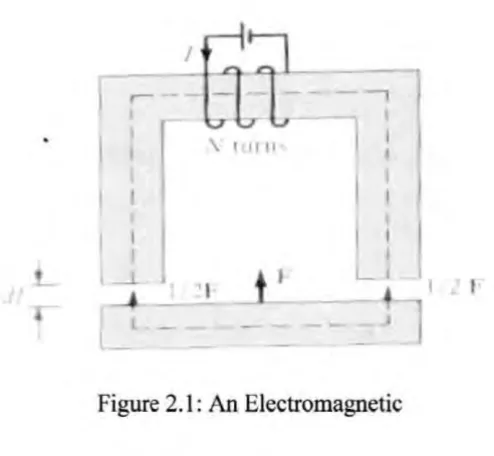
made from iron of constant relative permeability as shown in Figure 2.1. The coil bas N
turn and carries a current I. with ignored the fringing, the magnetic field in the air gap is
the same as that in iron ( B1n = B2n ).
-
I-
---,
\ I I II
-
t
I 1 l I· [image:19.562.204.451.323.551.2]--~ ~---
~
]
Figure 2.1: An Electromagnetic
To find the force between the two pieces of iron, the changed of total energy
were calculated that would result of the two pieces of magnetic circuit separated by a
differential displacement dl. The work required to effect the displacement is equal to the
changed the stored energy in the air gap ( assuming constant current ) that is :
8
where S is the cross-sectional area of a gap, the factor two accounts for the two air gaps.
And the negative sign indicates that the force acts to reduce the air gaps ( or that the force is attractive). Thus
F
=-2
(
B
2S
/
2
J.1o)
(2.10)The force is exerted on the lower piece and not and the cWTent-carrying upper piece
giving
rise
in to the field The tractive force across a single gap can be obtained fromeq.(2.10) as
(2.11)
This equation can be used to calculated the forces in many types of devices including in
electromagnetic levitation system. The tractive pressure in ( N/m2 ) in a magnetic surface is
(2.12)
CHAPTERID
SYSTEM DESJGN
3.1
INTRODUCTION
.
This chapter explained about the overall process flow and construction to build
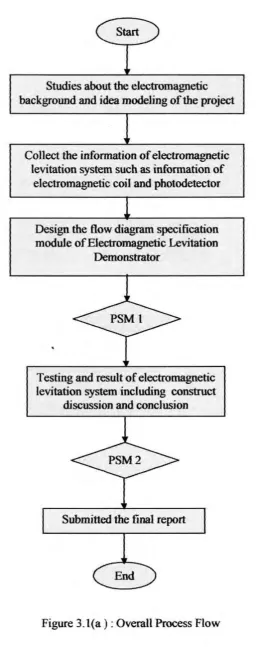
the electromagnetic levitation demonstrator in Figure 3.1(a) from start until progress the
fmal report, to design the circuit and to make sure the objectives of this project
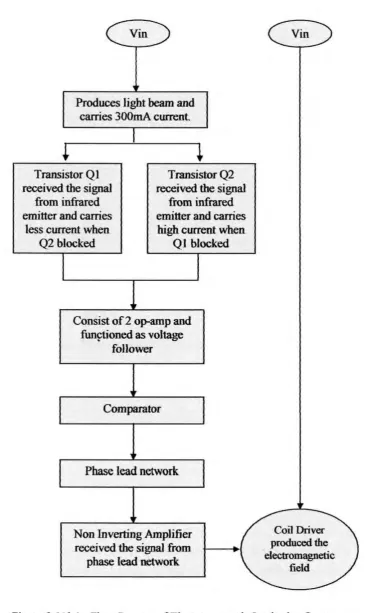
successfully done. Figure 3. 1 (b) show the flow process of electromagnetic levitation
system functioned and their specifications, This system used the looping system as phase
lead network to reduced the coil strength to allow the ball to go down but doesn't turn to
the coiJ
until
the
ballis
past thereference
spot This system also
used the transfer
Studies about
tbe
electromagnetic background and idea modeling of the projectCollect the information of electromagnetic levitation system such as information of
electromagnetic coil and photodetector
Design the flow diagram specification module of Electromagnetic Levitation
Demonstrator
Testing and result of electromagnetic levitation system including construct
discussion and conc1usion
Submitted the final report
Figure 3.l(a): Overall Process Flow
[image:22.559.172.430.42.691.2]Produces light beam and carries 300mA cwrent.
~
TransistorQ
1received the signal from infrared emitter and carries
less current when Q2 blocked
Transistor Q2 received
the
signalfrom infrared emitter and carries
high current when QJ blocked
Consist of2 op-amp and funftioned as voltage
fo1lower
Comparator
Phase lead network
Non Inverting Amplifier
received the signal :from
phase lead network
Coil Driver produced the electromagnetic
[image:23.559.126.492.50.664.2]field
Figure 3.1 ( b ) : Flow Process of E1ectromagnetic Levitation System
12
3.2
FLOW
DIAGRAM OF
ELECTROMAGNETIC LEVITATION SYSTEM
'lin (+)
Signal
Detector
Different Amplifier
Phase Lead
Net-work
~ ~
Amplifier
Coil
[image:24.562.72.512.112.445.2]Vo~
Figure 3.2: Flow Diagram of Electromagnetic Levitation With Looping Feedback System
The flow diagram shoWn in Figure 3.2 explained about the process sequence for
electromagnetic levitation system which separated by eight stage start from input until
output. Each stage explained are :
3.2.1 INPUT
The type of the input voltage that used is direct current (DC). This