Rochester Institute of Technology
RIT Scholar Works
Theses Thesis/Dissertation Collections
6-1-2010
Modification of an asynchronous dexterous hand
movement decoder for hardware implementation
Adam Kevin Bosen
Follow this and additional works at:http://scholarworks.rit.edu/theses
This Thesis is brought to you for free and open access by the Thesis/Dissertation Collections at RIT Scholar Works. It has been accepted for inclusion in Theses by an authorized administrator of RIT Scholar Works. For more information, please [email protected].
Recommended Citation
Modification of an Asynchronous Dexterous Hand
Movement Decoder for Hardware Implementation
by
Adam Kevin Bosen
A Thesis Submitted in Partial Fulfillment of the Requirements for the Degree of Master of Science in Computer Engineering
Supervised by
Associate Professor Daniel B. Phillips Department of Electrical Engineering Kate Gleason College of Engineering
Rochester Institute of Technology Rochester, New York
June 2010
Approved By:
Daniel B. Phillips
Associate Professor, Department of Electrical Engineering Primary Adviser
Juan Carlos Cockburn
Associate Professor, Department of Computer Engineering
Marcin Lukowiak
Thesis Release Permission Form
Rochester Institute of Technology
Kate Gleason College of Engineering
Title: Modification of an Asynchronous Dexterous Hand Movement
De-coder for Hardware Implementation
I, Adam Kevin Bosen, hereby grant permission to the Wallace Memorial Library
repor-duce my thesis in whole or part.
Adam Kevin Bosen
Dedication
I highly doubt I could get away with not dedicating my first major work to my mother, so,
Acknowledgments
Thanks to Marc H. Schieber, who generated the neural data analyzed here and in previous
research on this topic(supported by R01 NS27686).
Thanks to Vikram Aggarwal, Soumyadipta Acharya, and Francesco Tenore for
performing the research that lead to my work and for providing the guidance and advice to
get me going.
Thanks to Daniel Phillips, Juan Cockburn, and Marcin Lukowiak for providing me with
direction and support throughout this research and for happily enduring the many
Abstract
One of the goals of modern prosthetics research is to provide natural, neurologically driven
control of a prosthetic device, preferably in a portable format. Previously, an algorithm for
asynchronously decoding individuated finger and wrist movements from recordings of
neu-ral activity in the primary motor cortex was developed by Aggarwalet al.and implemented
in software. The first objective of this work was to determine what effect simplifying
Aggarwal’s algorithm by using linear Artificial neural networks instead of nonlinear ones
would have on movement detection and classification accuracy. The simplified algorithm
developed in this work was demonstrated to achieve movement detection and
classifica-tion accuracies of 99.7%, 89.9%, and 95.3% for an individuated movement decoding task
across three subjects using neural recordings from 80 neurons. In comparison, the
origi-nal algorithm demonstrated accuracies of 96.2%, 90.5%, and 99.8% for the same task and
subjects using neural recordings from 40 neurons. Additionally, the simplified algorithm
was demonstrated to have a detection and classification accuracy of 80.5% for a combined
movement task, whereas the original algorithm achieved accuracy of 92.5%. Even though
a greater input space size was required for the linear decoder, the computational intensity
was reduced with a mean accuracy loss in the individuated movement task of only 0.53%.
However, the 12% loss of accuracy observed in the combined movement task is considered
unacceptable and suggests that the simplified algorithm is not appropriate for this task.
The second objective of this work was to create a digital hardware implementation of
the simplified linear artificial neural network version of Aggarwal’s algorithm. A scalable,
FPGA. This implementation could be realized with an input dimension of up to 60
neu-rons on this FPGA, although computations were performed on the order of104 times faster
than was necessary for realtime operation, indicating that there is an opportunity to reduce
hardware size in exchange for computational speed. This work is an important exploration
into the eventual goal of incorporating a hardware movement decoder in a prosthetic
de-vice and demonstrates that a hardware implementation is feasible using currently available
Contents
Dedication. . . iii
Acknowledgments . . . iv
Abstract . . . v
1 Introduction. . . 1
1.1 The Nervous System . . . 2
1.2 Recording Nervous Signals . . . 3
1.3 Machine Learning . . . 4
1.4 Asynchronous Dexterous Decoder . . . 8
1.5 Thesis Objective . . . 12
2 Algorithm Modifications . . . 14
2.1 Replacement of Nonlinear Artificial Neural Networks . . . 15
2.2 Gating Logic Modification . . . 17
2.3 Elimination of Floating Point Multiplication . . . 22
3 Hardware Implementation . . . 26
3.1 Architecture Selection and Requirements . . . 26
3.2 Choice of a Development Platform . . . 28
3.3 Hardware Implementation Overview . . . 30
3.4 Input Window . . . 31
3.5 Classifiers . . . 32
3.6 Output Logic . . . 33
3.7 IO Interface . . . 34
3.8 Hardware Analysis . . . 36
4 Test Methodology . . . 39
4.2 Classifier testing . . . 41
4.3 Comparing Hardware and Software Implementations . . . 42
5 Results. . . 43
6 Discussion . . . 49
6.1 Algorithm Modification Analysis . . . 49
6.2 Hardware Implementation Analysis . . . 51
7 Conclusions . . . 55
List of Figures
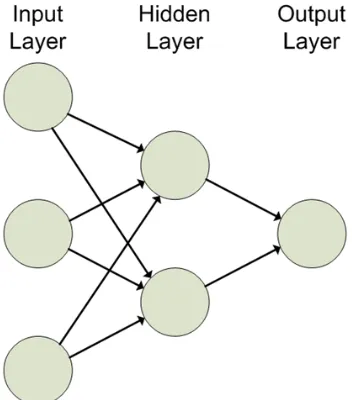
1.1 Example of a simple artificial neural network with three inputs, a single hidden layer, and one output. Each node, represented by circles, computes the weighted sum of each input, represented by arrows. . . 6 1.2 A diagram of the original asynchronous dexterous decoder[1]. The use
of two classifiers allows for the detection and classification of movement from recorded nerual signals,X(tk), without any reliance on external cu-ing. The gating classifier output, G(tk), is a boolean value that corre-sponds to whether or not movement is occurring, with the heuristic check,
Gtrack(tk), eliminating spurious classifications. The movement classifier output,S(tk), represents which type of movement, out of a predefined set, is occurring. Together, they allow for the asynchronous detection of a spec-ified set of finger and wrist movements from the recorded firing rates of neurons in the primary motor cortex[1]. . . 11 1.3 Block diagram of a complete neurally controlled hand prosthesis. White
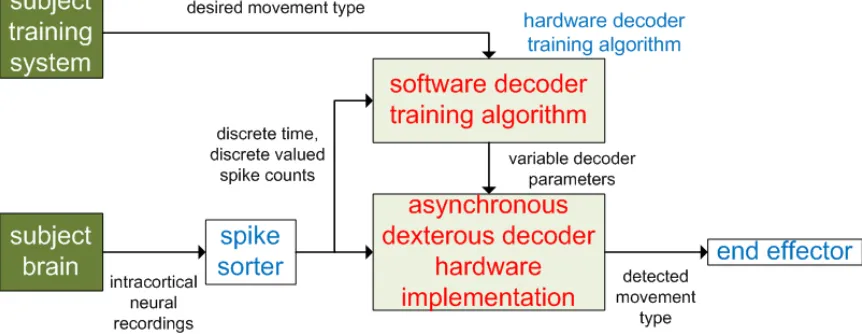
text indicates preexisting structures, red text indicates the proposed work, and blue text indicates additional components necessary for a complete portable neurally controlled hand prosthesis. . . 13
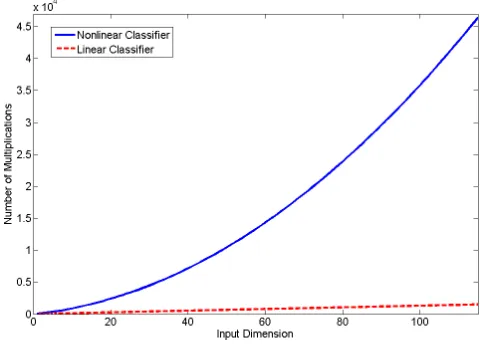
2.1 Number of multiplications required per classification with respect to input space dimension, assuming the nonlinear classifier uses an average hidden layer size 1.5 times larger than the input space and a 12 movement output space. . . 16 2.2 Response of linear gating classifier to a set of four movements occurring
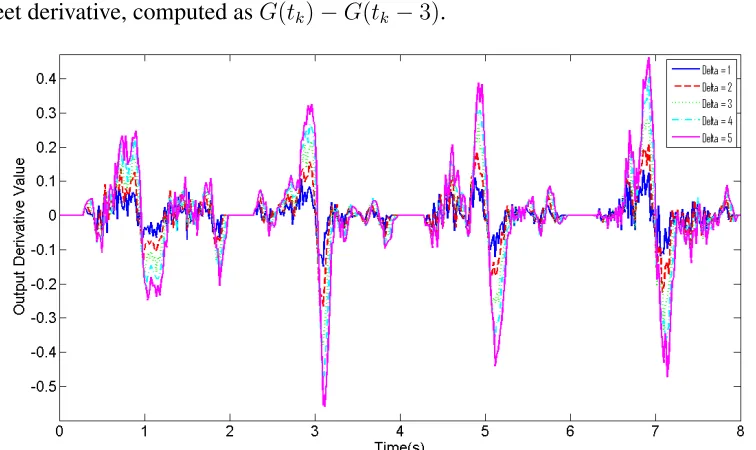
2.3 The discrete derivative of the gating classifier response to a set of four movements using the entire input space, computed asG(tk)−G(tk−∆), where∆ranges from 1 to 5. Movements occurred at times 1, 3, 5, and 7 seconds, to which the negative signal peaks correspond (the peak observed near time 2 seconds is a false positive). Note that as∆increases both the peak magnitude and delay between movement time and peak time increase. 19 2.4 Response of linear gating classifier to a set of four movements occurring
once every two seconds using the entire input space with gating classifier derivative. The blue solid line represents the function that the gating classi-fier was trained to, the red dashed line represents the actual response of the gating classifier, and the green line represents the discrete time derivative
of the gating classifier response. . . 20
2.5 Response of linear movement classifier to a sequence of trials occurring once every two seconds using the entire input space. The movements were presented every odd second in the following order: extension of each digit, in order from thumb to little finger (e1-e5), extension of the wrist(ew), flexion of each digit in the same order(f1-f5), and flexion of the wrist(fw). The diagonal row of spikes in the center of the diagram shows that the largest response during each trial is the expected movement type. . . 21
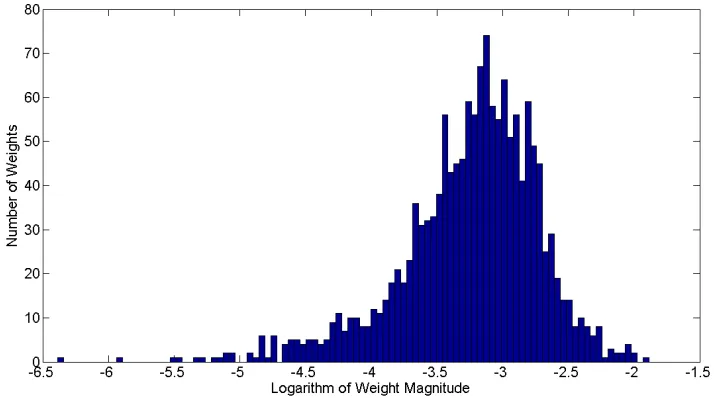
2.6 This graph shows the base-10 logarithm of a sample distribution of classi-fier weights after training to a full input space (1495 weights total). . . 22
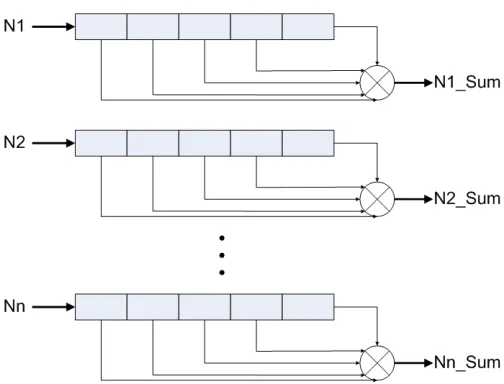
3.1 Block diagram of input window . . . 31
3.2 Block diagram of linear classifiers . . . 32
3.3 Block diagram of gating logic . . . 33
3.4 Block diagram of movement logic . . . 34
3.5 Block diagram of output logic . . . 35
3.6 Block diagram of asynchronous dexterous decoder hardware implementa-tion with IO interface . . . 36
3.7 Critical path delay with respect to input space dimension. Note that since the graph scale is on the order of nanoseconds the 20ms maximum is not an issue. . . 37
5.1 Movement detection accuracy rate of the gating classifier with respect to the level threshold and derivative threshold parametersγandδin the region 0.2≤γ ≤0.5,−0.1≤δ≤0. . . 44 5.2 Movement detection accuracy rate of the gating classifier with respect to
the level threshold and derivative threshold parametersγandδin the region 0.25≤γ ≤0.35,−0.06≤δ≤ −0.01. . . 44 5.3 False Positive rate of gating classifier with respect to the gating classifier
refractory period parameterρ. . . 44 5.4 Linear classifier decoding accuracy with respect to input space size. Note
List of Tables
5.1 Summary of gating classifier accuracy using the full input space of each subject. . . 45 5.2 Summary of movement classifier accuracy using the full input space of
each subject. . . 45 5.3 Table of output differences between hardware and software implementation
over 100 trials with an input dimension of 10. . . 46 5.4 Table of output differences between hardware and software implementation
over 100 trials with an input dimension of 20. . . 47 5.5 Table of output differences between hardware and software implementation
over 100 trials with an input dimension of 30. . . 47 5.6 Table of output differences between hardware and software implementation
over 100 trials with an input dimension of 40. . . 48 5.7 Table of output differences between hardware and software implementation
over 100 trials with an input dimension of 50. . . 48
Chapter 1
Introduction
One of the primary problems in prosthetics development is the need for a means of control
that functions similarly to the biological system the prosthetic is intended to replace. Recent
research has focused on brain-machine interfaces (BMI), which is the recording and
decod-ing of electrophysiological measures of neural activity to control an electronic device[1].
The nervous system has several unique properties that must be accounted for when
design-ing a BMI. One of these properties is the duplication of signals in multiple locations in
the body, which has allowed researchers to explore multiple methods of recording nervous
information[2, 3]. This also means that it is often very difficult to isolate a single signal
re-sponsible for any individual action, so machine learning techniques are typically employed
to convert neural recordings to useful information. One method of performing this, the
asynchronous dexterous decoder developed by Aggerwalet al.[1], is the foundation of the
research presented in this paper. This algorithm has been previously demonstrated to be
capable of asynchronously detecting and identifying hand movements in rhesus monkeys
with as high as a 99.8% accuracy[1], indicating that it is potentially viable for use in a hand
prosthesis. The goal of this research is to develop a simplified version of the asynchronous
dexterous decoder that requires fewer computational resources per classification decision,
quantify the accuracy of the simplified decoder, and design and implement a hardware
1.1
The Nervous System
In order to meet the objective of this research it is necessary to understand the structure of
the nervous system and the nature of the signals it generates. The nervous system is one
of the primary organ systems responsible for control and communication between all other
systems in the body. Its functions include sensory integration and motor control, along
with cognition. The functional units of the nervous system are nerves, which are bundles
of specialized excitable cells called neurons that can accept and propagate signals through
the body[4].
The primary means of signal propagation in an individual neuron is the action potential,
a rapid depolarization and repolarization of the electrical potential between the interior and
exterior of the neuron[5]. A depolarization in one part of the cell will cause depolarization
of adjacent portions of the cell, effectively allowing for the action potential to travel down
the cell. Action potentials typically have a amplitude of +100mV and can occur at a
max-imum rate of 200Hz[5]. Since the amplitude of an action potential is fixed, information is
encoded in the rate at which the action potentials occur. The rate at which action
poten-tials occur is limited by the presence of a refractory period following each action potential,
during which another action potential cannot occur[4].
Individual neurons are bundled in groups called nerves which are responsible for
trans-mitting information through the body. Any nerve not located in the brain or spinal cord
are designated as part of the peripheral nervous system (PNS), while the brain and spinal
cord are collectively known as the central nervous system (CNS). The PNS is primarily
responsible for propagation of sensory and motor information, while the CNS performs
most decision making and control signal generation tasks. The brain is divided into several
distinct components, each of which is primarily responsible for different aspects of mental
function, including sensory integration, cognition, and control of autonomic processes. The
outer layer of neurons in the brain, the cerebral cortex, plays a significant role in perception,
The cerebral cortex can be divided into regions called Brodmann areas that are
pri-marily responsible for specific functions[4]. Communication in these area is performed by
ensembles of neurons firing together, so recording from any portion of one of these areas
should give a good overall representation of the area’s current activity. The function of an
individual neuron in one of these areas may change over time, but the overall function of
the area remains fairly constant[4].
One Brodmann area of particular interest for this research is the primary motor cortex,
which is responsible for voluntary movement. Control of every portion of the body is
mapped topographically to the primary motor cortex, so recording the activity of a portion
of the primary motor cortex can provide relevant information about what the corresponding
portion of the body is doing[4]. Research has demonstrated that sufficient information to
decode the movement of individual fingers is distributed throughout the hand control region
of the primary motor cortex, so neural recordings taken from any portion of this region can
provide a good representation of overall hand activity[3].
1.2
Recording Nervous Signals
In order to make use of the information available in the nervous system a means of
record-ing and interpretrecord-ing its signals is necessary. Several methods of performrecord-ing this task are
currently being researched, one of which is electrode implantation. As the name implies,
this method involves directly implanting electrodes into some section of the brain for the
purpose of recording neural signals. Typically, recording is done using a cluster of
elec-trodes arranged in an array suitable for implantation in one specific portion of the brain[6].
Research has shown that recording as few as 20 neural signals located anywhere within
the hand area of the primary motor cortex is sufficient to provide a reliable estimate of
hand activity[3], although the most common type of electrode array, the Utah Intracortical
Electrode Array, is capable of recording significantly more[6]. Individual electrodes in the
but several filtering and sorting algorithms known collectively as spike sorters have been
developed to address this issue[7, 8]. Additionally, long term studies have been performed
on electrode arrays that demonstrate they can maintain signal quality for a period of at least
1.5 years, which shows potential for use in long term applications[9]. The specific
record-ing areas, significant quantity of data, and long term durability make this approach viable
for prosthetic control.
However, electrode implantation does have a few significant limitations. The biggest
barrier to this approach is the need to directly implant the electrodes into the brain, which
requires significant surgery to remove the skin, bone, and meninges directly over the desired
recording site [6]. This surgical procedure has been performed on cats[6] and monkeys[1],
but obvious ethical considerations prevent much experimentation on humans. Additionally,
the function of individual neurons is known to potentially shift over time[9], so systems
designed to use information recorded from an electrode array will need to be capable of
accounting for this shift.
1.3
Machine Learning
Once nervous signals are obtained from a subject, they can be processed using machine
learning. Machine learning is the study of algorithms that can learn rules based on example
data[10]. It is often used to create rules that relate data sets in situations where the
relation-ship between those sets is not well understood. In the context of brain-machine interfacing,
machine learning can be applied to create rules that relate nervous activity to observed body
function. The ability to generate relationships between data sets is of particular value in
this application due to the fact that the exact function of any individual nervous signal is
often difficult to determine. In general, there is no guarantee that a relationship between a
set of nervous signals and body function exists, but previous research has demonstrated that
activity in the hand control region of the primary motor cortex can be mapped to a set of
creating a relationship between two data sets[11]. One approach, artificial neural networks,
can be used to create mappings of arbitrary complexity from one data set to another and
are capable of defining complex, nonlinear relationships.
An Artificial Neural Network (ANN) is a directed graph where each node computes a
weighted sum of its inputs. An ANN consists of external inputs from one data set, weighted
connections between nodes, and external outputs that represent the network’s mapping into
a different set. The complexity and linearity of the mapping performed by the ANN is
controlled by the number of nodes and the way they are connected, while the exact shape
is determined by the weight values. Mapping an input set to an output set is performed
via training, which uses presented data to adjust network weights. Although ANNs can be
constructed arbitrarily, in this work only layered feedforward networks will be considered
in order to avoid introducing the increased complexity of time variant systems. A
feedfor-ward network consists of two or more discrete layers of neurons in which every node of
one layer functions as an input to every node in the next layer. The first layer is the input
layer, where system inputs are directly applied, and the last layer is the output layer, where
the output values are read from. Additional layers between the input and output layers are
referred to as hidden layers, because they are not directly controlled or visible outside the
ANN. In hidden layers a nonlinear function, typically a sigmoid or a hyperbolic tangent is
applied to each sum to allow for the ANN to produce nonlinear mappings[10]. Figure 1.1
shows a diagram of a simple ANN consisting of three inputs, a single hidden layer with
two nodes, and a single output.
Each connection from one layer to the next can be viewed as a transform from one space
to another. If no hidden layers are present in the ANN then the relationship between the
inputs and an individual output can be expressed simply as a weighted sum and is therefore
linear. Geometrically, this describes a hyperplane drawn through the input space. The
dis-tance from a point in the input space to this plane determines the value of the corresponding
output of the ANN. Alternatively, if hidden layers are used then the transformation from
Figure 1.1: Example of a simple artificial neural network with three inputs, a single hidden layer, and one output. Each node, represented by circles, computes the weighted sum of each input, represented by arrows.
that a nonlinear function is applied to each sum. If this nonlinear function was not present
the ANN would be several cascaded linear transforms, which could be simplified to a
sin-gle linear transform and render it unable to perform higher order functions. Nonlinearity is
advantageous because it allows for mappings that are not possible with a linear transform,
although additional computation is required to perform this mapping. Each hidden layer
increases the order of the mapping function, which can allow for mappings that would not
be attainable with a lower order function[10].
For the sake of simplicity it is preferable to use the least computationally intensive ANN
that meets performance requirements. The number of hidden layers and hidden nodes in
an ANN determine the order of complexity of the functions it is capable of learning as
well as the number of calculations required to compute a result[10]. Therefore, there is a
tradeoff between accuracy and computational cost that is governed by hidden layer size and
quantity. An ANN with no hidden layers is only capable of computing linear functions,
but only requires a number of computations of order n, wheren is the input dimension.
each hidden layer, but requires a number of computations of order nm, where m is the
number of hidden layers. Additionally, each hidden layer requires the computation of a
nonlinear function for each sum. This tradeoff indicates that it is desirable to find the
smallest ANN that is capable of estimating the desired function to a specified accuracy. If
problem complexity is unknown, as is the case for many machine learning applications,
then using an ANN with more hidden layers or nodes than necessary will not adversely
affect performance, but will be more computationally intensive than necessary.
One of the objectives for any machine learning task is the minimization of output error.
Typically, this requires that the system be trained using sample data. One of the common
methods of training an ANN is gradient descent. Gradient descent is a supervised learning
algorithm that minimizes error by descending the gradient of the mean square error between
the actual and desired outputs. In an ANN with no hidden layers this is done by giving the
system an input value, comparing the system output to the desired output, and modifying
the weights in the weight vector by subtracting from it the partial derivative of the error
with respect to that weight multiplied by a learning factor. In this method, weights that
have a greater contribution to the incorrect value are modified more heavily. As the system
is trained the learning factor is gradually decreased in order to converge on a single set of
weights for the system. Equation 1.1 expresses this rule mathematically, where∆wt j is the
amount added to weightwj after training examplet, ηis the learning factor that controls
the magnitude of weight adjustments, rt is the desired output at training example t, yt is
the actual output at training examplet, andxtj is the input corresponding to weightwj[10].
∆wjt =η(rt−yt)xtj (1.1)
For an ANN with hidden layers gradient descent is performed via backpropagation, which
essentially performs the same weight modifications one layer at a time. The output layer is
modified in a manner identical to gradient descent, and previous layers are iteratively
mod-ified after determining the amount of error each neuron in the previous layer contributed.
Note that in order for this to be possible the output of every neuron needs to be
layer[10].
Another potential goal for a machine learning task that has a large number of inputs is
to reduce the number of inputs to a smaller subset that still meet performance requirements.
This is especially useful when it is suspected that some inputs provide information that is
redundant or independent of the desired output function. Reduction of system complexity
can be accomplished by incorporating a method of structural adaptation into the learning
algorithm. This can be either constructive, where inputs are added to a very simple
net-work as needed, or destructive, where inputs are removed from a complex netnet-work as they
are determined to be unnecessary. One simple method of destructive reduction is weight
decay. Weight decay replaces the error function used for gradient descent with an error
function that penalizes output error andweight size. This gives each weight in the system
a tendency to decay to zero. If a particular input associated with a weight is not necessary
to provide accurate classification then its contribution to the system is removed without
af-fecting overall accuracy. Input weights that are critical to correct classification are updated
whenever an error occurs, so their weights are not removed. At the end of training, any
inputs with weights of zero can be removed without affecting classifier accuracy[10].
1.4
Asynchronous Dexterous Decoder
The asynchronous dexterous decoder developed by Aggarwalet al.is a system for decoding
a specific set of hand movements from neural signals recorded from the primary motor
cortex. This decoder uses committees of artificial neural networks to detect and classify
finger and wrist extension and flexion from intracortical neural signal recordings. It was
demonstrated to be accurate over 90% of the time in three different subjects, indicating that
it is a potentially viable for use in a neurally controlled multifingered hand prosthesis[1].
The data used for this work were intracortical neural signals recorded from three male
rhesus monkeys, identified as monkeys C, G, and K. Each monkey was trained to perform
performing these movements, a recording was obtained from a single neuron in the
pri-mary motor cortex. Each subject had different numbers of recording sites: 312 neurons
were recorded from in monkey C, 125 neurons were recorded from in monkey G, and 115
neurons were recorded from in monkey K. Data was collected from each neuron
individ-ually in a series of repeated trials for each movement type. For monkeys C and G up to
seven trials were recorded for each neuron for each movement type, while for monkey K
up to 15 trials were recorded per neuron per movement type. These recordings were then
processed by a spike detector that quantified the time at which action potentials occurred
with respect to time at which a movement was performed[1].
The feature that makes this decoder unique is its asynchronous nature. Most prior
research focused on cued decoding, which relies on an external signal to indicate when
decoding should be performed. Obviously, this dependence is undesirable when attempting
to develop a useful prosthetic device. The asynchronous dexterous decoder overcomes this
limitation by using two classifiers: one classifier determines whether or not a movement
is occurring (gating classifier), and the other determines what type of movement out of a
specified set is being performed (movement classifier). Input to both classifiers is provided
as a count of the number of action potentials that occur during a 100ms window that shifts
forward every 20ms. This sliding window produces a set of discrete time, discrete valued
signals that describe the activity of each neuron in the system[1].
As shown in figure 1.2, the gating classifier was designed as a odd numbered committee
of artificial neural networks trained to produce an output between 0 and 1 corresponding to
the probability that movement was occurring. Each ANN possessed a single tan-sigmoidal
hidden layer containing anywhere from 0.5 to 2.5 times the number of input neurons, a
single output neuron, and a log-sigmoidal output function. The output of each ANN was
thresholded at a value of γ to produce a boolean value of 0 or 1. A majority voting rule
was used to determine the committee output. If the committee output was 1 more thanβ
times in the pastτ decisions then the gating classifier fired, indicating positive movement.
to guard against false positives[1]. This rule is expressed mathematically in equation 1.2,
whereG(tk)is the gating ANN committee output andGout(tk)is the movement detection
decision, with a 1 indicating movement and a 0 indicating no movement.
Gout(t) =
1 ifPtk
t=tk−τG(tk)> β
0 otherwise
(1.2)
Like the gating classifier, the movement classifier consists of an odd numbered
com-mittee of ANNs, but each ANN had a number of output neurons equal to the number of
movement types decoded, with each neuron corresponding to a specific movement type.
A set of twelve distinct movement types were performed in all subjects: flexion and
ex-tension of each individual finger and the wrist. In one subject, monkey K, additional data
was recorded for an extra set of six movement types: combined flexion and extension of
the thumb and forefinger, the forefinger and middle finger, and ring finger and little finger.
Every movement type was treated as a binary decision, with no consideration given to
par-tial movements. Each ANN was trained to output values between 0 and 1 corresponding
to the probability that a given movement type was occurring. The movement type with the
highest probability was chosen as the output of each network, and a majority voting rule
was used to determine the movement classifier output[1]. Equation 1.3 expresses this rule
mathematically, wheres(t)is the movement decision out of the set ofimovements at time
tandPi(t)is the output of movement ANNiat timet.
s(t) = arg max
i Pi(t) (1.3)
The final classification decision was produced by multiplying the output of the gating
classifier with the output of the movement classifier. Ideally, this produces an output of
zero when no movement is detected and an integer corresponding to a specific movement
type when that movement type is detected. A diagram of the decoder is shown in figure 1.2
All portions of the decoder were implemented and trained in software using Matlab[1].
Figure 1.2: A diagram of the original asynchronous dexterous decoder[1]. The use of two classifiers allows for the detection and classification of movement from recorded nerual signals,X(tk), without any reliance on external cuing. The gating classifier output,G(tk), is a boolean value that corresponds to whether or not movement is occurring, with the heuristic check, Gtrack(tk), eliminating spurious classifications. The movement classifier output, S(tk), represents which type of movement, out of a predefined set, is occurring. Together, they allow for the asynchronous detection of a specified set of finger and wrist movements from the recorded firing rates of neurons in the primary motor cortex[1].
for all three subjects when as few as 40 neurons were used as input. Additionally, the
decoder was shown to be as high as 99.8% accurate for monkey K in the individual finger
movement task and 92.5% accurate for monkey K when combined movements were added
to the output space. These results demonstrate that this algorithm is robust to decode hand
movements regardless of the specific neural population recorded from, which indicates that
it has potential application to the development of a neurally controlled hand prosthesis[1].
Additionally, research by Acharyaet al.[3] demonstrates that movement can be accurately
neurons contain some redundant information. Since it is known that a good nonlinear
approximation exists when 20 neurons are used adding information from other neurons can
be viewed as a transformation to a higher dimensional space, which may allow classes to be
separated linearly[10]. However, since the exact transformation that occurs when neurons
are added is unknown, linearly separability cannot be guaranteed, but the possibility that
linear separability exists for this problem was investigated because it would allow for the
order of complexity of the ANNs in the asynchronous dexterous decoder to be reduced.
1.5
Thesis Objective
The purpose of this research is to determine if an asynchronous dexterous decoder that
uses only linear ANNs can achieve accuracy comparable to that of the original decoder
presented in [1] and, if so, implement the linear ANN decoder in digital hardware.
Ide-ally, the linear ANN decoder will be as accurate as the nonlinear ANN decoder, although
accuracy degredation is acceptable if the best case decoder accuracy does not fall below
90%, which is comparable to the lowest best case performance demonstrated by the
origi-nal nonlinear ANN decoder. It is proposed that meeting this accuracy objective will require
a larger input space than necessary for comparable accuracy in the nonlinear ANN
de-coder. This requirement is considered acceptable, because even if the linear ANN decoder
requires a larger input space, the order of complexity will still be lower than that for the
nonlinear ANN decoder. If this accuracy objective can be met, the linear ANN decoder
would be adapted for a digital implementation capable of making classification decisions
in real time, which was defined in the original algorithm as one decision every 20ms.
The implementation of a digital realization of the asynchronous dexterous decoder is
an important step toward a practical prosthesis, but it is beyond the scope of this work to
develop a completely independent prosthetic control system. All ANN training will be
per-formed in software using MATLAB (Mathworks Inc., Natick, MA) using custom scripts
feasibility of implementing a hardware based machine learning system will be performed
as a basis for potential future work. Additionally, the data used to train and test the system
will be the discrete time, discrete valued integer counts of the number of action
poten-tials(spikes) that occurred in the past 100ms, moving forward every 20ms, as described in
section 1.4. In a complete neurally controlled prosthesis this information would need to be
extracted from neural recordings by spike sorting and counting hardware, then provided to
the asynchronous dexterous decoder. Several algorithms for the detection of action
poten-tials that would be suitable for incorporation into a neurally controlled prosthesis have been
developed previously[12, 13], indicating that this requirement is not a major limitation on
future work. The other necessary component of a neurally controlled prosthesis, the end
ef-fector, will not be integrated with the asynchronous dexterous decoder in this work. Figure
1.5 shows a block diagram of a complete neurally controlled hand prosthesis and the way
in which the research performed in this thesis is meant to be incorporated into a complete
[image:26.612.94.525.409.576.2]prosthetic system.
Chapter 2
Algorithm Modifications
The first objective of this research is to determine if the asynchronous dexterous decoder
algorithm can be modified to use linear artificial neural networks while still meeting the
accuracy requirements defined previously. This chapter describes the theoretical
modifica-tions made to the asynchronous dexterous decoder algorithm and their impact on the
com-putational complexity of the system. For a digital hardware implementation of an ANN
the number of floating point multiplications necessary to compute the output is the most
intensive aspect of the algorithm[14], so computational complexity of the decoder will be
primarily measured in terms of number of floating point multiplications. The four
modifi-cations made to the decoder algorithm were the replacement of the nonlinear ANNs with
linear ANNs, the removal of the committee voting structure, a new gating decision
algo-rithm, and an integer approximation of all floating point math. These modifications
pur-posefully do not include any changes to the sliding input window or decision rate, so that
any larger system can use the original decoder algorithm developed by Agarwalet al.or the
new, modified algorithm interchangeably, and to simplify direct comparison between the
two algorithms. All modifications were designed with the intention of providing the same
movement classification accuracy as the original algorithm at a reduced computational cost.
Since the functionality of the original algorithm is only approximated some error is
intro-duced, although attempts were made to minimize its impact on movement classification
accuracy. All training and testing computations described in this chapter were performed
2.1
Replacement of Nonlinear Artificial Neural Networks
The first modification performed on the decoder algorithm was the replacement of the
non-linear, single hidden layer ANNs with linear ANNs. The purpose of this modification was
to determine if the same classification accuracy can be achieved at a lower computational
cost. The switch from a nonlinear ANN to a linear ANN can be viewed as simply removing
the hidden layers from the ANN. Removing hidden layers imposes a significant constraint
because it restricts the ANN to only linear transformations, but if linear separability can be
demonstrated then this constraint will not adversely affect performance.
Switching from nonlinear ANNs to linear ANNs reduces the usefulness of the
commit-tee voting structure used in the original algorithm. An ANN with hidden layers inherently
implements a nonlinear function, so more than one function that can approximate the
de-sired output may exist. Additionally, the number of nodes in a hidden layer may be varied,
so multiple ANNs, each with a different number of hidden layer nodes, can be combined in
a committee structure to yield accuracy greater than each ANN individually[1]. In
compar-ison, an ANN without hidden layers is only capable of implementing linear functions. This
limitation means there will only be one error minimum towards which all stable learning
algorithms will converge. Therefore, every member in a committee of linear ANNs would
appear to be almost identical, which eliminates the utility of the committee. Based on this
fact, it was decided a single linear ANN was sufficient to replace each committee.
In terms of computational complexity, the single most prevalent and expensive
oper-ation in the implementoper-ation of an ANN is floating point multiplicoper-ation. A multiplicoper-ation
is needed for each connection from one layer to the next, from which the total number
can be determined as the product of the number of neurons in each layer. For example,
a typical implementation of the original asynchronous dexterous decoder uses about 40
input neurons, 3 committees for each classifier, and 12 movement types. Assuming the
mean number of hidden layer neurons of 1.5 times the number of input neurons gives an
estimated need for ((40 input neurons)(60 hidden neurons)+(60 hidden neurons)(12 output
classifier and ((40 input neurons)(60 hidden neurons)+(60 hidden neurons)(1 output
neu-ron))(3 ANNs in each committee) = 7,380 floating point multipliers for the gating classifier.
This gives a combined total of 16,740 floating point multiplications needed for the
origi-nal algorithm for each classification decision. In comparison, the number of multipliers
needed for a linear, committee-less algorithm is (40 input weights)(1 linear classifier) =
40 multipliers for the gating classifier and (40 input weights)(12 movement types)(1 linear
classifier) = 480 multipliers. This gives a total of 520 multipliers, which is still about 35
times fewer than the neural network. Furthermore, the lack of a hidden layer means that
the number of multiplications required to calculate a classification scales linearly with
in-put dimension, unlike the nonlinear ANN approach, where the number of multiplications
required increases as the square of the input dimension. Figure 2.1 compares the relative
complexity (number of multiplications required per classification) of each classification
al-gorithm with respect to the size of the input space. Note that, despite the change in the
way computations are performed, the input and output, a count of the number of spikes
for each neuron in the past 100ms and an integer corresponding to a classification
deci-sion, are untouched, so from an external perspective the linear and nonlinear classifiers are
[image:29.612.189.429.464.638.2]interchangable.
2.2
Gating Logic Modification
Ideally, the above changes should not have significantly impacted classifier performance.
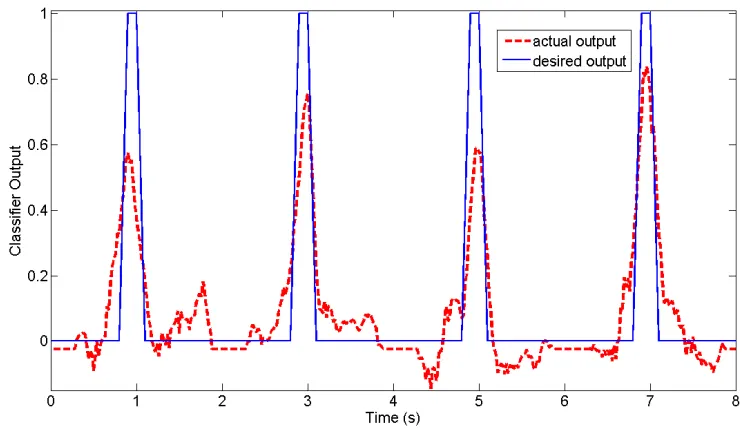
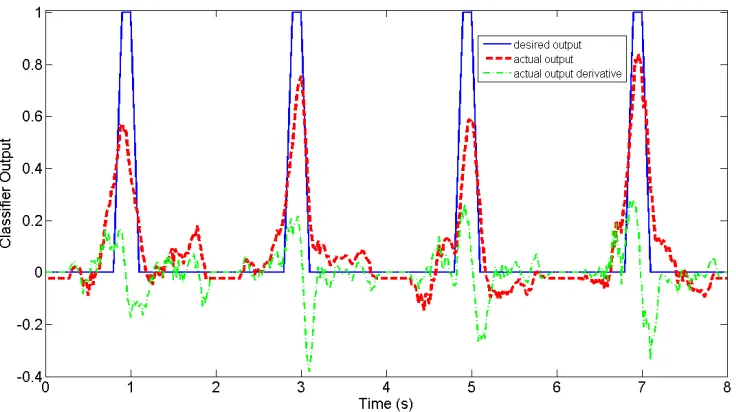
However, it was observed in early testing that this was not the case. Figure 2.2 shows
the output of the new, linear gating classifier in response to a set of four movement trials
occurring once every two seconds. The variation in the shape of this output was observed
to be typical for the gating classifier. As shown, the gating classifier output does not closely
follow the desired output, in one case rising only as high as 0.58 instead of the desired value
of 1, but does demonstrate a rising and falling pattern that roughly follows the rise and fall
[image:30.612.122.495.297.511.2]of the desired output. The potential reason for these variations is discussed later.
Figure 2.2: Response of linear gating classifier to a set of four movements occurring once every two seconds using the entire input space. The blue solid line (desired output) rep-resents the ideal signal that the gating classifier was trained to, and the red dashed line (actual output) represents the actual response of the gating classifier. Note that the peak level, duration, and location with respect to the desired output is not consistent from trial to trial.
The error demonstrated in figure 2.2 by the gating classifier is undesirable. The peak
level, time, and duration are not consistant from trial to trial, and the classifier output
wanders (even taking negative values) when no activity is present. If the primary objective
be discarded in favor of a different solution. However, the goal of this classifier is to
provide enough information to allow a decision making scheme to accurately determine
when a movement occurs. Based on the clear presence of output activity at the desired
times an alternative decision making rule was designed.
As described previously, the original algorithm used a movement detection scheme that
counted the number of times the gating classifier output was above a static threshold in a
set window and fired if the output was above the threshold above a certain number of times.
This approach was sufficient for the nonlinear classification scheme because the nonlinear
gating classifier closely and predictably followed the desired output, but since the linear
gating classifier did not consistently reach a specific peak value for a predictable duration
this decision scheme was not as effective. A four dimensional search of the parametersγ,
τ,β, andρwas performed (values ranged between 0.15 to 1 in 0.05 increments forγ, 3 to
10 in integer increments forτ andβ, and 2 to 10 in integer increments forρ) to find
param-eter values that met the specified accuracy requirements, but a set of values that achieved
at least 90% movement detection accuracy was not found. As a result, an alternative
de-cision method was developed. Analysis of the problem showed that although the gating
classifier output did not peak consistently, it did drop off rapidly following a movement.
This lead to the decision to use the derivative of the gating classifier output as well as the
output itself. Figure 2.3 shows the derivative of the actual response signal from figure 2.2,
computed as G(tk)−G(tk−∆), where ∆ranged from 1 to 5. The important aspect of these signals is the negative peaks, which correspond to a decrease in the gating classifier
output, indicating that a movement occurred. As∆increases the magnitude of the negative
peaks increases, along with the delay between the actual movement time and peak time.
This relationship creates a tradeoff between movement identifiability and temporal
accu-racy. To compromise, a value of∆ = 3was selected, creating a delay of three time samples
(60ms) and negative peaks that are sufficiently large to detect movement (Determination of
exact threshold levels is discussed later, in chapter 4). Further analysis of figure 2.3 shows
peaks, such as the one slightly before the two second mark, are present in the signal even
when no movement is occurring. Because of this, the decision was made to use both the
gating classifier output and its derivative to detect movement. Figure 2.4 shows the same
movement response as in figure 2.2 with added information of the gating classifier output
[image:32.612.120.498.179.404.2]discreet derivative, computed asG(tk)−G(tk−3).
Figure 2.3: The discrete derivative of the gating classifier response to a set of four move-ments using the entire input space, computed asG(tk)−G(tk−∆), where∆ranges from 1 to 5. Movements occurred at times 1, 3, 5, and 7 seconds, to which the negative signal peaks correspond (the peak observed near time 2 seconds is a false positive). Note that as∆increases both the peak magnitude and delay between movement time and peak time increase.
Based on this, the new movement detection decision scheme was designed to check if
the output was above some static threshold γ and instead of counting the number of time
windows during which the output was above this threshold also checked the derivative of
the gating classifier output. If the difference between the current output and the output three
time windows ago was less than the negative constantδ and the current output was above
the thresholdγ the gating classifier fired. Equation 2.1 expresses this rule mathematically,
where γ and δ are the parameters described above, G(t) is the gating classifier output
Figure 2.4: Response of linear gating classifier to a set of four movements occurring once every two seconds using the entire input space with gating classifier derivative. The blue solid line represents the function that the gating classifier was trained to, the red dashed line represents the actual response of the gating classifier, and the green line represents the discrete time derivative of the gating classifier response.
indicating no movement.
Gout(t) =
1 ifG(t)> γandG(t)−G(t−3)< δ
0 otherwise
(2.1)
One additional issue highlighted by figure 2.4 is that the criteria for movement detection
defined in equation 2.1 can be true for more than one classification decision during each
movement trial. Every time the gating classifier fires it is considered a separate detection
of movement, which could lead to the misclassification of a single movement as multiple
movements. To reduce this occurrence a refractory period was added. Once the gating
classifier output a positive movement decision, further positive decisions were ignored until
at leastρtime steps had occurred.
The output of the movement classifier was also observed to determine if it still
per-formed similarly to the original algorithm. Figure 2.5 shows the response of the movement
classifier to a sequence of 12 movements occurring once every two seconds in the following
Figure 2.5: Response of linear movement classifier to a sequence of trials occurring once every two seconds using the entire input space. The movements were presented every odd second in the following order: extension of each digit, in order from thumb to little finger (e1-e5), extension of the wrist(ew), flexion of each digit in the same order(f1-f5), and flexion of the wrist(fw). The diagonal row of spikes in the center of the diagram shows that the largest response during each trial is the expected movement type.
wrist(ew), flexion of each digit in the same order(f1-f5), and flexion of the wrist(fw). The
desired output for this trial is a series of output spikes that have a value of 1 when the
cor-responding movement is being performed and 0 all other times. As shown in the diagram,
the response does not closely follow this desired output, instead peaking at a maximum of
0.32, but as in the gating classifier, enough information is still present to make a correct
decision. As mentioned previously, the movement classifier output is only used when the
gating classifier determines that a movement has occurred. As shown in this graph, at the
time a movement occurs there is a clear spike from the desired movement type, while all
other movement types show little activity. This demonstrates that choosing the movement
type with the largest corresponding movement classifier output when the gating classifier
fires will provide a correct movement classification. This rule is expressed mathematically
in equation 2.2, wherePi(t)is the output corresponding to each movement typeiands(t)
is the chosen movement type.
s(t) = arg max
2.3
Elimination of Floating Point Multiplication
Even with a reduced number of floating point multiplications this operation still represents
the most computationally intensive portion of the algorithm. Fortunately, analysis of the
decoder algorithm shows that floating point math can be completely replaced by integer
math without introducing error sufficient to adversely affect classification decisions. Initial
analysis of weights in the gating and movement classifier after training with a full input
space showed that weights differed by several orders of magnitude, although the
major-ity were less than 10−3. Figure 2.6 shows the magnitude logarithm of an example set of
post-training weights. Examination of this figure suggests that weight magnitudes are
ap-proximately log-normally distributed. The fact that the order of magnitude of the weights
roughly falls in this distibution indicates that an approximation of these weights needs to
primarily focus on preserving the accuracy of the weights closer in order to the mean. In
this set of weights, the magnitude mean was9.98∗10−4and the magnitude standard
devia-tion was1.2∗10−3, with minimum and maximum magnitudes of4.11∗10−7and1.3∗10−2. This range of about five orders of magnitude was typical, although exact values varied each
[image:35.612.130.487.455.654.2]time the system was trained.
With this distribution in mind a simplification that eliminated floating point
multiplica-tions was derived. Generally, a linear classifier can be described by equation 2.3, where n
is the number of inputs,wis the constant weight multiplied by each inputx,bis a constant
offset, andyis the classifier output.
y= n
X
i=0
wixi+b (2.3)
For this specific problem it is known that all inputsxare nonnegative integers with a
max-imum value of about 20, due to the limiting effect of refractory periods. The weights are
floating point numbers and are on the order of10−2to10−7, which makes direct rounding
them a poor idea. However, scaling by a large constant α (henceforth referred to as the
rounding coefficient) reduces the error introduced by rounding.
αy= n
X
i=0
αwixi+αb (2.4)
Note that in this stateαwi is still a floating point number. To simplify, a new valuewˆi that
is the nearest integer toαwiis substituted into the equation.
ˆ
wi =round(αwi) (2.5)
αyˆ= n
X
i=0
ˆ
wixi+αb (2.6)
This substitution effectively eliminates the need for floating point multiplication. To prove
that this introduces negligible error rounding can be modeled as a uniform error between
-0.5 and 0.5, assuming that the value of the rounding coefficient is large enough that every
weight has a magnitude of at least 1, and the value ofyˆcan be compared toy.
ˆ
wi =αwi+U(−0.5,0.5) (2.7)
Substituting this distribution into equation 2.6 gives
αyˆ= n
X
i=0
αwixi+ n
X
i=0
The products of uniform distributions and inputs are independent, identically distributed
random variables, so their sum can be approximated as a normal distribution[15].
n
X
i=0
U(−0.5,0.5)xi ≈N(0, σ2) (2.9)
Given that U(−0.5,0.5) has a variance of 0.0833 and a mean of 0, assuming that xi is discretely uniformly distributed between 0 and 20 at integer intervals and therefore has a
variance of 33.3 and a mean of 10, and that the number of inputs is 40, it is estimated that
the variance of the normal distribution is approximatelyσ2 = 0.0833∗33.3+102∗0.0833
40 = 0.278.
αyˆ= n
X
i=0
αwixi+N(0, σ2) +αb (2.10)
Dividing both sides by the rounding coefficient gives an equation foryˆ.
ˆ
y= n
X
i=0
wixi+b+
N(0, σ2)
α (2.11)
Substituting in the original equation forygives the following
ˆ
y=y+N(0, σ
2)
α (2.12)
Note that as the size of the rounding coefficient increasesyˆ→y. In practice, the rounding coefficient was chosen to be the reciprocal of the smallest weight present in any classifier,
and was observed to be between the order of105 to107. Therefore the error introduced is
99.7% likely to be less than±2.78∗10−4, which is likely negligible when compared to the magnitude of the signals in figures 2.4 and 2.5.
This simplification is useful due to the fact that the weights are computed during
train-ing and do not change after that. Multiplytrain-ing every weight by the roundtrain-ing coefficient and
then rounding introduces error on the order of 10−4 and eliminates the need for real time
floating point multiplication. Furthermore, since the refractory period of a neuron prevents
it from firing above a rate of about 200Hz it is very unlikely that any individual input to the
decoder will ever be above 20 in any given 100ms input window. This means that inputs
implemented as a lookup table, greatly reducing hardware demand. Note that one floating
point division is necessary if the value ofyˆis needed, but if subsequent processing can use
αyˆinstead this division is not necessary. In equation 2.1G(t),γ, andδ can be multiplied
by the rounding coefficientαand rounded to the nearest integer in order to take advantage
of the elimination of floating point math given in equation 2.6. By doing this the output
of the gating classifier multiplied by α can be used directly in equation 2.1, eliminating
the need to perform a floating point division. Additionally, since equation 2.2 chooses the
maximum likely movement type out of each of the movement classifier outputs its
behav-ior is unaffected if all movement classifier outputsPi(t)are multiplied by a constant, so no
Chapter 3
Hardware Implementation
Once the modified asynchronous dexterous decoder algorithm was developed the next step
was to design a hardware implementation. The first step in this task was to choose an
archi-tecture for the implementation and identify a target platform that could meet the
require-ments of the architecture. The target platform size and speed capabilities were analyzed
to ensure that it could meet the requirements of the hardware implementation. Next, the
digital design task was broken down into four independent stages that were designed
indi-vidually and then combined to form the complete decoder. Once the digital implementation
was designed the resulting hardware performance and size were analyzed.
3.1
Architecture Selection and Requirements
The first step in design of the hardware decoder was an analysis to determine an
appropri-ate architecture for performing the required computations. The hardware decoder needed
to be able to take the number of spikes that occurred in the past 20ms for each neuron
and based on that data perform the necessary computations, as described above, to produce
a movement classification. The necessary computations can be broken down into three
stages: The first stage stores and sums the number of spikes that occurred over the sliding
100ms window, the second stage performs the linear classification by multiplying spike
counts by weights and summing the result, and the third stage uses the classifier results to
but, aside from refractory period suppression of positive movement classifications, each
movement decision is independent of any other classification. Additionally, the
computa-tions performed in each classifier within a single movement period are independent of one
another. It was decided that this independence should be exploited to create a hardware
architecture where all classifiers and multipliers were implemented in parallel. This fully
parallel approach closely mimics the theoretical algorithm structure, which is advantageous
because it is easy to understand and compare to both the theoretical behavior and software
implementation. Each hardware component can be easily compared to its theoretical
coun-terpart, allowing for easy verification of proper functionality. Additionally, a fully parallel
implementation should have a short critical path delay, making the 50Hz target clock rate
easily achievable. Since the product of intermediate computations do not need to be stored
if every computation is happening simultaneously the entire system can be clocked at the
50Hz rate, which also closely matches the theoretical algorithm structure. Optimizations
undoubtedly exist, but since this work represents a first attempt at implementing this
algo-rithm in hardware design simplicity was favored over speed and size.
Once a fully parallel approach was selected an analysis of required digital components
was performed. The sliding input window requires five registers for each input to store the
past five 20ms spike counts and a five input integer adder for each input. For the linear
classifiers the most prevalent operations are the multiplications required to compute the
weighted inputs to each classifier. Because the weights are constant when the decoder is
not being trained and the input value falls in a set range of 0 to 20 each multiplier can be
implemented as a lookup table, which is a basic digital design component. The number of
lookup tables required to implement the decoder is equal to the number of classifier inputs
multiplied by the number of movement types plus one. In order to complete each classifier
an adder is necessary to sum the multiplication products. The number of adders required
is equal to the number of movement types plus one, and each must have a number of
in-puts equal to the number of classifier inin-puts. For the gating logic two 2-input comparators
inputs equal to the number of movement types is necessary for movement classification.
Additionally, three registers are needed for the derivative computation, and one register is
needed for the refractory period. To give a concrete example of hardware requirements,
implementing a 50 input, 12 movement type decoder in hardware would require 64
regis-ters, 12 5-input adders, 650 lookup tables, 13 50-input adders, 2 2-input comparators, and
1 12-input comparator.
3.2
Choice of a Development Platform
The above analysis gives an indication of the resources the hardware platform had to be
capable of providing to implement the decoder. For this work the ability to test the
hard-ware was necessary, so the platform also had to have an external communication interface
capable of sending data to and from a Matlab test script. It also had to be capable of
com-puting a result at a minimum rate of 50Hz to allow for realtime movement classification.
Because training was unique to each subject and the significance of recorded values could
potentially change over time the linear classifier weights had to be modifiable. Based on
these requirements, it was decided that a field programmable gate array would be the most
appropriate platform for hardware development.
A Field Programmable Gate Array(FPGA) is an electronic device consisting of small
digital memory and logic units that can be configured to form specific connections and
implement arbitrary digital circuits. Typically, a hardware description is written using a
hardware description language such as VHDL, synthesized to convert the hardware
de-scription to a set of physical connections, and programmed into the FPGA. The net result
is a physical realization of a digital electronic circuit that can be reconfigured, which meets
the requirements for a method of modifying classifier weights. Additionally, this
reconfig-urability also makes debugging a hardware design easier because corrections can be made
and applied nondestructively. In a digital implementation of the decoder algorithm each
for the 50Hz rate to be met without issue. Finally, a single FPGA is capable of
provid-ing enough hardware to implement the dexterous decoder, as the hardware description and
analysis below demonstrate.
The specific FPGA targeted for development was a Xilinx (Xilinx, Inc., San Jose, CA)
Virtex-4 FX60 FPGA (Virtex-4 for short) mounted on a Xilinx ML410 embedded
devel-opment platform. The Virtex-4 contains 25,280 logic slices that can be used to implement
user defined functionality, 128 digital signal processing(DSP) slices that are designed for
signal processing type applications, and two PowerPC processor cores that can run user
defined software, among other features. Each logic slice contains two 4-bit lookup tables
and two storage elements. Logic slices are organized into larger groups called configurable
logic blocks(CLB), with four slices in every CLB[16]. Additionally, the ML410 platform
provides 256 megabytes of DDR2 memory and a 512 megabyte flash card[17]. The
mod-erate number of slices provided should be sufficient for a hardware implementation and the
additional features are available for future development, although their use will be avoided
in this research so that the hardware implementation will be portable to other FPGA
plat-forms.
Use of the Xilinx ML410 can be justified by predicting the number of slices necessary
to implement each decoder component. Each register is eight bits wide, so four logic slices
will be needed for each. Each two-input adder and lookup table(5-bit input, 32-bit output)
will require 16 slices to implement. Each two-input comparator will require 32 slices to
implement. Components with greater than two inputs can be treated as the number of inputs
minus one two-input components of the same type (i.e. a 16-input adder can be treated as
15 two-input adders). Using these estimates the 60 input, 12 movement type example given
above would require 64*4 = 256 slices for registers, (48+637)*16 = 10960 slices for adders,
650*16 = 10400 slices for adders, and (2+11)*32 = 416 slices for comparators. This gives a
total of 22,032 slices necessary to implement the decoder without including logic required
for testing, which is less than the number of slices available on the Virtex-4 FPGA. This
testing logic is incorporated, but suggests that it is likely. This estimate also suggests that a
full input space (115 inputs, at minimum) will not be realizable on the Virtex-4.
3.3
Hardware Implementation Overview
From a hardware perspective, the decoder can be viewed as a series of data transformations,
starting with the set of neuron spikes in the past 20ms and ending with a single number
cor-responding to a movement type. The three primary components are the input window, the
linear classifiers, and the gating logic. The input window stores the number of spikes that
occurred in the past five 20ms windows and outputs the sum of those windows, effectively
creating a 100ms window that slides every 20ms. The classifiers take this data and perform
linear classification, which creates a single output from each classifier. This data is then fed
to the output logic, which performs the maximum and thresholding operations described
above. In addition to these three components that form the decoder, a serial IO interface
was also implemented to allow for hardware testing. This interface received spike counts
from a Matlab program, sends those spikes to the input window, and sends back to the
Matlab program the classification result created by the output logic.
VHDL generate statements were used extensively in the design to allow for easy
synthesis of decoders with different numbers of inputs or movement types. Because of
this, the component descriptions given below are in terms of various synthesis parameters.
The number of input neurons is denoted n and the number of movement types is denoted
m.
Algorithm training was performed offline in Matlab; as mentioned previously, hardware
that can adapt online is restrictively complex and beyond the scope of this thesis. A Matlab
script was created that can generate a VHDL constants file usable in hardware synthesis.
Once the algorithm is synthesized and programmed into the FPGA the parameters cannot
be changed without another synthesis, although, outside of testing purposes, the FPGA does
independent of any other system.
For use in a complete system it is assumed that input signals would be provided in real
time, allowing the entire system to be clocked at a rate of 50Hz, which would create the
20ms time windows desired. However, because communication with test software running
on a PC does not occur at a predictable rate the system clock rate was given to the IO
interface, as described below.
[image:44.612.183.435.286.478.2]3.4
Input Window
Figure 3.1: Block diagram of input window
The input window is a set ofnfive byte shift registers and a five input adder, as shown
in figure 3.1. Input to this component is an array of unsigned 8 bit integers indicating how
many spikes have occurred in each neuron since the input window was last clocked. When
the input window is clocked each shift register captures its corresponding input and shifts
all previous data by one, eliminating the oldest value. The contents of each shift register
are summed and that sum, another unsigned eight bit integer, is sent to the classifier stage.
If this stage is clocked at 50Hz it will effectively create a 100ms window that slides every
would be accumulated by an asynchronous counter that would be reset by the controlling
clock.
[image:45.612.204.416.198.528.2]3.5
Classifiers
Figure 3.2: Block diagram of linear classifiers
Each classifier consists ofnmultipliers and one n input adder. Each multiplier,
imple-mented as a lookup table, takes one of the summed inputs provided by the input window
and converts it to a 32 bit signed integer based on the constant weight specific to that
clas-sifier and input. The n input adder, implemented as a linear array of two input adders, sums
the 32 bit integers produced by the multipliers. A total of m+ 1 classifiers were
particular movement type. A block diagram of the classifiers is shown in figure 3.2. Note
that this functionality consists solely of combinational logic, so no clock is necessary.
[image:46.612.133.490.191.310.2]3.6
Output Logic
Figure 3.3: Block diagram of gating logic
The output decision logic consists of gating logic and movement logic, as in the
modi-fied algorithm described above. The gating logic takes input from the gating classifier and
determines if movement has or has not occurred. The movement logic takes input from
themmovement classifiers and determines the index of the largest movement value. Note
that since the multipliers used in the classifiers use weights scaled by α the output logic
constants must also be scaled byα.
The output of the gating classifier is sent to a three value 32 bit shift register that holds
t
![Figure 1.2: A diagram of the original asynchronous dexterous decoder[1]. The use of twoclassifiers allows for the detection and classification of movement from recorded nerualTogether, they allow for the asynchronous detection of a specified set of finger and](https://thumb-us.123doks.com/thumbv2/123dok_us/52537.4787/24.612.209.410.84.388/asynchronous-dexterous-twoclassiers-classication-nerualtogether-asynchronous-detection-specied.webp)