Paid Parental Leave
Evaluation
PHASE 2 REPORT
Prepared for: Department of Families, Housing, Community Services and Indigenous Affairs
The University of Queensland
Institute for Social Science Research ABN: 63942 912 684
Paid Parental Leave Evaluation
PHASE 2 REPORT
File Name: PPL_PH2_draft_Report_Jan2013.docx
Authors: Bill Martin, Mara A. Yerkes, Belinda Hewitt, Marian Baird, Andrew Jones, Emily Rose, Judy Rose, Kristen Davis, Laetitia Coles, Alexandra Heron, Ning Xiang
Project team members: Bill Martin, Belinda Hewitt, Andrew Jones, Mara A. Yerkes, Marian Baird, Kristin Davis, Emily Rose, Judy Rose, Laetitia Coles, Alexandra Heron, Ning Xiang, Lyndall Strazdins, Maria Zadoroznyj, Guyonne Kalb, Duncan McVicar, Janeen Baxter, Margaret Walter, Mark Western, Gillian Whitehouse, Luke Connelly, Dorothy Broom.
Name of Project: Paid Parental Leave Evaluation Document Status: Final
ACKNOWLEDGEMENTS
RECOMMENDED REFERENCE
INSTITUTE FOR SOCIAL SCIENCE RESEARCH
ISSR is one of Australia’s largest social science research institutes with extensive experience in applied social science research and in providing research services to government agencies. ISSR was established by UQ in 2007 to enhance social science research at UQ; to contribute nationally to the development of Australian social science; to signal the university's major strengths in and commitment to the social sciences and to facilitate UQ’s role in applied social science research. The Institute directly employs over 60 research staff, is one of the largest social science research institutes in Australia and has a growing international profile. ISSR researchers collaborate extensively with researchers throughout UQ, Australia and overseas. The Institute works in close cooperation with government agencies and the corporate and community sectors on flagship and high-impact social research.
DISCLAIMER
i
CONTENTS
CONTENTS ... I LIST OF TABLES ... I ABBREVIATIONS ... I A NOTE ON AUTHORSHIP ... III EXECUTIVE SUMMARY ... IV
1 INTRODUCTION ... 1
1.1 The PPL scheme ... 1
1.2 The PPL Evaluation ... 2
2 THE DESIGN OF THE PPL SCHEME ... 6
2.1 Introduction ... 6
2.2 Policy History ... 6
2.2.1 Origins ... 6
2.2.2 The Productivity Commission Inquiry ... 7
2.2.3 Laying the groundwork ... 7
2.2.4 The legislation and implementation ... 8
2.2.5 Summary ... 9
2.3 Policy design: elements, rationale and risks ... 9
2.3.1 Objectives ... 10
2.3.2 Risks ... 14
2.3.3 Eligibility ... 15
2.3.4 Benefits ... 18
2.3.5 Funding and cost ... 23
2.3.6 Delivery ... 24
2.4 Conclusion ... 28
2.4.1 Immediate objectives ... 29
2.4.2 Long-term objectives ... 29
2.4.3 Eligibility ... 30
2.4.4 Benefits ... 30
2.4.5 Funding and cost ... 31
2.4.6 Delivery ... 31
3 THE IMPLEMENTATION AND DELIVERY OF THE PAID PARENTAL LEAVE SCHEME ... 32
3.1 Introduction ... 32
3.2 Managing the implementation process ... 34
3.2.1 Key groups involved in managing PPL ... 34
3.2.1 Key tasks in implementing PPL ... 35
3.2.2 Implementing DaPP in relation to PPL ... 36
3.3 Undertaking further consultation ... 36
3.4 Developing the legislation ... 37
ii
3.4.2 PPL Guide ... 38
3.4.3 PPL Rules ... 38
3.4.4 Issues arising following implementation ... 38
3.5 Information provision ... 39
3.5.1 Information provision to families ... 40
3.5.2 Information provision to employers ... 41
3.5.3 Outreach to special audiences ... 42
3.5.4 Issues arising during the communications campaign ... 43
3.6 Service delivery ... 43
3.7 Determining eligibility and processing claims ... 44
3.7.1 Determining eligibility ... 44
3.7.2 Processing claims ... 44
3.8 Making payments ... 46
3.8.1 Making payments through Centrelink ... 46
3.8.2 Making payments via employers ... 47
3.9 Monitoring performance ... 48
3.10 Conclusion ... 49
4 MOTHER’S IMPLEMENTATION AND PROCESS EVALUATION ... 52
4.1 Take up of the scheme ... 52
4.1.1 Characteristics of PPL and PPL eligible mothers taking BB ... 53
4.1.2 Section Summary ... 56
4.2 Awareness and knowledge of PPL scheme ... 57
4.2.1 Mothers’ sources of awareness and information about the PPL scheme ... 57
4.2.2 Use of Online Estimator ... 58
4.3 Deciding between PLP and BB ... 60
4.3.1 Deciding between PLP and BB: evidence from qualitative interviews... 62
4.3.2 Section Summary ... 63
4.4 Experiences of applying for and receiving PLP payments ... 64
4.4.1 The timing of the application process ... 64
4.4.2 Mode of application and ease of application process ... 65
4.4.3 Mothers’ views on experiences of PLP application process ... 65
4.4.4 Receipt of PLP Payments ... 67
4.4.5 Qualitative views of receipt and timeliness on payments ... 72
4.4.6 Section Summary ... 76
4.5 Keeping in Touch days ... 77
4.5.1 Qualitative views on KIT ... 79
4.5.2 Section Summary ... 79
4.6 Forms of leave taken around the birth ... 79
4.6.1 Qualitative views on paid and unpaid leave taken around the birth ... 81
4.7 Fathers who took PLP ... 82
iii
4.8.1 Uptake of PLP ... 85
4.8.2 Awareness and Knowledge of the scheme... 85
4.8.3 Deciding between PLP and BB ... 85
4.8.4 Mothers’ Experiences applying for and receiving PLP payments ... 86
4.8.5 KIT Provisions ... 87
4.8.6 Paid and unpaid leave around the birth ... 87
5 EMPLOYER’S IMPLEMENTATION AND PROCESS EVALUATION ... 89
5.1 Employer Role ... 89
5.2 Organisational policies and leave provisions ... 89
5.2.1 Formally arranged paid leave ... 90
5.2.3 Employer-provided leave duration ... 94
5.2.4 Unpaid leave ... 97
5.2.5 Changes to HR policies... 98
5.2.6 Changes to HR practices ... 101
5.2.7 Section summary: key points ... 103
5.3 Managing PLP in the Organisation ... 105
5.3.1 Sourcing of information ... 105
5.3.2 Registering for PPL ... 109
5.3.3 Making payments and payroll changes ... 110
5.3.4 Experiences of the employer role ... 113
5.3.5 Perceived retention effects ... 114
5.3.6 Voluntary administration of PLP ... 115
5.3.7 Changes to payroll systems ... 117
5.3.8 Costs involved in implementation ... 119
5.3.9 Employer attitudes towards PPL ... 121
5.3.10 Employer attitudes and experiences with PPL: interviews ... 122
5.3.11 Section summary ... 124
5.4 Managing PLP with Employees ... 126
5.4.1 Providing information to employees ... 126
5.4.2 Discussing leave take-up with employees ... 127
5.4.3 Organisation of work ... 132
5.4.4 Grievances... 133
5.4.5 Section summary ... 133
5.5 KIT provisions ... 134
5.5.1 Awareness, intent to use and structure of KIT provisions ... 134
5.5.2 Employee use of KIT provisions ... 135
5.5.3 Employer experience with KIT provisions ... 136
5.5.4 Section summary ... 137
5.6 Summary: Key points ... 137
6 MAIN FINDINGS AND IMPLICATIONS ... 140
iv
6.1.1 Main Findings ... 140
6.1.2 Implications ... 140
6.2 Implementation and Delivery ... 140
6.2.1 Main Findings ... 140
6.2.2 Implications ... 141
6.3 Uptake ... 141
6.3.1 Main Findings ... 141
6.3.2 Implications ... 141
6.4 Information provision and use ... 142
6.4.1 Main Findings ... 142
6.4.2 Implications ... 142
6.5 Decision Making ... 142
6.5.1 Main Findings ... 142
6.5.2 Implications ... 143
6.6 Applying for PLP and registering to pay PLP ... 143
6.6.1 Main Findings ... 143
6.6.2 Implications ... 144
6.7 Payments ... 144
6.7.1 Main Findings ... 144
6.7.2 Implications ... 145
6.8 Employers role and impact on employers ... 145
6.8.1 Main Findings ... 146
6.8.2 Implications ... 146
6.9 PLP and leave taking ... 146
6.9.1 Main Findings ... 146
6.9.2 Implications ... 146
6.10 Keeping in Touch ... 146
6.10.1 Main Findings ... 147
6.10.2 Implications ... 147
6.11 Conclusion ... 147
i
LIST OF TABLES
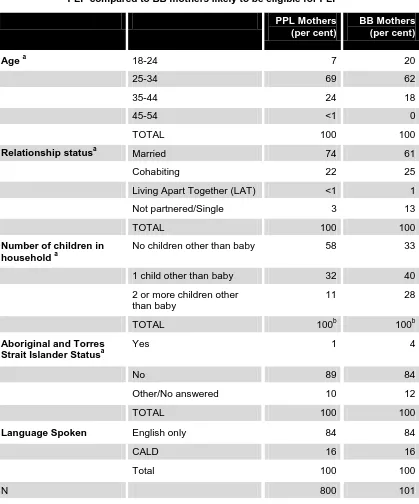
Table 4.1 Selected social and demographic characteristics of mothers who took
PLP compared to BB mothers likely to be eligible for PLP ... 54
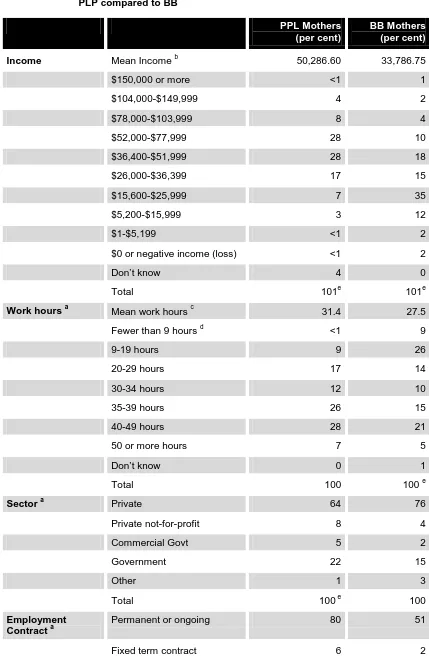
Table 4.2 Selected work and job characteristics of PPL eligible mothers who took PLP compared to BB ... 55
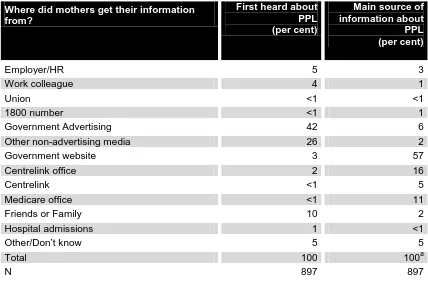
Table 4.3 Sources of awareness and information about the scheme ... 58
Table 4.4 Mothers awareness and use of online estimator ... 59
Table 4.5 Mothers’ experience in use of online estimator ... 59
Table 4.6 Consideration of applying for each scheme and employer involvement, by receipt of BB and PLP ... 60
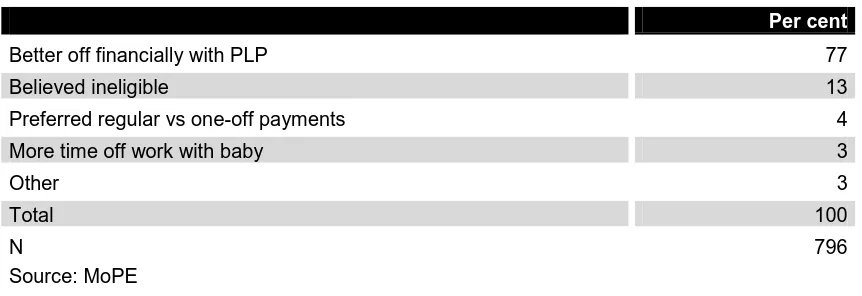
Table 4.7 BB mothers’ main reason for applying for and choosing BB rather than PLP ... 61
Table 4.8 PPL mothers’ main reasons for choosing PLP rather than BB... 61
Table 4.9 Important factors in decision to take PLP rather than BB ... 62
Table 4.10 Timing of PLP application ... 64
Table 4.11 Mode of application for PLP ... 65
Table 4.12 Agreement with the statement that “The application process was easy” by mode of application for PLP ... 65
Table 4.13 Number of weeks taken by PPL mothers ... 68
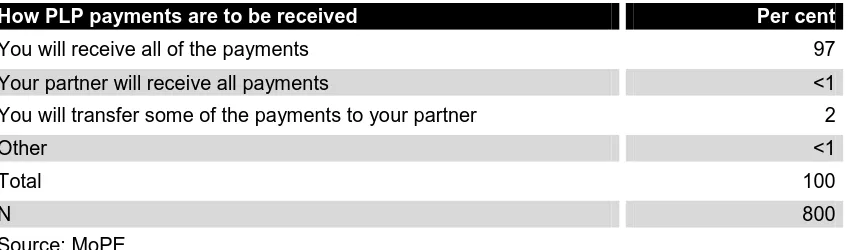
Table 4.14 Distribution of PLP payments between mothers and partners ... 68
Table 4.15 Mothers receipt of payments through employer or Centrelink... 69
Table 4.16 Distribution of payments made by employer and Centrelink by employment contract prior to birth ... 69
Table 4.17 Total number of Problems with payments, by payments made by employer or Centrelink ... 70
Table 4.18 Problems with payments by payments made by employer or Centrelink .. ... 71
Table 4.19 Awareness of KIT days (PLP recipients) ... 77
Table 4.20 Employer or business program for keeping in touch ... 78
Table 4.21 Mothers’ use of KIT provisions ... 78
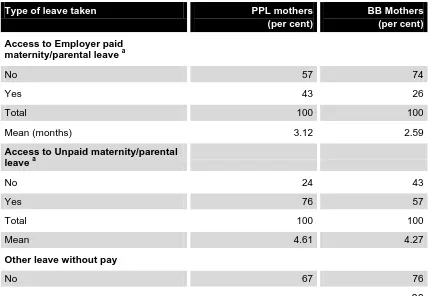
Table 4.22 Paid and unpaid leave taken around birth ... 80
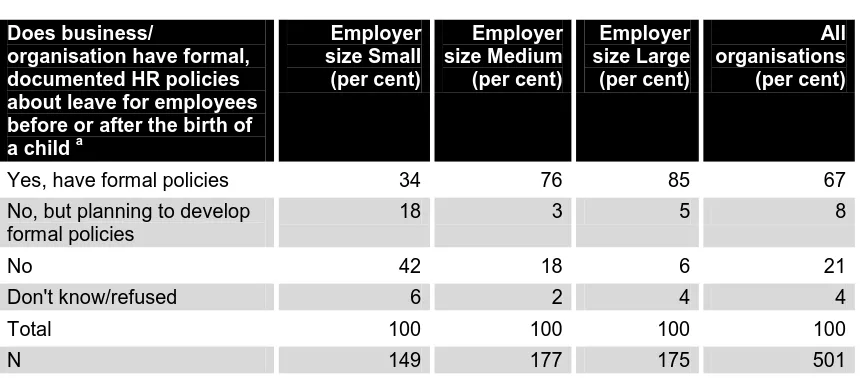
Table 5.1 Formalization of HR policies about leave for employees before or after the birth of a child ... 90
Table 5.2 Employer-paid leave by organisational size ... 91
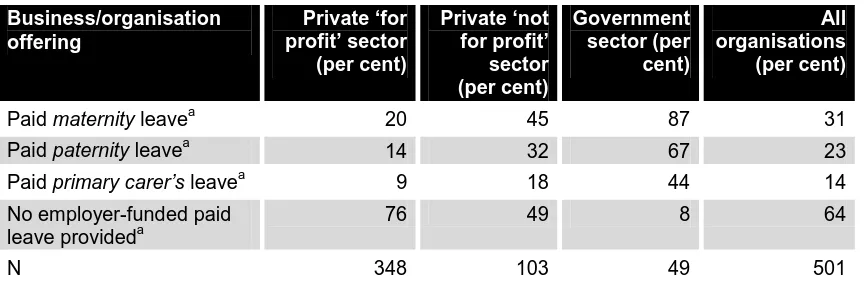
Table 5.3 Employer-paid leave by sector ... 91
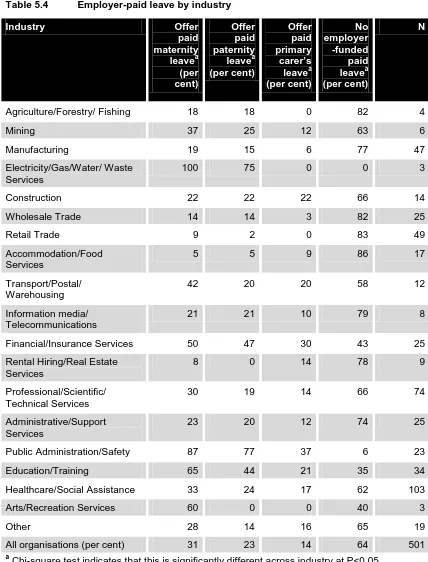
Table 5.4 Employer-paid leave by industry ... 92
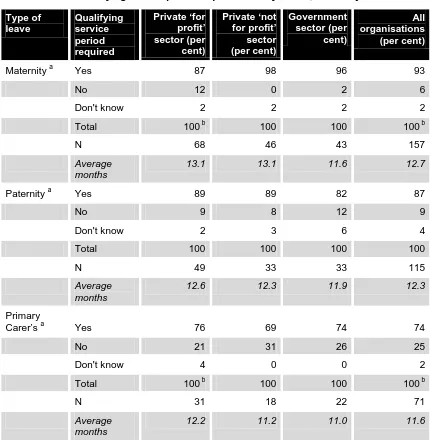
Table 5.5 Qualifying service period requirements by sector, maternity leave ... 94
ii Table 5.7 Leave remuneration and superannuation contributions, by sector and
employee type ... 97
Table 5.8 Employer provisions of unpaid leave by organisational size ... 98
Table 5.9 Changes to paid leave policies or introduction of new policies made by organisations that offer employer-paid leave ... 99
Table 5.10 Types of changes to existing policies/introduction of new policies made by employers who did make changes ... 99
Table 5.11 Proportion of organisations that have changed unpaid leave policies. 101 Table 5.12 Changes made to informal HR policies made by organisations without formal HR policies in place ... 101
Table 5.13 Changes to HR practices resulting from PPL ... 102
Table 5.14 Types of changes to HR practices made by those organisations that did make some change ... 102
Table 5.15 Sources of awareness and information about the scheme ... 106
Table 5.16 Employer size and ease/difficulty in sourcing information, perceived helpfulness and accuracy of information ... 107
Table 5.17 Ease of registering for PPL scheme by organisational size ... 110
Table 5.18 Employer attitudes towards organising PPL payments ... 111
Table 5.19 Voluntary administration of PLP by sector and size ... 116
Table 5.20 Reasons for voluntarily administering PLP by those organisations that voluntarily administered PLP ... 117
Table 5.21 Changes made to payroll systems made by those organisations that did make changes ... 118
Table 5.22 Types of costs involved in the implementation of PPL for those organisations that reported additional costs ... 120
Table 5.23 Staff hours needed to implement PPL ... 120
Table 5.24 Cost of implementing PPL (in dollars) ... 121
Table 5.25 Employer attitudes towards PPL ... 122
Table 5.26 Do employers inform their employees about PPL? ... 127
Table 5.27 Means of informing employees about PPL in organisations that informed employees about PPL ... 127
Table 5.28 Timing of employee approaching manager about PLP take up ... 128
Table 5.29 Do organisations discuss leave options with employees? ... 128
Table 5.30 Did employer or employee mention PPL option first? ... 129
Table 5.31 Which leave options are discussed with employees among employers who discuss leave options... 129
Table 5.32 Whether employees obtain information about PPL on their own, independent of the organisation ... 130
iii Table 5.34 Kinds of information on PPL sought by employees among those who approached their employer or manager for information ... 131 Table 5.35 How organisations organise work when someone takes PPL ... 132 Table 5.36 Most relied on methods for organising work when someone takes PLP ...
... 132 Table 5.37 Employer awareness of KIT provisions ... 134 Table 5.38 Employer intent to use KIT provisions among organisations aware of KIT
provisions ... 135 Table 5.39 Employee use of KIT provisions among organisations aware of KIT
i
ABBREVIATIONS
AGD Attorney-General’s Department ALP Australian Labor Party
ATO Australian Tax Office BaMS Baseline Mothers Survey
BAU (Centrelink) Business as Usual Communications
BB Baby Bonus
CALD Culturally and Linguistically Diverse DAPP Dad and Partner Pay
DEEWR Department of Education, Employment and Workplace Relations DHS Department of Human Services (including Centrelink and Medicare) DIISRTE Department of Industry, Innovation, Science, Research and Tertiary
Education
DoFD Department of Finance and Deregulation DVA Department of Veterans’ Affairs
EIPE Employer Implementation Phase Evaluation Study
FaHCSIA Department of Families, Housing, Community Services and Indigenous Affairs
FAO Family Assistance Office1 [Centrelink and Medicare] FTB A Family Tax Benefit Part A
FTB B Family Tax Benefit Part B FWO Fair Work Ombudsman GFC Global Financial Crises IDC Interdepartmental Committee IG Implementation Group KPI Key Performance Indicator KIT Keeping in Touch
MoPE Mothers Process Evaluation Study NES National Employment Standards NESB Non-English Speaking Background
OECD Organisation for Economic Cooperation and Development OLDP Office of Legislative Drafting and Publications
OPC Office of Parliamentary Council PI Policy Implementation Study
1
ii PLP Parental Leave Pay
PM&C Department of the Prime Minister and Cabinet PPL Paid Parental Leave
iii
A NOTE ON AUTHORSHIP
iv
EXECUTIVE SUMMARY
Introduction
Since 1 January 2011, most Australian families in which a mother was in paid employment before the birth or adoption of a child have been eligible for the new Australian Government funded Paid Parental Leave (PPL) scheme.2 The scheme provides eligible parents with up to 18 weeks of Parental Leave Pay (PLP), paid at the rate of the National Minimum Wage, following the birth or recent adoption of a child. The PPL scheme brings Australia into line with all other Organisation for Economic Cooperation and Development (OECD) countries, except the United States, in having a national scheme for paid leave available to mothers following childbirth.
This report describes the results of an evaluation of the initial operation of the scheme. It focuses on answering the following questions:
1. What are the main elements and components of the PPL scheme, their rationale and inter-relationships, focusing on the scheme’s original design? 2. How has the scheme operated on its implementation? To what extent is the
PPL scheme operating as intended, and what factors have resulted in any discrepancies between intent and actuality?
3. What have been the immediate outcomes of the PPL scheme in its early months of operation, and what factors have impacted on these outputs and outcomes?
4. What have been the lessons learned about the design and operation of the PPL scheme?
Evaluation methodology
The evaluation questions are answered primarily through data collected specifically for the PPL evaluation. The evaluation consists of:
• A Policy Implementation (PI) study, involving 16 in-depth interviews with FaHCSIA and Centrelink departmental staff and analysis of press coverage relevant to the development and implementation of the PPL scheme.
• A Mothers Process Evaluation (MoPE) study, involving a survey of a random sample of mothers who were eligible for PLP and had taken or were approved to take PLP (N=800) and those who were eligible for PLP but had applied for the Baby Bonus (BB) instead (N=101). In addition, in-depth interviews were also conducted with a subsample of 97 mothers and fathers. These interviews focused on groups of special interest (i.e. casual and self-employed before the birth, single mothers, Aboriginal and Torres Strait Islander mothers, and fathers who took PLP). They provided more detailed and nuanced information about parents’ experiences with the PPL scheme than was available from the survey.
• An Employers Implementation Phase Evaluation (EIPE) study, involving a survey of a stratified random sample of employers who had provided PLP to at least one employee (N=501) and in-depth interviews with a purposive sample of 41 employers.
2
v Data from all three components is used to examine the range of issues for parents and for employers. These include: accessibility of PPL information, decision making about taking leave following the birth of a baby, eligibility and applying for PPL, making and receiving PPL payments, employers role, Keeping in Touch (KIT) provisions, and employer-provided leave.
A history of the policy design, implementation and delivery and evaluation results is outlined below.
Policy History
The issue of paid parental leave has been debated in Australia since at least the early-1970s. Prior to the 2007 federal election, the then opposition leader Kevin Rudd committed that if elected, his government would commission a Productivity Commission inquiry into improved support for parents with newborn children. The Inquiry was announced in February 2008 (following the election of the Rudd Government) and the resulting final report of the Productivity Commission, delivered in February 2009, provided much of the detail for the final PPL scheme, for which legislation was passed on 17 June 2010. The scheme commenced operation on 1 January 2011, with applications accepted from 1 October 2010. Employer participation was optional before 1 July 2011, after which employers had a mandatory role in providing PLP to their long term eligible employees.
Policy Design: elements, rationale and risks
The Australian Government sought to achieve three main objectives in introducing the scheme:
1. To enhance the health of babies and mothers, and the development of children, by enabling working mothers to spend longer at home with their newborn children.
2. To facilitate women’s labour force participation, and
3. To encourage gender equality and improve the balance of family and work life in Australian families.
These objectives corresponded closely to evidence martialled by the Productivity Commission. The Commission reviewed a range of research, and conducted some modelling of its own, to arrive at a view about the appropriate design to achieve goals in the areas of mothers’ and babies’ health and development, women’s workforce participation, gender equality, and work/life balance.
There are some risks and uncertainties inherently associated with these broad objectives, arising from such matters as:
• the possibility that operational shortcomings could limit the success of the scheme in achieving these goals;
• the need to manage expectations of the scheme;
• the value judgements inherent in objectives like achieving gender equality and work/life balance;
• the possibility of unintended consequences; and
• the difficulties in attributing any perceived changes in behaviour to the PPL scheme itself.
In the development of the PPL scheme, these policy objectives and risks were addressed through four key aspects of the scheme’s design:
vi 2. Benefits;
3. Funding the payment; and 4. Delivery arrangements.
Issues associated with eligibility requirements revolved around which parent should be eligible, how the work test would operate, the level of any income test that might need to be met, and what residency requirements would need to be met. The ultimate design of the scheme embodied the twin principles that the scheme should be as flexible as possible and that people with a reasonable attachment to the workforce would meet eligibility requirements.
The main issues associated with benefits related to the duration and timing of payments, the level of payments, whether payments should be taxed, how payments should interact with family payments, whether superannuation should be paid by employers while employees were receiving PPL, and whether a separate paternity leave component be included. The final design of the scheme resulted from detailed consideration of these issues.
Public funding of payments provided by the scheme was preferred over a range of other alternatives considered (such as a hypothecated payroll tax, or direct employer financing). It was recognised that the role of employers necessarily brought some
costs to them, though minimising these was a consideration in the scheme’s design. Similarly, consideration was given in the scheme’s design to minimising costs to taxpayers, particularly through removal of entitlement to some other social security payments (notably the Baby Bonus (BB), Family Tax Benefit- Part B (FTB-B) during the PPL period and certain tax offsets) if parents chose to take PPL payments.
Delivery arrangements were a final area of detailed policy development. Strategies for disseminating information to employers and parents were developed, to ensure that both groups understood the scheme. It was decided to process claims through Centrelink, but to provide PPL funds to employers to make payments if claimants were long-term employees.
Policy Implementation and Delivery
vii interactions and consequential amendments to existing legislation required a high level of involvement by PPL IDC member agencies.
The implementation of the key deliverables of the PPL scheme (claims from 1 October 2010, payments from 1 January 2011 and the mandatory employer role from 1 July 2011) has been relatively unproblematic, although a number of minor issues have arisen. These include questions around eligibility, the work test and the meaning of continuous employment, and legislative issues regarding the use of “Keeping in Touch” (KIT) days.
Consultation process: developing the legislation
From mid-2009 to the implementation of PPL, consultations were undertaken with a range of key stakeholders including major employee and employer peak bodies, representatives of small business, family and community stakeholder groups, tax professionals, payroll specialists and payroll software developers and state and territory governments. Consultations played an important role in the development of PPL legislation and led to changes in the role played by employers. These changes included; a delay in the mandatory employer role until 1 July 2011, thereby allowing for a more gradual phasing in of the employer role and enabling the employer role to start from the beginning of a financial year; employers being able to choose to receive three equal PPL funding amounts rather than fortnightly funding; and, employers not having to provide PLP to employees receiving fewer than eight weeks of payments. Information provision
The implementation of the PPL scheme was supported by a communication campaign designed to raise awareness among families and employers about PPL and encourage them to seek more detailed information about the scheme. The start of the campaign was supported by the creation of information brochures, and later the campaign used a much wider range of awareness raising strategies, including traditional and social media; public relations activities; and media and news reports. The communication campaign also included outreach to people with a disability and people from Culturally and Linguistically Diverse Backgrounds (CALD), Aboriginal and Torres Strait Islander Australians, and those living in remote, rural and regional areas. The campaign directed parents and employers to more detailed information provided by Centrelink, including brochures, facts sheets, web site content, and telephone assistance via the Parent Line and the Centrelink Business Hotline.
Data collected in relation to the campaign reveals some issues emerged regarding the provision of information to families and employers through the PPL communication campaign. The most commonly reported issue was the on-going tension between perceptions of the high level campaign information and the accessibility and intelligibility of the more detailed information.
Determining eligibility and processing claims
In regards to determining eligibility and processing claims, the PPL scheme presented challenges owing to the interactions with existing social welfare and employment provisions. In the actual operation of the scheme, eligibility issues have been few. The vast majority of applicants have been birth mothers with few complex cases involving secondary and tertiary claimant eligibility. There have, however, been some issues in regards to processing claims. There was some confusion among PPL applicants regarding the need to both claim the payment and provide proof of birth and the amount of time required to process payments after providing proof of birth.
viii easier cannot be carried out immediately because this requires a major systems release from Centrelink. These system releases occur quarterly.
In addition, the occurrence of two natural disasters in the state of Queensland, Cyclone Yasi and the Queensland floods, impacted on Centrelink’s capacity to process PPL claims in the early part of 2011.
An assessment of payment timeliness and examination of the causes of delays has resulted in Centrelink putting into place new claim processing timeliness standards and other strategies to reduce PPL claim processing delays, such as targeted messaging for parents and employers about claims and processes. It will be important to monitor PPL payment timeliness on an ongoing basis.
Making payments: through employers and through Centrelink
PLP payments to claimants are made in one of two ways. In the majority of cases, PLP payments are made through employers. From 1 July 2011 an employer (with an Australian Business Number) must provide PLP to an eligible employee who:
• has a child born or adopted from 1 July 2011; and
• has worked in the business for at least 12 months prior to the expected date of birth or adoption – consistent with the eligibility requirements for unpaid parental leave under the National Employment Standards (NES) in the Fair Work Act(2009); and
• will be an employee of the business for their PPL period; and • is an Australian based employee; and
• is expected to receive at least 8 weeks of PLP.
Employers can also opt to provide PLP to employees who they are not required to under their mandatory role.
In cases where PLP is not provided by an employer, PLP payments are provided by Centrelink. As outlined previously, no issues were presented in relation to Centrelink’s role in making payments in the initial months of the scheme’s operation. Chapter five discusses employers’ views on the administration of payments and the timeliness of payments. While the administration of PLP payments by employers is going smoothly, there are some issues regarding the timeliness of PLP payments, discussed in later chapters from the perspective of PLP recipients (chapter 4) and from the perspective of employers (chapter 5).
Administrative data shows in the first full financial year of the Paid Parental Leave scheme’s operation, 2011-12, almost 130,000 expectant and new parents applied for the Paid Parental Leave scheme,with around 125,000 families receiving Parental Leave Pay.3
During 2011-12, 99.4 per cent of recipients were mothers and of those recipients who had finished their PLP, 98.6 per cent took the full 18 weeks of payments. The median annual income of PLP recipients during this period was $44,350. Ongoing monitoring of PLP recipients will measure take-up as well as the functioning of the scheme in relation to the stated objectives.
3
ix Administrative data shows that, of mothers who had babies in 2011-124, approximately 44 per cent received PLP and 55 per cent received the BB. Note that some mothers received both PLP and BB in the case of multiple births.
In practice, due to the requirement for birth mothers to be the primary claimant in most cases for the primary carer of the child to receive the payments, and the choices of parents about who would be the primary carer, the PPL scheme acted almost exclusively as a maternity leave scheme.
Uptake – mothers choosing PLP compared to those choosing BB
Most mothers who were eligible for the PPL scheme also had the choice of applying for the BB instead. It is estimated from the MoPE survey that, in late 2011, about 17 per cent of PPL eligible mothers chose to take the BB rather than PLP. Mothers who were likely to be eligible for both payments and chose the BB over PLP differed from those who took PLP in the following main ways:
• BB mothers were less likely to be having their first baby (33 per cent of BB mothers compared to 58 per cent of PPL mothers);
• BB mothers were more likely to be single mothers (13 per cent of BB mothers compared to 3 per cent of PPL mothers);
• BB mothers earned less in their jobs before the birth than PPL mothers (51 per cent of BB mothers earned less than $26,000 per year compared to 12 per cent of PPL mothers);
• BB mothers worked fewer hours before the birth than PPL mothers (35 per cent of BB mothers worked less than 20 hours per week compared to 10 per cent of PPL mothers);
• BB mothers were somewhat more likely to have worked in the private sector before the birth (76 per cent of BB mothers compared to 64 per cent of PPL mothers);
• BB mothers were more likely to have resigned from paid employment before the birth (21 per cent of BB mothers compared to 6 per cent of PPL mothers); • BB mothers were much more likely to have been on casual employment
contracts or self-employed before the birth (33 per cent of BB mothers compared to 9 per cent of PPL mothers, and 14 per cent of BB mothers compared to 4 per cent of PPL mothers, respectively); and
• BB mothers were more likely to have been working for very small employers (1-4 employees) before the birth (19 per cent of BB mothers compared to 6 per cent of PPL mothers), and less likely to have been working for large employers (>200 employees) (47 per cent of BB mothers compared to 60 per cent of PPL mothers).
Collectively, this indicates that mothers who were likely to be eligible for PLP, but chose to take BB, are more likely to be from disadvantaged backgrounds and have more precarious employment arrangements than mothers who chose PLP.
How mothers found out about PPL
In general mothers used government information to find out more about PPL and make decisions about it.
4
x • Mothers were most likely to have first heard of PPL through government
advertising (42 per cent) or other media (26 per cent), though small
proportions had first heard of it through family and friends or in work settings (10 per cent each);
• Just over half of mothers (57 per cent) relied on a government website as the main source of PPL information, with many others (22 per cent) using
government offices (Centrelink or Medicare); and
• Almost all PPL eligible mothers who had chosen the BB had heard of PPL (96 per cent).
Decision making
Overall, about three quarters of mothers used the online PPL comparison estimator available on the Centrelink website to assist them in assessing whether it was most financially advantageous for them to take PLP or the BB. Those who used the comparison estimator generally found it easy to use and a source of useful and important information for their decision making.
Nearly two thirds of mothers (63 per cent) who applied for PLP said they did so without considering the alternative of taking the BB, even though most would have been eligible. By contrast, only one quarter of mothers who chose the BB over PLP said they did not consider applying for PLP.
Over three quarters of mothers did not talk to their employers before making a decision about whether to take PLP or the BB. More than 80 per cent of those who did talk to their employers received support for their decision, whether it was to take PLP or the BB.
Financial reasons were by far the most common reasons mothers chose PLP over the BB, or vice versa. However, mothers who chose PLP were more likely than mothers who chose BB to cite financial reasons as the main factor in their decision (77 per cent of PPL mothers compared to 51 per cent of BB mothers). A significant group (20 per cent) of mothers who chose the BB over PLP indicated that they did not want to take the leave from work needed to get PLP. Nearly 15 per cent of mothers who chose PLP, and a similar proportion of mothers who chose BB, said the main reason was they thought they were ineligible for the other scheme. A small proportion of mothers (8 per cent) who chose the BB gave reasons that indicated they were confused about the eligibility requirements for PLP.
Many mothers cited the time they were able to take off from work with their baby as an important factor in their decision to take PLP (64 per cent).
There were no indications that employers played any significant role in discouraging women from taking PLP. Half of mothers who chose PLP, and had talked to their employer before making a decision, indicated that their discussion with their employer was an important factor in their decision. Only 3 per cent of mothers who chose the BB said they did so because they did not want to involve their employer in the payment.
xi Applying for PPL
Mothers generally applied for PPL before the birth of their baby (83 per cent did so); three fifths had applied before they were into the eighth month of pregnancy.
Most mothers (85 per cent) applied for PPL online, with 59 per cent of these mothers finding the process easy. The remaining mothers mostly applied in person at a Centrelink or Medicare office, and were less likely to find the process easy (43 per cent did so). In-depth interviews with mothers suggested factors that detracted from the ease of application included:
• The length and detail of the application;
• Requirements to complete additional, sometimes repetitious, paperwork to confirm the baby’s birth; and
• Difficulties in obtaining assistance from Centrelink or Medicare offices.
Mothers of Aboriginal and Torres Strait Islander background were somewhat more likely to note these difficulties, as were mothers from CALD backgrounds. Single mothers indicated particular problems associated with processes that included a difficulty in attending a Centrelink or Medicare office after the birth.
Receiving PLP
Some 83 per cent of mothers in the MoPE survey who received PLP took the full 18 weeks, with only 2 per cent taking less than 10 weeks. PPL administrative data shows that over 98 per cent of recipients who have finished the payment took the full 18 weeks. One possible reason for this discrepancy is that mothers may not fully understand their entitlement and may not know how many weeks of payment they have received (once tax and interactions with any paid leave from their employer have been factored into their pay).
Nearly three quarters (73 per cent) of mothers in the MoPE survey were paid through their employer. Mothers on permanent or ongoing contracts were much more likely to be paid through employers than those who were on fixed term or casual contracts (85 per cent, 48 per cent, and 27 per cent respectively paid through employers). Due to the design of the scheme, all self-employed mothers should be paid through Centrelink. However, we had one self-employed mother who reported being paid through an employer. We can only conclude that she paid herself PPL as an employee through her business.
xii Qualitative interviews indicated that mothers who experienced these difficulties quite often had to work hard to overcome them. Where difficulties arose because employers did not act as they were expected to (e.g. they were slow to register or provide PLP), as was often the case when difficulties occurred, mothers usually felt it was their responsibility to resolve the problem and that Centrelink were not responsive to helping them deal with their issues with their employers. Some of these mothers thought there were few incentives for employers to do their part, or checks to ensure that they had. Aboriginal and Torres Strait Islander and CALD mothers appeared more likely than others to experience difficulties, particularly in having their employers act as was expected. Single mothers also appeared particularly affected by problems in payments, largely because they were more likely than other mothers to be financially reliant on PLP so that any delays in payments had a much greater effect on them.
Keeping in Touch (KIT) days
The PPL scheme has provision for KIT days in which mothers may choose to engage in paid work activities with their employer before the end of their PPL period, with the aim of facilitating their return to work. Less than half of mothers (42 per cent) were aware of this provision. Amongst those who were aware of the KIT provision, about one quarter of mothers (24 per cent) knew their employer had established a structured KIT program. Over a quarter of mothers (28 per cent) who were aware of the KIT provisions had used them, most often for one or two days. Qualitative interviews revealed that many mothers had informal contact with their employer or workplace while they were on parental leave, whether or not they were aware of the formal KIT provisions relating to paid work activities.
PPL and interaction with paid and unpaid leave
Mothers receiving PLP usually had access to various forms of leave while out of the workforce after the birth of their baby. Some 91 per cent of mothers who took PLP had access to some form of paid or unpaid leave from their jobs, compared to 73 per cent of mothers who were eligible for PLP but chose to take the BB. Less than half (43 per cent) of mothers who took PLP were eligible for employer paid maternity or parental leave, as were 26 per cent of mothers who were eligible for PLP but chose the BB. The most commonly available form of paid leave was paid holiday or annual leave, which was available to 69 per cent of mothers who took PLP, and 41 per cent of mothers who chose the BB though they were eligible for PLP.
In-depth interviews indicated mothers combined a variety of paid and unpaid leave, along with PLP, both directly before and after the birth of their babies. Mothers did not experience difficulties in taking the paid or unpaid leave they wanted at these times, nor did any indicate difficulties with taking the unpaid leave that was necessary for many to take PLP. Nevertheless, some 24 per cent of mothers who took PLP, and 43 per cent of mothers who took the BB thought they would probably have been eligible for PLP, indicated that they believed they were not eligible for statutory unpaid leave. Fathers taking PLP
In-depth interviews with seven fathers who had received some or all of their partner’s PLP entitlement suggested that:
• Fathers who took PLP tended to be highly educated and employed full-time on permanent contracts;
xiii • Fathers who took PLP experienced a range of difficulties arising from negative
views from employers and/or family, friends and the wider community; and • Most fathers experienced major problems with the PLP application process.
Employer role
The role of employers in providing Government funded PLP to their long term employees is a central component of the PPL scheme’s design. From 1 July 2011 PLP was generally provided to employees through employers if a mother had worked for the employer for 12 months or more before the birth of her baby. This is consistent with the 12 month employment requirement for parents to be eligible for unpaid parental leave under the NES. In effect employers are only required to provide PLP to employees who already have an entitlement to leave from the workplace and a return to work guarantee following the birth of a child. Employers who are required to provide PLP must register for the scheme with Centrelink and accept their role for their eligible employee. When an employer accepts the role and the PPL period starts, PPL funds are sent to the employer who is required to provide it to the mother in her usual pay cycle. The evaluation examined employers’ experiences with providing PLP, including their leave provisions for new mothers, how involvement with the PPL scheme fitted with their existing HR and payroll practices, and their experiences in providing PLP to employees.
In the 2011-12 financial year more than 24,000 employers provided PLP to over 75,000 employees.
Existing employer arrangements
The extent of existing formal, documented HR policies about leave for employees after the birth of a child is likely to be significantly related to the ease with which employers are able to manage the payment of PLP. Overall, two thirds of surveyed employers had such policies. Large and medium employers (≥200 employees and 20-199 employees, respectively) were much more likely to have such policies than small employers.
Some 36 per cent of employers offered some form of paid parental leave, with 31 per cent providing paid maternity leave. Such provisions were much more common among large employers (58 per cent offered paid maternity leave) than among medium or small employers (23 per cent and 11 per cent respectively offered paid maternity leave). Overwhelmingly, public sector employers offered paid maternity leave (87 per cent did so), while less than half (45 per cent) of ‘not-for-profit’ organisations and 20 per cent of private ‘for profit’ businesses did so. The availability of such leave also varied across industries, with employers in industries dominated by public sector employers (e.g. Electricity, Gas, Water, Waste Services; Public Administration and Safety, etc.) being most likely to offer such benefits.
xiv casual contracts were only covered by about 20 per cent of employers that offered some form of paid parental leave.
Where paid parental leave was offered, it was generally at normal rates of pay. When employers offered such leave, they often made provision for employees to take it at half the normal rate of pay, extended over twice the full pay leave period. About half of private sector employers that offered leave, and three quarters of public sector employers, made this provision.
As well as paid leave, many employers provided unpaid leave beyond the minimum national standard of 12 months unpaid leave for employees who had been employed for 12 months or more. Some 44 per cent of employers in the survey indicated they offered more than 12 months unpaid leave, with large employers being most likely to do so (61 per cent did), and small employers least likely (26 per cent did).
Changes to HR policies following the introduction of PPL
Some 20 per cent of employers made changes to their own parental leave policies following the introduction of PPL. Most changes appeared to increase the level of provision for employees, with the most common changes being to introduce a new policy that combines with PPL or to increase existing paid leave policies by combining with PLP. However, about 3 per cent of all employers reduced or withdrew existing paid leave policies when PPL was introduced. Changes to organisational unpaid leave policies were much less common, with only 5 per cent of employers making such changes.
Most employers (85 per cent) did not make changes to other HR practices following the introduction of PPL. Amongst those that did make changes, most were focused around managing the ways employees and managers dealt with the new PPL scheme, though a small proportion of employers (5 per cent of all employers) were prompted to check their hiring procedures to ensure that there was no bias against women of child-bearing age.
Managing PPL in the organisation
Employers gained information about the PPL scheme and their role in it from a variety of sources. Most commonly they used government provided information, whether it was a government website, media information (usually reliant on government information), a Centrelink office or government advertising.
Employers generally found it easy to source the information they required about the PPL scheme (83 per cent), and they found the information accurate and helpful (92 per cent found it accurate and 89 per cent found it helpful). Small employers (<20 employees) were somewhat more likely to express misgivings about the ease of access or accuracy or helpfulness of information. However, even amongst small employers, only a small minority (17 per cent or less) expressed such misgivings about the ease of access accuracy or helpfulness of information. In-depth interviews confirmed this picture, indicating employers usually found information on government websites very useful and easy to understand. Those few employers who did express dissatisfaction were often concerned that they had to find information themselves, rather than having it sent to them.
xv problems, usually associated with difficulty in easily understanding the process or registering as quickly as they would have liked.
The majority (79 per cent) of employers found organising PLP to be easy, though many (41 per cent) found it time consuming. In-depth interviews confirmed many employers found the process simple, with PLP payments from Centrelink arriving smoothly and on-time. When difficulties did occur, they often seemed to be associated with timing issues. For example, a delay in commencement of payment, perhaps due to late provision of evidence of the birth to Centrelink, could produce considerable administrative work for an employer by requiring the mother be backpaid. In-depth interviews also indicated mixed views amongst employers about their role. Some indicated they saw advantages in it, others that they had expected problems that did not materialise, and others could not see any benefit to themselves in their involvement. Similarly, employers expressed varying views about whether payment of PLP through them would improve retention of mothers when they returned to work. The most likely direct cost to employers in administering the PPL scheme would be in changes to their payroll systems. However, less than half of employers (39 per cent) said they made changes to their payroll systems as a consequence of the introduction of PPL. Large employers (>200 employees) were particularly likely to make such changes, with just over half (51 per cent) doing so. Almost all such changes involved updating payroll systems, sometimes by receiving an update from a commercial payroll system used by the employer. In-depth interviews indicated employers usually did not find these changes to be time consuming or costly.
Less than one third (29 per cent) of employers said they had additional costs involved in implementing their role in the PPL scheme. The time taken to implement their PPL role was in accord with this assessment, with 30 per cent of employers saying implementation took more than 15 hours of staff time in total, and 49 per cent saying it took less than 6 hours.
Overall, nearly three quarters (74 per cent) of employers found the PPL scheme easy to implement. However, they continued to have mixed views about the benefits for their organisation of employees taking PPL over the BB. Equal proportions of employers felt that it was and was not beneficial (about 30 per cent each), while a sizeable group (41 per cent) had no strong view either way.
Managing PLP with employees
Employers generally viewed it as an employee’s responsibility to obtain information about PPL and then to approach them. Most employers (78 per cent) had not done anything to inform employees about PPL. Employer responses indicated that most allowed the process of negotiating arrangements for PPL and associated leave to be led by the employee. Thus:
• Three quarters of employers said employees gained information about PPL independent of the organisation;
• Two thirds of employers had informal discussions or provided information, rather than organising a formal meeting, when an employee advised that she was pregnant;
• In these informal discussions and information provision, employers were the first to mention PPL in a minority of cases (38 per cent);
• Leave options were usually discussed (in 83 per cent of cases), and PPL was usually part of the discussion;
xvi • Most employees who sought information from their employer about PPL were
looking for details of how the scheme would be administered within the organisation;
• Employers were generally aware of employees’ intentions well in advance, with 70 per cent saying the employee had approached them when they were less than 8 months pregnant.
Keeping in Touch provisions
KIT provisions in the PPL scheme allow employers and employees the option of an employee spending up to a total of 10 paid KIT days at work between becoming the primary carer and the end of their PPL period, without losing their PLP entitlements. Exactly half of all employers were aware of this provision, with larger employers being more likely than smaller ones to know about it. Most (79 per cent) employers that did know about the KIT provision intended to use it, with half already having done so at the time of the survey. Nearly two thirds (59 per cent) of all employers that had used KIT provisions said that the use had benefited the organisation. The most commonly mentioned benefit was helping the employee to keep up-to-date, engaged with the organisation and easing their return to work.
Summary
Almost 130,000 parents applied for the Paid Parental Leave (PPL) scheme in the first full financial year of its operation, 2011-12, according to administrative data. Around 125,000 families received Parental Leave Pay (PLP). In practice, the scheme acted as a maternity pay scheme, with 99.4 per cent of recipients being mothers. Almost all recipients (98.6 per cent) took the full 18 weeks of payments.
The scheme operated much as intended during its first year. Administrative procedures designed to determine eligibility faced very few unexpected issues, and operated as expected. Arrangements for paying claims require that recipients both make a successful claim and provide proof of birth before payments begin. These requirements produced some confusion amongst some PPL applicants. The timeliness of payments was also affected by other inter-related factors. For example, two natural disasters in Queensland affected Centrelink’s capacity to process PPL claims in early 2011. Centrelink has developed new strategies and standards to reduce PPL claim processing delays.
A communications campaign was used to raise awareness about PPL and encourage parents to seek detailed information about the scheme. This campaign was effective in informing mothers of the scheme, and virtually all eligible mothers were aware of the scheme whether they applied for it or not. Government advertising, websites and offices were the source of most mothers’ awareness and knowledge about the scheme.
Most mothers who were eligible for PLP were also eligible for the Baby Bonus (BB), and made a choice between the payments. It is estimated that 17 per cent of PLP eligible mothers chose to take the BB. Overall, mothers who chose the BB over PLP had more precarious employment arrangements before the birth, and faced other disadvantages, compared to those who chose PLP. For example, compared to mothers who chose PLP, mothers who chose the BB:
• Worked fewer hours before the birth;
xvii • Were more likely to have worked for very small employers, and less likely to
have worked for large ones;
• Were more likely to be single mothers; and • Had lower incomes.
When mothers were asked about their decision to take PLP or the BB:
• Three quarters of those who chose the BB said they did consider applying for PLP, whereas only just over one third of mothers who chose PLP considered applying for the BB.
• They most commonly gave financial reasons as explanations for their choice of payment;
• About three-quarters said they used the online comparison estimator to assist them;
• They usually did not talk to their employers before making the decision (over three quarters did not);
• They usually received support from their employer for their decision if they did talk to the employer;
• Timing issues were significant for some mothers: nearly two-thirds of those who chose PLP cited the time off work with their baby as important in their choice; and a small group of mothers who chose the BB did so because they did not wish to take sufficient leave from work to receive PLP that was greater than the BB.
Most mothers applied for PPL online, and the majority found the process easy. Amongst the 15 per cent who lodged a paper application (often in person at a Centrelink or Medicare office), just under half found the process easy. Those who faced difficulties in the application process indicated they had problems with the length and detail of the application, paperwork associated with confirmation of the birth, or obtaining the assistance they wanted from Centrelink or Medicare offices. About three quarters of mothers received their PLP through their employer. Overall, just under half (46 per cent) of mothers said that they had experienced a problem of some sort in the payment of PLP, with 22 per cent of all mothers having experienced more than one problem with payments. Mothers paid through employers were much more likely to have experiencee a problem (54 per cent did so) compared to those paid through Centrelink (26 per cent did so). Payment problems mothers reported included:
• Not receiving payments on time (by far the most common problem); • Not receiving one or more payments at all;
• Receiving less or more than they expected.
Administrative data suggests that mothers did not miss out on receiving payments. Mothers’ experience of payment issues may be due to a variety of issues including: confusion about when payments would be received, the effects of payments in arrears, or deficiencies in some employers’ payment systems.
Almost all mothers (91 per cent) who took PLP were eligible for either paid or unpaid leave from their jobs, with under half (43% of PLP mothers) being eligible for some employer paid maternity or parental leave.
xviii Public sector employers were far more likely than private for-profit businesses to provide their own paid parental leave (87 per cent of the former compared to 20 per cent of the latter).
Many employers found their role in the PPL scheme to be unproblematic, while some experienced difficulties. Thus:
• Employers generally found it easy to source the information they required about the scheme, and found the information accurate and helpful;
• Just over two thirds of employers found it easy to register for PPL, while about one quarter did not find it easy;
• Most employers (79 per cent) found organising PLP easy, though many (41 per cent) found it time consuming;
• When employers did experience difficulties in their role, they were often associated with timing of receiving the payment from Centrelink and/or making it to mothers;
• Most employers did not change their existing parental leave policies in response to PPL. Very few (3 per cent of all employers) reduced or withdrew existing paid leave policies.
• Less than half of employers (39 per cent) changed their payroll systems as a consequence of the introduction of PPL.
• Less than on third of employers (29 per cent) incurred additional financial costs in implementing their role in the PPL scheme.
• Overall, just under three quarters of employers (74 per cent) found the PPL scheme easy to implement.
An information campaign was used to raise employers’ awareness about PPL and encourage them to seek detailed information about the scheme. Employers generally viewed it as an employee’s responsibility to obtain information about PPL and then to approach them. Most employers (78 per cent) had not done anything to inform employees about PPL.
KIT provisions in the PPL scheme allow employers to arrange for employees to spend paid KIT days at work, without losing their PLP entitlements. Less than half of mothers (42 per cent) were aware of the Keeping in Touch (KIT) provisions of the PPL scheme. Just over one quarter of mothers who were aware of the KIT provisions (28 per cent) had used them. Half of all employers knew about the KIT provisions, with most of these (79 per cent) intending to use them. Most employers that had used the KIT provisions (59 per cent) said that the provisions had benefited the organisation. Implications
The main results of the phase 2 evaluation identified aspects of the PPL scheme that may need to be reviewed and/or monitored. The main aspects are as follows:
• The timeliness of PLP payments should be monitored on an ongoing basis. • Monitoring of PLP recipients will be necessary to measure take-up as well as
the functioning of the scheme in relation to the stated objectives of the scheme.
xix • It will be appropriate to review the communication and information about the PPL scheme, to understand if the decisions of mothers who misunderstood their eligibility could be altered through these products.
• It will be appropriate to monitor the provision of information about the PPL scheme to small employers, to ensure employers new to the scheme (due to the small number of employees in these firms and the frequent establishment of new small firms) are finding the information accurate and helpful in establishing their role in the PPL scheme.
• It will be important to ensure that those mothers who legitimately choose the BB over PLP because of a need or desire to return to work quickly, understand the relative value of the two payments, particularly as the value of the payments further diverges over time.
• It may be appropriate to review the application and birth verification procedures of the PPL scheme. It will be important to ensure all of the requirements associated with the PLP application are necessary. Consideration may also be given to the risks of substantially simplifying the birth verification procedure.
• It will be appropriate to ensure employers accept their role in the scheme expeditiously and to review the procedures for providing PPL funds to employers, since a majority of mothers paid through employers experienced problems of some kind with their payments.
• It will be appropriate to consider the possibility of advancing prepayment to employers. By presuming birth occurs on the due date unless advised otherwise, Centrelink could make an initial prepayment of PPL funds to employers if an employee is deemed initially eligible for PPL based on a pre-birth claim, to ensure employers can make timely payments to PLP recipients. • It is important to monitor employers’ perceptions of the PPL scheme over time, and to ensure they are aware of expectations and future evaluation findings in relation to benefits to them that may accrue from their role in the scheme. • It is important to continue to provide information to mothers about their
statutory unpaid leave entitlements, to try to continue to reduce misunderstanding and lack of awareness about these entitlements.
• It is appropriate to review arrangements for making employers and mothers aware of KIT provisions, and it will be important to continue to monitor their knowledge and use of these arrangements.
Future evaluation tasks
The third and fourth phases of the PPL evaluation began in early 2012, and will be completed in early 2014. These phases of the evaluation will continue to monitor the short-term outcomes of the scheme. In addition, these phases will focus on evidence about progress on the ultimate outcomes of the scheme:
• women’s labour force participation;
• maternal and infant health and wellbeing; and • gender equity.
1
1 INTRODUCTION
Since 1 January 2011, most Australian families in which a mother was in paid employment before the birth or adoption of a baby have been eligible for the new Australian Government funded PPL scheme. The scheme provides eligible working parents with up to 18 weeks of PLP, paid at the rate of the National Minimum Wage, following the birth or adoption of a child. The PPL scheme brings Australia into line with all other OECD countries, except the United States, in having a national scheme for paid leave available to working mothers following childbirth.
The Australian Government Department of Families, Housing, Community Services, and Indigenous Affairs (FaHCSIA) commissioned the Institute for Social Science Research at the University of Queensland to undertake a comprehensive evaluation of the PPL scheme. The evaluation will assess the outcomes of the scheme, including progress towards the three main policy objectives. It will also evaluate operational aspects of the scheme. This report provides the main findings of the evaluation of the operational aspects of the scheme and the scheme’s immediate outcomes.
1.1 The PPL scheme
The PPL scheme is designed to improve the support available to Australian families with infants where the primary carer takes time out of the labour force to care for a newborn or recently adopted child. The scheme aims to provide assistance to a broad range of Australian families where the primary carer (who will usually be the child’s birth mother) has been working in a paid job for at least 10 of the 13 months before the child’s birth. The work test requires that claimants have worked at least 330 hours (on average just over one day per week) during 10 of the 13 months before the birth, with no more than an eight week gap between consecutive work days, a requirement that was designed to be generous. Claimants must also meet residency, income and primary carer requirements. The scheme excludes a small number of families where the birth mother has a very high individual income.
The Australian Government sought to achieve three main objectives in introducing the scheme:
1. To enhance the health of babies and mothers, and the development of children, by enabling working mothers to spend longer at home with their newborn children.
2. To facilitate women’s labour force participation, and
3. To encourage gender equality and improve the balance of family and work life in Australian families.
The key features of the PPL scheme are as follows:
• Payments under the scheme are fully government funded, rather than requiring direct employer funding, or being financed through national insurance payments as in many European countries.
• Generally, the birth mother must first be eligible for the payment, and if her partner is eligible and becomes the child’s primary carer, she may transfer some or all of the payment to her partner.5
• Parents are eligible if they:
5
2 o Are the primary carer of a newborn or recently adopted child;
o Worked for at least 10 of the 13 months (295 days in a 392 day period) prior to the expected date of birth or adoption; and
o Worked at least 330 hours in that 10 month period (around 7.6 hours per week on average), with no more than an eight week (56 consecutive day) gap between two consecutive working days;
o Have an individual adjusted taxable income of $150,000 or less in the financial year before the birth or adoption, or date of claim, whichever is earlier;
o Are on leave or not working from the time they become the child’s primary carer until the end of their PPL period
• PLP is paid at the rate of the National Minimum Wage for up to 18 weeks, and does not vary with the hours or earnings of the claimant before the birth.
• PLP is paid through employers in the majority of cases. From 1 July 2011 an employer (with an Australian Business Number) must provide PLP to an eligible employee who:
o Has a child born or adopted from 1 July 2011; and
o Has worked in the business for at least 12 months prior to the expected date of birth or adoption – consistent with the eligibility requirements for unpaid parental leave under the National Employment Standards (NES) in the Fair Work Act (2009); and
o Will be an employee of the business for their PPL period; and
o Is an Australian based employee; and
o Is expected to receive at least 8 weeks of PLP.
From the start of the scheme (from 1 January 2011) employers could opt-in to provide payments to eligible employees they were not required to pay. The opt-in arrangements are an ongoing feature of the scheme.
• PLP is provided by Centrelink to other eligible parents including short-term and non-ongoing employees, and non-employees such as the self-employed. • PLP can be taken at any time within the first 12 months of the child being born
or entering the parent’s care. • PLP is taxable.
• Families may choose to take either PLP or the BB if they are eligible for both payments, but not both, except if eligible in the case of multiple births.
• Family Tax Benefit Part B and some tax offsets are not available during the PPL period.
In the first full financial year of the Paid Parental Leave scheme’s operation, 2011-12, almost 130,000 expectant and new parents applied for the Paid Parental Leave scheme. Around 125,000 families started receiving Parental Leave Pay (excluding those whose payment started in 2010-11 and finished in 2011-12).
1.2 The PPL Evaluation
3 the scheme. A particular focus of the evaluation is whether there are indications that it will achieve its main objectives (see above).
The evaluation is proceeding in four phases, with the fourth phase being the production of the final report:
Phase 1 (2010-2011) focused on establishing robust baseline data in all areas related to the intermediate and ultimate outcomes of the evaluation.
Phase 2 (2011-2012), the current phase, is focused on evaluating the initial operation of the PPL scheme.
Phase 3 (2012-2013) will focus on evaluating the intermediate and, where possible, ultimate outcomes of the PPL scheme.
Phase 4 (2014) will produce the Final Evaluation Report.
This report presents results from Phase 2 of the evaluation. The focus of this phase is on the operation of the PPL scheme during its first year. It details the main elements of the scheme and how it has operated in the first 12 months, assesses the scheme’s immediate outcomes, and summarises the main lessons to be learned from the design and operation of the scheme to date.
This report focuses on answering the following four research questions:
1. What are the main elements and components of the PPL scheme, their rationale and inter-relationships, focusing on the scheme’s original design? 2. How has the scheme operated on its implementation? To what extent is the
PPL scheme operating as intended, and what factors have resulted in any discrepancies between intent and actuality?
3. What have been the immediate outcomes of the PPL scheme in its early months of operation, and what factors have impacted on these outputs and outcomes?
4. On the basis of Research Questions 1-3, what have been the lessons learned about the design and operation of the PPL scheme?
These questions are answered primarily through data collected specifically for the evaluation. These data consist of:
4 Commission, FaHCSIA and on-line web-sites (for example, the Parliamentary website online, Hansard online, and FaHCSIA and Centrelink web-sites). The main source used in the analysis of the design of the PPL scheme was the Productivity Commission Inquiry Report. This main source is complemented by other materials including:
o Policy statements relating to the PPL scheme including Government policy statements released in May 2009 and May 2010, Ministerial press releases, second reading speeches and Budget Papers;
o The records of Parliamentary Debates leading to the enactment of the Paid Parental Leave Act 2010 and the rejection of the amendment moved by the Opposition in November 2010;
o The records of the Senate Community Affairs Legislation Committee’s Inquiry into the Paid Parental Leave Bill 2010;
o The text of the Paid Parental Leave Act 2010 and Rules made pursuant to the legislation, together with related documents such as Explanatory Memorandum and the Paid Parental Leave Guide;
o Documents such as brochures, guides and the online PPL comparison estimator developed by implementing agencies to inform parents, employers and the community;
o Other information provided by government agencies such as Annual Reports, content presented on websites;
o Selected internal documents (for example, Inter-Departmental Committee (IDC) papers and PPL log of email questions);
o Expert and academic papers providing commentary on the PPL scheme;
o Externally commissioned reports on the PPL communication campaign; o Interviews with public servants who were involved in the development
of the PPL scheme; and
o Press coverage of the development and implementation of the PPL scheme.
5 3. An Employers Implementation Phase Evaluation Study (EIPE). This study