International Journal of Language and Communication Disorders I -first
July 2014 Title
Developing a universal reading comprehension intervention for mainstream primary schools within areas of social deprivation for children with and without language-learning impairment: a feasibility study
Authors
Dr Elspeth McCartney, Professor James Boyle, School of Psychological Sciences and Health, University of Strathclyde, Glasgow G1
Professor Sue Ellis, School of Education, University of Strathclyde, Glasgow G1
Declaration of interest:
Ellis and McCartney were funded to undertake this study by grant Developing Reading Comprehension across the Curriculum from the Scottish Government Teachers’ Division
via the School of Education, University of Strathclyde.
Key words
What is already known on this subject
Larger than expected number of pupils in areas of social deprivation show difficulties in reading comprehension, with or without difficulties in comprehending spoken language. There is a need to develop universal reading comprehension interventions for use in such settings to enhance reading outcomes for all children.
What this paper adds
Validated reading comprehension strategies were introduced in three primary schools in an area of social deprivation. Pre-intervention spoken language
comprehension and reading comprehension were measured on standardised tests. Post-intervention, children showed good reading progress with medium effect sizes. 38% of pupils displayed spoken language comprehension below the 10th centile, but their reading progress was as good as other children. This cohort feasibility study suggests potential effectiveness of the reading comprehension intervention for children with or without difficulties in comprehending spoken language, warranting further investigation in a controlled trial.
Abstract Background
There is a need to develop effective reading comprehension interventions that fit easily into the school curriculum and can benefit all pupils. A feasibility study of reading comprehension strategies with existing evidence of efficacy was undertaken in three mainstream primary schools within an area of social deprivation in west central Scotland, to decide whether further investigation of this intervention was warranted.
Aims
Aims were to measure comprehension of spoken language and reading via
standardised assessments towards the beginning of the school year (T1) in mainstream primary school classrooms within an area of social deprivation; to have teachers
introduce previously-validated text comprehension strategies, and to measure change in reading comprehension outcome measures towards the end of the year (T2).
Methods and Procedures
A pre- and post-intervention cohort design was used. Reading comprehension strategies were introduced to staff in participating schools and used throughout the school year as part of on-going reading instruction. Spoken language comprehension was measured by TROG-2 at T1, and reading progress by score changes from T1 to T2 on the WIAT-IIUK-T reading comprehension scale.
Outcomes and Results
Forty-seven pupils in five classes in three primary schools took part: 38% had TROG-2 scores below the 10th centile. As a group, children made good reading
with considerable overlap. However, TROG-2 did not make a unique contribution to reading progress: children below the 10th centile made as much progress as other children. The intervention was welcomed by schools, and the measure of reading comprehension proved responsive to change.
Conclusions
The outcomes suggest the reading intervention may be effective for children with and without spoken language comprehension difficulties, and warrants further investigation in larger, controlled, studies.
Introduction
In Scotland, as in other countries, children living in areas of social deprivation as a group attain lower reading outcomes than neighbouring children in more advantaged areas. Sosu and Ellis (2014 p8) report a 17 percentage point difference on the Scottish Survey of Literacy between children from the least and most deprived backgrounds in mid-primary school. Developing interventions to increase reading skills for socially disadvantaged children is of interest to educationalists within Scotland, and
internationally for services tackling similar issues.
Population studies show lower scores on standardised measures of spoken
difficulties (Strand and Lindsay 2012). Relationships between social disadvantage and language are of interest to speech and language therapists (SLTs) who support children with identified language impairments and also contribute to universal interventions for all children and targeted services for vulnerable children (Scottish Government 2010b, Law et al. 2013).
The relationship between language and literacy is made explicit in the Simple View of Reading (Gough and Tunmer 1986) where reading comprehension is seen as a product of word-decoding and linguistic processes. Longitudinal studies support the link, with spoken language comprehension predicting reading comprehension in later years (Verhoeven and Van Leeuwe 2008, Adlof et al. 2010).
Reading comprehension difficulty occurs with adequate word decoding and good reading accuracy in around 3-10% of children (Nation and Snowling 1997) and
concomitant spoken language comprehension difficulties may also be identified in this group. (Stothard and Hulme 1992, Nation et al. 2004, Nation et al. 2010). Nation et al. (2004) found many children who had poor reading comprehension with language scores low enough to be considered language impaired, albeit previously undetected. Children with identified language impairments may also show later reading comprehension difficulties predicted by their spoken language comprehension scores (Botting et al. 2006).
Reading comprehension strategies
Effective approaches to teaching reading comprehension have been developed in the U.S. A large-scale study (James-Burdumy et al. 2010) found teachers’ use of reading comprehension strategies within on-going classroom instruction in secondary schools correlated with pupil reading progress. Strategies encouraged children to reflect on text via questioning; elaborating concepts; providing definitions/explanations; providing multiple meanings; using visuals/pictures; and teaching word knowledge and word learning techniques. Shanahan et al. (2010 p11) define such strategies as ‘intentional mental actions’ undertaken by children during reading to improve reading
comprehension, requiring deliberate efforts by a reader to better understand or remember what is being read. They provide an evidence-base supporting the focussed use of strategies in the early primary years, with a detailed research synthesis and
suggestions of age-appropriate ways to present and teach them. Similar approaches have been positively evaluated in Ireland (Courtney and Gleeson 2010). But the focussed use of comprehension strategies had not been researched in a Scottish or UK context in areas of social deprivation; nor their potentially differential efficacy for children with and without spoken language comprehension difficulties.
The feasibility study was a preliminary investigation of the use of focussed reading comprehension strategies as outlined by Shanahan et al. (2010) in an area of social deprivation for children with and without spoken language comprehension difficulties. A small-scale cohort study design was used to generate a signal of potential efficacy that would warrant a larger, controlled study. A cohort design with pre- and post-intervention measures aimed to compare standardised scores for reading and spoken language
Methods
Participants
Three mainstream primary schools from one local authority (LA) took part. LA senior education officers and the schools’ management teams elected to participate. English was the language of instruction. Schools 1 and 2 were within post-codes in the lowest quintile of the Scottish Index of Multiple Deprivation, School 3 in the third quintile. The latest inspection reports noted School 1 had ‘well above average’ uptake of free school meals, and School 3 ‘above average’ uptake. School 2 is a denominational school, recruiting from a wider catchment area, with a school meal uptake just below the Scottish primary school average. Five teachers agreed to participate, three from Primary Three classes in each school, and two from Primary Four in Schools 1 and 3. Pupil ages were 6-plus to 8-6-plus years.
Ethical permission was granted by the University of [Anonymised] School of Education Ethics Committee. Teachers in research schools were provided with participant information sheets and those volunteering to participate contacted the research team. All pupils of participating teachers were taught to use reading
comprehension strategies as part of their on-going literacy curriculum, but children and parents were provided with participant information sheets and signed consent sheets if willing to undertake research assessments. Forty-seven children returned both parent and child consent forms and completed T1 and T2 assessments.
Reading comprehension was measured by standard scores (SS) on the Wechsler Individual Achievement Test, Second UK Edition for Teachers Reading Comprehension Scale (WIAT-IIUK-T RCS, Wechsler 2006). Pupils read age-appropriate passages and answer questions on their meaning.
Spoken language comprehension was assessed via standard scores (SS) on the Test for Reception of Grammar-2 (TROG-2, Bishop, 2003). TROG-2 assesses comprehension of progressively more complex morphology and syntax (e.g. ‘Not only the box but also the flower is yellow.’; ‘The sheep the girl looks at is running.’) using a picture-pointing task
with three distractors and one accurate response. No external inference or knowledge of the world is therefore required. TROG-2 uses vocabulary suitable for four-year-old children and so is relatively immune to word-knowledge which, being dependent upon personal experience and exposure to particular words, may show social-environmental bias (Stockman, 2000). Both assessments have UK standardisations including Scottish children.
Assessments were carried out individually by qualified SLTs not otherwise connected with the study in a quiet room within the child’s school. Children took short breaks as necessary. T1 assessments were WIAT-IIUK-T RCS and TROG-2, undertaken in one session or within a few days in late September or October. The child selected the order of assessments. T2 assessment was a repeat of the WIAT-IIUK-T RCS around eight months later in June, towards the end of the Scottish school year. T2 assessments were by a different team of SLTs with no knowledge of T1 scores, and so no preconceptions about the child. Assessments were checked and scored by a member of the research team, with scores entered into SPSS.
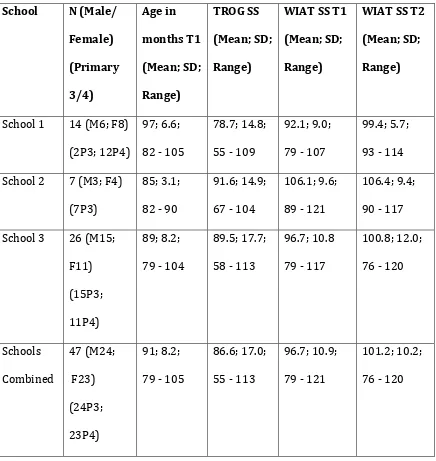
(Anonymised)’s cut-off for language disorder. They were designated as showing language-learning impairment (LLI), on the basis of their spoken language comprehension results. However, the children were not identified as language disordered, and may or may not have had the functional communication difficulties required for a clinical diagnosis. Eighteen of the 47 children (38%) were designated as showing LLI rather than the <10% expected by the standardisation sample. Descriptive statistics for number; gender; primary class; age; TROG-2 and WIAT-IIUK-T RCS SS at T1, and WIAT-IIUK-T RCS SS at T2 by school are shown in Table 1.
INSERT TABLE ONE ABOUT HERE
The intervention
The schools used the Scottish curriculum, the Curriculum for Excellence (CfE: Scottish Government, 2012). CfE provides non-statutory guidance to teachers, who use it to design a broad and balanced curriculum to dovetail with the needs of their school community. Reading comprehension strategies were discussed with classroom teachers from the three research schools near the start of the school year in a brief in-service session attended also by school senior staff. This session explained how reading
comprehension could be enhanced using strategies, and how these could be incorporated into on-going CfE reading instruction. Informal contact was thereafter maintained to address any issues arising. Information hand-outs and ‘reminder’ classroom display posters for staff and children were left for each class.
children would actively engage in reading comprehension by consciously accessing their prior knowledge; ‘prepare your mind. What is this about?’
children would develop and answer questions about important ideas in the text; ‘wonder to yourself. Does this seem likely?’
children would visualise what a text means; ‘if this was a film, what would I see?’ children would clarify points of mis-understanding; ‘if I don’t understand, stop, re-read. If I still don’t understand, find the problem word. Does it remind me of other words? If necessary, look it up.’
children would make inferences around the text; ‘how does this relate to what I already know? What was new?’
children would summarise; ‘what do I know so far? What do I need to know?’ children would re-tell the main points of the text; ‘in my own words, that means….’
Children were also taught hand gestures from Courtney and Gleeson (2010) to indicate when they were using strategies and which one, and encouraged to hear a voice ‘reading aloud’ in their head. They were asked to reflect after reading texts by thinking where the ‘story’ could have gone a different way (’crunch points’), and to learn unfamiliar words by adopting word-learning strategies from (Anonymised). Children also attended to text organisational structures; engaged in focussed discussion with teachers, and were offered appropriate texts in a motivating context that encouraged engagement with reading.
Results
A mixed model ANOVA was conducted with Group (LLI versus non-LLI) as the independent variable and pre- and post intervention (T1 versus T2) WIAT-IIUK-T RCS SS scores as the dependent variable, collapsed across schools and gender. Preliminary analysis revealed small numbers (N= 9) of males and females in the LLI group and small numbers of participants in the LLI group in each of the schools (ranging from 2-8), which precluded reliable estimates from including schools and gender as independent variables.
There was a significant effect of group, with the non-LLI pupils achieving
significantly higher reading comprehension scores overall (F 1, 45 = 14.873, p = .0001 Partial Eta Squared = .248). There was also a significant effect of time-point (F 1, 45 = 11.382, p = .002, Partial Eta Squared = .202), indicating increases in reading
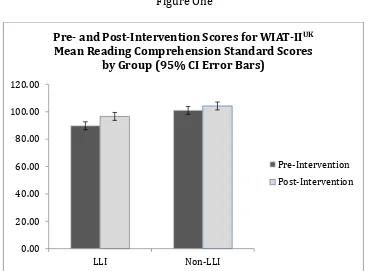
comprehension scores at T2. However, as shown in Figure 1, the group x time-point interaction failed to reach significance (F 1, 45 = 1.563, p = .218, Partial Eta Squared = .034) indicating that the intervention was equally successful for both LLI and non-LLI groups. The implications of the modest numbers in each of the groups (18 for LLI versus 29 for non-LLI) on statistical power should be noted, however.
INSERT FIGURE ONE ABOUT HERE
intervention effect for reading comprehension for the non-LLI group was 3.14 standard score points (corrected d = 0.32). The mean score change for the LLI group was 6.84 (corrected d = 0.72), which exceeds the upper-bound of the 95% confidence interval for the standard error of measurement for the WIAT-IIUK-T RCS based on test-retest
reliability data for the 6-9 years age-group reported in the test manual.
Therefore, in contrast to the non-LLI group, the mean reading comprehension score change for the LLI group cannot be attributed purely to measurement error arising from a practice effect from the re-administration of the test, although in the absence of a control group the possible contribution of regression to the mean cannot be entirely discounted.
While TROG-2 scores were significantly correlated with both pre-intervention and post-intervention WIAT-IIUK-T RCS scores (r = .588, p = .0001 and r = .400, p = .005 respectively), as the ANOVA reveals they were not predictive of change in reading comprehension scores across the intervention period (r = -.233, p = .116).
Discussion
The study is small-scale, with no control group, and with schools, teachers and children who volunteered to participate: it does not represent a complete population. No observations were made of teacher or child use of text-comprehension strategies,
although teachers reported that they were used. No counterfactual evidence was collected, and in the absence of a control group, changes in the reading comprehension scores were evaluated in terms of test-retest measurement error from the
standardisation sample of the WIAT-IIUK-T RCS. These factors would require to be addressed in future controlled studies.
intervention with existing research evidence in a new context; its acceptability to participants; the practicability and responsivity of the research measures, and potential effect sizes, before embarking upon a full-scale randomised controlled trial, which tends to be expensive. A cohort study is appropriate for these purposes.
Results appear sufficiently promising to merit further trials. The intervention was welcomed by teachers and school management, and was reportedly easy to implement within the Scottish curriculum, with low resource costs. By encouraging children to reflect on text actively within classroom reading activities when use of strategies may support their understanding, there is no need to ‘transfer’ techniques from other learning contexts. The standardised measures were practicable and acceptable to children, and WIAT-IIUK-T RCS was responsive to change. Measures detected the larger number of children with lower scores than expected by test standardisations found by previous researchers (Law et al. 2011, Locke et al. 2002; Sosu and Ellis 2014, Spencer et. al 2012). Children in Schools Two and Three, with most evidence of social deprivation as indexed by uptake of free school meals, had WIAT-IIUK-T RCS scores at T1 skewed towards the lower end of the normal distribution, and all three schools showed this pattern on TROG-2. 38%of pupils had TROG-2 scores below the 10th%ile.
Participant progress also suggests the intervention should be further researched. Children’s reading scores at T2 related to their scores at T1, but pupils in all schools made good progress, with a medium effect size on a measure controlled for age-related change. The intervention therefore appears promising for children in areas of social deprivation.
Children with LLI
would not be disclosed, and it is not known if any of the children in the study were already recognised by their school or family as having language difficulties. It is however probable, on the basis of previous research studies cited, that some children with LLI were not recognised.
TROG-2 was not a unique predictor of reading progress, supporting Dockrell et al.
(2012)’s finding for children with language impairments and autism spectrum disorders.
The intervention proved as efficacious for children with LLI as for non-LLI children. As a group children with LLI both began and ended with lower reading attainment scores than children without LLI (albeit with considerable overlap), and did not ‘catch-up’ with their non-LLI classmates. However, their progress over the year was just as great and they developed their reading comprehension abilities just as rapidly.It is nonetheless also possible that additional support to develop understanding of syntactic structures and morphemes would have been helpful to some children, with SLTs having a role in
advising schools on how such vulnerable children’s language might be supported in class. Identifying children whose lower language scores impair their social communication, and who require further assessment towards specialised intervention for language disorder, may also be useful. The study identifies a possible unmet need.
Conclusions
Results suggest that a larger, controlled study investigating the intervention is warranted. The ease of implementation and the positive outcomes, including gains for children with LLI, suggest the intervention is feasible, and should be further researched in a controlled study, and if successful in real-life implementation trials.
References
ADLOF, S.M., CATTS, H. W. and LEE, J., 2010, Kindergarten predictors of second vs. eighth grade reading comprehension impairments. Journal of Learning Disabilities, 43, 332-345.
BISHOP, D. V. M. (2003) Test for Reception of Grammar Version 2 (TROG-2). (London: Pearson Assessment).
BOTTING, N., SIMKIN, Z. and CONTI-RAMSDEN, G., 2006, Associated reading skills in children with a history of specific language impairment (SLI). Reading and Writing, 19, 77-98.
COURTNEY, A. and GLEESON, M., 2010, Building Bridges of Understanding: A Whole School Approach to Children’s Comprehension Development.
http://www.sess.ie/resources/reference-material/building-bridges-understanding-resource (accessed 23 October 2013)
DOCKRELL, J. RICKETS, J., PALIKARA, O., CHARMAN, T. and LINDSAY, G., 2012, Profiles of need and provision for children with language impairments and autism spectrum disorders in mainstream schools: a prospective study. London: Department for Education. Research
report DFE-RR247-BCRP9
JAMES-BURDUMY, S., DEKE, J., LUGO-GIL, J., CAREY, N., HERSHEY, A., GERSTEN, R.,
NEWMAN-GONCHAR, R., DIMINO, J., HAYMOND, K., and FADDIS, B. (2010) Effectiveness of Selected Supplemental Reading Comprehension Interventions: Findings From Two Student Cohorts (NCEE 2010-4015). Washington, DC: National Center for Education Evaluation
and Regional Assistance, Institute of Education Sciences, U.S. Department of Education.
LAW, J., McBEAN, K. and RUSH, R., 2011, Communication skills in a population of primary school-aged children raised in an area of pronounced social disadvantage. International Journal of Language and Communication Disorders, 46, 657-64.
LAW, J., REILLY, S. and SNOW, P. C., 2013, Child speech, language and communication need re-examined in a public health context: a new direction for the speech and language therapy profession. International Journal of Language and Communication Disorders, 48, 486–496.
LOCKE, A., GINSBORG, J. and PEERS, I., 2002, Development and disadvantage: implications for the early years and beyond. International Journal of Language and Communication Disorders, 37, 3–15.
MORRIS, S.B. and DeSHON, R.P., 2002, Combining effect size estimates in meta-analysis with repeated measures and independent-groups designs. Psychological Methods, 7, 105-125.
impairment? Journal of Speech, Language, and Hearing Research, 47, 199-211.
NATION, K., COCKSEY, J., TAYLOR, J. S. H. and BISHOP D. V. M., 2010, A longitudinal
investigation of early reading and language skills in children with poor reading
comprehension. Journal of Child Psychology and Psychiatry, 51, 1031-9.
NATION, K. and SNOWLING, M., 1997, Assessing reading difficulties: the validity and utility of current measures of reading skill. British Journal of Educational Psychology 67, 359-370.
SCOTTISH GOVERNMENT, 2010, Guidance on Partnership Working Between Allied Health Professions and Education. May 27, 2010. Edinburgh: Scottish Government.
SCOTTISH GOVERNMENT, 2012, Literacy and English: Experiences and Outcomes
http://www.educationscotland.gov.uk/learningteachingandassessment/curriculumareas
/languages/litandenglish/eandos/index.asp) (accessed on 18October 2013)
SHANAHAN, T., CALLISON, K., CARRIERE, C., DUKE, N. K., PEARSON, P.
SCHATSCHNEIDER, C., and TORGESEN, J. (2010) Improving reading comprehension in kindergarten through 3rd grade: a practice guide. NCEE 2010-4038. (Washington, DC:
National Center for Education Evaluation and Regional Assistance, Institute of Education Sciences, U.S. Department of Education).
SPENCER, S., CLEGG, J. and STACKHOUSE, J., 2012, Language and disadvantage: a comparison of the language abilities of adolescents from two different socioeconomic areas. International Journal of Language and Communication Disorders, 47, 234-284.
STOCKMAN, I. J., 2000, The new Peabody Picture Vocabulary Test-III: An illusion of unbiased assessment? Language Speech And Hearing Services In Schools, 31, 340-353.
STOTHARD, S. E. and HULME, C., 1992, Reading comprehension difficulties in children. The role of language comprehension and working memory skills. Reading and Writing, 4, 245-256.
STRAND, S. and LINDSAY, G., 2012, Ethnic disproportionality in the identification of speech, language and communication needs (SLCN) and autism spectrum disorders (ASD): 2005-2011, Department for Education Research Report DFE-RR247-BCRP15.
https://www.education.gov.uk/publications/standard/publicationDetail/Page1/DFE- RR247-BCRP15 (accessed on 22 November 2013).
VERHOEVEN, L. and VAN LEEUWE, J., 2008, Prediction of the development of reading comprehension: a longitudinal study. Applied Cognitive Psychology, 22, 407–423.
Acknowledgement
Table 1
Number, gender, primary class, age, TROG-2 Standard Scores and WIAT-IIUK-T Reading Comprehension Scale Standard Scores at T1; and WIAT-IIUK-T Reading Comprehension Scale Standard Scores at T2, by school.
School N (Male/ Female) (Primary 3/4) Age in months T1 (Mean; SD; Range) TROG SS (Mean; SD; Range)
WIAT SS T1 (Mean; SD; Range)
WIAT SS T2 (Mean; SD; Range)
School 1 14 (M6; F8) (2P3; 12P4)
97; 6.6; 82 - 105
78.7; 14.8; 55 - 109
92.1; 9.0; 79 - 107
99.4; 5.7; 93 - 114 School 2 7 (M3; F4)
(7P3)
85; 3.1; 82 - 90
91.6; 14.9; 67 - 104
106.1; 9.6; 89 - 121
106.4; 9.4; 90 - 117 School 3 26 (M15;
F11) (15P3; 11P4)
89; 8.2; 79 - 104
89.5; 17.7; 58 - 113
96.7; 10.8 79 - 117
100.8; 12.0; 76 - 120
Schools Combined 47 (M24; F23) (24P3; 23P4) 91; 8.2; 79 - 105
86.6; 17.0; 55 - 113
96.7; 10.9; 79 - 121
Figure One
0.00 20.00 40.00 60.00 80.00 100.00 120.00
[image:22.595.109.477.162.433.2]LLI Non-LLI
Pre- and Post-Intervention Scores for WIAT-IIUK Mean Reading Comprehension Standard Scores
by Group (95% CI Error Bars)
Pre-Intervention