City, University of London Institutional Repository
Citation
: Afshar, A.K. (1994). The effect of corporate divestment on shareholder wealth:
the UK experience. (Unpublished Doctoral thesis, City University London)This is the accepted version of the paper.
This version of the publication may differ from the final published
version.
Permanent repository link:
http://openaccess.city.ac.uk/7419/Link to published version
:
Copyright and reuse:
City Research Online aims to make research
outputs of City, University of London available to a wider audience.
Copyright and Moral Rights remain with the author(s) and/or copyright
holders. URLs from City Research Online may be freely distributed and
linked to.
THE EFFECT OF CORPORATE DIVESTMENT ON SHAREHOLDER WEALTH THE UK EXPERIENCE
A THESIS SUBMITTED TO THE CITY UNIVERSITY
BUSINESS SCHOOL IN THE SUBJECT OF FINANCE
for the degree of
Doctor of Philosophy
by
ABDOL KARIM AFSHAR
TABLE OF CONTENTS
CHAPTER 1- INTRODUCTION 12
CHAPTER
2-
CAUSES AND FORMS OF DIVESTITURE 172.1- CAUSES OF DIVESTITURE 17
2.1.1- MANAGERIAL PROBLEMS 20
2.1.2- NEED FOR CASH 26
2.1.3- STRATEGIC CHANGE 28
2.2- FORMS OF DIVESTITURE 32
2.2.1- SPIN-OFFS 33
2.2.2- REASONS FOR VOLUNTARY SPIN-OFF 34
I- MANAGERIAL CONSIDERATIONS 34
II- CAPITAL MARKET FORCES 35
III- RISK EFFECT 36
IV- TAX BENEFITS 36
V- MARKETING CONSIDERATIONS 37
VI- REGULATORY FACTORS 37
VII- LEGAL FACTORS 38
2.2.3- MANAGEMENT BUY-OUTS 38
2.2.4- SELL-OFFS 41
CHAPTER 3- REVIEW OF LITERATURE 47
3.1- PRICE DISCLOSURE 51
3.2- CERTAINTY ASSESSMENT 52
3.3- RELATIVE SIZE 55
3.4- FINANCIAL STRENGTH OF DIVESTOR 55
3.5- INSIDER TRADING, OWNERSHIP STRUCTURE 56
3.6- LONG TERM PERFORMANCE PLAN 57
3.7- MANAGEMENT MOTIVES 58
3.8- CONFOUNDING EFFECT OF OTHER NEWS 62
3.9- FACTORS INFLUENCING THE DIVESTMENT DECISION 62
3.10- METHODOLOGICAL ISSUES 64
3.10.1- SAMPLE SIZE 64
3.10.2- ESTIMATION PERIOD 64
3.10.3- CHOICE OF PREDICTION MODEL 66
3.11- THE PRESENT RESEARCH 66
3.11.1- CERTAINTY ASSESSMENT 67
3.11.2- PRICE DECLARATION, RELATIVE SIZE AND FINANCIAL STRENGTH 68
CHAPTER4-
HYPOTHESES AND METHODOLOGY AND DATA 704.1- HYPOTHESES 72
4.2- MARKET EFFICIENCY 79
4.2.1- MARKET EFFICIENCY 79
4.2.2- MARKET ANOMALIES 84
4.2.3- MARKET EFFICIENCY & EQUILIBRIUM MODELS 87
4.3- MODELS FOR MEASURING ABNORMAL RETURNS 88
4.3.1- MARKET ADJUSTED RETURN 88
4.3.2- OLS MARKET MODEL 89
4.3.3- MARKET AND RISK ADJUSTED RETURN MODEL 90
4.3.4- MEAN ADJUSTED RETURN 91
4.3.5- COMPARISON BETWEEN MODELS 92
4.4- TESTS OF SIGNIFICANCE OF ABNORMAL RETURNS - DEPENDENCE 93 ASSUMPTION
4.4.1- CHANGES IN PS 95
4.4.2- TEST STATISTICS UNDER THE INDEPENDENCE ASSUMPTION 96
4.5- T-TEST FOR DIFFERENCE BETWEEN TWO MEANS (DEPENDENCE ASSUMPTION)
4.6- PROPERTIES OF DAILY DATA 98
4.7- TREATMENT OF THIN TRADING 101
4.7.1- SCHOLES - WILLIAMS METHOD. 101
4.7.2- DIMSON METHOD (1979) 102
4.8- SIZE EFFECT 104
4.9- Z-SCORE 105
4.10- DATA PREPARATION 106
4.10.1- SOURCE OF DIVESTOR INFORMATION 106
4.10.2- PERIOD OF STUDY 106
4.10.3- METHOD OF SAMPLING 106
4.10.4-SAMPLE CHARACTERISTICS 109
4.11- DAILY SHARE PRICES 101
4.12-SUB-SAMPLES 113
CHAPTER 5-
EMPIRICAL RESULTS 1145.1- ALL ANNOUNCEMENTS 114
5.2- PRICE DECLARATION IMPACT 116
5.2.1- PRICE DISCLOSURE GROUP 117
5.2.2- NO-PRICE GROUP 118
5.3- INTENTION GROUP 120
5.3.1- INTENTION-PRICE GROUP 121
5.3.2- INTENTION NO-PRICE 122
5.4- COMPLETION GROUP 124
5.4.1- COMPLETION-PRICE GROUP 125
5.4.2- COMPLETION NO-PRICE 126
5.5- PRICE DISCLOSURE IMPACT 127
5.6- PRICE DECLARATION IMPACT ON THE ALL SAMPLE 127
5.6.1- PRICE DECLARATION IMPACT ON INTENTION SUB-SAMPLE 129 97 97
4-5.6.2- PRICE DECLARATION IMPACT FOR COMPLETION SUB-SAMPLE 129
5.6.3- PRICE DECLARATION IMPACT -FURTHER ANALYSIS. 130
5.7- COMPLETION ANNOUNCEMENT IMPACT 132
5.7.1- COMPLETION ANNOUNCEMENT IMPACT ON ALL SAMPLE 132
5.7.2- COMPLETION ANNOUNCEMENT IMPACT ON PRICE SUB-SAMPLE 134
5.7.3- COMPLETION ANNOUNCEMENT IMPACT ON NO-PRICE SUB-SAMPLE 135
5.7.4- COMPLETE CERTAINITY 135
5.8- PRICE - NO PRICE AND COMPLETION - INTENTION INTERACTIONS. 136
CHAPTER 6-
IMPACT OF ALTERNATIVE METHODOLOGIES 1436.1- IMPACT OF CHOICE OF 13s 143
6.1.1- MARKET ADJUSTED (13 = 1) VERSUS OLS UNADJUSTED 13's 147
6.1.2- DIMSON VERSUS SCHOLES AND WILLIAMS METHODS. 147
6.2- CHOICE OF PREDICTION MODEL 147
6.2.1- MARKET MODEL VERSUS CAPM 148
6.3- IMPACT OF DEPENDENCE/INDEPENDENCE ASSUMPTION. 148
CHAPTER 7-
IMPACT OF CONTEXTUAL VARIABLES ON 153MARKET REACTION TO SELL-OFFS
7.1- RELATIVE SIZE AND FINANCIAL STRENGTH 153
7.1.1- MULTICOLLINEAVITY PROBLEMS 157
7.2- TESTS OF HYPOTHESES CONCERNING RELATIVE SIZE 158
7.3- TEST OF HYPOTHESIS CONCERNING DIVESTOR'S FINANCIAL STRENGTH 160
7.4- RELATIVE SIZE AND FINANCIAL STRENGTH RELATIONSHIP 161
7.5- INTERACTION BETWEEN INDEPENDENT VARIABLE 161
7.6- POSSIBLE OMITTED VARIABLES 163
7.7- CONSISTENCY OF HYPOTHESIS 168
7.8 REVIEW OF RESULTS 170
CHAPTER 8-
SUMMARY AND CONCLUSION 1728.1- GENERAL RESULTS 172
8.2- STOCK MARKET REACTION TO PRICE ANNOUNCEMENT 173
8.3- STOCK MARKET REACTION TO STATUS OF DIVESTITURE 173
8.4- INTERACTION BETWEEN PRICE DISCLOSURE AND STATUS OF DIVESTITURE 174 ANNOUNCEMENT
8.5- THE IMPACT OF FINANCIAL STRENGTH OF THE DIVESTOR ON MARKET 174 REACTION
8.6- RELATIVE SIZE OF SELL-OFF AND SHAREHOLDER WEALTH 175
8.7- IMPACT OF ALTERNATIVE METHODOLOGIES 175
8.8- COMPARISON OF RESULTS WITH OTHER STUDIES 176
8.8.1-LIMITATION OF THIS STUDY 178
8.9- CONTRIBUTIONS TO THE FIELD 180
8.10- DIRECTIONS FOR FUTURE RESEARCH. 182
8.10.1- MOTIVES FOR PRICE DISCLOSURE AND COMPLETION 182 ANNOUNCEMENT.
8.10.2- FACTORS INFLUENCING THE DIVESTMENT DECISION IN THE UK 182
8.10.3- LONG TERM PERFORMANCE PLANS. 182
8.10.4- FINANCIAL STATUS 182
8.10.5- EFFECT OF MOTIVATION 183
8.10.6- EFFECT OF ACQUIRERS 183
REFERENCES
184APPENDIX
198-LIST OF TABLES
1.1 Aquisitions, Divestments and Buy-Outs in U.K.
3.1 Klein (1986) Price vs No-Price and Intention vs Completion.
3.2 Results of Selected Divestiture (Sell-off) Studies
4.1 Distribution of the UK Sell-offs and Sell-offs in the Sample (1985-1986)
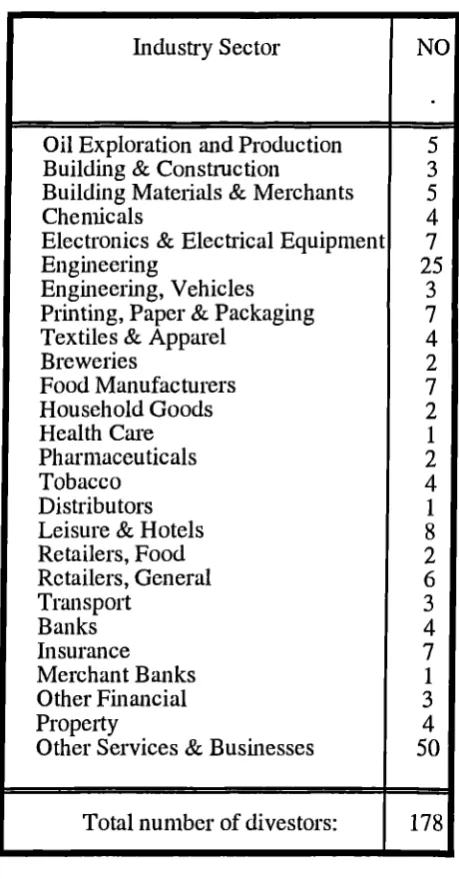
4.2 Distribution of Divestor's Industry Sector
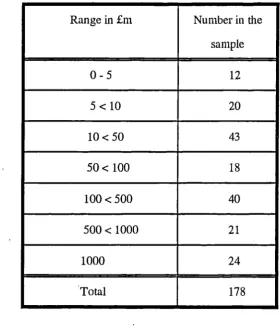
4.3 Divestors Market Size Distribution in Million £.
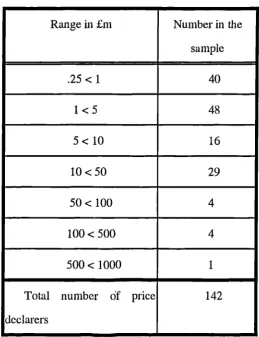
4.4 Divestees Size Distribution.
5.1 Time Series CARs and t-Statistics: All Announcements (n=178)
5.2 Breakdown of Sample in Terms of Price Declaration
5.3 Breakdown of Intention and Completion samples in Terms of Price Declaration.
5.4 Time Series CARs and t-statistics: Price Disclosure Group (n-142)
5.5 Time Series CARs and t-statistics: No-Price Group (n=36)
5.6 Time Series CARs and t-statistics: Intention Only (n=86)
5.7 Time Series CARs and t-statistics: Intention-Price group (n=69)
5.8 Time Series CARs and t-statistics: Intentions No-Price Group (n=17)
5.9 Time Series CARs and t-statistics: Completion Sample Only Group(n=92) 5.10 Time Series CARs and t-statistics: Completion Price Group (n=73)
5.11 Time Series CARs and t-statistics: Completion No-Price Group (n=19)
5.12 Price Impact Analysis CARs (%) for days (-2 to 0)
5.13 Time Series CARs (%) for Various Intervals, Price and No-Price Groups
5.14 Time Series CARs (%) for Various Intervals, Completion and Intention Only Samples
5.15 Impact of Price Disclosure and Intention/Completion on CARs (%),
Panel A: CARs of Sub-samples
Panel B: Difference in CARs between Sub-samples
5.16 Event Day AR and 21 Trading Day CAR For Various Samples in Descending
Order CAR Size
6.1 Average Betas Obtained from Combination of Lag and Lead Terms using the
Dimson Method.
6.2 Comparison of Average Betas
6.3 Comparison of CARs and t-statistics Obtained from Different
p
Estimates6.4 Comparison of CARs between the Market Model and the CAPM
6.5 Comparison of CAR (-2,0) with Dependence vesus Independence Assumption
6.6 Comparison of AR on day -1 with Dependence vrsus Independence Assumtion
7.1 Distribution of Relative Size of Divestment
7.2 Regression of Event Day (-1) AR on Sell-off Characteristics: Completion, Price
Disclosure, Relative Size and Z-score.
7.3 Regression of CARs on Intention/Completion, Price Disclosure, Z-score for
differing periods (n=147) FIGURE 4.1 Tree of sub-samples
ACKNOWLEDGEMENTS
Deepest thanks to Dr A.H.Ganj avian who encouraged me and gave me the confidence
to continue my studies from a Masters Degree to a Ph.D. degree. What seemed as an old
and impossible ambition gradually appeared within reach.
I would like to express my gratitude to Professor R.J. Taffler for his supervision,
advice and encouragement throughout this project. I am greatly indebted and thankful to
Dr. P.S. Sudarsanam who clarified every technicality throughout this research specifically
in the writing and presentation of this thesis and the related research papers. I would
also like to thank Dr. M. Lasfer who commented in detail on one of the earlier versions
of this thesis.
Special thanks to the staff of Southampton University: Professor C. Chapman who
permitted the use of Datasteam for collection of data; Mr. A. E. L. De Watterville who
permitted the use of computer facilities; and finally Mrs. P. Kurukulaaratchy and Mr. A.
Cotton who offered their indispensable help and expertise in programming and the
handling of data.
I am grateful to my wife, at home, my parents and my brothers at work who supported
me and who waited so patiently for this research to be completed.
My final thanks go to Mrs. V. Fabricious, Mrs P Sandle and Mrs. S. Bunyan who
typed and corrected this thesis and Dr. N. Siabi who assisted in refining the presentation.
DECLARATION
I
grant powers of discretion to the University Librarian to allow this thesis to becopied in whole or in part without further reference to me. This permission covers only
ABSTRACT
This is the first known study of stockmarket reaction to U.K. sell-off
announcements. Earlier U.S. studies have found positive market reaction to sell-off
announcements. Various of these have aimed to relate the magnitude of marketreaction to
factors such as price declaration, completion of agreement and financial strength of
divestor. This study also explores the impact of the above factors and their
inter-relationships. Typical event-study methodology is used in estimating the size of the
unexpected market reaction, the so called abnormal return.
Separate analysis of sub-samples is undertaken in this study to help enhance our
understanding of market response to corporate sell-offs. Examples of such sub-samples
are price/no-price groups and completion/intention groups. This analysis provides
explanations for some of the seemingly contradictory U.S. study results.
A measure of financial distress, namely the z-score, is introduced to explore the
"bankruptcy avoidance" hypothesis. We find a degree of financial distress prior to
divestment to be inversely related to abnormal return - a result consistent with market
approval for such "distress" sales. Relative size of divested part to parent is also shown to
be positively related to abnormal returns. Price declaration seems to be vitally important
in generating positive market response. Announcements of completed sell-offs along with
the price is even more welcome by the market. Announcement of completed sell-offs with
undisclosed price seems to induce market uncertainty and thus negative abnormal returns.
Announcement of intended sell-offs with price disclosure as well as our overall sample
results both provide statistically significant positive shareholder gains. This, latter finding
Chapter 1: INTRODUCTION
In the 1960's, US firms viewed mergers and acquisitions as a way of
strengthening their market position. They believed that economic synergy could be
derived from acquisitions. Such thinking resulted in the conglomeration of several
entities that had to survive as a group under a central management The running of such
newly grown corporations introduced problems in every aspect of business, from
finance and personnel, through to upgrading of manufacturing in the face of increasing
technological advances made by the specialized competitors. International
competition exerted pressure on firms to stay fit in their specific sectors. This pressure
resulted in major reorganisation of corporations towards streamlining of their
activities. In the 1970's, managers began to see that divestments could take place
without any overall economic loss to the company, that is, by selling a unit whose
continued presence is causing diseconomies or "negative synergy" in the selling firm
(Linn and Rozeff, 1986, p436). Therefore, beginning a surge in divestment activities
that is still on going.
Academic studies of divestiture in the finance literature have focused on the
impact of the divestiture announcement on shareholder wealth as measured by the
market. For example, an increase in the share price following the announcement of a
sell-off, implies gains to shareholders. Such a sell-off action should in theory take
place if the management expects a positive response from the stock market. The
present study aims to see if this is the case and whether divestment strategies in the UK
have led to increases in firm value.
Divestment is an important part of corporate restructuring and can take a number
of forms which include:
a) Sell-offs where a division is sold to a new parent.
12-b) Spin-offs where a division is incorporated as a new and independent entity and is
expected to survive on its own. The new ownership is initially kept within the same
group of share-holders as the parent's.
c) Management buy-outs where the company is sold to the existing management.
Within the context of the shareholder wealth maximisation objective the financial
impact of divestiture may be objectively measured by evaluating its impact on the share
price. Spin-offs are very rare among UK firms and, therefore, not the subject of this
study. Management buy-outs, although a regular method of divestment in the UK, are
also not considered in this study. Market reactions observed on the announcement of
management buy-outs is treated as a separate issue in the academic literature. This is
due to the difference in the internal and external circumstances of management
buy-out and sell-off deals.
Table 1.1 provides data on UK divestments since 1980 and shows the fairly steady
increase over the years in the number of sell-offs and in the average sizes of sell-offs, at
least until 1989.
Research in the United States demonstrates gains to shareholders around the
announcement of sell-offs. It also shows that the magnitude of gain has some
relationship to the relative size of the divested part compared with the parent (Zaima
and Hearth, 1985; Klein, 1986). Price declaration is also shown to be an important
factor in producing positive abnormal returns (Klein, 1986). The certainty of the
divestment deal being completed is also studied (eg. Hearth & Zaima, 1986) but no
clear conslusions have been drawn. Financial strength of the seller as measured by
Standard and Poor' s common stock ranking is found to produce higher gains to
TABLE 1.1- Aquisitions, Divestments and Buy-Outs in U.K.
INDEPENDENT SELL-OFF OF MANAGEMENT
ACQUISITIONS SUBSIDIARIES BUY-OUTS
YEAR NO.
ACQUIRED
VALUE
£M
AVE.
£M
No. VALUE
£M
AVE.
£M
NO. VALUE
£M
AVE.
fM
1980 368 1,265 3.44 101 210 2.08 107 50 0.47
1981 327 882 2.70 125 262 2.10 124 114 0.92
1982 296 1,373 4.64 164 804 4.90 238 348 1.46
1983 302 1,783 5.80 142 436 3.07 235 365 1.55
1984 398 4,252 10.74 170 1,121 6.59 238 404 1.61
1985 340 6,281 18.53 134 793 5.92 262 1,141 4.35
1986 621 12,279 19.8 221 3,089 14.0 313 1,188 3.79
1987 1187 11,861 10.0 340 4,668 13.7 344 3,214 9.3
1988 1123 17,300 13.1 376 5,534 14.7 371 3,715 10.0
1989 725 21,026 29.0 352 5,340 15.2 359 3,877 10.8
1990 2322 3,068 9.5 183 1,661 9.0 214 1,419 6.6
to June
Source: Business Monitor MQ7 and Center for Management Buy-Out Research of the University of Nottingham (Wright, Chiplin, Thompson and Robbie, 1992).
This research aims to examine the relationship between sell-off announcements
and security returns in the United Kingdom. It is the first known study that involves the
analysis of UK daily share prices in the divestment context. This study generally
the announcement of sell- offs. However, in addition to replicating the findings of the
US studies for the UK stockmarket environment, it also makes the following original
contributions to the field:
a) The impact of certainty of completion of the proposed sell-off is tested directly and
in isolation by examining a sample of announcements of completed sell-offs.
b) The impact of the initial announcement of divestment on shareholder wealth is
measured in isolation from the deals that have been completed and then announced.
Our results for this intention category show small and
insignificant abnormal returns. Alexander, Benson and Kampmeyer (1984) found
similar results and the discrepancy in their findings compared with other US
studies, up to now, has not been fully explained. Our results for this subcategory
are almost identical to those of Alexander et al (1984), and our consequent ability
to provide an explanation for their contradictory results is another original
contribution in this field.
c) The z-score, as a measure of company financial strength, is used for the first time
in the study of divestitures and the relationship between level of financial distress
of the divestor and stockmarket reaction to sell-off announcements is explored.
d) Several regressions of abnormal returns, as dependent variables, are conducted
against independent variables such as price declaration, completion and intention
of announcement, relative size of divestment to parent, and z-score.
e) On the methodological front, various tests using alternative measures of systematic
risk and alternative assumptions of both dependence and independence in residuals
are carried out and different return generating processes are modeled. Our
empirical conclusions, relating to daily data, are also important for other
The general methodology adopted in this study is similar to that used in the US
sell-off studies, that is, the risk adjusted excess returns surrounding the divestment
announcement event are used in assessing the significance of the announcement
impact. The methodology is based on Brown and Warner (1980, 1985). The relevant
model parameters are adjusted for thin trading by adopting both the Dimson (1979) and
Scholes and Williams (1977) methods and the results compared.
This study builds on and develops further in a UK context the extant US-based
research. As with extant US studies, it focuses on the impact of sell-off announcement
on shareholder wealth on or around announcement day. It does not explore managerial
motivation-related issues (eg Tehranian et al, 1987; Denning, 1988). This thesis
concentrates on sell-offs from 1985 through 1986, and the layout of this thesis is as
follows:
Chapter 2: describes the causes and different forms of divestiture.
Chapter 3: provides a review of the relevant literature and identifies key research
issues.
Chapter 4: discusses the main methodology used in the study, alternative
methodologies and the data.
Chapter 5: reports the initial empirical results.
Chapter 6: describes the effects of applying different methodologies on the results.
Chapter 7: provides the results of regressions of abnormal returns on z-score, relative
divestment size and price declaration for various sub-samples of data as
well as on Intention and Completion dummy variables.
Chapter 8: summarises the results, draws conclusions and suggests directions for
Chapter 2 CAUSES AND FORMS OF DIVESTITURE
2.1 CAUSES OF DIVESTITURE
The reasons for divestment are not the same for every company. The different
forms of divestiture, namely, sell-off, management buy-out and spin-off, are each
solutions specific to certain problems experienced by the divestor. Such problems
are explored by Coyne and Wright (1986, pp. 1-26). Problem areas that induce a
divestment can be grouped as follows:
1) Managerial Problems
2) The Need for Cash
3) Strategic Change
These categories are very broad and issues within them are inter- related. We aim
to explain the issues within each of these groups separately. Divestment of a specific
form is decided on with reference to the above categories of problems as part of
corporate restructuring. Restructuring refers to liquidating projects in some areas
and redirecting resources to other existing or new areas. The concept of
restructuring has also been applied to changing the ownership structures or
financing patterns in a firm. Divestment can be used as a means of corporate
restructuring.
In traditional finance theory, managers are assumed to act in the interests of
shareholders when divesting an asset or making a new investment. Management
may be viewed as being involved in continual research process for the configuration
of activities which produce the best returns for shareholders (Cable, 1977).
arising on such a decision. Shareholder wealth is similarly measured via the
discounted value of the after tax cash flows paid out by the firm, namely, dividends
plus capital gains. Corporate restructuring with a view to maximisation of
shareholder wealth forms the theoretical foundations of our analysis of causes of
divestments.
Furthermore, as mergers and acquisitions are also part of corporate restructuring,
the theories developed in the field of mergers and acquisitions are of assistance to us
in understanding the reasons for divestment. One such theory is the life-cycle
theory. Life-cycle theory has been applied to products as well as industries. It
consists of four stages: development stage, growth stage, maturity stage and decline
stage. At the development stage of a new product or industry, an introduction period
may be required. Such introductions may be associated with losses to the innovating
producers. Growth stage is when consumer acceptance has been achieved and sales
are growing. This stage is associated with high profitability and additional capacity
is attracted into the industry. Maturity stage is when growth rate of sales slows
down. The additions to capacity, stimulated by the record of high profits, may reach
their peak as the growth of sales begins to slow. Excess capacity in the industry may
develop and prices and profits decline. At the decline stage new products substitute
at least in part for existing products. As substitute products are successfully
introduced, they begin to erode the sales of the older product lines and growth rates
for the older firms decline.
A generalised industry life-cycle is used to describe how different stages in an
industry's development may lend themselves to different types of merger activities.
At the introductory and growth stages, new small firms with investment
opportunities but no cash to exploit them may sell out to larger firms from mature
-industries where cash flows exceed investment opportunities. As products reach
maturity stage, growth slows down and competitive pressures increase as excess
capacity develops. This period is more likely to produce horizontal mergers in an
effort to keep costs down via economies of scale (Weston et al, 1990, p.104).
The role of the industry life-cycle in relation to mergers and acquisitions is in
much dispute. Wright and Thompson (1986) test for vertical disintegration and find
no support for the view that such divestment is typical of growing markets. Harrigan
(1979) has shown the importance of divesting product areas in the declining phase
of their life-cycle. Duhaime and Grant (1984) find that life-cycle of the product and
the firm may be influential in determining divestment. The general economic cycle,
however, is not usually found to be a determinant of divestment. The UK experience
shows, on the other hand, that in the case of a deep recession, as in the early 1980s,
divestments may rise steeply (Coyne and Wright, 1982). Lack of finance may cause
parents to sell-off those subsidiaries which are a great drain on resources, or in some
severe cases, those which provide the easiest means of raising funds quickly (Coyne
and Wright, 1986, p.13).
Schendel and Patton (1976, p.240) note that unexpected poor performance and
deepening stagnation pressurise firms to take major decisions such as divestments.
Pashley and Philippatos (1990) found different patterns of divestiture related to the
life-cycle of divesting firms. Firms ending their expansionary phase and those
entering maturity stage divested to reduce debt burdens incurred during
expansionary phases. On the other hand, firms reaching their peak of maturity and
those beginning their decline used divestment primarily to improve profitability by
selling off poorly performing units. The firms in their declining stage were found to
use divestment to improve their liquidity.
-19-2.1.1 MANAGERIAL PROBLEMS
Maximisation of shareholder wealth by managers on behalf of
shareholders requires effective control and monitoring of management as well as
long term managerial compensation schemes. The related problem of pursuit of
managerial self-interest to the detriment of shareholders is referred to as the
agency problem. Jensen and Meekling (1976) were amongst the first to write
extensively about agency problems of the firm.
Agency problems arise basically because contracts between managers
(decision and control agents) and owners (risk bearers and principals) cannot be
costlessly written and enforced. Resulting (agency) costs include (1) costs of
restructuring a set of contracts, (2) costs of monitoring and controlling the
behaviour of agents by principals, (3) costs of bonding to guarantee that agents
will make optimal decisions or principals will be compensated for the
consequences of non-optimal decisions, and (4) the residual loss, that is, the
welfare loss experienced by the principals arising from the divergence between
agents' decisions, in their own self-interest, and their obligation to maximise the
principal's welfare. This residual loss can arise because the costs of full
enforcement of contracts exceed the benefits.
Despite potential agency problems many organisations are characterized
by separation of ownership and control, where decision agents do not bear the
major wealth impact of their decisions. This separation of risk-bearing and
decision functions is found in large professional partnerships, financial mutuals,
non-profit organisations and open corporations. Open corporations is a term
used by Fama and Jensen (1983) for large corporations whose residual claims
(equity) are least restricted. Following characteristics are identified: (1) They
-20-have property rights in the net cash flows for an indefinite horizon; (2)
Stockholders are not required to hold any other role in the organisation; (3)
Equity is alienable (transferrable, saleable) without restriction.
Fama (1980) and Fama and Jensen (1983) hypothesize that organizations in
which ownership and control are separated survive because they have found an
effective means of dealing with resulting agency problems. They argue that
agency problems are controlled by separating decision management and
decision control in complex organisations.
It is generally recognized that the decision process involves at least the
following elements:
1. Initiation of proposals for resource allocation and structuring
contracts.
2. Selection among alternative decision choices.
3. Implementation of ratified decisions.
4. Monitoring - measurement of the performance of decision agents.
5. Incentive and reward system.
Fama and Jensen (1983) hypothesize that the separation of residual risk
bearing from decision management leads to the separation of decision control
(selection, monitoring, and reward systems) from decision management
(initiation and implementation). Their view is that the separation is efficient in
complex organizations. Because the knowledge needed for decisions is diffused
among many agents, (i.e. different levels of managers) decision management is
delegated to agents who possess the relevant information - the hired professional
-21-managers in the firm. Decision control rests with residual claimants
(shareholders). The advantages to having residual claims in widely diffused
ownership are twofold. First, the large risk of uncertain net cash flows is shared
by many. Second, this enables corporate enterprises to raise substantial funds for
buying assets and for bonding payments to creditors.
The common features of decision control systems involve (1) a decision
hierarchy, (2) a mutual monitoring system among employees and managers, and
(3) top-level decision control which usually resides in the board of directors. The
ultimate source of internal control is the expert board of directors.
Fama and Jensen (1983) observe that open corporations are characterised by
the most complete separation of decision management and residual risk bearing.
This specialisation enhances adaptability to environmental changes. They point
to a number of mechanisms which exist to control agency problems that may
arise. Two of these mechanisms are external. One is the stock market by which
prices signal a wide perception of the effectiveness of internal decisions. The
other external mechanism is the takeover market by which outsiders can oust
incumbent managers by direct appeals to residual claimants.
Control of the agency problem through the market mechanism has been the
subject of a number of studies. Manne (1965) argues in his seminal paper that the
alleged separation of ownership and control is considerably weakened by the
existence of the market for corporate control. This market conveys to small
shareholders both power and protection commensurate with their interest in
The market for corporate control requires and presumes a high positive
correlation between corporate managerial efficiency and stock price. The stock
price of a poorly managed company declines relative to its industry or the market
as a whole. A lower stock price facilitates takeover by giving the prospect of a
large capital gain to those who believe that they can manage the company more
efficiently. Thus, the takeover market provides some assurance of competitive
efficiency among corporate managers and thereby affords strong protection to
small, noncontrolling shareholders.
When organisational and market mechanisms are not sufficient to control
agency problems, the market for takeovers provides an external control device of
last resort (Manne, 1965). Mueller's (1969) managerialism theory argues that an
agency problem is not solved through merger activity and that, on the contrary,
merger activity is a manifestation of the agency problem. That is, managers are
motivated to increase the size of their firm. He assumed that management
compensation is a function of the size of the firm, and argued that managers adopt
too low an investment hurdle rate. But in a study critical of earlier evidence,
Lewellen and Hunstman (1970), presented findings that managers'
compensation is significantly correlated with the firm's profit rate, not its level of
sales. The basic premise of managerialism theory, therefore, is doubtful.
Mueller (1972) and Marris and Mueller (1980) have argued that
managerially controlled firms where managers are rewarded on relatively fixed
salaries according to their position within a large hierarchy, may not divest as
readily as those which are owner-controlled, where emphasis is on maximising
may provide a basis for subsequent growth and senior management may wish to
trade-off the benefits of empire building against the problems of controlling large
organisations.
Divestments can be seen as a way of enhancing managerial performance by
separating differing managerial units or by providing some managers with an
ownership interest in the firm. Wright and Thompson (1987) and Wright and
Coyne (1985) explain how selling-off divisions may ease control within the firm
without adversely affecting the units of the firm that remain. The ownership
interest can more effectively motivate managers if it relates to the division or
divisions that are under their control. The management interest in a large and
well established conglomerate where managers each have only a minor influence
is not so effective, in motivating managers, as an interest in a smaller divested
unit or in the remaining parts that they can influence and control.
There are several areas that generate managerial problems to the extent that
divestment might be viewed as a way out:
1) Behaviour of the managers of a subsidiary may not be compatible with the
objectives of the organisation as a whole and hence may be detrimental to its
overall performance.
2) The organisation may become so diverse and large that the central office is
unable to prevent divisional management opportunism occurring in the
divisions (Klein, 1983; Wright, 1986). Opportunism involves self-interest
seeking with guile and includes shirking, cheating and other suboptimal
behaviour. It can involve data distortion or making of self-disbelieved
3) A rapidly changing environment may hinder the subsidiary management's
ability to adapt to changed circumstances and hence poor performance
results through control loss (Wright et al, 1983).
4) New opportunities may be lost due to the lack of incentive for the
management to take advantage of such opportunities. To revive a spirit of
entrepreneurship may necessitate spinning off of the division concerned so
that management may be rewarded more directly within the new smaller
spun-off unit.
5) There might be incentives for some managers to leave the organisation and
set up in direct competition to the parent. Alternatively, managers may
engage in opportunistic behaviour which cannot be resolved internally by
improved incentives. The parent in such cases may decide to encourage a
management buy-out while protecting the required relationship between the
ex-subsidiary and parent.
Following a divestment there would be the need for a change in the composition
and responsibility of the management team, and incentive structure.
Another area of management literature that is of relevance to organisational
problems and divestment decision is transaction cost efficiency. A transaction
represents the transfer of a good or service across a technologically separable
interface (Williamson, 1971, 1973). The purchase rather than production of a car
component by an automobile manufacturer would be an example of such a
transaction. The transaction at arm's length may be smooth, or the parties to the
transaction may disagree on the quality of the goods or service and haggle over
the terms of exchange. A smooth exchange could be achieved by an
organisational arrangement between the transactors to provide for each other's
needs within the same organisation.
-25-There are circumstances where the firm might decide not to obtain a
product or service from the outside but rather produce the same internally,
(Williamson, 1971). Williamson (1971, 1975) argues that a set of environmental
factors together with a related set of human factors cause such contracts to be
costly to write, execute and enforce. He attempts to identify these sources of
friction which ultimately lead transactions to be executed within a firm rather
than across a market. He holds that the benefits derived from internalisation of a
transaction are from informational efficiency, particularly where strategic and
operational responsibilities are separated within a multi-divisional (M-form)
structure. This structure is claimed to permit the use of decentralised information
whilst, at the same time, minimising the potential for shirking, opportunism, etc.
The transaction cost model underlines the suitability of internalisation of
transactions in areas where frequent applications of proprietary knowledge are
made; where assets are indivisible (Teece, 1980) and where there is lack of trust
in complex transactions (Butler and Carney, 1983). However, the cost of
coordinating or managing transactions within the organisation may offset the
benefits of a smooth, internally organised transaction. Under these
circumstances the parent might decide to divest, in the form of sell-off, or
spin-off or management buy-out, and purchase the required product or service
from the divested part.
2.1.2 NEED FOR CASH
By the term "need for cash" we refer to the urgent need for funds to finance the
business as a going concern or to boost performance of some divisions in an
attempt to avoid further deterioration of the firm's financial position and ultimate
bankruptcy. Such needs for funds are distinguished from general requirements
for investment funds by their urgency. The requirements for long term
-26-investment funds are dealt with in Section 2.1.3 on Strategic Change below,
where the parent is considering the reshaping of the investment portfolio of the
group and the requirements for further investments.
The need for cash may be observed at the level of the subsidiary or the parent.
At the subsidiary level there may be demand for a large cash injection to
implement a project with recognised potential. The parent may be either unable
to raise, internally or externally, the required capital and thus lose the opportunity
for growth in that subsidiary. Two options may then be open to the parent: First,
the sale of the whole subsidiary and preferably, at a premium, to a buyer who can
exploit the potential of the subsidiary best. Secondly, the parent may have the
option to divest a different unit to raise sufficient cash for injecting into the
subsidiary with growth potential. In both cases the divestment route is taken.
In cases of severe financial distress, divestment may be the only route to
avoiding bankruptcy. Divestment may be used as means of raising cash and
reducing the debt burden of the group. Such a divestment may follow high
leverage buy-outs or high leveraged acquisitions. For example, in the case of the
Iscoceles bid for the Gateway supermarket chain, an agreement was made prior
to the bid whereby Asda would purchase a certain number of Gateway stores.
The proceeds from the sales were used to reduce the high levels of debt following
this acquisition. An extreme case of such an exercise is total liquidation, as an
alternative to bankruptcy. This would constitute selling assets of the firm
piecemeal to various interested parties rather than selling the whole of the firm to
one buyer. There is also a case for partial or total liquidation when management
believes that the existing management structure is no longer viable and that not
only do the assets have a higher-valued use elsewhere, but they are also more
-valuable divided and sold off in piecemeal fashion, (Hite and Owers, 1986, p.
422). Liquidation is proposed in such a situation as a way of unlocking such
shareholder wealth. The current organisation in this situation is dismantled and
each unit or division is sold as a going concern. Hite, Owers, and Rogers (1987)
find highly significant risk adjusted returns to shareholders over the
announcement period of liquidation (12.2% average).
The need for cash, although often stated as a reason for divestment, seems
to be only one of the reasons for divestment as it can be a very expensive way of
raising funds compared with borrowing or issuing equity (Linn and Rozeff,
1986, p.430). The real cause may simply be opportunistic in that the seller feels
it can obtain a good price for the subsidiary. The fact that the newly liquid assets
are used to pay off debt may be a secondary matter and not the sole purpose of
divestment
2.1.3 STRATEGIC CHANGE
Strategic planning as defined by Argenti (1974, p.15) is careful, deliberate,
systematic taking of decisions which affect, or are intended to affect, the
organisation as a whole over long periods of time. Ansoff (1969, Ch. 1) suggests
that strategic decisions are those that arise from the external influences on the
company (ie from its environment) as opposed to tactical decisions which arise
from internal problems. In this study we define strategic change as change in
those strategies that determine financial structure, product and market structure
and organisation structure. Such decisions are a response to environmental
pressures and changes. One of the causes of such pressures could be the industry
divestments is the level of mergers and acquisitions. Divestment waves are
found to follow merger waves within one to two years (Linn and Rozeff, 1986
p.435).
The parent firm's management may lack the expertise to manage dissimilar
assets. The assets may be creating negative synergy, actively interfering with
other profitable operations of the parent. The process of strategic divestitures
enables selling firms to salvage a portion of their investment by selling assets to
other firms who could exploite them more profitably. Such divestments may
also be planned prior to an acquisition if they are seen to be a poor fit to the
acquiring firm. In cases of acquisitions of undervalued investments or firms with
underperforming management, the acquiror may, after increasing the value of a
segment acquired, sell-off that segment at a profit.
Some divestitures can be made to correct previous investment decisions
(Weston et al, 1990, p.226). Mistakes may occur in connection with internal or
external investments. Such mistakes are likely to occur when companies engage
in efforts to diversify. This is because they are moving into product-market areas
with which they have less familiarity than with their existing activities. Some
divestments represent the harvesting of earlier successful investments. Here the
purpose may be to make financial and mangerial resources available for
developing other profitable opportunities.
Re-structuring of an organisation in an ever changing environment is of
paramount importance. Corporate restructuring in times of crisis might well
result in divestments (Wright, 1985, p.9). Crisis could be manifested in such
areas as:
-29-a) Finance, that is, severe liquidity problems.
b) Labour contract, when there are insufficient incentives, inability to monitor
the labour force, divisional employees requiring parity with workers in other
divisions, and when there is an inability on the part of the parent to change
pay and incentives structures.
c) Product markets, when there is a long term decline in the firm's markets and
affinities between different parts of the corporation may break down.
d) Organisation failure (Jensen and Meckling, 1976), where the functions of
the firm cannot be held together, monitored and managed effectively within
the existing organisation.
In each of the above cases the goal of the management is expected to be the
rescue of the group from the crisis and to maximise market value. Divestment, as
a means of corporate restructuring and regaining confidence within the group
may then be offered to the board in one or more of its various forms, spin-offs,
management buy-outs and sell-offs.
If the announced divestment is perceived by the market as good news, share
prices should increase and shareholders gain. An example of the usefulness of
divestiture as an effective tool in corporate restructuring is in the case of US
divestor Dillingham in 1978 (Hite and Owers, 1986, p419), where managers
orchestrated a remarkable series of structural changes and earned risk-adjusted
returns of 185% for their stockholders. Of this gain more than 160% preceded
the announcement of the leveraged buy-out proposals which included sell-offs,
The management of Dillingham started the restructuring following a
take-over threat which was initially perceived as a crisis. However, the
restructuring which was accomplished over a period of four years, was
conducted in a positive spirit of profit maximisation rather than rescue from
disaster. Whereas there are divestments that take place as a response to crisis,
there are also divestments by parents that take place in the absence of any crisis
-where the management can sell a unit at a price they can justify as a good deal.
The market should react positively to such deals and is apparently attracted to a
sell-off announcement when it can see that the parent is likely to remove certain
diseconomies and is shaped for making higher profits.
The sell-off of a subsidiary, division, or line of business, could be viewed as
a mechanism for transferring assets to higher valued users in other corporations.
The buyer of a divested entity may have comparative advantage in monitoring
and controlling the management of the subsidiary or may offer economies of
scale. Such gains from economic synergies are transferred to the seller in part as
a premium and thus one would expect to observe positive market response on
announcement of divestment in these cases. Linn and Rozeff (1984) argue that
there are only two valid reasons for divestitures:
1. The assets are worth more as part of the buyer's organisation
than as part of the seller's.
2. The assets are actively interfering with the seller's other
2.2 FORMS OF DIVESTITURE
Divestiture can be defined as the sale of a segment of a company (assets, a
product line, a subsidiary) to a third party for cash or for securities (Weston et al,
1990, p.734-). If this part is sold to its management, it is called a management
buy-out. If the ownership is transfered to the same shareholders as the parent's, it is
called a spin-off and if it is sold to an outside party it is called a sell-off. Each of these
categories will be addressed individually. There are, however, other categorisations
of divestiture. Coyne and Wright (1986) divide divestitures into six categories based
on the nature of ownership severance, the relative frequency with which it takes
place and the post-divestment ownership of the part disposed of. They regard
franchising, contracting out and asset-swaps as forms of divestiture and offer the
following definitions (pp.2-4):
"Franchising is the means by which trade can take place. The precise form
varies, but normally involves some kind of competition for the exclusive right
to produce a firm's product or service in a particular area for a given period".
"Contracting out has similarities with franchising in that firms engage in tenders
for the production of a service. However, the distinction may be made that
contracting-out involves the provision of a specific good or service to the parent
company. To all intents and purposes, the contractor obtains a monopoly
position for the period of the contract, and the service or good will be normally
provided by a contractor who is a specialist in that area".
"The case of asset-swap or strategic trade is treated separately because, strictly
speaking, little if any funds change hands. Transfer of ownership is effected by
exchanging some of the assets of one firm with some of those of another". It is
-32-a m-32-atch between wh-32-at one comp-32-any h-32-as which it wishes to dispose of -32-and wh-32-at
another company is prepared to offer. Although an asset-swap can stem from
the intention to divest a part of a business, it can also be regarded as a
reorganisation of a company's assets with the help of a matching party who
wishes to do the same. The payment, if any, is intended to equate the value of
assets swapped.
It is also necessary to mention equity carve-outs. Equity carve-out is defined
as a transaction in which a parent firm offers some of a subsidiary's common
stock to the general public, to bring in a cash infusion to the parent without loss
of control (Weston et al 1990, p.734). An equity carve-out is the initial public
offering (IPO) of some portion of the common stock of a wholly owned
subsidiary. These are also referred to as "split-off IPO's". The IPO of the
common stock of the subsidiary indicates public trading in a new and distinct set
of equity claims on the assets of the subsidiary.
However sell-offs, management buy-outs and spin-offs are the main
categories of divestitures as far as we are concerned. These all originate from
fundamental crises or opportunities within the internal and external
environments of the parent and affect its shareholders. We analyse in the next
sub-sections reasons for the choice of each method of divestment.
2.2.1 SPIN-OFFS
Corporate spin-off is defined as a transaction in which a company
distributes on a pro-rata basis all of the shares it owns in a subsidiary to its own
company shareholders, (Weston et al, 1990, p.745). In the case of a spin-off the
existing owners maintain ownership in and control over the newly divested
entity. Furthermore, the parent neither receives new funds nor incurs any
expenses other than flotation costs in relation to the spin-off.
Corporate spin-offs are more common in the USA and their rate accelerated in
the 1970's. There are also involuntary spin-offs. Commonly, involuntary
spinoffs are the result of complaints filed by a US federal or state regulatory
agency (Kudla and McInish, 1983, p.24). Federal complaints filed by the Federal
Trade Commission or the Department of Justice usually allege violation of
anti-trust laws, especially Section 7 of the Clayton Act. If the complaints are
upheld, the target of the complaint may be ordered to divest.
2.2.2 REASONS FOR VOLUNTARY SPIN-OFF
Seven categories of reasons for spin-offs can be drawn (Kudla and McInish,
1983, pp.12-26):
I- MANAGERIAL CONSIDERATIONS
Often the operations of the spun-off subsidiary are so different from
those of the parent that an independent management will benefit the
subsidiary. Operating as a wholly-owned subsidiary under central
management reduces the profit potential of what could otherwise be a profit
making and growing entity under its own independent management. As an
independent entity, the management would be expected to make the best use
of their skills and environment in order to survive. They can no longer depend
greater under the new circumstances of independence. The operational and
financial progress of the spun-off subsidiary will be more visible to
shareholders, the separate business will require executives to generate growth
and profits. There will be a clear basis for evaluation and correspondingly a
more accurate basis for appraisal of performance of the management by
employees, the public, and the investment community.
Schipper and Smith (1983) find that their sample of spin-off firms was
characterised by diversity of operation and recent expansion. They suggest
spin-off was used to segregate distinct business lines, presumably for reasons
of imposed management efficiency. This is supportive of the management
efficiency hypothesis and probably the reason behind the recent spin-off
movement in the USA (Schipper and Smith, 1983, p.443). However, they do
not rule out the possibility of market undervaluation of conglomerate assets
as a reason for spin-off as explained below.
II- CAPITAL MARKET FORCES
The management of the parent might consider spin-off of a subsidiary if
it is believed that the market value of the spun-off subsidiary plus the market
value of the parent after spin-off would be greater than the market value of the
parent with the subsidiary before spin-off (Miles and Rosenfeld, 1984).
Miles and Rosenfeld (1984) found favourable performance of firms'
share prices following a spin-off. They find that firms with multiple lines of
business are difficult to value because of a lack of accounting data and
because few analysts track (or fully understand) multiple-industry firms.
When a spin-off takes place, the spun-off part would need to provide
-information and accounts of its own activities independent of the parent.
Such availability of information could assist investors and market analysts to
evaluate the worth of individual lines of business better than when the parent
is reporting on overall group performance. In cases where the individual lines
of business are undervalued, such availability of information through spin-off
could raise the market value of the divested parts and thus the overall worth of
the parent.
III- RISK EFFECT
In many spin-offs, the spun-off firm's activity is very different from that
of the parent. When the operation of the subsidiary is more risky than the
parent's, the parent management may consider disassociation from the risky
subsidiary. Such a decision is seen to achieve reduced volatility of earnings
and hence stability and reliable forward planning and growth of the parent,
(Kudla and McInish 1983, p.19).
IV- TAX BENEFITS
There are areas of operations that may benefit from tax advantages if
they are made independent of the parent. In the U.S.A., for example, if the
company's principal asset is real estate, it may be able to qualify as a Real
Estate Investment Trust (REIT). REIT may deduct dividends paid to
shareholders from income before calculating taxes (Kulda and McInish,
1983, p.20). Tax related issues relevant to divestments in the U.K. are
V- MARKETING CONSIDERATIONS
Sometimes, firms spin off subsidiaries whose operations are not closely
related to their primary activities, not for reasons of reducing risk but for
marketing considerations. The reason offered is that such a move can allay
fears of customers, suppliers and others, that these firms were not committed
to, and might end participation in, their particular industries. Another
example of spin-off motivated by marketing considerations is when the
spin-off is designed to separate potentially incompatible product lines.
Division of two incompatible parts is aimed to enhance each division in its
effort to market its products (Kudla and McInish, 1983, p.23).
Incompatibility can arise in marketing organisations and sales back up. For
example, food and electronic products may require different types of
marketing organisations.
VI- REGULATORY FACTORS
Regulatory factors have been the cause of both involuntary and
voluntary spin-offs. Voluntary spin-offs have been made to separate
regulated and unregulated businesses. For example CBS Inc., spun off
Viacom International Inc. to comply with the rules of the US Federal
Communications Commission (FCC), which prevented television networks
from engaging in domestic cable television (CATV) operations and also
severely restricted their ability to do business in the worldwide film
VII- LEGAL FACTORS
Voluntary spin-offs are sometimes made by firms as a means of
overcoming legal obstacles which prevent the firm from accomplishing its
objectives. For example the Bank Holding Act 1969, in the USA, requires
companies whose business is not principally banking to divest themselves of
ownership and control of a commercial bank (Kudla and Mclnish, 1983,
p.26).
2.2.3 MANAGEMENT BUY-OUTS
The purchase of a subsidiary from its parent by the subsidiary's own
managers is called a management buy-out. The division is then run by
owner-managers. The buy-out arrangement is applicable to both the private
sector and the public sector and is, therefore, one of the means of privatisation.
There are many instances whereby the management buy the company from
absentee shareholders, a current owner-manager, the receiver, etc. Divestment
by management buy-out is not the focus of attention as far as this study is
concerned.
There are times when purchase of the subsidiary is not directly affordable by
its current management. When the purchase is largely financed by debt the term
leveraged buy-out is often used. If the management is prepared to pay the market
price for the division, the parent may decide to sell the subsidiary to its
management. Often the existing management is prepared to pay a higher price
than an outside firm as their dream of owning their own business can suddenly
come true in a collective way. Managers whose jobs might otherwise be in
efficiency, productivity and profit stem from the fact that they all now care more
and have no one to rely on for their salaries but their own joint effort.
Furthermore, they have inside information on the real value of the subsidiary and
may thus be prepared to pay a higher price than the market.
Management buy-outs increased during the 80's since: a) the number of
divestments as a whole increased, b) finance was made available for leveraged
buy-outs, c) it was a convenient way of divesting and d) the relationship of the
parent with the subsidiary could still be maintained if needed. Management
buy-outs in the UK grew during the 80's both in total value and average value.
The share of all acquisitions accounted for by buy-outs and buy-ins rose sharply
to almost a third of the total volume at 31.8% in 1989 and 22.1% of value in 1989
(Wright et al, 1992). However, in the first half of 1990, acquisitions of
independent companies and buy-ins both fell sharply. Buy-ins are defined as the
purchase of an equity holding by a new management team. The joint share of
buy-outs and buy-ins in all takeovers by value reached a peak of 26.6%. Their
share of volume was 34.9%, which was the highest since 1985. In 1979 these
were only 3% of all acquisitions (Wright et al, 1992).
According to Stallworthy and Kharbanda (1988): i) management buy-outs may
lead to a revitalisation of the company and later resale or flotation of the company
on the stock market. ii) The time between management buy-out and floatation on
the stock market has been getting shorter. iii) There is a tendency to increased
gearing (debt/equity) ratio in management buy-outs. iv) There are cases where
at a loss to another company or gone bankrupt. v) Based on the US experience,
management buy-outs with the following characteristics have generally been
found to be sound (Stallworthy and Kharbanda 1988, p.174):
1) Strong, stable earnings history with a predictable cash flow.
2) Growth, but not too fast.
3) A well defined niche in the market.
4) Are not too capital intensive and do not require much capital in near future.
5) Have a strong proven management
In general, if the profits of a subsidiary are dependent more on the
management and labour force than on its capital investment and technology, a
divestment by management buy-out would be expected to enhance performance.
From the parent's point of view, the subsidiary would thus be of greater value to
its existing management than to an outside investor as a detached independent
entity. Therefore under such circumstances the parent might choose to divest by
management buy-out in order to fetch higher sale proceeds. Some conditions for
a successful management buy-out from the point of view of the vendor and the
MB 0 team might be:
a) the management is prepared to pay the required price.
b) a quick and quiet internal sale is preferable to the parent.
c) sale to management will better preserve the overall reputation of the parent.
d) there is a personal bond such that the internal management will be
preferred.
e) there is sufficient hope and commitment on the part of the parent and the
UK evidence from two surveys covering the first half of the 1980's (Wright,
1986; Wright, Chiplin, Thompson and Robbie, 1990) shows that almost two
fifths of the bought-out divisions or subsidiaries sold their products and services
to the former parent. Around one quarter of buy-outs were found to purchase
goods from their former parent. However, for the most part, these links account
for a relatively small share of the buy-out's sale and purchases. Buy-outs from
non-UK parents were found, on average, to have a higher portion of sales and
supplies relations with their former owners than was the case with those acquired
from UK parents (Wright, Chiplin, Thompson and Robbie, 1990). UK parents
were generally customers and non-UK parents were suppliers to the divested
part.
2.2.4 SELL-OFFS
However key to this thesis is the sell-off. A sell-off is defined as the sale of
a part of a business to an independent buyer. It is the traditional method of
disposing of a subsidiary. Following a major acquisition the unwanted portions
are often sold off. A sell-off may result from financial, organisational or strategic
considerations raised by internal development and growth, or may follow an
acquisition. In the latter case a single acquired company may be split into several
parts for multiple sell-offs or several acquisitions may be grouped for a single
divestment. In 1980's a new form of acquisition emerged in the US, termed
"bust-up" take-over, in which companies were acquired and quickly
dismembered because the company was valued in aggregate lower than the sum
that could be realised by reselling the pieces separately.
Examination of US data for the years 1963 - 1983 reflects a strong
relationship between annual rate of change in merger activity in any given year,
-41-and the annual rate of change in divestiture in the years after. Linn -41-and Rozeff
(1986, p.435) find a strong statistical relationship between the annual rate of
change in merger activity in any given year, and the annual rate of change in
divestitures two years after. In other words, if the rate of mergers jumps we
expect that the rate of divestitures will rise sharply within one to two years
thereafter. Conversely, if the merger rate declines we can predict that the
divestiture rate will fall several years later.
Porter (1987) compiled data on a sample of 33 US Companies over the
period of 1950-1986. Each company on average entered 27 new sectors or fields
(e.g. financial services) and 80 new industries within the existing field of the
company (e.g. insurance). About 70% of each entry was made via acquisitions.
On average his sample firms divested 53.4% of acquisitions in new industries
and 60% of acquisitions in new fields. When acquisitions were in fields
unrelated to the companies' existing fields, the rate of divestiture was 71%.
Company divestiture to acquisition ratios up to 1980 range from 87% down to
17%. Similarly W.T. Grimm (1987) data shows divestiture to acquisition ratios
for the years 1975 to 1987 ranging between 35 to 54%. Such high
divestiture/acquisition rates could be interpreted as signs of dynamism among
US firms, and a contribution to resource mobility within an enterprise economy.
A large survey of US acquisitions and divestments by Ravenscraft and
Scherer (1987, pp.159-191) throws some light on the nature of divestment
activity. It shows that units acquired and later divested were on average in robust
good health at the time of their acquisition, but became gravely ill thereafter. It is
estimated that one third of acquisitions made during the 1960's and the early
likely to be subject to divestiture, than lines already operated by the parent
company in 1950. Declining profitability at the line of business or company level
or both, characteristically preceded a sell-off. Change in top management
encouraged the divestiture of acquired lines of business as the new management
had less personal attachment to existing lines. On the other hand, a strong market
position, reflected by high market shares and/or a large prior investment in
research, diminished the probability of sell-off. No evidence was found by
Ravenscroft and Scherer to support the argument that R & D and advertising
spending were cut back by the parent disproportionately in anticipation of a
sell-off. Their study finds that sell-off tends to occur in response to profit
performance deemed unsatisfactory by corporate management. They also found
that for both acquired and original lines, sell-off was on average a manifestation
of financial distress, that is, severe financial pressures precipitated the decision to
sell. Following sell-offs, substantial efficiency increases often occurred under
the new organisational structures established following divestiture.
In the UK, Wright (1988) shows that buy-out targets were usually owned only
for a small portion of their lives by the divesting parent before they were
purchased by an MBO team. In respect of sell-offs, Chiplin and Wright (1980)
show that over a quarter of the firms which divested in the two year sample period
they examined engaged in more than one divestment, with 4% undertaking at
least four sales of subsidiaries. From January 1984 to June 1986, some 16% of
the acquiring firms in the UK divested subsidiaries either to another group or to
incumbent management (Wright et al, 1992).
Companies Act 1989 requirements enable the Director General of Fair
proposals, usually involving the divestment of some of the assets of the merging
business in order to avoid reference to Monopolies and Mergers Commission
(MMC). Divestment may be ordered without reference to the MMC if legally
binding undertakings, to dispose of the required assets within a given period, are not
honoured. Recent recommendations of the MMC in respect of divestment include
requirements to divest the whole of an acquisition; divest the offending part of a
larger acquisition; reduce the shareholding in its target. In many cases the MMC has
sought to obtain undertakings from the parties concerned and has proposed
divestment if such undertakings to dispose of assets cannot be agreed (Wright et al,
1992).
As far as tax issues are concerned, it is comparatively rare for taxation
considerations to be the driving force behind corporate restructuring (Dicker 1990,
p. 99). It is, however, argued that the replacement of equity by debt in the form of
leveraged buy-outs in the United States is tax-driven. There are three ways of
divesting (Attwood,1988):
1. Selling the shares of an existing company.
2. Transferring the divested asset/operation into a new company
and selling shares of the new company to the acquiror, the so called "hive
down".
3. Direct sales of assets.
The divestor is primarily interested in the capital gains cost of selling. No
capital gains will be paid on the sales of assets of the divested part if the divested unit
is sold as an existing company rather than a combination of assets. The