Wang, Zheng and Ren, Jinchang and Wang, Yubin and Sun, Meijun and Jiang, Jianmin (2013) Reliable camera motion estimation from
compressed MPEG videos using machine learning approach. Optical Engineering, 52 (5). ISSN 0091-3286 ,
http://dx.doi.org/10.1117/1.OE.52.5.057401
This version is available at https://strathprints.strath.ac.uk/48372/
Strathprints is designed to allow users to access the research output of the University of Strathclyde. Unless otherwise explicitly stated on the manuscript, Copyright © and Moral Rights for the papers on this site are retained by the individual authors and/or other copyright owners. Please check the manuscript for details of any other licences that may have been applied. You may not engage in further distribution of the material for any profitmaking activities or any commercial gain. You may freely distribute both the url (https://strathprints.strath.ac.uk/) and the content of this paper for research or private study, educational, or not-for-profit purposes without prior permission or charge.
Any correspondence concerning this service should be sent to the Strathprints administrator:
The Strathprints institutional repository (https://strathprints.strath.ac.uk) is a digital archive of University of Strathclyde research outputs. It has been developed to disseminate open access research outputs, expose data about those outputs, and enable the
1
Reliable Camera Motion Estimation from Compressed
MPEG Videos using Machine Learning Approach
Zheng Wang1, Jinchang Ren2, *,Yubin Wang1, Meijun Sun3 and Jianmin Jiang3
[email protected] [email protected]
{wangyubin, sunmeijun, jmjiang}@tju.edu.cn
1 School of Computer Software, Tianjin University, Tianjin, 300072, China
2 Centre for excellence in Signal and Image Processing, University of Strathclyde, Glasgow, U.K.
3 School of Computer Science and Technology, Tianjin University, Tianjin, 300072, China
Abstract: As an important feature in characterising video content, camera motion has been widely applied in various multimedia and computer vision applications. A novel
method for fast and reliable estimation of camera motion from MPEG videos is
proposed, using support vector machine (SVM) for estimation in a regression model
trained on a synthesised sequence. Experiments conducted on real sequences show that
the proposed method yields much improved results in estimating camera motions whilst
the difficulty in selecting valid macroblocks and motion vectors is skipped.
2
1. Introduction
Camera motion estimation plays crucial roles in many multimedia and computer vision
applications. In Tan et al [1], camera motion is estimated from compressed MPEG
videos and used for video annotation. In Skulimowski and Strumillo [2], camera motion
parameters are employed to refine extracted depth/disparity metrics. In Ren et al [3],
camera motion is estimated from MPEG videos for event based video indexing and
retrieval. In Jiang et al [4], the extracted camera motion are applied in detecting
combined video events such as closing up of players in sports videos. In Ren et al [5],
camera motion is estimated as global motion by using phase correlation and then applied
to compensate frame difference for the detection of film dirt in archive restoration
applications.
Since compressed-domain processing can avoid time-consuming fully decoding of
the video, camera motion estimation from compressed videos is preferred [1, 3, 4, 6, 7].
Among these approaches, the classic work in [1] needs particular attention as it has
successfully directly motivated several other approaches [3, 4, 6].
In Tan et al [1], a six-parameter affine transformation is simplified to three
parameters, a zooming factor f and a 2-D shifts (px,py) . These parameters are
estimated using the motion vectors extracted from macroblocks of p-frames in
compressed MPEG videos. The reason here is that unlike b-frames which contain
bi-directional motion vectors thus need more complex processing in partially decoding of
the videos, p-frames have only forward motion vectors and can be easily parsed.
Due to unavailable motion vectors in intra-coded marcobocks and inaccurate motion
vectors in texture-free areas, Tan’s approach suffers a fundamental problem in choosing
3
macroblocks with zero motion vectors for improved accuracy. In practice, noisy motion
vectors can be non-zero hence this problem can be generalised as how to remove outliers
of motion vectors for robustness [3]. In Nikitidis et al [7], a stochastic model is
established from noisy motion vector fields for camera motion estimation with the
assistance of heuristic rules.
To overcome the problem in selecting macroblocks and motion vectors, a novel
approach is proposed to apply machine learning for motion estimation, where support
vector regression is employed. To the best of our knowledge, this is the first attempt to
apply support vector machines in this field, and the approach and promising results are
presented in the next two sections.
2. The Approach
In many video compression standards, such as MPEG and H.26x, block-based motion
estimation and compensation is widely applied. Accordingly, the motion vector and the
motion compensated resident can be used to restore the original image blocks. Since
motion estimation is of very high computational cost, how to make use of these extracted
motion vectors from compressed video sequences becomes a research trend [10].
Typically, the 6-parameter projective camera model is used as defined below [1, 3],
1 1 6 1 5 3 1 2 1 1 i i i i i y p x p p y p x p
x (1)
1 1 6 1 5 4 1 1 1 2 i i i i i y p x p p y p x p
y (2)
where p1 is the zoom factor (p11 represents zoom in and p11 represents zoom out)
and (xi,yi) and (xi1,yi1) are the image coordinates of corresponding points in two
4
and p5 and p6 refer to perspective distortion effects. Finally, p represents rotation 2
about the axis of the camera lens.
In general, inter-frame camera motion is relatively small and contains minimal lens
distortion effects [1, 18]. For simplicity, the distortion and the camera rotation are
ignored, so that the model contains only shift and zooming. Accordingly, the model
becomes by setting p20,p50 and p60.
4 3 1 1 1 1 0 0 p p y x p p y x i i i i (3)
Actually, the simplified model has been successfully for content-based video
annotation, indexing and retrieval [1, 3, 4, 6, 14, 18], where different videos such as
sports, news, movies, surveillance and home generated videos are used. In most videos,
rotation of the camera is rare, especially for surveillance, news and home generated
videos. To this end, the simplification of the model is a reasonable practice in this
context.
In Tan et al [1], corresponding pair of points are obtained automatically by checking
the two macroblocks in fi and fi1, where the two blocks are connected by the motion
vectors extracted in P-frames of compressed MPEG video. Finally, p1 is determined
below, where N refers to the number of inter-coded macroblocks:
Nk i k i
N
k ik i i k i w w w w w w p 1 2 1 ) ( 1
1 1( ) 1
T ) ( 1 || || ) ( ) ( (4) 1 1 1 1 1 4 3 1 i i i i i i y x y x p w p w p p (5) where T
1 ( ) 1
) , ( j j N
k jk
j N w x y
w
and T) ( ) ( )
(k ( jk , jk )
j x y
5
Since the above solution suffers from false alarms caused by object motion and
unreliable / non-exist motion vectors, selection of suitable motion vectors connected
macroblocks to be used in (4) and (5) is required. For different videos, this seems quite
arbitrary as different strategies need to be applied [11, 12].
The initial motivation to apply the SVM for camera motion estimation is to
overcome the difficulty in selecting such suitable macroblock pairs. As a result, all
macroblocks are used in training the SVM model. For those macroblocks without valid
motion vectors, we simply assign the average motion vector over all available ones to
them. To achieve this, firstly we extract motion vectors from all other macroblocks and
calculate their mean as (vx,vy). Then, (vx,vy) is assigned as the motion vector for all the
invalid motion vectors mentioned above.
For a given input vector x, the output of the SVM is determined as follows [21],
b
fSVM(x)wT(x) (6) where the two parameters wand brespectively refer to a weight vector and a bias that can be determined in the training process through minimizing a given cost function, and
) (
is a linear or nonlinear mapping to map the input vector x into a higher dimensional
space for easily separated by a linear hyperplane.
A training sample (xi,yi)is a support vector if it satisfies yifSVM(xi)1, where y is i the designed output. If we denote sk as extracted support vectors, k[ M1, ], the SVM function can be re-written as
) ( ) ( ) , ( ) , ( ) ( T 1 k k M k k SVM K b K f s x s x s x x 6
where K(,) is a kernel function to represent the effect of the mapping () in
prediction, including both classification or regression.
Three commonly used kernel functions are summarized as follows, which include
linear and two nonlinear functions. If the training samples are non-separable in linear
cases, non-linear kernels like polynomial and Gaussian RBF functions are preferred. In
addition, the associated parameters in the kernel functions, such as p and , can be
determined in the training process.
RBF e polynomial linear K j i p j i j i j i 1 2 T T ) 2 ( , ) 1 ( ) , ( 2
x x
x x
x x
x
x (8)
With the finally extracted motion vectors, for each of the three parameters in (3), i.e.
y x p p
f, , , a regression model is learnt by using the SVM on a manually synthesised
sequence generated by Maya with known camera parameters (as shown in Fig. 1). The
generated video is converted to MPEG-1 format for training, where the macroblock size
is 16*16 pixels. Motion vectors which were estimated using block-matching as defined
in MPEG are then directly extracted from these macroblocks and used in learning the
regression model.
Using 2-fold cross validation, the optimal parameters for SVM are determined via a
grid search, as suggested by many other researchers [22, 23]. Usually, the SVM is trained
with various combinations of parameter values, and the one which generates the best
training results is selected as the best. For the generated ground truth, both polynomial
kernel and Gaussian kernel are respectively employed for training. Not surprisingly, the
Gaussian kernel produces more accurate training results as it is preferred in many
7
validation seem much better, which indicates that Gaussian kernel causes severe
over-fitting of the problem.
To avoid over-fitting, the polynomial kernel rather than the Gaussian kernel is
adopted in our experiments, using the platform of libSVM [8] for implementation. The
motion vectors are normalised into [-1,1] before they are inputted to SVM as features for
prediction. For the training sequence, we then compare the mean squared error (MSE) of
estimated camera motion vectors against known ground truth over all frames. The MSE
for f,px,py is found as 0.032, 0.081 and 0.083, which shows a very high performance
in training. Finally, the learnt regression models are applied on real sequences to valid
the efficacy of the proposed approach.
3. Experimental Results
In our experiments, in total eight test sequences are used as summarised in Table 1. Four
MPEG-1 sequences, Movie11, Movie3, River and Under the Sea of frame size 352*288,
and four MPEG-2 video clips of frame size 720*576 and 720*480 are employed for
performance validation. The MPEG-1 videos are from [9], which have all three camera
motions, i.e. pan, tilt and zooming. Two MPEG-2 video clips are from youTube, which
are for the football game between two teams, the Real Madrid and AC Milan, on Aug. 8,
2012, in which large object motions and fast camera movement are contained. In other
two MPEG-2 sequences, one is from a surveillance camera in an airport and the other is
cycling video. These test videos are selected to cover a wide range of video contents.
This is not only reflected in the change of spatial resolutions, but also change of contents
in various aspects. For example, we choose videos of single or multiple objects,
indoor/outdoor scenes, home captured/professional videos, slow/fast movement as well
8
With the SVM models learnt from the synthesised sequence, we apply these models
to estimate camera motions from the test sequences, where again motion vectors are
extracted as input features of the SVMs. It is worth noting that the training is carried out
on the simulated sequence, i.e. independent on any testing sequence. Consequently, the
test results will inevitably prove the effectiveness of the proposed approach.
Since there is no ground truth information for these test sequences, motion
compensated frame difference is calculated for performance evaluation. Let f,px,py be
the estimated camera motion of two frames I and m Im1, motion-compensated difference
is given by
y x m m m y x y x I y x I I p y f y p x f x ,1( , ) ( ', ')| | ) ( ' ' (6)
Accordingly, the average frame difference over all frames, , and the standard
derivation , are obtained below, where M is the number of frame pairs.
m m m m I M I M 2 1 1 ] ) ( [ ) 1 ( ) ( (7)For the eight test sequences, the average frame differences and the standard
derivations are obtained and compared in Table 2, where the classic approach from
Tan et al [1] and the more recent work in [6] are used for benchmarking. The running
time of the two approaches are also shown in Table 2 for comparisons.
As can be seen, in general our approach yields the best performance among all three
methods in terms of the sum of average frame differences . In fact, our results are
consistently better than Tan’s approach, also it slightly outperforms Weng’s approach.
9
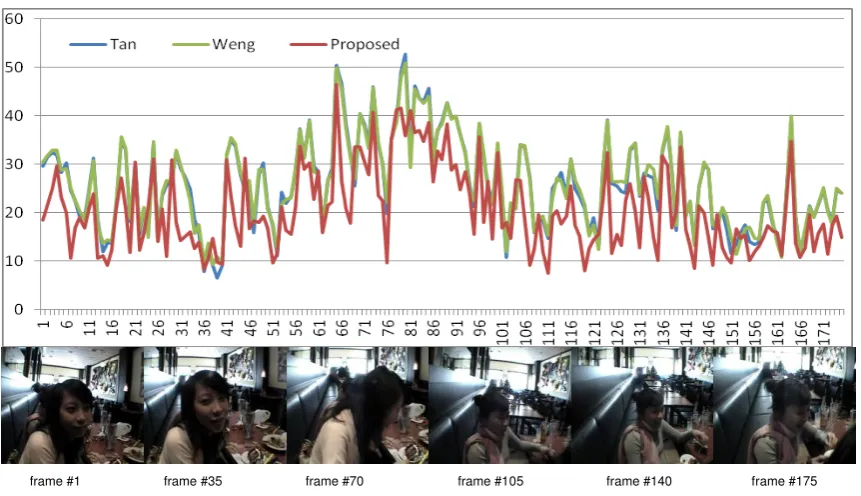
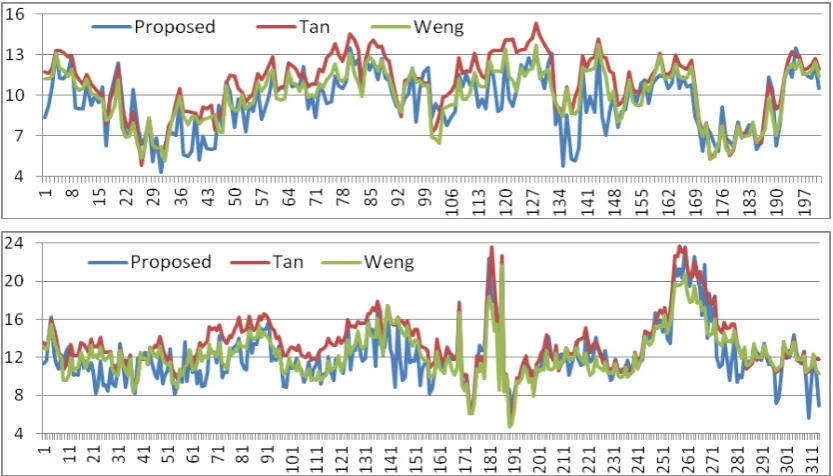
comparable, though our approach generates slightly less sum of standard derivation as
summarized in Table 2. Detailed comparisons over four sequences are also illustrated in
Fig. 2 and Fig. 3, respectively.
Regarding running time, the performance of the three approaches are quite
comparable and all satisfy real-time requirements, though Weng’s approach seems more
efficient, followed by ours and Tan’s approach. This is because the majority efforts in
common are used to extract motion vectors from compressed videos, yet estimation of
camera motion itself requires much less computational power. However, in at least two
sequences when there are complex (object) motions, Movie3 and Airport, Weng’s
approach generates the worst results. This has demonstrated that Weng’s approach fails
to deal with such complex cases, although the running time is reduced.
It is worth noting that in all the three approaches, ours and those in [1] and [6], as a
standard procedure, no object detection is required. As a result, object motion may affect
the estimated results as the extracted motion vectors become unreliable or inaccurate,
especially when the object is too large [19, 24]. In this case, the basic assumption that the
camera motion will be the dominant one in the frame will become invalid. One possible
solution is to remove the outliers of motion vectors that do not fit well with the global
motion model and re-estimate the camera motion model in an iterative process [24].
However, if the object is too large and persists for a certain period, the accuracy of
estimation will be still questionable.
To illustrate how object motion affects the accuracy of camera motion estimation,
Fig. 4 gives the motion compensated residual images for the Movie11 sequence, using
the results from our approach. If we compare the original frame image in Fig. 2 with the
residual image in Fig. 4, we can clearly find that these residuals are mainly caused by
10
can be a possible solution, although it needs fully decoding the video thus the overall
efficiency may be degraded. On the other hand, compressed domain processing has
provided a reasonable comprise in this context.
4. Conclusions
A novel machine learning based approach is presented for camera motion estimation
from compressed MPEG videos, using support vector regression with extracted motion
vectors as feature of input. When the support machine models is learnt from synthesised
sequence, the test results on real sequences produce much improved performance in
terms of motion compensated frame difference. Since selection of valid macroblocks and
motion vectors is skipped, our proposed approach provides a more feasible solution in
this context.
Acknowledgement
This work is partially supported by National Science Foundation of China under grants
numbered 61202165 and 61003201.
References
1 Tan, Y., Saur, D. D., Kulkarni, S. R., and Ramadgeet, P. J.: ‘Rapid estimation of
camera motion from compressed video with application to video annotation’. IEEE
Trans. Circuits Syst. Video Technol. (T-CSVT), 2000, 10, (1), pp. 133-146
2 Skulimowski, P. and Strumillo, P.: ‘Refinement of depth from stereo camera
11
3 Ren, J., Jiang, J., Chen, J., and Ipson, S. S.: ‘Extracting objects and events from
MPEG videos for highlight-based indexing and retrieval’. Journal of Multimedia,
2010, 5, (2), pp. 95-103
4 Jiang, J., Kohler, J., Williams, C., Zaletelj, J., Guntner, G., Horstmann, H., Ren, J.,
Loffler, J., and Weng, Y.: ‘LIVE: an integrated production and feedback system for
intelligent and interactive TV broadcasting’. IEEE Trans. Broadcasting, 2011, 57, (3), pp. 646-661
5 Ren, J. and Vlachos, T.: ‘Detection of dirt impairments from archived film sequences:
survey and evaluations’. Optical Engineering, 2010, 49, 067005
6 Weng, Y. and Jiang, J: ‘Fast camera motion estimation in MPEG compressed
domain’. IEEE Trans. Consumer Electronics, vol. 57, no. 3, pp. 1329-1335, 2011
7 Nikitidis, S., Zafeiriou, S. and Pitas, I.: ‘Camera motion estimation using a novel
online vector field model in particle filters’. IEEE T-CSVT, 2008, 18, (8), pp. 1028-1039
8 libSVM: www.csie.ntu.edu.tw/~cjlin/libsvm/
9 MUSCLE-VCD-2007: https://www.rocq.inria. fr/imedia/civr-bench/data.html
10Zhang, H. J., Low, S. Y., and Smoliar, S. W.: ‘Video parsing and browsing using
compressed data,’ Multimedia Tools and Apps., 1(1), pp. 89-111, March 1995.
11Dante, A. and Brookes, M.: ‘Precise real-time outlier removal from motion vector
fields for 3D reconstruction,’ In: Proc. ICIP, I, pp. 393-396, 2003
12Ewerth, R., Schwalb, M., Tessmann, P., and Freisleben, B.: ‘Estimation of arbitrary
camera motion in MPEG videos,’ In: Proc. ICIP, I, pp. 512-515, 2004
13 Papadopoulos, G. Th., Briassouli, A., Mezaris, V., Kompatsiaris, I., and Strintzis, M.
12
analysis,’ IEEE Trans. Circuits Syst. Video Techn., vol. 19, no. 10, pp. 1513-1528,
Oct. 2009
14Abdollahian , G., Taskiran, C. M., Pizlo, Z., and Delp, E. J.: ‘Camera Motion-Based
Analysis of User Generated Video,’ IEEE Trans. Multimedia, vol. 12, no. 1, pp.
28-41, Jan. 2010
15Hu, W., Xie, N., Li, L., Zeng, X., and Maybank,, S.: ‘A Survey on Visual
Content-Based Video. Indexing and Retrieval’, IEEE Trans. Systems, Man and Cybernetics,
Part C, vol. 41, no. 6, Nov. 2011, pp. 797-819
16Chen, Y., and Bajic, I. V., ‘A joint approach to global motion estimation and motion
segmentation from a coarsely sampled motion vector field,’ IEEE Trans. Circuits
Syst. Video Techn., vol. 21, no. 9, pp. 1316-, 1328, Sept. 2011
17Khatoonabadi, S. H., and Bajic, I. V.: ‘Video object tracking in the compressed
domain using spatio-temporal Markov random fields,’ IEEE Trans. Image
Processing, vol. 22, no. 1, pp. 300-313, Jan. 2013
18Kas, C., and Nicolas, H.: ‘Compressed domain indexing of scalable H.264/SVC
streams,’ Signal Processing: Image Communication, vol. 24, no. 6, pp. 484-498, 2009
MPEG-2
19Wang, J., Patel, N. V., Grosky, W. I., and Fotouhi, F.: ‘Moving camera moving object
segmentation in compressed video sequences,’ Int. J. Image Grap. 09, 609, 2009 20Badu, R. V., and Ramakrishnan, K. R., ‘Compressed domain video retrieval using
object and global motion descriptors,’ Multimedia Tools and Applications, vol. 32,no.
1, pp. 93-113, 2007
21 Ren, J.: ‘ANN vs. SVM: Which one performs better in classification of MCCs in
13
22Hsu, C.-W., and Lin, C.-J., ‘A comparison of methods for multiclass support vector
machines,’ IEEE Trans. Neural Networks, vol. 13, no. 2, pp. 415-425, 2002.
23Zhuang, L., Dai,, H., ‘Parameter optimization of kernel-based one-class classfier on
imbalance learning,’ Journal of Computers, vol. 1, no. 7, 2006
24Wang, H., Divakaran, A., Vetro, A., Chang, S.-F.,and Sun, H.: ‘Survey of
compressed-domain features used in audio-visual indexing and analysis,’ J. Vis.
14
Biographies
Dr Zheng Wang graduated from School of Computer Science and Technology in 2002
and also obtained his Master and PhD degrees from the same school in Tianjin
University, China in 2005 and 2008, respectively. He was a joint PhD student in
INRIA, France from Sept. 2007 to Aug. 2008. From Sept. 2009, he is a Lecturer in the
School of Computer Software, Tianjin University. His research interests focus on
image and graphics, and he has published over 20 papers and held several patents in
this field.
Dr Jinchang Ren received his undergraduate degree in Computer Software, MEng in
Image Processing, DEng in Computer Vision, all from Northwestern Polytechnical
University, Xi’an, China. He was also awarded a PhD in Electronic Media from
Bradford University, U.K. Currently he is a Lecturer and Deputy Director of
Hyperspectral Imaging Centre in the University of Strathclyde, Glasgow, U.K. His
research interests focus mainly on intelligent visual computing and multimedia signal
processing, especially on semantic content extraction for video analysis and
understanding and hyperspectral imaging. He has published over 100 peer reviewed
journal/conferences papers, and acts as an Associate Editor for two international
journals including Multidimensional Systems and Signal Processing (Springer) and
International Journal of Pattern Recognition and Artificial Intelligence.
Mr Yubin Wang is a Master student in the School of Computer Science and
15
Dr Meijun Sun obtained her Bachelor, Master and PhD degrees in 2002, 2005 and
2009, respectively all from School of Computer Science and Technology, Tianjin
University, China. She is now an Associate Professor in the same School. Her
research interests are mainly in using image and graphics techniques for Chinese paint
simulation and analysis. She has published over 20 papers with several Chinese
patents in this field.
Prof Jianmin Jiang received the B.Sc. degree from Shandong Mining Institute,
Shandong, China, in 1982, the M.Sc. degree from China University of Mining and
Technology, Xuzhou, China, in 1984, and the Ph.D. degree from the University of
Nottingham, Nottingham, U.K., in 1994. He is currently a professor of digital media
with the School of Computer Science and Technology, Tianjin University, China. He
is also an adjunct professor with the University of Surrey, Surrey, U.K. He is an
Evaluator for the Sixth and Seventh Framework Programmes (FP6/FP7) of the
European Union. He has published around 400 refereed research papers. His research
interests include image/video processing in the compressed domain, digital video
coding, stereo image coding, medical imaging, computer graphics, machine learning,
and artificial intelligence applications in digital media processing, retrieval, and
analysis. Dr. Jiang is a Chartered Engineer, a Fellow of the Institution of Electrical
Engineers and the Royal Society of Arts, Manufacture and Commerce, and a
16
Table 1. Sample frames of the 8 test sequences
Movie11 River Movie3 Under the sea
Single object slow motion
Fast camera motion, outdoor
Multi-object, home-video, indoor
Natural outdoor scene multi-object
Airport Cycling Football-1 Football-2
Multi-object indoor
Multi-object, fast outdoor motion
Multi-object, slow motion, sports
17
Table 2: Performance comparison of our method and those in [1] and [6].
Sequences Frame pairs and (size)
() Running time (s)
Tan [1] Weng [6] Ours Tan [1] Weng [6] Ours
Movie11 88 (352x288) 14.00(2.163) 13.22(2.160) 12.15(2.161) 0.55 0.51 1.14
Movie3 176 (352x288) 25.93 (0.705) 26.04 (0.688) 20.38 (0.643) 1.41 1.38 1.42
River 205 (352x288) 15.30 (0.552) 15.09 (0.551) 14.87 (0.527) 1.52 1.29 1.54
Under the sea 383 (352x288) 5.64(0.971) 5.41(0.971) 5.36(0.975) 2.98 2.17 2.34
Airport 212 (720x576) 10.70(0.536) 11.66(0.540) 11.23(0.541) 8.95 4.26 4.33
Cycling 41 (720x480) 37.64 (1.307) 35.25 (1.329) 34.53 (1.287) 1.14 0.98 1.65
Football clip 1 201 (720x576) 10.77 (0.160) 10.23 (0.139) 9.39 (0.149) 1.69 1.50 1.57
Football clip 2 315 (720x576) 13.49 (0.165) 12.79 (0.141) 12.16 (0.167) 2.20 1.96 2.10
18
List of Figure Captions:
Fig.1. Virtual Scene constructed by Maya.
Fig. 2. Comparisons of motion compensated frame difference of the Movie11 sequence
using Tan’s approach [1], Weng’s approach [6] and ours.
Fig. 3. Comparisons of motion compensated frame difference of the Movie3 sequences
using Tan’s approach [1], Weng’s approach [6] and ours.
Fig. 4. Comparisons on two football sequences of higher resolution and large object motions.
19
20
frame #1 frame #22 frame #44 pair #66 pair #88
Fig. 2. Comparisons of motion compensated frame difference of the Movie11 sequence
[image:21.595.85.501.75.361.2]21
frame #1 frame #35 frame #70 frame #105 frame #140 frame #175
Fig. 3. Comparisons of motion compensated frame difference of the Movie3 sequence
[image:22.595.75.506.68.316.2]22
[image:23.595.90.507.83.321.2]23
Frame pair #1 Frame pair #22 Frame pair #44 Frame pair #66 Frame pair #88
Residual image
Ours
e 12.7756 22.5303 11.2387 3.95588 8.81223
![Table 2: Performance comparison of our method and those in [1] and [6].](https://thumb-us.123doks.com/thumbv2/123dok_us/1669447.120471/18.595.91.506.105.316/table-performance-comparison-method.webp)
![Fig. 2. Comparisons of motion compensated frame difference of the Movie11 sequence using Tan’s approach [1], Weng’s approach [6] and ours](https://thumb-us.123doks.com/thumbv2/123dok_us/1669447.120471/21.595.85.501.75.361/comparisons-motion-compensated-difference-movie-sequence-approach-approach.webp)