Theses Thesis/Dissertation Collections
2010
Pond IDE: Machine level program development
environment and register transfer level simulator for
a massively parallel computer architecture
Jesse Muszynski
Follow this and additional works at:http://scholarworks.rit.edu/theses
This Thesis is brought to you for free and open access by the Thesis/Dissertation Collections at RIT Scholar Works. It has been accepted for inclusion in Theses by an authorized administrator of RIT Scholar Works. For more information, please [email protected].
Recommended Citation
Massively Parallel Computer Architecture
by
Jesse J. Muszynski
A Thesis Submitted in
Partial Fulfillment of the
Requirements for the Degree of MASTER OFSCIENCE
in
Electrical Engineering
Approved by:
Dr. Dorin Patru, Assistant Professor
Thesis Advisor, Department of Electrical and Microelectronic Engineering
Dr. Eric Peskin, Assistant Professor
Committee Member, Department of Electrical and Microelectronic Engineering
Dr. Daniel B. Phillips, Associate Professor
Committee Member, Department of Electrical and Microelectronic Engineering
Dr. Sohail A. Dianat, Professor
Department Head, Department of Electrical and Microelectronic Engineering
DEPARTMENT OFELECTRICAL ANDMICROELECTRONICENGINEERING
KATEGLEASON COLLEGE OF ENGINEERING
ROCHESTERINSTITUTE OF TECHNOLOGY
ROCHESTER, NEW YORK
Rochester Institute of Technology
Kate Gleason College of Engineering
Title:
Pond IDE: Machine Level Program Development Environment and
Register Transfer Level Simulator for a Massively Parallel Computer
Architecture
I, Jesse J. Muszynski, hereby grant permission to the Wallace Memorial Library to reproduce my thesis in whole or part.
Jesse J. Muszynski
c
Copyright 2010 by Jesse J. Muszynski
Dedication
Acknowledgments
I would like to acknowledge my advisor, Dr. Patru for his contributions to this work and my committee members for their guidance and feedback in the preparation of this
document. Additionally I would like to acknowledge Trevor West, my friend and colleague, for his help consulting me on the proper development of the Computer Science
Abstract
Pond IDE: Machine Level Program Development Environment and Register
Transfer Level Simulator for a Massively Parallel Computer Architecture
Jesse J. Muszynski
Supervising Professor: Dr. Dorin Patru
As computing architectures are being implemented in late and post silicon technologies, fault tolerance and concurrent operation are becoming increasingly important. It is already common knowledge that manufacturers are putting two, four or even more cores on a sin-gle silicon die to improve computing performance. The proposed architecture far exceeds
this number by grouping thousands or even millions of simplereduced instruction set
com-puting (RISC) processors, each of which is capable of a single operation at a time, and to communicate with its eight nearest neighbors. In this architecture, if a single core or cluster of cores have defects at the time of manufacture, or later in the life of the system, it is possible to test and disable them as necessary.
A fine-grained architecture of this kind calls for a parallel programming style. One approach to this problem is the use of a parallelizing compiler. Another approach may be
to use one of the severalapplication programming interfaces(APIs) available for standard
text based programming languages, with some built-in features for parallel programming. This work has generated a solution for creating machine level parallel programs for the massively parallel computer architecture described above using text and graphical means.
To support this programming method, an integrated development environment (IDE) and
a zero communication latency, register transfer level (RTL) simulator have been
Contents
Dedication. . . iv
Acknowledgments . . . v
Abstract . . . vi
1 Background and Motivation . . . 1
2 Architecture Organization . . . 4
2.1 Architecture Overview . . . 4
2.2 Instruction Set . . . 8
2.3 Communications . . . 11
2.4 Entity Movement . . . 18
2.5 Input/Output . . . 19
2.6 Entity Abutment . . . 21
2.7 Instruction Execution . . . 21
2.8 Function Calls . . . 22
2.9 Loops . . . 24
3 Programming Environment and Simulation Model . . . 27
3.1 Integrated Development Environment GUI . . . 27
3.2 Model of a Processor . . . 33
3.3 Specialty Tokens . . . 34
3.4 Simulator Basics . . . 36
3.5 Creating a Function Definition . . . 38
4 Experimental Results . . . 39
4.1 Sequential Code Example - Fibonacci Series . . . 39
4.2 Concurrent Code Example - Vector Addition . . . 40
4.4 Floating Point Packing and Unpacking . . . 44
4.4.1 IEEE Floating Point Standard . . . 47
4.4.2 Unpacking the Sign . . . 47
4.4.3 Unpacking the Exponent . . . 48
4.4.4 Unpacking the Significand or Mantissa . . . 48
4.4.5 Packing Floating Point Numbers . . . 50
4.5 Floating Point Multiplication . . . 52
4.5.1 24-bit Fixed-Point Multiplier . . . 52
4.5.2 Function Calls to Perform Floating Point Multiplication . . . 56
4.6 Integer Division . . . 59
5 IDE Development and Programming . . . 65
5.1 Program Structure . . . 65
5.1.1 GUI Related Classes . . . 66
5.1.2 Data Related Classes . . . 67
5.1.3 Simulator Related Classes . . . 69
5.2 Future Development of the IDE . . . 71
5.2.1 Loops . . . 71
5.2.2 Re-annotate IDs and Non-unique IDs . . . 73
5.2.3 Token Quick View and Print . . . 73
5.2.4 Data Structures (Data Element Arrays) . . . 74
5.2.5 Additional Opcodes . . . 74
5.2.6 Partially implemented IDE Features . . . 75
6 Conclusion . . . 79
Bibliography . . . 80
A IDE User Guide . . . 89
A.1 Menus . . . 89
A.1.1 File Menu . . . 89
A.1.2 Edit Menu . . . 90
A.1.3 View Menu . . . 91
A.1.4 Tools Menu . . . 93
A.1.5 Help . . . 93
A.3 Project Files . . . 96
A.4 The Property Grid . . . 96
A.5 Tokens on the Layout Grid . . . 98
A.6 Conditional Tokens . . . 100
A.7 Breakpoints . . . 102
A.8 Function Calls . . . 102
List of Tables
2.1 Information stored by one atomic processor, and its significance. Storage
requirements, in bits, for64K and1T seas of atomic processors. . . 9
2.2 The reduced instruction set. To meet the self-imposed requirement that
each atomic processor has to be a low complexity, processing element, we have included in the instruction set only fundamental arithmetic, logic, and control flow instructions. . . 10
2.3 Communications handshake codes. . . 13
2.4 Message routing scheme used during a global or entity casts. . . 15
2.5 Message formats. The numbers of bits in the shaded boxes change with the
size of the sea of atomic processors and/or size of operands. The message codes are described in Table 2.6. ID = Identification number; S = Source; D = Destination; I = Intermediate. . . 18
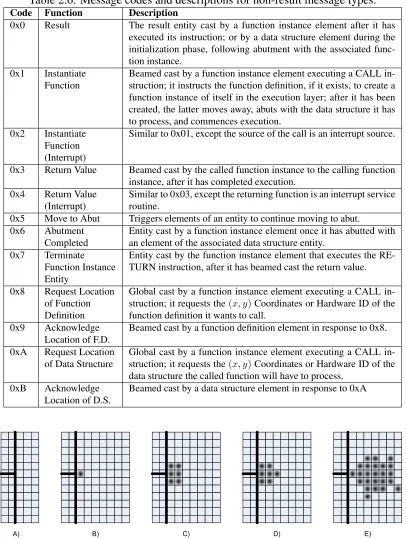
2.6 Message codes and descriptions for non-result message types. . . 20
List of Figures
2.1 The sea of atomic processors. Each atomic processor can communicate
with its eight adjacent neighbors. The input / output ports, illustrated in
bold lines, can be located at the periphery, or can penetrate the sea. . . 5
2.2 A snapshot of the sea of atomic processors. Programs are broken down into
functions. A function copy is stored in afunction definitionentity. When a
function is called, the function definition creates a copy, called afunction
instance. This moves away and abuts with the data structureentity it has
to process. . . 5
2.3 The communications hardware is divided into a send and receive layer.
Each layer uses a set of 8 handshake buffers and one message buffer. This allows full-duplex message passage. . . 12
2.4 A complete communications cycle. Atomic processor xis transmitting a
message to its neighbor, atomic processory. . . 14
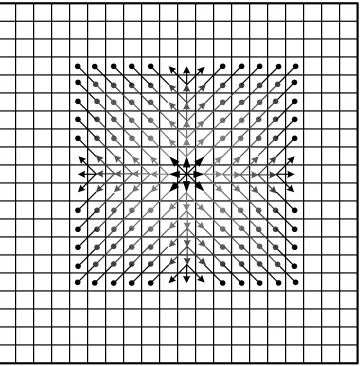
2.5 Routing and propagation of a beamed, entity, and global cast messages. In
a beamed cast, the maximum number of atomic processors the message has
to pass through is equal tomax{|xs−xr|,|ys−yr|}, where the sender is
at(xs, ys)and the receiver is at (xr, yr). In an entity cast the propagation
stops at the edge of the entity. . . 16
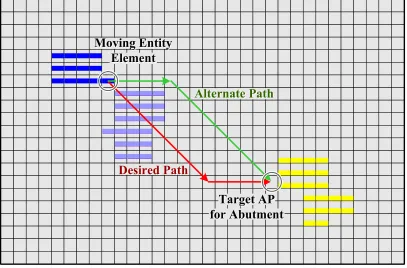
2.6 A moving entity is forced to move around another entity. Elements of the
moving entity move counterclockwise as many times as needed, and correct
their course as soon as possible afterwards. . . 17
2.7 An entity enters the sea of atomic processors, when viewed froma → f,
or exits the sea of atomic processors, when viewed fromf → a. Large
entities may be input or output via multiple ports and associated atomic
processors. . . 20
2.8 Routing and propagation of a global cast message. Using the scheme in
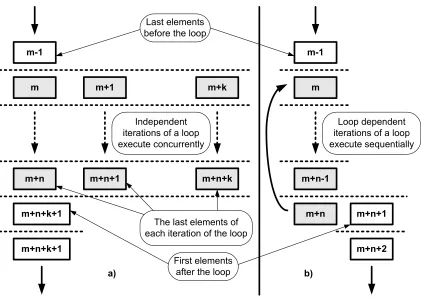
2.9 The execution of a loop without loop carried dependencies (a), and with loop carried dependencies (b). The gray shaded function instance elements are part of the loop iteration. . . 26
3.1 Text based code for the first four tokens of the 32-bit multiplier shown in
Figure 4.7. . . 29
3.2 IDE Property Grid . . . 32
3.3 Different tokens placed on the layout grid. . . 35
4.1 C code that calculates the first twelve elements of the Fibonacci series. . . . 40
4.2 Screen Capture of the Fibonacci Program showing the calculation of the
first twelve elements of the Fibonacci series. AP 10 returns the twelfth element to the calling function. Call out boxes have been added to show the values within each processor. . . 41
4.3 C Code that performs vector addition for two eight element vectors. . . 42
4.4 Screen Capture of the Vector Add Program showing two eight element
ar-rays of data elements, DEs 1 through 7 and 8 through 16, being added by APs 17 through 24. Call out boxes have been added indicating the operands, operation and output of each of the tokens. . . 43
4.5 C Code that performs integer multiplication using a left shift multiplication
algorithm. . . 44
4.6 Screen Capture of 32-bit Left Shift Integer Multiply Function Definition . . 45
4.7 Screen Capture of 32-bit Left Shift Multiply Simulation, multiplying
un-signed integers 5 and 10 to yield a result of 50. Call out boxes have been added to show the values within each processor. . . 46
4.8 C Code that unpacks the sign bit from the floating point number
represen-tation. . . 48
4.9 The sign bit of a floating point number is unpacked by simply masking the
MSB. Call out boxes have been added to show the operation performed by each processor. . . 49 4.10 C Code that unpacks the exponent portion of the floating point number
representation. . . 50 4.11 The exponent of a 32-bit floating point number is unpacked by masking off
4.12 C Code that unpacks the mantissa or significand portion of the floating point number representation. . . 52 4.13 The significand of a 32-bit floating point number is unpacked by masking
off the least significant 23 bits and adding a 1 in the 23rd bit position, where bit 0 is the LSB. Call out boxes have been added to show the operation performed by each processor. . . 53 4.14 C Code that packs a sign, exponent, and mantissa into the IEEE Floating
Point representation. . . 54
4.15 Packing operation for a 32-bit floating point number. The function defini-tion takes a sign, exponent and mantissa as inputs and outputs a floating point number. Call out boxes have been added to show the operation
per-formed by each processor. . . 55
4.16 C Code that performs a 24-bit fixed point multiplication using a right shift multiplication algorithm. . . 57 4.17 Right Shift Integer multiplier for 24 bit fixed point multiplication used in
floating point multiplication algorithm. Call out boxes have been added to show the operation performed by each processor. . . 58 4.18 C code that implements the top level floating point multiplication algorithm
by making calls to the previously mentioned C code. . . 60 4.19 Floating point multiply program with function calls to floating point
un-packing and un-packing operations and right shift fixed point (24bit integer) multiplier. Call out boxes have been added to show the operation performed by each processor. . . 61 4.20 C Code to perform division through iterative subtraction. . . 63 4.21 Example integer division algorithm [1]. . . 63
4.22 Screen Capture of sample division algorithm with Next Row to Execute
field and non-unique ID numbers indicated in call out boxes (Simulation
non-functional). . . 64
5.1 Export to Human Readable Code for the first four tokens of the 32-bit
mul-tiplier shown in Figure 4.7. . . 76
A.1 Example Project Properties Dialog from the 32-bit floating point number packing function. . . 92
A.3 Toolbar Buttons: A) Atomic Processor, B) Concurrent Array, C) Sequential Array, D) Data Element, E) Function Call, F) Design Mode, G) Simulation Mode. . . 95 A.4 IDE Property Grid . . . 99 A.5 A) The lines coming into AP1 are highlighted for easier reading, the line
exiting AP1 is in its normal unhighlighted state. B) The source token for AP2 has been deleted, a red stub remains. . . 100 A.6 Conditional Tokens A)Before Simulation tokens are yellow, B)During
Sim-ulation tokens change green or red based on if the condition is met. . . 101
A.7 Example of the 32-bit Left Shift Multiplier stopped at a breakpoint. . . 103
A.8 Example of the 32-bit Left Shift Multiplier stepped one step forward after
a breakpoint. . . 104
A.9 Example function call property grid for the Floating Point pack operation
Chapter 1
Background and Motivation
Parallelism and concurrency are inherent in many computational tasks. Techniques that
ex-ploit instruction and thread level parallelism in traditional von Neumann architectures have
been successfully applied in single processors, as described by Hennessey and Patterson
in [2]. During the past decade researchers and manufacturers have turned to multi-core
processors, which at the present time are limited to just a few cores [3–8]. Scaling up the
techniques used to exploit instruction and thread level parallelism in single core processors
to many core processors is challenging for both hardware and software designers [9–12].
As pointed out by Hennessy and Patterson in [2], multi-core processors are a
combi-nation of computer architecture and communications architecture. Computer networks on
a chip or cluster computing on a chip are adapting the vast knowledge base of designs
and architectures of macro computer networks to the micro scale, [13–26]. Marculescu
et al. in [27] classify outstanding research problems related to networks on chip into 15 categories. Predominant are problems related to communications infrastructure and
com-munications paradigms, as illustrated by [28–54]. Dongarra et al. explore the potential
symbiosis between networks on chip and multicore processors in [55].
Late and post silicon era integrated circuit fabrication technologies will continue to
number will not translate into an increase in performance unless new parallel and
concur-rent architectures are developed, as pointed out by Rabaey and Malik in [56], and Wen-mei
et al. in [57]. These new architectures will have to address reliability at the circuit and system levels because some components will experience premature, transient or permanent
failures, as highlighted by Austinet al.in [58]. Lei Zhanget al.address reliability and fault
tolerance in networks on chip in [59]. Power dissipation will have to be mitigated starting
at the system level. This is already being considered in multicore processors [60, 61], and
in networks on chip [62–67]. Nano architectures attempt to specifically address the
afore-mentioned challenges posed by late and post silicon technologies [68–76].
Taking into account the above considerations, a focus has been placed on exploring the
feasibility of a hardware design in massively parallel processing. The design itself consists
of an undetermined, but large number of simple, interconnected processing elements
re-ferred to as aseaof processors. Each element has the ability to communicate only with its
eight nearest neighbors through a dedicated message passing layer. Messages intended to
be passed a distance further than a nearest neighbor must propagate from processor to
pro-cessor using algorithms designed to optimize message passing using the shortest number
of hops to get to the intended recipients. While the design of the underling hardware is
im-portant and is discussed in Chapter 2, it is not the primary research focus. The architecture
organization and communication algorithms have been developed and described by Adam
Spirer in his thesis [1].
Accordingly, the current work focuses on the development of a machine level
program-ming environment, and register-transfer level simulator, for a massively parallel
architec-ture. The register-transfer level simulator assumes zero-latency communications. Initially,
the method of programming for the aforementioned architecture was performed in a C
like, text based format, but this quickly proved inadequate. The programming environment
program flow and register level information.
The organization of the architecture, including communications and operation, is
cov-ered in Chapter 2, followed by the description of the programming environment and
sim-ulation model of the architecture in Chapter 3. Experimental results are shown and
dis-cussed in Chapter 4, and development of the programming environment and simulator are
Chapter 2
Architecture Organization
An introduction to the architecture has been given in this chapter to provide the reader a
basis of what the machine level program development environment and register-transfer
level simulator aims to model. The chapters following this overview require this basis
for a solid understanding of the implemented model. The work introduced in this chapter
describing the development of the architecture is primarily the focus of Adam Spirer’s
thesis [1].
2.1
Architecture Overview
The proposed architecture is comprised of a sea of atomic processors, or atomic processing
elements, arranged in an orthogonal structure, as shown in Figure 2.1. All atomic
proces-sors are physically and functionally identical, but operationally independent. Each atomic
processor is a low-complexity processing element, capable of:
• Storing and executing one instruction, and storing its associated operands and result,
or
Input / Output Port AP (i,j) AP (i-1,j) AP (i-2,j) AP (i+1,j) AP (i+2,j) AP (i,j-1) AP (i-1,j-1) AP (i-2,j-1) AP (i-2,j-2) AP (i-1,j-2) AP (i,j-2) AP (i+1,j-2) AP (i+1,j-1) AP (i+2,j-1) AP (i+2,j-2) AP (i-2,j+1) AP (i-2,j+2) AP (i-1,j+1) AP (i-1,j+2) AP (i,j+1) AP (i,j+2) AP (i+1, j+1) AP (i+1, j+2) AP (i+2, j+1) AP (i+2, j+2)
Figure 2.1: The sea of atomic processors. Each atomic processor can communicate with its eight adjacent neighbors. The input / output ports, illustrated in bold lines, can be located at the periphery, or can penetrate the sea.
FI moving around dead APs DS moving between two other DSs
FD = Function Definition DS = Data Structure DS = Data Structure
FI = Function Instance Dead Atomic Processors
APs = Available Atomic Processors
FD = Function Definition
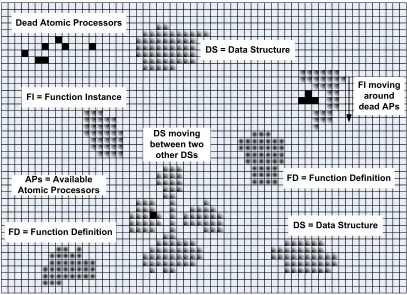
Figure 2.2: A snapshot of the sea of atomic processors. Programs are broken down into
functions. A function copy is stored in a function definition entity. When a function is
called, the function definition creates a copy, called a function instance. This moves away
In the sea of atomic processors, programs and data structures are organized as
morpho-logical entities, as shown in Figure 2.2. These can move, abut, and dissolve. As in the
C programming language, programs are broken down into functions. A function’s code is
stored in a function definition. When a function is called at runtime, the function
defini-tion creates an instance of the funcdefini-tion. The funcdefini-tion instance moves away, and eventually
abuts with the data structure that was passed to it by the calling function instance, before
commencing execution. Upon completing execution, the called function instance returns a
value or the result of processing in the form of a data structure.
Thus, in the sea of atomic processors as shown in Figure 2.2, we distinguish the
follow-ing morphological entities:
1. Function Definitions - FD. These are functions / programs not actively associated
with any data set or structure. An element of a function definition entity is an
in-struction word and its associated operand(s). In conventional architectures, these
entities are equivalent to copies of programs stored on hard disk or other high
ca-pacity storage media. These entities also include functions, which assist with input
/ output operations, and system level housekeeping. In conventional architectures,
these are equivalent to operating system functions.
2. Function Instances - FI. These are runtime instances of function definitions, which
can be or are already actively associated with a data set or structure. An element of
a function instance is an instruction word and its associated operand(s) and result. In
conventional architectures, these entities are equivalent to copies of programs loaded
at runtime into main memory.
3. Data Structures - DS. These are collections of associated data elements, which would
be processed by the same function instance. An element of a data structure is a data
complex as files on a hard disk or other high capacity storage media in conventional
architectures.
Not classified as morphological units,Dead Atomic Processorsare individual or groups
of atomic processors, which have been rendered not functional as a result of one or more
internal faults.
The architecture is inspired from the field of microbiology. The morphological entities
in the sea of atomic processors shown in Figure 2.2, move, change shape, and adapt like
microorganisms in a medium. The shape of an entity may change in the course of a
nor-mal move, a move around other entities or dead atomic processors, or to group together
associated elements.
Each atomic processor can store at the same time a function definition element, and a
function instance or data structure element. This breaks down the sea of atomic processors
into two functional layers: the definition layer, in which function definition elements are
stored, and the execution layer, in which function instance or data structure elements are
stored. In addition, in each layer the atomic processor stores configuration information
associated with each element.
The storage requirements for an atomic processor are summarized in Table 2.1. We
show for reference the size of each field in bits for a64K(216) and1T (240) seas of atomic
processors. The 64K sea of atomic processors is typical for a computer system used in
an embedded application, while the 1T is typical for a computer system used in desktop
applications. The morphological entity type indicates the momentary functional role of the
atomic processor. The hardware identification number contains thexandycoordinates of
the atomic processor, and does not change during the lifetime of the system. The entity
identification number identifies the element within the entity. The target entity
identifica-tion number and(x, y)coordinates are used during the move and abut processes, which are
described in Sections 2.4 and 2.6, respectively. The primary and secondary operand source
identification numbers indicate which element within the entity will provide the value of
these operands. Either of these can also be initialized. There can be up to 16 data types, of
which we currently encode: Boolean, character, character string, unsigned and signed
in-tegers of 16, 32, and 64 bits, single and double precision fixed and floating point numbers.
Theprevious execution order,execution order, execution countandexecution count iden-tification numberare used for execution flow control, as described in Sections 2.7 and 2.9. The operation code distinguishes between 256 different possible operations in the
instruc-tion set. Each instrucinstruc-tion can be executed uncondiinstruc-tionally or condiinstruc-tionally on the value of
four status bits. Their true and complemented values are stored in the execution conditions
field. The values of the status bits are produced by the element whose identification number
corresponds to the status bits source identification number.
2.2
Instruction Set
The reduced instruction set is listed in Table 2.2. To meet the self-imposed requirement that
each atomic processor has to be a low complexity processing element, we have included in
the instruction set only fundamental arithmetic, logic, and control flow instructions.
Com-plex or compound operations like multiplication or division are implemented as functions,
Table 2.1: Information stored by one atomic processor, and its significance. Storage
re-quirements, in bits, for64K and1T seas of atomic processors.
Name 64K 1T Value
METype 2 2 Morphological Entity Type (element)
0=Unoccupied; 1=FD ; 2=FI ; 3=DS Hardware ID 16 40 (x, y)coordinates of the atomic processor
Entity ID 16 40 Entity element identification number
Element ID 16 40 Entity element identification number
Target Entity ID 16 40 Target entity identification number used during the move and abut processes.
TargetEntityXYCoordinates 16 40 Target entity(x, y)coordinates used during the move and abut processes.
PrimaryOperandSourceID/ DataWordID
16 40 FD/FI:Primary operand source identification number; corresponds to an associated DS element data word ID SecondaryOperandSourceID 16 40 FD/FI:Secondary operand source identification num-ber; corresponds to an associated DS Entity ID or Ele-ment ID
PrimaryOperandType/ DataWordType (Execution)
4 4 FD/FI:Primary operand type; DS: Data word type SecondaryOperandType
(Execution)
4 4 FD/FI:Secondary operand type PrimaryOperandValue/
DataWordValue (Execution)
32 64 FD/FI:Primary operand value; DS: Data word value SecondaryOperandValue
(Execution)
32 64 FD/FI:Secondary operand value
PrevExecutionOrder 16 32 FD/FI: ExecutionOrder number, of element(s) that must execute before this element
ExecutionOrder 16 32 FD/FI:Element execution order number
ExecutionCount (Execution) 16 32 FI: How many times must this FI receive a result broadcast with a particular execution order number (from a previous instruction) before executing itself? ExecutionCountID 16 40 FI:Associated DS Element ID that also stores the
Ex-ecutionCountvalue
StatusBitsSourceID 16 40 FD/FI: Element ID whose execution result produces the status bits for this instruction (compared against Execution Conditions)
SourceStatusBitsValues 8 8 FD/FI: Status bits values received from Status-BitsSource
OperationCode 8 8 FD/FI:Instruction/operation code
ExecutionConditions 8 8 FD/FI:Status bits (C, N, V, Z, !C, !N, !V, !Z) required for execution of instruction
ResultValue (Execution) 32 64 FI:Result value of last execution ResultStatusBitsValues
(Execution)
8 8 FI:Result status bits of last execution
Cast Type 8 8
Total to Store: 386 754
To move FD/FI element: 274 538
Table 2.2: The reduced instruction set. To meet the self-imposed requirement that each atomic processor has to be a low complexity, processing element, we have included in the instruction set only fundamental arithmetic, logic, and control flow instructions.
Mnemonic Operation Code Operation
NOP 0x00 No operation.
ADDPS 0x01 Add primary and secondary operands.
ADDPC 0x02 Add carry and primary operand.
ADDPSC 0x03 Add primary operand, secondary operand, and carry.
SUBPS 0x04 Subtract secondary operand from primary operand.
SUBPC 0x05 Subtract carry from primary operand.
SUBPSC 0x06 Subtract secondary operand and carry from primary
operand.
INC 0x07 Increment primary operand.
DEC 0x08 Decrement primary operand.
INV 0x09 Bitwise inversion of primary operand.
AND 0x0A Bitwise AND of primary and secondary operands.
OR 0x0B Bitwise OR of primary and secondary operands.
XOR 0x0C Bitwise XOR of primary and secondary operands.
SETC 0x0D Explicitly set ‘carry’ flag.
SETZ 0x0E Explicitly set ‘zero’ flag.
SETN 0x0F Explicitly set ‘negative’ flag.
SETV 0x10 Explicitly set ‘overflow’ flag.
RSTC 0x11 Explicitly reset ‘carry’ flag.
RSTZ 0x12 Explicitly reset ‘zero’ flag.
RSTN 0x13 Explicitly reset ‘negative’ flag.
RSTV 0x14 Explicitly reset ‘overflow’ flag.
SHL 0x15 Shift left primary operand, pad with zeros.
SHR 0x16 Shift right primary operand, pad with MSB.
SHLC 0x17 Shift left primary operand through carry, pad with zeros. SHRC 0x18 Shift right primary operand through carry, pad with MSB. CALL 0x19 Function call instruction; requests the function defini-tion whose identificadefini-tion number is stored in the primary operand value to create an instance; the created function instance will process the data structure whose identifica-tion number is stored in the secondary operand value; the execution of this instruction completes when it receives a RETURN result from the called function instance. RETURN 0x1A Function return instruction; broadcasts return value of
2.3
Communications
Communications in the sea of atomic processors are constrained to the Moore
neighbor-hood, i.e. each atomic processor can only communicate with its eight adjacent neighbors.
This self-imposed design constraint is justified by the desire to eliminate the need for long
interconnects, which in nanometer technologies scale slower than devices. As a
conse-quence, communication latency becomes a key factor that affects the performance of the
architecture. To minimize the communication latency, we have developed a minimum
over-head, custom communications protocol.
Communications are used to pass messages, which contain operational information
and/or data. In the sea of atomic processors, messages can be broadcast in all directions,
i.e. over the entire sea of atomic processors (global cast), or just to a specific entity (beamed
cast). Within an entity, messages are sent to all elements of the entity (entity cast), to all
eight neighbors (local cast), or to only one neighbor (point-to-point cast).
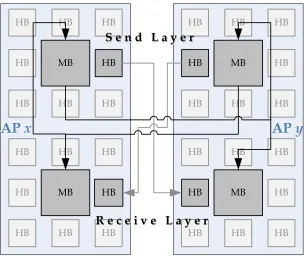
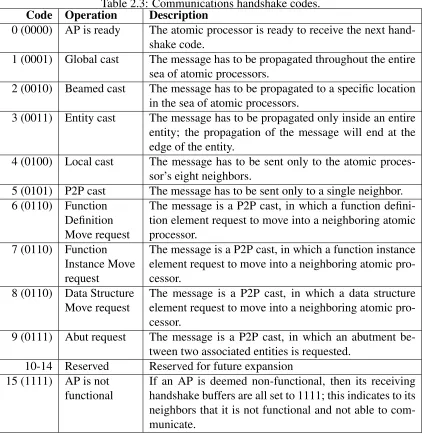
From a hardware point of view, communications use eight handshake buffer pairs,
which are used to exchange handshake codes, as shown in Table 2.3, and two message
buffers, which are used to exchange messages, as shown in Figure 2.3. The transfer of a
message from atomic processorxto atomic processoryis called hereafter a communication
cycle, and is illustrated graphically in Figure 2.4. It proceeds as follows:
1. Atomic processoryresets its receiving handshake buffer once it is ready to receive a
handshake code. This does not mean it is ready to receive a message yet.
2. Atomic processorxrepeatedly checks the receiving handshake buffer of atomic
pro-cessory. When it sees that the latter has been reset, it uploads the handshake code of
the message it wants to send.
handshake codes it may have received from other neighbors. This comparison is used
to prioritize transfers, where handshake code 1 in Figure 2.6 has the highest priority.
Once it is ready to receive the message from atomic processorx, atomic processory
resets its receiving handshake buffer again.
4. Atomic processorxchecks repeatedly the receiving handshake buffer of atomic
pro-cessory. When it sees that it has been reset again, it transfers the message into the
message buffer of atomic processory.
HB HB HB HB MB HB HB HB HB HB HB HB MB HB HB HB HB HB HB MB HB HB HB HB HB HB MB HB HB HB HB HB HB HB HB HB S e n d L a y e r
S e n d L a y e r
R e c e i v e L a y e r
R e c e i v e L a y e r
[image:27.612.162.466.289.545.2]AP x
AP
x
AP y
AP
y
Figure 2.3: The communications hardware is divided into a send and receive layer. Each layer uses a set of 8 handshake buffers and one message buffer. This allows full-duplex message passage.
The handshake code received by an atomic processor is used for two purposes: first, to
prioritize transfer requests received in the same cycle from different neighbors, and second,
Table 2.3: Communications handshake codes.
Code Operation Description
0 (0000) AP is ready The atomic processor is ready to receive the next
hand-shake code.
1 (0001) Global cast The message has to be propagated throughout the entire
sea of atomic processors.
2 (0010) Beamed cast The message has to be propagated to a specific location
in the sea of atomic processors.
3 (0011) Entity cast The message has to be propagated only inside an entire
entity; the propagation of the message will end at the edge of the entity.
4 (0100) Local cast The message has to be sent only to the atomic
proces-sor’s eight neighbors.
5 (0101) P2P cast The message has to be sent only to a single neighbor.
6 (0110) Function
Definition Move request
The message is a P2P cast, in which a function defini-tion element request to move into a neighboring atomic processor.
7 (0110) Function
Instance Move request
The message is a P2P cast, in which a function instance element request to move into a neighboring atomic pro-cessor.
8 (0110) Data Structure
Move request
The message is a P2P cast, in which a data structure element request to move into a neighboring atomic pro-cessor.
9 (0111) Abut request The message is a P2P cast, in which an abutment
be-tween two associated entities is requested.
10-14 Reserved Reserved for future expansion
15 (1111) AP is not
functional
APx checks APy receiving
HB for zero APy resets its
receiving HB
APx uploads handshake code in APy receiving HB APx APy APy compares handshake code to determine priority
When it is ready to receive the message, APy resets again its HB
APx checks APy receiving
HB for zero
APx transfers message in
APy MB
t
t
Figure 2.4: A complete communications cycle. Atomic processorxis transmitting a
mes-sage to its neighbor, atomic processory.
which are shown in Table 2.3. Code 0 indicates the atomic processor’s readiness to accept
the next handshake code from its neighbor. Codes 1-5 encode the five different cast types.
Codes 6-8 are used during the move process, and code 9 is used during the abut process.
Code 15 is used to indicate that the atomic processor is not functional. The remaining codes
are currently reserved for future extensions.
Each of the two communication layers shown in Figure 2.3 comprises one set of
hand-shake buffers and one message buffer. Thus, an atomic processor can receive and send a
message at the same time. This eliminates the possibility of lockup if both atomic
proces-sors try to send a message to each other at the same time.
To avoid duplicate transmissions of the same message to the same atomic processor,
during a global, or beamed, or entity cast, a message is routed according to the scheme
presented in Table 2.4. For example, if the message is received from the neighbor to the
north, it is sent to the south, southeast and southwest neighbors. Messages received from
east, south and west are routed in a similar way. Alternatively, if for example the message
is received from the neighbor to the northeast, it is sent to the southwest neighbor only.
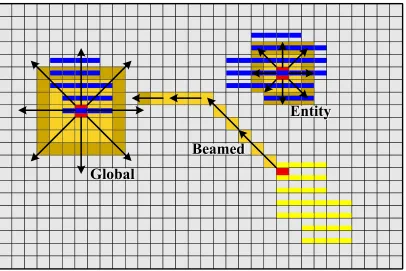
The routing and propagation of a global cast message is shown in Figure 2.5. This is also
applicable to an entity cast, except the propagation stops at the edge of the entity. The
casts are shown in Figure 2.6. In a beamed cast, the maximum number of atomic processors
the message has to pass through is equal to max{|xs−xr|,|ys−yr|}, where xs, ys, xr,
andyr are the(x, y)coordinates of the sending and receiving atomic processors.
Table 2.4: Message routing scheme used during a global or entity casts.
Receive From Transmit To
N NE E SE S SW W NW
N 4 4 4
NE 4
E 4 4 4
SE 4
S 4 4 4
SW 4
W 4 4 4
NW 4
We have identified the need for two message formats, as shown in Table 2.5a and 2.5b.
A type 0 or result message is entity cast either by a function instance element or a data
structure element. The former entity casts it after it has executed its instruction. The latter
entity casts it during the execution initialization phase, which follows the abutment with
the associated function instance. Message types are described in Table 2.6, and their usage
Beamed
Beamed
Global
Global
[image:31.612.109.515.219.490.2]Entity
Entity
Figure 2.5: Routing and propagation of a beamed, entity, and global cast messages. In a beamed cast, the maximum number of atomic processors the message has to pass through
is equal tomax{|xs−xr|,|ys−yr|}, where the sender is at(xs, ys)and the receiver is at
Desired Path Desired Path
Alternate Path Alternate Path Moving Entity
Element Moving Entity
Element
Target AP for Abutment
[image:32.612.107.514.231.499.2]Target AP for Abutment
Table 2.5: Message formats. The numbers of bits in the shaded boxes change with the size of the sea of atomic processors and/or size of operands. The message codes are described in Table 2.6. ID = Identification number; S = Source; D = Destination; I = Intermediate.
a) Result Message Format
Sea Size Message Type Message Source ID Result Value Primary/ Secondary Operand Execution Order Number Status Bits Reserved Total Bits
64K 4 16 32 32 16 8 20 128
1T 4 40 64 64 40 8 44 256
b) Message Formats for types 1-11
Sea Size Message Type Message Source ID Message Dest. ID Intermediate ID ID Type: S/D/I Reserved Total Bits
64K 4 16 16 16 2 / 2 / 2 70 128
1T 4 40 40 40 2 / 2 / 2 126 256
2.4
Entity Movement
An entity element moves from atomic processorxinto atomic processoryas follows:
1. Atomic processor x requests to move an entity element into atomic processoryby
setting its handshake buffer to code 6, if the element is a function definition element,
or to code 7 if the element is a function instance element, or to code 8 if the element
is a data structure element, as described in Table 2.3.
2. Atomic processoryresets its handshake buffer back to 0 if it is ready to receive the
new element. It can only do so if it is not storing any other similar entity element.
3. Once the move request is accepted, atomic processorx transfers the entity element
information through the message buffer.
The move is further triggered and sustained through the use of theMove to Abut
function instance element in the 64K and1T seas of atomic processors, 274 bits and 538
bits, respectively, have to be transferred. The size of the message buffers being 128 bits
and 256 bits, respectively, three transfers through the message buffer are necessary, and
therefore steps 1 - 3 are repeated three times for these kinds of elements. A data structure
element needs to transfer 148 bits and 276 bits, respectively, and therefore steps 1-3 are
executed twice.
In the course of a move, an entity element may encounter unavailable atomic
proces-sors. In this case, it first moves in an alternative direction, and then corrects its course by
moving again towards the target location. For example, in Figure 2.6 the moving entity
element encounters an unavailable atomic processor to the southeast. Then it tries the next
counterclockwise neighbor. In the example, the neighbor to the east is available, and it
moves into it. Then it tries again to move southeast but encounters another unavailable
atomic processor. Thus, it tries the next counterclockwise neighbor, and so on. Finally,
after five moves due east, it can turn southeast and move towards the target direction. If the
front of the moving entity gets stuck, the back is forced to move around and become the
new front. Thus, entities will not get stuck during moves.
2.5
Input/Output
Two special kinds of moves are the input and output of entities into the sea of atomic
processors. These occur through atomic processors which are connected to the input /
output ports, illustrated in bold in Figure 2.1. The input of function definition entities is not
time critical. Thus, it can be performed serially, following the steps illustrated in Figure 2.7.
As for data, the amount and speed to be input and/or output are application dependent. In
these cases, an entity may transfer via several input / output ports and associated atomic
Table 2.6: Message codes and descriptions for non-result message types.
Code Function Description
0x0 Result The result entity cast by a function instance element after it has executed its instruction; or by a data structure element during the initialization phase, following abutment with the associated func-tion instance.
0x1 Instantiate Function
Beamed cast by a function instance element executing a CALL in-struction; it instructs the function definition, if it exists, to create a function instance of itself in the execution layer; after it has been created, the latter moves away, abuts with the data structure it has to process, and commences execution.
0x2 Instantiate Function (Interrupt)
Similar to 0x01, except the source of the call is an interrupt source.
0x3 Return Value Beamed cast by the called function instance to the calling function instance, after it has completed execution.
0x4 Return Value (Interrupt)
Similar to 0x03, except the returning function is an interrupt service routine.
0x5 Move to Abut Triggers elements of an entity to continue moving to abut. 0x6 Abutment
Completed
Entity cast by a function instance element once it has abutted with an element of the associated data structure entity.
0x7 Terminate Function Instance Entity
Entity cast by the function instance element that executes the RE-TURN instruction, after it has beamed cast the return value. 0x8 Request Location
of Function Definition
Global cast by a function instance element executing a CALL in-struction; it requests the(x, y)Coordinates or Hardware ID of the function definition it wants to call.
0x9 Acknowledge Location of F.D.
Beamed cast by a function definition element in response to 0x8. 0xA Request Location
of Data Structure
Global cast by a function instance element executing a CALL in-struction; it requests the(x, y)Coordinates or Hardware ID of the data structure the called function will have to process.
0xB Acknowledge Location of D.S.
Beamed cast by a data structure element in response to 0xA
A) B) C) D) E)
Figure 2.7: An entity enters the sea of atomic processors, when viewed from a → f, or
exits the sea of atomic processors, when viewed fromf → a. Large entities may be input
2.6
Entity Abutment
After moving diligently towards the target location, at some point a function instance
ele-ment encounters a data structure eleele-ment. The function instance eleele-ment initiates an abut
request, using handshake code 9 and a point-to-point cast, and provides its entity
identifica-tion number. In return, the data structure element provides its entity identificaidentifica-tion number.
If the identification numbers match, the function instance element, entity casts an abutment
complete message, type 6 in Table 2.6. Because the move and abutment processes are
asynchronous, multiple function instance and data structure elements may abut at the same
time, so multiple abutment complete messages may be entity cast. The function instance
entity abutted to its associated data structure entity will hereafter be called a superentity.
Once they receive the abutment complete message, all data structure elements entity cast
their current data word values over the superentity. These are then received by all function
instance elements which have to update their primary and/or secondary operand values.
This means that before execution commences, all function instance elements have their
operands available, less the values updated at runtime.
2.7
Instruction Execution
Once abutment completes, and all data structure elements entity cast their data word
val-ues, the first instruction executes as soon as it has its operands available. At run-time, all
function instance elements monitor all entity casted result messages. If the message source
identification number matches one of their own source identification numbers, they update
their primary operands, and/or secondary operands, and/or source status bits values. At
the same time, they check theExecutionOrdernumber in the result entity cast message. If
all operand and source status bits values are available, the function instance element
ex-ecutes the instruction. TheExecutionOrder andPrevExecutionOrder numbers, which are
statically assigned, are the means through which the architecture implements the necessary
execution flow control. The operand values, source status bits values and ExecutionOrder
number may arrive in the same or different result entity cast messages, and in arbitrary
order. The instruction cycle completes when the function instance element entity casts the
result of its instruction execution.
There are obviously no structural dependencies. Data and control dependencies are
explicit, and therefore automatically resolved. Instruction level parallelism is exploited
dynamically and it is maximized, because an instruction executes as soon as it has its
operands, source status bits, and knowledge of the fact that the previous instruction in
the execution flow has executed.
At runtime, all result messages are entity cast over the entire superentity, and so also
reach all data structure elements. A data structure element updates its data word value
when there is a match between the message source identification number and its element
identification number. This means that when the function instance completes execution and
is ready to return the data structure, the latter is up to date.
All instructions defined in Table 2.2 execute as described above, except for CALL and
RETURN, which are described in the next section.
2.8
Function Calls
A function call involves four entities: the calling function instance, the called function
definition and its instance, and the data structure to be processed. A complete function call
and return cycle comprises the following steps:
function definition Y of the called function to create an instance of itself, which
should move to location(xZ, yZ)and process data structureZ. If the calling function
instance X knows the location of the function definitionY, it uses a beamed cast.
Else, it uses a global cast. In either case, it provides its own(xX, yX)coordinates.
2. Function definition Y replies with a beamed cast, in which it provides its current
coordinates and a confirmation that the function instance Yi has been created and
moves towards data structure Z. Function definition Y instantiates Yi by
simulta-neously creating a copy of its elements from the definition layer into the execution
layer.
3. Function instance Yi moves to, abuts with, and processes data structure Z, as
de-scribed in the previous four sections.
4. The last instruction executed by function instanceYi is a RETURN. The element of
function instanceYi that executes the RETURN, beam casts areturn valuemessage,
see Tables 2.5 and 2.6, to the calling function instanceX. It also entity casts a
termi-nate function instance entitymessage, if the function instance is no longer needed.
During the entire call-return cycle, the element of function instanceXthat executes the
CALL instruction cannot move, because it has to receive the RETURN beamed cast.
Mul-tiple CALL instructions may call for mulMul-tiple instantiations of the same function definition,
to process different, independent data structures.
Input / output port requests or interrupts are handled in the same way, except for the
fact that the calling function is actually an input / output port. If and which currently
run-ning function instances are halted, or affected by the exception, is decided by the function
2.9
Loops
If there are no data and/or control dependencies between the iterations of a loop, they
are executed concurrently, as shown in Figure 2.9a. In this case, each loop iteration is
implemented by a separate set of elements or function instance entities. These iterations
complete out-of-order and the last instructions of all iterations will entity cast the same
ExecutionOrdernumber. This is received and counted by the first instruction after the loop.
When the count value is equal to the ExecutionCountvalue, it proceeds to execution and
the loop is completed. Double counting is eliminated because the same entity cast cannot
reach the same element twice, as is illustrated in Figure 2.8. If there are dependencies,
loop iterations have to be executed in sequence, as shown in Figure 2.9b. In this case, it is
not effective to create or instantiate elements or function instances for each iteration of the
loop. The single instance of the iteration is executed repeatedly. The last instruction in the
iteration, which can also manipulate the index, executes if the condition to repeat is true.
It entity casts theExecutionOrdernumber of the instruction before the loop, triggering the
instructions in the loop to execute again. The first instruction after the loop executes if the
condition to repeat is false. This is equivalent to a for loop in which the first iteration is
always executed. Alternatively, the condition can be tested by the first instruction of the
m-1
m
m+n
m+n+k+1
m+1
m+n+1
m+k
m+n+k
m+n+k+1
m-1
m
m+n-1
m+n m+n+1
m+n+2
a) b)
Last elements before the loop
Independent iterations of a loop execute concurrently
First elements after the loop
Loop dependent iterations of a loop execute sequentially
[image:41.612.99.520.215.514.2]The last elements of each iteration of the loop
Chapter 3
Programming Environment and
Simu-lation Model
This chapter describes the model of the architecture, which was described in the previous
chapter. This model is used in the integrated development environment and simulator.
Furthermore, justification for several of the software design decisions are introduced here
and further discussed in Chapter 5. Finally, a short discussion has been provided describing
the creation of a function definition in the IDE.
3.1
Integrated Development Environment GUI
As our computing environments continue to look for ways to exploit more concurrency and
focus less on executing a sequential string of commands, programming these upcoming
massively parallel architectures is a challenge. Code development for a massively
paral-lel architecture such as the one discussed in Chapter 2, is a difficult task when presented
with the choice of the standard text based coding languages such as C, C++ and Visual
Basic, just to name a few, which primarily are sequential in nature. Much work has been
done to create concurrent programming languages in addition to using APIs such as the
languages [77–79]. An alternate approach is a compiler designed to automatically extract
parallelism from sequential code, but such compilers have very limited success and are
typically aimed toward specific applications [80]. Many of these parallel programming
techniques are designed for a limited number of processors or processors that are far more
complex then the RISC processors in the architecture examined in this research. Because
of this, an alternate programming method and environment are required.
Hence, an initial approach at programming the massively parallel architecture was
at-tempted using a C like, text based format. It was quickly discovered that this format was
cumbersome and lacked an easy way to convey important information, such as program
flow control. Each time a change was desired, even in a simple program, it had to be made
in several locations throughout the code. In anything more than a simple algorithm this
meant that thousands of lines of code would have to be browsed through. Figure 3.1 shows
an example of this text based code for one of the example algorithms discussed later.
Ulti-mately, the limitation of a text only programming language is that text conveys sequential
information.
In contrast, a graphical programming environment allows for multiple threads of a
pro-gram to be displayed simultaneously. An example of this is provided by Mathworks’
Simulink, in which several dynamic systems can be graphically diagrammed within the
same project. While Simulink offers several libraries for control theory and digital signal
processing, its use in implementing a programming environment for a massively parallel
computer architecture would require the development of a custom library and significant
add-ons. Similarly, one of the several commercially available schematic capture programs
would serve adequately for diagramming the model of a massively parallel program.
How-ever, these tools would still require an add-on for simulation purposes.
Furthermore, programming tools provided forfield programmable gate arrays(FPGAs)
PXOWLSOLHUW[W %HJLQ&RQFXUUHQW >,QSXW ([HFXWLRQ2UGHU ([HFXWLRQ2UGHU&RXQW ([HFXWH$IWHU2UGHU 6WDWXV%LWV6RXUFH
6WDWXV%LWV9DOXHV & )DOVH1 )DOVH9 )DOVH= )DOVH &RQGLWLRQDO([HFXWLRQ 8QFRQGLWLRQDO
3ULPDU\2SHUDQG6RXUFH
3ULPDU\2SHUDQG7\SH 8QVLJQHG,QWHJHU 3ULPDU\2SHUDQG9DOXH
6HFRQGDU\2SHUDQG6RXUFH 6HFRQGDU\2SHUDQG7\SH 6HFRQGDU\2SHUDQG9DOXH
2SHUDWLRQ 1238QFRQGLWLRQDO
&DVW (QWLW\,GHQWLILFDWLRQ1XPEHU([HFXWLRQ2UGHU1XPEHU 6WDWXV%LWV3ULPDU\2SHUDQG @ >,QSXW ([HFXWLRQ2UGHU ([HFXWLRQ2UGHU&RXQW ([HFXWH$IWHU2UGHU 6WDWXV%LWV6RXUFH
6WDWXV%LWV9DOXHV & )DOVH1 )DOVH9 )DOVH= )DOVH &RQGLWLRQDO([HFXWLRQ 8QFRQGLWLRQDO
3ULPDU\2SHUDQG6RXUFH
3ULPDU\2SHUDQG7\SH 8QVLJQHG,QWHJHU 3ULPDU\2SHUDQG9DOXH
6HFRQGDU\2SHUDQG6RXUFH 6HFRQGDU\2SHUDQG7\SH 6HFRQGDU\2SHUDQG9DOXH
2SHUDWLRQ 1238QFRQGLWLRQDO
&DVW (QWLW\,GHQWLILFDWLRQ1XPEHU([HFXWLRQ2UGHU1XPEHU 6WDWXV%LWV3ULPDU\2SHUDQG @ (QG&RQFXUUHQW >$WRPLF3URFHVVRU ([HFXWLRQ2UGHU ([HFXWLRQ2UGHU&RXQW ([HFXWH$IWHU2UGHU 6WDWXV%LWV6RXUFH
6WDWXV%LWV9DOXHV & )DOVH1 )DOVH9 )DOVH= )DOVH &RQGLWLRQDO([HFXWLRQ 8QFRQGLWLRQDO
3ULPDU\2SHUDQG6RXUFH L 3ULPDU\2SHUDQG7\SH 3ULPDU\2SHUDQG9DOXH 6HFRQGDU\2SHUDQG6RXUFH
6HFRQGDU\2SHUDQG7\SH 8QVLJQHG,QWHJHU 6HFRQGDU\2SHUDQG9DOXH
2SHUDWLRQ $1'8QFRQGLWLRQDO
&DVW (QWLW\,GHQWLILFDWLRQ1XPEHU([HFXWLRQ2UGHU1XPEHU 6WDWXV%LWV3ULPDU\2SHUDQG @ %HJLQ&RQFXUUHQW >$WRPLF3URFHVVRU ([HFXWLRQ2UGHU ([HFXWLRQ2UGHU&RXQW ([HFXWH$IWHU2UGHU 6WDWXV%LWV6RXUFH
6WDWXV%LWV9DOXHV & )DOVH1 )DOVH9 )DOVH= )DOVH &RQGLWLRQDO([HFXWLRQ 8QFRQGLWLRQDO
3ULPDU\2SHUDQG6RXUFH
3ULPDU\2SHUDQG7\SH 8QVLJQHG,QWHJHU 3ULPDU\2SHUDQG9DOXH
6HFRQGDU\2SHUDQG6RXUFH L 6HFRQGDU\2SHUDQG7\SH 6HFRQGDU\2SHUDQG9DOXH
2SHUDWLRQ $''36=
&DVW (QWLW\,GHQWLILFDWLRQ1XPEHU([HFXWLRQ2UGHU1XPEHU 6WDWXV%LWV3ULPDU\2SHUDQG
[image:44.612.108.506.88.662.2]3DJH
Xilinx exhibit similar problems. Logical models of processors in the proposed architecture
could be created in these tools and simulated, but computing needs would be excessive. The
shortcomings of these tools leads to the conclusion that a custom environment is needed.
Moreover, a common textbook approach to modeling a parallel program is the
depen-dency graph [81]. A typical dependency graph shows the dependencies between objects and allows one to determine the order or lack of order that the objects must be evaluated in.
This method is often used to aid in decisions about the appropriate program flow in
concur-rent algorithms. The proposedintegrated development environment (IDE) allows the user
to indicate concurrency and dependencies of each processing element for a given function
or set of functions in a manner similar to a dependency graph.
Once the programmer considers an algorithm complete, the option is provided to parse
the visual display and check for errors as well as provide warnings about potential mistakes.
If the program is parsed without any errors, the program is simulated using a simulation
engine designed to match the proposed architecture. The simulator does not account for
communication delays between processors as would exist in actual hardware because of the
large amount of resources required for this type of simulation. Instead, the communication
latency is assumed to be zero, allowing for a purely functional simulator used for algorithm
development. This is similar to how one may functionally simulate VHDL or Verilog code
without hardware timing delays to get an idea of how a given algorithm works. Henceforth,
the combined IDE and simulator will be referred to as the IDE for the remainder of the
document.
The goals set forth for the prototype IDE are to show proof of concept for the proposed
visual programming method and to functionally simulate simple algorithms, intended
pri-marily for embedded applications, on the proposed architecture. A typical embedded
appli-cation may differ from a desktop or server system in that it often has real time constraints
these applications also quite frequently require that system memory and power
consump-tion are kept to a minimum. In many cases, the only system memory is part of the processor
chip itself [2]. One example of an embedded application is a cell phone; it requires real
time processing of radio signals in a small, low-power package.
Accordingly, the user interface is intended to mimic a dependency graph in some
re-gards and is based on a layout grid that the user can place tokens onto. The grid is arranged
such that when the user places a token, it will snap to that grid location automatically. The
grid is divided into rows and columns. A token is assigned an(x, y)location based on the
row and column into which it has been placed. Each row signifies a concurrent step to be
simulated so that all tokens on a given row execute in parallel. Columns provide no
signif-icance in the user interface beyond allowing each token to be assigned a unique location
on the grid. There are several types of tokens that can be placed on to the layout grid. The
token types include atomic processors (APs), data elements (DEs), function calls (Fns),
inputs,sequential arrays(SAs) andconcurrent arrays(CAs). The different types of tokens will be discussed in more detail later in this chapter, but for the purpose of this description,
each token represents a single atomic processor, with the exception of the array tokens.
Once tokens are placed onto the design grid, properties for each token can be defined
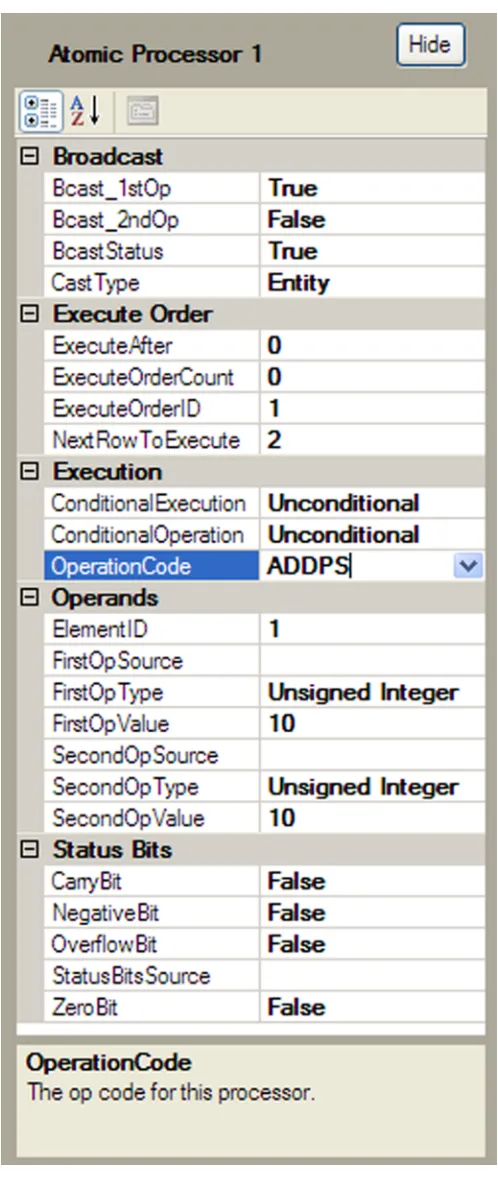
in a table, called the property grid as shown in Figure 3.2, by selecting the desired token.
If a user indicates that a token should take one of its operands from another token, a line is
drawn connecting the two tokens to indicate the data dependency. Additionally, information
defining a processor’s operation code, status bits, execution order and broadcast type are
editable from the property grid. Currently, the execution order and broadcast information
have no effect on the simulator, due to the exclusion of communication delays from the
functional simulator and the implied program flow of the IDE’s graphical user interface
(GUI). If the IDE was further developed to compile code for a communication accurate
avoid the tedious and error prone process of populating them by hand.
3.2
Model of a Processor
Each processor is modeled by a single token placed on the layout grid. The basic building
block of the architecture, an atomic processor, is modeled by an AP token. Each AP token
is capable of performing a single arithmetic, logic, status bit or function return operation
as discussed in Chapter 2. Function calls, while represented by a standard operation code
are handled by a separate token in the IDE. An AP token provides the user with fields for
primary and secondary operands which can be defined within the token by providing a type
and value or received from another token on the layout grid. Status bit value and source
fields are also provided to allow for conditionals within the token. As with operands, if
another token is provided as a source for the status bits its values will override the internal
values.
Additionally, conditional tokens can be used to make program flow decisions based on
status bits passed from other processors or as defined within a processor. When a token
is made conditional, by defining a condition in its property grid, it will change to yellow
and display a conditional symbol on the face of the token. During a simulation conditional
tokens change color based on the program flow. If a conditional token executes, it becomes
green. If it does not execute, it becomes red.
Furthermore, there are two types of conditionals in the simulator:conditional execution
andconditional operation. Conditional executionblocks the broadcast of any information
from the token in the event the condition is not met. Conditional operationis non-blocking
and allows a broadcast of information from the token, but does not perform the indicated
operation on the operands when the condition is not met. A falseconditional operationis
Finally, other fields included for an AP fall into categories of broadcast information and
execute order fields. These fields are provided to the user solely for the export to human
readable text function of the IDE. They have no effect on the simulator which handles
execution order and message passing internally.
3.3
Specialty Tokens
In addition to the standard AP tokens, five other token types are available to the user,Input
Tokens, Function Calls, Data Elements, Concurrent Arrays and Sequential Arrays. The different token symbols are shown in Figure 3.3. Input tokens are added to the IDE through
the view menu by selecting the project properties dialog, currently the number of input
tokens is limited to ten. Input tokens do not represent physical processors in hardware, but
are a means for debugging a function definition during its development. Default values are
provided by an input token so a function definition can be simulated without instantiating it
from another Pond project. When a function definition is instantiated from another project
the default values provided by the input token are instead overridden by values being passed
into the function instance. Input tokens only provide fields for the default operand value
and type, and input description and label fields to aid the user in selecting the proper inputs
during a function call.
The remaining token types are added to the IDE the same way AP tokens are added,
through the left hand side tool bar, shown to the left of Figure 3.3. Function call tokens
allow the user to instantiate a function definition from within a project. Each function call
token has a field for the .pnd file that the function definition is stored in. Upon populating
this field, the file is read and the appropriate number of input source fields show up in
the property grid interface for the user to define. Each input source field provides a label
method of calling functions differs from the actual description of how a function is called
in hardware, which requires a normal atomic processor with the function to instantiate in
the primary operand field and a reference to the data structure of data elements with the
function inputs as the second operand, this seemed impractical in the IDE. The primary
reason for this decision was the lack of a way to use a file name as a primary operand in an
atomic processor, and a still-to-be-determined way to define or reference a data structure
in the IDE. Overall thefunction calltoken still models what happens in hardware from the
underlying simulation engine by instantiating a function definition and providing it with
data to process. When a function instance reaches its return token, the function call token
is provided with the returned operand to pass as an output to the rest of the project that
called the function.
Data element tokens represent entries within a data structure as defined by the archi-tecture in Chapter 2. Each data element has fields for first operand source, value, and type.
Each is capable of providing data to other tokens or receiving data from a source token.
Currently, the sequentialand concurrent array tokens have no function in the simulator,
they have been left for a future implementation of the IDE. The original thought behind the
array tokens was to allow the user to represent several tokens performing the same
opera-tion with only a single token, thus reducing the amount of time spent placing replica tokens
on the layout grid. Each array token has an array size field and operand source index fields
in addition to the standard AP fields. These fields would allow the user to indicate the
number of tokens in the array and how to process source inputs to the array, respectively.
3.4
Simulator Basics
When a simulation is started by the user by selecting simulate under the tools menu or
is parsed. During the parsing process, each token’s properties are read in and checked for
errors. If an error is found during parsing, an error list is returned to the user indicating the
problem. Warnings can also be returned to the user indicating a potential problem, but do
not stop simulator execution. If a token’s information is successfully read in without errors,
a simulation operation for that token is created. Once an entire row is parsed successfully
without errors, a simulation step that contains each of the simulation operations for that
row is created. An overall simulation path is assembled from steps that represent each row
of the layout grid, as further discussed in Section 5.1.3.
Likewise, during simulation, the simulator calls the step for each row, which in turn
calls the operation for each token. Operations are split intomath,logic,status,no,function
andcalloperations. Themathandlogicoperations are called if an operation code defined
in a token is an arithmetic or logic type operation. Statusoperations are called for
manipu-lations to status bits andnooperations are called if a NOP is desired. Functionoperations
handle returns from a function instance and call operations handle function instantiation
calls.
Furthermore, the simulator can run all the steps at once or an option is provided to step
through them one at a time. Breakpoints are provided for the simulate all option to stop
simulator execution at a desired location. Additionally, during the simulate step option,
or at a breakpoint, a yellow bar highlights the current row. Once the user has finished
simulating their design they can return the IDE to design mode by selecting theDMbutton
on the right hand side tool bar. Further details about the simulator internals are provided in
3.5
Creating a Function Definition
Now that a basic understanding of the IDE exists, it is possible to create simple function
definitions. A function definition consists of an appropriate number of input tokens to pass
data into the function instance and tokens on the layout grid to process data. The user
may set the number of inputs for the function definition and define name and description
fields for the function from within the project properties dialog. In addition the user can
select the bit size representation for the project; options of 16, 32, or 64 bit operands are
available. The function definition ends in an AP token with the “RETURN” opcode as its
operation. Once a function definition is completed and saved, it can be ins