City, University of London Institutional Repository
Citation:
Delaney, L. and Thijssen, J. (2011). Valuing voluntary disclosure using a real options approach (11/06). London, UK: Department of Economics, City University London.This is the unspecified version of the paper.
This version of the publication may differ from the final published
version.
Permanent repository link:
http://openaccess.city.ac.uk/1456/Link to published version:
11/06Copyright and reuse: City Research Online aims to make research
outputs of City, University of London available to a wider audience.
Copyright and Moral Rights remain with the author(s) and/or copyright
holders. URLs from City Research Online may be freely distributed and
linked to.
City Research Online: http://openaccess.city.ac.uk/ [email protected]
Department of Economics
The Impact of Voluntary Disclosure on a Firm’s Investment
Policy
Laura Delaney1 City University London
Jacco J. J. Thijssen
University of York
Department of Economics Discussion Paper Series
No. 11/06
1 Department of Economics, City University London, Social Sciences Bldg, Northampton Square, London EC1V 0HB, UK.
Emai
The Impact of Voluntary Disclosure on a Firm’s
Investment Policy
Laura Delaney
∗Jacco J.J. Thijssen
†December 5, 2012
Abstract
We provide a theoretical model describing how corporate voluntary disclosure impacts on a firm’s investment timing decisions. Investment profitability and market reaction to investment are unknown ex ante, but the manager receives signals over time pertaining to the investment’s expected profitability and the likely market response. His objective is to maximise the firm’s current stock price. We find that when voluntary disclosure is incorporated into the investment timing decision, the man-ager will invest too early (late) relative to an identical profit-maximising manager if the positive stock price impact is expected to be high (low) relative to the negative (positive) stock price impact.
Keywords: Voluntary disclosure, Real options, Sub-optimal investment.
JEL Classification Numbers: C61, D81, M41.
∗Department of Economics, City University, Northampton Square, London, EC1V 0HB,
UK. Email: [email protected] Tel.:+44-(0)207-040-4129.
†Department of Economics and Related Studies, University of York, Heslington, York
1
Introduction
The purpose of this paper is to investigate the influence of corporate volun-tary disclosure on the timing of a firm’s investment decision when the manager of the firm has incomplete information regarding the true profitability of the investment and the likely market response to the investment decision. Volun-tary disclosures relate to those announcements willingly made by firms outside of their legal and regulatory requirements. We develop a theoretical model of investment whereby the manager of a firm acquires an option to disclose the return arising from some investment venture only after the investment has been undertaken. The real options methodology is used to develop the model. This technique has been widely applied to investment decisions (see Dixit and Pindyck [7] for a general presentation of real options and investment), but the use of real options methodology in relation to voluntary disclosure has been relatively scant (see Dempster [6]). This is surprising given that voluntary dis-closure decisions share three important characteristics with many investment decisions; i.e., they are irreversible, the payoff is uncertain, and the decision-maker has some leeway over deciding when to disclose. Given this, the real options methodology is an appropriate, and it appears, under-used tool for analysing voluntary disclosure decisions.
In our model, the manager of the firm has the option to invest in some risky venture. Once he exercises this investment option, he acquires another option which is to voluntarily disclose the return from investment to the mar-ket. He only acquires the disclosure option after having invested, and the option to disclose is dependent upon his option to invest. The manager is re-munerated based on his firm’s stock price, and thus, he adopts an investment and disclosure policy such that his firm’s current stock price is maximised. He is uncertain about the investment profitability and the subsequent market reaction to the investment decision, but he receives signals over time which improve the accuracy of his beliefs as to the likely profitability and associated market response. Thus, our model is a compound real options model such that uncertainty is resolved over time.
Our contribution gives a theoretical explanation of the growing body of survey, anecdotal, and empirical evidence that finds that managers take real economic actions (for example, postpone undertaking profitable investments) which could have negative long-term consequences on firm value in an attempt to manage their reported earnings. For example, Graham et al. [18] survey and interview more than 400 executives to determine the factors that drive voluntary disclosure decisions. They find that managers would rather take economic actions that could have negative long-term consequences than make within-GAAP accounting choices to manage their reported earnings. In fact 78% of their sample admits to sacrificing long-term value to smooth earnings while over half of survey respondents (55.3%) state that they would delay starting a new project to meet an earnings target, even if such a delay entailed a small sacrifice to value. In support of the evidence provided by Graham et al. [18], Penman and Zhang [29] find that postponing certain investments can boost reported earnings in the presence of conservative accounting methods, while Roychowdhury [31] argues that firms overinvest and give sales discounts to meet earnings targets.
Aside from the above cited studies, the literature that focuses upon this managerial intent to sacrifice economic value to meet financial reporting goals for their own personal benefit is relatively scant. From the literature that does exist, the results that demonstrate this behaviour appear to be either empirical or anecdotal. The contribution of our paper to this literature is important because we provide a theoretical model describing how investment is influenced by voluntary reporting decisions. Indeed, the predictions arising from our model support much of these phenomena.
We consider two separate scenarios. In one scenario the market fully ob-serves the investment decision of the manager, but does not observe the realised return. We refer to this as the observable investment decision. In the other scenario, the market does not observe the manager’s investment decision, and thus, cannot determine whether or not the manager has undertaken an in-vestment until he opts to disclose the realised return. We refer to this as the unobservable investment decision.
expected to be low relative to the negative stock price impact. Furthermore, the manager may even risk investing in a negative net present value (NPV) venture if the positive stock price impact is sufficiently high relative to the neg-ative stock price impact and if, simultaneously, the signals which the manager receives are not very informative.
Furthermore, we show that when the investment decision is unobservable, the manager may invest but withhold disclosing that he has done so until at a later date. He will act in this manner only if the realised return from under-taking the investment is low. A possible motivation for why he behave in this way is that if he considers the investment important for the company’s future success but if the market were to learn of it at this stage they may not under-stand its potential for the firm’s future success. Therefore, the market may need to be prepared for the product before its existence is revealed. However, at the same time, the manager may not wish to wait until the market is ready for the product before investing because by doing so, for example, the initial cost of investment may have risen dramatically, or they may want to obtain exclusive rights to the product and thus invest now to preempt a competitor from investing. The launch of Apple’s iPad is a relevant example of this.
At a technology conference in Los Angeles in June 2010, CEO of Apple, Steve Jobs, admitted that the company began to develop the iPad before the iPhone, but the announcement of its launch was postponed until almost three years after the iPhone was launched (FoxNews [17]). Jobs’ justification for this strategy was that the ideas on which the iPad is based “work just as well on a mobile phone”. However, at that time, the iPad was unknown and something the market did not realise it had a use for, whereas a mobile phone was something that everybody used. Thus, by introducing the market to such a portable, diverse, touch screen device via something as important for everyday use as a mobile phone, the market was only then able to realise the potential and value of a similar device, but with a larger screen. Presumably, had the iPad been launched when it was initially developed; i.e., pre-iPhone, the impact on Apple’s stock price would not have been nearly as extreme as it has proven to be. From the launch of the iPad in April 2010 until the end of 2011, it’s stock price increased by over 72% (Yahoo Finance).
To summarise, our model depicts clear evidence of myopic and inefficient managerial behaviour when a firm’s compensation policy does not encourage the adoption of forward-looking and profit-maximising objectives. This has implications for corporate policy. In particular, other mechanisms, aside from simply stock price based remuneration, ought to be administered to discourage managers from applying such strategies to their investment timing decisions. This is an important issue which we return to and discuss in detail in a later section.
draw upon is that related to corporate voluntary disclosure. One of the earliest findings in the disclosure literature, provided by Grossman and Hart [20] and Grossman [19], has become known as the “unraveling result”. If the managers of firms, holding private information, choose not to disclose their information to outside investors, then the investors will discount the value of the firm down to the lowest possible value consistent with whatever voluntary disclosure is made. Once the managers realise this, they will have an incentive to make full disclosure.
The unraveling argument is underpinned by the assumption that all in-vestors respond to the firm’s disclosure in the same way and that this response is known to the firm in advance of them making a disclosure. We relax this assumption in our model by introducing uncertainty over investor response. Response uncertainty can arise for many reasons. For example, the disclo-sure of a profitable return from undertaking some investment is likely to be interpreted favorably by the market in that it signals growth and innovation within the firm through newer and more improved products. However, it is also true that such news may be interpreted unfavorably if the market views the investment as a costly venture which has been wasteful of capital and re-sources. If the manager places too a high risk on the latter effect occurring, the full-disclosure unraveling result will not ensue.
The literature that focuses on the implications of relaxing this response assumption is scant. To the best of our knowledge, the only paper that deals specifically with the disclosure behaviour of firms that face uncertainty re-garding investor response to disclosed information is Suijs [33]. He shows that the unraveling argument that yields full disclosure will not apply if the firm is faced with such uncertainty. In particular, if the risk of an unfavourable market response to the private information acquired by the firm is too high, the firm will refrain from disclosing. Qualitatively, this supports our findings. However, our paper differs from Sujis’ in that we analyse such disclosure be-haviour of firms who can only make a disclosure subsequent to having made a corporate investment. In this respect, we focus on the economic relevance of voluntary disclosure and its implications for the timing of a firm’s investment decision.
framework allows for both cases to be solved for analytically. This is a further contribution of our model.
The remainder of the paper is organised as follows: In Section 2, we de-scribe the economic environment and present the benchmark model of invest-ment against which our results can be compared. In Section 3 we focus on the situation where the investment decision is fully observable to the market while in Section 4 we consider the case when the investment decision is not observable. In Section 5 we present the results that emerge from our model, while in Section 6 we discuss the implications of these results for corporate policy and outline some possible directions for future research. All proofs are placed in the Appendix.
2
The Model Description
Consider a risk-neutral manager who has the opportunity to undertake some risky investment. The payoff from the investment is uncertain; it can be good, leading to high revenues ofUP, or bad, leading to a low revenues ofUN. These
parameters represent an infinite stream of revenue discounted at a constant rate
r. Without loss of generality, we assume that UN = 0. Once the investment
option is exercised, its true state (or profitability) is realised. In reality, this may take some time, but we abstract from this without loss of generality. We denote the sunk costs of investing by I >0, where I ≤UP, by assumption.
The objective of the manager is to adopt an investment and a disclosure policy such that his own current expected (discounted) utility from wealth is maximised. In particular, we assume that the manager’s compensation is dependent on the firm’s stock price, and hence, his objective is to maximise the expected utility of his compensation through maximising the firm’s current price. This assumption is consistent with Dow and Gorton [8] who point out that owing to the fact that the manager’s tenure at the firm may be short relative to the horizon over which his decisions impact on the value of the firm, his compensation should not be based on the realised returns that result from his decisions, but instead, should be linked to the firm’s stock price.
We assume that the voluntary disclosure is fully credible if the investment is exercised, and is fully incredulous otherwise. In particular, if a firm invests, but then chooses not to disclose, it is indistinguishable from a firm who has not invested at all; i.e., the firm cannot credibly communicate its lack of in-vestment. The assumption of fully credible disclosure is very standard in the disclosure literature and the justification for this assumption is the potentially large penalties, for example, reputational damage, of deliberately misinforming the market.
disclosure strategy (see, for example, Dye [10], Wen [35], Pae [28], Dutta and Trueman [9], Ostaszewski and Gietzmann [27]). Typically, in these discrete-time theoretical disclosure models, there is a terminal date whereby the econ-omy ends and/or the firm is liquidated. Our primary motivation for adopting a continuous-time setting is to gain insights into the economic relevance of corporate voluntary disclosure in a more realistic manner. In particular, the continuous-time assumption gives the manager flexibility over the timing of disclosure which a discrete-time setting does not allow for. This is impor-tant when, for example, there are a large number of information providers present in the market (see Arya and Mittendorf [1]). Most firms are followed extensively by financial analysts, media outlets, etc. The presence of such information providers means that an infinite amount of firm-relevant informa-tion can come to the fore at any stage which the manager should be able to immediately react to. By adopting a continuous-time assumption, our model enables us to endow the manager with such flexibility.
2.1
The Information Environment
Over time the manager receives a stream of information signals, some of which pertain to the potential return from the investment, and others which pertain to the market sentiment towards the firm and its investment venture. Exam-ples of what such signals could be include news concerning the outcome from an application for patent protection for the investment, results from a market research experiment, and publicly observable forecasts issued by financial an-alysts also serve as good indicators of the general market sentiment towards the firm. Note that we work with only one stream of signals and each one of those signals, irrespective of whether the signal pertains to investment return or to market sentiment, is interpreted by the manager in terms of likely stock price impact owing to disclosure. The impact on stock price is a result of the response of investors to learning about the return acquired from undertaking the investment. The investors respond to the manager’s disclosure favourably (by investing more of their available capital in the firm over other possible as-sets) which has a positive effect on the stock price, or unfavourably (by selling some of their existing shares in the firm and transferring the capital elsewhere) which has a negative effect. So, for example, news that a patent application has been accepted increases the investment’s expected return to be disclosed, and therefore, increases the likelihood of a favourable market response. Thus, such a signal is indicative of a stock price increase. Alternatively, if, for example, a market research experiment indicates that the demand for the investment will be low, then this decreases the expected investment return, and thus, is indicative of a stock price decrease.
model of Thijssen et al. [34]. By contrast to our paper, however, they interpret each of the signals in terms of investment profitability as opposed to market response. We further assume that each signal contains imperfect information about the true market reaction such that the probability that the signal is correct is given by θ ∈(1/2,1). We assume that θ >1/2 so that the model is well-defined.1 This parameter is a measure of signal quality.
In this set-up, the number of signals indicating a positive market reaction net of the number of signals indicating a negative market reaction is a sufficient statistic for the manager’s optimal investment policy. At time t this number of signals is denoted by st. Under the assumptions regarding the arrival and
precision of information it can be shown that st evolves over time according
to (cf. Thijssen et al. [34])
dst =
1 w.p. [1(δ=1)θ+ 1(δ=0)(1−θ)]µdt
0 w.p. 1−µdt
−1 w.p. [1(δ=1)(1−θ) + 1(δ=0)θ]µdt,
(1)
where δ= 1 denotes a true favourable response and δ= 0 a true unfavourable one.
Suppose that the manager has a prior (before the investment option is exercised) over the probability of a positive market reaction equal top0 ∈(0,1).
If, at time t ≥ 0, the manager observes st, then his posterior probability of
a favorable market response follows from an application of Bayes’ rule (see Thijssen et al. [34]):
pt:=p(st) =
θst
θst +ζ(1−θ)st, (2)
where ζ = (1−p0)/p0 is the prior odds ratio. Note that pt is a monotonically
increasing function in st, and that the inverse function is given by
st :=s(pt) =
log (
1−pt
pt
)
−log(ζ)
log(1−θθ) . (3)
This implies that the analysis of the solution can apply to either the net number of signals or the posterior belief. In terms of solving for the model and analysing the results that emerge, we use both approaches intermittently, depending on analytical convenience.
1This assumption is made without loss of generality. A choice ofθ=1
2 implies that the
2.2
A Benchmark Case for the Optimal Investment
Pol-icy
Thijssen et al. [34] solve for the optimal stopping problem when the firm has only one option which is to invest in some risky venture. This will be the benchmark model against which we compare our results. In that paper, the manager’s objective is to maximise the amount of revenue obtained for the firm through investing. In this paper, somewhat differently, the manager’s objective is to maximise his firm’s current stock price (or, equivalently, his compensation) through disclosing the return acquired from undertaking some risky investment. This implies that in our set-up the manager’s investment decision will be based on his prediction of how the market will interpret his investment decision while in the model of Thijssen et al. [34] the investment decision is simply based on the manager’s own interpretation of the signals. In the subsequent sections it will become clear that this feature will drive the difference between the optimal investment policy of a manager with the disclosure option and him without.
The (benchmark) critical level of the conditional belief in high revenues arising from investment is denoted by ˜p∗i =p( ˜s∗i), where ˜s∗i is the critical level ofstsuch that the manager is indifferent between investing or not. Forst≥s˜∗i,
or equivalently, pt ≥ p˜∗i, the manager will invest, otherwise he will wait until
enough positive signals have arrived to increase the level of st to reach the
critical level. We present the critical level in terms of conditional belief and this is given by (cf. Thijssen et al. [34]):
˜
p∗i ≡p(˜s∗i) =[1 +(UP/I−1)Ψ]−1, (4)
where
Ψ = (r+µ(1−θ)) [β1(r+µ)−µθ(1−θ)]−µ
2β
1θ(1−θ)
(r+µθ) [β1(r+µ)−µθ(1−θ)]−µ2β1θ(1−θ)
(5)
and β1 > θ is the larger root of the quadratic equation
Q(β) = β2−
(
r
µ+ 1
)
β+θ(1−θ) = 0. (6)
They show that ˜p∗i is a well-defined probability.
Furthermore, the classical net present value (NPV) threshold, denoted by
pN P V, is given by
pN P V =I/UP, (7)
which is the solution to the NPV function
ptUP −I = 0.
3
Observable Investment Decisions
In this section we extend the benchmark model of investment to a situation whereby the manager’s investment decision is made based upon the influence such an investment will have on the firm’s stock price as a result of disclosing the investment return.
We assume that the investment decision made by the manager is fully observed by the market, but the return that is realised from undertaking such an investment is not. (In the following section we relax the assumption of fully observable investment decisions.) Investors in this sense correspond with “informed investors” from Dye [11]. The standard unraveling argument leading to full disclosure applies, and thus it will never be an optimal strategy to invest and not disclose.2 This is because once the firm decides to invest, it is known as a firm with private information (about the return of the investment). If the market knows that the manager has invested, but he fails to disclose the return, the market is almost certain to infer that the manager has invested in a venture which has not turned out to be profitable and react through selling off the firm’s stock. Therefore, in essence, the manager holds one option only: to invest and disclose simultaneously, or not to invest and, thus, not disclose at all.
Since the manager’s compensation is dependent on the firm’s current stock price, and an increase in the stock price is acquired through a favourable response to disclosure, the problem for the manager essentially reduces to a problem over when to disclose. Hence, the investment-disclosure decision is a stand-alone option in the sense of Section 2.2. Therefore, with respect to the optimal threshold in this case, it is simply obtained via the method outlined in Thijssen et al. [34]. However, the payoffs must now reflect the market response to investment rather than simply the return on the investment itself.
We assume that any direct costs associated with disclosure, for example, the costs associated with producing and disseminating the information, are negligible compared to the impact from disclosure, and hence, the sunk costs of disclosure are zero in our model.3
Once disclosure has been made, the market revises its perception of the
2In Dye [11], an informed investor knows whether or not a manager possesses any private
information but does not know the realised value of that information. Thus, if they know that the manager has information which he chooses to withhold, he does so because it is unfavourable information (but they do not know how unfavorable) and react accordingly. However, in that paper, the manager is uncertain whether any given investor is informed or uninformed. In our paper, if the investment decision is observable, then the manager is aware that all investors are informed in the sense of Dye and, thus, it is never optimal for him to invest and not disclose.
3This assumption is made without loss of generality. We could easily include a sunk
disclosure cost, Id >0, but this would be at the expense of parsimony and would have no
price of the firm to incorporate the impact of the investment venture. We as-sume that this impacts on the stock price by an amount equal to the revenue obtained from investment less the sunk investment cost; i.e., by UP −I or−I.
Added to this effect, there is an additional impact from exercising the disclo-sure option owing to the market’s interpretation of the information disclosed. We incorporate this so called “disclosure” effect to account for the extensive empirical and anecdotal evidence of stock price over- and under-reactions to various streams of good and bad news (see Graham et al. [18], Sletten [32], Arya and Mittendorf [1], and Barberis et al. [2]).
If the market participants react favourably to the information regarding the investment venture, they will diversify their portfolios by opting to invest more of their available capital in the firm over other possible assets. We assume that the positive disclosure effect on the stock price is given by α(UP − I) and, thus, the overall positive impact of disclosure (i.e., which also allows for the investment return to be incorporated) on the firm’s stock price (from its current level) to be SP, where SP = (1 +α)(UP −I) ≥0, for α ≥ −1. The positive disclosure effect can be related to, for example, upward revisions in the market expectations of future earnings (owing to the investment venture) and/or decreases in systematic risk, such as, for example, decreases in the firm’s cost of capital (see Chen et al. [4]). Alternatively, if the overall market reaction is unfavourable, there will be a loss in market confidence in the firm relative to other assets. For example, the existing shareholders may liquidate some (or all) of their shares in the firm owing to downward revisions in their expectations of firm future earnings and/or increases in systematic risk. In this case the overall negative impact of disclosure leads to a decrease in stock price by an amount we assume to be equal to SN = (γ − 1)I ≤ 0, where γI denotes the negative disclosure effect, and γ ≤ 1. It is not necessarily the case that SP = |SN| because, as documented in the behavioural finance literature, investor sentiment in the form of over- and under-reaction can lead to a differential response to good and bad news (see, for example, Fama [15], Barberis et al. [2], and Maheu and McCurdy [23]).
Replacing for (UP/I−1) in equation (4) with −SP/SN as defined above,
the investment-disclosure conditional belief threshold is given by
p∗id=p(s∗id) =
[
1 + 1 +α 1−γ
(
UP
I −1
) Ψ
]−1
, (8)
where Ψ is given by equation (5) ands∗iddenotes the critical number of positive over negative signals at, or above, which it is optimal to invest and disclose. We prove in Appendix A that p∗id is a well defined probability.
and investing and disclosing the return will almost surely result in a stock price decline. Alternatively, he may personally believe that the venture is a worthwhile investment but is not sufficiently convinced that the market will share his view. Hence, if that were true, then the payoff from the investment may be profitable, but the market may interpret the investment decision as a waste of resources and capital that could have been utilised for what they consider to be more worthwhile ventures. Thus, he will refrain from exercising since he deems the risk that there will be a fall in the firm’s stock price by an amount SN as being too high.
4
Unobservable Investment Decisions
When investors do not observe if and when an investment decision is made, then as soon as the manager exercises the investment option he acquires an-other separate option which is to voluntarily disclose the realised investment return. This disclosure option can be exercised immediately, some time in the future, or may never be exercised at all.
Once the unobservable investment has been undertaken, the manager con-tinues to observe signals regarding the likely response if he discloses. These signals refer to a continuation of the same stream of signals that arrived before the investment option was exercised. Therefore, st still evolves according to
(1) and p(st) is given by (2). As in Section 3, the sunk costs of disclosure are
zero.
With respect to the optimal disclosure threshold in this case, it is obtained via the same method outlined in Section 3. This is because once the manager invests, the decision over when to optimally disclose is independent of the in-vestment decision, and becomes a stand-alone disclosure option. Therefore, the disclosure threshold when the investment decision is not observed by the market will be exactly equal to the investment-disclosure threshold when the investment decision is fully observable. For clarity, we denote the “unobserv-able” disclosure (conditional belief) threshold by p∗d, but technically, p∗d =p∗id. Therefore,
p∗d=p(s∗d) =
[
1 + 1 +α 1−γ
(
UP
I −1
) Ψ
]−1
. (9)
The optimal investment policy for the manager in this instance is stated in the following theorem, the proof of which is provided in Appendix B.
1. if the critical number signals at or above which it is optimal to invest, denoted by s∗i, is less than the critical number of signals at or above which it is optimal to disclose, s∗d, then
p∗i =p(s∗i) =
[ (ε+β1µθα)(UP −I)
εI −β1µ(1−θ) (γI−UP)
Ψ + 1 ]−1
, (10)
where
ε=β1(r+µ)−µθ(1−θ) (11)
and β1 and Ψ are as previously defined, or
2. if, however, the critical number of signals at, or above, which it is optimal to disclose is less than the critical number of signals at, or above, which it is optimal to invest, then
p∗i ≡p∗d ≡p∗id =
[
1 + 1 +α 1−γ
(
UP
I −1
) Ψ
]−1 .
Moreover, p∗i is a well-defined probability.
The first point in Theorem 1 implies that if the investment decision is not observable, the manager may invest at some pointp∗i but refrain from disclos-ing until a sufficient number of positive signals regarddisclos-ing market sentiment have arrived for pt to reach the critical disclosure level, p∗d. This is intuitive
because, unlike in the scenario where the investment decision is fully observed by the market, the manager is not required to disclose the realised investment return immediately after he exercises his investment option. Thus, he may take the risk of investing, but protect the effect of a negative return on his com-pensation by choosing not to disclose. This behaviour is made possible owing to the assumption that the manager cannot communicate his lack of invest-ment. Thus, by not disclosing, his firm is pooled with other firms which have invested but not disclosed, but also with firms which have not undertaken an unprofitable investment. The market cannot distinguish between these firms, and thus, the penalty to the manager from investing in an unprofitable project (via his compensation) may never be realised.4
4It could be argued that the poor investment decision cannot be hidden from the market
It is important to point out here that in solving for p∗i, which is given by equation (10), we assumed that s∗i < s∗d. It can only be the case that s∗i < s∗dif the return from investment,(UP/I−1), is sufficiently low.5 This makes sense
intuitively since if the return from investment is low, the manager who makes an unobservable investment decision will opt to invest but withhold disclosure until he is sufficiently convinced that the market reaction will be favourable and have a positive impact on his stock price. This will happen when, for example, the market has been better “prepared” for the product.
If, on the other hand, the return from investment is high enough, then
s∗d ≤ s∗i and it will be optimal for the manager to disclose at, or before, the point at which it is optimal for him to invest. The second point in Theorem 1 implies that in this scenario, the manager will invest and disclose simultane-ously at p∗d. The reasoning is as follows: since he can only acquire the option to disclose once he exercises the option to invest, he will invest atp∗dso that he can thereby acquire, and thus exercise, his option to disclose. This situation corresponds with the case of the investment decision being fully observable because, in both cases, the manager will invest and disclose simultaneously at p∗d (or equivalently, p∗id). However, the motivation for why he will invest and disclose simultaneously at this threshold differs depending on whether the investment decision is observable or not. When the investment decision is un-observable, the most plausible reason for why the manager will adopt such an investment-disclosure policy is if he wishes to reassure the market that his firm is in a more stable financial position than the market currently assumes, and thereby increase (or prevent a decline in) the firm’s stock price.
There are several scenarios under which this latter situation is likely to arise. For example, Arya and Mittendorf [1] analyse the disclosure behaviour of firms in the presence of third party information providers; i.e., financial analysts, credit rating agencies, and media outlets. They find that the presence of such information providers leads to greater transparency by the firm. This is so that the firm can exert greater control over the information released to the market. They point out that “while firm disclosures have the downside of directly revealing firm proprietary information to the competition, the chilling effect on the revelation of other information may make it worthwhile.” This is particularly true when the information providers rely heavily on the firm’s disclosure and eschew their own information in response. With respect to our setting, the presence of information providers may be what motivates the manager into wanting to make a disclosure so that he may effectively guide the information funneled to the market. This will be his attempt at managing his own compensation through preventing a large undervaluation of the firm’s stock price. However, in our set-up, he may only disclose if he has already
5Recall that sinces
tis monotonically increasing inpt, ifs∗i < s∗d, then so too isp∗i < p∗d.
It is then easy to verify that p∗i < p∗d for a low value of (UP/I−1) where p∗
d and p∗i are
exercised an investment option. Thus, when such an investment opportunity is available to him, he will invest before it is optimal to do so (i.e., for some
pt ∈ [p∗d, p∗i)) so that he may then exercise the disclosure option. Indeed, this
scenario is particularly likely given evidence from Graham et al. [18] that CFOs of firms cite financial analysts as being a very significant driver of short-term stock prices because analysts are the second most important (after institutional investors) marginal investors in their stock.
Two further examples, both of which are adequate motivations for why a manager may be anxious to communicate with the market via disclosure, are provided by Dye and Sridhar [12] and Einhorn and Ziv [13]. Dye and Sridhar [12] show that an increase in disclosure can ensue as a result of competitive pressures. Essentially, disclosure by a competitor pressurises a firm into also disclosing so as to convince investors that it too has information which is worthy of disclosure. Einhorn and Ziv [13] show that disclosure will be more forthcoming by firms who have previously set a disclosure precedent which they now must maintain (to prevent downward revisions of their stock price by the market).
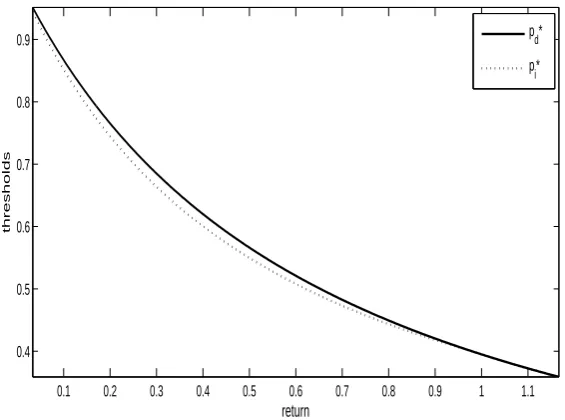
Figure 1 depicts the unobservable investment scenario graphically. We plot the investment and disclosure thresholds of the manager as a function of the project return. In particular, we see that when the return is low, the in-vestment threshold lies below the disclosure threshold implying that the man-ager will invest and withhold disclosure for some period (in particular, for all
pt∈[p∗i, p∗d)) until he is sufficiently convinced of a favourable market response.
However, when the return from investing is sufficiently high, p∗d overshoots p∗i
on the downside. Then for all p∗d ≤ p∗i, the manager will invest and disclose once enough positive signals have been obtained so that only p∗d needs to be reached. We see from the plot that once this happens, the two thresholds coincide.
5
Analysis of the Optimal Investment-Disclosure
Policy
The impact disclosure has on the investment timing decision of the manager is stated in Proposition 1, the proof of which is provided in Appendix C.
Proposition 1. A sufficient condition forp∗i < p∗id ≤p˜∗i to hold is thatα≥ |γ|. Furthermore, if this latter condition is satisfied with strict inequality, and if θ
takes a sufficiently small value, then it also holds that p∗i < p∗id ≤pN P V.
0.1 0.2 0.3 0.4 0.5 0.6 0.7 0.8 0.9 1 1.1 0.4
0.5 0.6 0.7 0.8 0.9
return
thresholds
p d*
[image:18.595.114.397.108.318.2]p i*
Figure 1: Managerial thresholds as a function of project return.
the more likely is the manager to invest sub-optimally, irrespective of whether the investment decision is observable to the market or not. We refer to a sub-optimal investment decision as one such that the investment policy of the manager deviates from the benchmark, profit-maximising, investment policy. In particular, a manager behaves sub-optimally when he adheres to any in-vestment threshold which differs from ˜p∗i.
Recall that the manager’s compensation is assumed to be dependent on the firm’s stock price. The effect on the stock price will be a result of the market reaction to the manager’s disclosure that the firm has undertaken some risky investment. Furthermore, the disclosure option is only acquired once investment has been exercised. Therefore, this result implies that if the positive stock price impact from disclosure is sufficiently high relative to the negative stock price impact, the manager will over-invest sub-optimally so that he can acquire, and thus exercise, the disclosure option and realise the benefit to himself through his compensation package. We refer to over-investment as investment that takes place at a level ofptsuch thatpt <p˜∗i. This implies that
the manager invests after fewer positive signals have been obtained than the number required for an identical manager with a profit-maximising objective.
Of course, sub-optimal investment will not only arise when the manager over-invests, but it will also arise when the manager waits too long before investing relative to the benchmark case; i.e., he invests at some pt > p˜∗i.
of positive signals required by the manager before he invests, relative to an identical manager with a profit-maximising objective. This is intuitive in the case where the investment decision is observable since he cannot invest and withhold information. Therefore, if he were to invest and disclose at the profit maximising threshold, ˜p∗i, he faces a greater risk of a (relatively large) negative market response than if he were to wait and invest at p∗id. Thus, he forgoes undertaking a profitable investment for some time (i.e., for all pt ∈ [˜p∗i, p∗id))
in order to withhold disclosure and protect his compensation. However, the intuition is less obvious when the investment decision is unobservable since he could invest at ˜p∗i and withhold disclosure until he is more convinced of a positive market response when, for example, the market is better prepared for the product. One plausible explanation for why he would wait is to avoid using the firm’s capital for the current investment when another, potentially more favourable investment, from the market’s perspective, may arise in the future which could prove to be a better use for such capital in terms of the manager’s compensation maximising or, equivalently, stock price maximising objective.
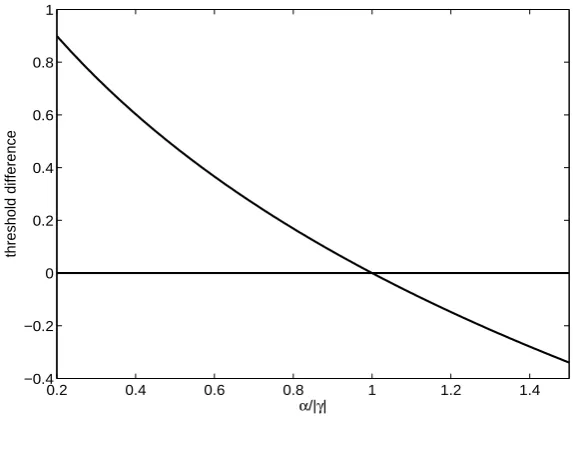
Figure 2 shows the difference between the fully observable investment threshold, p∗id, and the profit-maximising benchmark threshold, ˜p∗i, as a func-tion ofα/|γ|. A corresponding figure for the unobservable investment threshold is not included as the result is qualitatively the same. This figure simply de-picts the result that is stated in the first part of Proposition 1 and corresponds with our above discussion. We see that as α increases relative to γ, the more likely is the manager to over-invest relative to the benchmark case (i.e., p∗id
decreases relative to ˜p∗i). Note that the benchmark case arises whenα/|γ|= 1.
0.2 0.4 0.6 0.8 1 1.2 1.4 −0.4
−0.2 0 0.2 0.4 0.6 0.8 1
α/|γ|
[image:20.595.109.396.107.337.2]threshold difference
Figure 2: p∗id−p˜∗i.
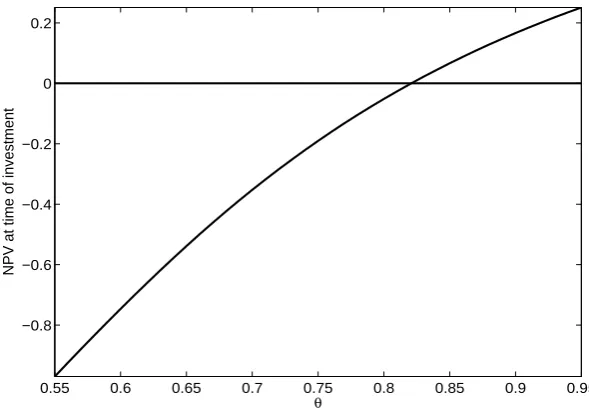
all. Conversely, if the signals are very informative about investor response, the manager will be more inclined to spend the time studying the signals in greater detail. Therefore, the value of waiting to invest will be greater and hence, he will invest only after more positive signals have been obtained; i.e., when the NPV is higher. This result is depicted in Figure 3. It is also important to note that had the manager adopted a profit-maximising objective, he would always adopt positive NPV investments, no matter what the signal quality; i.e., ˜p∗iUP −I >0 for all θ. Therefore, the impact of voluntary disclosure on a firm’s investment policy can be substantial.
In the next section we discuss in detail the implications of these results for corporate policy. We also suggest a direction for future research, the aim of which would be to determine the most appropriate mechanisms for eliminating some of this opportunistic behaviour that managers often engage in.
6
Discussion and Concluding Remarks
0.55 0.6 0.65 0.7 0.75 0.8 0.85 0.9 0.95 −0.8
−0.6 −0.4 −0.2 0 0.2
θ
[image:21.595.103.398.108.316.2]NPV at time of investment
Figure 3: NPV at the time of investment as a function ofθ.
In particular, what our results imply is that the investment behaviour of a manager can mitigate investment efficiency6 when the firm’s compensation
package does not encourage him to adopt a profit-maximising objective to-wards investment. We find that the manager may either over- or under-invest sub-optimally when the investment option is embedded with an option to vol-untarily disclose the return acquired from the investment to the market. The market reaction to the manager’s disclosure impacts on the stock price which, in turn, impacts on the manager’s compensation. Therefore, in essence, his compensation is based on the payoff from the disclosure option and thus, he makes his investment decision so as to maximise the impact of the associated disclosure on the current stock price while eschewing a more forward-looking profit-maximising objective.
This tendency on the part of the manager to act in his own self inter-est and invinter-est sub-optimally corresponds fundamentally with the definition of myopic managerial behaviour in Cheng et al. [5]. According to Cheng et al. [5], “myopia refers to sub-optimal under-investment in long-term projects for the purpose of meeting short-term goals (for example, Porter [30])”. In our paper, under-investment corresponds with waiting too long before investing
6Typically, in the corporate finance literature, an inefficient investment policy is one
when the positive impact from disclosure is small relative to the negative im-pact. However, we also find that managers will over-invest so that they can be more forthcoming with disclosure in order to meet that same short-term goal (i.e., boost their compensation). This arises when the positive impact from disclosure is large relative to the negative impact. Thus, we find evidence of managerial myopic behaviour, driven by disclosure, whereby investment is un-dertaken sub-optimally for the purpose of satisfying their short-term goal to raise the current stock price in order to boost compensation.
Our findings support empirical evidence that myopic behaviour can ensue when firms’ incentivisation mechanisms encourage the adoption of a short-term perspective, such as short-term need to raise capital (which has a positive ef-fect on the stock price) (Bhojraj and Libby [3]) and incentive compensation concerns (Matsunaga and Park [24]). Indeed, this tendency for managers to behave myopically is assisted by the fact that market participants over-react (both positively and negatively) to firm announcements through excessive buy-ing and sellbuy-ing of firm shares. This effect is especially acute when investors themselves have a short-term focus (Ellis [14]). An effect of this is demon-strated by Bhojraj and Libby [3] who examine the impact of managerial my-opia on capital markets. They show that firms who engage in real actions so as to meet or beat earnings targets are able to boost stock price in the short-term but can experience adverse price reversals a few years later.
This demonstrates that other mechanisms ought to be applied in such in-stances to encourage managers to adopt more long-term profit-maximising strategies for their investment timing decisions. One such approach could be to re-design the manager’s compensation contract so that he has no incentive to withhold any of his private information from the market. In that way the disclosure problem would become moot and the manager would have no reason not to adopt a profit-maximising objective. In fact, according to the revelation principle, “any contract can be re-written in a way that induces full revelation of all private information held by the parties to it without affecting the pay-ments they receive” (Myerson [26]). However, such a contract could not be applied to the set-up of our model because once any information is disclosed, the market responds to the disclosure by altering its demand for the firm’s shares, and thus, altering the firm’s stock price. The only way it could be ap-plied would be if each investor had an enforceable contract with the manager specifying that they would disregard the manager’s disclosure in determining their demand for the firm’s shares. Such contracts are not enforceable.
makes the assumption that a corporate control challenge results in dismissal. In her model, the manager faces dismissal if the value-maximising threshold of the shareholder is too far misaligned with the wealth-maximising threshold of the manager. She shows, firstly, that if there is not a well-functioning market for corporate control, the manager will make investment timing decisions which differ markedly from firm value-maximising ones. This is consistent with our findings despite the driving force of our model (the effect of the voluntary disclosure option) being different to her’s (incomplete markets). She further shows that when a manager who is faced with idiosyncratic risks is also subject to a corporate control challenge, the risk of a control challengealways leads the manager to invest at a threshold closer to the shareholders’ value-maximising threshold.
We could apply a similar line of reasoning to our model to ascertain whether the risk of corporate control would be effective in helping to eliminate the opportunistic behaviour of managers for their own personal welfare. This would require him to be more transparent with his private information so that investors can ensure he always acts in their best interest by adopting profit-maximising investment strategies. This is because insufficient transparency can lead to sub-optimal investment timing decisions. Therefore, we could adapt our model to incorporate the feature of a control challenge resulting in dismissal if the manager is found to be exercising a policy of disclosure that is not sufficiently transparent for the investor. This would allow us to determine the extent to which such a control mechanism would be effective in discouraging the manager from acting in this sub-optimal manner and, in particular, what features of the model are most crucial for achieving this. Such an analysis will be carried out in future research.
References
[1] Arya, A. and B. Mittendorf (2005). Using disclosure to influence herd behaviour and alter competition. Journal of Accounting and Economics 40, 231–246.
[2] Barberis, N., A. Shleifer, and R. Vishny (1998). A model of investor sen-timent. Journal of Financial Economics 49, 307–3343.
[3] Bhojraj, S. and R. Libby (2005). Capital market pressure, disclosure frequency-induced earnings/cash flow conflicts, and managerial myopia.The Accounting Review 80, 1–20.
[4] Chen, S., D. Matsumoto, and S. Rajgopal (2011). Is silence golden? An empirical analysis of firms that stop giving quarterly earnings guidance.
[5] Cheng, M., K. Subramanyam, and Y. Zheng (2005). Earnings guidance and managerial myopia. Working paper, University of Southern California.
[6] Dempster, A. (2006). Valuing announcement options. European Manage-ment Journal 24(2-3), 117–127.
[7] Dixit, A. and R. Pindyck (1994). Investment under uncertainty. Princeton, NJ: Princeton University Press.
[8] Dow, J. and G. Gorton (1997). Stock market efficiency and economic efficiency: Is there a connection? Journal of Finance 52(3), 1087–1129. [9] Dutta, S. and B. Trueman (2002). The interpretation of information and
corporate disclosure strategies. Review of Accounting Studies 7, 75–96. [10] Dye, R. (1985). Disclosure of non-proprietary information. Journal of
Accounting Research 23, 123–145.
[11] Dye, R. (1998). Investor sophistication and voluntary disclosures. Review of Accounting Studies 3, 261–287.
[12] Dye, R. and S. Sridhar (2004). Reliability-relevance trade offs and the efficiency of aggregation. Journal of Accounting Research 42, 51–87.
[13] Einhorn, E. and A. Ziv (2008). Inter-temporal dynamics of voluntary corporate disclosures. Journal of Accounting Research 46(3), 567–589. [14] Ellis, D. (2004). Capital: The story of long-term investment excellence.
Hoboken, N.J.: John Wiley & Sons.
[15] Fama, E. (1998). Market efficiency, long-term returns, and behavioural finance. Journal of Financial Economics 49, 283–306.
[16] Fama, E. and M. Jensen (1983a). Separation of ownership and control.
Journal of Law and Economics 26, 301–325.
[17] FoxNews (2010, June). Jobs says iPad idea came before iPhone. Avail-able at: http://www.foxnews.com/scitech/2010/06/02/jobs-says-ipad-idea-came-iphone/.
[18] Graham, J., C. Harvey, and S. Rajgopal (2005). The economic impli-cations of corporate financial reporting. Journal of Accounting and Eco-nomics 40, 3–73.
[20] Grossman, S. and O. Hart (1980). Disclosure laws and take-over bids.
Journal of Accounting Research 23, 123–145.
[21] Henderson, V. (2010). Is corporate control effective when managers face investment timing decisions in incomplete markets? Journal of Economic Dynamics and Control 34, 1062–1076.
[22] Jensen, M. and R. Ruback (1983). The market for corporate control: the scientific evidence. Journal of Financial Economics 11, 5–50.
[23] Maheu, J. and T. McCurdy (2004). News arrival, jump dynamics, and volatility components for individual stock returns.Journal of Finance 59(2), 755–768.
[24] Matsunaga, S. and C. Park (2001). The effect of missing a quarterly earnings benchmark on the CEO’s annual bonus.The Accounting Review 76, 313–332.
[25] McDonald, R. and D. Siegel (1986). The value of waiting to invest. Quar-terly Journal of Economics 101, 707–728.
[26] Myerson, R. (1979). Incentive compatibility and the bargaining problem.
Econometrica 47, 61–74.
[27] Ostaszewski, A. and M. Gietzmann (2008). Value creation with Dye’s disclosure option: Optimal risk shielding with an upper tailed disclosure strategy. Review of Quantitative Finance and Accounting 31(1), 1–27. [28] Pae, S. (2005). Selective disclosures in the presence of uncertainty about
information endowmwent. Journal of Accounting and Economics 39, 383– 409.
[29] Penman, S. and X. Zhang (2002). Accounting conservatism, the quality of earnings, and stock returns. The Accounting Review 77, 237–264.
[30] Porter, M. (1992). Capital choices: The causes and cures of business my-opia. Research report to the U.S. Government’s Council on Competitiveness, Washington D.C.
[31] Roychowdhury, S. (2006). Earnings management through real activities manipulation. Journal of Accounting and Economics 42(3), 335–370. [32] Sletten, E. (2011). The effect of stock price on discretionary disclosure.
Available at: http://papers.ssrn.com/sol3/papers.cfm?abstract id=966706.
[34] Thijssen, J., K. Huisman, and P. Kort (2004). The effect of information streams on capital budgeting decisions. European Journal of Operational Research 157, 759–774.
Appendix
A
Proof that
p
˜
∗idis a well-defined probability
p∗id given by equation (8), is a well-defined probability if, and only if, 0< p∗id ≤
1.
p∗id > 0 if, and only if, Ψ ≥ 0, where Ψ is given by equation (5). This is because (1 +α)(UP −I)≥0 and (γ−1)I ≤0, by assumption. If r= 0, from equation (6), β1 = θ, and Ψ = 0; i.e., the numerator of (5) is zero. Hence
p∗id = 1>0.
Finding the total derivative of the numerator of Ψ, denoted n(Ψ), with respect to r yields:
∂n(Ψ) ∂r = ∂n(Ψ) ∂r + ∂n(Ψ) ∂β1 ∂β1 ∂r = (
β1(r+µ)−µθ(1−θ)
) +β1
(
r+µ(1−θ)
)
+∂β1
∂r
(
(r+µ) (r+µ(1−θ))−µ2θ(1−θ) )
This expression is positive since r >0,β1 > θ, and ∂β∂r1 >0.
Thereforen(Ψ)≥0.
On the other hand, when r = 0, the denominator of Ψ, denoted d(Ψ), is
µ2θ2(2θ−1)>0, since θ > 1
2 by assumption. Furthermore
∂d(Ψ) ∂r = ∂d(Ψ) ∂r + ∂d(Ψ) ∂β1 ∂β1 ∂r = (
β1(r+µ)−µθ(1−θ)
) +β1
(
r+µθ
)
+∂β1
∂r
(
(r+µ) (r+µθ)−µ2θ(1−θ) )
>0.
Therefore d(Ψ)>0.
This proves that Ψ≥0 andp∗id >0.
p∗id ≤1 if, and only if, Ψ≥0. Indeed, Ψ≥0, sincer ≥0, and thusp∗id ≤1.
Hence, p∗id, given by equation (8), is a well-defined probability.
B
Proof of Theorem 1
t ≥0 the net number of signals,st, is such that even after a new positive signal
arriving, it is still not optimal to invest; i.e., st+ 1 < s∗i. It then follows from
Thijssen et al. [34] that the value of the investment opportunity, denoted by
V1(st), equals
V1(st) =
A1β1st
θst +ζ(1−θ)st,
where A1 is a constant and β1 > θ is the larger (real) root of the quadratic
equation (6).
Alternatively, if the value of st is such that it is not optimal to exercise
the investment option immediately, but if the manager obtains one more (net) positive signal it will be optimal to invest (i.e., if s∗i −1 ≤ st < s∗i), then
Thijssen et al. [34] show that the value of the investment opportunity, denoted by V2(st), equals
V2(st) =
µ
r+µ
[θst+1+ζ(1−θ)st+1
θst +ζ(1−θ)st Ω(st+ 1)
+θ(1−θ) A1β
st−1 1
θst +ζ(1−θ)st
]
.
(B.1)
Here Ω(st) denotes thetotal value of the undertaking investment for the
man-ager at time t when there ares net positive signals. Note that the total value refers to both the impact from investment and the subsequent acquiring of the disclosure option on the firm’s stock price:
Ω(st) =p(st)UP −I+ “Value of Disclosure Option” at st.
As soon as the manager invests, he immediately acquires an option to disclose his investment decision to the market. We denote by s∗d the threshold number of positive over negative signals above which he will opt to disclose and not otherwise. The Bellman equation for an active firm (i.e., one that has invested) in the region where st < s∗d−1 is
C(st) =e−rdtE[dC(st)] (B.2)
and E is the expectation operator.
This formulation of the Bellman equation for an active firm which must decide when to exercise an option that they have only acquired as a result of their decision to become active in the first place differs slightly from standard real options arguments (see Dixit and Pindyck [7]). Specifically, it does not depend on the payoff flow accruing from the investment.
The solution to equation (B.2) is given by
C(st) =
B1β1st
where B1 is constant andβ1 > θ is the larger root of the associated quadratic
equation, and this is also given by equation (6).
Alternatively, if the net number of signals,st, is such that it is not optimal
to disclose at timet, but if the manager obtains one more (net) positive signal about the likely market response, then it will be optimal to disclose (i.e., if
s∗d−1≤st< s∗d), then the value function in this region becomes:
CU(st) =
µ
r+µ
[θst+1+ζ(1−θ)st+1
θst+ζ(1−θ)st Uˆ(st+ 1) +θ(1−θ)
B1β1st−1
θst +ζ(1−θ)st
]
,
where ˆU(st) denotes theadditional value to the manager from making a
disclo-sure at st after the realised payoff from the investment has been incorporated
into the stock price. This value is given by
ˆ
U(st) =αp(st)
(
UP −I)+ (1−p(st))(γI−UP). (B.3)
In order to solve for the optimal time to invest, given that through invest-ing the manager acquires an option to disclose his investment decision to the market, we must solve for the following two optimality conditions:
V1(s∗i −1) = V2(s∗i −1) (B.4)
and
V2(s∗i) = Ω(s∗i). (B.5)
Owing to the presence of the disclosure option, Ω(s∗i) takes different forms depending on the value ofs∗i in relation to the value of the disclosure threshold
s∗d.
Case I:
s
∗i< s
∗dIf s∗i −1≤ st< s∗d−2, then after one more positive signal, it will be optimal
to invest, but not disclose. Even after two more positive signals, it will still not be optimal to disclose. Therefore
Ω(st) =p(st)UP −I +C(st)
=p(st)UP −I +
B1β1st
θs+ζ(1−θ)st.
(B.6)
On the other hand, if s∗i −1≤st < sd∗−1 and if, simultaneously, st ≥s∗d−2,
to invest and to disclose. This implies that the value of the disclosure option that the manager acquires upon investing is CU(·). Thus
Ω(st) =p(st)UP −I+CU(st)
=p(st)UP −I+ µ
r+µ
[θst+1+ζ(1−θ)st+1
θst +ζ(1−θ)st Uˆ(st+ 1)
+θ(1−θ) B1β
st−1 1
θst+ζ(1−θ)st
]
.
(B.7)
Substituting for V2(s∗i) and Ω(s∗i) in equation (B.5) using equations (B.1) and
(B.6) and (B.7), respectively, yields two equations which may be solved simul-taneously (after some rather cumbersome, but trivial, algebraic manipulation) for p∗i. We find that the solution for p∗i is as follows:
p∗i =
[ (ε+β1µθα)(UP −I)
εI−β1µ(1−θ) (γI −UP)
Ψ + 1 ]−1
, (B.8)
where
ε=β1(r+µ)−µθ(1−θ) (B.9)
and Ψ is given by equation (5).
Case II: If
s
∗i≥
s
∗dIf s∗i ≥ s∗d it is optimal for the manager to disclose at, or before, the time it is optimal for him to invest. However, since he can only acquire the option to disclose once he exercises the option to invest, he will invest at s∗d, or equiv-alently, p∗d, so that he can thereby acquire, and thus exercise, his option to disclose.
B.1
Proof that
p
(
s
∗i)
is a well-defined probability
p(s∗i)≡p∗i, given by equation (B.8), is a well-defined if, and only if, 0< p∗i ≤1.
p∗i >0 if Ψ ≥0, where Ψ is given by equation (5) and if
ε+β1µθα
εI−β1µ(1−θ)(γI −UP)
>0, (B.10)
where ε is given by equation (B.9). This is because UP ≥I, by assumption.
In Appendix A we showed that Ψ≥0, and thus, it is only necessary for us to show that the condition given by (B.10) holds.
We first show that ε > 0: If r = 0, β1 = θ. Thus ε = µθ2 > 0. ∂ε/∂r =
(r +µ)∂β1/∂r +β1 > 0, since ∂β1/∂r > 0 and β1 > θ. Thus, For r > 0,
Now, since, ε >0 and γI −UP ≤ 0 (because UP ≥I by assumption and
γ ≤ 1 by definition of SN), the denominator of (B.10) is positive. Hence, we
only need to show that ε+β1µθα > 0 for the condition to hold. Ifr = 0, the
latter equation becomes µθ2(1 +α)>0 since α≥ −1 by definition.
∂
∂r (ε+β1µθα) =β1+ (r+µ(1 +αθ))
∂β1
∂r
which is definitely positive if α ≥ −1/θ, since ∂β1/∂r >0. But since α ≥ −1
and θ ≤1, thenα ≥ −1/θ. Hence, condition (B.10) holds.
On the other hand, p∗i ≤1 if and only if
(ε+β1µθα)
(
UP −I)
εI−β1µ(1−θ)(γI −UP)
Ψ≥0,
which we have just shown to be true.
Thus,p∗i is a well-defined probability.
C
Proof of Proposition 1
The derivation of p∗i, given by equation (10), is obtained via the assumption
that s∗i < s∗d. Since s∗i and s∗d are increasing in p∗i and p∗d, respectively, then
p∗i < p∗d. However, as we discuss in Section 4, pd∗ = p∗id, where p∗id is given by
equation (8). Therefore, it always holds that p∗i < p∗id.
p∗id ≤p˜∗i if and only if [
1− 1 +α
γ−1
(
UP −I
I
) Ψ
]−1
≤
[ 1 + U
P −I
I Ψ
]−1
⇐⇒ −(1 +α)≤γ−1
⇐⇒α≥ −γ
⇐⇒α≥ |γ|
p∗id ≤pN P V if and only if
[
1−1 +α
γ−1
(
UP −I
I
) Ψ
]−1
≤ I
UP
⇐⇒ −1 +α
γ−1Ψ≥1
⇐⇒(1 +α)Ψ≥1−γ.