City, University of London Institutional Repository
Citation
: Caudrelier, V. and Ragoucy, E. (2010). Direct computation of scattering matrices
for general quantum graphs. Nuclear Physics B, 828(3), pp. 515-535. doi:
10.1016/j.nuclphysb.2009.10.012
This is the published version of the paper.
This version of the publication may differ from the final published
version.
Permanent repository link:
http://openaccess.city.ac.uk/160/
Link to published version
: http://dx.doi.org/10.1016/j.nuclphysb.2009.10.012
Copyright and reuse:
City Research Online aims to make research
outputs of City, University of London available to a wider audience.
Copyright and Moral Rights remain with the author(s) and/or copyright
holders. URLs from City Research Online may be freely distributed and
linked to.
www.elsevier.com/locate/nuclphysb
Direct computation of scattering matrices
for general quantum graphs
V. Caudrelier
a, E. Ragoucy
b,∗aCentre for Mathematical Science, City University London,
Northampton Square, London, EC1V 0HB, United Kingdom
bLaboratoire d’Annecy-le-Vieux de Physique Théorique, LAPTH, CNRS, UMR 5108,
Université de Savoie, 9 chemin de Bellevue, B.P. 110, F-74941 Annecy-le-Vieux Cedex, France
Received 3 August 2009; accepted 8 October 2009 Available online 13 October 2009
Abstract
We present a direct and simple method for the computation of the total scattering matrix of an arbitrary finite noncompact connected quantum graph given its metric structure and local scattering data at each vertex. The method is inspired by the formalism of Reflection–Transmission algebras and quantum field theory on graphs though the results hold independently of this formalism. It yields a simple and direct algebraic derivation of the formula for the total scattering and has a number of advantages compared to existing recursive methods. The case of loops (or tadpoles) is easily incorporated in our method. This provides an extension of recent similar results obtained in a completely different way in the context of abstract graph theory. It also allows us to discuss briefly the inverse scattering problem in the presence of loops using an explicit example to show that the solution is not unique in general. On top of being conceptually very easy, the computational advantage of the method is illustrated on two examples of “three-dimensional” graphs (tetrahedron and cube) for which other methods are rather heavy or even impractical.
©2009 Elsevier B.V. All rights reserved.
1. Introduction
Excitement in the study of systems on quantum graphs has been revived recently as they pro-vide models for the study of transport properties in quantum wires connected through junctions.
* Corresponding author.
E-mail addresses:[email protected](V. Caudrelier),[email protected](E. Ragoucy). 0550-3213/$ – see front matter ©2009 Elsevier B.V. All rights reserved.
It is largely motivated by the range of different physical applications that can be linked to such models, starting from condensed matter experiments or atomic wires up to chaos and neural networks, for reviews, seee.g.[1,2].
A powerful formalism in this respect is that of quantum fields theory on graphs combined with bosonization techniques. One of the central objects in this approach is the total scattering matrix of the graph and the knowledge of its analytic structure. A number of results are already available in[3–6]but essentially for star graphs. Results that apply to more general graphs can be found in[7–12]where spectral properties of the one-dimensional Laplace operator are studied to obtain general information (and/or construction) of the total scattering matrix. A purely algebraic approach (based on RT algebras[13,14]) for general graphs has been presented in[15], but it uses a rather heavy recursive construction, preventing its possible use for the construction of quantum interacting fields on a graph.
The goal of this paper is to provide an efficient and simple technique to compute this matrix for an arbitrary finite noncompact connected quantum graph knowing only its metric structure and local scattering data at each vertex. The point of view taken here is that the complete graph is obtained by assembling star graphs (single vertex graphs with a certain number of edges) which are well-understood. We obtain an explicit formula for the total scattering matrix. It turns out that our results hold beyond the context of quantum field theory on graphs. Not only do they represent an extension of recent results[10]to the case of graphs with loops but our method also provides a direct (as opposed to recursive[15]) and simple derivation, involving not more than basic linear algebra.
The paper is organised as follows. In Section2we present our formalism to compute directly the scattering matrix associated to a general quantum graph without loop. Once the notation is settled, the calculation is very simple and effective. In the next section, we show how to extend the techniques to graphs with loops. Then, in Section4, we illustrate the techniques in computing the scattering matrix for graphs corresponding to Platonic solids, the cases of tetrahedron and cube being treated in great details. Finally, the last section is devoted to a short conclusion on possible applications.
2. General setting and results
We consider a finite noncompact graph with N vertices that we label with α=1, . . . , N
and with internal and external edges. The graph is compact if it has no external edges. At each vertexαare attached possibly several edges. One can endow the graph with a metric structure: theexternal edgesare associated to infinite half-lines and are connected to a unique vertex; the
internal edgesare associated to intervals of finite length and connect two vertices, possibly not distinct. In the case where an internal edge connects the same vertex, we call it a loop (also called tadpole in the literature). Two edges are adjacent if they are connected by an internal edge. We consider a connected graphi.e. a graph such that for any two verticesα,β there is a sequence
{α1=α, α2, . . . , αq=β}of adjacent vertices. We define an orientation on the edges, and in the
case of internal edges,(αβ)will define an edge with orientation from vertexαto vertexβ. By convention, external edges(α0)are always oriented from the vertex to infinity. On each of these edges, we attachmodes(of fields living on the edge)
aαβj (p), j=1, . . . , Nαβ; β=0,1, . . . , N; α=1, . . . , N; α=β,
• α=1,2, . . . , N denotes the vertex to which the edge is attached;
• β=0,1,2, . . . , Ndenotes the vertex linked toαby the edge under consideration, with the convention that external edges corresponds toβ=0;
• j =1, . . . , Nαβnumbers the different edges betweenαandβ,Nαβbeing their total number.
We setNαβ=0 ifαis not connected toβ.
In this way the ordered triplet(α, β, j ) uniquely defines all the oriented edges of the graph. Obviously,(α, β, j )and(β, α, j )define the same edge, but with a different orientation. Hence we have Nαβ=Nβα. We will call internal mode (resp. external mode) a mode living on an
internal edge (resp. external edge).
2.1. General case without loops
For the time being, we assumeNαα=0 for allα=1, . . . , Ni.e. we do not consider loops. We
will see later on that they are easily incorporated in our formalism. The modes are not indepen-dent but are related by two types of fundamental relations defining the scattering and propagation on the graph:
• Local scattering at vertex α: Following the RT-algebra formalism (see e.g. [13,14]), this reads
aαβj (p)=
N
γ=0
Nαγ
k=1
sβγα;j k(p)aαγk (−p) ∀j=1, . . . , Nαβ; ∀β=0,1, . . . , N, (2.1)
where sβγα;j k(p) are the components of the local scattering matrix Sα(p) which satisfies
Sα(p)Sα(−p)=1.
• Propagation on edge(αβj ): As already mentioned, the edges(αβj )and(βαj )are identical (up to the orientation), so that the modesaαβj (p)andaβαj (p)are related. Denoting bydjαβ= djβαthe length of the edge, we have1
aαβj (p)=exp−idjαβpaβαj (−p). (2.2) The aim now is to obtain the scattering relations directly between the external modesi.e. relations of the form
aαj0(p)=
N
γ=1
Nγ0
k=1
sαγtot;j k(p)aγk0(−p) ∀j=1, . . . , Nα0; ∀α=1, . . . , N, (2.3)
wheresαγtot;j k(p)are the components of the total scattering matrix for the graph,Stot(p). This
is most easily achieved by arranging the modes in vectors and using simple linear algebra. De-noteMr×s the vector space of r×s matrices over C. In particular, we identify Mn×n and
End(Cn). We denoteEi,jr,s ther×smatrix whose only nonzero entry is 1 at position(i, j ). The set{Eijrs}i=1,...,r;
j=1,...,s
is a basis ofMr×s. We will drop the superscripts every time this does not cause
1 The particular form of this relation comes from the fact that we have in mind applications to quantum fields which
confusioni.e. each time the size of the matrix corresponds to the range of the indices. Similarly, we denote{enj}j=1,...,nthe canonical basis ofCnand we will use a similar convention. Finally, we
denoteF(p)the space of all (possibly generalized) functions ofp∈C, with the understanding that these functions can be operator-valued in quantum field applications (cf. the modes). The following definitions illustrate our notations and conventions. For a given vertexα, we define different vectors:
• We collect the external modes attached toαin
Aα(p)=
⎛ ⎝
aα10(p) .. .
aαN0
α0(p)
⎞ ⎠=Nα0
j=1
ej⊗aαj0(p)∈CNα0⊗F(p). (2.4)
• We collect the internal modes attached toαin
Bα(p)=
⎛ ⎜ ⎜ ⎜ ⎜ ⎜ ⎜ ⎜ ⎜ ⎜ ⎜ ⎜ ⎜ ⎜ ⎜ ⎜ ⎜ ⎜ ⎜ ⎜ ⎜ ⎜ ⎜ ⎝
aα11(p) .. .
aαN1
α1(p)
aα12(p) .. .
aαN2
α2(p) .. . .. .
aαN1 (p) .. .
aαNN
αN(p) ⎞ ⎟ ⎟ ⎟ ⎟ ⎟ ⎟ ⎟ ⎟ ⎟ ⎟ ⎟ ⎟ ⎟ ⎟ ⎟ ⎟ ⎟ ⎟ ⎟ ⎟ ⎟ ⎟ ⎠ , (2.5)
where only the modes withNαβ=0 appear. For conciseness,2we write this as
Bα(p)= N
β=1
Nαβ
j=1
eβ⊗ej⊗aαβj (p)∈Cνα⊗F(p), (2.6)
whereνα=Nβ=1Nαβis the number of internal edges attached toα. This makes the
follow-ing computations a lot more transparent but the reader should remember the actual content and size of each vector.
• Similarly, we collect all the modes attached toαin
Aα(p)= N
β=0
Nαβ
j=1
eβ+1⊗ej⊗aαβj (p)∈C
Nα⊗F(p), (2.7)
2 The explicit, longer formula is Bα(p)=
qα
p=0
βp+1−1
β=βp+1 Nαβ
j=1
eNβ−−pqα⊗ej⊗aαβj (p),
where Nα =Nα0+να is the total number of edges attached to α. This way, Aα is the
concatenation ofAα andBα withAα “sitting on top”.
With the same conventions, we introduce
Sα(p)= N
β,γ=0
Nαβ
j=1
Nαγ
k=1
Eβ+1,γ+1⊗Ej k⊗sβγα;j k(p)∈End
CNα⊗F(p), (2.8)
so the relations(2.1)read
Aα(p)=Sα(p)Aα(−p), ∀α=1, . . . , N. (2.9)
The set of relations(2.9)can be gathered into a single one:
A(p)=S(p)A(−p) withA(p)=
N
α=1
eα⊗Aα(p)andS(p)= N
α=1
Eαα⊗Sα(p).
(2.10) Remark thatA(p)∈CNe+2Ni⊗F(p)whereN
e=Nα=1Nα0is the total number of external
edges andNi=
1αβNNαβis the total number of internal edges. Then, we introduce
B(p)=
N
α=1
eα⊗Bα(p)∈C2Ni⊗F(p), (2.11)
and
E(p)=
N
α,β=1
Nαβ
j=1
Eα,β⊗Eβ,α⊗Ejj⊗exp
−idjαβp∈EndC2Ni⊗F(p), (2.12)
so the relations(2.2)read
B(p)=E(p)B(−p). (2.13)
It is easy to see that
E(p)E(−p)=
N
α,β=1
Nαβ
j=1
Eα,α⊗Eβ,β⊗INαβ
that acts as the identity matrix12Ni. The final step is to decompose the matrixS(p)into four
submatrices related to external or internal edges:
S(11)(p)=
N
α=1
Nα0
j,k=1
Eαα⊗Ej k⊗s00α;j k(p)∈End
CNe⊗F(p), (2.14)
S(12)(p)=
N
α,γ=1
Nα0
j=1
Nαγ
k=1
Eαα⊗E1,γ ⊗Ej k⊗s0αγ;j k(p)∈MNe×2Ni⊗F(p), (2.15)
S(21)(p)=
N
α,β=1
Nαβ
j=1
Nα0
k=1
S(22)(p)=
N
α,β,γ=1
Nαβ
j=1
Nαγ
k=1
Eαα⊗Eβ,γ ⊗Ej k⊗sβγα;j k(p)∈End
C2Ni⊗F(p). (2.17)
Therefore, the set of all the relations we have becomes
A(p)=S(11)(p)A(−p)+S(12)(p)B(−p), (2.18)
B(p)=S(21)(p)A(−p)+S(22)(p)B(−p), (2.19)
B(p)=E(p)B(−p). (2.20)
Assuming thatE(p)−S(22)(p)is invertible this yields the desired relations in the form
A(p)=Stot(p)A(−p), (2.21)
with
Stot(p)=S(11)(p)+S(12)(p)
E(p)−S(22)(p)−1S(21)(p). (2.22) The internal modes can be expressed in terms of the external ones:
B(p)=E(−p)−S(22)(−p)−1S(21)(−p)A(p). (2.23)
These two formulas are the central result of this work. We note that in the course of our inves-tigation, we discovered that the analog of the result(2.22)has been found in[10]in the setting of abstract graph theory and using the formalism of Grassmann variables. However, the proof is based on the notion of generalized star product [8] and requires a rather involved proof by induction on the size of the graph. Here, it is obtained directly by simple linear algebra and ready to use for computations (either analytical or numerical).
2.2. Discussion
We have checked that our formula reproduces known results obtained by other methods for simple graphs (star-triangle, etc.)[7,8,15]. In the following, we present in detail the computation for new graphs, especially in 3D, for which the previous methods are impractical analytically. Our method presents several advantages compared to previous ones. First, as just mentioned, it is computationally easier and one does not have to worry about the sequence of steps used in iterative methods where one has to make sure that fusing two given vertices and then a third gives the same results a fusing the first and third and then the second (cf.[15]). The only task involved is the inversion of a matrix and there are well-known efficient methods both analytically and numerically. Then, we have an explicit formula which shows the location of the poles ofStot
(on top of the possible ones from the local matrices which are given data in our approach). They are solutions of
detE(p)−S(22)(p)=0. (2.24) This is important as these poles play a fundamental role in the computation of physical quantities like the conductance in quantum systems defined on graphs (see [5,15]). Finally, for quantum systems on compact graphs,i.e. without external edges, the same equation provides the allowed modes on the graph. In this respect,(2.24)is the generalization to an arbitrary compact quantum graph of the quantization equation
for a particle in a box of lengthL. The matrixS(22)(p)accounts here for the one particle scat-tering occurring at the vertices. In the theory of integrable systems, this type of equations is sometimes called Bethe ansatz equations. However, here we emphasize that it is not related to such an ansatz. In condensed matter physics, the information given by this equation together with the dispersion relation of the model provides the basis of band structure analysis.
Scattering matrix of a graph and RT algebras
We would like to comment on the fact that we callStotthe scattering matrix of the graph. This
comes from the terminology one encounters when one takes a graph such as those described in this paper to model quantum wires for instance. In this context, our method gives the matrix which is known to be the scattering matrix in those models. Also, in the context of quantum field theory on graphs, the total scattering matrix that we obtain is precisely the matrix whose elements are the transition amplitudes between asymptotic states. Indeed, using the formalism of quantum field theory, the modesaαβj (p), which are used as labels in the previous general setting, acquire the status of Fourier modes of the quantum fields living on the edges of the graph. Together with another set of modes, denoteda†jαβ(p), they are creation and annihilation operators acting in a Fock space and obeying the RT-algebra relations. This situation has been described and used in detail in[3,4]for star graphs and in[16]for a simple line of edges. Following the latter, we know that relations(2.1) and (2.2) (together with their hermitian conjugates), in the case where the local scattering matrices derive from the self-adjoint extensions of the one-dimensional Laplace operator, ensure that the complex scalar field
φjαβ(x, t)= ∞
−∞ dp
2πa
αβ j (p)e
ipx−ip2t
(2.26)
living on the edge(α, β, j )withx∈ [0, djαβ]satisfies the Schrödinger equation3
i∂t+∂x2
φαβj (x, t)=0, (2.27)
together with the boundary conditions
N
γ=0
Nαγ
k=1
Cαβγ;j kφαγk (0, t )+Dαβγ;j k∂xφkαγ(0, t )
=0, (2.28)
where the matricesCα andDα form the local scattering matrix Sα(p)as explained in [7]. In
this setting, an incoming asymptotic state on thej-th external edge attached to the vertexαis given bya†jα0(p)withp <0 while an outgoing state corresponds top >0. Hence the scattering amplitude between an incoming and an outgoing state is
0|aβj0(−q)ak†α0(p)|0 , p, q >0, (2.29)
where|0 is the vacuum state annihilated by thea’s (see[13]for more details). The RT alge-bra formalism then enables to compute this scattering amplitude using the following exchange relations between the external (and independent) generators
3 This is just an example of governing equation one might want to use on the edges. For a relativistic model, one simply
ajα0(p)aβk0(q)−akβ0(q)aαj0(p)=0, (2.30)
aj†α0(p)a†kβ0(q)−ak†β0(q)a†jα0(p)=0, (2.31)
aαj0(p)a†kβ0(q)−a†kβ0(q)aαj0(p)=2π δj kδαβδ(p−q)+2πsαβtot;j k(p)δ(p+q), (2.32)
where sαβtot;j k(p) are the elements of the total scattering matrix Stot(p) obtained in (2.22)
from(2.1) and (2.2). Then one gets
0|aβj0(−q)a†kα0(p)|0 =2πsαβtot;j k(−q)δ(p−q), p, q >0. (2.33) This also shows that, given the metric and local scattering data of the graph, the total scattering matrix is unique.
2.3. Properties
To be consistent, our general formula should not depend on the numbering of the internal edges or vertices (internal permutation) and should transform appropriately under a permutation of the external modes (external permutation). LetΠ be an external permutation acting onA(p)
andP an internal permutation acting onB(p). It is easy to see that this induces the transforma-tions
S(11)(p)→Π S(11)(p)Π−1, (2.34)
S(12)(p)→Π S(12)(p)P−1, (2.35)
S(21)(p)→P S(21)(p)Π−1, (2.36)
S(22)(p)→P S(22)(p)P−1, (2.37)
E(p)→P E(p)P−1, (2.38)
producingStot→Π StotΠ−1as it should. Therefore, in examples or applications, one can always
fix a convenient numbering of edges and vertices and work up to an external permutation. In view of physical application, we must also be concerned with the properties of Stot. We
have seen already thatSα(p)Sα(−p)=1Nα. This implies
Stot(p)Stot(−p)=1Ne. (2.39)
To see this, note that the block matrix made of(2.14)–(2.17)is related toS(p)given in(2.10)by
S(p)≡
S(11)(p) S(12)(p) S(21)(p) S(22)(p)
=P S(p)P−1, (2.40)
whereP is the permutation matrix defined by
PA(p)=
A(p) B(p)
. (2.41)
Then by direct calculation and upon usingS(p)S(−p)=1Ne+2Ni andE(p)E(−p)=12Ni we
get
Stot(p)Stot(−p)=1Ne+S
(12)(p)E(p)−S(22)(p)−1
where
M=12Ni−
E(p)−S(22)(p)E(−p)−S(22)(−p)−E(p)−S(22)(p)S(22)(−p)
−S(22)(p)E(−p)−S(22)(−p)−S(22)(p)S(22)(−p)
=0. (2.43)
Now the local scattering matrices can be required to have additional properties, like unitarity. This is the case in particular if they arise from non-dissipative local boundary conditions emerg-ing from self-adjoint extensions of the free one-dimensional Hamiltonian (seee.g.[7]). One then has unitarity
Sα†(p)=Sα−1(p). (2.44)
Following the same type of argument as above, one finds thatStotis also unitary.
We finish this section by providing a few properties ofE(p). It is symmetric and we have already seen thatE(p)E(−p)=12Ni. In particularE(0)
2=1
2Ni so its eigenvalues are±1 and
are equally degenerate. Also,E(0)is a permutation matrix andE(p)is a generalized permutation matrix (with coefficients of the typee−ipd
αβ
j ) which can be written as a product of a permutation
matrix and a diagonal matrix
E(p)=D(p)E(0)=E(0)D(p), (2.45)
where
D(p)=
N
α,β=1
Nαβ
j=1
Eα,α⊗Eβ,β⊗Ejj⊗exp
−idjαβp, (2.46)
with
D(p)D(q)=D(p+q), p, q∈C. (2.47)
3. Including loops
The case of loops attached to single vertices can be treated with minor modifications in our formalism. Essentially, the idea is again to see a loop attached to a given vertex αas arising from the gluing of two edges attached to this vertex. This will be most easily incorporated in the general formalism if we use the following trick for notations. LetNαα=0 be the number
of loops attached to vertexα. To each loopj,j =1, . . . , Nααcorrespond two modes4aαα2j−1(p)
andaαα2j(p)which are related by
a2ααj−1(p)=e−ipdjααaαα
2j(−p), j =1, . . . , Nαα. (3.1)
We collect these modes in two-component vectors
aααj (p)=
a2ααj−1(p) a2ααj(p)
, j=1, . . . , Nαα. (3.2)
We denote all the components of the local scattering matrixSα(p)related to the loop modes
bysααβ;j k(p),j=1, . . . ,2Nαα,k=1, . . . , Nαβ;sβαα;j k(p),j =1, . . . , Nαβ,k=1, . . . ,2Nαα; and
sααα;j k(p),j, k=1, . . . ,2Nαα. Mimicking(3.2), we then define, forα=β,
sαβα;j k(p)=
sαβα;2j−1,k(p) sααβ;2j,k(p)
, j =1, . . . , Nαα, k=1, . . . , Nαβ, (3.3)
sβαα;j k(p)=( sαβα;j,2k−1(p) sαβα;j,2k(p) ) , j=1, . . . , Nαβ, k=1, . . . , Nαα, (3.4)
and also,
sααα;j k(p)=
sαα
α;2j−1,2k−1(p) s
αα
α;2j−1,2k(p)
sααα;2j,2k−1(p) sααα;2j,2k(p)
, j, k=1, . . . , Nαα. (3.5)
Finally, we define
eαβj (p)=
eipd αβ
j , ifβ=αandN
αβ=0,
eipdααj 0 1
1 0
, ifβ=αandNαα=0.
(3.6)
With all this, the relations defining scattering and propagation on the graph take the same form as before (cf.(2.1) and (2.2))
aαβj (p)=
N
γ=0
Nαγ
k=1
sβγα;j k(p)aαγk (−p) ∀j =1, . . . , Nαβ; ∀β=0,1, . . . , N (3.7)
and
aαβj (p)=ejαβ(−p)aβαj (−p) ∀j=1, . . . , Nαβ; ∀β=0,1, . . . , N. (3.8)
Therefore, all the formalism and the results developed in Section2.1hold in the same form, pro-vided one substituteseαβj (−p)fore−ipd
αβ
j in(2.12). One should not be deceived by the apparent
similarity of the results with or without loops. In general, the consequences of adding a loop in a given graph can be drastic.
However, as the formalism suggests, allowing for loops in graphs opens the possibility that two topologically completely different graphs can have exactly the same total scattering matrix. This is illustrated on the example below. In particular, this shows that the uniqueness of the inverse scattering problem, as discussed in[9], does not extend to the case of graphs with loops.5 The equivalent statement in terms of the Schrödinger operator on a graph was discussed in[17]
where it was shown that in general the knowledge of the scattering matrix of a noncompact graph is not enough to fix its topological structure and the boundary conditions at the vertices.
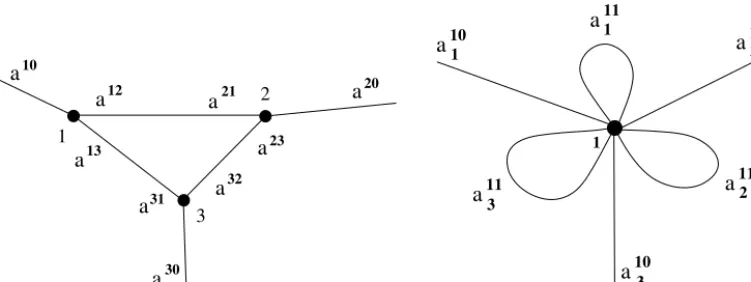
We consider the two graphs depicted inFig. 1below. To illustrate our notations, we have displayed the modes involved in the construction, dropping thep-dependence for conciseness. They are topologically completely different, one being a triangle with one external edge attached to each vertex and the other being a single vertex star graph with three external edges and three loops attached to it. Note that for the triangle, we drop the unnecessary Latin subscripts since
Nαβ=1 for allα=1,2,3 andβ=0,1,2,3,β=α.
We assume that the scattering and propagation data is given as follows (we drop again thep
dependence for clarity),
5 Uniqueness is only guaranteed if one requires in addition that the number of vertices is maximal (cf. Theorem 4.6
Fig. 1. Two topologically different graphs with the same total scattering matrix. Left: triangle. Right: star graph with loops.
For the triangle,
S1=
⎛ ⎜ ⎝
s001 s021 s031 s201 s221 s231 s301 s321 s331
⎞ ⎟
⎠, S2=
⎛ ⎜ ⎝
s002 s012 s032 s102 s112 s132 s302 s312 s332
⎞ ⎟
⎠, S3=
⎛ ⎜ ⎝
s003 s013 s023 s103 s113 s123 s203 s213 s223
⎞ ⎟ ⎠,
(3.9)
giving the four blocks as defined in(2.14)–(2.17)in the form
S(11)=
⎛ ⎝s
00
1 0 0
0 s002 0 0 0 s003
⎞
⎠, S(22)=
⎛ ⎜ ⎜ ⎜ ⎜ ⎜ ⎜ ⎜ ⎜ ⎜ ⎝
s221 s231 0 0 0 0
s321 s331 0 0 0 0 0 0 s112 s132 0 0 0 0 s312 s332 0 0 0 0 0 0 s113 s123
0 0 0 0 s213 s223
⎞ ⎟ ⎟ ⎟ ⎟ ⎟ ⎟ ⎟ ⎟ ⎟ ⎠ , (3.10)
S(12)=
⎛ ⎝s
02 1 s
03
1 0 0 0 0
0 0 s012 s032 0 0 0 0 0 0 s013 s023
⎞
⎠, S(21)=
⎛ ⎜ ⎜ ⎜ ⎜ ⎜ ⎜ ⎜ ⎝
s201 0 0
s301 0 0 0 s102 0 0 s302 0 0 0 s103
0 0 s203
⎞ ⎟ ⎟ ⎟ ⎟ ⎟ ⎟ ⎟ ⎠ , (3.11) and
Et =
⎛ ⎜ ⎜ ⎜ ⎜ ⎜ ⎝
0 0 e−ipd12 0 0 0 0 0 0 0 e−ipd13 0
e−ipd12 0 0 0 0 0
0 0 0 0 0 e−ipd23
0 e−ipd13 0 0 0 0 0 0 0 e−ipd23 0 0
For the star graph, T = ⎛ ⎜ ⎜ ⎜ ⎜ ⎜ ⎜ ⎜ ⎜ ⎜ ⎜ ⎝
t001;11 0 0 t011;11 t011;12 t011;13
0 t001;22 0 t011;21 t011;22 t011;23
0 0 t001;33 t011;31 t011;32 t011;33 t101;11 t101;12 t101;13 t111;11 t111;12 t111;13 t101;21 t101;22 t101;23 t111;21 t111;22 t111;23 t101;31 t101;32 t101;33 t111;31 t111;32 t111;33
⎞ ⎟ ⎟ ⎟ ⎟ ⎟ ⎟ ⎟ ⎟ ⎟ ⎟ ⎠ ≡
T(11) T(12) T(21) T(22)
, (3.13)
and
Es=
⎛ ⎜ ⎜ ⎜ ⎜ ⎜ ⎝
0 e−ipd111 0 0 0 0
e−ipd111 0 0 0 0 0
0 0 0 e−ipd211 0 0
0 0 e−ipd211 0 0 0
0 0 0 0 0 e−ipd311
0 0 0 0 e−ipd311 0
⎞ ⎟ ⎟ ⎟ ⎟ ⎟ ⎠ . (3.14)
The lengths of the internal edges of the triangle are related to the lengths of the loop in the star graph by
d12=d111, d23=d311, d23=d211, (3.15) and the following relations for the scattering data hold, showing in particular the matrix structure defined in(3.3)–(3.5)in the case of loops,
t001;11=s001 , t001;22=s002 , t001;33=s003 , (3.16)
t011;11=(s021 0) , t011;12=(0 0) , t011;13=(s031 0) , (3.17)
t011;21=(0 s012 ) , t011;22=(s032 0) , t101;23=(0 0) , (3.18)
t011;31=(0 0) , t011;32=(0 s023 ) , t011;33=(0 s013 ) , (3.19)
t101;11=
s201
0
, t101;12=
0
s102
, t101;13=
0 0
, (3.20)
t101;21=
0 0
, t101;22=
s302
0
, t101;23=
0
s203
, (3.21)
t101;31=
s301
0
, t101;32=
0 0
, t101;33=
0
s103
, (3.22)
t111;11=
s221 0 0 s112
, t111;12=
0 0
s132 0
, t111;13=
s231 0 0 0
, (3.23)
t111;21=
0 s312
0 0
, t111;22=
s332 0 0 s223
, t111;23=
0 0 0 s213
, (3.24)
t111;31=
s321 0 0 0
, t111;32=
0 0 0 s123
, t111;33=
s331 0 0 s113
The fact that these two graphs give rise to the same total scattering matrix follows from the fact that their scattering data are related by an internal permutation
P=
⎛ ⎜ ⎜ ⎜ ⎜ ⎜ ⎝
1 0 0 0 0 0 0 0 1 0 0 0 0 0 0 1 0 0 0 0 0 0 0 1 0 1 0 0 0 0 0 0 0 0 1 0
⎞ ⎟ ⎟ ⎟ ⎟ ⎟ ⎠
, (3.26)
such that
P S(22)P−1=T(22), P EtP−1=Es,
S(12)P−1=T(12), P S(21)=T(21). (3.27) Then,
Stottriangle=S(11)+S(12)
Et−S(22)
−1
S(21)
=S(11)+S(12)P−1P EtP−1−P S(22)P−1
−1
P S(21)
=T(11)+T(12)Es−T(22)
−1
T(21)
=Stotstar. (3.28)
4. Platonic solids
In this section, we illustrate the freedom on numbering and the use of formula (2.22) on the convex regular polyhedra known as Platonic solids (tetrahedron, cube, octahedron, dodeca-hedron, icosahedron)[18]. Once the scattering matrix is known, physical quantities associated to the graph can easily be computed, such as the conductance, using the formalism developed in[3]. The calculation essentially relies on the pole structure and the general techniques have been explicited in[15].
We carry out explicit calculations in the case of the tetrahedron and the cube. This choice is primarily motivated by aesthetic and academic criteria rather than any particular practical application. It also shows the computational advantage of our method over recursive ones on rather involved graphs. More precisely, we consider graphs whose internal edges and vertices correspond to Platonic solids and for which exactly one external edge is attached to each vertex. This corresponds toNαβ=1, α=1, . . . , N,β=0, . . . , N,α=β. Note that the condition of
regularity yieldsd1αβ≡dfor allα, β=1, . . . , N. Also, all the vertices are connected to the same number of vertices soνα ≡ν is the same for allα=1, . . . , N.N is even for all those graphs.
Finally, from the general theory of graph colouring, seee.g.[19], it is known that we can assign a label (or colour)a∈ {1, . . . , ν}to the edges connected to the same vertex in a way compatible with the graph,i.e. in colour terms, such that no two edges connected to the same vertex have the same colour and each edge can only have one colour. This allows us to define functionsnα,
α∈ {1, . . . , N}from{1, . . . , ν}to{1, . . . , N}such thatnα(a)=β if and only ifβ is connected
toαby the edge labelleda. We use the conventiona=0 for external edges and setnα(0)=0
for allα∈ {1, . . . , N}. By construction, we have the following properties
nα(a)=β⇔nβ(a)=α, nα(a)=nβ(a)⇔α=β,
In view of formula(2.22), the main object of interest isE(p)−S(22)(p)which we seek to invert. With our notations, we get
E(p)=e−ipd
N
α=1
ν
a=1
Eα,nα(a)⊗Eaa,
S(22)(p)=
N
α=1
ν
a,b=1
Eα,α⊗Eab⊗sabα (p), (4.2)
where the local matrices read
Sα(p)= ν
a,b=0
Ea+1,b+1⊗sabα (p), α=1, . . . , N. (4.3)
For later convenience, we define a reduced scattering matrix containing only the information about scattering on the internal edges
Sαred(p)=
ν
a,b=1
Ea,b⊗sabα (p), α=1, . . . , N. (4.4)
Let us also define
Ea= N
α=1
Eα,nα(a). (4.5)
ThenE(p)=e−ipdνa=1Ea⊗Eaaand from the general properties ofE(or by direct
calcula-tion) we find
Ea=Eat =Ea−1, a=1, . . . , ν. (4.6)
ThereforeEais diagonalizable with eigenvalues±1 each degenerateN2 times and with
eigenvec-torsvα=√1
2(eα+enα(a)),= ±1,α < nα(a), forming an orthonormal basis.
4.1. Tetrahedron
For the tetrahedron,N=4,ν=3 and the matricesEaenjoy the additional property
EaEb=EbEa, ∀a, b=1,2,3, (4.7)
due to the fact that
∀β∈ {1,2,3,4},∀a, b∈ {1,2,3}, nnβ(a)(b)=nnβ(b)(a). (4.8)
This can be seen to hold by direct inspection on Fig. 2and holds also for other inequivalent numberings.
From (4.7), they can be diagonalized simultaneously. As already explained, to fix ideas we can fix a numbering without loss of generality since we work up to permutations. In the present case, changing the edges and or vertices numbering amounts to interchanging theEa’s. From the
figure we obtain
E1=
⎛ ⎜ ⎝
0 0 0 1 0 0 1 0 0 1 0 0 1 0 0 0
⎞ ⎟
⎠, E2=
⎛ ⎜ ⎝
0 1 0 0 1 0 0 0 0 0 0 1 0 0 1 0
⎞ ⎟
⎠, E3=
⎛ ⎜ ⎝
0 0 1 0 0 0 0 1 1 0 0 0 0 1 0 0
⎞ ⎟
Fig. 2. Tetrahedron with an example of numbering.
and a diagonalizing matrix is
T =1
2
⎛ ⎜ ⎝
−1 1 −1 1 1 −1 −1 1
−1 −1 1 1 1 1 1 1
⎞ ⎟
⎠=T−1=Tt. (4.10) So far, we haven’t taken advantage of the geometry and its symmetries. The scattering can still be different from vertex to vertex (as labelled by the indexαon the local matrices) and at a given vertex, the scattering from edgeato edgebneeds not be the same as the scattering from edgea
to edgecsay. Clearly, this does not respect the natural symmetry of the underlying graph. One can impose that the local scattering matrices be the same for all verticesi.e.Sα(p)≡S(p)and
in particularSαred(p)≡Sred(p)for allα=1,2,3,4. This already greatly simplifies the problem of inversion. Letτ=T ⊗13andDa=TEaT−1then
τE(p)−S(22)(p)τ−1=e−ipd
3
a=1
Da⊗Eaa−14⊗Sred(p). (4.11)
The matrix on the right-hand side is a block diagonal matrix made of four 3×3 blocks essentially determined bySred
τE(p)−S(22)(p)τ−1=
4
α=1
Eαα⊗
e−ipdIα−Sred(p)
, (4.12)
with
I1=
−1 0 0
0 −1 0 0 0 1
, I2=
1 0 0
0 −1 0 0 0 −1
,
I3=
−1 0 0
0 1 0 0 0 −1
, I4=13. (4.13)
Thus, the problem is reduced to inverting 3×3 matrices. In particular, the poles of Stot are
solutions of
dete−ipdIα−Sred(p)
=0, α=1,2,3,4. (4.14) We now turn to the explicit calculation ofStot in the case where the vertices are described by
our case, each local matrix is the same 4×4 scale invariant matrix whose explicit form has been classified in[3]. Note also that we can take further advantage of the symmetries of the underlying geometry here by imposing for instance that the scattering be invariant under a rotation ofπ/3 around the axis passing through a vertex and the centre of the opposite face. Physically, this means that an incoming particle from the external edge of a vertex has the same probability of being transmitted to any one of the internal edges attached to this vertex. Mathematically, this amounts to requiring thatSsatisfies
1 0 0 J S 1 0 0 J−1
=S, (4.15)
where
J=
0 1 0
0 0 1 1 0 0
, J3=13. (4.16)
Putting everything together, we find two possible local scattering matrices
S1=
⎛ ⎜ ⎜ ⎜ ⎝ −1 2 1 2 1 2 1 2 1 2 − 1 2 1 2 1 2 1 2 1 2 − 1 2 1 2 1 2 1 2 1 2 − 1 2 ⎞ ⎟ ⎟ ⎟
⎠, S2=
⎛ ⎜ ⎜ ⎜ ⎝ −1 2 1 2 1 2 1 2 1 2 5 6 − 1 6 − 1 6 1 2 − 1 6 5 6 − 1 6 1 2 − 1 6 − 1 6 5 6 ⎞ ⎟ ⎟ ⎟
⎠. (4.17)
In the first case, we computeStot(p)as
Stot1 (p)= 1 G1(p)
−2e−3ipd+e−ipd−114+e−ipd
e−ipd+1A, (4.18) whereG1(p)=(2e−2ipd+e−ipd+1)(2e−ipd−1)and
A=
⎛ ⎜ ⎝
0 1 1 1 1 0 1 1 1 1 0 1 1 1 1 0
⎞ ⎟
⎠. (4.19)
The poles of this matrix are given by
e−ipd=x withx∈
1 2,
−1+i√7 4 ,
−1−i√7 4
. (4.20)
In the second case, we obtain
Stot2 (p)= 1 G2(p)
−2−6e−3ipd+4e−2ipd+10e−ipd−614
+3e−ipde−ipd−1A, (4.21) whereG2(p)=(6e−2ipd−e−ipd−3)(2e−ipd−1), leading to the poles
e−ipd=x withx∈
1 2,
1+√73 12 ,
1−√73 12
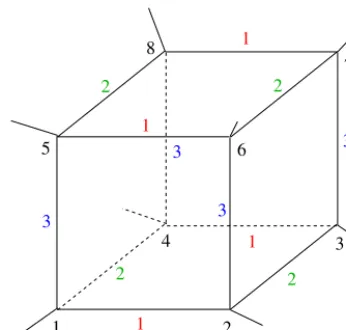
Fig. 3. Cube with an example of numbering.
4.2. Cube
For the cube,N=8 andν=3 and the matrices Ea also commute. So one can perform the
same analysis as before.
Based onFig. 3, we get explicitly
E1=
⎛ ⎜ ⎜ ⎜ ⎜ ⎜ ⎜ ⎜ ⎜ ⎜ ⎝
0 1 0 0 0 0 0 0 1 0 0 0 0 0 0 0 0 0 0 1 0 0 0 0 0 0 1 0 0 0 0 0 0 0 0 0 0 1 0 0 0 0 0 0 1 0 0 0 0 0 0 0 0 0 0 1 0 0 0 0 0 0 1 0
⎞ ⎟ ⎟ ⎟ ⎟ ⎟ ⎟ ⎟ ⎟ ⎟ ⎠
, E2=
⎛ ⎜ ⎜ ⎜ ⎜ ⎜ ⎜ ⎜ ⎜ ⎜ ⎝
0 0 0 1 0 0 0 0 0 0 1 0 0 0 0 0 0 1 0 0 0 0 0 0 1 0 0 0 0 0 0 0 0 0 0 0 0 0 0 1 0 0 0 0 0 0 1 0 0 0 0 0 0 1 0 0 0 0 0 0 1 0 0 0
⎞ ⎟ ⎟ ⎟ ⎟ ⎟ ⎟ ⎟ ⎟ ⎟ ⎠ , (4.23)
E3=
⎛ ⎜ ⎜ ⎜ ⎜ ⎜ ⎜ ⎜ ⎜ ⎜ ⎝
0 0 0 0 1 0 0 0 0 0 0 0 0 1 0 0 0 0 0 0 0 0 1 0 0 0 0 0 0 0 0 1 1 0 0 0 0 0 0 0 0 1 0 0 0 0 0 0 0 0 1 0 0 0 0 0 0 0 0 1 0 0 0 0
⎞ ⎟ ⎟ ⎟ ⎟ ⎟ ⎟ ⎟ ⎟ ⎟ ⎠ , (4.24)
and a diagonalizing matrix is
V = 1
2√2
⎛ ⎜ ⎜ ⎜ ⎜ ⎜ ⎜ ⎜ ⎜ ⎜ ⎝
1 −1 1 −1 −1 1 −1 1 1 1 −1 −1 −1 −1 1 1
−1 1 1 −1 1 −1 −1 1
−1 −1 −1 −1 1 1 1 1
−1 1 −1 1 −1 1 −1 1
−1 −1 1 1 −1 −1 1 1 1 −1 −1 1 1 −1 −1 1 1 1 1 1 1 1 1 1
⎞ ⎟ ⎟ ⎟ ⎟ ⎟ ⎟ ⎟ ⎟ ⎟ ⎠
Again assuming that the local scattering matrices are the same at all vertices, we get
VE(p)−S(22)(p)V−1=e−ipd
3
a=1
a⊗Eaa−18⊗Sred(p), (4.26)
where a=VEaV−1 andV =V ⊗13. This is a block diagonal matrix and the problem is
reduced to inverting 3×3 matrices,
E(p)−S(22)(p)−1=V−1
8
α=1
Eαα⊗
e−ipdIα−Sred(p)
−1
V, (4.27)
where
I1=13, I2=
−1 0 0
0 1 0 0 0 1
,
I3=
1 0 0
0 −1 0 0 0 1
, I4=
−1 0 0
0 −1 0 0 0 1
, (4.28)
I5=
1 0 0
0 1 0 0 0 −1
, I6=
−1 0 0
0 1 0 0 0 −1
,
I7=
1 0 0
0 −1 0 0 0 1
, I8= −13. (4.29)
We turn to the explicit computation of the total scattering matrix in the two cases(4.17) describ-ing scale and rotation invariant local scatterdescrib-ing at the vertices. In both cases, we find the followdescrib-ing structures forStot: it is a linear combination of matrices in the Abelian group generated by the E’s with coefficients being polynomials ine−ipd. Forj=1,2,
Stotj (p)=a
j
0(p)18+a
j
1(p)E1+a
j
2(p)E2+a
j
3(p)E3+a
j
4(p)E1E2+a
j
5(p)E1E3
+a6j(p)E2E3+a7j(p)E1E2E3. (4.30)
In the first case, we find
a01(p)=8+e
−ipd−8e−2ipd−5e−3ipd−40e−4ipd+4e−5ipd−32e−6ipd
4(−1+e−2ipd+8e−4ipd+16e−6ipd) , (4.31)
a11(p)= −5e
−ipd+e−3ipd−20e−5ipd
4(−1+e−2ipd+8e−4ipd+16e−6ipd), (4.32)
a21(p)= 3e −ipd
4−16e−2ipd, (4.33)
a31(p)= 3e −ipd
4−16e−2ipd, (4.34)
a41(p)= − e
−ipd(1−9e−ipd+2e−2ipd)
4(−1+e−ipd+2e−2ipd−4e−3ipd+8e−4ipd), (4.35)
a51(p)= − e
−ipd(1−9e−ipd+2e−2ipd)
a61(p)= e
−ipd(1+9e−ipd+2e−2ipd)
4(−1−e−ipd+2e−2ipd+4e−3ipd+8e−4ipd), (4.37)
a71(p)= − e
−ipd+19e−3ipd+4e−5ipd
4(−1+e−2ipd+8e−4ipd+16e−6ipd). (4.38)
The poles of the scattering matrix can be then computed. They are given by
e−ipd=x withx∈
±1
2,±
1+i√7 4 ,±
1−i√7 4
. (4.39)
In the second case, we find
a02(p)=72+9e
−ipd−440e−2ipd−45e−3ipd+728e−4ipd+36e−5ipd−288e−6ipd
4(−9+73e−2ipd−184e−4ipd+144e−6ipd) ,
(4.40)
a12(p)= − 3e
−ipd(15−67e−2ipd+60e−4ipd)
4(−9+73e−2ipd−184e−4ipd+144e−6ipd), (4.41)
a22(p)= 3e −ipd
4−16e−2ipd, (4.42)
a32(p)= 3e −ipd
4−16e−2ipd, (4.43)
a42(p)= − 3e
−ipd(−1+3e−ipd+2e−2ipd)
4(3−e−ipd−18e−2ipd+4e−3ipd+24e−4ipd), (4.44)
a52(p)= − 3e
−ipd(−1+3e−ipd+2e−2ipd)
4(3−e−ipd−18e−2ipd+4e−3ipd+24e−4ipd), (4.45)
a62(p)= 3e
−ipd(−1−3e−ipd+2e−2ipd)
4(3+e−ipd−18e−2ipd−4e−3ipd+24e−4ipd), (4.46)
a72(p)= 3e
−ipd(3−7e−2ipd+12e−4ipd)
4(9−73e−2ipd+184e−4ipd−144e−6ipd). (4.47)
The poles of the scattering matrix are given by
e−ipd=x withx∈
±1
2,±
1+√73 12 ,±
1−√73 12
. (4.48)
5. Conclusion and outlooks
We want to stress that in the present paper, themodesas we called them, appear more as con-venient labels than true quantum field theoretic objects. This has two consequences. First, our results are ready to use for applications in quantum field theory on graphs by simply promoting the modes to generators of the RT-algebra [13], as briefly discussed in Section2.2. Second, it means that our results hold in complete generality for abstract graphs with or without loops. In this respect, the present results provide an extension of the results in [10] to the case of loops.6
Finally, this paper lays the ground to applications to transport problems on arbitrary graphs in the spirit of the studies performed ine.g.[3–6]using quantum field theory and bozonization techniques. Indeed, it provides one with the central ingredient which is the total scattering matrix together with its pole structure. Once this structure is known, the calculation of physical data such as the conductance between external edges is rather direct, see e.g.[15]. We will return to these questions in the near future. Let us note that some of them have been addressed in the first quantization approach, where the scattering matrix was computed for continuous wave functions[20], and then used to compute local conserved quantities[21].
References
[1] P. Exner, Leaky Quantum graphs: A review, Proc. Sympos. Pure Math. 77 (2008) 523, arXiv:0710.5903. [2] P. Kuchment, Quantum graphs: An introduction and a brief survey, Proc. Sympos. Pure Math. 77 (2008) 291,
arXiv:0802.3442.
[3] B. Bellazzini, M. Mintchev, P. Sorba, Bosonization and scale invariance on quantum wires, J. Phys. A 40 (2007) 2485, hep-th/0611090.
[4] B. Bellazzini, M. Burrello, M. Mintchev, P. Sorba, Quantum field theory on star graphs, Proc. Sympos. Pure Math. 77 (2008) 639, arXiv:0801.2852.
[5] B. Bellazzini, M. Mintchev, P. Sorba, Boundary bound state effects in quantum wires, arXiv:0810.3101.
[6] B. Bellazzini, M. Mintchev, P. Sorba, Quantum wire junctions breaking time reversal invariance, arXiv:0907.4221. [7] V. Kostrykin, R. Schrader, Kirchhoff’s rule for quantum wires, J. Phys. A 32 (1999) 595–630, math-ph/9806013. [8] V. Kostrykin, R. Schrader, The generalized star product and the factorization of scattering matrices on graphs,
J. Math. Phys. 42 (2001) 1563, math-ph/0008022.
[9] V. Kostrykin, R. Schrader, The inverse scattering problem for metric graphs and the traveling salesman problem, math-ph/0603010.
[10] Sh. Khachatryan, R. Schrader, A. Sedrakyan, Grassmann–Gaussian integrals and generalized star products, J. Phys. A 42 (2009) 304019, arXiv:0904.2683.
[11] Sh. Khachatryan, A. Sedrakyan, P. Sorba, Network models: Action formulation, arXiv:0904.2688. [12] R. Schrader, Finite propagation speed and causal free quantum fields on networks, arXiv:0907.1522.
[13] M. Mintchev, E. Ragoucy, P. Sorba, Scattering in the presence of a reflecting and transmitting impurity, Phys. Lett. B 547 (2002) 313, hep-th/0209052;
M. Mintchev, E. Ragoucy, P. Sorba, Reflection–transmission algebras, J. Phys. A 36 (2003) 10407, hep-th/0303187. [14] V. Caudrelier, M. Mintchev, E. Ragoucy, P. Sorba, Reflection–transmission quantum Yang–Baxter equations,
J. Phys. A 38 (2005) 3431, hep-th/0412159.
[15] E. Ragoucy, Quantum field theory on quantum graphs and application to their conductance, J. Phys. A 42 (2009) 295205, arXiv:0901.2431.
[16] M. Mintchev, E. Ragoucy, Algebraic approach to multiple defects on the line and application to Casimir force, J. Phys. A 40 (2007) 9515, arXiv:0705.1322.
[17] P. Kurasov, F. Stenberg, On the inverse scattering problem on branching graphs, J. Phys. A 35 (2002) 101. [18] Pythagoras, autos ephe,∼500 B.C.;
Theaetetus, Book X of Euclid’s Elements, 300 B.C.
6 The more general case where relations(2.2)are replaced by a general invertible connecting matrix is easily
[19] C. Shannon, A theorem on coloring the lines of a network, J. Math. Phys. 28 (1949) 148–151; V.G. Vizing, On an estimate of the chromatic class of ap-graph, Diskretn. Anal. 3 (1964) 25–30; V.G. Vizing, Critical graphs with given chromatic class, Metody Diskretn. Anal. 5 (1965) 9–17;
P. Erdös, R. Wilson, Note on the chromatic index of almost all graphs, J. Combin. Theory B 23 (1977) 255–257. [20] C. Texier, G. Montambaux, Scattering theory on graphs, J. Phys. A 34 (2001) 10307–10326.
[21] C. Texier, M. Büttiker, Local Friedel sum rule in graphs, Phys. Rev. B 67 (2003) 245410;