Students’ Perceptions of Technology-based Marketing Courses
Dawn Birch, University of Southern Queensland Michael Gardiner, University of Southern Queensland
Abstract
Distance education courses have been traditionally delivered via static print-based packages. However, advances in technology and greater use of multimedia in education have provided an opportunity for course designers to enrich students’ learning experiences by providing technology-based learning resources that comprise a range of multimedia and online components. Driving forces including pedagogical, opportunistic, pragmatic, and
psychological motivations have encouraged educators to adopt educational technologies for designing and delivering their courses. In this paper, the findings of two electronic surveys used to determine distance education students’ perceptions of two marketing undergraduate courses that have recently been converted from a print-based to a technology-based course (comprising an interactive CD and a course homepage) are presented. The findings indicate that respondents enjoyed using the course CD, found the course CD to be easy to use and navigate, and agreed that the course CD had assisted their performance in the course. The findings also indicated that respondents perceived the multimedia elements that were housed on the course resources to be valuable in terms of achieving desired learning outcomes.
Introduction
In recent times, marketing educators have been enhancing or replacing elements of their traditional on-campus lecture and tutorials with more advanced learning technologies
including interactive CDs and electronic communication via e-mail, online discussion forums, and chat rooms (Eastman and Owens Swift, 2001; McPhail and Birch, 2004). Major distance education providers, such as the University of Southern Queensland have traditionally
delivered courses via static print-based study packages, typically comprising an introductory book, a study guide and a book of readings. However in recent times, a number of courses have been converted to technology-based courses comprising an interactive CD accompanied by a course homepage. The shift has resulted from a number of driving forces including pedagogical, pragmatic, opportunistic, and psychological motivations. This trend has attracted the interest of researchers concerned about the impact of these changes on students in terms of both student acceptance and performance (Hunt, Eagle and Kitchen, 2004; McDonald and McPhail, 2004). The purpose of this paper is to investigate distance education students’ perceptions of technology-based learning resources for undergraduate marketing courses.
Motivations for Developing Technology-based Learning Resources
Educational technology is defined as “recent developments in computer-based technologies used to facilitate teaching” (Ebersole and Vorndam, 2003, p. 4). A review of the literature has revealed that there are a number of pragmatic, opportunistic, psychological, and pedagogical motivations for the adoption of educational technologies for the purpose of designing and delivering courses (Ebersole and Vorndam, 2003; Tetiwat and Huff, 2002). For example,
convenience of communicating electronically with students who are studying at a distance, the reduced cost of printing and distribution of print-based materials, effective and efficient use of learning time, and the need to remain competitive by meeting student demands (Ebersole and Vorndam, 2003). Opportunistic motivations for adopting educational
technologies include embracing advanced educational and communications technologies and multi-media opportunities, and accessing a wealth of rich information from the Internet (Ebersole and Vorndam, 2003). However, the success of the shift to technology-based courses requires that students have access to the necessary technology, and that students are “techno-savvy” enough and willing to access these technologies (McCorkle, Alexander and Reardon, 2001). Psychological motivations may include the personal gratification or satisfaction of the educator and the perceived need of the educator to be innovative, creative or ‘state of the art’ in the development of their learning resources (Ebersole and Vorndam, 2003; Jacobsen, 1998).
However, the primary motivations for the shift away from static print-based materials toward technology-based resources should be based on sound pedagogy. Pedagogical motivations for developing technology-based resources may reflect a shift away from a teacher-centred, instructivist model of teaching toward a more learner-centred, socio-constructivist approach. For example, online discussions allow students to learn collaboratively by sharing their experiences and perspectives to co-construct knowledge by arriving at shared meanings (Jonassen, 1999). Electronic communication skills and competence in the use of electronic media are attributes that are required from today’s marketing graduates (Vlosky and Wilson, 2004). Hence, many marketing educators have adapted their teaching strategies and resources to facilitate the development of these important skills (Laurillard, 2002).
Another key pedagogical motivation for developing technology-enhanced resources is to cater for diverse student learning styles or modalities (Fleming, 1995). Fleming (1995) identified four learning styles, namely, visual, aural, read/write, and kinaesthetic (VARK). While some students may have one predominant learning style, many students are multi-modal. The ability to house multi-media elements on CD and course homepage allows instructors to cater for diverse learning styles. For example, visual/aural learners may learn better by viewing lecture slides and listening to an audio explanation of the course content than by reading a study guide or a text book. Kinaesthetic learners who ‘learn by doing’ may benefit by interacting with other students on the course homepage or working through an interactive diagram on the CD. Indeed, more effective learning occurs when multiple senses are engaged (Kearnsley, 2000). Dual coding theory indicates that multiple representations of content in both visual and verbal form can lead to improved retention by reducing the cognitive load on working memory (Bodemer and Ploetzner, 2002; Mayer, 2001). Hence, educators adopt educational technologies with the aim of appealing to diverse student learning styles, and thus attaining improved learning outcomes (Ebersole and Vorndam, 2003; Jacobsen, 1998).
Case Studies – Undergraduate Distance Education Marketing Courses
This study focuses on distance education students enrolled in two undergraduate marketing courses that have been converted from print-based to technology-based courses comprising an interactive CD and a course homepage (WebCT). One of the courses, Introduction to
Marketing (MKT1001) is part of the core of the Bachelor of Business at the University of Southern Queensland. The other course, Marketing Channels (MKT2004) is a second-level course in the marketing major. The interactive CD contains a section on ‘getting started’ and provides the necessary downloads to access the multi-media elements (flash, media player etc.). The introductory section of the CD includes a video introduction from the course leader, a hyperlinked study schedule, and audio explanations of the assessment items with links to assessment websites. The study modules housed on the CD include audio introductions, Breeze lecture presentations (PowerPoint with audio), interactive diagrams (with text and audio explanations), interactive quizzes and crosswords, hyperlinked examples and activities, and links to learning resources. The course homepage provides current information, such as announcements from course instructors, assignment and module discussion topics, and updated lecture recordings.
Research Method
To ascertain students’ perceptions towards the technology-based learning resources and their perceptions of the value of the various elements housed on the course CD and course
homepage, an electronic survey was conducted for each course at the end of the semester. Students were sent two follow-up emails reminding them to complete the survey. Students were asked how many times they had used the course CD and accessed the course homepage. Three items measured perceptions of the course CD on five-point Likert scales including enjoyment, ease of use and navigation, and perceived impact of the CD on their performance in the course. The students were also asked to indicate how valuable the various elements that were housed on the CD and the course homepage were in terms of achieving desired learning outcomes on five-point interval scales.
Research Findings and Discussion
The response for the electronic surveys was 86 students (32%) for the core course,
Table 1: Number of Times Course Resources were Used by Valid Percentage
Course resource 12 + 7-12 4-6 1-3 0 Mean St.D Course CD - MKT1001 57.1 17.9 9.5 10.7 4.8 1.88 1.24 Course CD - MKT2004 70.0 13.3 10.0 6.7 0 1.53 .937 Course homepage - MKT1001 62.4 21.2 9.4 4.7 2.4 1.64 .998 Course homepage - MKT2004 60.0 23.3 13.3 3.3 0 1.60 .855
(Five-point usage scale: 1 = 12 or more times and 5 = 0 times)
Second, respondents were asked to indicate their level of agreement with three statements regarding the course CD (see table 2). For both courses, 83% of the respondents agreed that the course CD was easy to use and navigate. For the core course, 68% of the respondents agreed that they enjoyed using the course CD, and 77% in the second-level course agreed with the same statement. For the core course, 64% of the respondents agreed that the course CD assisted their performance in the course, while 73% in the second-level course agreed with this statement.
Table 2: Attitudes Toward the Course CD by Valid Percentage
Item SA A N D SD Mean StD
Course CD was easy to use and navigate - MKT1001 64.3 19.0 11.9 2.4 2.4 1.60 .96 Course CD was easy to use and navigate - MKT2004 60.0 23.3 13.3 3.3 0 1.60 .86 Enjoyed using course CD - MKT1001 42.9 25.0 19.0 8.3 4.8 2.07 1.18 Enjoyed using course CD - MKT2004 60.0 16.7 3.3 10.0 10.0 1.93 1.41 Course CD assisted my performance in this course -
MKT1001 38.6 25.3 21.7 8.4 6.0 2.18 1.21
Course CD assisted my performance in this course
-MKT2004 60.0 13.3 13.3 0 13.3 1.93 1.41
(Five-point Likert scale: 1= SA, strongly agree and 5 = SD, strongly disagree)
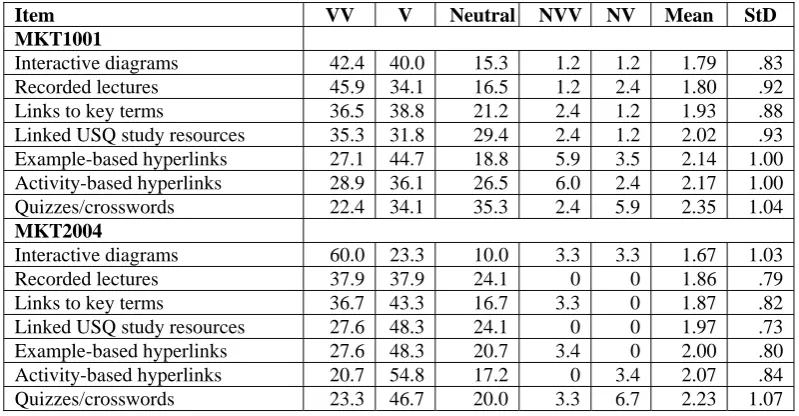
Respondents were asked to indicate the perceived value of the elements housed on the course CD, in terms of assisting their performance and enhancing their learning experience (table 3). Table 3: Perceived Value of CD Elements by Valid Percentage
Item VV V Neutral NVV NV Mean StD
MKT1001
Interactive diagrams 42.4 40.0 15.3 1.2 1.2 1.79 .83 Recorded lectures 45.9 34.1 16.5 1.2 2.4 1.80 .92 Links to key terms 36.5 38.8 21.2 2.4 1.2 1.93 .88 Linked USQ study resources 35.3 31.8 29.4 2.4 1.2 2.02 .93 Example-based hyperlinks 27.1 44.7 18.8 5.9 3.5 2.14 1.00 Activity-based hyperlinks 28.9 36.1 26.5 6.0 2.4 2.17 1.00 Quizzes/crosswords 22.4 34.1 35.3 2.4 5.9 2.35 1.04 MKT2004
[image:4.595.98.498.538.746.2]In particular, the recorded lectures, interactive diagrams, and links to key terms were considered to be the most valuable elements by respondents in both courses. However, all elements housed on the course CDs were rated as valuable in terms of assisting performance and enhancing the learning experience
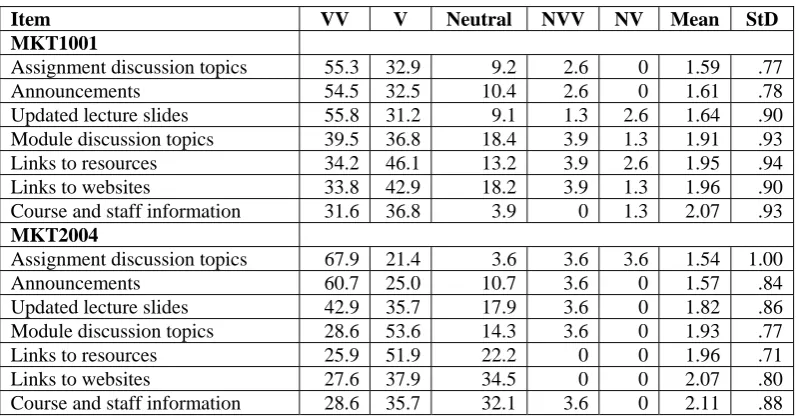
[image:5.595.101.501.261.469.2]Finally, respondents were asked to rate the perceived value of various aspects of the course homepage, in terms of enhancing their learning experience (table 4). For both courses, the assignment discussion topics, announcements, and updated lecture slides were rated as the most valued. However, the remaining components including module discussion topics, links to resources, links to websites, and course and staff information were also valued.
Table 4: Perceived value of the Course Homepage Aspects by Valid Percentage
Item VV V Neutral NVV NV Mean StD
MKT1001
Assignment discussion topics 55.3 32.9 9.2 2.6 0 1.59 .77
Announcements 54.5 32.5 10.4 2.6 0 1.61 .78
Updated lecture slides 55.8 31.2 9.1 1.3 2.6 1.64 .90 Module discussion topics 39.5 36.8 18.4 3.9 1.3 1.91 .93 Links to resources 34.2 46.1 13.2 3.9 2.6 1.95 .94 Links to websites 33.8 42.9 18.2 3.9 1.3 1.96 .90 Course and staff information 31.6 36.8 3.9 0 1.3 2.07 .93 MKT2004
Assignment discussion topics 67.9 21.4 3.6 3.6 3.6 1.54 1.00
Announcements 60.7 25.0 10.7 3.6 0 1.57 .84
Updated lecture slides 42.9 35.7 17.9 3.6 0 1.82 .86 Module discussion topics 28.6 53.6 14.3 3.6 0 1.93 .77 Links to resources 25.9 51.9 22.2 0 0 1.96 .71 Links to websites 27.6 37.9 34.5 0 0 2.07 .80 Course and staff information 28.6 35.7 32.1 3.6 0 2.11 .88 (Five-point scale: 1= VV (very valuable), 2 = V (valuable), 4 = NVV (not very valuable), 5 = NV (not valuable))
Conclusion
References
Bodemer, D., Ploetzner, R., 2002. Encouraging the active integration of information during learning with multiple and interactive representations. In Niegemann, H., Brünken, R. and Leutner, D. (Eds.). Proceedings of the EARLI SIG 6 Biannual Workshop 2002 in Erfurt. Münster: Waxmann.
Davis, F. D., Bagozzi, R. P., Warshaw, P. R., 1989. User acceptance of computer technology: A comparison of two theoretical models. Management Science 35 (8), 982-1003.
Eastman, J. K., Owens Swift, C., 2001. New horizons in distance education: The online learner-centered marketing class. Journal of Marketing Education 23 (1), 25-34.
Ebersole, S., Vorndam, M., 2003. Adoption of computer-based instructional methodologies: A case study. International Journal on E-Learning 2 (2), 15-20. Available:
http://dl.aace.org/12678, accessed 29 May 2005.
Fleming, N.D., 1995. I'm different; not dumb. Modes of presentation (VARK) in the tertiary classroom. In Zelmer, A., (Ed.) Research and Development in Higher Education. Proceedings of the 1995 Annual Conference of the Higher Education and Research Development Society of Australasia (HERDSA), HERDSA 18, 308–313.
Hunt, L., Eagle, L., Kitchen, P., 2004. Balancing marketing education and information technology: Matching needs or needing a better match? Journal of Marketing Education 26 (1), 75-88.
Jacobsen, D. M., 1998. Adoption patterns of faculty who integrate computer technology for teaching and learning in higher education. Paper presented at The Educational Multimedia and Hypermedia and World Conference on Educational Telecommunications, Freiburg. Jonassen, D., 1999. Designing constructivist learning environments. In C. Reigeluth (Ed.). Instructional Design Theories and Models: A New Paradigm of Instructional Theory (vol. II). Mahwah, NJ, Lawrence Erlbaum Associates, 215-239.
Kearnsley, G., 2000. Online Education: Learning and Teaching in Cyberspace, Belmont, CA, Wadworth/Thomson Learning.
Laurillard, D., 2002. Rethinking University Teaching: A Conversational Framework for the Effective Use of Learning Technologies. London, Routledge Falmer.
Mayer, R.E., 2001. Multimedia Learning. Cambridge, Cambridge University Press.
McCorkle, D. E., Alexander, J. F., Reardon, J., 2001. Integrating business technology and marketing education: Enhancing the diffusion process through technology champions. Journal of Marketing Education 23 (1), 16-24.
http://130.195.95.71:8081/WWW/ANZMAC2004/CDsite/papers/McPhail1.PDF, accessed 25 May 2005.
McDonald, J., and McPhail, J. D., 2004. Students' satisfaction with a hybrid course offering: An Australian case study. Proceedings of the International Conference on Computers in Education. Melbourne, Australia.
Tetiwat, O., and Huff, S., 2002. Determinants of the adoption of web-based educational technology: A preliminary data analysis of New Zealand tertiary educators. Proceedings of the International Conference on Computers in Education.