Neighbourhood-Trust Dependency
Access
Control
for
WFMS
Jianming Yong
Department ofInformation Systems, Faculty ofBusiness
University ofSouthern Queensland, Australia
yongj@usq.
edu.
auAbstract
WFMSs are widely used by modern business processes. But sofar it is still a challenge to have a simple andeffective access control mechanism for WFMSs. This paper contributes an
effective
andsimply access control mechanism, called Neighbourhood-Trust Dependency Access Control (NETDEPAL), for WFMSs. This new notioncombines theworkflow mechanism and RBAC into Netdepal for WFMSs. The secure accessfor WFMSs can be efficiently implemented by Netdepal from system dependencyand taskdependencyvia theirneighbourhood relationships.Keyword: WFMS, RBAC,Neighbourhood-Trust Dependency Access Control
1. Introduction
Workflow management systems (WFMSs)have been used in business process re-engineering for many years.
More and more organisations are using WFMSs to
facilitate their daily business processes. Furthermore WFMSs are used to coordinate the intra-organisation processes,for anexample, a workflow system can be used
to facilitate the operations of an enterprise supply chain which connects customers, venders, material suppliers, and financial agents, etc. Because aworkflow system can
run acrossdifferent organisations, it is essential to have a reliable access control mechanism to ensure the security of all transactions among these intra-organisation processes. It is obvious that an intra-organisation workflow includes aseries ofdefinedtasks whichare run bydifferentusersinthe different domains. Differentusers are assigned suitable authoritiesto execute the designated tasks of a workflow. In order to clearly illustrate the implementation of aworkflow, we use anonline air-ticket booking system as an example. This online air-ticket booking workflow canbe decomposed into the following four tasks:
- Task 1 (TI) customer booking: a customer wants to book air tickets anduses his/her Internet browser to input his/herdata and submitstothe airline'sbooking system;
- Task 2 (T2) airline booking processing: Airline booking system gets data from the customer and
checking the seat availability and contacting the bank for verification of customer'sbanking information; - Task 3 (T3) banking system processing: Bank system
gets data and processing and confirming airline booking system;
- Task 4 (T4) confirming: The airline confirms the customerthe finalprocessingresult.
This example well demonstrates the different users who have different purposes to do different tasks in a streamline workflow. Each task can onlybe done bythe different users or systems associated with relevant authorities. Like TI, only a customer can do it on their demands. T2 can only be executed by airline booking system. T3 can only be implemented by the banking system. T4 needs to be done by airline booking system. Obviously the system which executes TI needs to access the system which executes T2, in reverseT2 systemneeds accessing TI system. The system ofT2 needs accessing the system of T3, in reverse T3 system needsaccessingT2
system. T3 system needs accessing T4 system, and reversely T4 system needs accessing T3 systems. In order
to ensure the security and seamless connection of a workflow, an effective access control policy needs to be developedfor WFMSs. This paper intendsto introducean
effective access control mechanism for WFMSs, namely neighbourhood-trust dependency access control (NETDEPAL).
This paper is organised as the follows. Section 2
discusses some basic notations of WFMS and recent developments. Section 3 introduces a current dominant
access control technology, namely role-base access
control(RBAC). Section4 identifiesconstraints of RBAC for WFMSs. Section 5 discusses NETDEPAL in details. Section 6 draws the conclusions.
2. WFMS
Workflow is a key technology for automating business processes that involve access to several
applications[i].
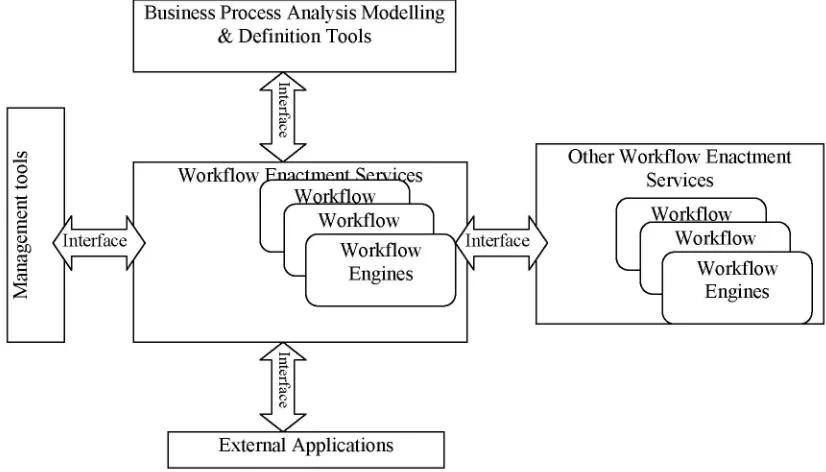
This makes workflowtechnologybecomeInternet-Business Process Analysis Modelling &Definition Tools
Figure 1.General architecture ofworkflow
based e-commerce utilises workflow technology to effectively conduct inter & intra-organisational business processes. The Workflow Management Coalition(WfMC) [8] has been formed by vendors, users, consultants, and researchers to develop the primary standards in workflow management arena. The first most important standard is the workflow reference model [9], which appeared in January 1995. Inthe document of the workflow reference model, workflow is defined as the computerised facilitation or automation ofabusiness process, in whole
orpart. Itisconcerned with the automation ofprocedures where documents, information or tasks are passed betweenparticipants accordingto adefined setof rulesto achieve, orcontribute to, anoverall business goal. Whilst workflow may be manually organised, in practice most
workflow is normally organised within the context ofan IT system to provide computerised support for the proceduralautomation. Workflow is often associated with business process re-engineering, which is concerned with the assessment, analysis, modelling, definition and subsequent operational implementation of the core
business processes ofan organisation or other business entities. While aworkflowmanagement systemis defined as a system that completely defines, manages and
executes "workflows" through the execution of software whose order of execution is driven by a computer representation of the workflow logic. All workflow management systems exhibit certain common characteristics, which provide a basis for developing integration and interoperability capability between different products. At the highest level, all workflow management systems are characterised as providing support inthree functionalareas:
- the build-time functions, concerned with defining, andpossibly modelling, the workflow process and its constituentactivities;
- the run-time control functions, concerned with managing the workflow processes in an operational environment andsequencing the various activities to
be handledaspartof each process;
- the run-time interactions with human users and IT application tools for processing the various activity steps.
Figure 1 illustrates the general workflow architecture. The major components and interfaces are clearly identifiedthrough the architecture.
After the workflow reference model, several standards have been proposed at the interface level for business process integration, such as Wf-XML [10], MIME [11].
3. Role-based Access Control
(RBAC)
In February 2004, ANSI INCITS 359-2004 [12] was approved. It is a milestone for RBAC research and development. It has a significant impact on the access
control. So far RBAC has been accepted as a primary technology for systemaccess control. It is aresult of
co-effortsbyboth academia andindustry.
3.1.Inacademia
symposiums are more or less related to RBAC. If any search is done on ACM or IEEE digital libraries for RBAC, there will bring hundreds of papers which are relevant to RBAC. The fundamental concepts of RBAC wereaddressed by Sandhu, et al [13]. In [13], RBAC was categorized as four sub-components, RBACO, RBAC1, RBAC2, and RBAC3.
RBACO is base model of RBAC. In ANSI INCIT 359-2004, RBACOis called Core RBAC. Core RBAC has four fundamental entities: Users (U), Permissions (P), Sessions (S), and Roles (R). Users are human beings or their agents who haveability to use information systems. Roles are duties and responsibilities in an organisation or a system. Permissions are concerning access toroles with suitable users. Sessions are responsible for establishing dynamical relationships between users and roles. The set
of relationships of U, P, S, and R is defined at Core RBAC as UxR, PxR, S-*U, and S--Set(R). UxR means the relationship mapping between users and roles. PxR
meanstherelationship mapping between permissions and roles. S-÷U means that a specific user gets a required session or sessions. S--Set(R) means that a session is associated witha setof roles.
RBAC1 isdefinedasrole hierarchies. InANSI INCIT 359-2004, RBAC1 is called Hierarchical RBAC. Hierarchical RBAC is actually defined the relationships among different roles, especially role inheritance. The main purpose of hierarchical RBAC is to simplify the system administration and management.
RBAC2 is defined as Constraints Model. In ANSI INCIT 359-2004, RBAC2 is called Constrained RBAC. Constrained RBACactually puts constrainson userswhat roles andpermissionscanbeassignmentto. It canprevent
some users from abusing the system. Furthermore static constraint and dynamic constraint are introduced by Ferraiolo,etal [14].
RBAC3 is actually a combination of RBAC1 and RBAC2. Ithas notbeen listedas a separate component in ANSI INCIT 359-2004.
3.2.InIndustry
Many popular operating systems, like, Windows, Linux, Unix, are widely using roles to manage system
resources.MajorDBMSproducts, likeOracle, Sybase,etc, all support RBAC. Major enterprise integration solutions, like SAP, PeopleSoft, widely use the concept and mechanism of roles which have the similar functions as beingdefined in RBAC.
4. Constraints
on
RBAC for WFMS
defined system and is meaningless to any other systems. Continuously we still use the online air ticket booking system as an illustration. There are three systems which are involved in this workflow (w), customer system (S1), airline system (S2) and banking system (S3). Prior to the workflow, S1, S2 and S3 are definitely separate systems. In order to simplify the analysis, we assume that all systemshave used RBAC as their access control. S1 has a setofroles, SI.r, a set of users, Sl.u, a set of permissions, SI.p, a set ofsessions, SI.s. S2 has a set of roles, S2.r, a set of users, S2.u, a set of permissions, S2.p, a set of session, S2.s. S3 has a set of roles, S3.r, a set of users, S3.u, a set of permissions, S3.p, and a set of sessions, S3.s.
1S1=S1.rU S1.uU S1.pUSl.s 2S2=S2.rUS2.uUS2.pUS2.s 3 S3=S3.rUS3.uUS3.pUS3.s
4
SI.rn 2.rn
S3.r=0
5 Sl.u0S2.u0S3.u=0
6si.pnS2.p0nS3.p=
s 7SI.s0S2.s0S3.s=0
The previous equations (1-7) well represent the independency ofS1,S2and S3 prior to forming the online air ticketbookingworkflow. Because the online air ticket bookingworkflow needs a fullcooperation ofS1, S2 and S3. Wewill have thefollowing equations.
8w=(subsetofS1)
U
(subsetof S2)U
(subset of S3)9
SI.rn 2.rn
S3.r. S7
10S1.unS2.unS3.u.
0
11
si.P0S2.pnS3.p.
#12SI.snS2.snS3.s.
#The formulas (8-12) present the cooperation relationships among S1, S2 and S3. There have to have
some common sets toseamlesslyconnectS1,S2and S3 to
form aneffective bookingworkflow. The online air ticket booking system is shown in Figure 2. With 8 steps, the booking workflow finishes its procedures. S1 needs an access to S2 at step 1-2. S2needs an access to S3 as step 3-4. S3 needs an access to S2 as step 5-6. S2 needs an access toSI as step 7-8.
Definition 1. Access order is definedas a2-tupe<Si, Sj>, (Sie wand Sjc w),where Si executes its task firstthen needs an access toSj for thefollow-uptask. AsFigure2, SI executes TI then needs an access to S2 for T2. This
canbeexpressedas<S1,S2>. Though RBAC has been widely used by current
Figure 2. workflow of online air ticket booking
The access orders of this online air ticket booking workflow are <SI, S2>, <S2, S3>, <S3, S2>, <S2, SI>. Prior to this workflow, Si, S2 and S3 have their own defined RBAC sets respectively. When SI, S2 and S3 form a workflow, these RBAC sets need keeping its original independency so that SI, S2 and S3 can be used separately. Inthe otherhand, theyneed a common RBAC set so that two neighbour systems can work together to finish the defined tasks of a workflow. This common RBACwill ensure the secure access to streamline systems. Like inFigure 2, SI has its RBAC sets and S2 also has its own RBAC sets. In order to execute TI by SI and T2by S2securelyandseamlessly,aneffective mechanism needs to be work out between SI and S2. So far to the best of our knowledge, there is no much literature about this research. We propose a solution, called Neighbourhood-TrustDependencyAccessControl(NETDEPAL).
5.
Neighbourhood-Trust
Dependency Access
Control
(NETDEPAL)
A workflow has a series of well defined tasks which
are executedby different/same systems. Like inFigure2, TI is executed by
SI,
T2 and T4 are executed byS2,
while T3 is executed by S3. In order to clearly demonstrate NETDEPAL, we need the following definitions.Definition 2 Workflow task sequence and workflow system sequence: aworkflow task sequence is definedas a2-tupe, <Ti, n>, Tiis adefined task ofaworkflow (w), TiE w, n is the order number of executed tasks. For an example, intheFigure2, TI is executed first. We denote it as
<Ti,
1>. Similarly a workflow system sequence is defined as a 2-tupe, <Si, m>, Si is a system whichexecutes tasks foraworkflow. The m is the order number of Si in the streamline systems for the workflow. <Si, 1>
denotes that the system, SI, is firstly used to execute a
defined task for the workflow. <S2, 2> denotes that S2 is secondly used to execute a defined task.
Definition
3 Neighbourhood task: a neighbourhood task is defined as a 2-tupe, [Ti, Tj], a task which is executedimmediatelybefore or after it. Like there is <Ti, n>,itsneighbourhood tasks are Tj, Tk, while there exists a workflow task sequence<Tj, n-i> or<Tk, n+±>. For an example, in Figure 2 the streamline of tasks is <TI, I>, <T2, 2>, <T3, 3>, and <T4, 4>. TI and T3 are the neighbourhood tasks of T2, [TI,T2] and [T2, T3].Definition 4 Neighbourhood system: a neighbourhood systemis defined as a 2-tupe, {Sy, Sz}, asystemwhich is usedimmediatelybefore or after it. Like there is <St, m>, its neighbourhood systems are Sy and Sz, which there exists a workflow system sequence <Sy, m-I> or <Sz, m+±>. For an example, in Figure 2 the streamline of systems is<SI, I>, <S2, 2>, <S3, 3>, <S2, 4>, and <SI, 5>. SI and S3 are S2'sneighbourhoodsystems, {S1, S2} and {S2, S3}.
Definition 5 Task dependency: Task dependency is defined as a relationship, Ti-*Tj, a task, Tj is to be executed depending on the successful execution of its prior task, Tj. Like in Figure 2, Task 2 can only be executed after Task I successfully finishes, Ti-*T2. Itis obvious that task dependencycomes fromneighbourhood task, [Ti, Tj]<+- Ti-*Tj
Again a workflow consists ofa series of well defined tasks [15]. Ageneral workflow can be modelled as:
w=T(TI, T2, T3, ...,
T,1,
Tn)Allsystems involved in theexecution of the workflow are modelled as:
S=(S1, S2, S3, ...,
Smi1,
Sm)According to the systemrequirements, all the tasks areassigned to relevant systems (as amapping function,
f).
The system sequence (Q) for the workflow is modelledas:
Q=f(T)=S' S' is the streamline ofinvolved systems for the workflow.
From the definition 5 & 6, we know that system dependency is decided bytask dependency because each task can only be executed by a specific system. We can model a workflow as the follows.
w-*T-*Neighbourhoodtask->task
dependency-*Users-*roles-*S'-*system dependency ->system
neighbourhood-*access
controlpolicyNeighbourhood-trust dependency access control fora
workflowcanbeimplementedeffectively. For anexample, if there exists
Si-*Sj,
Sj allows Si's roles which are involved in the workflow process to access its relevant resourcesfor the workflow tasks. Throughthismechanism, the access control of a workflow becomes simple, effective and efficient.6. Conclusions
More andmore WFMSs are used in current business processes. Itis very important to have a goodmechanism
to implement an effective access control policy for a
WFMS. So far, RBAC is a dominant access technology used in many systems. This paper discusses RBAC and its constraints for WFMSs. Furthermore, a neighbourhood-trustdependencyaccess control isproposed andanalysed for WFMSs. The major contribution of this paper is to identify NETDEPAL as an effective access control for WFMSs. The minor contribution is to extend RBAC and its mechanism into NETDEPAL for WFMSs.
Acknowledgement
This paper is finished duringmy academic stayatPurdue University. Prof. Elisa Bertino gives a valuable support and advice. The paper is also partially supported by USQ'searlycareerresearch grant.
References
[1] B. B. Medjahed, A. Bouguettaya, A. H. H. Ngu, A. K. Elmagarmid, "Business-to-business interactions: issues and enabling technologies," The VLDB Journal The International Journal on Very Large Data Bases, vol. 12, pp. 59-85, 2003.
[2] P. Hartmann, R. Studt, and T. Wewers, "A Framework for Classifying Interorganizational Workflow-Controlled Business Processes Focusing on Quality Management," the 34th Hawaii International Conference on System Sciences, Maui, Hawaii, USA, 2001.
[3] M.Kwak, D. Han, and J. Shim, "A Framework Supporting Dynamic Workflow Interoperation and Enterprise Application
Integration," the 35th Annual Hawaii International Conference
onSystem Sciences(HICSS'02),2002.
[4] J. A.Espinosaand A. S.Pulido,"IB(integrated Business): a Workflow BasedIntegration Approach,"the 35th annual Hawaii internationalconference onsystem sciences(HICSS-35'02), Big
Island, Hawaii, USA, 2002.
[5] M. Rohloff, "Reference Model and Object Oriented
Approach for Business Process Design and Workflow Management,"the 1996InformationSystmesConferenceofNew
Zealand,PalmerstonNorth,NEWZEALAND, 1996.
[6] M. Gillmann, G. Weikum, and W. Wonner, "Workflow
Management with Service Quality Guarantees," the International Conference on Management of Data and
Symposium on Principles of Database Systems, Madison, Wisconsin, USA,2002.
[7] P. Xu and B.Ramesh, "Supporting Workflow Management
Systems with Traceability," the 35th Hawaii International
ConferenceonSystem Science,Big Island, Hawaii, USA,2002.
[8] WfMC, "Workflow MangementCoalition,"
http ://ww,.w~ 2003.
[9] D. Hollingsworth, "The Workflow Reference Model," vol.
WfMC-TC-1003,Version 1.1,1995.
[10] WfMC, "Workflow Management Coalition Workflow Standard-InteroperabilityWf-XMLBinding,"
httpd//www.wfmc.org/standards/docs/Wf-XML- I7pdf,
2003.[11] WfMC,"Workflow Standard-InteroperabilityInternet e-mail MIMEBinding,"
httf, 2003.
[12] ANSI, American National Standard for Information
Technology -Role Based Access Control, ANSI INCITS
359-2004,February2004.
[13] R. S. Sandhu, E. J. Coyne, H. L. Feinstein, and C. E. Youman, Role-Based Access ControlModels,IEEE Computer,
29(2): 38-47, February 1996.
[14] D. F.Ferraiolo, R. S. Sandhu, S. Gavrila,D. R. Kuhn, and R. Chandramouli, Proposed NIST standard for role-based
access control, ACMTransactions onInformation andSystems
Security,4(3):224-274,August 2001.
[15] E. Bertino, E. Ferrari, and V. Atluri, AFlexible Model