ASSESSMENT OF EXECUTIVE FUNCTION IN TYPE 2 DIABETES MELLITUS – A CASE CONTROL STUDY
Dissertation submitted to
THE TAMIL NADU DR. M.G.R. MEDICAL UNIVERSITY In partial fulfillment of the regulations
for the award of the degree of
M.D. BRANCH - XVIII
M D. Psychiatry
INSTITUTE OF MENTAL HEALTH
MADRAS MEDICAL COLLEGE
THE TAMIL NADU DR. M.G.R. MEDICAL UNIVERSITY
CHENNAI, INDIA
C E R T I F I C A T E
This is to certify that the dissertation titled, “ASSESSMENT OF EXECUTIVE FUNCTION IN TYPE 2 DIABETES MELLITUS – A CASE CONTROL STUDY” is the bonafide work of Dr. MYTHILI. V in part fulfillment of the requirements for M.D. Branch – XVIII (Psychiatry) examination of The Tamilnadu Dr. M. G. R. Medical University, to be held in APRIL 2015. The period of study was from July 2014 – September 2014.
The Director, The Dean,
Institute of Mental Health Madras Medical College
CERTIFICATE OF GUIDE
This is to certify that the dissertation titled, “ASSESSMENT OF EXECUTIVE FUNCTION IN TYPE 2 DIABETES MELLITUS – A CASE CONTROL STUDY” is the original work of Dr. MYTHILI. V, done under my guidance submitted in partial fulfilment of the requirements for M.D. Branch – XVIII [Psychiatry] examination of The Tamilnadu Dr. M. G. R. Medical University, to be held in April 2015.
DECLARATION
I, Dr. MYTHILI. V solemnly declare that the dissertation titled,
“ASSESSMENT OF EXECUTIVE FUNCTION IN TYPE 2 DIABETES MELLITUS – A CASE CONTROL STUDY” is a bonafide work done by me at the Rajiv Gandhi Government General Hospital, Chennai, during the period from July 2014 – September 2014under the guidance and supervision of Dr. R. JEYAPRAKASH M.D, D.P.M, Professor, Institute of Mental Health Madras Medical College.
The dissertation is submitted to The Tamilnadu Dr. M. G. R. Medical University towards part fulfillment for M.D. Branch XVIII (Psychiatry) examination.
Place: Chennai Dr. MYTHILI . V
A C K N O W L E D G E M E N T :
These few words of acknowledgement are a sincere recognition of all the help and co-operation I have received from various people in completing this study.
I am grateful to Professor Dr.Vimala.R, M.D.Dean , Madras Medical College , Chennai, for permitting me to do this study.
Words are insufficient to express my sincere gratitude to our revered director, Professor Dr. R.Jeyaprakash, who has encouraged me and inspired me constantly, in choosing the topic and without whose help and guidance, my endeavor probably would not have seen the light of the day. With deep sense of gratitude and thankfulness, I express my indebtedness to my respected guide, Professor
Dr. R. Jeyaprakash, Department of Psychiatry .
I like to thank Dr.Jeya Krishnaveni and Dr. Shanthi Mageshwari
my co guide who has constantly supported me throughout the study. I express my indebtedness and gratitude to my Prof. Dr.Shanmugiah and my assistant professors Dr.Vimal Doshi, Dr. Sharon Joe Daniel, Dr. Priya Subashini who helped me to choose the topic and guided me throughout the study. Their unflinching interests, relentless efforts, invaluable guidance, untiring support, constant encouragement has guided me through every stage of this dissertation. I extend my thanks to Clinical Psychologist Mr. Vijayan and Mr. Sudhakar for their guidance.
endeavours. I like to thank faculty members and post graduates of Diabetology clinic, for helping me in finding cases and controls and for being a guiding light in my study.
I am also thankful to Prof. V.S. Krishnan, Dr.ShanthiNambi, Dr.Alexander Gnanadurai, Dr.Shanmugiah, Dr.P.P.Kannan and
Dr.Sabitha for being a constant source of encouragement.
Dr.Nakeerar, Dr.Saravanan. J, Dr. Sujatha, Dr. Hariharan, Dr. Aravindan, Dr. Priya Subashini, Dr. Karthik and all other assistant professors by their support, guidance and constant inspiration have enriched and gave the final shape to this work.
I owe my thanks to all departmental staff who helped me in completing this study.
I extend my sincere thanks to Dr.Sivakumaran, for helping me out with the statistics.
My heartfelt thanks to my family and friends who were with me through my ups and downs, and without whom, this study would have been impossible. My sincere thanks to my well-wishers for their constant encouragement.
Finally, I acknowledge with gratitude, the co-operation of all the
patients included in the study.
Above all, I thank the Almighty for his blessings and I offer my sincere prayers to him
Dr. MYTHILI . V
CONTENTS
SERIAL NO TOPIC PAGE NO
1 INTRODUCTION 1 2 REVIEW OF LITERATURE 4
3 AIMS AND OBJECTIVES 41
4 METHODOLOGY 43
5 RESULTS 58
6 DISCUSSION 94
7 CONCLUSION 101
8 LIMITATIONS 102
9 BIBLIOGRAPHY 103
ASSESSMENT OF EXECUTIVE FUNCTION IN TYPE 2 DIABETES MELLITUS – A CASE CONTROL STUDY
Abstract
Introduction:
Type2 Diabetes Mellitus is associated with inherent micro-vascular disease affecting frontal sub-cortical function. Executive Dysfunctions are implicated in decreased self-care capacity, poor adherence to diabetic medication, decreased levels of autonomy and a decrease in ability to make essential decision, for instrumental activities of daily living, as well as resistance to proper medical care.Isolated executive impairment falls within the category of “mild cognitive impairment. Studies have shown that patients with Type 2 DM performs significantly poorer in Executive Function compared to normal subjects .Hence this study was proposed to assess the executive Function of Type 2 DM patients.
Aim &Objective:
To assess executive functioning in type 2 diabetic patients compared to normal subjects.
Methods:
the evaluation tests. This was done to avoid hypoglycemia /severe hyperglycemiaaffecting the executive function assessment. The following parameters were assessed - Proforma for socio demographic data of study cases and control group, Proforma for Diabetes Status, Mini Mental State Examination (MMSE), Test for Executive Function namely Digit Span Test,Verbal fluency , Trail making test, Stroop Test, Wisconsin Card Sorting Test. The data collected were analysed using Chi square test and Wilcoxon – Mann-Whitney U test.
Result:
Comparison of socio-demographic data of cases and controls shows no significant difference. The mean age of onset of diabetesmellitus is 41.40 years and the duration of illness was < 5 years. There was no major macro / micro vascular complication. Comparison of neuropsychological scores between cases(study group) and controls with Digit Span Test,Verbal fluency , Trail making test, Stroop Test, Wisconsin Card Sorting Test was done.In Digit Span Test,Verbal fluency, Stroop Test& Wisconsin Card Sorting Test did not show statistical significance. Trail making test showed statistical significance.
Conclusion:
Executive functioning in diabetics was comparable to that of control group. Though Trail making test, showed a statistical difference between diabetics and non-diabetic, it was still within the normative Range for the particular age group. Validation of this conclusion requires a larger group and prospective longitudinal study.
Keywords :
INRODUCTION
Diabetes mellitus type 2 is a metabolic disorder
characterized by hyperglycemia in the context of insulin
resistance and relative lack of insulin1 , 2.Type 2 Diabetes
Mellitus is being described as a modern day epidemic,
emerging rapidly in developing countries1. Type2 diabetes
mellitus is a major public health problem all over the
world3. The socio-economic cost of Type 2 diabetes
mellitus is exorbitant, mainly due to number of associated
problems that accompany diabetes mellitus, like micro and
macro vascular diseases and their increased susceptibility
for cognitive impairment1 , 2.
Executive function is a primary domain of cognition
that involves a broad set of cognitive abilities like
attention, working memory, organization, and persistence
that are necessary for orchestrating complex, goal-directed
activities3. Executive function appears to be orchestrated
and mediated by frontal cortex along with its networks in
cerebrum and sub-cortical regions of brain4.Though it is
known that diabetes is related to some domains of
attention is now being directed to the association and
causal link between diabetes and executive functioning
domain of cognition1 , 5. Recent studies and evolving data
categorically suggest that executive dysfunction is
causatively associated with poor glycemic control2 , 5 i.e. it
is one of the major risk factor. The effect of Type2
diabetes mellitus on executive function is associated with
inherent micro-vascular disease affecting frontal
sub-cortical function1.
Executive function is a major domain of cognition
that plays a pivotal role in allowing the execution of daily
management tasks including exercise, blood glucose
monitoring and drug intake, which are essential for
glycemic control1. Executive Dysfunctions are implicated
in decreased self care capacity, poor adherence to diabetic
medication, decreased levels of autonomy and a decrease
in ability to make essential decision, for instrumental
activities of daily living, as well as resistance to proper
medical care1 , 5. Individuals with Type2 diabetes mellitus
perform significantly poorer in executive functional
The purpose of this study is to assess executive
function in patients with type 2 Diabetes mellitus in
REVIEW OF LITERATURE
E X E C U T I V E F U N C T I O N
D E F I N I T I O N :
In this modern world with a frequently changing
environment, we are constantly facing altered
circumstances that require, continuous generation and
credible monitoring of appropriate strategies, for which
newer ways of action have to be formulated and
conducted3.
The specific abilities that are called upon to respond
accurately to newer situations are referred to as Executive
Functions. This domain of cognitive functions is used for
usually managing the conditions in which routine
activation of behavior would not be sufficient for optimal
performance, and hence in those conditions a top-down
control is required to adjust or modify behavior4.
The Diagnostic and Statistical Manuel of Mental
Disorders, fourth edition, defines executive function as
one’s ability to plan, initiate, sequence, monitor and
Executive function is a set of cognitive process that
allows one to behave independent of the environment,
instead of having behaviors mediated by the environment4.
Psychodynamic Diagnostic Manual – defines
executive function as cognitive abilities necessary for
complex goal directed behavior and adaptation to a range
of environmental changes and demands. Functions include
the ability to plan and anticipate outcomes (cognitive
flexibility), the ability to direct attentional resources to
meet the demands of non-routine events.
American psychiatric association describes executive
function as a set of cognitive abilities that control and
regulate other abilities and behaviors. They include ability
to initiate and stop actions, to monitor and change
behavior as needed, and to plan future behavior when faced
with novel task and situation3.
Two central themes of executive control framework are4
Self regulatory skills
Perception
Sustained attention
Flexibility
Working memory
Response inhibition
Emotional regulation
Goal oriented skills
Planning
Organization
Time management
Self monitoring
Executive functions comprise a set of skills which are
responsible for orchestrating goal oriented activities like
finances, medications, transportation, shopping, cooking,
housework, and using multimedia and communication
devices4 , 5.
These activities constitute the Instrumental Activities
of Daily Living4.These activities are made possible
through successful planning, initiation, sequencing with
ongoing monitoring and assessment for possible
functions, such as language and memory, these are
acquired skills. Intact executive functions are thus vital to
human autonomy4.
Anatomically, the pre-frontal cortex and its basal
ganglia connections are responsible for executive
functioning2. It is however difficult to exactly localize or
pinpoint specific executive functions to specific areas
within the frontal cortex. The frontal cortex is connected
to the caudate, putamen, pallidum and thalamus via
circuits2. These connections are intrinsically and
dynamically balanced direct and indirect circuits. The
importance of these connections is manifested by the fact
that executive impairment may occur without direct frontal
damage, that is by disruption of these dynamic circuits2 , 6.
Isolated executive impairment falls within the
category of “mild cognitive impairment”. Mild cognitive
impairment is heterogeneous group of disorders6 which
does not meet the criteria for dementia. Executive
impairment was added to the definition of dementia by the
The introduction of diagnosis – Mild Neurocognitive
disorder is crucial change in diagnostic criteria for
neurocognitive disorder in DSM – V Individuals often seek
medical and psychiatric evaluation for neurocognitive
problems that do not meet the criteria for major
neurocognitive disorder.
DSM – V also includes complex attention, Executive
function, peripheral motor problems, and social cognition
among neurocognitive domains that can be impaired by a
neurocognitive disorder.
These individuals frequently fall below the normal
range of function on neuro-psychological testing, but their
signs and symptoms are not severe enough to be classified
as major neurocognitive disorder or dementia.
Although they may be living independently, they
struggle with activities of daily living and express this
difficulty. Mild Neurocognitive Impairment is often found
to be a transitional stage between aging and dementia.
Although Mild Neurocognitive Impairment can present
with a variety of symptoms, when memory loss is the
Neurocognitive Impairment, and is frequently seen as
Prodromal stage of Alzheimer’s dementia.
When Individuals have impairment in domains other
than memory, it is classified as Non Amnesic, single or
multiple domain Mild Neurocognitive Impairment and the
individuals are more likely to convert to other dementia.
I M P A C T O F E X E C U T I V E I M P A I R M E N T O N T H E
I N D I V I D U A L :
Executive impairment has been shown to be strongly
associated to a number of chronic medical diseases1 , 2 , 7.
More commonly associated conditions include
schizophrenia, major depressive disorders, chronic
obstructive airway disease, obstructive sleep apnea
syndrome, congestive heart failure, infection with Human
Immunodeficiency Virus, chronic renal failure, lung
cancers, hypertension, subcortical ischemic vascular
disease, pituitary tumors and type 2 diabetes mellitus1 , 2 , 7.
During the normal aging process deterioration of
executive function correlates with longitudinal decline in
of functional status. Freedom House Study7 showed that in
patients with chronic diseases executive dysfunction may
be viewed as a predictor of severity and disability.
Tests of executive function correlate strongly with
instrumental activities of daily living rather than physical
activities of daily living8. Executive functioning is able to
discriminate between independent patients, patients
requiring moderate level supervision and those requiring
full supervision1, there by a guiding in level of supervision
required.
Self-management is regarded as a set of skilled
behaviors used to manage one’s illness. This places greater
responsibility on the individual for disease management.
Executive impairment impacts negatively on a patients’
ability to self-manage their disease. It hinders their ability
to adhere to treatment regimens and implement necessary
lifestyle changes. These patients have also been found to
be much more resistant towards effective care and suffer
from impaired medical-decision-making capacity8 , 9.
Patients with executive impairment are less likely to
with memory impairment, and more frequently may report
it as memory loss rather than executive dysfunction.
However impaired executive function may have a more
profound effect on ones autonomy than impaired
memory1 , 1 0 , 1 1.
T Y P E 2 D I A B E T E S M E L L I T U S A N D C O G N I T I O N :
D E F I N I T I O N :
According to WHO, the term diabetes mellitus
describes a metabolic disorder of multiple etiology,
characterized by chronic hyperglycemia, with disturbance
of carbohydrate, fat and protein metabolism, resulting from
defects in insulin secretion, insulin action, or both1 3. Type
2 diabetes mellitus is a non-autoimmune, complex,
heterogeneous and polygenic metabolic disease condition
in which the body fails to produce enough insulin,
characterized by abnormal glucose homeostasis1 4.
Diabetes mellitus may present with characteristic
symptoms such as thirst, polyuria, blurring of vision and
non-ketotic hyperosmolar state may develop and lead to stupor,
coma and in absence of effective treatment, death.
Type 2 diabetes mellitus is associated with a relative
impairment in insulin secretion coupled with varying
degrees of peripheral resistance to the action of insulin.
Type 2 diabetes may also be considered a syndrome with
multiple associated co-morbidities and complications1 5.
The associated insulin resistant state of type2 diabetes is
fundamental to the pathogenesis of the metabolic
syndrome1 0.
The long term effects of diabetes mellitus include
retinopathy with potential blindness, nephropathy that may
lead to renal failure, and/or neuropathy with risk of foot
ulcer, amputation, Charcot joints, and features of
autonomic dysfunction, including sexual dysfunction.
People with diabetes mellitus are at increased of
cardiovascular, peripheral vascular and cerebrovascular
disease1 6.
Diabetes is the potential epidemic in India with more
than 62 million diabetic individuals currently diagnosed
diabetes mellitus may afflict up to 79.4 million people in
India1 9.
G L O B A L B U R D E N O F T Y P E 2 D I A B E T E S M E L L I T U S :
International Diabetes federation has reported that the
prevalence of Type 2 diabetes mellitus have reached
epidemic proportions all over the world. Estimated number
of Type 2 Diabetes mellitus in the year 2010 was around
2,850,000 in 7 regions of International Diabetes
Foundation. The International Diabetes Foundation had
estimated that around 3,900,000 deaths were caused by
diabetes in 2010 which is about 6.8 percent of the total
number of death globally2 0. It is estimated that by the year
2030, more than 75.5 percent of the total global population
with diabetes will be the inhabitants of the developing
world countries and the countries expected to be with
largest population of Type 2 diabetes mellitus in the world
are 1.India(79.4%), 2.China(42.3%),3.United States of
America(30.3%)2 1.
In developing countries, the major proportion of
adults patients with Type 2 diabetes mellitus are between
countries, most of the Type 2 Diabetes Mellitus patients
are 65 years of age and above. The International Diabetes
Federation estimates that 23,000,000 years of productive
life span are lost to disability as well as reduced quality of
life, as a direct impact of the complication associated with
Type2 diabetes mellitus2 0.
Diabetes is a complex disease that requires intensive
self-care. The executive function seems to be essential to
carry out the day to day management tasks including
exercise, blood glucose monitoring and drug intake, which
are pre-requisite for adequate glycemic control.
Impairments in executive functional ability leads to
reduction in self-care capacity, as well as poor adherence
to the essential diabetic medication, low independence.
Executive dysfunction is also responsible for their
inability to make appropriate decisions, low autonomy in
instrumental activities of daily living, as well as
reluctance to care. Type 2 diabetes mellitus patients
perform significantly worse on executive functional
measures relative to normal comparison adult
D I A G N O S I S O F T Y P E 2 D I A B E T E S M E L L I T U S :
A M E R I C A N D I A B E T E S A S S O C I A T I O N C R I T E R I A D I A G N O S I S O F D I A B E T E S M E L L I T U S2 2 :
The American Diabetes Association (Diabetes Care
28:S4-S36, 2005) stated that diabetes can be provisionally
diagnosed using any 1 of the following 3 criteria.
1. Fasting plasma glucose >126 mg/dl (after nil intake
for at least eight hours)
2. Casual plasma glucose >200 mg/dl (taken randomly at
any time of day) and associated diabetes mellitus
symptoms:
Polyphagia, polydipsia, polyuria and unexplained
weight loss of more than 10%
3. Oral glucose tolerance test (GTT) (seventy five grams
dose) >200 mg/dl for the 2 hour blood sample. GTT is
unnecessary if patient’s FPG is >126 mg/dl.
The American Diabetes Association prefers the
fasting plasma glucose compared to GTT for diagnosing
I M P A C T O F T Y P E 2 D I A B E T E S O N C O G N I T I O N :
Diabetes mellitus is recognized to be associated with
cognitive dysfunction and cognitive abnormalities2 3 , 2 4.
Neuropsychological tests have demonstrated deficits in
various aspects of cognition in both young and elderly
diabetics2 3. Deficits affect global cognition, psychomotor
efficiency, episodic memory, semantic memory and
working memory2 4 , 2 5. Cognitive decrements may occur at
two separate intervals of cognitive vulnerability:
1. During brain development, ages 5-7 years, typically
this would refer to type 1 diabetes.
2. Later on they may develop within the
neurodegenerative phase, generally from age 65 years
onwards. This would be accounted for in the majority
by type 2 diabetes. Outside of these two periods it
would need to occur in the face of both
micro-vascular and macro-micro-vascular target organ damage2 6.
Diabetes mellitus is a risk factor for neurological
conditions of ageing; these include all forms of dementia
cognition has been of interest for at least past 8 decades. It
was first explored by Miles and Root who demonstrated
impaired memory, poor mental arithmetic, and slowed
psychomotor efficiency in type 1 diabetics exclusively.
They hypothesized that the main underlying mechanism
might be recurrent hypoglycemic episodes. However this
was disputed when later cognitive impairment was also
significantly associated with type 2 diabetics, in whom
chronic hyperglycemia was thought to be responsible1 2.
S T U D I E S S H O W I N G S I G N I F I C A N T C O R R E L A T I O N S :
In a cross-sectional study of 28 patients with diabetes
and 28 non-diabetic controls, Dey et al (1997) found some
association between cognitive impairment in people with
diabetes aged 55 years and younger. When comparing
people with Type 2 diabetes and people without the
condition, Grimley Evans and Areosa Sastre (2003) found
an up to twofold increase in the risk of cognitive
impairment or dementia in people with diabetes2 8.
Kumari and Marmot (2005), in a prospective cohort
study of 4020 men and 1627 women (mean age 56 years)
with diabetes, impaired glucose tolerance, and
normoglycemia, concluded that type 2 diabetes was
associated with impairment some aspects of cognition,
particularly verbal and mathematical reasoning, in
middle-aged men and women3 2.
Kuo et al in 20053 4 evaluated 2,802 community
dwelling aged adults (of which 358 had diabetes) for
cognition and physical function, along with their status of
activity of daily living. He reported that there is a
stastistically significant increased rate of decline in
performance on an executive function of attention in those
with diabetes mellitus than in people without diabetes
mellitus. This decline in executive measure of attention
had a compounded match of a increased rate of decrease in
performance on the physical function part of the Medical
Outcomes Study Health Survey (SF-36) questionnaire. A
similar result was found by measures of Activities of Daily
Living functioning assessing works/jobs - meal
preparation, homework, finance and health management,
Arvanitakis et al (2006), in the Rush Memory and
Aging Project, a longitudinal clinical pathological study
that recruited 882 participants aged 80.5 (± 6.9 years) from
retirement facilities in Chicago, assessed episodic,
semantic, working memory, perceptual speed, visuospatial
ability and global cognition and concluded that diabetes is
associated with lower levels of semantic memory and
perceptual speed. Associations were reduced when
controlling for several vascular variables and were
substantially stronger in current smokers2 9 , 3 0.
Many researchers have reported impaired performance
on a number of executive function requiring tasks in older
adults with type 2 Diabetes Mellitus. Many longitudinal
investigations of type 2 Diabetes Mellitus and cognition
had shown a significantly increased risk of executive
function decline5 2. Qiu WQ et al in20063 5 assessed the
cognitive function of 291 people older than sixty years of
age and who were home bound. He found that people with
type 2 diabetes mellitus (115), demonstrated significantly
more deficits inn executive function measures - updating
shifting(21%). These findings were consistent with other
longitudinal datas describing a small and significant
deficits over baseline of approximately –10 percentage—in
measures of attention (55) and shifting (682) in older
adults who had type 2 Diabetes mellitus. A longitudinal
follow-up showed that these people with diabetes mellitus
had two fold increase in the risk of decline on both these
measures of executive function, over four year and six year
periods.
One of the strongest evidence for type 2 diabetes
mellitus causing executive dysfunction arises from an
analysis by Yeung etal(2009)3 6 .He administered
multidimensional executive function assessment battery to
465 older adults, of which 41 had type 2 Diabetes Mellitus.
Those without diabetes mellitus scored up-to 12% and 14%
higher than those with diabetes on executive function
measures of inhibition and shifting. This type of
detrimental effect of diabetes mellitus on executive
function continued to remain significant even after the
1. young-old (53–70 yrs)
2. old-old (71–90 years),
There by suggesting that the impairments were more
likely to be mediated by diabetes mellitus status of the
patient, rather than by age of the patient
Alvarenga et al in 20103 7 compared the functional
mobility, the risk of falls and the executive function
among elderly with and without type 2 diabetes. They
concluded that diabetics presented worse performance in
the functional mobility and in the verbal fluency test than
non-diabetics elderly that suggests a greater risk of falls
for the elderly with diabetes.
Rucker JR, Jernigan SDamong etal in 20113 8 did the
one of the first pilot study to examine executive abilities
in adults with diabetes across a range of EF domains. They
found diabetic individuals demonstrated intact performance
on many measures, they appear to exhibit deficits in
executive tasks involving verbal fluency and organization,
Similarly, Nooyens et al (2010) measured cognitive
functioning in diabetic and non-diabetic adults aged 43-70,
twice in a 5 year interval and found that those patients
with type 2 diabetes mellitus showed a greater decrease in
cognitive functional measures than those individuals
without diabetes mellitus3 3.
It is not easy to measure cognitive impairment in
diabetes directly given diabetes’ association with other
risk factors such as hypertension and dyslipidemia, and
other comorbidities including cardiovascular disease, all of
which have been shown to interact with cognition
(Perlmuter et al. 19885 1; Larkin 20015 8 Messier et al.
20044 9 , 5 0 Van Den Berg et al. 20106 0).
Solanki etal in 2010 studied the association of
diabetes mellitus with cognitive functioning and
depressive features in 50 diabetic and 30 control subjects,
and concluded that though genesis of cognitive deficits in
diabetic patients is complex, it may be associated with
chronically poorly controlled diabetes4 4.
Mukherjee et al in 20124 5 determined the relationship
the age of onset and duration of diabetes, other
complication of diabetes mellitus and effect of short term
glycemic control on cognitive impairment. 50 diabetic
patients were assessed by ―Kolkata Cognitive Screening
Battery. They found that cognitive decline was associated
with diabetes but not directly related to the duration and
age of onset of diabetes and control of diabetes lead to
improvement of cognitive function.
Subha et al in 2012 evaluated the cognitive functional
status of type 2 diabetes mellitus patients and non-diabetes
controls using the Mini Mental Status Examination and the
Modified Mini Mental Status Examination . They
concluded that type 2 diabetes mellitus is associated with
lesser levels of performance of cognitive function4 6.
H. Nicolae, C. Panea etal in 20125 9 assessed cognitive
function of a group of 23 type 2 diabetes mellitus patients
who were between 40 and 68 years of age. The global
cognitive score for diabetic patients was significantly low
– 60.3/100 pts when compared to control group - 69.08/100
pts (p 0.048). The cognitive field most affected in these
diabetic patients compared to that of the control group –
11.04/20 points(p = 0.008). Thei r inference was that type 2
Diabetes Mellitus patients had a lower cognitive score,
even at middle-age, when compared with patients without
this type of diabetes mellitus. The concluded that domain
that is more affected than other domains of cognition is the
executive function.
Marzieh Nazaribadie et al in 20144 7 assessed the
executive functions and information processing in type 2
diabetes mellitus patients in comparison to pre-diabetes
patients and normal subjects. Executive functions were
assessed by Wisconsin Card Sorting Test in 28 diabetic s,
28 prediabetics and 30 controls. The pairwise comparisons
of executive functions among three groups suggest a
significant difference between diabetic and normal groups
in Wisconsin Card Sorting Test (perseveration) p = 0.018,
and significant difference between diabetic and
pre-diabetic patient in Wisconsin Card Sorting Test
(perseveration) p = 0.019. They concluded that there were
information processing in patients with in type 2 diabetes
mellitus and normal individuals.
S T U D I E S S H O W I N G I N S I G N I F I C A N T C O R R E L A T I O N S :
Deborah Amanda Goh et al in 20144 8did a pilot study,
to evaluate the clinical association between level cognitive
impairment and the biochemical perturbations that occur in
Type 2Diabetes Mellitus, and the impact of HMG Co A
Reductase inhibitors (statins) treatment on cognitive
function in Type 2 diabetes mellitus patients. They
concluded that overall cognitive function was similar
among diabetes mellitus patients and non-diabetes
controls. Among diabetes mellitus patient with HMG-CoA
reductase inhibitors users, High Density Lipoproteins, Low
Density Lipoproteins and total cholesterol had a negative
correlation with executive function, whereas peripheral
levels of insulin and insulin resistance had a negative
correlation with attention. Diabetes mellitus patient with
HMG-CoA reductase inhibitors users were expected to
have a decreased level performance in the areas of
biomarkers are also expected to contribute to poorer
cognitive performance.
Depression, which has been shown to be more
common in people with diabetes than their healthy
counterparts (Amato et al. 19963 9; Moussavi et al. 200741;
Anderson et al. 20124 0;), can exacerbate or be mistaken for
cognitive impairment or even the early stages of dementia
(Visser et al. 20004 2; Swainson et al. 20014 3). Many
studies have looked at cognition, but often have taken
global measures of cognitive function. This approach may
overlook types of cognitive impairment that affect specific
areas of function but not others. Also, studies that have
looked at specific areas of cognition have been extremely
varied in their study designs and participants selected.
The effect of type 2 diabetes mellitus on executive
function had not been demonstrated consistently and
uniformly across all studies. Many Authors have shown a
negative correlation between diabetes mellitus and
executive dysfunction.
Lynnp. Lowe et al in 19945 4 explored the relationship
diabetic and 81 non-diabetic older Native Americans and
assessed the effects of other selected risk factors for
cognitive dysfunction on this relationship. They found
little evidence that type II diabetes in this population of
Native Americans was associated with decrement in
cognitive function. Saczynski JS etal in 20085 5 evaluated
1,917 old aged people (218 had type 2 Diabetes mellitus)
for executive dysfunction and found that there was no
significant executive dysfunction on a composite
evaluation of updating and inhibition tasks. Ruis et al in
20095 6 observed that there is no impairments on a set of
un-specified executive tasks for a sample of 183 old aged
adults with recently diagnosed type 2 Diabetes Mellitus.
The results were in agreement with prior literature
reviews, which describe an inconsistent relationships of
affects of type 2 Diabetes Mellitus on executive function.
Paul et al in 20095 7 evaluated elderly diabetics with
or without peripheral neuropathy, by asking them to
perform a serial mental subtraction task, and carrying of a
tray with water-filled cups during walking. It was found to
diabetes mellitus and no clinical signs of peripheral
neuropathy by approximately 27%. These tasks also
decreased step length in these diabetes mellitus with no
peripheral neuropathy by up to 20% and increased their
double-support time by approximately 17%. These changes
did not show any statistically significant difference when
compared to the ones elicited in with diabetic mellitus
patients with peripheral neuropathy. This seems to
re-emphasize a gross and vital limitation in the executive
function ability that is needed to divide the attention
between the various tasks, which is a central limitation,
rather than a limitation occurring due to somato-sensory
neural pathway affection in the form of diabetic
neuropathy, which is a peripheral limitation.
P O S S I B L E M E C H A N I S M S O F I M P A I R E D C O G N I T I O N :
Cognitive dysfunction in diabetes mellitus range from
subclinical to subtle to severe deficit like dementia6 1.
Hypoglycemia
Hyperglycemia
Hyperinsulinemia
E x e c u t i v e D y s f u n c t i o n a n d H y p o g l y c e m i a :
The brain being an high energy consuming organ, it
utilizes upto 25% of total body glucose for adequate
functioning6 2. The normal blood glucose level is a range
between 3.9 to 7.1 mM (1 mM
~
18 mg/dl). Blood glucose level below which brain function deteriorates is 3mmol/l(54 mg%). In Diabetes Mellitus patients, not only
severe hypoglycemia (<2 mmol
~
36mg%) but alsorecurrent mild (3.2 - 3.6 mmol
~
58 - 64mg%) or moderate(2.3 -3.2 mmol
~
42 -58mg%) hypoglycemia have deleterious affects on brain6 2 - 6 5. Latter two (recurrent mildand moderate ) are significantly more common than severe
hypoglycemia6 5. Hypoglycemia occurs more commonly
with intensive insulin therapy6 5.
Acute hypoglycemia affects attention, mental
flexibility and associative learning6 6 , 6 7. Recurrent mild and
decline especially with performance IQ, impaired mental
abilities and short term memory deficits6 6. Many
experimental as well as clinical studies have shown that
severe hypoglycemia for a duration of least ten minutes
result in activation of microglial cells. The oxidative
stress that occurs results in release of many neuro-toxic
substances, like superoxide(SO3), nitric oxide(NO), and
metallo-proteinases. These neurotoxins cause wide spread
neuronal cell death in the cerebral cortex and
hippocampus6 8 - 7 0. Scattered neuronal death in the II and III
layers of cerebral cortex as well as in hippocampal CA1
dendritic region is caused by recurrent hypoglycemia of
moderate intensity7 1 , 7 2. Repetitive mild and moderate
hypoglycemia causes cognitive impairment adults probably
as a result of deterioration due to synaptic injury. This
type of synaptic insult results in its inability to induce or
maintain a persistent inhibition of LTP(long term
potentiation) as well as facilitation of LTD(long term
depression) at hippocampal CA1 (which is important for
Hence it causes activity-dependent synapse weakening
leading to cognitive impairments7 4 , 7 5.
E x e c u t i v e D y s f u n c t i o n W i t h H y p e r g l y c e m i a :
The etiology of executive impairment due to
hyperglycemia is multifactorial. At experimental level,
hyperglycemia induced detrimental effects on learning,
memory as well as executive dysfunction were observed in
GK rat7 5, Zucker rat (genetic models of Type2Diabetes
Mellitus). These rats were evaluated with
1. Morris water maze spatial test
2. inhibitory or active avoidance tasks
3. object discrimination task tests,
They all showed significant impairment in
hippocampus and its interconnected structures7 5 , 7 6.
Chronically elevated blood sugar levels as well as Type2
diabetes mellitus causes blood brain barrier disruption.
Hyperglyemia causes modified insulin transporter as well
as down regulation of insulin receptors .These
Transporters and receptors are present in discrete neuronal
decrease in factors like insulin like growth factor 1 and its
brain derived neurotropic factor7 8 - 8 0.
Clinically, adult Diabetes Mellitus patients score low
in IQ evaluation tests and have less scores in forward digit
span, backward span test. They also show a decline in
score levels in memory, comprehension tests. Visual
reasoning, pattern analysis, quantitation, are also equally
affected. As far as associate learning, psychomotor
efficiency, problem solving ability, information processing
speed are concerned, they are also equally affected. Many
studies reported that executive dysfunction is highly
correlated with the level of chronic hyperglycemia.
Improvement in performance of executive function testing
occurs with improvement in glycemic control8 1 - 8 5.
The neurophysiological studies observed
abnormalities in P300 component of ERPs. Event related
potentials are physiological analogue of cognitive testing.
The I-III and I-V inter-peak latencies of the auditory
brainstem response are prolonged in Type2 diabetes
level metabolic derangement and diabetes mellitus
duration8 6 , 8 7.
The more typical pattern of cognitive deficits in
diabetics is suggestive of frontal sub-cortical dysfunction
from a micro-vascular insult. Structural brain imaging
studies in type 2 diabetics between ages 60 to 65 years
revealed an increase in both cerebral atrophy and lacunar
infarcts. This pattern of microvascular disease of the brain
is characteristically associated with cardiovascular risk
factors. In particular this frontal subcortical syndrome
manifests with significant executive impairment, motor
slowing and mood symptoms, with minimal memory loss.
These deficits impact on the individuals’ ability to plan,
organize, problem solve, reason and also limits their
insight8 8 , 8 9.
Longitudinal and population based studies have
implicated type 2 diabetes mellitus as a risk factor for age
related cognitive decline and dementia. Cognitive
impairments have been evidenced in multiple
Vijayakumar et al in 20109 0 suggested hyperglycemia
alters function through a variety of mechanisms including
polyol pathway activation, increased formation of
advanced glycation end products, diacylglycerol activation
of protein kinaseC and increased glucose shunting in the
hexosamine pathway leading to changes in cognitive
function that have been detected in patients with diabetes.
At the neuroimaging level, continuous arterial spin
labeling MRI has shown significant decreased cerebral
blood flow resulting in cortical and sub-cortical atrophy9 1.
Suggested causes of hyperglycemia induced Executive
dysfunction are
1. Diabetic vasculopathy,
2. hyper-lipidemia,
3. hypertension,
4. insulin resistance
5. hyper-insulinemia
6. dysregulation of limbic-hypothalamic-adrenal pituitary axis (LHPA)
8. advanced glycation products
9. Inflammatory mediators like cytokines
10. oxidative stress
11. diabetes related depression
Adults Type2diabetes mellitus patiens have higher
serum levels of NSE (Neuron specific Enolase – a specific
marker of neuronal cell damage).Higher NSE levels
correlated well with executive dysfunction This correlation
between NSE level and Executive function is regardless of
the level of glycemic control, hence, implicating direct
Neuronal injury of chronic-hyperglcemia 9 2.
P a t h o p h y s i o l o g i c a l M e c h a n i s m s o f E x e c u t i v e D y s f u n c t i o n i n D i a b e t e s :
N e u r o a n a t o m i c a l C h a n g e s :
Manschot SM –etal9 3 in their study involving 164
older adults, of which113who had type 2 Diabetes mellitus,
exhibited up-to 23% cortical atrophy, 12% sub-cortical
atrophy more than non-diabetics. Further Diabetics had
significantly greater number deep white matter lesions and
mellitus. These investigators also noted a small to
moderate, but statistically significant deficits in cognitive
functions like 1.attention 2.processing speed 3. memory in
diabetic mellitus patients.
G l y c e m i c C o n t r o l a n d E x e c u t i v e D y f u n c t i o n :
Many animal models have shown that increased blood
glucose levels may promote the formation of –
1. Advanced glycation products,
2. Reactive oxygen species – S03
3. Activation of polyol / protein kinase C pathway
4. Increased glucose by-passing in to the
hexos-amine pathways,
5. Altered Neuro-transmitter functions
Munshi M, etal in 20069 4 demonstrated that glycated
hemoglobin levels and measures of working memory have
significant inverse relationships. Similar significant
inverse relationships exist between HbA1c and measures of
Ha T. Nguyen etal3 in 2010 examined the association
between glycemic control and the executive functioning
domain of cognition in ninety-five rural older adults with
diabetes found that suggest that poor glycemic control is
associated with impairments in performance on composite
measures of executive function, and that this relation may
be explained by modifiable risk factors for glycemic
control such as use of diabetes medication and diabetes
knowledge.
I N S U L I N R E S I S T A N C E A N D E X E C U T I V E D Y S F U N C T I O N :
It is now known that insulin plays important
neuro-trophic roles by interacting with receptors all over the
brain, which also includes regions that are thought to be
critical for executive functional abilities9 5. Newer
evidence are pointing that insulin resistance probably
promotes the development of the β-amyloid plaques or
inhibit their degradation. β-Amyloid plaques characteristic
V A S C U L A R D I S E A S E A N D E X E C U T I V E D Y S F U N C T I O N :
Newer studies are suggesting that vascular
dysfunction could be contributing to executive disturbance.
Neuro-pathic and angio-pathic alterations have been noted
in the cranial nerves and peripheral nervous system
including spinal cord of the diabetic patients. Vasodilation
is disrupted by the harmful combination of inadequate
cerebral blood flow and hyper-activation of the
thromboxane A2 (TX-A2) receptor. The resultant ischemia
is propably exacerbated due to associated hyperglycemia in
diabetics, thereby providing a favorable environment
milieu for damaging agents like lactate and / or glutamate,
whose accumulation can cause the neural injury9 6 , 9 7.
The Rotterdam study1 0 (cross-sectional study using
dementia as a variable) showed a significant association
between diabetes mellitus and dementia, with the strongest
association for vascular pattern dementia. Importantly this
was found to be independent of education, body mass
of antihypertensive agents. It was also not explained by
cerebral infarcts.
The Hisayama Study1 0 (seven year follow-up of 828
diabetic residents aged 65 years and over without baseline
dementia) demonstrated an increased risk of vascular
dementia.
In a cross-sectional population based study of home
bound individuals diabetics had a worse MMSE score:
24/30 vs 25.7/30. Only 50% of diabetic individuals
successfully reproduced the pentagon illustration whereas
68% of non-diabetics were successful. However more
sensitive tests of executive function such as the Trail B
demonstrated significantly worse scores for diabetics5 0. In
a large cohort (10963 patients assessed at two separate
occasions six years apart) those with diabetes at baseline
had a greater decline in scores on two separate executive
measures: digit symbol subset and first-letter word
fluency. This persisted after controlling for demographic
and vascular risk factors, and was also demonstrated when
restricted to a younger age group of 47-57 years. In a
between poor verbal fluency scores and type 2 diabetes
mellitus was demonstrated9 8.
Though it is difficult to elucidate the impact of
diabetes mellitus on Executive function, it seems possible
that disease-mediated changes in executive function do
adversely affect the daily functional abilities in patients
with type 2 Diabetes Mellitus.
The purpose of this study is to assess executive function in
patients with type 2 Diabetes mellitus in comparison to
A I M
To assess executive functioning in type 2 diabetic patients
N U L L H Y P O T H E S I S
There is no difference between the study and control
groups, in tests of executive function.
E t h i c s C o m m i t t e e:
The study was approved by the Institutional Ethical
Committee, Madras Medical College vide letter No
20092013.
All subjects (both patients and control group) gave
MATERIALS AND METHODS
The study is a cross sectional case control study,
conducted at the Rajiv Gandhi Government General
Hospital(RGGGH), Chennai. 50 patients attending
outpatient department of Diabetology, fulfilling the
inclusion criteria were randomly chosen and included in
the study. Fifty consenting age, sex, education matched
normal people who were relatives of patients attending
RGGGH OPD were taken as controls. Both the study
population and controls were administered the semi
structured proforma. Then GHQ and HAM D was
administered to screen for psychiatric symptoms. Those
who scored positively were excluded from the study.
MMSE was administered as a screening tool for cognition.
All diabetes mellitus patients were tested for their blood
glucose level before administering the evaluation tests.
This was done to avoid hypoglycemia / severe
S U B J E C T S E L E C T I O N :
50 patients with type II DM attending Diabetalogy OPD in
RGGGH
50 normal subjects (attenders of patients attending the
OPD)
I N C L U S I O N C R I T E R I A : G R O U P A :
1. Age 40 – 50 years
2. Type II DM diagnosed as per American Diabetes
Association Criteria
3. Giving informed consentCooperative for Cognitive
Assessment
G R O U P B :
1. Age & gender matched NonDiabetes
2. Giving informed consent Cooperative for Cognitive
E X C L U S I O N C R I T E R I A : G R O U P A :
1. Co-Morbid Medical illness
2. Co-Morbid Psychiatric illness
3. Co-Morbid Neurological illness
4. H/o of substance dependence
5. Intellectual Disabilities
6. Long term benzodiazepine use
G R O U P B :
1. Co-Morbid Medical illness
2. Co-Morbid Psychiatric illness
3. Co-Morbid Neurological illness
4. H/o of substance dependence
5. Intellectual Disabilities
A S S E S S M E N T S O F P A R A M E T E R S :
1. Proforma for socio demographic data of study cases
and control group
2. Proforma for Diabetes Status
3. Mini Mental State Examination (MMSE)
4. Test for Executive Function:
a. Digit Span Test
i. Forward Digit span
ii. Reverse digit span
b. Verbal fluency
i. Letter fluency
ii. Category Fluency
c. Trail making test
i. TMTA
ii. TMTB
d. Stroop Test
1 . D I G I T S P A N T E S T :
The Digit Span Test is a brief test to evaluate the
person's cognitive function. It is commonly used in by the
physician to rapidly evaluate the normality of patient's
cognitive function and mental abilities.
Digit Span Test was originally a component of
Wechsler's Intelligence Scale. Wechsler's Intelligence
Scale is used evaluate and measure the patient’s IQ
(intelligence quotient)
In digit span test the subject is instructed to repeat a
series of numbers in the same order as said to them. The
evaluator then utters a series of three numerical, such as
"4,1, 8." Numbers are said in a clear mono-tone voice,
each one a second apart form the next one. The subject
then has to repeat back those numerical in the same order
as said, back to the evaluator. The next level is to give a
series of 4 numbers, such as, "5, 8, 3, 6." Even this time,
the subject has repeat those numbers back to the evaluator.
This continues in the same sequential series with
progressively increasing the series of numerical to 5 and
the evaluator. The evaluator continues to keep on
increasing the series of numerical in order of one every
time and then asking the subject to repeat them back to the
evaluator as along as the answers are correct and stops
when a response is incorrect. Similarly in the backward
digit span task the participant needs to reverse the order of
the numbers. Of the two the Forward Digit span test is
relatively easier when compared to the backward digit span
test.
2 . V E R B A L F L U E N C Y T E S T :
The verbal fluency test is a short screening test that
evaluates cognitive function. The Verbal Fluency battery
includes tests for Letter and Category fluency. In Verbal
fluency test the subject is evaluated for maximum number
of word production, within a set time frame, and within a
specific constraint, e.g., words starting with the alphabet
“S” -- Letter Fluency Test, or name of birds / animals --
Category Fluency test. This is an executive function task
where strategies such as clustering can be implemented in
order to facilitate word production. In the Letter Fluency
the letters F, A, and S. The Category Fluency test is a
one-minute trial for a single category like birds which can fly,
four legged land animals etc. For Subjects not proficient
English, in case of the Letter Fluency Test, 3 letter of their
Vernacular language is given. Example – (அ, க, த)
3 . W I S C O N S I N C A R D S O R T I N G T E S T ( M I L N A R 1 9 6 3 ) :
Wisconsin card sorting test developed by Milnar in
1963 is used to test the set-shifting ability. It was
originally developed to assess abstract reasoning ability
and the ability to shift cognitive strategies in response to
changing environmental contingencies. It consists of sixty
four tests cards and 4 stimulus cards. Each card is a square
of dimensions 8cms by 8cms. The stimuli vary in 3
attributes: color (red, green, yellow, blue), form (triangle,
star, cross, circle) and number(1,2,3,4). Of these four
stimulus card the first card consist of one red triangle, the
second card consist of 2 green stars, the third card consist
of 3 yellow crosses and the fourth card consist of 4 blue
The four stimulus cards are placed in front of the
subject, with one red triangle placed on the left had side of
the subject. Next to it is the card with two green stars,
followed by the card with 3 yellow crosses and on the
extreme right the card with 4 blue circles. The deck of 64
cards is arranged according to the sequence of presentation
given in the test manual and placed to the left side of the
subject. The subject is asked to study the cards and match
each successive card from the pack to one of the four
stimulus card. The subject is told only whether each
response is right or wrong and never about the correct
sorting principal. Each time the subject places a card
according to the sorting principal it is scored starting from
1 and continued serially for consecutive correct responses.
After 10 consecutive correct responses, the examiner
changes the concept without the knowledge of the subject.
The first matching principal is by color then form and
finally number. This sequence is repeated.
S c o r i n g i n W i s c o n s i n c a r d s o r t i n g t e s t :
The scoring is done for the
2. Total number of correct responses,
3. Total number of errors,
4. Percent errors,
5. Perseverative responses,
6. Percent perseverative responses,
7. Perseverative errors,
8. Percent perseverative errors,
9. Non-perseverative errors,
10. Percent non perseverative errors, conceptual level
responses, Percent conceptual responses, Number of
categories completed.
1. Responses that match sorting principle are scored as
c o r r e c t while incorrect responses are scored as
e r r o r s.
2. Response is additionally scored as ambiguous or
unambiguous
3. When a client persist in responding to a stimulus
be perseverated to principle and scored as
P e r s e v e r a t i v e
4. Responses not matching to perseverated to principle
are scored N o n p e r s e v e r a t i v e.
5. The perseverated to principle is established at the
beginning of the test the first time the client makes
an u n a m b i g u o u s e r r o r
6. The first unambiguous response to match the new
perseverated to principle is an u n a m b i g u o u s
p e r s e v e r a t i v e e r r o r
7. N u m b e r o f c a t e g o r i e s c o m p l e t e d is simply the number
of categories – 10 consecutive correct matches the
client completed
8. T r i a l s t o c o m p l e t e f i r s t c a t e g o r y is total number of
trials to successfully complete first category
9. P e r c e n t p e r s e v e r a t i v e e r r o r s : density of
10. F a i l u r e t o m a i n t a i n s e t : error following five or more
consecutive correct response before category
completion
11. P e r c e n t C o n c e p t u a l l e v e l r e s p o n s e : Reflects insight
into correct sorting principle
12. L e a r n i n g t o l e a r n: Average change in conceptual
efficiency.
4 . S T R O O P T E S T ( A L E X A N D E R , S T U S S , 1 9 8 9 ) :
This test measures the response inhibition ability.
Three cards which has 20 rows and 5 columns of either
color names or symbol is presented. First card has color
names printed in black color, second card has x symbol
printed in different colors. And last card has color names
blue, green , and red printed in different colors ( e.g. red
printed in green color).
First card is presented to the subject and asked to
read the color words along the column. Then, second card
is given and the number of X symbols read is noted. Third
card given and the subject has to read the color in which
time taken to read each card (t1, t2, t3) and the number of
errors made is noted. The Stroop effect is calculated as :
t3-(t1+t2 / 2).
5 . T R A I L M A K I N G :
Trail Making Test has two parts A and B. Each part
consists of 25circles drawn on a plain white paper. In trail
making Test-A, the circles are numbered from one to
twenty five. The evaluator asks the subject to draw lines
connecting the numbers in ascending order. For trail
making test - B, the circles are marked with numbers (1 –
13), while remaining circles ar e labeled with letters (A –
L); The evaluator then asks the subject to connect the
circles in an order of ascending, but the extra task is to
alternate between letters and numbers(i.e., 1-A-2-B-3-C,
etc.). The subject is to connect the circles as fast as
possible, and without lifting the marker off the paper.
Time taken for completion the trail marking is penned in
separately for Trail marking test A,B . If an error is done
during marking of trail, it is pointed as correction is
allowed. But Errors do affect the subject’s score in a way,
time for the task only. Maximum time give for completion
of task is 5 minutes and after which the test is called off,
OPERATIONAL DESIGN:
This was a hospital based study, conducted at Institute of Mental
Health, Madras Medical College, Chennai in a cross sectional
comparative design, for a period of three months. Approval from the
Institutional Ethical Committee, Madras Medical College was obtained.
The sample was chosen from Diabetology outpatient department of
RGGGH, Chennai-3 . Patients diagnosed as Type 2 diabetes Mellitus
were chosen as cases and attendenders accompanying the patients
attending RGGGH, Chennai-3 as controls. All the cases and controls
were screened depending on the inclusion and exclusion criteria, were
included in the study.
The study subjects were explained about the nature of the study
and consent was obtained. Socio demographic details as per proforma
collected from cases and controls. Complete physical examination
including detailed Neurological evaluation was done. Subsequently, all
subjects were given the scales and cognitive assessments as mentioned.
Tests were administered in a quiet room in a fixed pre-set order according
to standard administration instructions. The time taken was about 1hr to
1hr and 30 minutes. Assessments were carried out in 1-2 sessions, each
DATA ANALYSIS
S T A T I S T I C A L A N A L Y S I S P L A N :
Comparison of socio demographic data of study and
control groups:
Chi square test
Comparison of executive function of study and control
groups:
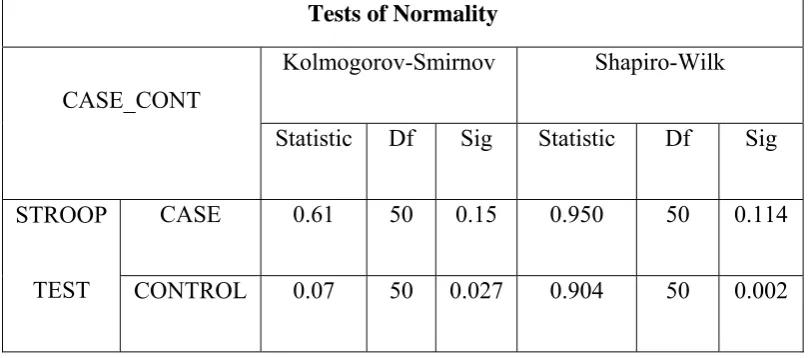
Assessing normality of data for cases and controls
a. Shapiro-Wilk test.
b. Kolmogorov-Smirnov test.
Comparison of neuropsychological scores between
cases(study group) and controls.
1. When data distributed Normally
i. 2 Tailed Students T test
2. For Non-Normative distribution of data
i. Wilcoxon – Mann-Whitney U test (non-parametric
RESULTS
The study is a case control study, cases defined as
Type2 Diabetes mellitus and controls as healthy unrelated
subjects.
A. Socio-demographic data of cases and controls
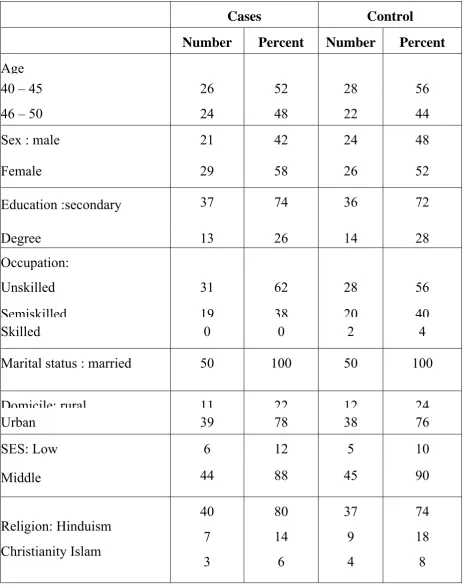
With respect to study population (cases), 26(52%)
were between than 40 year – 45 years of age, and 24(48%)
were between 45 years – 50 years. Sex distribution was,
21(42%) males and 29(58%) females. And 37 (74%) had a
secondary education, while 13 (26%) had a degree.
With respect to control group), 28 (56%) were
between than 40 year – 45 years of age, and 22(44%) were
between 45 years – 50 years. Sex distribution among
control was 26 (52%) male and 24 (48%) female. Control
group distribution in education was 36 (72%) had a
Table 1 : Socio-Demographic Data
Cases Control Number Percent Number Percent
Age 40 – 45
46 – 50
26 24 52 48 28 22 56 44
Sex : male 21 42 24 48
Female 29 58 26 52
Education :secondary 37 74 36 72
Degree 13 26 14 28
Occupation:
Unskilled 31 62 28 56
Semiskilled 19 38 20 40
Skilled 0 0 2 4
Marital status : married 50 100 50 100
Domicile: rural 11 22 12 24
Urban 39 78 38 76
SES: Low 6 12 5 10
Middle 44 88 45 90
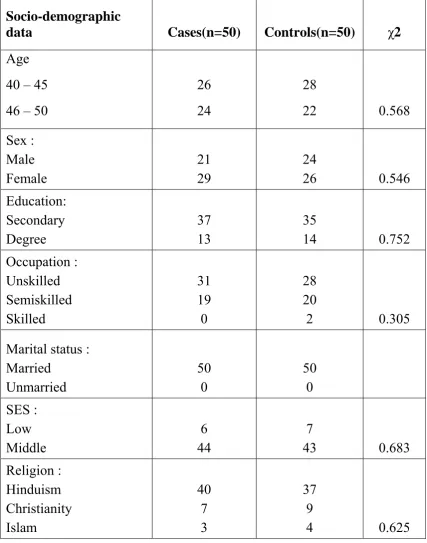
Table 2: Comparison of socio-demographic data Socio-demographic
data Cases(n=50) Controls(n=50) χ2
Age
40 – 45
46 – 50
26
24
28
22 0.568
Sex : Male Female 21 29 24
26 0.546 Education: Secondary Degree 37 13 35
14 0.752 Occupation : Unskilled Semiskilled Skilled 31 19 0 28 20
2 0.305
Marital status : Married Unmarried 50 0 50 0 SES : Low Middle 6 44 7
43 0.683 Religion : Hinduism Christianity Islam 40 7 3 37 9
4 0.625
Comparison of socio-demographic data of cases and
controls shows no significant difference. Hence the two
groups are comparable with respect to age, sex
distribution, education, occupation, socioeconomic status.
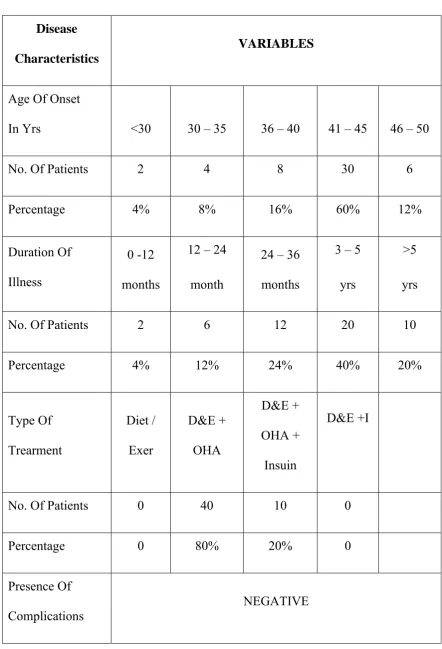
C . I L L N E S S C H A R A C T E R I S T I C S O F D I A B E T E S M E L L I T U S P A T I E N T S :
The table 3 below shows the details regarding the
T a b l e : 3 I l l n e s s c h a r a c t e r i s t i c s o f D i a b e t e s M e l l i t u s p a t i e n t s
Disease
Characteristics
VARIABLES
Age Of Onset
In Yrs <30 30 – 35 36 – 40 41 – 45 46 – 50
No. Of Patients 2 4 8 30 6
Percentage 4% 8% 16% 60% 12%
Duration Of
Illness
0 -12
months
12 – 24
month
24 – 36
months
3 – 5
yrs
>5
yrs
No. Of Patients 2 6 12 20 10
Percentage 4% 12% 24% 40% 20%
Type Of Trearment Diet / Exer D&E + OHA D&E + OHA + Insuin D&E +I
No. Of Patients 0 40 10 0
Percentage 0 80% 20% 0
Presence Of
Complications
[image:74.595.87.530.115.765.2]The mean age of onset of diabetes mellitus is 41.40
years and the mean duration of illness is < 5 years. There
AGE DISTRIBUTION
0% 10% 20% 30% 40% 50% 60%
40‐45yrs 46‐50yrs
Subject
GENDER DISRIBUTION
0% 10% 20% 30% 40% 50% 60% 70%
Male Female
Subject
EDUCATION
0% 10% 20% 30% 40% 50% 60% 70% 80%
Secondary Degree
EDUCATIO