20 April 2011
Regional Innovation Monitor
Innovation Patterns and Innovation Policy in European Regions
- Trends, Challenges and Perspectives
2010 Annual Report
Project No. 0932
To the European Commission
Enterprise and Industry Directorate-General
Directorate D – Industrial Innovation and Mobility Industries
Technopolis Group Belgium Jacek Walendowski
Fraunhofer ISI
Henning Kroll, Thomas Stahlecker, Elisabeth Baier
UNU MERIT
Table of Contents
Preface 1
Executive summary 2
Identified policy challenges 4
1. Patterns of regional innovation performance 5
2. Regional innovation governance and policies: Major developments, focus and
links to performance 9
2.1 Analysis of trends in regional governance 10
2.1.1 General long-term trends in European governance 10
2.1.2 Specific trends in regional governance 11
2.1.3 Summary assessment of trends 13
2.2 Devolution processes across Europe: Selected cases 14
2.2.1 Policy devolution in the UK: asymmetric and regionally differentiated
devolution 14
2.2.2 The case of asymmetric decentralisation in Spain 15
2.2.3 Belgium: a special case of regionally differentiated devolution 16
2.2.4 Modernising a federal system with a long tradition: The German case 16
2.2.5 Austria: co-operative and symmetric federalism 17
2.2.6 Two waves of regionalisation: the French way of decentralisation 17
2.2.7 Devolution of powers in Italy: the ongoing attempt to establish a state of
fiscal federalism 17
2.2.8 Regionalisation in post-communist Europe: The example of Poland 18
2.2.9 Summary assessment of regional devolution 18
2.3 Assessment of the governance framework 19
2.3.1 Methodology 19
2.3.2 General and country specific findings 19
2.3.3 Autonomy 20
2.3.4 Governance principles 21
2.3.5 Reference points in strategy development 22
2.3.6 Efficiency and impact 23
2.3.7 Summary assessment of the governance framework 24
2.3.8 Analytical perspectives: Regional governance capacities 24
2.4 Analysis of trends in regional innovation policies 25
2.4.1 Methodology 25
2.4.2 Launch and evolutions of regional innovation policies 25
2.5 Assessment of regional innovation policies 30
2.5.1 Similarities 30
2.5.2 Differences 35
2.5.3 Relations between autonomy and types of implemented policies 37
2.5.4 Summary assessment of regional innovation policies 39
2.5.5 Perspectives of regional innovation policies 39
2.6 Analysis of governance, policies and performance links 41
2.6.1 Governance factors 41
2.6.2 Links between governance (factors) and patterns of innovation
performance (factors) 42
2.6.3 Governance characteristics for the regional groups of innovation
performance 42
2.6.4 Policy factors 44
2.6.5 Links between policy (factors) and innovation performance (factors) 45
2.6.6 Policy characteristics for the regional groups of innovation performance 45
2.6.7 Conclusions and perspectives in terms of policy challenges and policy
options 49
2.6.8 Policy challenges and policy options 51
3. Strategic use of the Structural Funds for regional innovation policies 53
3.1 Contextual information 53
3.2 The assessment of the Structural Funds significance in terms of funding and
relevance for strategy development 55
3.2.1 Regions with low significance of the SF in terms of funding (less than
10%), but high and medium relevance for strategy development 56
3.2.2 Regions with relatively low significance of the SF in terms of funding
(11-24%) but high relevance 57
3.2.3 Regions with relatively high significance of the SF in terms of funding
(25-49%) but both high and low relevance 57
3.2.4 Regions with very high significance of the SF in terms of funding (50-74%
and above) but also very high and very low relevance 57
3.3 The strategic use of the Structural Funds 58
3.3.1 Current situation 61
3.3.2 Strategic desirable deployment of the Structural Funds 63
4. Conclusions and perspectives 73
4.1 Governance 73
4.2 Policies 74
4.3 Links between governance, policies and innovation patterns 74
4.4 Strategic use of the Structural Funds 75
Appendix A References 77
Appendix C Typology of patterns of regional innovation performance and average
scores of innovation performance 83
Appendix D A comparison of the typology on performance patterns and the
Regional Innovation Scoreboard typology 85
Appendix E List of regions used for the development of regional innovation
performance typology 88
Appendix F Governance factors and their composition 91
Appendix G Governance factor scores: Regression results 92
Appendix H Linking the performance groups with the governance factors 93
Appendix I Policy factors and their composition 94
Appendix J Policy factor scores: Regression results 95
Appendix K Linking the performance groups with the policy factors 96
Appendix L Relationships between significance of the Structural Funds in terms of
funding and relevance for strategy development 97
Table of Figures
Figure 2-1 Relevance of EU Structural Funds for innovation strategy development ...43
List of tables
Table 2-1 Evidence of administration of the SF operational programmes at the regional
level...12
Table 2-2 Existence of regional strategy and trends in RTDI expenditure ... 20
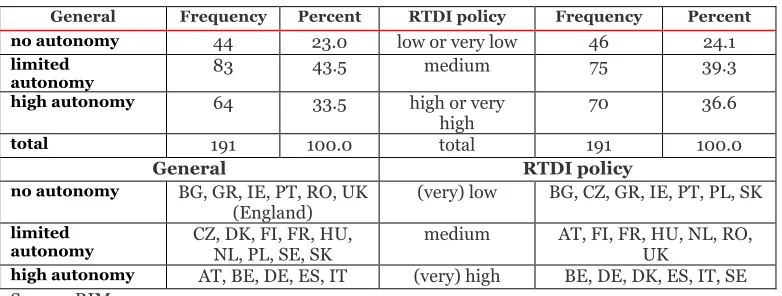
Table 2-3 Regional autonomy (general and in the field of RTDI policy)... 20
Table 2-4 Importance of policy level in RTDI policy making ...21
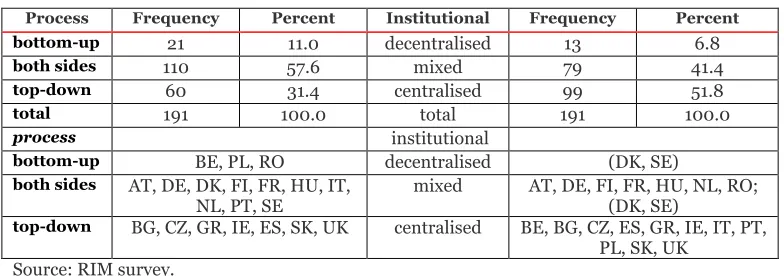
Table 2-5 Governance approaches...21
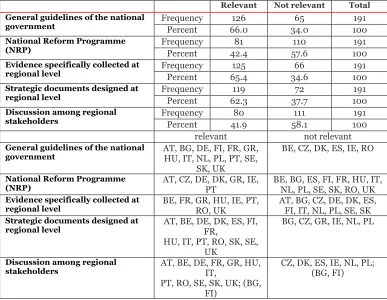
Table 2-6 Reference points in strategy development ... 22
Table 2-7 Efficiency of governance process and impact of RTDI policy... 23
Table 2-8 Cluster policies... 32
Table 2-9 Demand side policies... 33
Table 2-10 Policies for innovation in services and policies for public sector innovation ... 35
Table 2-11 Policies for open innovation... 36
Table 2-12 Eco-innovation policies... 36
Table 2-13 Relations between regional innovation autonomy and implementation of policies for open innovation...37
Table 2-14 Relations between regional innovation autonomy and implementation of policies for innovation in services... 38
Table 2-15 Relations between regional innovation autonomy and implementation of policies for public sector innovation... 38
Table 2-16 Relations between regional innovation autonomy and implementation of policies for eco-innovation... 39
Boxes
Box 2-1 White Paper on Local growth: Realising every place’s potential...27
Box 2-2 Regional Innovation Platforms: Finland ...28
Box 2-3 Regional innovation policies (Lower Saxony) ... 31
Box 2-4 Evolutions of regional innovation strategies (Silesia)...32
Box 2-5 Changing paradigm of regional innovation policies in the North of England.34
Box 2-6 Balanced innovating regions and Knowledge-absorbing regions: Lower Saxony and Silesia ...45
Box 2-7 Public knowledge regions: Prague and Scotland...47
Box 2-8 Knowledge absorbing innovating regions: Sterea Ellada and Norte ...47
Box 2-9 Industrialised innovating regions: North West of England and Bretagne ...48
Box 2-10 High-tech business innovating regions: North Brabant ...49
Box 2-11 Business innovating regions: Emilia-Romagna and Upper Austria ...49
Preface
The research for this report was undertaken by Technopolis Group, Fraunhofer Institute for Systems and Innovation Research ISI, and UNU-MERIT, Maastricht University in the framework of the Directorate-General for Enterprise and Industry project ‘Regional Innovation Monitor’ (Contract No. ENTR/09/32).
This report is the product of extensive desk research conducted during Winter 2010 and further work carried out at the beginning of 2011. It takes account of the Regional governance and policy survey results (hereinafter referred to as RIM survey) collected in the framework of this project by a network of experts as well as the discussions at the first RIM policy workshop held in Brussels on 26 October 2010.
The report has been written by: Jacek Walendowski (Technopolis Group Belgium), Henning Kroll, Thomas Stahlecker, Elisabeth Baier (Fraunhofer ISI), René Wintjes, and Hugo Hollanders (UNU-MERIT).
The authors wish to thank all those who have provided their comments on the first draft of report, especially Peter Droell, Alberto Licciardello from Enterprise and Industry Directorate-General of the European Commission, Claire Nauwelaers from Directorate for Public Governance and Territorial Development of OECD, and Prof. Lena Tsipouri from the University of Athens.
RIM provides detail information on regional innovation policies for 20 EU Member States: Austria, Belgium, Bulgaria, the Czech Republic, Denmark, Finland, France, Germany, Greece, Hungary, Ireland, Italy, the Netherlands, Poland, Portugal, Romania, Slovakia, Spain, Sweden and the United Kingdom. The core of the RIM service is a knowledge base of information on some 200 regions.
For further information about the project and access to the full range of information
on regional innovation policies, please visit the RIM website at:
http://www.rim-europa.eu
Disclaimer
Executive summary
This first annual report of the Regional Innovation Monitor pursued three main objectives. The first objective is a systematic analysis of the existing wealth of information on the topic of regional innovation policies with the aim to carry out comparative analysis and drawing policy recommendations. Within this context, the
governance aspects are analysed especially in terms of general long-term and specific trends. Furthermore, the establishment of governance capacities to participate in
multi-level governance is analysed as well as the capacities to design and implement RTDI policies influenced by the process of devolution.
The second objective of this report was to assess how innovation performance across EU regions relates to governance and policy aspects. The results of this analysis were
primarily used in order to better understand specific innovation challenges and policy
options in different groups of EU regions. In particular, the use of novel approaches to currently existing benchmarking exercises has been put into practice by going beyond the use of available quantitative indicators.
Finally, the third objective was to prepare a thematic section in order to analyse strategic use of the Structural Fund interventions in support of regional innovation policies. Overall, strategic deployment of the SF remains so important because they provide many regions with substantial leverage to introduce targeted activities. In detail, this part of the report describes policy options for a strategically desirable use of the SF interventions and presents concrete examples of good practices across different types of EU regions.
The five main emerging conclusions of the analysis can be summarised as follows:
• The assessment of existing regional innovation policies reveals both similarities,
but also some distinct differences in policies adopted by regions in support of innovation activities. Firstly, almost all regions efforts are concentrated on defining key areas of strategic importance for regional development, in addition to high popularity of cluster policies. Secondly, policies remain heavily focused on supply-side despite efforts to support knowledge transfer and collaboration activities between the research base and industry. Thirdly, policies are predominantly concentrated on the manufacturing sector, while there has been so far limited implementation of policies for innovation in services and public sector innovation. Differences primarily relate to a limited implementation of new models of innovation policies, particularly in regions of Central and Eastern Europe. An example is the ‘Doing-Using-Interacting’ approach, in contrast with the Science Technology Innovation (STI) approach. It refers to learning which is tacit and often highly localised and covers non-R&D innovations
• The last decade has witnessed two main trends in regional governance, notably
building up the basic capacities required for regional governance of RTDI policy, as well as establishing new organisations and institutions to assume new approaches to regional innovation policies. The main triggers for policy makers in regional innovation policies were the increasing competition in a globalised economy, shortcomings of traditional policies and emergence of cluster initiatives.
evidence of co-ordination to build up structures and competences in RTDI policy making.
• The survey provides strong evidence of multi-level governance suggesting that
even in countries where regional autonomy is high, the national level can rarely be disregarded in the process of regional governance. Although the dynamic landscape of multi-level governance is shaped by multiple strategies developed by regions, governance capacities in a broader sense have not yet been sufficiently attained. Other specific trends include the establishment of regional innovation councils, formulation of bottom-up networks and cluster policies, strengthening existing strengths, as well as more widespread use of evidence-based approaches and evaluations.
• Regarding innovation performance, one of the main conclusions is that only a few
of the governance and policy factors show a significant relationship with one of the performance factors. The outcome depends on a number of framework conditions, such as different degrees of bottom-up pressures, the flexibility of the multi-governance model, as well as the regional multi-governance capacity. Regions with higher governance capacities consider regional process of RTDI governance a more efficient and yielding a greater impact.
• With regard to the relevance of the Structural Funds for strategy development,
Identified policy challenges
With a view to the overall governance framework:
Capacity building must catch up with the processes of devolution. Even though a formal process of devolution has been initiated in many countries, governance capacities have not yet been sufficiently attained in many regions surveyed by the Regional Innovation Monitor.
Two thirds of the regions surveyed report that process of regional RTDI governance cannot yet be assessed as “fairly effective”. Further analysis is needed to determine if this lack of effectiveness of regional governance systems is merely due to the fact that they have only recently been established or if other, more fundamental challenges exist.
With a view to regional innovation strategies and policies:
The current focus of regional innovation policies raises some issues of concern. Many strategies and measures remain unduly focused on a supply side approach. Moreover, most support to enterprises is provided to the manufacturing sector, while other parts of the business sector are neglected.
There is evidence of a too generic imitation of cluster policies across Europe. While devised as a measure to build on a region’s strengths, they are also deployed in regional frameworks where the utility of such an approach is not evident. Moreover, some regions are supporting so many clusters that no clear focus can be identified.
Evidence suggests, that this process may repeat itself in other policy fields. While “novel approaches“ to regional innovation policy are currently mostly piloted in regions with governance capacities adequate for these efforts, many other regions with less developed governance capacities aim to follow suit.
In the era of budgetary restraint following the financial crisis, generic and all-inclusive approaches will most likely not be sustainable. While the regional process of strategy development will have to remain inclusive, regional innovation policy will no longer be able to avoid a clearer definition of priorities in the allocation of funding. To mitigate the impact for regional stakeholders, it will be necessary to increase synergies between public funding from the regional, national and the European level as well as to increasingly leverage the potential of PPPs (Private Public Partnerships).
With a View to Structural Funding:
More needs to be done in order to increase the impact of Structural Funding. While financial allocations to support RTDI activities and business innovation have increased substantially, the actual interventions need to be better adapted to regional requirements. In many cases, a more strategic approach to programming is needed to successfully identify those assets relevant for regional competitiveness and to build on them by means of targeted measures.
Well positioned regions need to continue to pilot novel approaches to build
on existing competitive strengths. Moreover, they need to integrate structural
fund programming with existing regional strategies (Regional Competitiveness and Employment).
1.
Patterns of regional innovation performance
Summary of Key Messages
• The results of RIM typology confirm that there is a large diversity regarding patterns of
innovation performance across EU regions. Consequently, the typology defines seven major groups of regions with distinctive innovation performance patterns.
• The typology of innovation patterns is different from the Regional Innovation Scoreboard
typology. The main purpose of the RIM typology is to capture innovation performance patterns, in order to establish a link between the key regional distinctive patterns regarding innovation performance, governance and policy.
Innovation is a complex and dynamic concept which can be defined in many ways and at many levels of activity. There is therefore no single, best way to measure innovation and innovation processes which take place in a certain region. In most studies a broad set of indicators are used, to incorporate different aspects of innovation. For many years patents were the most commonly used indicators for R&D, next to data on sector-structure. With the increased availability of data from the Community Innovation Survey (CIS) more indicators for innovation-input and output at firm-level have become available for Member States, however, not in each country these CIS data are available at the regional level.
Comparing many different regions becomes even more complex, precisely because the chosen set of indicators has to be relevant for a large diversity of regions (especially in Europe), but also comparable. Additional difficulty for comparisons across EU regions stems from the fact that the number of indicators for which recent data is available for almost all EU regions is limited.
In order to measure regional innovation performance patterns, the following indicators are used:
• BERD % GDP (Business R&D expenditures as % of GDP), 2007;
• GOVERD % GDP (R&D expenditures in the government sector as a percentage of
GDP), 2007;
• HERD % GDP (R&D expenditures in the higher education sector as a percentage
of GDP), 2007;
• Share tertiary educated (% of population with tertiary education), 2007;
• EPO patent applications per million population, 2007;
• Non-R&D innovation expenditure (% of turnover), 2006;
• Share of technological innovators (% of SME’s introducing product and/or process
innovations), 2006; and
• Share of non-technological innovators (% of SME’s introducing marketing and/or
organisational innovations), 2006.
The indicators listed above are also included in the list of 16 indicator used in the 2009 Regional Innovation Scoreboard (RIS), except Government R&D expenditures and Higher education R&D expenditures which are combined into one indicator in the 2009 RIS. In the 2009 RIS eight additional indicators are used to calculate a composite indicator measuring innovation performance (the RIS distinguishes the European regions into five performance group from low to high innovation regions), but for the purpose of this report where we are more interested in differences in performance patterns and taking into account the above-mentioned considerations we have used eight core and latest available indicators. As background information, the data for the other indicators are downloaded from Eurostat in 2010. The latest available year is often 2007, but otherwise data from 2006 is used. Any remaining missing values for the non-CIS indicators have been imputed using available data at higher level of aggregation (e.g. NUTS 1 if NUTS 2 missing). The regional CIS data have been extracted from the RIS database. Not for all regions regional CIS data are available and missing data have been imputed using linear regression techniques. We refer to the 2009 RIS Methodology report for full details.
After having normalised all indicators to a common range of 0 to 1, a factor analysis has been used to identify the main patterns of performance, reducing the eight
indicators into three main factors or components (cf. Appendix B).
Factor 1 can be labelled as ‘Innovative entrepreneurship’. It is mostly based on a
high score on the share of both non-technological innovators (those introducing marketing or organisational innovations) as well as technological innovators (product or process innovations) among SMEs in the region. This factor therefore identifies those regions where a large share of SMEs are innovators. Regions where both these ‘output’ indicators are high, also have a relatively high score on R&D expenditures at higher education institutes.
Factor 2 is labelled ‘Technological innovation’ because it mostly refers to patent
generating business R&D with a relatively low score on non-R&D innovation expenditures as share of business turnover. In regions where this factor shows a high score, technology generating firms are well represented. This factor is mainly about ‘firm activities’, but to a lesser extent also the enabling dimension of higher education contributes to this factor.
Factor 3 is labelled ‘Public knowledge’. This component of innovation performance
patterns is based on the co-location of R&D expenditures at government research institutes and to a lesser extent on a high share of population with completed tertiary education.
Every region in Europe is unique, but discussing the factor scores of each individual regions would be beyond the scope of this report. We therefore distinguish different groups of regions with similar patterns of innovation performance among the group-members. Based on the score on the three identified factors of innovation performance, groups of regions with similar innovation performance patterns are distinguished statistically with the use of hierarchical clustering. This results in seven
different groups of EU regions (cf. Appendix C).
The first group of regions is labelled ‘Balanced innovating regions’ (green). The
mean score for each innovation performance factor is above the average of all 203 regions. In particular, ‘innovative entrepreneurship’ is above average, but this is mainly due to the relatively high R&D expenditures at institutes of higher education. This group of 42 regions includes regions in the Netherlands, Belgium, Denmark, North Germany, South UK, and some regions in Austria and Italy.
Group 2 consists of 49 Knowledge-absorbing regions’ (orange). Most regions of
small and the high score on non-R&D innovation expenditure signals that innovation is mostly the result of absorbing already existing knowledge.
Group 3 is labelled: ‘Public knowledge regions’ (blue). They are characterised by a
very high score on the factor ‘public knowledge’. The average R&D expenditures in government research organisations (as % of GDP) are higher than for any of the other groups and the average share of tertiary educated is equally high as for the group of ‘high-tech business innovating regions’ (Group 6). The average score on the other two factors are slightly below average, but on none of the eight indicators this group shows a major weakness. The 21 regions in this group are scattered across Europe, including many capital regions such as Madrid, Rome, London, Berlin, Prague, and Bucharest, but also regions in Eastern Germany, Scotland and Southern France.
Group 4 is named: ‘Knowledge-absorbing innovating regions’ (red) because
they have the highest average score on ‘innovative entrepreneurship’. In particular, the share of both technological and non-technological innovators is high. This group has on average the lowest score on ‘technological innovation’: business R&D and patenting is very low, while the non-R&D innovation expenditures (as % in turnover) are higher than in any other group. Similar as for the second group, innovation is mostly the result of absorbing already existing knowledge. These 19 regions are mostly located in Portugal and Greece.
Group 5 has been labelled ‘Industrialised innovating regions’ (yellow). The score
on ‘technological innovation’ for this group is above average, but ‘innovative entrepreneurship’ is below average. Overall there are no really weak or strong scores on any of the eight indicators. Many regions of this group are located in France and Spain; also included are Irish regions, some in Sweden and early industrialised regions in Germany and the UK.
Group 6 is named ‘High-tech business innovating regions’ (pink). This is the
most innovative group of regions (cf. the discussion below comparing the typology with the performance typology of the Regional Innovation Scoreboard). Particularly high is the factor ‘technological innovation’, and all its major components: patents and business R&D are much higher than in any other group and this group has on average the lowest share of non-R&D innovation expenditures. On average ‘innovative entrepreneurship’ is also high, but not as high as for the group of ‘knowledge-absorbing innovation regions’. The score on ‘public knowledge’ is above average, but government R&D expenditures are clearly below the average of the group of ‘public knowledge regions’. The 12 ‘high-tech business innovators’ are located in South of Germany, most of Finland, some regions in Sweden, East of England (UK) and North Brabant (NL).
Group 7 is labelled ‘Business innovating regions’ (purple) because on average
these 11 regions score well on both ‘innovative entrepreneurship’ and ‘technological innovation’ but they have the lowest score on the factor ‘public knowledge’. Both the low performance regarding government R&D expenditures and tertiary educated contribute to the low score on this ‘enabling’ aspect. The score on ‘innovative entrepreneurship’ is high; the share of SMEs introducing technological innovations is on average even higher than in any other group. The performance on the factor ‘technological innovation’ is above average. The regions of this group are located in Northern Italy and in Austria.
innovation systems: innovative entrepreneurship, technological innovation and public knowledge.
We can conclude that at regional level there is a large diversity regarding patterns of innovation performance. Innovation performance of a region is based on a combination of three different components. The first distinctive characteristic is ‘Innovative entrepreneurship’, which is based on the share of SMEs that have introduced innovations. The second component refers to innovation based on technology generating business R&D. The third component refers to innovation based on ‘public knowledge’.
The regional diversity in the configurations of these three components of innovation performance is shown with the identification of seven different groups of regions. The purpose of the typology here is not to find explanations for the differences in the innovation trajectories or innovation models, nor to explain the different development stages of identified groups of regional innovation systems. Such explanations would require more contextual information (e.g. on sector structure, socio-economic and institutional aspects) and more in-depth and long-term (retro-) perspective. Regarding Italy, for instance, several decades of literature have devoted attention to explain the differences of regional development (ranging from Myrdal, 1957 to the literature on ‘flexible specialisation’, Piore 1984 and ‘industrial districts, Becattini, 1990).
We note that the typology still recognises the knowledge-absorbing regions in the South and East and the importance in the North of SMEs which innovate without much R&D efforts, but here we do not address the complex details of the historical backgrounds of such differences. We rather take such structural differences amongst groups of regions at a European level as a given fact for policy makers, as an ex-ante assessment for innovation policy.
2.
Regional innovation governance and policies: Major
developments, focus and links to performance
Summary of Key Messages:
• The recent years have witnessed the establishment of a regional governance
level in most mid- to large-size EU countries. Many regions remained busy with the creation of the governance structures to conduct a meaningful RTDI policy and will in the near future only become able to refine and differentiate their approaches.
• The devolution processes are highly individual and lead to different results.
Within regional policy-making, there has been a change over recent years towards an empowerment of stakeholders resulting in a lower emphasis placed on centralised regional policy making. On the other hand, in many member states the process of devolution has not been homogenous, certain regions have higher autonomy than others.
• The absence of regional strategies is more frequent in regions where the
regional level does not play a central role for policy development. Interestingly, no lack of such policies could be detected in countries for which RTDI policy constitutes a new endeavour.
• There is strong evidence of multi-level governance. Even in countries where regional
autonomy is high and increasing, the national level retains a number of key decision-making powers. The national level remains an important factor for regional RTDI policy. For about half of the regions surveyed, national policies remain the most important.
• Capacity building must catch up with the processes of devolution. Even though a
formal process of devolution has been initiated in many countries, governance capacities have not yet been sufficiently attained in many regions surveyed by the Regional Innovation Monitor.
• The most common approach is a combination of bottom-up and top-down
elements. This serves as evidence that the regional RTDI policy making can thus neither be characterised as a technocratic nor as a fragmented process.
• Two thirds of the regions surveyed report that process of regional RTDI
governance cannot yet be assessed as “fairly effective”. Further analysis is needed to determine if this lack of effectiveness of regional governance systems is merely due to the fact that they have only recently been established or if other, more fundamental challenges exist.
• Regional innovation strategies are evolving at a rapid pace, yet more evidence is
needed. The RIM survey finds that four in five regions with regional innovation strategies designed them during the last five years (since 2005).
• New approaches to regional innovation policies take different forms. The recent years have witnessed the emergence of different decision-making and delivery mechanisms ranging from those based exclusively on market failures to the establishment of regional development and innovation platforms with a comprehensive mandate.
• The current focus of regional innovation policies raises some issues of concern.
Many strategies and measures remain unduly focused on a supply side approach. Moreover, most support to enterprises is provided to the manufacturing sector, while other parts of the business sector are neglected.
• There is evidence of a too generic imitation of cluster policies across Europe.
While devised as a measure to build on a region’s strengths, they are also deployed in regional frameworks where the utility of such an approach is not evident. Moreover, some regions are supporting so many clusters that no clear focus can be identified.
• Evidence suggests, that this process may repeat itself in other policy fields. While
“novel approaches“ to regional innovation policy are currently mostly piloted in regions with governance capacities adequate for these efforts, many other regions with less developed governance capacities aim to follow suit.
• In an era of budgetary restraint following the financial crisis, generic and
2.1
Analysis of trends in regional governance
2.1.1
General long-term trends in European governanceUntil the late 1980s, the European world of RTDI governance used to be dominated by national level decisions. For the larger part of the late 20th century, most European countries, with the exception of Austria, Belgium and Germany, were characterised by centralist rather than federal or otherwise regionalised approaches to policy making. With the increasing relevance of European regional policy and the ensuing empowerment of regions, as well as strong moves towards devolution in countries such as Spain and the UK, this situation changed substantially in the course of the 1990s. Later on, regions were heralded as central players in the European Research Area, both as implementers of policy measures and as ‘bridges’ between the EU and the local level.
In more and more Member States of the European Union can the governance system no longer be defined by a central, point of leverage on the national level, i.e. a central, unitary legislature and government. Instead, an increasing number of European and regional policy circles have to be taken into consideration (Benz, 1992). In recent years, moreover, approaches to decision making have become more problem oriented, i.e. policy makers have become more open to thinking outside of the box of the traditional ministerial spheres of influence (Marks et al, 1998; Benz, 2004). Against this background, an increasingly complex network of interactions emerges, that enables and shapes the governance of RTDI policy in European regions (Scharpf, 1997; Kohler-Koch, 1999).
In this situation, where competencies tend to overlap and most policy makers are in some way or the other dependent on resources beyond their control (Hooghe, 1996; Benz, 2004) the need for coalition building and co-ordination has risen to the same degree as it is has become more challenging (Uyarra et al., 2007). In any case, the mutual path dependency of many processes of policy development has grown (Peters/Pierre, 2004). As a result, the governance system has arguably become less stable (Sutcliffe, 2000) or, phrased positively, more flexible.
In that sense, processes of multi-level governance do not only involve interfering and complementary decision making on the institutionalised European, national and regional government levels. Instead, with the empowerment of a larger number of stakeholders, flexible coalitions of joint interest can and have been formed depending on the purpose at hand – spanning and transcending the traded spheres of influence. As a consequence, regional policy makers can influence the economic development of a region by activities on the regional level alone to an increasingly lower degree (Marks, 1993).
On the other hand, they have gained new opportunities and new freedoms for action. For example, they can match up with regions from neighbouring states without having to consult their national governments. Moreover, they can in many cases now participate in EU policy making directly with a far lower degree of interventions from the national level than before. Increasingly, regional policy makers want to take these opportunities and increase their ability to influence the trend of economic development in the region as well as on the short term to acquire funding for RTDI support policies (Koschatzky/Lo, 2005; Uyarra et al., 2007).
The concept of governance capacity reflects the ability to devise strategies and implement support measures.
• Regional governance capacities in a narrow sense:
− Sufficient legislative/regulatory autonomy
− Sufficient budgetary autonomy
• Regional governance capacities in a broader sense:
− Sufficient human resources to design and implement policy
− Sufficient competences and experience to do so effectively
• Good relations with policy makers at the other levels with which interaction is
planned.
• A relevant basis of regional stakeholders as addressees of the envisaged policy
support.
While as a tendency, many European regions have extended their capacities to participate in processes of multi-level governance to secure their share of national and European resources, this cannot be taken for granted across the board. Devolution has happened in an asymmetric fashion and many regions have only become autonomous quite recently. In a significant number of regions, therefore, governance capacities in a narrow sense may have been granted, but experiences with regional governance remain scarce. With decision makers still early on the policy learning curve, governance capacities in a broader sense have not yet been sufficiently attained (Koschatzky 2000, Kuhlmann 2001, Kuhlmann/Edler, 2003; Howells, 2006).
2.1.2
Specific trends in regional governanceIn summary, the last decade has witnessed two main trends in regional governance: Firstly, the build up of the basic capacities needed for regional governance of RTDI policy. Many EU-12 Member States used to have little administrative capacities at the regional level prior to their accession to the European Union. In many countries administrative structures at the regional level had to be established in a situation where regional policy as such had no substantial tradition and no precursor organisations existed. While certain pilot programmes such as the RIS and RITTS strategies aimed to pave the way for the development of regional capacities for strategy building in the late 1990s, the process of awareness creation in the political arena as well as the concrete set-up of policy agencies at the regional level and the clarification of their mandate inevitably took some time.
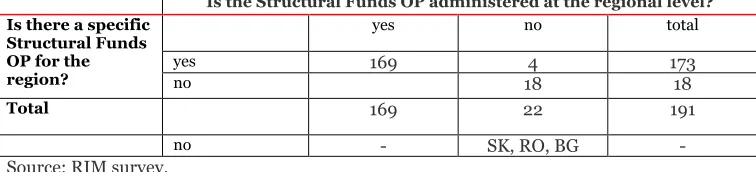
Table 2-1 Evidence of administration of the SF operational programmes at the regional level
Is the Structural Funds OP administered at the regional level?
yes no total
yes 169 4 173
Is there a specific Structural Funds OP for the
region? no 18 18
Total 169 22 191
no - SK, RO, BG -
Source: RIM survey.
The second trend can be observed in regions in which basic capacities for regional strategy building have already been solidly established. In the course of the last decade, a non-negligible number of policy makers had tended to fall into the ‘functionalist trap’ to assume that a new approach in regional RTDI policy would require the establishment of new institutions (Uyarra, 2010). As a consequence we have seen the development of a large number of science parks, technology transfer offices, incubators and the like. While these activities are not as such misguided their mere replication disregards the fact that much more could in many cases be gained through the transformation of attitudes of and interaction between the existing actors in a region. Consequently, such measures should not be implemented in a stand-alone manner, but complemented by other activities. In many regions, with a longer tradition in regional innovation policy, this issue has been recognised in the course of the last decade and resulted in the participation and consultation of regional stakeholders and in more co-ordinated and refined approaches to regional governance. In this respect, three developments occupy centre stage:
Firstly, an increasing number of regions have set up more formalised bodies in the field of innovation policy making. This trend does not (only) refer to the standardised bodies for stakeholder involvement that have to be consulted in the context of the development of operational programmes. Even in many leading regions, where the basic requirements for governance are met otherwise, new ‘regional councils for innovation’ have been set up in recent years. The key role of these councils is to enable regional stakeholders to participate in the process of policy development with the aim to establish a focused and context specific approach to policy making. Typically, these councils bring together actors from regional industry, the regional public research sector as well as other non-public institutions to provide opinions based on which tailor made strategies can be developed.
a minimum level of socio-economic assessments, SWOT analyses and monitoring had inevitably to be performed in all European regions.
Likewise, even by more developed regions, structural funding could to a higher degree be leveraged for RTDI support measures. When supported under the SF framework, however, regional governments have less leeway to implement policy measures at a totally ad hoc basis and stricter stipulations are imposed with respect to accountability. Moreover, regular inter-regional meetings in the context of structural funding have helped to facilitate inter-regional benchmarking activities as well as the exchange of experiences.
2.1.3
Summary assessment of trendsAccording to many observers, the fast spread of multi-level governance across
Europe in areas which were institutionally quite unprepared has led to an overtly optimistic assessment of the potentials for learning from best practices (Kaiser/Prange, 2002; Uyarra et al., 2007). Likewise, the asymmetries in devolution and regional empowerment have been underestimated (Dolowitz/Marsh, 2000; Uyarra et al., 2007). As a consequence, the need for adaptive policy learning and the pro-active use of methods of strategic intelligence has been large underestimated (Metcalfe/Georghiou, 1997; Kuhlmann et al., 1999). At the current point in time, the reservoir of those standardised approaches that can easily be distributed by means of “good practice” learning to create basic capacities will soon be exhausted. While it was necessary and recommendable to take these first steps and to implement standardised practices like the development of regional RTDI strategies across Europe, the challenge ahead is to find ways how strategic plans can be implemented under different framework conditions.
In summary, many regions with an established history in RTDI governance have in recent years pioneered approaches that are now more broadly promoted as means to
the end of “smart specialisation” on a Europe wide basis. In parallel, many other
regions remained busy with the creation of the very basic governance
structures needed to conduct a meaningful RTDI policy and will only in the near future become able to refine and differentiate their approaches. The coming years, therefore, will be a crucial time to spread good practice with regard to general approaches to regional governance rather than to repeat the mistake of the out-of-context imitation of perceived best practices with regard to individual policy actions. Recently, under the headline of “smart specialisation”, European policy makers have suggested that not only leading but also less developed regions need to avoid such imitation and instead take time to explore their own strengths, decide which competences should be build regionally and only then develop policies accordingly (cf. Foray et al., 2009). They propose that government intervention should start with an enabling stance and only later, when needs have been identified and articulated by regional stakeholders provide the means to make them a reality. In the future,
therefore, regional governance will need to be based on efficient bottom-up
elements to enable the participation of stakeholders but also on formalised procedures and centralised capacities to enable strategic planning and policy implementation.
2.2
Devolution processes across Europe: Selected cases
As pointed out above, the availability of regional governance capacities is a key prerequisite for the ability of regions to participate in the process of multi-level governance as well as to design and implement their own RTDI policies. As already mentioned, the establishment of such capacities is a comparatively recent development based on the process of devolution which has occurred in parallel in a number of European States since the late 1980s.
Devolution processes, however, are by no means homogenous across Europe, but depend on national idiosyncrasies that have their roots in the constitutional and administrative history of the countries. Thus, European countries are on different trajectories determined by historical backgrounds and path-dependency, institutional transformation and consolidation of regional autonomy (Rodríguez-Pose/Bwire, 2003). As a result, different types of regionalisation continue to co-exist in Europe (Yoder, 2007) with regard not only to the degree of decentralisation as such but also with regard to the functions and competences that are devolved to the sub-national level. Likewise, there are asymmetries between the degree of devolution to different regions within one nation and the degree of interaction of the regions with the European level. Thus policy devolution has created complex and sometimes even conflicting arenas of policy making with overlapping competences.
In the following, the devolution process is described for a number of different EU Member States in the course of the past years, in order to understand driving forces behind the process, and to illustrate how these processes are highly individual and lead to different results.
2.2.1
Policy devolution in the UK: asymmetric and regionally differentiated devolutionSince 1998 the constitutional structure of the United Kingdom has undergone dramatic changes. Through the process of devolution certain powers formally vested in the U.K., Parliament have been transferred to new legislative bodies located in
Scotland, Northern Ireland and Wales via three key pieces of legislation: The Scotland
Act 1998, The Government of Wales Act 1998, and The Northern Ireland Act 1998. The devolution process granted Scotland, Wales and Northern Ireland forms of self-government within the United Kingdom. The UK Parliament has ceded a number of legislative competences on the elected Scottish Parliament, National Assembly for Wales and Northern Ireland Assembly to do this. On all three cases, legislative devolution went along with executive devolution to the Scottish Government, the Welsh Assembly Government and the Northern Ireland Executive which are accountable to their respective Parliament or Assembly. Additionally, all three devolved areas of the UK remain represented in the UK Parliament at Westminster. The UK Parliament thus remains sovereign in law and can, de jure, still legislate for Scotland, Wales and Northern Ireland. By convention, however, it does not do so for devolved matters without the consent of the devolved legislature concerned.
Even today, more than 10 years after the onset of devolution, the UK system remains characterised by a lack of interaction and co-ordination among institutions that continue to exhibit a number of characteristics that predate devolution. The operations of the public sector are still based on an essentially top-down, consultative rather than a participative management mode and an adherence to an old way of thinking about STI policy focused on the national science-base rather than integrated and inclusive regional innovation systems (Lyall, 2007).
With respect to the so far non-devolved areas, the overall process has not yet gained clear momentum and remains subject to continuous change. In 1998, a clear step towards decentralisation was taken with the Regional Development Agencies Act and the creation of the Regional Development Agencies (RDAs) which have had their scope and powers enhanced in the years since. At present, the statutory objectives of the RDAs are: to support economic development and regeneration, to promote business efficiency and competitiveness, to promote employment, to enhance the development and application of skills relevant to employment, and to contribute to sustainable development.
In June 2010, however, the newly elected conservative government announced plans to abolish the RDAs by 2012, to be replaced by Local Enterprise Partnerships. In October 2010 the decision was taken that 24 partnerships between local businesses and councils will replace the current RDAs. Additionally, for several years there is a movement that supports devolution in Cornwall, an issue which is currently debated.
2.2.2
The case of asymmetric decentralisation in SpainDecentralisation is a relatively recent experience in Spain, since it dates only back to 1978. The Spanish model of decentralisation is neither a centralised nor a federal model (Giordano/Roller, 2004). The Constitution allows for a decentralised, although not federal, structure of the State.
Spain's process of devolution, initiated in the late 1980s, has led to an asymmetrical structure of devolution with certain regions, such as Catalonia and the Basque Country, acquiring more autonomy than others. Spain’s system of asymmetrical devolution allows for variable competencies not only between different regions, but also within the same region over time.
In fact, the Constitution allows for a dynamic evolution of the transfer of competencies between the Central Government. In the so-called ‘Autonomic Pacts’ of 1992 and 1997 all seventeen regional governments received new powers, some of which required amendments to existing statutes of autonomy.
While regions have very limited primary authority, the Constitution permits the extension of this authority by subsequent delegation. In some cases, this has led to inconsistencies such as the fact that autonomous regions have substantial autonomy with regard to expenditure while almost all revenue authority remains with the central government. Arguably, this separation of responsibilities between expenditure and revenue raising authority has given rise to economic inefficiency (Fernández et al., 2006).
2.2.3
Belgium: a special case of regionally differentiated devolutionUntil the 1960s, Belgium was governed centrally. Over the past four decades, however, a series of constitutional reforms has resulted in a complex devolution arguably turning Belgium into the most decentralised state of the European Union. The successive changes arose from the fact that Belgium hosts different linguistic groups: Dutch/Flemish-, French-, and a very small group of German-speakers in two regions with distinct histories, Flanders and Wallonia.
Belgium and its constituent parts have six governments, each with its own parliament and cabinet ministers:
• a federal government, responsible for defence, foreign affairs, justice, health, and
pension;
• a Flemish government, also serving as the government of the Dutch-speaking
community;
• a Walloon regional government;
• a government for the French-speaking community;
• the Brussels-capital regional government; and
• a community government for German-speakers.
The Federal government is competent for scientific research; the federal scientific institutes; programmes such as national networks for basic research requiring homogenous execution at national or international level; introducing fiscal incentives to encourage recruitment of researchers by universities, research organisations and enterprises. The language-based communities are responsible for education, while regional governments are responsible for economic policy including applied industrial research. The federal government cannot overrule communities in educational matters, just as regions have no say in the field of defence policy. As a result, Belgian-style devolution is rather complex in its outcome, however, the regions have the main responsibility for economically oriented research, technological development and innovation policy (Belgian Science Policy Office, 2010).
2.2.4
Modernising a federal system with a long tradition: The German caseGermany has a long tradition of regional government and federalism. However, German federalism, established in its current form with the 1949 constitution (Basic Law), has gained momentum after the reunification. The Basic Law divides authority between the federal government and the federal states, with a subsidiarity principle, articulated in Article 30: "Except as otherwise provided or permitted by this Basic Law, the exercise of state powers and the discharge of state functions is a matter for the Länder." Thus, the federal government can exercise authority only in those areas specified in the Basic Law.
The federal government is assigned a greater legislative role and the Land governments a greater administrative role. The areas of shared responsibility for the
Länder and the federal government were enlarged by an amendment to the Basic Law in 1969, with joint areas of action for instance in higher education, and regional
economic development. The Länder also retains significant powers of taxation.
The federal system in Germany has undergone several changes during the last 10 years in order to make the system more effective with e.g. the following goals:
• strengthening federal and state legislation by dividing legislative powers more
clearly and doing away with framework legislation;
• reducing barriers by redefining the requirements for Bundesrat (legislative body
representing the sixteen Länder at the federal level) approval of federal
• reducing the use of mixed federal–state funding and restructuring the options for federal financial assistance while emphasizing the promises made in the second solidarity package for Eastern Germany.
The German Federal Reform was finally agreed upon by both Bundesrat and
Bundestag (after strenuous discussions since 2003) in mid 2005 and entered into
force on 1st September 2006. A central issue with regard to RTDI policy making was
an adaptation of competences in the field of higher education which is one of the key competences at the Länder level. Additionally, amendments to Article 23 of the Basic Law specified the competences between different levels of policy making as regards decision-making at the level of the European Union and to strengthen the German position within the policy making processes at the European level. However, overlaps in competences could not be overcome completely.
2.2.5
Austria: co-operative and symmetric federalismIn Austria federalism is a basic constitutional principle since 1920, the division of
competences between the federation and the Länder date back to 1925 but have
experienced major revisions and adaptations since then. Today, the Federal Constitution provides for a distribution of competences between the federation and
the nine Länder. The Länder enjoy some autonomy and are represented at the level of
federal lawmaking (Federal Council –Second Chamber).
In comparison to e.g. Germany, the Austrian Länder exercise comparatively few
legislative powers. At times, the Austrian system of federalism has thus been described as a “centralistic federation” (Erk, 2004). While the federal constitution initially granted all legislative powers to the states, many powers have subsequently been taken away to such an extent that relatively few matters remain under the exclusive control of regional policy makers.
In 2007, the Commission of Experts presented its first suggestions how to clear up the complex body of constitutional laws, reform the plethora of independent administrative bodies and regulatory agencies. Parts of the proposals as well as some additional ideas discussed in the constitutional convention were adopted in December 2007.
2.2.6
Two waves of regionalisation: the French way of decentralisationSince March 2003 France is a decentralised country, granted by the French Constitution. During the first wave of decentralisation 1982-1983 decentralisation laws created fully-fledged territorial units called regions at NUTS 2 level. Regions became fully competent and autonomous territories with an elected regional council. The region has the power of raising taxes and the autonomy to manage its own budget freely. Regional, departmental and local self-governments no longer need the authorisation of prefects (i.e. representatives of the national governments) to act. Instead, action is taken and only controlled by the prefect afterwards. From 2003-2004 onwards the devolution of power initiated by the decentralisation of the 1980s was strengthened by a parallel process of deconcentration. Today, French sub-national governance rests upon a complex actor system, whereby policy is managed by plural actors with overlapping responsibilities at several levels (Cole 2006).
2.2.7
Devolution of powers in Italy: the ongoing attempt to establish a state of fiscal federalismSince the mid-1990s, a devolution process has been initiated in Italy, since the political elites have taken concrete measures to decentralise decision-making to lower levels.
By means of the Bassanini Laws and the Bindi reform (1997-2000) regions were
In essence, it should be said that the recently adopted legislation (Law No. 42 of 5 May 2009 – “Delegation to the government in the matter of fiscal federalism further to article 119 of the Constitution”) seeks to overcome the grant system of funding and endow sub-national level with greater independence in levying taxes. To conclude, the biggest challenge for the implementation of fiscal federalism in Italy will be to ensure the compatibility with the financial commitments undertaken within the stability and growth pact (Frosini, 2009).
2.2.8
Regionalisation in post-communist Europe: The example of PolandIn many post-communist countries, regionalisation was largely triggered in a two-fold way: either propelled by national policy makers or viewed as a necessary step to further the integration into the European Union. Poland was one of the first countries to establish elected regional councils in 1998, followed by the Czech Republic in 2000,
and the Slovak Republic in 2002. The regional reform became effective on 1st January
1999 giving the newly elected councils three months to organise.
The regional-level, the voivodeships are responsible for the development and
implementation of regional economic policies; their task is to stimulate business activities and improve competitiveness and innovation in the region. The Polish regions are mainly responsible for RTDI policy, however, due to limited own financial resources, the SF are the main source of funding for activities in support of innovation. With regard to taxation Polish regions have no direct tax raising powers and only receive low percentage of revenue from the corporate and personal taxes. Using a concrete example of Silesia, the share in personal income tax was estimated at 1.6% and 14.75% in the case of corporate income tax, altogether representing the total
amount of roughly about €137.5m.
2.2.9
Summary assessment of regional devolutionThe brief overview of processes of regional devolution in Europe has yielded a two-fold finding.
Firstly, while devolution can be regarded as a general trend, it is strongly contingent on the different histories of governance in each Member State that we considered. Even in cases where the overall political objective pursued with devolution at the
national level is identical, the process itself as well as its outcome will depend on a
number of framework conditions. These include different degrees of bottom-up pressure from different regions within a nation, the flexibility of the current model of multi-level governance already enshrined in legislation, as well as the administrative capacity of the current regional administrations to shoulder newly ceded functions on short notice. Evidently, it is important to understand the differences in the current status quo to be able to assess the options for future development.
Secondly, we found that the objectives pursued with devolution on the
2.3
Assessment of the governance framework
2.3.1
MethodologyIn the framework of the Regional Innovation Monitor, regional experts were asked to fill out a questionnaire regarding the set-up of the governance framework in individual regions. Inevitably, the answers thus collected are assessments from an outside expert’s perspective and may not in all cases reflect official positions. In total, 191 questionnaires (i.e. one questionnaire per region) were returned and analysed for this RIM annual report. Notwithstanding, they provide a wealth of findings in a breadth that no single, focused study could provide. Even though individual assessments may appear remarkable and will be highlighted as such in the text the overall findings appear plausible and suitable as a basis for identifying structures, trends and challenges in the European governance landscape.
The approach taken to do so is two-fold.
• Firstly, the overall frequency of certain characteristics will be reported both in absolute and in relative terms. Moreover, it will be outlined for which Member States these attributes are characteristic by highlighting in which category more than 50% of a country’s regions (RIM coverage) can be found. It should be pointed out, however, that this constitutes but a rough categorisation as in many countries a large degree of differentiation prevails across regions. Where the extent of differentiation is such that no clear categorisation can be performed, a separate line is included in the table.
• Secondly, an attempt will be made to assess if any general conclusions can be
drawn with respect to the fact how governance capacities at the regional level (degree of autonomy) relate to both the characteristics and the efficacy of the regional process of governance. To that end, a number of analytical juxtapositions will be performed by means of cross-tabulations.
2.3.2
General and country specific findingsAs a starting point, the survey confirms that regional RTDI governance is a current
and relevant topic. The findings illustrate that nearly two thirds of all regions
have developed a regional strategy and even more claim to have a structured approach (see below under degree of formalisation). Likewise, it is reported for nearly three quarters of the surveyed regions that expenditure for RTDI policies has been growing in recent years (Table 2-2).
Remarkably, the absence of regional strategies is not most common in
countries for which RTDI policy constitutes a new endeavour (with the exception of the Czech Republic), but in those where the regional level does not really play a central role for policy development (e.g. Ireland, Sweden and the Netherlands).
In Greece the absence of strategies may be considered as evidence of a
general lack of policy efforts in the field. These findings thus underline the conclusion that sometimes politics matter more than mere administrative capacities, a conclusion which could already been drawn based on the case studies.
Likewise, the cases in which regional expenditure has or has not grown provide
evidence of national particularities. As a general trend, expenditure has grown