McDonald, D.M. and Weir, G.R.S. (2006) Developing a conceptual model for
exploring emergence. In: International Conference on Complex Systems
(ICCS2006), 28-31 May 2006, Reading, United Kingdom.
http://eprints.cdlr.strath.ac.uk/2
786
/
Strathprints is designed to allow users to access the research
output of the University of Strathclyde. Copyright © and Moral
Rights for the papers on this site are retained by the individual
authors and/or other copyright owners. Users may download
and/or print one copy of any article(s) in Strathprints to facilitate
their private study or for non-commercial research. You may not
engage in further distribution of the material or use it for any
profitmaking activities or any commercial gain. You may freely
distribute the url (
http://eprints.cdlr.strath.ac.uk
) of the Strathprints
website.
Developing a conceptual model
for exploring emergence
Diane M McDonald
1,2and George RS Weir
2Information Resources Directorate
1,Computer and Information Sciences
2University of Strathclyde
[email protected], [email protected]1. Current perspectives on emergence
Emergence is a fundamental property of complex systems and can be thought of as a new property or behaviour which appears due to non-linear interactions within the system; emergence may be considered to be the ‘product’ or by-product of the system. For example, within social systems , social capital, the World Wide Web, law and indeed civilization in general may be considered emergent, although all within different time scales. As our world becomes increasingly more interconnected, understanding how emergence arises and how to design for and manage specific types of emergence is ever more important. To date, the concept of emergence has been mainly used as an explanatory framework (as used by Johnson 2001), to inform the logic of action research (Mitleton-Kelly 2004) or as a means of exploring the range of emergent potential of simulation of real complex systems (Axelrod 2003). If we are to improve our ability to manage and control emergence, we need first to directly study the phenomenon of emergence, its causes and consequences across real complex systems.
2
Adaptive Systems (CAS); multiple, possibly non -homogeneous ‘agents’ are represented as identifiable components which behave in an autonomous and goal-directed manner. ABM is not a direct model of emergence, rather the computer simulation of ABM aims to replicate emergence as observed in real complex systems.
The ability of current models fully to portray emergence in all its possibilities has been questioned (Gross and Jeffries 2001; Kauffman 2000; Fontana 2003; Funtowicz & Ravetz 1994). Reasons range from the lack of understanding of the inner working of CAS (Strogatz 2003), through intrinsic limitations of programming constraints (Gross and Jeffries 2001) to the claim that the behaviour observed in real complex biological and social systems is uncomputable (Rosen 1991). As Funtowicz & Ravetz (1994) point out, current conceptual models of emergence are too simplistic or general to be useful when examining real life social systems – they do not adequately replicate the range of types of emergent phenomena observed in real physical, biological and social systems. Improved understanding and modelling of emergence is required.
Emergence by its nature is problematic to model. It is the product of interconnections and interaction making it dynamic and unpredictable; entities, interactions, their environment and time are key contributors to emergence, however there is no simple relationship between them. For example, how do novel system entities, such as the appearance of life, eyes or language appear? Examination of literature shows that different types of emergence exist – the self-organised structure of birds flocking is quite different from the emergence of the first self-reproducing cells – at least in terms of the creativity of the system. The question is, how and why do these different types of emergence arise? For example, self-organisation, while linked with the appearance of hierarchical structures and system wide properties does not account for the emergence of true novelty (Gross and Jeffries 2001) or sema ntics and meaning (Pattee 2001). Are there underlying generalisations which can be drawn about the occurrences of different types of emergence, which can be applied to real systems? This is after all one of the underlying principles of Complexity Science. Another little understood issue is how emergent properties or dynamics appear to influence the behaviour of the constituent entities of the system – displaying what Campbell (1974) describes as downward causation. The inner workings of such ‘closed causal loops’ (Rosen 1991) are still unclear, presenting a fundamental modelling problem.
The paper proceeds as follows: The new conceptual model of emergence is presented in section 2; the testing of the model is described in section 3. Section 4 then discusses the advantages of this approach, addressing issues of reliability, generalisability and transferability and its limitations. The paper concludes (section 5) by summarising the results, identifying the novelty and outlining future steps.
2. Developing the model
2.1. Meta Classes of Emergence
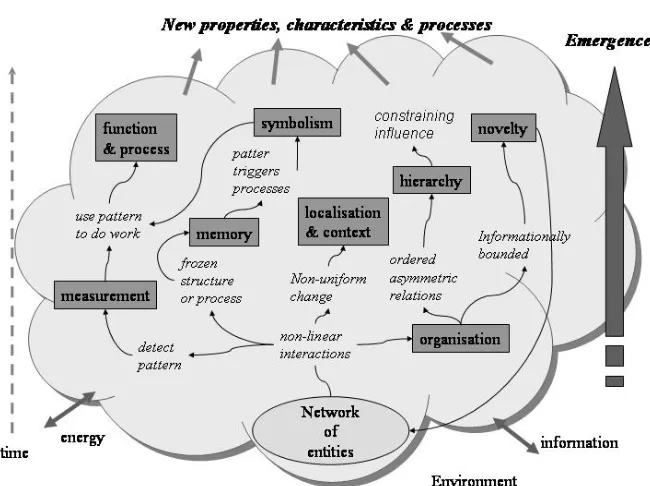
Below, we provide a brief summary of the rationale for the various meta classes of emergence identified through the literature review process. Thes e meta classes – indicated by italics - were first introduced in McDonald and Weir (2005). Features were considered potential meta classes if (i) they were the product of non-linear interactions, (ii) they were domain independent (iii) they were a core building block for system interactions and (iv) they open up new system potential by their existence.
Self-organisation, where detailed organisational structure and new system interactions emerge as a result of the, often very simple, behaviour rules of the system entities , is a well documented feature of real complex systems. The term self -organisation is varyingly used to describe the dynamics of complex systems, emergence or the specific organisational changes brought about through the autonomous entity behaviour. The term organisation rather than self-organisation is there fore used in preference and is defined as the structural change in a complex system which arises from nonlinear, possibly noisy interaction. Where this structural change is a collection of parts with ordered asymmetric relationships, we class it as hierarchy. The concept of hierarchy again is well documented, frequently acting to constrain the degrees of freedom of a complex system.
As Kauffman (2000) observes, some emergence fundamentally changes the complex system in which it appears. For example, the appearance of biological cells radically changed the purely chemical environment on earth leading to life as we know it. Similar step changes occurred with the emergence of new social units in history . Therefore, we define novelty as the emergence of a sustainable new entity with distinctly different interaction patterns. For Pattee (2001), the role of memory is crucial in biological systems – “evolution depends, at least to some degree, on control of dynamics by rate-independent memory structures.” These memories must first appear before the complex systems may capitalise on them. Therefore , we define the memory meta class as frozen structure or processes which arise through non-linear interactions.
Kauffman (2000) in his ‘investigation’ of life suggests that biological life relies on synergistic coupling which happens in nature through an entity’s ability to sample its environment and make use of synergistic opportunities – it uses other entities or processes within the system to do work. This is an example of what we term the emergence of functionality, where a new process emerges that carries out 'work' which is used by another entity. Before entities can make use of other entities or processes in this synergistic way, they must be able to detect their existence. When a new ability for sampling of the environment arises through interaction, we define that as the emergence
4
the various entities of the complex system. Where the non-linear interactions cause this memory or processes within the system to be restricted to certain parts, we describe this
as localisation. If the localised memory or processes are ‘used’ differently within the
system, then context is said to have emerged. Related to this is semantics . As Kauffman (2000, p111) emphasises - “Once there is an autonomous agent, there is a semantics from its privileged point of view. […] we are not far fro m C.S. Pierce’s meaning laden semiotic triad”. It is this ability of entities to recognise patterns which trigger specific behaviour, although the original causal pattern may be lost that significantly adds to the creativity of complex systems. This we call symbolism.
We discarded certain phenomena found in the literature if they did not meet our criteria. For example, ‘surprise’ (Roland et al) was discarded as it is related to the degree of understanding rather than any intrinsic quality of emergence. Variation is included within contextualisation. We also have, for two reasons, deliberately excluded concepts such as autocatalysis, reproduction, evolution, dissipative systems and autopoiesis. Firstly, these are specialised forms of processes which emerge and therefore are included under function / process. And secondly, we wish to start afresh – the model if it is to be useful should be able to shed new light on these processes rather than be restricted by these preconceived theories.Domain specific phenomena such as life were excluded to retain neutrality. We suggest however, novelty, memory functionality and processes are components of life, which is still itself to a degree an ill-defined concept.
[image:5.596.130.455.418.661.2]2.3 The Model
Combining the meta classes with the basic components of complex systems identified in section 1, we arrive at our new conceptual model of emergence, illustrated in Figure 1 above. The meta classes represent the core building blocks and creative steps of emergence within complex systems. Specific emergent phenomena are built up from a combination of various meta classes. The meta classes illustrate the texture of emergence and we do not require that each emergent phenomenon belong to a specific class, nor must each meta class be a component of the emergence. The meta classes are not disjoint. For example, hierarchy may be considered a specialised subset of organisation. Hierarchy is included because its constraining effect helps distil new emergence from more chaotic dynamics.
3.
Testing the model
As the aim of the model was to challenge existing conventions and develop a useful exploratory framework for emergence in real systems, the model was necessarily speculative and subject to change as investigation progressed. While to a large degree, it is the lessons learnt through the development and testing that are important rather than the initial model itself, it was important not to waste time using an inappropriate or false model. To address this challenge and the need to test both usefulness and accuracy, a two stage strategy was adopted: (i) the plausibility of the model was tested and (ii) its usefulness as a framework for exploring emergence in real complex systems was assessed by its application in real complex systems to test pertinent hypothesis.
3.1. Plausibility testing
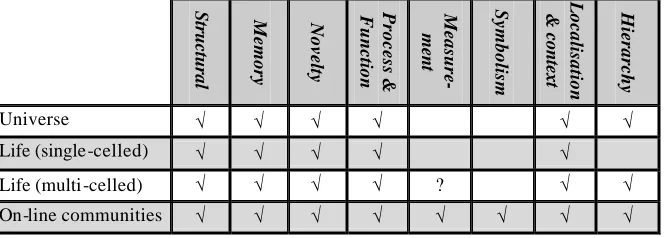
Two aspects required testing: firstly, that the conceptual model is fit for purpose – it is both a valid model of emergence and actually captures the types of emergent behaviour observed in real complex systems and secondly, that the manner in which it does is useful – it aids generation of new insight. The first plausibility requirement was addressed by analysing the fit of the model to existing accounts of real complex systems. Three systems – physical, biological and social - were analysed in detail, examining how their adaption over time matched the various meta classes. The results, displayed in Table 1 below, showed a correlation that supported the appearance of the meta classes as expected. For example, symbolism and measurement were not expected to be found in the evolution of the physical u niverse.
Structural Memory
Novelty Function Process & Measure
-ment
Symbolism & context Localisation Hierarchy
Universe √ √ √ √ √ √
Life (single-celled) √ √ √ √ √
Life (multi-celled) √ √ √ √ ? √ √
6
Table 1: Analysis of meta classes found in sample complex systems .
To address the second plausibility requirement, a focus group was used to test the perceived usefulness of the meta classification in tackling identification and understanding of emergence. The group was asked to consider emergence within the context of a university community. Discussion focused on how emergence is currently identified and whether a meta class approach could help improve that. The discussion supported the proposal that a meta class approach could provide useful insight.
3.2 Usefulness and Hypothesis
In order to test the usefulness of the meta model as an investigatory framework for real complex systems, the original hypothesis HO was broken down into H1: The ‘meta’ classes provide a useful framework for exploring and improving understanding of
emergence in social systems and H2: Examining the ‘meta’ classes and how they
develop will provide valuable insight into the mechanics of emergence, aiding development o f a theory of emergence.
The usefulness of the model (H1) could be best tested by its practical application. This was achieved by development of an investigatory tool derived from the conceptual model framework, followed by its application to real complex social systems (2) to identify their emergent characteristics. The tool consisted of semi-structured interviews designed to explore the existence and causal factors of each of the meta classes. The open ended questioning allowed for additional, unanticipated emergence types to be identified. The tool was applied to investigate emergence in ‘Complex Learning Communities’. Its application proved successful with both a range of emergence and its netlike causal structure identified (McDonald 2005). Respondents also reported it as being a useful exercise as they were asked to consider things from a different angle. Thus, the evidence gathered supported H1.
H2 was further split into a number of sub-hypothesis concerning how the meta classes were expected to appear within the systems under investigation. For example, H2-2: Measurement is a precondition for the emergence of new functionality. The data gathered from the tool application was then used to test these hypotheses. Again, the evidence gathered supported H2.
4. Discussion
The concepts on which a good conceptual model are built should, according to Järvelin and Wilson (2003) (i) meet basic scientific requirements of precision, accuracy, simplicity, generality and suitability for expressing testable propositions; (ii) represent essential features (objects, relationships, events) of the research area; and (iii) differentiate and classify the phenomena in ways that lead to interesting hypothesis (research problems). To this , we add our criterion (iv) provide a useful framework for investigating emergence in real complex systems. The extent to which these criteria have been met is discussed below.
This it is argued is important as it provides insight into the texture of emergence which is an improvement over more formal grammar based models. The testing described in section 3 suggested that the meta model was sufficiently apposite and suitable for generating testable propositions (the hypotheses).
The analysis of the model’s applicability across physical, biological and social systems, combined with its successful application within learning communities lends credibility to its claim to represent the essential features of emergence. However, it should be born in mind that complex adaptive systems are essentially creative – their ‘adjacent possible ’ is ever changing (Kauffman 200 0) and novel building blocks of emergence may appear. This suggests that the model should eventually be coupled with a formal calculus of emergence, if such a model is feasible – the meta model providing the more accessible context, the calculus providing a more rigorous base.
One of the advantages of our meta model is that it affords differentiation of the different meta classes and probing of how these might be linked. It also addresses Kubik’s (2003) criticism of existing models - “definitions [of emergence] lack a common basis of comparison. It seems they overlap in some way, but it is unclear how” – by providing a set of criteria by which other models can be tested. If they cannot reproduce these classes under the relevant circumstance then other models ’ appropriateness should be questioned. The ability to structure the investigation of emergence in real complex systems, while still remaining open to unanticipated factors proved useful. And while the model was tested within learning communities, its domain independent nature means that it could equally be used as a framework to develop investigatory tools for other social, biological and physical contexts. Indeed, although a princip al driver for the model was to facilitate investigation of emergence in real complex systems, the model is equally applicable to investigating emergence simulated within ABM.
The process of developing the model was an important part of the learning experience in itself. The meta model is to a degree a speculative, concept testing tool, which meant that it evolved as the research progressed. Enabling this to happen while maintaining scientific soundness meant that a two stage testing approach was adopted. As Patton (2002) observers , this is in reality a common, but unacknowledged part of the scientific process, where experience feeds back, refining and enriching the model.
5. Conclusion: Summary, novelty and next steps
8
and (iii) investigate how this model could be applied to improve the simulation and theoretical modelling of emergence.
References
Axelrod, R. 2003, Advancing the art of Simulation in the Social Sciences - Japanese Journal for Management Information Systems.
Bedau, M., 2002, Downward Causation and the Autonomy of Weak Emergence. Principia Vol 6, No 1.
Bedau, M., 1997, Weak Emergence. In Tomberlin, J. (Ed), Philosophical Perspectives: Mind, Causation, and World, Vol. 11, 375, 24.
Campbell D.T. 1974, Downward causation in Hierarchically Organized Biological Systems - Studies in the Philosophy of Biology, F.J.Ayala & T.Dobzhansky (ed.), (Macmillan Press), 179, 7.
Casti, J. 1997, Would-Be Worlds. John Wiley & Son, New York.
Cariani, P. 1989, ‘On the design of devices with emergent semantic functions’. PhD Thesis, State University of New York at Binghamton.
Crutchfield, J.P., 1993, The Calculi of Emergence. Physica D special issue on the Proceedings of the Oji International Seminar: Complex Systems - from Dynamics to Artificial Reality. Fromm, J. 2004, The Emergence of Complexity, kassel university press (Germany)
Funtowicz, S. and Ravetz, R.J., 1994, Emergent Complex Systems, Futures, Vol. 26 No 6 568,14. Gross, D. and Jeffries, D., 2001, Complexity Beyond Agent Based Models - Complexity
International, Issue 8.
Holland, J. 1998, Emergence: From Chaos to Order, Oxford University Press.(Oxford).
Järvelin, K. and Wilson, T.D., 2003, On conceptual models for information seeking and retrieval research, Informationresearch, Vol. 9, No. 1.
Johnson, S. 2001, Emergence: the connected lives of ants, brains, cities and software. Penguin (London).
Kauffman, S.A. 2000, Investigations. Oxford University Press, Inc.
Kubik, A., 2003, Towards a Formalization of Emergence, Artificial Life, Vol. 9, No 1 41, 24. McDonald, D.M., 2005, Emergent Characteristics of Complex Learning Communities
-Complexity, Science and Society Conference (Liverpool, UK).
McDonald, D.M. and Weir, G.R.S., 2005, Improving understanding of emergen ce: developing a discipline neutral ‘meta’ classification - Complexity, Science and Society Conference (Liverpool, UK).
Mitleton-Kelly E., 2004, An Integrated Methodology to Facilitate the Emergence of New Ways of Organising - Proceedings of the 3rd European Conference on Research Methodology for Business and Management Studies.
Pattee, H.H.2001, The Physics of Symbols: Bridging the Epistemic Cut - Biosystems .Vol.60, 5, 16.
Patton, M.Q., 2002, Qualitative Research & Evaluation Methods, 3rd Edition, Sage Publications (Thousand Oaks, CA).
Roland, E.A., Sipper, M. and Capcarrerre, M.S., 1999, Design, observation, surprise! A test of emergence - Artificial Life Vol 5, 225,14.
Rosen, R. 1991, Life Itself, Columbia University Press (New York).