by
CHIA-SHONG CHEN
This thesis was submitted in partial
fulfilment of the requirements for
the degree of Doctor of Philosophy in
The Australian National University
CONTENTS
Page
PREFACE
iv
ABSTRACT
vi
CHAPTER I
INTRODUCTION
1
CHAPTER II
NUMBER CONCEPT IN ANIMALS
3
CHAPTER III GENERAL METHOD
21
CHAPTER IV
CAPACITY OF WHITE RATS IN THE
TEMPORAL CIRCULAR MAZE
29
CHAPTER V
CAN RATS COUNT?'
62
CHAPTER VI
GUIDED VERSUS TRIAL-AND-ERROR
PROCEDURE
99
CHAPTER VII TRAINING SCHEDULES OF VARIOUS
GUIDED/FREE TRIALS (
g/F) RATIO
116
CHAPTER VIII TRAINING SCHEDULES WITH G/F
RATIO OF ONE
137
CHAPTER IX
EFFECT OF ALCOHOL UPON THE
PERFORMANCE OF THE TWO-TURN TASK
152
CHAPTER X
CONCLUSIONS
178
APPENDICES
la
190
lb
191
Ila
192
lib
196
Ilia
197
Illb
198
PREFACE
I w o u l d like to thank members of my supervisor committee. Ass o c i a t e Professor P, P e n t o n y , Dr J.R. Trotter, and Dr W , H0 Gladstones, for their valuable
advice, for their critical r e a d i n g of the drafts of the thesis, and for their patience in correcting my English, I w o u l d also like to thank Dr J.R. Trotter for
p r o g r a m m i n g the automatic control circuit and for encouragement at all times; and A s s o c i a t e Professor G.N. S e a g r i m for his interests in this study and his
suggestion that a film be made, the script of w h i c h was w r i t t e n by him.
I thank P r o f e s s o r C.A. Gibb for his encouragement and for the use of facilities in his Department.
I a m indebted to the A u s t r a l i a n National U n i v e r s i t y for a w a r d i n g a post-graduate research scholarship.
X thank the staff of the A u s t r a l i a n Nat i o n a l
U n i v e r s i t y Thesis T y p i n g Scheme, for typing and printing this thesis, and the staff of the Visual Aids Unit of the U n i v e r s i t y for* preparing the copies of the figures.
The main findings of the r e s e a r c h have been published by, or are in press with, the following j ournals s
Chen, CoS. Can rats count?
Nature (L o n d . ) , 1967, 2 1 4 , 15-7.
G u idance in a two-turn task in a temporal circular maze.
Chen 5 CoSo Tra ining schedule in a two-turn task in a temporal circular maze,
Psychon. Sei.,, 1967 9 273-4.
A study of the alcohol-tolerance effect and an introduction of a new behavioural
t e c h n i q u e „
Psychophar macologla. 9 in press.
The following abbreviations have been used in this t h e s i s .
E E x p e r i m e n t e r Mdn Median
ABSTRACT
An enclosed temporal circular mazes
which consisted
of a circular runway and a radial stem, was developed
for the study of 'counting* ability in the white rat,
In this maze situation, the white rat was required,
after emerging from the radial stem, to circle the
circular runway a specific number of times before re
entering the stem for food reward,
The findings may be
summarized as follows,
(1)
The white rat is able to learn tasks requiring
two to seven turns to obtain food reward in this maze
situa
t
i
o
n ,
(2)
Results on control tests suggest that
exteroceptive cues, cues of distance, cumulative sensory
feedback of running activities, and time are not
essential for the successful performance.
From these results it is inferred that the ability
of the white rat to learn these tasks,
which requires
retention of the number of events (e,g,,
number of turns
made) following each other in temporal sequence, may
indicate the rudiments of a counting ability,
(3 )
It is found that in training the white rat to
learn a two-turn task, an ordinary trial and error
training procedure is very ineffective, A certain amount
of guidance (i,e,, forcing S to make the required
(
4
)
The effectiveness of various training schedules (a certain combination of guided and free trials) was studied» The results suggest that (i) within certain limits the effectiveness of guidance isin direct proportion to the number of guided trials given, and (ii) the effectiveness of training schedules is the result of the interaction of guided and free trials„
(
5
)
The present maze situation has potential for studying the effects of drugs on cognitive or symbolic aspect of behaviour, Specifically, the effect ofalcohol on the white r a t ’s performance of the two-turn task was studied« The effect of alcohol was found to be detrimental in terms of response rate, the number of correct trials achieved, and the number of errors made» Some aspects of alcohol-tolerance effect were studied. The result shows that Ss that had the opportunities of running the maze while under the influence of alcohol perform much better than Ss that had merely been
accustomed to the same amount of alcohol but trained in a sober state.
INTRODUCTION
Although it may be true that comparative
psychologists have concentrated unduly on rats (Beach,
1950; Bitterman, i960,
1 9 6 5), there are some aspects of
rats’
behaviour, e.g., ’counting' ability, about which
little is known.
Previous investigations of this and
related abilities in rats showed that the achievements
of rats were surprisingly poorer than those of birds,
which have been extensively studied by Koehler and his
co-workers (see Chapter II).
It is hard to imagine that
the rat would be less able than the bird, which is
supposed to be lower in the phyletic scale.
One probable
reason for these results seems to be the inappropriate
techniques used in the previous studies.
Besides the compelling curiosity to devise adequate
methods for studying this interesting problem in the rat,
there is another important underlying motive which led
this writer to the present study.
If we are going to
learn more about animal learning, and to obtain more
understanding on certain aspects of human behaviour
through studies of animal behaviour, then much effort
should be made to study complex processes; and one of
the most important needs is to develop better techniques
for these studies.
The following sentence is worth
quoting:
little i n f o r m a t i o n about the nature of complex behavior, w h e r e a s the successful analysis of c o m p l e x b e h a v i o r may give vast insight into the n ature of simple behavior.
(Harlow, 1959» p.494)
S i n c e the author regards the study of the 'counting' a b i l i t y in the w h i t e rat as a means for further r e search r ather than as an ulti m a t e end, e x p l o r a t i o n of the
p ossibilities of the met h o d dev e l o p e d in the present study was e m p h a s i z e d at the expense of d e tailed
e x p e r i m e n t a t i o n on each individual problem. T h e
experiments in this thesis, w h i c h can be g r o uped under three m a i n topics , show that the me t h o d has great
potential in the field of c o m p arative studies, in studies of guidance in learning, and in studies of the effects of drugs on a nimal behaviour.
Th e first topic dealt w i t h in this study is the
CHAPTER II
NUMBER CONCEPT IN ANIMALS
Since some excellent reviews on the ’number
conception in animals’
are available in the literature
(Honigmann, 1942; Salman, 1943; Wesley, 196l), it would
seem redundant for this writer to do the same.
The
purpose of this chapter is merely to provide a brief
summary of the main methods related to the studies of
the so called ’number conception’
in animals.
MULTIPLE-CHOICE METHOD
The main principle of this method is that the animal
is required to select one object out of many, which has
a certain relationship with the others.
The object to be
selected is not necessary identical from trial to trial.
As for example, in Yerkes’
multiple-choice test
situation where the correct box varies from trial to
trial, but always maintains a definite relation to the
others,
such as ’the middle one’
or 'the second from the
right’
etc.
Kinnaman (1902) presented two macacus rhesus monkeys
21 glasses of uniform shape on a board and trained them
at first to obtain food from ’glass no. 4 from the right
end’.
Later he trained them to find food in glasses nos
2, 5, 1, or 6 out of a total of 11 glasses.
The monkeys
were found to be able to learn the tasks.
However,
that might be responsible for the successful results,
namely, constant distance of the correct glasses from
the right end of the row of glasses, and marks on the
board, on which the glasses were apparently placed on
the same spot. This same method was employed by Porter
(l904) with English sparrows, which were required to
select glasses nos 1, 2, 5» 4, or 5 out of a maximum of
6 identical glasses. Again, as in Kinnaman’s study,
the cues due to distance and marks on the board were not
excluded.
The multiple^ohoice method was further refined by
Yerkes (1915) for the study of abstraction in animals.
The apparatus consists of a series of identical
compartments or boxes.
During the course of training,
however, only a certain number of these boxes were
accessible (i.e.,
opened) to the animal, and it was
required to find one that had a definite relation to the
others.
The number and position of the open boxes
varied from trial to trial, and consequently the correct
box varied as well.
For example, for the second from
the right problem, when boxes 2, 3, and 4 are open, the
correct one is box 3> and on the next trial boxes 7» 8,
9> and 10 may open, and the correct one is now box 9*
The problems used were: (i) the first box on the animals’
left, (ii) the second box from the right end, (iii)
alternately the right and the left end box, and (iv) the
middle box.
It is clear that the first and the third
problems actually have little to do with the topic in
question.
This method has been applied to birds
and apes (Yerkes,
1916), and chimpanzees (Yerkes,
1934;
Spence, 1939)*
Coburn and Yerkes found that the crow
was able to master problems 1 and 3» but not 2;
Sadovinkova found that her finches were able to select
the middle-box out of a setting of from seven to nine.
However, according to Honigmann, she was without doubt
being outwitted by her birds,
as the correct door was a
swing one and the wrong doors were blocked by means of
pin let down from above.
The birds might have used this
as cue to solve the problem.
The pig was able to master
problems 1, 2, and 3 hut failed problem 4 when seven or
nine boxes were used.
The monkey was able to deal with
all the four problems.
However, it is interesting that
Yerkes’
four chimpanzees failed to master problems
2,3,
and 4, and mastered only the problem of no. 1 type.
Spence used a modified apparatus (manipulatory type) and
trained 17 chimpanzees on five problems.
He found that
15 Ss learned the middle box of five, and all the Ss
were able to learn the second box from the left-end box
of six, the right-end box of seven and the left-end box
of seven.
In all studies ,
only sets of adjacent boxes were
presented, e.g., boxes 3> 4, and 5, or boxes 6, 7> 8, and
9, etc.,
thus the distance between the correct and the
extreme end box of each set might provide the secondary
cue for the correct solution of the second from the left
THE ALTERNATION METHOD
The second method related to the study of '
number
conception' in animals was to test the animals' ability
to perform actions either in single or multiple
alternation.
Katz and Revesz (1909) working with the domestic
fowl, used a row of grains of corn, of which every second
one was glued to cardboard.
The Ss soon learned to eat
every loose grain without pecking the fixed ones.
One
hen even learned to peck every third one and leave the
other untouched, but it failed in learning to peck every
fourth grain.
In a later research (R6v6sz, 1922), the
distance between the grains was doubled or halved after
completion of the training without disturbing the
alternation habits.
As Honigmann pointed out in his
review (19^2), these Ss might just learn to distinguish
between fixed and loose grains, as no control test, in
which all the grains were loose, was carried out.
Honigmann (1942a) succeeded in demonstrating what appears
to be a true single alternation habit in the hen in which
other extraneous cues were excluded. According to his
opinion, 'even a simple alternation, performed in a
"multiple way” without any secondary cues (discrimination
of fixed and loose grains) and independent of the
distances between them, can be considered as a preliminary
stage to counting’
(p.324).
plan of the maze used by H un t e r in an earlier study is shown in the following diagram.
FIGURE 1. D i a g r a m of H u n t e r ’s d o u b le-alternation temporal maze; E, entrance; R, right; L, left;
(modified from Hunter, 1 9 2 0, p.6).
In this maze situation, the animal is required to turn twice to the right and twice to the left (or vice versa). Thus in making these turns the animal is not aided by any differential sensory cues at all, for it has to make each turn at the same choice point. As H unter pointed o u t :
It is impossible for one and the same stimulus to cause first one response and then another unless it is supplem e n t e d by some other factor either inside or outside the o r g a n i s m ... .The experimental situation rules out the possibility of a
supplement from outside the s u b j e c t ’s body. If the subject masters the problem, it can be only because some supplement within the animal's body
is presented.... (1928, p.377)»
counting behaviour in man, but on a more primitive level.
Hunter himself favoured the second mechanism.
Gellermann (l93l), working with monkeys, developed
an alternative procedure, in which S is required to
choose a box to open (manipulatory type) rather than to
run the maze (locomotor response). The procedure is
further adopted in the Wisconsin General Test Apparatus
(e.g., Stewart and Warren, 1957)*
The double-alternation technique has been applied
to rats (see below), rabbits (Livesey, 1964 and 1965),
racoons (Hunter, 1928; Johnson, 1961), cats (Karn, 1938;
Karn and Patton, 1939s Stewart and Warren, 1957;
Yamaguchi and Warren, I96I; Livesey, 1965)» dogs (Karn
and Malamud, 1939)» and monkeys (Gellermann, 1931 and
1931a; Warren and Sinha, 1959)* All the species studied
were able to learn to some degree the sequence of LLRR
(or RRLL) response, but none was able to extent ’the
principle of alternation’
beyond the sequence which it
was trained on, except the monkey which was able to
extend to as many as 16 RRLL sequences (Gellermann,
1931).
In all the experiments using the locomotor response,
only one (i.e., Karn and Patton, 1939) bothered to
control cues of distance.
They were able to transfer
their cats to temporal mazes of different sizes after Ss
had acquired the double-alternation behaviour in a
standard training maze, which suggested that the
cumulative effect of the response was not the operative
cue for the successful performance.
In those
carried out in the W i s c o n s i n General Test A p p a r a t u s ), there seems to be no active control of the possible involvement of secondary cue from the odour of reward. F o r example, in Stewart and W a r r e n ’s study (1957)? fresh kid n e y was used as the r e w a r d 5 therefore there was the possibility that their cats might be guided solely by the odour of the reward.
T H E DISCR I M I N A T I O N M ETHOD
There are two main methods under this category, namely, simultaneous p r esentation and successive
presentation of numbers of stimuli to be discriminated. In the former method, a bird may be required to select one of two groups of edible units (grains of corn, fruit, pieces of meat, etc.), or learn to choose one of five boxes which had the same number of spots on its lid as there were on a ’k e y ’ card lying on the ground in front of the boxes to be chosen. A mo n k e y m a y be required to select one of two cards presented side by side on the basis of number only, irrespective of extraneous cues,
such as size or stimulus configuration. In the second method the stimuli or events are presented s u c cessively in temporal sequence, and the animal is required to estimate or to r e m e m b e r the number of items in
succession, w h i c h is independent of rh y t h m or any other extraneous cues that might be helpful. Thus a bird may be required to eat only ' x ’ gi‘ains out of m any offered,
a monkey, the task may be to open the trainer's clenched
hand twice to obtain food or to reach for food in
response to the number of sounds that indicate the
position of the reward.
The discrimination method has been employed by
Hassmann (1952) on squirrels, and by Woodrow (
1929
),
Kuroda (
1931
), Gallis (1932), Kühn (1953) and Hicks (1956)
on monkeys.
Hassmann reported that her squirrels were
able to discriminate seven irregular dots from three,
four, five, and six dots presented simultaneouslyon
the successive task one S was able to reach the six
level. The results of the first three studies on monkeys
were less satisfactory, both for the poor achievement,
and most importantly for lack of adequate control of
extraneous factors (in the case of Gallis and Kuroda's).
Kühn reported that his monkey was able to discriminate
seven from eight dots which were independent of size and
spatial arrangement,
and presented simultaneously.
Hicks,
using a visual discrimination technique, was able to
train his monkeys to form a so called 'three-ness'
concept. A special feature of Hicks' study is that he
used entirely new stimulus cards on control tests.
Much work has been carried out by Koehler and his
co-workers on several species of birds.
The work has
been nicely summarized by Thorpe (
1963
), and critically
reviewed by Wesley (
1961
), and thus will not be repeated
here.
Their work is characterized by the rigorous control
of every possible extraneous cue, such as the 'Clever
Hans' type error, temporal rhythm, size, figure of the
number of units, etc.
Some remarkable results were
(19^3), using the ’match the key' method mentioned
earlier, trained a raven to open a box that had the same
number of dots on its lid as there were on a key card.
All possible extraneous cues were randomly changed from
experiment to experiment, and the birds still were able
to select, from five lids that had two, three, four,
five, and six irregular dots on them, the one that
matched the key card in number of dots.
Lögler (1959)
was able to train a grey parrot to eat exactly eight
baits that were randomly distributed among a row of 11
food trays.
He even demonstrated the bird’s ability to
combine successive presentation of a number of optical
stimuli with a task of ’acting up’
to the equal number,
e.g.,
to eat only six or seven baits distributed in a row
of food trays after having seen six or seven flashes of
light. Even more astonishing is that when the flashes of
light were replaced by the tones of a flute, the bird was
still able to take only two or three baits in a row of
eight trays according to the number of the tones without
requiring further training.
The same bird was also able
to transpose from simultaneous-successive combination to
the simultaneous-simultaneous one, i.e., when the bird
had learned to act up to two or one after having heard
two sounds or a single sound, he was able to open a lid
with two dots or one dot on it according to the same
acoustic signal without re-learning. According to Thorpe
(1963), this result ’does bring the counting achievement
of birds a step nearer that of man; though it is still
not true counting in the fully human sense’
(p.393)»
Recently, Ferster and Hammer (1964) trained
in binary form'.
They taught the animal at first to
choose from two binary numbers present side by side, the
one that corresponded to the number' of objects shown in
the middle of them. The size, shape, arrangement and
other physical properties of the objects presented were
randomized, and both Ss learned to select the correct
binary number ranging from one to seven after
500,000
trials of training.
Following that, they were trained to
’write* out in binary form the number of the objects
presented. After 170,000 trials of training Ss were able
to master the task, again from one to seven.
The
tremendous number of trials required seems to be due in
part to the complexity of the indication response, i.e.,
the chimpanzees had to learn to discriminate not only the
number of the objects presented, but also the binary
system.
RELATED STUDIES IN THE RAT
Burtt (
1916
), using Yerkes’
multiple-choice test,
trained rats to learn two problems s (i) to choose the
door on the right end of a series of doors, and (i.i) to
choose the second from the left of a series of doors.
As mentioned earlier, the number and position of the
T h e failure might be due to factors such as the a m b i g u i t y of the stimulus situation (it is doubtful that each set of doors was clearly presented to S s ), and delay of reinfo r c e m e n t after a correct choice had been made (Ss had to traverse a distance for food reward).
Atk i n s and D a s h i e l l (l92l), u s i n g a four-box
m u l t i p l e - c h o i c e apparatus, trained whi t e rats to go to the first, second, or third of the three boxes that w e r e illu m i n a t e d in irregular temporal order. Fo r example, for the first box problem, boxes nos 4, 2, and 3, might be i lluminated in this order, and the correct response w o u l d be going to box n o . 4; on the next trial nos 3, 1» and 4 might be illuminated in this order and the correct one w o u l d now be b o x n o ,3, etc. This method differed from that of B u r t t ’s in that each set of boxes were presented in temporal order r ather than b e i n g presented s p a t ially and simultaneously; thus some a b i l i t y to
r e member the p o s i t i o n and the order of the boxes
illuminated was required. However, there seem to be at least two improvements in the technique. Firstly, the experiment was carried out in a dark room, and thus each set of boxes was pr e s u m a b l y more easily perceived, since the n o n - i l l u m i n a t e d or irrelevant b o x was kept out of the l e arning situation. Secondly, the food box was placed i m m e diately be h i n d the correct box, thus the reward w o u l d be m o r e prompt than in B u r t t ’s case. Irrespective of these advantages, none of their Ss m a stered these problems; every S (except one that was d i s c o n t i n u e d a f t e r 160 trials of training) soon
on the white rat with negative results.
In a later study
(Hunter and Nagge,
1931)» when S was at first aided by
differential sensory cues which were later gradually
eliminated, some rats were able to perform the required
LLRR response sequence in a temporal maze.
In this
experiment four T-shaped discrimination boxes were placed
side by side, S was then required to go left in the first
and second boxes,
and to go right in the third and fourth
boxes. After the response sequence LLRR were established
in the four boxes,
S was then required to run LL in one
box and RR in the other, and finally it was required to
run all LLRR in the first box which had been converted
into a temporal maze.
Some Ss learned the double
alternation behaviour in this manner, but like other
higher organisms mentioned earlier, they could not extend
the LLRR series on which they were trained.
One of the practical difficulties of the double
alternation temporal maze technique is the now well-
known phenomenon of spontaneous alternation behaviour
in the rat (e.g., see Dember and Fowler, 1958), which
Hunter himself had realized and concluded that ’it seems
safe to affirm that these are innate reactive tendencies
of the rat' (1920, p.9)*
In order to avoid this
a l t e r n a t i o n trials. S c h l o s b e r g and Katz (19^3) trained rats to learn a d o u b l e - a l t e r n a t i o n b a r - p r e s s i n g problems, in w h i c h they were required either to move a lever two times up and then two times down or to move the lever twice to the right followed by twice to the left. The rats learned the problem. However, since the response sequence o ccurred in a v e r y short interval without any intervening behaviour, the results are generally
r e garded as due to the first m e c h a n i s m proposed by Hunter, namely, ’a cumulative piling up in the nervous system of the r e t a i n e d effect of the responses already made* (1 9 2 8 , p.3 7 8 ) ; the shift in strokes was
c o n d itioned to the cumulative trace of the previous a c t i o n s .
More r e c e n t l y L i v esey (1 9 6 5 ) trained eight white rats on a d o u b l e - a l t e r n a t i o n problem in the W i s c o n s i n General Test Apparatus (a m a n i p u l a t o r y type), in w h i c h the position
of the reward was twice in the right w e l l followed by
twice in the left (or vice versa). S e v e n out of the eight rats ma s t e r this d o u b l e - a l t e r n a t i o n problem to a
criterion of 80 per cent correct responses over 50
consecutive sequ e n c e of responses. Unfortunately, it is apparent that no attempt was made to control the possible odour cue by b a i t i n g b o t h wells on each trial (pellets of rat food were u s e d as r e w a r d ) . It is gen e r a l l y assumed that the rat, w i t h a very well d e v eloped olfactory
structure, has good s e n s itivity to odour.
Ellis (l933) trained eight albino rats in a
m o d i f i e d jumping apparatus. In his so called * counting experiment* , Ss w h i c h had learned a brightness
trained at first to jump three times to the left and on
the fourth trial to the x’ight,
or three times to the
right and the fourth time to the left. This training
stage was actually a continuation of the brightness
discrimination training, in which the positive card was
placed three times to the left (or right as the case
might be) and shifted to the other side on the fourth
trial.
However, on the critical test, the condition on
the first three was the same as that during training,
i.e.,
the positive and negative cards were presented to
guide S ’s response, and on the fourth trial (so called
critical trial), both stimulus cards were made the same
(all positive cards). According to the author, there
were no extraneous cues to guide Ss which side to jump.
The results showed that six out of eight were able to
jump to the required side.
The author did realize that
the results did not permit the conclusion that the rats
could count,
but he thought that they gave some
indication in this direction.
It is very probable that
Ss were only responding to the change of the stimulus
card per se.
During the training stage, the stimulus
cards were changed on the fourth trial,
and on the
critical test, making the stimulus cards the same
actually changed the stimulus complex and this might
account for the positive results.
Furthermore on the
first three trials, Ss were clearly guided by the
positive (or even the negative) stimulus card? there
seems to be no need to assume that counting was involved.
each of a pair of numbers given in the form of sounds of
a bell with right or left turn. The result showed that
Ss could not discriminate one from two and three acoustic
stimuli, but were able to differentiate five from one,
two, and three.
Two Ss were even able to discriminate
between five and four sounds.
Since the interval between
successive stimuli was kept constant throughout the
experiment,
it is likely that Ss did not base their
successful performance on the number of sounds per se,
but rather on the time interval between the first and
the last stimuli.
This view is indirectly supported by
Woodrows’
(1929) study on monkeys; when the interval
between sounds in the groups of two was made equal to
that between the first and the last sounds in the groups
of three, the acquired habit of differentiating two and
three disappeared.
It was not until the study of Wesley (1959) that
rigorous controls of extraneous or secondary cues
comparable to those of the work on birds were introduced
into the study of ’number concept’
in the rat.
He
employed two methods successfully used by Koehler and his
co-workers on the birds, namely, simultaneous and
successive discrimination methods.
A linear
runway-type maze with ten left side alleys with a starting box
at one extreme end was developed for the successive
method.
Subject is required after running out of the
start box, to learn to enter the second open alley. The
total number of open alleys varies from two to six.
For
example,
on one trial when alleys nos 6 and 10 are opened
and the remaining eight are closed, the correct alley
10
may be opened and the correct one is no .
3 ?
etc. Thus
the position of the correct alley varies from trial to
trial. The distance between the correct alley and the
starting box, and the distance between the correct and
the first open alley can be varied as well.
At this
point it is clear that this method is actually a
variation of the multiple-choice method.
Seven albino
rats and seven hooded rats were assigned to seven
training conditions (corrective vs noncorrective by
aided vs nonaided; three aided conditions being used)5
the result showed that at least three Ss showed mastery
of the problem, but the correct response was not very
stable and occurred solely at the end of massed practice.
This result was later interpreted by the same author in
his review article (1961) as that ’the rats may have
responded only to oneness’
,
for the rats may only learn
to avoid the first open alley rather than to enter the
second open.
A
modified Fields' (1953) serial multiple visual
discrimination apparatus was used for studying the
simultaneous discrimination ability of the rat. Nine
hooded rats were used to learn a 'twoness’ ,
a 'threeness'
problem, or both.
Some Ss were at first aided with size,
location, figure, and rotation of the units, and others
were not aided.
Three Ss were able to retain the
could not be retained when the triangularity arrangement
of the units was excluded.
It is thus clear from the above review that the
number ability in the rat has not been so extensively
and properly studied as that of birds.
Of the ten
related investigations reviewed, only one attempted
actively to control the extraneous cues.
Furthermore,
the limitation of the techniques used in these studies is
clearly reflected in the poor achievements of the rat.
A further attempt on this interesting problem appears to
be desirable.
METHOD USED IN THIS STUDY
At the very beginning of developing adequate
techniques for this study, the simultaneous discrimination
method was excluded for the following reasonss
(1)
this method required simultaneous presentation
of groups of exteroceptive stimuli, which would
certainly involve other secondary cues such as
brightness, size, intensity, etc., that not
only would impede the discovery of the relevant
aspect of the stimuli (i.e.,
number alone) but
also would require more effort to control them,
and
(2)
the necessary involvement of sensory processes
would reduce the value of the method concerned
for comparative studies.
For example, in
Thus the successive presentation method was adopted and an enclosed temporal circular maze developed. It is hard to recall how this maze was developed, but in the course of attempting: this, three guiding: criteria for the desired technique were rigidly a pplieds
(1) not to require any exteroceptive stimuli, such
as successive presentation of number of sounds, flash light, etc.f this is to avoid the same difficulty involved in the simultaneous method,
(2) not to require any special manipulatory ability, and
(3) not to require any handling of S during the
course of training.
CHAPTER III
GENERAL METHOD
APPARATUS
The apparatus consisted mainly ofg (i) an enclosed
temporal circular maze, (ii) an event recorder, (iii) a
Deutsch Spaghetti Gun (Trotter, 1956), (iv) a relay
control circuit, and (v) a stop clock. The temporal
circular maze was developed by this writer.
THE MAZE
In this section, only some general features of the
temporal circular maze are described.
The maze, which
was of an enclosed type, consisted of two main partsg a
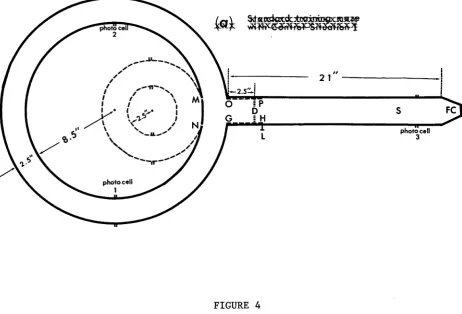
circular runway and a radial stem (see Figure 2).
The entire maze was made of stainless steel and had
an interior height of four inches and an interior width
of 2.5 inches.
The floor of the maze consisted of two
7/8 inch steel bars set 1/2 inch apart, and separated by
a 1/8 inch gap from the side walls. The bars were so
constructed that they could be used as electrodes for the
delivery of electric shock if desired. The entire maze
was covered with Plexiglas lids.
The top picture of Figure 2 shows the maze viewed
from above with its lids removed, and the bottom
FIGURE 2
features of the maze ares (i) a food cup, (ii) a sliding
door, and (iii) three photocells.
The food cup was used
to receive food reward (a definite length of raw
spaghetti, e.g., 1 cm) delivered through the Deutsch
Spaghetti Gun. The sliding door, situated in the stem
was used as a mechanical means of guiding the animal* s
response. The three photocells served to collect
information of the movement of the animal in the maze for
the control circuitry.
THE EVENT RECORDER
The performance of S was registered on a two-channel
event recorder.
One of the channels was used to register
the number of turns being made on each trial and the
other was used to register the number of trials being
made in each training session (for definition of trials
see procedure below).
Samples of the record are shown in
Figure 3*
TRIALS CHANNEL
Iff ft tit
TURNS CHANNEL
THE SPAGHETTI GUN
The Deutsch Spaghetti Gun (shown in the bottom
picture of Figure 2) was used for the delivery of food
reward.
When the Gun was activated, it would deliver a
portion of spaghetti of known length into the food cup.
The length of spaghetti cut off could be adjusted.
THE RELAY CIRCUITRY
The relay circuitry, which was programmed by Dr J.R.
Trotter, was used for automatic recording of S ’s
performance and automatic operation of the Spaghetti Gun.
It was so programmed that in order to operate the turn
recording pen, both photocells in the circular runway
had to be activated (by interruption of the light beam to
the photocells) in a row. The first one that was
activated served to prim the relay circuitry in such a
way that the turn recording pen would operate when the
second photocell was activated.
It was also programmed
in such a way that in order to operate the turn pen for
the second time,
the photocells had to be activated in
the same sequence as on the first turn.
This arrangement
maximized the possibility that the record taken was
always of a complete turn and that every turn within a
trial was in the same direction. The trial pen and the
Spaghetti Gun were under the control of the photocell in
the radial stem.
When the beam to this photocell was
interrupted, the trial pen would be operated and
wh^n the beam to this photocell was interrupted. The
relay circuitry was situated in a room next to the
experimental one.
THE STOP CLOCK
The clock was used to measure the time taken on
each training session.
It was always started at the
moment S ran out of the stem and was stopped at the end
of the last trial.
THE TASKS
In this maze situation, S was required, after
emerging from the stem, to follow the circular runway
for a definite number of turns (e.g.,
three turns) in
one direction, before re-entering the stem for food
reward.
(it is clear that the stem functioned as a
start box at the beginning of a trial and as an end box
at the end of that trial). To say that S was required
to learn an n-turn task means that S had to make exactly
n whole turns before returning to the stem for food.
If
it made too few or too many turns it received no food.
PROCEDURE
OPERATIONAL DEFINITION OF TERMS USED
G u i d e d and free t r i a l s . A trial is said to be a guided trial when S is forced to make a correct one. On
a guided trial, the sliding door is closed after S has entered the circular runway to prevent it from returning to the stem before the specified number of turns has been run; the door is re-opened w h e n S is about to complete the last turn. A trial is said to be a free trial w h e n there is no interference from the experimenter with S ’s
performance. On a free trial, the sliding door is kept open all the time, and S is free to make either a correct or an erroneous trial.
T r a i n i n g s c h e d u l e s . A training schedule consists of a certain c o m b ination of guided and free t r i a l s ,
specified by a formula such as b x (cG dF), w h i c h means b repetitions of a b l o c k of c guided trials follows by d free tirals (b, c, and d b e i n g positive intergers). For example, a S on a 2 x (3G 6F) schedule receives on each training session two repetitions of a block of three guided trials followed by six free trials.
In connection w i t h the training s c h e d u l e s , a G/F ratio was used to represent the ratio of a guided/free trials of a t r aining schedule, e . g . , the G/F ratio of 2 x (3G 3F) or of 3 x (4G 4f ) is one, while for 3 x
(4G 2F) the ratio is two, etc. The G/F ratio was used because it provided a v ery convenient way for the
GENERAL PROCEDURE
The training procedure consisted essentially of two
stages: a preliminary training and an experimental
training.
Preliminary training.
The main purposes of the
preliminary training were to habituate S to the noise of
the operation of the Spaghetti Gun, and to familiarize S
to the temporal circular maze.
For the first purpose,
several methods were tried, each of which is mentioned in
connection with the relevant experiment.
For the second
purpose,
S was generally allowed to run the maze for a
certain number of trials each day for a certain number of
days, and spaghetti was delivered at the end of each trial
irrespective of S's performance, i.e., irrespective of the
nature of trials being made.
Experimental training.
A daily session began by
putting S into the stem and ended when it finished the
assigned daily trials.
No effort was made to control
the intertrial interval, and intertrial handling was nil
during the course of daily training.
The maze is thus
virtually a free responding situation.
Throughout this
study, no punishment, e.g., electric shock, was
administered at the end of erroneous trials,
On correct
trials (i.e., the correct responses made on free trials)
and on guided trials, the spaghetti was delivered as
soon as S interrupted the light beam to the photocell in
the radial stem.
consecutive correct runs) was attained. Guidance was generally dis c o n t i n u e d w h e n S has reached the criterion of learning, and after r e a c h i n g the criterion, S ’s daily session w o u l d then consist of a certain number of free t r i a l s .
Scores c o l l e c t e d . The scores collected g e n e rally i n c l u d e d :
(1) time score, i . e . , time taken to complete a s e s s i o n ,
(2) number of total trials requ i r e d to reach the c r i t e r i o n of learning; this score had two components: the number of total guided trials and the number of free trials w h i c h included correct and erroneous t r i a l s , and
(
3
) percentage (and ratio) of correct trials made in each p o s t - c r i t e r i o n session.SUBJECTS
The Ss used in this study were male white rats obtained from the A n i m a l B r e e d i n g E stabl i s h m e n t of the A u s t r a l i a n N a t i o n a l University. Details w i l l be presented
CHAPTER IV
CAPACITY OF WHITE RATS IN THE TEMPORAL CIRCULAR MAZE
The main purposes of the following two experiments
were to determines
(1)
if the white rat is able to master any task
provided by this maze situation, and if so,
(2) what is the upper limit of its ability in this
maze .
As mentioned in the previous chapter, S was required,
after emerging from the stem of the maze, to follow the
circular runway for a definite number of turns before re
entering the stem for food.
It is thus possible to
present S with a series of tasks that require different
numbers of turns.
It is presumed that a task that
requires a large number of turns is more difficult to
learn than one that requires a smaller number, e.g.,
a
five-turn task is more difficult than a two-turn one.
In the following two experiments, the general
procedure was to train S to learn a two-turn task.
When
this task was well mastered, S was then required to learn
a three-turn task.
The experimenter added one turn at a
EXPERIMENT 1
METHOD
SUBJECTS
The Ss were 12 male white rats aged about 6=7*5
months when the experimental training started.
They
were housed in groups of six with water freely available,
and were generally maintained on a
22-25
hours food
deprivation schedule.
APPARATUS
Two temporal circular mazes of different sizes were
used.
The radii of the inner walls of the circular
runways were respectively five inches and 8.5 inches, and
the lengths of the radial stems were 20 inches and 21
inches respectively.
PROCEDURE
Preliminary training.
All preliminary training was
carried out in the five inch maze.
Each S received five
consecutive free trials each day for about 20 days.
Spaghetti was delivered at the end of each trial
irrespective of S ’s performance.
Two-turn task.
Training was carried out in the 8.5
inch maze for all Ss except two which were at first
trained on a two-turn and a three-turn task respectively
in the five inch maze.
General treatments for the 12 Ss
are summarized belows
(1) Rats 1 to 5 were trained in the 8.5 inch maze
under a 3G 5F 2G
2G 10F 3G schedule each
day. However, the schedule was not strictly
followed.
At the later stage, extra trials
were given, usually by successively repeating
(2G lOF) pattern or by continuously giving
free trials.
(2) Rats 6 to 10, also trained in 8.5 inch maze,
were at first trained with a trial and error
method without success; on each session, they
were run 20 free trials.
Rats 6 and 7 were
later randomly selected and trained under the
guidance procedure.
Detailed procedure and
comparison between the effectiveness of trial
and error method and the guidance procedure of
(l) are discussed in Chapter VI.
(3 ) Rat 11, which was used for exploratory study,
was trained under an irregular training
(4)
Rat 12 was at first trained to learn the
three-turn task under a guidance procedure similar to
that of rat 11’s ,
but failed to master it.
It
was then trained on the two-turn task, and like
rat 11, was trained in the five inch maze using
a similar schedule.
Guidance was generally withdrawn when S was able to
make at least nine correct trials out of ten.
On the
following sessions they were given 25 free trials each
day until the performance was very efficient.
Rats 1 to
5, 7, 11, and J2, received a total of 10 to 20 training
sessions (median: 16) before being trained on the
three-turn task.
Rats 1 to 5 had also undergone a control test
before they were trained on the three-turn task.
Three-turn task.
Ten Ss were trained on the
three-turn task.
Eight of them (rats 1 to
5
j7»
11, and 12)
had mastered the two-turn task, while the remaining two
(rats
8
and
9)
had not.
General training schedules was
5G 5F 3G 5F 4
g10F 3G each day.
However, daily training
was sometimes extended as in the two-turn task when Ss
consistently made correct trials. Training was carried
out in the 8.5 inch maze except for rat 11 which was
trained in the five inch maze. The condition on the
withdrawal of guidance was similar to that of the
Four -turn task.
Only two Ss (rats 4 and 1.2) ,
which
had received a total of 13 and 10 training’
sessions
respectively on the three-turn task, were trained on the
four-turn task.
The general training schedule was 70 5F
3G 5F 50 10F 30, and as with the two- and the three-turn
task, exceptions to the schedule were allowed.
Training
was carried out in the 8.5 inch maze.
Rat 12 had
undergone a control test before it was trained on a five-
turn task.
Five-, six-, and seven-turn tasks.
Only rat 12,
which had received a total of
51
training sessions on the
four-turn task, was trained on these tasks.
On the first
training session it was run without giving guided trials,
the purpose of which was to see if it was able to master
the task without further guidance.
On the first session
of the five-turn task, it ran a total of 22 free trials,
and training had to be called off because it refused to
continue the maze running (on the last eight trials the
intertrial interval range from two minutes to
13minutes)
After the second session, it was generally run under the
schedule of continuous repetitions of
(30 3F)
block, and
the numbers of the daily total trials ranged from
20to
39It had received a total of six training sessions and
undergone a control test before being trained on the six-
turn task.
thereafter under a schedule of continuous repetitions of (3GS- 3F) block. It was eliminated from further training; after being; tx-ained for five training sessions ? because of its apparently disorganized behaviour in the maze.
RESULTS AND DISCUSSION
The results for each S on each task are presented in Table 1. This shows the number of total trials required to reach a criterion of at least 80 per cent correct trials on a training session, and the percentage (and ratio) of correct trials achieved on this criterion session.
On the two-turn task all S s , except 8, 9> and 1 0,
which were trained under the trial-and-error procedure, were able to master the task. When trained under the
trial-and-error method, rats 6 and 10 refused to run the maze (generally they would stay at the food cup for a
long period of time); after receiving the specified
number of t r i a l s , they had to be eliminated from further training. Rats 6 and 7> which failed to master the task after being trained with the trial-and-error procedure, were able to master it when they were trained under the guidance method. Thus it appears that the trial-and-error method was quite ineffective in training the white rat to learn the two-turn task (see Chapter VI for more details).
Nine Ss out of ten trained on the three-turn task were able to master it. It is interesting to note that all eight Ss that had mastered the two-turn task learned
TABLE 1
NUMBER OF TOTAL TRIALS REQUIRED TO REACH THE CRITERION OF 80 PER CENT CORRECT AND THE PERCENTAGE (AND RATIO) OF CORRECT TRIALS
MADE ON THIS CRITERION SESSION
Subject
Total trials to criterion of at least 807o correct
Percentage (and ratio) correct trials
on criterion session
Total trials to criterion of at least 807o correct
Percentage (and ratio) correct trials
on criterion session
Two-turn task Three-turn task 1 3 6 9 8 8 ( 2 2 / 2 5 ) 4 9 1 8 5 ( 2 3 / 2 7 ) 2 3 3 5 8 4 ( 2 1 / 2 5 ) 4 4 8 8 1 ( 2 1 / 2 6 ) 3 4 0 0 9 6 ( 2 4 / 2 5 ) 4 3 5 8 6 ( 6 2 / 7 2 ) 4 2 7 1 9 2 ( 2 3 / 2 5 ) 2 5 6 8 1 ( 2 1 / 2 6 ) 5 201 9 2 ( 2 3 / 2 5 ) 4 9 4 8 3 ( 3 3 / 4 0 ) 6 1 2 0 ( 1 8 9 ) a 8 4 ( 2 1 / 2 5 ) -
-7 6 8 2 ( 3 7 0 ) 7 6 ( 4 5 / 5 9 ) 6 3 1 8 2 ( 4 1 / 5 0 ) highest
8 6 3 3 failed 1 0 5 0 8 0 ( 4 0 / 5 0 )
9 6 7 9 failed 3 4 9 failed
10 9 0 failed -
-11 3 8 5 1 0 0 ( 2 5 / 2 5 ) 4 2 7 9 2 ( 3 6 / 3 9 ) 12 2 0 6 8 0 ( 2 0 / 2 5 ) 3 1 5 9 0 ( 2 6 / 2 9 )
Four-turn task Five-turn task
4 208 57 (17/30) _
-12 1 4 0 7 80 (32/40) 81 53 (20/38)
a
[image:42.544.76.500.122.585.2]Moreover, it is clear from Table 1 that rat 8 reached the
criterion of 80 per cent correct with greater difficulty
than the remaining eight
S s
.
Rat 9 was eliminated when
its response rate got very low, i.e., intertrial. interval
became very long.
It is also of some interest to note
that, at the very beginning, rat 12 had been trained on
the three-turn task for a total of 9^8 trials without
success,
before it was trained to learn the two-turn task
which it mastered.
It was then able to master the three-
turn task on the second attempt, i.e.,
after it had
mastered the two-turn task.
These results, i.e.,
failure
of rat 9
master the three-turn task, the failure of
rat 12 to master it on the first occasion when it had not
learned the two-turn task, and the great difficulty for
rat 8 to master the three-turn task, seem to suggest
that mastery of the two-turn task is helpful in mastering
the three-turn task.
There were no special reasons for giving Ss
different numbers of trials on each training session,
except that S was generally allowed to run the maze for
as many trials as possible and sessions were discontinued
when S showed signs of restlessness (e.g.,
biting, pushing
the lid with its head etc.), or when the intertrial
interval got longer and longer.
Only rat 12 was able to reach the criterion of at
least 80 per cent correct on the four-turn task. Although
the number of total trials required to reach the
criterion was large (l407),
it should be pointed out that
evidence of learning occurred quite early.
For example,
after receiving 166 trials,
it was able to make 12
was very stable. Rat
4
started its training well. However, d u r i n g this stage of training, it was veryliable to get disturbed, either by any noise from outside or by the n o n-rewarded trials (i.e., errors). It w o u l d run the maze sporadically, and would often
retrace the stem in b e t w e e n trials. It w o u l d run out of the stem, but instead of fol l o w i n g the runway as it w o u l d in the normal state, would immediately ret u r n to the food cup. It was e l iminated from further training after being trained for 13 sessions.
As shown in Tab l e 1, rat 12 did not achieve the criterion of at least 80 per cent correct on the five-turn task. However, it should be pointed out at this stage that a control test in w h i c h the distance of the runway h a d been r a n d o m l y varied, was carried out on the f o l l owing session. Its performance on that control session was 80 per cent correct (see C h a pter V for d e t a i l s ).