arXiv:quant-ph/9711033 v1 18 Nov 1997
Security against eavesdropping in quantum
cryptography
Norbert L¨
utkenhaus and Stephen M. Barnett
University of Strathclyde, Glasgow G4 0NG, Scotland
EMail:
{
norbert, steve
}
@phys.strath.ac.uk
25. September 1996
1
Introduction to quantum cryptography
of this type will be refered to as deterministic signals since, the outcome of the polarisa-tion measurement is fully determined by the state of the signal photon. The remaining signals are non-deterministic signals. An example for this is a horizontal linear polarised photon which triggers with equal probability the outcome “right circular” and “left circu-lar” in the polarisation analyser distinguishing in the circular polarisation basis. Sender and receiver can distinguish between deterministic and non-deterministic signals using the public channel without giving away any information about the specific signal. They just compare the polarisation basis of the signal and the measuring polarisation analyser, both of which can be “linear” or “circular”. The signal sequence of the deterministic bits can then be transformed into a binary key by assigning “0” for linear horizontal or right circular polarised photons and “1” for the remaining linear vertical or left circular polarised photons.
In this idealisation the security of quantum cryptography is given by the fact that the four polarisation states are not four orthogonal states and so there exists no quantum non-demolition measurement which could distinguish between them. Even more importantly, each attempt to distinguish between any of the states will change, in average, the states of the signals. This state-change destroys the perfect correlation between the signal and the measurement outcomes for the deterministic signals. A test checking this correlation will reveal any attempt at eavesdropping. If the test shows that the correlation is still perfect then sender and receiver can be sure that there was no eavesdropping attack and their shared binary key is perfectly secret.
In the practical realisation of quantum cryptography we face two specific problems. The public channel needs to be implemented in such a way that sender and receiver can ensure that the messages being received are really coming from each other. This is the problem of authentication for which various techniques are in use. In general, however, there will be the need for the two parties to share a limited amount of secret knowledge, for example in form of a secret key, before the authentication can take place. Quantum cryptography then generates a large secret key from a small secret key.
of each other. It therefore does not include coherent attacks in which the product state of all signal photons is attacked. The sharp bound does not take into account that an eavesdropper can make use of the later acquired knowledge about the polarisation basis of the signal photons to change the measurement of the signal. However, we are able to give a rough upper bound for this situation. The reason that this is possible is that the eavesdropper has to decide how to interact with the signal states before he acquires the additional knowledge about the polarisation basis.
2
Generalised measurements
The key input to derive the bounds given in this paper is the most general description of a measurement on a given system. Any measurement can be described by a set of operators
Al defined on the Hilbert space H of the system the measurement is performed on. The
only restriction on the operators is that
X
l∈K
A†lAl =11H. (1)
where K is some finite or countable infinite index set. The link between these operators and a measurement is given by the following formulas which describe the probabilities that a particular outcome of a measurement is triggered, and which give the final state of the measured system after that outcome was registered. For the sake of simplicity we assume the set of outcomes to be discrete. The probability that the outcomek is triggered by an input state with density matrixρ is given by
pk = TrH
ρ X
l∈Kk
A†lAl
(2)
where theKk are disjunct subsets of K with K =SkKk. The final density matrix ˜ρ(k) of
the selected states belonging to this outcome is given by
˜
ρ(k)=
P
l∈KkAlρA
†
l
TrHρP l∈KkA
†
lAl
. (3)
The density matrix of the final state, which does not select any states, but describes the whole ensemble for all outcomes is given by
˜
ρ=X k
pkρ˜(k) = X
l∈K
AlρA†l . (4)
chooseHto be the Hilbert space of the spin of electron. If we are interested in the position or momentum of the electron as well we have to add the Hilbert space of spatial modes. It is a bit less obvious in quantum optics. IfH is the one-photon polarisation Hilbert space then we implicitly assume that precisely one photon remains after the measurement. An eavesdropper may absorb the photon and so the final state is the vacuum. Therefore the adequate Hilbert space is the full Hilbert space of a light mode plus the polarisation degree of freedom. It turns out that we can derive the bounds presented here by restricting the Hilbert space to that of a single photon and later generalise it to the full Hilbert space.
3
Estimate of the Shannon information
The relevant expression for the Shannon information per signal is given with the help of the function h(x) =−xlogx, where log refers to basis 2, as
I = X
Ψ=0,1
h[p(Ψ)] + X
α=◦,+
k
h[p(kα)]− X
Ψ=0,1
k,α
h[p(Ψ, kα)] . (5)
An eavesdropper gains this Shannon information on the binary key whose signals are given by Ψ = 0,1 when he learns, from communication on the public channel, the polarisation basis α = ◦,+ (linear or circular) used for each signal, and registers the outcome k on the measurement apparatus triggered by each signal. The probabilities that a “0” or a “1” is sent are denoted by p(Ψ), the probability that outcome k is triggered by a photon prepared as basis state of the linear or circular polarisation basis is written asp(kα), and
the joint probability distribution for both events is p(Ψ, kα).
We would like to give an upper bound on this Shannon information as a function of the
measureddisturbance of the quantum channel given as the error rate in the deterministic signals. This error rate is basically the fidelity measure Dfid of the channel, given by
Dfid = 1−
1 4
4
X
j=1
TrH(ρiρ˜i). (6)
The definition of Dfid assumes here the use of the one photon polarisation Hilbert space.
The expression TrH(ρiρ˜i) is the overlap between the input state ρi, which is one of the
four signal states, and the final state ˜ρi of the eavesdropper’s measurement performed on
this input state ρi. This can be interpreted as the probability that the final state is still
recognised as the initial state in apparatus of the receiver. Then Dfid is the error rate
averaged over the four signal states.
It can be shown [8] that the optimal eavesdropping strategy can be given by operators
Ak which can be described by real matrices in a representation for which the signal states
are real density matrices. Each operator Ak, which can always be expressed in the form
Ak =√akOk+ q
bk−√ak
with real, positive numbers ak and bk, (bk ≥ak), projection operatorsPk and orthogonal
operators Ok. The optimal strategy satisfies the symmetry that for each such operator
the set of operatorsAk contains as well the operator
˜
Ak=√akOk+ √
bk−√ak
OkP (8)
which employs the orthogonal complement P = 11H −Pk. The optimal eavesdropping
strategy associates a measurement outcome with each of the operators Ak separately so
that we do not need to employ any partitions K(k). For such an eavesdropping strategy
the measured disturbance Dfid is given by
Dfid =
X
i "
1
4TrH(ρiEi)−
X
k∈K
1 4
q
akbkTrH
OkρiOTkEi
+1 4
√
bk−√ak 2
2
TrH
OkPkρiPkOkTEi
+ TrH
OkPkρiPkOkTEi
!#
.
Here Ei is the projection operator describing the effect of the polarisation analyser. For
the one photon space we haveEi =ρi. The Shannon information is given by the expression
I = P
kak+2bk
1−log(1 +η2k)+
1
2(1+η2
k)
(η2k+ck−ηk2ck) log(ηk2+ck−ηk2ck)
+(1−ck+η2kck) log(1−ck+ηk2ck)
+(ηk2+dk−ηk2dk) log(ηk2+dk−ηk2dk)
+(1−dk+ηk2dk) log(1−dk+ηk2dk)
.
(9)
In this expression we used the definitions of the overlaps ck = TrH(ρ1Pk) and dk =
TrH(ρ3Pk) and of the characteristic parameters ηk = qa
k
bk with η ∈ [0,1]. For ηk = 1
an operator Ak takes the characteristics of the identity operator, which corresponds to
non-interference of the eavesdropper, and for ηk = 0 the eavesdropping strategy tends to
a von Neumann projection measurement. The overlaps are restricted by the inequality
(dk−
1 2)
2+ (c
k−
1 2)
2
≤ 14 . (10)
We can find the optimal choice of orthogonal operatorsOkandPk. The optimal choices
are given in a later section. As a result we find now for the disturbance the inequality
Dfid≥
X
k∈K
ak+bk
2 1 4
(1−ηk)2
1 +η2
k
Note that the condition (1) implies that
X
k
ak+bk
2 = 1 (12)
so that the expressions ak+bk
2 have the property of a probability. The Shannon information
can be estimated by
I ≤X
k
ak+bk
2 1
2 1−log(1 +η
2
k) +
ηk2
1 +η2
k
logη2k
!
. (13)
It can be shown that the optimal choice of the characteristic parametersηk is for them
to take the same value ˜η. The proof uses variation methods. Then we find the inequalities
Df id ≥
1 4
(1−η˜)2
1 + ˜η2 (14)
I ≤ 1
2 1−log(1 + ˜η
2) + η˜2
1 + ˜η2 log ˜η 2
!
. (15)
If we actually measure the average error rate Dfid and find the value Dm we can bound
the value of ˜η by
˜
η≥η:=
1−2√2√(1−2Dm)Dm
1−4Dm Dm ≤
1 4
0 Dm≥ 14
(16)
which leads to the bound of the eavesdropper’s Shannon information [7, 8] as
IS ≤
1
2 1−log(1 +η
2) + η2
1 +η2 logη 2
!
. (17)
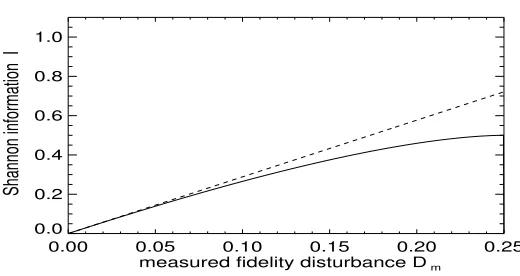
It can be shown that this bound can be further estimated by the linear bound
I ≤ 2
ln 2Dm (18)
where ln 2 is the natural logarithm of 2. For small Dm this bound is nearly as good as
the bound (17) which will later be shown to be sharp. The sharp bound and the linear approximation are plotted in figure 3 as a function of the measured fidelity disturbance. Typical values for experimental realisations using the BB84 protocol achieve an error rate of 4 % for 30 km or 1.5 % for 10 km distance between sender and receiver.
4
Privacy amplification
0.00 0.05 0.10 0.15 0.20 0.25 measured fidelity disturbance D m
0.0 0.2 0.4 0.6 0.8 1.0
[image:7.612.214.474.139.277.2]Shannon information I
Figure 1: The bound on the Shannon information in the sharp (continuous line) and the linear bound (dashed line) as a function of the measured distur-bance Dm.
making use of the technique of privacy amplification [9] it is possible to reduce Eve’s total amount of Shannon information on the remaining key. For that the key has to be shortened usinghash functions. The characteristic quantity for the fraction by which the key has to be shortened is the parameter τ1. If we shorten the key by the fraction τ1
then the eavesdropper is left at most with a Shannon information of 1 bit on the whole
key. Each bit by which the key is is shortened additionally decreases this remaining Shannon information exponentially. The parameter τ1 can be expressed with the help of
the collision probability hpc(y)iy as
τ1 = 1 + loghpc(y)i
1
N
y . (19)
The collision probabilityhpc(y)iy = P
xp(x|y)2 refers to the probability distributionp(x|y)
over all possible signal stringx, conditioned on the event that the eavesdropper measured a particular string of measurement results y.
Before they can apply the technique of privacy amplification, the sender and the receiver have to perform some type of error correction on their shared key. We assume that this process can be done without the eavesdropper gaining any additional knowledge and without the creation of any correlations between the signals. A possible realisation would be to use block parity comparison where the compared parity bit is encoded using some short shared secret key from the same source which gives the key used in the authentication of the public channel. In this case the collision probability is given by
hpc(y)i
1
n = X
k,α,ψ
p(c)(ψ, k
α)2
p(c)(k
α)
, (20)
where the probabilities p(c)(ψ, k
α) and p(c)(kα) now refer to the corrected key, and it
joint probability distribution p(c)(ψ, k
α) is given, with a normalisation constant C, by
p(c)(ψ, kα) =
1
CTrH
AkρψαA
†
kρψα
. (21)
It is again possible to show general properties of the Ak which lead to an optimal
information gain by the eavesdropper, along with minimal disturbance of the signal trans-mission. The optimalAk can be shown to be real (in the real representation of the signal
states) and to consist of symmetric or anti-symmetric matrices. The symmetric matrices can have eigenvalues of different or of the same sign so that they can be written as
A(±)k =√ak11H−
√
ak± q
bk
Pk (22)
with the ak and bk satisfying, as before,bk ≥ak ≥0 and Pk is a projection operator. To
each such operator the set of operatorsAk contains an operator
˜
A(k±) =
√
ak11H−
√
ak± q
bk
Pk (23)
using the orthonormal complement Pk = 11H −Pk. I refrain from giving to give the
expressions for the collision probability and the disturbance Dfid in the general form and
give instead the forms optimised with respect to the choice of projection operatorsPk. At
this stage they are given with the help of the characteristic parameter ηk which satisfies
η2
k= ak
bk and takes values in the rangeηk ∈[−1,1] which is in contrast to the calculations
leading to the bound on the Shannon information. The disturbance satisfies the inequality
Dfid=
X
k∈K(±)
ak+bk
2 1 4
(ηk−1)2
η2
k+ 1
+ X k∈K(a)
ak+bk
2 1
4 . (24)
where K(±) is the index set of the symmetric operators and K(a) the index set of the
anti-symmetric operators. The collision probability is bound by
D
p(cc)(y)E
1
n ≤
X
k
ak+bk
2 1 2
1 1 +η2
k
17 + 12ηk+ 6ηk2+ 12ηk3+ 17η4k
3 + 2ηk+ 3ηk2 X
k
ak+bk
2
3 + 2ηk+ 3η2k
1 +ηk2
. (25)
We use again a variation method to show that the optimal eavesdropping strategy employs characteristic parameters ηk with the same value ˜η. Also it is clear that it is of
disadvantage to the eavesdropper to use anti-symmetric operators Ak. This leads to the
estimates
Dfid ≥
1 4
X
k∈K
(˜η−1)2 ˜
and
D
p(cc)(y) E1
N
≤ 1217 + 12˜η+ 6˜η
2+ 12˜η3+ 17˜η4
(3 + 2˜η+ 3˜η2)2 . (27)
The measured disturbance Dm leads to a bound on ˜η given by
˜
η≥η:=
1−2√2√(1−2Dm)Dm
1−4Dm Dm≤
1 2
−1 Dm≥ 12
. (28)
This finally allows us to bound the parameter τ1 (19) by the inequality [8]
τ1 ≤
log 17+12η+6η2+12η3+17η4
(3+2η+3η2)2 !
Dm ≤ 13
1 13 ≤Dm ≤1
(29)
This bound is shown in figure 4. Typical error rates in the BT experiment are e ∈
[0.01,0.05] which corresponds to τ1 ∈[0.05,0.26].
0.00 0.10 0.20 0.30 0.40 0.50
error rate e 0.0
0.2 0.4 0.6 0.8 1.0
fraction to be discarded
[image:9.612.214.473.394.577.2]τ
Figure 2: The parameter τ1 as a function of the error rate. The error rate e
is equal to the disturbance measure Dfid.
5
Validity of the bounds
to accommodate the possibility of absorption by re-defining the average error rate as refer-ing only to those signals where the polarisation analyser successfully measured a signal. It can be shown that the eavesdropper cannot increase the trade-off between information and induced error rate by forwarding signal states to the receiver which contain more than one photon. The basic tool for this extension of the validity of the bounds is that one can show that each eavesdropper strategy is equivalent to an eavesdropper strategy which results in final states which are Fock states of fixed photon number.
6
Delayed measurements
The description of a delayed measurement needed here is that the eavesdropper has effec-tively two eavesdropping strategies at hand: one for each signal set of linear or circular polarisation. They are given by the A-operators {Ak}k∈K and {Bl}l∈L with two index
sets K andL which are not necessarily of the same size. The strategies cannot be chosen independently of each other since they must be alternative descriptions of the quantum channel viewed as a non-selective measurement. This means that the equality
X
k∈K
AkρA†k = X
l∈L
BlρBl† (30)
must hold for all density matrices ρ. An example of relations between the sets {Ak}k∈K
and {Bl}l∈L satisfying this equality is the choice Bl = PkclkAk with Pkclkckn = δln.
One can give a crude estimate of the Shannon information and of the collision probability because the disturbance is independent of the overlaps ck and dk. To give the bounds let
the eavesdropper choose the projection operators Pk of the set of operators Ak and Bk
independently. Quantum mechanics will put some restrictions on that relation so that the resulting bounds are no longer sharp. Thus the eavesdropper’s Shannon information may increase by a factor 2. The collision probability is bounded by
D
p(cc)(y) En1
≤ 1 + ˜η
4
(1 + ˜η2)2 (31)
where ˜η is bounded by the measured disturbance Dfid as given in (28). The resulting
bound for the fraction τ1 of bits to be discarded during privacy amplification is plotted in
figure 6. In this estimate we can prove security against eavesdropping as long as the error rate is less than 25 %. This result is likely to remain valid if we allown-photon operations as in the previous chapter. Formal proof, however, should be postponed until a sharp bound for delayed choice eavesdropping strategies can be given. Clearer understanding of the restrictions imposed by (30) is essential for the derivation of the sharp bound.
0.00 0.05 0.10 0.15 0.20 0.25 0.30 error rate e
0.0 0.2 0.4 0.6 0.8 1.0
fraction to be discarded
[image:11.612.213.470.143.276.2]τ
Figure 3: The crude bound of the fraction τ1 of bits to be discarded during
privacy amplification allowing for delayed measurements (solid line). This is compared to the sharp bound for non-delayed measurements (dashed line).
[1] R. J. Hughes, D. M. Alde, P. Dyer, G. G. Luther, G. L. Morgan, and M. Schauer, “Quantum cryptography,” Contemp. Phys. 36, 149–163 (1995).
[2] S. J. D. Phoenix and P. D. Townsend, “Quantum cryptography and secure optical communications,” BT Technol. J. 11, 65–75 (1993).
[3] S. J. D. Phoenix and P. D. Townsend, “Quantum cryptography - how to beat the code breakers using quantum-mechanics,” Contemp. Phys. 36, 165–195 (1995).
[4] C. H. Bennett and G. Brassard, “Quantum cryptography: Public key distribution and coin tossing.,” In Proceedings of IEEE International Conference on Computers, Systems, and Signal Processing, Bangalore, India, (IEEE, New York, 1984) pp. 175– 179.
[5] B. Huttner and A. K. Ekert, “Information gain in quantum eavesdropping,” J. Mod. Opt. 41, 2455–2466 (1994).
[6] A. K. Ekert and B. Huttner and G. M. N. Palma and A. Peres, “Eavesdropping on quantum-cryptographical systems,” Phys. Rev. A 50, 1047–1056 (1994).
[7] N. L¨utkenhaus, “Security against eavesdropping in quantum cryptography,” Phys. Rev. A 54, 97 (1996).
[8] N. L¨utkenhaus, Ph.D. thesis, University of Strathclyde, 1996.