What lessons from the 1930s?
CEPS Working Document No. 312/May 2009
Daniel Gros
and
Cinzia Alcidi
Abstract
This paper explores three areas in which the experience of the Great Depression might be relevant today: monetary policy, fiscal policy and the systemic stability of the banking system.
We confirm the consensus on monetary policy: deflation must be avoided.
With regard to fiscal policy, the picture is less clear. We cannot confirm a widespread opinion according to which fiscal policy did not work because it was not tried. We find that fiscal policy went to the limit of what was possible within the confines of sustainability, as they existed then.
Our investigation of the US banking system shows a surprising resilience of the sector: commercial banking operations (deposit-taking and lending) remained profitable even during the worst years. This suggests one policy conclusion: At present the authorities in both the US and Europe have little choice but to make up for the losses on ‘legacy’ assets and wait for banks to earn back their capital. But to prevent future crises of this type, one should make sure that losses from the investment banking arms cannot impair commercial banking operations. At least a partial separation of commercial and investment banking thus seems justified by the greater stability of commercial banking operations.
CEPS Working Documents are intended to give an indication of work being conducted within CEPS research programmes and to stimulate reactions from other experts in the field. Unless otherwise indicated, the views expressed are attributable only to the authors in a personal capacity and not to any institution with which they are associated.
ISBN 978-92-9079-882-8
Contents
1. Monetary policy... 1
2. Fiscal policy... 2
Infrastructure as the focal point of fiscal policy... 4
Long-term changes in the savings/investment balance? ... 4
3. Banking system under stress... 7
Can banks survive a depression?... 8
Concluding Remarks... 11
References ... 13
Annex I. Debt sustainability... 14
| 1
W
HAT LESSONS FROM THE
1930
S
?
CEPS
W
ORKING
D
OCUMENT
N
O
.
312/A
PRIL
2009
D
ANIELG
ROS ANDC
INZIAA
LCIDI*he overarching concern of policy-makers dealing with the financial crisis on both sides of the Atlantic is to avoid a repeat of the policy errors that contributed to the severity of the downturn in the 1930s. The lessons from the Great Depression for monetary policy and for the banking sector seem clear.1 However, the same cannot be said for fiscal policy. It
seems that fiscal policy played only a minor role even after the New Deal was announced by Roosevelt both in terms of government deficits and government employment.
A closer inspection of some key economic variables shows that the situation today is quite different from that of the 1930s. This is the case for the savings/investment balance (during the Great Depression, savings actually declined, whereas today they are increasing).
The performance of the US banking system during the Great Depression shows a surprising resilience of the sector. US (commercial) banks surprisingly continued to make profits throughout the 1930s, whereas the profits of the non-financial sector experienced wide swings and in aggregate actually made losses in 1933.
1. Monetary
policy
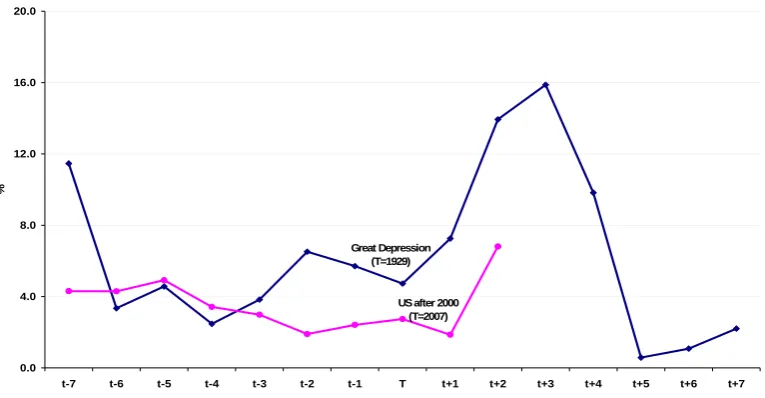
[image:3.595.110.493.476.675.2]There is a general consensus among economists that sustained deflation has to be avoided at all costs. This was not the case after the crash of 1929. Between 1929 and 1933, prices fell in the US by a cumulative total of over 25%.
Figure 1. US real interest rate on AAA corporate bonds
0.0 4.0 8.0 12.0 16.0 20.0
t-7 t-6 t-5 t-4 t-3 t-2 t-1 T t+1 t+2 t+3 t+4 t+5 t+6 t+7
%
Great Depression (T=1929)
US after 2000 (T=2007)
Data source: FRED II. Real rate own computation based on CPI (all items) inflation.
* Daniel Gros is Director of CEPS. Cinzia Alcidi is a LUISS Research Fellow at CEPS.
1 See for instance Bernanke (2004) IMF (2009a).
With nominal interest rates during this period registering not even close to zero (they hovered above 4% even for AAA rated issues), this implies, as shown Figure 1, an impossibly high real interest rate during this period. Double-digit real interest rates must be the main explanation of the near collapse of investment until 1933 (massive bank failures of course also contributed to this).2
Another indication of the extraordinary level of interest rates is given by the concept of the ‘natural’ rate,3 which should be close to the growth rate of nominal GDP. As real GDP also fell by about 25% over this period the difference between the nominal growth rate of GDP (about minus 20%) and the nominal interest rate (3-4% even for good credit risks) was extraordinary. It is no wonder that borrowers massively default when the market (nominal GDP) contracts at such a rate.
There seems to be little danger that sustained deflation will occur in either the US or Europe today. Wages are still increasing and the money supply is growing rapidly (almost everywhere).
The conclusion for monetary policy is clear: the errors of the 1930s will not be repeated (policy) interest rates have been lowered decisively and quantitative easing is being actively considered even by the ECB.
2. Fiscal
policy
There is less consensus on fiscal policy.4 Did fiscal policy play a central role in stopping the
recession in the 1930s? In particular, did Roosevelt’s New Deal mark a clear turning point? A cursory look at Figure 2 below suggests that in terms of fiscal policy Roosevelt did not mark a radical change. Even before his election, the deficit had been allowed to increase to 5% of GDP and it fluctuated within a rather narrow corridor, between 4% and 5% of GDP, until 1936 without any clear break after Roosevelt’s election (1932). Growth, however, was highly variable over these years, ranging from -12% (1932) to plus 10% (1934). During that period, federal fiscal expenditure amounted to only 2.3% of GDP5 (about the same as all public sector
infrastructure investment spending is today). Roosevelt increased it to 5% in 1934. It is hard to
2 Romer (2009), among others, argues that monetary policy played an important role in the recovery
phase of the Great Depression. At that time, monetary policy action was mainly conducted by the US Treasury and took the form of quantitative easing. Yet, the monetary expansion did not significantly lower nominal interest rates. If one compares the volatility of nominal and real interest rates, the latter is far larger than the former (e.g. over the period 1928-37, the proportion is 1 to 7).
3 The notion of a
natural rate of interest was introduced by the Swedish economist Knut Wicksell at the
end of the 19th century. Conceptually different from the money interest rate, it is defined as the real
interest rate consistent with output equalling its potential and stable inflation. In a context of standard growth model, the natural rate of interest varies over time and depends upon preferences and technology, i.e. the main determinants of the trend growth rate of output.
4 A quite large literature, among others Cole & Ohanian (2004), argues that the New Deal was
contractionary. Yet, the opposite conclusion is drawn recently by Eggertsson (2009), who goes beyond the conventional ‘macro’ view of the New Deal as consisting primarily of the Banking Act and federal spending. Using a dynamic general equilibrium model that incorporates inflation expectation, the paper shows that the New Deal had an expansionary effect. The author emphasises that by increasing monopoly power and facilitating union militancy, the New Deal generated inflationary expectations, which lowered real interest rates and resulted in stimulating private spending.
5 This is the average between 1929 and 1932 of the values derived from the national accounting according
believe that an increase in such a small item could have led to the huge turnaround in growth between 1932 and 1934.
Figure 2. Government fiscal deficits and growth in the US during the 1930s
-15 -10 -5 0 5 10 15
1929 1930 1931 1932 1933 1934 1935 1936 1937 1938 1939
Real GDP growth Deficit as % of GDP
Note: Government deficits include federal, state and local government deficits.
Source: Bureau of Economic Analysis (BEA), US Department of Commerce, Washington, D.C.
It is sometimes alleged that Hoover, Roosevelt’s predecessor, could have been more active. However, if rather than measuring expenditure in terms of GDP, one looks at the ratio with respect to tax revenue, already in 1932, federal expenditure was two times larger than expenditure and the ratio fell to 1.8 in 1934. These values are larger than President Obama’s fiscal package as documented in Table 2. In its projections, the Congressional Budget Office estimates the ratio at 1.6 for 2009 and at 1.5 for the following period. Hence one cannot really argue that fiscal policy was not used during the 1930s. During that time the size of the government’s budget in the economy was so small that it would have been impossible to have a deficit (as a proportion of GDP) comparable to today’s values. Annex I elaborates on this point.
Table 1. Government expenditure/revenue ratio
1932 1933 1934 1935 2008(Q3) 2009 2010
Fed expenditure/revenue 2 1.5 1.8 1.7 1.3 1.6 1.5
Total government expenditure/
revenue 1.3 1.3 1.4 1.3 1.3 1.29* 1.3*
Note: TARP is excluded from the outlays for 2009.
*Authors’ own computations.
initially) did undertake substantial efforts to improve the labour market. However, Figure 3 shows a clear policy switch in 1934 and a slowdown in the employment increase.
Figure 3. Government employment during the 1930s
0.0 5.0 10.0 15.0 20.0 25.0
1929 1930 1931 1932 1933 1934 1935 1936 1937 1938
Pe
rce
n
t
of t
o
ta
l em
ploy
me
n
t
Total Goverment
Federal Government
Source: Bureau of Economic Analysis (BEA), US Department of Commerce, Washington, D.C.
Infrastructure as the focal point of fiscal policy
The invocation of John Maynard Keynes as providing the intellectual justification of fiscal policy expansion during the 1930s seems also not quite justified. It might be useful to carefully (re-)read Keynes in 1942:
Organized public works, at home and abroad, may be the right cure for a chronic tendency to a deficiency of effective demand. But they are not capable of sufficiently rapid organization (and above all cannot be reversed or undone at a later date), to be the most serviceable instrument for the prevention of the trade cycle (John Maynard
Keynes, Collected Writings, Vol. XXVII, 1942, p. 122).
Keynes’ mature policy ideas of the late 1930s and 1940s seem to differ from his simple advice of the early 1930s. The reason is quite simple: infrastructure expenditure always takes a long time to implement. Moreover, public sector infrastructure investment accounts only for 2-3% of GDP in both the US and the EU. It would have to increase by a large percentage (+40%) in order to have an appreciable impact on demand. In Japan, public sector infrastructure was always much higher and reached 7% of GDP at one point. However, this does not seem to have had a strong impact on either demand or supply, as the trend growth did not increase in Japan. On the contrary, as shown in Annex II, it has contributed to capital overhang.
Long-term changes in the savings/investment balance?
to use Keynes’ words. Is this likely to be the problem today in Europe or the US? The answer should be yes if there are reasons to believe that investment will remain weak for a long time and/or savings rates increase permanently. For the US both might be the case, but not necessarily for Europe.
In the case of the US, one can argue that the credit and housing bubble has led to a capital overhang (at least in housing, as shown by Gros, 2007) and that there are many indications that household savings should increase as asset prices have collapsed and credit availability has fallen (Mayer, 2009).The key question now is whether government (and enterprise) dissavings can make up for this turnaround by households. The trend-wise increase in the US current account deficit from the 1990s until 2006 suggests by itself a chronic savings/investment imbalance in the US. However, Figure 4 below shows that the national (as opposed to the
[image:7.595.100.508.338.548.2]personal) savings rate in the US actually slightly increased between 2003 and 2006 (although the household savings rate fell).
Figure 4. Gross national savings and investment rates in the US
10 12 14 16 18 20 22
1991 1992 1993 1994 1995 1996 1997 1998 1999 2000 2001 2002 2003 2004 2005 2006 2007 2008 2009
% of G
D
P
Current account deficit
Savings
Investment
Source: World Economic Outlook (WEO), International Monetary Fund, Washington, D.C.
If one looks at personal (household) savings in the US, she will find that it actually declined
Figure 5. Consumption and investment during the Great Depression
0 200 400 600 800 1000
1929 1930 1931 1932 1933 1934 1935 1936 1937 1938 1939 1940
In
constant
p
ric
es
0 20 40 60 80 100 120
In
constant
p
ric
es
Gross Private Domestic Investment (rhs) Personal Consumption
Expenditure
Source: Bureau of Economic Analysis (BEA), US Department of Commerce, Washington, D.C.
In contrast to the situation in the US today, savings (and investment) rates have been roughly constant over the last decade in most of the euro area (the exceptions are mainly Spain and Ireland); and the current account of the eurozone has remained in rough balance over the last decade. A priori there is thus little reason to expect a lasting change in either savings or investment on aggregate for the eurozone.
Figure 6. Gross national savings and investment rates in the eurozone
15 17 19 21 23 25
1991 1992 1993 1994 1995 1996 1997 1998 1999 2000 2001 2002 2003 2004 2005 2006 2007 2008 2009
% o
f
G
D
P
Investment
Savings
[image:8.595.94.499.517.717.2]Figure 6 shows that investment in the eurozone has fluctuated quite regularly between 20-22% of GDP over the last decades. The years 2007-08 represented a cyclical peak so that one could have expected in any event a fall in investment (albeit not that rapidly) on a purely cyclical basis.
3.
Banking system under stress
There is today a general consensus that everything possible must be done to avoid large-scale bank failures and that this was not done during the 1930s. However, the impact of the wide scale failures that took place then was much more limited than is generally assumed.
[image:9.595.117.478.351.555.2]The number of bank failures rose from an annual average of about 600 during the 1920s, to 1,350 in 1930 and then peaked in 1933 when 4,000 banks were suspended. According to the World Economic Outlook (WEO), April 2009, over the entire period 1930-33, one-third of all US banks failed. However, deposit losses remained limited even during this turbulent period at a cumulative 4% (with an annual peak of 2.15% in 1933) of total deposits (of all commercial banks). How can one reconcile these relatively modest losses with the large number of bank failures?
Table 2. Commercial bank suspensions during the Great Depression
Year Number of
suspensions
Deposits ($ millions)
Losses borne by depositors ($ millions)
Losses (%)
Losses of deposits of all
commercial banks (%)
Average
1921-28 631 174 61 35 0.15
1929 659 231 77 33 0.18
1930 1,350 837 237 28 0.57
1931 2,293 1690 390 23 1.01
1932 1,453 706 168 24 0.57
1933 4,000 3597 540 15 2.15
Cumulative
1930-33 9096 6830 1337 20 4.3
Source: Federal Deposit Insurance Corporation (FDIC).
A first reason why losses to depositors were, in the end, quite limited is that depositors got back, on average, about 80 cents on the dollar (the rate of loss was only about 20%).6
Another key reason was that back then the degree of concentration in the banking industry back then was much lower than it is today. In the mid-1930s, the top three banks had about 11% of the total assets of the industry, whereas in 2008, that share was about 40%. Although about one-third of all banks failed between 1930 and 1933, they had only about 20% of all deposits. The downside of this fragmentation of the banking sector was that few institutions were regarded as systemic. The failure of any one of the numerous ‘mini’ banks thus did not arouse
6 According to the US Federal Deposit Insurance Corporation (FDIC), between 1908 and 1917, eight
particular concerns. Hence little was done to prevent the very numerous bank failures that did occur. However, the continuing latent, even if actuarially relatively small, risk of a bank undermined confidence. Given the absence of a federal deposit insurance system, this undermined the functioning of the banking system, as banks had to be extremely cautious given the potential for withdrawal of deposits (runs). The negative feedback loop, which is manifested by weakness of demand leading to more firms failing and hence bank losses, was thus amplified by the lack of an effective deposit insurance system and a generally higher willingness to allow banks to fail.
The creation of the federal deposit insurance system in the US was one of the key lessons learnt, and its creation as part of the New Deal certainly contributed to the recovery. The lesson that confidence of depositors in the banking system is crucial has been amply applied in Europe during the crisis management in 2008, when EU governments extended the existing deposit insurance systems to cover the missing spots that the Northern Rock episode had exposed. The US authorities had to relearn this lesson after the Lehman Brothers debacle. Given the large impact of the modest deposit losses during the 1930s, it should not have come as a surprise that a failure of this size should have extreme consequences. As an investment bank, Lehman did not have any deposits from the general public, but its assets of about $660 billion were equivalent to about 5% of the entire US banking system. Moreover, Lehman constituted by itself an important part of the bank bond market as it had issued about $600 billion of short- and long-term bonds, out of a total of about $1,200 billion emitted by all commercial banks together.
Can banks survive a depression?
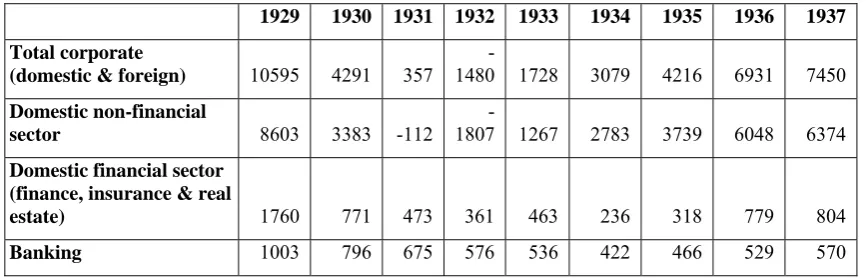
[image:10.595.82.516.456.595.2]The Great Depression certainly led to a collapse in corporate profits. The corporate sector went from profits amounting to over $10 billion (about 10% of GDP) in 1929 to a collective loss of about $1.5 billion (about 2.5% of GDP) in 1932 (see table below).
Table 3. Corporate profits before tax (millions of $)
1929 1930 1931 1932 1933 1934 1935 1936 1937
Total corporate
(domestic & foreign) 10595 4291 357
-1480 1728 3079 4216 6931 7450
Domestic non-financial
sector 8603 3383 -112
-1807 1267 2783 3739 6048 6374
Domestic financial sector (finance, insurance & real
estate) 1760 771 473 361 463 236 318 779 804
Banking 1003 796 675 576 536 422 466 529 570
Source:Bureau of Economic Analysis (BEA), US Department of Commerce, Washington, D.C.
Figure 7. Profits (before tax) in the US during the 1930s (% of GDP).
-4.0 -2.0 0.0 2.0 4.0 6.0 8.0
1929 1930 1931 1932 1933 1934 1935 1936 1937 1938 1939 1940
year
P
ro
fit
s as % o
f G
D
P
Financial other than banking Banking sector Non-financial Sector
Banking sector
Financial other than banking
Non-financial sector
Source: Bureau of Economic Analysis (BEA), US Department of Commerce, Washington, D.C.
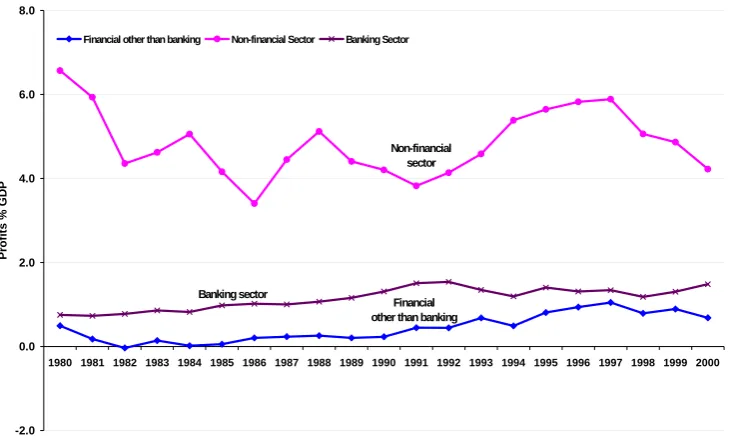
However, the financial sector outside of banking also experienced losses. Banks thus appear to have been an island of relative stability. The run-up and aftermath of the current crisis show similar features with corporate profits buoyant before the crisis but collapsing with the onset of the bust. This boom-bust pattern is also pronounced in the financial sector outside of banking. The data for the period 1980-2000 plotted in Figure 8 show that in general banking profits display little correlation with GDP growth. This property is not evident in any other sector of the financial industry, nor the corporate sector as whole.
As most observers tend to lump banks and the larger financial sector together, it is widely assumed that banks’ profits also increased during the last boom. However, this is not the case. The profits of (commercial) banks as measured by national accounts have not noticeably increased up to 2007. The data from the Great Depression suggest that they might also be more resilient than that of the wider financial sector.
Another reason for the widespread impression of large profits in banking might be the confusion between the national income accounting concept and the numbers reported in financial statements. The national income accounts do not ‘mark to market’. Financial transactions and capital gains and losses related to transactions of financial securities are thus not included in the national accounts. During the boom phase national income accounting profits tended thus to be lower than those reported to financial markets (and vice versa during the bust). Profits as measured by the national accounts should thus give a better picture of underlying, operating profitability of the sector.
Figure 8. Profits (before tax) as a share of GDP in the US after 1980
-2.0 0.0 2.0 4.0 6.0 8.0
1980 1981 1982 1983 1984 1985 1986 1987 1988 1989 1990 1991 1992 1993 1994 1995 1996 1997 1998 1999 2000
Prof
it
s %
G
D
P
Financial other than banking Non-financial Sector Banking Sector
Financial other than banking
Non-financial sector
Banking sector
Source:Bureau of Economic Analysis (BEA), US Department of Commerce, Washington, D.C.
How can one explain the relative stability of bank profits in general and in particular during the Great Depression? Simply put, it seems that banks are on average able to charge enough of a risk premium to cover the increase in non-performing loans during downturns. The present crisis confirms this tendency. Much has been made of the headline estimate of over $4 trillion, published recently by the IMF of the aggregate losses to the financial sector expected from the present crisis. However, this figure is an estimate of the total over four years (2007-10) and banks account for only about 60% of the overall amount. Moreover, about one-half of the losses expected by banks ($2.4 trillion) derive from the markdown of securities (which would not be included in national income accounts).7
The global average overall loss rate on loans for banks is estimated to be around 5.1%. Given that this is assumed to be the cumulated loss rate over four years, banks should be able to absorb it with a commensurate increase in their spreads. If the losses accrue mostly towards the end of this period, an increase in the spread applied by banks of less than 2%, on average on all loans, should be sufficient to protect banks (on average at least) from making large losses. This should be the case at present as well. For example, the European Central Bank reports that the rates charged by euro area banks to corporate customers are now around 4.8%, about 2.5-3 percentage points higher than marginal funding costs as measured by Euribor rates or the rates paid on savings deposits. In the US, the ‘prime rate’ (the rate charged by banks to their best customers) is, at 3.25%, about 3 percentage points above marginal funding costs embodied in federal funds or commercial paper rates. This should be sufficient to deal with the losses that can be expected even under the current economic conditions.
Despite its much greater severity, the Great Depression did not actually lead to much higher loss rates. According to the IMF, commercial bank loan charge-off rates peaked for only one year at a bit above 5%,8 but the average for the early 1930s remained between 2 and 3%.
Concluding Remarks
The analysis of monetary policy and the banking system in the 1930s has led to two important lessons from the Great Depression: deflation as well as massive bank failure must be avoided. The lesson for fiscal policy is less unambiguous. There is widespread consensus that the fiscal expansion during the 1930s was too limited to yield a significant impact on economic growth. This seems to be the case. Yet, some considerations about government debt sustainability seem to suggest that fiscal policy failed to generate recovery because the government could not do more than it did.9
However, this analysis has also pointed out differences in terms of the starting point and possible adjusting mechanisms. In this regard, as shown above, during the Great Depression, output was largely driven by a strong cycle in investment and until 1937, the savings rate did not increase. Thus the current crisis starts with a completely different pattern, namely insufficient household savings in the US.
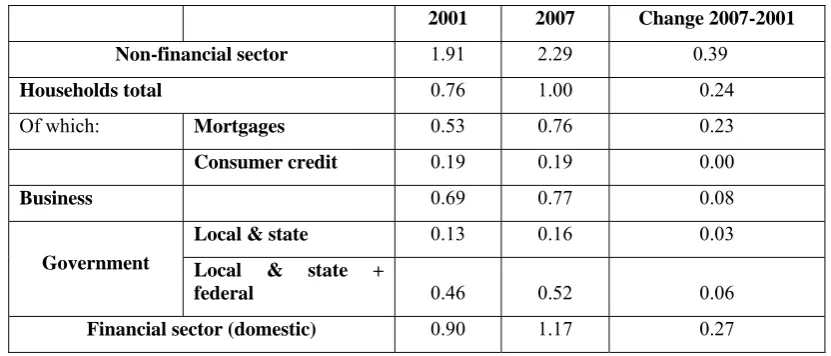
[image:13.595.89.505.443.621.2]Another potential difference lies in the size of private-sector balance sheets. As shown in Table 4, the debt burden of the financial and non-financial sector (excluding government) increased by almost 70% of GDP between 2001 and 2007. Moreover, this increase in debt has been accompanied by huge balance-sheet leverage that is largely based, as shown in Figure 9, on a bubble in housing prices.
Table 4. Debt burden as a proportion of GDP in the US (1 = 100 %)
2001 2007 Change 2007-2001
Non-financial sector 1.91 2.29 0.39
Households total 0.76 1.00 0.24
Of which: Mortgages 0.53 0.76 0.23
Consumer credit 0.19 0.19 0.00
Business 0.69 0.77 0.08
Local & state 0.13 0.16 0.03
Government Local & state +
federal 0.46 0.52 0.06
Financial sector (domestic) 0.90 1.17 0.27
Source: Federal Reserve, flow of funds (Z1).
8 Ibid.
9 In line with this thesis, W. Buiter talks of US
de facto default during the 1930s: “In the case of the US,
By contrast, housing prices do not seem to have played a crucial rule in the development of the crisis in the 1930s, at least not as much as today.10 Although housing prices started to fall at the end of the 1920s, there is no evidence of a bubble in the pre-Depression period.
Figure 9. US home price index
0 50 100 150 200 250
t-9 t-8 t-7 t-6 t-5 t-4 t-3 t-2 t-1 T t+1 t+2 t+3 t+4 t+5 t+6 t+7 t+8 t+9
Re
al
0.00 1.00 2.00 3.00 4.00 5.00 6.00 7.00
N
o
mina
l
Real HPI Great Depression
(T=1929) Real HPI
US after 1998 (T=2007)
Nominal HPI Great Depression
(T=1929) (rhs)
Source: Shiller (2005) and author’s update.
The fall in housing prices in 2007 acted as an important factor triggering the financial crisis and in making this recession a ‘balance-sheet’ recession.
Surprisingly, the good news comes from the banking sector. The resilience of ‘normal’ banking operations to a recession or even a depression strengthens the argument for a separation of commercial and investment banking activities.
The classic banking operations of deposit-taking and lending tend to remain profitable even under conditions of stress. But this classic function of banking would not be such a cause of concern today if the investment banking arm of banks had not gotten into trouble by investing in ‘toxic’ assets. At present the authorities in both the US and Europe have little choice but to make up for the losses on ‘legacy’ assets and wait for banks to earn back their capital. But to prevent future crises of this type, one should make sure that losses from investment banking arms cannot impair commercial banking operations.
10 We can assume that during the 1930s, stock prices played a similar role to the one being played by
| 13
References
Bernanke, B. (2004), Essays on the Great Depression, Princeton, NJ: Princeton University
Press.
Buiter, W. (2009) The green shoots are weeds growing through the rubble in the ruins of the
global economy (ft.com/mavercom).
Cole, H.L. and L.E. Ohanian (2004), “New Deal Policies and the Persistence of the Great Depression: A General Equilibrium Analysis”,Journal of Political Economy, Vol. 112,
pp. 779-816.
Federal Deposit Insurance Corporation (FDIC) (1998), A Brief History of Deposit Insurance in
the United States, prepared for the International Conference on Deposit Insurance,
Washington, D.C.
Eggertsson, G. (2009), Was the New Deal contractionary?, Federal Reserve Bank of New York
staff report 264.
Gros, D. (2007), Bubbles in real estate? A Longer-Term Comparative Analysis of Housing
Prices in Europe and the US, CEPS Working Document No. 239, CEPS, Brussels.
IMF (2009a), Crisis and Recovery, World Economic Outlook (WEO), International Monetary
Fund, Washington, D.C., April.
IMF (2009b), Responding to the Financial Crisis and Measuring Systemic Risks, Global
Financial Stability Report (GFSR), International Monetary Fund, Washington, D.C., April.
Mayer, T. (2009), “The Coming Rebound in US Household Saving”, Global Economic
Perspectives, Deutsche Bank, 28 January.
Romer, C. D. (2009), “Lessons from the Great Depression for Economic Recovery 2009”, paper presented at the Brookings Institution, Washington, D.C., 9 March.
Annex I. Debt sustainability
Given that in the 1930s, unlike today, federal spending was much smaller than state and local government spending, to get a complete overview of the fiscal situation, Table 1 in the main body of the text above also shows data also for the aggregate. Combining US Census Bureau and US Government Accountability Office data and forecast, we guesstimate that the ratio between total expenditure and revenue is about 1.3 for both 2009 and 2010. Hence one cannot really argue that federal fiscal policy had been too timid at the start of the Great Depression.11
Another aspect to take into account in assessing whether the authorities tried fiscal policy during the 1930s is debt sustainability.
The standard exercise for assessing debt sustainability starts from the following equation:
(1) t t t t t t t t t Y SF y y i Y D Y PD + ⎟⎟ ⎠ ⎞ ⎜⎜ ⎝ ⎛ + − = − 1 1
where Y is GDP at current prices, D is general government debt, PD is primary deficit, it is the
implicit interest rate, y is the growth rate of nominal GDP, SF is the stock-flow adjustment and subscript t stands for time.
This equation just says that a primary deficit that keeps the debt/GDP constant is a function of the initial debt-to-GDP ratio and the so-called ‘snowball’ factor, which is [(it-yt)/(1+yt)] (plus
any stock-flow adjustment, SF, which basically captures the various factors that influence changes in the stock of debt, i.e. the assumption of debt outside the budget). This latter element is of course now a key factor as governments all over the world are guaranteeing large amounts of liabilities of banks, liabilities that are backed by assets of dubious quality.
It is customary to deflate debt by GDP; however, debt has to be serviced by taxes and in reality tax revenues might be limited to a certain proportion of GDP, dictated by the prevailing social and political forces. Equation (1) might thus be more usefully rewritten as:
(2)
⎭
⎬
⎫
⎩
⎨
⎧
+
⎟⎟
⎠
⎞
⎜⎜
⎝
⎛
+
−
=
+
⎟⎟
⎠
⎞
⎜⎜
⎝
⎛
+
−
=
=
− − t t t t t t t t t t t t t t t t t t t t t tT
SF
y
y
i
T
D
Y
SF
y
y
i
Y
T
D
T
T
PD
T
Y
T
PD
1
1
1 1τ
τ
where τ represents the (maximum) tax-to-GDP ratio, which is assumed to be fixed.
From this point of view, the large drop in nominal GDP and consequently in tax revenue had the effect of making the ratio of debt over tax revenue explosive. One could therefore argue that in the 1930s the US government did not have room to further expansionary fiscal policy.
In Table A1 below, we propose an approximate estimate12 of the federal debt throughout the 1930s, so to have a sense of the situation.
11 For a different point of view, see “Lessons from the Great Depression for Economic Recovery 2009”.
In his speech, C. Romer strongly reaffirms the idea that fiscal policy failed to generate recovery in the 1930s because it was not tried.
12 Unfortunately data on debt are available starting only from 1938 and only for the federal component. In
Table A1. US government debt during the 1930s
1930 1931 1932 1933 1934 1935 1936 1937 1938 1939 1940
Gross federal debt* 48.2 50.7 57.5
Estimated federal debt
22.0 25.0 27.7 30.0 33.8 37.6 42.7 44.4 47.7 51.7 54.5
D(t)/T(t) 12.5 16.3 11.5 9.7 9.7 8.5 6.3 7.5 7.8 6.4
*Source: FRED II database.
The ratio of the outstanding debt over total receipts in 1932 and 1933 is simply huge.13 From
1934, the ratio steadily declines but it is still dramatically high. These simple calculations suggest that the federal authorities had a reason to be cautious because, given the low tax revenues on which they could count, the debt could become unsustainable (absent a strong resort to the inflation tax).
Annex II. Savings and investment balances in Japan
[image:18.595.91.501.259.468.2]Japan represents a typical case of a capital overhang. The investment rate was very high during the entire 1980s and reached a peak of 34% of GDP during 1991. It then declined continuously by about 10 percentage points of GDP. The capital overhang also explains the large amounts of bad loans on the balance sheets of Japanese banks: much of the investment they had financed during the boom phase turned out to have been worthless.
Figure A2. Savings and investment rates in Japan
15.0 20.0 25.0 30.0 35.0 40.0
1980 198119821983 1984 198519861987 1988 19891990 1991 199219931994 1995 199619971998 1999 200020012002 2003 200420052006 200720082009
% of G
D
P
Gross national savings Investment
Peak of Bubble
Current account surplus
About CEPS
Place du Congrès 1 • B-1000 Brussels Tel : 32(0)2.229.39.11 • Fax : 32(0)2.219.41.51 E-mail: [email protected]
Website : http://www.ceps.be Bookshop : http://shop.ceps.be Founded in Brussels in 1983, the Centre for
European Policy Studies (CEPS) is among the most experienced and authoritative think tanks operating in the European Union today. CEPS serves as a leading forum for debate on EU affairs, but its most distinguishing feature lies in its strong in-house research capacity, complemented by an extensive network of partner institutes throughout the world.
Goals
• To carry out state-of-the-art policy research leading to solutions to the challenges facing Europe today. • To achieve high standards of academic excellence
and maintain unqualified independence. • To provide a forum for discussion among all
stakeholders in the European policy process. • To build collaborative networks of researchers,
policy-makers and business representatives across the whole of Europe.
• To disseminate our findings and views through a regular flow of publications and public events.
Assets
• Complete independence to set its own research priorities and freedom from any outside influence. • Formation of nine different research networks,
comprising research institutes from throughout Europe and beyond, to complement and
consolidate CEPS research expertise and to greatly extend its outreach.
• An extensive membership base of some 120 Corporate Members and 130 Institutional Members, which provide expertise and practical experience and act as a sounding board for the utility and feasability of CEPS policy proposals.
Programme Structure
CEPS carries out its research via its own in-house research programmes and through collaborative research networks involving the active participation of other highly reputable institutes and specialists.Research Programmes
Economic & Social Welfare Policies
Energy, Climate Change & Sustainable Development EU Neighbourhood, Foreign & Security Policy Financial Markets & Taxation
Justice & Home Affairs
Politics & European Institutions Regulatory Affairs
Trade, Development & Agricultural Policy
Research Networks/Joint Initiatives
Changing Landscape of Security & Liberty (CHALLENGE) European Capital Markets Institute (ECMI)
European Climate Platform (ECP)
European Credit Research Institute (ECRI)
European Network of Agricultural & Rural Policy Research Institutes (ENARPRI)
European Network for Better Regulation (ENBR)
European Network of Economic Policy Research Institutes (ENEPRI)
European Policy Institutes Network (EPIN) European Security Forum (ESF)