Bayesian Semiparametric Inference in Multiple Equation Models
Gary Koop Department of Economics
University of Leicester [email protected]
Dale J. Poirier Department of Economics University of California at Irvine
and
Justin Tobias Department of Economics University of California at Irvine
June 2003
KEYWORDS: nonparametric regression, nonparametric instrumental variables, SUR model, endogeneity, nonlinear simultaneous equations
1
Introduction
Despite the proliferation of theories for semiparametric and nonparametric regression, the use of these
techniques remains relatively rare in empirical practice. Increased computational difficulty and mathematical
sophistication, and perhaps most importantly, thecurse of dimensionality - wherein the rate of convergence
of the nonparametric regression estimator slows with the number of variables treated nonparametrically - all
seem to provide barriers which prevent the widespread use of nonparametric techniques.
The rapid increase in computing power and growth in nonparametric routines found in statistical software packages has helped to mitigate computational concerns. To combat the curse of dimensionality problem,
many researchers have adopted the use of thepartially linear orsemilinear regression model. This model,
though not fully nonparametric, provides a convenient generalization of the standard linear model which
is not as susceptible to the curse of dimensionality since only one, or perhaps a few, variables are treated
nonparametrically. Finally, some studies (e.g. Blundell and Duncan (1998), Yatchew (1999) and DiNardo
and Tobias (2001)) have tried to bridge the gap between theory and practice, and make these techniques accessible to applied researchers.
In this paper we continue in this tradition, and describe and implement simple and intuitive Bayesian methods
for semiparametric and nonparametric regression. Importantly, the methods we describe can be used in the
context of multiple equation models, thus generalizing the scope of models for which simple nonparametric
methods have been described. In our discussion, we focus primarily on the Seemingly Unrelated Regression (SUR) model. This model is of interest in and of itself, but is also of interest as the (possibly restricted)
reduced form of a semiparametric simultaneous equations model (or the structural form of a triangular
simultaneous equations model).
Before describing the contributions of this paper, it is useful to briefly outline the method we used in related
work (e.g. Koop and Poirier (2003a)) in the single equation partially linear regression model. This partially linear model divides the explanatory variables into a set which is treated parametrically,z, and a set which
is treated nonparametrically,x, and relates them to a dependent variabley as:
yi=z′
iβ+f(xi) +εi,
fori= 1, .., N where f() is an unknown function. Because of the curse of dimensionality,xi must be of low
dimension and is often a scalar (see Yatchew, 1998, for an excellent introduction to the partial linear model).
For most of this paper we will assumexi is a scalar, although this assumption is relaxed in Section 4.
In this model we assumed εi iid∼ N¡0, σ2¢ for i = 1, ..., N, and all explanatory variables were fixed or exogenous. Observations were ordered so thatx1< x2< ... < xN.Define y= (y1, ..., yN)′, Z= (z1,..., zN)′
previous equation could be written as:
y=W δ+ε.
Thus, the partially linear model can be written as the standard Normal linear regression model where the
unknown points on the nonparametric regression line are treated as unknown parameters. This regression
model is characterized by insufficient observations in that the number of explanatory variables is greater
thanN. However, Koop and Poirier (2003a) showed that, if a natural conjugate prior is used, the posterior
is still well-defined. In fact, we showed that the natural conjugate prior did not even have to be informative
in all dimensions and that prior information about the smoothness of the nonparametric regression line
was all that was required to ensure valid posterior inference. Thus, for the subjective Bayesian, prior information can be used to surmount the problem of insufficient observations. Furthermore, for the researcher
uncomfortable with subjective prior information, the required amount of prior information was quite small,
involving the selection of a single prior hyperparameter which we called η that governed the smoothness
of the nonparametric regression line. In Koop and Poirier (2003b), we went even further and showed how
(under weak conditions) empirical Bayesian methods could be used to estimateη from the data.
The advantages of remaining within the framework of the Normal linear regression model with a natural
conjugate prior are clear. This model is very well understood and standard textbook results for
estima-tion, model comparison and prediction are immediately available. Analytical results for posterior moments,
marginal likelihoods and predictives exist and, thus, there is no need for posterior simulation. This means
methods which search over many values for η (e.g. empirical Bayesian methods or cross-validation) can be
implemented at a low computational cost. Furthermore, as shown in our previous work, the partial lin-ear model can serve as a component in numerous other models which do involve posterior simulation (e.g.
semiparametric tobit and probit models or the partial linear model with the errors treated flexibly by using
mixtures of Normals). The ability to simplify the estimation of the nonparametric component in such a
complicated empirical exercise may provide the researcher a great computational benefit.
In this paper we take up the case of Bayesian semiparametric estimation in multiple equation models, and adopt a similar approach for smoothing the regression functions. In particular, we consider the estimation
of a semiparametric SUR model of the form:
yij =z′
ijβj+fj(xij) +εij, (1.1)
where yij is the ith observation (i= 1, .., N) on the endogenous variable in the jthequation (j = 1, .., m),
zij is a kj×1 vector of observations on the exogenous variables which enter linearly,fj(xij) is an unknown function which depends on a vector of exogenous variables,xij,andεij is the error term. For equations which
have nonparametric components,zij does not contain an intercept since the first point on a nonparametric
regression line plays the role of an intercept.
The approach we describe for the estimation of this model is simple and intuitive and, hopefully, will appeal
employ a prior which serves to smooth the nonparametric regression functions. It is important to recognize
that for the (parametric) seemingly unrelated regressions model (and the reduced form of the simultaneous
equations model), the natural conjugate prior suffers from well known criticisms (see Rothenberg, 1963,
or Dreze and Richard, 1983). On the basis of these, Dreze and Richard (1983, page 541) argue against using the natural conjugate prior (except for certain noninformative limiting cases not relevant for our class
of models). Their arguments carry even more force in the present semiparametric context since it can be
shown that the natural conjugate prior places some undesirable restrictions on the way smoothing is carried
out on nonparametric regression functions in different equations (i.e., the nonparametric component in each
equation is smoothed in the same way). Thus, in the present paper we do not adopt a natural conjugate
prior, but rather use an independent Normal-Wishart prior.
The basic ideas behind our approach are straightforward extensions of standard textbook Bayesian methods
for the SUR model (see, e.g., Koop (2003) pages 137-142). Thus, textbook results for estimation, model
comparison (including comparison of parametric to nonparametric models) and prediction are immediately
available. This, we argue, is an advantage relative to the relevant non-Bayesian literature (see, e.g., Pagan and
Ullah (1999) chapter 6) and to other, more complicated, Bayesian approaches to nonparametric seemingly unrelated regression such as Smith and Kohn (2000).
We illustrate the use of our methods by estimating a two-equation simultaneous equations model in parallel
with the development of our theory. This application takes data from the National Longitudinal Survey of
Youth (NLSY) and involves estimating the returns to schooling, job tenure, and ability for a cross-sectional
sample of white males. Our triangular simultaneous equations model has two equations, one for the (log) wage and the other for the quantity of schooling attained. After estimating standard parametric models that
have appeared in the literature, we first extend them to allow for nonparametric treatment of an exogenous
variable (weeks of tenure on the current job) in the wage equation (Case 1). Subsequently, we consider Case
2 where single explanatory variables enter nonparametrically in each equation. In this model we additionally
allow a measure of cognitive ability to enter the schooling equation nonparametrically. We complete our
empirical work with Case 3 by giving cognitive ability a nonparametric treatment in both the wage and
schooling equations (with tenure on the job also given a nonparametric treatment in the wage equation).
Our results reveal the practicality and usefulness of our approach. In some cases, our semiparametric
treatment yields results which are very similar to those from simple parametric nonlinear models (e.g.
quadratic). However, one advantage of a semiparametric approach is that a particular functional form such
as the quadratic does not have to be chosen, either in anad hoc fashion or through pre-testing. Furthermore,
in some cases our semiparametric approach yields empirical results that could not be easily obtained using standard parametric methods. In terms of our application, our results reveal the empirical importance of
controlling for nonlinearities in ability in both the wage and schooling equations when trying to estimate the
The outline of our paper is as follows. In the next section, we outline our basic semiparametric SUR model,
describe our data, and obtain parametric results and semiparametric results for a model where job tenure is
treated nonparametrically. In section 3, we describe the process of estimating a model with nonparametric
components in both equations, and estimate the model in Case 2. Finally, in section 4, we describe how to handle the estimation of additive models and provide estimation results for our most general Case 3. The
paper concludes with a summary in section 5.
2
Case 1: A Single Nonparametric Component in a Single
Equa-tion
We begin by considering a simplified version of (1.1) where a nonparametric component enters a single
equation (chosen to be the mth equation) and the explanatory variable which receives a nonparametric
treatment,xim, is a scalar. In later sections, we consider cases where several equations have nonparametric
components each depending on a different explanatory variable (or variables).
We assume that the data is ordered so thatx1m< ... < xN m and define γi =fm(xim) fori= 1, .., N to be the unknown points on the nonparametric regression line in the mthequation. We also letγ = (γ
1, .., γN)
′
andζi be theithrow ofIN. With these definitions, we can write the model as:
yi=Wiδ+εi, (2.1)
whereyi= (yi1, .., yim)
′
, εi= (εi1, .., εim)
′ , Wi= z′
i1 0 . . . 0
0 z′
i2 . . . .
. . . .
. . 0 z′
i,m−1 0 0
0 . . 0 z′
im ζi
andδ= (β′
1, .., β
′ m, γ
′
)′ is aK+N vector whereK=Pmj=1kj. For future reference, we define the partition
Wi=hWi(1):Wi(2)iwhereWi(1) is anm×(K+ 2) matrix andWi(2) ism×(N−2). The likelihood for this
model is defined by assumingεiiid∼ N(0,Σ).
We define smoothness according to second differences of points on the nonparametric regression line. In light of this, it proves convenient to transform the model. Define the (N−2)×N second-differencing matrix as:
D=
1 −2 1 . . . . 0
0 1 −2 1 0 . . 0
. . . .
. . . .
0 0 . . . 1 −2 1
, (2.2)
so thatDγis the vector of second differences, ∆2γi. Prior information about smoothness of the nonparametric
regression line will be expressed in terms ofRδ, where the (N−2)×(K+N) matrixR=£0(N−2)×K :D ¤
For future reference, we partitionR= [R1:R2] whereR1is an (N−2)×(K+ 2) matrix andR2is (N−2)×
(N−2) (i.e., the nonsingular matrixR2 isD with the first two columns deleted). Note that other degrees
of differencing can be handled by re-defining (2.2) as appropriate (see, e.g., Yatchew (1998) pages 695-698
or Koop and Poirier (2003a)).
Using standard transformations (see, e.g. Poirier (1995) pages 503-504), (2.1) can be written as:
yi=Vi(1)λ1+Vi(2)λ2+εi=Viλ+εi, (2.3)
where λ= (λ′
1, λ
′
2)
′
, λ1 = (β1′, .., β
′
m, γ1, γ2)
′
, λ2 =Dγ, Vi(1) =W
(1)
i −W
(2)
i R −1
2 R1 and Vi(2) =W
(2)
i R −1 2 .
Note thatλ2 is the vector of second differences of the points on the nonparametric regression line and it is
on this parameter vector that we place our smoothness prior.
We use an independent Normal-Wishart prior forλand Σ−1 which is a common choice for the parametric
SUR model (see, e.g., Chib and Greenberg (1995) or (1996)). Thus,
λ∼N(λ, Vλ) (2.4)
and
Σ−1∼
W¡V−1 Σ , ν
¢
, (2.5)
whereW(VΣ, ν) denotes the Wishart distribution (see, e.g., Poirier (1995) page 136).
Our empirical work is based on a Gibbs sampler involving p¡λ|y,Σ−1¢ and p¡Σ−1|y, λ¢. Straightforward
manipulations show these to be:
λ|y,Σ−1∼N¡λ, V
λ ¢
(2.6)
and
Σ−1|y, λ∼W³V−1 Σ , ν
´
, (2.7)
where
ν =ν+N, (2.8)
V−Σ1=
" VΣ+
N X
i=1
(yi−Viλ) (yi−Viλ)′ #−1
, (2.9)
Vλ= Ã
V−1
λ + N X i=1 V′ iΣ
−1Vi
!−1
(2.10)
and
λ=Vλ Ã
V−1
λ λ+ N X
i=1
V′ iΣ
−1y
!
. (2.11)
Of course, many values may be selected for the prior hyperparameters,λ, Vλ, V −1
Σ andν. Here we describe
a particular prior elicitation strategy that requires a minimal amount of subjective prior information. We
assume
Vλ= ·
V1 0
0 V (η) ¸
where V1 and V(η) are the prior covariance matrices for λ1 and λ2, respectively. We set V
−1
1 = 0, the
noninformative choice. Since λ2 = Dγ is the vector of second differences of points on the nonparametric
regression line,V(η) controls its degree of smoothness. We assumeV(η) depends on a scalar parameter,η.
As discussed in Koop and Poirier (2003a), several sensible forms forV(η) can be chosen. In this paper, we setV(η) =ηIN−2. We also setλ= 0K+N. Note that these assumptions imply we are noninformative about
λ1= (β′1, .., β
′
m, γ1, γ2)
′
, but have an informative prior for the remaining parameters which reflect the degree
of smoothness in the nonparametric regression line. Our information about this smoothness is of the form:
∆2γi∼N(0, η) fori= 3, .., N.1
In this paper we adopt an empirical Bayesian approach whereη is chosen so as to maximize the marginal likelihood. However, it is worth noting that η could be treated either as a prior hyperparameter to be
selected by the researcher or as a parameter in a hierarchical prior. If the latter approach were adopted,η
could be integrated out of the posterior. Our empirical Bayesian approach is equivalent to this hierarchical
prior approach using a noninformative flat prior forη (and plugging in the posterior mode ofη instead of
integrating out this parameter).2
The results of Fernandez, Osiewalski and Steel (1997) imply that an informative prior is required for Σ−1
in order to ensure propriety of the posterior. However, in related work with a single equation model (see
Koop and Poirier (2003b)), we found that use of a proper, but relatively noninformative prior on a similar
nuisance parameter yielded sensible (and robust) results. Accordingly, we set ν = 10 in our application.
Using the properties of the Wishart distribution, we obtain the prior meanE(σ−1
ij ) =νV −1
Σij, whereσ −1
ij and
V−1
Σij are theij
thelements of Σ−1andV−1
Σ , respectively. To center the prior correctly, we calculate the OLS
estimate of Σ based on a parametric SUR model where all variables (including xim) enter linearly. We set
νV−1
Σ equal to the inverse of this OLS estimate.
In order to compare models or estimate/selectηin our empirical Bayesian approach, the marginal likelihood
(for a given value ofη) is required. No analytical expression for this exists. However, we can estimate the
marginal likelihood using Gibbs sampler output and the Savage-Dickey density ratio (see, e.g., Verdinelli and
Wasserman (1995)). DefineM1to be the semiparametric SUR model given in (2.3) with prior given by (2.4)
and (2.5) and a particular value forη selected. DefineM2to beM1with the restrictionλ2= 0N−2imposed
(with the same prior forλ1 and Σ−1). Using the Savage-Dickey density ratio, the Bayes factor comparing
M1 toM2 can be written as:
BF(η) = p(λ2= 0|M1) p(λ2= 0|y, M1)
, (2.13)
where the numerator and denominator are the prior and posterior, respectively, ofλ2 in the semiparametric
SUR model evaluated at the pointλ2= 0N−2. This Bayes factor may be of interest in and of itself since it
1
This approach to prior elicitation does not include any information in xim other than order information (i.e. data is
ordered so thatx1m< ... < xN m). If desired, the researcher could includeximby eliciting a prior, e.g., of the form ∆2γi∼
N 0, η∆2
xim
.
2
compares the semiparametric SUR model to a sensible parametric alternative.3 However, it can also be used
in an empirical Bayesian analysis to selectη. That is, since η does not enter the prior for M2, BF(η) will
be proportional to the marginal likelihood for the semiparametric SUR model for a given value ofη. The
empirical Bayes estimate ofη can be implemented by running the Gibbs sampler for a grid of values forη and choosing the value which maximizesBF(η). Alternative methods for selectingηinclude cross-validation
or extensions of the reference prior approach discussed in van der Linde (2000).
Note that BF(η) can be calculated in the Gibbs sampler in a straightforward manner. The quantity
p(λ2= 0|M1) can be directly evaluated using the Normal prior given in (2.4), whilep(λ2= 0|y, M1) can be
evaluated in the Gibbs sampler in the same way as any posterior function of interest. That is, if we define
b
p(λ2= 0|y, M1) =
1 S
S X
s=1
p³λ2= 0|y,Σ(s)
´ ,
where Σ(s) for s = 1, .., S denotes draws from the Gibbs sampler (after discarding initial burn-in draws),
then
b
p(λ2= 0|y, M1)→p(λ2= 0|y, M1)
asS→ ∞. Note that the posterior conditionalp¡λ2= 0|y,Σ(s)
¢
is simple to evaluate since it is Normal (see
equation 2.6).
This semiparametric SUR model can be used as a restricted reduced form of a semiparametric simultaneous
equations model and, thus, the methods described above allow for Bayesian inference in the latter model.
That is, our Gibbs sampler provides us with draws from the posterior of the reduced form parameters. Provided the model is identified, the structural form parameters will be a transformation of the reduced
form parameters and the draws of the latter can be transformed into draws of the former. The triangular
structure of the model in our application means we do not have to adopt such an approach. However, it is
useful to note that our approach can be used with more general simultaneous equations models.
Before introducing our application, we briefly discuss related (parametric) work on simultaneous equations models. The literature on Bayesian analysis of simultaneous equations models is voluminous. Dreze and
Richard (1983) surveys the literature through the early 1980s, while Kleibergen (1997), Kleibergen and van
Dijk (1998) and Kleibergen and Zivot (2003) are recent references. The more recent literature focusses on
issues of identification and prior elicitation which are of little relevance for our work. For instance, some of
this recent work discusses problems with the use of noninformative priors at points in the parameter space
which imply non-identification (and show how noninformative priors based on Jeffreys’ principle overcome
these problems). However, these problems are less empirically relevant if the posterior is located in regions of the parameter space away from the point of non-identification or if informative priors are used. Furthermore,
parameters in the reduced form model do not suffer from these problems. Hence, we feel some of the problems
3
Note thatλ2= 0 implies the nonparametric regression line is perfectly smooth (i.e. is a straight line). Thus,M2 is nearly
equivalent to a SUR model with an intercept andxim entering linearly. It is not exactly equivalent since we are only using
discussed in, e.g., Kleibergen and van Dijk (1998) are not critical for our work. In some sense, these problems
all involve prior elicitation and, with moderately large data sets, data information should predominate.4 In
practice, we argue that our approach should be a sensible one for practitioners and that the advantage of
being semiparametric outweighs any costs associated with not eliciting priors directly off of structural form parameters.
2.1
The Parametric SEM
In this section we provide an empirical example to illustrate how our techniques can be applied in practice.
Our specific example, though primarily illustrative in nature, simultaneously addresses several topics of
considerable interest in labor economics. Specifically, we will introduce and estimate a two equation structural
simultaneous equations model and permit various nonparametric specifications within this system. The two
endogenous variables in our system will be the log hourly wage received by individuals in the labor force and
the quantity of schooling attained by those individuals. While many studies have recognized the potential endogeneity of schooling in standard log wage equations (see Card (1999) for a review of recent instrumental
variable studies on this issue), these studies do not typically estimate the full underlying structural model,
and have not allowed for nonparametric specifications within these systems.
To fix ideas, the fully parametric version of our model may be written as:
si=zC′
i αS1 +ziS′α2S+uSi
wi=α0+ρsi+zC′i αW1 +zW
′
i αW2 + +uWi ,
(2.14)
with ·
us i uw
i ¸
iid
∼N ·µ
0 0
¶ ,
µ
σ2s σsw σsw σ2w
¶¸
≡N(0,Σ).
In the above equationzC
i is akC−vector of exogenous variables common to both equations,z S
i is akS−vector of exogenous variables which enter only the schooling equation (i.e., these are the instruments) andzW
i is
a kW−vector of exogenous variables which enter only the wage equation. The parameters in (2.14) are structural, withρbeing the returns to schooling parameter that is often of central interest. The triangular
structure of (2.14) implies that the Jacobian is unity, so that we can directly estimate the structural form
using the methods we have developed in the previous section for the semiparametric SUR model.
In our empirical work we generalize this fully parametric structural model by permitting nonparametric
specifications for a few variables in this system. We divide our empirical analysis into three cases, with each case adding a new nonparametric component. In Case 1 we add a nonparametric specification to our wage
equation and treat tenure on the job nonparametrically. Several studies in labor economics (e.g. Altonji and
Shakotko (1987), Topel (1991), Light and McGarry (1998) and Bratsberg and Terrell (1998)) have addressed
4
the issue of separating the effects of on-the-job tenure and total labor market experience, with all of these
studies specifying parametric (typically quadratic) specifications for each of these variables. In Case 1, we
include a linear experience term and a nonparametric tenure term to flexibly investigate the shape of the
relationship between job tenure and labor market experience. In Case 2, we add a nonparametric component to the schooling equation and treat the “ability” variable nonparametrically. In this analysis, “ability”
refers to measured cognitive ability, and is proxied by a (continuous) test score that is available in our data
set. Finally, in Case 3 we also treat this ability variable nonparametrically in our wage equation.5 Before
discussing our models and results in more detail, we first describe the data used in this analysis.
2.2
The Data
To estimate our models we take data from the National Longitudinal Survey of Youth (NLSY). The NLSY is a widely-used panel study containing a wealth of demographic information regarding a young cohort of
U.S. men and women. Survey information from the NLSY begins in 1979, at which point the respondents
range in age from 14 and 22. Sample participants are re-interviewed annually until 1994, and then additional
biennial interviews were conducted.
To illustrate the use of our methods and remain consistent with the models described above, we abstract
from the panel aspect of the NLSY and focus only on cross-sectional wage outcomes in 1992. We choose this year since key variables of interest are directly available in that year, and since the NLSY participants range
in age from 27-35 in 1992 and thus are likely to have completed their education and possess a reasonable
degree of labor market experience. In keeping with this literature and to abstract from selection issues into
employment, we also focus exclusively on the outcomes of white males in the NLSY.
Key to identification of this simultaneous equations model is the availability of an instrument or exclusion restriction. In the context of our application we need to find some variable that affects the quantity of
schooling attained, yet has no direct structural effect on wages given the other controls we employ. To this
end, we depart from the usual supply-side IV literature (e.g. Card (1999)) and use the quantity of schooling
attained by the respondent’s oldest sibling (SIBED) as our instrument.6 The argument behind the use of this
instrument is that sibling’s education should be strongly correlated with one’s own schooling. This correlation
could arise, for example, from unobserved family attitudes toward the importance of education, or credit constraints faced by the family. However, we argue that the only channel through which sibling’s education
affects one’s own wages is an indirect one (through the quantity of schooling attained), since conditioned
on the schooling of the respondent himself and added controls for family background, the education of the
5
In related work, Cawley, Heckman and Vytlacil (1999) argue that ability enters the wage equation nonlinearly. Blackburn and Neumark (1995), Heckman and Vytlacil (2001) and Tobias (2003) examine if returns to schooling vary with ability. The latter two of these studies obtain results by allowing for flexible specifications of the relationship between ability and log wages.
6
sibling should play no structural role in the wage equation.7
To estimate our models of interest we also need to obtain information about the actual labor market
experi-ence of the individual as well as his tenure on the current job in 1992. The job tenure (TENURE) variable is readily available, as the NLSY directly provides information on the total tenure (in weeks) with the current
employer. As for total labor market experience, in each year of the survey the NLSY constructs the total
number of weeks worked since the previous interview date. Since information for some weeks is occasionally
missing, the NLSY also has a companion question that provides the percentage of weeks unaccounted in
each year in the construction of this weeks of work variable. As such, we confine our attention to only those
individuals whose weeks are fully accounted for in each year, and aggregate these experience variables across years to obtain our measure of total labor market experience (EXPERIENCE).8
In both the schooling and wage equations, we include the respondent’s Armed Forces Qualifying Test (AFQT)
score which is standardized by age (denoted ABILITY), highest grade completed by the respondent’s mother
(MOMED) and father (DADED), and a dummy variable equal to 1 if the respondent lives with both of his
parents at age 14 (NON-BROKEN). In the wage equation, we also include weeks of actual labor market experience (EXPERIENCE), weeks of tenure at the current job (TENURE), a dummy for residence in an
urban area (URBAN), and a continuous measure of the local unemployment rate (UNEMP). When measured
in weeks, both EXPERIENCE and TENURE can be regarded as approximately continuous variables. Our
sample restrictions are quite strict, and produce a clean, but relatively small data set. To summarize: we
limit our focus to white men in 1992 with older siblings at least 24 years of age in the base year of the survey
and with complete information on the remaining variables. In addition, we exclude several extra observations for those individuals who report to be currently enrolled in school in 1992, who are in the military subsample,
whose hourly wage exceeds $100 or is less than $1 per hour or who report to have completed less than 9
years of schooling. This leaves us with a total of N = 303 observations, for which an exact finite-sample
Bayesian analysis seems particularly useful.
2.3
Parametric Results
Before presenting results from our semiparametric models, we briefly present results using two standard
parametric approaches. The first of these simply estimates the structural wage equation ignoring potential
endogeneity problems. In this model we include an intercept, linear terms in the explanatory variables
described above and a quadratic in TENURE.9 We estimate this model using a fully noninformative prior
7
Simple regression analyses that included sibling’s education along with the other controls found no significant role for SIBED in the log wage equation.
8
This definition is not without controversy, with many researchers (e.g. Wolpin (1992) and Bratsberg and Terrell (1998)) only considering labor market experience after the completion of high school (or looking at only “terminal” high school graduates). Light (1998) investigates this issue and finds sensitivity of results to the definition of the career starting point. In this analysis, we do not make a distinction between pre-high school and post-high school labor market experience.
9
so that our results can be interpreted as the Bayesian counterpart to using OLS techniques on the structural
wage equation, for now, ignoring potential endogeneity issues. The second of our parametric models estimates
the two equation structural model in (2.14). The prior for all of the regression coefficients is noninformative.
For Σ−1we use the same prior as for the semiparametric model (see the discussion of the prior for Case 1).
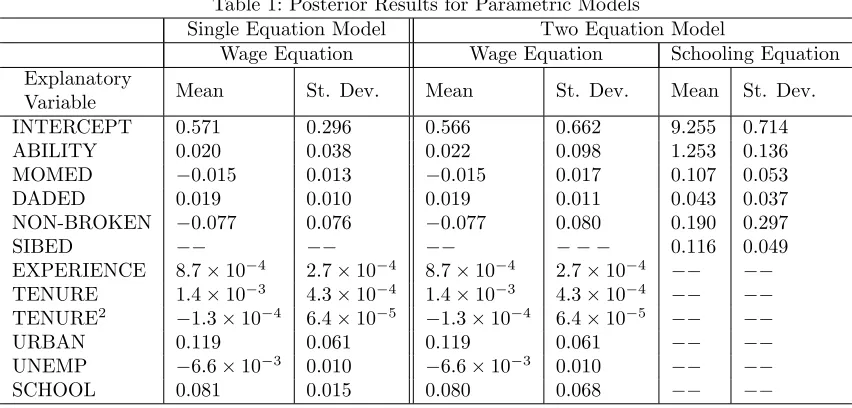
Table 1 presents empirical results for the coefficients in these parametric models. The results are mostly
sensible. The coefficient on our instrument SIBED is positive, as expected, with a posterior mean more
than twice its posterior standard deviation.10 We also note that results from single equation estimation of
the wage equation (which ignores the endogeneity problem) are quite similar to results obtained the two
equation system. For instance, in both cases the point estimate of the return to schooling parameter is roughly 8 percent, and the results for the remaining coefficients are highly similar. The main differences in
results occur with the posterior standard deviations for the coefficients on the highly correlated variables
SCHOOL and ABILITY, which are much larger in the two equation model. This reduction in precision
can be explained by the fact that although the point estimate of the correlation between the errors in the
two equations is not far from zero (i.e., it is 0.054), it is relatively imprecisely estimated with this modest
sample size (i.e., the posterior standard deviation of this coefficient is 0.252). Thus, although the point estimate suggests that endogeneity is not a problem in this data set (and, hence, point estimates of key
parameters do not change much when we control for endogeneity), the posterior for Σ is quite dispersed and
allocates appreciable probability to regions of the parameter space where endogeneity is a problem. Given
this uncertainty regarding the empirical importance of endogeneity, the standard errors associated with these
parameters tend to increase relative to the model which ignores endogeneity concerns.
The finding that appreciable posterior probability is allocated to regions where the correlation between
the errors in the two equations is near zero or small in magnitude is consistent with some of the other
empirical work in this literature.11 That is, it has often been either assumed or more formally argued that
after controlling for a rich set of explanatory variables, endogeneity problems are likely to be mitigated.
Our analysis lends some additional credence to this claim, as we “test down” from a structural model that
permits endogeneity, and find little evidence that endogeneity is a serious empirical issue for this model.
As we show in later sections, however, we find evidence against this basic parametric model, and in our generalized model specifications, there is some indication of a need to control for endogeneity of schooling.
10
In fact, we find a “significant” role for this instrument in all of our model specifications.
11
Table 1: Posterior Results for Parametric Models
Single Equation Model Two Equation Model
Wage Equation Wage Equation Schooling Equation
Explanatory
Variable Mean St. Dev. Mean St. Dev. Mean St. Dev.
INTERCEPT 0.571 0.296 0.566 0.662 9.255 0.714
ABILITY 0.020 0.038 0.022 0.098 1.253 0.136
MOMED −0.015 0.013 −0.015 0.017 0.107 0.053
DADED 0.019 0.010 0.019 0.011 0.043 0.037
NON-BROKEN −0.077 0.076 −0.077 0.080 0.190 0.297
SIBED −− −− −− − − − 0.116 0.049
EXPERIENCE 8.7×10⁻⁴ 2.7×10⁻⁴ 8.7×10⁻⁴ 2.7×10⁻⁴ −− −−
TENURE 1.4×10⁻³ 4.3×10⁻⁴ 1.4×10⁻³ 4.3×10⁻⁴ −− −−
TENURE2 −1.3×10⁻⁴ 6.4×10⁻⁵ −1.3×10⁻⁴ 6.4×10⁻⁵ −− −−
URBAN 0.119 0.061 0.119 0.061 −− −−
UNEMP −6.6×10⁻³ 0.010 −6.6×10⁻³ 0.010 −− −−
SCHOOL 0.081 0.015 0.080 0.068 −− −−
2.4
Case 1: Application
In this model, we elaborate (2.14), and allow the variable TENURE to enter the log wage equation
nonpara-metrically. Formally, we specify:
si=zC′
i αS1 +ziS′αS2 +uSi
wi=ρsi+zC′
i αW1 +ziW′α2W +f(xi) +uWi ,
(2.15)
where xi denotes the number of weeks of work on the current job (TENURE) and ziW no longer contains
TENURE. In our analysis, we set η = 5×10⁻⁹, which is the empirical Bayes estimate that maximizes
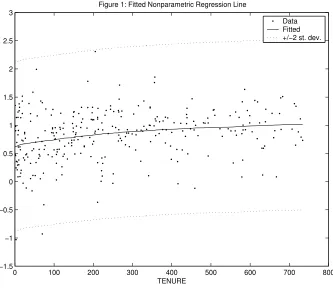
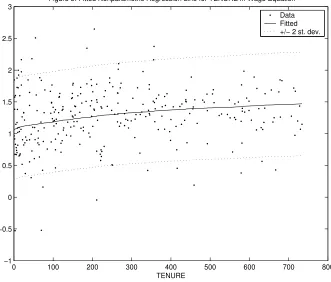
the marginal likelihood (see Figure 2). Figure 1 plots the fitted nonparametric regression line against the
data (after removing the effect of the other explanatory variables). That is, Figure 1 plots the posterior mean of the nonparametric regression line (and +/- two standard deviation bands) and the “data” points
have coordinates xi and wi−ρsi−zC′
i αW1 −zW
′
i αW2 for i = 1, .., N where all parameters are evaluated
at their posterior means. Figure 2 plots the log of the Bayes factor in favor of the semiparametric model
over the parametric model with a linear TENURE term across alternate choices of η (see equation 2.13).
It can be seen that the maximum of the log Bayes factor is 0.026. Thus, there is only slight support for
our semiparametric model over the parametric model with a linear tenure term. Note that as η → 0, the nonparametric and linear models become equivalent and the log Bayes factor is zero. The value of η that
maximizes the marginal likelihood is quite close to this case. However, Figure 2 does indicate an interior
maximum, so a model with slight nonlinearities that suggest a concave tenure profile is preferred over the
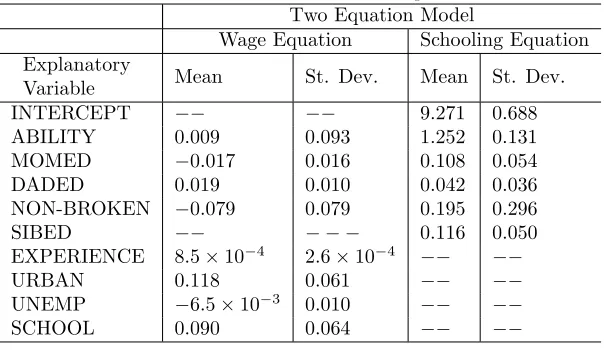
Table 2: Posterior Results for the Case 1 Semiparametric Model Two Equation Model
Wage Equation Schooling Equation Explanatory
Variable Mean St. Dev. Mean St. Dev.
INTERCEPT −− −− 9.271 0.688
ABILITY 0.009 0.093 1.252 0.131
MOMED −0.017 0.016 0.108 0.054
DADED 0.019 0.010 0.042 0.036
NON-BROKEN −0.079 0.079 0.195 0.296
SIBED −− − − − 0.116 0.050
EXPERIENCE 8.5×10⁻⁴ 2.6×10⁻⁴ −− −−
URBAN 0.118 0.061 −− −−
UNEMP −6.5×10⁻³ 0.010 −− −−
SCHOOL 0.090 0.064 −− −−
The results in Table 2 are very similar to the two equation results in Table 1 which differ in that TENURE
and TENURE2are included parametrically. The point estimate of returns to schooling, at 9.0%, is slightly
higher than with the parametric models. However, relative to its posterior standard deviation this difference
is minor. The posterior mean of the correlation between the errors in the two equations is also very similar
to that of the parametric model (i.e., its posterior mean is 0.031 and standard deviation is 0.231). Overall,
we find our nonparametric function of TENURE to be playing a nearly identical role to the quadratic
specification of this variable in the parametric model.
A comparison between a parametric SUR with TENURE entering quadratically to the semiparametric SUR
can be done by first calculating the Bayes factor in favor of the quadratic SUR model of Table 1 against
the parametric SUR with TENURE entering linearly (call this Bayes factor BF∗
to distinguish it from
BF(η) defined in equation 2.13).12 That is,BF(η) compares the semiparametric SUR against a linear SUR
(subject to the qualification of footnote 3), and thus the two Bayes factors BF∗
and Bf(η) will each be
comparing a nonlinear (either quadratic or nonparametric) specification to the linear one. However, Bayes factor calculation requires an informative prior over parameters which are not common to both models.
Thus, to calculateBF∗
we require an informative prior for the coefficient on TENURE2 which we choose to
beN¡0, vq ¢
. With this prior,BF∗
can be calculated using the Savage-Dickey density ratio with the strategy
discussed above (see the discussion around equation 2.13). The elicitation of prior hyperparameters such as
vq can be difficult (which is a further motivation for our empirical Bayesian analysis of a semiparametric
model). In our application, values of vq greater that 10
−10 indicate support for the linear model (i.e.,
BF∗
<1). This apparently informative choice of prior variance is actually not that informative relative to
the data information (note that the posterior standard deviation of this coefficient in Table 1 is 6.4×10⁻⁵).
Forvq<10
−10, the quadratic model is supported (i.e.,BF∗
>1). However, there is no value forvqfor which
the quadratic model receives overwhelming support. The maximum value forBF∗
is 2.77 which occurs when
12
0 100 200 300 400 500 600 700 800 −1.5
[image:15.612.138.471.75.372.2]−1 −0.5 0 0.5 1 1.5 2 2.5 3
Figure 1: Fitted Nonparametric Regression Line
TENURE
Data Fitted +/−2 st. dev.
vq = 10 −12.13
This prior sensitivity analysis for the quadratic model can be interpreted in various ways, but regardless of how it is interpreted it is clear that the performance of the semiparametric and quadratic models (as
measured by their marginal likelihoods) is similar. This is despite the fact that there is a strong support
for parsimony implicit in Bayes factors. In the quadratic parametric model, deviations from linearity are
modelled by adding a single extra parameter, but in our semiparametric model deviations from linearity
are modelled by adding N−2 extra parameters. Hence, we would expect our semiparametric model to be penalized relative to the quadratic model. In any empirical exercise, if the researcher knows the correct functional form of the nonlinearity then it is best to work with the parametric model which captures this
functional form. However, the advantage of the nonparametric approach is that the data can be used to
decide the (here roughly quadratic) functional form. With the parametric model, preliminary estimation
and pretesting were required to select “down” to the quadratic functional form. Hence, in our case it is not
advisable to compare the quadratic model to the semiparametric model using a Bayes factor which ignores
the model selection issues involved with the quadratic model.
13
0 0.1 0.2 0.3 0.4 0.5 0.6 0.7 0.8 0.9 1
x 10−8 −0.03
[image:16.612.135.475.76.361.2]−0.02 −0.01 0 0.01 0.02 0.03
Figure 2: Log of Bayes Factor in Favor of Semiparametric Model
eta
3
Case 2: A Single Nonparametric Component in Several
Equa-tions
In this section, we consider the more general semiparametric SUR model given in (1.1) where a nonparametric
component potentially exists in every equation. That is, γij =fj(xij) for j = 1, .., m is the ith point on
the nonparametric regression line in the jth equation. We maintain the assumption that xij is a scalar.
Simple Bayesian methods for this model can be developed similarly to those developed for Case 1. We
adopt the same strategy of treating unknown points on the nonparametric regression lines as unknown parameters and, hence, augment each equation withN new explanatory variables (as in equation 2.1). We
then use a smoothness prior on each nonparametric regression line (analogous to equations 2.4 and 2.12).
The resulting posterior can be handled using a Gibbs sampler (analogous to equations 2.6 and 2.7). Note,
however, that we expressed our smoothness prior in terms of the second-differencing matrixDgiven in (2.2).
This prior required the data to be ordered so thatx1m< ... < xN m. However, unless each equation has its
nonparametric component depending on the same explanatory variable (i.e.,xij =xim forj= 1, .., m−1), the data in thejthequation (forj= 1, .., m−1) will not be ordered in such a way that a smoothness prior can be expressed in terms ofD. However, this can be corrected for by redefining the explanatory variables. This
requires some new, somewhat messy, notation. Unless otherwise noted, all other assumptions and notation
are as for Case 1. For future reference, defineγj = (γ1j, ..., γN j)
In Case 1, the inclusion of the nonparametric component implied that the identity matrix,IN, was included
as a matrix of explanatory variables (see equation 2.1 and the surrounding definitions). Here we defineI∗ j
which is the identity matrix with columns rearranged to correspond to the ordering of the data in the jth
equation forj= 1, .., m. Thus, sincex1m< ... < xN m,I ∗
mis simplyIN, but the other equations potentially involving a reordering of the columns ofIN. Also defineζij to be the ithrow ofI∗
j.
A concrete example of how this works might help. Suppose we haveN = 5 observations and the explanatory
variables treated nonparametrically in the m = 2 equations have values in the columns of the following
matrix: 3 1 4 2 1 3 2 4 5 5 .
The data has been ordered so that the second explanatory variable is in ascending order, x12 < ... < x52
and, hence, the Case 1 smoothness prior can be directly applied in the second equation. However, the first explanatory variable is not in ascending order. However, we can reorder the columns of the identity matrix
as I∗ 1 =
0 0 1 0 0
0 0 0 1 0
1 0 0 0 0
0 1 0 0 0
0 0 0 0 1
.
It can be seen that withI∗
1 used to define the nonparametric explanatory variables for the first equation,γ11
is the first point on the nonparametric regression line, γ21 is the second point, etc.. Thus, the smoothness
prior can be expressed as restrictingDγ1.
In Case 1, we noted that the smoothness prior was only anN−2 dimensional distribution for theN points on each nonparametric regression line. Implicitly, this prior did not provide any information about the
initial conditions (i.e., what we calledγ1 andγ2in Case 1), but only the second differences of points on the
nonparametric regression line,γi−2γi−1+γi−2. For the initial conditions, we used a noninformative prior.
This need to separate out initial conditions necessitates the introduction of more notation. Define the 2×1 vector of initial conditions in every equation asγ0
j forj= 1, .., m. Letγ ∗
j beγj with these first two elements deleted. Similarly, letI∗∗
j beI ∗
j with its first two columns deleted andI ∗∗∗
j be the two deleted columns. Also
define ζ∗
ij to beζij with the first two elements deleted and ζij0 be the two deleted elements. Analogously, partitionD= [D∗∗
D∗
] whereD∗∗
contains the first two columns ofD.
With all these definitions, we can write the Case 2 semiparametric SUR as (2.1) with
Wi= z′
i1 ζi01 0 . . . 0 ζ
∗
i1 0 . . 0
0 0 z′
i2 ζi02 . . . 0 ζ
∗
i2 . . .
. . . .
. . . . 0 z′
i,m−1 ζi,m−0 1 0 0 . . 0 ζ
∗
i,m−1 0
0 . . . 0 z′
im ζim0 0 . . . ζ
whereδ=¡β′
1, γ0
′
1, .., β
′ m, γ0
′ m, γ
∗′
1, .., γ
∗′ m ¢′
is a K+mN vector of coefficients.
Prior information about smoothness of the nonparametric regression lines will be expressed in terms ofRδ,
where them(N−2)×(K+mN) matrix Ris given by
R=
0 D∗∗
0 . . . . 0 D∗
0 . . 0
. 0 D∗∗
. . . . 0 D∗
. . .
. . . .
. . . D∗∗
0 0 . . . D∗
0
. . . 0 0 D∗∗
0 . . 0 D∗
. (3.2)
The remainder of the derivations are essentially the same as for Case 1. Define the partitions Wi == h
Wi(1):Wi(2)iwhereWi(1) is anm×(K+ 2m) matrix andWi(2) ism×m(N−2) andR= [R1:R2] where
R1 is anm(N−2)×(K+ 2m) matrix and R2 ism(N−2)×m(N−2). Transform the model as:
yi=Vi(1)λ1+Vi(2)λ2+εi=Viλ+εi, (3.3)
where λ= (λ′
1, λ
′
2)
′
, λ1=¡β′1, γ0
′
1, .., β
′ m, γ0
′ m ¢′
,λ2=Rδ=£(Dγ1)
′
, ..,(Dγm)′¤′,Vi(1) =Wi(1)−Wi(2)R−1 2 R1
andVi(2)=Wi(2)R−1 2 .
This model is now in the same form as Case 1. Given an independent Normal-Wishart prior as in (2.4) and
(2.5), posterior analysis can be carried out using the Gibbs sampler described in (2.6) through (2.11). As in
Case 1, we use a noninformative prior forλ1. The prior for Σ−1uses the same hyperparameter values as in
Case 1. The smoothness prior relates toλ2 and, for this, we extend the prior of Case 1 (see equation 2.12)
to be:
V(η1, .., ηm) =
η1IN−2 0 . . 0
0 η1IN−2 0 . .
. 0 . . .
. . . . 0
0 . . 0 ηmIN−2
. (3.4)
Thus, the nonparametric component of each equation can be smoothed to a different degree. An empirical Bayesian analysis can be carried out as described above (see equation 2.13 and surrounding discussion). The
computational demands of empirical Bayes in this general case can be quite substantial since a search over
mdimensions of the smoothing parameter vector must be carried out.
3.1
Case 2: Application
For Case 2, we extend the Case 1 model to allow for an exogenous variable in the schooling equation to receive a nonparametric treatment. The model we consider here is:
si=zC′
i αS1 +zS
′
i αS2 +f1(xi1) +uSi
wi =ρsi+ziC′α W
1 +ziW′α W
2 +f2(xi2) +uWi
, (3.5)
where all definitions are as in (2.15) except that xi1 is ABILITY and xi2 is TENURE and ziC no longer
smooth the nonparametric regression lines in the two equations. This leads us to set η1 = 5×10⁻⁶ and
η2= 10−11.
Table 3 presents posterior results for the parametric coefficients in this semiparametric model. As found in our previous results, the correlation between the errors in the two equations has a point estimate near to,
but now farther away from zero (i.e., its posterior mean is 0.102) and remains very imprecisely estimated
(i.e., its posterior standard deviation is 0.142). Thus, we have more evidence that endogeneity is an issue in
model specification. Other results can be seen to be similar as for Case 1.
Interestingly, this analysis finds rather strong evidence of nonlinearities in the relationship between ability and schooling. The log of the Bayes factor of our semiparametric model against the linear-in-schooling
model is 4.645, which indicates substantially more support for departures from linearity than was found
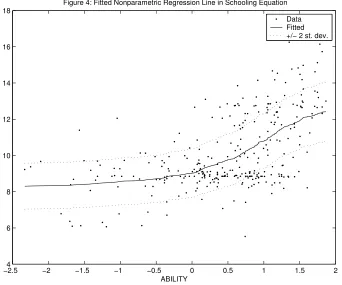
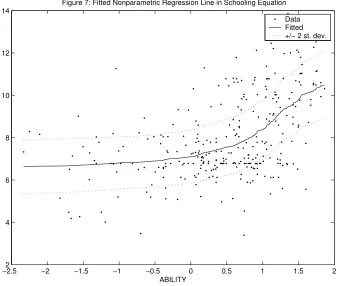
in Case 1. Figures 3 and 4 plot the posterior means of the two nonparametric regression lines against the
data (after controlling for parametric explanatory variables). That is, the “data” points in Figure 3 plot
TENURE against wi−ρsi−zC′ i α
W
1 −zW
′ i α
W
2 for i = 1, .., N where all parameters are evaluated at their
posterior means. The comparable points in Figure 4 plot ABILITY againstsi−zC′
i αS1 −ziS′αS2 (evaluated
at the posterior means for αS
1 and αS2). Figure 3 looks very similar to Figure 1 and indicates some slight
nonlinearities that appear quadratic. Figure 4 indicates more interesting (and more precisely estimated)
nonlinear effects that would not be captured by simple parametric methods (e.g. including ABILITY in
a quadratic manner).14 Specifically, the graph suggests that marginal increments in ability for low ability
individuals does little to increase the quantity of schooling attained (i.e.,the graph is quite flat to the left
of zero). However, for those individuals above the mean of the ability distribution, marginal increments in ability significantly increase the likelihood of acquiring more schooling. The fact that ability is a strong
predictor of schooling has been well-documented (e.g. Heckman and Vytlacil (2000)), and here we add to
this result by finding that it is relatively high ability individuals whose schooling choices are most affected
by changes in ability.
It is also of interest to note that results for the returns for schooling parameter are slightly lower than what
we have seen in either the parametric model or Case 1, with a posterior mean of 0.058 and posterior standard deviation of 0.038. We will now try to reconcile why this reduction has taken place. Our semiparametric
estimation results found strong evidence of a nonlinear (and convex) relationship between ability and the
quantity of schooling attained. To illustrate how this convex relationship may lead to a reduction of the
schooling coefficient, let’s suppose for the sake of simplicity that the actual relationship between schooling and
ability is quadratic, with a positive coefficient on the squared term. Since the correlation between the errors
of the structural equations of Case 2 is non-zero (or at least most of the posterior mass is concentrated away from zero), this implies that the conditional mean of wages given schooling (i.e.,the “reduced form” wage
equation from our structural model), will now contain the nonlinear ability term that enters the education
14
If we add ABILITY2
equation. This nonlinear term was, of course, not present in the conditional mean of Case 1 since that model
only contained a linear ability term. So, we can regard the differences between the conditional means of
Case 2 and Case 1 as essentially an omitted variable problem - in Case 2 we have an added quadratic ability
term that is positively correlated with education (see Figure 4) and also positively correlated with log wages (we provide evidence of this in the next section). Using standard omitted variable bias formulas, we would
thus predict a reduction in the “reduced form” schooling coefficient upon controlling for this nonlinearity in
ability. This result has potentially significant implications for this literature, as it suggests the importance
of controlling for potential nonlinearities in ability (in both the schooling or wage equations) in order to
extract accurate estimates of the return to education. Despite this result, it is also important to recognize
[image:20.612.155.459.268.418.2]that the shift in the posterior of this key parameter is small relative to its posterior standard deviation.
Table 3: Posterior Results for the Case 2 Semiparametric Model Wage Equation Schooling Equation Explanatory
Variable Mean St. Dev. Mean St. Dev.
SIBED −− −− 0.087 0.047
ABILITY 0.051 0.061 −− −−
MOMED −0.012 0.015 0.123 0.052
DADED 0.021 0.010 0.050 0.035
NON-BROKEN −0.068 0.077 0.045 0.287
EXPERIENCE 8.0×10⁻⁴ 2.7×10⁻⁴ −− −−
URBAN 0.124 0.062 −− −−
UNEMP −6.4×10⁻³ 0.010 −− −−
SCHOOL 0.058 0.038 −− −−
4
Case 3: Nonparametric Components Depend on Several
Ex-planatory Variables: Additive Models
To this point we have only considered cases where the nonparametric component in a given equation depended
on a single explanatory variable. That is,xijwas assumed to be a scalar. In this section, we assumexijto be
a vector ofpexplanatory variables.15 The curse of dimensionality (see, e.g., Yatchew (1998) pages 675-676)
implies that it is difficult to carry our nonparametric inference (whether Bayesian or non-Bayesian) when
pis even moderately large. The intuition underlying our smoothness prior is that values of xij which are
near one another should have points on the nonparametric regression line which are also near one another.
Whenxij is a scalar, the definition of “nearby” points is simple and is expressed through our ordering of
the data asx1m< ... < xN m. Whenxij is not a scalar, it is possible to order the data in an analogous way
using some distance metric. If it is sensible to order the data in this way, then the approach of Case 2 can
be applied directly. However, this approach is apt to be sensitive to choice of distance definition and which
point to choose as the first on each nonparametric regression line. In the single equation case, Yatchew (1998,
15
0 100 200 300 400 500 600 700 800 −1
[image:21.612.138.470.90.374.2]−0.5 0 0.5 1 1.5 2 2.5 3
Figure 3: Fitted Nonparametric Regression Line in Wage Equation
TENURE
Data Fitted +/− 2 st. dev.
−2.54 −2 −1.5 −1 −0.5 0 0.5 1 1.5 2 6
8 10 12 14 16 18
Figure 4: Fitted Nonparametric Regression Line in Schooling Equation
ABILITY
[image:21.612.135.477.416.701.2]page 697) argues that the classical Differencing Estimator works well provided the dimension ofxi does not
exceed 3. It is likely that such an approach could work well in our Bayesian semiparametric framework when
dimensionality is as low as this. Nevertheless, in this section we develop a different approach for this general
case.
The curse of dimensionality is greatly reduced if it is assumed thatfj(xij) is additive. This is, of course, more
restrictive than simply assumingfj(xij) is an unknown smooth function, but it is much less restrictive than
virtually any parametric model used in this literature. Furthermore, by definingxijto include interactions of
explanatory variables, some of the restrictions imposed by the additive form can be surmounted. Accordingly,
in this section we develop methods for Bayesian inference in the model given in (1.1) with:
fj(xij) =fj(xij1, .., xjip) =fj1(xij1) +..+fjp(xijp) =γij1+..+γijp. (4.1)
The basic idea underlying our approach to this model is straightforward: define a smoothness prior for
each of the fjr(xijr) for j = 1, .., m and r = 1, .., p and use the methods for Bayesian inference in the
semiparametric SUR model with independent Normal-Wishart prior described for Case 1. However, we
must further complicate notation to handle this general case. In the following material, the indices run
i= 1, .., N,j= 1, .., mandr= 1, ..p.
For Case 2, we defined matrices,I∗
1, .., I
∗
m which were used as explanatory variables for the nonparametric
regression lines taking into account the fact that each nonparametric explanatory variable was not necessarily
in ascending order. For Case 3, we define analogouslyI∗
jr which is the re-ordered identity matrix needed to
incorporatefjr(xijr) , taking into account that the data are not necessarily ordered so thatx1jr < .. < xN jr.
All the other Case 2 definitions can be extended in a similar fashion. Divide the vector of points on each nonparametric regression line,γjr= (γ1jr, .., γN jr)
′
, into the 2×1 vector of initial conditions, γjr0 ,and the remaining elements,γ∗
jr. Similarly, letI ∗∗ jr beI
∗
jr with the first two columns corresponding deleted andI ∗∗∗ jr
be the two deleted columns. Furthermore, let ζ∗
ijr be ζijr with the elements corresponding to the initial conditions deleted and ζ0
ijr be the two deleted elements, where ζijr is the i
throw of of I∗
jr. Further define
ζ0
ij= ¡
ζ0
ij1, ..ζijp0 ¢
andζ∗ im=
¡ ζ∗
ij1..ζ
∗ ijp
¢
. Note that these last two definitions differ from Case 2.
With all these definitions, we can write the Case 3 model as a semiparametric SUR as in (2.1) withWias given
in (3.1), except that the definition of some of the terms has changed slightly andδ=¡β′
1, γ0
′
11, .., γ0
′
1p, .., β ′ m, γ0
′ m1, .., γ0
′ mp, γ
∗′
11, .., γ
∗′
1p
is now aK+mpN vector of coefficients.
As before, our smoothness prior is expressed in terms ofRδ, whereRis now anmp(N−2)×(K+mpN) matrix: R=
0 D∗∗
p 0 . . . . 0 D
∗
p 0 . . 0
. 0 D∗∗
p . . . . 0 D
∗
p . . .
. . . .
. . . D∗∗
p 0 0 . . . D
∗
p 0
. . . 0 0 D∗∗
p 0 . . 0 D
where D∗∗ p = D∗∗
0 . 0
0 . . .
. . . 0
0 . 0 D∗∗
is anp(N−2)×2pmatrix and
D∗ p= D∗
0 . 0
0 . . .
. . . 0
0 . 0 D∗
isp(N−2)×p(N−2).
The remainder of the derivations are the same as for Cases 1 and 2. That is, the model can be transformed
as in (3.3). An independent Normal-Wishart prior for the transformed parameters is used with prior
hy-perparameters selected as for Case 2. The Gibbs sampler described in (2.6) through (2.11) can be used for
posterior inference. The only difference is that it will usually be desirable to have a different smoothing
parameter for every nonparametric regression line in every equation. Thus, we choose the prior covariance matrix forλ2 to be:
V (η11, .., η1p, .., ηm1, .., ηmp) =
η11IN−2 0 . . . .
0 . . . . .
. 0 η1pIN−2 . . .
. . . .
. . . 0
. . . . 0 ηmpIN−2
. (4.2)
There is an identification problem with this model in that constants may be added and subtracted to
each nonparametric component without changing the likelihood. For instance, the equationsyij =z′ ijβj+ fj1(xij1)+fj2(xij2)+εij andyij=zij′ βj+gj1(xij1)+gj2(xij2)+εij are equivalent ifgj1(xij1) =fj1(xij1)+c
and gj2(xij2) = fj2(xij2)−c where c is an arbitrary constant. Insofar as interest centers on the shapes
of the fjr(xijr) for r = 1, .., p, prediction or the overall fit of the nonparametric regression line, the lack
of identification is irrelevant. If desired, identification can be imposed in many ways (e.g. by setting the intercept of therthnonparametric component in each equation to be zero forr= 2, .., p).
4.1
Case 3: Application
In Case 3 we extend Case 2 to also allow for a nonparametric treatment of ABILITY in the wage equation.
Thus, ABILITY is treated nonparametrically in both equations and TENURE is treated nonparametrically
in the wage equation. The model is:
si=zC′ i α
S
1 +ziS′α S
2 +f11(xi11) +uSi wi=ρsi+zC′
i αW1 +zW
′
i αW2 +f21(xi21) +f22(xi22) +uWi
where definitions are as for Case 2 except that xi11 =xi22 is ABILITY and xi21 is TENURE and zCi no
longer contains ABILITY in either equation. We identify the model by setting the intercept of one of the
nonparametric functions in the wage equation to be zero, i.e.,f22(x122) = 0.
With three nonparametric components, empirical Bayesian methods involve a three-dimensional grid search
over the smoothing parameters η1, η2 and η3 for terms relating to ABILITY (in the schooling equation),
TENURE and ABILITY (in the wage equation), respectively. We findη1= 10−6, η2= 10−9andη3= 10−11.
With these values, the log of the Bayes factor in favor of the nonparametric model is 3.837 indicating stronger
support for the semiparametric model over the parametric alternative of (2.14) than with Case 1.
Empirical results for the regression coefficients are presented in Table 4 and are found to be similar to those
for Case 2. In addition, the posterior mean of the correlation between the errors in the two equations is
0.138 (standard deviation 0.140), values similar to Case 2. Perhaps the most interesting finding is that the
posterior mean of the return to schooling parameter is, at 0.042, similar to but smaller than that found for
Case 2, and approximately one-half of the size of those reported in Case 1 and the parametric model. Again,
upon controlling for nonlinearities in the relationship between ability and log wages, we find even more reduction in the return to schooling coefficient. However, the posterior standard deviation of this parameter
is still quite large.
Figures 5, 6 and 7 plot the fitted nonparametric regression lines (after controlling for other explanatory
variables in the same manner as for previous cases). Figure 7 indicates the same non-quadratic nonlinearities
in the relationship between ABILITY and SCHOOL (after controlling for other explanatory variables) as Figure 4, while Figure 5 is similar to Figures 1 and 3. Figure 6 also appears to exhibit a slightly nonlinear
regression relationship between log wages and ABILITY of a non-quadratic form (although the pattern is
much weaker than in Figure 7). Specifically, Figure 6 suggests that marginal increments in ability does little
to increase the log wages of individuals of low to moderate ability, but does begin to have a reasonable
effect on the log wages of those already above the mean of the ability distribution (i.e.,increasing returns to
ability). It is also important to recognize that we are obtaining this result after controlling for the potentially
endogenous education variable and also controlling for nonlinearities in the education-ability relationship. The fact that +/- two posterior standard deviation bands in Figure 6 are very tight for the lowest values
of ABILITY is due to the identification restriction and the fact that there are very few observations in this
0 100 200 300 400 500 600 700 800 −1
[image:25.612.139.470.81.363.2]−0.5 0 0.5 1 1.5 2 2.5 3
Figure 5: Fitted Nonparametric Regression Line for TENURE in Wage Equation
TENURE
Data Fitted +/− 2 st. dev.
Table 4: Posterior Results for the Case 3 Semiparametric Model Wage Equation Schooling Equation Explanatory
Variable Mean St. Dev. Mean St. Dev.
SIBED −− −− 0.163 0.049
MOMED −0.010 0.015 0.202 0.056
DADED 0.022 0.010 0.047 0.039
NON-BROKEN −0.080 0.079 0.257 0.308
EXPERIENCE 6.8×10⁻⁴ 2.7×10⁻⁴ −− −−
URBAN 0.112 0.063 −− −−
UNEMP −0.010 0.010 −− −−
SCHOOL 0.042 0.039 −− −−
5
Conclusions
In this paper, we have developed methods for carrying out Bayesian inference in the semiparametric seemingly
unrelated regressions model and showed how these methods can also be used for semiparametric simultaneous
equations models. There are, of course, other methods for carrying out Bayesian inference in semi- or
nonparametric extensions of SUR models (e.g. Smith and Kohn (2000)). A distinguishing feature of our
approach is that we stay within the simple and familiar framework of the SUR model with independent
[image:25.612.161.453.402.539.2]−2.5 −2 −1.5 −1 −0.5 0 0.5 1 1.5 2 −2
[image:26.612.136.475.93.375.2]−1.5 −1 −0.5 0 0.5 1 1.5
Figure 6: Fitted Nonparametric Regression Line for ABILITY in Wage Equation
ABILITY
Data Fitted +/− 2 st. dev.
−2.52 −2 −1.5 −1 −0.5 0 0.5 1 1.5 2 4
6 8 10 12 14
Figure 7: Fitted Nonparametric Regression Line in Schooling Equation
ABILITY
[image:26.612.136.476.416.702.2]