Int. J. Electrochem. Sci., 14 (2019) 662 – 678, doi: 10.20964/2019.01.60
International Journal of
ELECTROCHEMICAL
SCIENCE
www.electrochemsci.org
Effect of Electrolysis Parameters on the Specific Surface Area of
Nickel Powder: Optimization using Box-Behnken Design
Ali H. Abbar
Chemical Engineering Department, University of Al-Qadisiyah, Iraq E-mail: [email protected], [email protected]
Received: 3 September 2018 / Accepted: 4 November 2018 / Published: 30 November 2018
The effect of three electrolysis operating parameters on the specific surface area of electrolytic nickel powder was investigated by adopting response surface methodology approach. Box-Behnken design was selected to optimize the electrodeposition process and to estimate the effects and interactions of current density, nickel sulfate concentration, and temperature. BETS, XRD-diffraction, optical microscopy, and atomic force microscopy (AFM) were used to characterize the nickel powder. The results revealed that the current density has the major effect on the specific surface area of nickel powder followed by nickel sulfate concentration. No significant effect of temperature was observed. The optimum conditions for producing nickel powder at a maximum specific surface area of 1.05m2 g-1 with an average particle size of 680.65 nm were a current density of 500 mAcm-2, nickel sulfate concentration of 20 g L-1, and an operating temperature of 38 °C. The corresponding current efficiency and energy consumption were 30%, 24.0 kWh kg-1 respectively. The prepared powder has better specifications than the industrial type (Type 255-carbonyl process). Analysis of variance (ANOVA) showed a high coefficient of determination (R2) value of 0.978, thus ensuring an adequately adjustment of the second-order regression model with the experimental data. The conformity results proved that the Box-Behnken design could be efficiently used to optimize the process parameters for the electrolytic preparation of metal powders.
Keywords: electrodeposition, nickel powder, surface area, Box–Behnken design, optimization
1. INTRODUCTION
medicine and biology [2]. Suspensions of cobalt and nickel powders are used as oil additives for in-process repair of worn-out parts of automobile [3].
Ni powder can be made by different methods including the decomposition of nickel carbonyl, reduction of aqueous solution of a nickel salt with hydrogen under pressure (hydrometallurgical Sherritt process), water atomization of molten nickel, and electrochemical method [4]. Hydrometallurgical and atomization methods give relatively large particles and it is difficult to produce fine particle sizes economically while the other two methods give much finer particles [5].
The Electrochemical method provides Ni powders with particle size ranging from a few nanometers to several micrometers based on the operating conditions of the electrodeposition process. The main properties of the electrolytic Ni powder are dendritic shape of the particles, good compressibility, and the highest purity. By selecting the appropriate process parameters such as metal ion concentration, pH of the electrolyte, current density, cathode potential, temperature, type of the anode and cathode, and the distance between them, it is possible to control the crystallization mechanism to acquire the required shape and size of powder particles [6].
Ni powder electrodeposition was performed using two types of electrolyte: Acid electrolytes [7-9] and ammoniacal electrolytes [10-15]. The characteristic of acid electrolytes is that decreasing the nickel ion concentration in solution and increasing current density result in reducing the powder fragility. However, no oxides and basic salts existing in the structure of this powder and it could be stored in a dry place for an indefinite period without structure change or oxidation. For ammoniacal electrolytes, using of higher concentration of ammonia results in producing disperse and pure (without hydroxide impurities) nickel deposits [16]. A number of researchers [17-19] have recommended sulphate-chloride or all-chloride electrolytes for nickel powder electrodeposition. However, using such electrolytes is not always justified due to the unequal of the cathodic and anodic current efficiencies when nickel anodes are used, hence a necessary correction of nickel ion concentration is required for keeping a constant electrolyte composition during electrolysis. The use of all-sulphate electrolytes overcomes these shortcomings and gives superior results than sulphate-chloride electrolytes in spite of their lower electrical conductivity in comparison with sulphate-chloride or chloride electrolytes. [20].
Intensive studies have been conducted on the Nickel powder electrodeposition, most of these studies concerned with the investigation of the morphological structure (XRD, EDS, SEM) of Ni powders [8,14,16,21], while fewer studies were devoted to investigate the effect of operating variables on the particle size and apparent density of nickel powder [9,12,13,15,22]. However, no information is available on the effect of operating variables like current density, metal ion concentration, pH, and temperature on the specific surface area of Ni powder. Specific surface area as the most important physical property of Ni powder has an important effect on the physical and mechanical behavior of the powder metallurgy products prepared from this powder that have been used in different applications like electrical applications [23]. Therefore the investigation of the mutual effect of the operating variables on the specific surface area could be given a right picture of the strategy used for producing this powder at excellent properties.
the number of runs required to achieve the research which in turn cause an increase of time and expenses [24, 25]. To overcome this problem, response surface methodology (RSM) can be used as a motivating approach to recognize the process variables which drive to optimal response by conducting a less number of experiments. RSM is a combination of statistical and mathematical methods suitable for developing, improving, and optimizing processes parameters and can be utilized for estimating the relative significance of several operating parameters even in the existence of complex interactions [26]. Box– Behnken design is part of RSM, where each experimental factor is tested at three levels and the experimental response is compared with the predicted response [27, 28]. RSM has been successfully used in various sectors of the industry including metal removal processes [29], chemical and biological processes, drug and food industry [30]. To the best of our knowledge, the application of RSM in nickel powder electrodeposition is not yet reported.
The aim of this work is to study the effect of three operating variables including current density, nickel sulfate concentration, and temperature on the specific surface area of nickel powder and determine the optimal values of these variables using Box–Behnken design.
2. EXPERIMENTAL WORK 2.1. Materials
All chemicals used were of analytical grade (BDH) and the experimental solution was prepared using double distilled water. Electrodeposition of Nickel powder was conducted from a solution containing 1 M (NH4)2SO4, 0.7 M NH4OH with different concentrations of nickel sulfate (NiSO4.7H2O).
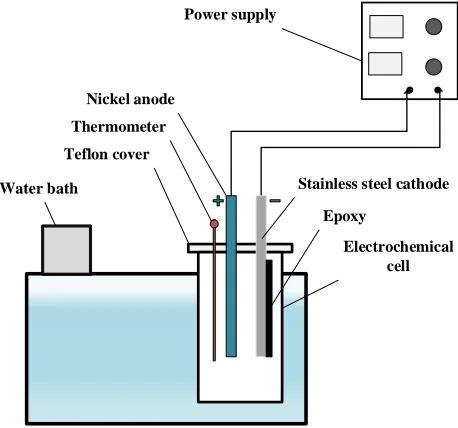
2.2. Electrolytic cell
Water bath
Power supply
Nickel anode
Stainless steel cathode
Epoxy
Electrochemical cell Teflon cover
[image:4.596.180.409.71.285.2]Thermometer
Figure 1. Electrochemical system
The current efficiency (CE) was calculated using Eqs. (1, 2) as follows [31, 39]:
mth=MnFwIt (1)
CE=mexp
mth (2)
where mth is the theoretical weight of nickel powder (g), mexp is the actual weight of powder (g)
produced in time (t), Mw is the atomic weight of Ni (58.693 g mol-1), I is the current in ampere, t is the
time of electrodeposition in seconds, n is the valence of nickel (2), and F is Faraday constant (96486 C mol-1).
The energy consumption was estimated using the following equation [32, 39]: EC=2.778×10m -4EIt
exp (3)
Where EC is the energy consumption (kWh kg−1) and E is the cell potential in volts
2.3. Characterization of Nickel powder
The specific surface area of nickel powder was measured by ASAP 2020 surface area analyzer using BET method. X-ray diffraction (CuKα radiation as the X-ray source, λ= 1.54056 ̊A) was used to identify the crystal structure of nickel powder. Atomic force microscopy (AFM) SPM-AA3000 (Angestrom Advanced Inc., USA) in contact mode was used to determine the average particle size of nickel powder. The AFM images were recorded over a scan area (2 µm x 2 µm). The optical micrographs of nickel powder were obtained using Olympus BX51M with DP70 digital camera system.
2.4. Experimental design
RSM is the empirical preferred one. It is collective statistical and mathematical techniques depend on the fitting of a polynomial equation (empirical models) to the experimental data. This method creates a polynomial function which relates the response to the factors studied. To do that, it considers the factors only at certain levels (mostly -1, 0, 1). Response surface methodology produces an experimental design for model preparation, which is a particular set of runs defined by a matrix consisted of the different level combinations of the factors involved. RSM regressively fits the experimental results of the design to a model (first, second or higher order) then the coefficients involved in the model are determined. General designs relating to these models are: 1) First-Order Designs: The most well-known first-order designs are 2k factorial (k is the number of control parameters) and Plackett–Burman designs. 2) Second-Order Designs: The most commonly employed second-order designs are the 3 k factorial, Box–Behnken, and the central composite designs [33].
Box–Behnken design (BBD) is an autonomous, rotatable quadratic design without inserted factorial or fractional factorial points where the combinations of variables are at the midpoints of the edges of the variable space and at the center. Besides, Box–Behnken design permits evaluating the response function at middle levels and permits the determination of the system performance at any experimental point within the range studied via suitable design and analysis of experiments [34]. In comparison with traditional factorial design methods, choosing Box–Behnken designs can decrease the number of experimental sets without reducing the optimization accuracy [35]. Therefore, Box–Behnken design offers more efficient matrices and is more economical design.
In Box–Behnken design, the number of runs was determined according to the formula N=2k(k-1) + cp, where k refers to the number of factors while (cp) represents the number of the central points. Besides, all factor levels should be regulated only at three levels (-1, 0, +1) with equally spaced intervals between these levels [33]. The quadratic equation model for predicting the optimal point based on this deign can be expressed as follows [27]:
Y=β0+∑βixi+∑βiixii2+∑βijxixj+ε (4)
Where Y is the predicted response, β0 is the constant coefficient, βi is the ith linear coefficient of
the input factor xi, βii is the ith quadratic coefficient of the input factor xi, βij is the different interaction
coefficients between the input factors xi and xj, and ε is the error of the model [27].
The optimization procedure consists of different consecutive steps; firstly the response of the statistically designed combinations is studied. Secondly, the coefficients of the model are determined by fitting the experimental data to the response functions. Thirdly, predicting the response of the fitted model, and finally the suitability of the model is checked by performing analysis of variance (ANOVA) [35].
In the present research, the Box–Behnken experimental design was used to investigate and confirm the electrolysis parameters affecting the specific surface area of electrochemically prepared nickel powder. Current density (A), nickel sulfate concentration (B), and temperature (C) were the input variables, while the specific surface area of nickel powder was chosen as a response(Y). Equation (4) then could be written as follows:
Y=β0+β1A+β2B+β3C+β12AB+β13AC+β23BC+β11A2+β22B2+β33C2 (5)
was generated by MINITAB-17 statistical analysis software. Statistical analysis of the model was achieved to evaluate the analysis of variance (ANOVA).
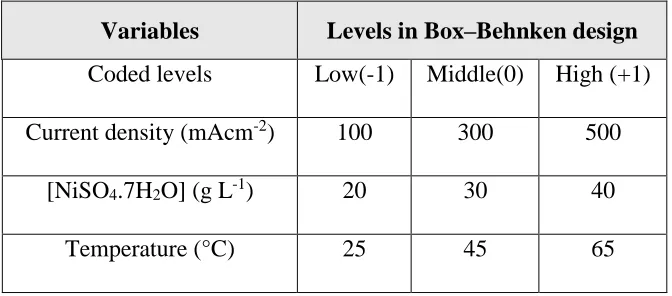
Table 1. Experimental design levels of the selected variables
Levels in Box–Behnken design Variables High (+1) Middle(0) Low(-1) Coded levels 500 300 100 ) 2 -density (mAcm Current 40 30 20 ) 1
-O] (g L
[image:6.596.131.467.149.297.2]2 .7H 4 [NiSO 65 45 25 Temperature (°C)
Table 2. Box–Behnken experimental design matrix
Real value. Coded value Run Order Temperature (°C) [NiSO4.7H2O ]
(g L-1) Current density
(mAcm-2) C B A 45 20 100 0 -1 -1 1 65 40 300 1 1 0 2 45 40 500 0 1 1 3 65 30 500 1 0 1 4 25 40 300 -1 1 0 5 65 30 100 1 0 -1 6 45 40 100 0 1 -1 7 25 30 100 -1 0 -1 8 45 20 500 0 -1 1 9 45 30 300 0 0 0 10 45 30 300 0 0 0 11 25 30 500 -1 0 1 12 65 20 300 1 -1 0 13 25 20 300 -1 -1 0 14 45 30 300 0 0 0 15
3. RESULTS AND DISCUSSION 3.1. Statistical analysis
[image:6.596.110.489.353.619.2][image:7.596.82.521.155.425.2]
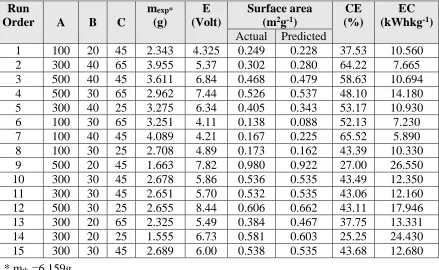
specific surface area. The values of current efficiency and power consumption for each experiment are mentioned also.
Table 3. Experimental results of Box–Behnken design with the predicted values
EC (kWhkg-1) CE
(%) Surface area
(m2g-1) E (Volt) mexp* (g) C B A Run Order Predicted Actual 10.560 37.53 0.228 0.249 4.325 2.343 45 20 100 1 7.665 64.22 0.280 0.302 5.37 3.955 65 40 300 2 10.694 58.63 0.479 0.468 6.84 3.611 45 40 500 3 14.180 48.10 0.537 0.526 7.44 2.962 65 30 500 4 10.930 53.17 0.343 0.405 6.34 3.275 25 40 300 5 7.230 52.13 0.088 0.138 4.11 3.251 65 30 100 6 5.890 65.52 0.225 0.167 4.21 4.089 45 40 100 7 10.330 43.39 0.162 0.173 4.89 2.708 25 30 100 8 26.550 27.00 0.922 0.980 7.82 1.663 45 20 500 9 12.350 43.49 0.535 0.536 5.86 2.678 45 30 300 10 12.160 43.06 0.535 0.532 5.70 2.651 45 30 300 11 17.946 43.11 0.662 0.606 8.44 2.655 25 30 500 12 13.331 37.75 0.467 0.384 5.49 2.325 65 20 300 13 24.430 25.25 0.603 0.581 6.73 1.555 25 20 300 14 12.680 43.68 0.535 0.538 6.00 2.689 45 30 300 15
* mth =6.159g
The experimental results show that CE ranges between (25.52-65.52%). These results are in agreement with previous works [8, 11- 13] in spite of a higher current efficiency was observed in the present work. The lower CE results from the effect of side reaction (hydrogen evolution) which can’t be avoided and the low value of Ni concentration. The hydrogen evolution increases as the concentration of metal ion decreases.
The experimental results were analyzed via Box–Behnken design to get an empirical model for the best response. The predicted results of this model are also reported in Table 2. The empirical model that describes the relationship between the response and input factors in coded terms can be expressed by the following quadratic equation:
Y=0.5353+0.2371A-0.1116B-0.0497C-0.0664A2-0.0054B2-0.1067C2-0.1100AB-0.0127AC
+0.0183BC (6)
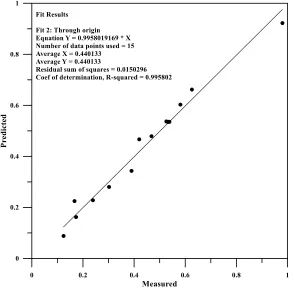
[image:8.596.154.448.150.440.2]
The coefficient of correlation (R2) for fitting through origin is 0.9958 which confirms that the regression equation gives a precise description of the experimental data. It has successfully expressed the correlation between the three operating parameters and the specific surface area of nickel powder.
Figure 2. Relation between experimental and predicted surface area
Analysis of variance has been performed to determine the adequacy of the model representing the specific surface area; the results are given in Table 4. ANOVA as an analytical method is used to specify the significance of the model and its parameters where Fisher’s F-test and Student’s t-test (p-value) are used as criteria for this purpose. As a guideline, smaller p-values and larger F-values reveal more significant coefficient terms. ANOVA also splits the total variation in a set of data into individual parts accompanied with certain sources of variation to examine hypotheses on the model parameters [36].
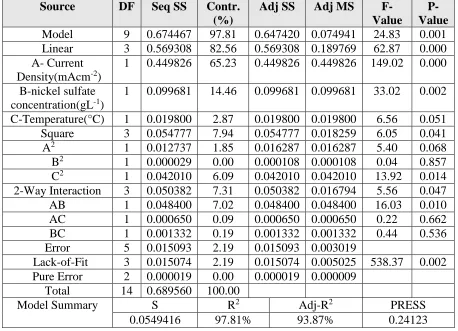
Analysis of variance (Table 4) revealed that the predictability of the model is at 95% confidence interval. The ANOVA of this response verified that the model is highly significant as is observed from the value of Fstatistic=24.83 (the ratio of regression mean square to the real error mean square), and a very
low probability value (P = 0.001). The value of probability P < 0.05 reveals that the model is statistically significant [37].
Table 4. ANOVA results for the quadratic equation for specific surface area of nickel powder
Source DF Seq SS Contr. (%)
Adj SS Adj MS F-Value
P-Value Model 9 0.674467 97.81 0.647420 0.074941 24.83 0.001 Linear 3 0.569308 82.56 0.569308 0.189769 62.87 0.000 A- Current
Density(mAcm-2)
1 0.449826 65.23 0.449826 0.449826 149.02 0.000 B-nickel sulfate
concentration(gL-1)
1 0.099681 14.46 0.099681 0.099681 33.02 0.002 C-Temperature(°C) 1 0.019800 2.87 0.019800 0.019800 6.56 0.051 Square 3 0.054777 7.94 0.054777 0.018259 6.05 0.041
2
A 1 0.012737 1.85 0.016287 0.016287 5.40 0.068 B2 1 0.000029 0.00 0.000108 0.000108 0.04 0.857 C2 1 0.042010 6.09 0.042010 0.042010 13.92 0.014 2-Way Interaction 3 0.050382 7.31 0.050382 0.016794 5.56 0.047 AB 1 0.048400 7.02 0.048400 0.048400 16.03 0.010 AC 1 0.000650 0.09 0.000650 0.000650 0.22 0.662 BC 1 0.001332 0.19 0.001332 0.001332 0.44 0.536 Error 5 0.015093 2.19 0.015093 0.003019
Lack-of-Fit 3 0.015074 2.19 0.015074 0.005025 538.37 0.002 Pure Error 2 0.000019 0.00 0.000019 0.000009
Total 14 0.689560 100.00 Model Summary
S R2 Adj-R2 PRESS
0.0549416 97.81% 93.87% 0.24123
In the present work, coefficient of determination (R2) of 0.9781 and an Adj-R2 of 0.9387 at a
level of confidence of 95% were obtained for the quadratic equation model. Joglekar [38] proposed that a well model fit should produce value of R2 higher than 0.8. This means that the response model
estimated in this work can elucidate the relation between process variables and specific surface area of electrolytic nickel powder as well. The results of ANOVA show that current density has the major contribution at 65.23% (in linear term) followed by nickel sulfate concentration at 14.46% while temperature has the lower contribution at 2.87%. This is an indication that current density has the main effect on the surface area. Results of our previous work [39] related to the electrolytic zinc powder showed that zinc ion concentration has the main effect followed by current density while temperature has a little effect. This discrepancy may be resulted from the deference in electrode potentials where zinc has a more negative potential than nickel.
3.2. Effect of variables on the specific surface area of nickel powder
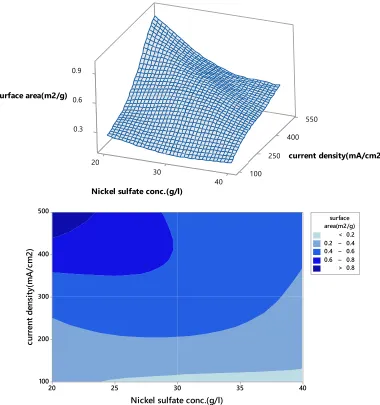
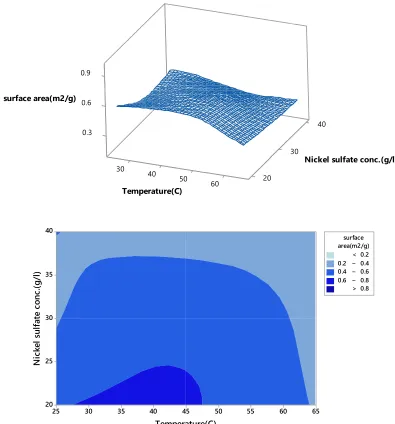
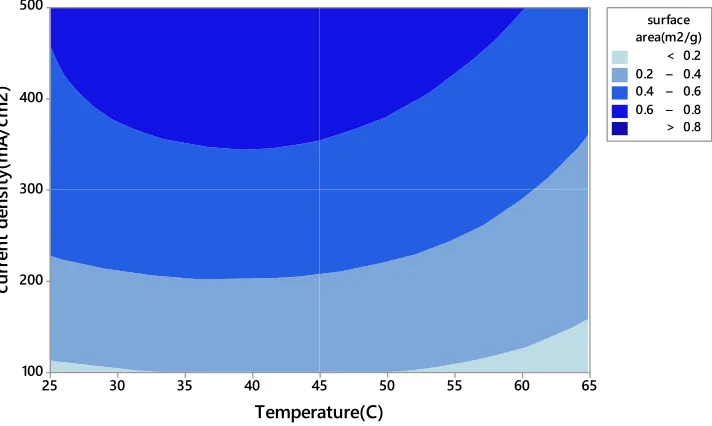
plots which are two-dimensional pictures of the response for selected factors. The contour plots are the projections of the response surfaces in the x–y plane that give a direct determination of the effects of variables on the response. An elliptical contour plot reveals that the interactions between them are significant while a circular contour plot reveals that no interactions could be existed [40].
The surface plot in Fig.3 reveals that the specific surface area of Ni powder strongly increases as the current density increases or decreasing of nickel sulfate concentration, the corresponding contour plot confirms that a maximum value of specific surface area lies in a smallest elliptic curve area in which the current density ranged between 450-500 mAcm-2 and nickel sulfate concentration between 20-23gL -1. the contour plot shows an interaction between current density and sulfate concentration. In Fig. 4, a
slight increase in the specific surface area of nickel powder was observed as nickel sulfate concentration and temperature decreased. The contour plot shows a semicircular curve area in which the surface area maximized. A maximum value could be obtained at a temperate range (35-45°C) and concentration range (20-23 gL-1). No interaction between these variables was detected.
Figure 3. Response surface plot and contour plot of the specific surface area of nickel powder vs. current density and nickel sulfate concentration, temperature=45°C
0 2 0 3 .3 0 .6 0 0 4 0 5 2 00 1 400 0 5 2 550 0.9
surface area(m2/g)
) 2 m c / A m ( y t i s n e urrent d c t a f l u s l e
N ci k e conc.(g/l)
urface Plot of surface area(m2/ vs
current density(; Nickel
S
sulfate c
Nickel sulfate conc.(g/l)
cu rr en t de ns it y( m A /c m 2) 40 35 30 25 20 500 400 300 200 100 > – – – < 0.2 0.2 0.4 0.4 0.6 0.6 0.8 0.8 area(m2/g)surface
[image:10.596.124.504.318.723.2]Int. J. Electrochem. Sci., Vol. 14, 2019
672
Figure 4. Response surface plot and contour plot of the specific surface area of nickel powder vs. nickel sulfate concentration and temperature, current density =300mAcm-2
30 0 4 50 3 0. 6 . 0 0 2 60 30 40 0.9 e area(m2/g) c a f r u s a f l u s l e k c i
N teconc.(g/l)
empera C)
T ture( Temperature(C) N ic ke l s ul fa te c on c. (g /l ) 65 60 55 50 45 40 35 30 25 40 35 30 25 20 > – – – < 0.2 0.2 0.4 0.4 0.6 0.6 0.8 0.8 area(m2/g) surface
Contour Plot of surface area(m2/ vs Nickel sulfate c; Temperature(C)
0
3 40
50
0 3.
0.6 60 250 100 00 4 250 50 5 9 0.
surf ce aa rea(m2/g)
/cm2) A m ( y t i s n e d t n e r r u c pe
Tem r tua re(C)
urface Plot of surface area(m2/ v
current d
e
[image:11.596.114.509.79.503.2]
Figure 5. Response surface plot and contour plot of the specific surface area of nickel powder vs. current density and temperature ,nickel sulfate concentration =30 gL-1
Fig.5 displays the surface plot of current density and temperature verses specific surface area. As can be seen, increasing the current density leads to strongly increasing in the surface area while a slight increase in the surface area of powder was found as the temperature decreased. Contour plot shows a circular curve region in which the surface area is maximized however no interaction between these variables was found.
All surface and contour plots confirm that current density has the major and strong effect on the specific surface area of nickel powder. This observation could be attributed to the enhancement of hydrogen evolution on the cathode due to the increase in the cathodic potential as the current density increases and this in turn gives more fine, porous, and nodular dendritic structure of the deposits [12]. On the other hand, present results show that the temperature has no significant effect which is in agreement with our previous work [39].
3.3. Conditions optimization and confirm tests
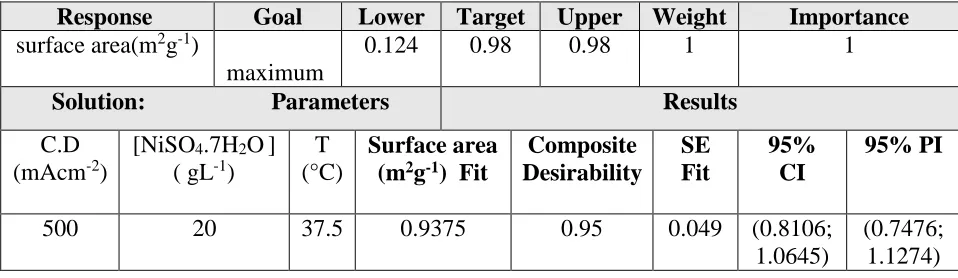
The numerical optimization of the software has been selected so as to discover the specific point that maximizes the desirability function. The desired goal was chosen by regulating the weight or importance that might change the goal characteristics. The goal ranges for the response of the model have five options: none, minimum, maximum, target and within range. The goal for the specific surface area of the powder is designated as ‘maximum’ with corresponding ‘weight’1.0. The lower limit value of the specific surface area is allocated at 0.124m2g-1 while the upper limit value allocates at 0.98m2g-1. The optimization procedure was performed under these settings and restrictions. The optimum values of the process variables in maximizing specific surface area are shown in Table 5 with desirability function of 0.95.
Temperature(C)
cu
rr
en
t
de
ns
it
y(
m
A
/c
m
2)
65 60
55 50
45 40 35
30 25
500
400
300
200
100
[image:13.596.58.537.223.362.2]
One of the main goals of this work is to confirm the result acquired for RSM-based optimized process factors. For their confirmation, duplicate confirmatory runs were achieved using the optimized factors. It was found that the average specific area is 1.05 m2g-1 which lies within 95% CI as shown in Table 6. These results confirm that Box-Behnken design could be efficiently employed to optimize the process operating factors in the electrolytic preparation of metal powders using the statistical design of experiments
Table 5. Optimum of process parameters for maximum specific surface area of nickel powder
Importance Weight
Upper Target
Lower Goal
Response
1 1
0.98 0.98
0.124 maximum
)
1
-g
2
surface area(m
Results Solution: Parameters
95% PI 95%
CI SE
Fit Composite
Desirability Surface area
(m2g-1) Fit T
(°C) [NiSO4.7H2O]
( gL-1)
C.D )
2
-mAcm (
(0.7476; 1.1274) (0.8106;
1.0645) 0.049
0.95 0.9375
37.5 20
[image:13.596.77.520.414.459.2]500
Table 6. Confirmative value of the optimum surface area
EC (kWhkg-1) CE
(%) surface area
(m2g-1) E
(Volt) Weight
(g) C
(°C) B
(gL-1) A
(mAcm-2)
24.0 30
1.05 7.86
1.848 38
20 500
3.4. Characterization of nickel powder
Figure 6. XRD diffraction pattern of the electrolytic nickel powder
Based on the results of BTE, XRD, AFM, it was observed that the prepared powder has excellent properties in comparison with the industrial nickel powder (Type 255-carbonyl process) that has a purity of 99.7% , an average particle size in the range ( 2.2 - 2.8 μm), and a specific surface area of 0.68 m2g
-1 [41].
[image:14.596.147.452.67.271.2] [image:14.596.28.569.415.606.2]
Figure 8. Optical micrograph of the optimum nickel powder. Magnification, 100X
4. CONCLUSIONS
From the results presented in this work it could be concluded that current density has the important role on the specific surface area of nickel powder while a sensitive role of metal ion concentration was observed with no effect of temperature. The Box–Behnken design was successfully used to create a mathematical model for predicting the specific surface area of nickel powder. The value of R2 > 0.9781 for the obtained quadratic model shows that there is high correlation between experimental results and predicted values by the model. Numerical Optimization using RSM gave optimum operating conditions as current density of 500 mAcm-2, nickel sulfate concentration of 20 gL
-1, and temperature of 38°C yielding a specific surface area of powder of 1.05m2g-1. Under these optimum
conditions, a current efficiency of 30% was observed, which is higher than the previous works. Interestingly, 3D-response surface plots combined with contour plots can be the suitable way for observing parameter interactions where a clear interaction between current density and nickel sulfate concentration was observed.
It should be emphasized that the first results on using of response surface methodology for studying the effect of interaction among electrolysis parameters on the specific surface area of metal powder are presented in this work and this methodology may be successfully used to study the importance of the individual, cumulative, and interactive effects of process variables in preparation of other metallic powders.
ACKNOWLEDGMENTS
References
1. A. Calusaru, Electrodeposition of Metal Powders, Elsevier, (1979) Amsterdam, The Netherlands. p. 299, 303, 377.
2. I. Šafařík and M. Šafaříková, Monatshefte. Fuer. Chemie. 133 (2002) 737. 3. A. I. Gusev, Phys. Usp., 41(1998) 49.
4. O. D Neikov, I. B. Murashova, N. A. Yefimov and S. Naboychenko, Handbook of Non-Ferrous Metal Powders: Technologies and Applications, Elsevier Science, (2009) Amsterdam, The
Netherlands.
5. J. M. Capus, Metal Powders: A Global Survey of Production, Applications and Markets 2001-2010, Fourth edition, Elsevier, (2005) Amsterdam, The Netherlands. p.90.
6. I. B. Murashova, Electrochemical Methods of Metal Powder Production in: O. D. Neikov, I. B. Murashova, N. A. Yefimov, S. Naboychenko, Handbook of Non-Ferrous Metal Powders: Technologies and Applications, Elsevier, (2009)Amsterdam, The Netherlands. p.181-211. 7. G. Wranglen , Acta Polytech. Electr. Eng. Ser. 2(1950)69.
8. R.M. Khalil, J. Appl. Electrochem., 18 (1988) 292.
9. S.G. Viswanath and M. M. Jachak, Metall. Mater. Eng., 19 (2013) 233. 10. C. L. Mantell, Production of nickel powder (1941) USA Patent No. 2233103.
11. A. M. Abd El-Halim, A. O. Baghlaf and R.M. Khalil, Powder Technol., 43(1985)103. 12. A.M. Abd El-Halim and R.M. Khalil, Surface Technology, 26 (1985) 343.
13. D.K. Borikar, S.S. Umare and S.G Viswanath, Metalurgija 45 (2006) 3. 14. O. I. Kuntyi, Russ. J. Non-ferrous Metals, 48(2007)17.
15. S.G. Viswanath and G. Sajimol, Metall. Mater. Eng., 18 (2012)129.
16. V. D. Jović, V. Maksimović, M. G. Pavlović and K. I. Popov, J. Solid State Electrochem., 10 (2006) 373.
17. K. Appelt, Z. Dominiczak, A. Nowacki and M. Paszkiewicz , Electrochem. Acta, 10 (1965) 617. 18. C. L. Mantell, J. Electrochem. Soc., 106 (1959)70.
19. B. B. Bagalkote and J. G. Kane, ind. J. Appl.Chem. 24 (1961) 29.
20. S.V. Kupin and B. S. Yurev, Poroshkovaya Metall (Translated) 145(1973) 20. 21. A.S. Kurlov, A.I. Gusev and A.A. Rempel, Rev.Adv.Mater. Sci., 32 (2012) 52. 22. A.V. Pomosov and I.B. Murashova, Powder Metall. Met. Ceram., 5 (1966)433.
23. M. Lucaci, S. Gavriliu, M. Lungu, I. Vida Simiti and I. Roman, J. Optoelectron. Adv. M., 6 (2004) 947.
24. M.A. Bezerra, R.E. Santelli, E.P. Oliveira, L.S. Villar and L.A. Escaleira, Talanta,76 (2008)965. 25. P.D. Haaland, Statistical Problem Solving, In: P.D. Haaland, Experimental Design in
Biotechnology, Marcel Dekker, (1989) New York. p.1-18.
26. M. Tir and N. Moulai-Mostefa, Desalin. Water Treat., 7 (2009) 214. 27. G.E.P. Box and D.W. Behnken, Technometrics, 2(1960)455.
28. S.L.C. Ferreira, R.E. Bruns, H.S. Ferreira, G.D. Matos, J.M. David, G.C. Brandao, E.G.P. Dasilva, L.A. Portugal, P.S. Dos Reis, A.S. Souza and W.N.L. Dos Santos, Anal. Chim. Acta, 597(2007)179. 29. M.Y. Can, Y. Kaya and O.F. Algur, Bioresour. Technol., 97(2006)1761.
30. M. Meilgaard, G.V. Civille and B.T. Carr, Advanced Statistical Methods, Sensory Evaluation Techniques, 2nd ed., CRC Press, (1991)Boca Raton, FL. p. 275.
31. B. Sharifi, M. Mojtahedi, M. Goodarzi and J.Vahdate Khaki, Hydrometallurgy, 99 (2009)72. 32. G. Kreysa, J. Appl. Electrochem., 15(1985)175.
33. A. I. Khuri and S. Mukhopadhyay, Response surface methodology, WIREs Comp Stat 2(2010)128-149.
34. E. Hamed and A. Sakr, J. Controlled Release, 73 (2001) 329.
36. R. Arunachalam and G. Annadurai, J. Environ. Sci. Technol., 4 (2011) 65.
37. M.S. Phadke, Quality Engineering Using Robust Design, Prentice Hall, (1989) New Jersey, USA. 38. A.M. Joglekar, and A.T. May, Cereal Food World, 32(1987)857.
39. A. H. Abbar, S. A. Rushdi and H. M. Al-Tameemi, Int. J. Electrochem. Sci., 12(2017)7075.
40. J. Aravind, C. Lenin, C. Nancyflavia, P. Rashika and S. Saravanan, Int. J. Environ. Sci. Technol., 12 (2015)105.
41. V. A. Tracey, Powder Metall., 9(1966)54.