Extracting Typed Values from XML Data
Richard Connor
‡David Lievens
‡Paolo Manghi
†‡Steve Neely
‡Fabio Simeoni
‡‡
Department of Computer Science
University of Strathclyde, Glasgow (Scotland)
†
Dipartimento di Informatica
Universit`a di Pisa, Pisa (Italy)
28th September 2001
Abstract
Values of existing typed programming languages are increas-ingly generated and manipulated outside the language juris-diction. Instead, they often occur as fragments of XML docu-ments, where they are uniformly interpreted as labelled trees in spite of their domain-specific semantics. In particular, the values are divorced from thehigh-leveltype with which they are conveniently, safely, and efficiently manipulated within the language.
We propose language-specific mechanisms which extract language values from arbitrary XML documents and inject them in the language. In particular, we provide a general framework for the formal interpretation of extraction mecha-nisms and then instantiate it to the definition of a mechanism for a sample language coreL. We prove that such mechanism can be built by giving a sound and complete algorithm that implements it.
The values, types, and type semantics ofLare sufficiently general to show that extraction mechanisms can be defined for many existing typed languages, including object-oriented languages. In fact, extraction mechanisms for a large class of existing languages can be directly derived fromL’s. As a proof of this, we introduce the SNAQueprototype system, which transforms XML fragments into CORBA objects and exposes them across the ORB framework to any CORBA-compliant language.
1
Introduction
Values of existing typed programming languages are increasingly generated and manipulated outside the language jurisdiction. Instead, they often occur as fragments of XML documents (cf. [8])1
.
This may be because the containing documents are
semistructured, i.e. their structure is too irregular or unstable to be effectively handled by traditional pro-gramming languages or DBMSs (cf. [1, 9]). It may also occur when the document is more disciplined, but needs to be exchanged across proprietary bound-aries in a standard and self-describing format.
1
Here and throughout the paper, XML is implicitly in-tended as a format for arbitrary data, not only document-oriented data.
As an example, consider the following XML doc-ument d, where some irregularities have been inten-tionally added to the data for sake of illustration.
<staff>
<member code = "123517"> <name>Richard Connor</name>
<home>www.cis.strath.ac.uk/~richard</home> </member>
<member code = "123345"> <name>Steve Neely</name> <ext>4565</ext>
<project>
<name>SNAQue</name> <project/>
</member>
<member code = "175417"> <ext>4566</ext>
<name>Fabio Simeoni</name> </member>
</staff>
On a much larger scale, this irregularity would prevent the document from being conveniently man-aged within the typed framework of conventional technology. While union types and object-oriented features may accommodate some of the irregularity, their abuse would soon degrade the performance of the system and complicate program specification and maintenance.
Consider instead the fragmentd′ ofdshown next:
<staff>
<member code = "123517"> <name>Richard Connor</name> </member>
<member code = "123345"> <name>Steve Neely</name> </member>
<member code = "175417"> <name>Fabio Simeoni</name> </member>
</staff>
class Staff {
private Member[ ] members; Member[ ] getMembers() {...}}
void setMembers(Member[ ] members) {...}} ...}
whereMemberis the class:
class Member {
private String name; private int code; String getName() {...}} void setName (String n){...}} int getCode() {...}}
void setCode (int c){...}} ...}
This simple observation raises the expectation that programming overd′ be as simple, safe, and efficient as programming over staff with existing program-ming languages. In particular, we require these good properties to scale, i.e. hold for generalised computa-tions over XML fragments considerably larger than
d′. Unfortunately, we believe that none of the cur-rent approaches fully satisfies such requirement.
1.1
Background
To date, computations over XML data can be speci-fied in a variety of paradigms, models and languages. Two kinds of approaches, however, appear to prevail: dedicated query languages and bindings to program-ming languages, typically object-oriented ones.
In query languages such as [11, 3, 14], queries have a familiar SQL-like structure, but contain powerful path expressions specified against the tree topology of the data. This gives the languages the flexibil-ity required to compute over data with irregular or partially known structure. It makes them also more succinct than full-fledged programming languages for most operations of data filtering and transformation. However, query languages are not computationally complete, nor well suited to complex programming tasks over large datasets, possibly involving recur-sion. Furthermore, they are essentially untyped, ex-cept with respect to the tree structure of the data. While this is justified in the general case by the type-less nature of the format, potential regularity in (sub-sets of) the data could and should be exploited for program verification and optimisation.
Language bindings are instead defined by imple-menting programming interfaces to one of two pos-sible in-memory representations of the data. In the Document Object Model interface (cf. [15]), the data is organised and manipulated as a labelled tree. In the Simple API for XML (cf. [23]), the data is a string of characters organised and processed along parsing events.
Beside performance-related differences, both solu-tions impose an interpretation of the data which gen-eralises their structural relationships (e.g. nodes of a
tree), but conveys only indirectly and too concretely their intended meaning (e.g. staff of a university de-partment). When computations explicitly address the structural properties of the data (e.g. adding or removing a node, searching for a string in the data), this interpretation is adequate. In most cases, how-ever, it complicates program specification, making it tedious, error-prone and hard to maintain.
Consider, for example, any computation over the names and codes of the staff members ind. In a pure implementation of the DOM interface for a Java-like language, the code may include something like:
int code;
String name=null;
Element staff=d.getDocumentElement(); NodeList members =
staff.getElementsByTagName("member"); int memberCount = members.getLength();
for (int i=0;i<memberCount,i++) {
Element member = (Element) members.item(i);
code = Integer.parseInt(member.getAttribute("code")); NodeList children = member.getChildNodes();
int length = children.getLength(); for (int j=0;j<length,j++) {
Node child = children.item(j);
if (child.getNodeType()==Node.ELEMENT NODE) { String tagName= ((Element) child).getTagName(); if (tagName.equals("name")) name=
((characterData) child.getFirstChild()).getData(); }} ...do something with name and code ...}
Even for a simple task, the code is highly con-voluted and inefficient. Partly, this is due to the document-oriented nature of any XML programming interface. For instance, semantically related data must be accessed with the different algebras of ele-ments and attributes. Similarly, manipulating atomic data requires an implicit or explicit cast from the type of strings, the only available. More generally, the logic of the computation is unnecessarily expressed in an algebra of trees, while domain-specific concepts (e.g. names and codes) are relegated to the role of run-time parameters.
The same task could have been specified directly against the objectstaffof classStaffdefined above, and as simply as:
Member[ ] members = staff.getMembers(); for (int i=0;i<members.length,i++) {
int code = members[i].getCode(); String name = members[i].getName(); ...do something with name and code ...}
The code is now aligned to the semantics of the application. It is also more succinct and less redun-dant, for generic operations on staff and staff mem-bers do not have to be repeated within specific com-putations, but can be factored out in class definitions, thoroughly tested, and then reused.
not staff members. For example, the following invo-cation:
NodeList members =
staff.getElementsByTagName("mebmer");
where "mebmer" is a typo for "member", would silently compile and return anullvalue only at run-time. Safety is thus responsibility of the program-mer, not the system. Programmatic checks worsen readability and maintainability of the code, and are not always sufficient to guarantee correct behaviour. In the lack of some description of the data (e.g. a DTD), the typo may be interpreted as the absence of required data and thus trigger unintended behaviour. Even assuming some data description, the typo may accidentally identify some other data or, in the best case, be simply signalled at run-time.
For similar reasons, the system can optimise re-sources only within the limits of its static knowledge of the data. For instance, it ignores the fact that all staff members have names and codes.
1.2
Extraction Mechanisms
Motivated by the previous observations, we aim at defining high-level bindingsbetween XML and exist-ing programmexist-ing languages, which preserve the in-tended semantics of the data.
Specifically, we propose language-specific mecha-nisms that extract self-describing representations of language values from arbitrary XML documents, and transform them into their counterparts within the language. Thereafter, the extracted data are com-puted over in a familiar, expressive, and robust envi-ronment.
To achieve this for a given language, we interpret the extraction of a value as the projection of its lan-guage type over the containing XML document. Fol-lowing the previous example, the projection of class
Staff over d would result in the extraction of the objectstaff.
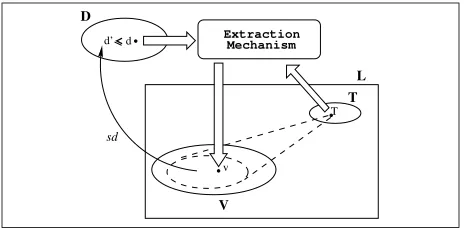
More formally, letDbe the set of XML documents, L a typed programming language, and V and T the
value and type spaces of L, respectively (see
Fig-ure 1). Let also sd : V → D be a self-describing
interpretation ofL’s values inD, and ¹inD×D a
relation of containment between XML documents.
Definition 1.1 Let v ∈ V. v is extractable from
d ∈D according to T ∈ T if: (i) v has type T, and
(ii) there existsd′¹dsuch that sd(v) =d′. Finally, anextraction mechanismforLtakes both
a document d and a type T, and returns a value v
extractable fromdaccording toT, if one exists. An extraction mechanism is invoked by a program-mer, via some interface to the language. If no ex-tractable value can be returned, the programmer is
Extraction Mechanism
<
V
T d’
D
T
sd
L
[image:3.595.310.543.51.165.2]v d
Figure 1: An extraction mechanism forL
notified of the failure. In case of successful extrac-tion, the returned value may still not fully satisfy the programmer’s requirements.
The reason is that, when passing a type to the mechanism, the programmer may not be aware of the exact structure of the target document. Such a type will probably be defined after an eye-inspection of the document or, if available, a description of its structure. As a result, the type may be an under-specification or an over-under-specification of the data that are potentially relevant to the programmer.
These sort of misjudgements may be very frequent, especially in correspondence with large documents in which data have been inserted at different times and possibly by different users with a different cognition of data representation.
In general, we require that some quantification of relevance be always returned along with the value ex-tracted by the mechanism, and Section 6 will present one quantification scheme in more detail. By inter-preting the quantification, the programmer may con-clude the inadequacy of the proposed type, refine it, and then re-invoke the mechanism in a prototyping fashion.
1.3
Outline
In the rest of the paper, we concentrate on the formal definition of an extraction mechanism. This is done in Section 4, after the definition of a simplified syntax for XML data and a typed language core in Section 2 and Section 3, respectively.
Section 5 completes the definition of the extraction mechanism by presenting an algorithm that imple-ments it. The algorithm is then used to illustrate a sample quantification scheme in Section 6. Section 7 presents a prototype implementation of the mecha-nism, while Section 8 and Section 9 examine related work, draw conclusions, and outline further work.
2
A Document Syntax
In this section, we define a syntax for XML docu-ments that isolates the data-oriented features of the format (e.g. naming and nesting) from its document-oriented features (e.g. ordering, attributes, processing instructions, etc.)2
.
Definition 2.1 LetDbe the language of documents
defined by the following grammar:
d, d1, d2::=<>| s |< l1→d >| d1∧d2
where li ∈ Lbl, s ∈ Str, and the sets Lblof labels
andStrof strings are pre-defined languages over the same alphabet of characters.
A document d is atomic or complex. An atomic document is either theempty document<>or else a string. A complex document is either the singleton document< l→d >or the concatenationd1∧d2of
two complex or empty documents. Finally, we shall consider equal two documents that differ only in the ordering of components (e.g.d1∧d2=d2∧d1).3
In the rest of the paper, we shall abbreviated=< l1 → d1 > ∧. . .∧ < lp → dp > with < l1 →
d1, . . . , lp → dp > and refer to l → d as to an l−
fieldwith namel and valued. We will also use the functionFVlwhich takes a document and returns the
set of itsl-field values.
Definition 2.2 Letl∈Lbl. LetFVl:D→℘(D)be
the function:
FVl(d) =
{d′} d= [l
→d′] FVl(d1)SFVl(d2) d=d1∧d2
∅ otherwise
As an example, the following documentd
< member→< name→Richard, age→<>>>
is a rewriting of the XML syntax
<member>
<name>Richard</name> <age/>
</member>
whileFVmember(d) ={< name→Richard, age→< >>}.
3
A Language Core
In this Section, we present the language L for our
sample extraction mechanism of Section 4. For our purposes, it suffices a language core defined around a value notation, a language of structural types, and a relationship of typing between the two. Extensions to
2
In practice, element attributes may be replaced by subele-ments.
3
Essentially, a document is an edge-labelled tree, in slight contrast with the standard interpretation of XML documents as node-labelled trees. This choice allows us to simplify the formal treatment but has no impact on the applicability of our results.
full-fledged languages with value operators or object-oriented types do not present particular problems.
Along the way, we follow a principle of generality that allows extraction mechanisms for other typed languages to be derived from L’s.
We have chosen for La selection of the type
con-structs commonly found in existing programming lan-guages. Available types are constructed from a range of atomic typesB1, B2, . . . , BN. They include record,
set, and union types, possibly recursively defined. Record constructors are the singleton record type
[l : T]and the concatenation T1∧T2 of two disjoint
record types4
. Set types are denoted byset(T), where
T is the member type of the set5
, recursive types by
µX.T, whereT is the body of the type and Xa type variable, and union types byT1∨T2, whereT1andT2
are the branch types of the union. Contrary to most languages, union types are untagged, as we do not need tags to describe alternatives in the structure of the data6
.
Definition 3.1 Let T be the language of types
gen-erated by the following grammar:
T, T1, T2::=Bk |X| [l:T] | T1∧T2 |T1∨T2 | set(T) |µX.T
wherel∈Lbl, X∈Var, k∈ [1, n].
As for documents, two types are equal if they differ only in the ordering of the components (e.g. T1∧
T2 = T2∧T1 and T1∨T2 = T2∨T1). Similarly,
we shall implicitly extend to types the abbreviations, conventions, and auxiliary functions introduced for documents.
The values ofLinclude the elements of the atomic
types, singleton records [l = v], disjoint concatena-tions v1∧v2 of two record values,7 sets {v1, . . . vn},
and the empty set{ }. 8
Finally, value equality follows the same rules as document and type equality.
Definition 3.2 LetVbe the language of values
gen-erated by the following grammar:
v, v1, . . . , vn::=bk | [l=v] | v1∧v2 | { } | {v1, . . . , vn}
wherel∈Lblandbk∈Bk.
The relation of typing between values and types is standard and can be defined as follows:
4
Two record types are disjoint when they have no field name in common.
5
We could have chosen bag types that, differently from set types, can describe repeated sub-documents of a given doc-ument. The extension does not present particular problems but it slightly complicates the formal treatment and has been avoided here.
6
Of course, this does not exclude the use of tagged unions to increase static checking of programs. In this case, tags would be simply ignored for extraction purposes.
7
To improve readability, we do not syntactically distinguish the operations of concatenation of documents, types, and val-ues. The context shall clarify the domains of definition.
8
In the following examples, we shall assume thatLinclude integer numbersnof typeintand strings "s"of typestring
Definition 3.3 Letd∈D, T ∈T. dhas typeT ifd:
T, where:⊆D×T is the typing relationinductively
defined by the following rules:
bk:Bk (ATM) { }:set(T) (ESET)
v1:T, . . . , vn:T {v1, . . . , vn}:set(T)
(SET) v:T
[l=v] : [l:T] (SREC)
v1:T1 v2:T2
v1∧v2:T1∧T2
(REC) v:T £µX. T/
X¤ v:µX.T
(RCS)
v:T1
v:T1∨T2
(ULFT) v:T2
v:T1∨T2
(URGT)
and where ThµX. T/Xi denotes the standard opera-tion of (capture-avoiding) variable substituopera-tion.
4
An Extraction Mechanism
In this Section, we provide a self-describing interpre-tation of language values as well as an inclusion rela-tion between documents.
Definition 4.1 Let sd:V →D be the function
de-fined as:
sd(bk) =textify(bk)
sd([l=v]) =
<> v={ } Vn
i=1< l→sd(vi)> v={v1, . . . vn}
< l→sd(v)> otherwise
sd(v1∧v2) =sd(v1)∧sd(v2)
wheretextifyis any function that returns string rep-resentations of atomic values.
The interpretation is straightforward, except per-haps for the case of set values, which are interpreted only within record values. The reason is that set val-ues are not directly supported inDand must be
inter-preted in correspondence with repeated field names within complex documents.
For example, the document
<member→< name→Steve >, member→< name→Fabio >>
interprets the value
[member={[name= ‘‘Steve′′],[name= ‘‘Fabio′′]}].
In particular, values such as {1, 2},v∨ {1, 2}, or [a: {{1, 2}, 3}]cannot be interpreted inDfor no field label
is available for their interpretation.
Inclusion of documents is susceptible of different interpretations. Here, we have followed the simple intuition according to whichd′ is includeddifd′ is syntactically contained ind, with the exception that the empty document is included in any document.
Definition 4.2 Let d, d′ ∈D. d′ is containedind
ifd′¹d, where¹:⊆D×Dis the relation inductively
defined by the following rules:
<>¹ d (EMP)
s¹s (STR)
d1¹d2
< l→d1>¹< l→d2>
(SDOC)
d1¹d3 d2¹d4
d1∧d2¹d3∧d4
(DOC)
5
Extraction Algorithm
In this Section, we show the algorithm Extthat im-plements the extraction mechanism defined in Sec-tion 4.
Definition 5.1 LetV⊥=V S{
⊥}. LetExt:D×T
→V⊥ be the algorithm defined as
Ext(d, T) =
1 if unf(T)={T}
2 case of T
3 Bk:
4 { if ∃bk s.t. textify(bk)=d return bk
5 return ⊥ }
6 T1∧T2: return (Ext(d, T1)∧⊥Ext(d, T2))
7 [l:T′], T′=set(T′′): 8 {if d∈Str return ⊥
9 A:=∅
10 for each d′∈FV l(d){ 11 v= Ext(d′, T′′
) 12 if v6=⊥ A=AS{v} } 13 return [l=collect(A)] } 14 [l:T′], T′6=set(T′′): 15 { for each d′∈FV
l(d){ 16 v= Ext(d′, T′)
17 if v6=⊥ return [l=v] }
18 return ⊥ }
19 otherwise: return ⊥ 20 else
21 { for each T′∈ unf(T) { 22 v= Ext(d, T′)
23 if v6=⊥ return v } 24 return ⊥ }
where ∧⊥ : V⊥×V⊥ → V⊥ is the function defined
as:
v1∧⊥v2=
¯
⊥ v1=⊥or v2=⊥
v1∧v2 otherwise
Given d ∈ D and T ∈ T, Ext performs a
recur-sive analysis of both type and document and it either fails (i.e. returns ⊥) or else derives a value v ∈ V
extractable from d according to T. To achieve this, Extsolves two main problems.
Definition 4.1. This explains why Extprocesses set types only when processing record types and fails with types such asset(T)∨T orset(set(T)).
The situation is complicated further by the possi-bility that set types do occur within record types but are ‘protected’ by union or recursive types. Given the type[a:set(T)∨T], for example, we cannot re-cursively delegate to the union case the extraction of a value of type set(T), for we would lose the labela
necessary to extract the value set from the document. Ext solves the problem by extracting values only according to record types that are ’flattened’, i.e. con-tain no union or recursive type fields. This is achieved with the preliminary check on line 1, which invokes an implementation of the functionunf. unfis a gen-eralisation of the standard operation of one-step un-folding of recursive types. In particular, it one-steps unfolds a union type into the set of its branches, and a record type into the set of records obtained by one-step unfolding all its non-record field values.
Definition 5.2 Let unf : T → T be the function
defined as:
unf(T) =
{T′£µX. T/
X¤} T=µX.T′
{T1, T2} T=T1∨T2
{[l:T′]|T′∈unf
R(T)} T= [l:T] {T′
1∧T ′ 2|
T′
1∈unf(T1), T2′∈unf(T2)} T=T1∧T2 {T} otherwise
whereunfR:T →T is the function unfR(T) =
¯ {
T} T= [l:T]
unf(T) otherwise
For example,
unf([a:int∨set(string), b: [c:int∨set(int)]]) = {[a:int, b: [c:int∨set(int)]],
[a:set(string), b: [c:int∨set(int)]]}.
A typeT is then unfoldedifunf(T) ={T}, otherwise isfolded.
The second problem occurs when multiple values of typeT can be extracted fromd. Due to the presence of set and union types, this possibility is in fact the norm. For example, consider the document d =< a → 1, a → 2, b → 3, c → four > and the type
T = T1∨T2, where T1 = [a : set(int), b : int] and
T2= [a:set(int), c:string].
From Definition 1.1 and Definition 4.1, it is easy to see that the values [a = {1, 2}, b = 3] and [a = {1, 2}, c= "four"]are extractable fromdaccording to
T1andT2, respectively, and thus according toT. The
same is true of the values[a={ }, b=3],[a={1}, b=
3],[a={2}, b=3], etc.
Ext returns one extractable value on the basis of both abest-attemptand afirst-attemptpolicy. Specif-ically, it returns: (i) the largest value extractable fromdaccording to a set type, and(ii)the first value extractable from daccording to one of the branches
of union types, when these are ordered from left to right.9
In the previous example,Extderives the value
[a={1, 2}, b=3].
The best-attempt policy is justified by an immedi-ateprinciple of maximisationof the data contained in a correctly extracted value. The first-attempt policy is instead more arbitrary but it simplifies the defi-nition of the algorithm and is thus adequate for the purpose of a proof of concept.
In lines 21-23,Extimplements its first-attempt pol-icy and either fails or returns the first extractable value returned by a recursive execution of Extwith
dand an unfolding ofT.
In lines 2-19,Extprocesses basic, singleton record, and concatenated record types. For a basic typeBk,
Extis successful only ifd‘textifies’ a valuevof type
Bk (lines 3-5).
For singleton record types [l:T′],Exttries to de-rive a singleton record value [l :v], where the shape ofv depends on whetherT′ is a set type.
IfT′ is a set type set(T′′)(lines 7-13), Ext imple-ments its best-attempt policy and tries to extract a value of type T′′ from each l-field value of d. The extracted values are then memorised and eventu-ally grouped into a set value v by the sub-routine collect. Notice that, in this case, Ext fails only when the document is a string (line 8). Otherwise, it returns at worst the singleton record[l={ }].
IfT′is not a set type (lines 14-18),Extreturns the first value of typeT′extractable from anl-field value ofd. If such value does not exist,Extfails.
If T is the concatenation of two record types T1
and T2, Ext concatenates the values extracted from
daccording toT1andT2respectively. The operation
of concatenation ∧⊥ refines standard concatenation by returning ⊥ any time one of the operands is ⊥. This ensures that failing the extraction according to either singleton record type fails the entire process.
Extis clearly terminating, for it recursively oper-ates on subdocuments of the input document and be-causeunf,textify, andcollectare trivially termi-nating.10
In Appendix A, we shall also give a for-mal proof thatExtis sound, i.e. returns a value ex-tractable fromdaccording toT, and complete, i.e. it fails only when no value of type T can be extracted from d.
6
Relevance
In this Section, we present a simple relevance quan-tification scheme for the extraction mechanism
de-9
Accordingly, left-to-right is the branch ordering followed by the sub-routineunf.
10
fined in Section 4. The scheme can be easily embed-ded inExt, but we give it here a separate specification to improve readability.
Let us start with a motivating example. Consider the following documentd:
< staff < member→
< name→David > < project→
< name→SNAQue, . . . > . . . > < project→
< name→GLOSS, . . . > . . . > . . . > < member→
< name→Paolo > < project→
< name→Tequyla, . . . > . . . > < project→
< name→TQL, . . . > . . . > . . . > . . . >
and assume that the programmer requires to compute over named projects of staff members.
¿From an initial analysis of d, the programmer proposes the typeT:
staff: [member:set([project: [name:string]])]]
and the mechanism returns the valuev:
[staff= [member={[project= [name= "SNAQue"]],
[project= [name= "Tequyla"]]}]].
The programmer did not notice that some staff members have more than one project, i.e.dcontains more relevant data thanT makes possible to extract. To inform the user, we quantify theprecisionwith whichT describes the data ind that are relevant to the programmer. To return a readable measure, we distribute it along the singleton record types occur-ring inT, i.e where loss of relevant data may actually occur. The result is a set of annotations for T that may help the user to refine the type and improve ex-traction.
In particular, the precision of a singleton record type[l:T′]is measured with respect to all the docu-ments that are processed with[l:T′]on a successful execution path ofExt(d, T).11
Let thus D[l:T′] be the set of all such documents,
and let
P[l:T′]={(d′,[l=v′])|d′∈DT′,[l=v′] =Ext(d′,[l:T′])}.
The precision prec[l:T′] of[l :T′] is then calculated
as:
prec[l:T′]=
P
p∈P[l:T′]vprec(p)
|P[l:T′]|
where the value precision vprec of a pair in P[l:T′]
is defined as:
vprec(d′,[l=v′]) =
±
|v′| σ σ > 0
1 σ=0
11
By successful execution path ofExt(d, T), we intend a path of the execution tree ofExt(d, T) along whichExtnever fails.
and, in turn,σ= |FVl(d′)|and
|v′|=
0 v′={ }
n v′={v
1, . . . , vn}
1 otherwise
Informally,prec[l:T′]is the average of the precisions
calculated at each pair (d′,[l = v′]) ∈P[l:T′]. Each
of these is in turn the ratio between the number of
l-field values from which Extextracted a value and the number of those it did not.
In particular, low precision for a singleton T1 = [l : set(T′)] in T suggests that Ext did not extract values of type T′ from many l-field values in d. A renewed analysis of the data may then reveal that the singletonT2= [l:set(T′∨T′′)]allows to extract
more relevant data from d and should thus replace
T1. Similarly,[l:set(T′)]may do better than a
low-precision singleton [l:T′]ifT′6=set(T′′).
For example, the precision of typeTin the previous example may be returned as the following annotation:
1[staff1[member:set{21[project:1[name:string]]}]]
The user may then improve extraction by refiningT
into the type:
[staff: [member:set{[project:set([name:string])]}]]
which has precision1on all its singleton record types. The problem of relevance quantification is certainly complex and identifies an interesting research topic per se. The scheme presented is fairly simple, and we have introduced it as a proof of concept. Al-though we have not yet gathered experimental re-sults, we believe that the scheme can be useful with large datasets, where the exact structure of relevant data is not known when the mechanisms is first in-voked.
7
Snaque
Based on the algorithm Ext, we have built a dis-tributed system prototype. The system, maintained at the Computer Science Department of the Univer-sity of Strathclyde, is calledSNAQue-the Strathclyde Novel Architecture for Querying extensible mark-up language(cf. [29]). Although some parts are still un-der development, the system is currently being tested in a number of biodiversity projects by the Palaeobi-ology Research Group at the University of Glasgow.
SNAQue is a CORBA application that implements an extraction mechanism for a subset of theCORBA Interface Definition Language(cf. [28]), and therefore for any CORBA-compliant language (e.g. C, C++, Smalltalk, Java, Ada95, etc.).
Ext
CORBA objects
T
D
T
d
V
v o
XML IDL
[image:8.595.71.303.51.159.2]Client
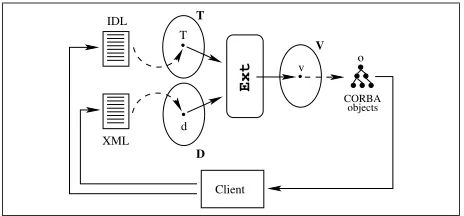
Figure 2: The SNAQue architecture
client, and maps them onto a documentd ∈D and
a type T ∈T, respectively. It then invokes Extand
transforms the output v ∈ V of type T in a
num-ber of interrelated CORBA objects. By virtue of the mapping from IDL toT, the objects expose interfaces
corresponding to the initial IDL description.
According to the XML specification, there is al-ways one entry point to the CORBA objects: the object o that corresponds to the root of the XML document. Finally, a reference to o is returned to the client for local binding in programs written in any CORBA-compliant language of choice. Option-ally, SNAQue may registero with a public alias pro-vided by the client. Then any client informed of the alias can come along and gain remote access too(see Figure 2).
The details of the mappings from XML toD, IDL
toT, andVto the corresponding CORBA objects are
out of the scope of this paper. Roughly, the mapping from XML concentrates on the data-oriented features of the format, while the mapping from IDL converts interfaces, sequences, and tagged union types, into records, sets, and untagged union types inT.
As an example, consider the document d and its fragmentd′introduced in Section 1. Using SNAQue, it is straightforward to compute overd′ with a code analogous to that shown in Section 1. One has only to provide SNAQue with the following IDL type de-scription:
interface Staff {
typedef sequence <Member> MemberSeq; attribute MemberSeq members; } interface Member {
attribute String name; attribute long code; }
With respect to these inputs, SNAQue will create four CORBA objects: one conforming to the Staff interface and three conforming to the Member inter-face. It will then return a reference to the first object to which clients can bind in their programs.
SNAQue choses Java to implement the extracted CORBA objects. In particular, the Java classes gen-erated by the system for the objects derived above are
exactly theStaff and Memberclasses shown in Sec-tion 1. Similarly, the Java-like code suggested there could be immediately used to compute over the data.
The choice of CORBA IDL as the type language is an obvious one. It increases the applicability of the extraction mechanism forLand makes it distributed.
However, the distributed nature raises performance issues, such as those related with every read or write operation performed on the data across the network. SNAQue offers two ways of tackling such problems. On the one hand it allows the use of value types12
. This allows clients topullthe generated CORBA ob-jects over the network and inject them in the local environment. On the other hand, SNAQue gives the possibility of pushing computations to the server, by allowing the clients to specify additional methods in the IDL interfaces. For example, theStaffinterface could be extended with a new method:
interface Staff {
typedef sequence<Member> MemberSeq; attribute MemberSeq members; Member getMember(in String name) }
SNAQue can not automatically generate the imple-mentation for this method, which has to be provided by the client. Due to the lack of space, we cannot discuss this facility in more detail.
8
Related Work
The differences between extraction mechanisms and existing approaches has been largely discussed in Sec-tion 1. It is worth noticing here that extracSec-tion mech-anisms operate on arbitrary XML documents and can thus be easily coupled with untyped query languages. In an integrated environment, the convenience of the first would complement the flexibility of the second for data with a varying degree of structural regularity. Other high-level bindings between XML and exist-ing programmexist-ing languages have been recently pre-sented (cf. [31, 16, 22]). They all map some form of data description (usually a DTD or an XML Schema) onto language types that capture directly the seman-tics intended for the data. For this reason, they op-erate on fairly regular XML documents and do not provide facilities for extracting regular subsets from arbitrary documents. In addition, they have been de-veloped for specific languages (e.g. Haskell, Java) and do not generalise.
The idea of exploiting regularity in XML, and more generally, semistructured data, has also motivated a number of approaches.
Early proposals were for extending standard database technology to accommodate some degree of
12
irregularity in the data, typically via the provision of union types. Although similar in motivation, such approaches differ from ours in their attempt to pro-vide a total description of the data. As mentioned in Section 1, significantly irregular data lead to an un-controlled use of union types, thereby progressively decreasing system performance and complicating pro-gram specification.
Later proposals assume a dedicated query language as a starting point, but differ in their data-first or type-first strategy.
Approaches of the first kind infer type informa-tion from existing datasets. In this case, type in-ference can be performed by the system for the en-tire database, automatically or semi-automatically (cf. [27, 25, 26, 20, 19]). The resulting types are mainly for users to understand the data and, to some extent, for query optimisers to improve execution (cf. [18]). Partial inference can be also performed by users, and the results then fed to the system as hints to reduce the scope of a search (cf. [10]). Over-all, inference-based approaches exploit typing for re-source optimisation, while computations remain es-sentially untyped.
Approaches of the second kind exploit static knowl-edge to guarantee computational safety (cf. [21, 4, 12, 13]). To achieve this against a tree-based model, they resort to low-level types for XML documents. Due to the support of regular expressions, suchtree typesare more flexible than high-level types in capturing irreg-ularities in the data (cf. [17, 30, 7, 6]).
To the best of our knowledge, Ozone (cf. [2]) is the only attempt to seamlessly integrate structured and semistructured data in the same typed environ-ment. The system extends the ODMG model to in-clude semistructured data, and allows structured ob-jects to be queried with semistructured primitives. Interestingly, it also supports a function for coercing semistructured data to structured objects according to a type and, as such, implements a simple extrac-tion mechanism for ODMG. However, our mechanism is proved correct and returns values of a larger set of types.
9
Conclusions and Future
is-sues
We have presented a novel approach to programming over XML data based on language bindings. The bindings are defined as mechanisms that identify and derive language values from subsets of arbitrary XML documents. When programming over such subsets, the approach delivers the computational advantages associated with the host language. Furthermore, the derived values preserve the semantics intended for the data, and thus facilitate program specification.
These mechanisms can be formally defined and cor-rectly implemented, and we have done it for a sample but representative core language. In particular, we have proven the generality of the sample mechanism by deriving extraction mechanisms for all CORBA-compliant languages directly from it.
Future research directions concern both theoreti-cal and practitheoreti-cal aspects of the investigation. Be-yond XML, we have already extended our results to more general forms of semistructured data. In par-ticular, we are able to extract language values from graph-structured data, i.e. in the presence of cycles and sharing. The interested reader is referred to [24] for the full treatment.
Another interesting direction relates to the defini-tion of inclusion between documents. The one we proposed follows first intuitions, but alternative def-initions could be considered. As a first example ex-ample, inclusion checks may start from arbitrary el-ements of the target document, not necessarily the root element. This would save the user the often te-dious task of describing the structure that leads from the root of the document to the data of interest. It would also give a hint of the flexibility achieved by navigational query paradigms without reducing the advantages of the approach.
The extraction algorithm has been proved sound but the belief that it is also tractable in pragmatic terms has not been supported by a formal analysis of its complexity. Although tests on large data samples have shown acceptable performance even on desktop machines, the impact of a considerable use of union types remains to be measured. Furthermore, we are currently working with back-tracking techniques to-wards algorithms with stronger properties of com-pleteness.
Relevance quantification could be certainly im-proved over the sample scheme proposed in Section 6. In particular, an extraction mechanism could cus-tomise a general scheme to the programmer’s spec-ifications.
Finally, SNAQue is under continuous development, and a web interface to the system is being published at the time of writing. The research agenda is cur-rently focusing on whether values can be virtually in-jected in the value space of the target language rather than materialised. Single or multiple indexes to reg-ular subsets suggest the possibility to dynamically synchronise the interface between the language and the database under updates. At the same time, they raise the opportunity for incremental extractions.
In addition, the client/server scenario raises a num-ber of questions related to the efficiency of the sys-tem and to the possibility of integrating data from distributed XML servers.
at the client side or else push client computations to the server. Completeness quantification could here be used by both client and server to make intelligent decisions about data or code migration.
In addition, the possibility of storing and publish-ing typed interfaces over the data at the server side suggests interesting data protection and data evolu-tion policies. For example, the usage and volume of XML data referenced through the interfaces could be gathered into statistical information that may be used to assess the impact of changes to the data.
References
[1] S. Abiteboul. Querying semi-structured data. Database Theory - ICDT ’97, 6th International Conference, Del-phi, Greece, pages 1–18, January 8-10 1997.
[2] S. Abiteboul, R. Goldman, T. Lahiri, J. McHugh, and J. Widom. Ozone: Integrating structured and semistructured data. Technical report, Stanford Univer-sity Database Group, 1998.
[3] S. Abiteboul, D. Quass, J. McHugh, J. Widom, and J.L. Wiener. The Lorel Query Language for Semistuctured Data. Journal of Digital Libraries, 1(1), pages 68–88, April 1997.
[4] Antonio Albano, Dario Colazzo, Giorgio Ghelli, Paolo Manghi, and Carlo Sartiani. A type system for querying XML documents. In Proceedings of ACM SIGIR 2000 Workshop On XML and Information Retrieval, Athens, Greece, July 2000.
[5] G. Amadio and L. Cardelli. Subtyping recursive types.
ACM Transactions on Programming Languages and Sys-tems(TOPLAS), 15(4), pages 575–631, 1993.
[6] Arnaud Sahuguet. Everything You Ever Wanted to Know About DTDs, But Were Afraid to Ask. InWebDB-2000, 2000.
[7] Paul V. Biron and Ashok Malhotra. XML Schema Part 2: Datatypes. Technical report, World Wide Web Con-sortium, December 1999. W3C Working Draft.
[8] T. Bray, J. Paoli, and C. Sperberg-McQueen. Extendible Markup Language (XML) 1.0. Technical report, World Wide Web Consortium, 1998. W3C Recommendation. [9] P. Buneman. Semi-structured data.In Proceedings of the
Sixteenth ACM SIGACT – SIGMOD – SIGART Sympo-sium on Principles of Database Systems, pages 117–121, 1997.
[10] P. Buneman, S. Davidson, M. Fernandez, and D. Suciu. Adding structure to unstructured data. Lecture Notes in Computer Science, 1186:336–350, 1997.
[11] Peter Buneman, Mary Fernandez, and Dan Suciu. UnQL: A Query Language and Algebra for Semistructured Data Based on Structural Recursion. VLDB Journal, 9(1):76– 110, 2000.
[12] Don Chamberlin, Daniela Florescu, and Jonathan Robie. Quilt: an XML query language for heterogeneous data sources. InProceedings of WebDB, Dallas, TX, May 2000. [13] Sophie Cluet, Claude Delobel, J´erˆome Sim´eon, and Katarzyna Smaga. Your mediators need data conversion! InProceedings of the ACM SIGMOD International Con-ference on Management of Data (SIGMOD-98), volume 27,2 ofACM SIGMOD Record, pages 177–188, New York, June 1998. ACM Press.
[14] Alin Deutsch, Mary Fernandez, Daniela Florescu, Alon Levy, and Dan Suciu. XML-QL: A Query Language for
XML. Technical report, World Wide Web Consortium, August 1998. Submission to the World Wide Web Con-sortium.
[15] Document object model (DOM).
http://www.w3.org/DOM.
[16] The Breeze Factor. Xml data binding and breeze xml studio (white paper). 2001.
[17] David C. Fallside. XML Schema Part 0: Primer. Techni-cal report, World Wide Web Consortium, October 2000. W3C Candidate Recommendation.
[18] Mary Fernandez and Dan Suciu. Optimizing regu-lar path expressions using graph schemas (full ver-sion), February 1997. Manuscript available from http://www.research.att.com/~{mff,suciu}.
[19] R. Goldman and J. Widom. Approximate DataGuides. In Proceedings of the second International Workshop WebDB ’99, Pennsylvania, June 1999.
[20] Roy Goldman and Jennifer Widom. DataGuides: En-abling query formulation and optimization in semistruc-tured databases. In VLDB’97, Proceedings of 23rd In-ternational Conference on Very Large Data Bases, Au-gust 25-29, 1997, Athens, Greece, pages 436–445. Morgan Kaufmann, 1997.
[21] Haruo Hosoya and Benjamin C. Pierce. XDuce: A typed XML processing language (preliminary report), May 2000. WebDB workshop.
[22] Sun Microsystems Inc. Web services made easier: The java apis for xml”. 2001.
[23] Megginson Technologies Ltd. SAX 2.0: The Simple API for XML, 2000. http://megginson.com/SAX/.
[24] Paolo Manghi. Extracting Typed Values from Semistruc-tured Databases. PhD thesis, Dipartimento di Informat-ica, Universit`a di Pisa - Italy, 2001.
[25] S. Nestorov, S. Abiteboul, and R. Motwani. Infer-ring structure in semistructured data. Workshop on Management of Semistructured Data, in conjuction with PODS/SIGMOD, Tucson - Arizona, 1997.
[26] S. Nestorov, S. Abiteboul, and R. Motwani. Extracting schema from semistructured data.ACM SIGMOD, pages 295–306, 1998.
[27] Svetlozar Nestorov, Jeffrey D. Ullman, Janet L. Wiener, and Sudarshan S. Chawathe. Representative objects: Concise representations of semistructured, hierarchial data. In Alex Gray and Per-˚Ake Larson, editors, Proceed-ings of the Thirteenth International Conference on Data Engineering, April 7-11, 1997 Birmingham U.K, pages 79–90. IEEE Computer Society, 1997.
[28] OMG. CORBA OMG IDL text file
-The Object Management Group, 1999. ftp://ftp.omg.org/pub/docs/formal/99-04-01.txt. [29] Anna Stavrianou. Querying XML through a CORBA
gateway. Master’s thesis, University of Glasgow (UK), September 1999.
[30] Henry S. Thompson, David Beech, Murray Maloney, and Noah Mendelson. XML Schema Part 1: Structures. Tech-nical report, World Wide Web Consortium, December 1999. W3C Working Draft.
A
Appendix
Lemma A.1 Letv ∈ V,T ∈ T. v : T if and only if there
existsT′∈unf(T)
such thatv:T′
.
Proof. By structural induction onT. The proof is immediate and we shall here discuss only the casesT=T1∧T2.
Assumev:T. For typing scheme (REC),v=v1∧v2, with
v1:T1, andv2:T2. For the inductive hypothesis,v1:T1′ and
v2:T2′, for someT ′
1∈unf(T1)andT2′∈unf(T2). For typing scheme (REC) and Definition 5.2, v=v1∧v2 :T1′∧T
′ 2 ∈
unf(T1∧T2) =unf(T).
Vice versa, assume v:T′, withT′ ∈unf(T). For Defini-tion 5.2,T′=T′
1∧T ′ 2, withT
′
1∈unf(T1)andT2′∈unf(T2). For type scheme (REC),v=v1∧v2, v1:T1′, v2:T2′. For the inductive hypothesis and typing scheme (REC),v=v1∧v2:
T1∧T2=T.
Proposition A.2 Letd∈D,T∈T. If Ext(d, T)6=⊥then
Ext(d, T) is extractable fromdaccording toT.
Proof. By induction on the heighthof the execution tree of Ext(d, T).
For the hypothesis, the caseh=1corresponds to one of the casesT=Bk andT′= [l=T′], withT=set(T′′). In the first case,Ext(d, T)=bk and sd(bk) =d. The thesis follows then from typing scheme (ATM), and the reflexivity of document inclusion.13
In the second case,v= [l={ }]. For Definition 4.1 and inclusion scheme (EMP),sd(v) =sd([l={ }]) =<>¹d. For typing schemes (SREC) and (ESET),v:Tand the thesis is proven.
Assume now an execution tree of heighth > 1and that the thesis is proven for all execution trees of heighth−1. Let us distinguish the cases in whichTis folded or unfolded.
If T is folded, the hypothesis ensures that Ext(d, T)=Ext(d, T′)= v =6 ⊥ for some T′ ∈ unf(T). For the inductive hypothesis, sd(v) ¹ dand v : T′
. For Lemma A.1,v:Tand the thesis is proven.
IfTis unfolded, there are three cases to examine.
(i)T =T1∧T2. For the hypothesis and the definition of ∧⊥, Ext(d, T)=v =v1∧v2, where v1 =Ext(d, T1)6=⊥ and
v2 =Ext(d, T2)6=⊥. For the inductive hypothesis, sd(v1)¹
d,v1 : T1,sd(v2)¹ d, and v2 : T2. For Definition 4.1 and inclusion scheme (DOC) , sd(v) =sd(v1∧v2) =sd(v1)∧
sd(v2)¹d∧d=d. For typing scheme (REC),v:T and the thesis is proven.
(ii) [l:T′], withT′ =set(T′′). For h > 1,FV
l(d)6=∅. For the hypothesis, Ext(d, T)=v= [l={v1, . . . , vn}], where
vi=Ext(di, T′′)6=⊥,di∈FVl(d), for eachi∈[1, n]and some
n∈ N. For the inductive hypothesis, sd(vi)¹ dand vi :
T′′. For Definition 4.1 and scheme (DOC) , sd(v) =sd([l=
{v1, . . . , vn}]) =V n
i=1< l→sd(vi)>¹ Vn
i=1< l→di >¹
d. For typing schemes (SREC) and (SET),v:Tand the thesis is proven.
(iii) [l : T′]
, with T′ 6= set(T′′)
. For the hypothesis, Ext(d, T)= v = [l = v′]
, where v′ =
Ext(d′, T′ )6=⊥, d′
∈
FVl(d). In particular,d= [l:d′]∧d′′, for somed′′∈(D). For the inductive hypothesis, sd(v′)¹ d′ and v′ : T′. For Definition 4.1 and inclusion scheme (DOC), sd(v) =sd([l=
v′]) =< l
→sd(v′)>¹d. For scheme (SREC),v:T and the
thesis is proven.
Proposition A.3 Let d∈ D, T ∈ T, v ∈ V. If vis
ex-tractable fromdaccording toT thenExt(d, T)6=⊥.
Proof. By induction on the heighthof the proof tree ofv:T. The caseh=1corresponds to one of the casev=bk and
v={ }. The second case is excluded by the hypothesis and
13
Reflexivity can be easily proven by structural induction on D.
Definition 4.1. In the first case, T =Bk,Ext(d, T)=bk 6=⊥ and the thesis is proven.
Assume now an execution tree of heighth > 1and that the thesis is proven for all execution trees of heighth−1. Let us distinguish the cases in whichTis folded or unfolded.
If T is folded, the hypothesis v : T and Lemma A.1 en-sure that v: T′, for someT′ ∈ unf(T), and thus that vis extractable fromdaccording toT′
. For the inductive hypoth-esis,Ext(d, T′
)6=⊥and thusExt(d, T)6=⊥.
IfTis unfolded, there are three cases to examine.
(i) T = T1∧T2. For typing scheme (REC) there ex-ist v1, v2 ∈ V such that v1 : T1, v2 : T2, and v =
v1∧v2. For the definition of ∧, Definition 4.1, inclusion schemes (EMP) and (DOC), and the hypothesis sd(v)¹ d,
sd(v1) =sd(v1)∧ <>¹ sd(v1)∧sd(v2) =sd(v1∧v2) =
sd(v)¹d. Similarly,sd(v2)¹d. For the inductive hypoth-esis, Ext(d, T1)6=⊥ and Ext(d, T2)6=⊥. For the definition of ∧⊥,Ext(d, T)=Ext(d, T1)∧⊥Ext(d, T2)6=⊥, and the thesis is proven.
(ii) [l:T′]
, withT′=set(T′′)
. The thesis follows immedi-ately fromExt(d, T)=[l=v′], for somev′∈(V).
(iii) [l:T′], withT′6=set(T′′). For the hypothesisv:Tand scheme (SREC),v= [l=v′],
andv′:T′
. For the hypothesis
sd(v)¹dand Definition 4.1, sd(v) =sd([l= v′] =< l
→ sd(v′)