JOURNALOFVIROLOGY, June 1989,p. 2437-2444 0022-538X/89/062437-08$02.00/0
Copyright © 1989, American
Society
for MicrobiologyIdentification of Temperature-Sensitive
Mutants
of Vaccinia Virus
That
Are
Defective in
Conversion of Concatemeric Replicative
Intermediates
to
the Mature Linear DNA Genome
A. M. DELANGE
Departmentof Human Genetics, University of Manitoba, Winnipeg, Manitoba, Canada R3E OW3
Received 9 November 1988/Accepted 15 February 1989
Pulsed-field gel electrophoresis wasused toscreentemperature-sensitive mutantsof vaccinia virusfor the
ability to convert replicated viral DNA intomaturelinear 185-kilobase hairpin-terminated genomes. Of 30 mutually noncomplementingmutantstested, 5displayedatemperature-sensitive defectinthe resolution ofthe telomere fusion configuration within concatemeric replicative intermediates, resulting ina failureto convert
such intermediates to the linear monomeric genome. Adjacent genomic units in the concatemeric arrays generatedinthesemutantswerearrangedinbothtandemand inverted orientations. Theobservation thatfour ofthefivemutantshada severegeneraldefect inthesynthesis ofthe late classof viral proteinssuggeststhat
atleastonelate protein is directly requiredtoresolvethetelomerefusion intermediatetohairpin termini. The identification of such telomere resolution proteins should be facilitated by geneticandmolecular characteri-zationofresolution-defective mutants, suchasC63, in which late protein synthesis isnotseverelyaffected.
Thepoxvirus family comprisesagroupof eucaryotic DNA viruseswhich characteristically replicate in a highly auton-omousfashion in the cytoplasm of infected cells. Members of thisfamily encode allornearly all factors requiredfor the replication of their large DNAgenomes(37, 45), aproperty which rnakes them choice candidates toidentify the corre-sponding genes and perform the genetic and molecular studies sovitaltounderstand themechanisms ofbiological phenomena such as DNA replication and recombination. Vaccinia virus, theprototype member of thisfamily, has a 185-kilobase (kb) linear double-stranded DNA genome which includes a 10-kb terminal inverted repeat that is terminally crosslinked by an A+T-rich incompletely base-paired hairpin structure. The terminal hairpin exists intwo
isomeric configurations (flip and flop), which are inverted andcomplementary in sequence(reviewed in reference 31). Thisgenomestructure isconservedamongpoxviruses.
Mechanisms used by poxviruses to replicate their DNA
are still ill defined. DNA replication takes place within specialized structures called "factories" or "virosomes." Initiation of DNAreplication has been examined by electron microscopy and in vivo labeling of early replicating DNA (17, 35, 36). The resultssuggestthe existence ofareplication origin at or near the hairpin terminus. The existence ofa specific origin sequence could not be confirmed by the in
vivo plasmid replication assay (21), since plasmids trans-fected into poxvirus-infected cells replicate efficiently
irre-spective of the presence ofpoxvirus DNA sequences (11, 28). The mechanism by which transfected plasmid DNA is replicated isnotunderstood. However, the observationthat
extensive recombination between and within exogenous plasmid DNA coincides with its replication (13, 18) may indicate thatareplicative recombination pathway similarto
thatobserved inT4 bacteriophage (fora review, see refer-ence30) is operative in poxviruses.
Newly replicated poxvirusDNA existsas high-molecular-weightaggregates(9), which have been postulatedtoconsist
of transient circular intermediates (1, 27) or concatemeric
arrays(32, 33), and whichareconverted intomature
hairpin-terminatedgenomes. Replication ofthehairpintermini
gen-erates replicative intermediate forms that existas inverted repeat configurations in which the two isomeric (flip and flop) hairpin strands are base-paired (13, 28, 32, 33). This "telomere fusion" configuration, whichconnects two adja-centterminal inverted repeatswithin replicative intermedi-ate structures, harbors the cis-acting DNA sequence that facilitates their conversion tohairpin termini (12, 13, 28).
Geneticanalysis of the vaccinia virus infective cycle has been initiated in severallaboratoriesthrough the isolation of temperature-sensitive mutants (6-8, 10, 14, 15), many of which have been screenedfor defective DNA replicationby
monitoring their ability to incorporate [3H]thymidine into viral DNA. This method has permitted identification of three DNA-negative complementation groups, whose wild-type genesarerequired for viral DNA synthesis (7, 8).
This articlereportsarapid and sensitive method of screen-ing mutants with replication defects that would have gone undetected with an in vivo labeling protocol. Specifically,
the detection of altered conformationalstates ofreplicated viral DNA requires a method that allows facile distinction betweenreplicative intermediates and the 185-kb linearviral
genomes. Pulsed-fieldgel electrophoresis (PFGE) and field
inversion gel electrophoresis are sensitive size-dependent separation procedures for linear DNA moleculesuptoabout 10,000 and 2,000 kb, respectively (4, 5, 39, 40), and allow separation of large circularDNAmolecules thatcannot enter thegel under conventional electrophoresis conditions(26).I
show the use of PFGE as a tool to rapidly detect and
characterize replication defects among temperature-sensi-tive mutants of vaccinia virus and show the existence of several classes ofmutants that are incapableofconverting concatemericreplicativeintermediatesintothematurelinear
185-kbgenome.The data suggest that this conversionevent isdependenton oneor morelate viralgeneproducts.
MATERIALS AND METHODS
Cellsand virus. Continuous lines of Africangreenmonkey
kidney cells (BGMKor BSC40cells)weregrownin mono-layercultures in Dulbecco modified Eagle (DME) medium supplemented with 5% fetal calfserum. Wild-typevaccinia
2437
Vol. 63, No.6
on November 10, 2019 by guest
http://jvi.asm.org/
2438 DELANGE
virus WR and mutants (ts C21, C37, C40, C42, C45, C46, C49, C52, C53, C56, C57, C60, C63, C5, C6, C7, C8, Cll, C13, C17, C50, C51, C25, C22, C33, C16, Cl, C30, C18, and C12) representing 30complementation groups were obtained from R. Condit (7, 8, 43). In this report, these mutants are referred to with the prefix C. Virus stocks were passaged at low multiplicity (0.05 to 0.1). Crudevirus preparations were routinely obtained by three cycles of freeze-thawing of 48-h-infected BSC40 cells. Propagation, purification, and titration of wild-type virus and temperature-sensitive mu-tants were done as described before (7, 8).
PFGE. Monolayers of BSC40 cells, infected at a multiplic-ity of 1 PFU per cell, were harvested by scraping the infected cells into the culture medium and pelleting cells at 700 x g, followed by suspension in a small volume (the amount depending on desired cell density, usually
107
cells per ml) of phosphate-buffered saline (PBS) with 40 mM EDTA. This cell suspension was placed at 40°C for at least 10 min before being mixed with an equal volume of 1% low-melting-point agarose (Bio-Rad Laboratories) contain-ing 0.125 M EDTA which had been warmed at 43°C.Thecell-agarose mixture was pipetted into plasticmolds (2 by5 by 10 mm) and allowed to solidify. Theresulting agarose blocks were treated for 24 h in a solution containing 1%
Sarkosyl, 100 ,ug of proteinase K per ml, 0.18 M EDTA, and 10 mM Tris chloride (pH 7.5), equilibrated withagitation at 4°C against two changes of electrophoresis running buffer (TBE; 0.1 M TBE is 0.1 M Tris, 0.1 M boric acid, 2 mM EDTA), after which they were stored in 0.1 M TBE at 4°C. Just prior to electrophoresis, agarose blocks (2 by 5 by 5 mm) were inserted in premolded wells and sealedwith0.5%
low-melting-point agarose. PFGE was performed in the LKB 2015 Pulsaphor electrophoresis unit. Initial gels (1.5%
agarose, 0.1 M TBE) were run with electrodes setfor a dual nonhomogeneous field of electrophoresis (5). In later runs, homogeneous fields, obtained with the use of a hexagonal electrode system (LKB), ensured straight lanes rather than the bent lanes routinely obtained with nonhomogeneous fields. The latter electrode system facilitates homogeneous electrophoresis conditions with an angle of1100between the alternating currents. Gels were run at 200 mA with pulse times as indicated, usually 25 to 100 s, and the electropho-resisbuffer was held at 15°C by means of cooling coils and a circulating-water bath. With the hexagonal electrode sys-tem, DNA samples were allowed to enter the gel at 5V/cm for 45 mintopromote sharper bands, followed by pulsing at indicated intervals and durations.
Following electrophoresis, DNA was partially depuri-natedby 15 min of incubation in 0.25 N HCI, transferred to a nitrocellulose membrane by Southern blotting (42), and hybridized with a32P-labeled probe. Probes were prepared by the random hexanucleotide primer method (19) with [32P]dCTP and [32P]dATP (Amersham). Washed blots were exposed to Kodak X-Omat R film with a Cronex Lightning-Plusintensifier screen (Du Pont Co.) at -70°C.
Restriction enzyme digestion of high-molecular-weight DNA. To further characterize the nature of DNA visualized by PFGE, DNA from agarose blocks was run in 1.5% low-melting-point agarose-0.1 M TBE and stained briefly with1.0 ,ug of ethidium bromide per ml, and individual bands were excised. The excised bands (1 to 1.5 mm thick) were first equilibrated at0°C against two changes of TE (10 mM Trischloride [pH 7.5], 0.1 mM EDTA) and then against two changes of restriction enzyme buffer (as recommended by thesupplier), and finallydigestion was allowed to take place for at least 8 h at 37°C for XhoI or 30°C for SmaI in the
2 4
:.
6 8!-
24ORIGIN
242.5
-48.5
FIG. 1. PFGE analysis ofreplicatingandreplicated DNAfrom wild-typevaccinia virus. MonolayersofBSC40 cellswereinfected
at amultiplicity of5withwild-typevaccinia virus strainWR,andat
2,4, 6, 8, and24hafterinfection,infected cellswereembedded in agaroseblocks, treated withSarkosylandproteinaseK(see Mate-rials andMethodssection), andsubjectedtoPFGEanalysis.DNA
was electrophoresed for 48 h in 200-mA nonhomogeneous fields whichalternatedat25-sintervals,allowingseparationof linearDNA
molecules uptoabout 400kb. TheDNAwasthen transferredto a
nitrocellulose membraneandhybridizedwithplasmidpAB208
(ob-tained from A. Ball), which contains a 4-kb DNA fragment of vaccinia virus. Bacteriophage lambdaoligomers wereusedas size standards. Sizesareindicatedin kilobasepairs.
presence of0.2 U of restriction enzyme per ,ul.
Agarose
plugs thustreatedwere
placed
in wells andelectrophoresed
under conventional orPFGE conditions of
electrophoresis.
TheXhoI-digestedDNA waselectrophoresed
in0.7%agar-ose for18 hat 1.25
V/cm,
and theSmaI-digested
DNAwaselectrophoresedin 1.5%agaroseat200
mA,
with 30-spulses
for 16 h and 8-spulses for8 h.Thegels
werethenblotted andprobed with
plasmid
pVT1, which contains a1.4-kb Sau3Afragment fromthe
region
oftandem repeatsnearthetermini ofthevacciniavirus genome.Protein synthesis and SDS-PAGE.
Techniques
for[35S]_
methionine
pulse-labeling
ofproteins
within vaccinia virus-infected cells andfor sodiumdodecyl
sulfate-polyacrylamide
gel electrophoresis
(SDS-PAGE)
andautoradiography
oflabeled samples were
basically
as describedby
Condit andMotyczka (7).
Briefly, monolayers
ofBSC40
cells were infectedat amultiplicity
of between 5 and50,
incubatedat32or 40°C for various
periods
oftime,
washed twice with warmed PBS, and pulse-labeled for 15 min in warmed PBScontaining 20
,uCi
of[35S]methionine (1,100
Ci/mmol;
Amer-sham) per ml at either 32 or
40°C.
Theproteins
were thensolubilizedin
electrophoresis
sample buffer(22),boiled for4min, frozen at -20°C, and reboiled for 4 min
prior
toelectrophoresis on 10% or 12.5%
polyacrylamide-SDS
slabgels, with the mini-Protean
gel
system from Bio-Rad. Thegels were fixed and stained in 40% methanol-10% acetic
acid-0.1% Coomassie blue R-250, dried under vacuum, and
autoradiographed.
RESULTS
PFGE ofwild-type vaccinia virus. The
migration
ofrepli-cating and replicated
wild-type
vaccinia virus DNA inpulsed-field gels was examined
by
analysis
of viral DNAisolated at 2, 4, 6, 8, and 24 h
postinfection
(Fig. 1).
The earliest detectable viral DNA, visible at 4 hpostinfection,
remained associated with the agarose matrix in thewell,
as J. VIROL.on November 10, 2019 by guest
http://jvi.asm.org/
[image:2.612.383.503.78.225.2]VACCINIA VIRUSES DEFECTIVE IN CONCATEMER RESOLUTION
was the great majority of high-molecular-weight cellular DNA. The viral replicative intermediates in the "well"
fraction became prominent at 6 h postinfection, at which
time a small amount of a linear DNA molecule appeared, which migrated at 180 to 190 kb, as would be expected for the 185-kb linear vaccinia virus genome. This band will henceforth be referred to as the 185-kb monomer ormature
genome. The monomer band became prominent at 8 h
postinfection and reached a maximum level sometime be-tween 8 and 24 hpostinfection. At 24 h postinfection, very little
repticating
DNA (well fraction) remained. No signifi-cant differences between efficiencies of DNA replication at 32and 40°C have been detected. The only consistent differ-ence was the presence of a weak slower-migrating band, which was present at 32°C but absent at 40°C. This band represents alinear dimeric molecule (see next section).PFGE oftemperature-sensitive mutants. To monitor
repli-cation defects among a collection of 30 noncomplementing
temperature-sensitive mutants, monolayers of BGMK cells wereinfected with individual mutants at a multiplicity of 0.5 andincubated at 40°C for 48 h; agarose blocks were prepared
as usual and electrophoresed under the PFGE conditions describedin thelegend to Fig. 1. This analysis revealed four classesofmutants. First, the majorityofmutants (21 of 30) behaved like the wild type (Fig. 1, 24 h postinfection).
Second, mutants C42 and C17 did not generate newly
replicated DNA at 40°C. These mutants were previously identified as DNA negative by failure to incorporate
[3H]thymidine.Third, mutants C25 and C50, when grown at
40°C, produced levels ofthe 185-kb monomer band which were reduced at least 10-fold. C25 has previously been identified as a DNA-negative mutant, whereas no DNA
replication defect has been reported for C50. Fourth, five mutants(C21, C53, C63, C7, and C22) displayed, in addition
to a weak monomer 185-kb band, significant quantities of
slower-migrating DNA as wellas ahigh proportion of DNA that was incapable of enteringthe gel.
Among the 30 mutants tested, 9 displayed either quantita-tive orqualitativedefectsin viral DNA replication. Three of these mutants are DNAnegative. Interestingly, the remain-ing six mutants share a "defective late" or "abortive late"
protein synthesis phenotype (8). Conversely, only a single
defective late mutant, C56, had no apparentdefect in viral
DNA replication. The defective late class of mutants was
characterized in moredetail. Infected monolayers ofBSC40 cellswereincubated for 24 hat32 or40°C,afterwhich DNA was prepared in agarose blocks and subjected to PFGE
analysis under conditions that enable separation of linear DNAmolecules up toabout 1,000kb. Both wild-type virus WR and mutant C56 replicated their genomes with equal
efficiency into185-kb monomers at either 32 or 40°C(Fig. 2 and3; lanes 1, 2, 7, and 8). In contrast, mutant C50 (Fig. 2 and3; lanes 11 and 12)consistently replicated about 10-fold less DNAat40°C than at32°C. Virtually allreplicated DNA
was present as an apparently mature linear monomer. This result appears to bein contradiction toaprevious report, in which no reduction in the amount of DNA synthesis was detected when incorporation of
[3H]thymidine
was mea-sured. The discrepancy appears to be due to the fact thatprevious measurements were done at a multiplicity of 10 rather than 1. Afterincreasing the multiplicity to 10 and 40 and analysis by PFGE, little or no reduction in the total amountof DNA synthesis was observed (not shown).
Thephenotypeof fourof fivemutants(C21, C53, C7,C22, and C63) with slowly and nonmigrating DNA species is
illustrated in Fig. 2, 3, and 4. At 32°C, these five mutants
1 2 3 4 5 6 7 8 9 10 11 12 13 14 15
=7rI a I v -I =
FIG. 2. PFGE analysis ofDNAfromtemperature-sensitive mu-tantsof vaccinia virus:ethidium bromide-stained gel. Monolayers of BSC40 cellswereinfectedat amultiplicity of1withwild-typeWR
(lanes 1 and2) and with mutantsC21 (lanes 3and4),C53 (lanes5 and 6),C56 (lanes7and 8),C7(lanes9and10), C50 (lanes 11 and 12),andC22(lanes13and14).Infectedmonolayerswereincubated for 24 h at 32°C (odd-numbered lanes) or 40°C (even-numbered lanes), after which DNA was prepared and PFGE analysis was
performed asdescribed in thelegendto Fig. 1,exceptthat homo-geneous fields were used and currents were alternated at 100-s
intervalstoallowseparation oflinear DNA molecules up toabout
1,000 kb.Tofacilitate visualization ofconcatemerbands,7.5 x 105
ratherthan 2.5 x 10⁵cellswereused inlane 4. Yeastchromosomes
wereused assize standards(lane 15).
behavedlike the wild type. In eachcasethe greatmajority of
replicated DNA resolved into the mature 185-kb monomer genome. However, at 40°C all five mutants displayed a
characteristic patternofDNA molecules which, in addition
to a reduced amount of the 185-kb monomer, contained a
ladderofslow-migratingDNA speciesas well as an abnor-mallyhigh proportion of viralDNA thatwasunabletoenter
the gel matrix. This pattern ofslow-migrating DNA mole-culeswasnotaffectedby changesinmultiplicityofinfection,
atleast in the range between 1 and 25. (Figure 4 shows the
1 2 3 4 5 6 7 8 9 10 11 12 13 14
.t_.
A.:
w _ r, ;^. 1 -oOL |G O+RIl PE NTA4_ .|-TETRA
* w*, 1 i_~~~~~~~~~~~~TR
_
4 b DI
~-MONO
.~ ~ ~
.~~~~~~~~~~- r
FIG. 3. PFGEanalysisofDNAfromtemperature-sensitive mu-tantsof vaccinia virus: Southern blot. The gel illustratedin Fig. 2
was blotted and hybridized with vaccinia virus DNA (Fig. 1).
Members of the oligomeric series are indicated. The
slowest-migratingbandrepresentslongerlinearoligomers(oligo) and appar-ently nonlinear replicative-intermediate (RI) DNA (see text). See
Fig. 2legend forlanedetails.
2439 VOL.63, 1989
on November 10, 2019 by guest
http://jvi.asm.org/
[image:3.574.293.510.65.222.2] [image:3.574.285.525.484.654.2]2440 DELANGE
12 3 4 5 6
*1* j-ORIGIN
^ _0LIGOfRI
t %-PENTA
* *F-TETRA
* w-TRI
* ~~~~~DI
t*§999- MONO
FIG. 4. PFGEanalysis of DNA fromC63-infected cells. Mono-layers of BSC40 cells were infected atamultiplicity of1(lanes1and 2)5(lanes 3 and 4)or25(lanes5and 6). Infected monolayerswere
incubated for 24 h at32°C (lanes 1, 3, and 5)or40°C (lanes 2, 4, and 6), after which DNA was prepared and PFGE analysis was per-formed as described in the legend to Fig. 2. Members of the
oligomeric series areasdescribed in thelegendtoFig. 3.
effect ofmultiplicity of infection on replication products of
mutantC63.) That therelative proportionsof slow-migrating DNA wereinvariantas afunction oftime afterinfectionwas
demonstrated by time course analysis of each of these
mutants. Whetheranalyzed at6 to 8 h postinfection, when
viralDNAfirst entered the gel, or at 24 or 48 h postinfection, noqualitative differences were detected. That the ladder of slow-migrating DNA moleculesrepresentedaseries of linear oligomers ofthe 185-kb vaccinia virus genome was initially
suggested by their apparent sizeson pulsed-field gels.
Sev-erallinesofevidence confirm both thelinearandoligomeric
natureofthese DNAspecies. First, duringconventional gel
electrophoresis, all linear DNA molecules above a certain
molecular weightmigrate at a constantidenticalratethrough
sieving by thegel matrix, and relaxed circular DNA mole-cules above a certain size fail to enter the gel matrix (26). When the ladder of DNA molecules generated by mutant
C21 on a pulsed-field gel was subjected to conventional
electrophoresisat anangletotheinitialdirectionusedduring PFGE, itwasfoundthat all except theslowest-movingband
migratedatidenticalrates (Fig. 5), aswouldbe expected of
linear DNA molecules in the observed size range. The
slowest-moving band consisted oftwocomponents, alinear componentcapable of migratingunderconventional
electro-phoresis conditions, and an apparently nonlinear compo-nent,called RI inFig.3 and5,whichfailed tomigrate under those conditions. Second, oligomeric forms of the linear genome ofa poxvirus are expected to consist ofmultiple components of the unit genome which are linked by the
inverted repeat "telomere fusion" configuration. When members of the oligomeric ladder from mutant C21 were excised and digested with the restriction enzyme XhoI,
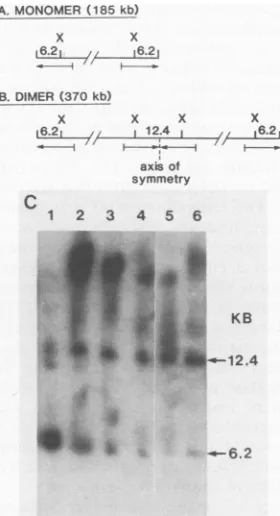
hairpin-terminatedand telomere fusion fragments of 6.2 and
12.4kb, respectively, were obtained in ratios expected for an
oligomeric ladder, i.e., thefast-migrating monomerband of 185kbcontained only the 6.2-kb terminal hairpin fragments, whereas the slowest-migrating members of the oligomeric series harbored predominantly 12.4-kb telomere fusion
frag-ments(Fig. 6). When the well fraction of nonmigrating DNA
was similarly analyzed, the telomere fusion configuration
again constitutedthe predominant component (Fig. 6C, lane
6). Third, digestion of the oligomers with the restriction enzymeSmaI,which cleaves the mature vaccinia virus DNA genome once, generating 35-kb and 150-kb fragments, re-sulted in the additional appearance of double-size (70 and
300kb)andof genome-size(185 kb) digestion products (Fig.
_,,n,C']~~~~~~CLGC) FT:NTA
1TE. THA
=_ ~~~~~~~~~~~TF-3
FIG. 5. Identification of linear and nonlinearconcatemers from C21-infected cells. Monolayers of BSC40 cells were infected at a
multiplicity of 1 and incubated at 40°C for 24 h, and DNA was
preparedasdescribed in Materials and Methods. Conditionsof the first dimensionofPFGE were as described in the legend to Fig. 2. Theresulting concatemeric array of fragments generated by PFGE wasexposedtoconventional electrophoresis at a550 angle to the first dimension. This was achieved by turning off the switching device used forPFGE. The four lanes contain DNA from 2x 10⁶, 1 x 106,5 x 105,and 2.5 x 10⁵cells, respectively, from left toright. The gel was stained with ethidium bromide and photographed. Linearmonomers(mono),oligomers (di, tri, tetra, penta, and oligo), and anonlinear presumed replicative intermediate (RI) hybridized
withvaccinia virusDNA(Southernblot notshown).
7). The double-size molecules representtheinverted orien-tation and the genome-size molecules the tandemorientation ofadjacent genomicunitsof the concatemers(Fig. 7B). The slower-migratingmembers of theoligomericDNAmolecules generated increased quantities of the 70-kb, 185-kb, and
300-kbfragments, andcorrespondingly reduced amounts of
the terminal 35-kb and 150-kb fragments, as would be expected of anoligomeric series.
Proteinsynthesis:SDS-PAGE oftemperature-sensitive mu-tants. The30 mutantsanalyzedinthisstudyhave been tested
previously for their abilitytoincorporate[3H]thymidineinto
viral DNA and for the ability to synthesize both early proteins (before DNA replication) and late proteins (afterthe onset of DNA replication) (7, 8). On the basis of these
experiments, it was shown that a class of DNA-positive mutants, representing seven complementation groups,
dis-played characteristically defective or abortive synthesis of
lateproteins. Upon examination of the 30mutantsby PFGE, I observed a nearly perfect correlation between defective DNA replication and late-protein synthesis. Thus, mutants
with normal protein synthesis generated normal amounts of the mature 185-kb genome. Conversely, six of seven abor-tive late and defecabor-tive latemutantsproduced either reduced
amounts of DNA or a characteristic pattern of linear and
nonlinear concatemeric DNA (Table 1). Defective late mu-tants are a highly heterogeneous class which includes mu-tants that exhibit a veryextreme shut-down oflate-protein synthesis and others with only slightly delayed or reduced
protein synthesis (8). In an attempt to correlate the differ-encesintheproteinsynthesis phenotype with defectsatthe DNA level, I analyzed protein synthesis in cells infected with each of the seven defective or abortive late mutants.
Even though, as expected, all seven mutants displayed a J. VIROL.
on November 10, 2019 by guest
http://jvi.asm.org/
[image:4.612.390.508.75.262.2] [image:4.612.127.249.76.192.2]VACCINIA VIRUSES DEFECTIVE IN CONCATEMER RESOLUTION
A.MONOMER (185 kb)
x x
16.21 / 1 16.21
B. DIMER (370 kb)
x x x x
16.21 ,,f 1 12.4 6 2
0i_ e 7IL
-~
axisof
symmetry
C
1 2 3 4 5 6
KB
i:
A. MONOMER (185 kb)
150 35
B. DIMER (370 kb)
DIRECT REPEATS
150 S 185 S35
3_5l 185 S 150 1
INVERTED REPEATS:
35s 300 S35,
I50 _ 70 s 150
axisof
symmetry
c 1 2 3 4 5 6 -12.4
[image:5.612.331.530.78.393.2]--6.2
FIG. 6. Prevalence of the hairpin and telomere fusion conforma-tions within members of the oligomeric series from C21-infected
cells. The 185-kb monomer genome (A)andthe 370-kb dimer(B)
contain10-kb terminalinvertedrepeats (indicated byarrows).XhoI (X) cleaves within theserepeats to generatea6.2-kb terminalhairpin
fragment and a 12.4-kb telomere fusion fragment (see text). (C)
MonolayersofBSC40cellswereinfected withmutantC21,and the infectedmonolayerswereincubated for24hat40°C. The resulting oligomerswere excised from theagarosegel, digested in situ with
XhoI, and electrophoresed in 0.7%agarosegel under conventional
electrophoresis conditions,asdescribed in Materials and Methods.
The gel was blotted and hybridized witha 1.4-kb vaccinia virus
terminal DNAfragment.The6.2-kb (hairpin)and 12.4-kb (telomere
fusion) fragmentsareindicatedbyarrows. Lane 1,Monomer; lane
2, dimer; lane 3, trimer; lane 4, tetramer; lane 5, oligomer plus replicativeintermediate (see Fig.5); lane 6;originorwell fraction. The faintbands in lane 1 (atapprox. 11and 12kb)representpartial digestion products, and the slow-migrating bands in lanes 2 to 6
probablyrepresentundigestedorpartiallydigested high-molecular-weightDNA.
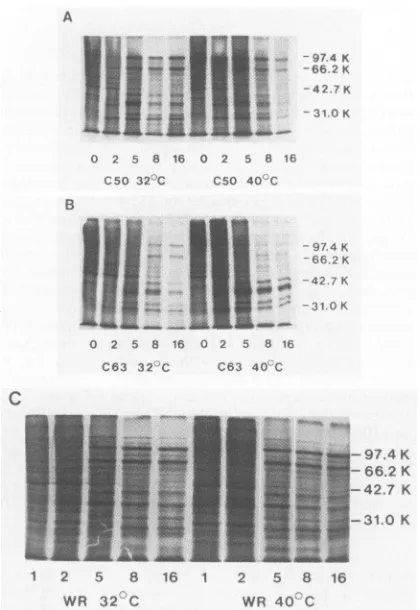
defectiveorabortive latephenotype,thepatternsofproteins on SDS-polyacrylamide gels permitted subdivision of these mutants on the basis of the kinetics of activation of late-protein synthesis at 40°C. Mutants C21, C53, and C7 dis-played a characteristically much delayed onset of
late-protein synthesis, which never approached the wild-type level. The remainingmutantswereshowntoinitiate expres-sion ofatleast themorehighly expressedlateproteinswith wild-type kinetics. The apparently normal switch to late-protein synthesis between 2 and 5 hpostinfection wasthen followed by a gradual decline (C50, C56, and C63) or an abrupt cessation (C22) of the synthesis ofsome orall late proteins. Figure 8 shows the synthesis of late proteins as early as 5 h after infection with wild-type WR or with mutantsC50and C63.
DISCUSSION
PFGE has been used successfully to screen
temperature-sensitive mutants ofvaccinia virus for defects during the
a1
FIG. 7. Structure of high-molecular-weight concatemers from C21-infected cells. The 185-kbmonomer(lanes1 and7),dimer(lane 2),trimer(lanes3 and8),tetramer(lane 4), oligomer plus replicative
intermediate(lane 5), andnonmigratingwell DNA (lanes6and9)
were excised from low-melting-point agarose as described in the
legendtoFig.6 anddigestedin situ withSmaI(S),andtheresulting
restriction fragments were analyzed by PFGE as described in
Materials and Methods.SmaI cleaves the 185-kbmonomergenome of vaccinia virusoncetoproduce35-kb and 150-kbfragments (A; C,
lanes 1 and 7). SmaI digestion of the 370-kb dimer generates additionalfragmentsof70, 185,and300kb,each of which contains
atelomere fusion element (B; C, lane 2). These telomere fusion
fragments (indicated by arrows in panel C) were obtained from
dimers, trimers,tetramers,oligomers plus replicative intermediates,
and thenonmigratingwell DNA. Asexpected,theproportionof the 35-kb and 150-kb hairpin-containing fragments (indicated by "hairpins" inpanel C)decreases with increasingsizeof the
oligo-mers. Note that lanes 1 to6represent incomplete digestsand that the observed partial digestion products,e.g., twofragmentsin the 185-to300-kbrange, arecompatiblewiththe proposed oligomeric
structures(B). Complete digests (C,lanes 7to9)showthatonlythe twohairpin fragmentsweregeneratedfrom the 185-kbmonomer(C,
lane 7) and that three additional (telomere fusion) fragments were
generated from the oligomers (C, lane 8) and nonmigrating well DNA (C, lane9). Sizes (in kilobase pairs) were determined from lambdaoligomerstandards.
termination phase of viral DNAreplication. Thistechnique was shown to be a sensitive and relatively rapid way to
detect not only the mature viral 185-kb DNA genome, but
also aseries of linear concatemers and as yet
uncharacter-ized nonlinear DNAstructures. Characteristicconcatemeric arrays were generated during replication of each of five noncomplementing mutants at the nonpermissive
tempera-ture. The linearconcatemersin thesearrays were shown to
7 8 9
S
VOL.63, 1989 2441
on November 10, 2019 by guest
http://jvi.asm.org/
[image:5.612.103.243.79.337.2]2442 DELANGE
TABLE 1. Summary of DNA and protein synthesis defects amongsix defective-late mutantsandoneabortive-latemutant
Activation of DNA
Mutant late-protein conformation Defectivegene
synthesis (PFGE) product
(SDS-PAGE)
C56 Normala Normal N.D.b
C50 Normala Normalc Nucleosidetriphosphate phosphohydrolase I C22 Normald Concatemers N.D.
C63 Normala Concatemers N.D.
C7 Delayed Concatemers 22-kDa RNApolymerase
subunit
C21 Delayed Concatemers 21-kDaRNApolymerase
subunit?
C53 Delayed Concatemers 147-kDaRNApolymerase subunit
a These mutants display a reduced rate of synthesis of some or all late proteinsafter the switch from early- to late-protein synthesis.
bN.D., Not determined.
Reducedamount of DNA synthesis (see text). d Abortive late-protein synthesis (34).
consistofmultiple lineargenomeunits linkedtogetherbythe viraltelomere fusion element. These concatemeric arrays, which have also been visualized by field inversion gel
electrophoresis (unpublished data), haveevidently accumu-lated as a result of a defect in the mechanism of telomere
resolution.
A
97.4K
K
-42
0 2 5 8 16 0 2 5 8 16
C 50 32C CC50 40 C
B
Z'-W .. so
X I :.
;.:11... .., ,,. .
0 2 5 8 16 0 2 5 8 16
c63 32 C c63 40 C
-97.4 K 66.2K
-42.7K
-310K
.~~~"o -97.4 Ks
__ w w-~~~~~-66.2K
w
wXBB
-il
E~~~~
42.7 K21_ i 16 1 3 2.v
1 2 5 8 16 1 2 5 8 16
WR 32 C WR 40" C
FIG. 8. Protein synthesis in mutants C50 (A), C63 (B), and
wild-typestrainWR(C).BSC40cellswereinfected atamultiplicity of20andincubatedfor0,1, 2,5, 8,or16 hat 32 or40°C,afterwhich
they were pulse-labeled with [35S]methionine and samples were
electrophoresed on 12.5% (A and B) or 10% (C)
polyacrylamide-SDSgels. Molecularmasses are indicated in kilodaltons.
Replicationof thewild-type vaccinia virus genome gener-ated DNAcomplexesthatfailed toenteragarosegels under conventional or pulsed-field electrophoresis conditions. Thesecomplexesareprobablyequivalenttothelarge DNA aggregates observed in neutral sucrosegradients (9, 16). At the earliest time after infection that viral DNA entered the
gel, onlythe185-kbmonomerformwasdetected.Therefore,
resolution of the telomere fusion conformation present in
wild-type replicating aggregates (32, 33) to hairpin termini
musttakeplaceonDNA aggregates thatareunable toenter
thegelmatrix.This telomere resolution mechanism isclearly impaired in some mutants, resultingin the accumulation of linear concatemers. Linear concatemeric arrays are also
generated when a circular plasmid containing a telomere fusionfragmentisallowedto replicate and resolvetolinear minichromosomes in cells infected with wild-type virus(13, 28). Once established, the relative ratios of different
mem-bers of theoligomeric arrays of either poxvirus genomes or
minichromosomes are invariant, suggesting that they are terminal replication products that are no longer substrates for resolution of resident telomere fusion elements. The failuretofurther resolve these fusionelements within linear
concatemers would be explained if a superhelical DNA substrateorattachmenttoamatrix structure were a prereq-uisite to anefficient resolutionevent.
The presence of linear concatemers among the DNA
products ofmutant virus isalways accompanied by a high
proportion ofapparently nonlinearreplicative DNA, most of which never enters the gel matrix. The existence oflong
stretches oflinear concatemeric DNA (300 kb and longer)
withinthese DNA aggregates, demonstrated by digestion of such DNA with the restriction enzyme SmaI, supports the notion that themutants aredefective in the conversion of the telomere fusion elements to hairpin termini. The failure of these concatemeric DNA aggregates to enter agarose gel
matrixes would beexplained if they containreplicating DNA
or consist of fully replicated DNA that is either circular,
partially circular, or attached to a Sarkosyl-proteinase K-resistant matrix. In any case, inefficient resolution of the telomere fusion elements wouldrelease large linear
concate-mers from the DNA aggregates. The remaining nonlinear structureswould fail to enter thegel ormigrate slowly under PFGE conditions ofelectrophoresis. The observation that the intercalating drug ethidium bromide inhibits replication ofa fast-sedimenting replicative intermediate suggests the existence of a circular orpartially circular replicative inter-mediate (1). Circular structures could act as precursors to the replication offast-sedimenting concatemeric replicative
intermediates, which are then converted to hairpin-termi-nated linear DNA molecules by resolution of the hairpin fusion elements.
Digestion of the concatemerswith therestriction endonu-clease SmaI, which cleaves vaccinia virus DNA once, has demonstrated that both tandem and inverted orientations of adjacent units in the concatemeric arrays exist with about equal incidence. This observation is in contrast to the observed structure ofreplicating rabbit poxvirus DNA, in which theinverted orientation predominates (33). My results
are compatible with the model proposed by Moyer and Graves (33), which postulates replication of linear DNA genomes into concatemers in which adjacent genome units are present in the inverted orientation. Subsequent
recom-bination between the terminal inverted repeats of
nonadja-centunits promotesconversiontoboth tandem and inverted orientations. The defective resolution of concatemers in mutant virus would be expected to extend the time period J.VIROL.
-..7f
V-W--".."w
;?!i. I
--,
16Nq j..,
1::.e,
T.,4- 9
iill. u
f: 1:
-O.?. 4miw
on November 10, 2019 by guest
http://jvi.asm.org/
[image:6.612.68.304.101.245.2] [image:6.612.81.291.370.675.2]VACCINIA VIRUSES DEFECTIVE IN CONCATEMER RESOLUTION
neededto facilitate suchrecombination eventsand thereby increase the
proportion
of tandem orientations.The onset of viral DNA replication is a prerequisite for
synthesis
oflate viral proteins. Consequently,DNA-nega-tive mutants fail to produce late proteins. Inaddition, late
viral protein synthesis is defective or abortive in several
DNA-positivemutants(7, 8, 23). Ithas nowbeen foundthat
five ofsevendefective or abortivelate mutants of vaccinia virus are unable to convert replicatedconcatemer interme-diates to mature viral genomes. In agreement with this
observation,
thesame mutants haverecentlybeenshowntobe
defective
in theconversion of telomerefusion-containing
plasmids
to linear minichromosomes (29). In contrast, no DNAreplication
defectswereobservedamong mutantsthatdisplay
normalprotein synthesis.
These datasuggest that theresolution of concatemeric
replicative
intermediates requires the function ofone or more late gene products. Theaccu-mulation ofconcatemersinmutantvirusmay be anindirect effect due to a
general
failure tosynthesize sufficientquan-tities of late
proteins
or a direct effect of a defectiveconcatemerresolution
protein.
Anexample ofamutantthat appears to act in an indirect fashion isprovided
by theabortive late mutant
C22,
inwhich the failure tosynthesize lateproteins
iscausedbytherapid degradation ofRNA(34).The RNA
polymerase
mutants C7, C51, and C53 representanother class ofgenes that may
indirectly
affect concatemer resolution. Mutants C7 andC53,
which have lesions in the 22- and 147-kDasubunits ofthe virus-encoded RNApoly-merase,
respectively,
combine a severe defect in proteinsynthesis (20, 44)
and defective resolution of concatemericreplicative
intermediates. MutantC21,
which isprobably
defective forthe21-kDaRNA
polymerase
subunit(41), hasasimilar
phenotype. Conversely,
bothprotein synthesis
and DNAreplication
arenormal in anothermutant(C51)that hasalesionin the 147-kDa subunit ofRNApolymerase. These data support the contention that one or more late
proteins
are
required
for efficient resolutionof concatemericreplica-tive intermediates. Identification of these concatemer
reso-lution
proteins
may well be achieved throughanalysis
ofmutantsthataredefective inconcatemerresolutionbut have
little or no defect in
late-protein
synthesis. Two candidate genes have been identified.First,
mutant C63displays
aconcatemer
phenotype
that is identicaltothatoftheseverely
late defective RNA
polymerase
mutants, yet it has normal kinetics of activation of lateproteins
andonly
slightly
reduced amounts ofsome late
proteins.
Theslight
decreasein
protein synthesis
observedmaypossibly
be accountedforby
an indirect effect ofunresolved concatemerproducts.
Asecond mutant,
9383,
withaphenotype
similartothatofC63wasrecently detectedduring screeningofmutants obtained
from S. Dales(10, 24).
Preliminary mapping
dataplaced
themutation in both C63 and 9383 withinalate gene clusterin
the
HindIII-D/Ajunction region
(46). The mutation inmu-tantC63waslocalizedtotheleft-most1.5kbofthe
HindIIl-A
region, consisting
ofthreecomplete
openreading
frames(ORFs) corresponding
tolateproteins
withpredicted
sizes of17,
26, and 9kDa,
and part of the ORFencoding
themajor
latecorepolypeptide
P4b. Themutationinmutant9383waslocalizedto a1.9-kbBamHI-XhoI
region
in HindIII-Dwhich contains part of two ORFsencoding
63-kDa latepolypep-tides and the
complete
ORFencoding
a 32-kDaprotein
which
is
expressed
bothearly
and late (25). A detailedanalysis
of these two mutants is inprogress.The
weak
defective latephenotype
of two temperature-sensitive mutants was notaccompanied
by
the presence of concatemers. The reducedquantity
of DNA observed withoneof these mutants(C50) may reflect defective viral DNA replication, which in turncouldleadto apartialinhibitionof
late-protein synthesis following an initially wild-type kinetics and rate of late-protein synthesis. The defective gene prod-uct in C50 is nucleoside triphosphate phosphohydrolase I, a DNA-dependent ATPase (3, 38, 41), which has been postu-lated to function in transcription, DNA replication, and recombination. Further studies are needed to establish any such role(s).
Finally, the PFGE approach has proven very useful as a rapid and sensitive method to identify various types of
replicative-intermediate DNA molecules and in its use of screening collections of temperature-sensitive mutants for specific defects in the conversion of these intermediates to a matureviralgenome. Both PFGE and its sister method field
inversion gel electrophoresis have the potential to become instrumentalinidentification of defective genomes,mapping (2), and detailed analysis ofthe interconversion of replica-tive-intermediate andmaturegenome structures of wild-type andtemperature-sensitive mutants.
ACKNOWLEDGMENTS
IthankR. ConditandS. Dales formakingmutantsavailable;R.
Condit, G. McFadden, andJ. Davie forvaluable discussions;and M.Gibb andJ.Baccari for technical assistance.Thanks are also due toJosie Dumaran for typing the manuscript.
I am anMRC Scholar. Thisworkwassupported by the Manitoba Health Research Council and the Medical Research Council of Canada.
LITERATURECITED
1. Archard,L.C.1979.De novosynthesis oftwoclassesofDNA
inducedby vaccinia virus infection ofHeLa cells.J.Gen.Virol. 42:223-229.
2. Bostock, C. J. 1988. Parameters of fieldinversion gel electro-phoresis for the analysis ofpox virusgenomes.NucleicAcids Res.16:4239-4252.
3. Broyles,S.S.,andB. Moss. 1987. Identification ofthevaccinia virusgeneencoding nucleoside triphosphate phosphohydrolase I, aDNA-dependentATPase. J. Virol.61:1738-1742.
4. Carle,G.F.,M.Frank,and M. V.Olson. 1986.Electrophoretic separationsoflargeDNAmoleculesby periodic inversion of the electricfield. Science232:65-68.
5. Carle, G. F., and M. V.Olson. 1984. Separationof
choromo-somalDNAmolecules fromyeastby orthogonal-field-alteration gelelectrophoresis. Nucleic Acids Res.12:5647-5664. 6. Chernos, V. I., E. G. Belanov, and N. N. Vasilieva. 1978.
Temperature sensitive mutants of vaccinia virus. I. Isolation andpreliminary characterization. ActaVirol. 22:81-90.
7. Condit,R.C.,and A.Motyczka. 1981. Isolation andpreliminary
characterization oftemperature-sensitive mutants of vaccinia
virus.Virology 113:224-241.
8. Condit, R. C., A. Motyczka, and G. Spizz. 1983. Isolation, characterization,andphysical mappingoftemperature-sensitive mutants ofvaccinia virus.Virology 128:429-443.
9. Dahl, R.,andJ.R. Kates.1970. Intracellularstructures contain-ing vaccinia DNA: isolation and characterization. Virology 42:453-462.
10. Dales,S.,V.Milovanovitch,B. G. T.Pogo, S.B.Weintraub,T.
Huima, S. Wilton, and G. McFadden. 1978. Biogenesis of
vaccinia: isolation of conditional lethal mutants and electron
microscopiccharacterizationof theirphenotypicallyexpressed
defects. Virology84:403-428.
11. DeLange,A.M.,andG. McFadden.1986.Sequence-nonspecific
replication of transfected plasmid DNA in poxvirus-infected
cells. Proc. Nati.Acad.Sci. USA83:614-618.
12. DeLange,A.M.,andG. McFadden. 1987.Efficient resolution of replicated poxvirus telomeres to native hairpin structures
re-quirestwo inverted symmetrical copies ofacoretarget DNA
sequence. J. Virol. 61:1957-1963.
VOL.63,1989 2443
on November 10, 2019 by guest
http://jvi.asm.org/
2444 DELANGE
13. DeLange, A. M., M. Reddy, D. Scraba, C. Upton, and G. McFadden. 1986. Replication andresolution ofcloned poxvirus telomeres in vivogenerateslinearminichromosomes with intact viralhairpin termini. J. Virol.59:249-259.
14. Drillien, R., D. Spehner, and A. Kirn. 1982. Complementation andgenetic linkage between vaccinia virus temperature-sensi-tivemutants.Virology119:372-381.
15. Ensinger, M. J. 1982. Isolationandgenetic characterization of temperature-sensitive mutantsof vaccinia virus WR. J. Virol. 43:778-790.
16. Esteban, M., and J. A. Holowczak. 1977.Replication of vaccinia
DNA in mouse L cells. I. In vivo DNA synthesis. Virology
78:57-75.
17. Esteban, M., L. Flores, and J. A. Holowczak. 1977. Model for vaccinia virusDNAreplication.Virology83:467-473.
18. Evans, D. H., D. Stuart, and G. McFadden. 1988.Highlevels of genetic recombinationamong cotransfected plasmid DNAs in poxvirus-infected mammalian cells. J.Virol. 62:367-375. 19. Feinberg, A. P., and B. Vogelstein. 1983. A technique for
radiolabelling DNA restrictionendonuclease fragmentstohigh
specific activity. Anal. Biochem. 132:6-13.
20. Hooda-Dhingra, U., C. L. Thompson, and R. C. Condit. 1989.
Detailedphenotypic characterization offive temperature-sensi-tivemutants inthe 22- and 147-kilodalton subunitsof vaccinia virusDNA-dependent RNA polymerase. J. Virol. 63:714-729. 21. Kucherlapati, R., and A. I. Skoultchi. 1984. Introduction of
purified genes into mammalian cells. Crit. Rev. Biochem. 16:
349-379.
22. Laemmli, U. K. 1970.Cleavage of structural proteins during the assembly ofthe head of bacteriophage T4. Nature (London) 227:680-685.
23. Lake, J. R., and P. D. Cooper. 1980. Synthesis of virus DNA
andpolypeptidesby temperature-sensitivemutantsofrabbitpox virus.J. Gen. Virol.47:243-259.
24. Lake, J. R., M. Silver, and S. Dales. 1979. Biogenesis of
vaccinia: complementationand recombination analysis ofone group ofconditional-lethal mutantsdefective in envelope self-assembly. Virology96:9-20.
25. Lee-Chen, G., and E. G. Niles. 1988. Transcription and
transla-tion mapping of the 13 genes in the vaccinia virus HindIll D
fragment. Virology 163:52-63.
26. Levene, S. D., and B. H. Zimm. 1987. Separations of
open-circular DNA using pulsed-field electrophoresis. Proc. Natl.
Acad. Sci. USA84:4054-4057.
27. McFadden, G., and S. Dales. 1979. Biogenesis ofpoxviruses:
mirror-imagedeletions invaccinia virusDNA. Cell 18:101-108. 28. Merchlinsky, M., and B. Moss. 1986. Resolution of linear
minichromosomes with hairpin ends from circular plasmids
containing vaccinia virus concatemeric junctions. Cell 45:879-884.
29. Merchlinsky, M., and B. Moss. 1988. Sequence-independent
replication and sequence-specific resolution of plasmids
con-taining the vacciniavirusconcatemerjunction:requirements for
early and late trans-acting factors,p.87-93. In T. Kelly and B.
Stillman (ed.), Cancercells 6:eukaryotic DNA replication. Cold
SpringHarborLaboratory,ColdSpring Harbor,N.Y. 30. Mosig,G. 1987.The essential role of recombination inphageT4
growth.Annu.Rev. Genet. 21:347-371.
31. Moss,B.1985.Replicationofpoxviruses,p. 685-703.In B. N. Fields(ed.), Virology. RavenPress,NewYork.
32. Moss, B., E. Winters, and E. V. Jones. 1983. Replication of vacciniavirus, p.449-461. In N. Cozzarelli(ed.),Mechanisms ofDNAreplicationandrecombination. Alan R.Liss, Inc.,New York.
33. Moyer, R. W., and R. L. Graves. 1981. The mechanism of
cytoplasmic orthopoxvirus DNAreplication. Cell 27:391-401. 34. Pacha, R. F., and R. C. Condit. 1985. Characterization ofa
temperature-sensitive mutantofvaccinia virus revealsa novel
function that prevents virus-induced breakdown of RNA. J. Virol. 56:395-403.
35. Pogo,B. G.T.,E. M.Berkowitz,and S.Dales. 1984.
Investiga-tion of vaccinia virus DNAreplication employingaconditional lethal mutantdefective in DNA. Virology132:436-444.
36. Pogo,B. G.T.,M.O'Shea,andP. Freimuth. 1981. Initiation and termination of vaccinia virus DNAreplication. Virology 108: 241-248.
37. Prescott,D.M., J. Kates, andJ. B. Kirkpatrick. 1971. Replica-tion of vaccinia virus DNA in enucleated L-cells.J. Mol.Biol. 59:505-508.
38. Rodriguez,J. F.,J. S.Kahn,and M. Esteban. 1986.Molecular
cloning, encodingsequence, and expression of vaccinia virus
nucleic acid-dependent nucleoside triphosphatase gene. Proc.
Natl. Acad. Sci. USA 83:9566-9570.
39. Schwartz,D.C., and C. R.Cantor. 1984. Separation of yeast chromosome-sized DNAs by pulsedfield gradient gel
electro-phoresis. Cell 37:67-75.
40. Schwartz,D.C., W.Saffran,J.Welsh, R.Haas,M.Goldenberg,
and C. R. Cantor. 1982. New techniques for purifying large DNAs andstudying their properties and packaging. Cold Spring HarborSymp. Quant. Biol. 47:189-195.
41. Seto, J., L. M. Celenza, R. Condit, and E. G. Niles. 1987.
Genetic mapofthe vaccinia virus Hindlllfragment. Virology
160:110-119.
42. Southern,E. M. 1975. Detection ofspecific sequencesamong DNAfragments separated by gel electrophoresis.J.Mol. Biol.
98:503-517.
43. Thompson, C. L., and R. C. Condit. 1986. Marker rescue
mapping of vaccinia virus temperature-sensitivemutantsusing overlapping cosmid clones representing the entire virus ge-nome. Virology150:10-20.
44. Thompson, C. L., U. Hooda-Dhingra, and R. C. Condit. 1989.
Fine-structuremapping of five temperature-sensitive mutantsin
the 22- and 147-kilodalton subunits of vaccinia virus
DNA-dependentRNApolymerase. J. Virol. 63:705-713.
45. Villarreal, E. C., N. A. Roseman, and D. E. Hruby. 1984. Isolation ofvaccinia virusmutantscapable ofreplicating inde-pendentlyof thehostcellnucleus.J. Virol. 51:359-366.
46. Weinrich, S.L., and D. E. Hruby. 1986. Atandemly-oriented
late gene cluster within the vaccinia virus genome. Nucleic AcidsRes. 14:3003-3016.
J. VIROL.