0022-538X/91/010505-06$02.00/0
Copyright © 1991, American Society for Microbiology
Modulation of Immortalizing Properties of
Human
Papillomavirus
Type 16 E7 by p53 Expression
TIM CROOK, CHRIS FISHER,AND KAREN H. VOUSDEN*Ludwig Institute for CancerResearch, St. Mary's Hospital Medical School, Norfolk Place, London W2
IPG,
UnitedKingdom
Received 18 July 1990/Accepted 18October 1990
The E7 protein isone ofthe principle transforming proteinsencoded by human papillomavirus type 16 (HPV16),avirusstronglyassociatedwiththe developmentofcervicalcarcinoma.Inthepresentstudyweshow that cotransfection of wild-type human or murine p53 sequences with E7 and ras markedly reduces
transformationinbabyratkidneycells, althoughnoeffect ofp53 isseen onthe abilityofE7totransforman establishedmouselinetoanchorage independence.Incontrast,expression ofmutantp53 stronglypotentiates thetransforming functionof E7 and confers marked growth factor independencetocellscotransformedby E7
andras.These datasuggestthat E7 and p53function inseparate yetcomplementary biochemical pathways.
Human papillomavirus type 16 (HPV16) is the genital HPV type mostfrequently found associated with the devel-opment of cervical carcinoma (8, 19). Analysis oftheviral genomehas revealed that HPV16 encodes two transforming orimmortalizinggenes, E6 and E7 (22, 28, 32, 41).
Expres-sion ofE7alone canpartially transform established mouse cells (41) and, in cooperation with ras, fully transform primary rat or mouse cells (6, 32). HPV16 E7 has been shown tobind the cellular RB protein in vitro and in vivo (9, 16, 29)and mutagenic analyses have shown that the ability to bindRBis essential for the transforming and immortalizing activities of the E7 protein in rodent cells (2, 3). It is therefore likely that E7 acts, at least in part, by interfering with the normal cellular function of RB. HPV16 E6 has recently also been shown to complex with another cellular
antioncogene product,p53(42). The ability to encode
trans-forming proteins capableofbinding RB and p53 is shared by twoother DNA tumor viruses, adenovirus and simian virus 40 (7, 25, 33, 43), and it is possible that simultaneous
interference with the function of both cellular proteins is
important intransformation. Inthis study we have investi-gated the possibility thatalterations within the
p53-associ-atedpathway will modulate transformation by the E7
pro-tein, which apparently acts via an RB-associated pathway. The cellular p53 gene shows characteristics of a tumor suppressorgene,inwhich loss of wild-typep53expressionis
associatedwith the development of many differenttypes of humanmalignancies (1, 31, 39). Although wild-typep53does not appear to have any transforming activity (11, 15, 23), mutant murine p53 sequences have been shown to act as dominanttransforming genes in assays suchascooperation
with ras totransform primary rat cells (11, 15, 23, 30). Since activated mutant p53 sequences have been isolated from murinetumors(11, 30), it ispossiblethat
p53
can act asboth anoncogene or anantioncogene, dependingonthe presence orabsence ofactivating mutations (24).The mechanismbywhichmutantp53transforms cells is unclear. Onepossibility
is that the mutant p53 protein acts ina dominant negative fashion by bindingto and inactivating wild-type p53 in the cell. However, there is also evidence that at least some mutant p53 proteins also exert a dominant positive
trans-*Correspondingauthor.
forming function (44) and that normalp53 may also play a
positive, as well as anegative, regulatory role in allowing cells toenterSphase (27, 36). Previous studies have shown that wild-type p53 can inhibit the transforming activity of mutantp53, adenovirus Ela,andanumber of other cellular immortalizing proteins (12, 14). We have investigated the
effects of bothwild-typeandmutantp53ontheability ofE7 to cooperate withras totransformprimarybabyratkidney
(BRK)epithelialcells.
Suppression of transformation by wild-type p53. Primary
BRKcellsweretripletransfected withlongterminal repeat-driven HPV16 E7 (pMoE7) (10), EJ-ras (pEJ6.6) (35), and
plasmids encoding either murine or human wild-type p53 (MSVcL-alaor
pJ4fQArg53)
(23, 40). BRK cell culture and transfections werecarriedout usingthe calciumphosphate coprecipitationmethodaspreviouslydescribed(5).Insome experiments, pSV2Neo (37) was included in orderto com-pare efficiencies of drug-resistant colony formation withefficiencies of focus formation following transfection. In
primary rat cells a stronger transforming activity appears necessary for focus formation than for colony formation,
making thisamorestringentassayfortransformation(4). As
positive controls forthe transformation-suppressing ability ofwild-type p53,EJ-ras wascotransfected witheither Ela
(pCE) (34) or atransforming murine
p53 (pLTRpS3cG)
(13) togetherwith thewild-typep53 (Table1).Followingcotrans-fection ofwild-typep53with E7 andras astronginhibitionof
transformationwasseeninbothcolonyformation and focus
formationassays(Table 1).This inhibitionwas
dependent
onthe amount ofp53 plasmid, sincecotransfectionofanequal
mass(5
jig)
of either murineorhumanwild-typep53
with E7produced amarked reduction in the number of
G418-resis-tantcoloniesproduced byE7plusras(Table 1),and
increas-ingthemassof
wild-type p53
to10 ,ugresultedinvirtually
noG418-resistant coloniesgrowingoutby4weeks after
trans-fection(datanotshown).
In order to examine the expression of transfected
plas-mids, immunoprecipitations ofproteinsfrom
independently
isolated colonies of cells arising after transfection with various combinations ofDNAs were carried out. Proteins were immunoprecipitated from[35S]cysteine-
and [35S]me-thionine-labeled cellsas previouslydescribed(10). Lysates
were allowed to react with a polyclonal serumspecific
toHPV16 E7 (3), monoclonal antibody M73
specific
for Ela505
on November 10, 2019 by guest
http://jvi.asm.org/
TABLE 1. Effectsofwild-typemouse and humanp53on transformationof BRKcells by E7, Ela, and
mutantp53 in cooperation with ras No. of
G418-resistant No. of foci'
Transfected plasmida coloniesb in expt: (expressed protein) inexpt:
1 2 1 2
MSVcL-ala (wild-typemousep53) 0 0 0 0 pJ4fQArg53 (wild-type humanpS3) 0 0 0 0
pMoE7 (HPV16 E7) 41 52 32 55
pMoE7 + MSVcL-ala 5 3 2 3
pMoE7 + pJ4fQArg53 3 1 0 0
pCE (Ela) >100 >100 57 61
pCE + MSVcL-ala 14 9 10 7
pCE + pJ4fQArg53 8 12 ND ND
pLTRp53cG(mutant mousep53) 10 11 3 3
pLTRp53cG + MSVcL-ala 0 0 0 0
aAll plasmids were cotransfected with pEJ6.6 andpSV2Neo. b Colonies were counted 3 weeks after transfection.
Foci werecounted 4 weeksafter transfection. ND, Not determined.
A
(((0 (0
(D +
LLJw LUw
C. 0
+ a
wL C
0~~~~~~~~~~
o.la b
B
C0 w
r-LU 0+
w
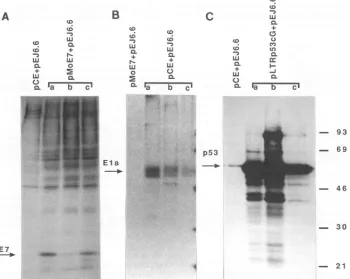
(21),ormonoclonalantibodyPAb421 whichrecognizes both normal andmutantforms ofrat and mousep53 (20). Three independently isolated cell lines obtained following transfec-tion withE7, Ela, or mutant p53 sequences plus ras (Fig. 1A, B, and C) expressed E7, Ela, or mutant p53 proteins, respectively, as expected, although levels of expression were different between each of the three cell lines. p53 immunoprecipitations from therare colonies of cellsarising following transfection with pE7 plus ras plus wild-typep53 orEla plusraspluswild-type p53 showthat the level ofp53 synthesis in these lines isnotsignificantly above the endog-enouslevels, although these lines did expressE7 and Ela, respectively, as expected (data not shown). However, Southern blot analysis showed that all of these colonies contained the transfected wild-type p53 sequences. These dataare in accordance with previous observations (12, 14) andsupportthenotion that these cells are unable to tolerate high levels ofwild-type p53 expression.
Although the cotransfection of wild-type p53 sequences clearly inhibited the appearance of transformed foci or coloniesby E7 plusras,itwas notpossible,by usingthiscell system, to determine whether this was because of transfor-mation suppression by the p53 proteinor simplya nonspe-cifictoxic effect ofoverexpression ofwild-type p53inthese cells. To address thisquestion,werepeatedthe transfections byusingNIH3T3,an established murine fibroblast cellline, as arecipient for transfection aspreviously described (41).
C
CD (0 ILO
w0.
+
w
0
la bca
'f. .`~i
p53
JMMi
E7
w
Q
((0LUInCO
CI-1L
CL+ F
LJ C
CL ra b
~c'
- 93
- 69
- 46
- 30
Wil-i.
4 - 21
FIG. 1. Immunoprecipitationsof E7, Ela, andp53 proteins from independently isolated colonies of transfected cells (lanes a, b, andc). p53proteins were immunoprecipitated withantibody PAb421, which recognizes normal and mutant rat and mouse p53.Each panel shows immunoprecipitationofthe protein indicated by the arrow. (A) E7 expression in cells isolated following transfection with E7 plus ras, with Elaplusras-expressingcellsas anegative control for E7 expression. (B) Ela expression in cells transfected with Ela plus ras, with E7plus rascells as acontrol. (C)p53expression in mutantp53plus ras-transfected cells. The low level of endogenous ratp53expression isillustrated bythe Elaplus ras-transfectedcontrol cell line; the endogenous ratp53bandruns slightly more slowly than the transfected mousepS3band intheother lanes. This ratp53band is masked by thehigh expression of mousep53 in the other lanes. Molecularweightmarkers(103)are
indicated.
on November 10, 2019 by guest
http://jvi.asm.org/
[image:2.612.148.498.374.653.2]TABLE 2. Effect of wild-type mouse and human p53 on colony formation andtransformation of NIH 3T3 cells by E7 and Ela
No.of
G418-Transfectedplasmida resistant Growthc in agar (expressed protein) coloniesb (mass cultures)
inexpt:
1 2
pMo 28 34
-pMoE7 (HPV16 E7) 34 21 + + +
pCE(Ela) 38 11 ++
MSVcL-ala (wild-type mouse p53) 40 34 pJ4flArg53 (wild-type human p53) 31 ND
pMoE7+ MSVcL-ala 53 29 ++++
pMoE7+ pJ4flArg53 31 ND +++
pCE + MSVcL-ala 29 20 +++
pCE +J4lArg53 20 ND ++++
a Allplasmidswerecotransfected withpSV2Neo.
bColonies were counted 2 weeks after transfection. ND, Not determined.
cGrowth in agarwas scored in terms of numbers and size of colonies ranging from-(0ogrowth) to+ + + +(more than20%ogrowth).
Expressionof E7 caninduceanchorage-independentgrowth
in these cells, but unlike the BRK cells, the growth ofthe
cells is not dependent on transfected sequences. E7, Ela, and wild-type p53-containing plasmids were transfected alone or in combination (Table 2). All transfections also
contained the plasmid pSV2Neo as a selectable marker.
There was no significant difference in the number of
drug-resistant colonies obtained following transfection of wild-typep53 sequences comparedwithothertransfections with-outtheseplasmids (Table 2). This indicatesthattransfection with these DNAs is not toxic to these cells. However, we werealso unabletoshow aninhibition of transformationby
wild-type p53 in these established cells as measured by
colony formation after3weeks in0.4% soft agar(Table 2).
Thissuggeststhattheeffect ofp53 is specificto the immor-talizing function of E7 in primary cells rather than the
mechanismby whichE7transforms established cells.
Inter-estingly, immunoprecipitations of
p53
proteins from massculturesof G418-resistant colonies againshowed no elevated
levels of
p53
expression in cells which had been transfected with the p53-containing plasmids (data not shown). Theseresults indicate that neither primary norestablished rodent cells can tolerate high levels ofwild-type
p53
expression,althoughthe observation that there is no decrease in
num-bers of G418-resistant colonies following wild-type
p53
transfection suggests that transfection of these
plasmid
se-quencesis nottoxic tothecells.Enhancement of transformation by mutant p53. pMoE7 and
pEJ6.6
werecotransfected intoBRKcellstogetherwith aplasmid
encoding
murine mutantp53 (pLTRp53cG).
Inboth focus-forming and G418-selected assays the effect of the mutant p53-encoding plasmid was two-fold. (i) The number offoci or G418-resistant colonies was consistently elevated by fivefold on dishes cotransfected with mutant
p53. (ii)The rateofappearanceofthecolonies orfoci was much greater on dishes triple transfected with the mutant
p53
plasmidsthan ondishestransfectedwith E7plusrasplusvector controlplasmids. This potentiationof transformation was much more evident in the focus assay, in which the
[image:3.612.309.555.97.186.2]activity of E7 aloneplusras or mutantp53 aloneplusrasis
TABLE 3. Effects ofmutantp53ontransformation ofBRKcells by E7 and Ela incooperation with ras
Transfected plasmida No. of focib in expt:
(expressedprotein) 1 2
pMoE7(HPV16 E7) 12 8
pCE(Ela) 39 24
pLTRpS3cG(mutant mouse p53) 2 0
pMoE7+ pLTRp53cG 62 50
pCE + pLTRp53cG 87 75
aAllplasmids werecotransfected with pEJ6.6. bFoci were counted 2 weeks after transfection.
fairly modest (Table 3). Independent foci of transformed cells were isolated following transfection with E7 plus ras
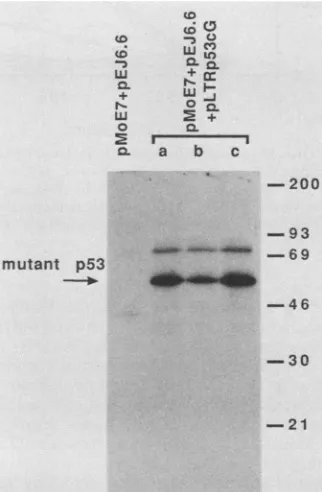
plusmutantp53and eachcolonywasshown to be expressing both E7 (data not shown) and mutant p53 proteins (Fig. 2) by
immunoprecipitation. The p53 antibody PAb240 used in these immunoprecipitations is specific for the mutant
con-formation of p53 (18) and is therefore unable to detect the background of wild-type rat p53 normally expressedby the BRKcells.
Growth rates of independently isolated BRK lines
ex-pressing onlyE7plusras, mutantp53 plusras, or E7plusras plus mutantp53wereexaminedin mediacontaining10% or 1% calf serum (Fig. 3). In 10% serum the three lines
expressingboth E7 and mutantp53clearlygrew much more
rapidly than lines expressing only E7 or mutant p53 (Fig. 3A). The difference ingrowth potential of these cell lines was evenmore evident in 1% serum(Fig. 3B). Cell lines
express-(0 * CC
+-,0W ffi Qj
0 .
a.a b c
-200
mutant p53
-93 - 69 - 4 6
-30
- 21
FIG. 2. Immunoprecipitation ofmutant p53from cells isolated following transfection withE7 plusras plusmutant p53. The p53 antibody PAb240 used intheseimmunoprecipitations detectsonly
mutant p53 protein. Immunoprecipitations from cells transfected with E7plusras are shown as a negative control formutant p53 expression. Molecularweightmarkers(103)areindicated.
&ANN 4000AL,*d"m
qw
on November 10, 2019 by guest
http://jvi.asm.org/
[image:3.612.353.514.419.665.2]A
E
C)
1000000-
-:-800000- av
-
l-400000
200000
0
B
E i3
c)
E7+ras/a E7+ras/b
p53+ras/a p53+ras/b E7+ras+p53/a E7+ras+p53/b E7+ras+p53/c
0 50 100
Time in hours
M- E7+ras/a
800000-0
E7+ras/bv p53+ras/a
p53+ras/b
600000 - E7+ras+p53/a
C1 E7+ras+p53/b
E7+ras+p53/c 400000
200000
0
0 50 100 150
Time in hours
FIG. 3. Growthratesofindependentlyisolated colonies of BRK cellsfollowingcotransfection with E7plusras,mutantp53 plusras
or E7 plus ras plus mutant p53. Cells in duplicate wells were
harvestedatvarious times. (A)Growth in mediumcontaining 10%
serum. (B) Growth of the same cells in medium containing 1%
serum.
ing mutant p53 were unable to divide under low-serum conditions,andlinesexpressingE7 showedonlyveryslight growth. However, all lines expressingboth E7 and mutant
p53 wereable todivide underlow-serum conditions almost as rapidly as in 10% serum. These dataindicatethat simul-taneous expression of E7 and mutantp53 canrelieve BRK cells of some exogenous growth factor requirements and clearly demonstrate a cooperation between E7 and p53 in transforming these cells.
Anumber of studies havesuggested that overexpresssion ofwild-type p53 has atransformation-suppressing effect in rodent systemsorisincompatiblewithnormalcellgrowthor both (12, 14, 26). Insomuch as cotransfection ofwild-type p53 virtually eliminated the transforming effects of E7 in cooperation with ras, our data are consistent with these reports. Although we were unable to determine directly
whether the lackof transformationbyE7following cotrans-fection withwild-type p53wasdueto aspecificeffect of
p53
on the mechanism oftransformation by E7 (aspreviously
suggestedfor Ela andmyc)or
simply
anonspecific
cytotoxic
effectofwild-type p53 expressiononthesecells, by
demon-strating apotent transformation-promoting effect ofmutant p53, we provide direct evidence that p53 expression can indeed modulate the biological effects of E7. In previous
work, expressionof mutant p53 has been shown tomodestly enhance thetransformation ofcellsby Ela(12, 14), but in ourstudyweobservedamuch strongerpotentiation of both foci number and rate ofappearance, withatleastafivefold increasein numbersof foci.Furthermore, thegrowthrateof the cloned cell lines expressing E7 and mutant p53 was
markedly faster than that of cell lines expressing only E7 plus ras or p53 plus ras in both high- and low-serum
conditions. Ithaspreviouslybeennotedthat NIH 3T3cells expressing mutant p53 show a reduced requirement for platelet-derived growth factor (17). The observation that
coexpression of E7 and mutant p53 can relieve cells of growthfactorrequirements raisesthepossibilitythat thetwo proteinsfunction within complementary signal transduction
pathways. It is clearfromthe results that the
transforming
activity of E7 in the BRK assay is strongly affected by
expressionofp53. SinceE7isthought to act,atleastin part, by binding to cellular RB, these results suggest that simul-taneous interference with p53 and RB can cooperate to enhance cellulartransformation and indicate thatthesetwo proteins function in complementary but independent path-ways.
The possible biological relevance ofour datato cervical
carcinoma is underlined by the recent observation that the E6proteinfrom the malignant HPV typesis able tocomplex
with p53 (42). Other p53 binding proteins such as LT and Elb have been suggested to act bybindingtoand inactivat-ing endogenous cellular p53. This seems aless likely mech-anism ofaction for E6, since transformed cells express only
very low levels of E6 and since there is no evidence forthe stabilization of p53 proteins in E6-transformed cells such as that seen inLT-transformed cells. It has beensuggested that binding to E6 induces a more rapid degradation of p53, depleting thecell of functional wild-type p53 in this way(42). However, thefunction of mutantp53 inthis system is clearly different from the effect of E6-p53 binding, since expression of E6 in the E7-transfected BRKs does not enhance trans-formation (38). This may be areflection of dominant positive transforming activity encoded by the mutant p53 protein in addition to the negative function (presumably shared byE6)
ofinactivation of normal p53. It willclearly be important to
determinetheeffects of mutant and wild-type p53expression
on the biology of HPV-transformed human epithelial cells andtoascertain thefrequency of activating p53 mutations in
HPV-positive and -negative cervical cancers.
We thank the following for generous gifts of plasmids: A. Levine forMSVcL-ala, M. Oren forpLTRp53cG, S. TuckforpJ4flArg53, and N. Jones for pCE. We are also very grateful to J. Schiller and D. Lowy for the anti-E7 antibody, to E. Harlow for the anti-Ela antibody M73, to L. Crawford for the anti-p53 antibody PAb421, and to D. Lane for theanti-p53 antibodyPAb240. We also thank P. Farrell for reading themanuscript, and we are extremely grateful to S. Benchimol for helpful discussion and for sharing unpublished data with us.
REFERENCES
1. Baker, S. J., E. R. Fearson, J. M. Nigro, S. R.Hamilton,A. C. Preisinger, J. M. Jessup, P. vanTuinen, D. H.Ledbetter, D. F.
on November 10, 2019 by guest
http://jvi.asm.org/
[image:4.612.74.301.72.482.2]Barker, Y. Nakamura, R. White, and B. Vogelstein. 1989. Chromosome 17 deletions and p53 gene mutations in colorectal carcinomas. Science 224:217-221.
2. Banks, L., C.Edmonds, and K. H.Vousden. 1990. Ability of the HPV16 E7protein to bind RB and induce DNAsynthesis is not sufficient for efficient transforming activity in NIH3T3 cells. Oncogene 5:1383-1389.
3. Barbosa, M. S., C. Edmonds, C. Fisher, J. T. Schiller, D. R. Lowy, and K. H. Vousden. 1990. The region of the HPV E7 oncoprotein homologous to adenovirus Ela and SV40 large T antigen contains separate domains for Rb binding and casein kinase IIphosphorylation. EMBO J. 9:153-160.
4. Chesters, P. M., K. H. Vousden, C. Edmonds, and D. J. McCance. 1990.Analysis of humanpapillomavirustype16 open reading frame E7 immortalizing function in rat embryo fibro-blast cells. J. Gen. Virol.71:449-453.
5. Crook, T., J. P.Morgenstern,L. Crawford, and L. Banks. 1989. Continued expression of HPV-16 E7 protein is required for maintenance of the transformed phenotype of cells co-trans-formedbyHPV-16 plus EJ-ras. EMBO J.8:513-519.
6. Crook, T., A. Storey, N. Almond, K. Osborn, and L.Crawford. 1988. Humanpapillomavirus type 16 cooperates withactivated ras and fos oncogenes in thehormone-dependent transforma-tion of primary mouse cells. Proc. Natl. Acad. Sci. USA 85:8820-8824.
7. DeCaprio, J. A., J. W. Ludlow, J. Frigge, J.-Y. Shew, C.-M. Huang, W.-H. Lee, E.Marsillo, E. Paucha,andD. M. Living-stone. 1988.SV40large tumor antigenformsaspecificcomplex with the product of theretinoblastoma susceptabilitygene. Cell 54:275-283.
8. Durst, M., L.Gissmann,H.Ikenberg,andH. zurHausen.1983. A papillomavirus DNA from a cerevical carcinoma and its prevalence in cancer biopsy samples fromdifferent geographical regions. Proc.Natl. Acad. Sci. USA80:3812-3815.
9. Dyson, N., P. M. Howley, K.Munger,andE. Harlow. 1989. The humanpapillomavirus-16E7 oncoprotein is able to bind to the retinoblastoma gene product. Science 243:934-936.
10. Edmonds, C., and K. H. Vousden. 1989. A point mutational analysis of humanpapillomavirus type 16 E7 protein. J. Virol. 63:2650-2656.
11. Eliyahu, D., N. Goldfinger, 0. Pinhasi-Kimhi, G. Shaulsky, Y. Skurnik, N. Aria, V. Rotter, and M. Oren. 1988. Meth A fibrosarcoma cells express two transforming mutant p53 spe-cies. Oncogene 3:313-321.
12. Eliyahu, D., D. Michalovitz, S. Eliyahu, 0. Pinhasi-Kimhi, and M. Oren. 1989. Wild type p53 can inhibit oncogene-mediated focusformation. Proc. Natl.Acad. Sci. USA 86:8763-8767. 13. Eliyahu, D., D.Michalovitz,and M. Oren. 1985.Overproduction
of p53 antigen makes established cells highly tumorigenic. Nature (London) 316:158-160.
14. Finlay, C. A., P. W. Hinds, and A. J. Levine. 1989. The p53 proto-oncogenecan act as a suppressorof transformation. Cell 57:1083-1093.
15. Finlay, C. A., P. W. Hinds, T.-H. Tan, D. Eliyahu, M. Oren, and A. J. Levine. 1988. Activatingmutations for transformation by p53 produce a gene product thatformsan hsc70-p53 complex with analteredhalf-life. Mol. Cell. Biol. 8:531-539.
16. Gage, J. R., C. Meyers, and F. 0. Wettstein. 1990. The E7 proteins of the nononcogenic human papillomavirus type 6b (HPV-6b) and oftheoncogenic HPV-16 differinretinoblastoma proteinbindingandotherproperties. J. Virol. 64:723-730. 17. Gai, X., M. G. Rizzo,J. Lee, A.Ullrich, and R.Baserga. 1988.
Abrogationoftherequirement foraddedgrowth factorsin 3T3 cellsconstitutively expressingthep53 and IGF-1 genes. Onco-gene Res. 3:377-386.
18. Gannon, J. V., R. Greaves, R. Iggo, and D. P. Lane. 1990. Activating mutations inp53 produceacommonconformational effect. A monoclonal antibody specific for the mutant form. EMBO J. 9:1595-1602.
19. Gissmann, L., M. Boshart, M. Durst, H. Ikenberg, and D.
Wagner. 1984. Presence of humanpapillomavirus (HPV)DNA in genitaltumours. J. Invest. Dermatol. 83:265-288.
20. Harlow, E., L. V. Crawford, D. C. Pim, andN. M.Williamson.
1981.Monoclonalantibodiesspecificfor simian virus40tumor antigens. J. Virol. 39:861-869.
21. Harlow, E., B. R. Franza, Jr., and C. Schley. 1985.Monoclonal antibodies specific for adenovirus early region 1A proteins: extensive heterogeneity in early region 1Aproducts. J. Virol. 55:533-546.
22. Hawley-Nelson, P., K. H. Vousden, N. L.Hubbert,D. R.Lowy, andJ. T. Schiller. 1989. HPV16 E6 and E7proteinscooperateto immortalize human foreskin keratinocytes. EMBO J. 8:3905-3910.
23. Hinds, P., C. Finlay, and A. J. Levine. 1989. Mutation is required to activate the p53 genefor corporation with theras
oncogeneandtransformation. J. Virol. 63:739-746.
24. Lane, D. P., and S. Benchimol. 1990. p53: oncogene or anti-oncogene?Genes Dev. 4:1-8.
25. Lane, D. P., and L. V. Crawford. 1979. T-antigen is boundto
host protein inSV40-transformed cells. Nature (London)278: 261-263.
26. Mercer, W. E., M. Amin, G. J. Sauve, E. Appelia, S. J.Ulirich, and J. W. Romano. 1990. Wild typehumanp53is antiprolifer-ative inSV40 transformed hamster cells. Oncogene 5:973-980. 27. Mercer, W. E., C. Avignolo, and R. Baserga. 1984.Role of the p53 proteinincell proliferationasstudied bymicroinjection of monoclonalantibodies. Mol. Cell. Biol.4:276-281.
28. Munger, K., W. C. Phelps, V. Bubb, P. M. Howley, and R. Schlegel.1989.TheE6and E7 genes of thehuman
papillomavi-rus type16togetherarenecessaryandsufficientfor transforma-tion of primaryhuman keratinocytes. J. Virol. 63:4417-4421. 29. Munger,K., B. A. Werness, N. Dyson, W. C. Phelps, E.Harlow,
and P. M. Howley. 1989. Complex formationof human papillo-mavirus E7 proteins with the retinoblastomatumor suppressor gene product. EMBOJ. 8:4099-4105.
30. Munroe, D. G., J.W. Peacock,andS. Benchimol. 1990. Inacti-vation of the cellular p53 gene is acommon feature of Friend virus-induced erythroleukemia: relationship of inactivation to dominanttransforming alleles. Mol. Cell. Biol. 10:3307-3313. 31. Nigro, J. M., S. J. Baker, A. C. Preisinger, J. M. Jessup, R.
Hostetter, K. Clearly, S. H. Bigner, N. Davidson, S. Baylin, P. Devilee, T. Glover, F. S. Collins, A. Weston, R. Modali, C. C. Harris, and B. Vogelstein. 1989.Mutationsin the p53 geneoccur
in diverse human tumour types. Nature (London) 342:705-708.
32. Phelps, W. C., C. L. Yee, K. Munger, and P. M. Howley. 1988. The human papillomavirus type 16E7 gene encodes transacti-vation and transformation functions similar to those of adeno-virus Ela. Cell53:539-547.
33. Sarnow, P., Y. S. Ho, J. Williams, and A. J. Levine. 1982. Adenovirus Elb-58kd tumor antigen and SV40 large tumor antigen are physically associated with the same 54kd cellular proteinin transformed cells. Cell 28:387-394.
34. Schneider, J. F., F.Fisher, C. R. Goding, and N. C.Jones. 1987. Mutational analysis of the adenovirus Ela gene: the role of transcriptional regulation in transformation. EMBO J. 6:2053-2060.
35. Shih, C., and R. A. Weinberg. 1982. Isolation ofatransforming sequencefrom a human carcinoma cell line. Cell 29:161-169. 36. Shohat,O., M. Greenberg, D.Reisman, M. Oren, and V. Rotter.
1987. Inhibition of cell growth mediated by plasmids encoding p53 anti-sense. Oncogene 1:277-283.
37. Southern, P. J., and P. Berg. 1982. Transformation of mamma-lian cells to antibiotic resistance with a bacterial gene under controlof theSV40early region promoter. J. Mol. Appl.Genet. 1:327-341.
38. Storey, A., D. Pim, A. Murray, K. Osborn, L. Banks, and L. Crawford. 1988. Comparison of the in vitrotransforming activ-ities of humanpapillomavirus types. EMBO J. 7:1815-1820. 39. Takashi, T., M. M. Nau, I. Chiba, M. J. Birrer, R. K.
Rosen-berg, M. Vinocour, M. Levitt, H. Pass, A. F. Gazdar, J. D. Minna.1989. p53: afrequent target for genetic abnormalities in lungcancer. Science 246:491-494.
40. Tuck, S. P., and L. Crawford. 1989. Overexpressionofnormal human p53 inestablished fibroblasts leads totheirtumorigenic conversion. OncogeneRes. 4:81-96.
on November 10, 2019 by guest
http://jvi.asm.org/
41. Vousden, K. H., J. Doniger, J. A. DiPaolo, and D. R. Lowy.
1988. The E7openreading frameof human papillomavirustype 16 encodesatransforminggene. Oncogene Res. 3:167-175. 42. Werness, B. A., A. J. Levine, andP. M. Howley. 1990.
Associ-ation of humanpapillomavirustypes16and18E6proteins with p53. Science248:76-79.
43. Whyte, P., K. Buchovich, J. Horowitz, S. Friend, M.Raybuck,
R. Weinberg, and E. Harlow. 1988. Association between an oncogene and an anti-oncogene: the adenovirus Ela proteins
bind to the retinoblastoma gene product. Nature (London) 334:124-129.
44. Wolf, D., N. Harris, and V. Rotter.1984. Reconstitutionofp53 expressioninanonproducerAb-MuLV-transformedcell lineby
transfection ofafunctionalp53gene.Cell38:119-126.