MODHOC - MULTI OBJECTIVE DIRECT HYBRID OPTIMAL CONTROL
Lorenzo A. Ricciardi, Massimiliano Vasile
University of Strathclyde
Mechanical and Aerospace Engineering
75 Montrose Street, G1 1XJ, Glasgow, United Kingdom
ABSTRACT
MODHOC (Multi Objective Direct Hybrid Optimal Control) is a toolbox for the design, optimisation and trade off study of space systems and missions. It solves general nonlinear multi phase optimal control problems, automatically computing a well spread set of optimal trade off solutions. In addition, it is able to handle discrete optimisation parameters. In order to do so, MODHOC combines a direct transcription method based on finite elements and a global multi objective optimisation algorithm combining evolutionary heuristics and mathemati-cal programming. MODHOC has been applied to a variety of applications: from the optimisation of launch vehicles and their ascent, abort and re entry trajectories, to the design of the optimal deployment of constellations of satellites, to the design of multi target missions. In this paper, the main ele-ments of MODHOC are described and the application of the software in space and non space related sample problems is demonstrated.
Index Terms—Optimal Control, Multi Objective optimi-sation, Global optimioptimi-sation, Mixed integer optimisation
1. INTRODUCTION
Space systems are complex engineering systems that need to operate reliably and optimally in a harsh environment and with limited resources. Their design is a challenging endeav-our involving several disciplines simultaneously: decisions are to be taken at the subsystem or vehicle level, at the tra-jectory level and at the mission design level, and each choice can affect several other aspects.
The design process inherently implies the presence of trade-offs: the performances of a subsystem might need to be increased in order to mitigate the demands on another sub-system, while the achievement of a more ambitious mission goal might require higher overall economic cost, time and technical complexity of the solution.
This paper presents MODHOC, an open source tool con-ceived specifically to help in the preliminary design stages of complex systems. The previous version of MODHOC is available under the Strath-ACE/SMART-o2c repository of
Github1. Its main goal is to present to the decision makers a set of optimal trade off solutions, allowing them to take more informed decisions.
MODHOC combines a transcription method for nonlin-ear multi-phase optimal control problems, a population based memetic multi-objective optimisation algorithm and math-ematical programming solvers. The transcription method allows to treat general optimal control problems, thus it can tackle problems with any kind of dynamic model. The memetic multi-objective optimisation algorithm allows for a global exploration of the search space and is able to treat problems with an arbitrary number of objectives. The mathe-matical programming solvers are used to refine the solutions obtained and guarantee the local optimality of the solutions found while also satisfying tight constraints.
The combination of these tools allows MODHOC to si-multaneously optimise the design of a vehicle and its trajec-tory, returning several solutions, each striking a different bal-ance between the high level goals set by the decision maker. MODHOC has been used in the past to perform the multi-objective optimisation of multi-stage launch vehicles, of the ascent, abort and reentering trajectories of spaceplanes, and of the deployment of constellations of satellites. [1, 2, 3, 4, 5] In this paper, MODHOC will be applied to a three objec-tive design and trajectory optimisation problem of a launch vehicle, a two objective trajectory optimisation from LEO to GEO orbit, and a two objective planning and scheduling prob-lem where the order in which the targets are visited is not specified a priori.
2. MODHOC
MODHOC is composed of these three main building blocks
- DFET, Direct Finite Elements Transcription method
- MACS, Multi Agent Collaborative Search
- NLP, Nonlinear programming solvers
1At the repo site https://github.com/strath-ace/smart-o2c it is possible to
2.1. DFET
Direct Finite Elements in Time (DFET) is a direct transcrip-tion method to solve optimal control problems and was ini-tially proposed by Vasile and Finzi [6] in 2000. Finite Ele-ments in Time (FET) for the indirect solution of optimal con-trol problems were initially proposed by Hodges and Bless [7], and during the late 1990s evolved to the discontinuous version. Borri [8] and Borri et al. [9] have shown that the resulting scheme is unconditionally stable, and if the dynam-ics of the system does not contain any damping term the FET formulation results in a symplectic integration scheme, thus conserving the total energy of the system. Moreover, Bottasso [10] pointed out that FET for the forward integration of ordi-nary differential equations are equivalent to some classes of implicit Runge-Kutta integration schemes. In addition, they can be extended to arbitrary high-order, are numerically very robust and allow full h-p adaptivity.
The basic idea of DFET is to discretise the time domain in several elements, and represent on each element both the states and controls as polynomials. The differential equations are not directly satisfied on the nodes like in the various col-location methods. Instead, they are first recast in weak form. This important step ensures that the resulting formulation is mathematically correct even in the presence of discontinuities for the dynamics within an element. The transcription process also translates the objective function and the other boundary and path constraints. The original problem is thus converted into a finite dimensional problem, which can be solved di-rectly through one of the several NLP solvers available.
In the past decade, DFET has been successfully used to solve a range of difficult problems: from the design of low-thrust multi-gravity assist trajectories to Mercury [11] and the Sun [12], to the design of weak stability boundary trans-fers to the Moon, low-thrust transtrans-fers in the restricted three body problem and optimal landing trajectories to the Moon [6]. More recently they have been used to perform multi-objective optimal control of spacecraft [2, 4], ascent trajecto-ries of launchers [3], or abort trajectotrajecto-ries of reusable launch vehicles [13, 5].
The significant flexibility of DFET has been recently ex-ploited by Ricciardi and Vasile [14] to devise a new scheme. By using a new set of basis functions, the new DFET method is able to completely remove the spurious oscillations orig-inating from a sharp variation of the controls, like in case of a bang-bang control solution. In addition a theorem was proved, which guarantees the satisfaction of inequality path constraints for all times if this new version of DFET is em-ployed and the feasible region of the path constraints is con-vex.
All these features make DFET a very powerful and gen-eral transcription method, with unique characteristics which make it particularly suited for space applications.
2.2. MACS
MACS is a memetic algorithm to solve multi-objective opti-misation problems. It was proposed some time ago to solve robust optimisation problems in space mission design [15, 16], where the location of global optima is particularly im-portant and challenging.
In MACS, a population of virtual agents is deployed at random locations in the search space. Each agent locally explores its neighbourhood performing a set of local search actions, also named individual actions. The individual ac-tions are Inertia, Pattern Search and Differential Evolution. Each agent performs each action sequentially until an im-provement is registered. A combination of Pareto dominance and Tchebycheff scalarisation is employed to select potential improvements towards the Pareto front. Then the population as a whole performs a set of social actions, to concurrently ad-vance towards the front. An external archive is used to store the current best representation of the Pareto set.
Previous studies by Vasile and Zuiani [17, 18, 19, 20] showed the effectiveness of this approach on different bench-mark and challenging real problems, testing numerous strate-gies both for the individual and the social actions. MACS was successfully used for the design of space missions for the removal of space debris by means of low-thrust, many rev-olutions orbits, and for the design of the initial, low-thrust rising phase for the technology demonstrator mission DES-TINY. Ricciardi and Vasile [21] then introduced a new archiv-ing algorithm able to improve the spreadarchiv-ing of the solutions on the Pareto front. This modification, together with addi-tional modifications on the heuristics employed by MACS, allowed to further improve the results of the optimiser.
Since then, MACS has been used to solve complex opti-misation problems like the optimal deployment strategies for a constellation of satellites [1], the optimisation of an asteroid deflection mission through laser ablation [22] the multi-target space debirs removal mission of the9thedition of the Global
Trajectory Optimisation Competition [23], and, combined for the first time with DFET to solve multiobjective optimal con-trol problems [2].
2.3. NLP
NLP solvers are gradient based solvers for constrained non-linear optimisation. Several high quality, open source and commercial implementations are available. These methods are able to tackle problems with millions of variables and constraints. If the problem has a good sparsity pattern, like in case of optimal control problems, these methods are able to produce a solution in a matter of seconds to hours even on an ordinary desktop.
op-timal solution which is far from the global one. For this rea-son, MODHOC employs a combination of NLP solvers and MACS to synergistically leverage the respective strength of the algorithms: the NLP solvers produce fully feasible and locally optimal solutions, while MACS automatically gener-ates guesses for the NLP, provides global search capabilities and retains a set of Pareto optimal solutions.
To solve a multi objective optimal control problem, MODHOC first transcribes it using DFET. MACS then pro-duces random first guesses for the solutions through Latin Hypercube Sampling: these guesses are passed to the NLP solver, which tries to make them feasible by solving a feasi-bility problem. These solutions are passed back to MACS, which employs its dominance and Tchebychev scalarisation criteria to evaluate the quality of the solutions and store them in its archive. MACS then employs its heuristics to generate new candidate solutions, which are passed back to the NLP to restore feasibilty. Its important to highlight that MACS takes a fully feasible solution and only changes its static and control variables. Thus the NLP receives a good warm start solution and typically takes a fraction of a second to return a new fully feasible solution. This way, global exploration is performed and a Pareto front is produced.
In addition, once every user specified number of itera-tions, the NLP solver is invoked in a different mode, with the task of refining the solutions and guaranteeing local op-timality. Since the NLP solver is inherently single objective, the way the various objectives are combined to produce a single objective problem is of paramount importance. In this phase MODHOC employs the Pascoletti-Serafini scalarisa-tion, which can be seen as a constrained but continuous and differentiable form of the Tchebychev scalarisation. Thus, MODHOC has the unique capability of performing both global and local search, employing the more suitable scalari-sation scheme depending on weather it is performing global or local search, and seamlessly transition between the two equivalent scalarisation schemes. More details about the implementation can be found in [5].
This way, MODHOC has been able to automatically pro-duce Pareto optimal solutions of problems with known single objective solution, like the reentry of a shuttle like vehicle, the maximum energy orbit rise of a spacecraft and the mini-mum time transfer to rectilinear path [4, 5]. In addition, it was able to solve complex coupled vehicle and trajectory design problems without requiring any user supplied guess [5].
2.4. Treatment of Discrete variables
Since MACS was initially conceived to solve problems with continuous variables only, its heuristics have been extended in order to deal also with integer variables. The heuristics have been modified in such a way that after their application the value of the discrete variables remains integer and within the allowed bound, while leaving unchanged the behaviour of the
heuristics when operating on the continuous variables. This enables MACS to directly treat nonlinear mixed integer multi objective optimisation problems.
However, MODHOC relies on the NLP solver in order to ensure tight satisfaction of the constraints. For this reason, when the solutions are passed to the NLP problems, the dis-crete variables are relaxed and treated as continuous. This allows the NLP solver to change the value of the relaxed vari-ables, if this is needed to get a feasible solution. After a solu-tion of the relaxed problem is found an addisolu-tional constraint is imposed on each relaxed variablexiin order to force them
to assume only integer values within the prescribed bounds:
sin(πxi) = 0 Li≤xi≤Ui (1)
This constraint is smooth and is satisfied only for integer val-ues of the relaxed variablexi. The NLP solver is run again
with the imposition of this constraint, and the fully feasi-ble non-relaxed solution is returned to MACS. This way, no heuristics are needed to round the relaxed variables.
3. APPLICATIONS
This section shows three example applications: a three objec-tive design and trajectory optimisation problem of a launch vehicle, a two objective trajectory optimisation from LEO to GEO, and a two objective planning and scheduling problem of a simplified car model, where three target destinations need to be visited but the order in which they are visited is not spec-ified a priori.
3.1. Three-objective Ascent Problem
This test case is the multi-objective, multidisciplinary design of a rocket-powered, two-stage launch vehicle optimised for the ascent to orbit. The vehicle is air dropped from a carrier aeroplane flying at 200 m s−1 at an altitude of 10 km east-bound along the equator, with an initial flight path angle of
10◦. It has to deliver a 500 kg payload to a 650 km alti-tude circular equatorial orbit. The aim of this test case is to minimise the initial gross mass of the vehicle, examining the trade-off between the engine sizing and dry masses of each of the two stages. The vacuum thrust ratings of the two rocket engines are set as optimisation variables, which through the mass model directly affect the dry masses of the two vehicle stages. Similarly, the mass of propellant used in each stage also affects the dry mass of each stage by altering the mass of the tanks. As the focus here is on the vehicle design of the mass and propulsion systems, a simple aerodynamic model was used for both stages: for the firstCL= 0,CD= 0.1and
Sref = 73.73 m2, while for the secondCL= 0,CD= 0.01
andSref =1 m2.
second stage vehicles), and Phase 2 is the ascent of only the second stage vehicle.
3.1.1. Structural mass models
For each stage, the dry mass was computed as a function of the engine mass and propellent mass. The vacuum thrust of the engines was used to estimate their structural mass based on an empirical linear relationship of existing commercial en-gines. The mass model was developed in parallel for an indus-trial vehicle and cannot be released publicly [24]. For the first stage engine,0 ≤ Tvac ≤2 MNandIsp = 332 s, while for
the second stage engine0≤Tvac≤200 kNandIsp= 352 s.
Propellent masses were limited to100 tfor the first stage and
20 tfor the second. The maximum gross takeoff mass for the first stage was also assumed to be100 t.
3.1.2. Objectives
The aim of the optimisation is to study the trade off between propellent efficient designs and designs that require relatively small engines. The objective functions were to minimise the gross vehicle massm0,1and the two ratios between the
vac-uum thrust of the stage engine, and the gross weight at the beginning of each phase. The thrust-to-weight metric also gives an indication of the vehicle loads or induced acceler-ations the vehicle experiences during flight. The higher the ratio between thrust and mass, the higher the loads imposed on the vehicle, thus one option is to minimise loading by min-imising the thrust to weight ratio. Reducing the vacuum thrust reduces the engine performance however, which requires of-ten longer duration trajectories and more propellant, which in turn increase the vehicle mass.
[J1, J2, J3]T =
m0,1,
Tvac,1
g0m0,1
, Tvac,2
g0m0,2
T
(2)
3.1.3. Numerical settings
The problem was discretised using 4 DFET elements of order 7 for both states and controls, and both phases, resulting in a total of 207 optimisation variables for the outer level and 666 optimisation variables for the single level and inner level NLP. A limit of 80000 calls to the objective vector was given to the optimiser, 106 agents were deployed in the search space and the same maximum number of solutions were kept in the Archive. The initialisation of the population required between 5 seconds and 5 minutes per agent. Matching conditions be-tween the phases were imposed on all state variables except for the mass, for which the following instantaneous drop was imposed at the stage separation:
m0,2=mf,1−mdry,1 (3)
[image:4.612.317.554.202.365.2]3.1.4. Results
Figure 1 shows the 106 Pareto optimal solutions in the archive at the last iteration, with an additional colorbar indicating gross take-off mass. The shape of this 3D Pareto front re-sembles a smooth half cup. The figure shows the 3D surface in the middle, and the three orthogonal projections. As can be seen, the algorithm found a very good spread set of solutions, all of which are feasible and locally Pareto optimal up to the requested10−6threshold.
min T
vac,1/(m0,1g0)
0 0 0 0.5 1 min T vac,2 /(m 0,2 g0 ) 1 1.5
×104
m0,1 [kg] 5 2 2 3 10 4 5 5.5 6 6.5 7 7.5 8 8.5 9 9.5 10
×104
Fig. 1: Three-Objective Ascent: set of Pareto-optimal solu-tions, colorbar indicates gross mass of the vehicle. The 3D Pareto front is in the middle, with orthographic projections shown on each coordinate plane.
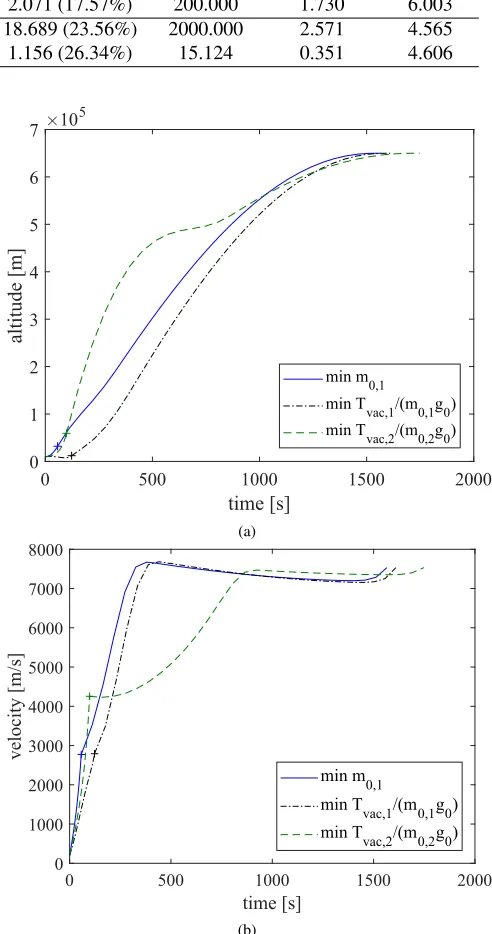
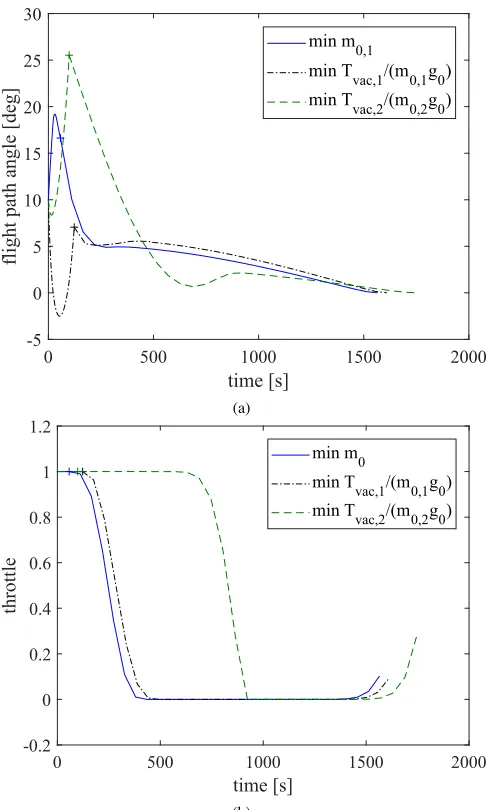
Figures 2 and 3 show the altitude and velocity profiles plus the flight path angle and throttle time histories of the three extreme solutions of the Pareto front. The altitude, ve-locity and throttle profiles of the minimum gross mass and minimum first stage (Tvac,1/m0,1g0) solutions are similar,
while their flight path angles differ substantially during the initial ascent: in both cases the first stage engine is working at full throttle and for a comparable time, but given the rel-atively lower thrust engine of the minimum(Tvac,1/m0,1g0)
case, the resulting flight path angle dips and becomes nega-tive causing the vehicle to briefly lose altitude. The minimum second stage(Tvac,2/m0,2g0)solution is instead quite
differ-ent: the first stage engine has to compensate for the relatively small second stage engine by pushing the vehicle to a higher altitude, velocity and flight path angle at the separation point. The second stage engine has to operate at maximum throttle for a comparatively longer length of time after the separation, and has a higher throttle setting during the final circularisa-tion burn in order to compensate for its lower thrust, as shown in Fig. 3b. The total flight duration is also slightly longer than the other two.
ob-Table 1: Design parameters for the three extreme cases of the Three-Objective Ascent case
Solution Stage Initial Propellant Dry Vacuum Thrust ∆v
mass [t] mass [t] mass [t] thrust [kN] weight ratio [km s−1]
min(m0,1)
1 49.995 29.632 (59.27%) 20.363 (40.73%) 1682.611 3.432 2.836 2 8.765 7.063 (80.59%) 1.699 (19.38%) 126.100 1.467 5.664
min(Tvac,1/m0,1g0)
1 100.000 72.830 (72.83%) 27.170 (27.17%) 1930.137 1.968 4.115 2 11.789 9.717 (82.42%) 2.071 (17.57%) 200.000 1.730 6.003
min(Tvac,2/m0,2g0)
1 79.318 60.629 (76.44%) 18.689 (23.56%) 2000.000 2.571 4.565 2 4.390 3.234 (73.66%) 1.156 (26.34%) 15.124 0.351 4.606
jective individually) including a breakdown of the vehicle masses with the relative percentage values with respect to the stage’s initial mass, engine vacuum thrust, thrust to weight ratio, and resulting∆vcontribution. The solution with min-imum initial mass requires high ratios of vacuum thrust to initial weight, though the vacuum thrust of the engines does not reach the maximum allowed values. Propellent mass is approximately 60% of the total mass of the first stage and ap-proximately 80% of the total of the second stage. Total∆vis of8.5 km s−1, with the first stage contributing approximately
for2.8 km s−1or 33% of the total, and the rest coming from
the second stage. The ratio between the payload and gross vehicle mass is approximately 1%.
The solution corresponding to the minimum thrust to weight ratio of the first stage requires a larger vehicle with a substantially higher amount of propellant: its initial mass reaches the maximum allowed value for the mass of the ve-hicle, and is double the value of the previous case. Of this gross mass, approximately 70% is propellant for the first stage. The ratio between the payload mass and the initial mass is 0.5%. The total required∆v is 10.1 km s−1, with
6 km s−1 coming from the second stage. The second stage engine also has the maximum possible vacuum thrust and consumes more propellant than the previous case leading to a high(Tvac,2/m0,2g0)at the cost of a minimised first stage
(Tvac,1/m0,1g0).
The solution corresponding to the minimum thrust to weight ratio of the second stage requires an intermediate ini-tial mass, approximately 60% more than the minimum iniini-tial mass case. The ratio between the payload mass and the initial mass is 0.63%, and the required∆vtotals9.1 km s−1, evenly
spread between the two stages. This is true also for the pro-pellant mass, representing approximately 75% of the total of each stage and totalling twice as much as the minimum gross take-off mass case. The first stage engine has to compensate by taking the maximum allowed value of vacuum thrust, with the resulting thrust to weight ratio being higher than in the previous case, leading to higher induced accelerations. How-ever, the second stage is significantly lighter than the other solutions both in terms of dry mass and propellent mass, and its engine has a vacuum thrust one order of magnitude smaller than the previous solutions.
(a)
(b)
[image:5.612.58.554.94.192.2] [image:5.612.314.560.158.625.2](a)
(b)
Fig. 3: Three-Objective Ascent: time-history of a) the flight path angle and b) the throttle for the three extreme solutions of the Pareto front in Fig. 1. The+indicates the stage separation point.
3.2. Two objective LEO to GEO transfer
This test case is a multi-objective extension of a problem pre-sented in [25], the trajectory optimisation for a transfer from LEO orbit to GEO orbit. To remain consistent with the origi-nal problem, in this case the Imperial System was used. The vehicle is controlled by two finite length impulses of a chemi-cal engine. The engine has anIspof 300 seconds and can only
operate at full thrust of 1.25 lbs, but the duration of the thrust-ing arcs and the direction of thrustthrust-ing are free. The space-craft has a notionary mass of 1 lbs, and is orbiting earth at an altitude of 150 Nautical miles along a circular orbit with 28 degrees of inclination. In order to avoid any singularity, the dynamics is formulated using the modified equinoctial
el-Fig. 4: Pareto front for the LEO to GEO transfer
ements as in [25]. The objectives of the optimisation are to minimise the transfer time, and to maximise the final mass.
3.2.1. Numerical settings
The problem was formulated as a 4 phases problem: phase 1 and 3 model the coasting arc, and are discretised with 3 DFET elements of order 6. Phases 2 and 4 are thrusting arcs, but due to their expected short duration they are discretised with a single DFET element of order 6. Continuity of the state variables was imposed between the phases, and the final time of each phase was left as a free parameter to be determined by the optimiser. MODHOC was run for a total of 50000 function evaluations, with gradient based refinement taking place every 10 iterations. 20 points on the Pareto front were sought.
3.2.2. Results
Figure 4 shows the Pareto front: as it is evident, lower mission times imply lower final mass. Solution marked with 1 coin-cides with the solution found in the reference, corresponding to the maximum final mass and a transfer time of 21704 sec-onds. The transfer time of the reference solution took 21683 seconds. This slight difference can be attributed to the differ-ence of the integration schemes, the NLP solvers and settings used, and the fact that the solution in the reference comes after 4 mesh refinement iterations. However, the difference in final time is lower than0.1%. The Pareto front also suggests an in-teresting trade-off region in solutions marked between 1 and 7, where the transfer time can be reduced by approximately
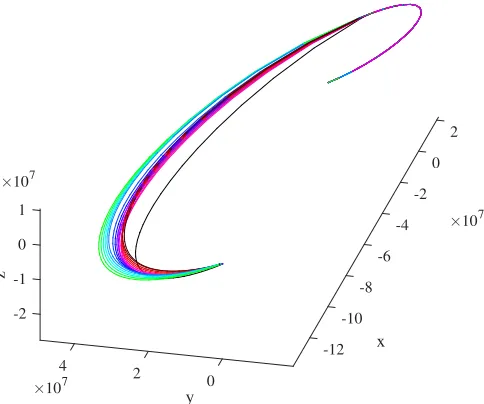
[image:6.612.315.560.67.254.2] [image:6.612.56.300.68.473.2]Fig. 5: Trajectories for the LEO to GEO transfer
is the black one, which is the minimum mission time solution and is markedly different from the others
3.3. A planning and scheduling problem
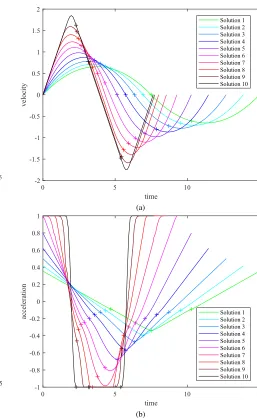
This section describes a non space related application. It is a multi-objective extension of a problem presented in [26]: a vehicle, described by a simple two dimensional dynamic model, starts from the origin of the plane and has to visit three target destinations before finally returning to its starting po-sition. It is controlled by the magnitude of the acceleration and by the steering rate, both of which are limited. The or-der in which the three targets are to be visited is not specified a priori but has to be found as part of the solution, which in the original reference had to minimise the total mission time. The vehicle has to pass on each target point without any restriction on the velocity or direction of velocity at the rendez-vous, while at the final time it had to be at rest at the original position. This problem can be seen as an extension of a classic Travelling Salesman Problem, where the presence of a dynamical model for the Salesmen significantly changes the nature of the problem and its complexity. The problem is here extended with a second objective minimising the total energy expense, measured as the integral of the square of the instantaneous acceleration.
3.3.1. Numerical settings
The problem was divided into four phases. At the end of the first three phases, conditions were imposed to enforce the po-sition of the car to match with the popo-sition of one of the three targets, while for the last phase the destination was the origin, with zero final velocity. A special set of constraints was im-posed to deal with the categorical choice of the destinations,
including the constraint that each target must be visited only once. On each phase, the problem was discretised using 3 DFET elements of order 7. MODHOC was run for a total of 40000 objective function evaluations, with 10 agents to find 10 points on the Pareto front.
3.3.2. Results
[image:7.612.56.298.70.272.2](a)
(b)
Fig. 6: Dynamic planning and scheduling problem: a) Pareto front, b) Trajectories. Circled indicate target destinations.
4. CONCLUSIONS
This paper presented MODHOC, a direct method for solv-ing multiobjective hybrid optimal control problems. By em-ploying DFET, a general and powerful transcription method, it is able to solve nonlinear optimal control problems with user defined dynamical models and path constraints. MACS, the memetic multiobjective optimisation algorithm, allows to globally explore the search space, automatically generate ini-tial guesses and return an evenly spread set of solutions. The smart coupling with the NLP solver through the bi-level and the single level approaches allows for the strict satisfaction of general nonlinear constraints, and to guarantee local optimal-ity of the solutions. The simultaneous treatment of discrete and continuous variables allows to treat complex mixed inte-ger problems, where the selection of discrete variables does
(a)
(b)
Fig. 7: Dynamic planning and scheduling problem: time his-tories for a) velocities and b) accelerations. +indicate when a target destination is visited.
[image:8.612.297.554.65.483.2] [image:8.612.59.302.67.468.2]Acknowledgments
The research was partially funded by an ESA NPI grant (ref TEC-ECN-SoW-20140806) and Airbus Defence & Space. The authors would like to thank Orbital Access Limited and BAE Systems for the mass and structural models.
5. REFERENCES
[1] Marilena Di Carlo, Lorenzo Angelo Ricciardi, and Mas-similiano Vasile, “Multi-objective optimisation of con-stellation deployment using low-thrust propulsion,” in AIAA/AAS Astrodynamics Specialist Conference. sep 2016, American Institute of Aeronautics and Astronau-tics.
[2] Lorenzo A Ricciardi, Massimiliano Vasile, and Christie Maddock, “Global solution of multi-objective optimal control problems with multi agent collaborative search and direct finite elements transcription,” inEvolutionary Computation (CEC), 2016 IEEE Congress on. IEEE, 2016, pp. 869–876.
[3] Lorenzo Angelo Ricciardi, Massimiliano Vasile, Fed-erico Toso, and Christie A Maddock, “Multi-objective optimal control of the ascent trajectories of launch ve-hicles,” inAIAA/AAS Astrodynamics Specialist Confer-ence, 2016, p. 5669.
[4] Massimiliano Vasile and Lorenzo Ricciardi, “A direct memetic approach to the solution of multi-objective op-timal control problems,” inComputational Intelligence (SSCI), 2016 IEEE Symposium Series on. IEEE, 2016, pp. 1–8.
[5] Lorenzo A. Ricciardi, Christie A. Maddock, and Massi-miliano Vasile, “Direct solution of multi-objective opti-mal control problems applied to spaceplane mission de-sign,” Journal of Guidance, Control and Dynamics, p. Accepted for publication on 26 August 2018, 2018.
[6] Massimiliano Vasile and Amalia E Finzi, “Direct lu-nar descent optimisation by finite elements in time ap-proach,” International Journal of Mechanics and Con-trol, vol. 1, no. 1, 2000.
[7] D. H. Hodges and R. R. Bless, “Weak hamiltonian finite element method for optimal control problems,”Journal of Guidance, Control, and Dynamics, vol. 14, no. 1, pp. 148–156, jan 1991.
[8] Marco Borri, Carlo Bottasso, and Paolo Mantegazza, “Basic features of the time finite element approach for dynamics,”Meccanica, vol. 27, no. 2, pp. 119–130, Jun 1992.
[9] M. Borri and C. Bottasso, “A general framework for interpreting time finite element formulations,” Compu-tational Mechanics, vol. 13, no. 3, pp. 133–142, Dec 1993.
[10] Carlo L Bottasso and Andrea Ragazzi, “Finite element and runge-kutta methods for boundary-value and opti-mal control problems,” Journal of Guidance, Control, and Dynamics, vol. 23, no. 4, pp. 749–751, 2000.
[11] Massimiliano Vasile and Franco Bernelli-Zazzera, “Op-timizing low-thrust and gravity assist maneuvers to design interplanetary trajectories,” arXiv preprint arXiv:1105.1829, 2011.
[12] Massimiliano Vasile and Franco Bernelli-Zazzera, “Tar-geting a heliocentric orbit combining low-thrust propul-sion and gravity assist manoeuvres,” Operational Re-search in Space & Air, vol. 79, 2003.
[13] Lorenzo Ricciardi, Christie Maddock, and Massimil-iano L. Vasile, “Multi-objective optimal control of re-entry and abort scenarios,” in 2018 Space Flight Me-chanics Meeting. jan 2018, American Institute of Aero-nautics and AstroAero-nautics.
[14] Lorenzo A. Ricciardi and Massimiliano Vasile, “Direct transcription of optimal control problems with finite el-ements on bernstein basis,” Journal of Guidance, Con-trol and Dynamics, p. Accepted for publication on 26 August 2018, 2018.
[15] Federico Zuiani and Massimiliano Vasile, “Preliminary design of debris removal missions by means of simpli-fied models for low-thrust, many-revolution transfers,” International Journal of Aerospace Engineering, vol. 2012, 2012.
[16] Federico Zuiani, Yasuhiro Kawakatsu, and Massimil-iano Vasile, “Multi-objective optimisation of many-revolution, low-thrust orbit raising for destiny mission,” in23rd AAS/AIAA Space Flight Mechanics Conference, 2013.
[17] M. Vasile and F. Zuiani, “Multi-agent collaborative search: an agent-based memetic multi-objective opti-mization algorithm applied to space trajectory design,” Proceedings of the Institution of Mechanical Engineers, Part G: Journal of Aerospace Engineering, vol. 225, no. 11, pp. 1211–1227, 2011.
[18] Federico Zuiani and Massimiliano Vasile, “Im-proved individualistic actions for multi-agent collabo-rative search,”In EVOLVE, July 2013.
[20] Federico Zuiani and Massimiliano Vasile, “Multi agent collaborative search with thecycheff decomposition and monotonic basin hopping,” In BIOMA, May 2012.
[21] Lorenzo A. Ricciardi and Massimiliano Vasile, “Im-proved archiving and search strategies for multi agent collaborative search,” inComputational Methods in Ap-plied Sciences, pp. 435–455. Springer International Pub-lishing, jul 2018.
[22] Nicolas Thiry and Massimiliano Vasile, “Statistical multi-criteria evaluation of non-nuclear asteroid deflec-tion methods,” Acta Astronautica, vol. 140, pp. 293 – 307, 2017.
[23] Carlos Ortega Absil, Lorenzo Ricciardi, Marilena Di Carlo, Cristian Greco, Romain Serra, Mateusz Polnik, Aram Vroom, Annalisa Riccardi, Edmondo Minisci, and Massimiliano Vasile, “Gtoc 9: Results from university of strathclyde (team strath++),” Acta Futura, 2018.
[24] Christie Maddock, Federico Toso, Lorenzo Ricciardi, Alessandro Mogavero, Kin Hing Lo, Sriram Rengara-jan, Konstantinos Kontis, Andy Milne, David Evans, Michael West, and Stuart McIntyre, “Vehicle and mis-sion design of a future small payload launcher,” in 21st AIAA International Space Planes and Hypersonics Technologies Conference. mar 2017, American Institute of Aeronautics and Astronautics.
[25] John T Betts,Practical methods for optimal control and estimation using nonlinear programming, SIAM, 2010.