0022-538X/92/074242-10$02.00/0
Copyright © 1992, AmericanSociety for Microbiology
Two Distant
Upstream Regions
Containing
cis-Acting Signals
Regulating Splicing Facilitate 3'-End Processing
of Avian Sarcoma Virus RNA
JENNIFER T. MILLERAND C. MARTINSTOLTZFUS*
Department of Microbiology, Universityof Iowa, Iowa City, Iowa52242
Received 12December 1991/Accepted 2April 1992
Retroviruses, pararetroviruses, and related retrotransposons generate terminally redundant RNAs by transcription of a template flanked by long terminal repeats in which initiation occurs within the 5' long terminal repeat sequences and 3'-end processing occurs within the 3' long terminal repeat sequences. Processing of avian sarcoma virus RNA is relatively inefficient; approximately 15% of the viral RNA transcripts areread-through products; i.e., theyarenotprocessedattheviralpoly(A) addition site butatsites
inthe cellularsequencefurther downstream. In thisreport,weshow that theefficiency ofprocessingattheviral siteis further reducedby deletion oftwodistantupstream sequences: (i)a606-nucleotidesequenceinthegag genecontainingacis-acting negative regulator of splicing and (ii) a 136-nucleotidesequencespanning theenv
3' splice site. The deletion of eitherorboth upstreamregions increases the levels of read-through products of
bothunspliced and spliced viral RNA.Incontrast, deletion of thesrc3' splice site doesnot affecttheefficiency ofprocessingatthe viralpoly(A) addition site. The effects on3'-end processingarenotcorrelated either with distance from the promoter to the poly(A) addition site or with the overall level of viral RNA splicing. Substitution of the avian sarcoma virus poly(A) signalwith the simian virus 40earlyor late poly(A) signal
relieves the requirement for the distant upstream sequences. We propose that cellularfactors, which may
correspondtosplicing factors, boundtotheupstreamviralsequences mayinteract with factors bound atthe avian sarcoma virus poly(A) signal to stabilize the polyadenylation-cleavage complex and allow for more
efficient 3'-end processing.
Primary RNA transcripts of viral and cellular eukaryotic
genes are subject to a number of posttranscriptional proc-essing steps, including capping, methylation, splicing, 3' cleavage, and polyadenylation. The processing at the 3' terminus occurs by endonucleolytic cleavage followed by
the addition of approximately 200 adenylic acid residues (63). Several cis-acting elements have been shown by
muta-tionalanalysis in vivotobeessential for thesesteps tooccur.
These elements include the hexanucleotide AAUAAA lo-cated 10to20 nucleotides(nt) 5' of the poly(A) addition site (17, 35, 40, 62) and alessconserved GU-orU-rich element
3' of the poly(A) addition site (5, 14, 18, 33, 44, 49, 64). In several specialized cases, signals upstream of the hexanu-cleotide element that may be important in regulation of polyadenylation-cleavage efficiency have been reported (9, 10, 12, 15, 16, 42, 43, 46, 57). In addition, in transcription units inwhich multiple polyadenylation signalsare present,
alternativesplicingmaypromotetheuseofonepoly(A) site, with theexclusion of the other(1, 8, 20, 31, 38, 64).
Many retroviruses, pararetroviruses, and
retrotrans-posons also demonstrate a type of regulated polyadenyla-tion. Proviral DNA genomes are flanked by long terminal
repeats (LTRs), each of which contains the signals for initiation of transcription and 3'-end processing. In most
retroviruses, transcription results in aterminally redundant
RNAthatcontainstwopoly(A) signals. One of these signals arises from sequences in the 5' LTR, and the other signal
arises from identical sequences in the 3' LTR. However, only the downstream signal is used as a processing site.
Pararetroviruses and retrotransposons synthesize primary
* Correspondingauthor.
transcripts withasimilararrangementoftwopoly(A) signals (6, 39). Several mechanisms have been proposedto account
for the selectiveuseof the downstream signal.These
mech-anisms have been shown to include, first, the presence of additionalsignalsupstreamof thehexanucleotide elementin the unique viral sequences which are necessary for 3'-end processing (9, 16, 42, 43, 46, 57) and, second, promoter occlusion in which the efficiency of 3'-end formation is determinedbythedistance fromthepromotertothepoly(A) addition site(25, 47, 60).
Avian sarcoma and leukosis viruses (ASV and ALV,
respectively) have evolvedanLTRarrangementthatavoids this general problem by positioning the 5' start site for transcription between the upstream AAUAAA and the downstream GU-rich element. Therefore, in the terminally redundant primary transcript, there is only one functional poly(A) signal, which arises from sequences in the 3' LTR. However, in infected cells, ahigh level of viral transcripts
thatare processed in cellularsequencesdownstream of the viral 3' LTR poly(A) site are present (21). This somewhat-less-efficientlevel of 3'-endprocessing relativetoother viral polyadenylation-cleavage efficiencies (7, 10, 32) has implica-tions for thebiology of ALV. Some cellularoncogenes(e.g., myb and erbB) are activated by adjacent upstream ALV proviral integration followed by read-through transcription into the cellularsequences(26, 41). One modelsuggeststhat
some cellular oncogenes may have been transduced by
packaging such hybrid read-through transcripts into ALV virions followed by recombination with wild-type viral RNAs during a subsequent round of reverse transcription
(22, 56).
In an effort to understand the basis for the relatively inefficient ASV and ALV3'-endprocessing,wehave
devel-4242
on November 9, 2019 by guest
http://jvi.asm.org/
oped a transfection assay that measures the level of
read-through transcription incells transfected withwild-type and
mutant proviral DNA. We have found two regions in the
unique viral sequences and distant from the viral poly(A)
addition site that positively affect 3-end processing. Bothof
theseregions containcissignalsaffecting viralRNAsplicing.
Our results suggest, however, that the efficiency of 3-end
processingatthe viral poly(A) site isnot coupledto theact
of splicing itself. We propose that the presence of the
upstream cis signals affecting splicing in the full-length
transcript may facilitate 3'-end processing at the viral
poly(A) site.
MATERIALS AND METHODS
Plasmids.Theclones used in this studyare diagrammed in
Fig. 2. pJD100,aninfectious nonpermuted clone ofaPrague
Astrain ofASVclonedat the HindlIl site of pBR322, was
obtained as a gift from J. Thomas Parsons, Department of
Microbiology, University of Virginia, Charlottesville.
pUC18.Bgl.SVA contains a trimer of a 237-nt fragment
containing the simian virus 40 (SV40) early and late gene
poly(A) signals contained in pUC18 and was obtained as a
gift from Ian Maxwell, University of Colorado Health
Sci-ence Center, Denver. Plasmids pAl 3'CAT, pA9, pA5-14
3'CAT, pJS2CAT (52), pz\5-25 3'CAT, p5'XH1 (54), and
pMPM7 and pMPM13 (4) have been described previously.
The clone pSLB-Sac(-23) (4), previously reported to
con-tain a deletion of 23 bases from nt 6870 to 6892 was
reanalyzed and found tocontainadeletion of22 bases from
nt6871to6892. Deletion and inversionmutantswerecreated
bystandard recombinantDNAtechniques (45). pJTM14was
created bycloning the entire provirus derived from pJD100
intoapUC18-based vector(pSVEUCAT) containing thecat
gene and the SV40 early poly(A) signal. pSVEUCAT was
obtained from L. Turek, Department of Pathology,
Univer-sity ofIowa. pJTM19wasconstructedby ligation ofaBglII
fragment (nt 4236 to 7736) into pAll 3'CAT. pJTM28 and
pJTM29 were constructed by partial digestion of pJTM14
withNheI andcomplete digestionwithKpnI.The ends were
blunt endedwith T4 DNApolymerase andligated. pJTM21
wascreatedbydigestionofpJTM14withSacll.pJTM50was
constructedbyligationof theSacIIfragment (nt 543to1806)
back into the wild-type pJTM14 in the reverse orientation.
pJTM54wascreatedby ligationof a SacIIfragment (nt543
to1806) frompA9 intopJTM21. pJTM46wasconstructedby
ligation of a KpnI-MluI fragment (nt 4995 to 7901) from
pSLB-Sac(-23) into the wild-type pJTM14. pJTM6 was
createdbyligationofaClaI linker intopAll 3'CATpartially
digestedto alinearfragmentwithEcoRIat nt9238.pJTM52
was constructed by ligation of aSacl-HindIll fragment (nt
6865 to 9393) from pJTM6 into pSPT18. pJTM53 was con-structedbyligationofaHindIII-SmaIfragment (289 nt)from
pUC18.Bgl.SVA into pJTM52 cleaved with Hindlll and
ClaI. This linear fragment was blunt ended with T4 DNA
polymerase andligated. pJTM56wasconstructedbypartial
digestionofpJTM53withBglIIand completedigestionwith
BamHI,followed byreligation of bothfragmentscreatedby
the digestion. pJTM58 was created by ligation of an
MluI-HindlIl fragmentfrompJTM56intopA5-25 3'CAT. pJTM60
wasconstructed by ligation ofanMluI-SacI fragment from
pJTM14 into pJTM58. pJTM62was created by cleavage of
pJTM60withSacII followedbyreligationof bothfragments,
createdbythedigestion,andby selectionfor insertion of the
inverted fragment.
Cell culture and DNA transfections. Secondary chicken
embryo fibroblasts (CEF) isolated from embryonated eggs
thatwerenegative for both group-specific antigenand
chick-en-helper factor (SPAFAS, Inc., Norwich, Conn.) were
cultured inSGM (Medium 199 [BethesdaResearch
Labora-tories, Inc., Gaithersburg,
Md.]
supplemented with 10%(vol/vol) tryptose phosphate broth and 5% (vol/vol) calf
serum].
CEF were transfected by using a DEAE-dextranprocedure described previously (50). Purified plasmid DNA
(40 FLg) in 13 ml of serum-free SGM adjusted to a final
concentration of 50mMTris (pH 7.4)wasused totransfect
CEF on subconfluent 150-mm plates at a concentration of
200 1Lg of DEAE-dextran per ml. After 25 min at room
temperature, 4ml ofthetransfection mixwasremoved,and 21 ml of serum-free SGM was added. The plates were
incubatedfor3h at37°Cand thenrefed with25 mlofSGM.
Themediumwasreplaced 20to24h later with 25 ml of fresh
SGM.RNAstabilitywasdetermined by the addition of10 ml
ofSGM containing 1Fgof dactinomycinpermltoconfluent
CEF on 100-mm plates 48 h after transfection. Whole-cell
RNA was harvested (seebelow) at0, 3, 6, 9, and 12 h after
addition of the drug and analyzed by the RNase protection
assay.
RNAisolation and analysis. Whole-cell RNA at48 h after
transfection was isolated by the guanidine hydrochloride
methodessentiallyasdescribedby Strohmanetal. (55).The
poly(A)+ RNAfractionwasisolatedby binding50 to 100kug
of whole-cellRNA to anoligo(dT)-cellulose column
(approx-imately 0.1 g) in the presence of 0.5 M NaCl and 0.05%
sodium dodecyl sulfate (SDS). Afterahigh salt (0.5MNaCl)
wash, the bound poly(A)+ fraction was eluted in the
pres-enceof0.05% SDS. This fractionwas thenreapplied to the
columninthe presenceofhigh salt, washed,andreelutedas
described above. Northern blot analysis of 10 to 20 kg of
whole-cell RNA wasperformed according tothe methodof
Sambrooketal. (45) andprobed withan SP6riboprobe (34).
The RNase protection assay wascarried outessentially as
described previously (54), except that the hybridizations
were performed at57°C for14h underconditions ofgreater
than 10-fold molarexcess ofriboprobe, determined
empiri-cally by hybridization of 10 kug of whole-cell RNA with
increasing amounts of probe. The RNase digestions were
done at30°C for 1h with25
kg
of RNase A per mland6,000 U of RNase T1 per ml. The protected fragments were denatured bybeing heatedat85°C for 10min andseparatedon adenaturing7Murea-5%polyacrylamide gelat500 Vfor
4 to5h. Densitometricanalysiswasperformed asdescribed
previously (4). Statistical analyses were obtained by using
STATPAC, Apple Ilesoftware.
Materials. [(x-
2P]UTP
(800Ci/mmol)waspurchased fromAmersham Corp., Arlington Heights, Ill. Restriction en-zymes, T4 DNApolymerase,T4DNAligase, proteinase K,
and plasmid pSPT18 were purchased from Boehringer
Mannheim Biochemicals, Indianapolis, Ind. RNase T1 and the 1-kb ladder were obtained from Bethesda Research
Laboratories. Dactinomycin and RNase A were obtained
from Sigma, St. Louis, Mo. SP6 polymerase wasobtained
from Promega Biotec Co., Madison, Wis.
Oligo(dT)-cellu-lose was purchased from Collaborative Research, Inc.,
Waltham, Mass. The Clal linker was obtained from New
England Biolabs, Beverly, Mass.
RESULTS
Analysis of ASV3'-end processing intransfected CEF. To
definewhich elements affected3'-endprocessinginASV,we
used atransient transfection assayto compare the level of
on November 9, 2019 by guest
http://jvi.asm.org/
S'(d uur d*uc 3mac
SV4U
RSVp(A) --ir p(A)
I
CATgezeI
pol env sf
I .111t p 'XHI(P)
l*i4 nt
L1 Wildtyp trwiAript
;mti17(
:t44
2211 2111 R gdthmnghb--uBpript
D I ... I ...L. .i .
- ~Retdthriugh (R]I) 3:36nt
C.
vCm~1011 -- P
9..l * US
- ~~~~~TYO-fAl
506t/517
396
-344
-298 _
us()
_ _ RT
._-
*MSRl
a
220
1 2 3
3'
4 5 6 7 8
transcriptsprocessedatthepolyadenylation[poly(A)] sitcin
the 3' LTRwiththoseresultingfromread-through
transcrip-tion. To provide a defined 3' processing site and to confer
stability tothe transcripts not processed at the correctsite,
all constructs contained the bacterial chloramphenicol
ace-tyltransferase (cat)genefollowedbythe SV40early poly(A)
signal cloned downstream of the provirus (Fig. IA). CEF
weretransfected withgenomic cloncsof ASVcontainingthe above sequences. Forty-eight hours after transfection,
whole-cell RNA was harvested and assayed by an RNase
protection assay with an antisense riboprobe transcribed
from the linearized DNAtemplate p5'HX1 (Fig. IA) under
conditions of probe excess (see Materials and Methods).
Thisprobeprotects LTRsequences present at the 3' endsof
the messages, producing fragments corresponding to
tran-scriptsthat are processed at theASV poly(A) sitc (256 nt),
and read-through transcripts (336 nt). The probe is also
1 2 , 4 5; b 7 1] t9 1I
FIG. 1. RNaseprotection assays ofwild-type andmutant RNA samples. (A) Map of riboprobe template and resulting protected fragments. The sizes of theexpectedfragmentsareindicatedbelow the RNAspecies.Nucleotideswerenumberedaccordingtothe ASV Prague C sequence(48).(B and C)RNaseprotectionassaysshowing the expected protected RNAs. Markers correspond to
y-32P
end-labelled DNA fragments of the 1-kb ladder (Bethesda Research Laboratories). The probe (P), unspliced (US), and spliced (S) hybrids are indicated, aswell asthe truncatedunspliced band that results whenconstructswithdeletionsorinversionsoriginatingat nt543 (Sacll) are assayed (US A). The bands corresponding to read-through RNAspecies (RT)and those processedattheviral 3' LTRpoly(A) site(3')are alsoindicated.
complcmentarytosequenccsspanninigthe 5'LTR,thesplice
donor sitc, and a portion of the gag gcnc cxtending to the XhoIsitcat nt630.Thcrefore,the amounts of bothunspliced
(630 nt) and spliced (398 nt) transcripts can also be
dctcr-mined bythe assay.
The amount ofrcad-through RNA measured after
trans-fection with the wild-type gcnomiiic clone, pJTM14, was
similartothe resultsobtained byHermanand Coffin(21) for
ALV-infected turkey embryo fibroblasts; approximately
15%of the viral RNA transcriptswcrcnot processed atthe 3' LTR poly(A) site (Fig. 1B, lane 3; Fig. 2). The level of viral read-through transcripts in the poly(A)+ RNA was
identical tothat obtained for the whole-ccll RNA (data not
shown). Thus, the efficiency of 3'-end processing by the
transient transfectionl assay correlated well with the
effi-ciency of 3'-end formation in transcripts arising from
inte-grated proviruses. This result also indicated that the
down-stream cat and SV40 sequences did not influence the
efficiencyof3'-end processing in ASV.
Two distantupstreamregionsfacilitate theefficiencyof ASV
3'-end processing. Previous studies of regulation of RNA
splicingin ASVindicated that twoclones,pA5-143'CATand
pA5-25 3'CAT, deleted in a portion of gag and in all of pol,
demonstratedincreased levels ofread-throughtranscription
as well as increased levels of splicing (54). In addition,
pA5-253'CATwas deficient in a substantialportion ofenv.
Read-through transcription in these clones was elevated
approximately 3- to 5-fold compared with that of the wild
type (Fig. IB, lanes 8 and 9, and summarized in Fig. 2).
These data suggested that there might be distant upstream
A.
EDH--Jeg
SP6
.4
B.if,; Ci v
:g
8
; -, ..; < <riI
V
U-- phw (US) - 2 P3'Puxad(3T)
b3 nt 256 nt
Splic,d (S)
398 nt
... _,
*:te=
-P
us
US(A)
RT
:3'
A* VW Om i#Wiav 00 0
de ..-.:, :SE:wos ..
on November 9, 2019 by guest
http://jvi.asm.org/
[image:3.612.323.545.79.286.2]5m
pA 5-14 3' CAT
630 ph 5-25
TCAT I 1630
RSVp(A) SV40 I 3s 3'ws C pA)
5258
6983
pnMi9 I I
1630 4236
pITM
29 1rm----3054 4995
pl. 54 '''
11491630
pJTM79 EflJ-11j9
4995
pYTM21 'I'--(
543 1806
PTTM so1 1 11 1806 543 pJTWM28 4 5131
4995 5131 p MPM7 L11JJ
pMPM13 MT
pJTM461l
prlM 77
1IEF-pJS2MTC=Dj98
G_-T
dketk r
CGGA 22nt idl dae at6871nt
o-.i CJ0,aG/QA
a4tdodt
CGGA 7054
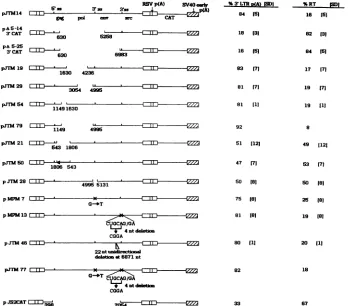
FIG. 2. Schematicrepresentationofwild-typeandmutantconstructsand theircorrespondinglevels ofread-through RNA.Deletionsare
indicated bygapsin thesolidline, withstartandendpoints marked bythenumbers of therespectivenucleotides(numberedasdescribed in thelegendtoFig. 1). Thickarrow,invertedSacIIfragmentinpJTM50;hatchedbox,SV40 earlygenepoly(A) signal.Note thatpJS2CATis
acDNAclonepossessinganexactdeletion ofthesrcintron.Percentagesofread-through (RT)andcorrectly processedRNA[3'LTR p(A)]
were determined by densitometric analysis of bands resulting from the RNase protection assay(seeFig. 1BandC)andwereadjustedto account forthe molar ratio of uridine residues present as described previously (4). The standard deviation (SD) for each sample pair is indicated in brackets.
cis-acting sequences in the viral genome which influenced
the site of 3'-end formation of ASV RNA.
Inordertodefinemorepreciselytheregion(s) responsible
for wild-type levels of 3'-end formation, mutants with
smaller deletions ingag and/orpol were analyzed by the
RNase protection assay. Mutants pJTM19 (A = nt 1630 to
4236), pJTM29 (A = nt3054 to 4995)and pJTM54 (A = nt
1149to1630)exhibitednosignificantdifferences(P> 0.4)in
the amounts of read-through transcription compared with that of the wildtype(Fig. iB,lanes 4 and6;Fig. 1C,lane4;
Fig. 2). Taken together, these data indicate that sequences
contained within nt 1149 to 4995 do not contain cis-acting
sequences that affectwild-type levels of3' processing. To confirm this conclusion, a mutant (pJTM79) in which the entire region from nt 1149 to 4995 was deleted produced
levels ofread-through RNAthatwerenotelevatedandwere
comparable to thoseof the wildtype (Fig. 2).
Mutations in tworegions of theviral genome were
asso-ciated with significantly increased levels of read-through
RNA. Either deletion (pJTM21) orinversion (pJTM50)ofa
1263-ntSaclI fragmentfrom nt543 to1806resulted in levels
ofread-through RNA whichwerethreefold higherthan that
of the wild type(Fig. 1B,lane7; Fig. 1C, lane5; Fig. 2).As
previouslyshown(2, 54),these mutations alsoresulted inan
increased level of viral RNA splicing. The ratio of spliced
RNAtounspliced RNAwith the inversion mutantis larger
than the ratio obtained with the deletion mutant (compare Fig. 1B, lane 7, and C, lane 5). This result was expected
because the inversioncreatesapremature stop codon inthe
gag gene, which has been shown to selectively destabilize
theunsplicedRNA(2).Theseresults, togetherwith the data
givenabove, suggest the presenceof an
orientation-depen-dent element affecting 3' processing contained in the se-quencesfromnt630to1149(region I).The distance fromthe promoter in the 5' LTR to the viral poly(A) site in the inversionmutantwasunchanged;thisfinding suggestedthat
the elevated levels ofread-through RNAobtained with the deletedconstructswerenotduetothe reduced distance from
thecap site tothepoly(A) site in the 3' LTR.
The region downstream ofnt 4995 wasalso studied. The
genomicclonepJTM28 contained a 136-nt deletion fromnt
4995 to 5131 and demonstrated increased levels of
read-through RNAsimilarto those of the regionI mutants (Fig.
1C, lane 6; Fig. 2). As shown previously, this mutation
resulted in wild-type levelsof splicing; however, all of the
splicing occurredat thesrc 3' splicesite (3' ss) (4). Again,
the fact that the distance fromthecapsitetothepoly(A)site
inpJTM28wasgreaterthan thatof several otherconstructs
(pJTM54, pJTM19, and pJTM29) demonstrating wild-type
levels ofread-through productsindicated thatareductionin
this distance was not correlated with increased levels of
read-through RNA.
%3LTR p(A)[SDI
84 151
18 131
16 151
%RT ,;DI
16 151
82 131
84 151
17 171
19 171
19 111 83 17l
81 171
81 111
92
51 1121
47 [71
50 181
75 181
81 [81
80 [11
49 1121
53 [71
50 181
25 181
19 181
20 111
82
33 67
on November 9, 2019 by guest
http://jvi.asm.org/
[image:4.612.140.488.78.384.2]B.
A.
pJTM14
Hrs 0 3 6 9 12
R.
RT
*t*
.
OMpJTM
21Hrs 0 3 6 9 12
Us
S
RT
3.
0
a
a
C
pJT
28D.
Hrs 0 3 6 9
Us
,__
pA
5-143'CAT
HZ 0 3 6 9 12
US _
S
RT RT1,::
[image:5.612.152.472.77.412.2]3 "
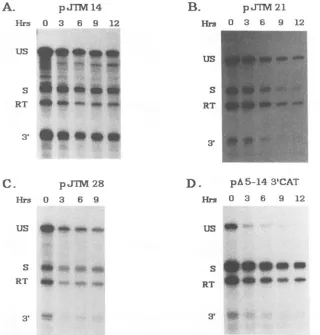
FIG. 3. Analysisof RNAstability inCEF transfected withwild-typeand mutantconstructs.Steady-state levels of the wild type(A), a
regionI deletion(B), aregion IIdeletion (C),and aregion I plusregion IIdeletion mutant(D)are shown.RNA atvarious timesafterthe addition ofdactinomycin (1,ug/ml)asdeterminedby the RNaseprotectionassayis shown. The identities and locationsof theprotected RNAs are asindicated in thelegend toFig. 1.
It wasalsopossible, however,that the deletedsequences
in region I or II functioned to stabilize the correctly
proc-essed messages. In order to examine this possibility, time
course studies utilizing dactinomycin, an inhibitor of RNA
synthesis,wereperformedwith thewild-type clone,aregion
I deletion mutant (pJTM21), a region II deletion mutant
(pJTM28), or a construct which removed both regions
(pA5-143'CAT). The drug was added 48 h after transfection;
whole-cell RNA was harvested at 0, 3, 6, 9, and 12 h
postaddition; and the samples were assayed by RNase protection for levels of correctly processed and read-through
transcripts (Fig. 3). The steady-state levels of RNAs proc-essed atthe 3' LTRand theread-through RNAs atvarious
times after addition of the drug are given in Table 1. The
ratios ofread-through to correctly processed RNAs in the
deleted clones remained relatively constant at the various
chase times, indicating that the mutations did not cause a selective degradation of transcripts processed at the ASV
poly(A) site. In contrast, note in Table 1 that the ratios of
spliced RNA to unspliced RNA for pJTM14, pJTM28, and
pA5-14
3'CAT increased over time, as expected from theprevious data indicating that the unspliced RNA is more
labile than the spliced RNAs (2, 53). These data suggested
that the read-through transcripts were present in both the
splicedandunspliced poolsof RNA. This fact wasconfirmed
by Northern blot analyses (see below). Surprisingly, as
shown in Table 1, the ratio of spliced RNA to unspliced
RNA for pJTM21 did not increase significantly during the
dactinomycin chase. We do not yet understand this
differ-ence compared with those of the other mutants, and it is
currentlyunderinvestigation inourlaboratory.
Analysis ofpoly(A)+ RNAisolated from CEFtransfected
with mutants containing deletions spanning region I or II
(datanotshown)gaveresults similartothoseshown inFig.
2, indicating that the read-through transcripts are
polyade-nylated at a downstream site and that these RNAs do not
arise as aresult of aberrant transcription termination.
3'-endprocessing efficiencyis notdirectlycoupledtotheact
of RNAsplicing. Both regions that influenced 3-end
proc-essing containedsignals affecting splicing of the viral RNA.
RegionIIcontained theenv3' ss at nt5078(11)andalsopart
ofanexonsequence necessaryfor maintenance ofwild-type
splicinglevels (29); region Icontained acis-acting negative
regulator of splicing (NRS)(2,54). Thus,wetestedwhether
the act of RNA splicing was directly coupled to 3'-end
processing. First, we tested a mutant (pMPM7, Fig. 2)
containing a G-to-Tpoint mutation at the consensus AG of
the env 3' ss, which abolishes env splicing. In cells
trans-fected with this mutant, the overall level of viral RNA
splicing does not change; however, theproportion of RNA
normally spliced at env is shifted to src (4). The levels of
read-through transcription obtained with this clone were
on November 9, 2019 by guest
http://jvi.asm.org/
TABLE 1. Comparisonoflevels ofspliced andunspliced
RNAs and 3' processedRNAatvarioustimes afterdactinomycintreatment"
Time" % RNAprocessed %RNA
Plasmid meSD' SD
(h) At 3' LTR AsRTV Spliced Unspliced
pJTM14 0 82 18 1 44 56 1
3 84 16 2 48 52 6
6 85 15 2 50 50 4
9 90 10 9 54 46 4
12 84 16 2 60 40 3
pJTM21 0 53 47 7 57 43 4
3 53 47 3 57 43 5
6 53 47 5 57 43 5
9 47 53 3 52 48 3
12 52 48 0 54 46 1
pJTM28 0 53 47 3 54 46 3
3 44 56 1 57 43 2
6 37 63 3 64 36 3
9 45 55 5 67 33 1
12 NDe ND ND ND ND ND
pA5-143'CAT 0 43 57 2 84 16 2
3 44 56 3 93 7 2
6 45 55 1 92 8 2
9 49 51 10 94 5 3
12 36 64 2 95 5 2
RNaseprotectionassaysfor 3'processingandsplicingwerecarriedoutas
describedin thelegendtoFig.1 and inMaterials andMethods.
"Timeatwhich the RNAwasharvested after theaddition ofdactinomycin. cThestandarddeviationresultingfromaduplicate experimentwitheach pair [viralpoly(A)andread-throughRNAs; splicedandunsplicedRNAs].
dRT,RNAwhich readthroughthe ASVpoly(A) signal.
e ND,notdone.
slightly, but significantly, elevated (25% versus 16%; P <
0.05),comparedwith the levels ofwild-type (Fig. 1B,lane5;
Fig. 2). Several mutations inthe regionofthesrc3'ss were
also examined. One mutant (pMPM13) contained a 4-nt deletion encompassing thesrc 3' ss at nt 7054, preventing
splicing at the src 3' ss. This construct demonstrated an
increase in the amount ofunspliced RNA, with littleor no
change in the amount of env message (4). Similar results
were obtained by using a mutant deleted between nt 6983
and nt 7127 (data not shown). Another mutant (pJTM46)
contained a22-nt deletion upstream of thesrc 3' ss, which
was previously shown to demonstrate an approximately
twofoldincrease in theamountofsplicedsrcmRNAwith a
concomitantdecrease inthe level ofunsplicedRNA(4).The amountof viralRNAresultingfromread-throughof the viral
poly(A)siteobtainedwithanyofthe above threecloneswas
notsignificantlydifferent(P> 0.1)from that of thewildtype
(Fig. 2).
In order to further test the relationship of ASV RNA
splicing to 3'-end formation, we examined two additional
constructswhich wouldnotbeexpectedtoundergo splicing.
First,weinvestigatedamutantwhichcombinedthepMPM7
env 3' ss mutation and pMPM13 src 3' ss mutation
(pJTM77).Thisclone,asexpected,demonstrated littleor no
splicing by using the ASV 5' ss (data not shown) but
exhibited levels ofread-through RNAcomparable to those of thewild-type clone (Fig. 2). Because thelimited number
ofrepetitionsdid notallow ustodetermine statistical
signif-icance, we cannot yet determine whether there is a slight
elevation ofread-through RNA withpJTM77similartothat
TABLE 2. Effect ofSV40 small-t intron on 3' processing levels"
% RNAprocessed % RNA processed
Clone With small-t SDb Without small-t SD
intron intron
At3' LTR AsRT' At3' LTR As RT
pJTM14 84 16 5 87 13 4
pJTM21 51 49 12 54 46 NA"
pJTM28 50 50 8 50 50 NA
aRNase protection assays for 3' processing were carried out as described inthe legend to Fig. 1 and in Materials and Methods.
hThestandard deviation resulting from two or more experiments with each pair [viral poly(A) and read-through RNAsJ.
' RT, RNA which read throughthe ASV poly(A)signal.
dNA, not applicable. These data were based on the results of one
experiment.
with the env 3' ss mutant pMPM7 (Fig. 2). Second, we studied a src cDNA clone (pJS2CAT) that does not require splicing in order to express src mRNA and which lacks both
regions I and II. This clone demonstrated levels of read-through RNA comparable to those of spliceable clones deleted in both regions (Fig. 1C, lane 7; Fig. 2). These results
suggested that theextentofread-throughRNAtranscription
is not directly coupled to the act of splicing but to the
absence ofcis elements in regionI orII orboth.
In all ofthe above constructs, the sequence downstream
of the 3' LTR contained the intron of the SV40 small-t
antigen. The presence of this intron in the 3' untranslated
region ofagene has been shown, in some cases, to inhibit
geneexpressionattheposttranscriptional level and to cause
aberrant splicing (24). In order to determine whether this
intronwasinfluencing 3'-end formation, both wild-type and
mutant constructs thatcontained an appropriately sized src
exon fragment (nt 7127 to 7736) substituted for the above
sequence were examined by the RNase protection assay.
The amountsof read-through RNA detected with the wild-type(13%versus16%), region 1 (54% versus 49%), or region II (50% versus 50%) deletions were comparable to those
obtained with constructs containing the small-t antigen
in-tron, suggesting that the presence of this intron does not
influence 3-end formation in this assay (Table 2).
Read-through transcripts are present in both spliced and
unsplicedRNApools. To confirm the RNase protection assay
results andto examine theproportion ofread-through
tran-scripts present in the spliced and unspliced pools of RNA
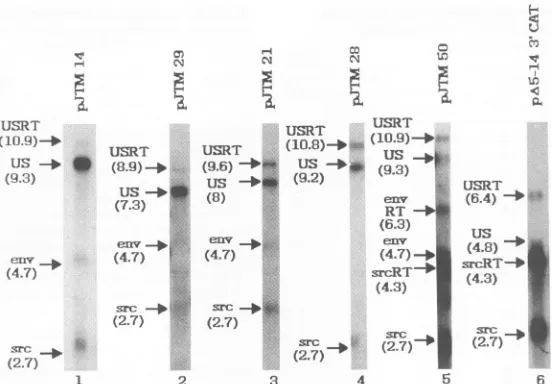
from transfectedcells, Northern blotanalysiswasperformed
with the probediagrammed in Fig. 1A(Fig. 4). The expected
sizes for the read-through transcripts which were cleaved
andpolyadenylated atthe SV40poly(A) site downstream is
approximately 1.6 kb larger than the correctly processed
RNAs. Asexpected, thewild-type construct, pJTM14,
ex-hibited a low level of unspliced read-through products
present in the 10.9-kb band. The same was true fora clone
deleted in the 3' gag and5'polgenes (pJTM29, 8.9kb). An
elevated level of unspliced read-through transcripts
com-pared withthat of the wild typewaspresentin cloneswhich
weremutatedinregionI(pJTM21,9.6kb;pJTMS0, 10.9kb)
orII(pJTM28, 10.8kb).It wasdifficulttodetecttheamount ofspliced read-through products becauseof the low amount
of total splicedRNAin all ofthese clones. However,itwas
clear from the data obtained with mutantswith which the
amountofsplicingwas
significantly
increased that both thesplicedandunspliced poolsofRNA contained
read-through
transcriptswhichwereprocessed atthe SV40poly(A) site.
on November 9, 2019 by guest
http://jvi.asm.org/
[image:6.612.57.300.104.349.2]°: N N U:v
USRT
USRT
US; -* (8.9)-_ (9.3)
us (7.3)
ensv :'
ells.*_ (4.7)
(4.7)
src --.W
(2.7)
(2.7)
1
USRT (9.6)-+.
us __P
(8)
envs
(4.7) src-7 (2.7)
-2 3
U'SRT USRT
us
(9.2) (9.3)
*i USRT
env (.) i" RT -+10
(6.3) Us
envr (4.8)
(4.7)-4
srcRT_
src-RT-- (4.3) (4.3)1
(2.7f (2.7) (2)+
[image:7.612.172.448.72.264.2]4 6
FIG. 4. Northern blotanalysisof RNA from CEF transfected withwild-typeandmutant constructs.Thegenomic(US)andsubgenomic (env andsrc) RNA species are indicated, as well as the correspondingread-through products (RT),ifpresent.The sizes(inkilobases) ofthe various RNA transcripts are indicated inparentheses.
TheinversionmutantpJTM50 demonstrated elevatedlevels
of read-through products resulting from the spliced pools
(env, 6.3 kb, andsrc, 4.3 kb) aswell as from theunspliced
pools (10.9 kb). The region I-region II deletion mutant
pA5-14 3'CAT demonstrated thesamephenomenon for the
spliced src RNA (4.3 kb). In this case, the ratio of src
read-through productsprocessedattheSV40 poly(A) siteto
correctly processed src RNAs appeared to be somewhat
lower than the values detected by the RNase protection
assay, the results of which are shown in Fig. 2. One
explanation may be that Northern blot analysis is able to
clearly detect only those transcripts which are complete,
whereas RNaseprotection can detectnicked species,
lead-ingtoavaluehigherthan that detectedbytheNorthernblot.
In addition, thelarge amount of28SrRNAwhich migrates
similarlymayinterfere with transferor hybridizationof the
probe to the 4.3-kb read-through RNA species.
Alterna-tively, theremaybetranscriptswhichhave been processed
at heterologous locations downstream that are not readily
detectablebyNorthern blot analysis.
The effect ofupstream sequences on 3'-end processing of
ASV RNAcan bealleviated bysubstitutionofa heterologous
poly(A) signal. In order to determine whether the
require-ment forregions I and IIwas specific to the ASV poly(A)
site, constructs in which an efficient heterologous poly(A)
signalwassubstituted for the viralpoly(A)sitewerecreated
(Fig. SA). These constructs contained the cat and SV40
downstream sequences. Clone pJTM60 contains the SV40
early poly(A) signalinplace of the ASV signal; the
remain-der of the plasmid is identical to the wild-type clone.
Northern blot analysis revealed that less than 1% of viral
RNAs resulted from read-through transcription and were
processed at the downstream SV40 poly(A) site (compare
the10.9-kb bandinFig. 4, lane 1,tothat in Fig.SB,lane 3).
Thisresult suggested that the SV40 early poly(A) signal is
more efficient than the ASV poly(A) signal. To determine
whetherregionIorIIorbothwererequired for this efficient
3'-end processing, mutant constructs containing the SV40
early poly(A) signal were examined (Fig. 5A, pJTM58 and
pJTM62). The amount ofread-through transcripts detected
witheither of thesemutantswasnegligible (Fig.SB, lanes 4
and5; compare toeither the deletionmutantpA5-25 3'CAT
orthe src cDNA clone pJS2CAT, Fig. 5B, lanes 1 and 2),
suggesting that neither region I alone nor regions I and II
togetherwere required for this efficient 3'-end processing.
RNA from cells transfected withconstructs identical tothe
aboveclonescontainingthe SV40 latepoly(A) signalinstead
of the ASVpoly(A) signalwas also examined by Northern
blot analysis, with similar results (data not shown). To
confirm the results obtained by Northern blot analysis, an
RNaseprotectionassaywasperformedwiththe aboveRNA
samples with the antisense riboprobes spanning the SV40
early or late poly(A) sites. The amount of read-through
productswaslessthan1% of the total amountof viral RNA
transcripts. Conversely, genomicclones deleted in regionI or II or both containing the ASV 3' LTR poly(A) site, as
expected from theprevious data, demonstrated anelevated
levelof RNAtranscripts processedatthedownstream SV40
earlypoly(A)site(datanotshown).These data suggest that
theability of the upstreamregionstofacilitate 3'-end
forma-tion isspecific for the relativelyweak ASVpoly(A)signal.
DISCUSSION
Theresults show that theefficiencyof3'-endprocessingat
the ASVpoly(A) addition site in the 3' LTRis reduced by
the deletion of two distant upstream regions. Region I
mapped to the gag gene between nt 630 and 1149 and
contained bothanNRS (2,54) and anenhancer element(3,
27, 52), either of which may coincide with the sequences
responsible for the effects on viral 3'-end processing. The
effect on 3'-end formation was absolutely dependent on a
positive orientation. Therefore, it ispossible that theNRS,
whoseeffectonsplicing is also absolutely orientation
depen-dent (2), is responsible for the phenomenon, but further work is required to map more precisely the cis element
responsiblefor the effect.RegionII waslocated in the3'pol
and 5' envsequencesbetween nt4995 and5131andcontains theenv3'ssat nt5078(11, 48).Thisregion also contains part
of an elementshown by deletion tobe importantin
regulat-ingASVsplicing (29). The importance of the 3'pol-5' env
region in determining the
efficiency
of3'-end processing ofon November 9, 2019 by guest
http://jvi.asm.org/
(4..?,
.^
is
a
SV4r0) r1y sv4(1Itlr f--- ~ p(A) p,(A)
._ 6qRl
fi7R0
_
7OS4
4 - US(9.3j)
4 mnv(4.7)
4+-- ~r;(2.7)
1 2 3 4
FIG. 5. Effect ofsubstitutingofa heterologous poly(A)signalon
RSV 3'-end formation. (A) Schematicrepresentation of cloneswith theinsertedSV40genefragment containing theearlypoly(A) signal.
The wild type (pJTM60). an inversion ofregion I(pJTM62), and a
deletion of regions I andII (pJTM58) are shown. (B) Northernblot
analysis of RNA from CEF transiently transfected with the con-structs diagrammed in panelA. AnsrccDNAclone (pJS2CAT)and a region I and region II deleted mutant (pA5-25 3'CAT), both
containing the RSV poly(A)signal, arealsoshown forcomparison.
Identities and sizes of the bands indicated are as described in the
legend to Fig. 4.
ASV RNAwas previously suggested by the experiments of
Wang (59),whoshowedthatthepresenceof aberrantlylarge
RNA species in CEF cell lines transformed by defective ASV correlatedwith deletion of this region. This resultwas
shown tobe acis effect and could not becomplemented by expression of a helper virus genome. The aberrant RNA
species contained cellular sequences at their 3' ends, result-ing from read-through transcription followed by cleavage and polyadenylation at cellularprocessingsites downstream ofthe integrated proviruses.
Our data indicated that, although both regions I and 11 containedci.s elements thatinfluenced thelevel ofviral RNA
splicing (2, 28, 29, 54), the increased level of read-through
transcripts wasnot directly couplcd to thc act of viral RNA splicing. Previousstudies haveindicated that 3'cleavageand polyadenylation of other cellularandviral RNApolymerase
II transcripts may be facilitated by the presence of cis
splicingsignals. Several studies showed that thepresenceof
introns in a transcriptional unit are associated with
signifi-cant increasesin the level ofexprcssion ofthe gene (12, 13,
23, 37). One study has shown that this increased level of
expressionwasnotcorrelatedwith the level oftranscription
butwith the level ofpoly(A)+ RNA in the nucleus (23). This
poly(A)' RNA included both unspliced precursors and
spliced RNA species, suggesting that the increase in
effi-ciency of3-endprocessing was correlated withthepotential
of the RNA to be spliced, i.e., the presence of functional
spliccsitcs,rather than with the splicing eventitself. Results
from acoupled in vitro splicing and polyadenylationsystem have alsosupported a role forsplice sites indetermining the
efficiency of 3'-end processing. It wasfound that therateof
3'-end processing was stimulated when RNA substrates
containing introns were used. This effectrequired an intact
3' ss but not a 5' ss,suggestingthat the presenceof the 3'ss processing signals and the ability to "define" the terminal
exon rather than splicing itself may determine 3-end
proc-essing efficicncy (36). Recent in vivo studies involving the
SV40 late leader sequences by Chiou et al. (12) have
supportedthese data,by finding that the decrease in thelevel
of polyadenylation efficiency was more pronounced when
mutant upstream 3' ss were present, rather than when
upstream 5' sswere mutated. Theprevious studies (12, 36)
showed that increased 3'-end processing efficiency was correlated with the presence ofa functional 3' ss that was upstream of the AAUAAAhexanucleotide and flanked the 3'
terminal exon of the pre-mRNA. Itis interestingto notethat
this finding was not the case in our system. Mutation or
deletionofthe src 3' ssdid notaffect theefficiencyof3'-end
processing at the ASV poly(A) site. Rather, deletion of a
fragment containing the more distal env 3' ss exhibited the
lower3'-end processingphenotype. Undertheseconditions,
the presence of an intact src 3' ss was not sufficient to maintainwild-type3'-end formation efficiency. These results
suggest that 3'-end formation in retroviruses may require a
selective interaction betweenspecificsplicingsignals and the
viralpoly(A)site. Thesedifferent rules for3'-endprocessing
may apply to retroviruses,which must maintain a significant
pool of unspliced RNA, in contrast to those that apply to
cellular pre-mRNAs, which are almost completely spliced.
Thestriking effect of upstream sequences onthe efficiency
of ASV RNA 3' processing may result from the relative
weakness of the 3' LTR poly(A)signal. Consistent with this
hypothesis, we found that when the viral 3' LTR poly(A)
signal was replaced with the efficient SV40 early or late poly(A) signal, the requirement for the upstream sequences was alleviated and read-through transcription was essen-tially eliminated. Alternatively, this result may indicate that
3'-end processing in ASVrequiresmore-specific interactions
between the 3' LTRpoly(A)site and theupstream sequences tomaintain cleavageandpolyadenylation at wild-type levels than are required for the SV40 signals.
The efficiency of3'-end processing has been correlated
with the binding of a cleavage factor to the GU- or U-rich
element downstream of the poly(A) cleavage site. The
se-quence ofthis element is highly variable in different
poly(A)
sites, and these differences in sequence apparently deter-mine the level of factor binding (19, 61). One possible
explanation for the effect of the upstream ASV sequences on
the efficiency of 3'-end processing could be that the
up-stream sequences bind additional factors that interact with the cleavage factortostabilize itsbindingtothe viral
poly(A)
addition site. Sincc region II contains part of asplicing
regulatoryelemcnt and theenv3' ss, these additional factors
may bc splicing factors. The mechanism bywhich the NRS clement in region I acts to inhibit
splicing
is also not yetA.
p.ITM58B
53qn p.TTMhAfiI II
pn 43
p.7 2 rFIT-L4
pAS25 [ir7-TF_
2C-AT fi3n
pJS:2AT TI.]
B.
~B
0.
NS
-, = . = -on November 9, 2019 by guest
http://jvi.asm.org/
[image:8.612.62.298.73.410.2]known.Onepossiblemodelis that the NRS inhibitssplicing by acting as a "decoy" splice site that competes with the
authenticsplicesite forsplicingfactors(51). Thus, the NRS
element in region I may also bind splicing factors that
interact with factors bound at the poly(A) addition site.
Alternatively, region I orII orbothmaycontain
secondary
structure elements that arerecognized by the 3' processing complex in orderto achieve efficientcleavage
and polyade-nylation atthe viral poly(A) site.There have been several previous reports indicating that
3-endprocessingof other retroviruses andpararetroviruses
is dependent on upstream sequences within 500 nt of the
poly(A) signal (9, 16, 42, 43, 46, 57); however, these up-stream sequences donot appeartocontain splicing signals.
It is possible thatASVmayalso contain suchelements;we would nothave detected their effect in ourstudiessincewe
have analyzed 3-end processing in the presence of the
region which corresponds in location to these previously
defined elements. In a series ofexperiments analyzing the
genome of the
Drosophila
melanogaster
retrotransposoncopia, it has been found that deletion of a 518-nt
region
beginning
312 nt upstream from the 3'-end processing siteinhibits cleavage and polyadenylation at the copia 3' LTR
and results in an increase in the amount of read-through transcripts (30).The deletedregioncontainsa3' ss,which is used tosynthesize a subgenomic copia mRNA. The 3'-end
processingof both the unspliced and the spliced 2-kbcopia
RNAswasaffectedbydeletionofthisregion, suggestingthe
possibility
that aregioncontaining cis-acting splicing signalsmay, in this case, facilitate copia 3'-end processing by a
mechanism similartothat proposed above for ASVRNA. ACKNOWLEDGMENTS
This workwassupportedbyPublic Health Service grant CA28051 from the National Cancer Institute.
We thank S. Perlman, M. F. Stinski, and the members ofour
laboratory for critical review of the manuscriptand M. Reeve for
typing.
REFERENCES
1. Adami, G., andJ. R. Nevins. 1988. Splice site selection
domi-nates overpoly(A)site choice in RNAproductionfromcomplex adenovirus transcription units. EMBO J. 7:2107-2116. 2. Arrigo, S., and K. Beemon. 1988. Regulationof Rous sarcoma
virus splicingandstability. Mol. Cell. Biol. 8:4858-4867. 3. Arrigo, S., M.Yun,and K.Beemon. 1987.cis-acting regulatory
elements within the gag gene of avian retroviruses. Mol. Cell. Biol. 7:388-397.
4. Berberich, S. L., and C. M. Stoltzfus. 1991. Mutations in the
regions of the Rous sarcomavirus 3' splice sites: implications
for regulationof alternative splicing.J. Virol. 65:2640-2646.
5. Bhat, B. M., and W. S. Wold. 1985. AATAAA as well as
downstream sequencesare requiredfor RNA3'-end formation in E3complex transcriptionunit of adenovirus. Mol. Cell. Biol. 5:3183-3193.
6. Bingham,P.M.,and Z. Zachar.1989.Retrotransposonsand the FB transposon from Drosophila lnelanoga,vster, p. 485-502. In D. E. Berg and M. M. Howc (ed.), Mobile DNA. American
SocietyforMicrobiology, Washington,D.C.
7. Bohnlein, S., J.Hauber,and B.R.Cullen. 1989.Identification of
a U5-specific sequence required for efficient polyadenylation within thehumanimmunodeficiencyviruslong terminal repeat. J. Virol. 63:421-424.
8. Brady, H.A.,and W. S.M.Wold. 1988.Competition between
splicingandpolyadenylationreactionsdetermines which
adeno-virus region E3 mRNAs are synthesized. Mol. Cell. Biol. 8:3291-3297.
9. Brown, P. H., L. S. Tiley, and B. R. Cullen. 1991. Efficient
polyadenylationwithin thehumanimmunodeficiencyvirus type
1long terminal repeat requiresflanking U3-specificsequences. J. Virol. 65:3340-3343.
10. Carswell,S.,andJ. C. Alwine. 1989. Efficiencyof utilization of the simian virus 40 late polyadenylation site: effects of upstream sequences. Mol.Cell. Biol. 9:4248-4258.
11. Chang, L.-J.,andC. M. Stoltzfus. 1985. Cloningand nucleotide sequences of cDNAs spanning the splice junctions of Rous sarcomavirus mRNAs. J.Virol. 53:969-972.
12. Chiou, H. C., C. Dabrowski, and J. C. Alwine. 1991. Simian virus 40 late mRNA leader sequences involved in augmenting mRNA accumulation via multiple mechanisms, including in-creased polyadenylationefficiency. J. Virol. 65:6677-6685. 13. Choi, T., M. Huang, C. Gorman, and R. Jaenisch. 1991. A
generic intron increases gene expression in transgenic mice. Mol. Cell. Biol. 11:3070-3074.
14. Conway, L., and M.Wickens. 1985. A sequencedownstream of AAUAAA is required for formation of simian virus 40 late mRNA3' termini in frog oocytes. Proc. NatI. Acad. Sci. USA 82:3949-3952.
15. DeZazzo, J. D., and M. J. Imperiale. 1989.Sequencesupstream of AAUAAA influence poly(A) site selection in a complex transcription unit. Mol. Cell. Biol. 9:4951-4961.
16. DeZazzo, J. D., J. E. Kilpatrick, and M. J. Imperiale. 1991. Involvement of long terminal repeat U3 sequencesoverlapping the transcriptional control region in human immunodeficiency virustype 1 mRNA 3'-end formation. Mol.Cell. Biol. 11:1624-1630.
17. Fitzgerald, M., and T. Schenk. 1981. The sequence 5'-AAUAAA-3' forms part of therecognition site for polyadenyl-ation of late SV40 mRNAs. Cell 24:251-260.
18. Gil, A.,and N. J.Proudfoot. 1984. Asequence downstream of AAUAAA isrequired forefficient rabbit ,B-globinmRNA3'-end formation. Nature (London) 312:473-474.
19. Gilmartin, G. M., and J. R. Nevins.1991. Molecularanalyses of twopoly(A) site-processingfactors that determine the recogni-tion and efficiency of cleavage of the pre-mRNA. Mol. Cell. Biol. 11:2432-2438.
20. Helfman, D. M., S. Cheley, E. Kuismanen, L. A. Finn, and Y. Yamawaki-Kataoka. 1986. Nonmuscle andmuscle tropomyosin isoforms are expressed from a single gene byalternative RNA splicing and polyadenylation. Mol. Cell. Biol.6:3582-3595. 21. Herman,S. A., and J. M. Coffin. 1986.Differential transcription
from the long terminal repeats of integratedavian leukosis virus DNA. J. Virol. 60:497-505.
22. Herman, S. A., and J. M. Coffin. 1987. Efficient packagingof readthrough RNA in ALV.Implications for oncogene transduc-tion. Science 236:845-848.
23. Huang, M. T. F., and C. M. Gorman. 1990. Intervening se-quencesincreaseefficiency of RNA 3'processing and accumu-lation ofcytoplasmic RNA. Nucleic Acids Res. 18:937-947. 24. Huang,M.T.F., and C. M.Gorman. 1990. The simian virus40
small-t intron, present in many common expression vectors, leadstoaberrant splicing. Mol. Cell. Biol. 10:1805-1810. 25. Iwasaki, K., and H. M. Temin. 1990. The efficiency of RNA
3'-end formation is determinedby the distance between the cap site and the poly(A) site in spleen necrosis virus. Genes Dev. 4:2299-2307.
26. Kanter, M. R., R. E. Smith,and W. S. Hayward. 1988. Rapid induction of B-cell lymphomas: insertional activation of c-myb by avian leukosis virus. J. Virol. 62:1423-1432.
27. Karnitz, L., S. Faber, and R. Chalkley. 1987. Specific nuclear proteins interact withRous sarcomavirus internal enhancer and share a commonelement with the enhancer located in the long terminal repeat of the virus. Nucleic Acids Res. 15:9841-9859. 28. Katz,R.A.,M.Kotler,and A. M.Skalka. 1988.cis-acting intron mutations that affect the efficiency of avian retroviral RNA splicing: implications for mechanisms of control. J. Virol. 62:2686-2695.
29. Katz, R.A., and A. M. Skalka. 1990. Control of retroviral RNA splicing through maintenance of suboptimal processing signals. Mol. Cell. Biol. 10:696-704.
30. Kurkulos, M., J.M.Weinberg,M. E.Pepling,and S.M. Mount. 1991. Polyadenylation in copia requires unusually distant
on November 9, 2019 by guest
http://jvi.asm.org/
stream sequences. Proc. Natl. Acad. Sci. USA88:3038-3042. 31. Leff, S. E.,R. M. Evans, and M.G. Rosenfeld. 1987. Splice site
commitment dictates neuron-specific alternative RNA process-ing in calcitonin/CGRP gene expression. Cell 48:517-524. 32. McDevitt, M. A., R. P. Hart, W. W. Wong, and J. R. Nevins.
1986. Sequences capable of restoring poly(A) site function define two distinct downstream elements. EMBO J. 5:2907-2913.
33. McDevitt,M. A., M. J. Imperiale, H. Ali, and J. R. Nevins. 1984. Requirement of a downstream sequence for generation of a poly(A) addition site. Cell 37:993-999.
34. Melton, D. A., P. A. Kreig, M. R. Rebagliati, T. Maniatis, K. Zinn, and M. R. Green. 1984. Efficient in vitro synthesis of biologically active RNA and RNA hybridization probes from plasmids containing the bacteriophage SP6 promoter. Nucleic Acids Res. 12:7035-7056.
35. Montell, C., E. F. Fisher,M. H.Caruthers, and A. J. Berk. 1983. Inhibition ofRNAcleavage but notpolyadenylation by a point mutation in mRNA 3' consensus sequence AAUAAA. Nature (London) 305:600-629.
36. Niwa, M., S. D. Rose, and S. M.Berget. 1990. In vitro polyade-nylation is stimulated by the presence of an upstream intron. Genes Dev. 4:1552-1559.
37. Palmiter, R.D., E. P.Sandgren, M. R. Avarbock, D. D. Allen, and R. Brinster. 1991. Heterologous introns can enhance expression of transgenesin mice. Proc. Natl. Acad. Sci. USA 88:478-482.
38. Peterson, M. L., E. R. Gimmi, and R. P. Perry. 1991. The developmentally regulated shift from membrane to secreted k mRNAproduction is accompanied byan increase in cleavage-polyadenylation efficiency butnomeasurablechangeinsplicing efficiency. Mol. Cell. Biol. 11:2324-2327.
39. Proudfoot, N.J. 1991. Poly(A)signals. Cell64:671-674. 40. Proudfoot,N.J.,and G.G.Brownlee.1976. 3' noncoding region
sequences in eukaryotic messenger RNA. Nature (London) 263:211-214.
41. Raines, M. A.,N. J. Maihle, C. Moscovici, L.Crittenden, and H.-J. Kung. 1988. Mechanism of c-erbB transduction: newly released transducing viruses retain poly(A)tractsoferbB tran-scripts and encode C-terminally intact crbBproteins. J. Virol. 62:2437-2443.
42. Russnak,R. H.1991. Regulation ofpolyadenylation in hepatitis B viruses: stimulation by the upstreamactivating signal PS1 is orientation-dependent, distance-independent, and additive. Nu-cleic AcidsRes. 19:6449-6456.
43. Russnak, R.,and D. Ganem. 1990.Sequences 5' to the polyad-enylationsignal mediate differential poly(A) site useinhepatitis Bviruses. GenesDev. 4:764-776.
44. Sadofsky, M., S. Connelly, J. L. Manley, andJ. Alwine. 1986. Identification ofasequence elementonthe 3' side of AAUAAA which is necessary for simian virus 40 late mRNA 3'-end processing. Mol. Cell. Biol. 5:2713-2719.
45. Sambrook, J.,E. F. Fritsch, and T. Maniatis. 1989. Molecular cloning: a laboratory manual, 2nd ed. Cold Spring Harbor Laboratory, ColdSpringHarbor, N.Y.
46. Sanfacon, H.,P.Brodmann,and T. Hohn. 1991. Adissectionof thecauliflower mosaic viruspolyadenylation signal. GenesDev. 5:141-149.
47. Sanfacon, H., and T. Hohn. 1990. Proximity to the promoter inhibits recognition of cauliflower mosaic virus polyadenylation signal. Nature (London) 346:81-84.
48. Schwartz, D. E., R. Tizard, and W. Gilbert. 1983. Nucleotide sequence of Rous sarcoma virus. Cell32:853-869.
49. Simonsen, C. C., and A.D. Levinson. 1983. Analysis of proc-essing and polyadenylation signals of the hepatitis B virus surface antigen gene by using simian virus 40-hepatitis B virus chimeric plasmids. Mol. Cell. Biol. 3:2250-2258.
50. Sompayrac, L. M., and K. Danna. 1981. Efficient infection of monkey cells with DNAand SV40. Proc. Natl. Acad. Sci. USA 78:7575-7578.
51. Stoltzfus, C. M. 1988. Synthesis and processing of avian sar-comaretrovirus RNA. Adv. Virus Res. 35:1-38.
52. Stoltzfus, C. M., L.-J. Chang, T. P. Cripe, and L. P. Turek. 1987. Efficient transformation by Prague A Rous sarcoma virus plasmidDNArequires the presenceof cis-acting regions within the gag gene. J. Virol. 61:3401-3409.
53. Stoltzfus, C. M.,K. Dimock, S. Horikami, and T. Ficht. 1983. Stabilities ofaviansarcomavirus RNAs: comparison of subge-nomic andgenomicspecies with cellularmRNAs.J.Gen.Virol. 64:2191-2202.
54. Stoltzfus, C. M.,andS.J. Fogarty. 1989.Multipleregions inthe Rous sarcoma virus src gene intron act in cis to affect the accumulation ofunspliced RNA. J. Virol. 63:1669-1676. 55. Strohman, R., P. Moss, J. Micou-Eastwood, D. Spector, A.
Przybyla, and B. Peterson. 1977. Messenger RNA for myosin polypeptides: isolation from singlemyogenic cell cultures. Cell 10:265-273.
56. Swain,A., andJ. M. Coffin. 1992. Mechanism oftransduction byretroviruses. Science 255:841-845.
57. Valsamakis, A., S.Zeichner,S.Carswell,andJ. C. Alwine. 1991. The human immunodeficiency virus type 1 polyadenylation signal: a 3' long terminal repeat element upstream of the AAUAAAnecessary for efficientpolyadenylation. Proc. Natl. Acad. Sci. USA88:2108-2112.
58. Wang, J., and T. Pederson. 1990. A 62,000 molecular weight spliceosome protein crosslinks to the intron polypyrimidine tract. Nucleic Acids Res. 18:5995-6001.
59. Wang, L.-H. 1985. Deletion in the 3' pol sequence correlates with aberration ofRNAexpressionin certain replication-defec-tiveavian sarcomaviruses. J. Virol. 54:446-459.
60. Weichs an der Glon, C., J. Monks, and N.J. Proudfoot. 1991. Occlusion of the HIVpoly(A) site. Genes Dev. 5:244-253. 61. Weiss, E. A., G. M.Gilmartin, andJ. R.Nevins. 1991. Poly(A)
site efficiency reflects thestability of complex formation involv-ing the downstream element. EMBO J. 10:215-219.
62. Wickens, M., and P. Stephenson. 1984. Role of theconserved AAUAAA sequence: four AAUAAA point mutants prevent messenger RNA3'-endformation. Science 226:1045-1051. 63. Wickens, M. 1990. Howthe messenger got its tail: addition of
poly(A)in thenucleus. Trends Biochem. Sci. 15:277-281. 64. Zhang,F., R. M.Denome, and C.N. Cole. 1986.Finestructure
analysis of the processing and polyadenylation region of the herpes simplex virus type 1 thymidine kinase gene by using linkerscanning, internal deletion, and insertion mutations. Mol. Cell. Biol.6:4611-4623.