Date of publication xxxx 00, 0000, date of current version xxxx 00, 0000. Digital Object Identifier 10.1109/ACCESS.2017.DOI
An Improved Particle Swarm Algorithm
for Multi-Objectives based Optimization
in MPLS/GMPLS Networks
MOHSIN MASOOD1, MOHAMED MOSTAFA FOUAD2, RASHID KAMAL3, AND IVAN GLESK1
1
Electronics and Electrical Engineering Department, University of Strathclyde, G11XW, Glasgow, UK 2
Arab Academy for Science, Technology, and Maritime Transport, Cairo, Egypt 3
Department of Computing and Technology, Abasyn University, Peshawar, Pakistan
Corresponding author: Rashid Kamal (e-mail: [email protected])
This work was supported by the European Union 's Horizon 2020 Research and Innovation Program through the Marie Sklodowska-Curie under Grant 734331
ABSTRACT Particle swarm optimization (PSO) is a swarm-based optimization technique capable of solving different categories of optimization problems. Nevertheless, PSO has a serious exploration issue that makes it a difficult choice for multi-objectives constrained optimization problems (MCOP). At the same time, Multi-Protocol Label Switched (MPLS) and its extended version Generalized MPLS, has become an emerging network technology for modern and diverse applications. Therefore, as per MPLS and Generalized MPLS MCOP needs, it is important to find the Pareto based optimal solutions that guarantee the optimal resource utilization without compromising the quality of services (QoS) within the networks. The paper proposes a novel version of PSO, which includes a modified version of the Elitist learning Strategy (ELS) in PSO that not only solves the existing exploration problem in PSO, but also produces optimal solutions with efficient convergence rates for different MPLS/ GMPLS network scales. The proposed approach has also been applied with two objective functions; the resource provisioning and the traffic load balancing costs. Our simulations and comparative study showed improved results of the proposed algorithm over the well-known optimization algorithms such asstandardPSO, Adaptive PSO, Bat and Dolphin algorithm.
INDEX TERMS communication networks optimization, exploration problem, multi-objective constrained optimization, particle swarm optimization, swarm intelligence
I. INTRODUCTION
I
N a network terminology, network efficiency term is used for the effective use of the network resources. Therefore, the target is to find the optimal route within the network that ensures the efficient utilization of the network resources. The computation of the optimal paths relays on optimization algorithms. Selecting the optimal paths in multi-constraints networks is still a major challenge. Finding the best path from the list of feasible paths under real networks scenarios is called a Multi-Constrained Optimal Path (MCOP) prob-lem [1], [2]. In actual networks, the optimal paths can be derived by computing the multiple objectives with multi-constraints. These constraints might conflict with each other, which limits the feasible number of optimal paths. There-fore, network traffic engineers are trying to balance between multi-objective constrained functions. This concept is known as Pareto based optimal solutions. Pareto based solutionsconsist of Pareto set (multiple feasible solutions) in the multi-objective spaces. These optimization challenges can be solved either by exact or approximate/ meta-heuristic approaches. Meta-heuristic based methodologies are usually applied when exact-based approaches failed, or a computa-tional complexity arose [3], [4].
Particle swarm optimization (PSO) technique is a swarm-based algorithm for solving both continues and combinato-rial optimization problems and had been applied to several applications due to its fast convergence to find optimal so-lution. StandardPSO can be easily trap to its local and/or global optima that not only become the source of exploration problem but also effects its convergence. Multiple versions had been proposed, including hybrid and adaptive models of PSO to rescue algorithm's local and/or global optima problem [6]–[8]. However, PSO exploration problem is still a serious drawback for some modern applications.
This paper offers an adapted version of PSO algorithm for solving both local and global optima problem with a fast con-vergence rate for the MCOP optimization problem in MPLS/ GMPLS networks. The proposed adapted algorithm is based on the linear combination of objectives functions in order to produce optimal solutions and Pareto set that is offered as non-dominant solutions of the contrast based function. The rest of the paper is organized as follows; Section 2 represents an importance of meta-heuristic algorithms including PSO algorithm for solving various optimization problems and dis-cusses the related work to PSO algorithm, subject to its vari-ous improved versions. Section 3 will formulates the problem of traffic engineering in MPLS/GMPLS networks as MCOP problem that includes multi-objectives subject to multiple constraints. Section 4 presents the solution in the form of proposed algorithm for MCOP problem in MPLS/GMPLS networks. Section 5 provides the results obtained and com-parative analysis between the proposed algorithm and other meta-heuristic techniques. Finally, section 6 includes the conclusions. In the paper, for MPLS and GMPLS networks MPLS/ GMPLS keywords are used.
II. BACKGROUND AND RELATED WORK
A. META-HEURISTIC OPTIMIZATION ALGORITHMS
Numerous developed meta-heuristic algorithms are inspired by the behavioral study of birds, fishes, bees, ants, bats, and other animals. These algorithms have been used for solving complex optimization problems [9]. The meta-heuristic al-gorithms are classified on the foundation of inputs, searching tactics and the complication of exploration and exploitation capabilities [10]. Developing and selecting an efficient algo-rithm, that could manage multiple objective-based optimiza-tion problems, has become a core challenge. Moreover, local and global optima are known challenges in the convergence of meta-heuristic optimization techniques. Therefore, the best algorithm should offer global overview and have fewer chances to be trapped into its local optima [11].
B. PARTICLE SWARM OPTIMIZATION ALGORITHM AND EXPLORATION PROBLEM
Particle swarm optimization (PSO) algorithm was introduced by Kennedy and Eberhart to solve optimization problems [12]. The algorithm is dependent on a number of parti-cles as searching agents, which disperse in the searching area hunting for solutions in a swarm formation. In such
swarm, each particle depends on two parameters; a self-learning (cognitive) capability and social interactions with other swarm members through several iterations. During each algorithm's iteration, each particle locates the best position compared to the previous position, technically recognized as the local best position (local optima). Whereas, for global best position (global optima), each particle's best position is compared with all other particle's best positions in the swarm and choose the (global optima). The cognitive parameter is considered for tracing local optima, and for global optima, a social-interaction parameter is used. As per next iteration, the global optima will be considered as the reference that should be followed by the other swarm members [12], [13]. One of the basic problems of the PSO algorithm is the trapping of particles into local optima; a state where the particle flies to the same position in each iteration. This is identified as the local optima problem [6]. Whereas, global optima problem refers to a state where the number of particles in the swarm offer repetitive global position during iterations. Local and global optima problems not only occur in the PSO algorithm but are subjects of investigation for other optimization techniques such as Genetic and Ant Colony optimization algorithms [6], [14].
The enhancement of PSO technique performance by de-signing onto various types of topologies is an active research direction [15]. According to Dong et al [16], PSO algorithm for high dimension complex problem produces premature solutions due to its local optima problem. He further stated that present PSO has lack of effective global search capability and therefore, fail to find optimal solutions for complex and complicated optimization problems. Consequently, optimiza-tion algorithm designers are focusing on the fundamental improvement of local optima in detail with fast convergence or find all probabilities of exploring other searching areas in the searching domain. To increase the exploring capability of the PSO algorithm, the common strategy is to improve the search space diversity.
Further approaches are adapted through the enhancements in the algorithm's parameters or through proposing hybrid models with different algorithms [17]. According to Laura et al. [18], most of the techniques escape local optima trap by accepting non-improving or inferior neighbors. Liang et al. [15] presented a comprehensive learning particle swarm optimization (CLPSO), where all particles in the swarm maintain the particle's best positions and use it to update particle's velocity. A combination of local and global version is presented by Parsopoulos and Vrahatis [19] as a unified particle swarm optimizer (UPSO). Mendes and Kennedy proposed fully informed PSO, where all neighbor particles are used to update velocity instead of using particle's best and global best position parameters. Hence, the particle's influence on its neighbor is weighted the result is dependent on its fitness value and neighborhood size [20]. A fitness-distance-ratio-based PSO (FDR-PSO) has been developed by Veeramachaneni et al. [21], in which the strategy of near neighborhood interaction is employed. Other researchers
posed a hybrid model of PSO with algorithms to enhance the algorithm performance and solve local and/ or global optima problem [22].
In actual networks, multiple objectives having multi-constrained based optimization problem (MCOP) is consid-ered as complex optimization problem, which is also an NP hard problem. Therefore, meta-heuristic techniques have become appealing approaches, since they consume a small amount of the computing time to resolve described network optimization issues. Regarding multi-constrained optimal path (MCOP), PSO algorithm either in its original form or its modified versions has been applied for various optimization problems [1], [23]. Siddiqui et al. [24], proposed PSO based algorithm for the multi-constrained route optimization for electric vehicles (EVs). Jiuxin et al [25], propounded efficient objective service selection (EMOSS) based on a multi-objective methodology to answer the time-complexity and non-global optimal solutions problems in quality of service levels requirements. Dekun [26], came up with an improved version of PSO algorithm for MCOP problem, which uses an external library to save its current best solution and maintains this archive during iterations.
III. PROBLEM FORMULATION AND NOTATIONS
According to several PSO based research papers, the appli-cation of the local best(Pbest)PSO is superior to the global best(Gbest)PSO. The local best PSO has better exploration abilities, not easily falling into a local optimum, and it is not suffering from an early convergence. While the global best version of particle swarm optimization(Gbest)model is suitable for uni-modal optimization problems (single objec-tive), but can be trapped into local optima for multi-modals problems. Whereas the local best version of PSO(Pbest)can be used for solving multi-modal problems, it badly affects the convergence of the algorithm for uni-modal optimization problems [27].
To address the above, this paper proposes a modified version of PSO which is based on a combination of both, the local-best and the global-best versions of PSO algorithms. The method is entitled as “Pareto based Modified Local
Global Particle Swarm Optimization (PMLG-PSO)”
algo-rithm. The paper then evaluates the local and global optima problems and proposes solutions for MCOP optimization in MPLS/GMPLS networks. In the paper, an exploration problem and local/global optima problem are interchange-able. Before starting to investigate the exploration problem of the PSO algorithm, the paper first formulates the multi-objectives optimization problem in MPLS/GMPLS using a Pareto approach.
A. MPLS/ GMPLS NETWORKS: A BRIEF
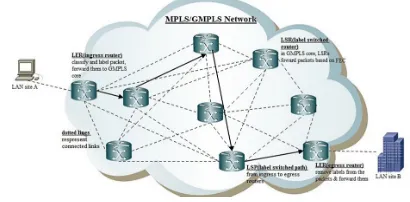
[image:3.576.313.518.65.166.2]MPLS/ GMPLS is a network protocols suite used for modern communication networks and supports all network switching technologies including time, wavelength, space, and packet switching. Using MPLS/ GMPLS protocols suite, a wireless connection establishes as a path between the edge routers of
FIGURE 1. MPLS/GMPLS Network
the network, known as Label Switched Path (LSP). An edge router that is connected to sending host is called an ingress router. Whereas the router connected with the receiving host is the egress router. Ingress and egress routers are named as Label Edge Routers (LER). The present network domain includes all the connected nodes/ routers between LERs. Thus, based on the network topology, there are two basic types of routers; called interior routers and boundary routers. LERs are boundary routers. All connected routers between LERs are interior routers. MPLS/ GMPLS networking is built over the label switching terminology, where packets are identified and forwarded into the network, based on labels identification rather than IP addresses. All routers between LERs are Label Switched Routers (LSR). The job of LERs is to assign labels and LSRs will forward the packets in the network, dependent on the label identification rather than using IP addresses. Today, major networking vendors offer MPLS/ GMPLS enabled routers and many ISPs (Internet Service Providers) have deployed these routers in backbone networks [28].
In our study, the MPLS/ GMPLS network is represented as graphs, where nodes/routers are vertices and links signify edges, according to the graph theory. A route is computed path between the LERs. Each path indicates the sequentially connected links between LSRs. Therefore, the MPLS/ GM-PLS network can be presented asG, where denotes for graph/ network, set of routers (vertices) are denoted byRSet, where each routerr/ LER/ LSR is the member ofRSet andLSet is the set of connected linksl. Each link has a fixed capacity for traffic denoted aslc. In the experiments, number of traffic requests will be arriving at ingress router, which computes the optimal path (s) based on proposed algorithm between ingress and the egress routers. Fig. 1 portrays the graphical representation of described MPLS/GMPLS networks. Fur-ther details on the topology notations are given in Table 1.
B. OBJECTIVE FUNCTIONS AND CONSTRAINTS (MCOP) FOR MPLS/ GMPLS NETWORKS
TABLE 1. Topology Notations
G graph / network topology
l each link in the network
r every router in the network (LERs and LSRs)
LSet {li, i= 1,2 3, . . . ..,ln}is the set of;∈Lset
RSet {ri, i= 1,2 3, . . . .,rn}is the set of routersr, r∈Rset
lr is the link betweenrandr∗(connectedLSRs)
e unit of traffic (traffic is no. of packets/ bits per sec)
Eset {ei,i = 1,2 3, . . . ..,en}set of all traffics e ;e∈Eset
p path defined for each traffic requestebetween LERs
Ptotal total number of pathsp
pb
r path bandwidth between connected routers
vtraf f ic total volume of traffic requests for pathp
lu link utilization of each linkl
lc link capacity of each linkl ϕl load balancing objective function
cl,r routing cost for unit trafficeover linkl
Cep routing cost for unit traffic over pathp
xpe flow of traffic request on pathpas continues variable ;xpe>0
ipe,l an indicator of traffic flow over pathp
ipe,l is 1 if linklis being used by pathpfor traffic requeste
functions.
1) OPTIMAL RESOURCE PROVISIONING OBJECTIVE FUNCTION
In the experimental setup, the MPLS/ GMPLS domain-based network is designed, which receives traffic demands at ingress router of the network. The objective function for the routing algorithm is to compute the optimal path(s), where re-sources can be provisioned optimally without compromising on quality-of-services (QoS), to be granted to end users. In the network, each linklhas assigned a specific cost per unit of traffic flow called asCl,r, which is assigned by the service provider. WhereasCepis the total routing cost of a pathpfor traffic request over a selected linkl. The bandwidth price for the connection between each router of the network ispbrand thus, the bandwidthB cost isCe = B ×pbr over the linkl such as,l =r, r∗. Similarly, there is a delaydeon each link lfor forwarding the data traffic in the network. Letxijbe the used as an indicator to show that whether the linklis selected for forwarding traffic fromitoj.
Xij = (
1, if the edge is selected
0, otherwise (1)
Costresource=Costbandwidth+Costdelay+CostRouting (2)
Costbandwidth= α X
l Lset Ceipe,l
!
(3)
Costdelay = β X
l Lset de
!
(4)
CostRouting= γ X
l Lset Cl,ripe,l
!
(5)
Objective F unction: min (Costresource) (6)
which subject to following constraints; P
l Lsetxij = 1 f or x p
e>0 Constraint (6a)
P
l Lsetxij = 1 f or i p
e,l= 1 Constraint (6b)
PLset
l x
p
e=vtraf f ic Constraint (6c)
PLset
l p
b
r where pbr>0, pb
r={10, 100}
Constraint (6d)
de>0 f or ∀l ∈Lset Constraint (6e) Whilecl,r is the total routing cost of a pathpfor traffic request over a selected link l. alpha , beta and gamma are positive constants that are used to denote the weight of each component. The objective function for offline resource provisioning problem is given by Eq. (6); Constraint (6a) ensures that all the links belonging to a set of links can only be selected if xij = 1, and when the variable xpe for the selection of the path value is greater than 0. From constraint (6b), the constraint identifies that the link l from LSet can only be chosen if linkl is used for the traffic request. Con-straint (6c) verifies that all selected links for the computed path must accommodate all number of traffic requests in the given topology. Constraint (6d) as a verification of bandwidth price is added on each selected link within limited bounds of [10, 100]. Constraint (6e) recognizes that traffic delay must be present to all links.
2) TRAFFIC LOAD BALANCING OBJECTIVE FUNCTION
There are a number of choices how to accomplish traffic load balancing metric and implement a piecewise approximation of a cost function as described by Fortzet et al. [29]. Each connected link between routers in the network is associated with two parameters identified as a link load or utilizationlu and a link capacitylc. The Link utilizationluis a number of traffic flows over the link. While the link capacitylc can be defined as a capacity of a link to handle unit traffic/number of traffic flows [2], [30]. By having these two functions, traffic load balancing (ϕl) cost can be illustrated as the link utilization according to its capacity as follow;
ϕl=
link utilization(lu)
link capacity(lc) (7)
To achieve a resourceful use of links for traffic flows in the network, the links load balancing can be used as a fitness function that is to be minimize. This approach leads to an ef-ficient utilization of network resources as well as to minimum packets loss, bound delays, and jitter etc. Consequently, this objective function can be described to minimize the sum of traffic load balancing costs for all the links(l)in the network as demonstrated by Eq. (8).
Objective F unction: mini( X
l Lset
ϕl) (8)
Subject to constraints:
lu ≤ lc Constraint (8a)
ϕl ≥ lu∀l ∈ Ltotal Constraint (8b)
lu = Pe∈E PLset
l=1 i
p
expe Constraint (8c)
ϕl ≥ 2.2lu −0.5 2 lc Constraint (8d)
ϕl ≥ 5.1lu −2.33 lc Constraint (8e)
ϕl ≥ 15.2lu −9.32 lc Constraint (8f)
ϕl ≥ 60.2lu −45.35 lc Constraint (8g)
ϕl ≥ 300.3lu −261.34 lc Constraint (8h)
xp
e>0, ∀e ∈Eset and ∀l∈Lset Constraint (8i)
r ∈Rsetf or vtraf f ic Constraint (8j)
l >0f or l={r, r∗} Constraint (8k)
Constraint (8a) ensures that the link utilizationlu in the network must have either the same or less than the link’s capacitylu. In modest wordings, the traffic flows over the link must not exceed the link’s capacity. Constraint (8b) states that traffic load balancingϕl must be greater than or equal to the link utilizationlufor all links. Further, this constraint guarantees that difference between the link utilizationlu and link capacitylc must not be very high. Constraint (8c) precisely explains features of the link utilizationlu in the given topology. Linklcan only be considered as utilized for a traffic flow, when the traffic flow is the member of the set of traffic demands, and the linkl is also the member of the set in admissible links of the network. While ipexpe are the indicators which identifies the link lcan be used for traffic flow over a path, such that a link l can be used for path computation. Constraints (8d) to (8h) defines some specific linear load balancing cost function within feasible region. Constraint (8i) represents the identifier of traffic flow over a path, when it is more than 0 value. In other words, a path can be used for a traffic request. Moreover, constraints (8j) and (8k) identify the connected links and routers in the topology, which are used for the requested path.
a: PARTICLES ENCODING
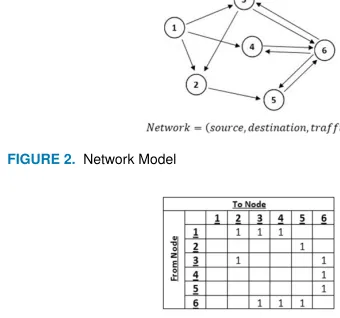
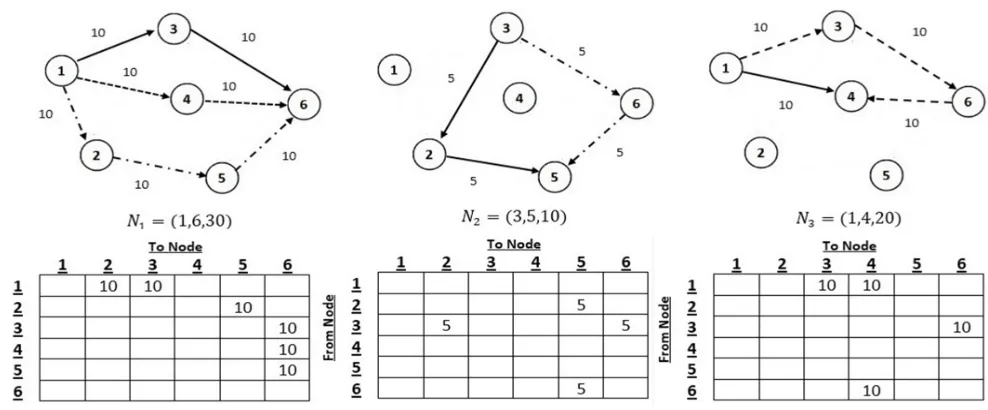
[image:5.576.294.464.66.225.2]A Particle encoding is the first step towards further evaluation of the proposed algorithm. In this paper, the particles travel over the two-dimensional matrix, where each row represents a from-node and each column defines the to-node, in a searching (sparse) matrix. Each particle represents the traffic flow over each selected link for a given traffic request. To elaborate this section, let us consider a 6-nodes network as shown in Fig. 2 and the adjacency and demand matrices, as shown in Fig. 3, 4. In the given example, three traffic
FIGURE 2. Network Model
FIGURE 3. Adjacency Matrix for Traffic Model
demands (packets per unit secs) are considered as N1 =
(1, 6, 30), N2 = (3, 5, 10)andN3 = (1, 4, 20). For the first traffic demandt1, the traffic will be split over three paths; i.e., first path as (1, 3, 6), 2nd path (1, 4, 6) and (1, 2, 5, 6) as 3rd path. ForN2, traffic splits over two paths such as path-1: (3, 2, 5), and path-2: (3, 6, 5). Similarly, forN3, the traffic will be split over two equal paths as path-1: (1, 4) and path-2: (1, 3, 6, 4).
IV. PROPOSED PMLG-PSO APPROACH
The paper proposes a novel meta-heuristic approach, named
as PMLG-PSOalgorithm for the MCOP optimization
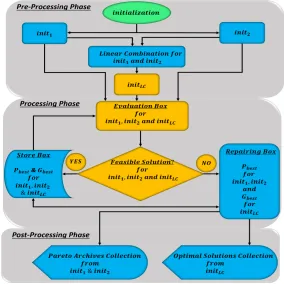
prob-lem in MPLS/ GMPLS networks. The flow chart of the proposed PMLG-PSO algorithm is shown in Fig. 5. The flow chart is segmented into three main phases; initialization phase, processing phase and post-processing phase. Each of the phase will be described in pseudo code along with explanation in the following subsections.
A. INITIAL PHASE
This phase discusses the initial stage of the algorithm, where the searching agents (particles), searching space (ma-trix/graph) and algorithm's initial operations are engaged. In pre-processing stage, the constraints have been applied to limit the searching space and as a result obtain a skeleton matrix. A Skeleton matrix is used as a searching constrained dependent graph, where particles can hunt for the feasible solutions. Certain network administrative-based constraints are applied. For example, each traffic request for specific nodes and links are not allowed. In experiments, skeleton matrix is applied as a MPLS/ GMPLS network that is the collection of permissible links between connected nodes and can be used for traffic requests. Furthermore, the particles are initialized with random initial positions in the searching matrix for both fitness functions (resource provisioning and traffic load balancing).
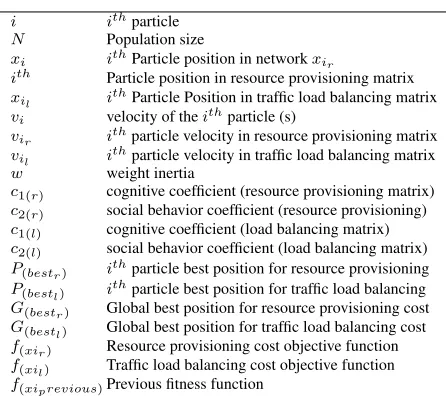
[image:5.576.41.282.68.327.2]traf-TABLE 2. Variables used in Pseudo code of PMLG-PSO Algorithm
i ithparticle
N Population size
xi ithParticle position in networkxir
ith Particle position in resource provisioning matrix
xil i
thParticle Position in traffic load balancing matrix
vi velocity of theithparticle (s)
vir i
thparticle velocity in resource provisioning matrix
vil i
thparticle velocity in traffic load balancing matrix
w weight inertia
c1(r) cognitive coefficient (resource provisioning matrix)
c2(r) social behavior coefficient (resource provisioning)
c1(l) cognitive coefficient (load balancing matrix)
c2(l) social behavior coefficient (load balancing matrix)
P(bestr) i
thparticle best position for resource provisioning
P(bestl) i
thparticle best position for traffic load balancing
G(bestr) Global best position for resource provisioning cost
G(bestl) Global best position for traffic load balancing cost
f(xir) Resource provisioning cost objective function
f(xil) Traffic load balancing cost objective function
f(xiprevious)Previous fitness function
fic load balancing fitness functions with its constraints, the initial particle positions are loaded ininit2. ThePMLG-PSO algorithm and its proposed modifications are:
A Particle best position for a resource provision function is Pbestr . The particle best position for a load balancing function isPbestl . Global-best-positionsGbestr andGbestl are computed by Pbest (Pbestr andPbestl) . Solutions for
(Gbestr and Gbestl) are collected as non-dominant solu-tions for generating the graph of Pareto front. However, the algorithm's optimal solutions are obtained as global-best-positionsGbest from the foundation of the linear combina-tion fitness funccombina-tion(initLC). According to [31], [32] for an optimal solutions collection, there are various tactics that can be used for MCOP optimization problems. They are criteria-based, aggregation-criteria-based, Pareto-based dominant ranking and linear combination-based methods. In this Paper, we applied the parametric linear combination of fitness functions for the computation of optimal solutions (Gbest, which can mathematically derive as;
F itness F unction(LC):
α (Costresource) + (1−α) X
l Lset ϕl
!
+ Φ (9)
In Eq. (9), α is a weight variable and Φ is called plenty. Gbest of the linear combination fitness function F itness F unction(LC) or initLCwill be considered as the optimal solution. The pseudo code for the initialization phase is given below asAlgorithm1, whereas variables used in the algorithms are defined in Table 2.
Algorithm 1:Algorithm for Initialization Stage
1: Each particleP in population initialize w.r.tfxir &fxil
LOOP Process
2: fori= 1 :Ndo
3: xi(r): forinit1subject to constraints
4: xi(l): forinit2subject to constraints
5: vi(r): forinit1
6: vi(l): forinit2
7: end for
8: w: initialize weight inertia parameter
9: (c1 (r), c2(r)): initialize with the initial values of 2
10: fori= 1 :N do
11: evaluatef intessCostresource (fxir): forinit1 12: evaluatef intessP
l Lsetϕl(fxil): forinit2 13: updatePbestr: based onfxir
14: updatePbestl: based onfxil 15: end for
16: selectGbestr: among updatedPbestr 17: selectGbestl: among updatedPbestl 18: fori= 1 :N do
19: evaluatef itness(LC): α(fxir) +(1−α)(fxil) +Φ 20: updatePbestLC: based onf itness(LC)
21: end for
22: GenerateGbestLC among updatedPbestLC
B. PROCESSING PHASE
Processing fragment contains all those key components of the proposed algorithm, which help PMLG-PSOto resolve the traditional PSO algorithm’s exploration problem and thus, find the optimal solutions for MCOP optimization in the network. During processing stage, algorithm’s traditional parameters such asw, c1andc2will contribute to the algo-rithm’s convergence activity forinit1,init2andinitLC. The updated positions and velocities forinit1, init2andinitLC are evaluated with respect to their fitness functions separately. The feasible solutions are referred here as feasible paths in the network. A condition is applied that if the updated fitness function used for path computation is optimal than the previous solution, then update particle’s position (solu-tion) as particle’s best solution(Pbest). This exercise occurs in init1, init2 as Pbestrand Pbestl respectively. This step ensures that the updated position is better than the previous position. If the latest position of the particle is not optimal then particle keeps the previous position as its best position and fromPbestpositions in the updated swarm, chooses the global best solution(Gbest).
The algorithm uses evolutionary state estimation (ESE) tech-nique, which is dependent on the particle’s distribution in-formation in the swarm [33]. The evolutionary factor is developed on the fuzzy classification method and is directed by evolutionary factorf . The steps that are been followed for ESE terminology can be described as follow:
1) Find each particle’s mean distancedi from all other particles in the swarm, using following expression;
di= 1 N−1
N X
j=1, j6=xi v u u t D X
k=1
xk i − xkj
2
(10)
Where,j= another particle fromxiparticle, k=each dimension in the matrix
[image:6.576.45.268.76.274.2]FIGURE 4. Demand Matrices
D= total dimensions in the matrix
1) Compare all computed distances (for each particle) for bothinit1andinit2matrices and determine max-imum distance(dmax), minimum distance(dmin)and distance of the computed global best particle(dg). 2) Now, evaluate the evolutionary factor(f)by the
follow-ing expression;
f = dg− dmin
dmax− dmin
∈[0,1] (11)
3) After computing evolutionary factor(f), calculate the was follow;
w= 1
(1+1.5e−2.6f)∈[0.4,0.9],∀f ∈[0,1] (12) 4) Evaluatec1andc2with the following expression;
cti+1=cti±δ (13)
Where i =1, 2 for c1 and c2, but c1, c2 values must be within the limits[1.5, 2.5] and is a uniformly generated random value from the range [0, 1]. Adaptive PSO used Elitist Learning Strategy (ELS) method to target the global optima problem in PSO technique [33].
In APSO based ELS model, the random dimensionpd from the particle’s global historical best positions is selected, denoted as pd. After that, find the maximum xd
max and minimumxd
mindimension ranges. Compute the value ofPD (dimension value) based on the following equation:
PD=pd+ xdmax−xdmax
Gaussian µ, σ2 (14)
whereσ =σmax(σmax−σmin),σmax = 1,σmin = 0.1. Gaussian represents here as Gaussian distribution with mean valueµ= 0andσis time varying standard deviation value.
σmax andσmin values are based on the empirical study of [33].
Despite the use of an ELS model in APSO, the algorithm can still suffer intense exploration problem, as the local-optima problem still exist during number of iterations. Such as, if only global optima problem is supervised with the assistance of ELS model (as proposed in [33]), then the local optima problem can still occur. This situation disturbs the overall performance of the PSO algorithm with respect to global optima problem along with poor convergence and thus, gen-erate sub-optimal solutions. Moreover, during iterations, the increasing number of particles undergoing local optima may results the ELS technique as ineffective model.
In simple words, the ELS model that targets only global optima problem, does not guarantee the provision of optimal solutions if has the exploration problem in the form of the local optima issue. The research work presented in this paper proposes an algorithm that targets both local and global optima problems simultaneously, and to certify the algo-rithm’s rationality on real-world application, and is applied for MCOP optimization in MPLS/ GMPLS networks.
1) PMLG-PSO Algorithm for Exploration Problem
FIGURE 5. Proposed PMLG-PSO Algorithm Flow Chart
TABLE 3. Registers used for Detection of Exploration Problem
Register Names
Registers Working
i. Pbest Register Register for each particle’s local best posi-tionPbest
ii. Pbest :
pd Register Register for
Pbestrandompdvalues
iii. Pbest :
PD Register
Register forPbestPDvalues
iv. Gbest Register Storing register for global best position
Gbest
v. Gbest :
pd Register Register of global best position
pdvalues
vi. Gbest :
PD Register Storing register for
GbestPDvalues
different stages of the algorithm. The purposes and names of the registers are mentioned in Table 3.
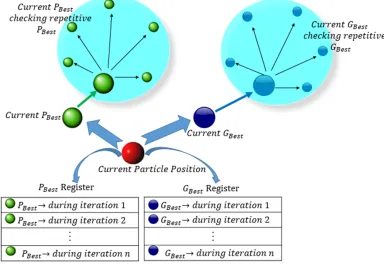
Registers in Table 3 work as a memory registers that store previous values thus help the algorithm to spot the exploration problem. For example, during algorithm’s ex-ecution, each i particle in the swarm keeps storing its Pbest values in the Pbest register. If Pbest fell into its local optima, then Pbest register identifies the repetitive value/ position for Pbest. Furthermore, it is also possible that Pbest:pd Register and Pbest:PD Register
may detects the local optima problem. Similar situations can be reflected in Gbest register, Gbest: PD Register and Gbest: PD Register during algorithm’s processing stages. Once the local and/ or global optima problem are identified at any stage with the help of mentioned registers, then algorithm follows towards the repairing box. Repairing box contains the modified version of ELS model and is entitled as Adaptive Elitist learning Strategy(AELS)
model. In the repairing box, the offeredAELSmodel will be used to fix the local/ global optima problem. Fig. 6 and Fig. 7 are the pictorial demonstration of the proposed repairing box andAELSmodel.
For example, if Pbest Register found a local optima problem, this is resolved with the help ofAELS. If in some way if thePbest :pd Registerrecords still show the local optima problem, then the proposed AELS technique will further choose another random pd value and then computes the finalPDvalue. If the problem still occurs, the algorithm will repeat the random replacement of otherpd values until the condition is not satisfied. Furthermore, in worst-case scenario, whenpd is also trapped in a fixed value, then the newpdwill be fetched fromPbestregister.
Global optima problems can be exposed inGbest , Gbest : pd and Registers and henceforth, can be resolved with the help of AELS model in the repairing box. Once, the exploration problem is solved, the updated solution is sent back to the processing stage of the algorithm.
Similar procedure of the proposed repairing box (along withAELS) and the algorithm will be followed for the linear
[image:8.576.37.279.403.580.2]FIGURE 6. Mean Distance Computation between Swarm particles
[image:9.576.98.482.414.678.2]combination function (initLC). If there is no local/global op-tima problem found, then Pareto based feasible solutions are stored the in the appropriate storage boxes ofinit1, init2and optimal solutions ininitLC.
The pseudo code in the processing stage of thePMLG-PSO
algorithm is given as follow.
C. POST PROCESSING PHASE
In the algorithm, two separate initializations(init1and init2) are used to collect non-dominated solutions, in order to create the archive for the Pareto front. Whereas the algorithm‘s optimal solutions are stored in the form of Gbest solutions from initLC. These optimal solutions are a collection of connected links (paths). The Gbest solutions are preserved in the form of an archive and stored in theGbeststoring box, as a number of available optimal solutions, as it is shown in
Algorithm3.
Algorithm 2: Pseudo code for Processing stage of PMLG-PSO Algorithm
1: forboth Objective functionsdo 2: fori= 1 :Ndo
3: iffxipresent< fxiprevious then
4: update:Pbest:xir, xil→Pbestr, Pbestl 5: store:pdregister(P
best)= empty 6: store:PDregister(Pbest)= empty 7: else
8: Pbestprevious= updated−Pbest(PbestrOR Pbestl) 9: evaluate:updated−Pbest→Repairing Box 10: Repairing Box(AELS method forPbest): 11: ifpd=pd
previousandPD=PpreviousD then 12: initialize: random pdfromPbestdimensions 13: initialize: xd
maxandxdmaxfromPbestdim. 14: compute: PD
15: else
16: initialize:randompdfrom”pd Register” 17: initialize:randomPDfrom”PD Register” 18: end if
19: update: pdregister(P best) 20: update: PDregister(Pbest)
21: update:Pbest(Pbestr, Pbestl)register 22: end if
23: storedPbest(Pbestr, Pbestl) 24: updateGbest(Gbestr, Gbestl)
25: Pbest(Pbestr, Pbestl)→Gbestprevious(Gbestr, Gbestl) 26: ifGbestpresent < Gbestprevious then
27: update Gbest
28: store:Gbest(Gbestr, Gbestl)inGbestRegister 29: store: pd(G
best)= empty 30: store: PD(Gbest)= empty
31: Gbestprevious => updatedGbest(Gbestr ,Gbestl) 32: else
33: evaluate:Gbest→Repairing Box
34: Repairing Box(AELS method forGbest) 35: if(pd =pd
previousandPD =PpreviousD then 36: initialize:randompdfromGbestdimensions
37: initialize:xdmaxandxdmaxfromGbestdim. 38: compute:PD
39: else
40: initialize:randompdfromG
bestRegister 41: initialize: xd
maxandxdmaxfromGbestdim. 42: compute:PD
43: end if
44: update:pdregister(G best) 45: update:PDregister(Gbest)
46: update: Gbest(Gbestr, Gbestl)register 47: end if
48: end for
49: stored:Gbest(Gbestr, Gbestl)register end for
Algorithm 3: Pseudo code for Post Processing Stage of the PMLG-PSO Algorithm
Input: Gbestfrom objective functions Output: Optimal path for the traffic request
1: fori=1:maximum iteration forGbestdo 2: forj=1:Ndo
3: Gbest: representing solutions of the problem 4: select link with minimum value inGbestmatrix 5: initialize path from selected links
6: path for requested traffic 7: end for
8: archive the selected links as the optimal 9: end for
V. EMPIRICAL ASSESSMENTS
To assess the effectiveness of the proposedPMLG-PSO
algorithm, we have made two concise performance anal-ysis investigations. The first evaluation appears in the outcomes of solving the MCOP optimization problem in MPLS/ GMPLS networks by using the Pareto Front graphs. The second investigation is a comparative study analysis; where the offered algorithm performance is compared against numerous meta-heuristic algorithms such as particle swarm optimization (PSO), adaptive PSO [33], [34], Bat algorithm [35] and Dolphin algo-rithm [36]. Both researches focus on an algoalgo-rithm con-vergence ratio (particularly the trapping in local/global optima) to test how successfully the proposed algo-rithm fixed the exploration problem when compared to the other optimization algorithms. The MPLS/ GMPLS network-based topology is used for the experiments, where objective functions; resource provisioning costs and traffic load balancing costs are considered, as de-scribed in the problem formulation section. Demonstra-tion of the conducted experiments along with results breakdown are discussed in the proceeding sections.
A. EXPERIMENTS FOR PARETO FRONT AND RESULTS ANALYSIS
For conducting simulations, we have used theMATLAB R2016apackage to develop the Pareto based solutions as well as optimal solutions based on described algorithms.
TABLE 4. PMLG-PSO Algorithm Versions
Version Number of Particles Number of Iterations
P M LG−P SO1 20
P M LG−P SO2 30 20
P M LG−P SO3 40
P M LG−P SO4 20 40
P M LG−P SO5 20
P M LG−P SO6 40 60
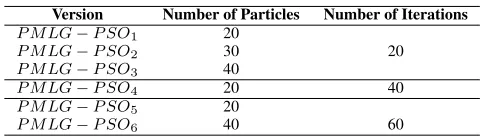
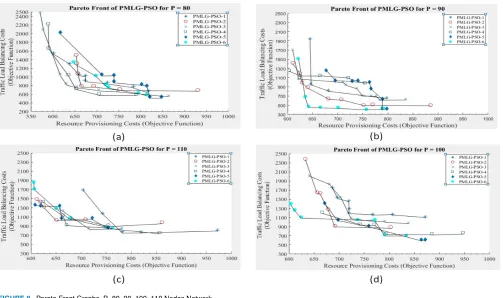
The experiments were scheduled in such a manner that the proposedPMLG-PSOalgorithm was categorized into six classes, such asPMLG-PSOn wheren= 1, 2, 3, 4, 5, 6. In each version, various approaches are applied (in case of number of particles or number of algorithm iterations as it is labelled in Table 4). These classes are implemented for a predefined number of nodes for MPLS/ GMPLS networks P = 80, 90, 100 and 110 nodes. The purpose of making these variations is to inspect the success of the algorithm on different network generating optimal solutions. The basic structure of the algorithm (described in Algorithm1, 2 and 3) towards obtaining a minimization of the objective functions, is the same for all network’s scenarios. Fig. 8 portrays the results of the Pareto archive that has been collected in the post-processing stage, which produced Pareto front-based solutions fromPMLG-PSO1toPMLG-PSO6for a different scale of MPLS/ GMPLS networks.
A set of Pareto solutions from the Pareto archive, for two objective functions, were collected and are presented in Fig. 8 (a) – (d). As formerly explained, for each PMLG-PSOn (PMLG-PSO1 to PMLG-PSO6) class, dissimilar values are presented as Pareto solutions. For the ease of understanding, the obtained non-dominated solutions are presented in separate figures for each case and are linked by lines to highlight differentPMLG-PSOn classes re-sults. Fig. 8 indicates that the proposed algorithm is eli-gible to provide feasible Pareto based solutions with the contrast objective functions. Fig. 8 also shows that once the traffic load balancing costs increases, the resource provisioning costs decreases and vice versa.
B. PMLG-PSO ALGORITHM 'S CONVERGENCE INVESTIGATION
To investigate the PMLG-PSO success ratio in terms of exploration problem, the results are collected as the optimal solutions from the linear combination fitness function (initLC). To discover the algorithm conver-gence activity with various network scale, the algorithm has been run on 30, 60, 90 and 100 nodes network (see Fig. 9 (a, b, c and d)). The purpose of this investigation is to discover the algorithm’s capability of solving lo-cal/global optima problem and create optimal solutions with smooth convergence without any interruption of the exploration problem during any iteration of the algo-rithm.
The results shown in Fig. 9 (a, b, c and d) display the convergence activity ofPMLG-PSOand portray the local/global optima problem (if one existed) during the convergence. In our experiments, each version of PMLG-PSOn is simulated using various network sizes. From the results obtained in Fig. 9, it is found that the algo-rithm does not experience a local/ global problem and smoothly converges towards its optimal solutions. We can conclude that the algorithm successfully overcomes the exploration problem and produces optimal solutions with the coherent convergence. In its naturePMLG-PSO
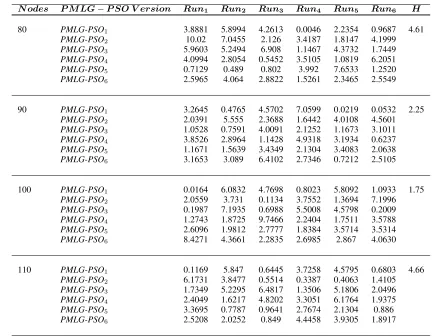
is a stochastic algorithm, therefore the Pareto curves change. To examine these statistical variations, the pa-per uses a non-parametric test, the Kruskal-Wallis Test [40]. The purpose of the Kruskal-Wallis test was to identify if at least one sample stochastically dominates over the others. Table 5 shows our simulation results for each version ofPMLG-PSOnwhich were conducted for a different number of nodes, it also includes re-sulted H values. In our simulations, all PMLG-PSOn versions had the same number of iterations but a dif-ferent number of particles. Runn represents a number of simulations for eachPMLG-PSOnalgorithm version. Using the Kruskal-Wallis test, we have tested six groups of data PMLG-PSOn (PMLG-PSO1 to PMLG-PSO6). Based on test rules, twoHvalues i.e.,H0andH1 were considered. H0 indicates there is no significant differ-ence between PMLG-PSOn (PMLG-PSO1 to PMLG-PSO6) data, whileH1indicates a major difference. In the Kruskal-Wallis test a valueα= 0.05 is used for the iden-tification ofH0or H1. The degree–of–freedom (df) for αvalue is calculated wheredf=k– 1 andkrepresents a number of data sets [40]. In our case study (PMLG-PSOn versions),kvalue is 6 (asn= 6). For these data sets, by taking into accountα= 0.05 and df= 5 and applying a state decision rule we get 11.0705. This means, H
values less than 11.0705 satisfyH0hypothesis. On other hand,Hvalues more than 11.0705 satisfyH1hypothesis. Having this in mind, when examining Table 5, we can see that for each case study shown, the computed Hvalue is less than 11.0705. Therefore, according to Kruskal-Wallis test, there is no statistically significant difference among solutions produced by individual PMLG-PSOn versions. The experiment thus provides a proof that even a stochastic nature of the PMLG-PSO algorithm can produce optimal solutions that will not stochastically dominate over each other solutions. By other words, the algorithm does not produce abrupt solutions.
C. COMPARATIVE STUDY OF PMLG-PSO WITH META-HEURISTIC ALGORITHMS
opti-FIGURE 8. Pareto-Front Graphs, P=80, 90, 100, 110 Nodes Network
FIGURE 9. Analysis of Convergence of PMLG-PSO Algorithm
[image:12.576.37.536.390.694.2]TABLE 5. Kruskal-Wallis Test results
N odes P M LG−P SO V ersion Run1 Run2 Run3 Run4 Run5 Run6 H
80 PMLG-PSO1 3.8881 5.8994 4.2613 0.0046 2.2354 0.9687 4.61 PMLG-PSO2 10.02 7.0455 2.126 3.4187 1.8147 4.1999 PMLG-PSO3 5.9603 5.2494 6.908 1.1467 4.3732 1.7449 PMLG-PSO4 4.0994 2.8054 0.5452 3.5105 1.0819 6.2051 PMLG-PSO5 0.7129 0.489 0.802 3.992 7.6533 1.2520 PMLG-PSO6 2.5965 4.064 2.8822 1.5261 2.3465 2.5549
90 PMLG-PSO1 3.2645 0.4765 4.5702 7.0599 0.0219 0.0532 2.25 PMLG-PSO2 2.0391 5.555 2.3688 1.6442 4.0108 4.5601 PMLG-PSO3 1.0528 0.7591 4.0091 2.1252 1.1673 3.1011 PMLG-PSO4 3.8526 2.8964 1.1428 4.9318 3.1934 0.6237 PMLG-PSO5 1.1671 1.5639 3.4349 2.1304 3.4083 2.0638 PMLG-PSO6 3.1653 3.089 6.4102 2.7346 0.7212 2.5105
100 PMLG-PSO1 0.0164 6.0832 4.7698 0.8023 5.8092 1.0933 1.75 PMLG-PSO2 2.0559 3.731 0.1134 3.7552 1.3694 7.1996 PMLG-PSO3 0.1987 7.1935 0.6988 5.5008 4.5798 0.2009 PMLG-PSO4 1.2743 1.8725 9.7466 2.2404 1.7511 3.5788 PMLG-PSO5 2.6096 1.9812 2.7777 1.8384 3.5714 3.5314 PMLG-PSO6 8.4271 4.3661 2.2835 2.6985 2.867 4.0630
110 PMLG-PSO1 0.1169 5.847 0.6445 3.7258 4.5795 0.6803 4.66 PMLG-PSO2 6.1731 3.8477 0.5514 0.3387 0.4063 1.4105 PMLG-PSO3 1.7349 5.2295 6.4817 1.3506 5.1806 2.0496 PMLG-PSO4 2.4049 1.6217 4.8202 3.3051 6.1764 1.9375 PMLG-PSO5 3.3695 0.7787 0.9641 2.7674 2.1304 0.886 PMLG-PSO6 2.5208 2.0252 0.849 4.4458 3.9305 1.8917
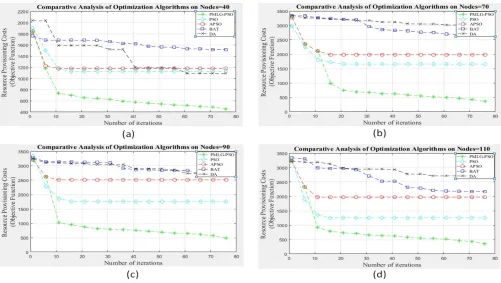
mization (PSO), an advance version as adaptive particle swarm optimization (APSO), dolphin algorithm (DA) and bat algorithm (BAT). The experiments included a development of PSO, APSO, BAT and DA algorithms for the described MCOP optimization problem. Each algorithm is simulated using the sameMATLABversion, and results are collected to figure out the exploration problem in the algorithms (if exists during the iterations). The results for both fitness functions (traffic load bal-ancing and resource provisioning costs) were collected separately, as shown in Fig. 10 and Fig. 11, respectively. Fig. 10 and Fig. 11 show the convergence activity and how each algorithm suffers from the local/global optima problem. In Fig. 10, for all its cases (a, b, c, and d), algo-rithms (PSO, APSO, DA and BAT), apart from PMLG-PSO, had drastically failed to deal with the exploration problem and once their searching agents were trapped in their local/ global optima, the algorithms could not converge properly to find the optimal solutions for the resource provision fitness function. Consequently, these algorithms failed to find optimal solutions, and the result in this case is incomplete/ sub-optimal solution.
For example, in Fig. 10 (d), the figure shows that PSO, APSO, DA and BAT algorithms, are poorly deteriorated to converge properly until the end of iteration because
of a local/global optima problem. As a reference, it is appeared that PSO and APSO have fallen to a local optima and cannot converge after the 14th iteration. Likewise, for the traffic load balancing costs function, it can be seen in Fig. 11, that PSO, APSO, DA and BAT al-gorithms had generated sub-optimal solutions produced worse convergence activity with respect to the fitness function.
FIGURE 10. Comparison of Meta-heuristic algorithms w.r.t Convergence ratio for resource Provisioning Costs Function
FIGURE 11. Comparison of Meta-heuristic algorithms w.r.t Convergence ratio for Traffic Load Balancing function
[image:14.576.36.539.409.699.2]TABLE 6. Statistical based Comparative Analysis of 30 Nodes Network
Resource P rovisioning Costs Objective F unction
P SO AP SO BAT DA P M LG−
P SO
OS 228 168.3926 475.9140 537.79 66.3332
M ean 585.3900 758.9721 902.6723 615.2437 400.9275
SD 162.2130 318.7124 156.0202 49.6646 210.9559
T raf f ic Load Balancing Costs Objective F unction
P SO AP SO BAT DA P M LG−
P SO
OS 50.2371 284.1536 65.8446 141.07 43.0134
M ean 771.5276 1168 1056.4 474.1919 467.4116
[image:15.576.36.279.77.223.2]SD 233.5189 259.6976 348.5924 160.7355 224.6925
TABLE 7. Statistical based Comparative Analysis of 50 Nodes Network
Resource P rovisioning Costs Objective F unction
P SO AP SO BAT DA P M LG−
P SO
OS 644 448.7235 877.32 774.38 80.8595
M ean 1016.2 1381.8 1508.6 908.4148 465.0897
SD 221.678 507.7226 268.8695 68.1039 275.8044
T raf f ic Load Balancing Costs Objective F unction
P SO AP SO BAT DA P M LG−
P SO
OS 295.02 880.3437 354.54 505.34 103.0016
M ean 1230.8 1968.1 1950.1 836.5914 490.1594
SD 423.7258 378.0275 511.4425 181.6391 254.2641
D. STATISTICAL ANALYSIS
For further investigation, the same setup of the PMLG-PSOalgorithm is run for 100 times to extract and then evaluate the overall performance of the algorithms using statistical parameters such optimal fitness function costs, MEAN value and Standard Deviation values. The output results are given in the following tables.
Table 6 to Table 9, represent the comprehensive com-parative analysis of optimization algorithms over 30, 50, 80 and 100 nodes networks. While reviewing each algorithm output in the form of an optimal solution in the given tables, it can be concluded that for each network scale, the optimum solutions are obtained from the pro-posedPMLG-PSOalgorithm. As the minimum function costs are obtained from the proposed algorithm and com-pare to other techniques. Similarly, for MEAN values,
PMLG-PSO provides optimal MEAN values compare
to other algorithms (PSO, APSO, DA and BAT). Here, minimum MEAN values are considered as the optimal values. As all mentioned algorithms have stochastic na-ture, therefore, the standard deviation parameters were used to monitor the deviation values of each run during all 100 iterations. For this case, DA algorithm has got the minimum standard deviation value but has sub-optimal values, whereas the other acceptable choice as for
stan-TABLE 8. Statistical based Comparative Analysis of 80 Nodes Network
Resource P rovisioning Costs Objective F unction
P SO AP SO BAT DA P M LG−
P SO
OS 1070 844.74 1570.2 1035.8 89.738
M ean 1761 2179.8 2555.7 1213.1 685.7291
SD 304.7261 827.6866 383.1460 97.4751 532.9176
T raf f ic Load Balancing Costs Objective F unction
P SO AP SO BAT DA P M LG−
P SO
OS 430.44 1428.7 735.68 585.2 121.78
M ean 1890.8 3326.4 2679.2 907.0565 687.1046
SD 757.4162 627.0519 647.9020 184.7952 608.8075
TABLE 9. Statistical based Comparative Analysis of 100 Nodes Network
Resource P rovisioning Costs Objective F unction
P SO AP SO BAT DA P M LG−
P SO
OS 1585 1315.2 1786.6 1333.8 80.878
M ean 2230.5 2740.2 3066.1 1512.5 765.0592
SD 279.4764 1063.5 504.7764 108.3417 643.6658
T raf f ic Load Balancing Costs Objective F unction
P SO AP SO BAT DA P M LG−
P SO
OS 634.44 2227 983.44 736.77 140.03
M ean 2226.9 2227 3634.7 1013.1 722.7989
SD 886.1651 641.8836 881.7565 192.8892 776.1407
dard deviation values along with optimal solutions are
fromPMLG-PSOalgorithm.
The tables (Table 6 to Table 9) give us conclusion that the proposedPMLG-PSOalgorithm has maximum probability for generating optimal solutions even after implementing it into multiple numbers of simulations.
VI. CONCLUSION
The exponential increase in the data traffic demands substantial throughput improvements to avoid network congestion. Approaches with different algorithms were introduced to tackle this problem. The purpose of these algorithms is to distribute the network traffic that will assure the network efficiency and reliability. PSO is one of the many well-known meta-heuristic algorithms that are used to address the above challenge. However, PSO suffers from convergence problem. This is suggesting that astandardPSO may not be the best suitable algo-rithm for multi-objective-based approaches.
This paper has considered multi-path between routers of the MPLS/GMPLS networks and proposes a novel
“Pareto based Modified Local Global Particle Swarm
[image:15.576.37.278.258.401.2]PMLG-PSO technique solved the exploration problem for the given constrained based multiple objective op-timization (MCOP) problems. From the proposed algo-rithm, a Pareto based approach was adapted to create Pareto front graphs as well as optimal solutions. To analyse the performance of our proposed PMLG-PSOalgorithm, a number of experiments were conducted for obtaining: (i) a Pareto front for both objective func-tions; (ii) convergence graphs with different number of nodes, (iii) for comparing the convergence rate with other algorithms; (iv) statistical analysis ofPMLG-PSO
in comparison with thestandardPSO, APSO, Bat and DA, and (v) the Kruskal-Wallis test.
While investigating thePMLG-PSOalgorithm, we have shown that our proposed algorithm can successfully gen-erate non-dominant solutions in the form of Pareto front, even when the MPLS/GMPLS network size varies, this is shown in Fig. 8. The algorithm can also effectively produce optimal solutions, as it is shown in convergence graphs in Fig. 9. By comparing PMLG-PSO with a
standardPSO, APSO, Bat and DA applied to a different number of nodes, we have shown that PSO, APSO, DA, and BAT algorithms suffer from an exploration problem for the MCOP optimization and therefore cannot gener-ate the optimal solutions (see Fig. 10 and Fig. 11). On the contrary, the presentedPMLG-PSOcan overcome the drawbacks of the former PSO algorithms, it converges smoothly, and successfully finds the optimal path that satisfies the minimization of both objective requirements and does it without any trade-off. Furthermore, the
PMLG-PSO algorithm was compared to PSO, APSO,
Bat and DA algorithms using statistical parameters such as MEAN, standard deviation, and optimal solutions (Table 6, 7, 8, and 9). The comparison has shown a dominance of the proposedPMLG-PSOalgorithm over the other algorithms and its capability to produce better results. Because thePMLG-PSOalgorithm is stochastic in its nature, the Kruskal-Wallis test was also conducted. From the test’s results was concluded that the proposed
PMLG-PSOalgorithm does not suffer from ‘generation
of abrupt results that stochastically dominates each other, and therefore, proved its superiority producing betters results when compared to thestandardPSO, APSO, Bat and DA algorithms.
REFERENCES
[1] R. G. Garroppo, S. Giordano, and L. Tavanti, “A survey on multi-constrained optimal path computation: Exact and approximate algo-rithms,” Computer Networks, vol. 54, no. 17, pp. 3081–3107, 2010. [2] M. Masood, M. M. Fouad, and I. Glesk, “A pareto based approach
with elitist learning strategy for mpls/gmps networks,” in 2017 9th Computer Science and Electronic Engineering (CEEC), pp. 71–76, IEEE, 2017.
[3] Y. Lee, Y. Seok, Y. Choi, and C. Kim, “A constrained multipath traffic engineering scheme for mpls networks,” in 2002 IEEE International Conference on Communications. Conference Proceedings. ICC 2002 (Cat. No. 02CH37333), vol. 4, pp. 2431–2436, IEEE, 2002. [4] C. C. Coello, G. T. Pulido, and E. M. Montes, “Current and future
re-search trends in evolutionary multiobjective optimization,” pp. 213–
231, 2005.
[5] G. M. Lee and J. K. Choi, “Multipath routing for traffic engineering with flow classification in gmpls network,” in 2006 Asia-Pacific Conference on Communications, pp. 1–5, IEEE, 2006.
[6] Z. Du, S. Li, Y. Sun, and N. Li, “Adaptive particle swarm optimiza-tion algorithm based on levy flights mechanism,” in 2017 Chinese Automation Congress (CAC), pp. 479–484, IEEE, 2017.
[7] C.-F. Wang and K. Liu, “A novel particle swarm optimization al-gorithm for global optimization,” Computational intelligence and neuroscience, vol. 2016, p. 48, 2016.
[8] S. U. Khan, S. Yang, L. Wang, and L. Liu, “A modified particle swarm optimization algorithm for global optimizations of inverse problems,” IEEE Transactions on Magnetics, vol. 52, no. 3, pp. 1– 4, 2015.
[9] S. Zhang, C. K. Lee, H. K. Chan, K. L. Choy, and Z. Wu, “Swarm intelligence applied in green logistics: A literature review,” Engi-neering Applications of Artificial Intelligence, vol. 37, pp. 154–169, 2015.
[10] A. Amuthan and K. D. Thilak, “Improved ant colony algorithms for eliminating stagnation and local optimum problemâ ˘AˇTa survey,” in 2017 International Conference on Technical Advancements in Com-puters and Communications (ICTACC), pp. 97–101, IEEE, 2017. [11] S. M. Mousavi, M. Moghadasi, and G. Fazekas, “Dynamic resource
allocation using combinatorial methods in cloud: A case study,” in 2017 8th IEEE International Conference on Cognitive Infocommu-nications (CogInfoCom), pp. 000073–000078, IEEE, 2017. [12] J. Kennedy and R. Eberhart, “Particle swarm optimization, doi:
10.1109/icnn. 1995.488968,” in Proceedings of IEEE International Conference on Neural Networks, vol. 4, pp. 1942–1948, 1995. [13] C. Akjiratikarl, P. Yenradee, and P. R. Drake, “Pso-based algorithm
for home care worker scheduling in the uk,” Computers & Industrial Engineering, vol. 53, no. 4, pp. 559–583, 2007.
[14] M. A. A. Aziz, M. N. Taib, and N. M. Hussin, “Assignments accep-tance strategy in a modified pso algorithm to elevate local optima in solving class scheduling problems,” in 2010 6th International Colloquium on Signal Processing & its Applications, pp. 1–5, IEEE, 2010.
[15] J. J. Liang, A. K. Qin, P. N. Suganthan, and S. Baskar, “Compre-hensive learning particle swarm optimizer for global optimization of multimodal functions,” IEEE transactions on evolutionary computa-tion, vol. 10, no. 3, pp. 281–295, 2006.
[16] C. Dong, G. Wang, Z. Chen, and Z. Yu, “A method of self-adaptive inertia weight for pso,” in 2008 international conference on computer science and software engineering, vol. 1, pp. 1195–1198, IEEE, 2008.
[17] S. M. A. Salehizadeh, P. Yadmellat, and M. B. Menhaj, “Local optima avoidable particle swarm optimization,” in 2009 IEEE Swarm Intelligence Symposium, pp. 16–21, IEEE, 2009.
[18] L. Barbulescu, J.-P. Watson, and L. D. Whitley, “Dynamic represen-tations and escaping local optima: Improving genetic algorithms and local search,” AAAI/IAAI, vol. 2000, pp. 879–884, 2000. [19] K. E. Parsopoulos and M. N. Vrahatis, “Unified particle swarm
optimization for solving constrained engineering optimization prob-lems,” in International Conference on Natural Computation, pp. 582– 591, Springer, 2005.
[20] R. Mendes, J. Kennedy, and J. Neves, “The fully informed particle swarm: simpler, maybe better,” IEEE transactions on evolutionary computation, vol. 8, no. 3, pp. 204–210, 2004.
[21] T. Peram, K. Veeramachaneni, and C. K. Mohan, “Fitness-distance-ratio based particle swarm optimization,” in Proceedings of the 2003 IEEE Swarm Intelligence Symposium. SIS’03 (Cat. No. 03EX706), pp. 174–181, IEEE, 2003.
[22] P. J. Angeline, “Using selection to improve particle swarm opti-mization,” in 1998 IEEE International Conference on Evolutionary Computation Proceedings. IEEE World Congress on Computational Intelligence (Cat. No. 98TH8360), pp. 84–89, IEEE, 1998. [23] H. Y. Cho, J. Y. Lee, and B. C. Kim, “Multi-path
constraint-based routing algorithms for mpls traffic engineering,” in IEEE International Conference on Communications, 2003. ICC’03., vol. 3, pp. 1963–1967, IEEE, 2003.
[24] U. F. Siddiqi, Y. Shiraishi, and S. M. Sait, “Multi-constrained route optimization for electric vehicles (evs) using particle swarm opti-mization (pso),” in 2011 11th International Conference on Intelligent Systems Design and Applications, pp. 391–396, IEEE, 2011.
[25] C. Jiuxin, S. Xuesheng, Z. Xiao, L. Bo, and M. Bo, “Efficient multi-objective services selection algorithm based on particle swarm optimization,” in 2010 IEEE Asia-Pacific Services Computing Con-ference, pp. 603–608, IEEE, 2010.
[26] D. Tan, “Chaos particle swarm optimization algorithm for multi-objective constrained optimization problems,” in Future Wireless Networks and Information Systems, pp. 469–476, Springer, 2012. [27] L. Shi, Z.-H. Zhan, H.-Q. Yuan, J.-J. Li, and J. Zhang, “Distributed
co-evolutionary particle swarm optimization using adaptive migra-tion strategy,” in 2017 IEEE Symposium Series on Computamigra-tional Intelligence (SSCI), pp. 1–7, IEEE, 2017.
[28] A. Farrel and I. Bryskin, GMPLS: architecture and applications. Elsevier, 2005.
[29] B. Fortz and M. Thorup, “Internet traffic engineering by optimizing ospf weights,” in Proceedings IEEE INFOCOM 2000. Conference on Computer Communications. Nineteenth Annual Joint Conference of the IEEE Computer and Communications Societies (Cat. No. 00CH37064), vol. 2, pp. 519–528, IEEE, 2000.
[30] F. Li and J. Chen, “Mpls traffic engineering load balance algorithm using deviation path,” in 2012 International Conference on Computer Science and Service System, pp. 601–604, IEEE, 2012.
[31] E. K. Burke, G. Kendall, et al., Search methodologies. Springer, 2005.
[32] E. Zitzler, M. Laumanns, and S. Bleuler, “A tutorial on evolutionary multiobjective optimization,” in Metaheuristics for multiobjective optimisation, pp. 3–37, Springer, 2004.
[33] Z. J. Zhan Z., “Adaptive particle swarm optimization,” in Adaptive Particle Swarm Optimization, pp. 3–37, Springer, 2008.
[34] X.-F. Xie, W.-J. Zhang, and Z.-L. Yang, “Adaptive particle swarm optimization on individual level,” in 6th International Conference on Signal Processing, 2002., vol. 2, pp. 1215–1218, IEEE, 2002. [35] M. Masood, M. M. Fouad, and I. Glesk, “Proposing bat inspired
heuristic algorithm for the optimization of gmpls networks,” in 2017 25th Telecommunication Forum (TELFOR), pp. 1–4, IEEE, 2017. [36] A. Kaveh and N. Farhoudi, “A new optimization method: Dolphin