Received date: 2017-04-07
Foundation item: Shanghai Science and Technology Committee (No.17170712100) *E-mail address: [email protected]
Impacts of CaO solid particles in carbon dioxide absorption process from ship
emission with NaOH solution
WANG Zhongcheng(王忠诚)1, LIU Xiaoyu (刘晓宇)1*, ZHOU Peilin(周培林)2, XU Leping(许乐平) 1
(1. Merchant Marine College, Shanghai Maritime University, Shanghai 201306, China;
2. Naval Architecture Ocean and Marine Engineering College, University of Strathclyde, Glasgow G11XQ, UK)
Abstract: CO2 emitted from ship exhaust is one of the major sources of atmospheric pollution. In
order to reduce ship CO2 emissions, this paper comes up with the idea of recovering CO2 from
ship exhaust by NaOH solution and improves the absorption rate by adding CaO solid particles.
The effect mechanism of CaO solid particles on CO2 absorption efficiency is analyzed in detail,
and the mathematical model is deduced and the CaO enhancement factor is calculated through
experiments. Experiment result demonstrates that the effect of CaO solid particles on the
absorption of CO2 in alkali solution is significant. The absorption rate of pure CO2 gas, the
simulated ship exhaust gas and 6135AZG marine diesel engine emission can be increased by 10%,
15.85% and 10.30%, respectively. So it can be seen that CaO solid particles play an important role
in improving the absorption efficiency of ship CO2 emission.
Key words: environmental protection, diesel emissions, CO2 absorption, CaO particulate matter,
enhancement factor
CLC number: U 661 Document code: A
0 Introduction
With the rapid development of the shipping industry, air pollution caused by marine diesel engine emissions draws more attention. The ship is a major means of transportation, producing a large quantity of CO2 emissions[1]. The International Convention for the Prevention of Pollution
from Ships of 1973, as amended by the Protocol of 1978, adopted by the IMO Marine Environment Protection Committee (MEPC) at its 62nd meeting in July 2011, approved the Energy Efficiency Design (EEDI), Ship Energy Efficiency Management Plan (SEEMP) and other ship energy efficiency standards. According to the tacit acceptance procedure, the amendment was enforced in 2015[2], imposing severe restrictions on ship CO2 emissions.
act out
J
A
J
,
(1)where A, Jact and Jout are manoeuvring indices; A is the total enhancement factor; Jact is the mass transfer rate with the solid particles; Jout is the mass transfer rate without solid particles. Eq. (1) demonstrates the effect of particulate matters on gas-liquid two-phase mass transfer, which is much closer to the actual situation.
It was found that when adding slight solid particles into the gas-liquid reaction, the mass transfer efficiency could be improved significantly. After investigating the zero-order and first-order reaction processes of the vapor phase on catalyst surface in a stirred tank, Yuan et al.[4] and Gutierrez et al.[5] concluded that the stirring rate, gas feed rate, catalyst particle concentration, particle size and other elements could affect the enhancement factor directly. Wimmers et al.[6] believed that there was a membrane at the gas interface in the activated carbon slurry and the solids concentration within the membrane area was much higher than that of the liquid phase. Liu et al.[7-9] carried out the experiment that CO2 was absorbed by ethanolamine solution within filler absorption tower and the absorption rate could be improved by increasing alkali concentration or circulating fluid flow. Excessive chemicals will be consumed by purely increase the alkali concentration, and by just increasing the circulating fluid flow also led to higher energy consumption, neither economic nor environmental friendly. In this paper, we come up with the idea that by adding solid particles into the alkaline liquor to improve CO2 absorption efficiency in both chemical and physical aspects, reducing chemicals and energy consumption.
In this paper, a certain amount of CaO solid particles is added into the NaOH solution to increase the CO2 absorption rate. The enhancement mechanism of solid particles in the alkali decarburization is investigated, which provides the theoretical and experimental basis for improving solid particles decarburization.
1 Solid Particles Mass Transfer Mechanism
According to the current researches, scholars did not draw a unified conclusion about solid particles function mechanism in gas-liquid mass transfer, as the results from experiments were not quite the same. Below are some major theories about solid particles mass transfer mechanism:
① particles have only physical absorption on gases component in the gas-liquid mass transfer
area; ② particles catalyze in the chemical reactions involved in gas component; ③ particles
react with gases to be transferred; ④ particles react with gases after getting dissolved in the
gas-liquid mass transfer area; ⑤ particles work as the combinations of above four cases. This
paper emphasizes on the mechanisms research synthesized ① and ④ theories.
1.1 Marine Alkaline Liquor Decarburization Mechanism
2 2
CaO(s)+H O=Ca(OH) (l) , (2)
After introduced into the alkaline solution, CO2 gas will react with NaOH and Ca(OH)2 solution. The reaction equation are
2 2 3 2
2NaOH(l)+CO (g)=Na CO (l)+H O, (3)
2 3 2 3
Na CO (l)+Ca(OH) (l)=CaCO (s) +2NaOH . (4)
That is, 2NaOH(l)+CaO(s)+CO (g)=CaCO (s) +2NaOH(l)2 3 .
From Eq. (4), NaOH can be regenerated and NaOH solution will be recycled, while CaCO3 is precipitated at the same time. Since the molecular weight of Ca(OH)2 is 74 and CaCO3 is 100, the total amount of solid particles is almost constant throughout the experimental cycle.
1.2 CaO Particles Enhanced Mechanism
The CO2 absorption by NaOH solution with CaO solid particles is a mass transfer process accompanied with chemical reaction, both the chemical reaction mass transfer enhancement and physical enhanced particulate matter mass transfer happen during the reaction period.
1.2.1 Chemical enhancement mechanism Eqs. (5) and (6) show the kinetic model of liquid
membrane reaction and diffusion[10-11] in the reaction
2
2 2 3 2
CO (g)+Ca(OH) (l)
kCaCO (s) +H O
.The second order linear models are
2 2 2 2 2
CO 2 CO Ca(OH) 2
CO ,L
d d
c k c c
x D , (5)
2 2 2
2 2
Ca(OH) 2 CO Ca(OH) 2
Ca(OH) ,L
d d
c k c c
x D , (6)
where,
c
CO2 ,c
Ca(OH)2 ,DCO ,L2 , k2 and DCa(OH) ,L2 are manoeuvring indices;c
CO2 is theconcentration of CO2 at the interface, kmol/m3;
2
Ca(OH)
c
is the concentration of Ca(OH)2 at theinterface, kmol/m3;
2 CO ,L
D is the diffusion coefficient of CO2 in liquid phase, m2/s;
2
k is a
reaction constant for the second stage, m3/(kmol∙s);
2 Ca(OH) ,L
D is the diffusion coefficient of
Ca(OH)2 in liquid phase, m2/s. When
2 2
CO CO ,i
0,
x
c
c
(c
CO ,i2 represents CO2 concentration,kmol/m3), d Ca OH 2 0
d c
x ; when x, cCa OH 2 cCa OH ,L 2 , where is the film thickness of
reaction, m.
Since the Ca(OH)2 concentration is almost constant during the reaction and involatile, therefore, the chemical enhancement factor can be expressed as below[12-13].
2 2 2 2
CO ,L 2 Ca(OH) ,i CO ,L 2 Ca(OH) ,i 0
L L
tanh
D k c D k c
E
k k
where E, cCa(OH) ,i2 , 0 L
k and kL are manoeuvring indices; E is chemical enhancement factor;
2 Ca(OH) ,i
c is concentration of Ca(OH)2 during the reaction period, kmol/m3; 0 L
k is liquid phase
mass transfer coefficient without chemical reaction, kmol/(m2∙s∙kPa);
L
k is liquid phase mass
transfer coefficient with chemical reaction, kmol/(m2∙s∙kPa). Then the boundary conditions and integrate are brought into by combing Eqs. (5) and (6).
Then, the function model is
2
2 2 2 2
Ca(OH) ,L
CO ,L CO ,i Ca(OH) ,L Ca(OH) ,i
(E 1)D c D (c c )
v
, (8)
Finally, the function model is
2 2 2
2 2
Ca(OH) ,L Ca(OH) ,L Ca(OH) ,i CO ,L CO ,i
( )
+1
D c c
E
vD c
, (9)
where vand cCa(OH) ,L2 are manoeuvring indices; vis the velocity of CO2 in the solution, m/s;
2 Ca(OH) ,L
c is concentration of Ca(OH)2 solution, kmol/m3;
2
2 2 2
CO
CO ,L 2 CO ,L Ca OH ,L d
1 d
c
D k c c
x
.
1.2.2 Physical enhancement mechanism The physical enhancement is mainly about the mass transfer between gas and liquid. According to the dual-membrane theory[14-15], it is necessary to
meet the equilibrium state of the A component at the gas-liquid interface, i.e.,
C
A,i
Hp
A,i.Where
C
A,i is A component concentration in solution, kmol/m3;H
is A component Henrycoefficient, m3·kPa/kmol; ,i
A
p
is A component partial pressure in gas phase, kPa. Since this study satisfies this condition, so the rate equation of CO2 diffused from the gas phase to the gas-liquid interfacecan be expressed below.The first order linear model is
2 2
2 2
CO CO ,G
CO ,G CO ,i
G
d
(
)
d
n
D
p
p
S
t
, (10)where
D
CO ,G2 ,
G ,p
CO ,G2 ,p
CO ,i2 andS
are manoeuvring indices;D
CO ,G2 is thediffusion coefficient of Ca(OH)2 in gas phase, m2/s; G
is film thickness of CO2 in solution, m;2
CO ,G
p
is the pressure of CO2 in solution, kPa;2
CO ,i
p
is the pressure of CO2 during the reactionperiod, kPa;
S
is the solubility, g.The rate equation of the diffusion of CO2 components from the gas-liquid interface to the liquid phase is below.
2 2
2 2
CO CO ,L
CO ,i CO ,L
L
d
(
)
d
n
D
c
c
S
t
, (11)where
L is film thickness of liquid reaction, m.Combined with the definition of membrane transfer coefficient 2
2 CO ,G CO ,G G
,
D
k
2 2 CO ,L CO ,L LD
k
. The first order linear model is2 2 2 2 2 2 2
* *
CO CO ,G
(
CO ,G CO)
CO ,L(
CO CO ,L)
N
K
p
p
K
c
c
, (12)where
N
CO2,k
CO ,G2 ,p
CO* 2,k
CO ,L2 ,c
*CO2 andc
CO ,L2 are manoeuvring indices;N
CO2 isphysical enhancement factor;
2
CO ,G
k
is gas phase mass transfer coefficient of CO2,kmol/(m2∙s∙kPa);
2
* CO
p
is the equilibrium pressure of CO2 in solution, kPa;2
CO ,L
k
is liquidphase mass transfer coefficient of CO2, kmol/(m2∙s∙kPa);
2
* CO
c
is the equilibrium concentrationof CO2 in solution, kmol/m3;
2
CO ,L
c
is concentration of CO2 in solution, kmol/m3;2
2 2
CO ,G
CO ,G CO ,L
1
1
1
K
k
Hk
; 22 2
CO ,L
CO ,G CO ,L
1
1
K
H
k
k
.The total mass transfer resistance during the reaction process is the sum of the mass transfer resistance and the mass transfer resistance of the liquid phase[16]. The total mass transfer rate is the ratio of the total mass transfer(y-y*) to the total mass transfer resistance (1/Ky), and regarding
dilution solution, the equilibrium relationship between the dilute solution and the system is subject
to Henry's law[17] y* = mx, where y is molar concentration ratio of the gas phase; y*
molar concentration ratio of the gas phase balanced with it’s of the liquid phase;
m is equilibrium constant; x is molar concentration ratio of the liquid phase; Kyis total
mass transfer coefficient driven by (y-y*), kmol/(m2∙s∙kPa).
From the gas phase: CO2
i y
N
y y
k
and liquid phase:
2 CO * i x
N
m
y
y
k
, wherek
yis mass transfer coefficient of the gas phase, kmol/(m2∙s∙kPa);
x
k
is mass transfer coefficient ofthe liquid phase, kmol/(m2∙s∙kPa);
i
y
is molar concentration ratio of the gas phase
2
* *
CO
1
1
i i
y x y x
y y
y
y
y y
N
m
m
k
k
k
k
. (13)
From the differ phase:
2
*
* CO
1
yy
y y
N
K y y
K
and by comparison:1
1
y y x
m
K
k
k
,the total mass transfer rate equation is calculated in terms of gas phase[18], so the physical enhancement factor can be expressed.
The function model is
2 2 2
2 2
*
CO CO ,G CO
CO ,L CO ,G
1
(
)(
)
1
1
N
p
p
Hk
k
. (14)Therefore, the total enhancement factor of CaO particles is the sum of the chemical enhancement factor, Eq. (9), and the physical enhancement factor, Eq. (14).
Finally, the function model is
2
CO
.
A E N
(15)2 Experimental Condition
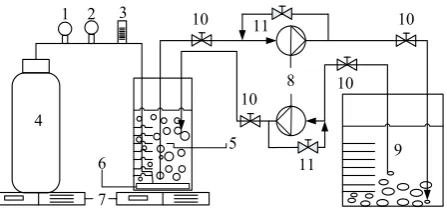
The main purpose of this experiment is to study the effect of solid particles on marine alkaline liquor decarburization; Figure 1 shows the experimental process.
4
1 2 3
5 6
7
8
9 10
10 10
10 11
11
1- Reducing valve, 2-Pressure gauge, 3-Flowmeter, 4-CO2 cylinder, 5-Reactor, 6-Diffusor, 7-High-precision scale,
8-Gear pump, 9-Reservoir, 10-Regulate valve, 11-Bypass valve Fig. 1 Facilities for marine alkaline liquor decarburization
[image:6.595.188.412.439.545.2]2.1 Gas Used for the Experiment
The experiment uses three kinds of gas, namely pure CO2, simulated exhaust and diesel engine exhaust. The pure CO2 is 99% purity gas produced by Shanghai Special Gas Co., Ltd. The simulated exhaust gas is applied in the experiment which is based on the exhaust gas data from 6S35 ME-B produced by MAN B&W Company. The diesel engine exhaust comes from MAN Shanghai Diesel Engine Co., Ltd and the simulating exhaust gas consists of N2, O2, CO2 and SO2 with the mass fraction of 80.09%, 15.18%, 4.69% and 0.04%, respectively.
2.2 Experimental Chemicals
During the study, NaOH solid and CaO solid are used, the specific parameters are shown in Table 1.
Table1 NaOH solid and CaO solid specific parameters
Solid NaOH (flake ) Calcium oxide(CaO particles)
Charity test Qualified AL ≤0.00 2% Cl ≤0.01%
Total nitrogen(N) ≤0.00 1% K ≤0.05% Sulfate(SO4) ≤0.1%
Chloride(Cl) ≤0.00 5% Ca ≤0.01% Loss on ignition ≤2.0%
Sulfate(SOx) ≤0.00 5% Fe ≤0.00 1% Fe ≤0.01 5%
Phosphate(POx) ≤0.00 1% Carbonate (Na2CO3)
≤1.5% Alkali and magnesium ≤0.5% Heavy metal(Pb) ≤0.00 3% Content(NaOH) ≥96% Heavy metal(Pb) ≤0.00 5%
Acetic acid insoluble matter ≤0.05% CaO content ≥98.0% Particles volume ≤0.3mm 2.3 Measuring Instrument
Measuring instruments include 2 pieces of high-precision ACS-258 electronic scales, 1 piece of JJ324BC balance and 1 piece of MP512-02 pH meter. The maximum range and accuracy of the high-precision electronic scales are 15 kg and 0.1 g, similarly the pH meter is 14.00 pH and ± 0.002.
3 Experimental Results and Analysis
In order to analyze the effect of solid particles on CO2 absorption, pure CO2 gas is first introduced to NaOH solution, then to the mixed NaOH solution with CaO particles, finally the simulated ship exhaust gas is used for verification. CO2 absorbance rate is the ratio of the mass of absorbed CO2 to the total mass of CO2 that enters the liquid, expressed as a percentage.
3.1 Study on CaO Enhancement Factor
95 93 T he a bs or pt io n ra te o f C O 2 /%
Adding different quality of CaO /g
2.5 1.25 0.75 0.375 0.1875 97 99 0.0937 93.00% 94.00% 95.00% 96.00% 97.00% 98.00% 99.00%
0.0937 0.1875 0.375 0.75 1.25 2.5
吸收率
加入CaO质量(g) CaO对吸收率的影响
Fig. 2 CO2 absorption rate varies with CaO weight
It can be seen from Fig. 2 that the average CO2 absorption rate is 94.25% with 0.093 7 g CaO. As CaO increases continuously, the absorption rate also increases, indicating that the more particles, the more favorable of gas-liquid mass transfer. However, the average CO2 absorption rate reaches the maximum value of 98.2% when CaO’s weight reaches to 1.25 g. After increasing the weight of CaO to 2.5 g, the absorption rate slightly decreases to 97.41%, which means that CaO solid particles does improve the CO2 absorption within a certain limit. When the mole ratio of NaOH to CaO is 135, the absorption of CO2 in NaOH solution reaches the maximum, and the enhancement factor A is 1.1.
Through observation, Ca(OH)2 particles play two main roles: first role is to prevent bubble polymerization. When CO2 is introduced into the solution, chaotic circulation occurs, Ca(OH)2 particles are rapidly shuttled among the CO2 bubbles and inhibit the bubbles polymerization; second role is to improve the adsorption effect. Ca(OH)2 particles circulate in the solution with a certain amount of micro CO2 bubbles adsorbed on their surface, which reduces the amount of bubbles escaping from the liquid surface and increases the residence time.
3.2 The Effect of CO2 Absorption Rate from Pure CO2
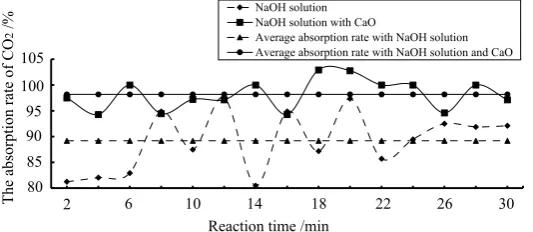
[image:8.595.162.441.80.199.2]In order to study the effect of solid particles on ship’s decarburization, a contrast experiment is carried out with pure NaOH solution and mixed NaOH solution with CaO solid particles. The concentration of NaOH solution is 1 mol/L, the total volume is 3 L, and CaO’s weight is 1.25 g. Figure 3 shows the CO2 absorption rate varies with time.
95 90 85 80 T he a bs or pt io n ra te o f C O 2 /% 6
Reaction time /min
2 10 14 18 22 26 30
100 105 80.00% 85.00% 90.00% 95.00% 100.00% 105.00%
2 4 6 8 10 12 14 16 18 20 22 24 26 28 30
吸收率
反应时间(min)
NaOH solution NaOH solution with CaO
Average absorption rate with NaOH solution Average absorption rate with NaOH solution and CaO
Fig. 3 CO2 absorption rate varies with time before and after adding CaO particles
[image:8.595.166.433.550.666.2]mol, compared with 3 mol NaOH solution, the difference of alkalinity is nearly 100 times. During the experiment, the average reaction temperature is 27.5℃. The relationship between solubility
and the temperature of Ca(OH)2 [19] shows that the solubility of Ca(OH)2 is 0.156 g at 27.5 ℃, so there is only 0.468 g Ca(OH)2 dissolved in the mixed solution. From Eq. (3), it can be seen that CaCO3 precipitates during the reaction process, and it also participates in the reaction, so the mass of the solid particles changes little during the whole cycle. After adding 1.25 g CaO solid particles, the CO2 absorption rate is increased by 10% because of the physical effects.
3.3 The Effect of CO2 Absorption Rate from Simulated Exhaust Gas
Exhaust gas composition of diesel engines is affected by many factors, such as the type of diesel engine, fuel quality, ship operating conditions, etc. Based on the exhaust gas from 6135AZG diesel engine, the representative contents of exhaust gas are selected as N2, O2, CO2 and SO2 with mass fraction 80.09 %, 15.18%, 4.69% and 0.04% respectively. The simulated exhaust gas is first introduced to the pure NaOH solution, then 1.5 g CaO was added into the NaOH solution with same concentration. Since the acidity of SO2 is stronger than CO2, so SO2 is assumed to be absorbed completely. Figure 4 shows the absorption rate of CO2 contrast.
60 40
Th
e
ab
so
rp
tio
n
ra
te
o
f C
O
2
/
%
Reaction time /min 100
120
5 10 15 20 25 30
80
40.00% 60.00% 80.00%
100.00%
120.00%
0 5 10 15 20 25
吸收率
反应时间 NaOH solution NaOH solution with CaO
Average absorption rate with NaOH solution Average absorption rate with NaOH soultion and CaO
Fig. 4 CO2 absorption rate varies with time before and after adding CaO to simulated exhaust
We can see that CO2 content in the simulated exhaust gas is lower than that of pure CO2 gas, so the curve fluctuates wildly but the overall trend of the two absorption curves is about the same, and the main difference is the first half of the reaction, which achieves a better absorption effect due to the presence of solid particles. The average absorption rate of simulated exhaust gas is 80.65% without CaO solid particles and it increases by 15.85% to 96.50% after adding CaO solid particles. It can be seen that neither pure CO2 gas, simulated exhaust gas nor CaO solid particulates can improve CO2 absorption significantly, and the trend of both charts is very similar.
3.4 Experimental with Marine Diesel Engine of 6135AZG
Based on the 6135AZG marine diesel engine, running under load L characteristics condition at the speed of 1 500 r•min-1, the engine operating points and the theoretical displacement are
[image:9.595.158.424.349.492.2]shown in Table 2.
Table 2 Diesel engine load characteristics of 6135AZG Working
condition Load ratio /% Fuel consumption /g• (kW•h) -1 Power /kW /(N•m) Torque
Theoretical displacement
/(m3•h -1)
Theoretical displacement of CO2
/(kg•h-1)
[image:9.595.91.505.721.766.2]2 75% 227.0 121.5 773.55 2 814.05 86.89
3 50% 236.0 81.0 515.70 1 950.45 60.24
4 25% 252.0 40.5 257.85 1 040.73 32.12
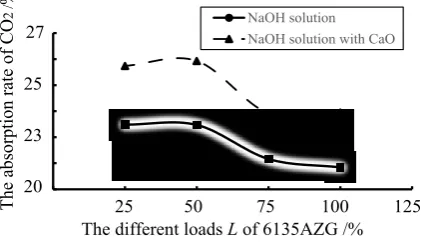
The exhaust gas outlet temperature is 55 ℃ after cooling , and other test conditions remain unchanged. Figure 5 shows the test results.
23 20
T
he
a
bs
or
pt
io
n
ra
te
o
f
C
O
2
/
%
The different loads L of 6135AZG /% 25
27
25 50 75 100 125
20.00% 21.00% 22.00% 23.00% 24.00% 25.00%
26.00%
0% 25% 50% 75% 100% 125%
NaOH solution NaOH solution with CaO
Fig. 5 CO2 absorption rate varies with time before and after adding CaO to simulated exhaust
From Fig. 5 we can see that when the 6135AZG marine diesel engine runs at 25% load, the exhaust gas CO2 absorption rate is 22.48% in pure NaOH solution. It falls to 22.47%, 21.16% and 20.84% at 50%, 75% and 100% load respectively. After adding CaO solid particles into the solution, the exhaust gas CO2 absorption rate rises to 24.74%, 24.93%, 22.92% and 22.95% at 25%, 50%, 75% and 100% load respectively.
3.5 The Varies of pH Value on Absorption Solution in Experiment
In the experiment, we find that the pH value obtained by using simulated exhaust of a ship distribution trend is in good agreement with the experiment of 6135AZG marine diesel engine. In other words, the pH value reduction of NaOH solution with CaO solid is slower than the purity NaOH solution, as shown in Fig. 6.
13.50 13.00 12.50 12.00
T
he
p
H
r
ed
uc
ti
on
v
al
ue
4
Reaction time /min
0 8 12 16 20 24 32
14.00
6 10 14 22 26
2 18 28 30
12.00 12.50 13.00 13.50 14.00
0 2 4 6 8 10 12 14 16 18 20 22 24 26 28 30 32
PH
值
反应时间(min) 循环试验/吸收实验PH值变化对比
NaOH solution with CaO NaOH solution
Fig. 6 The pH reduction varies with time using simulated gas and real gasin experiment
At the beginning of the experiment, the pH of NaOH solution with CaO is lower than the purity NaOH solution at 13.88. And the pH values of the two solutions are different in the 14th minute, the pH value of NaOH solution with CaO is 13.70, while the NaOH solution pH value is 13.67.
[image:10.595.192.407.159.281.2] [image:10.595.155.440.479.581.2]3.6 The Comparison of CO2 Absorption Rate in NaOH Solution with and without CaO
Particles
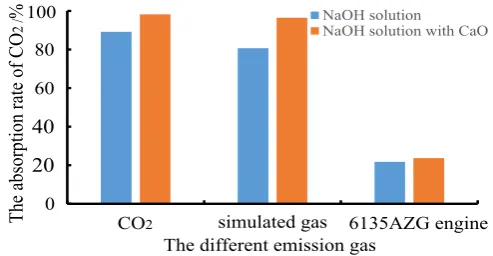
When the mole ratio of NaOH to CaO is 135 in the mixed solution. The CO2 absorption rate reaches to 98.2% to pure CO2 gas, 10% higher than the pure NaOH solution, the CO2 absorption rate of the simulated exhaust gas also increases by 15.85% from 80.65% to 96.5%. The CO2 absorption rate from 6135AZG diesel engine emission also increases by 10.30% from 21.74% to 23.89%, as shown in Fig. 7.
40
20
T
he
a
bs
or
pt
io
n
ra
te
o
f C
O
2
/
%
60 100
CO2
0.00% 20.00% 40.00% 60.00% 80.00% 100.00%
CO2
NaOH solution
NaOH solution with CaO
80
0
simulated gas 6135AZG engine The different emission gas
Fig. 7 CO2 absorption rate varies before and after adding CaO to the different gas
4 Conclusion
In this paper, the method of adding CaO solid particles into NaOH solution is proposed to improve CO2 absorption efficiency. The CaO particles enhancement mechanism is expounded from both chemical and physical aspects. The mathematic enhancement model was derived and the enhancement effect have been verified through the experiment. The experimental result shows that there is a micro bubbles accumulation process during the CO2 absorption process without adding CaO in the solution and the absorption effect will gradually increase as the micro bubbles form a circulation in the upper part of the reactor, and the average absorption rate can reach the highest level of 89.2%, which is far to achieve the desired value. While, the absorption efficiency improves significantly after adding CaO solid particles. So we can conclude that adding CaO particles into the NaOH solution can improve CO2 absorption significantly and it has a promising future in the ship exhaust gas handling area.
Acknowledgement The author thanks to my tutors Professor Xu Leping and Zhou Peilin,
the project team and my family.
References
[1] WANG Z C, ZHOU P L, XU L P, et al. Experimental study of CO2 absorption by NaOH
solution[J]. Journal of Safety and Environment, 2015,15(4):293-296(in Chinese).
[image:11.595.172.419.204.332.2]operating vessels" [J]. Marine Technology, 2013,(1):67-69(in Chinese).
[3] HU X W. Study on the effect of adsorbent particles and pollutants on CO2 absorption[D].
Tianjin:Tianjin University, 2008(in Chinese).
[4] YUAN G, KEANE M A. Liquid phase catalytic hydrodechlorination of 2, 4-dichlorophenol
over carbon supported palladium: an evaluation of transport limitations[J]. Chemical
Engineering Science, 2003,58(2):257-267.
[5] GUTIERREZ-ORITIZ J I, LOPEZ-FONSECA R. Mass transfer studies in the hydrogenation
of methyl oleate over a Ni/SiO2 catalyst in the liquid phase[J]. Reaction Kinetics,
Mechanisms and Catalysis, 2000,70(2):341-348.
[6] WIMMERS O J, FORTUIN J M H. The use of adhesion of catalyst particles to gas bubbles
to achieve enhancement of gas absorption in slurry reactors—Ⅰ. Investigation of
particle-to-bubble adhesion using the bubble pick-up method[J]. Chemical Engineering
Science, l988,43(2):303-3l2.
[7] LIU Y S, WEI G F, ZHANG H. Enhancement factor of CO2 absorption by ethanolamine
aqueous solution in packed tower[J]. Journal of Chemical Industry and Engineering, 2014,
65(8):3054-3061(in Chinese).
[8] NA Y Q, FU K Y, LIANG Z W, et al. Mass transfer performance in a θ-ring packed tower for
CO2 absorption process using MEA[J]. Journal of Hunan University: Natural Sciences, 2011,
38(3): 69-72(in Chinese).
[9] SHEN F Z, GUO S H, ZHOU H R. Waste carbon dioxide recovering methods and utilized
ways[J]. Guangdong Chemical Industry, 2013,40(23):136-138(in Chinese).
[10] JOOSTEN G E H, DANCKWERTS P V. Chemical reaction and effective interfacial areas in
gas absorption[J]. Chemical Engineering Science, 1973,28(2): 453-461.
[11] JIA S Y, CHAI C J. Chemical Mass Transfer and Separation Process (2nd Edition) [M],
Shanghai: Chemical Industry Press, 2010(in Chinese).
[12] TANG Z L, ZHAO X J, LIU B T, et al. Volumetric overall mass transfer coefficients of CO2
absorption into aqua ammonia in structured packed column[J]. Journal of Chemical Industry
and Engineering, 2012, 63(4): 1102-1106(in Chinese).
[13] CHENG Z M, ZHU K H, YUAN W K. Advanced reaction engineering Tutorial[M].
[14] BLAUWHOFF P M M, VERSTEEG G F, VAN SWAAIJ W P M. A study on the reaction
between CO2 and alkanolamines in aqueous solutions[J].Chemical Engineering Science,
1983,38(9): 1411-1429.
[15] JIANG W J, LEI L H, LIU M L, et al. Principles of Chemical Engineering (Volume 3)
[M].Beijin: Tsinghua University Press, 2010(in Chinese).
[16] LI H, LIU Y S, ZHANG H, et al. Effect of reaction conditions on mass transfer performance
of CO2 absorption by monoethanolamine Solution for biogas purification[J]. Transactions of
the Chinese Society of Agricultural Machinery, 2015, 46(1):185-191(in Chinese).
[17] VERSTEEG G F, VAN SWAALJ W P M. Solubility and diffusivity of acid gases (carbon
dioxide, nitrous oxide) in aqueous alkanol amine solutions[J]. Journal of Chemical and
Engineering Data, 1988, 33(1):29-34.
[18] QI G J, WANG S J, LIU J Z, et al. Impact of SO2 on CO2 capture in coal-fired flue gas using
aqueous ammonia[J]. Journal of Chemical Industry and Engineering, 2012, 63(7):
2203-2209(in Chinese).
[19] LUO P, XIE Q B. The solubility study of Ca(OH)2 "anomaly"[J]. Chemistry Teaching and