Open Access
Technical advance
A robust, low- to medium-throughput
prnp
genotyping system in
sheep
Johannes Buitkamp* and Jördis Semmer
Address: Bavarian State Research Center for Agriculture, Institute of Animal Breeding, Prof.-Dürrwaechter-Platz 1, 85586 Poing, Germany
Email: Johannes Buitkamp* - [email protected]; Jördis Semmer - [email protected] * Corresponding author
Abstract
Background: In many countries breeding programs for resistance to scrapie in sheep are established. Therefore, the demand on genotyping capacities of the polymorphisms of the prion protein gene (prnp) relevant to presently known disease associations and EU regulations is steadily increasing. Most published typing methods are not well suited for routine typing of large sample numbers in smaller service laboratories for different reasons: they require partly manual data processing, sophisticated and sensitive protocols, high efforts regarding time and manpower, multiple step reactions or substantial hardware investments. To overcome these drawbacks, we developed a prnp typing method that is based on a `multiplex amplification refractory mutation system' (ARMS) reaction.
Methods: In this study we combined the amplification refractory mutation system (ARMS) with standard fluorescent based fragment length analyses method to develop a prnp genotyping method (PRNP ARMS).
Results: By optimised primer design it was possible to type the 4 relevant single nucleotide polymorphisms (SNPs) in the prnp simultaneously in one multiplex reaction. Automated fragment length analysis enabled automated allele designation. Suitability of the PRNP ARMS for routine application was proven by typing samples with known genotypes and larger sample numbers from half-sib families.
Conclusion: The ARMS PRNP typing method established in this study is universally suited for a broad range of typing projects with different requirements. It provides an efficient and inexpensive diagnostic mutation analysis that will improve the quality of prnp genotyping compared with other low-cost methods. It can be implemented by most molecular genetic laboratories using standard equipment.
Background
Scrapie is a contagious prion disease [1] of sheep and goat. In contrast to BSE, there is no evidence for a transmission to humans. Nevertheless, BSE is experimentally transmit-table to sheep and the resulting disease can not be
distin-guished from scrapie [2,3]. Even though BSE has not been found in farmed sheep yet, the possibility that BSE occurs in "scrapie" diseased sheep can not be excluded. There-fore, scrapie control programs were implemented in many countries. Since no vaccine or therapeutic means is Published: 02 September 2004
BMC Infectious Diseases 2004, 4:30 doi:10.1186/1471-2334-4-30
Received: 25 May 2004 Accepted: 02 September 2004
This article is available from: http://www.biomedcentral.com/1471-2334/4/30
© 2004 Buitkamp and Semmer; licensee BioMed Central Ltd.
currently available, these programs rely on selective breed-ing for scrapie resistance. Susceptibility to scrapie is largely controlled by three polymorphic amino acid posi-tions (136, 154, 171) of the ovine prion protein gene (prnp) [4] and reliable genotyping of the corresponding DNA polymorphism is required as a basis for selection decisions.
For determination of prnp alleles or haplotypes, there are several typing techniques applied today. Direct sequenc-ing coversequenc-ing the region of exon 2 encodsequenc-ing amino acid positions 136, 154 and 171 is the most accurate method, that enables the typing of additional and detection of hitherto unknown polymorphisms. Other methods are classical PCR-restriction fragment length polymorphism (RFLP)-typing [5,6], DNA strand conformation polymor-phism detection, denaturing gradient gel electrophoresis (DGGE) [7], PCR-single-strand conformational polymor-phism (PCR-SSCP) [8], hybridisation with allele-specific oligonucleotides [9,10], primer extension [11], and so on. For high-throughput genotyping matrix assisted laser desporption/ionisation – time of flight (MALDI-TOF) sys-tems (e.g. for bovine prnp [12] and the LGC-web page [13]), taqman® (Applied Biosystems, CA) [14], and pyro-sequencing (Biotage AB, Uppsala, Sweden) are used, but methodologically details of these methods are not very well documented in the literature.
The amplification refractory mutation system (ARMS) method is well established [15] and has been applied not only to single nucleotide polymorphism (SNP) detection but also to haplotype determination [16]. In the present work we combined the use of fluorescence labelled oligo-nucleotides with ARMS technology for the simultaneous detection of 4 SNPs without using common primers. Based on this PRNP ARMS method we developed a cost-effective, well-reliable and low- to high-throughput tech-nology for prnp typing that can easily be adopted by a wide range of other laboratories.
Methods
DNA-Samples
EDTA-blood or Typifix®-tissue samples were collected from half-sib families from three common sheep breeds in Bavaria. All lambs were born in the years 2001 and 2002. DNA was isolated by using the E.Z.N.A. Blood DNA Mini Kit (#12-3482-03, PEQLAB Biotechnologie GmbH, Erlangen, Germany) or the NucleoSpin® Multi-96 Tissue kit (MACHEREY-NAGEL GmbH & Co. KG, Düren, Ger-many), respectively.
PRNP-ARMS
Design of Primers
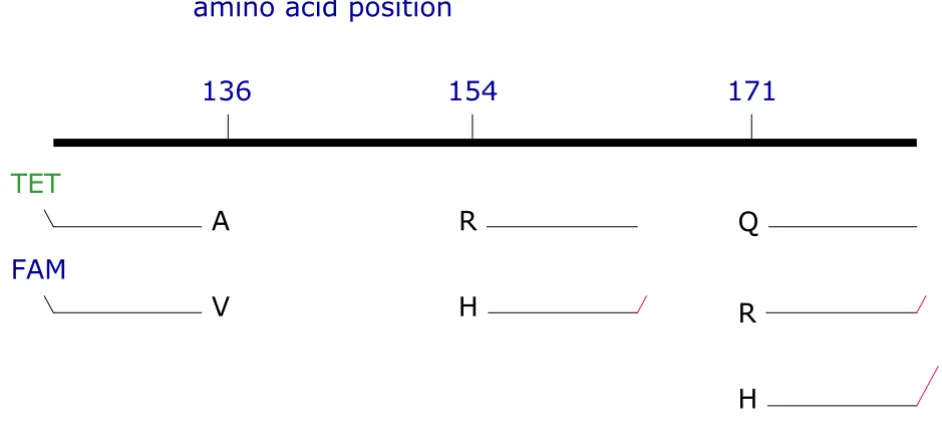
An overview of primer locations is given in Fig. 1. Initially, allele-specific primers were designed that differed only at
the 3'-nucleotide (given in bold letters in Table 1). Using these primers it was not possible to obtain reliable dis-crimination of alleles. Especially the simultaneous use of primers for alleles Q-171 and R-171 resulted in cross-amplification products. Therefore, a number of additional primers were tested to optimise allele discrimination. Destabilizing mismatches were introduced at the first or second penultimate base in addition to the allele-specific base at the 3' termini of the primers (ARMS principle, indicated by small letters in Table 1). The sense primers specific for the alleles at amino acid position 136 were labelled with two different fluorochromes, 4, 7, 2', 7'-tetrabetweenchloro-carboxyfluorescein (TET) and 6-carboxyfluorescein (FAM) (Table 1, Fig. 1). That allows the detection and discrimination of the alleles by standard gel electrophoresis on a fluorescent sequencer. Pieces of neutral sequence [17] were added to the 5'-end (under-lined in Table 1) of the unlabeled antisense primers for amino acid positions 154 and 171. These enable the dif-ferentiation of the alleles by different lengths. Mismatches between primers were deliberately introduced at the 5' region in these neutral sequences to avoid jumping ampli-fication products. For a delineation of primer sequences with a reference sequence (Fig. 3).
PCR-reaction
For the ARMS reaction haplotypes were amplified from 2
µl of DNA solution with standard buffer conditions, 1.5 mM MgCl2, dNTP's (25 nM each), and 0.75 units of Hot-Star-taq polymerase (Qiagen, Hilden, Germany) in a final volume of 10 µl on a t-gradient 96-well thermocycler (Biometra, Göttingen, Germany). Primer concentrations were 10 nmol each. Cycling was for 15 min at 95°C, [0.5 min at 94°C, 1 min at 62°C, 1 min at 74°C]33× without final extension.
Fragment analysis
Fragment lengths of ARMS amplification products were analysed on an ABI PRISM® 310 genetic analyser (Applied Biosystems, Foster City, CA) with 5 sec injection time, 15 kV, 60° and 18 min runtime using 36 cm capillaries. Allele designations were generated automatically using the Genotyper® software (V. 2.5, Applied Biosystems) as described [18]. The data were imported into an Microsoft Access database. Standard DNA samples representing dif-ferent alleles were included in the assay to control each PCR mix and reaction. As an additional control a sql-query was used to flag all genotypes transferred to the database that were not compatible with the 15 known standard genotypes (e.g. peaks from FAM in the range of 153 bp) for retyping.
Comparative sequencing
using 2 µl of genomic DNA, 0.05 µM of each primer (5'-tcc tgg agg caa ccg cta tc-3' and 5'-gga gga tca cag gag ggg aag-3'), 50 µM of each dNTP, 0.5 units of HotStar-taq polymerase (Qiagen, Hilden, Germany), and reaction buffer containing 1.5 mM MgCl2. Cycling-conditions on a Biometra T gradient 96-well thermocycler were: 15 min at 95°C, [0.5 min at 95°C, 1 min at 60°C, 0,5 min at 72°C]35× and 10 min, 60°C final extension. Before direct sequencing PCR-reactions were purified using the 96-well MultiScreen-PCR plates (Millipore, Bedford, MA). Sequencing was performed using BigDye V 2.0 terminator cycle sequencing kit (Applied Biosystems, Foster City,
CA). Sequencing analysis was run on an ABI PRISM® 310 genetic analyser.
Results
Development of the PRNP ARMS method
We have established a multiplex `amplification refractory mutation system' (ARMS) based method for the identifi-cation of prnp 136-154-171 genotypes in sheep. The PRNP ARMS method was developed using standard DNAs repre-senting all five main haplotypes. In a first stage, different primer pairs were tested for allele specific amplification using an anneal-temperature gradient. By redesign of
[image:3.612.54.525.103.324.2]Scheme of PRNP ARMS-PCR design
Figure 1
Scheme of PRNP ARMS-PCR design. PrP amino acid positions are given above. The allele-specific up-primers (discrimina-tion of A-V at codon 136) are fluorescence labelled, whereas down primers (discrimina(discrimina-tion of R-H and Q-R-H at codon 154 and 171, respectively) are of different lengths (tails are shown as red lines).
Table 1: ARMS primers used to type the ovine PRNP
Name Sequence of Primer 5'-3' Allele Length/Label Fragment Length
PRNP_136A ATACATGCTGGGAAGTGC A136 18 bp/TET
-PRNP_136V CTACATGCTGGGAAGTGT V136 18 bp/FAM
-PRNP_154R ACTAACGGTACATGTTTTCAC R154 21 bp/- 92 bp
PRNP_154H AGTTTGTAACGGTACATGTTTTgAT H154 25 bp/- 96 bp
PRNP_171Q GGAAGTTGTTCTGGTTACTATcCT Q171 24 bp/- 146 bp
PRNP_171R TCAGTTAAGTTGTTCTGGTTACTATtCC R171 28 bp/- 150 bp
PRNP_171H TTCTGAGCATAAAGTTGTTCTGGTTACTATAA H171 32 bp/- 154 bp
Small letters indicate deliberately introduced mismatches (ARMS principle); underlining indicate pieces of neutral sequence that were added to elongate the primer to allow allele-discrimination by capillary electrophoresis.
154
171
136
TET
FAM
amino acid position
A
V
R
H
R
[image:3.612.55.554.430.530.2]Location of ARMS Primers within the reference sequence
Figure 3
Location of ARMS Primers within the reference sequence. Primer sequences are given above the sequence represent-ing the "wild-type" allele (Genbank accession number AJ000739). The 5 prime and 3 prime ends are indicated. Small letters indicate deliberately introduced mismatches; underlining indicate pieces of neutral sequence that were deliberately added to elongate the primer.
AJ000739. Ovis aries PrP genomic [gi:2398746]
1 ctgcagactt taagtgattc ttacgtgggc atttgatgct gacaccctct ttattttgca 61 gagaagtcat catggtgaaa agccacatag gcagttggat cctggttctc tttgtggcca 121 tgtggagtga cgtgggcctc tgcaagaagc gaccaaaacc tggcggagga tggaacactg 181 gggggagccg atacccggga cagggcagtc ctggaggcaa ccgctatcca cctcagggag 241 ggggtggctg gggtcagccc catggaggtg gctggggcca acctcatgga ggtggctggg 301 gtcagcccca tggtggtggc tggggacagc cacatggtgg tggaggctgg ggtcaaggtg 361 gtagccacag tcagtggaac aagcccagta agccaaaaac caacatgaag catgtggcag
PRNP_136V > 5’-CTACATGCTG GGAAGTGT-3’ PRNP_136A > 5’-ATACATGCTG GGAAGTGC-3’ 421 gagctgctgc agctggagca gtggtagggg gccttggtgg ctacatgctg ggaagtgcca
3’-TAgTTTTGT- 3’-CACTTTTGT- 481 tgagcaggcc tcttatacat tttggcaatg actatgagga ccgttactat cgtgaaaaca
3’- AATATCA TTGGTCTTGT ACATGGCAAT GTTTGA-5’ < PRNP_154H 3’- CCtTATCA TTGGTCTTGT ACATGGCAAT CA-5’ < PRNP_154R 3’- TCcTATCA TTGGTCTTGT 541 tgtaccgtta ccccaaccaa gtgtactaca gaccagtgga tcagtatagt aaccagaaca
TGAAATACGAGTCTT-5’ < PRNP_171H TGAATTGACT-5’ < PRNP_171R TGAAGG-5’ < PRNP_171Q
primers for amino-acid positions 154 and 171 and introducing deliberate mismatches close to the 3' end an optimised primer set was established (Table 1) allowing multiplex, allele-specific amplification. "False positive fragments" (peaks above the background signal generated by primers complementary to alleles that were not present in the corresponding sample) were not observed using the optimised primer set. Nevertheless, the average peaks heights differed between alleles. For example the average peak heights of the allele Q-154 was 1.5 times higher than that of R-154. The ratio of peak heights in heterozygous individuals differed from 0.5 to 2.5 fold (compare Fig. 2). These were observed when different PCR assays with low number of samples and small volumes of master-mix are compared. The peak height differences depend mainly on the relative primer concentrations and can be avoided e.g. by using premixed primer solutions containing all ARMS primers. For automated "base calling" the minimum peak height was set to 100 (in practice most samples gave peak heights well above 1000).
Proof-of-principle
To provide a proof-of-principle the same 140 sheep DNAs were analysed by direct PCR sequencing and by PRNP ARMS. Typing results were identical with both methods. In a second step, 420 sheep from half-sib families and 20 samples from the international sheep and goat DNA typ-ing comparison test 2003 of the International Society of Animal Genetics were analysed by the PRNP ARMS method. All genotypes followed the rules of Mendelian inheritance and no deviation from the main 5 haplotype patterns was observed. Allele frequencies derived from these animals from three different Bavarian breeds are shown in Table 2. Paternity of all lambs was checked with a set of 9 microsatellites (data not shown).
Typical electropherograms representing different haplo-type combinations are shown in Fig. 2. Allele length deter-mination was highly reproducible (Table 3). The range of individual peaks from each individual allele was well below +/-1 bp allowing unambiguous allele-calling and automatic generation of results tables using the genotyper software. Furthermore, the PRNP ARMS reaction worked fairly stable with different DNA qualities. The quality and concentration of the DNAs that were isolated from tissue varied widely (5 – 50 ng/µl, various degrees of fragmenta-tion). Failed PCR reactions (e.g. one primer missing) were identified by analysing the standard samples. Failed indi-vidual samples (e.g. due to low DNA concentrations or failure of the fragment analyses run) were easily identified by missing or very low and out-of-range peaks. Neverthe-less, the proportion of samples that had to be retyped was well below 1%.
Discussion
The PRNP ARMS genotyping method has several advan-tages. It is based on a one step reaction using competitive allele discrimination. The fragments can be analysed on an automated sequencer that allows data to be directly transferred to a database. The reaction proved to be highly specific and no false negative or positive results were observed yet. Furthermore, it is robust with respect to var-iations of DNA quality and, since no further purification or reaction is necessary, the costs for consumables are low. The ARMS method allows the determination of partial (136-154 and 136-171, compare Fig. 1) prnp haplotypes, thereby facilitating the detection of 'complex' prnp geno-types that do not match one of the 15 standard genotype patterns. If necessary, it can easily be extended to com-plete haplotype determination by adding additional labelled forward primers for position 154 (for haplotype 154-171).
All methods currently available for SNP typing are inher-ent sensitive to nucleotide changes within the primer attachment or restriction sites. The resulting mismatches can cause inconclusive typing results or null alleles, as fre-quently observed with microsatellite loci. Therefore, it is crucial to be aware of this phenomenon and to take measures to reduce the risk of mistyping. The primers for PRNP ARMS were carefully checked against a prnp in-house database containing 16 published and 11 unpub-lished (mainly from rare German and Spanish breeds) alleles. No known polymorphism interfere with the attachment of the selected ARMS primers. Nevertheless, the recently described rare polymorphism K-171 [19] with unknown effect to scrapie resistance is not included in the standard PRNP ARMS set (that gives Q-171 as typing result for this allele) and requires one additional specific oligonucleotide. This oligonucleotide should be added if the respective breeds (mainly hair breeds [19]) are geno-typed. When further polymorphisms associated with resistance to scrapie will be identified appropriate oligo-nucleotides can easily be added. Unlabelled additional oligonucleotides can be used when SNPs upstream of the amino acid position 136 shall be typed. Nevertheless, the inclusion of positions downstream of position 136 would require additional labelled oligonucleotides. A third fluo-rescent dye might be useful especially when the lengths of the fragments interfere with on of the other alleles.
sequencing machines are used. Since all reactions can be performed in microtiter plates, the ARMS reaction can eas-ily be adopted for a pipetting robot. Together with the one step reaction and the automated data transfer, the risk of cross-contamination or interchanging of samples is mini-mized. The runtime of 18 min results in 25 min analyses
time per sample on the ABI 310 and could be optimised by using shorter capillaries. When using the standard run conditions on the smallest, single capillary sequencer the throughput is limited to about 55 samples per working day but can be scaled up to more than 5000 samples per day by using a 96-well capillary sequencer. That should be
Electropherograms from 5 PRNP genotypes
Figure 2
Electropherograms from 5 PRNP genotypes. The "green" lanes correspond to TET labelled fragments, the "blue" lines to FAM labelled products. The PRNP genotype of each individual is given above each lane. Only the informative lanes (no peaks were observed in the "blue" lane of A136 and no peaks were observed in the "green" lane of V136 homozygotes, respectively) are shown. The scheme at the bottom shows how the peaks relate to the alleles.
136_V
136_A
R
R
154
H
Q
Q
171
R
H
ARQ/AHQ
ARQ/ARR
ARR/ARR
sufficient even for large, existing breeding programs. PRNP ARMS can be multiplexed with other typing systems (microsatellite or SNP), since it is analysed using standard fragment analysis technique. Moreover, it is suit-able for further applications as e.g. allele frequency esti-mation from pooled DNA [20] for investigating rare breeds.
Conclusions
An easy and robust one-step prnp typing method has been established that is universally suited for a broad range of typing projects with different requirements. This typing method was developed by optimising ARMS primers and combining these with standard fragment length analyses. The method provides an efficient and inexpensive diag-nostic mutation analysis that can be implemented by most molecular genetic laboratories using standard equipment. It should contribute to reliable and economic genotyping of the ovine prnp by the many smaller labs throughout Europe.
Competing interests
The authors declare that they have no competing interests.
Authors' contributions
J.B. designed the project and protocols involved, per-formed analysis of results and drafted this manuscript. J.S. conceived the ARMS reaction, fragment analysis and DNA sequencing.
Acknowledgements
We would like to thank Georg Mendel, Albert Steiner and Max Wagenpfeil for collecting sheep samples.
References
1. Prusiner SB: Prions. Proc Natl Acad Sci USA 1998, 95(23):13363-13383.
2. Baylis M, Houston F, Kao RR, McLean AR, Hunter N, Gravenor MB: BSE – a wolf in sheep's clothing? Trends Microbiol 2002, 10(12):563-570.
3. Foster JD, Parnham D, Chong A, Goldmann W, Hunter N: Clinical signs, histopathology and genetics of experimental transmis-sion of BSE and natural scrapie to sheep and goats. Vet Rec 2001, 148(6):165-171.
4. Hunter N: Molecular Biology and Genetics of Scrapie in Sheep. In: The Genetics of Sheep Edited by: Piper LR, Ruvinsky A. CAB International; 1997:225-240.
[image:7.612.53.555.100.192.2]5. Hunter N, Foster JD, Benson G, Hope J: Restriction fragment length polymorphisms of the scrapie-associated fibril protein (PrP) gene and their association with susceptibility to natu-ral scrapie in British sheep. J Gen Virol 1991, 72(Pt 6):1287-1292. 6. Hunter N, Goldmann W, Benson G, Foster JD, Hope J: Swaledale sheep affected by natural scrapie differ significantly in PrP genotype frequencies from healthy sheep and those selected Table 2: PRNP allele frequencies (%) as observed in three sheep breeds common in Bavaria
breed
Allele ML SK SU
AHQ 7.68 0.00 1.96
ARH 0.18 0.00 0.00
ARQ 82.14 24.58 27.45
ARR 9.82 69.49 66.67
VRQ 0.18 5.93 3.92
ML, Merinolandschaf; SK, German Blackheaded Mutton; SU, Suffolk.
Table 3: Statistics for peak lengths of the PRNP ARMS system
Calculated peak sizes#
Dye Oligonucleotide Fragment length Mean StdDev Min Max
TET PRNP_154R 92 bp 89.16 0.12 88.91 89.70
PRNP_154H 96 bp 92.13 0.09 91.98 92.45
PRNP_171Q 146 bp 142.91 0.12 142.67 143.48
PRNP_171R 150 bp 148.05 0.18 146.72 148.42
PRNP_171H 154 bp 153.13 0.72 152.31 153.74
FAM PRNP_154R 92 bp 89.56 0.13 89.36 89.84
PRNP_154H 96 bp np np np np
PRNP_171Q 146 bp 143.29 0.11 143.13 143.48
PRNP_171R 150 bp np np np np
PRNP_171H 154 bp np np np np
[image:7.612.55.562.252.398.2]Publish with BioMed Central and every scientist can read your work free of charge
"BioMed Central will be the most significant development for disseminating the results of biomedical researc h in our lifetime."
Sir Paul Nurse, Cancer Research UK
Your research papers will be:
available free of charge to the entire biomedical community peer reviewed and published immediately upon acceptance cited in PubMed and archived on PubMed Central yours — you keep the copyright
Submit your manuscript here:
http://www.biomedcentral.com/info/publishing_adv.asp
BioMedcentral for reduced incidence of scrapie. J Gen Virol 1993, 74(Pt
6):1025-1031.
7. Belt PB, Muileman IH, Schreuder BE, Bos-de Ruijter J, Gielkens AL, Smits MA: Identification of five allelic variants of the sheep PrP gene and their association with natural scrapie. J Gen Virol 1995, 76(Pt 3):509-517.
8. Marcos S, Calvo JH, González C, Serrano M: Haplotype determi-nation and new variants within the ovine prion cds region. In: Proceedings of the International Workshop on Major Genes and QTL in Sheep and Goat: 8–11 dec. 2003; Toulouse; CD-ROM communication n°2-30 2003.
9. Hunter N, Moore L, Hosie BD, Dingwall WS, Greig A: Association between natural scrapie and PrP genotype in a flock of Suf-folk sheep in Scotland. Vet Rec 1997, 140(3):59-63.
10. Ishiguro N, Shinagawa M, Onoe S, Yamanouchi K, Saito T: Rapid analysis of allelic variants of the sheep PrP gene by oligonu-cleotide probes. Microbiol Immunol 1998, 42(8):579-582. 11. Zsolnai A, Anton I, Kühn C, Fesus L: Detection of
single-nucle-otide polymorphisms coding for three ovine prion protein variants by primer extension assay and capillary electrophoresis. Electrophoresis 2003, 24(4):634-638.
12. Humeny A, Schiebel K, Seeber S, Becker CM: Identification of pol-ymorphisms within the bovine prion protein gene (Prnp) by DNA sequencing and genotyping by MALDI-TOF-MS. Neuro-genetics 2002, 4(1):59-60.
13. LGC awarded genotyping contract as part of National Scrapie Plan [http://www.lgc.co.uk/news_story.asp?strare ano=47_2&intelement=3655]
14. Cawthraw S, Nadales EP, Martin TC: PrP genotyping in sheep using the 5' nuclease (Taqman) PCR assay. Res Vet Sci 2001, 70(Suppl A):24.
15. Newton CR, Graham A, Heptinstall LE, Powell SJ, Summers C, Kalsheker N, Smith JC, Markham AF: Analysis of any point muta-tion in DNA. The amplificamuta-tion refractory mutamuta-tion system (ARMS). Nucleic Acids Res 1989, 17(7):2503-2516.
16. Lo YM, Patel P, Newton CR, Markham AF, Fleming KA, Wainscoat JS: Direct haplotype determination by double ARMS: specifi-city, sensitivity and genetic applications. Nucleic Acids Res 1991, 19(13):3561-3567.
17. Lindblad-Toh K, Winchester E, Daly MJ, Wang DG, Hirschhorn JN, Laviolette JP, Ardlie K, Reich DE, Robinson E, Sklar P, et al.: Large-scale discovery and genotyping of single-nucleotide polymor-phisms in the mouse. Nature Genet 2000, 24(4):381-386. 18. Hall JM, LeDuc CA, Watson AR, Roter AH: An approach to
high-throughput genotyping. Genome Res 1996, 6(9):781-790. 19. Guo X, Kupfer DM, Fitch GQ, Roe BA, DeSilva U: Identification of
a novel lysine-171 allele in the ovine prion protein (PRNP)
gene. Anim Genet 2003, 34(4):303-305.
20. Germer S, Holland MJ, Higuchi R: High-throughput SNP allele-frequency determination in pooled DNA samples by kinetic PCR. Genome Res 2000, 10(2):258-266.
Pre-publication history
The pre-publication history for this paper can be accessed here: