Journal of Microbiology & Biology Education
©2015 Author(s). Published by the American Society for Microbiology. This is an Open Access article distributed under the terms of the Creative Commons Attribution-Noncommercial-NoDerivatives 4.0 International license (https://creativecommons.org/licenses/by-nc-nd/4.0/ and https://creativecommons.org/licenses/by-nc-nd/4.0/legalcode), which grants the public the nonexclusive right to copy, distribute, or display the published work. *Corresponding author. Mailing address: College of Public Health,
Medical and Veterinary Sciences, James Cook University, Douglas 4811, Townsville, Queensland, Australia. Phone: +62 747 814123. Fax: + 62 747 791526. E-mail: [email protected].
†Supplemental materials available at http://jmbe.asm.org INTRODUCTION
The current speed of advances in technology and the creation of new knowledge require a constant review and renewal of curricula in undergraduate science degrees. In addition to updating content in the curriculum, it is also important to consider the educational objectives, as described in a revision of Bloom’s taxonomy (1), as well as strategies to encourage student approaches to deep learning (SAL), with the goal of achieving higher levels in the hierarchy of educational objectives rather than just rote knowledge (22, 26).
Whereas academic staff are well placed to refresh the content and the educational objectives through their
scientific knowledge, it is more of a challenge to design a
curriculum that will encourage deep learning in the student body. There is a widening chasm between how students of today embrace the new world of knowledge acquisi-tion and the vastly different approach that was common
when the teaching staff acquired their knowledge (17). To overcome this challenge, it is possible to solicit the opinions and suggestions of the students, who are also stakeholders in this process, through a process termed “action research” (7, 23).
In this practice, the researcher is also the teacher, and the students are involved as partners in a collaborative process to investigate and improve the curriculum. The students will often see another perspective than that of the teacher or an observer/researcher. By cooperating with students, researchers uncover these other perspectives,
contributing to the analysis of and reflection on the criti
-cal incident investigated (15). The added benefits of this approach are that teachers will enter a reflective mode
on their teaching, giving them the power to change their teaching into a better learning space for students and al-lowing them to stay engaged in their own teaching (6, 5).
The students also benefit by using meta-cognitive strategies
with regard to their own learning preferences (19). Academic staff are challenged to comprehend and predict student choices because they are usually in a different age group from the students. But they are also on the teaching/knowledge side of the fence, making it
difficult for them to understand why certain knowledge
is troublesome to learn—we already know it and hence cannot easily regress back to the state of not knowing
Action Research to Improve the Learning Space for Diagnostic Techniques
†Ellen Ariel* and Leigh Owens
College of Public Health, Medical and Veterinary Sciences, James Cook University,
Townsville, Queensland, Australia
(15). Students, on the other hand, are still grappling with the concepts of new knowledge or have recently vaulted over the threshold of troublesome knowledge and may
therefore find it a little easier to reach back to their earlier
state of not knowing. Academic staff know the learning “destination” so to speak, but the students will have to make the journey there. In other words, both teachers and students are important team players when it comes to modernizing teaching modules.
Offerdahl and Montplaisir (17) describe the “for-mative assessment loop,” where student thinking is diagnosed via student-generated reading questions, and evidence of gaps in student achievement is subsequently used to adjust the teaching and learning process concur-rently during the module. This process enables teachers
to fine-tune their delivery according to actual real-time
information rather than their own perceptions of student thinking and is another example of engaging student
feed-back to refine the teaching and learning space, but on a
more immediate basis.
The Medical Laboratory Science and Biomedical Sci-ence degrees are part of James Cook University’s support for the allied healthcare demands of northern Queensland, Australia, and it provides locally trained graduates with a focus on tropical health. Some of the core skills required of these graduates are the competencies associated with laboratory diagnosis. Multiple techniques and methods are appropriate for the diagnosis of different diseases at various stages of the disease process, and the students need to know how the tests function (factual and proce-dural knowledge), when they can be employed, and how to troubleshoot and interpret the results (conceptual knowledge) (12). The latter requires an intimate knowl-edge of the test design and the ways in which the different components interact.
Based on past evidence, the technical procedures of applying reagents to diagnostic tests are not a problem for most students. This process falls under the cognitive process of “application” in Bloom’s revised taxonomy. However, when interpreting results or when unexpected results occur, the processes of troubleshooting are often very challenging because the design of the tests and the interaction of the different components are troublesome concepts for many (15). In real life, robots can carry out repetitive actions, but humans have the competitive ad-vantage of being able to analyze results, design new tests,
and find faults with existing tests, provided they have the
right background and training. Such processes occupy higher levels of the cognitive hierarchy in Bloom’s revised taxonomy, as described by Krathwohl (12).
The realization that our students found this
compo-nent difficult made us critically reflect on the teaching,
spurring a redesign of the curriculum, with alternative teaching and learning methods to facilitate the transition of students across the critical threshold of understanding the diagnostic test design (27, 12).
This approach was evaluated by the target group (students) via anonymous feedback, while their knowledge acquisition as the module progressed was monitored via multiple-choice questions (MCQs) and comparison with
the final exam of the previous year’s class. The two meth
-ods of evaluating the module are discussed, and ideas for future directions to improve the learning space for this topic are suggested.
MATERIALS AND METHODS
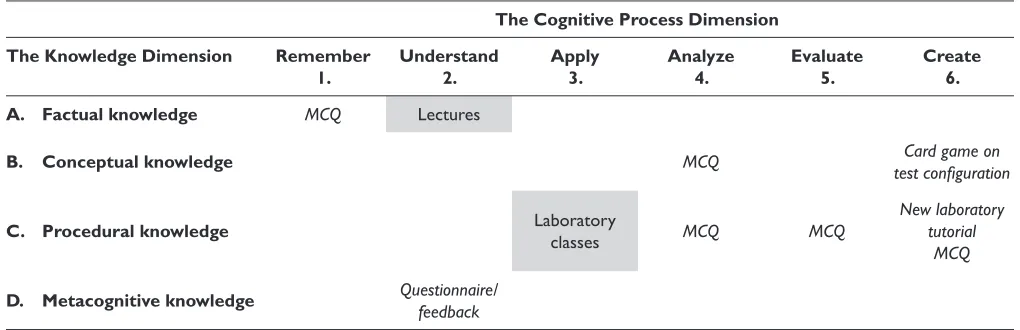
Clinical Microbiology is a third-year subject typi-cally consisting of a combination of lectures and laboratory classes. The objective of this subject is for students to un-derstand the fundamentals of diagnosis of selected clinically relevant organisms. The diagnostic test module runs over three weeks and was selected for review because students traditionally fare poorly in this topic. In preparation for a curriculum refresh, the existing activities were categorized according to Bloom’s revised taxonomy (12) in order to better identify gaps in the knowledge and cognitive pro-cesses (shaded areas, Table 1). The new activities were also categorized (italics, Table 1).
Traditionally the module on diagnostic techniques for
the identification of viral diseases consisted of seven lectures
and three laboratory classes in which students performed diagnostic tests according to written instructions. These activities fell into the lower part of the cognitive hierarchy, namely “understand” and “apply.” In order to have students progress toward a higher cognitive level of educational objective, “create,” using conceptual and procedural knowl-edge, exercises were included in which students had to engage in all previous cognitive process categories: a card game and a tutorial. The addition of an MCQ component in the curriculum served a dual purpose: in addition to serving as a means to monitor the progress of the students during the module, it has also been shown to enhance student learning as a tool in itself when used appropriately (20). An additional activity was added in “understanding metacogni-tive knowledge” as students intrinsically engage in metacog-nitive behavior in action research when considering their preferred learning style.
For the game, the students were tasked with
construct-ing diagnostic test configurations in groups, usconstruct-ing test com
-ponents supplied as icons on cards representing an enlarged model of the microscopic components. The groups were given a list of tests to construct, for example, Construct an antibody ELISA (enzyme-linked immunosorbent assay) to detect previous exposure to the measles virus. As there are several
possible configurations, the students had to discuss which
one to choose and why. The instructors interacted with groups on a rotational basis, providing input and suggesting/
correcting configurations with an explanation of why they
would or would not work.
a remote location to accommodate testing for a list of local tropical diseases. The criteria were to use as many different tests as possible. The students discussed which test best suited the diagnosis of the different diseases, based on background knowledge of the disease presentation and the strengths and weaknesses of the different tests. Instructors were available for assistance.
These activities replaced one lecture and one labora-tory class. A guest lecturer from a diagnostic laboralabora-tory was invited to present one of the remaining six lectures in order to stress the future relevance and applicability of the topic to the undergraduates. The other lectures were changed to include more visual explanations of the microscopic components of the tests rather than purely text.
Part of the strategy for the new module to be tested was also to design components to cater to the diversity of learning styles (25). Both aural and reading/writing strategies were included in the original curriculum, but not visual or kinesthetic. Students learning by visualization were particu-larly compromised, because the microscopic interactions taking place in diagnostic tests can neither be observed with the naked eye nor under a microscope. An understanding of these processes is therefore highly conceptual and per-haps not easily accessible for students who prefer visual or kinesthetic sensory modes of learning (25). Visual aids
and gamification in teaching have been successfully used for
both secondary and tertiary students (4, 21, 11). The card game and tutorial on how to set up a new laboratory were therefore included in the new curriculum.
ASSESSMENT OF STUDENTS AND TEACHING
Student learning throughout the module was assessed
using three sets of MCQs and a final exam at the end of the
semester. Final exam grades for the diagnostic test module of the cohort with the refreshed curriculum were compared
with the grades from the previous cohort in inter-quartile ranges. The pass grade at James Cook University is 50%.
Student evaluation of the different learning units was in the form of a questionnaire at the end of the module and a focus group for unstructured feedback. The students were handed an information sheet and consent forms during the
first lecture. These were collected by a third party, who
coded the MCQ answers according to the consent forms before analysis by the authors in order to ensure anonymity of the participants. The study was carried out under JCU Human Ethics permit H3979.
Multiple-choice questions
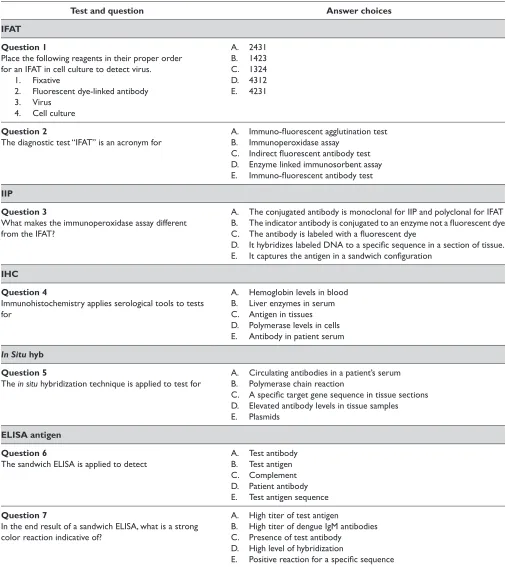
The MCQs on diagnostic techniques (Table 2) were designed according to JCU guidelines for MCQs (10) and
consisted of a lead-in question and five options (choices),
one of which was the correct answer. The questions were
classified according to Bloom’s revised taxonomy table,
which assumes a loose cumulative hierarchical progression from simple to complex concepts, with the higher concepts being valued in tertiary education (12). One question tested Recall of Factual Knowledge, another Analysis of Conceptual Knowledge, and the rest were all in the Procedural Knowl-edge category at the three highest levels: Analyze, Evaluate, and Create (Table 3).
Before the undergraduate students were tested, the MCQs were evaluated for suitability and clarity by four
staff members teaching the diagnostic test module and five postgraduate students. During the first lecture, the class completed the first run of MCQs to determine the baseline
knowledge for individual students before the module. The second run of MCQs was completed after the lectures and before the laboratory classes and tutorials, and the third run was completed at the end of the module. The three runs of MCQs contained the same questions but in a different TABLE 1.
Existing activities (lectures and laboratory classes, shaded) and additional activities after curriculum refresh (card game, tutorial, ques-tionnaire/feedback, and multiple-choice questions), categorized according to Bloom’s revised taxonomy.
The Cognitive Process Dimension The Knowledge Dimension Remember
1. Understand2. Apply3. Analyze4. Evaluate5. Create6.
A. Factual knowledge MCQ Lectures
B. Conceptual knowledge MCQ test configurationCard game on
C. Procedural knowledge Laboratory classes MCQ MCQ
New laboratory tutorial
MCQ
D. Metacognitive knowledge Questionnaire/ feedback
[image:3.612.50.560.97.262.2]TABLE 2.
Multiple-choice questions used in this study to assess student knowledge, categorized according to Bloom’s revised taxonomy.
Student name:
Immuno assays can be used to diagnose infectious diseases. The following questions are all in the topic of immuno assays. Please choose an answer from the options to the right that you feel best answers the question to the left.
Test and question Answer choices
IFAT Question 1
Place the following reagents in their proper order for an IFAT in cell culture to detect virus.
1. Fixative
2. Fluorescent dye-linked antibody 3. Virus
4. Cell culture
A. 2431 B. 1423 C. 1324 D. 4312 E. 4231
Question 2
The diagnostic test “IFAT” is an acronym for
A. Immuno-fluorescent agglutination test B. Immunoperoxidase assay
C. Indirect fluorescent antibody test D. Enzyme linked immunosorbent assay E. Immuno-fluorescent antibody test
IIP
Question 3
What makes the immunoperoxidase assay different from the IFAT?
A. The conjugated antibody is monoclonal for IIP and polyclonal for IFAT B. The indicator antibody is conjugated to an enzyme not a fluorescent dye C. The antibody is labeled with a fluorescent dye
D. It hybridizes labeled DNA to a specific sequence in a section of tissue. E. It captures the antigen in a sandwich configuration
IHC Question 4
Immunohistochemistry applies serological tools to tests for
A. Hemoglobin levels in blood B. Liver enzymes in serum C. Antigen in tissues D. Polymerase levels in cells E. Antibody in patient serum
In Situ hyb
Question 5
The in situ hybridization technique is applied to test for A. Circulating antibodies in a patient’s serum B. Polymerase chain reaction C. A specific target gene sequence in tissue sections D. Elevated antibody levels in tissue samples E. Plasmids
ELISA antigen Question 6
The sandwich ELISA is applied to detect A. Test antibodyB. Test antigen C. Complement D. Patient antibody E. Test antigen sequence
Question 7
In the end result of a sandwich ELISA, what is a strong color reaction indicative of?
A. High titer of test antigen
B. High titer of dengue IgM antibodies C. Presence of test antibody
D. High level of hybridization
[image:4.612.52.558.130.697.2]order. Twenty-five students in a class of 26 completed all
three MCQs and were included in the analysis described here. They were not informed of scores between runs. The response data were normally distributed and were therefore not transformed.
Questionnaire
On completion of the module, the students filled out
an anonymous questionnaire regarding their perception of the value of different teaching and learning activi ties (Ap-pendix 1). The questionnaire covered all components of the three units in the module: lectures, laboratory classes, and tutorials. Initially students were asked which components they attended; they were then asked to evaluate the
com-ponents on a Likert-like scale of one to five, where 1 = “not
useful at all” and 5 = “very useful.” Only those components where students had registered attendance were included in the analysis, and these ranged from 19 to 26 students for the different activities. The two-way ANOVA procedure was used to test whether the means of the perceived value of the three teaching modes, namely lectures, laboratory TABLE 2.
Continued
Test and question Answer choices
ELISA antibody IgG Question 8
Place the following reagents in their proper order for the indirect ELISA
1. enzyme-linked antibody 2. known antigen 3. patient serum 4. chromogen
A. 2413 B. 3214 C. 1432 D. 4132 E. 2314
Question 9
In the indirect ELISA the enzyme-linked antibody will attach to
A. Test antibody
B. The variable region of the patient antibody C. The constant region of the patient antibody D. The wall of the microtiter well
E. Patient antigen
ELISA antibody IgM
Question 10
The doctor submits a sample from a patient with suspicion of dengue. Your IgG ELISA results are negative, but IgM levels are high in your antibody ELISA. What is the most likely diagnosis of this patient?
A. The patient does not have dengue B. The patient is immune to dengue
C. The patient has had dengue in the past, but is now over it D. The patient is in the early stages of dengue
Question 11
In the indirect ELISA the development of strong color is indicative of
A. High titer of dengue B. Presence of test antigen C. High level of hybridization D. High titer of test antibody
E. Positive reaction for a specific sequence
IFAT = Immunofluorescence antibody test; IIP = indirect immunoperoxidase test; DNA = deoxyribonucleic acid; IHC = immuno-histochemistry; ELISA = enzyme-linked immunosorbent assay; IgM = immunoglobulin M; IgG = immunoglobulin G.
TABLE 3.
Individual multiple-choice questions categorized according to Bloom’s revised taxonomy matrix in Table 1. Multiple-Choice
Question Bloom’s Revised Taxonomy Category
1 Procedural – Create C6
2 Factual – Remember A1
3 Conceptual – Analyze B4
4 Procedural – Analyze C4
5 Procedural – Analyze C4
6 Procedural – Analyze C4
7 Procedural – Evaluate C5
8 Procedural – Create C6
9 Procedural – Analyze C4
10 Procedural – Evaluate C5
[image:5.612.53.560.86.416.2] [image:5.612.53.295.504.734.2]classes, and tutorials, were significantly different. The data
were analyzed using SPSS (ANOVA) and graphed for the individual components and the three units. Eight students took the opportunity to add comments anonymously.
Statistical analyses
Class progress as individual scores was analyzed over time as a one way ANOVA to test the hypothesis of there being no difference between the effect of both stimuli (i.e., tutorials and laboratory classes following the lectures) on students’ scores as a measure of effective learning. The categorical shift in students’ performance was measured by
χ2, with the pre-intervention scores used as the expected
values. Teaching components were completely confounded within the modes of teaching (i.e., lectures, tutorials, laboratory classes). Therefore, a generalized linear model (GLM) with teaching components nested within modes of teaching was analyzed. To separate out the impact of the various components, student assessment of the usefulness of activity modules was analyzed as a two-way ANOVA with students as a second factor. An ordered logit model is the most appropriate model for this student assessment data, but missing and low 1 and 2 responses from students led
to lowered sensitivity of this model. Therefore, qualified ANOVAs were used as a guide for trends, but significance
levels should be viewed with caution. Individual teaching components as assessed by the students were analyzed as
a one-way ANOVA. A least significant differences (LSD) post-hoc test was used to separate significant groups across all analyses. Multiple-choice question scores in the final run
were ranked in order to identify knowledge that was hard to assimilate. All analyses were conducted in IBM Statistical Package for the Social Sciences (SPSS) version 20.
Focus group
Five students volunteered for a focus group to discuss their experiences in an unstructured way without a mod-erator. The lecturer was an observer only and transcribed the main points arising during the discussion. These were
read back to the focus group for clarification and approval.
The students were aware that anonymity could not be assured, since the lecturer was present during the focus group meeting.
RESULTS
Multiple-choice questions
The class’s MCQ score improved from 46% before the module to 67% after the lectures and 73% after the labo-ratory classes and tutorials. The difference between runs
was significant (F = 11.0, df = 2,72, p < 0.0001) between
first and second runs but not between the second and third
runs (p > 0.05). Individual students regressed down two
marks between testing, but the class did improve overall
between the first and third run, with an average of three
points (out of 11 possible), ranging from negative one to plus seven. Some of the students consistently presented
incorrect answers to specific questions, and the final
score for each question was used to rank the questions
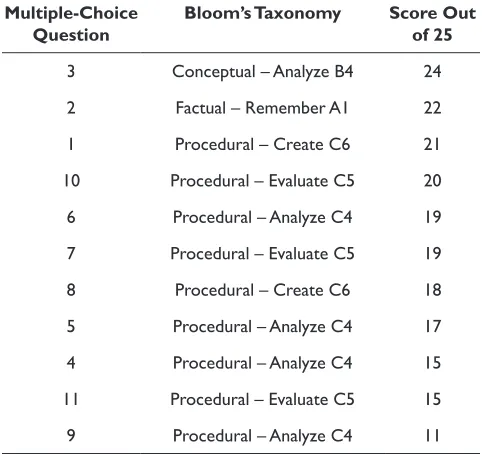
according to difficulty (Table 4), with question 3 being the least difficult (24/25 correct) and question 9 the most
troublesome (11/25).
Questions 2 and 3 were classified as simpler concepts
in the category of factual and conceptual knowledge as opposed to the more complex concepts covered in pro-cedural knowledge. Apart from question 2, the cognitive process dimensions ranged from four to six. Questions 9 and 11 both addressed the topic of a test called indirect enzyme-linked immunosorbent assay (ELISA).
An equal percentage of students (34%) failed the module in both years. The class improved by 6% from 57%
to 63% in the students’ final exam compared with before
the curriculum refresh, which was significant (χ2 = 26,
df = 4, p < 0.001). However, the cohort with the new curriculum produced more students with grades in the upper quartile (48%) relative to the previous year (19%) (Fig. 1).
Questionnaire
The average Likert-like scores for the various activi-ties ranged between 3.5 and 4.1 out of 5 possible points. Average Likert-like scores should not be considered as mathematical averages but more as a gross indication of where the aggregated student responses clustered.
TABLE 4.
Multiple-choice questions ranked according to class score in the final run.
Multiple-Choice
Question Bloom’s Taxonomy Score Out of 25
3 Conceptual – Analyze B4 24
2 Factual – Remember A1 22
1 Procedural – Create C6 21
10 Procedural – Evaluate C5 20
6 Procedural – Analyze C4 19
7 Procedural – Evaluate C5 19
8 Procedural – Create C6 18
5 Procedural – Analyze C4 17
4 Procedural – Analyze C4 15
11 Procedural – Evaluate C5 15
[image:6.612.316.557.505.732.2]The qualified two-way ANOVA showed that there was a significant statistical difference (F = 3.67, df = 2,186, p <
0.05) between students’ assessments of the three units in the module, with lectures and laboratory classes being
statistically equivalent, whilst tutorials were significantly less useful. However, there was a significant student effect
(F = 5.5, df = 25,186, p < 0.0001) and a significant
student-by-assessment interaction (F = 1.46, df = 50,186, p < 0.05), showing that some students perform better in alternative learning environments.
The GLM demonstrated that both teaching mode (χ2 = 6.3, df = 2, p < 0.05) and the teaching component
(χ2 = 23.5, df = 8, p < 0.01) were significant. The activities
that the students rated lowly were the card game (2.9) and the lecture and tutorial notes (3.5), which they rated
significantly (p < 0.05) less useful than staff in the
labora-tory classes (4.0) and doing the laboralabora-tory exercises (4.0) (Table 5).
The graphing of the results in a 100% stacked bar graph showed that the spread of opinion in the group was skewed towards the higher scores, generally indicating favorable opinion (Fig. 2).
Anonymous comments from the questionnaire
The questionnaire included an option for anonymous unstructured feedback, and 8/26 students took the oppor-tunity to express their thoughts. Most comments referred to the new components in the module, either the game, new laboratory tutorial, or guest lecture. The critical comments referred to the game, and one student expressed how he/
she did not find it valuable for learning.
• While activities like the “game” may have been fun in a different setting, I found them time consuming and they didn’t help my understanding at all.
Another student complained that the size of the icons on the cards was too small to see easily, and one student asked for more examples of diagnostic tests. Two students asked for more details written on the online lecture notes. Some students were supportive of the new approach
and made comments specifically regarding the tutorial, game,
and guest lecture. One student even suggested applying the game approach to other topics:
• How about using the “game” approach on the topic of “viral replication” of different viruses?
• The tutorials were the best part, in terms of learning. They put it all together.
• An effective approach for teaching complex topics. • Constructing tests was very helpful, as it made me
re-member what we did in lectures. Tutorials overall were very good.
• Overall it was interesting to know about viruses and the diagnostic methods used in laboratories.
• Guest lecture was great at making it all relevant to the real world.
TABLE 5.
Student ranking of the different learning activities in terms of perceived value.
Activity Max Score of 5
Guest lecture 4.1
Laboratory exercise 4.0
Laboratory staff 4.0
Tutorial staff 3.9
Tutorial – New lab 3.9
Lecture notes 3.9
Diagnostic test lectures 3.8
Laboratory report 3.7
Tutorial notes 3.5
Laboratory notes 3.5
[image:7.612.54.289.302.403.2]Card game 2.9
[image:7.612.52.293.513.731.2]FIGURE 1. Interquartile range of student final exam grades before (grey) and after (black) curriculum refresh. Quartile 1 = 0 to < 25%, quartile 2 = 25 to < 50%, quartile 3 = 50 to < 75%, and quartile 4 = 75 to 100%.
Feedback from the focus group
Five students volunteered to participate in the focus group discussions at the end of the module. Some of the is-sues that came up were a great appreciation for the technical staff involved in the laboratory classes, both in terms of their prior work in preparing for the class and their willingness to help individual students. The students in the focus group liked the hands-on approach in the laboratory classes, game, and tutorial and felt they made a difference to understanding the theoretical concepts taught in lectures. They expressed a particular liking for the game of constructing laboratory tests and enquired about the possibility of having a com-puter game to practice these skills. The necessity of trying examples of different tests in laboratory classes was also voiced, and this brought back the possibility of using a virtual space for trying out different tests rather than using time and resources in real life. All agreed that the guest lecturer was a hit and they appreciated her coming to university to talk to them. It made them feel valued as future employees and also brought home to them the imminent reality of having to work in a diagnostic laboratory.
The students in the focus group were positive toward new types of learning and were appreciative of both per-sonal interaction with the teaching staff and computer-based learning.
DISCUSSION
The curriculum refresh was designed with consideration for current educational theories for improved learning. The new curriculum did not assist the weaker portion of the class, whereas the pass-grade students improved their
grades significantly. The student feedback and suggestions
provided new angles of approach to overcome learning
hurdles in this field.
The on-course assessment in the form of MCQs showed an increase in knowledge and understanding in the class resulting from the module, with lectures appearing to have
the biggest impact on learning. A comparison of final grades
for this module indicated that the changes to the curriculum had not facilitated learning for the group of students who struggled to pass the component. It did however appear to assist the students in the lower pass grades to progress to higher cognitive levels of operation in Bloom’s taxonomy of educational objectives and achieve higher grades. The stu-dent assessment of the different learning activities showed overall contentment with the curriculum, with individual exceptions. Anonymous feedback and the focus group com-ments provided valuable insight into the students’ percep-tions of the usefulness of the various activities and uncovered novel pathways for future directions in the curriculum.
According to Marton and Saljo (13, 14), students may approach learning in two different ways: either by surface learning, where they try to retain facts, or by deep learning, where they learn for the purpose of understanding. In this
module, it is necessary to encourage deep learning, so that students may retain the knowledge of the different com-ponents of the tests, as well as obtaining an understanding of how those components interact. The module applied consisted of a relatively passive part, the lectures, where the students had the opportunity to familiarize themselves with the topic and collect information. During the labora-tory classes they were able to get hands-on experience with the different techniques used to carry out the diagnostic tests. The theoretical and practical aspects were subse-quently combined in a more active component during the new laboratory tutorial and card game, which consisted of problem-solving within groups, a process that would have improved students’ conceptual analytical and reasoning skills, thereby enhancing deep learning (3, 24, 18).
Multiple-choice questions
One would expect a linear progression toward a higher score in the MCQs, which formed part of the on-course assessment during the diagnostic test module, and this was the case for the majority of students. The small regressive
fluctuations in the MCQ results for individual students may reflect uncertainty in the students’ knowledge and/or trying
to grapple with an old concept from a new angle with novel teaching and learning units. The nature of multiple-choice tests is that a student can answer correctly by chance, without being certain of the answer, which could also
ac-count for some of the fluctuations of individual students.
In addition, it is important to acknowledge that student motivation may oscillate over time due to extrinsic factors
or performance anxiety, which may influence both learning
and performance (3, 8).
To counteract previous selection habits or trends (i.e., always select the middle answer if in doubt), all the questions and answers were shifted around between tests. Addition-ally, students were not informed of their grades or correct answers from one test to the next, which made rote learning
of correct answers difficult. However, performance could still have been influenced positively by students directing specific attention to terminology or components of the
MCQs in other subsequent learning activities, thereby us-ing the MCQs as a learnus-ing tool (16). The 25 students who completed all three MCQs were included in the analysis, and any effect of the testing on the learning would therefore be a constant variable in the analysis of the effect of the different teaching components in the module.
It appears that the most significant increase in knowl
learning in this topic from basics to a higher level. Alterna-tively, it may be because the assessment strategy employed encouraged or challenged the students to interact with the material presented in lectures as suggested by Tomanek and Montplaisir (26) and Nguyen and McDaniel (16), rather than at the end of the module.
Achieving an equivalent increase in grades from a level of high comprehension is not as easy. Nevertheless, the active components of the laboratory classes and tutorials
did manage to influence the class scores considerably (67%
to 73%) and should therefore not be underestimated either. Introducing a new type of learning in third-year classes, namely the tutorial and the game, could also have led to some resistance in students, in part simply because it was new and they would now have to adopt to a different way of learning, but also because it required deep learning, which requires more effort than rote or surface learning.
As expected, the highest scores were achieved in the lower categories of questions on factual and conceptual knowledge. Amongst the questions on more complex proce-dural knowledge, questions 9, 11, and 4 received the lowest scores over the three tests, and their content is therefore
an indication of knowledge that was difficult to acquire.
For questions 9 and 11 the topic was the same, namely the indirect ELISA. Question 4 referred to the immuno-histochemistry (IHC) procedure, which combines several techniques. These particular concepts should therefore be covered more thoroughly in the lectures and revisited in the tutorials.
Final exams
The results of the final exams for the diagnostic test
module revealed that the grades for the cohort studying under the new curriculum had shifted toward higher grades for those students who passed the exam, with the majority of the grades in the upper quartile (75% to 100%), compared with the previous year, where the majority of students were in the third quartile (50% to 75%). An equal percentage of students still failed the module. These results indicate that the changes to the curriculum did not make any difference to the students struggling to grasp the troublesome knowledge, whereas it helped students already achieving passes to excel in the topic and reach a high level of knowledge and cognitive educational objectives. As such, the curriculum appears to improve the learning spaces for those students who score in the middle section of grades. Another approach would need to be considered to facilitate learning for students scoring below pass grades.
Anonymous questionnaires
To understand student perception of the new curricu-lum, we analyzed the answers to the anonymous question-naires on this matter. The replies were not uniform, and, in several cases, opinions were clearly divided. In order to
satisfy different needs for learning in a cohort, it is essential to offer opportunities for learning that do not necessarily appeal to the majority at all times (9). With this in mind, the
students’ comments are extremely valuable for reflection,
and not all critical comments should be regarded as
nega-tive, as they reflect the individual student’s experience and
preferred mode of learning (25). Even the harshest criticism of a certain approach does not automatically rule out its
effectiveness; other students may find the approach useful,
and it therefore serves a purpose in providing multiple learn-ing opportunities. Furthermore, learnlearn-ing in uncomfortable situations can be very effective (2), so even the perceived uncomfortable situation can be a good learning experi-ence. However, the reason for involving students in the research was precisely to get an insight into their learning experience, and this demands a very balanced approach to feedback comments—both the supportive and, especially, the critical ones.
Interestingly, students overall objected mostly to the components involving deep learning, although this was not true for all individuals. Student assessments were statisti-cally equivalent for the lectures and laboratory unit, which scored relatively highly, while the tutorial unit was found
to be significantly less useful on average. However, for the tutorial unit, there was a significant student effect and student-by-assessment interaction, which reflects the fact
that some students prefer alternative learning environments, such as hands-on challenges, whereas others do not care for these and would prefer to learn in the familiar and predict-able environment of lectures and laboratory classes. The game of designing tests with cards representing different reagents in the tutorial was well liked by some, while most disliked it. The decreased average score for this component should therefore be interpreted with caution. The range of
opinions in the class toward this component might reflect
the difference in their preferred mode of learning (9, 25). Some of those who liked it even asked for an online version
to practice on. Computer games are definitely the realm of
the younger generation and may appeal to them as a learning tool, because it is a sphere known to them.
Focus group
the graphics to cater to those students who either did
not make it to the lecture or had difficulties following
the verbal explanations. The laboratory sessions scored highly as well, but some of the students expressed a wish for more diagnostic test examples, which could be ac-commodated by demonstrations set up in the class for students to interact with during the incubation times of their current exercises.
This process of redesigning the module was aimed at making the subject more palatable to the students, not
only by delivering content, but also by reflecting on the
effectiveness of the delivery of the different activities. Despite efforts to include more complex categories in the module to encourage deep learning, the refreshed curriculum did not manage to cater to the 34% of
stu-dents who failed the module in the final exam. Clearly the
academic design of the new curriculum was not able to
fully take into account the learning difficulties associated
with the concepts of diagnostic tests. By soliciting student comments and feedback, several alternative avenues for learning were uncovered.
Overall the student feedback showed that they valued the teaching staff and the learning activities, and most did progress successfully past the liminal state into a deeper understanding of the concepts (15). This was evidenced in their problem-solving skills in the game, tutorial, and
final MCQ test. The student group that improved the
most from before the curriculum refresh to after it were those with low pass grades in the third quartile of
the cohort. This group of students obviously benefitted
from the novel activities introduced. The improvement of the class mean from 46% to 73% over the course of the module also shows alignment of the teaching and learning activities with the assessment.
Alternative perspectives emerging from the action research may facilitate an improvement of the learning in
this module for students who score low grades. Briefly, what we learned was: 1) To further flexibility in teaching
and learning, it would be useful to pursue the suggestion of an online program that would enable students to ma-neuver the different components of the diagnostic tests and get feedback on the appropriateness of their choices. From this they would gain a better insight into how the test functions, when it can be employed, and how to interpret the results. 2) The guest lecturer, which scored highest of all the components, should certainly remain, as it provided relevance to the students, enabling them to project their learning situation into a future job and milestone. 3) There is a need to rethink how to reach the weaker students in the class and get them above pass grades—34% is too many. 4) Students are still grappling with the concepts involved with indirect ELISA and IHC tests; this has to be addressed in the module. 5) More text alongside the graphics in lecture notes will cater to “reading and writing” learners. 6) There is the possibility of providing demonstrations for students to test in their own time in the laboratory classes.
Although the redesign of the module increased the cognitive objectives of education for a number of students, it failed to enable 34% of the cohort to pass. The redesign was inspired by published guidelines for teaching and learning, which were certainly effective, but the engagement of the action research process, where students are actively involved in research to improve the curriculum, provided suggestions for further alternative activities that had not been considered. These results emphasize the importance of taking into account the perceptions of the target group for academic education when redesigning curricula.
SUPPLEMENTAL MATERIALS
Appendix 1: Questionnaire used for student assess-ment of the different learning activities employed in this study
ACKNOWLEDGMENTS
We would like to thank the students who participated in the study, Emily Wright for technical assistance, and Jona-than Meddings for collecting the consent forms and coding the MCQs before statistical analysis. We also thank Nick Szorenyi-Reischl and Ed Errington for advice on study design.
The authors declare that there are no conflicts of interest.
REFERENCES
1. Anderson, L. W., and D. R. Krathwohl (ed.). 2001. A taxonomy for learning, teaching, and assessing: a revision of Bloom’s taxonomy of educational objectives. Longman, New York.
2. Berk, R. A. 2003. Professors are from Mars, students are from snickers: how to write and deliver humor in the classroom and in professional presentations. Stylus Publishing, LLC, Sterling, VA.
3. Biggs, J. 2003. Teaching for quality learning at university, 2nd edition (Society for Research into Higher Education). McGraw Hill and Open University Press, Berkshire, England. 4. Bowling, K. G., T. Klisch, S. Wang, and M. Beier. 2013.
Examining an online microbiology game as an effective tool for teaching the scientific process. J. Microbiol. Biol. Educ. 14:505.
5. Brockbank, A., and I. McGill. 2007. Facilitating reflective practice in higher education. Open University Press, Berkshire, England.
6. Brookfield, S. D. 1995. Becoming a critically reflective teacher. Jossey-Bass, San Francisco, CA.
7. Cavalieri, J. 2009. Veterinary student responses to learning activities that enhance confidence and ability in pig handling. J. Vet. Med. Educ. 36:39–49.
9. Dunn, R. 1990. Understanding the Dunn and Dunn learning styles model and the need for individual diagnosis and prescription. J. Read. Writ. Learn. Disabil. Internat. 6:223–247.
10. JCU guidelines for MCQ design. [Online.] http://www. cu.edu.au/learnandteach/public/groups/everyone/documents/ work-shop/jcu_086167.pdf.
11. Kapp, K. M. 2012. The gamification of learning and instruction: game-based methods and strategies for training and education. John Wiley & Sons, San Francisco, CA. 12. Krathwohl, D. R. 2002. A revision of Bloom’s Taxonomy:
an overview. Theory Practice 41(4):212–218.
13. Marton, F., and R. Saljo. 1976. On qualitative differences in learning – I: outcome and process. Brit. J. Educ. Psychol. 46:4–11.
14. Marton, F., and R. Saljo. 1976. On qualitative differences in learning – II: outcome as a function of the learner’s conception of the task. Brit. J. Educ. Psychol. 46:115–127.
15. Meyer, J. H. F., and R. Land. 2003. Threshold concepts and troublesome knowledge: linkages to ways of thinking and practising within the disciplines. In Rust, C. (ed.), Improving student learning: improving student learning theory and practice – ten years on. Oxford Centre for Staff and Learning Development, Oxford, UK.
16. Nguyen, K., and M. A. McDaniel. 2014. Using quizzing to assist student learning in the classroom: the good, the bad, and the ugly. Teach. Psychol. 42(1):87–92.
17. Offerdahl, E. G., and L. Montplaisir. 2013. Student-generated reading questions: diagnosing student thinking with diverse formative assessments. Biochem. Molecul. Biol. Educ. 42(1):29–38.
18. Peteroy-Kelly, M. A. 2007. A discussion group program enhances the conceptual reasoning skills of students enrolled in a large lecture-format introductory biology course. J. Microbiol. Biol. Educ. 8:13–21.
19. Pintrich, P. R. 2002. The role of metacognitive knowledge in learning, teaching, and assessing. Theory Practice 41(4):219–225. 20. Roediger, H. L., P. K. Agarwal, M. A. McDaniel,
and K. B. McDermott. 2011. Test-enhanced learning in the classroom: long-term improvements from quizzing. J. Experiment. Psychol. Applied 17:382–395.
21. Roshier, A. L., N. Foster, and M. A. Jones. 2011. Veterinary students’ usage and perception of video teaching resources. BMC Medical Educ. 11:1.
22. Rowe, J. W. K. 2002. First year engineering students’ approaches to study. Intl. J. Elec. Eng. Educ. 39(3):201–209. 23. Sander, P. How should we research our students – part
one. The Higher Education Academy. [Online.] www. heacademy.ac.uk/assets/Documents/resources/database/ id496_research_our_students_part1_sander.pdf.
24. Savin-Baden, M. 2003. Facilitating problem-based learning. The Society for Research into Higher Education & Open University Press, Berkshire, England.
25. Tanner, K., and D. Allen. 2004. Approaches to biology teaching and learning: learning styles and the problem of instructional selection—engaging all students in science courses. Cell Biol. Educ. 3:197–201.
26. Tomanek, D., and L. Montplaisir. 2004. Students’ studying and approaches to learning in introductory biology. Cell Biol. Educ. 3:253–262.