Benchmarking for technology enhanced learning: taking
the next step in the journey
Michael Sankey
Director, Learning Environments and Media University of Southern Queensland
Benchmarking in the areas of technology enhanced learning (TEL) has become an important part of how many institutions are able to mediate a level of quality in their learning and teaching practice. Many tools and methodologies have emerged over the last 10+ years to help our institutions undertake this important task. A recent major benchmarking activity (June 2014) took this to a whole new level; with 24 institutions meeting together to benchmark their capacity in TEL. This was based around using the newly refreshed ACODE Benchmarks and involved each institution performing a self-assessment of their practices and then sharing this with the other participants. This paper will report on this activity and, importantly, provide evidence of the value of this activity for those involved. It will conclude with a series of recommendations on how this may be applied by other institutions, as they contend with the rapidly changing TEL space.
Keywords: benchmarking, technology enhanced learning, quality indicators, improvement
Setting the scene
Benchmarking in the areas of technology enhanced learning (TEL) has become an important part of how many institutions are able to mediate a level of quality in their practices. This has become increasingly important with the advent of government quality agencies, such as TEQSA and NZQA, that are now starting to take a keen interest in how institutions can provide a level of equivalence in the quality of their online courses, as compared to their face-to-face offering (TEQSA, 2013). Further, Freeman (2014) states that, ‘TEQSA will explicitly require evidence of active benchmarking (and) formalised benchmarking relationships’ (p. 76).
Aligning with this, a number of tools and methodologies have emerged over the last 10+ years to help institutions undertake this important task. These tools typically look at either the institutional-wide processes sitting around governance processes and support mechanisms. Also, they look at the processes established for individual courses (subjects/units) of study, to ensure alignment with things like learning outcomes and the attainment of skills. This paper is more concerned with the former and by way of example provides the following list (not definitive) of notable institution-wide quality improvement tools for e-learning.
• The Australasian Council on Online, Distance and e-Learning (ACODE) Benchmarks for e-learning (2007) have been used by institutions to collaboratively benchmark their capacity in e-learning.
o There are eight benchmarks used to ensure appropriate linkages between general learning and teaching, IT and with staff and student development practices. Each Benchmark contains a series of criterion-based Performance Indicators (PIs) using a 1-5 scale. ACODE recommend a two-phased approach to benchmarking, firstly by using the tool to conduct an internal audit, then using this audit to undertake an inter-institutional activity.
• The E-Learning Maturity Model (eMM), based on the methodology of the Capability Maturity Model and SPICE (Software Process Improvement and Capability Determination).
o This provides institutions with a way to assess and compare their capability to sustainably develop, deploy and support e-learning (Marshall, 2008). Unlike the ACODE model, the eMM measures the progressive levels of an institutions capability from five discreet perspectives: Delivery, planning, definition, management and optimisation, and as an organisation develops its capability in each of these dimensions they are seen as being more ‘capable’ in these areas.
• The more recent E-xcellence model, released by the EADTU (European Association of Distance Teaching Universities).
These are just three examples, however, a simple search of Wikipedia using the term ‘Benchmarking e-learning’ reveals many other tools that exist under this mantle; far too many for this paper to rehearse. Suffice to say, the issues being faced within Australasian universities, particularly as they relate to the area of quality in the online space, are highlighted very succinctly by Freeman (2014) when she writes:
Few university policy cycles include the value-adding stages of monitoring, evaluation and benchmarking. This suggests that many Australian universities [and by implication New Zealand universities] will face challenges meeting the Australian tertiary sector regulators’ requirements regarding evidence of implementation of policy, and improvement of policy over time. (p. 84)
Bearing the above in mind, in mid-2013 it was identified by ACODE that their Benchmarks were in need of updating, as the then current suite had been in place since 2007. This was well before the advent of ubiquitous mobile delivery, the wide spread use of social media, cloud-based systems and the more recent phenomenon of MOOCs. As this was a major undertaking, a robust process was established for both the updating and trialing of any changes proposed to the benchmarks. This paper reports briefly on this activity and importantly, provides evidence of the value of this activity for those involved.
Refreshing the ACODE Benchmarks
The ACODE benchmarks were originally developed as part of an ACODE funded project initiated in 2004 (Bridgland & Goodacre, 2005). They were developed collaboratively by a group of ACODE nominees from Monash University, Royal Melbourne Institute of Technology (RMIT), Melbourne University, University of Queensland (UQ), University of Southern Queensland (USQ), University of Tasmania (UTas) and Victoria University (VU). They were subsequently piloted by these universities and were independently reviewed by Paul Bacsich (2006), an independent benchmarking consultant. The Benchmarks were then revised in 2007, again by a group of ACODE nominees led by Christine Goodacre, who subsequently facilitated five interactive workshops in Brisbane, Sydney, Melbourne, Adelaide and Perth to promote the use of the newly revised tool.
The purpose of the benchmarks has been to support continuous quality improvement in e-learning, now reframed as TEL (ACODE, 2014). The approach reflects an enterprise perspective, integrating the key issue of pedagogy with institutional dimensions, such as planning, staff development and infrastructure provision. They have been developed for use at either an enterprise level, or by an organisational unit, and may be used for self-assessment, or as part of a broader collaborative benchmarking activity. Since 2007, the Benchmarks have been used by a number of institutions (not an exhaustive list), more notably by:
• the Innovative Research Universities of Australia network in 2008, involving; Flinders University, Griffith University, La Trobe University, Macquarie University, Murdoch University and The University of Newcastle (using Benchmarks 1 and 5);
• two joint activities in 2008, the first between the University of Southern Queensland and Deakin University (using all eight Benchmarks), and the second between University of Southern Queensland and Central Queensland University (using two benchmarks); and
• more recently (2011) six universities (University of Southern Queensland, University of New England, Central Queensland University, Charles Sturt University, Massey University, and the Sultan Idris Education University of Malaysia) joined in a major inter-institutional activity held in Toowoomba.
The major review of the ACODE Benchmarks began in early 2014 with the mandate to ensure they were both current and forward-looking. A team of six ACODE nominees (from USQ, Macquarie, Victoria University Wellington, QUT, Wollongong, and UWS) worked to develop the new Benchmarks. The project also developed a robust methodology for running a self-assessment activity, a new step-by-step guide on how to use them, editable self-assessment templates and a new consolidation table. A methodology for running an inter-institutional activity was also developed to help facilitate institutions formally coming together to share their institutional practices within technology enhanced learning.
The reframing of the ACODE Benchmarks to focus on TEL was done with a clear understanding that the boundaries around e-Learning have become increasingly blurred, to the point where it is now hard to imagine, in today’s higher education sector, how learning could actually occur without the affordances offered by
rely solely on learning management systems, but many have now developed complex mash-ups of internally and externally hosted environments to feed an increasing business demand for flexibility and constant availability.
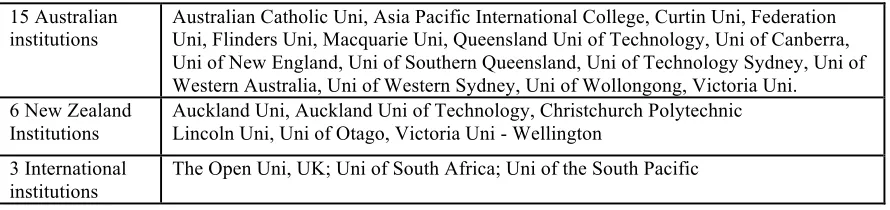
[image:3.595.77.522.207.312.2]In recognition of the importance of this new suite of Benchmarks, ACODE facilitated a major Benchmarking Summit at Macquarie University in Sydney between 1-3 June 2014. The Summit had four major sponsors, the University of Southern Queensland, Macquarie University, The Australian Office for Learning and Teaching (OLT) and Ako Aotearoa (the New Zealand National Office for Tertiary Teaching Excellence). This was an unprecedented event within the Australasian higher education sector, with 24 institutions (see Table 1) from five different countries coming together to Benchmark their capacity in TEL.
Table 1: Institutions involved in the ACODE Inter-Institutional Benchmarking Summit
15 Australian institutions
Australian Catholic Uni, Asia Pacific International College, Curtin Uni, Federation Uni, Flinders Uni, Macquarie Uni, Queensland Uni of Technology, Uni of Canberra, Uni of New England, Uni of Southern Queensland, Uni of Technology Sydney, Uni of Western Australia, Uni of Western Sydney, Uni of Wollongong, Victoria Uni. 6 New Zealand
Institutions
Auckland Uni, Auckland Uni of Technology, Christchurch Polytechnic Lincoln Uni, Uni of Otago, Victoria Uni - Wellington
3 International institutions
The Open Uni, UK; Uni of South Africa; Uni of the South Pacific
To participate in the event, each institution had to first undertake a self-assessment of their capacity in TEL against the PIs in the Benchmarks, and then be willing to share that self-assessment with the other institutions involved. As part of their commitment, each institution had to participate in a minimum of two of the
benchmarks, with some institutions doing three, four or five, and one institution doing all eight. In the week prior to the Summit each institution submitted their self-assessments to the website. These pages were then shared during the respective benchmarking session. During these sessions, each institution took it in turns to briefly describe how they came to give themselves their particular rating. This, in many cases, generated quite lively discussion. But more importantly, each institution was then able to make a judgement on the veracity of their self-assessment. Here in lies the essence of the Benchmarking activity; having the opportunity to engage in broad ranging discussion around the PIs allows participants to form clear judgements as to the context of their own institutions practice, thereby allowing them to make qualitative determinations as to the validity of their self-assessment.
Benchmarking Summit Evaluation
Of the 38 participants at the Summit, 35 completed the online evaluation containing some 30 questions. These data were analysed for frequency of response and a thematic analysis of the qualitative data was performed.
An extremely pleasing 89% of participants agreed that the way the new PIs had been framed within the new Benchmarks made what was required clear and unambiguous. A majority of participants (69%) also felt that the benchmarks covered sufficient ground, with only 2 participants expressing some room for expansion. This was extended further when participants were asked if the benchmarks went far enough, with 91% believing they did. Similarly, 91% of the participant had found the activity personally very rewarding. One could suggest this was partly due to the fact that 91% had also found that what the other institutions had to share particularly
informative. Here in lies the heart and the beauty of this type of activity.
Further, 94% of the participants agreed that they were the right people to be involved in this type of activity on behalf of their institution. However, 51% felt that there were others within their institution who could/should have also been involved in this activity. Having said that, there was also a clear indication that the
Benchmarking activity was targeted at the right types of people (80%), and that 94% clearly felt that they had the capacity to make the right types of judgment on behalf of their institution. Interestingly, 100% of
participants agreed that the Benchmarking Activity had given their institution plenty of room for thought and then, of these, 79% agreed that this would provide an impetus for change within their institution.
the benchmarks had prompted some 89% of participants to consider some strategic change that could be implemented, and that participants clearly wanted to engage with this tool again with (89%) agreeing that there is a real place for the Benchmarks within the suite of quality enhancement tools used by their institution.
From the open-ended questions, when participants were asked how they would have done things differently in the inter-institutional activity, their comments broadly fell into six main categories. Their advice is listed.
1. Extend the activity to three days to give sufficient time for small group work and more discussions, so the PIs can be dealt with in more depth.
2. Analyse more of the data before hand for theming purposes.
3. Have the opportunity to share more evidence around the PIs and provide some examples of what the different levels may look like.
4. Do the benchmarks in order.
5. Broaden internal self-assessment groups to get more robust internal data. 6. Generally very satisfied with how it was handled.
When participants were provided with an opportunity to make further comments that would potentially help make the Benchmarks, or the supporting documentation, more user-friendly, or to identify things they felt might be missing. These comments fell into five main categories as listed.
1. ACODE should look to develop a series of web-based forms for the self-assessment and consolidation documents, potentially linking this with a collaboration space in the future.
2. Develop some good practice examples to help participants as they come to self-assess. 3. Provide more details around the PIs in the Session Notes document.
4. Further reduce some of the repetition within the PIs.
5. Include more terms in the Glossary and further simplify some of the language used in the document.
Finally, participants were provided with an opportunity to make unguided (open) comments. Overwhelmingly these comments were of a very complimentary nature, congratulating ACODE on the work that went into refreshing the benchmarks and for facilitating the Inter-Institutional Summit. The following two comments in particular exemplified the overall sentiment expressed in the responses:
Great opportunity to meet and share where everyone is at. The benchmarking exercise is a great self reflective practice that is reinforced through the feedback and deliberation from other institutions.
I really enjoyed this Benchmarking Summit, I have learned a lot from the inter-institutional activity and will definitely be sharing and pushing for these benchmarks to be accepted at our institution. Thank you for facilitating this and look forward to the institution following up with the benchmarks in the future.
Conclusion
Many of the issues we face in our institutions can be remediated by simply taking the time to self-assess against a set of quality indicators, like those found in the ACODE Benchmarks for TEL. However, when we then look to further extend that self-reflection, by sharing our current practice with those in similar circumstances, this provides the impetus for a truly dynamic learning activity. This will become increasingly important as our regulatory bodies start to develop their formal measures for ensuring institutions are meeting their obligations to their students in relation to technology enhanced learning. An activity, like the one that was recently
experienced in the Inter-institutional Benchmarking Summit, has provided the opportunity for many of the institutions involved to build relationships and stronger ties (not competing) with their colleagues. In the broader context it has also provided these institutions with some of the wherewithal to meet the unique challenges of building a strong digital future. The ACODE Benchmarks for TEL have provided a catalyst to help make this happen for those who will take the time and subsequently benefited from the experience.
References
ACODE. (2014). Benchmarks for Technology Enhanced Learning. Retrieved from: http://www.acode.edu.au/mod/resource/view.php?id=216
Bacsich, P. (2006). Benchmarking e-learning in HEIs – the Pick & Mix approach: Second Update (13 April 2006) – Release 1.2, April 2006. Retrieved from
http://elearning.heacademy.ac.uk/weblogs/benchmarking/wp-content/uploads/2006/09/bacsich-report-public20060901.doc
Bridgland A. & Goodacre, C. (2005). Benchmarking in higher education: A framework for benchmarking for quality improvement purposes. In Proceedings of EDUCAUSE in Australasia 2005, Auckland, New Zealand. Retrieved from: http://repository.unimelb.edu.au/10187/1106
Britain, S. & Liber, O. (1999) A Framework for the Pedagogical Evaluation of Virtual Learning Environments’.
JISC Report. Retrieved from: http://www.jisc.ac.uk/uploaded_documents/jtap-041.doc
Freeman, B., (2014): Benchmarking Australian and New Zealand university meta-policy in an increasingly regulated tertiary environment. Journal of Higher Education Policy and Management. 36(1), 74-87. Retrieved from: http://dx.doi.org/10.1080/1360080X.2013.861050 DOI: 10.1080/1360080X.2013.861050 Marshall, S. J. (2008). What are the key factors that lead to effective adoption and support of e-learning by
institutions? In Proceedings of HERDSA Conference 2008, Rotorua, New Zealand. Retrieved from: http://www.herdsa.org.au/wp-content/uploads/conference/2008/media/Marshall.pdf
TEQSA. (2013). TEQSA Information Sheet: eLearning and compliance with the Threshold Standards. Retrieved from: http://www.teqsa.gov.au/sites/default/files/TEQSAeLearningInformationSheet.pdf
Contact author: Michael Sankey, [email protected]
Please cite as: Sankey, M. (2014). Benchmarking for technology enhanced learning: taking the next step in the journey. In B. Hegarty, J. McDonald, & S.-K. Loke (Eds.), Rhetoric and Reality: Critical perspectives on
educational technology. Proceedings ascilite Dunedin 2014 (pp. 668-672).
Note: all published papers are refereed, having undergone a double-blind peer-review process.