LSIR-2
Logic and the Simulation of Interaction and Reasoning
Pasadena CA, U.S.A., 12 July 2009edited byBenedikt L¨owe
Programme Committee:
Jan Broersen (Utrecht, The Netherlands) Cristiano Castelfranchi (Rome, Italy) Frank Dignum (Utrecht, The Netherlands)
Anton Leuski (Marina del Rey CA, United States of America) Benedikt L¨owe (Amsterdam, The Netherlands)
Erik T. Mueller (Hawthorne NY, United States of America) Amitabha Mukherjee (Kanpur, India)
Mark Overmars (Utrecht, The Netherlands) Eric Pacuit (Stanford CA, United States of America) Rohit Parikh (New York NY, United States of America) David Traum (Marina del Rey CA, United States of America) Jos Uiterwijk (Maastricht, The Netherlands)
Hans van Ditmarsch (Otago, New Zealand & Aberdeen, Scotland)
Logic and the Simulation of Interaction and Reasoning: Logic, Computer Games, and Narrative
Benedikt L¨owe pp. 3–4
The Representational Challenges of Fictional Worlds
R. Michael Young pp. 5–7
Discovering symbols from interactions — easier than explaining interactions via symbols?
Amitabha Mukerjee pp. 9–11
Speech acts as announcements
Nadine Guiraud, Andreas Herzig, Emiliano Lorini pp. 13–17 From generic sentences to scripts
Lenhart Schubert pp. 19–23
On Basic Characteristics of Agent Types and their Influence on Rational Agent Interactions
Jan Broersen pp. 25–27
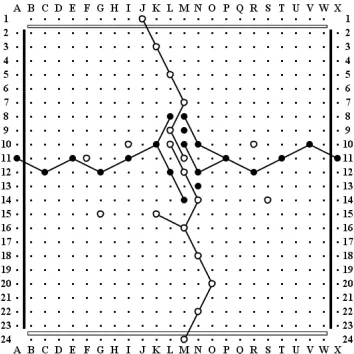
Mathematical Modelling in TwixT
Jos Uiterwijk, Kevin Moesker pp. 29–35
Emotions in Plot Generation
Rafael P´erez y P´erez pp. 37–39
Computing Quality of Life in a Social Management Game
Ethan Kennerly pp. 41–45
Thief Belief
Ethan Kennerly, Andreas Witzel, Jonathan Zvesper pp. 47–51 Logical Agents that Plan, Execute, and Monitor Communication
Martin Magnusson, David Land´en, Patrick Doherty pp. 53–58 Revisiting Choice Points in Branching Time Temporal Structures: Ontological Foundations of a Formal Theory of Time Travel
Logic and the Simulation of Interaction and Reasoning: Logic, Computer Games,
and Narrative
Benedikt L¨owe
Institute for Logic, Language and Computation, Universiteit van Amsterdam, Postbus 94242, 1090 GE Amsterdam, The Netherlands
Department Mathematik, Universit¨at Hamburg, Bundesstrasse 55, 20146 Hamburg, Germany Mathematisches Institut, Rheinische Friedrich-Wilhelms-Universit¨at Bonn,
Endenicher Allee 60, 53115 Bonn, Germany
Logic & Interaction
In recent years, logicians have become more and more inter-ested in the phenomenon of interaction. The research area Logic and Gamesdeals with the transition from the static logical paradigm of formal proof and derivation to the dy-namic world of intelligent interaction and its logical mod-els. Fruitful technical advances have led to deep insights into the nature of communicative interaction by logicians. This new direction of logic has quickly gained momentum and support. In 2006, a Marie Curie Research Training Site GLoRiClass (“Games in Logic Reaching Out for Classical Game Theory”) was opened in Amsterdam, providing grad-uate student training for a number of PhD students. In 2007, the European Science Foundation (ESF) has recognized this direction as one of the foremost research developments for the European science community and created a collaborative research platform called “LogICCC — Modelling intelligent interaction”. Finally, in December 2007, a new book series entitled “Texts in Logic and Games” was launched.
While these interactive aspects are relatively new to logi-cians, on a rather different level, modelling intelligent inter-action has been an aspect of the practical work of computer game designers for a long time. Pragmatic questions such as ‘What makes a storyline interesting’, ‘What makes an reac-tion natural’, and ‘What role do emoreac-tions play in game de-cisions’ have been tackled by practicing programmers. The practical aspects of computer gaming reach out to a wide in-terdisciplinary field including psychology and cognitive sci-ence. So far, there are only a few cross-links between these two communities.
LSIR-1 in Aberdeen (April 2008)
When the need for a venue to connect the research in logic and games with the more applied research on stories, games and simulation of behaviour was recognized, the mentioned research training site GLoRiClass decided to organize a workshopLogic and the Simulation of Interaction and Rea-soningat the AISB Convention in Aberdeen in April 2008 (for more on the motivation for this workshop, cf. (L¨owe
Copyright c2009, the author(s). All rights reserved.
In: Benedikt L¨owe (ed.), LSIR-2: Logic and the Simulation of Interaction and Reasoning, Pasadena CA, U.S.A., 12 July 2009. pp. 3–4.
2008)). The programme committee for this workshop con-sisted of Stefania Bandini, Johan van Benthem, Cristiano Castelfranchi, Bruce Edmonds, Jaap van den Herik, Wiebe van der Hoek, Benedikt L¨owe, Yoav Shoham, Keith Sten-ning, and Rineke Verbrugge. A number of research con-nections opened up during the workshop and discussions between researchers in the gaming industry and logicians created the opportunity for new ideas: LSIR-1 was consid-ered a success by the participants (the proceedings of the workshop are available as (Guerin, L¨owe, and Vasconcelos 2008)). The general sentiment of participants was that such a workshop should be repeated, possibly with more focus, enabling directed efforts for new research projects.
The Goals of LSIR-2
The successor of the Aberdeen workshop is now being held at IJCAI 2009, this time concretely focussing on the relation between modern techniques in logic (such as discourse rep-resentation theory or dynamic epistemic logic) and concrete modelling problems in computer games (either as part of the story or game design or as part of the design of the artificial agents).
As with LSIR-1, our workshop is sponsored by the Re-search Training Site GLoRiClass, allowing us to invite three speakers (Morgenstern, Schubert, and Young). Talks at LSIR-2 will describe either modelling techniques with po-tential applications to questions in computer game design or story design or to describe modelling problems that might be an area of application for techniques from logic. The work-shop layout allows ample time for informal discussions. The experience from Aberdeen shows that this time is used prop-erly and efficiently and will result in opening up research opportunities between the fields.
Programme Committee.
United States of America), Rohit Parikh (New York NY, United States of America), David Traum (Marina del Rey CA, United States of America), Jos Uiterwijk (Maastricht, The Netherlands), and Hans van Ditmarsch (Otago, New Zealand & Aberdeen, Scotland). We would like to thank the members of the PC for their effort and input.
Schedule
LSIR-2 will have ten presentations: three 45-minute invited presentations and seven contributed talks of 20 minutes. There were two more accepted presentations that had to be cancelled due to travel restrictions of the presenters. These were a paper entitled “Strategies made explicit in Dynamic Game Logic” by Sujata Ghosh (Groningen) and a paper by Jan Broersen (Utrecht). The latter paper is represented in this abstract volume.
09.05–09.15 Opening
09.15–10.00 R. Michael Young. The Representational Challenges of Fictional Worlds.
10.00–10.30 Coffee Break
10.30–10.50 Amitabha Mukerjee. Discovering symbols from interactions — easier than explaining interactions via symbols?
10.50–11.10 Nadine Guiraud, Andreas Herzig and Emil-iano Lorini.Speech acts as announcements.
11.10–11.30 Break
11.30–12.15 Lenhart Schubert. From generic sentences to scripts.
12.15–14.20 Lunch Break
14.40–15.00 Jos Uiterwijk and Kevin Moesker. Mathemat-ical Modelling in TwixT.
15.00–15.30 Coffee Break
15.30–15.50 Rafael P´erez y P´erez. Emotions in Plot Gen-eration.
15.50–16.10 Ethan Kennerly.Computing Quality of Life in a Social Management Game
16.10–16.30 Ethan Kennerly, Andreas Witzel and Jonathan Zvesper.Thief Belief
16.30–16.50 Break
16.50–17.10 Martin Magnusson, David Land´en and Patrick Doherty.Logical Agents that Plan, Execute, and Monitor Communication
17.10–17.55 Leora Morgenstern. Traveling Through Time and Logical AI: Toward a Formal Theory of Time Travel
References
Guerin, F.; L¨owe, B.; and Vasconcelos, W., eds. 2008. Proceedings of the AISB 2008 Symposium on Logic and the Simulation of Interaction and Reasoning, volume 9 ofAISB 2008 Convention, Communication, Interaction and Social Intelligence, 1st-4th April 2008, University of Aberdeen.
L¨owe, B. 2008. Logic and the simulation of interaction and reasoning: Introductory remarks. In Guerin, F.; L¨owe, B.; and Vasconcelos, W., eds.,Proceedings of the AISB 2008 Symposium on Logic and the Simulation of Interaction and Reasoning, volume 9 ofAISB 2008 Convention, Commu-nication, Interaction and Social Intelligence, 1st-4th April 2008, University of Aberdeen, iii–v.
The Representational Challenges of Fictional Worlds
R. Michael Young
Department of Computer Science, North Carolina State University, Raleigh, NC 27695-7534, United States of America
Introduction and Background
Modern computer games often have a strong narrative struc-ture to the progress of their gameplay. In some genres, story is at the forefront of the interaction. As game makers seek to add new capabilities for procedurally generated content to their new releases, work on interactive narrative is grow-ing in significance both as a basic research topic as well as a source for insight into the creation of content for games. As a result, there are now many compelling challenges for researchers working in AI that involve interactive computer games as their area of application. A significant different exists between application contexts familiar to most AI re-searchers and those found in games, however. Games are fictional worlds. Of course, we are all aware that games are fictional worlds. What is not so obvious is what this means to the relationship between a player and his or her game sys-tem and what consequences the relationship holds for the use of representations like logic and other formal computational approaches. Games are expected to be fictional in much the same way that other narrative media are. Their worlds share many properties in common with the real world, but their experience is specifically not realistic. Games are not sim-ulations, where system behaviors are required to be identi-cal to real world correlates. When a game player begins to play a game, he or she steps inside a magic circle (Huizinga 1955), effectively entering into a contract with the game? designers where players agree to suspend disbelief and play according to the rules and designers agree to manipulate the game world in ways that facilitate that effective play rather than recreate realistic interaction.
Understanding narrative in these game worlds, as in other media, involves the active construction and experience of an illusion (Gerrig 1993; Johnston and Thomas 1995). This construction process is particularly participatory in com-puter games, where players not only work to comprehend the story but take action throughout its unfolding to shape it in significant ways.
The distinction that I am drawing between simulations and game worlds points to interesting challenges for AI researchers in the representation and modeling of play-Copyright c2009, the author(s). All rights reserved.
In: Benedikt L¨owe (ed.), LSIR-2: Logic and the Simulation of Interaction and Reasoning, Pasadena CA, U.S.A., 12 July 2009. pp. 5–7.
ers?interactions with games. I describe two examples be-low, but essentially the larger class of challenges revolves around the requirement not to create a real world experi-ence in a game, but to create a fictional world whose expe-rience will prompt the same narrative comprehension pro-cesses that people use to understand other forms of narrative in conventional media (Graesser, Mills, and Zwaan 1997).
Levels of Narrative
When considering the structure of narrative, narrative theo-rists typical break a narrative down into two distinct levels: the story and the discourse (Chatman 1980). The story level contains the things within the story world itself ?the charac-ters and their mental state, the characcharac-ters actions, the objects and locations they interact with and within. The discourse contains those medium-specific elements used by the story teller to communication the story to the reader ?a novel? text, a film? camera shots and shot sequences, background music and lighting. This division is useful for approach-ing the design of narrative generation systems as it provides a direct and reasonable way of factoring the many prob-lems (Young 2007). The discussion below is divided into two parts, providing an example representational challenge from each level.
Two Representative Challenges
At the Story Level: Conflict
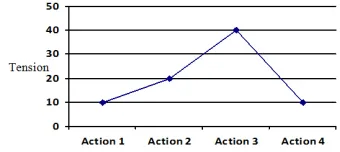
often to prevent their opponents from achieving theirs. Nar-rative conflict differs from real-world conflict, however, in a number of ways. For instance, narrative conflict is paced, so that conflict is interleaved in the story between periods of calm where other elements of the story can be advanced. Narrative conflict is balanced, so that protagonist and antag-onist are relatively equally matched in strength. As a result, interaction between the two doesn? result in one side over-whelming the other, thus ending the story prematurely. Nar-rative conflict is measured in order to create a story? rising action, that is, the tension that builds as the lead in to the story? major climax.
At the Discourse Level: The Dynamics of User
Beliefs
As in other forms of work focusing on the generation of dis-course (Moore and Paris 1993; Maybury 1992; Hovy 1989), the generation of narrative discourse has as its goal the cre-ation of a sequence of communiccre-ation actions that effec-tively manipulate the beliefs of a reader (or, in our case, a player). In typical existing AI approaches to discourse generation (often focusing on instructional text as a target genre), the content and organization of a discourse is se-lected in order to provide rhetorical structure that leads a reader to come to hold a certain set of beliefs. These beliefs are the central communicative goals of the discourse and, in some sense, the satisfaction of these goals is all that matters in the process of constructing the discourse.
In contrast, the beliefs that a reader or player holds about the story world at the end of a narrative are much less sig-nificant than in the case of instructional text generation. Rather, a storyteller (or a storytelling system) must give sig-nificant care to the creation of a discourse that manipulates the beliefs of the reader about the story world throughout the course of the unfolding story. In narrative discourse, information is intentionally withheld in order to create ef-fects like surprise and suspense (Ohler and Neiding 1996; Cheong and Young 2008). Information is presented out of order (e.g., flashbacks or foreshadowing) in order to drive expectations and build anticipation. Structures in narrative discourse follow specific, genre- and medium-specific con-ventions or idioms (Jhala and Young 2006) that license cer-tain types of inferences in much the same way that indirect speech acts license inferences in conversational discourse. A narrative discourse may intentionally prompt inferences at one point in the story that are in direct contradiction with prompted inferences at other points in the story. In many ways, it is the trajectory of the beliefs of a story? reader that matters in narrative rather than his or her beliefs about the story at its end.
Discussion
In the discussion above, I briefly describe two represen-tational challenges for interactive narrative within game worlds. Both these challenges arise from the particular fic-tional nature of game worlds themselves and the important difference between real-world and narrative models. These two areas are provide a significant number of open research
question, but they are not the only areas where progress on fictional representation is needed. Fortunately, there are many familiar logical tools that can be brought to bear on these issues. Epistemic logics, dynamic logics, logics of action and change and other computational models with well-understood semantics address aspects of these prob-lems. Just as planning algorithms provide significant, well-founded models for the generation of casual and temporal structures in stories, so these logical tools come with ob-vious first steps towards application in narrative contexts. Whatever points are chosen for advance in this area, how-ever, the significantly distinct nature of narrative and fic-tional worlds must play a central and consistent role.
References
Cavazza, M.; Charles, F.; and Mead, S. J. 2002. Planning characters’ behaviour in interactive storytelling.The Jour-nal of Visualization and Computer Animation13:121–131. Chatman, S. 1980.Story and Discourse: Narrative Struc-ture in Fiction and Film. Cornell University Press. Cheong, Y., and Young, R. M. 2008. Narrative generation for suspense: Modeling and evaluation. InProceedings of the International Conference on Interactive Digital Story-telling.
Gerrig, R. 1993. Experiencing Narrative Worlds: On the Psychological Activities of Reading. Yale University Press. Graesser, A.; Mills, K. K.; and Zwaan, R. A. 1997. Dis-course comprehension.Annual Review of Psychology48. Hovy, E. 1989. Approaches to the planning of coherent text. In Paris, C.; Swartout, B.; and Mann, W., eds.,Natural Language Generation in Artificial Intelligence and Compu-tational Linguistics.
Huizinga, J. 1955. Homo Ludens: A Study of the Play-Element in Culture. Beacon Press.
Jhala, A., and Young, R. M. 2006. Representational re-quirements for a plan based approach to automated camera control. InSecond Conference on Artificial Intelligence and Interactive Digital Entertainment.
Johnston, O., and Thomas, F. 1995. The Illusion of Life: Disney Animation. Disney Editions.
Maybury, M. 1992. Communicative acts for explanation generation.International Journal of Man-Machine Studies 37(2):135–172.
Moore, J., and Paris, C. 1993. Planning text for advisory di-alogues: Capturing intentional and rhetorical information. Computational Linguistics19(4):651–695.
Ohler, P., and Neiding, G. 1996. Cognitive model-ing of suspense-inducmodel-ing structures in narrative films. In Vorderer, P.; Wulff, H. J.; and Friedrichsen, M., eds., Sus-pense: conceptualizations, theoretical analyses, and em-pirical explorations.
Young, R. M., and Riedl, M. 2005. Integrating plan-based behavior generation with game environment. In ACM SIGCHI International Conference on Advances in Computer Entertainment Technology.
Discovering symbols from interactions — easier than
explaining interactions via symbols?
Amitabha Mukerjee
Department of Computer Science and Engineering, Indian Institute of Technology, Kanpur, India
Models of symbols in logic differ fundamentally from how what symbols are in linguistic usage. Most crucially, symbols in language, in the cognitive linguistic view (Lan-gacker 1991), are a tight binding between the phonological pole (or the label), and the semantic pole (all sorts of as-sociations indexed to the label). In the developmental view of language, such symbols are learned based on experiential patterns. On the other hand, symbols are givens in logic, and attempts at constructing semantics, e.g. in model theory, can only define these in terms of other algebraic symbols, which are in the limit, not experientially grounded.
At one level, all algebras are autonomous axiomatic con-structs, not requiring any semantics; this is why in formal logic, semantics is sometimes considered an ”illusion”. On the other hand, logic gets much of its legitimacy in terms of its being able to “formally model phenomena such as so-cial interactions” or even in esoteric questions such as “What makes a storyline interesting” (L¨owe 2009)? To address such questions in terms of formal structures is meaningful if it provides insights or holds explanatory power in under-standing such interactions. In particular, it would be impor-tant for artificial systems that attempt to learn to interact.
But is logic causally prior to the interaction, or is it inter-action that lets us reconstruct it in terms of logic? Arguments on both side of the debate have been made by philosophers (Quine, Fodor). I would like to focus on the semantics, and I would like to argue that to assume that the logical structures are prior to experience might call for a much larger set of assumptions (requiring us to natively know these constructs, in the Fodorian sense), and hence might be violative of Oc-cam’s razor.
But while defining the semantics of interaction is a com-plex enterprise, is it really any simpler in the other direction? This would depend on the mechanism suggested for learning semantics.
We present some arguments for the naive position that semantics, in the form of what psychologists call “image schemas”, arise directly from perceptual inputs, and is thus prior to syntax. Our approach is similar to Carnap’s radical reductionism, in that we feel that semantics may forma pri-Copyright c2009, the author(s). All rights reserved.
In: Benedikt L¨owe (ed.), LSIR-2: Logic and the Simulation of Interaction and Reasoning, Pasadena CA, U.S.A., 12 July 2009. pp. 9–11.
oricategories based on similarity (Aufbau’sremembered as similar(Schilpp 1963). If this relation is representedR, then it may, in a certain sense be a prior, though the descriptors of the sensory phenomena on which it works (“features”) may not be. In addition, our mechanism considers bottom-up attention as another prior, which selects elements from the dataset using a priori measures of relevance, thus ruling out certain combinations and limiting the set of objects to be matched byR.
Even if the enterprise we suggest is successful, it results in a private language, which is susceptible to drift, as pointed out in late Wittgenstein. We propose that these prior inter-nal abstractions are subsequently stabilized through interac-tions with a set of conventional categories that exists among others the system is interacting with. This external system serves to stabilize the units of the mental lexicon and also to modify it, by amplifying certain distinctions and merging others.
Clearly this is a forbiddingly complex argument, and the validity is subject to recognizing the mechanisms in-volved. Unlike Carnap’s approach however, it is possible to now construct empirical demonstrations of how the pro-cess might work. We proceed next to suggest some clues as to how this might be achieve, by presenting demonstra-tions from two domains. In the first, we consider a sys-tem that learns, from co-occurring language and visual se-quences, relations on events. In the second, we show how an intuitive sense of optimization may constitute one of the mechanisms that lead to the lower-dimensional chunks that eventually can form the atomic units in deriving symbols, and eventually inferential systems, from a chaotic percep-tual space.
Composition occurs first in semantics, and is then re-flected in syntax. This then provides the basis for ana pos-teriorilogic with which we can describe some of the effects in the real world. We demonstrate how simple modus po-nens structures might develop as an inheritance structure for action types, and how these eventually get reflected in the syntactic constructs such as valency.
Domain 1: Actions in 2D visual input
distance in the feature space as its model ofR. The input and the clusters in the features space are shown in Figures 1 and 2.
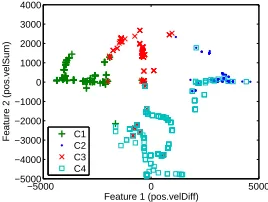
Figure 1:Input visual sequence of relative motions between two objects. (a) and (b) are both instances of “chase”, but attentive focus (in our computational bottom-up simulation) goes to the pursuer (square) in (a) and on the leader (circle) in (b). (c) and (d) are instances of away” and “move-closer”. We show that the conceptual notions underlying these units correlate with four concept spaces that can be clustered in a 2D feature space representing relative position and relative velocity.
−5000 0 5000
−5000 −4000 −3000 −2000 −1000 0 1000 2000 3000 4000
Feature 1 (pos.velDiff) Feature 2 (pos.velSum) C1
[image:10.612.102.236.287.388.2]C2 C3 C4
Figure 2: Unsupervised emergence of clusters in feature space
These four clusters map dominantly to one of the three concepts of “come closer”, “move away”, and “chase”, but since the latter is not symmetric, we find two instances of the latter, C3 an C4, in the cluster space. These may be roughly thought of as corresponding to “Lm chases Tr” and to ”Lm follows Tr” (Lm=landmark = object in attentive fo-cus; Tr=trajector). (Satish and Mukerjee 2008)
The input to each cluster is ordered in terms of the trajector-landmark distinction. What is revealing is that if the ordering is altered, the clusters C1 and C2 continue to be recognized as the same, but clusters C3 and C4 are in-verted. Thus, this discovers reflexivity for the predicates move-closer and move-away, and asymmetry for chase. In syntax, these will reflect as free word-order for the first two predicates, and for inferences a specific ordering in the latter. Further, if the number of clusters are increased, we find preliminary evidence that the clusters move-closer and move-away are also classified into three clusters. These ap-pear to correspond to the situations where one object (either the landmark or the trajector) is static, or where both are moving simultaneously.
Finally, these were correlated with linguistic inputs (un-processed commentary provided by American and Indian speakers), and reasonably high correlations are obtained for
these in terms of phrases in the language stream. This com-pletes the symbol discovery process by relating the prior im-age schema (the semantic pole) with a label (the phonolog-ical pole). Subsequently, all relations in which this label is involved may be thought as new logical structures that can be added to the system.
Domain 2: Optimization and Symbol formation
Many input spaces are very complex and high dimensional. Thus a very large number of parameters may be required to define a padlock geometry, say. Yet, once we consider func-tion, many of these parameters do not seem independent; we may find that as the body of the lock grows larger, the diame-ter of the shackle bolt also increases. Thus these two param-eters are not independent. In the cognitive literature, these type of relations are calledchunks. Discovering chunks may constitute be a fundamental step in the process of discover-ing symbols in high-dimensional perceptual spaces.
We consider this problem in the context of design, where function is often more formally elucidated than in everyday situations. Discovering a systematic inference structure for design problems also remains an important problem. Also, the dimensionality of many design problems (the number of parametersNrequired to describe a design) is very large.
In such situations, we find that optimization results in a sharp reduction of the parameter space. In general, designs are often evaluated based on multiple functional objectives, so that their optima lies on a pareto frontier; if there ared objectives, then this frontier has dimensionalityd−1 (usu-allyd << N). If the functional mapping is well-behaved, then the set of pareto designs in the N dimensional space will lie on a d−1 dimensional manifold. Such manifolds can be detected, and lead to the formation of chunks.
As an example, we consider an universal motor, with eight independent design parameters, optimized here for three functional aspects - mass, torque and efficiency. The result-ing set of non-dominated designs lie on a 2D surface, and can be clustered in an unsupervised manner (a). The same designs are then projected from the 8 dimensional parameter space onto a 2D manifold using Locally Linear Embedding (LLE). It is seen that the mapping remains coherent, reveal-ing reasonable inter-parameter relationships along each axis of the lower dimensional space.
0 0.5 1 1.5 2 0.4 0.6 0.8 1 0 2 4 π mass πefficiency πtorque
−3.5 −3 −2.5 −2 −1.5 −1 −0.5 0 0.5 1 1.5 −4 −3 −2 −1 0 1 2 3
Figure 3:Optimal surfaces form lower dimensional chunks.
Conclusions
We have sketched the barest outline of a mechanism whereby semantic units may be learned directly, and the
[image:10.612.332.541.546.622.2]lations between these may give rise to syntax. When ex-posed to a cultural system of symbols, these proto-concepts get reified and stabilized, and rich sets of relations are added to the system.
If such a mechanism exists, it would be able to explain how logical primitives arise to begin with. The other alter-native, that logical primitives are ontologically prior in some sense, faces the complex task of explaining how these set of symbols and their semantics arose in the cognitive structure. One answer may be radical nativism as in Fodor, but this re-quires too complex an input at the very least, and fails the Occam’s razor.
While clearly not complete, this process highlights the possibility that logic may be a consequence, and not a prior, to understanding various modes of interaction. If so, the en-terprise suggested in this workshop may be doomed. Logic is fine as it is in terms of a set of abstract relations. It may also be interesting as a post facto explanation of interactins etc., but the set of symbols that are used in such enterprises must be grounded in experience, and if this is to happen, the same system can also derive the rules of logic, and not the other way around.
References
Langacker, R. 1991. Foundations of Cognitive Grammar, vol. 1. Stanford, CA: Stanford University Press.
L¨owe, B. 2009. Logic and the simulation of interaction and reasoning: Logic, computer games, and narrative. THIS
BOOKLET, pp. 3–4.
Satish, G., and Mukerjee, A. 2008. Acquiring linguistic argument structure from multimodal input using attentive focus. In7th IEEE International Conference on Develop-ment and Learning, 2008. ICDL 2008, 43–48.
Speech acts as announcements
Nadine Guiraud
and
Andreas Herzig
and
Emiliano Lorini
Universit´e Paul Sabatier, Institut de Recherche en Informatique de Toulouse (IRIT),
Logic, Interaction, Language, and Computation (LILaC), 118 route de Narbonne, 31062 Toulouse Cedex 9, France
Abstract
Our aim is to use the logic of public announcements and more generally dynamic epistemic logics as a logic of speech acts. To that end we start from a simple multimodal logic of be-liefs and goals (without common belief), and add public an-nouncements. We suppose that announcements do not mod-ify goals. We then consider several variants of speech acts of assertive and directive force and provide a modeling in terms of speech acts.
1. Introduction
In this paper, we consider the domain of communication between agents, in particular we describe the dynamics of mental states due to communication by means of speech acts. Starting from the representation of speech acts by (Grice 1989), we consider the mental states which define the success preconditions of a speech act: intentions and be-lief. Thus Alice can say to BenI like cookies. The mental state corresponding to this action, if Alice is honest, is that Alice wants that Ben believes that she likes cookies. This is the well-known assertive speech act. On this way, Grice defines other kinds of speech acts we consider in this paper: assert,inform ,confirm,request,yes-no question. We do not only consider the mental states of the speaker, but also we represent the mental states of the hearer. In particular, we represent how the speech act influences beliefs and in-tentions of a locutor.
In agreement with Grice’s theory, we suppose that when an agent speaks, he informs about his mental states. In the previous example, when Ben hears Alice’s utteranceI like cookies, whether he thinks Alice is honest or not, he starts to believe that Alice wants him to beliefs that she likes cookies. Thus, in case of a successfull communication, the hearer will understand the mental states of the speaker.
The success preconditions of speech acts are formalized in this work by means of a modal logic of beliefs and goals. Similar formalisms have been used in (Herzig and Longin 2002; Sadek 2000). The logic is extended with modal opera-tors for announcements of Dynamic Epistemic Logic (DEL)
Copyright c2009, the author(s). All rights reserved.
In: Benedikt L¨owe (ed.), LSIR-2: Logic and the Simulation of
Interaction and Reasoning, Pasadena CA, U.S.A., 12 July 2009. pp. 13–17.
(van Ditmarsch, van der Hoek, and Kooi 2007) in order to model the dynamics speech acts. Our formalism enables to represent how a speech act of the speaker modifies the be-liefs of the hearer and so to capture the dynamic dimension of a dialogue between agents.
The paper is organized as follows: we first present the static modal logic of beliefs and goals. Then we provide a definition of model update by an announcement. Finally, we formally characterize the success preconditions of several kinds of speech acts and we develop an analysis of speech act dynamics.
2. A logic of beliefs and goals
LetPRP = {p, q, . . .}be a countable set of propositional letters, and let AGT = {i, j, . . .} be a countable set of agents. The set of formulas of our logic of beliefs and goals is defined by the following BNF:
φ::=p| > | ¬φ|φ∧φ|Beliφ|Goaliφ wherepranges overPRPandiranges overAGT. Beliφ reads “agentibelieves thatφ” andGoaliφreads “agent i wants thatφ”. The others boolean operators⊥,∨,→and↔ are defined in the standard way.
Models for that language are of the form M = hW,B,G, Viwhere
• W is a nonempty set of possible worlds;
• B : AGT −→ 2W×W associates a belief accessibility
relation to every agent;
• G: AGT−→2W×Wassociates a goal accessibility
rela-tion to every agent;
• V : W −→ 2PRP associates to every possible world a
valuation.
We useBi(w)to denote the set{w0| hw,w0i ∈ Bi},Gi(w) to denote the set{w0 | hw,w0i ∈ G
i}. Bi(w)is the set of worlds that are compatible with agenti’s beliefs at worldw andGi(w)is the set of worlds that are compatible with agent
i’s goals at worldw.
The truth conditions are as usual:
• M, u|= BeliφiffM, v|=φfor everyvsuch thatuBiv;
The logic of that class of models is fairly standard. It can be axiomatized by the principles of K45 for the belief op-eratorBeli, the principles of KD for the goal modalGoali, plus the following axiom schemas of positive and negative introspection for goals:
(1) Goaliφ→BeliGoaliφ
(2) ¬Goaliφ→Beli¬Goaliφ
Axioms 4 and 5 for beliefs correspond together to the fol-lowing semantic constraint(C.1)on models, Axiom D for goals corresponds to the constraint(C.2) and, finally, the axioms of positive and negative introspection for goals cor-respond together to the semantic constraint(C.3).
(C.1) w0∈ Bi(w)impliesBi(w) =Bi(w0) (C.2) Gi(w)6=∅
(C.3) w0∈ Bi(w)impliesGi(w) =Gi(w0)
3. Adding announcements
We suppose that announcements are public, and that they only modify the agents’ beliefs, but not their goals. Tech-nically, our logic combines Kooi’s version of public an-nouncement logic (Kooi 2007) with Gerbrandy’s logic of private updates (Gerbrandy 1999; Gerbrandy and Groen-eveld 1997). The latter allows us to update beliefs without updating goals, and is a particular dynamic epistemic logic (Baltag, Moss, and Solecki 1998; Baltag and Moss 2004; van Ditmarsch, van der Hoek, and Kooi 2007).1
We extend our language by modal operators of public an-nouncement by adding[φ!]φto the above BNF. The formula [ψ!]φreads “φholds after the public announcement ofψ”.
In order to give semantics to announcements we de-fine theupdate of a model by an announcement. The up-date of M = hW,B,G, Vi by φ! is the model Mφ! =
hWφ!,Bφ!,Gφ!, Vφ!iwhere
• Wφ!={u
b:u∈W} ∪ {ug :u∈W};
• Bφ!={hu
b, vbi:hu, vi ∈ BandM, v|=φ}∪{hug, vgi:
hu, vi ∈ B};
• Gφ!={hu
b, vgi:hu, vi ∈ G} ∪ {hug, vgi:hu, vi ∈ G};
• Vφ!(u
b) =Vφ!(ug) =V(u).
Basically, the effect of an announcement is to shrink the set of belief accessible worlds, while keeping constant the set of goal accessible worlds.
Proposition 1. For everyφ, ifMis a model of our logic of beliefs and goals thenMφ!is still a model of our logic of
beliefs and goals.
Proof. The proof consists in verifying the conservation of semantic properties seen ahead.
1For readers who are familiar with these logics: our event
mod-els have two possible eventsbandg, whereBi ={hb, bi,hg, gi}
andGi={hb, gi,hg, gi}.
• ForC.1: There are two cases for belief after announce-ment: eitherw2b∈ Bψi!(w1b)orw2g ∈ Bψi!(w1g). In each
case, it implies by definition thatw2 ∈ Bi(w1). Then
Bi(w1) = Bi(w2), because M satisfies constraintC.1.
And also assumew3∈ Bi(w2). Thenw3∈ Bi(w1).
In case w2b ∈ Biψ!(w1b): ifw3 |= ψ then w3b ∈
Biψ!(w2b) and w3b ∈ Biψ!(w1b). And if w3b 6|= ψ thenw3b 6∈ Bψi!(w2b)and w3b 6∈ Biψ!(w1b) and w3g 6∈
Biψ!(w2b)andw3g 6∈ Bψi!(w1b).
ThenBψ!
i (w1b) =Biψ!(w2b).
In casew2g∈ Bψi!(w1g): whether or notw3|=ψthen
w3g∈ Bψi!(w2g)andw3g∈ Bψi!(w1g). ThenBψ!
i (w1g) =Bψi!(w2g).
Therefore,Mψ!satisfies constraintC.1.
• ForC.2: Let us supposeGiψ!(wb) =∅. ThenGi(w) =∅ by the semantic definition, and it is contradictory with the constraints onM. ThenGψi!(wb)6=∅. It is the same proof forGiψ!(wg)6=∅. ThereforeMψ!satisfies constraintC.2.
• ForC.3: There are two cases for belief after announce-ment: eitherw2b∈ Bψi!(w1b)orw2g ∈ Bψi!(w1g). In each
case, it implies by definition thatw2 ∈ Bi(w1). Then
Gi(w1) = Gi(w2), because M satisfies constraintC.3.
And also assumew3∈ Gi(w2). Thenw3∈ Gi(w1).
In casew2b∈ Biψ!(w1b):w3g ∈ Giψ!(w2b)andw3g ∈
Giψ!(w1b). And in casew2g ∈ Biψ!(w1g):w3g ∈ Giψ!(w2g) andw3g∈ Giψ!(w1g).
ThenGiψ!(w1) =Giψ!(w2)in both cases.
Therefore,Mψ!satisfies constraintC.3.
Items 1, 2 and 3 together imply thatMψ!is a model of our
logic of belief and goal.
The truth condition for announcement is:
• M, u|= [ψ!]φiffMψ!, u
b|=φ
We suppose the usual definitions of validity and satisfia-bility. Then the following equivalences are valid:
(3) [ψ!]p↔p ifp∈PRP
(4) [ψ!]¬φ↔ ¬[ψ!]φ
(5) [ψ!](φ∧χ)↔([ψ!]φ∧[ψ!]χ)
(6) [ψ!]Beliφ↔Beli(ψ→[ψ!]φ)
(7) [ψ!]Goaliφ↔Goaliφ
Proof.
(3)hW,B,G, Vi,w |= [ψ!]p iffhWψ!,Bψ!,Gψ!, Vψ!i,w
b|=p iffw ∈Vψ!(p)
iffw ∈V(p)
iffhW,B,G, Vi,w |=p.
(4)hW,B,G, Vi,w |= [ψ!]¬ϕ iffhWψ!,Bψ!,Gψ!, Vψ!i,w
b|=¬ϕ
iffhWψ!,Bψ!,Gψ!, Vψ!i,w
b6|=ϕ iffhW,B,G, Vi,w6|= [ψ!]ϕ iffhW,B,G, Vi,w|=¬[ψ!]ϕ.
(5)hW,B,G, Vi,w |= [ψ!](ϕ1∧ϕ2)
iffhWψ!,Bψ!,Gψ!, Vψ!i,w
b|=ϕ1∧ϕ2
iffhWψ!,Bψ!,Gψ!, Vψ!i,w
b|=ϕ1
andhWψ!,Bψ!,Gψ!, Vψ!i,w
b|=ϕ2
iffhW,B,G, Vi,w |= [ψ!]ϕ1andhW,B,G, Vi,w|= [ψ!]ϕ2
iffhW,B,G, Vi,w|= [ψ!]ϕ1∧[ψ!]ϕ2.
(6)We show that the equivalent formula
¬[ψ!]Beliϕ↔ ¬Beli(ψ→[ψ!]ϕ) is valid:
hW,B,G, Vi,w |=¬[ψ!]Beliϕ
iffhW,B,G, Vi,w|= [ψ!]¬Beliϕ, by(4), iffhWψ!,Bψ!,Gψ!, Vψ!i,w
b|=¬Beliϕ iff∃w0
b∈ Bψ!(wb)s.t. hWψ!,Bψ!,Gψ!, Vψ!i,wb0|=¬ϕ iff∃w0∈ B(w)s.t.hW,B,G, Vi,w0|=ψand
hW,B,G, Vi,w0|= [ψ!]¬ϕ
iff∃w0∈ B(w)s.t.hW,B,G, Vi,w0|=ψ∧ ¬[ψ!]ϕ, by(4), iff∃w0∈ B(w)s.t.hW,B,G, Vi,w0|=¬(ψ→[ψ!]ϕ) iffhW,B,G, Vi,w|=¬Beli(ψ→[ψ!]ϕ).
(7)We show that the equivalent formula
¬[ψ!]Goaliϕ↔ ¬Goaliϕ is valid:
hW,B,G, Vi,w |=¬[ψ!]Goaliϕ
iffhW,B,G, Vi,w|= [ψ!]¬Goaliϕ, by(4), iffhWψ!,Bψ!,Gψ!, Vψ!i,w
b|=¬Goaliϕ iff∃w0
g∈ Gψ!(wb)s.t.hWψ!,Bψ!,Gψ!, Vψ!i,wg0 |=¬ϕ iff∃w0∈ G(w)s.t.hW,B,G, Vi,w0|=¬ϕ
iffhW,B,G, Vi,w|=¬Goaliϕ.
The following rules of equivalence for announcements (8) fromφ↔φ0infer[ψ!]φ↔[ψ!]φ0
(9) fromψ↔ψ0infer[ψ!]φ↔[ψ0!]φ preserve validity.
The above equivalences 3-7 and rules of inference 8-9 are so-calledreduction axioms: they allow to ‘move’ announce-ment operators across the other logical operators ‘inside’ formulas, and to eliminate them once they face a propo-sitional letters. Rewriting formulas starting from the in-nermost announcements, we can in this way eliminate an-nouncement operators from formulas, resulting in an equiv-alent formula of the underlying logic of beliefs and goals.
This provides a completeness result for our logic of an-nouncements.
Theorem 1. Our logic of beliefs and goals is sound and complete.
4. Speech acts as announcements
In dynamic epistemic logics announcements are usually viewed as communication actions performed by an agent that is ‘outside the system’, i.e. that is not part of the set of agentsAGTunder consideration. Our aim is to investi-gate how communication actions performed by agents from AGTcan be modelled in our logic of announcements. To
that end we consider a particular subset of announcements: we say that formulas of the form Beliψ! or Goaliψ! are about the mental state of agent i. We identify announce-ments about the mental state ofi, with actions performed by i. We follow Grice’s idea that speech acts are expressions of intentions by the speaker, and consider that such expressions take the formGoaliψ!of announcements of goals. Such an-nouncements of goals are directed towards an addressee. 4.1 Assertive speech acts
We consider the basic assertive as the primitive speech act and we suppose that the other kinds of speech acts are de-fined from this primitive speech act. We identify the ex-pression “iassertstoj thatψ” with the announcement of GoaliBeljψ:
Asserti,jψ def= GoaliBeljψ!
One might express a more complex notion of as-sertive speech act whose content is communicative in-tention in the sense of Grice (Grice 1989) of the form GoaliBeljGoaliBeljψ, i.e. agent iwants that j believes thatiwants thatjbelievesψ. In the classical Gricean view of linguistic communication, a communicative intention of the speaker is aimed at the recognition by the hearer of the speaker’s goal of making the hearer to believe something.
Starting from the basic assertive, we define the two speech actsinformandconfirm. The speech actinformis a speech actassertunder the precondition thatibelieves thatjhas no opinion aboutψ. We identify it therefore with the announce-ment ofBeli(¬Beljψ∧ ¬Belj¬ψ)∧GoaliBeljψ:
Informi,jψ def= Beli(¬Beljψ∧ ¬Belj¬ψ)∧GoaliBeljψ! The speech act confirm is a speech act assert under the precondition that i believes that j believes ψ. We iden-tify it therefore with the announcement of BeliBeljψ ∧
GoaliBeljψ:
Confirmi,jψ def= BeliBeljψ∧GoaliBeljψ! In both cases one might add the sincerity condition of as-sertives to the announcement: the speaker believes what he asserts. We then would writeBeliψ∧GoaliBeljψinstead of
GoaliBeljψfor the basic assertive of the formAsserti,jϕ, etc.
4.2 Directive speech acts
The speech actrequestis the basic speech act of the directive kind. We define it from the assertive. We identify “irequests jthatψ” with “iassertsthat he wants thatjhas the goal that ψ”:
Requesti,jψ def= Asserti,jGoaliGoaljψ
The yes-no query “iasksjwhetherψ” is a particular case of a request:
of request would implyGoaliGoaljψand the yes-no query would implyGoaliGoalj(Beliψ∨Beli¬ψ).
Supposejis cooperative. This could be expressed by the formula
BeljGoaliBeljGoaliGoaljp→Goaljp
Under this hypothesis the satisfaction conditions can be guaranteed, i.e. we have
Theorem 2.
`[Requesti,jp](BeljGoaliBeljGoaliGoaljp
→Goaljp)→[Requesti,jp]Goaljp Proof. We have the theorems that
`[Requesti,jp]BeljGoaliBeljGoaliGoaljp
and`[Requesti,jp]Goaljp↔Goaljp
so by K`[Requesti,jp](BeljGoaliBeljGoaliGoaljp
→Goaljp)→[Requesti,jp]Goaljp
4.3 Moore sentences in speech acts
In our logic one can study Moore-like sentences for beliefs. We can prove that the assertion of p ∧ ¬Belip leads to inconsistencies of the (higher-order) beliefs:
Theorem 3.
`Beli(p∧ ¬Belip)↔ Beli⊥
`[Asserti,jBeli(p∧ ¬Belip)!]BeljGoaliBeljBeli⊥ Proof.
• ` ¬Belip→Beli¬Belip(axiom 5) so` ¬Beli¬Belip→Belip
and`BeliBelip∧ ¬Beli⊥ → ¬Beli¬Belip so`BeliBelip∧ ¬Beli⊥ →Belip
and so`BeliBelip∧ ¬Beli⊥ ↔Belip∧ ¬Beli⊥
Beli(p∧ ¬Belip)
↔Belip∧Beli¬Belip∧(Beli⊥ ∨ ¬Beli⊥)
↔(Belip∧Beli¬Belip∧Beli⊥)∨(Belip∧Beli¬Belip∧
¬Beli⊥)
↔ Beli(p ∧ ¬Belip ∧ ⊥) ∨ (BeliBelip ∧ ¬Beli⊥ ∧ Beli¬Belip)
↔Beli⊥
Therefore`Beli(p∧ ¬Belip)↔Beli⊥
• So[Asserti,jBeli(p∧ ¬Belip)!]BeljGoaliBeljBeli⊥ iffBelj(GoaliBeljBeli(p∧ ¬Belip)→
[GoaliBeljBeli(p∧ ¬Belip)!]GoaliBeljBeli⊥)by(6) iffBelj(GoaliBeljBeli(p∧ ¬Belip)→
GoaliBeljBeli⊥)by(7)
iffBelj(GoaliBeljBeli⊥ →GoaliBeljBeli⊥)
iffBelj>
which is a tautology. Therefore
`[Asserti,jBeli(p∧ ¬Belip)!]BeljGoaliBeljBeli⊥
On the same way, we can prove that
`[Asserti,jBeli(p∧ ¬Belip)!]BeliGoaliBeljBeli⊥
5. Discussion and conclusion
An immediate extension of our logic is to add announce-ments modifying goals, similar to (van Benthem 2007; Roy 2008; van Benthem, Girard, and Roy to appear). Such announcements would leave an agent’s beliefs unaltered. In order to model this form of goal change, a product construc-tion symmetric to the one for beliefs can be used.
Another issue we intend to investigate in the future is the theory of speech acts in the context of indirected commu-nication. The idea is to extend the analysis presented in this paper to the case in which agents make assertions, re-quests, queries, etc. to other agents by using a shared black-board which can be observed by other agents connected to it. In this case, an agent’s speech act (defined in terms of an-nouncements) modify and update the contents of the black-board which is accessible to other agents, rather than directly modifying the beliefs and goals of other agents. In order to model this notion of blackboard, as a form of artefact used for mediating communication between agents, we intend to use the logic of acceptance recently proposed in (Lorini et al. 2009).
We also leave open the problem of integrating belief revi-sion mechanisms into our logic, and refer to (Aucher 2003; 2008; van Ditmarsch, van der Hoek, and Kooi 2007; Baltag and Smets 2007) for possible solutions.
References
Aucher, G. 2003. A combined system for update logic and belief revision. Master’s thesis, University of Amsterdam. ILLC Publications MoL-2003-03.
Aucher, G. 2008.Perspectives on belief and change. Ph.D. Dissertation, Universit´e de Toulouse.
Baltag, A., and Moss, L. S. 2004. Logics for epistemic programs.Synthese139(2):165–224.
Baltag, A., and Smets, S. 2007. From conditional proba-bility to the logic of doxastic actions. InProc. TARK 2007, 52–61. Presses Universitaires de Louvain.
Baltag, A.; Moss, L. S.; and Solecki, S. 1998. The logic of public announcements, common knowledge, and private suspicions. InProc. TARK’98, 43–56. Morgan Kaufmann. Gerbrandy, J., and Groeneveld, W. 1997. Reasoning about information change.J. of Logic, Language and Information 6(2).
Gerbrandy, J. 1999.Bisimulations on Planet Kripke. Ph.D. Dissertation, University of Amsterdam.
Grice, H. P. 1989. Studies in the way of words. USA: Harvard University Press, 3rd edition.
Herzig, A., and Longin, D. 2002. A logic of intention with cooperation principles and with assertive speech acts as communication primitives. In Castelfranchi, C., and John-son, W. L., eds.,Proc. of the first Int. Joint Conf. on Au-tonomous Agent and Multi-Agent System (AAMAS 2002),
Bologna, Italy, July 15–19, volume 2, 920–927. Associa-tion for Computing Machinery.
Kooi, B. 2007. Expressivity and completeness for public update logic via reduction axioms.Journal of Applied Non-Classical Logics17(2):231–253.
Lorini, E.; Longin, D.; Gaudou, B.; and Herzig, A. 2009. The logic of acceptance: grounding institutions on agents’ attitudes. Journal of Logic and ComputationDOI: 10.1093/logcom/exn103.
Roy, O. 2008. Thinking before acting: intentions, logic, rational choice. Ph.D. Dissertation, University of Amster-dam, ILLC dissertation series.
Sadek, D. 2000. Dialogue acts are rational plans. In Mar-tin M. Taylor, F. N., and Bouwhuis, D. G., eds.,The Struc-ture of Multimodal Dialogue II, 167–187. Amsterdam / Philadelphia: John Benjamins.
van Benthem, J.; Girard, P.; and Roy, O. to appear. Every-thing else being equal: A modal logic for ceteris paribus preferences. Journal of Philosophical Logic.
van Benthem, J. 2007. Dynamic logic of prefer-ence upgrade. Journal of Applied Non-Classical Logics 17(2):157–182.
From generic sentences to scripts
∗Lenhart Schubert
Department of Computer Science University of Rochester, PO Box 270226, 734 Computer Studies Building, Rochester, NY 14627-0226, United States of America
Abstract
One way to tackle the problem of acquiring general world knowledge to support language understanding and common-sense reasoning is to derive this knowledge by direct inter-pretation of general statements in ordinary language. One of several problems encountered in such an effort is that gen-eral statements frequently involve “donkey anaphora”. Here a “dynamic Skolemization” approach is suggested that avoids dynamic semantics and leads naturally to script- or frame-like representations.
Introduction: Long-range goals, and the need
for world knowledge
A group of us at the University of Rochester are pursuing the ambitious goal of creating a broadly knowledgable di-alog agent that is motivated by curiosity, by vicarious sat-isfaction in fulfilling user goals, and by the sheer “plea-sure” (positive utility) of engaging in conversation. How-ever, our achievements so far fall far short of this goal: we have (1) a general knowledge representation (episodic logic, or EL) intended to match the expressiveness of human lan-guages (e.g., (Schubert and Hwang 2000; Schubert 2000)), (2) a functioning, but still incomplete inference engine for that representation, EPILOG (e.g., (Schaeffer et al. 1993;
Morbini and Schubert 2008)), (3) compositional methods for generating logical forms from English parses, (4) a large base of general “factoids” (Schubert and Van Durme 2008), and (5) a self-motivated, reward-seeking agent in a small simulated world, capable of planning ahead and simple di-alogs (Liu and Schubert 2009). One of the most glaring la-cunae in all of this is a sizable world knowledge base.
Two related bottlenecks, and the
K
NEXTsystem
I believe that human-like language understanding by ma-chines is encumbered by two varieties of the notorious “knowledge acquisition bottleneck”: apattern acquisition ∗This work was supported by NSF grants 0328849 and IIS-0535105.
Copyright c2009, the author(s). All rights reserved.
In: Benedikt L¨owe (ed.), LSIR-2: Logic and the Simulation of Interaction and Reasoning, Pasadena CA, U.S.A., 12 July 2009. pp. 19–23.
bottleneck, and aworld knowledge acquisition bottleneck. Concerning the former, I suggest that we need to re-conceptualize parsing/interpretation as a massively pattern-based process, in which more specific idiomatic and se-mantic patterns select (and sometimes override) traditional, generic phrase structure patterns (Schubert 2009). Concern-ing world knowledge acquisition, we are confronted with a variety of practical and theoretical problems, some of which will be my focus here.
Our approach to knowledge acquisition is text-based, i.e., we are attempting to exploit the abundant textual materials available online nowadays. Most of our efforts so far, start-ing about 8 years ago, have been concerned with obtainstart-ing simple general factoids from arbitrary texts (see item (4) in the opening section). For example, the sentence “The boy entered through the open door of the old man’s shack”, when processed by our KNEXT system (e.g., (Schubert 2002;
Schubert and Tong 2003; Van Durme and Schubert 2008)) yields a set of EL formulas that are automatically verbalized as
A BOY MAY ENTER THROUGH A DOOR OF A SHACK. A SHACK MAY HAVE A DOOR.
A DOOR CAN BE OPEN. A MAN MAY HAVE A SHACK. A MAN CAN BE OLD.
(assuming that the intitial statistical parse is correct). We have obtained many millions of such factoids, and we regard these as providing a direct means for alleviating the pattern acquisition bottleneck; i.e., they provide patterns of predi-cation and modifipredi-cation that can be used to guide a parser and semantic interpreter to produce more reliable phrasal and logical form analyses. In this way they pave the way for acquiring more complex knowledge.
Common Sense collection (Singh et al. 2002)). A key point is that a generic conditional sentence such as the preced-ing one (unlike the earlier simple factoids) can enable in-ferences. For example, given a particular instance of a car crashing into a tree, we can infer that the driver of the car was probably injured or killed.
It is the acquisition of this kind of generic conditional knowledge about the world that is currently our primary concern. We are exploring a number of approaches, in-cluding abstraction from clusters of related factoids (Van Durme, Michalak, and Schubert 2009), abstraction from par-ticular multi-verb sentences, and interpretation of available collections of generic sentences. But there are some pro-found difficulties afflicting all approaches that seek to de-rive inference-capable generic knowledge from generic sen-tences phrased in ordinary language:
• lexical ambiguity; e.g., “Journalists write articles” – ar-ticlesin what sense?
• temporal ambiguity; e.g., “People worry about the econ-omy” – now? always?
• quantificational ambiguity; e.g., “Bears are rarely dan-gerous” – few bears, or bears in general at few times?
• radical underspecification; e.g., “Cats land on their feet” – under what conditions? and
• donkey anaphora; e.g., “If a car crashes into a tree,
the driver (of the car) is apt to be hurt” – which driver, which car?
There are plausible approaches to all five issues, but I will focus on the last, because it is equally important from the perspective of NL semantics and from the perspective of knowledge representation and reasoning (KR&R); my ap-proach to donkey anaphora leads to a serendipitous conver-gence of these perspectives.
The problem with donkey anaphora is well-known (Geach 1962). For example, in the sentence
If a farmer buys a donkey, he rides it home,
we would like to bind the anaphoric pronounsheanditto the indefinitesa farmeranda donkeyin the antecedent. But if we interpret the sentence (using a generic event quantifier Gen) as
(Gen e: during(e,Extended-present)
[[(∃x: farmer(x))(∃y: donkey(y)) buys(x,y,e)]
→(∃e0: after(e0,e) rides-home(x,y,e0)],
we are left with free variables in the consequent, falling outside the scopes of the existential quantifiers in the an-tecedent. This difficulty sparked the development of vari-ous versions ofdynamic semantics, including discourse rep-resentation theory (DRT) (Kamp 1981; Heim 1982) and dynamic predicate logic (DPL) (Groenendijk and Stokhof 1991). In these logics, formulas are thought of as transform-ing an “input” variable assignment. In the above formalized sentence, the antecedent formula would transform the val-ues of xandy, for any given value ofe, so as to satisfy buys(x, y, e)(if such values exist); these values would then be available in the consequent. We say in this case thatxand yaredynamically boundby the existential quantifiers in the
antecedent, even though they lie outside thestaticscopes of those quantifiers.
A disadvantage of dynamic semantics from a KR&R per-spective is loss of modularity. For example, even in a simple narrative such as
A farmer bought a donkey; he rode it home,
if we use free variables for heandit that are dynamically bound by the existential quantifiers in the first sentence, then the combined meaning of the two sentences would be lost if we interchanged their formal representations, let alone if we stored these representations separately in a KB, for indepen-dent use in inference processes. This difficulty is aggravated in extended generic contexts. For example, in the conjunc-tive sentence
Every man had a gun, and many used it,
the initial universal quantifier does not cover the second sentence, and consequently dynamic interpretation of the anaphoricitrequires repetition of material from the first sen-tence, along the lines
Every man had a gun, and many men had a gun and used it.
Treatment of extended generic passages in DRT was pio-neered in (Carlson and Spejewski 1997), but the need to re-peat earlier material for each new quantifier that applied to some portion of the generic passage was very much in evi-dence in that study.
Dynamic Skolemization
These problems can be avoided by Skolemizing. For ex-ample, the Skolemized representations of the two-sentence examples above would be (neglecting tense)
farmer(A), donkey(B), bought(A,B,E1); after(E2,E1), rode-home(A,B,E2). (∀x: man(x)) gun(G(x))∧had(x,G(x)); (Many x: man(x)) used(x,G(x)),
whereA,B, E1, andE2are Skolem constants and Gis a Skolem function. Note that if we immediately Skolemize upon encountering an existentially quantified variable, the Skolem constant or function will be available for resolving subsequent anaphors.
But of course the recalcitrant cases are those involving donkey anaphora, where the existential quantifiers occur in a conditional antecedent, and thus in a negative-polarity en-vironment. Standard Skolemization should not be expected to “work” in such a case, and at first glance, it does not. For example, consider a conditional version of the last example, tentatively Skolemized as before:
If every man has a gun, then many use it. [(∀x: man(x)) gun(G(x))∧have(x,G(x))]
→(Many x: man(x)) use(x,G(x)).
This formulation has many undesirable models, e.g., mod-els in which there are men, each has a gun, and none uses it, simply becauseG(x)happens to denote something that is not a gun; in such a case, the conditional sentence is trivially true in virtue of the falsity of the antecedent.
But this observation, that Skolemized donkey sentences
are rendered trivially true by trivially false antecedents, also holds the key to a solution: We constrain the Skolem con-stants or functions in the antecedent so that they cannot be trivially false. In the present example, this can be done by stipulating (separately) the followingSkolem conditional:
(∀x: man(x))[[(∃y: gun(y))have(x,y)]
→[gun(G(x))∧have(x,G(x))]].
ThusG(x)is constrained to refer to a gun that a manxhas, if indeedxis a man who has a gun; and thus if in fact every man has a gun, then the Skolemized antecedent is true, and so the conditional sentence as a whole is true only if many menxuseG(x), which must then be a gun thatxhas.
In general, we define dynamic Skolemization as the re-placement of indefinites (as soon as they are encountered in NL interpretation) by Skolem constants or functions, while simultaneously stipulating a corresponding Skolem condi-tional. More formally:
Given an occurrence of a formula(∃y : Φ)Ψ, contain-ing free variablesx1, ..., xm(and no unresolved refer-ring expressions) in the “provisional logical form” of an English sentence being interpreted,
(a) Assert the Skolem conditional (∀x1)...(∀xm)[[(∃y: Φ)Ψ]→
[ΦF(x1,...,xm)/y∧ΨF(x1,...,xm)/y]],
whereFis a newm-place function symbol; (b) Replace the original occurrence of (∃y : Φ)Ψ by
[ΦF(x1,...,xm)/y∧ΨF(x1,...,xm)/y]].
Some points worth noting are the following. First, as long as anaphors occur after (to the right of) their indefinite coref-erents, dynamic Skolemization enables anaphora resolution “as we go”. Second, we can easily generalize the above defi-nition so that multiple indefinites occurring in sequence, and lying within the scopes of the same non-existential quan-tifiers, are Skolemized simultaneously. Third, the Skolem conditional can be looked at as an equivalence, since its converse is assured by existential generalization. Fifth, dy-namic Skolemization reduces to ordinary Skolemization if the existential formula(∃y : Φ)Ψbeing Skolemized lies in a positive-polarity (upward-entailing) environment; i.e., in such a case the Skolem conditional can be shown to be logi-cally redundant.
Abbreviating dynamic Skolemization: concept
definitions
There is a certain verbosity in the use of dynamic Skolem-ization: we are writing down variants of the formula to be Skolemized,(∃y: Φ)Ψ, three times – once on each side of the Skolem conditional, and once in the Skolemized version of the original existential sentence. We can condense dy-namic Skolemization throughconcept definitionsthat essen-tially name the Skolemized material, and leave the Skolem conditional itself implicit.
For example, for the earlier sentence, “If every man has a gun, then many use it”, instead of writing down the stated
Skolem conditional, we would assert (Def HG (x) (G) [gun(G)∧has(x,G)]),
and rewrite the logical form of the given sentence as [(∀x: man(x)) HG(x)→(Many x: man(x)) use(x,G(x)). The statedDef-schema is a shorthand for
(∀x)[HG(x)↔[(∃y: gun(y)) have(x,y)]
↔[gun(G(x))∧have(x,G(x))]],
i.e., it stipulates that HG(x) holds just in case x has a gun, which in turn holds just in case G(x) is a gun that xhas. In general, aDef-schema for an existential formula
(∃y1)...(∃yn)Φ, containing free variablesx1, ..., xm, (DefΠ (x1, ..., xm) (F1, ..., Fn) ΦF /y),
is shorthand for
(∀x1)...(∀xm)[Π(x1, ..., xm)↔
(∃y1)...(∃yn)Φ ↔ ΦF(x1,...,xm)/y],
whereF(x1, ..., xm)=(F1(x1, ..., xm), ..., Fn(x1, ..., xm)) andy=(y1, ..., yn).
Creating scripts
To see how these devices lead to scripts, suppose that we are given something like the following English generic passage as a description of the process of dining at a restaurant:
Generally, when a person dines at a restaurant, they enter it,
they get seated at a table,
they make a meal selection from a menu, they tell the order to a waiter,
etc.
A rough provisional logical form, with anaphors subscripted for clarity with the presumed referents, is as follows:
(Gen e: (∃x: person(x))(∃y: restaurant(y)) dine-at(x,y,e)) (∃e1: initial-part(e1,e)) enter(x,ity,e1)∧
(∃e2: part-of(e2,e)∧before(e1,e2))
(∃t: table(t)) get-seated-at(theyx,t,e2)∧ ...etc...
The restrictor of the generic sentence is not a positive polar-ity environment, and so we Skolemize it dynamically, using a concept definition for conciseness. Note that the only free variable in the restrictor ise; for memonic reasons, we use X,Y for the Skolem functions (ofe) corresponding toxand y:
(Def PDR (e) (X,Y)
[person(X)∧restaurant(y)∧dine-at(X,Y,e)]). The body of the generic formula is a positive-polarity envi-ronment, and so we use ordinary Skolemization there. The rewritten logical form, with the anaphors resolved, thus be-comes
Gen e: PDR(e))
initial-part(E1(e),e)∧enter(X(e),Y(e),e)∧ part-of(E2(e),e)∧before(E1(e),E2(e))∧ table(T(e))∧get-seated-at(X(e),T(e),e)∧
...etc...
restaurant dining description, is remarkably script-like in structure and meaning. In fact, if we were to package the two items together, using aScriptheader, we would have
(Script PDR (e) (X,Y)
[person(X)∧restaurant(Y)∧dine-at(X,Y,e)] initial-part(E1(e),e)∧enter(X(e),Y(e),e)∧ part-of(E2(e),e)∧before(E1(e),E2(e))∧ table(T(e))∧get-seated-at(X(e),T(e),e)∧
...etc... ),
where by definition we take the first 4 items following “Script” to denote (respectively) the script name(i.e., the predicate defined in the implicitDef-schema), thescript pa-rameters, thescript roles, and thescript summary(much as proposed in (Lehnert 1977)). The advantages here, however, are that
• The representation is derived directly from English logi-cal form.
• The constituents of the script have a precise semantics, via their defined relationship to the original logical repre-sentation.
• We can refer to functional entities in scriptsoutsidethe scripts; this provides a solution to many problems in the interpretation ofbridging anaphora.
• Because of the preceding point, we have complete
flexibility in elaborating the derived script or vari-ants/specializations of it.
The last two points deserve brief illustration. Suppose that we have stored the above sort of script in a KB. and we come across the sentences
John dined at Mario’s. His table was wobbly.
In traditional script theory, as well as in a dynamic seman-tics approach, there is no simple way to equate the table re-ferred to with the table John was seated at, if he followed the generic restaurant script. Essentially we would have to instantiate the general script, which would have John being seated at some table and eating at that table, and then iden-tify that table with the one referred to here. In the present approach, we can simply refer to the table asT(E), where Eis John’s dining at Mario’s, and its proper role in the script instance – which need it not be made explicit – will be well-defined. The same method applies, for instance to parts of familiar kinds of objects. For example, in
John ran to a nearby house. The door was locked, we can easily interpretthe door as a Skolem function ap-plied to the house in question, where that Skolem function was dynamically generated in the interpretation of a descrip-tion along the lines, “A house generally has a door at the front, through which people can enter the house”. Descrip-tions such as this one, which quantify over objects rather than events, can be thought of as giving rise to Minsky-like framesrather than scripts, upon dynamic Skolemization, and packaging with the appropriateDef-schema.
Concerning variant scripts and specialized scripts, consider the following elaboration of the original generic passage:
When people dine at a fancy restaurant, their table
usually has a tablecloth on it.
Much as in the previous examples, we can use the available Skolem functions for this elaboration:
(Usually e: [PDR(e)∧fancy(Y(e)]) (∃c: tablecloth(c)) on(c,T(e)). We can in turn Skolemize the tablecloth:
(Usually e: [PDR(e)∧fancy(Y(e)])
tablecloth(C(e))∧on(C(e),T(e)).
Concluding remarks
I have indicated briefly that dynamic Skolemization can be used to deal systematically with donkey anaphora in generic sentences, without recourse to dynamic semantics or rep-etition of material. Moreover, the approach fortuitously leads to a convergence with traditional script- or frame-representations, while providing more flexibility and having a precise semantics. The connection between Skolem func-tions and roles in frames was noted early on in (Hayes 1981), but Hayes did not consider the possibility of Skolemizing indefinites in negative-polarity environments. Also, what has been added here is a systematic transduction from lan-guage to scripts or frames, and an elucidation of the role of Skolem constants/functions in anaphora, including donkey anaphora.
In previous work, I described both the dynamic Skolem-ization approach (Schubert 1999) and an approach called implicit Skolemizationthat avoids the stipulation of Skolem conditionals (Schubert 2007). But neither approach seemed fully satisfactory: Dynamic Skolemization seemed inca-pable of dealing with extended negative contexts where an indefinite phrase and anaphoric references to it both lie within the same downward-entailing environment; im-plicit Skolemization deals uniformly with all environments – but the semantics remains dynamic. However, I have re-cently found that negative-polarity environments can in fact be handled straightforwardly within the dynamic Skolem-ization approach. In essence, we distinguish co-Skolem constants/functions from the ordinary variety, and inter-pret these in terms of universal closure (whereas ordinary Skolem constants/functions are in effect interpreted in terms of existential closure). It turns out that co-Skolemization in donkey anaphora leads to “strong readings” of donkey sen-tences (where for instance “If a man has a gun, he uses it” is considered true only if multiple-gun owners usealltheir guns; in the weak readings I have restricted myself to herein, the multiple-gun owners need only use one of their guns). In current work, I am also looking at dynamic Skolemization of indefinites within attitudes such as belief, and this likewise appears feasible.
References
Carlson, G., and Spejewski, B. 1997. Generic passages. Natural Language Semantics5(2):101–165.
Geach, P. 1962. Reference and Generality. Ithaca, N.Y.: Cornell University Press.