20
1 Introduction
Looking back at the early days of computer science research we find, quite early in the literature, the suggestion of computer programs which behave in an intelligent, human-like manner (McCarthy 1955). One of the earliest success stories in this burgeoning field of “Artificial Intelligence” was the expert system, or knowledge-based system. The earliest such systems were little more than a collection of facts and rules, with an inference strategy to derive new facts from the known facts through application of the rules - but even these primitive systems were quite capable of performing many tasks admirably, where traditional programming methods were of lesser value (Buchanan, Barstow et al. 1983).
However, these early expert systems were plagued with shortcomings. In particular, they were only suitable for small, well-defined domains, since when trying to encompass more complex domains there arose serious concerns as to the maintainability of the rules, as well as problems concerning the acquisition of the knowledge from the human experts (Buchanan 1986; Bachant and McDermott 1988). These concerns were high among a list of factors that lead to a serious loss of popularity for knowledge based systems methods towards the late 1980s (Compton and Jansen 1988).
21
distinct from the facts and could not result in the further inference of knowledge like they previously could. This was of a lesser concern for single classification tasks, and the later development of Nested RDR alleviated what concern there was (Beydoun and Hoffmann 1997). However, with the development of Multiple Classification Ripple Down Rules (MCRDR) – an extension of the RDR methodology to suit multiple classification tasks – a need for a mechanism by which classifications could once again be treated as facts, from which to infer new knowledge, became more desirable.
After experience developing a knowledge based system for the complex, multi-disciplinary domain of medication review, this shortcoming became apparent. Further investigation revealed that the problem had been quite extensively considered previously, and had resulted in the proposal and development of Repeat Inference MCRDR (RIMCRDR) (Compton and Richards 1999; Finlayson 2008). However, it was considered that this method itself had some shortcomings, particularly the inability to retract assertions. This strategy had been employed to prevent problems with cycles which might otherwise occur, but did limit the method by disabling the ability to create exceptions to rules which were based on the presence of a classification (Compton and Richards 1999). Furthermore, it was felt that an attempt to extend the RIMCRDR approach to solve this problem would be likely to encounter efficiency concerns with regards to its repeat inference strategy, so it was resolved to determine a new strategy to solve this problem in a less restrictive way.
This resolution resulted in the Multiple Classification Ripple Round Rules (MCRRR) methodology, which is discussed and extensively evaluated in this document. It is expected that this new method shall allow the RDR method and philosophy to be applied to a greater range of domains, particularly complex configuration and planning tasks, as well as providing a useful additional tool to the experts in more traditional classification tasks.
1.1 Thesis Outline
22
The Medication Review section, the Multiple Classification Ripple Round Rules section, and the Simulation Studies section.
When commencing the research project several assets were available, the entire corpus of an existing study using Multiple Classification Ripple Down Rules (MCRDR) to perform Medication Review tasks which the author had previously undertaken, and experts in the topic of medication review. In light of this it made sense initially to extend the existing body of work in the medication review field. However, as the project developed it became clear that although it was possible to produce a medication review system which might perform better than the existing one, and although there were some interesting issues to address within the scope of the project, the resources were simply not available to extend this project into a full and comprehensive PhD in the broader fields of computing and artificial intelligence. Being unwilling to lose this initial work and time, it was sought to undertake further research which naturally extended from the experiences gained through working on the medication review system, and could as such justify its inclusion in the narrative of this document.
23
modernised equivalent of the simulated experts experiment outlined in Kang’s thesis (Kang 1995), which used a genuinely multi-class machine learning approach, and a range of genuinely multi-class datasets, was developed and tested on a range of publically available multi-class datasets. The simulated experts developed a variety of MCRDR knowledge bases, and then a further algorithm was applied to determine how suitable for “grouping” rules these domains might be. Since the MCRDR knowledge bases were already produced, and did bring something new to the table through both the method used and the data it was used on, it seemed prudent to also publish these results, as well as those which were originally sought after.
However, being dissatisfied with the breadth of evaluations the simulated experts could provide for the MCRRR method, a further simulated stress test was also developed and evaluated. This test sought to determine empirically the performance of the method under a range of possible conditions which may arise on various domains.
23
modernised equivalent of the simulated experts experiment outlined in Kang’s thesis (Kang 1995), which used a genuinely multi-class machine learning approach, and a range of genuinely multi-class datasets, was developed and tested on a range of publically available multi-class datasets. The simulated experts developed a variety of MCRDR knowledge bases, and then a further algorithm was applied to determine how suitable for “grouping” rules these domains might be. Since the MCRDR knowledge bases were already produced, and did bring something new to the table through both the method used and the data it was used on, it seemed prudent to also publish these results, as well as those which were originally sought after.
However, being dissatisfied with the breadth of evaluations the simulated experts could provide for the MCRRR method, a further simulated stress test was also developed and evaluated. This test sought to determine empirically the performance of the method under a range of possible conditions which may arise on various domains.
24
2 Literature Review
The studies outlined in this thesis require a review of past literature in several distinct areas. However, much of the literature is relevant to all of the components of the overall study, particularly the common ancestry of computing and the broader fields of artificial intelligence and knowledge based systems. This common past is outlined in this chapter, with literature more specific to a particular section of the study being covered in its relevant chapter.
2.1 Artificial Intelligence
The term artificial intelligence (AI) is widely considered to have been originally coined by John McCarthy, a celebrated computer and cognitive scientist, in a proposal for the Dartmouth conference in 1955 (McCarthy 1955). He defined the term to mean “the science and engineering of making intelligent machines”. Although a wide variety of definitions have since been proposed and used, they are generally in line with the same central premise.
In order for a computational approach to be considered an AI approach it must in some justifiable way attempt to model a problem solving approach that is made (or at least perceived to be made) by an intelligent biological organism, often but not necessarily a human. Generally speaking, research in the field of AI will either be concerned with knowledge representation (KR) (and the associated application of such knowledge), knowledge acquisition (KA) (or learning), or both, although there are different views as to exactly where the line should be drawn as to whether an approach can be considered AI or not (Schank 1987; McCarthy 1997).
2.1.1 Knowledge Representation
25
by that time. Similarly, if the knowledge was only capable of indicating to steer left or steer right and does not indicate the degree to which you should steer in either direction then it is lacking in expressivity. Both failings will result in the car being crashed.
There are essentially three “competing” views in terms of knowledge representation. There are those who argue for the physical symbol system hypothesis (Newell and Simon 1975), for reactive systems (embodied cognition) (Brooks 1991), and for connectionism (Rumelhart and McClelland 1986). Hybrid approaches have also been argued for and employed.
The physical symbol system hypothesis was the earliest successful approach towards building AI systems. To put it very briefly, a physical symbol system is one which can take physical patterns (words, concepts, etc.), combine them into expressions and manipulate them to produce new expressions (Newell and Simon 1975). The hypothesis states that “A physical symbol system has the necessary and sufficient means for general intelligent action” (Newell and Simon 1975). This approach has been widely criticised as being generally applicable for higher level functioning, such as playing chess and expert reasoning, but being unsuitable for lower order functions such as vision and navigation (Brooks 1991; McCloskey 1991).
26
approach towards intelligence does still have some level of knowledge representation and reasoning and this is typically in the form of the programmer’s instructions. A common example of such instructions that were advocated by Brooks is the use of a subsumption architecture, which is a set of behaviours in descending order of priority which will activate when certain conditions are met (Brooks 1997). This is still a representation of knowledge on how to behave, even if it is a very simple one. The key difference here is that these robots do not typically store any model of the world or remember past situations, they only operate on their present perception of the environment (Brooks 1997).
The connectionist approach holds that mental behaviours can be modelled as interconnected networks of simple units (Rumelhart and McClelland 1986; McCloskey 1991). These approaches are typically based on biological observations of how the brain operates (to varying degrees of accuracy). A common example of connectionist approach is that of a neural network, which is a network of interconnected neurons. Each neuron has an activation value and each connection has a weight. Learning in these systems is the process of adjusting these activations/weights to perform better at a task (Mitchell 1997).
2.1.2 Common Fields of Artificial Intelligence
Since its inception in the 1950s the field of AI has splintered into a diverse variety of sub-fields, including fields such as natural language understanding, computer vision, expert or knowledge based systems, machine learning, data mining and many others. Literature on all of these topics is widely available and generally well understood among those in the AI research community, so only those of relevance to this study will be discussed in any great detail. However, since many of these various disciplines all share a common ancestry and have ultimately similar goals it is important that a brief discussion ensues in order to highlight the commonalities and differences between the various major disciplines and to ensure that the reader and the author are largely on the same page.
Knowledge Based/Expert Systems
27
classification or classifications that were the same or similar to those that the real human expert might produce. Since the works in this thesis all come within this scope it will be discussed in full later in this chapter.
Natural Language Processing
An early goal of AI research was to be able to communicate to machines using natural language. In fact, work on “Computational Linguistics” had commenced before the term artificial intelligence had even been coined (Hutchins 1999). This is effectively two problems, being able to generate sentences to communicate from computer to human (natural language generation) and being able to parse human language into a formal model for machine comprehension (natural language understanding).
Typical of much early work in AI, a certain optimism was evident, the assumption being that since computers were proving themselves so capable in mathematical pursuits it was an obvious next step that they would be capable with language (Hutchins 1999). The original goal was to translate texts from one human language to another (specifically Russian scientific texts to English); however, it was quickly realised that in order to translate between languages it was necessary to understand the grammar of both languages, including both morphology and syntax. Then, in order to understand syntax it was necessary to understand semantics, the lexicon and the pragmatics of language use (Hutchins 1999).
Early examples of these types of systems such as SHRDLU, which used a grossly simplified “Blocks World” appeared quite successful, but ultimately it proved extraordinarily difficult to map the techniques to broader domains. However, the use of “micro-worlds” - simplified domains with which to test techniques in - did subsequently become a common trend in AI research (Dreyfus 1981).
The area of natural language processing is still a very open area of research, with many improvements being made, but as yet no artificial systems are capable of true natural language processing.
Computer Vision
28
goal is also similar to that of natural language processing, seeking to extract formally modelled information suitable for computation from a digitized image. The problem, of course, is that in order to extract information from an image the computer must be able to recognise the objects therein, yet it is not clear exactly how human brains are capable of performing this task (Ballard and Brown 1982). The field of computer vision has splintered into various sub-tasks which seek to perform a particular task, such as face-recognition, or the detection of a particular object. These approaches typically make use of extensive pre-processing in order to make the relevant features of the image easier to detect algorithmically (Forsyth and Ponce 2002). It is not difficult to liken these sub-tasks to the micro-worlds we have already discussed when talking of natural language processing. However, unlike many micro-worlds, these tasks are practical applications of computer vision, and tend to have a tangible direct commercial or social value.
As with natural language processing, the field of computer vision is still wide open. Currently, computer vision applications are largely distinct, following their own set of processes in order to identify a particular feature or features from a particular set of images. No true human-like computer vision system which is capable of identifying a large range of objects from a diverse range of sources has been developed.
Machine Learning
In the field of machine learning it is sought to create algorithms which can improve their performance at a given task over time (Witten and Frank 2002). There have been many algorithms developed, with the field becoming increasingly successful and applicable as computational power has increased, as many of these algorithms are quite computationally intensive, particularly on large datasets. Of the many known algorithms, there are some exemplars.
29
Artificial neural networks (ANNs) are inspired by the observation that biological learning systems are built from very complex webs of interconnected neurons. This approach is very well suited to many learning tasks, but for more complex datasets can take a very long time to learn, and produce very complex knowledge that is virtually incomprehensible to humans. They are considered to be well-suited to problems where the training data corresponds to noisy, complex sensor data, such as inputs from cameras and microphones, as well as problems for which more symbolic representations are often used (Mitchell 1997).
Decision Trees are an approach where a tree structure is built up which can be followed to determine the classification of the data. The tree is built upon training data (pre-classified instances), basically by considering each attribute as a node, and their possible values as branches. Information theory is employed to produce a more efficient tree. Due to the nature of this structure it is generally not suitable for non-discrete values, such as continuous numbers, although techniques have been developed to attempt to classify this kind of data with these methods (Quinlan 1993).
Unfortunately, a short discussion cannot really do the topic of machine learning justice, and since this area is largely only applicable to the Simulation Studies chapter, a more thorough discussion of various methods can be found therein. We will now focus our attention on the field of AI research which is most pertinent to this particular study as a whole – knowledge based systems.
2.2 Knowledge Based Systems
30
human-like intelligence, although they often do include features to this effect (Keen and Morton 1978).
2.2.1 Applications
KBSs have been applied to a diverse range of problem domains, including, but not limited to: medicine (Buchanan and Shortliffe 1984; Compton, Kang et al. 1993), geology (Duda, Gaschnig et al. 1979), air traffic control (Tobias and Scoggins Jr 1987), finance (Goonatilake and Treleaven 1995) and, of course, computing (Bachant and McDermott 1988). However, attempts are usually only made to model a small sub-section of any domain with a KBS, due to the explosion of knowledge that must be represented in order to branch out further into the domain. Various approaches have been undertaken in attempting to build KBSs which are capable of more general knowledge, rather than domain-specific knowledge. One such major attempt is the CYC project which is trying to model common sense by building an extraordinarily large knowledge base. This project was first commenced in 1984 and is still underway today (Lenat 1995; Cycorp 2008) although opinions are mixed as to how successful it might hope to be (Compton and Jansen 1989).
The domain based approach of knowledge representation has subsequently received some level of justification from the field of neuroscience, which has found that humans do appear to store knowledge in separated and abstracted domain hierarchies in the brain (Tyler and Moss 2001).
2.2.2 History
31
would be created through the use of an expert from which to derive the expert knowledge, a knowledge engineer to do the deriving and enter the knowledge into the system’s knowledge base, and a programmer to build the software required to both represent the knowledge base, express a particular case, and infer with the knowledge base to produce the classification.
This paradigm was deviated from and refined through successive projects - which include other well known and documented KBSs such as MYCIN, MOLGEN, MACSYMA, PROSPECTOR, XCON, and STEAMER (Buchanan 1986) – but went largely unchallenged as the “correct approach” for developing KBSs until the early 1990s. This approach is now considered by some to be a “classic” or “traditional” one.
2.2.3 Design
The common design hallmarks of these “traditional” KBSs are their use of an “expert system shell”, a “knowledge base” and an “inference engine”. The expert system shell is the mechanism through which the user can express facts and rules into the system, as well as request classifications or diagnosis. The knowledge base is the program’s storage of knowledge, or rules which it can use to infer some data from the known facts. The inference engine is the algorithm which applies the available facts in the context of the knowledge base to infer a classification or diagnosis (Buchanan, Barstow et al. 1983). For each of these components there is a variety of ways they might be expressed, although some are more prevalent than others.
Expert System Shell
The expert system shell is essentially just the program through which the user can operate the system. Through this mechanism they can assert and retract facts about the current case (or instance), create rules, and request an inference (Buchanan, Barstow et al. 1983). Historically, the user may have entered such information through a text-driven command line, but in modern systems a graphical user interface is generally considered a must-have for reasons of user friendliness.
Knowledge Base
32
IF-THEN production rules will be developed, such as those in Figure 2-1 below, although typically rules are even simpler than those below, such as statements like “IF (x>4) AND (y<3) THEN ClassA”.
IF parent(x, y) THEN child(y, x). IF child(x, y) THEN parent(y, x).
IF child(x, z) AND child(y, z) THEN sibling(x, y).
IF parent(x, y) AND parent(z, x) THEN grandparent(z, y). Figure 2-1 A simple set of rules.
Inference Engine
The inference engine is responsible for determining how to use the facts available and the known knowledge base to produce new facts, hopefully ultimately leading to a conclusion. How this might be approached is largely dependent on the particular problem and the programmer’s discretion, but two common methods are the forward chaining and backward chaining approaches.
The forward chaining approach was designed under the assumption that all facts will be available, allowing the inference algorithm to work forwards through the set of rules in the knowledge base to reach a result (Buchanan and Shortliffe 1984). To demonstrate, if we applied the knowledge base in Figure 2-1 with the set of facts in Figure 2-2 we might expect to immediately assert that Mary is a child of Joe, Charlie is a child of Joe, Joe is a child of Bob. We would then expect to further infer that Mary and Charlie are siblings, and they are both grandchildren of Bob.
parent(Joe, Mary). parent(Joe, Charlie). parent(Bob, Joe). Figure 2-2 A complete set of facts.
33
earlier, which was developed in the 1970 and 80s as part of the Stanford Heuristic Programming Project. This system was used to determine which antimicrobial (or antibiotic) should be used for patients with varying bacterial infections. It had a very complete backward chaining inference engine, which was not only capable of asking appropriate questions to classify the problem, but which was capable of providing explanations to the user as to why it was asking particular questions or coming up with particular classifications, while only relatively few rules were restricted to forward chaining mode (Buchanan, Barstow et al. 1983; Buchanan and Shortliffe 1984).
2.2.4 Extensions
Many different extensions have been made to the KBS approach as different problems were tackled, and although they are largely irrelevant to this particular study they do bear mention.
Of particular note is the highly popular concept of “fuzzy logic”. Fuzzy logic is essentially the addition of confidence factors and degrees of firing to the standard rule-based approach. In short, the rule will fire to a degree calculated based on how confident the system is that the rule should fire (Zadeh, Fu et al. 1974).
This technique is particularly suited to problems where it makes sense for a rule to fire to different degrees. An example of this is steering a car, which might be represented by the very simple rule set shown below in Figure 2-3. The steer-left or steer-right classifications will fire to a degree based on how much the system believes the statement “veering-right” or “veering-left”. So, if the car is veering heavily to the right the system will try to steer left quite hard. If the car is only slightly off course to the left, it will only steer slightly to the right. This sort of process is obviously quite difficult to represent in a rule-based system without the confidence factors provided by fuzzy logic, as the knowledge engineer might have to define a vast array of rules to determine the various fine-grained degrees that can be more adequately represented as a numerical figure.
34
Another example of where fuzzy rules can be very successful is when a classification is possible, but not guaranteed. Different confidence factors can be applied to the rules under different circumstances. For example, the system may be only 20% certain that a classification would be true under some set of facts. However, when another set of facts is added to the facts list that confidence may be increased or decreased based on the new evidence. This kind of classification can be very useful for diagnosis style problems such as the one considered in this study, with the system being varying degrees of “sure” that any particular diagnosis is correct, as was used in the MYCIN system mentioned earlier (Buchanan and Shortliffe 1984).
2.2.5 Optimisations
One popular enhancement to traditional rule based methods is the Rete algorithm. This is an efficient pattern matching algorithm, which trades off increased memory consumption for improved computational performance. To do this, a network of nodes is built, with each node corresponding to a pattern occurring in the condition of a rule. Every node stores a memory of facts which satisfy their pattern. This strategy preserves the essential capabilities and output performance of traditional rule based systems, but is capable of performing with a consistently fast performance on even very large knowledge bases (Forgy 1982).
2.2.6 Flaws
While KBSs were considered wildly successful in the 1980s, and were almost directly responsible for a resurgence in interest in AI research during this period, they did have substantial flaws which eventually saw to their demise towards the end of that same decade (Bachant and McDermott 1988; Compton, Horn et al. 1989).
35
(Compton and Jansen 1989). A classic example of this was the XCON system, designed to analyse the technical correctness of a customer’s computer order and provide guidance as to the actual assembly of this order. After four years in routine use it still involved the employ of four full-time knowledge engineers, although this was partly due to the constantly expanding nature of the domain (Bachant and McDermott 1988). This problem lead Buchanan et al. to observe, “Knowledge acquisition is a bottleneck in the construction of expert systems” (Buchanan, Barstow et al. 1983), and the so called “knowledge acquisition bottleneck” became the subject of substantial research (Lenat, Prakash et al. 1986; Cullen and Bryman 1988).
This maintenance problem is caused in a large part by the simple structure of the rules. The knowledge engineer adding a new rule must ensure that the new rule maintains the validity of the overall knowledge base, that it does not break existing rules whether it is through subsumption or conflict. This problem is very neatly illustrated in Figure 2-4 which shows how the very neat and uniform knowledge which is extracted from the expert must be substantially twisted in order to fit neatly into the collective knowledge base.
Figure 2-4 The difference between knowledge expressed by the expert, and the knowledge
as it must be represented in a standard knowledge base (Compton and Jansen 1989).
36
2.3 Ripple Down Rules
Ripple down rules (RDR) are an approach to building a KBS that allow the user to incrementally build the knowledge base while the system is in use, with no outside assistance or training from a knowledge engineer (Compton, Kang et al. 1993).
2.3.1 Origins & Philosophy
Conventional KBS wisdom during the 1970s and 80s as to why acquiring knowledge from experts was so difficult was simply that the experts intrinsically found it difficult to communicate their knowledge; “the pieces of basic knowledge are assumed and combined so quickly that it is difficult for him (the expert) to describe the process” (Waterman 1985). This perception facilitated much work directed towards getting to the “bottom” of the expert’s knowledge, that is the basic bits and relationships with which a powerful knowledge base can be created (Boose and Bradshaw 1987). However, despite strong work in this area few KBSs ever escaped the maintenance issues that plagued them.
After experience maintaining the GARVAN-ES1 system Compton and Jansen reported their observations, “The rule base has doubled in size in trying to go from an accuracy of 96% to 99.7%”. To determine why this was so, they examined a record of the growth of the system, and found that even the simplest and most clear cut interpretations are not fully correct when they were first entered, and it was necessary for the rules to misinterpret cases and fail to interpret cases many times before they were sufficiently refined (Compton and Jansen 1988).
37
The concept of situated cognition was put forward by Clancey (Clancey 1997). The RDR interpretation of situated cognition is slightly different, referring more to the ways in which experts explain their solutions and the facilitation of this process, rather than actually developing a system which holds strictly true to the philosophy itself. Despite this, the comparison is clear and well made. The situated cognition theory holds that knowing is inseparable from doing, part of the argument being that knowledge applies only in context. The RDR method attempts to mimic this insofar as expert knowledge is always applied in the context of the current circumstance, and related only to relevant past experience, representing a fine-tuning of past experiences to match current circumstances in which the past experience does not quite work.
Further to this, in situated cognition the role of perception is emphasised, and memory diminished (Clancey 1997). The perception end of the problem is maintained in RDR by the expert, when they point out the relevant features of a case both during initial rule creation and the validation phase, although, since RDR systems are not intended to be autonomous, they do not perceive directly as the robots developed by Clancey, and others with a similar philosophy, such as Brooks (Brooks 1997), might – although it should be made clear that Brooks and Clancey’s approaches do differ in key areas (Clancey 1995). The argument is a little more clouded regarding the reduced role of memory, since an important feature of RDR is its ability to recall past cornerstone cases for validation purposes. However, this can also be said to match the situated cognition philosophy insofar as RDR only needs to recall a minimum number of past cases that are required for the validation of the new piece of knowledge, so an exhaustive search of past memories is not required (Compton and Jansen 1992). This style of system has been termed a “weak situated cognition” system, a category which many other AI methods also fall into, including machine learning, repertory grids, and validation and verification techniques (Menzies 1996).
38
promise in both vastly reducing the time taken to add a new rule (up to 10 an hour, as opposed to a fairly standard 2 per day) and in maintaining knowledge base validity (Compton and Jansen 1989). Early and on-going experiments with this approach appear to provide support to the argument in favour of weak situated cognition approaches, which use symbols where needed, but allow for the easy updating of knowledge in context.
It should be noted, however, that views on the situated cognition philosophy are mixed. Authors such as Agre, referring to symbolic systems, argue that “nobody has described a system capable of intelligent action at all- and that nothing of the sort is going to happen soon” (Agre 1993), essentially calling for a strong situated cognition school of thought. Vera and Simon’s response to this criticism was that the physical symbol system hypothesis has been a fruitful paradigm, successfully modelling many expert behaviours. Further to this, they argue that situated cognition is in fact unfalsifiable and unscientific (Vera and Simon 1993).
Case-Based Reasoning
It has been claimed previously that RDR is a form of case-based reasoning, although the two approaches were developed largely during the same period in history by disparate groups (Kang and Compton 1994), so it is felt that a brief discussion of this approach is required in order to explain the similarities and distinctions. Case-based reasoning is a technique that employs past experiences (cases) to attempt to classify a current problem. The classification is usually then tested for validity using logical reasoning methods (Kolodner 1991). For example, a doctor might recall that when presented with a patient in the past suffering from the symptoms [very runny nose, sore eyes, and sore throat] they were found to have influenza. This would trigger the doctor to apply a few simple tests to further reinforce this hypothesis, such as checking the throat, ears and lungs of the patient. If, when checking the throat of the patient, the doctor notices white lumps around their tonsils the doctor might revise their conclusion to be that of tonsillitis based on this new sign (Aamodt and Plaza 1994).
39
remembering which ones to use. Computers are fundamentally good at remembering things, so it is assumed that this approach will show success in improving human decision making when coupled with the memorisation capabilities of computers (Kolodner 1991).
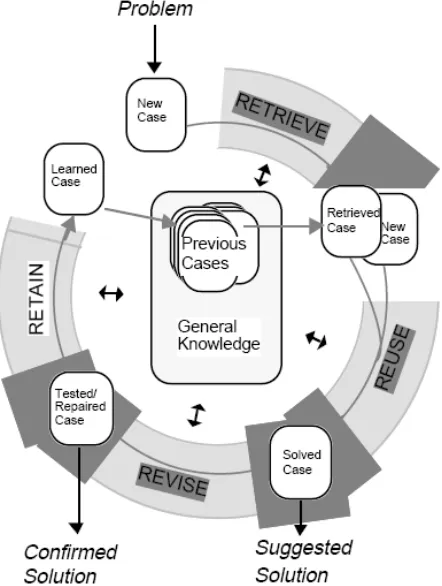
CBR follows a cyclic process which is sometimes referred to as the “four RE’s” (Aamodt and Plaza 1994) and can be seen below in Figure 2-5:
1. RETRIEVE the most similar cases;
During this process, the case based reasoner searches the database to find the most approximate case to the current situation.
2. REUSE the cases to attempt to solve the problem;
This process includes using the retrieved case and adapting it to the new situation. At the end of this process, the reasoner might propose a solution. 3. REVISE the proposed solution if necessary;
Since the proposed solution could be inadequate, this process can correct the first proposed solution.
4. RETAIN the new solution as a part of a new case.
This process enables case based reasoners to learn and create a new solution and a new case that should be added to the case base.
40
Figure 2-5 The case based reasoning cycle (Aamodt and Plaza 1994).
The first system implemented as a case based reasoner was CYRUS, developed by Janet Kolodner in the early 1980s. CYRUS was based on Schank’s dynamic memory model and memory organisation packets theory of problem solving and learning (Schank 1982). It was essentially a question-answering system, with knowledge of the various travels and meetings of a former US Secretary of State (Aamodt and Plaza 1994).
Problems
41
problem, but the major method of particular relevance to this study was the ripple down rules approach, and this was actually developed during the same period of history, with the first proposal being published in 1989 (Compton and Jansen 1989). This method was not originally intended as a case-based reasoning approach, but the overlaps are impossible to ignore, and it is the opinion of some that the ripple down rules approach is essentially case-based reasoning with the gaps filled in. It does this by providing an inference approach, and a structured knowledge base with which it is possible for the expert to demonstrate the features of a case which are significant to a particular classification (Kang and Compton 1994). This is to essentially say that “case-based reasoning” should be thought of as a method, or approach, rather than a technology (Watson 1999). Although these similarities can be drawn, it is felt that the subsequent paths these methods have taken in the past 10-15 years have rendered them mostly distinct, and the focus will now be directed back towards RDR, which is the more relevant method to this study.
2.3.2 Design
42
Using the sample knowledge base shown in Figure 2-6 we can also consider the inference process that is used in the RDR methodology. If we consider a sample case in which we have [X=5, Y=5, Z=10] then we will consider rule 1 initially and find that X>4 is true, so rule 2 will be considered. Y<3 is false, so rule 7 must be considered. The condition Z<9 is also false, but as there is no false branch deriving from rule 7 we have hit a dead end and as such will simply fire the last considered true statement, which sends us back to rule 1 because it was the last evaluated rule which returned true (Kang 1995). This process is illustrated in Figure 2-7.
Rule 0 TRUE Rule 1 IF X>4 ClassA Rule 2 IF Y<3 ClassB Rule 3 IF Z==3 ClassC Rule 4 IF X<3 ClassD Rule 5 IF Y<3 ClassB Rule 6 IF Z>8 ClassA Rule 7 IF Z<9 ClassE Rule 0 TRUE Rule 1 IF X>4 ClassA Rule 2 IF Y<3 ClassB Rule 3 IF Z==3 ClassC Rule 4 IF X<3 ClassD Rule 5 IF Y<3 ClassB Rule 6 IF Z>8 ClassA Rule 7 IF Z<9 ClassE
Figure 2-6 A simple RDR knowledge base, where arrows pointing upwards indicate the TRUE path
while arrows heading downwards indicate FALSE paths.
Figure 2-7 For a case [X=5, Y=5, Z=10] the emphasised rules are those which were evaluated,
[image:24.595.103.427.73.284.2]43
RDR, as described thus far, still encounters problems with maintainability. Particularly when adding a new rule you may still discover that the new rule has caused previously considered cases to become misclassified. Essentially, the rule is firing in the context as the expert has defined it when they created their rules, but these rules are not necessarily complete (or even correct), and as such some part of the context may be lost, so the rule is not guaranteed to have been created entirely in context.
However, with the RDR approach this problem was relatively simple to solve. The concept of “cornerstone cases”, cases which the knowledge engineers believed were somehow representative, had been considered previously in KBSs as a tool to help in creating valid new rules (Compton, Horn et al. 1989). This practice had previously been used only to assist in detecting the situations where a new rule might cause conflicts, not as a guarantee against them, but it was found that in RDR systems it was possible to guarantee knowledge base validity by simply storing and recalling one cornerstone case per rule.
44
2.3.3 Procedure
The beauty of RDR based approaches is revealed when you examine how the expert interacts with the system, gradually producing a more refined and complete knowledge base with which to encapsulate the given domain. The process is detailed in the set of steps below.
1. Expert loads a case.
2. The system interprets the case using the knowledge base so far, and presents its classification to the expert.
3. The expert assesses the classification provided.
a. If it is correct, accept it and return to step 1 to load another case. b. If it is incorrect, the expert will create a new rule as an exception to
produce the correct classification, then return to step 1 to load another case.
This process has lead RDR to be dubbed an “incremental knowledge acquisition” method.
2.3.4 Variations
As with most approaches in AI research, there are a range of variations and extensions to the RDR method. Several of these are mentioned here, but since they are more relevant to particular chapters of this thesis they will be discussed in more detail in those chapters.
Recursive RDR
RDR was modified by Mulholland in an attempt to make it suitable for a configuration style task, Ion Chromatography. This extension was entitled Recursive RDR and is discussed more completely in the Multiple Classification Ripple Round Rules chapter (Mulholland, Preston et al. 1993; Mulholland 1995).
Nested RDR
45
Hoffmann 2001). This is also discussed more thoroughly in the Multiple Classification Ripple Round Rules chapter.
Prudent RDR
In response to the perceived shortcomings of expert systems that lack common sense, prudent RDR was proposed. The idea behind prudent RDR is that the system should have some idea of its own shortcomings (Compton, Preston et al. 1996). It was observed that a well trained system might perform better than a trainee human expert, but that the trainee human expert would be better at identifying unusual situations in which they did not trust their knowledge. To approximate this behaviour it was attempted to add a facility to the RDR system such that it would be able to identify a case which is exceptional to its experience, and indicate a warning that the classifications it provides may not be reliable (Compton, Preston et al. 1996).
Induct RDR
Brian Gaines engaged in work to adapt his INDUCT algorithm to produce single classification RDR knowledge bases. This method has been used to train RDR systems from pre-classified case data which can then continue their training via a real expert using the same incremental knowledge acquisition process that normal RDR systems employ (Gaines and Compton 1992; Gaines and Compton 1995). It is particularly relevant to the work seen in the Simulation Studies chapter, and is discussed more fully therein.
2.3.5 Shortcomings
It has been seen that RDR has successfully solved the maintainability issues that plagued earlier KBSs, with the added benefit of removing the knowledge engineer from maintenance duties entirely. These benefits are substantial, but they do have a price. There are three major shortcomings with the RDR approach.
46
to those produced by automated machine learning methods such as C4.5 or ID3, which are typically much smaller than traditional rule-based methods (Kang 1995). Further to this, there is a problem by design. RDR is only designed to handle single classification tasks, so situations where more than one classification may apply to a given case must be handled by either multiple knowledge bases or through the declaration of compound classifications. Both these solutions are undesirable, with multiple knowledge bases requiring undue acquisition and maintenance, and with compound classifications potentially resulting in an exponential explosion of knowledge acquisition events to adequately classify (Compton, Kang et al. 1993; Kang 1995). These problems were effectively solved with the development of multiple classification RDR (Compton, Kang et al. 1993; Kang, Compton et al. 1995) which is discussed in detail below.
The final problem is that RDR does not allow the expert to define rules with any kind of intermediate classifications. That is, classifications cannot feed forward to another classification or, to express it differently, a classification cannot be treated as a fact and used to create a rule. This problem was addressed to varying extents with the developments of Recursive RDR (Mulholland, Preston et al. 1993) and Nested RDR (Beydoun and Hoffmann 1997) as mentioned above, which are highly relevant to one of the core contributions of this thesis and as such are discussed in detail in the literature section of the Multiple Classification Ripple Round Rules chapter.
2.4 Multiple Classification Ripple Down Rules
47
of classifications regularly on more complex domains the expert will start having to make many new rules, with overly specific sets of conditions, in order to correctly classify the case. So, in situations where a particular case is likely to have multiple classifications, single classification RDR will become an unwieldy choice (Compton, Kang et al. 1993; Kang, Compton et al. 1995).
To combat this problem a new approach was developed which aimed to preserve the essential philosophies and strategies that made RDR successful, but which was designed to elegantly handle multiple classification situations. This method was (creatively) entitled Multiple Classification Ripple Down Rules (MCRDR) (Kang, Compton et al. 1995; Kang 1995).
2.4.1 Design
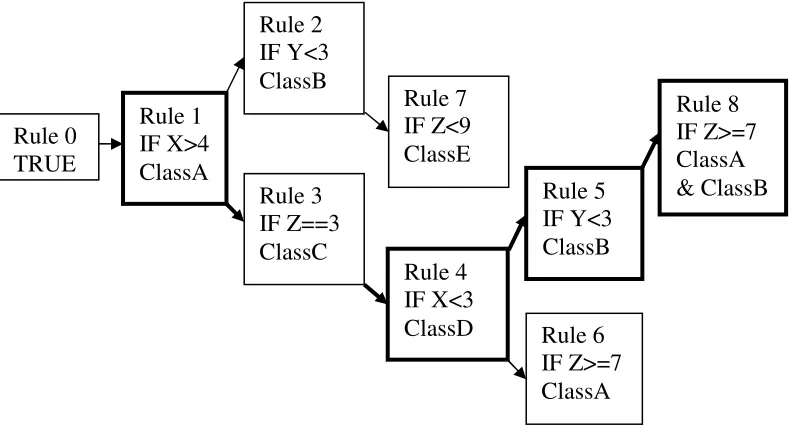
MCRDR preserves the essential strategies of RDR, but does of course deviate in a few key areas in order to provide multiple classification support.
Structure & Inference
[image:29.595.133.529.188.406.2]As has been discussed, RDR was designed to reach a particular classification then terminate the inference. With only one solution to find, once you have found the solution you should finish. However, to allow for multiple classifications without the use of compound classifications, it is necessary to find a classification then continue searching for other applicable classifications. This consideration
Figure 2-8 An example of a compound classification in RDR.
Rule 0
TRUE
Rule 1 IF X>4 ClassA
Rule 2 IF Y<3 ClassB
Rule 3 IF Z==3 ClassC
Rule 4 IF X<3 ClassD
Rule 5 IF Y<3 ClassB
Rule 6 IF Z>=7 ClassA Rule 7
IF Z<9 ClassE
48
necessitated a change in the overall structure and the inference approach utilised for MCRDR.
The binary tree structure was extended to become an exception based n-tree. With this structure all nodes at the first level (nodes which have the root as a parent) are evaluated. If a particular node’s rule is satisfied then any children it has will also be checked, and if they are satisfied then their children will be evaluated in turn, if they exist. Ultimately, the deepest satisfied nodes of the knowledge base will be added to the result list (Kang and Compton 1994; Kang, Compton et al. 1995; Kang 1995). This process of inference is very similar in many ways to that of a standard depth first search. An example of an MCRDR knowledge base is shown in Figure 2-9, which is a conversion of the RDR compound classification knowledge base example in Figure 2-8.
Reconsider the previous case example [X=4, Y=2, Z=7] which was meant to fire with the classifications ClassA and ClassB. We can see that it will reach ClassB from rule 5, as X<=4 is true which would fire ClassD, but the exception Y<3 will replace that. ClassA will be reached more simply via rule 6.
Knowledge Acquisition
The knowledge acquisition process in MCRDR follows a similar process as in single classification RDR, with a few simple differences to account for the fact that a case may require more than one classification.
1. Expert loads a case.
2. System provides a list of classifications based on the knowledge base to date.
Rule 0 – ROOT – always true 1
IF X>4 ClassA
2
IF Y<3 ClassB
7
IF Z<9 & Y>=3 ClassE
3
IF Z==3 ClassC
4
IF X<=4 & Z!=3 ClassD
5
IF Y<3 ClassB
6
IF X==4 & Z>=7 ClassA
Figure 2-9 The previous example of a compound classification RDR knowledge base
49 3. Expert assesses the classifications. 4. For each
a. Missing classification: the expert creates a new rule to add the missing classification.
b. Incorrect classification: the expert creates an exception rule to the incorrect classification to correct it.
5. When the case is classified correctly, return to step 1 with a new case.
When contrasted to single classification RDR’s knowledge acquisition process it is clear that it is effectively the same incremental knowledge acquisition process whereby the knowledge base is gradually improved. The process is very natural, being very much a process of trial and error. The system attempts to classify a case to the best of its understanding and wherever it fails, it asks the expert to explain why, such that it will not make the same mistake in the future. Although this process is simple and natural, the two steps (a) and (b) described above do bear further explanation.
There are three components required when creating a new rule. Firstly, the expert must express the desired classification to the system. This process is trivial; the expert simply has to state it to the system. However, it is undesirable that the expert creates two or more classifications to express the same thing, as this will artificially inflate the size of the list of classifications and may cause undesirable situations in the validation phase as described below (Kang 1995), so pains must be taken to ensure the expert is able to adequately recall the classifications they have created in the past in order to re-use them for future rules.
The second component is the rule location. This is also trivial. If the classification is missing then the rule that is created will be added to the root node of the knowledge base. In the case of a wrong classification, the new rule will be added as an exception to the node or nodes which are providing the wrong classification (Kang 1995).
50
required, which will potentially require further refinements of the rule (Kang 1995). This phase is outlined in the proceeding section.
Validation and Verification
The ability to easily guarantee and verify knowledge base correctness as the expert progressively added knowledge with RDR was a key feature of its success. It was seen that in order to preserve the integrity of the RDR method with MCRDR it was necessary to be able to give a similar such guarantee (Kang 1995).
With RDR this process was relatively simple, only having to store one cornerstone case for each rule created, and only ever having to check one cornerstone case per rule to ensure validity (Preston, Edwards et al. 1994). However, with multiple classifications the situation becomes a little more complex.
The basic principle of a cornerstone case in RDR is to point out a situation where the rule which the expert is trying to add would alter a previously accepted classification. So, the cornerstone case is the case whose classification is being retroactively altered by the new rule as it stands so far. In single classification RDR one can assume that if the previously accepted classification of the cornerstone case is being altered then it is an error, and the expert must select the relevant difference between the cornerstone case and the current case to remove this conflict (Preston, Edwards et al. 1994; Kang 1995). However, when considering multiple classifications new possibilities arise.
51
At this point it has been determined which cases are potentially cornerstone cases for a given new rule, but further to this you must also check that each of these potential cornerstone cases actually would fire on the new rule by checking the rule conditions. If it would fire, then the potential cornerstone case becomes an actual cornerstone case for this new rule and the expert must check the differences between the cornerstone case and the current case (Kang 1995). Through the use of this approach an assertion is being made that if a previous case’s classifications are changed by the addition of this new rule, then that previous case is to be used as a cornerstone case to help the expert validate this new rule.
When the expert is creating a new rule and is presented with one or more cornerstone cases they will be required to perform one of two actions for each cornerstone case. They must either select a relevant difference between the current case and the cornerstone case, to refine the rule and eliminate the cornerstone case as a potential conflict, or they must accept that the new rule should fire on the cornerstone case which signifies that they simply missed providing the associated classification when they examined that case previously. It should be noted that when refining a rule against a particular cornerstone case, it is entirely likely that multiple cornerstone cases will actually be eliminated through the refinement, so for each refinement the expert makes the list of applicable cornerstone cases should be re-evaluated until no more cornerstone cases apply to the new rule, or it has been accepted that they should (Kang 1995).
52
This is a suitable approach for reasonably simple domains where there is a small number of attributes in a given case, and the attribute value ranges are well defined, but has been shown to be impractical in some complex domains where the difference lists would be impractically large or where it would be difficult to determine suitable pivot points in numerical value ranges. However, in these situations simply showing the cases in question to the expert and allowing them to determine the relevant difference manually has been shown to be an adequate solution, as the well-trained expert generally has a good understanding of what the relevant differences are and does not need to pick them from a list (Richards and Compton 1997; Bindoff 2005; Compton, Peters et al. 2006).
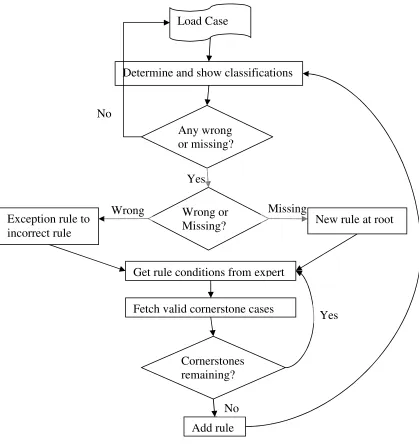
As was previously noted, the entire knowledge acquisition process outlined above includes verification and validation. The general knowledge acquisition cycle is illustrated diagrammatically in Figure 2-11.
Figure 2-10 The difference list approach (Kang 1995).
e
a f c d
b g
Cornerstone B
Cornerstone C Current Case A
Difference List between A and (B^C)
Difference List between A and C
Difference List between A and B
empty
53
2.4.2 Applications
Since its inception MCRDR has been applied to an interesting variety of domains, including but not limited to pathology, text/web document classification, medication review and help desk information retrieval (Kang, Yoshida et al. 1997; Park, Kim et al. 2004; Bindoff, Tenni et al. 2007).
[image:35.595.128.547.72.516.2]Of the many MCRDR applications that have been developed or trialled, some are better documented than others. Of those available a representative sample has been chosen to discuss with a little more detail.
Figure 2-11 The general MCRDR knowledge acquisition process.
Load Case
Any wrong
or missing?
Determine and show classifications
No
Wrong or Missing?
Yes
Wrong Missing
Exception rule to incorrect rule
New rule at root
Get rule conditions from expert
Fetch valid cornerstone cases
Cornerstones remaining?
Yes
54
Pathology
As has been previously discussed, the RDR method was tested on pathology domains via both of the GARVAN-ES1 dataset and the PEIRS project. It has also been noted that these domains did have situations where multiple classifications were desired, and that these situations were handled by compound classifications. In light of this, after the PEIRS system was taken offline in 1994 it was re-developed as a commercial MCRDR application in the form of LabWizard by Pacific Knowledge Solutions. This system is understood to have since grown to over 16000 rules at one site and is reported to have achieved a 99.5% rate of accurate classification on 80% of the entire pathology domain, with the only parts remaining unexplored being those that require the interpretation of complex data such as images (Compton, Peters et al. 2006; PKS 2009). Unfortunately since this is a commercial application, further details of the specifics of implementation are unavailable, but it is understood to be largely a traditional MCRDR application (Compton, Peters et al. 2006).
Perhaps the spiritual successor to this system is the system developed by this author, in which MCRDR was applied to the domain of medication review, of which there is a pathology interpretation component, but also combining medications, medical history and patient biography (Bindoff 2005). This work has been extended here, so more information can be found in the relevant Medication Review chapter.
Help Desk Document Retrieval
MCRDR was applied to indexing of cases in a help desk environment for UNIX users. This system used a string describing the user’s problem as a case, and then applied an MCRDR knowledge base and inference process to find appropriate help documents (Kang, Yoshida et al. 1997).
Document Classification and Web Monitoring
55
could relatively easily re-classify documents as the context shifted (Park, Kim et al. 2004; Park, Kim et al. 2004).
2.4.3 Variations
Much as MCRDR is an extension of the RDR method there have been several extensions and different versions of the MCRDR developed since its inception. These are outlined below.
Rated/Weighted Multiple Classification Ripple Down Rules
This extension to the MCRDR method was undertaken after it was observed that although an MCRDR system can correctly identify a series of classifications for a particular case, it is not able to model or provide any knowledge about the relationships between those classifications. Dazeley and Kang would suggest that because the expert has given a particular case a particular set of classifications that there must be a relationship between these classifications, even if it has not been expressed (Dazeley and Kang 2003). The example provided is an email classification system, such as the one developed by Deards (Deards 2001). In a situation where the user has created rules to classify work and spam emails, with one requiring immediate attention and one being safely ignored, it is conceivable that a situation might arise where they happen to receive a spam email selling something work related. The system will be capable of correctly classifying this case as being both work and spam, but Dazeley argues that it should be capable of suggesting the middle ground in this situation, perhaps marking the email as worth reading but with a low importance (Dazeley and Kang 2003).
The approach Dazeley suggests for how to do this in principle seeks to capture the relationships between these classifications. In practice it produces a value which attempts to model “worth” based on the particular classifications that are provided and/or the rule path that is followed (Dazeley and Kang 2003). To do this the resultant outputs of the MCRDR inference process and the current knowledge base are fed into an artificial neural network (these are discussed briefly in the Simulation Studies chapter).
MCRDR with Formal Concepts Analysis
56
extension was intended to allow knowledge reuse, by providing a visual insight into the knowledge (Richards 2000). This concept was then extended to allow the transfer of tacit knowledge between knowledge bases, which effectively allowed separate knowledge bases to be combined (Richards 2003).
Automatic Compression of MCRDR
An approach was outlined to automatically compress an MCRDR knowledge base into a more compact knowledge base by removing redundant rules. The authors were ultimately disappointed with the results of this approach when applied to a test domain “Ultra3700”, achieving a compression rate of only 10% without allowing negative conditions and only 25% when allowing negative conditions (Suryanto, Richards et al. 1999). Since their approach at compressing the knowledge base was fairly comprehensive, what this study in some ways suggested is the same as what similar attempts with other exception based knowledge representation structures have ultimately suggested – that these knowledge bases are inherently already quite compact by design, despite the potential for repetition.
Discovering Ontologies from Knowledge Bases
57
Bayesian Threshold with MCRDR (BayesTH-MCRDR)
Cho and Richards proposed an extension to the naive Bayesian method (discussed briefly in the Simulation Studies chapter) which included MCRDR. Their essential strategy was to use the machine learning strategy - naive Bayes with threshold - to learn a classification task, but under circumstances where the difference between two or more of the highest probability classes was low, or the highest probability class was still very low, the user was asked to intervene. This approach did demonstrate an improvement in accuracy on a web document classification task over other methods tested (Cho and Richards 2004).
Exposed MCRDR
This variation of the MCRDR approach was trialled as a tool to allow experts in lung function research to discover new knowledge about their domain, and is considered a knowledge discovery method. With this approach the expert is effectively allowed to create and destroy rules at a whim in order to see how these rules perform. The essential idea is that the expert will trial rules that they suspect, for whatever reason, might successfully classify a particular feature of the data. The system then provides feedback telling them what level of overlap the new rules results have with the existing methods of classifying that feature. Through this process the expert is able to discover new ways of reaching classifications. In this style of domain this is important, since every additional test the lung function expert must order costs a considerable amount of money, so being able to reach classifications with fewer tests is highly desirable (Ling 2006).
Interactive Recursive RDR
58
Resource Allocation RDR
In 1999 Richards and Compton published a document describing an adaptation of the MCRDR approach in order to apply it to a specific resource allocation task, Sisyphus-I (Richards and Compton 1999). The Sisyphus-I problem is a room allocation task whereby employees of a research facility must be allocated to rooms which they will find acceptable. Complications are added by giving various employees preferences on the types of employees they share rooms with or are located near to, as well as requirements on office sizes. The system proposed handled the problem quite elegantly, but was let down in two areas. Although the task appears complex there are solutions which require no or very little staff shuffling, so a robust approach to recursive solving of configurations was not required. As well as this, the system proposed was not very generally applicable, as it was designed very much with the Sisyphus-I task in mind (Richards and Compton 1999). However, this work encouraged more thought as to how the RDR approach might be more generally applied to configuration tasks which contributed strongly to the Repeat Inference MCRDR proposal which is outlined below.
Repeat Inference MCRDR
Few working systems can really come under the banner of Repeat Inference MCRDR. The term is poorly defined, but appears to have been derived from publications which proposed extensions to RDR in light of experiences with the Ion Chromatography and Sisyphus-I systems which were described earlier (Mulholland 1995; Compton and Richards 1999; Compton and Richards 2000). The approach proposed is in many ways similar to the Nested RDR approach if it were applied to MCRDR knowledge bases, although there are some key differences. These proposals were then refined in the later proposal for Generalised RDR which is discussed briefly below, although again a more thorough discussion of these topics can be found in the Multiple Classification Ripple Round Rules chapter.
Generalised RDR
59
2004; Singh and Compton 2005). This approach is again discussed comprehensively in the Multiple Classification Ripple Round Rules chapter.
2.4.4 Shortcomings
It is clear from the simple fact that those in the community saw fit to create the variations of MCRDR above that it has some shortcomings. The particular trends we see above include projects that seek to get more information out of the knowledge base, and projects that seek to get more information out of the particular group of classifications.
In fact, the shortcomings of MCRDR are largely the same as those of RDR: - - Potentially repeated knowledge.
o Except the knowledge is in a different context, so is it really repeated? And the level of repetition has been shown to be generally slight (Kang 1995; Suryanto, Richards et al. 1999).
- It encourages the expert to produce poorly defined domains, particularly in regards to the classifications.
o Although this seems inevitable in many situations, as one only has to look at work on ontologies to know that it is very difficult to fully define a domain beforehand (Van Heijst, Schreiber et al. 1997). - It is impossible to truly infer knowledge. That is, one cannot define a rule
that fires in the presence (or lack thereof) of another classification or classifications.
o As seen in the Variations section a fair body of work exists that deals with this issue, although this is discussed in far greater detail in the Multiple Classification Ripple Round Rules chapter where a new approach to this problem is described and evaluated.
60
knowledge, no true machine learning approach for MCRDR has been described and evaluated. This is discussed in greater detail in the Simulation Studies chapter, where a more robust (in terms of errors) machine learning approach for MCRDR is described and evaluated.
61
3 Medication Review
Sub-optimal drug usage is a serious concern in both Australia and overseas (Bates, Cullen et al. 1995; Peterson 2004), particularly with the elderly, resulting in at least 80,000 hospital admissions annually - approximately 12% of all admissions and reflecting a cost of about $400 million annually (Peterson 2002). In an attempt to counter this problem Australian government and pharmaceutical officials instigated both the Residential Medication Management Reviews (RMMRs) and the Home Medicines Review (HMR) schemes. The basis of these schemes is that pharmacists are now remunerated via a nationally funded program for conducting medication reviews for nursing home, hostel and selected high risk patients (Peterson 2002). Medication reviews are seen as an effective way to improve drug usage, with medication reviews conducted by pharmacists being found to be better than those conducted by general practitioners, leading to more medication changes and higher savings in medication costs (Anon. 2001; Zermansky, Petty et al. 2001). The remuneration offered in the medication review schemes is shown to be effective in increasing interest from pharmacists in undertaking medication review roles (Peterson 2002). However, many community-based pharmacists are still unwilling to undertake this new role, citing reasons including fear of error and a lack of confidence, while the quality of service provided by those who have is by no means standardised (Rigby 2004). Further to this, there is anecdotal evidence suggesting an inadequate number of medication reviews are being done, with all residents of a nursing home or aged accommodation facility being entitled to at least one medication review per year. Yet, with over 220,000 residents of these facilities in Australia (Australian Bureau of Statistics 2003) and each case taking “between 2 and 4 hours” (Tenni 2005), there are simply not enough pharmacists offering medication reviews to cope with the demand.
![Figure 2-7 For a case [X=5, Y=5, Z=10] the emphasised rules are those which were evaluated, while the highlighted rule is the one which ultimately fired](https://thumb-us.123doks.com/thumbv2/123dok_us/8430339.331767/24.595.103.427.73.284/figure-case-emphasised-rules-evaluated-highlighted-ultimately-fired.webp)