Lifting Integrity Constraints in Binary Aggregation
∗
Umberto Grandi
†and Ulle Endriss
Institute for Logic, Language and Computation
University of Amsterdam
Postbus 94242, 1090 GE Amsterdam
The Netherlands
[email protected], [email protected]
Abstract
We consider problems in which several individuals each need to make a yes/no choice regarding a number of issues and these choices then need to be aggregated into a collective choice. Depending on the application at hand, different combinations of yes/no may be considered rational. We describe rationality assumptions as integrity constraints using a simple propositional language and we explore the question of whether or not a given aggregation procedure will lift a given integrity constraint from the individual to the collective level, i.e., whether the collective choice will be rational whenever all individual choices are.
Keywords:collective decision making, computational social choice, multi-issue domains, combi-natorial vote, judgment aggregation.
1
Introduction
Social Choice Theory (SCT) is the study of mathematical models for collective decision making. In recent times, this discipline has received increasing attention in Artificial Intelligence (AI), as testified by a large number of papers on social choice at the major AI conferences and by the creation of an entirely new research agenda under the name of Computational Social Choice (Chevaleyre et al., 2007). There are several good reasons for this trend. On the one hand, a number of methods developed in AI and, more generally, in Computer Science have turned out to be useful to deepen our understanding of social choice and, in some cases, can even suggest an entirely new perspective on classical problems. Examples include the complexity-theoretic analysis of optimisation problems arising in social choice (Faliszewski et al., 2009; Faliszewski and Procaccia, 2010) and the creation of new choice procedures inspired by classical techniques in knowledge representation (Lang et al., 2011). On the other hand, methods from SCT have natural important applications in AI. They can, e.g., be employed to achieve consensus amongst the autonomous software agents in a multiagent system (Shoham and Leyton-Brown, 2009), to aggregate the output of several search engines (Altman and Tennenholtz, 2008), or to inform the design of online recommender systems (Pennock et al., 2000). One particular problem of interest for AI is the case of
social choice in combinatorial domains, in which the space of alternatives from which the individuals have to choose has a multi-attribute structure (Lang, 2004; Chevaleyre et al., 2008). Classical examples include voting in multiple referenda, where we have to decide which of a set of propositions to accept, or electing a committee, where we have to decide how to fill each seat. There have been several attempts to tackle the high complexity that arises in this context by using tools from AI, such as methods for
∗To appear onArtificial Intelligence. Accepted in May 2013.
†Corresponding author. Current affiliation: Department of Mathematics, University of Padova, Via Trieste 63, 35121
modelling preferences inspired by knowledge representation (Lang and Xia, 2009; Rossi et al., 2004). Finally, SCT provides tools for the analysis of collective choices of groups of agents, and as such is of immediate relevance to the study of multiagent systems.
A central problem in SCT, and, in view of our previous discussion, in all its applications to AI, is the problem of aggregation: Suppose a group of agents each supply a particular piece of information regarding a common problem and we want to aggregate this information into a collective view to obtain a summary of the individual views provided. A classical example is that of preferences (Arrow, 1963): each agent declares their individual preferences over a set of alternatives by providing an ordering over this set, and we are asked to amalgamate this information into a collective ranking that represents the individual preferences provided. The same methodology has also been applied more recently to a number of other types of information, such as beliefs (Konieczny and Pino P´erez, 2002, 2011) and judgments (List and Puppe, 2009).
One of the main features of the study of aggregation is the problem of collective rationality: given a rationality assumption that bounds the choices of the individuals, we ask whether the output of an aggregator still satisfies the same rationality assumption. To understand this problem better, consider the following example: three autonomous agents need to decide on whether to perform a collective action. This action is performed if two parameters are estimated to exceed a certain threshold. We can model the choice situation with a multi-attribute domain in which there are three issues at stake: “the first parameter is above the threshold” (T1), “the second parameter is above the threshold” (T2), and “the
action should be performed” (A). The rationality assumption that links the three issues together can be modelled using a simple propositional formula, namelyT1∧T2→A. The individual views on the three
issues are then aggregated using themajority rule, which accepts an issue if a majority of the individual agents do. Consider now the following situation:
T1 T2 A
Agent 1: Yes Yes Yes
Agent 2: No Yes No
Agent 3: Yes No No
Majority: Yes Yes No
In the situation described above the collective actionAis not performed, even though a majority of the individuals think that the first parameter exceeds the threshold and a (different) majority agree that also the second parameter exceeds the threshold. Situations like the one above are considered paradoxical: even if each individual agent is rational (i.e., each of them satisfies the rationality assumption), the collective view derived using the majority rule is not. That is, the majority rule fails tolift the integrity constraintT1∧T2→Afrom the individual to the collective level. This example shows that the majority
rule violates collective rationality in certain specific cases. Similar examples can be devised for a number of different situations ranging from voting to rank aggregation, to the development of a collective judgment in court cases.
In this paper we put forward a general framework that encompasses most of the classical studies of collective rationality in SCT, and that can prove useful to diverse research areas in AI. We base our framework on binary aggregation, in which individuals are required to choose from a multi-issue domain where issues represent different binary choices. Classical frameworks for the study of aggregation, such as preference and judgment aggregation, can be embedded in this framework. We model rationality assumptions using a simple propositional language, and we give a precise definition of collective rationality with respect to a given rationality assumption. We classify rationality assumptions with respect to their syntactic properties, and we give a systematic treatment of the question of how to relate collective rationality with respect to a syntactically defined sublanguage to classical axiomatic properties from SCT. For instance, we have already seen that the majority rule is not collectively rational with respect to the integrity constraint T1∧T2 →A. It is also not collectively rational with respect to the 3-clause
T1∨T2∨A: to see this, consider a scenario with three agents, where each agent accepts exactly one
issue, and no two agents accept the same issue. On the other hand, as we shall see, any 2-clause will always be lifted, i.e., the majority rule is collectively rational with respect to the language of 2-clauses. We will then be able to describe the majority rule in terms of classical axioms (see Proposition 2) or in terms of the subset of integrity constraints it lifts (see Theorem 28). It is results of this kind that we shall explore in depth in this paper, establishing a link between standard axiomatic requirements from SCT and collective rationality with respect to fragments of the propositional language.
This paper expands our initial work on this topic (Grandi and Endriss, 2010), complementing it with further results from previous work (Grandi and Endriss, 2011; Grandi, 2012b,a).
The paper is organised as follows. We begin by defining the basic notions that constitute the frame-work of binary aggregation with integrity constraints in Section 2. In this section, we give the crucial definition of collective rationality with respect to an integrity constraint expressed in a suitable propo-sitional language, and we list several axiomatic properties adapted from the literature on SCT. We also provide several examples of aggregation problems that can be modelled in binary aggregation with in-tegrity constraints, such as multi-issue elections, preference aggregation, judgment aggregation, and the problem of choosing from a set of candidates. In Section 3 we define the notion of language for integrity constraints, and we prove this to be the correct definition for the study of collective rationality (see Lemma 6). We then define classes of aggregation procedures both in terms of collective rationality and by using classical axiomatic requirements. We study the properties of these two means of defining classes of procedures, developing a theoretical machinery that enables us to provide a systematic treatment of the relation between propositional languages for integrity constraints and axiomatic properties. This is done in the two following sections. In Section 4 we characterise in axiomatic terms, for several fragments of the propositional language, the class of collectively rational procedures with respect to formulas in this fragment. In Section 5 we start from classical axiomatic properties, and we explore to what extent classes of aggregation procedures defined in these terms can be characterised as classes of collectively rational procedures for a given language. We provide negative results for three important axioms taken from the literature on SCT. These three axioms can be combined to obtain an interesting class of pro-cedures known as quota rules, defined by the choice of an acceptance quota for every issue. In Section 6 we concentrate on this particular class. We give precise bounds on the acceptance quotas to guarantee collective rationality with respect to integrity constraints that belong to given languages of clauses, i.e., disjunctions of literals. This includes a characterisation of the set of integrity constraints that are lifted by the majority rule (see Theorem 28). We discuss the significance of our results and their relation to classical frameworks of aggregation in Section 7. Related work is discussed in Section 8 and Section 9 concludes.
2
Basic Definitions
a mean of specifying the set of individual ballots to be considered rational. We then present a list of examples from both practical applications and classical frameworks of aggregation that can be modelled in our framework. Finally, we state the crucial definition of collective rationality and we review the classical axiomatic method for binary aggregation procedures. We conclude by axiomatising the class of quota rules and the majority rule over binary combinatorial domains.
2.1
Binary Aggregation with Integrity Constraints
Let I = {1, . . . , m} be a finite set ofissues, and let D = D1× · · · ×Dm be a boolean combinatorial
domain, i.e., |Di| = 2 for all i ∈ I (we assume Di = {0,1}). Let N = {1, . . . , n} be a finite set of
individuals and we assume |N | >1. A ballot B is an element of D. A profile B = (B1, . . . , Bn) is a
vector of ballots, one for each individual inN. We writebj for thejth element of a ballotB, andbi,j for
thejth element of ballotBi within a profileB= (B1, . . . , Bn).
Definition 1. Given a finite set of issuesI and a finite set of individuals N, an aggregation procedure
is a function F :DN → D, mapping each profile of binary ballots to an element of D.1
LetF(B)j denote the result of the aggregation on issue j. Note that we do not put any restriction on
the domain on which aggregation procedures are defined, i.e., Definition 1 includes a requirement known asuniversal domain.
If I is a set ofm issues, letPS={p1, . . . , pm} be a set of propositional symbols, one for each issue,
and letLPSbe the propositional language constructed by closingPSunder propositional connectives. For any formulaϕ∈ LPS, let Mod(ϕ) be the set of assignments that satisfyϕ. For example, Mod(p1∧ ¬p2) =
{(1,0,0),(1,0,1)}ifPS={p1, p2, p3}.
Definition 2. An integrity constraintis any formulaIC∈ LPS.
Integrity constraints can be used to define what tuples in D we consider rational choices. Any ballot
B ∈ D is an assignment to the variables p1, . . . , pm, and we call B a rational ballot if it satisfies the
integrity constraintIC, i.e., ifBis an element of Mod(IC). A rational profile will be therefore an element of Mod(IC)N. In the sequel we shall use the terms “integrity constraints” and “rationality assumptions” interchangeably.
2.2
Examples
In line with the example presented in the introduction, let us consider several other aggregation problems that can be modelled in binary aggregation by devising a suitable integrity constraint:
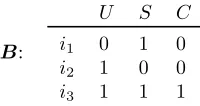
Example 1. (Multi-issue elections under constraints) A committeeN has to decide on each of the three following issues: (U) financing a new university building, (S) financing a sports centre, (C) increasing catering facilities. As an approval of both a new university building and a sports centre would bring an unsustainable demand on current catering facilities, it is considered irrational to approve both of the first two issues and to reject the third one. We can model this situation with a set of three issues I ={U, S, C}. The integrity constraint representing this rationality assumption is the following formula: pU∧pS →pC. To see an
example of a rational profile, consider the situation described in Table 1 for the case of a committee with three members. All individuals are rational, the only irrational ballot being
B = (1,1,0).
1In this definition we represent profiles as functions from the set of individualsN to the domainD, indicating the set
of all profiles withDN. Given that in this paper the set of individuals is finite, profiles can also be represented as tuples of
B:
U S C
i1 0 1 0
i2 1 0 0
[image:5.612.248.348.89.142.2]i3 1 1 1
Table 1: A rational profile forpU∧pS →pC.
Example 2. (Preference aggregation) A set N of individuals has to agree on a ranking of three alternativesa,bandc. Each individual submits its own ranking of the alternatives from the most preferred to the least preferred, e.g., b > a > c. We can model this situation using a binary issue for every pair of alternatives: issueab stands for “alternativeais preferred to alternativeb”. The set of issues is thereforeI={aa, bb, cc, ab, ba, bc, cb, ac, ca}. However, not every binary evaluation over this set of issues corresponds to a ranking. An integrity constraint needs to be devised to encode the correct properties of the binary relation: transitivity, completeness and irreflexivity. This can be done by considering the following set of integrity constraints IC<:
Irreflexivity: ¬pxx for allx∈ {a, b, c}
Completeness: pxy∨pyx for allx, y∈ {a, b, c}distinct
Transitivity: pxy∧pyz→pxz forx, y, z∈ {a, b, c} pairwise distinct
These formulas can be easily modified to account for different representations of preferences that are closer to applications in AI, e.g., partially ordered preferences (Pini et al., 2009).
Example 3. (Judgment aggregation) A court composed of three judges has to decide on the liability of a defendant under the charge of breach of contract. According to the law, the individual is liable if there was a valid contract and her behaviour was such as to be considered a breach of the contract.2 The court takes three majority decisions on the following
statements: there was a valid contract (α), the individual broke the contract (β), the defendant is liable (α∧β). We can model this situation using a set of six issues I={α,¬α, β,¬β, α∧
β,¬(α∧β)}to model the decision of a judge on the three issues at stake, and create a set of integrity constraints that reflect the consistency of a possible verdict by explicitly ruling out every inconsistent set that can be created using issues inI:
Inconsistent sets of size 2: ¬(px∧p¬x) for allx∈ {α, β, α∧β},
¬(pα∧β∧p¬α) and¬(pα∧β∧p¬β)
Inconsistent set of size 3: ¬(p¬(α∧β)∧pα∧pβ)
Situations like the one described in this example are the subject of a wide literature in SCT under the name ofjudgment aggregation(List and Puppe, 2009). We refer to our previous work (Grandi and Endriss, 2011; Grandi, 2012a) for more details about the correspondence between judgment aggregation and our framework of binary aggregation with integrity constraints.
Example 4. (Choosing from a set of candidates) A winning candidate has to be chosen from a set C={1, . . . , m} by an electorateN. Let the set of issues beI =C. If we are using an aggregation procedure likeapproval voting (Brams and Fishburn, 2007), in which individuals are submitting a set of candidates they approve of, then we can model the situation without any integrity constraint, since every binary ballot over I corresponds to a set of candidates. If instead we want to consider more restrictive ballots, like in the case of theplurality rule in which each individual submits only its favourite candidate, then we need to devise an integrity
constraint that forces each individual to approve a single candidate in the list. This can be done by taking the disjunction of all possible ballots:
(p1∨ ¬p2∧ · · · ∧ ¬pm)∨(¬p1∧p2∧ · · · ∧ ¬pm)∨ · · · ∨(¬p1∧ · · · ∧ ¬pm−1∧pm)
The voting rule known ask-approval voting, in which individuals submit a set ofkapproved candidates, can be modelled in a similar fashion.
2.3
Collective Rationality
Consider the situation introduced in Example 1: There are three issues at stake, and the integrity constraint is represented by the formula IC = pU ∧pS → pC. Suppose there are three individuals,
choosing ballots (0,1,0), (1,0,0) and (1,1,1), as in Table 1. Their choices are rational (they all satisfy
IC). Assume now we accept an issuej if a majority of individuals do, employing what we will call the
majority rule. We would then obtain as an outcome of this profile the ballot (1,1,0), which fails to be rational. This kind of observation, like the one presented in the introduction, is often referred to as a paradox.
In the literature on SCT, situations like the one above are ruled out by requiring aggregation proce-dures to satisfy a property calledcollective rationality, which forces the output of an aggregation procedure to be of the same form of the input, i.e., a rational ballot. In preference aggregation, for instance, the output of an aggregation procedure is required to be a linear (or weak) order over a set of alternatives (Arrow, 1963). In judgment aggregation the output is required to be a consistent judgment over a set of propositional formulas (List and Puppe, 2009). Here we give a general definition of collective rationality depending on the integrity constraint at hand:
Definition 3. Given an integrity constraintIC∈ LPS, an aggregation procedure F :DN → D is called collectively rational (CR) with respect to IC, if for all rational profiles B ∈ Mod(IC)N we have that F(B)∈Mod(IC).
Thus, F is CR if it lifts the rationality assumptions given by IC from the individual to the collective level. An aggregation procedure that is CR with respect to ICcannot generate a paradox with IC as integrity constraint.
Inspired by Definition 3, we can give a general definition of paradoxical behaviour of an aggregation procedure in terms of the violation of certain rationality assumptions:
Definition 4. A paradox is a triple (F,B,IC), where F :DN→D is an aggregation procedure, B is a
profile inDN,
ICis an integrity constraint inLPS, andBi∈Mod(IC)for alli∈ N butF(B)6∈Mod(IC).
This notion of paradox encompasses many of the classical paradoxes of aggregation studied in SCT. A shown by the examples presented in the previous section, preference and judgment aggregation, as well as other frameworks for collective decision making, can be modelled in binary aggregation by devising suitable integrity constraints. In previous work (Grandi, 2012b) we bring this correspondence one step further by showing how paradoxical situations traditionally studied in SCT, such as the Condorcet para-dox in preference aggregation (Arrow, 1963) and the discursive dilemma in judgment aggregation (List and Puppe, 2009), can be viewed as particular instances of our Definition 4.
2.4
The Axiomatic Method
Aggregation procedures are traditionally studied using the axiomatic method. Axioms are used to express desirable properties of a procedure, depending on the application at hand. In this section, we adapt the most important axioms familiar from standard SCT, and more specifically from judgment aggregation (List and Puppe, 2009) and binary aggregation (Dokow and Holzman, 2010a), to our setting. LetX ⊆ DN
Unanimity (U): For any profileB∈ X and anyx∈ {0,1}, ifbi,j=xfor alli∈ N, thenF(B)j=x.
Issue-Neutrality (NI): For any two issues j, j0 ∈ I and any profile B ∈ X, if for all i∈ N we have that bi,j=bi,j0, thenF(B)j=F(B)j0.
Independence(I): For any issuej∈ I and any two profilesB,B0∈ X, ifbi,j=b0i,j for alli∈ N, then
F(B)j =F(B0)j.
Anonymity(A): For any profileB∈ Xand any permutationσ:N → N, we have thatF(B1, . . . , Bn) =
F(Bσ(1), . . . , Bσ(n)).
Unanimity postulates that, if all individuals agree on issuej, then the aggregation procedure should im-plement that choice forj. Anonymity requires the procedure to be symmetric with respect to individuals. Issue-neutrality (a variant of the standard axiom of neutrality introduced in the literature on judgment aggregation) asks that the procedure be symmetric with respect to issues. Finally, independence requires the outcome of aggregation on a certain issuej to depend only on the individual choices regarding that issue.
It is important to remark that all axioms are domain-dependent, as testified by the domain restriction given byX. For instance, many aggregation procedures, such as the majority rule, are independent over the full set of profilesX =DN, while others, such as the one presented in the next example, are not.
With two issues, letIC= (p2→p1) and letF be equal to the majority rule on the first issue, and accept
the second issue only if the first one was accepted and the second one has the support of a majority of the individuals. This procedure is not independent on the full domain, but it is easy to see that it satisfies independence when restricted toX = Mod(IC)N. As in the previous example, in the following sections
we will specify restrictions on the domain of aggregation by means of propositional formulas.
As a generalisation of the axiom of neutrality introduced by May (1952), we introduce the following axiom:
Domain-Neutrality (ND): For any two issuesj, j0 ∈ I and any profileB∈ X, ifbi,j= 1−bi,j0 for all
i∈ N, thenF(B)j = 1−F(B)j0.
The two notions of neutrality are uncorrelated but dual: issue-neutrality requires the outcome on two issues to be the same if all individuals agree on these issues; domain-neutrality requires it to be reversed if all the individuals make opposite choices on the two issues.
We now introduce two axioms of monotonicity. The first, which we call independence-monotonicity, is often called positive responsiveness and is formulated as an (inter-profile) axiom for independent ag-gregation procedures. The second version of monotonicity is designed for neutral procedures, and it was introduced in our previous work (Endriss et al., 2010):
I-Monotonicity(MI ): For any j∈ I and any two profilesB andB0 in X, ifbi,j = 1 entailsb0i,j = 1
for all i ∈ N, and for some s ∈ N we have that bs,j = 0 and b0s,j = 1, then F(B)j = 1 entails
F(B0)j= 1.
N-Monotonicity (MN ): For anyj, j0 ∈ I and profile B ∈ X, if for all i∈ N we have that b i,j = 1
entails bi,j0 = 1 and for some s∈ N we have that bs,j = 0 andbs,j0 = 1, then F(B)j = 1 entails
F(B)j0 = 1.
That is, MI expresses that if an issue j is collectively accepted and receives additional support (from
an individual i), then it should continue to be collectively accepted. Axiom MN says that if issue j is collectively accepted and issue j0 is accepted by a strict superset of the individuals accepting j, thenj0
should also be collectively accepted.
profile. This notion is in clear contrast with the axiom of anonymity previously introduced. In Definition 9 we will generalise this notion by defining the class ofgeneralised dictatorships as those procedures that copy the ballot of a possibly different individual in every profile.
2.5
Quota Rules
An aggregation procedure F for n individuals is a quota rule if for every issue j there exists a quota 0 6 qj 6 n+ 1 such that, if we denote by NjB = {i | Bi,j = 1}, then F(B)j = 1 if and only if
|NjB|>qj. The class of quota rules, which we denoteQR, was introduced by Dietrich and List (2007b)
in the framework of judgment aggregation. Adapting a result by Dietrich and List (2007b, Theorem 1) we obtain the following axiomatisation of the class of quota rules:3
Proposition 1. An aggregation procedureF satisfiesA,I, andMI on the full domainDN if and only if
it is a quota rule.
A quota rule is called uniform if the quota is the same for all issues. By adding the axiom of issue-neutrality to Proposition 1 we immediately get an axiomatisation of this class.
A particular quota rule, which we study in detail in Section 6.2, is the majority rule. This rule, in case the number of individuals is odd, is the uniform quota rule with quotaq=n+12 . It is interesting to link these results with May’s Theorem (1952) on the axiomatic characterisation of the majority rule in voting theory. We can complement his result (which deals with the case of a single issue) by adding the axioms of domain-neutrality and issue-neutrality to Proposition 1 and considering the case of multiple binary issues. Under these assumptions, by issue-neutrality the quota must be the same for all issues, and by domain-neutrality the two setsNB
j andN \NjB must be treated symmetrically. Hence, the only
possibility is to have a uniform quota of n+12 .
Proposition 2. If the number of individuals is odd and|I|>2, an aggregation procedureF satisfies A,
NI,ND,I andMI on the full domainDN if and only if it is the majority rule.
3
Classes of Aggregation Procedures
In this section we introduce two definitions for classes of aggregation procedures on binary combinato-rial domains. Given a restriction on the propositional language in which integrity constraints can be expressed, we first define the class of procedures that are collectively rational with respect to all integrity constraints in the given restricted language. On the other hand, we consider a list of classical axiomatic properties and define the class of procedures that satisfy such axioms on domains defined by formulas in the given language. We study the properties of these two definitions, preparing the ground for character-isation results that will establish a strong link between requirements of collective rationality and classical axiomatic properties.
3.1
Collective Rationality and Axiomatic Properties
Recall that a binary aggregation problem is given by a set of agents N having to take a decision on which combination of binary issues inI to choose. Depending on the situation at hand, a subset of such combinations is designated as the set of rational choices, and this is specified by means of a propositional formula in the languageLPSassociated withI. We calllanguage any subsetLofLPS. Examples include the set of atomsPS, or the set of formulas of a given size, as well as more classical fragments obtained by restricting the set of connectives that can be employed in the construction of formulas, like the set of clauses obtained from the set of literals using only disjunctions. In Section 2.3 we called an aggregation procedure collectively rational with respect to a formula IC ∈ LPS if the outcome on every rational
profile satisfies the same integrity constraintIC. We now extend this definition to collectively rational procedures with respect to a given languageL:
Definition 5. Given a language L ⊆ LPS, call CR[L] the class of aggregation procedures that lift all IC∈ L:
CR[L] := {F:DN → D | N is finite and F is CR for all
IC∈ L}.
Note that in this definition we do not fix the number of individuals, makingI the only parameter that is fixed in advance. This choice is arguably a natural one, as a decisionproblem is usually defined before specifying the number of individuals that are going to take part in the decision process. However, its appeal does not only reside in its practical use; rather it is a mathematical assumption that allows us to gain more clarity in some of the results that follow.4
The next step is to introduce notation for defining classes of aggregation procedures in terms of classical axioms like the ones we listed in Section 2.4. Recall from Section 2.4 that an axiom may be satisfied on a specific subdomain of interestX, but not on the full domainDN. Here, we are interested
in domains defined by means of integrity constraints (i.e., propositional formulas), as this is interpreted as the domain of rational ballots. We therefore need some notation to identify procedures that satisfy an axiom on the subdomain Mod(IC)N induced by a given integrity constraint
IC. We give the following
definition:
Definition 6. An aggregation procedureF satisfies a set of axioms AX wrt. a language L ⊆ LPS, if F
satisfies the axioms in AX onMod(IC)N for all constraintsIC∈ L. This defines the following class:
FL[AX] := {F :DN→D | N is finite andF satisfies AXon Mod(IC)N for all IC∈ L}
In particular, F ={F :DN → D | N is finite} is the class of all aggregation procedures for a given set
of issues I. In the sequel we shall omit mentioning explicitly that N is finite, keeping it as a general underlying assumption.
3.2
Languages for Integrity Constraints
In this section we study the behaviour of the classes defined in the previous section with respect to set-theoretic and logical operations performed on the languages and on the axioms. In particular, we give a definition of language for integrity constraints that is specific to the study of collectively rational procedures.
Let L be a language. Define L∧ to be the closure of L under conjunction, i.e., the set of finite
conjunctions of formulas inL. We now prove that the class of collectively rational procedures is invariant under closing the language under conjunction, i.e., that the set of collectively rational procedures forL and forL∧ coincide:
Lemma 3. CR[L∧] =CR[L] for allL ⊆ L
PS.
Proof. CR[L∧] is clearly included in CR[L], since L ⊆ L∧.5 It is then straightforward to observe that if
an aggregation procedureF lifts every constraint inL, then it lifts any conjunction of formulas inL. This lemma entails that different languages for integrity constraints can define the same class of CR procedures. For instance, we have that the language of cubes (conjunctions of literals) generates the same class as the language of literals, i.e., CR[cubes] = CR[literals], since the former is obtained from the latter by closing it under conjunction. Another interesting fact is that procedures that are CR with respect to clauses (disjunctions of literals) are CR with respect toany integrity constraint in LPS, i.e.,
4Many of our results, e.g. Theorems 10 and Corollary 20, still hold if we fix the number of individuals in Definition 5,
as shown in our previous work (Grandi and Endriss, 2010).
CR[clauses] = CR[LPS]. This holds because every propositional formula is equivalent to a formula in conjunctive normal form (CNF), where it is expressed precisely as a conjunction of clauses.
We have just proven that the class CR[L] is invariant under closing the language under conjunction. Another such property is the closure under logical equivalence. Recall that two formulas are logically equivalent when they share the same set of models. Let us indicate withL≡ the set of formulas inL
PS that are equivalent to a formula inL. It is important to stress the fact that we consider logical equivalence
insidethe languageLPS, not allowing the use of additional propositional variables. We have the following lemma:
Lemma 4. CR[L≡] =CR[L]for allL ⊆ L
PS.
The proof of the lemma is straightforward from our definitions. It is sufficient to observe that an equivalent formulation of our definition of collective rationality can be given by substituting formulas with the set of rational ballots given by their models. Two formulas that are logically equivalent have the same set of models, giving rise to the same requirement of collective rationality.6
Bringing together the results of Lemmas 3 and of Lemma 4, we can now give the following definition:
Definition 7. A language for integrity constraintsLis a subset ofLPS that is closed under conjunction
and logical equivalence.
In the following sections we characterise languages for integrity constraints by means of syntactic prop-erties, without mentioning explicitly the closure under conjunction and logical equivalence. For instance, the language of 2-clauses (i.e., disjunctions of size at most two) denotes the language of formulas that are equivalent to a conjunction of clauses of size at most two.7 The language ofliterals and that ofcubes
coincide, as well as the language ofclauses and the full languageLPS, as we have previously remarked. Tautologies and contradictions play a special role in languages for integrity constraints. First, observe that if a languageLincludes a tautology (or a contradiction, respectively), then by closure under logical equivalence L containsall tautologies (all contradictions, respectively). Thus, we indicate with > ∈ L the fact that L contains all tautologies, and with ⊥ ∈ L the fact that L contains all contradictions. Second, not all languages for integrity constraints include both tautologies and contradictions, or either of them. For instance, the language of literals includes the contradictionp∧ ¬pbut it does not contain any tautology. On the other hand, the language of positive clauses, consisting of clauses in which all literals occur positively, does not include either tautologies or contradictions.
Nevertheless, it is easy to see that collective rationality with respect to tautologies and contradictions corresponds to a vacuous requirement: In the first case, the outcome of a procedure will always satisfy a tautology, and in the second case the set of rational ballots is empty. These remarks constitute a proof of the following lemma.
Lemma 5. CR[L ∪ {>}] =CR[L ∪ {⊥}] =CR[L]for all L ⊆ LPS.
We now move to answering the question of whether the operations that we have included in Definition 7 are all the operations that we can perform onLleaving the setCR[L] invariant. The following result provides a positive answer to this question, provided that a language include tautologies and contradictions:
Lemma 6. Given two languages for integrity constraintsL1andL2containing>and⊥, if it is the case
that L16=L2, then CR[L1]6=CR[L2].
Proof. As the two languages both contain tautologies and contradictions, they must differ on a contingent formulaϕ. Without loss of generality we can consider a formula ϕ∈ L2 such that ϕ6∈ L1. We want to
prove that there exists an aggregation procedureF ∈ CR[L1] that is not CR with respect toϕ. This in
turn implies thatF is not inCR[L2], and that the two classesCR[L1] and CR[L2] are different.
6This is the standard approach in the literature on binary aggregation (see, e.g., Dokow and Holzman, 2010a). Our
choice of using formulas rather than sets is motivated by the compactness of this representation and by the possibility of using syntax to classify rationality assumptions.
Let|N |=nwheren=|Mod(ϕ)|and letF be a procedure inCR[L1] defined forN.8 We claim that
it is possible to modify the behaviour ofF on a single profileB in order to create another procedureF0
that is still CR with respect toL1but sends the profileBofϕ-rational ballots to an outcome that does
not satisfy ϕ. To do so it is sufficient to find a profile B= (B1, . . . , Bn) of models ofϕand a ballotBc
outside Mod(ϕ) such that whenever each ofB1, . . . , Bnsatisfies any formulaψ∈ L1then alsoBc|=ψ. If
we can find such aBandBc, then by settingF0(B) =Bc andF0(B0) =F(B0) for all remainingB06=B
we obtain an aggregation procedure that is inCR[L1] but not inCR[L2].
Suppose for the sake of contradiction that such a profile does not exist, i.e., that for every choice of
nballots in Mod(ϕ) and ballot Bc outside Mod(ϕ), there is a formulaψ∈ L1 that separates them: for
alliwe have that Bi |=ψbut Bc 6|=ψ. Note that |Mod(ϕ)|=n, as well as the size of the profileB we
are looking for. This entails that we can construct a profileBϕ that contains all distinct models of ϕ, and that for everyBc6|=ϕthere is a formula inL1, that we shall callψc, that separates the set Mod(ϕ)
fromBc.
We have assumed that ϕ 6∈ L1, i.e., ϕis not equivalent to a conjunction of formulas in L1. Let us
now consider the conjunction V
ψc for Bc 6|= ϕ. We claim that ϕ ≡ Vψc, in contradiction with our
assumption, since allψc are in L1. By construction we know that Mod(ϕ)⊆Mod(Vψc), as all models
ofϕare individual ballots in the profileBϕ. We need to prove the other inclusion. Assume for the sake
of contradiction that there exists a B∗ in Mod(Vψc)\Mod(ϕ). By construction, there exists a formula
ψ∗ ∈ L1 that separates B∗ from Mod(ϕ), and this formula is included in Vψc. But by construction
B∗6|=ψ∗, therefore it cannot be included in Mod(Vψc).
The proof is now concluded: it is possible to modify F on the profile B that contains all models of
ϕto output a ballot that is not a model ofϕbut respects all integrity constraints inL1. That is,F0 so
defined is inCR[L1] but not inCR[ϕ].
We conclude this section by establishing some easy properties ofCR[L] and ofFL[AX] that shall be useful
in the next sections. LetL1 andL2be languages for integrity constraints.
Lemma 7. The following facts hold:
(i) If L1⊆ L2, thenCR[L1]⊇ CR[L2];
(ii) CR[L1∪ L2] =CR[L1]∩ CR[L2]for allL1,L2⊆ LPS.
The proof is straightforward from our definitions. Lemma 7 still holds if L1 and L2 are arbitrary sets
of propositional formulas (e.g., in the proof of Lemma 3 we are implicitly making use of point (i) of Lemma 7). Similar properties can be proved for classes of procedures defined in terms of axioms. We writeF[AX] as a shorthand forF{>}[AX], the class of procedures that satisfy the axioms in AX over the
full domainD. It is easy to see that the following lemma holds:
Lemma 8. The following facts hold:
(i) if L1⊆ L2 thenFL1[AX]⊇ FL2[AX];
(ii) in particular, if > ∈ L, thenF[AX]⊇ FL[AX];
(iii) FL[AX1,AX2] =FL[AX1]∩ FL[AX2].
Observe that for most axioms an additional fact holds: if the axiomatic property AX is satisfied on the full domainD, then AX is also satisfied on every subdomain ofD. This is true in particular for all the axioms we considered in Section 2.4. Thus, for most axioms AX the following additional property holds: F[AX]⊆ FL[AX] for allL ⊆ LPS. By (ii) of Lemma 8 this entails that if> ∈ LthenF[AX] =FL[AX]
for all L ⊆ LPS.. This observation will allow us in Section 5 to obtain stronger characterisation results by dropping the subscript in the definition of the classFL[AX].
8In Section 4 we prove thatCR[L] can never be empty for any languageLand any set of agentsN (see Theorem 16).
3.3
From Aggregation Procedures to Integrity Constraints and Back
In the first part of Section 3 we have associated with any language for integrity constraintsLa class of aggregation procedures that are collectively rational with respect to all formulas inL. Once a set of issues Iis fixed,CR[−] can therefore be viewed as an operator from the set of languages for integrity constraints (i.e., subsets ofLPS closed under conjunction and logical equivalence and containing>and⊥) to subsets of the classF of all aggregation procedures forI. In this section we introduce an inverse operation, that we shall callLF[−], which, given a class of procedures, outputs the set of integrity constraints that are
lifted by all procedures in that class. As we will see,LF is the left inverse ofCR, but on the other hand the two operators do not commute.
L ⊆ LPS G ⊆ F
CR[−]
LF[−]
Figure 1: The operatorsCR[−] andLF[−].
Definition 8. Given a class of aggregation proceduresG ⊆ F, call LF[G]the set of integrity constraints that are lifted by allF ∈ G:
LF[G] :={ϕ∈ LPS|F is CR wrt. ϕfor all F∈ G}
LF[G] is the intersection of allLF[{F}] forF ∈ G. We now prove the following:
Proposition 9. LetI be a set of issues,La language for integrity constraints containing>and⊥, and
G ⊆ F a class of aggregation procedures onI. Then the following facts are true:
(i) LF[CR[L]] =L;
(ii) CR[LF[G]]⊇ G and this inclusion is strict for some classes.
Proof. (i) We start by proving thatLF is a left inverse of CR. A direct consequence of our definitions is that L ⊆ LF[CR[L]], and we now prove the other inclusion. We want to show that if an integrity constraint ϕ is lifted by all procedures that are CR with respect to L, then ϕ belongs to L. This is a straightforward consequence of Lemma 6. Assume for the sake of contradiction that ϕ 6∈ L. By Lemma 6, there exists a procedureF which is collectively rational forL but not forϕ, in contradiction to our assumption that all procedures inCR[L] are CR with respect toϕ. Thereforeϕis in L.
(ii) It is straightforward from our definitions thatCR[LF[G]] ⊇ G. Recall that a generalised dicta-torship is a procedure that copies the ballot of a possibly different individual in every profile. It can be easily observed that such a procedure is collectively rational for every integrity constraint, and in Section 2.2 we will give a formal proof of this fact (cf. Theorem 16). Let us therefore consider a class of procedures G not containing any generalised dictatorship. In view of our previous observation we know that all generalised dictatorships are contained in CR[LF[G]], as they are collectively rational for any integrity constraint. As we assumed that G does not contain any generalised dictatorship, we infer that CR[LF[G]])G.
4
Characterisation Results for Propositional Languages
to explore the relationship between the two definitions of classes of aggregation procedures introduced in Section 3: collectively rational procedures on one side, and procedures defined by axiomatic requirements on the other. In particular, we look for results of the following form:
CR[L] = FL[AX],
for languagesL and axioms AX. We call such findings characterisation results: they provide necessary and sufficient axiomatic conditions for an aggregation procedure to be collectively rational with respect to a language for integrity constraints. Given the importance of collective rationality in many classical studies of aggregation and for a number of practical applications, such results are central to our study.
The focus of this section is on languages: We provide complete characterisation for some basic classes of languages defined in a syntactic fashion, proving the correspondence with some of the main classical axioms from the literature on SCT. We shift the focus to axioms in Section 5.
Definitions of all the axiomatic properties we refer to in this section can be found in Section 2.4. Axioms will be denoted with the capital letter associated with them, e.g., we will write U for unanimity and I for independence.
4.1
Characterisation Results
Recall that a procedure is unanimous if it shares the view of the individuals in case they all agree, either all accepting or rejecting a certain issue. The first characterisation result shows that the set of aggregation procedures that lift all rationality constraints expressible in terms of literals is precisely the class of unanimous procedures:
Theorem 10. CR[literals] =Fliterals[U].
Proof. The first direction (⊇) is easy: If X := Mod(`) is a domain defined by a literal `, then every individual ballot must agree with it, either positively or negatively depending on its sign. This entails, by unanimity, that the collective outcome agrees with the individual ballots. Thus,F is collectively rational for`.
For the other direction (⊆), suppose thatF ∈ CR[literals]. Fix an issuej∈ I. Pick a profileB∈ Dn
such that bi,j = 1 (or 0) for all i ∈ N. That is, B ∈ Mod(pj)N (or ¬pj, respectively). Since F is
collectively rational for every literal, including pj and ¬pj, it must be the case that F(B)j = 1 (or 0,
respectively), proving unanimity of the aggregator.
As remarked in Section 3, the language generated from literals is the same as the language ofcubes, i.e., finite conjunctions of literals. We can therefore state the following corollary:
Corollary 11. CR[cubes] =Fcubes[U].
Anequivalence is a bi-implication of literals where the literals are both positive (or both negative, which amounts to the same thing). CallL↔ the language for integrity constraints generated by equivalences,
i.e., the set {pj ↔ pk |pj, pk ∈ PS} closed under conjunctions and logical equivalence. This language
allows us to characterise issue-neutral aggregators, i.e., procedures that treat distinct issues in the same way:
Theorem 12. CR[L↔] =FL↔[N
I].
Proof. To prove the first inclusion (⊇), pick an equivalence pj ↔ pk. This defines a domain in which
issues j and k share the same pattern of acceptance/rejection, and since the procedure is neutral over issues, we getF(B)j=F(B)k. Therefore, the constraint given by the initial equivalence is lifted.
For the other direction (⊆), suppose that a profileB is such thatbi,j =bi,k for every i ∈ N. This
implies that B ∈ Mod(pj ↔ pk)N, and since F is in CR[L↔], F(B)j must be equal to F(B)k. This
With an analogous proof we can obtain a characterisation result involving the axiom of domain-neutrality. Recall that a procedure is domain-neutral if it symmetric with respect to any two issues. An XOR formula is a bi-implication of one negative and one positive literal. CallLXORthe language for integrity constraints generated from{pj ↔ ¬pk |pj, pk ∈PS}.
Theorem 13. CR[LXOR] =FLXOR[N
D].
Proof. The first inclusion (⊇) is straightforward: When every individual ballot in a profile satisfies the same XOR formula, then this means that there are two issues the behaviour of which is symmetrical. By domain-neutrality, the outcome of the aggregation is also symmetrical, and therefore the constraint is lifted.
To prove the remaining inclusion (⊆), suppose that a profileB is such that bi,j = 1−bi,k for every
i∈ N. This implies thatB∈Mod(pj↔ ¬pk)N. As before, sinceF is in CR[LXOR], it must be the case thatF(B)j = 1−F(B)k andF is domain-neutral.
Consider now the languageL+
→of positive implications, generated from formulas of the formpj→pk, or,
equivalently,¬pj→ ¬pk, forpj, pk ∈PS. SinceL+→⊇ L↔, we know thatCR[L+→]⊆ CR[L↔] =FL↔[N
I].
Therefore, a characterisation of the language of positive implications must involve the axiom of neutrality in combination with others. The right combination is the following:
Theorem 14. CR[L+
→] =FL+ →[N
I,MN].
Proof. (⊇) Let us first consider the case of individual ballots all satisfying a certain positive implication
pj →pk. We want to prove thatF lifts this integrity constraint. We note that if an individual accepts
issuej then she also accepts issuek. Therefore, the first part of the antecedent forming the axiom of N-monotonicity is satisfied. We now have to consider two cases: if for alli∈ N we have thatbi,j =bi,k= 1,
then by issue-neutrality we have thatF(B)j=F(B)k. The constraint is therefore satisfied, as the only
way to falsify it is by acceptingj and rejectingk. If on the other hand there is an individualisuch that
bi,j = 0 while bi,k = 1, thenB fully satisfies the antecedent of MN and therefore the constraint will be
lifted.
For the remaining inclusion (⊆), suppose that a profileBis such that wheneverbi,j= 1 thenbi,k= 1
for every i ∈ N. This implies that B ∈ Mod(pj → pk)N. Since we assumed F to be in CR[L+→],
F(B)j= 1 entailsF(B)k = 1, for the initial constraint has to be lifted. ThereforeF is N-monotonic. We
have already remarked that, due to Proposition 12, all procedures inCR[L+
→] are also issue-neutral.
This last result seems to suggest that a characterisation of the language of negative implications (i.e., when exactly one of the two literals is negative) might be proved by considering the axiom of domain-neutrality combined with N-monotonicity. Unfortunately, in the absence of a suitable richness condition on the profile this characterisation does not hold. A partial characterisation result for this class, i.e., a list of sufficient axiomatic conditions for collective rationality with respect to negative implications, involves the axiom of independence, and can be found in our previous work (Grandi, 2012a).
We conclude this section by characterising the classes of collectively rational procedures for languages at the extremes of the spectrum: the full languageLPS, the language of tautologies, and that of contra-dictions. For the last two classes the characterisation is straightforward. Recall thatF={F:DN → D}
is the class of all aggregation procedures (for fixed I). We have already stated in Lemma 5 that tau-tologies and contradictions are vacuous requirements for what concerns collective rationality, and here we use these arguments to give a characterisation result for this trivial class of formulas. Let{>}be the language of all tautologies, and{⊥}be the language of all contradictions:
Proposition 15. CR[{>}] =CR[{⊥}] =F.
If on the other hand we turn to study the class of procedures that liftany integrity constraint inLPS we discover an interesting class of procedures. Let us give the following definition, which generalises the notion of dictatorship:9
9An analogous definition was given by Cariani et al. (2008) in the context of judgment aggregation, under the name of
Definition 9. An aggregation procedure F:DN → Dis a generalised dictatorship, if there exists a map
g:DN → N such that F(B) =B
g(B) for every B∈ DN.
That is, a generalised dictatorship copies the ballot of a (possibly different) individual in every profile. Call this class GDIC. This class fully characterises the class of collectively rational aggregators for the full propositional languageLPS:
Theorem 16. CR[LP S] = GDIC.
Proof. Clearly, every generalised dictatorship lifts any arbitrary integrity constraint IC ∈ LP S. To
prove the other direction, suppose thatF 6∈ F[GDIC]. Hence, there exists a profile B∈ DN such that
F(B)6=Bi for alli∈ N. This means that for every ithere exists an issue ji such that F(B)ji 6=bi,ji. We now want to build a propositional formula that is satisfied by all individuals and not by the collective outcome, proving thatF is not CR with respect to the full propositional language. Define a literal `ji to be equal to pji ifbi,ji = 1, and to ¬pji otherwise. Consider as integrity constraintIC the following formula: W
i`ji. Clearly,Bi|=ICfor everyi∈ N, i.e.,B is a rational profile for the integrity constraint
IC. But by construction,F(B)6|=IC, as F(B) differs from the individual ballots on all literals inIC.
Therefore,F is not collectively rational forICand does not belong to the classCR[LP S].
As a concluding remark, recall that the language generated by clauses coincides with the full propositional language, as every propositional formula is equivalent to a conjunction of clauses by taking its conjunctive normal form. We therefore obtain the following:
Corollary 17. CR[clauses] = GDIC.
We analyse restricted languages of clauses in Section 6.
4.2
How to Combine Characterisation Results
Most of the characterisation results presented thus far characterise a class of procedures determined by a
single axiom and by auniform description of the language. We now briefly explain to what extent such results can be combined to allow us to make predictions regarding the collective rationality of procedures satisfying several such axioms, or in the case where the integrity constraints can be chosen from a more complex language.
Consider the case of two characterisation results CR[L1] = FL1[AX1] and CR[L2] = FL2[AX2]. By part (ii) of Lemma 7 and byFL1∪L2[AX1,AX2]⊆ FL1[AX1]∩ FL2[AX2] we can infer that:
FL1∪L2[AX1,AX2]⊆ CR[L1∪ L2].
(But note that the other inclusion is not always true.) This entails that if we express constraints in the language L1∪ L2 or in any of its sublanguages, then picking procedures from FL1∪L2[AX1,AX2] is a sufficient condition for collective rationality. If, instead, we start from a class of procedures satisfying axioms AX1and AX2 on the languageL1∪ L2then we can infer that these procedures lift any language
L ⊆ L1∪ L2, since as we previously observed FL1∪L2[AX1,AX2] is included in CR[L1∪ L2], which in turn is included inCR[L].
5
Characterisation Results for Classical Axioms
5.1
Characterisation of Axioms
Consider the classF[AX], dropping the subscriptL, as representing the class of procedures that defines an axiom. For every domain restriction, we know thatF[AX]⊆ FL[AX]. As anticipated at the end of
Section 3.2, most of the characterisation results presented in the previous section can be proved without the restriction onLon the right-hand side, becoming therefore characterisations of classical axioms:
Corollary 18. The following equivalences hold:
(i) F[U] =CR[literals].
(ii) F[NI] =CR[L↔].
(iii) F[ND] =CR[LXOR].
Proof. Refer to Theorems 10, 12 and 13. For all three classes we prove thatFL[AX] =F[AX], for the
relevant axiom and language. This can be seen by observing that, in the three cases under consideration, the condition required by the axiom is a vacuous requirementoutsidedomains defined by formulas inL. Therefore, if a procedure satisfies an axiom on domains defined byLthen it also satisfies the same axiom on the full domain.
5.2
Negative Results
Results such as the one proved in the previous section cannot be proved for other important axioms, for which it is not possible to obtain a characterisation result. In this section we prove a negative result for the axioms of independence, anonymity and both formulations of monotonicity. We first prove the following proposition. Recall that LF[G] is the set of integrity constraints lifted by all the aggregation procedures inG, and letL>,⊥ be the language for integrity constraints generated by{>,⊥}.
Proposition 19. The following hold:
LF[F[I]] =LF[F[A]] =LF[F[MI]] =LF[F[MN]] =L>,⊥
Proof. We prove this proposition by constructing for any contingent formulaϕ(i.e., such that bothϕand ¬ϕare satisfiable) an independent, anonymous and monotonic procedure that is not collectively rational with respect toϕ. Letϕbe such a formula, and letB?∈ Dbe a ballot such thatB?6|=ϕ. Consider now
the constant procedure F(B) = B? for all profilesB: this procedure is independent, anonymous and
monotonic, but it is not collectively rational with respect toϕ.
An immediate corollary of this result is that it is not possible to obtain a characterisation of these axioms in terms of collective rationality:
Corollary 20. There is no language for integrity constraints L ⊆ LP S such that CR[L] =F[I]. The
same holds forF[A],F[MI]andF[MN].
Proof. By Proposition 9, in the presence of a characterisation result the set of integrity constraints lifted by a class of procedures is uniquely determined. Suppose then that CR[L] = F[AX] for AX ∈ {I,A,MI,MN} and for a certain L. Proposition 19 forcesL to be equal toL
>,⊥, but we have already
proven that this class characterises the whole set of procedures F (cf. Proposition 15 combined with Lemma 7). Therefore, such a characterisation cannot exist.
Note that this argument can be generalised to prove that the class FL[I] (and the same holds for A,
MI and MN) cannot be characterised for any restriction given by a languageL. It is sufficient to note
that the constant procedure employed in the proof of Proposition 19 is defined regardless of the domain restriction.
characterisations can be studiedinside those classes, replacing the set F with, e.g., the class F[I]. We are going to pursue a similar approach in the following section by focusing on the classF[A,I,MI], i.e., the class of quota rules.
6
Quota Rules and Languages of Clauses
This section is devoted to a thorough exploration of the classes of collectively rational procedures for several languages of clauses inside the class of quota rules. In Section 6.1 we begin by characterising quota rules that are collectively rational with respect to positive or negative clauses, i.e., clauses in which literals are either all positive or all negative. Then in Section 6.2 we focus on arbitrary clauses of size 2, showing that this class coincides with the set of integrity constraints that are lifted by the majority rule. Finally, in Section 6.3 we provide a general result which characterises quota rules that are collectively rational with respect to an arbitrary clause of a given size.
We introduced quota rules in Section 2.5 as procedures assigning a quota qj to every issuej so that
F(B)j= 1⇔ |{i|bi,j= 1}|>qj. In the same section we also proved that quota rules are axiomatised as
the class of independent, anonymous and monotone procedures. If we denote with QRthe set of quota rules, then we can write QR = F[A,I,MI]. Recall that if |N | = n, quotas q
j are integers between 0
and n+ 1, the two extreme cases ofqj = 0 and qj =n+ 1 being the two constant rules that output,
respectively, 1 and 0.
There are several reasons why the choice of quota rules and languages of clauses constitutes an interesting combination. First, since we have proven in Section 5 that no characterisation result is possible neither for independent, nor for anonymous, nor for monotonic procedures, it is important to explore classes of collectively rational procedures inside those classes. As remarked earlier, by combining all three axioms together we obtain the set of quota rules. Second, languages of clauses are the most expressive ones, ranging from literals, to implications, to the full expressivity ofLPS. By Corollary 17 we know that to obtain interesting results it is necessary to limit either the size or the shape of the clauses that build up a language for integrity constraints. In this section we concentrate on languages defined by bounding the size of clauses, and quota rules seem a perfect candidate to deal with such restrictions, as they allow us to play with quotas and constrain them with equations. Clauses of limited size are of interest in the modelling of several applications, e.g., for limiting cluster size in graph aggregation (Endriss and Grandi, 2012), or for bounding the number of premises in Horn formulas.
We will assume for the rest of this section that the number of issues is always strictly bigger than the limitation on the size of a clause. This is because in case the number of issues is smaller or equal than the bound on clauses this limitation is fictitious. Fork >1, we define an exactk-clause as a clause of lengthk, i.e., a clause in which exactlykpropositional symbols occur either positively or negatively but not both.10 Ak-clause is a clause of sizeat most k. Ak-pclause is a positivek-clause, i.e., a disjunction where all literals are positive, and ak-nclause is a negativek-clause, where all literals are negative. Given a clause ϕ=`1∨ · · · ∨`k, we say that an issue j occurs in ϕ if one and only one ofpj and ¬pj is one
of the literals ofϕ. For instance, the following formulap∨q∨ ¬p∨ ¬r∨ ¬ris a 2-clause in which two propositional symbolsqandroccur, whilepoccurs in a spurious way and does not add to the length of the clause.
6.1
Positive and Negative Clauses
We start by studying the special case of positive and negative clauses of arbitrary size, obtaining necessary and sufficient conditions for quota rules to lift such constraints, and exploring characterisation results inside these classes.
Proposition 21. A quota rule is CR for an exact k-pclause IC if and only if P
jqj < n+k, with j
ranging over all issues that occur in ICandn being the number of individuals, orqj = 0for at least one 10This is to exclude from the count redundant subformulas of a clause likep
issuej that occurs in IC.
Proof. SupposeIC=p1∨ · · · ∨pk and calli1, . . . , ik the corresponding issues. Given thatICis a positive
clause, the only way to generate a paradox is by rejecting all issuesi1, . . . , ik. It is easy to see that this
cannot occur if the quota for one of these issues is 0. We can therefore assume that all quotas are positive. Suppose now that we can create a paradoxical profile B. Every individual ballotBi must accept at
least one issue to satisfy the integrity constraint; therefore the profileB contains at leastnacceptances concerning issues i1, . . . , ik. On the other hand, sinceF(B)j = 0 for all j = 1, . . . k, we have that the
number of individuals accepting an issue j is strictly lower than qj. As previously remarked, there are
at least n acceptances on the profile B and the maximal number of acceptances that allows rejection on all issues isP
j(qj−1). Hence n6Pj(qj−1). This is equivalent ton+k6Pjqj, since allj are
distinct, thus we can construct a paradox with ourICif and only if this inequality holds. By taking the contrapositive we obtain the statement of Proposition 21.
With a similar proof we get an analogous result for negative clauses. Both Propositions 21 and Proposi-tion 22 can be obtained as corollaries of a general result we shall prove in SecProposi-tion 6.3 (see Theorem 30). For a more detailed proof of the following proposition we refer to our previous work (Grandi, 2012a).
Proposition 22. A quota rule is CR for an exact k-nclauseIC if and only ifP
jqj >(k−1)n, withj
ranging over all issues that occur inICandnbeing the number of individuals, or qj =n+ 1for at least
one issuej that occurs inIC.
In case k = 1, i.e., the case of aggregators lifting both literals pj and ¬pj, we obtainqj < n+ 1 from
Proposition 21 andqj >0 from Proposition 22, thus forcing the rule to be unanimous on issue j (quota
rules satisfying 16qj 6nfor allj are unanimous). This is consistent with our Theorem 10.
We now want to turn these results into characterisation results in the line of those proved in Section 4. We first have to define languages of clauses from our definition of clauses of a limited size. Letk-pclauses
andk-nclauses denote, respectively, the language for integrity constraints generated from positive (neg-ative) clauses of size 6k. Denote by QRe(qj) the set of quota rules such that all quotas qj for j ∈ I satisfy the equation in the subscript. The function dxeis defined as the smallest integer greater than or equal thanx. We prove the following corollary of Propositions 21 and 22:
Corollary 23. The following inclusions are true:
(i) QRqj6dnke ⊆ CR[k-pclauses] (ii) QRqj>n−dnke+1⊆ CR[k-nclauses]
Proof. The first result is a consequence of Proposition 21 and the fact thatdn ke<
n
k + 1. If all quotas
qj6dnkethen for any subset ofkissues that might occur in ak-pclause we have thatPjqj 6Pjd n ke< P
j( n
k + 1) =n+k.
Analogously, referring this time to Proposition 22, we have that for any set of k issues P jqj > P
j(n− d n
ke+ 1)> P
j(n− n
k −1 + 1) = (k−1)n.
The significance of the previous result resides in the fact that the bounds given by those equations are the lowestuniform bounds we can give to quotas to guarantee collective rationality, as we prove in the following corollary:
Corollary 24. A uniform quota rule is CR with respect to:
(i) a k-pclause if and only if q6dn ke;
(ii) a k-nclause if and only if q>n− dn ke+ 1.
Proof. (i) In the case of uniform quota rules the equation in Proposition 21 takes the following form:
P
jq=kq < n+k. This holds if and only ifq < n
k + 1, which is equivalent, as remarked in the proof of
the previous corollary, toq6dn ke.
(ii) In the same way, using a single quota in the equation of Proposition 22 we obtainkq >(k−1)n, i.e.,q > n−n
Note that the two equations in the previous proposition are incompatible, except for the cases ofk= 1, as observed after Proposition 22, andk= 2 withnbeing odd, in which caseq= n+12 . This proves that no uniform quota rule is collectively rational on both positiveand negative clauses of a given size larger than 2, except for the case ofnodd andq= n+1
2 . This quota rule is known as the majority rule, and it
is now time to study this procedure in more detail.
6.2
Clauses of Size 2: The Majority Rule
The majority rule is the uniform quota rule that accepts an issue whenever there are more individuals accepting the issue than rejecting it. The majority rule is perhaps one of the most natural aggregation rules. It is arguably the one that is used most in practical applications, but as we noted in Section 1, it also generates a plethora of paradoxical situations that have been widely studied in the literature.
In case the number of individuals is odd, the majority rule has a unique definition by setting the quota toq= n+1
2 . As we have seen in Section 2.5, in this case the majority rule is axiomatised by A, I,
MI NI and ND for the case of more than two issues. The case of an even number of individuals is more
problematic, to account for profiles in which exactly half of the individuals accept an issue and exactly half reject it. We give two different definitions. The weak majority rule with quota q = n2 accepts an issue if and only if at least half of the individuals accepts it. The strict majority rule accept an issue if and only if a strict majority of the individuals accept it, i.e., it is the uniform quota rule with quota
q= n+22 . The first rule favours acceptance, while the second favours rejection of an issue. In the following sections we will characterise for each of the two cases the set of integrity constraints that are lifted by the corresponding definition of the majority rule.
6.2.1 Odd Number of Individuals: The Majority Rule
In this section we make the assumption that the number of individuals is odd, and we indicate withMaj
the uniform quota rule with quotaq= n+12 . We make the additional assumption that there are at least 3 individuals. The majority rule in the case of 1 individual is the identity function that outputs the ballot received by the only individual.
Let us begin with a base-line result that proves collective rationality of the majority rule in case the integrity constraint is equivalent to a conjunction of 2-clauses:
Proposition 25. The majority rule is in CR[2-clauses].
Proof. Let us first consider the case of a single 2-clauseIC=`j∨`k, where `j and`k are two literals,
i.e., atoms or negated atoms. A paradoxical profile for the majority rule with respect to this integrity constraint features a first majority of individuals not satisfying literal `j, and a second majority of
individuals not satisfying literal `k. By the pigeonhole principle these two majorities must have a
non-empty intersection, i.e., there exists one individual that does not satisfy both literals`j and`k, but this
is incompatible with the requirement that all individual ballots satisfyIC. To conclude the proof, it is sufficient to observe that if ICis equivalent to a conjunction of two clauses, then all individuals satisfy each of these clauses, and by the previous discussion all these clauses will also be satisfied by the outcome of the majority rule.
An easy corollary of this proposition covers the case of just 2 issues:
Corollary 26. If |I|62, then the majority rule is inCR[LPS].