I
Some problems in kernel curve
estimation
DATE
by
Ann Margaret Cowling
A thesis submitted for the degree of
Doctor of Philosophy of The Australian National University
1,,,·
.I
May 1995
Corrigenda
In the text below, the numbers in brackets refer to the page and line number (page, line).
• ( 4,8) Add the following sentence in brackets at the end of the first paragraph on page 4: "(Marron and Wand (1992, p729ff) give a number of further objections to higher order kernels.)"
• (5,10) Change hopt to hAoPT· Add the following immediately after equation (1.4). "Note that hAoPT minimises the asymptotic MISE rather than the actual MISE; see Marron and Wand (1992) for some comparisons of the minimiser of the actual MISE and asymptotic MISE which show that the difference may be large in some practical situations."
• (5,-9) Add the reference Cao et al (1994).
• (5,-14) Change the sentence "This produces h2, then j(r+2), h3 and finally j(r) ." to "This produces h2, then j(r+2), h3 and finally j(r); see for example Wand and Jones (1995, p72)."
• (7, Section 1.3) Move the 5th paragraph of this Section, beginning "A point
t
...
"
to immediately before Corollary 1.1.• (7, Corollary 1.1) Change the second sentence to the following: "For any boundary point x
= qh
where q E [0, 1), provided h - 0 and nh - oo as n - oobias
{}(x)}
= -f(
x)
1
1K(u)du+ O(h)
.
"
• (8,16) Add the reference Muller (1993).
• (18,-8) Add at end of sentence, "where f
= r(0) is the estimate
of the scale parameter r based on the original sample X.• (20,9) Change "the convergence of U(x)" to "the convergence of suprT(x)". • (28,5) Replace the first sentence of the paragraph with "Local polynomial kernel estimators gained renewed attention following the papers of Stone (1977) and Cleveland (1979). Recent work of Fan (1992, 1993) has shown that they have a number of advanta-geous properties, including minimax optimality properties and desirable MSE properties."
• (28,10) Add the reference Wei and Chu (1994).
• (30,8) Add the following as a new paragraph after the first paragraph on page 30 " Note that while G is monotone, a polynomial interpolant may be non-monotone. In addition, a polynomial fit may behave erratically in places. These matters are discussed further in Section 2.4.1."
• (30,9) Change "Note" to "Note also".
• (33,-10) Change the sentence beginning "Let h,..., ... " to "Let h,..., const.n-11(2r+I), and let m be of larger order than n2r/(2r+1), and of smaller order than n{2r/(2r+1)}+11, where 0 ~ TJ ~ 1/(2r
+
1)."• (35,1) Move the headings for Section 2.4 and 2.4.1 to the top of the page, above Figure 2.1.
• (43,7) Change the sentence beginning "Particularly at the ... " to "The left-hand end shows the trend in intensity at the beginning of the period when the accident rate was very high, and the right-hand end shows how current safety policies are working. In both cases it would be of interest to know whether the intensity is increasing or decreasing, but reflection cannot provide an answer."
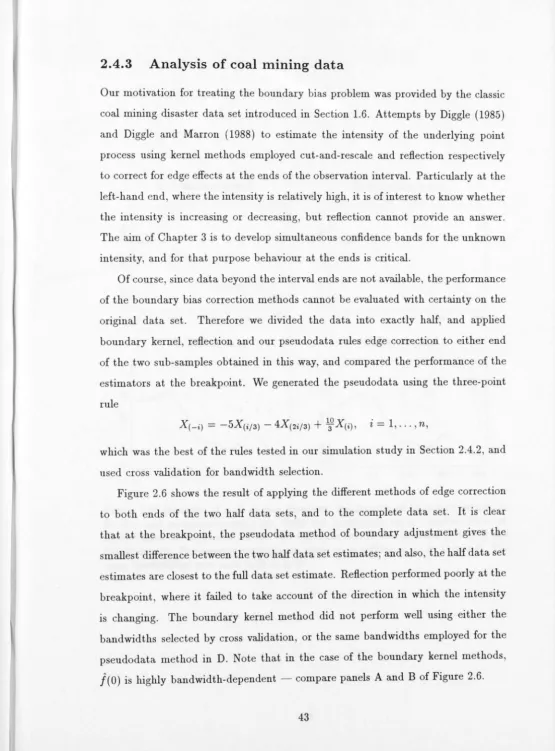
• ( 43,-11) Add at the end of the second paragraph of Section 2.4.3 "The cross-validation score function used was
CV(h)
= fo
1~(x)2
dx+
2I:
Li(Xi)'
where ~(
x)
is the estimate of the intensity constructed using both the real data and the pseudodata, andI:;
~-i(Xi)
is the sum over the sample points of the intensity estimates at each sample point, Xi, where each estimate is constructed using the all the sample points except the ith, and the pseudodata."• (59,1) Replace the sentence beginning "The manner in ... " with "The manner in which our univariate algorithms should be modified is straightforward.'
• (61,-7) Change hopt to hAoPT·
• (74, Section 3.4.1) Change all occurrences of hopt to hAoPT·
• (74,11) Before "The roughness ratios ... " add "The chosen sample sizes are typical of the sample sizes which arise in many practical settings and were chosen so that the conclusions drawn from the simulations would be applicable in such contexts."
• (76,-3) Change the sentence beginning "Moreover, the peaks ... ' to "While the confidence band is consistent with a monotonically decreasing intensity, examination of a number of bootstrap simulations suggests that the peaks around x
=
0.2 and x=
0.7 may be real features of the curve; see Cowling et al (1995)".• (78-82, captions) Change each occurrence of hopt to hAoPT·
• (125, References) Add the following references:
Additional References
Cao, R., Cuevas, A., and Manteiga, W. G. (1994). A comparitive study of several smooth-ing methods in density estimation. Comp. Statist. Data Anal. 17, 153-176. Cowling, A., Hall, P., and Phillips, M. J. (1995). Bootstrap confidence intervals for the
intensity of a poisson point process. J. Amer. Statist. Assoc. submitted.
Fan, J. (1993). Local linear regression smoothers and their minimax efficiencies. Ann. Statist. 21, 196-216.
Marron, J. S. and Wand, M. P. (1992). Exact mean integrated squared error. Ann. Statist. 20, 712-736.
Muller, H.-G. (1993). On the boundary kernel method for non-parametric curve estimation n ar ndpoints. Scand. J. Statist. pages 313-32 .
[image:3.609.19.594.19.759.2]I
11
I
Ii
11
II
Declaration
I hereby declare that this thesis describes my own work, supervised by Professor Peter Hall. A portion of it has been submitted for publication in papers jointly with him and Dr M. J. Phillips from the University of Leicester, who visited the Centre for Mathematics and its Applications in 1994.
Ann Cowling
ii
I
Acknowledgements
I am deeply grateful to Professor Peter Hall for his supervision. Although he was
extremely busy, his door was always open and he gave generously of his time. His
help has been invaluable.
I would like to thank the School of Mathematical Sciences and the ANU for their
financial support.
My thanks go also to the other postgraduate students, members and visitors of
the Statistical Sciences Program in the Centre for Mathematics and its Applications
for their cheerful company, friendship and support.
II
ll
I
Related Publications
The following papers have been submitted for publication from the work in this
thesis:
Cowling, A. and Hall, P. (1994). On pseudodata methods for removing bo
und-ary effects in kernel density estimation. J. Roy. Statist. Soc. Ser. B, under revision.
Cowling, A., Hall, P. and Phillips, M. J. (1994). Bootstrap confidence regions for
the intensity of a Poisson point process. J. Amer. Statist. Assoc., submitted.
Abstract
In this thesis, we present solutions to two problems in kernel curve estimation. First
we give a new method for reducing the boundary bias of kernel density and intensity
estimators. We apply this method in our second contribution, the development of
bootstrap confidence bands for the kernel estimator of the intensity of an
inhomo-geneous Poisson point process.
The thesis is divided into three chapters. In the first we give an introduction to
kernel density and intensity estimation, review the traditional methods of boundary
bias correction, and briefly present bootstrap methods and their use in constructing
confidence bands for kernel curve estimates. This chapter provides background and
motivation for our iater work.
In Chapter 2, we describe our new method for reducing the boundary bias of
kernel estimators of arbitrary order. The proposed technique involves generating
pseudodata beyond the support of the density
f
, then using
the pseudodata as wellas the original data in the usual kernel estimator, thereby boundary-correcting the
estimator. The pseudodata are simple to generate: they are formed using linear
combinations of the order statistics of the sample, with co-efficients that vary
ac-cording to the order of the kernel. We show that the kernel estimators produced in
this way have optimal orders of bias and variance throughout the estimation interval.
Our method is applied to simulated data, and optimal pseudodata generation rules
are proposed. We compare the performance of our method with that of traditional
methods, and find that our method outperforms the traditional optimal boundary
kernel method when
f'(O)
>
0. Finally, we compare pseudodata, reflection andboundary kernel intensity estimates for the classic coal mining disaster data set
given in Jarrett (1979).
In Chapter 3 we develop theory and methods for calculating confidence bands for the intensity function A(x) of an inhomogeneous Poisson process. Unlike previous
researchers, we treat the Poisson process as genuinely non-stationary rather than as a
Cox process. This requires us t'o derive the asymptotic distribution of j( x) - E j( x ). Our work complements previous work on point estimation, as well as contributing new results on confidence regions.
There are numerous ways of applying the bootstrap to develop confidence bands
for E
i
We describe methods based on several different bootstrap resamplingal-gorithms and a number of approaches to pivoting. We remove edge effects using
our pseudodata estimator, and correct the confidence intervals for bias, producing
intervals for .A. We demonstrate the effectiveness of these different approaches both
theoretically and numerically using simulated data. Lastly, we discuss the intensity
of the coal mining disaster data in the light of our confidence bands for .A.
Contents
Declaration
Acknowledgements
Related Publications
Abstract
1 Concepts of kernel curve estimation 1.1 Introduction . . . .. . . .
1.2 Basic results in kernel density estimation
1.3 Boundary effects in kernel density estimation .
1.3.1 Boundary bias reduction techniques
1.3.2 Proofs of corollaries ..
1.4 Intensity function estimation .
1.4.1 Poisson processes . . .
1.4.2 Kernel estimator of intensity function
1.5 Bootstrap confidence bands for kernel curve estimates
1.6 Motivation and summary of thesis . . . .
2 A pseudodata method of removing boundary bias in kernel density
11
111
IV
V
1
1
2
7
8
13
15 15 16
17
21
estimation 27
2.1 Introduction 27
2.2 Methodology 29
2.3 Asymptotic theory
2.4 Numerical results .
2.4.1 Location of pseudodata .
Vll
32
35
2.4.2 Simulation study . . . .
2.4.3 Analysis of coal mining data
2.5 Proof of Theorem 2.1 . . . .
Appendices
2A.l Lemmas
2A.2 Tables: simulation results
3 Bootstrap confidence regions for the intensity of a Poisson point
process
3.1 Introduction
3.2 Methodology
3.2.1 Kernel estimation of a Poisson intensity function .
3.2.2 Bootstrap resampling methods .. . .. .
3.2.3 Confidence bands before bias correction .
3.2.4 Bias correction . . . .
3.2.5 Corrections for edge effects .
3.3 Asymptotic theory
3.4 Numerical results .
3.4.1 Simulation study
3.4.2 Analysis of coal mining data
3.5 Proofs . . . . .. . . .
3.5.1 Proof of Theorem 3.2
3.5.2 Proof of Theorem 3.3 .
Appendices
3A.1 Lemmas bounding E {supz, IQ1(x)lk} .
3A.2 Martingale results and applications ..
3A.3 Bounds for sums using integral approximations
3A.4
3A.5
3A.6
A lemma on the closeness of two random processes
Holder continuity of
µ'
Technical Lemmas
List of Tables
1.1 Parallels between order statistics and Poisson processes 26
2.1 Boundary slopes of densities used in simulation study 38
2.2 Comparison of two-point rules for
f'
(O)
<
0 512.3 Comparison of two-point rules for
f'(O
) >
0 522.4 Comparison of three-point rules for
f'
(O)
<
0 . 532.5 Comparison of three-point rules for
f'
(O)
>
0 . 542.6 Comparison of boundary correction methods for
f'
(O)
<
0 552.7 Comparison of boundary correction methods for
f'(O)
>
0 563.1 Comparison of coverage probabilities of confidence bands for
>.
usingsmoothed bootstrap with different bandwidths . . . . . . 80
3.2 Observed coverage probabilities of confidence bands for
>.:
bias co r-rection by undersmoothing with recommended bandwidth choices . . 813.3 Observed coverage probabilities of confidence bands for
>.
:
biascor-rection by undersmoothing with suboptimal bandwidth choices . . . . 82
List of Figures
1.1 Usual kernel density estimate: fixed kernel construction . . 1.2 Usual kernel density estimate: moving kernel construction 1.3 Boundary kernels for x
=
0, 0.2h, 0.4h, 0.6h 0.8h, h 1.4 Boundary kernel density estimate1.5 Reflection kernel density estimate 1.6 Cut-and-rescale density estimate .
1.7 Cumulative number of coal mining disasters: 1851-1962 2.1 Location of pseudodata: factors influencing sign of X(i) 2.2 Empirical quantile function
G
and extensions at boundaries 2.3 Densities used in simulation study . . . .. . . . . 2.4 Comparison of boundary correction methods forf'
(0)
>
0 2.5 Comparison of boundary correction methods forf'
(0)
< 0
2.6 Intensity of coal mining disasters: comparison of boundaryreflection and pseudodata estimates . . . . . . . . . . . . . .
3
6
9
10 11
12 22 35 36 39 41 42
kernel, 44 3.1 Bootstrap confidence band for intensity of coal mining disasters 76 3.2 Comparison of confidence band construction methods: bias correction
by undersmoothing with recommended bandwidth choices . 78 3.3 Comparison of confidence band construction methods: bias correction
by undersmoothing with suboptimal bandwidth choices . . . . . . . . 79
Chapter
1
Concepts of kernel curve
estimation
1.1
Introduction
Non-parametric curve estimation techniques make no assumptions about the func -tional form or distribution of the data. The one assumption concerns the smoothness of the curve: typically, that it has at least two bounded derivatives.
In kernel curve estimation, the estimate at a given point is constructed using only local information: it is constructed from data values that lie in a neighbourhood of the point. To ensure that the estimate is consistent, as the sample size increases the neighbourhood must shrink in such a way that the points become dense in the neighbourhood. As only local information is used in the construction of an estimate, the convergence rate of these estimators is quite slow.
In applications, the support of the curve to be estimated is often known to be bounded on one or both sides. The smoothness assumption renders the kernel estimator unable to reproduce a discontinuity such as may occur at a boundary, and so the usual kernel estimator is much more biased near the boundaries than in the interior. For small and moderate sample sizes, a substantial portion of the support of the curve can be adversely affected by boundary bias. A number of different methods of reducing this bias have been suggested.
Non-parametric smoothing is an especially useful tool for exploratory analysis,
as it may reveal structure that would be missed by imposing a parametric model.
With the addition of a confidence band around the smooth curve, an unexpected
structure can be assessed as either likely to be a real feature of the underlying curve
or only an artifact of the sampling process.
In this thesis, we will be concerned with kernel estimation of density and Poisson
intensity functions. However, the same principles apply, perhaps with modifications,
to the estimation of regression curves.
The remainder of this chapter reviews in more detail the relevant aspects of kernel
curve estimation. In Section 1.2 we present some basic concepts of kernel density
estimation which are used throughout the thesis. The principal traditional methods
of reducing boundary bias are given in Section 1.3. We review Poisson processes
and define the kernel estimate of the intensity function in Section 1.4. Section 1.5
introduces the bootstrap and describes how it is used to construct confidence bands
for kernel curve estimates. In the final section, Section 1.6, we motivate and outline
the research detailed in Chapters 2 and 3.
1.2
Basic results in kernel density estimation
Kernel density estimation has attracted much research interest since the publication
of the pioneering papers of Rosenblatt (1956) and Parzen (1962). Some recent books
include Devroye and Gyorfi (1985) developing the 11 theory of density estimation;
Silverman (1986), the classical introductory work; Scott (1992) on multivariate
den-sity estimation; and the new introductory text of Wand and Jones (1995) covering
fundamental aspects of kernel estimation and many of the areas of research interest.
The traditional (see Silverman (1986, pl5)) and conceptually natural view of the
construction of the kernel density estimate is as follows. Suppose that X1, ... , Xn
is a random sample from an unknown continuous distribution with density f. A
kernel function K spreads equal probability mass through neighbourhoods centred at each Xi, with width depending on the bandwidth h. The estimate is the sum of the heights of these kernels.
"'
0
"'
0
-0
0
0
-2
' '
,,
'
-
---
::::.;.>~
liii
i
i
T-
T1
rTi
_iti~;;;;:i::~~>
--1 0 2 3 4
Figure 1.1: Usual kernel density estimate (dashed) for data from a truncated Normal density (solid). The estimate is the sum of the kernels (dotted) centered at the data points. Bandwidth h
=
1.65.This 1s illustrated m Figure 1.1 for a small simulated data set consisting of seven points from a truncated Normal distribution. This data set is used through-out Chapter 1 to demonstrate various kernel estimates and their construction. In practical applications, many more observations would be used: we use only seven observations here for clarity in the figures.
More formally, the usual kernel estimator of
f
is n}(x)
=
(nht1I:
K {(x -X
;
)
/
h},
i=l
where h is the bandwidth, and K is an rth order kernel satisfying
I
1
j
uiK(u)du=
O~
1
0
if i
=
0if 1::;
i::;
r - 1, if i=
r.(1.1)
(1.2)
It is obvious from ( 1. 1) that
j
has the same differentiability properties as K, so that the order of the kernel r is the number of bounded uniformly continuous derivatives that must be assumed for f.The bias and variance of
j
are given in the following theorem, which is easily proved using Taylor expansion; see for example Silverman (1986, p39).I
Theorem 1.1 If f has r bounded uniformly continuous derivatives and K satisfies
the conditions in ( 1. 2), then provided h - O and nh - oo as n - 00
'
bias
{}(x)}
var {}(x)}
(-1r _!_ /<i, hr f(r)(x)
+
o(hr) r!(nht1 f(x)
j
K2(u)du+
o{(nht1 }.(1.3)
Clearly the bias of
J
can be reduced by using a high-order kernel. However, kernels oforder greater than two have negative side lobes, which may result in negative density
estimates in places where data are sparse. Therefore, to ensure that }( x) ;?_ 0 for
all x, second order kernels are generally used in practice.
The bias of the estimate can also be reduced by using a smaller bandwidth h,
but this leads to a noisy estimate
J
with local detail masking global features of thesample
(f
has high variance). If his large,J
is smoother but the global features aredampened
(f
has high bias and low variance). The bias, then, can only be reducedat the expense of variance and vice versa, with the bandwidth h determining the
ratio of (squared) bias to ~ariance.
The choice of the bandwidth his perhaps the central issue in kernel estimation.
We shall discuss bandwidth choice briefly here as it is not addressed elsewhere in
this thesis.
Although in some circumstances it may suffice to choose the bandwidth by eye,
automatic methods of choosing a bandwidth are generally preferred for their
ob-jectivity and relative time efficiency. The automatic methods minimise an error
criterion, usually integrated squared error (ISE) or mean integrated squared error
(MISE), where ISE =
J(f
-
f)
2 and MISE = EJ(f
-
!)2. See Jones (1991) for a
discussion of the relative merits of these criteria.
Least-squares cross-validation, independently proposed for use in density
esti-mation by Rudemo (1982) and Bowman (1984), minimises the ISE. More precisely,
the cross-validatory bandwidth is that value of h which minimises
/
A2
-1""'
Af - 2n ~ f(-i),
l
an unbiased estimate of (ISE-
J
/2)
,
where f(-i)=
{(n-l)h}-1 I:i# K {(x-Xi)/h},the kernel stimate off constructed using all the data points except Xi. The chosen
I
bandwidth is consistent but Hall and Marron (1987, 1991) have shown that the relative rate of convergence of methods minimising the ISE cannot be less than
n-1/10 whereas the relative error of methods based on minimising the MISE can be
reduced to n-1/2.
As
MISE
j
E {}(x) - f(x)}2dx/ [bias{}( x)} ]2 dx
+
j
var{}( x)} dx,...., (r!r2 K-2 h2r
j
f(r)(x)2dx+
(nht 1j
K2(u) du ,it is minimised by
(1.4)
Perhaps the most popular of the bandwidth selection methods targeting MISE
are plug-in methods, which are based on using an estimate of f(r) in (1.4); see
for example Scott et al (1977), Park and Marron (1990) and Sheather and Jones (1991). The determination of j (r) involves a chain-like procedure: typically, an initial bandwidth h1 is chosen and used to estimate f(r+4). This produces h2, then
j(r+
2), h3 and finally
j(r).
An obvious question is how the number of iterations should be chosen.Empirical comparisons of various bandwidth selection methods using simulation are given in Park and Marron (1990), and Park and Turlach (1992). Comparisons based on real data sets are given in Sheather (1992). As yet no definitive reco m-mendations for an optimal bandwidth selection method can be made.
The bandwidth need not be constant throughout the estimation interval.
Vari-able bandwidths depending on the estimation point x, the data points Xi or both
have been proposed and studied; recent works include Jones (1990) and Hall (1990, 1992b).
Just as an "optimal" bandwidth can be found by minimising the MISE with
respect to h, an "optimal" kernel can be found by minimising the MISE with respect
to K, subject to the constraints (2.2). The optimal second order kernel, for example,
I
I
I
.,,
0
0
" 0
M
0 ()
N ()
0
0
0
0 0
-2 -1 0 2 3 4
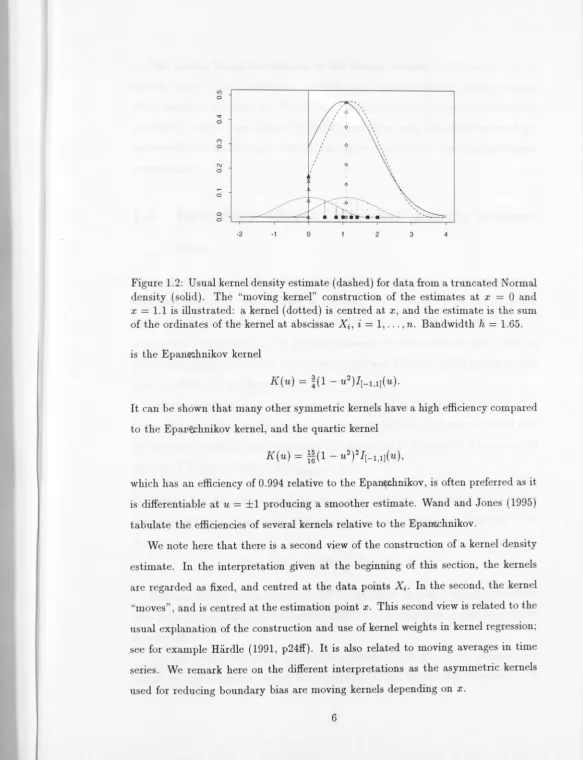
Figure 1.2: Usual kernel density estimate (dashed) for data from a truncated Normal density (solid). The "moving kernel" construction of the estimates at x
=
0 andx
=
1.1 is illustrated: a kernel (dotted) is centred at x, and the estimate is the sum of the ordinates of the kernel at abscissae Xi, i = 1, ... , n. Bandwidth h = 1.65.is the Epanechnikov kernel
K(u)
=
¾(1 -
u
2)I[-i
,
1](u)_
It can be shown that many other symmetric kernels have a high efficiency compared
to the Epan~hnikov kernel, and the quartic kernel
K(u)
=
~!(1-
u
2)2J[-i,1
](u),
which has an efficiency of 0.994 relative to the Epan~hnikov, is often preferred as it
is differentiable at u
=
±l
producing a smoother estimate. Wand and Jones (1995)tabulate the efficiencies of several kernels relative to the Epantchnikov.
We note here that there is a second view of the construction of a kernel density
estimate. In the interpretation given at the beginning of this section, the kernels
are regarded as fixed, and centred at the data points Xi. In the second, the kernel
"moves", and is centred at the estimation point x. This second view is related to the
usual explanation of the construction and use of kernel weights in kernel regression;
s e for example Hardle (1991, p24ff). It is also related to moving averages in time
senes. We remark here on the different interpretations as the asymmetric kernels
used for reducing boundary bias are moving kernels depending on x.
[image:18.610.15.598.16.776.2]I
II
I Ii
I
The movmg kernel construction of the density estimate at the point x is as
follows: centre a scaled kernel at x, and take as the estimate the sum of the ordinates
of the kernel at abscissae Xi. Whilst this construction can be clearly illustrated for
an isolated point x, see Figure 1.2, it does not allow such clear illustration of the
construction of the estimator over the full range of x values as does the fixed kernel
construction.
1.3
Boundary effects in kernel density
estima-tion
When the support of f is bounded, the usual kernel estimator (1.1) performs poorly near the boundary. The variance is the same size, o{(nht 1
}, in the boundary
regions as in the interior, but the bias is much greater. More specifically, as x
approaches a boundary b,
f
(
x) tends increasingly to underestimatef
(
x), until atthe boundary under the usual consistency conditions, E
f
(b) l'V ½J(b), as can be seenfrom Corollary 1.1 to Theorem 1. 1.
The underestimation at the boundary is illustrated in Figure 1.1 on page 3. This
figure also shows that kernels centred at points in the boundary region extend past
the boundary making
f(
x
)
>
0 beyond the support off. Thus whenf
has bounded support,f
is not a density since fsupp(f)f
=/-
1.Corollary 1.1 In addition to the conditions of Theorem 1.1, assume that K and
f
are supported on [-1, 1] and [O, 1] respectively. Then, provided h ---t O and nh ---too
as n ---t oo,
bias
{f(x
)}
= -
f(
x
)
i
1
K(u)du
+
O(h).Because the bias in the interior is 0( hr), edge effects dominate the global asymp
-totic behaviour, influencing bandwidth choice in cross-validatory or plug in methods
for example.
We will revi w the main traditional methods which have been proposed for
boundary bias reduction, and in the remainder of this chapter and Chapter 2, will
assume without loss of generality that
f
has compact support[
O
,
1
].
We willfur-ther assume that K has com pact support [-1, 1] as otherwise the whole estimation
interval
[O
,
1
]
would be subject to boundary effects.A point t whose location in
[
O
,
1
]
does not depend on n is not informative forstudying boundary behaviour since as n - t oo, h - t O and so t will eventually
become an interior point. Therefore, for studying boundary behaviour we consider
a sequence of points x(n) which have the same relative location in a boundary
interval for all n: x(n) = qh or x(n) = 1 - qh, with q E [O, 1). Only the correction methods at the left boundary will be described; corrections at the right boundary
can be obtained analogously.
1.3.1
Boundary bias reduction techniques
Boundary kernels
Gasser and Miiller (1979) proposed usmg different kernels, called boundary
ker-nels, in the boundary regions for kernel regression. They developed the theory in
Gasser et al (1985), and suggested that boundary kernels could also be employed
for correcting edge effects in density estimation.
We must take the moving perspective of the construction of the estimator when
discussing the boundary kernel method as boundary kernels vary according to the
estimation point x. For a boundary point x
=
qh, only the interval [-1, q) ofthe support of K is mapped into
[
O
,
l
].
The boundary kernel at x, Kq, is definedas a modification of the interior kernel K, which has support [-1, q) and satisfies
the moment conditions of the interior (1.2). It is desirable that Kq should depend
continuously on q and that Kq - t K as q - t 1.
The boundary kernel estimator is
if x E [0, h);
otherwise.
The definition of boundary kernels ensures that the bias of
}BK
is of the same orderin the boundaries as at interior points.
0
0.0 0.2 0.4 0.6 0.8 1.0
Figure 1.3: Boundary kernels based on the Epanichnikov kernel as given in (1.5) at x
=
0, 0.2h, 0.4h, 0.6h, 0.8h, h. Bandwidth h=
0.4.Suppose that the Epanichnikov kernel is used in the interior. For the left bound-ary region, Gasser et al (1985) propose the 2nd order polynomials
(1.5)
where c0 , c1 and c2 are constants depending on q such that
and
Figure 1.3 shows these kernels for various values of q.
Using the quartic kernel in the interior, Hall and Wehrly (1991) employ 5th order
polynomial boundary kernels based on the quartic kernel:
The coefficients c0 and c1 are obtained by solving
and
These kernels are defined so that Kq(-1)
=
0. Although similar in general outlineto the Gasser, Muller and Mammitsch kernels, the Hall and Wehrly kernels are
smoother as they are differentiable at u
=
±1. The Hall and Wehrly boundary kernel estimate for the simulated data set is shown in Figure 1.4. Note that fsupp(f)fBK
-/-
1."'
0
"'
0
0
0
-2 -1
·.,
't
1\ I ' :
' '
' ·,
I r, ,' [\
,' 6 ' 0 0
0
0
;
.... ···;·--: __ ....:·
~.
·. ··-.. -i, '• "" • •. --·•. . . ~-- ····•···· '" ' ---'-"----===··...[ ____
.~---0 2 3 4
Figure 1.4: Boundary kernel density estimate ( dashed) for data from a truncated
Normal density (solid). The construction of the estimates at x
=
0 and x=
1.1 is illustrated: a kernel (dotted) is centred at x, and the estimate is the sum of the ordinates of the kernel at abscissae Xi, i=
1, ... , n. Bandwidth h=
1.65.Although boundary kernels reduce boundary bias to the appropriate order, they
are not strictly positive; see Figure 1.3. This means that the boundary kernel
method cannot be guaranteed to give a positive density estimate especially if data
are sparse in boundary regions. This occurred with the simulated data set as shown
in Figure 1.4. The other drawback of the boundary kernel approach is the more
complex programming involved: a different kernel must be constructed for each
estimation point lying in the boundary region.
Reflection
The reflection technique is described in Boneva et al (1970). Schuster (1985) gives
conditions under which the reflection estimator is asymptotically unbiased, consi
s-tent, asymptotically normal and strongly uniformly consistent.
The data X1, . . . , Xn are reflected in the boundary, giving rise to pseudodata
X_1, .•• ,X_n on [-1,0], where X_i = -Xi, i = l, ... ,n. The usual estimator
is applied to the augmented data set consisting of both the original data and the
"'
ci
('")
ci
N
ci
ci
0 ci
-2 -1 0 2 3 4
Figure 1.5: Reflection density estimate ( dashed) for data from a truncated Normal
density (solid). The estimate is the sum of the kernels (dotted) centered at the data
points and pseudodata points(D). Bandwidth h
=
1.65.pseudodata. The reflection estimator is
fR(x)
=
(nht
1[
t
K{(
x
-
Xi)
/
h}
+
t
K{(
x
- X_i)/h}]
;
the estimate for the simulated data set is shown in Figure 1.5. Reflection is the only
method of boundary correction considered in this chapter for which fsupp (f)
J
=
1.The technique is particularly simple to implement, because the same estimator is
used throughout the estimation interval. The drawback of the method is that it does
not adequately correct the boundary bias as indicated by the following Corollary:
Corollary 1.2 In addition to the conditions of Theorem 1.1, assume that K and
f
are supported on [-1, 1] and [O, 1] respectively. Then, provided h -+ 0 and nh-+ oo as n -+ oo,
bias
{JR(x)}
=
2hf'(
x
)
i
1
(u
- q)K(u)du
+
o(h).Cut-and-rescale
Another long-used technique for boundary correction is the cut-and-rescale method;
see for xample Gasser and Muller (1979), Diggle (1985). In the boundary regions
a different kernel is constructed at each estimation point x
=
qh: the usual kernel"' d
"
d 0
('") 0
d
0
N
d
d
-r.··.. 0
···1._ .. -..
0
d
__ ... --1!;-····! ·-i~.-.
i i•'1-._·
ii ii ilo ii ..... ::::c··~ - --'-"---===
-2 -1 0 2 3 4
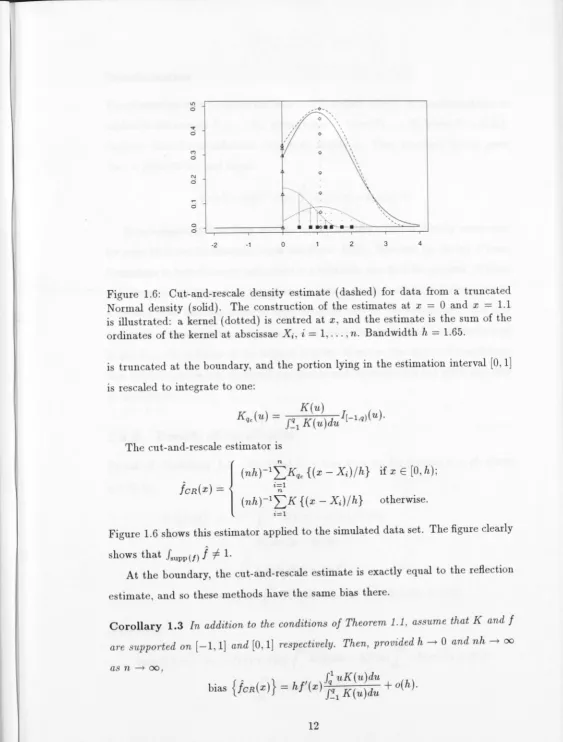
Figure 1.6: Cut-and-rescale density estimate ( dashed) for data from a truncated
Normal density (solid). The construction of the estimates at x = 0 and x = 1.1 is illustrated: a kernel (dotted) is centred at x, and the estimate is the sum of the
ordinates of the kernel at abscissae Xi, i = 1, ... , n. Bandwidth h = 1.65.
is truncated at the boundary, and the portion lying in the estimation interval
[O
,
1]
is rescaled to integrate to one:
The cut-and-rescale estimator is
if x E [0, h);
otherwise.
Figure 1.6 shows this estimator applied to the simulated data set. The figure clearly
shows that fsupp (/)
J
-f 1.At the boundary, the cut-and-rescale estimate is exactly equal to the reflection
estimate, and so these methods have the same bias there.
Corollary 1.3 In addition to the conditions of Theorem 1.1, assume that K and
J
are supported on
[-1
,
l]
and [O1]
respectively. Then, provided h --t O and nh--+ ooas n --+ oo,
{
.
}
J.1
uK(u)du bias fcR(x)=
hf'(x) ;~1
K(u)du
+
o(h). [image:24.609.30.594.9.751.2]Transformation
Transformation may be useful for removing boundary effects. A transformation tis applied to the sample
Xi,
...
,
Xn
,
giving a new data setYi
,
...
,
Yn
where1-':
=
t(Xi)-Suppose that the transformed data have density g. Then standard theory gives
f
(x)
=
g(t(x))t'(x)
,
and hencen
JT(x)
=
(nht
1t'(x)
L
K
[
{t(
x)
- t(Xi)}/h].
i=lTransformations have been used to reduce boundary bias in density estimation
for some time, see for example Copas and Fryer (1980). However, the theory of tran-formations in kernel density estimation is a relatively new field for research. Marron and Ruppert (1994) propose transforming from a density with bounded support to a density with first derivative of approximately zero at the boundaries. The new density is estimated using reflection for boundary correction, and backtransformed to produce the estimate of the original density. However, the choice of transforma-tion involves estimation of several parameters and the method is not quick and easy
to implement.
1.3.2
Proofs of corollaries
Proof of Corollary 1.1 Provided h -+ 0 as n -+ oo, for a point x
=
qh whereq E
[O,
1),E
{f(x)}
h-1l
ro
x+hK{(x
-y)/h
}f
(y)dy
[q
1
K(u)f(x
-
hu)du
1-qi K(u){f(x)
-
huj'(x)
+
·
· ·
}
du
f(
x)
[
q
1
K(u)du
-
hj'(x)
[
q
1uK(u)du
+
o(h).
Therefore,
bias {
f
(x)}-
f(
x)
+
f(
x)
1-
qi
K(u)du - hj'(x)
1-
qi uK(u)du
+
o(h)
-
f
(x)
1
1
K(u)du
+
O(h)
.
•
Proof of Corollary 1.2 Provided h - t O as n - t oo, for a point x
=
qh whereq E
[O
,
1),E {
j
R ( X)}=
1i-1 ( E [ K { ( X - Y) / h}]+
E [ K { ( X+
Y) / h}] )Therefore,
=
h-1[la
x+
h
K{(x -y)/h}f(y)dy
+
1-
x+h
K{(x+
y)/h}f(y)dy]=
1-
q
1
K(u)f(x - hu)du
+
1
:_
1
K(2q - u)f(x - hu)du
=
f(x){1-q
1 K(u)du
+
1:_
1 K(2q - u)du}-hf'(x)
{1-
q
1 uK(u)du
+
1
:_
1 uK(2q - u)du}+
o(h)=
f(x){1-q
1 K(u)du
+
i
1K(u)du}
-hf'(x)
{1-q
1 uK(u)du
+
i
1(2q - u)K(u)du}
+
o(h).bias {JR(x)}
=
2hf'(x) i\u - q)K(u)du+
o(h).•
Proof of Corollary 1.3 Provided h - t O as n - t oo, for a point x
=
qh whereq E
[O,
1),E {JcR(x)}
=
h-1Jo
rx
+h
KcR{(x - y)/h} f(y)dyJ~
1 K(u)f(x - hu)du=
J~
1 K(u)du
, J~
1 uK(u)du (h)=
f(x) - hf (x) f~1 K(u)du+
o .Therefore,
•
}
Jq
1uK(u)du
bias {fcR(x)
=
hf'(x) f~i K(u)du+
o(h).•
1.4
Intensity function estimation
1.4.1
Poisson processes
A Poisson process is a mathematical model describing the location of point events occurring completely at random in JRd, for example, the times of emissions from
a radioactive source or the location of raisins in a cake. The basic theory and
properties are well known, see for example Feller (1968).
The three characteristic features of a homogeneous Poisson process on [0, oo)
with rate or intensity parameter A are:
1. The number of points in each finite interval [ui, vi) has a Poisson distribution
with mean A(vi - ui)
-2. The numbers of points in disjoint intervals are independent random variables.
3. The distributions are stationary: they depend only on the lengths of the
in-tervals.
An important property of the homogeneous Poisson process is that conditional on the number of events N in the interval of interest, say [0, T) the times of the events are independently uniformly distributed over [0, T).
A Poisson process can be generated from sums of independent exponential ran
-dom variables: suppose that { Z1, Z2, ... } are independent exponential random va
ri-ables with parameter A and mean 1/ A. Let Y;
=
I:
~=
l
Zi · Then{Yi
,
Y;, ... } is aPoisson process with parameter A. Note that Y; ,.._, Gamma (A, i) with density
y
>
0,so that E(Y;)
=
i/A and var(Y;)=
i/A2•Random events need not occur uniformly in JRd: events may occur randomly with some locations being more likely than others, for example the locations of burglaries in a city, or the times of arrivals at a university cafeteria.
A non-homogeneous Poisson processes on [0, oo) is determined by a rate or in-tensity function A(
t)
2:
0. The process is defined by the following properties:1. The number of points in each interval ( Ui
vi]
has a Poisson distribution withmean J;: >.(t)dt.
2. The numbers of points in disjoint intervals are independent random variables.
A non-homogeneous Poisson process can be simply related to a homogeneous
Poisson process: if
{Yi
,
Y;, ... } is a Poisson process with unit mean, then writingA(t)
=
J~>.(x)dx and Xi= A-1(1':)
,
{X1
,
X2
,
---}
is a non-homogeneous Poissonprocess with intensity function >.(t).
For the non-homogeneous Poisson process, conditional on N, the times of the
events are independently distributed over [O T) with density >.(t)/ A(T). Thus >.(t)
can be considered as a density of sorts with the difference that A(T)
=
J{
>.( t) dt is unlikely to equal 1.There are a number of ways of simulating a realisation of a non-homogeneous Poisson process on [O, 1], see for example Devroye (1986). A simple (but not always very efficient) method, based on the analogy between intensities and densities, is to first generate a Poisson random variable N with mean A(l), and then to generate {Xi} as the order statistics of a sample of size N from the distribution with density
>.(t)/ A(l). Another method uses inversion of the integrated rate function and the
exponential spacings characteristic.
In our simulations in Chapter 3, we used the thinning method, which is similar to the rejection method of generating points from a specified density. In the thinning
method, points are generated from a Poisson process on [O, 1] with rate µ where
µ ~
>.(t).
A prospective event occurring at time t E [O, 1] is accepted with probability>.(t)/
µ. The "thinned" process, consisting of the accepted events, is a realisation ofthe non-homogeneous process with intensity >.(t).
1.4.2
Kernel estimator of intensity function
Leadbetter and Wold (1983) point out that a common feature of density and
inten-sity estimation is that the function to be estimated is the derivative of a function with a natural discontinuous estimator. The target estimator can therefore be
ob-tained by smoothing the steps using a differentiable function, and differentiating.
The obvious estimators of the distribution function and the integrated rate func-tion are
n N
F(x)
=
n-1L
I(Xi:S
x) and A(x)=
L
!(Xi:S
x),i=l i=l
where N is the number of events of the Poisson process in the interval [O, T). Smooth versions of these can be obtained by replacing !(Xi
:S
x) with a differentiable function5
{
(x -
Xi)/h}. The required estimators,}(x)
andX(x)
,
are therefore given byn N
f(x)
=
(nh)-1L5'{(x
-Xi)/h} andX(x)
=
h-1L5'{(
x
-
Xi)/h}.i=l i=l
This derivation focusses on the similarity between the distribution function and the integrated rate function, and leads to another interpretation of the kernel function K - as the derivative of a smoothed indicator function. The kernel estimator of
the intensity function is
N
~(x)
=
h-1L
K{(x - Xi)/h}.
i=l
We shall derive the distribution of this estimator in Chapter 3, and therefore delay
discussion of its bias and variance until then.
1.5
Bootstrap confidence bands for kernel curve
estimates
In a non-parametric setting, the bootstrap is a Monte Carlo based method of obtain-ing properties of the distribution of a particular statistic without making assump -tions about its distributional form. Much of the recent research into the bootstrap is aimed at finding reliable, automatic, data-based methods of calculating confidence intervals, but bootstrap methods can also be used to determine other measures of
statistical ac~uac y such as bias and prediction error.
Traditional confidence intervals for a parameter 0 are often based on the distri-bution of the asymptotically pivotal statistic T
=
(0 -
0)/'r(B), where -r(B) is an appropriate sample-based scale estimate, or on the non-pivotal statistic S=
0 - 0.I
I•
Bootstrap confidence intervals based on T, known as percentile-t intervals, can be
shown to be more accurate than intervals based on S, known as percentile intervals; see Beran (1987) and Hall (1992a). We shall derive below the symmetric percentile-t
bootstrap confidence interval for a single parameter 0, but shall first introduce some
necessary concepts and notation.
We regard the parameter 0 as a functional of the population distribution func -tion F, and denote it 0(F). The bootstrap estimate of 0(F) is the same functional
of the empirical distribution function
F:
8
= 0(F). For example, the bootstrap est i-mate of the population meanµ=J
xdF(x) is the sample meanX
=J
xdF(x). Let X* = (X;, ... , X~) be a resample drawn from the original sample X = (X1 , . . . , Xn), letff
·
be the empirical distribution function of the resample, and lete·
= 0(fe
·)
be the same functional of the bootstrap resample. Then T*, the bootstrap estimate
of T, is obtained by replacing
8
by B* and 0 by8
in the expression for T, so thatT* = (B* -8)/T(B*). The bootstrap 'works" because by judicious choice of the sa m-pling mechanism, the distribution of T* conditional on X , known as the bootstrap distribution of T*, is the same as that of T.
A symmetric
a%
confidence interval for T is given by (-t, t), where P(-t ~T ~ t) = a. Without making assumptions about the distribution of T we estimate
the quantile t by the bootstrap as follows. A number, B, of resamples are drawn from X , T* is calculated for each resample, and our estimate
i
of t is the a-level quantile of the empirical distribution of IT*I. The symmetric percentile-t bootstrapconfidence interval for 0 is then simply
(8 -
if
,
8
+if).
In conventional problems with a fixed number of parameters and unknown
distri-bution function F, bootstrap confidence intervals for 0 are more accurate than tra-ditional Normal approximation intervals. The reason, which is revealed by an Edge -worth expansion argument (see for example Singh (1981), and Hall (1988, 1992a)), is that the bootstrap correctly estimates first order departures from normality which are due to skewness, whereas traditional Normal theory does not. The essence of the
argument (see Hall (1992a, p83)) goes as follows: the pivotal statistic Tis generally
asymptotically Normal, and so its distribution function can be expanded as
G
(x)
=
P(T
s;
x)
=
cp
(x)
+
n-
1l
2q(x)</>(x)
+
O(n-
1),{1.6)
where q is an even quadratic polynomial and~,</> are respectively the standard Nor-mal distribution and density functions. The bootstrap estimate of G can similarly be expanded as
where the polynomial
q
is obtained from q by replacing unknowns such as skewness by their bootstrap estimates. Sinceq
-
q=
Op(n-112),that is, the bootstrap approximation to G is in error by only n-1. This is an improvement over the usual Normal approximation, G ~ ~, which is in error by n-1
/2 as shown in {1.6).
In kernel curve estimation, only the data points within a neighbourhood of width h of x contribute to the estimate at x, and so the effective sample size is nh rather than n. The smaller effective sample size leads to a worsening of the convergence rate, but bootstrap methods still perform better than Gaussian theory methods, as we shall see below.
The effective sample size of nh can be interpreted as meaning that our procedure is equivalent to estimating h-1
":: n115 parameters, a number which increases with
n. Thus curve estimation problems are sometimes referred to as infinite (number of) parameter problems.
A confidence band for a curve ,( x) on an interval I is the region between two curves,
LB(
x)
andUB(x)
,
x
E I , whereLB(x)
andUB(x)
are chosen to ensure that th true curve is covered by the band[LB(x)
,
UB(x)]
with probability o:; that1s,
P{LB(x)
s;
,(x)
s;
UB(x) for all
x
EI}= o:.When d termining a confidence band on I or a simultaneous confidence interval for a finite s t of points in I , rather than a confidence interval for a single point, our
interest moves from Tor ITI to supz
T(x)
or supz IT(x)I. The asymptotically pivotal statisticT(x)
=
{i(x) -,(x)}/T{'Y(x)}
is a stochastic process inx
which can beshown to converge to a stationary Gaussian process U(x) with known covariance
structure.
Confidence bands can be constructed based on the distribution of supz U(x).
Extreme value theory for Gaussian processes has been well studied; see for example
Hall (1979), Leadbetter et al (1983). The extreme value method of constructing
con-fidence bands for kernel curve estimates was first proposed in Bickel and Rosenblatt
(1973) for kernel density estimates. However, the convergence of U(x) to supz U(x)
is so slow, typically (log
nt
1, see Hall (1991), that extreme value confidence bands
are of no use in practice, being much too wide, unless the sample size is simply
enormous.
The bootstrap, then, is an especially useful tool for the construction of confidence
limits or bands for kernel curve estimates, allowing us to empirically estimate the
distribution of supzT(x). The convergence of the bootstrap approximation to the
distribution of supz
T(x)
can be shown to be much faster than (logn)-1;
for example, Hall (1991) derives the rate of (nht1l2(log n)2 in the case of the kernel densityestimator. In Chapter 3, we derive a similar comparison for the kernel intensity
estimator.
In the case of non-parametric curve estimation, the algorithm described above
produces a confidence interval for E
1'
rather than for I itself. Recall that thebootstrap approximates the distribution of (1 - 1
)/T(7)
by that of (i* - 1)/T(i*).However, as
1'
is a "linear" function of the data in the sense that ')'=
~?=
1 f(Xi)for some function f, 7*
=
~f=
1 f(Xt) has the property that E (i*IX)=
1',
so thatbias (i*IX)
=
0. Note that1' -
1=
1' -
E7+
bias (7). Then in estimating the distribution of1' -
1 by that of 7* -1',
we are estimating bias (1) by bias (i*).But bias (1'*)
= O
so that we are effectively setting bias (1) to zero and estimating(1- E7)/T(7) not (1-1)/T(7).
In the remainder of this thesis, we will explicitly recognise that the bootstrap
algorithm produces confidence intervals for E
1'
by expressing statistics such asT
andT*
in the formT(x)
=
{'Y(x)
-
E7(x)}
/
T{7(x)}
andT*(x)
=
{'Y*(x)
Ei*(x)}
/
T{i*(x
)}
. Confidence
intervals forEi can be correc
ted for bias to obtainthe required confidence intervals for 1 .
The simplest method of bias correction is to undersmooth
i
to such an extentthat its bias becomes negligible. Our confidence interval can then be regarded as one
for I as well as for E
i-
We will use this approach in Chapter 3. Another frequentlyused method is to explicitly correct the confidence interval for bias using an estimate
of the asymptotic bias (for example
(-lY
~"'hr j(rl(x) in the case of densityestima-tion). Bootstrap iteration could also potentially be used to increase the accuracy of
the bootstrap estimate in this context; see for example Hall (1992a). However, it is
possible that adding another level of bootstrap sampling and calculation of coverage
probabilities would increase the computing time above practical limits in the case
of confidence bands.
This completes our general overview of the bootstrap but we will now add some
more specific details. In general, the bootstrap resamples X* are drawn from X,
and the bootstrap estimate of
O(F)
isO(F)
,
where Fis the empirical distributionfunction. However, it has also been proposed to smooth the sample empirical
dis-tribution function and resample from that, thereby avoiding repeated values in the
resample X*; see for example Silverman and Young (1987). Although Silverman and
Young show that in some cases the smoothed bootstrap does improve performance,
Hall et al (1989) show that smoothing is really only beneficial when the quantities
under study depend in some way on local properties of the underlying distribution
F. The unknown factor in this is how much to smooth. Hall (1992a) suggests
that we should not smooth too much; oversmoothing causes a sharp deterioration in
performance. In Chapter 3, we use both the smoothed bootstrap and conventional
bootstrap resampling.
1.6
Motivation and summary of thesis
In industrial settings, observations may be collected in the form of point events
occurring randomly in space or time; such events might be for example the time
of accidents, the failure times of machines, or the location of point faults along a
'
8
"' VJ C: Q) 0
> ~
Q)
0 ~
8
E
::, C:
Q)
-i;j ~
3 0
E "'
::, (.)
0
0 10000 20000 30000 40000 t (days)
Figure 1.7: Cumulative number of coal mining disasters: 1851-1962
railway track. The analysis of industrial accidents usually aims to determine possible trends in the rate of occurrence of these events: an increase in the occurrence rate would lead to action to introduce new preventative measures. Similarly the analysis of failure times of industrial equipment concentrates on trends in the failure rate. In both cases, the main interest may be in either the global trend of a series of data or in early detection of an undesirable trend in the most recent data.
In this thesis we shall analyse the intensity of coal mining disasters using the classic data set given by Jarrett (1979) and previously studied by (among others) Maguire et al (1952), Barnard (1953), Cox and Lewis (1966) and Boneva et al (1970).
The data set gives the time interval in days between 190 successive severe explosions in mines for the period 15 March 1851 to 22 March 1962. The cumulative number of disasters is plotted against tin Figure 1.7.
A major issue in previous analysis of these data has been the detection of trends in the accident rate. For example, both Barnard (1953) and Cox and Lewis (1966) fit exponential models to the intensity function, thereby showing that it is decreasing. However, in our view, kernel estimation of this intensity, as used in Diggle (1985),
Diggle and Marron (1988) and this thesis, is a more flexible tool for preliminary analysis as it shows not only the general decreasing trend, but also reveals peaks at about 8,000 days and 32,000 days (see Figure 2.6, panels C and D, on page 44).
[image:34.607.16.595.20.757.2]In Chapter 3, we develop methods for calculating confidence bands for the
in-tensity function of an inhomogeneous Poisson process, and apply them to the coal
mining disaster data. Using this confidence band, we can not only address the
same issue of global trend as is answered by parametric analysis, but also determine
whether the additional information about the data revealed by the non-parametric
analysis, the apparent peaks, is likely to be real or merely a chimera of the
non-parametric methodology.
It is especially important in the case of intensity estimation to adequately adjust
for edge effects because the process continues unobserved outside the observation
interval and more data might become available at any time. The boundary bias
would ideally be no larger than the bias in the interior so that if more recent data
became available, the estimate based on the smaller old data set would co-incide
with that based on the new enlarged data set. We also note that if early detection
of undesirable trends in the most recent data is the main purpose of the analysis, it
is essential that the boundary bias be properly adjusted.
In Section 1.3, we described the traditional boundary kernel, reflection and cu
t-and-rescale methods of reducing boundary bias. Clearly the boundary kernel method
is the most effective, reducing the boundary bias from 0(1) to 0(hr), the size of
the interior bias, whereas the reflection and cut-and-rescale methods reduce the
boundary bias to only 0( h).
However, the speed and ease of application of an estimator are very important
considerations for the applied statistician-complex methods tend not to be used if
there are simple methods that are nearly as good. The boundary kernel estimator
shares a major drawback with the cut-and-rescale estimator, namely, its
implemen-tation is complicated in that a different kernel is constructed at each estimation point
in the boundary region. In addition, the computation of that kernel requires solving
a system of equations. On the other hand, the reflection estimator is extremely
sim-ple to apply: the same kernel is used throughout the estimation interval and that
kernel is simple to implement. Clearly then, there is a place for a new estimator
which combines the best features of the boundary kernel and reflection estimators:
boundary bias of order 0( hr) and applicability over the whole stimation interval.
23