An Activity-Generating
Theory of Regulation
The Harvard community has made this
article openly available.
Please share
how
this access benefits you. Your story matters
Citation
Schwartzstein, Joshua, and Andrei Shleifer. 2013. “An
Activity-Generating Theory of Regulation.” The Journal of Law and
Economics 56 (1) (February): 1–38. doi:10.1086/666959.
Published Version
10.1086/666959
Citable link
http://nrs.harvard.edu/urn-3:HUL.InstRepos:27814564
Terms of Use
This article was downloaded from Harvard University’s DASH
repository, and is made available under the terms and conditions
applicable to Other Posted Material, as set forth at
http://
[Journal of Law and Economics,vol. 56 (February 2013)]
䉷2013 by The University of Chicago. All rights reserved. 0022-2186/2013/5601-0001$10.00
Joshua Schwartzstein
Dartmouth CollegeAndrei Shleifer
Harvard UniversityAbstract
We propose an activity-generating theory of regulation. When courts make errors, tort litigation becomes unpredictable and as such imposes risk on firms, thereby discouraging entry, innovation, and other socially desirable activity. When social returns to activity are higher than private returns, it may pay the society to generate some information ex ante about how risky firms are and to impose safety standards based on that information. In some situations, com-pliance with such standards should entirely preempt tort liability; in others, it should merely reduce penalties. By reducing litigation risk, this type of regulation can raise welfare.
1. Introduction
According to the standard law and economics analysis (Coase 1960), private contracting and optimal tort rules leave very little room for efficient government regulation. Yet regulation is common and growing over a broad range of activities and, if anything, is more ubiquitous in richer, more democratic societies. In light of the Coasean logic, how can this be the case?
In this paper, we present a new case for efficient regulation, based on the idea that, compared to pure litigation, regulation alone or in combination with lit-igation can encourage socially desirable economic activity. Our theory is based on two fundamental assumptions. First, we assume that courts make errors that impose risk on firms. The litigation risk manifests itself in lower levels of eco-nomic activity such as the reluctance of some firms to enter. The recognition that courts make errors, particularly in the assessment of complex risks and damages, and that such errors affect firm decisions is quite standard in law and
economics (for example, Calabresi 1970; Calfee and Craswell 1984; Craswell and Calfee 1986; Kolstad, Ulen, and Johnson 1990; Kaplow and Shavell 1996).
Second, and perhaps more original in the discussion of regulation, we assume that economic activity is quite socially desirable and, in particular, that the social returns to such activity are higher than private returns. This assumption may cover situations in which innovators, such as pharmaceutical companies, earn returns that are lower than the social value of new drugs and may be deterred from introducing new products by litigation risk (Mankiw and Whinston 1986). It may also cover activities such as nuclear power generation, which earns social returns such as energy independence not captured by the producer. But we take a much broader view that social returns to productive activity are higher than private returns whenever the economy is not at full employment and job creation relieves the state of its social obligations. Scholars in public finance estimate that raising $1 of tax revenue entails a marginal deadweight cost of about $.25 (see, for example, Chetty 2011). This means that whenever a firm replaces $20,000 of welfare or unemployment benefits with wages to a new employee, $5,000 in social gains is created but not captured by this firm.
Under these two assumptions, government regulation either by itself or in combination with litigation can encourage economic activity by reducing the litigation risk facing firms and thus can be more efficient than litigation alone. Our analysis provides an analytical foundation for the commonly made argument that there is room for regulation when litigation drives firms out of business or discourages innovation (Viscusi 1991; Viscusi and Moore 1993).1
We develop these arguments in a fairly standard model of public policies used to create incentives for firms to take precautions. In this model, absent court errors, a negligence regime with appropriate penalties creates incentives for ef-ficient precautions and activity. When courts make errors, however, incentives for precautions and activity become distorted. In this framework, we think of regulators as first screening firms (or products) as risky or not and then man-dating precautions for firms deemed to be risky, a view of regulation similar to Shavell (1984a, 1984b). When such regulation is combined with litigation, courts can take compliance with regulatory standards into account. We assume that regulators, like courts, make errors, although we consider the possibility that, as specialists, they are less prone to error than courts (Landis 1938). With reg-ulatory errors, it is sometimes efficient for misclassified firms to ignore regreg-ulatory mandates, and the enforcement schemes we consider allow firms to do so. With this caveat, our model is similar to the standard command-and-control regulation
1According to Calabresi (1970, p. 270), “Too large a fine or criminal penalty in an area where
contingent on the information collected by the regulator.2
As an example, we can think of the regulator as classifying a power plant design as safe or less safe, and calling for additional safety measures for the latter, or a new drug as safe or less safe, and calling for warning labels for the latter. Or we can think of the regulator mandating additional pollution controls such as scrubbers or pollution filters for some but not other plants, depending on their technology. We derive optimal policies under litigation alone, regulation alone, and the combination of the two and examine the conditions under which regulation improves welfare. We thus make precise the argument for activity-generating regulation.
In our framework, compliance with regulatory standards need not automat-ically insulate firms from subsequent tort liability completely, although it would generally reduce the optimal penalties. At the same time, our model enables us to analyze the preemption doctrine, which holds that compliance with regulatory requirements should provide safe harbor against litigation risks. In particular, we suppose that, along with granting the regulator authority to classify firms and recommend precautions, the legislature can mandate that compliance with regulations insulates a firm from subsequent tort liability even if an accident occurs. When would such a legislative mandate be efficient? The U.S. Supreme Court has struggled with this doctrine in the area of medical safety, deciding that Food and Drug Administration (FDA) approval should preempt tort liability for medical devices (Riegel v. Medtronic,552 U.S. 312 [2008]) but not for drugs (Wyeth v. Levine,555 U.S. 555 [2009]). The question of preemption in the United States raises complex issues of division of powers between branches of govern-ment and between the federal governgovern-ment and the states (Schwartz 2000; Kessler and Vladeck 2008; Curfman, Morrissey, and Drazen 2008; Glanz and Annas 2008; Philipson, Sun, and Goldman 2009). Here we ask the much simpler ques-tion of efficiency: when should the legislature efficiently mandate preempques-tion for firms that comply with regulations? Since our model derives efficient rules for the control of harmful risks, it allows us to address this question.
We show that when social benefits from activity are sufficiently high relative to the harm from insufficient precautions (to be precise, on net even the activity of negligent firms is socially desirable), then the optimal rule is complete safe-harbor regulation, whereby a firm that satisfies the regulatory standard is exempt from damages when an accident occurs. Regulatory compliance preempts tort liability. In contrast, if the social benefits of activity are not so high, then the optimal policy should allow for negligence claims even against firms that comply with regulations, although the magnitude of damage awards is lower for such firms. Regulatory compliance does not preempt liability. Under our theory, the
2In fact, we also examine the case of pure command-and-control regulation, in which even the
preemption doctrine as applied to private common-law tort actions might be efficient in governing the safety of some pharmaceuticals with very high social benefits but not that of automobiles or airplanes.
To illustrate how the theory works, consider a simple example. Suppose that a company is considering the construction of a nuclear power plant and that the design can be either relatively safe or relatively unsafe as captured by the likelihood of an accident allowing radiation to escape. (For example, it could be the same design in seismologically different locations.) In the latter case, it is first-best efficient for the company to invest in additional safety precautions; in the former, it is not. Suppose that the social benefits of constructing the plant exceed the private benefits (for example, national interest in energy indepen-dence, reduced pollution), but the plant cannot be subsidized. Nonetheless, if unsafe designs can be perfectly identified, it is conditionally efficient to incentivize companies with such designs to take precautions: the social loss from some such companies avoiding costs by not building is outweighed by the gain from in-centivizing those that enter to take precautions. Suppose finally that if an accident occurs and radiation escapes, the court determines without error whether pre-cautions had been taken but possibly with error whether the design is unsafe and therefore precautions should have been taken.
In this example, without court errors, a negligence rule can achieve efficient precautions by all firms and conditionally efficient entry given the constraint that firms cannot be subsidized. With court errors, however, a negligence regime has the unintended consequence that firms with safe designs also face the risk of being held liable after an accident for failure to take precautions. As a con-sequence, some firms may (inefficiently) choose not to operate. Regulators have the ability to encourage entry by making an ex ante determination of whether a design is safe or unsafe and effectively limit liability costs for companies with designs determined to be safe, even if regulators also make errors. The benefit of introducing such regulation depends on the degree to which it is targeted: it limits liability costs for and only for companies with safe designs. It also depends on the degree to which entry needs to be encouraged, an increasing function of the shortfall of the private benefits of constructing the plant from the social ones.
Our theory of regulation does not merely make the point that collection of more information by law enforcers can enhance efficiency. Similar points have already been made by, for example, Craswell and Calfee (1986) and Kolstad, Ulen, and Johnson (1990). Rather, the previous literature has focused on how regulators can create incentives for firms to take more efficient precautions when a pure-liability regime results in too few. In our model, courts can implement first-best precautions even without additional information but may not be able to encourage the correct level of activity. Our principal innovation is to analyze a model with socially valuable activity, to identify conditions under which a pure-liability system results in too little activity, to analyze when and how the ex ante public collection of information can improve welfare through promoting activity, and to use the model to examine when preemption is efficient. We show that the activity-generating case for regulation relies both on courts errors and on the existence of positive externalities to firm activity.
Our paper is related to several strands of research in law and economics. Becker (1968), Calabresi (1970), Posner (1972, 1973), and Spence (1977) initiate the research on alternative methods of controlling harmful behavior and, in particular, on comparing regulation and litigation. Shavell (1980) and Polinsky (1980) consider activity levels in assessing the optimal liability rules but not regulation. Immordino, Pagano, and Polo (2011) analyze the performance of different methods of controlling harmful externalities when innovation may be discouraged. Craswell and Calfee (1986), Png (1986), Kolstad, Ulen, and Johnson (1990), and Polinsky and Shavell (2000) examine the implications of errors in enforcement for optimal fines. Kaplow and Shavell (1996) provide a general analysis of the effects of accuracy in the assessment of damages. Gennaioli and Shleifer (2008) endogenize court errors as the result of judicial policy preferences. Essentially, the assumption of errors in law enforcement implies that rules gov-erning the behavior of safe firms also affect unsafe firms and vice versa.
affects not just precautions but the level of activity, that private returns to activity are lower than social returns, and that both courts and regulators make errors. Section 2 presents the basic model of litigation and regulation. Section 3 considers outcomes and social welfare under the efficient-liability regime im-plemented by courts alone and demonstrates that the case for activity-generating regulation rests on private returns to activity being lower than social returns. Section 4 asks when replacing litigation with pure regulation improves welfare. Section 5 describes the circumstances under which adding regulation to litigation improves resource allocation, characterizes efficient combined regimes, and ad-dresses the question of optimality of preemption. Section 6 briefly considers firm behavior under two important but not optimal regimes: strict liability and neg-ligence when damages are restricted to equal harm. Section 7 concludes.
2. Model
2.1. Setup
A firm decides whether or not to engage in an activity,y苸{0, 1} (whether to bring a drug to market or to build a nuclear power plant). If it does not engage in activity (yp0), it receives a payoff of zero. If it engages in activity, it receives private gross payoff ofb⫺e, where b10 is the gross social return to firm activity, which is constant across firms, ande∼U[0,¯e](¯e!b) is a firm-specific parameter that measures the shortfall of the private gross benefit of an activity from the social one. In most models of law enforcement,ep0for all firms (¯e ), but here we focus on the more general case.3
p0
We make the fairly standard assumption that firms cannot be subsidized, which is important given that firms may not capture the full social benefit from their activity.4
Assumption 0. Transfers to firms are not possible.
If a firm engages in the activity, it also decides on its level of precautions (whether to warn physicians of a potential side effect of taking a drug
p苸{0, 1}
or to make additional safety investments). Not taking precautions (pp0) is costless. Taking precautions (pp1) costs the firm c and may decrease the
3In our model, firms vary in their ability to appropriate social benefits. Another interpretation is
that there is a single, representative, firm but that courts and regulators are uncertain about that firm’s ability to appropriate social benefits. We obtain similar but messier results under the alternative assumption that firms vary in the social returns from their activity (b) and that private returns equal
( ).
ab 0 ≤a ≤ 1
4A more general model could allow for subsidies conditional on a firm engaging in activity but
probability of an accident. The accident imposes a social costh, which is assumed to be the same for all accidents.5
The payoff to the firm if it engages in activity is
(b⫺e⫺cp⫺L), (1)
whereL(a function we will derive) stands for expected liability costs given the firm’s type and its level of precautions. The firm’s problem is to choose its level of precautionsp苸{0, 1}and activityy苸{0, 1}to maximize6
(b⫺e⫺cp⫺L)y. (2)
The social payoff that results from a given firm choosing precautions p and activityy equals
(b⫺cp⫺H)y, (3)
whereHstands for expected harm given the firm’s type and level of precautions. For each firm, activity is a {0, 1} decision. The activity level of firms that face expected costscp⫹Lif they choose to operate equals the count of the number of firms for which this cost is less than the private benefit of activity, b⫺e. Equivalently, the activity level equals the number of firms for whiche ≤ b⫺
. By the assumption that ¯, this level equals
cp⫺L e∼U[0, e]
b⫺cp⫺L
min
{
, 1 .}
(4)¯e
Firms differ in whether or not taking precautions is efficient. Denote this aspect of the firm’s typev, which is independent ofe. Fractiona!1 of firms are safe:vpS. For a safe firm, the probability of an accident is independent of the level of precautions and equalspS(p){pS10. Hence it is socially in-efficient for a safe firm to take precautions.
Fraction1⫺a!1of firms are unsafe:vpU. For an unsafe firm, the prob-ability of an accident depends on whether or not it takes precautions. If it fails to take precautions, the probability of an accident ispU(0){pU1pS. If it takes precautions, the probability of an accident isp L .
(1){p !p
U U U
We assume that it is socially efficient for unsafe firms to take precautions conditional on engaging in activity:
5Our model departs from some others in the literature (for example, Kolstad, Ulen, and Johnson
1990), by treating precautions as binary rather than continous. Using continuous rather than discrete precautions affects the precise predictions of our model (for example, the exact design of optimal regimes) but does not alter the intuitions we identify.
6When firm activity is interpreted as manufacturing a marketable product, we are implicitly
Assumption 1. L . (pU⫺pU)h1c
We also assume that unsafe firms generate positive social returns to activity so long as they take precautions (guaranteeing that it is never optimal to shut down a firm) but do not restrict whether they generate positive returns if they fail to take precautions. In addition, we assume that safe firms generate positive social returns to activity:
Assumption 2. b1max{c⫹pLh,ph}.
U S
2.2. First-Best Condition
Before introducing courts and regulators, briefly consider the market failure. To solve for the first-best outcome, maximize social payoff equation (3) with respect to activityy and precautions p for each firm. Under our assumptions, it is clear that, in the first-best outcome, safe firms do not take precautions, unsafe firms take precautions, and all firms engage in activity. Welfare in the first-best outcome is
FB L
W pa(b⫺pSh)⫹(1⫺a)(b⫺c⫺pUh). (5)
2.3. Laissez-Faire
In the absence of liability rules, each firm maximizes
(b⫺e⫺cp)y, (6)
since each firm faces zero liability costs (Lp0). As a consequence, all firms engage in activity (since¯e!b by assumption), and no firm takes precautions sincec10. Welfare under laissez-faire is
LF
W pa(b⫺pSh)⫹(1⫺a)(b⫺pUh). (7) The difference in welfare between the first-best outcome and laissez-faire is given by FB LF L ], which is the social loss from
W ⫺W p(1⫺a)[(pU⫺pU)h⫺c
unsafe firms taking inefficiently few precautions (this loss is positive by as-sumption 1). Courts and regulators can help bring outcomes more in line with the first-best outcome.
2.4. Courts
A case is brought against a firm if and only if it causes an accident.7If a case
is brought, the court can observe whether the firm took precautions as well as a noisy signaljJof firm safetyv苸{S, U}, where
ˆ
Pr[jJpSFvpU, epe]pSFU
and
7Setting the probability of a lawsuit equal to one is without loss of generality since damages are
ˆ
Pr[jJpUFvpS, epe]pUFS
for all e苸[0, e¯]. Here SFU and UFS represent court errors in determining whether a firm is safe. We assume that errors cannot be too large or, equivalently, that court signals are informative:
Assumption 3. 0 ≤ SFU ≤ 21; 0 ≤ UFS ≤ 12.
The court imposes damages D ≥ 0, where D is a function of whether the firm took precautions, as well as available information regarding firm safety.8
While the court verifies the firm’s type with error, it is able to perfectly verify whether precautions had been taken (it can verify whether safety investments were made, inspections conducted, or doctors warned).
2.5. Regulators
If the enforcement method involves regulators, then prior to a firm’s choice of precautions and activity, a regulator generates a public signal jR which is correlated with firm safetyv, where
ˆ
Pr[jRpSFvpU, epe]pdSFU
and
ˆ
Pr[jRpUFvpS,epe]pdUFS
for alle苸[0, ¯e]. The public signal is interpreted as reflecting the regulator’s ex ante determination of whether the firm is unsafe and should take precautions (namely, the firm is determined to be unsafe if and only if jRpUˆ). Then and are regulatory errors in firm classification. We assume that these
dSFU dUFS
errors cannot be too large or, equivalently, that the regulatory signals are in-formative:
Assumption 4. 0 ≤ dSFU ≤ 21; 0 ≤ dUFS ≤ 12.
For simplicity, we assume that regulators and courts observe independent signals conditional on a firm’s type:
Assumption 5. Pr[jRpr,jJpjFfirm’s type]pPr[jRprFfirm’s type]# Pr[jJpjFfirm’s type] for allrpSˆ orUˆ andjpSˆ or Uˆ.
Regulators investigate whether a firm took precautions and impose a fine , whereFis a function of the regulatory classification as well as whether
F ≥ 0
8Note that we restrict damages to be weakly positive. There are several reasons for imposing this
the firm took precautions or caused an accident. Our setup nests traditional command-and-control regulation in which the regulator directly controls whether the firm takes precautions, since the regulator has enough flexibility in setting the fine that it can create incentives for all firms to take precautions. By allowing the fine to depend on whether the firm caused an accident (for example, if the regulator investigates only whether the firm took precautions in the event of an accident), our setup also allows for regulation that can more efficiently target unsafe firms by making use of information about whether a firm causes an accident. By allowing the fine to depend on the regulatory classification, for example, if the fine is positive only if the firm is classified as unsafe, our setup also allows for regulation bearing resemblance to performance-based standards (for example, new electric utilities can pollute only some amount of sulfur dioxide per million BTUs of heat input) rather than design standards (for example, they must use scrubbers). The regulatory signal that the firm is unsafe can be interpreted as indicating that a firm has not met a performance standard and must take some action in order to do so. When regulators make errors, the assumption is that they cannot perfectly determine whether a performance standard has been met.
If the enforcement method involves courts together with regulators, the reg-ulatory classification can be considered by the court in setting damages. Sum-marizing the timing of the model:
Period 0. Each firm learns its true type(v, e). If the enforcement method involves courts, the damage award function D(7) ≥ 0 is announced, where
if the enforcement method involves only courts and
DpD(p, jJ) DpD(p, if the method also involves regulators. If the enforcement method involves
jJ,jR)
regulators, the fine schedule FpF(p, jR, a) is announced, where a苸{0, 1} represents whether the firm causes an accident.
Period 1. If the enforcement method involves regulators, then for each firm, the regulator generates a public signaljRthat is correlated with firm safety v.
Period 2. Each firm decides whether to engage in activity (y苸{0, 1}) and whether to take precautions (p苸{0, 1}).
Period 3. Any uncertainty about whether a firm causes an accident is realized. If a firm causes an accident and the enforcement method involves courts, then the court generates a signaljJthat is correlated with firm safetyvand imposes damagesDin accordance with the previously announced damage award function . If the enforcement method involves regulators, then the regulator imposes
D(7)
a fineFin accordance with the previously announced fine function F(7).
3. Courts Alone
the maximum level of social welfare achievable by an enforcement regime in-volving only courts by C.
W
3.1. Special Case: No Positive Externalities to Firm Activity
Consider the special case in which, before taking harmful externalities into account, firms fully internalize the social surplus generated by their activity: . In this case, courts alone can implement the first-best outcome. Consider
¯ep0
a strict-liability regime with damages equal to harm (namely, a firm pays h
whenever it causes an accident). Under this regime, each firm chooses precautions
pand activityy to maximize
(b⫺e⫺cp⫺H)yp(b⫺cp⫺H)y, (8) where the equality follows from0 ≤ e ≤ ¯ep0 (recall that Hstands for ex-pected harm given the firm’s type and level of precautions). Since the right-hand side of equation (8) is exactly the social payoff that results from a given firm choosing precautionspand activityy(namely, it is equivalent to equation [3]), we have the following proposition:
Proposition 1. With no positive externalities to firm activity (¯ep0), courts alone can implement the first-best outcome through a regime of strict liability with damages equal to harm.
Proposition 1 establishes that, absent positive externalities from firm activity, there is no role for regulation. Having strict liability with damages equal to harm ensures that precautions and activity levels are first best. In particular, generating additional information about firm safety cannot be helpful in this standard scenario. In fact, there is no need to collect any information about firm safety to create incentives for efficient precautions without distorting activity.9
However, there may be room for regulation when there are positive exter-nalities to firm activity (¯e10). To develop a useful necessary condition for when regulation can help in this more general case, we first establish a tighter bound on what is achievable by regimes involving both courts and regulators.
3.2. General Case
3.2.1. Full-Information Benchmark
In the enforcement regimes we consider, welfare levels cannot be higher than when damages are made directly contingent on whether a firm is safe or unsafe (namely,DpD(p,v)) and are set to maximize social surplus. We use this full-information benchmark to assess the performance of alternative enforcement methods.
9Absent positive externalities, the results of Section 3.2 imply that a properly designed negligence
To limit the number of cases considered and to keep the problem interesting, we assume that, absent subsidies, the net effect on social welfare of mandating that unsafe firms take precautions is positive (taking into account the impact on both the likelihood of an accident and activity):
Assumption 6. min {(b⫺c)/e¯, 1} (b⫺c⫺pLh)1b⫺p h.
U U
When assumption 6 does not hold, laissez-faire is necessarily optimal.10When
damages can be made contingent on firm safety, it is clear that the damage schedule for unsafe firms should be set to create incentives for these firms to take precautions (by assumption 6) while not exposing these firms to damages when they do take precautions (by assumption 2).11 It is also clear that it is
(weakly) optimal to never expose safe firms to damages (by assumption 2). Under any damage schedule satisfying these conditions, unsafe firms take pre-cautions and engage in activity so long as e ≤ b⫺c, while safe firms do not take precautions and all engage in activity. Welfare equals
b⫺c
FI L
W pa(b⫺pSh)⫹(1⫺a)min
{
, 1 (}
b⫺c⫺pUh). (9)¯e
Comparing this upper bound on welfare with welfare under the first-best out-come, we have
b⫺c
FB FI L
W ⫺W p(1⫺a) 1
(
⫺min{
, 1 (})
b⫺c⫺pUh), (10)¯e
which is the loss from some unsafe firms choosing not to operate given the costs of precautions (recall thate∼U[0,¯e]). If¯e ≤ b⫺c, then this loss is zero, which reflects the fact that if positive externalities are sufficiently low, then no loss results from the inability to directly control firm activity (or from the inability to subsidize firms).
In the remainder of the paper, we analyze and compare firm behavior under enforcement regimes implemented by courts alone, regulators alone, or regu-lators together with courts and consider when adding reguregu-lators gets closer to the full-information benchmark. We maintain assumptions 0–6 throughout the paper, except in the statement of proposition 7, where we relax assumption 6.
3.2.2. Negligence
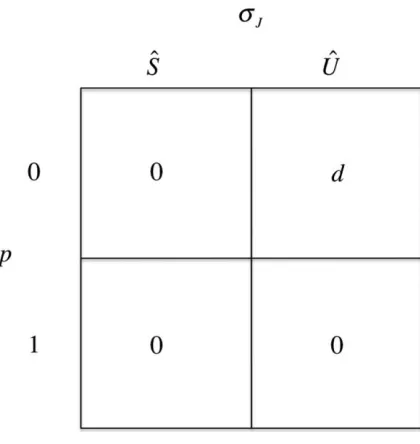
Consider negligence regimes, in which damages are zero whenever a firm takes precautions or is found to be safe. As illustrated in Figure 1, any negligence
10One simple condition that implies assumption 6 is(p ⫺pL)h12c.
U U
11For example, the planner could set
c
ifpp0,
pU
D(p,U)p
{
Figure 1. Damages under negligence, where damages are a function of the level of precautions (p苸{0, 1}) and the court’s signal (jJ苸{S, U}ˆ ˆ ).
regime can be described byd ≥ 0, the level of damages a firm must pay in the case of an accident if it is found to have not taken precautions and to be unsafe. Negligence regimes are a subset of all enforcement regimes involving only courts. Denote the maximum level of social welfare achievable by a negligence regime , which must lie weakly below the maximum level achievable by courts,
N
W
namely,WN ≤ WC.
To illustrate, take the drug example. Under negligence, after an accident occurs, a judge or jury decides both whether the drug company did warn and whether it should have warned physicians of a potential side effect. A plaintiff is awarded damages if the court decides (possibly incorrectly) that the drug company should have warned but failed to do so.
Lemma 1. WN C.
pW
achieved through a negligence regime if and only if it can be achieved when damages are the minimum necessary to create incentives for unsafe firms to take precautions. Label such damages , sod¯ ¯d equates the cost of precautions with the expected liability cost for an unsafe firm if no precautions are taken:
c ¯ ¯
cppU(1⫺SFU)d⇒dp . (1⫺SFU)pU
Whendpd, a safe firm optimally chooses not to take precautions since such firms are less likely than unsafe firms to cause an accident and to be found unsafe:
¯
c1pSUFSd, (11) where the right-hand term is the expected liability cost for a safe firm if no precautions are taken.
Now we consider firm activity whendpd¯. Because damagesd¯are such that unsafe firms take precautions, these firms are not exposed to liability costs. As a result, a given unsafe firm engages in activity if
b⫺e⫺c ≥ 0. (12) Inequality (12) implies that the activity level of unsafe firms is
b⫺c
min
{
, 1 ,}
(13)¯e
which is the full-information benchmark level.
Because damagesd are such that safe firms do not take precautions, they are exposed to liability costs due to court errors. As a result, a given safe firm engages in activity if
b⫺e⫺pSUFSd ≥ 0. (14) Inequality (14) implies that the activity level of safe firms is
b⫺pSUFSd
min
{
, 1 ,}
(15)¯e
which is the full-information benchmark level if and only if
¯e ≤ b⫺pSUFSd. (16) We have proved the following:
Proposition 2. Courts alone can implement the full-information benchmark if and only if
¯ ˜
regulation. There is no room for regulation when inequality (17) holds, which is the condition for it to be possible for a negligence regime to create incentives for unsafe firms to take precautions without deterring safe firms from partici-pating in the market. In particular, courts alone can implement the full-information benchmark whenever positive externalities are sufficiently small or courts mistake safe firms as unsafe with sufficiently low probability: inequality (17) is satisfied whenever is sufficiently small (fixing¯e UFS) orUFSis sufficiently small (fixing ).¯e
To illustrate, suppose that, absent the harmful externalities controlled by the negligence rule, the private and social returns to introducing a drug are similar. Then proposition 2 says that there is no welfare benefit from having the FDA make an ex ante determination of whether a drug company should issue a warning of a potential side effect. Likewise, suppose that judges have sufficient expertise that they find that a drug company should have warned physicians of a potential side effect only when issuing such a warning would have in fact been socially efficient. When judges and juries really have such expertise, then there are no additional benefits of regulation either, since negligence assures correct incentives. Matters may be different if the social benefits of drug introduction greatly exceed the private ones and if judges do not have sufficient expertise.
When inequality (17) does not hold, the addition of regulators with relative expertise may be beneficial by reducing safe firms’ exposure to liability costs. Before turning to this issue, it is helpful to derive optimal damages under courts alone. When any negligence regime that creates incentives for unsafe firms to take precautions deters safe firms from participating in the market (¯e1e˜), it may be optimal to set damages below the level that incentivizes precautions ( ). The obvious alternative to setting damages atd¯ d¯ is setting damages at
¯ b⫺e
if b!pUh
pSUFS
dp
{
(18)0 if b ≥ pUh,
which equals either the maximum damage award that does not affect the activity level of safe firms (whenb!pUh) or zero (otherwise). LettingW(d)equal social welfare as a function of the level of damages under negligence and definingd*to equal the smallest maximizer ofW(d)—namely,d*pmin arg maxd≥0W(d)—we have the following result:
Proposition 3. If¯e1˜e, then optimal damages under negligence are given by
LU
¯d if a!
LU⫹GS
d*p (19)
LU
{
d if a ≥ ,LU⫹GS
expected loss from eliminating a given unsafe firm’s incentive to take precautions by reducing damages from¯d dto (bothGSandLUare defined in the Appendix). Proposition 3 characterizes the optimal negligence regime when positive ex-ternalities and court errors are sufficiently large that negligence cannot implement the full-information benchmark. Proposition 3 says that damages should be high enough to create incentives for unsafe firms to take precautions if and only if the proportion of safe firms (a) is sufficiently low. The intuition is that the cost of setting large damages is the loss from deterring safe firms from participating in the market because of court errors; this loss is proportional to the number of safe firms that are affected.
4. Regulators Alone
When safe firms capture too low a share of the social surplus generated by their activity and courts mistake safe firms for unsafe ones with a sufficiently high probability (¯e1˜e), then any negligence regime that encourages unsafe firms to take precautions necessarily lowers the activity level of safe firms. In this situation, regulators may help by reducing safe firms’ exposure to liability costs while maintaining incentives for at least some unsafe firms to take precautions. We first consider regulation alone (no litigation) and ask when it performs better than courts alone. We then turn to the characterization of the optimal combined regime.
To gain intuition for why regulators may perform better than courts, consider first the extreme case in which regulators perfectly classify firms (dUFSp
), and consider the following regulatory regime: firms face a fine
dSFUp0 F1
for failure to take precautions if they are ex ante classified as unsafe by the
c
regulator and face no fine for failure to take precautions if they are classified as safe. It is clear that this regime implements the full-information benchmark, thus improving on the court-only outcome when¯e1e˜.
More generally (dUFS ≥ 0,dSFU ≥ 0), consider the following subset of regu-latory regimes. In the event of an accident, a regulator investigates whether a firm took precautions and imposes a fine if the firm failed to do so, where the magnitude of the fine may depend on the regulatory classification. The regulator does not investigate or impose a fine if the firm did not cause an accident. Any enforcement method of this form is described by (fSˆ, fUˆ), where fˆv ≥ 0 is the level of fines a firm ex ante classified as typevˆ苸{S, U}ˆ ˆ must pay in the case of an accident if it is found to have not taken precautions. Denote the maximum level of social welfare achievable by such an enforcement method byW˜ R.
phy-sicians and imposes a fine if it did not, where the magnitude of the fine can depend on the drug’s classification (in particular, the fine may be zero if the regulator had not required precautions).
We can restrict attention to such regimes by the following lemma, in which denotes the maximum level of social welfare achievable by an enforcement
R
W
regime involving regulators alone.
Lemma 2. WR ˜ R.
pW
Lemma 2 establishes that, in our model, there is no loss of generality in confining attention to regulatory regimes in which the regulator investigates whether a firm took precautions only in the event of an accident. In particular, it is suboptimal for a regulator to fine a firm for failure to take precautions prior to an accident occurring. Together with the next proposition, which establishes an upper bound on optimal regulatory fines, lemma 2 implies that command-and-control regulation, whereby the regulator forces all firms classified as some type to take precautions (or, equivalently, sets large enough fines that all such firms are incentivized to take precautions), is suboptimal in our model. The fact that an accident occurs provides an additional signal that a firm is unsafe. Making fines contingent on whether there is an accident thus allows the regulator to set fines that better target unsafe firms. Of course, as the example above illustrated, command-and-control regulation can perform just as well as contingent fines in the special case in which the regulator perfectly classifies firms. Likewise, while suboptimal, command-and-control regulation can perform better than litigation when regulators have sufficient expertise (namely, whendUFS anddSFU are suf-ficiently small).
What is the optimal combination of(fSˆ,fUˆ)? Whene¯1e˜, finefˆvshould be set by comparing the benefits of creating incentives for unsafe firms to take pre-cautions against the costs of discouraging safe firms from engaging in activity. These benefits and costs will depend on the relative number of safe and unsafe firms affected by the fine. Let
(1⫺dUFS)a
ˆ
aSˆpPr(SFjRpS)p
(1⫺dUFS)a⫹dSFU(1⫺a)
denote the fraction of safe firms among those classified by the regulator as safe and
dUFSa
ˆ
aUˆ pPr(SFjRpU)p
dUFSa⫹(1⫺dSFU)(1⫺a)
denote the fraction of safe firms among those classified by the regulator as unsafe. The obvious candidates for the optimal fine are
c
¯fp , (20)
pU
precautions, and
¯ b⫺e
if b!pUh,
pS
fp
{
(21)0 if b ≥ pUh,
which equals either the maximum fine that does not affect the activity level of safe firms (whenb!pUh) or zero (otherwise).
Define W(fˆS, fUˆ) to equal social welfare as a function of the level of fines and note that W(fSˆ, fUˆ) can be expressed as Pr(jRpS)ˆ WSˆ(fSˆ)⫹Pr(jRp , where equals expected welfare conditional on the regulator’s
ˆ
U)WUˆ(fUˆ) Wˆv(fvˆ)
signal. Finally, let fvˆ* equal the smallest maximizer of Wvˆ(fvˆ); namely, fvˆ*p .
min arg maxf≥0Wˆv(f)
Proposition 4. Let¯e1˜e,d 10, and d 10. Then fines in the optimal
SFU UFS
regulatory regime are given by
R
LU
¯f if aˆS!LR⫹GR, U S
fSˆ*p LR (22) U
{
f if aˆS ≥ LR⫹GR,U S
and
R
LU
¯f if aUˆ !LR⫹GR, U S
fUˆ*p LR (23) U
{
f if aUˆ ≥ LR⫹GR,U S
whereGRrepresents the expected gain from increasing a given safe firm’s
in-S
centive to engage in activity by reducing fines from to and¯f f LR represents the
U
expected loss from eliminating a given unsafe firm’s incentive to take precautions by reducing fines from¯f to f (both GR and LR are defined precisely in the
S U
Appendix).
Proposition 4 characterizes the optimal regulatory regime when negligence cannot implement the full-information benchmark. Proposition 4 says that fines should be high enough to create incentives for unsafe firms to take precautions if and only if the proportion of safe firms affected by the fine (namely,avˆ) is sufficiently low, since the loss from deterring safe firms from participating in the market by exposing them to large fines is proportional to the number of safe firms that are exposed.
When does regulation alone perform better than litigation? For this to be the case, we must have(f*,f*) ¯ : the regulatory classification matters.12There
p(f,f)
ˆ ˆ
S U
are two main cases to consider. In the first case, the optimal negligence regime
12This follows from the fact thatW(f,f) ≤ W(d)andW(f,¯ ¯f) ≤ W(d)¯, as we show in the proof
creates incentives for unsafe firms to take precautions at the cost of discouraging safe firms from engaging in activity. Proposition 3 identifies this as the case in which the proportion of safe firms in the population is sufficiently small:a! . In this case, regulation may help by reducing safe firms’ exposure
LU/(LU⫹GS)
to fines, while still creating incentives for correctly classified unsafe firms to take precautions. Since the benefit of regulation is proportional to the number of safe firms that are affected in this case, the number of safe firms must lie in some intermediate range for regulation to be optimal: this number must be sufficiently low that the optimal negligence regime creates incentives for unsafe firms to take precautions (d*pd¯), yet sufficiently high that it is better to instead limit liability costs for some safe firms by moving to regulation with fines (f, , at the cost of removing misclassified unsafe firms’ incentives to take
precau-¯f) tions.
In the second case, the optimal negligence regime does not create incentives for unsafe firms to take precautions because the cost of doing so is too large. Proposition 3 identifies this as the case in which the proportion of safe firms in the population is sufficiently high:a ≥ LU/(LU⫹GS). In this case, regulation may help by creating incentives for some unsafe firms to take precautions at the cost of discouraging misclassified safe firms from engaging in activity. That is, regulation may help if it is less costly for regulators to create incentives for precautions. Since the cost of regulation is proportional to the number of safe firms that are affected in this case, again the number of safe firms must lie in some intermediate range for regulation to perform better than courts: this num-ber must be sufficiently high that the optimal negligence regime does not create incentives for unsafe firms to take precautions (d*pd), yet sufficiently low that it is better to instead encourage some unsafe firms to take precautions by moving to regulation with fines(f,¯f), at the cost of discouraging misclassified safe firms from participating in the market.
In either case, regulation alone performs better than courts alone so long as the fraction of safe firms lies in some intermediate range, where what is inter-mediate depends on the magnitude of court and regulatory errors. Formally, we have the following proposition:
Proposition 5. Suppose that the conditions of proposition 4 hold.
1. If a!L /(L ⫹G ), then regulation alone performs better than courts
U U S
alone if and only ifG˜ 10 and
S
˜ LU
a1 , (24)
˜ ˜ LU⫹GS
moving to regulation with fines (f,¯f) from negligence with damages ¯d (both and are defined in the Appendix).
˜ ˜ GS LU
2. If a ≥ LU/(LU⫹GS), then regulation alone performs better than courts alone if and only ifG˜ 10 and
U
˜ GU
a! , (25)
˜ ˜ GU⫹LS
whereG˜Udenotes the expected gain (per unsafe firm) from encouraging fraction to take precautions by moving from negligence with damages to
(1⫺dSFU) d
regulation with fines(f,¯f)andL˜Sdenotes the expected loss (per safe firm) from discouraging fractiondUFSfrom engaging in activity by moving from negligence with damagesd to regulation with fines (f,¯f)(bothG˜UandL˜S are defined in the Appendix).
One implication of proposition 5 is that regulation alone is superior to liti-gation alone so long as regulators have sufficient expertise. Formally, the right-hand side of inequality (24) is increasing in regulatory errors (dSFU, dUFS) and tends toward zero as these errors tend toward zero. Similarly, the right-hand side of inequality (25) is decreasing in the size of regulatory errors and tends toward one as these errors tend toward zero.
Another implication is less obvious: regulation alone is (weakly) inferior to litigation alone when courts and regulators are subject to the same errors. Prop-osition 5 identifies two situations in which regulation alone performs better than courts alone, both of which amount to the fraction of safe firms falling between two bounds, where these bounds depend on court and regulatory errors: the number of safe firms (a) must satisfy L˜ /(L˜ ⫹G˜ )!a!L /(L ⫹G ), or
U U S U U S
. Neither situation can hold when courts and
˜ ˜ ˜ L /(L ⫹G) ≤ a!G /(G ⫹L)
U U S U U S
regulators are subject to the same errors, as in this case the upper bounds fall below the lower bounds: whenSFUpdSFU and dUFSpUFS, we have verified that L˜U/(L˜U⫹G˜S) ≥ LU/(LU⫹GS) and LU/(LU⫹GS) ≥ G˜U/(G˜U⫹L˜S) (cal-culations provided upon request).
Taken together, these two implications of proposition 5 provide some formal support for Landis’s (1938) claim that the central benefit of regulators relative to judges is greater expertise.
5. Combination of Regulators and Courts
A regime that combines the use of regulators and courts clearly does at least as well as one that involves only regulators or courts. What does the optimal such regime look like, and when does it in fact require the use of regulators?
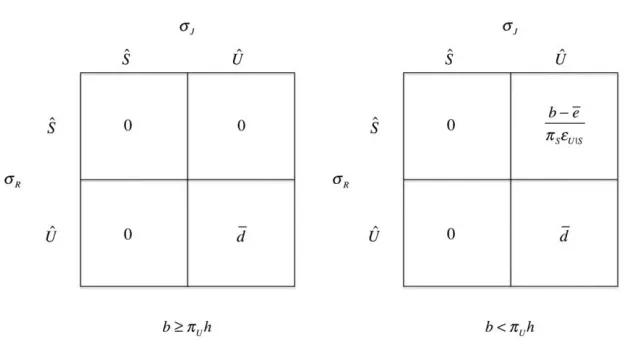
clas-Figure 2. Damages under negligence combined with regulation, where damages are a func-tion of the level of precaufunc-tions (p苸{0, 1}), the court’s signal (jJ苸{S, U}ˆ ˆ ), and the regulatory classification (jR苸{S, U}ˆ ˆ ).
sification.13As illustrated in Figure 2, any enforcement method involving both
regulators and courts of this form is described by(dSˆ,dUˆ), wheredvˆ ≥ 0is the the level of damages a firm ex ante classified as typevˆ苸{S,ˆ U}ˆ must pay in the case of an accident if it is found to have not taken precautions and to be unsafe. Since we allowdˆSpdUˆ, mixed regimes of this type nest pure negligence. Denote the maximum level of social welfare achievable by such an enforcement method by N⫹R.
W
To illustrate, return to the drug example. Prior to a drug’s release, a regulator determines whether the drug company should warn physicians of a potential side effect while marketing the drug. If an accident occurs, a case against the drug company is brought to court. A judge or jury then determines whether the drug company did and should have warned physicians of a potential side effect. A plaintiff is awarded damages if the court decides (possibly incorrectly) that the drug company should have warned but failed to do so. The magnitude of damages may depend on the regulator’s previous classification.
We can restrict attention to such mixed regimes by the following lemma,
13It is not important that the court (rather than the regulator) imposes a penalty in the case of
[image:22.432.108.324.75.298.2]where C⫹R denotes the maximum level of social welfare achievable by an
W
enforcement regime involving both courts and regulators.
Lemma 3. WC⫹R N⫹R.
pW
Lemma 3 implies that, without loss of generality, we can confine attention to situations where regulators do not perform an enforcement function (namely, the mixed regime illustrated in Figure 2 does not involve the use of regulatory fines). The intuition is that it is best to make incentives for precautions contingent on as much information as possible to maximally target these incentives toward unsafe firms. Regulatory fines are contingent only on information available to the regulator, while court damages are both contingent on this information and the court’s signal.
What is the optimal combination of(dSˆ,dUˆ)? DefineW(dSˆ,dUˆ)to equal social welfare as a function of the level of damages and note thatW(dˆS, dUˆ) can be expressed as Pr(jRpS)ˆWˆS(dSˆ)⫹Pr(jRpU)ˆ WUˆ(dUˆ), where Wˆv(dvˆ) equals ex-pected welfare conditional on a firm being classified as . Finally, letvˆ dˆv* equal the smallest maximizer ofWvˆ(dvˆ); namely, dvˆ*pmin arg maxd≥0Wvˆ(d).
Proposition 6. Let¯e1e˜,d 10, andd 10. Then damages in the optimal
SFU UFS
combined regime are given by
LU
¯d if aSˆ!
LU⫹GS
dS*ˆ p (26)
LU
{
d if aSˆ ≥ ,LU⫹GS
and
LU
¯d if aUˆ !
LU⫹GS
dU*ˆ p (27)
LU
{
d if aUˆ ≥ .LU⫹GS
Proposition 6 characterizes the optimal combined regime when positive ex-ternalities and court errors are sufficiently large that the negligence regime alone cannot implement the full-information benchmark. This proposition says that the level of damages faced by firms ex ante classified as unsafe (safe) by the regulator should be set high enough to create incentives for unsafe firms to take precautions if and only if the proportion of safe firms among those classified as unsafe (safe) is sufficiently low.
When does the optimal combined regime in fact make use of regulators?
Figure 3. Damages under the optimal regime whenever it includes regulation
LU
aˆS ≥ 1aUˆ. (28)
LU⫹GS
By corollary 1, the optimal regime includes regulation if and only if safe firms comprise a large enough fraction of those firms ex ante classified as safe by the regulator and unsafe firms comprise a large enough fraction of those firms classified as unsafe. In particular, regulators increase welfare if and only if they are sufficiently good at determining whether a firm should efficiently take pre-cautions. Formally,aˆSis decreasing in regulatory errors,dSFUanddUFS, and tends to one as these errors approach zero;aUˆ is increasing in these errors and tends to zero as these errors approach zero.
Corollary 2. Suppose the conditions of proposition 6 hold.
1. If b ≥ pUh, then whenever the optimal regime includes regulation, (dS*,ˆ . Compliance with regulatory standards exempts firms from liability.
¯ dU*)ˆ p(0,d)
2. If b!pUh, then whenever the optimal regime includes regulation, (dS*,ˆ . Compliance with regulatory standards reduces but
¯ ¯
dU*)ˆ p[(b⫺e)/(pSUFS),d]
does not eliminate liability.
Corollary 2 is illustrated in Figure 314and says that when the optimal law
enforcement regime includes regulation and unsafe firms generate positive social returns even if they fail to take precautions, then firms should be granted im-munity from future liability if they meet the safety standard set by the regulator.
14Damages are a function of the regulatory classification (j 苸{S, U}ˆ ˆ ), the court’s signal (j 苸
R J
), and the social returns from firm activity (b) as compared to expected harm generated by ˆ ˆ
{S, U}
On the other hand, when unsafe firms generate negative social returns if they fail to take precautions, then firms should be subject to negligence claims even if they meet the standard set by the regulator, but the magnitude of damage awards is lower for firms that meet that standard.
The intuition behind these results is as follows. A pure-negligence regime can always incentivize information benchmark precautions for all firms and full-information benchmark activity for unsafe firms. In consequence, the addition of regulators can improve matters only when the activity level of safe firms is less than the full-information benchmark under negligence alone. In this case, regulators have the ability to encourage entry by limiting liability costs for safe firms through setting a damage award for firms classified as safe that is lower than the minimum necessary to incentivize precautions among the unsafe firms mistakenly classified as safe. When unsafe firms generate positive social returns in the absence of precautions, a damage award of zero is optimal among awards in this range, since lowering the award encourages greater (and more efficient) activity while bringing out the same level of precautions. On the other hand, when unsafe firms generate negative social returns in the absence of precautions and unsafe firms are sometimes mistakenly classified as safe, it is no longer optimal to set a damage award of zero. This is because it is possible to set a small but positive award that efficiently lowers the level of activity of unsafe firms mistakenly classified as safe, while not affecting the level of activity of safe firms (recall that unsafe firms are more likely to cause harm and be held liable if an accident occurs).
This result may shed light on the important policy question of whether reg-ulation should preempt subsequent litigation against firms that comply with regulatory rules by providing them with safe harbor from future negligence awards. The answer, according to our analysis, turns on whether the social benefits of activity in the particular sphere exceed expected harm from accidents even when firms do not take proper care. For example, for some medical in-novations such as vaccines or treatments for the terminally ill, one might think that there is indeed a case for preemption because the social returns are large even with unwarned side effects. On the other hand, in situations such as airplane safety maintenance, where it is difficult to argue that the social benefits of an activity outweigh expected harm when proper care is not taken, our analysis provides no justification for preemption. Rather, the efficient enforcement regime combines regulation with negligence. The general point is that preemption should be quite rare: it requires that activity be so valuable that it should be encouraged even by negligent firms.
5.1. Benefits and Costs of Revealing Information about Firm Safety Ex Ante
classification. This is how regulation tends to work in practice. It is possible, however, that a more efficient outcome could be achieved if this information was instead revealed ex post, for example, if a regulator appeared as an expert witness at the time of a trial.
The comparison between generating and revealing additional information ex ante and ex post when courts do not have access to any other information (namely, absent the regulatory signal, courts mistake unsafe firms as safe with probability 1 and vice versa) is equivalent to the comparison between the
per-2
formance of courts and regulators alone when courts and regulators make the same errors (namely,SFUpdSFUandUFSpdUFS). As mentioned above, using the conditions of proposition 5, we have verified that courts alone perform (weakly) better than regulators alone when courts and regulators make the same errors. This suggests that, in our model, revealing additional information ex post is weakly better than revealing additional information ex ante. On the other hand, if regulators are better at classifying firms, then there is a case for ex ante regulation. When comparing regulation and litigation alone, the key benefit of regulation comes from the relative expertise of regulators.
6. Other Regimes
6.1. Strict Liability
Other liability regimes, in particular strict liability, cannot achieve higher levels of welfare than negligence in our model by lemma 1. It is worth explaining in a bit more detail why strict liability, whereby a firm has to pay damages whenever it causes an accident (damages are independent of whether the firm took pre-cautions and the signal of its type), is suboptimal.
To illustrate, consider the case in which negligence with damagesdpd¯ is optimal among negligence regimes and compare the performance of this regime to the performance of strict liability when damages are set atdSL, wheredSL is the minimum damage award necessary to incentivize unsafe firms to take pre-cautions:
c
L SL SL SL
c⫹pUd ppUd ⇒d p .
L
pU⫺pU
Like negligence with damagesd ¯, strict liability with damages SL
im-pd dpd
plements first-best precautions. However, both safe and unsafe firms face greater expected liability costs than under negligence: liability costs for unsafe firms are versus zero; liability costs for safe firms are versus
L SL SL L
pUd pSd ppSc/(pU⫺pU)
. As a result, activity levels tend to be lower, which
¯
pSUFSdppScUFS/pU(1⫺SFU)
leads to welfare losses by assumption 2.15
15It can also easily be shown that strict liability with damagesdcannot perform better than
Why does negligence perform better than strict liability under the assumptions of our model but not under the assumptions of earlier models of optimal tort rules that incorporate activity (for example, Shavell 1980; Polinsky 1980), in which strict liability with damages equal to harm always achieves the first-best outcome so long as only one party can affect the probability or magnitude of an accident?16 The answer is that we relax the assumption that firms fully
in-ternalize the gross social benefit of activity (namely, we allow¯e10). In this case, strict liability with damages equal to harm may lead to suboptimally low activity. When¯ep0, strict liability with damages equal to harm achieves the first-best outcome in our model as well, as illustrated in Section 3.1.
6.2. Negligence When Damages Equal Harm
Additional reasons to introduce regulation obtain when courts adjudicating tort claims are restricted to applying a negligence standard and setting damages equal to harm. Such damages are optimal in some circumstances (see, for ex-ample, Posner 1972) and standard in many others, perhaps because they com-pensate the plaintiff for harm and “make him whole” (Shavell 2004, p. 271).
There are at least two additional reasons why introducing regulation may be beneficial when damages are restricted to equal harm. First, with this require-ment, negligence may fail to create incentives for firms to take first-best pre-cautions. Introducing regulation can then result in more efficient behavior even absent positive externalities from firm activity (Kolstad, Ulen, and Johnson 1990). With no positive externalities and damages equal to harm, safe firms could inefficiently take precautions if they are often mistakenly found liable, or unsafe firms could fail to take precautions if they are often mistakenly found not liable. With either outcome, regulation that replaces tort liability with more efficiently set regulatory fines (namely, fines that create incentives for first-best precautions) is welfare enhancing.17
More interesting, the requirement that courts set damages equal to harm may result in inefficiency because the social loss from some firms avoiding exposure by stopping activity could outweigh the gain from incentivizing those still op-erating to take precautions. Introducing regulation that preempts tort liability
16In fact, under the assumptions of the more standard models that incorporate activity, strict
liability performs better than negligence. This is a consequence of the fact that these models assume decreasing social benefits but constant costs from firm activity (we instead assume that firms of given safetyvgenerate constant—across firms—net social returns to activity conditional on a level of precautions). Combined with the assumption that, in the absence of liability rules, firms fully internalize the social benefit to activity but not the expected harm from accidents stemming from the activity, decreasing social benefits imply that firm activity may be inefficiently high under any regime where expected liability costs are lower than expected harm for some firms given that they take privately optimal levels of care (as is the case under a negligence regime in which firms face zero expected liability costs so long as they take sufficient precautions to meet the standard of care).
17Under the assumption of no positive externalities from firm activity, a regulatory regime in
can increase welfare even in the absence of court errors in determining liability. We now develop a necessary and sufficient condition for this to be the case.
Suppose that courts do not make errors (UFSpSFUp0) and that assump-tions 1 and 2 hold. Under negligence with damages equal to harm, the behavior of safe firms is first best since they are never mistakenly held liable. An unsafe firm takes precautions since
c!pUh (29) (where pUh is the reduction in expected liability costs by taking precautions) and engages in activity if and only if the private benefit of activity exceeds the cost of precautions:
b⫺e1c. (30) Hence, the activity level of such firms is
b⫺c
min
{
, 1 .}
(31)¯e
While unsafe firms take first-best precautions under negligence, their activity is inefficiently low whenever¯e1b⫺c by equation (31). Welfare may actually be lower under negligence than it would be under laissez-faire because the welfare benefit from incentivizing unsafe firms to take first-best precautions can be outweighed by the resulting cost from a decrease in such firms’ activity.18The
formal condition is
b⫺c
L L
(pU⫺pU)h⫺c!
(
1⫺min{
, 1 (})
b⫺c⫺pUh) (32)¯e
or, equivalently,
L
(b⫺c)(b⫺c⫺pUh)
¯
b1p h and e1 . (33)
U
b⫺pUh
Examining relation (33) reveals that welfare is higher under laissez faire if and only if both the social benefit to activity exceeds the expected value of any harmful externalities that may result when firms take inefficiently few precautions and the level of positive externalities is sufficiently large. Since relation (33) is also the necessary and sufficient condition for unsafe firms not to take precautions under the full-information benchmark, we have established the following propo-sition:19
Proposition 7. Suppose thatUFSpSFUp0, assumptions 1 and 2 hold, and courts are restricted to setting damages equal to harm. If relation (33) is
18Note that we have implicitly relaxed assumption 6.
19As before, the full-information benchmark refers to the outcome under a benevolent social