Monograph:
Clark, James Hanley orcid.org/0000-0002-5860-2480, Farmer, Thomas James
orcid.org/0000-0002-1039-7684 and Sherwood, James Richard
orcid.org/0000-0001-5431-2032 (2015) Assessment study report of indirect declaration
techniques to determine total bio-based content. Report. KBBPPS
10.13140/2.1.3235.8727
[email protected] https://eprints.whiterose.ac.uk/ Reuse
Items deposited in White Rose Research Online are protected by copyright, with all rights reserved unless indicated otherwise. They may be downloaded and/or printed for private study, or other acts as permitted by national copyright laws. The publisher or other rights holders may allow further reproduction and re-use of the full text version. This is indicated by the licence information on the White Rose Research Online record for the item.
Takedown
If you consider content in White Rose Research Online to be in breach of UK law, please notify us by
Knowledge Based Bio-based Products'
Pre-Standardization
Work package 4
Biomass Content
Deliverable N° 4.5:
Assessment study report of indirect
declara-tion techniques to determine total bio-based
content
Public
Version: 1 York, 07/01/2015prepared by: James Clark, Thomas Farmer, James Sherwood Green Chemistry Centre of Excellence, Department of Chemistry University of York, Heslington, York, UK, YO10 5DD
2
The research leading to these results has received funding from the European Union Sev-enth Framework Programme (FP7/2007-2013 under grant agreement n° KBBE/FP7EN/312060/”KBBPPS”.
3
Table of contents
Table of contents ... 3
List of tables ... 9
List of figures ...31
List of schemes ...39
1 Summary ...42
2 Introduction ...44
2.1 Aims and objectives ...44
2.2 The concept of bio-based content ...45
2.2.1 Radiocarbon analysis ...46
2.2.2 Elemental analysis ...47
2.2.3 Stable isotope analysis ...49
2.2.4 Mass balance approach ...51
2.3 Standardisation and certification schemes relating to bio-based content ...57
2.3.1 BioPreferred ...57
2.3.2 OK biobased ...58
2.3.3 DIN Biobasiert ...59
2.3.4 Association Chimie du Végétal (ACDV) ...59
2.3.5 BASF-TÜV SÜD mass balance for the use of renewable feedstocks in integrated production processes ...63
2.3.6 ISCC-plus sustainability certification ...66
2.3.7 Supply chain book-and-claim ...67
2.3.8 EU Ecolabel ...67
2.3.9 Traceability and chain of custody claims ...69
3 Direct measurement of bio-based content and its role alongside indirect bio-based content calculations ...70
3.1 Calculation of bio-based carbon content ...70
3.1.1 Sample preparation ...71
3.1.2 Liquid scintillation-counter method ...71
3.1.3 Beta-ionisation ...72
3.1.4 Accelerator Mass Spectrometry ...72
3.2 Calculation of bio-based content with stable isotope analysis ...73
3.3 Examples of bio-based content measurement applied to molecules ...75
3.3.1 Methyl oleate ...76
3.3.2 Polyethylene terephthalate ...76
3.3.3 Bio-ethanol and ethyl acetate ...77
4
3.4 Advantages and limitations of direct bio-based content ...81
4 Atom connectivity ...83
4.1 Calculation of bio-based content with atom connectivity methods ...83
4.1.1 Definition of atom connectivity methods ...83
4.1.2 Selection of atom connectivity molecule case studies ...90
4.2 Examples of bio-based content calculations for bulk chemicals based on atom connectivity ...94
4.2.1 Acetic acid ...96
4.2.2 Glycerol ...99
4.2.3 p-Xylene ... 100
4.2.4 1,4-Butanediol ... 104
4.2.5 Adipic acid ... 105
4.2.6 2-Ethoxyethyl acetate ... 109
4.2.7 Butylated hydroxytoluene ... 111
4.2.8 Acetyl tributyl citrate ... 113
4.2.9 Ammonia ... 115
4.3 Examples of bio-based content calculations for lubricant base oils based on atom connectivity ... 117
4.3.1 Methyl oleate ... 118
4.3.2 Neopentyl glycol distearate ... 119
4.4 Examples of bio-based content calculations for plastics based on atom connectivity 123 4.4.1 Polyethylene ... 125
4.4.2 Polylactic acid ... 127
4.4.3 Poly(ethylene terephthalate)... 128
4.4.4 Poly(butylene adipate terephthalate) ... 130
4.4.5 Poly(vinyl acetate) ... 132
4.4.6 Poly(vinyl alcohol) ... 134
4.4.7 Poly(ethyl acrylate) ... 135
4.4.8 Poly(dodecyl acrylate) ... 141
4.4.9 Sodium polyacrylate ... 144
4.4.10 Polyurethane ... 146
4.5 Examples of bio-based content calculations for solvents based on atom connectivity 150 4.5.1 Methanol ... 151
4.5.2 Ethyl acetate ... 153
4.5.3 Ethyl lactate ... 154
4.5.4 Acetone ... 155
4.5.5 2-Methyltetrahydrofuran ... 157
5
4.5.7 Dimethyl isosorbide ... 160
4.6 Examples of bio-based content calculations for surfactants based on atom connectivity ... 163
4.6.1 Hydrogen dodecyl sulphate and the sodium salt ... 164
4.6.2 Sodium laureth sulphate ... 168
4.6.3 Cocamidopropyl betaine ... 174
4.6.4 N-Dodecylpyridinium chloride ... 175
4.7 Examples of bio-based content calculations for fine chemicals based on atom connectivity ... 179
4.7.1 Aspirin ... 180
4.7.2 Vanillin ... 182
4.7.3 p-Cymenesulphonamide ... 184
4.8 Examples of bio-based content calculations for formulations and composites based on complementary elemental analysis ... 187
4.8.1 Starch polymer blends ... 188
4.8.2 PBAT-PLA polymer blend ... 191
4.8.3 Polyurethane with polyamide ... 198
4.9 Advantages and limitations of using atom connectivity for indirect determination of bio-based content ... 201
5 Mass balance ... 208
5.1 Mass balance and book-and-claim methods ... 208
5.1.1 Rules and interpretation of mass balance... 208
5.1.2 Mass balance Method A: The determination and allocation of the average bio-based content in a final product within a predefined time period using attribution ... 215
5.1.3 Mass balance Method B: The determination by calculation and allocation of the average bio-based carbon content and average bio-based content ... 224
5.1.4 Mass balance Method C: The determination of the average bio-based content by calculation of fossil carbon savings ... 232
5.1.5 Mass balance Method D: Stoichiometrically limited determination of the average or minimum bio-based carbon content and average bio-based content ... 237
5.1.6 The use of the book-and-claim principle for mass balance methods ... 239
5.2 Mass balance case study: Platform molecules ... 244
5.2.1 Mass balance case study: Gasification ... 244
5.2.2 Thermocracking of naphtha and its downstream products ... 252
5.3 Mass balance case study: Esterification processes for commodity compounds .... 271
5.3.1 Ethyl acetate ... 271
5.3.2 Biodiesel ... 281
5.3.3 Polyethylene terephthalate ... 284
5.4 Mass balance case study: Fine chemical synthesis ... 290
6
5.4.2 Vanillin ... 302
5.5 Mass balance case study: Polymer blends ... 309
5.5.1 Starch polymer blends ... 311
5.5.2 PBAT-PLA blend ... 317
5.6 Formulation and composite assembly ... 329
5.6.1 Water based paint ... 329
5.6.2 Insulation panel ... 330
5.6.3 Cleaning product versus composite curing resin ... 331
5.7 Advantages and limitations of different mass balance approaches ... 342
5.7.1 Inter-methodology comparison ... 342
5.7.2 Allocation of fluctuating biomass feedstocks: Feedstock variation ... 349
5.7.3 Allocation of fluctuating biomass feedstocks: Integrated production facilities . 351 5.7.4 Allocation of intermediates and products: Storage and transport ... 355
5.7.5 Allocation of intermediates and products: Storage and transport with losses . 360 5.7.6 Allocation of intermediates and products: Changes to storage or transport policy 362 5.7.7 Allocation of intermediates and products: Production by synthesis ... 365
5.7.8 Allocation of intermediates and products: Formulation ... 375
5.7.9 Summary of mass balance ... 378
6 Indirect bio-based content assessment ... 384
6.1 Instructions and guidance for applying mass balance... 385
6.2 Applications of calculated total bio-based content ... 394
6.2.1 Application of (indirect) total bio-based content ... 394
6.2.2 Compatibility with future renewability assessments ... 398
7 Conclusion ... 402
8 Annex A: Atom connectivity ... 403
8.1 Calculated radiocarbon and elemental analysis of chemical products ... 403
8.2 Methanol and acetic acid ... 406
8.3 Glycerol and fatty acid methyl esters ... 411
8.4 p-Xylene ... 415
8.5 1,4-Butanediol ... 419
8.6 Adipic acid ... 421
8.7 2-Ethyoxyethyl acetate ... 425
8.8 Butylated hydroxytoluene and acetone ... 428
8.9 Acetyl tributyl citrate ... 432
8.10 Ammonia ... 436
8.11 Neopentyl glycol distearate ... 438
8.12 Polyethylene ... 441
8.13 Products of lactic acid ... 444
7
8.15 Polyvinyl acetate and polyvinyl alcohol ... 454
8.16 Polyacrylate products ... 458
8.17 Polyurethane ... 473
8.18 Ethyl acetate ... 477
8.19 2-Methyltetrahydrofuran ... 480
8.20 N-Methylpyrrolidinone ... 482
8.21 Dimethyl isosorbide ... 485
8.22 Hydrogen dodecyl sulphate and the sodium salt ... 488
8.23 Sodium laureth sulphate ... 493
8.24 Cocamidopropyl betaine ... 499
8.25 N-Dodecylpyridinium chloride ... 503
8.26 Aspirin ... 506
8.27 Vanillin ... 508
8.28 p-Cymenesulphonamide ... 510
9 Annex B: Mass balance ... 513
9.1 Gasification mass balance calculations ... 513
9.1.1 Total bio-based content calculation by mass balance Method A ... 514
9.1.2 Total bio-based content calculation by mass balance Method B ... 514
9.1.3 Total bio-based content calculation by mass balance Method C ... 515
9.2 Naphtha processing mass balance calculations (ethanol synthesis) ... 519
9.2.1 Total bio-based content calculation by mass balance Method A ... 519
9.2.2 Total bio-based content calculation by mass balance Method B ... 520
9.2.3 Total bio-based content calculation by mass balance Method C ... 521
9.3 Naphtha processing mass balance calculations (2-ethoxyethyl acetate synthesis) 524 9.3.1 Total bio-based content calculation by mass balance Method A ... 525
9.3.2 Total bio-based content calculation by mass balance Method C ... 528
9.4 Ethyl acetate production mass balance calculations ... 532
9.4.1 Total bio-based content calculation by mass balance Method A ... 533
9.4.2 Total bio-based content calculation by mass balance Method C ... 534
9.5 Bio-diesel manufacturing mass balance calculations ... 537
9.5.1 Total bio-based content calculation by mass balance Method A ... 537
9.5.2 Total bio-based content calculation by mass balance Method B ... 538
9.5.3 Total bio-based content calculation by mass balance Method C ... 539
9.6 Polyethylene terephthalate mass balance calculations ... 541
9.6.1 Total bio-based content calculation by mass balance Method A ... 542
9.6.2 Total bio-based content calculation by mass balance Method B ... 544
9.6.3 Total bio-based content calculation by mass balance Method C ... 545
9.7 Sodium laureth sulphate mass balance calculations... 548
8
9.7.2 Total bio-based content calculation by mass balance Method B ... 551
9.7.3 Total bio-based content calculation by mass balance Method C ... 553
9.7.4 Total bio-based content calculation by mass balance Method D (seasonal variation) ... 555
9.8 Synthetic vanillin mass balance calculations ... 560
9.8.1 Total bio-based content calculation by mass balance Method A ... 560
9.8.2 Total bio-based content calculation by mass balance Method B ... 561
9.8.3 Total bio-based content calculation by mass balance Method C ... 561
9.9 Mass balance calculations describing starch polymer blends ... 563
9.9.1 Total bio-based content calculation by mass balance Method A ... 563
9.9.2 Total bio-based content calculation by mass balance Method B ... 564
9.9.3 Total bio-based content calculation by mass balance Method C ... 566
9.10 PBAT-PLA mass balance calculations... 568
9.10.1 Total bio-based content calculation by mass balance Method A ... 569
9.10.2 Total bio-based content calculation by mass balance Method B ... 573
9.10.3 Total bio-based content calculation by mass balance Method C ... 575
9.11 Cleaning product ... 578
9.11.1 Total bio-based content calculation by mass balance Method A ... 578
9.11.2 Total bio-based content calculation by mass balance Method B ... 580
9.11.3 Total bio-based content calculation by mass balance Method C ... 580
9.12 Composite curing resin ... 582
9.12.1 Total bio-based content calculation by mass balance Method A ... 582
9.12.2 Total bio-based content calculation by mass balance Method B ... 584
9.12.3 Total bio-based content calculation by mass balance Method C ... 584
10 List of standards and pre-standardisation research reports ... 586
9
List of tables
10
Table 4-12 Allocation of bio-based content for 1,4-butanediol made from succinic acid... 105
Table 4-13 Allocation of bio-based content for adipic acid made from glucaric acid. ... 107
Table 4-14 Allocation of bio-based content for adipic acid made from benzene. ... 109
Table 4-15 Allocation of bio-based content for partially bio-based 2-ethyoxyethyl acetate. . 110
Table 4-16 Allocation of bio-based content for butylated hydroxytoluene made from toluene. ... 112
Table 4-17 Allocation of bio-based content for acetyl tributyl citrate made from citric acid. . 115
Table 4-18 Allocation of bio-based content for ammonia made from nitrogen and hydrogen gases. ... 117
Table 4-19 Allocation of bio-based content for methyl oleate made from vegetable oils. .... 119
Table 4-20 Allocation of bio-based content for neopentyl glycol distearate made from vegetable oils. ... 122
Table 4-21 Allocation of bio-based content for polyethylene made from ethylene. ... 126
Table 4-22 Allocation of bio-based content for polyethylene made from bio-ethanol. ... 127
Table 4-23 Allocation of bio-based content for poly(lactic acid) made from sugar. ... 128
Table 4-24 Allocation of based content for polyethylene terephthalate made from bio-based ethylene glycol. ... 130
Table 4-25 Allocation of bio-based content for poly(butylene adipate terephthalate) made from bio-based 1,4-butanediol. ... 132
Table 4-26 Allocation of bio-based content for polyvinyl acetate made from acetic acid. .... 133
Table 4-27 Allocation of bio-based content for poly(vinyl alcohol) made from poly(vinyl acetate). ... 135
Table 4-28 Allocation of bio-based content for poly(ethyl acrylate) made from fossil derived feedstocks. ... 137
Table 4-29 Allocation of bio-based content for poly(ethyl acrylate) made from bio-ethanol. 138 Table 4-30 Allocation of bio-based content for poly(ethyl acrylate) made from glycerol. ... 140
Table 4-31 Allocation of bio-based content for poly(ethyl acrylate) made from bio-based feedstocks. ... 141
Table 4-32 Allocation of bio-based content for poly(dodecyl acrylate) made from bio-based dodecanol... 142
Table 4-33 Allocation of bio-based content for poly(dodecyl acrylate) made from bio-based acrylic acid. ... 144
Table 4-34 Allocation of bio-based content for sodium polyacrylate derived from glycerol. . 146
Table 4-35 Allocation of bio-based content for soy derived polyurethane made from epoxidised soy oil. ... 149
Table 4-36 Allocation of bio-based content for methanol made from fossil derived feedstocks. ... 152
Table 4-37 Allocation of bio-based content for ethyl acetate made from bio-ethanol. ... 154
11
12
13
14
Table 5-50 Various claims of total bio-based content assuming losses or batch allocation or
fluctuating feedstocks in the production go dimethyl adipate. ... 365
Table 5-51 Mass balance Method D calculation of total bio-based content for sodium laureth sulphate produced from a bio-based dodecanol intermediate. ... 367
Table 5-52 Mass balance Method D calculation of bio-based carbon content for sodium laureth sulphate produced from a bio-based dodecanol intermediate. ... 368
Table 5-53 Mass balance Method D calculation of total bio-based content for sodium laureth sulphate produced with a bio-based hydrophilic section. ... 369
Table 5-54 Mass balance Method D calculation of bio-based carbon content for sodium laureth sulphate produced with a bio-based hydrophilic section. ... 369
Table 5-55 An example of seasonal feedstock input fluctuations with percentage of ethylene contribution also indicated. ... 370
Table 5-56 The division of bio-based ethylene and conventional ethylene whilst prioritising biomass input into oligomerisation in the production of sodium laureth sulphate. ... 371
Table 5-57 Mass balance Method D calculation of total bio-based content for sodium laureth sulphate when seasonal variation influences the bio-based content and biomass is prioritised into the oligomerisation pathway. ... 372
Table 5-58 Mass balance Method D calculation of bio-based carbon content for sodium laureth sulphate when seasonal variation influences the bio-based content and biomass is prioritised into the oligomerisation pathway. ... 372
Table 5-59 The virtual separation of bio-based ethylene and conventional ethylene for the production of sodium laureth sulphate without prioritisation of biomass input into a specific pathway. ... 373
Table 5-60 Mass balance Method D calculation of total bio-based content for sodium laureth sulphate when seasonal variation influences the bio-based content. ... 374
Table 5-61 Mass balance Method D calculation of bio-based carbon content for sodium laureth sulphate when seasonal variation influences the bio-based content. ... 375
Table 5-62 Data for two ingredients of a formulation made from variable amounts of biomass. ... 376
Table 5-63 The total bio-based content of a formulation accounting for the fluctuating feedstocks that created the ingredients. ... 376
Table 5-64 Seasonal total bio-based content describing the formulation ingredients. ... 377
Table 5-65 Overview of the different mass balance approaches. ... 379
Table 6-1 A demonstration of the calculation required to produce a value of bio-based carbon content. ... 390
Table 8-1 Bio-based carbon content and elemental analysis data for chemical products of relevance to the ACDV certification scheme. ... 403
Table 8-2 Indirect bio-based content allocation for methanol (Method 1). ... 406
Table 8-3 Indirect bio-based content allocation for methanol (Method 2a). ... 407
15
Table 8-5 Indirect bio-based content allocation for methanol (Method 3). ... 407
Table 8-6 Indirect bio-based content allocation for methanol (ACDV method). ... 407
Table 8-7 Indirect bio-based content allocation for acetic acid from syngas (Method 1)... 408
Table 8-8 Indirect bio-based content allocation for acetic acid from syngas (Method 2a). ... 408
Table 8-9 Indirect bio-based content allocation for acetic acid from syngas (Method 2b). ... 408
Table 8-10 Indirect bio-based content allocation for acetic acid from syngas (Method 3). ... 408
Table 8-11 Indirect bio-based content allocation for acetic acid from syngas (ACDV method). ... 409
Table 8-12 Indirect bio-based content allocation for acetic acid produced by fermentation (Method 1). ... 409
Table 8-13 Indirect bio-based content allocation for acetic acid produced by fermentation (Method 2a). ... 410
Table 8-14 Indirect bio-based content allocation for acetic acid produced by fermentation (Method 2b). ... 410
Table 8-15 Indirect bio-based content allocation for acetic acid produced by fermentation (Method 3). ... 410
Table 8-16 Indirect bio-based content allocation for acetic acid produced by fermentation (ACDV method). ... 410
Table 8-17 Indirect bio-based content allocation for methyl oleate (Method 1). ... 411
Table 8-18 Indirect bio-based content allocation for methyl oleate (Method 2a). ... 412
Table 8-19 Indirect bio-based content allocation for methyl oleate (Method 2b). ... 412
Table 8-20 Indirect bio-based content allocation for methyl oleate (Method 3). ... 412
Table 8-21 Indirect bio-based content allocation for methyl oleate (ACDV method). ... 412
Table 8-22 Indirect bio-based content allocation for glycerol (Method 1). ... 413
Table 8-23 Indirect bio-based content allocation for glycerol (Method 2a). ... 413
Table 8-24 Indirect bio-based content allocation for glycerol (Method 2b). ... 413
Table 8-25 Indirect bio-based content allocation for glycerol (Method 3). ... 413
Table 8-26 Indirect bio-based content allocation for glycerol (ACDV method). ... 414
Table 8-27 Indirect bio-based content allocation for p-xylene from isobutanol (Method 1). . 415
Table 8-28 Indirect bio-based content allocation for p-xylene from isobutanol (Method 2a). ... 416
Table 8-29 Indirect bio-based content allocation for p-xylene from isobutanol (Method 2b). ... 416
Table 8-30 Indirect bio-based content allocation for p-xylene from isobutanol (Method 3). . 416
Table 8-31 Indirect bio-based content allocation for p-xylene from isobutanol (ACDV method). ... 416
Table 8-32 Indirect bio-based content allocation for p-xylene from dimethylfuran (Method 1). ... 417
16
17
Table 8-54 Indirect based content allocation 2-ethoxyethyl acetate synthesised from
bio-ethanol (Method 2b). ... 426
Table 8-55 Indirect bio-based content allocation for 2-ethoxyethyl acetate synthesised from bio-ethanol (Method 3). ... 426
Table 8-56 Indirect bio-based content allocation for 2-ethoxyethyl acetate synthesised from bio-ethanol (ACDV method). ... 427
Table 8-57 Indirect bio-based content allocation for petrochemical butylated hydroxytoluene (Method 1). ... 429
Table 8-58 Indirect bio-based content allocation for petrochemical butylated hydroxytoluene (Method 2a). ... 429
Table 8-59 Indirect bio-based content allocation for petrochemical butylated hydroxytoluene (Method 2b). ... 429
Table 8-60 Indirect bio-based content allocation for petrochemical butylated hydroxytoluene (Method 3). ... 430
Table 8-61 Indirect bio-based content allocation for petrochemical butylated hydroxytoluene (ACDV method). ... 430
Table 8-62 Indirect bio-based content allocation for petrochemical acetone (Method 1). .... 430
Table 8-63 Indirect bio-based content allocation for petrochemical acetone (Method 2a). .. 430
Table 8-64 Indirect bio-based content allocation for petrochemical acetone (Method 2b). .. 431
Table 8-65 Indirect bio-based content allocation for petrochemical acetone (Method 3). .... 431
Table 8-66 Indirect bio-based content allocation for petrochemical acetone (ACDV method). ... 431
Table 8-67 Indirect bio-based content allocation for acetyl tributyl citrate from citric acid and syngas (Method 1). ... 433
Table 8-68 Indirect bio-based content allocation for acetyl tributyl citrate from citric acid and syngas (Method 2a). ... 434
Table 8-69 Indirect bio-based content allocation for acetyl tributyl citrate from citric acid and syngas (Method 2b). ... 434
Table 8-70 Indirect bio-based content allocation for acetyl tributyl citrate from citric acid and syngas (Method 3). ... 434
Table 8-71 Indirect bio-based content allocation for acetyl tributyl citrate from citric acid and syngas (ACDV method). ... 435
Table 8-72 Indirect bio-based content allocation for ammonia (Method 1). ... 436
Table 8-73 Indirect bio-based content allocation for ammonia (Method 2a). ... 436
Table 8-74 Indirect bio-based content allocation for ammonia (Method 2b). ... 437
Table 8-75 Indirect bio-based content allocation for ammonia (Method 3). ... 437
Table 8-76 Indirect bio-based content allocation for ammonia (ACDV method). ... 437
18
Table 8-78 Indirect bio-based content allocation for neopentyl glycol distearate from syngas
and propene and fatty acids (Method 2a). ... 439
Table 8-79 Indirect bio-based content allocation for neopentyl glycol distearate from syngas and propene and fatty acids (Method 2b). ... 439
Table 8-80 Indirect bio-based content allocation for neopentyl glycol distearate from syngas and propene and fatty acids (Method 3). ... 440
Table 8-81 Indirect bio-based content allocation for neopentyl glycol distearate from syngas and propene and fatty acids (ACDV method). ... 440
Table 8-82 Indirect bio-based content allocation for polyethylene from petroleum (Method 1). ... 441
Table 8-83 Indirect bio-based content allocation for polyethylene from petroleum (Method 2a). ... 441
Table 8-84 Indirect bio-based content allocation for polyethylene from petroleum (Method 2b). ... 442
Table 8-85 Indirect bio-based content allocation for polyethylene from petroleum (Method 3). ... 442
Table 8-86 Indirect bio-based content allocation for polyethylene from petroleum (ACDV method). ... 442
Table 8-87 Indirect bio-based content allocation for polyethylene from bio-ethanol (Method 1). ... 442
Table 8-88 Indirect bio-based content allocation for polyethylene from bio-ethanol (Method 2a). ... 443
Table 8-89 Indirect bio-based content allocation for polyethylene from bio-ethanol (Method 2b). ... 443
Table 8-90 Indirect bio-based content allocation for polyethylene from bio-ethanol (Method 3). ... 443
Table 8-91 Indirect bio-based content allocation for polyethylene from bio-ethanol (ACDV method). ... 443
Table 8-92 Indirect bio-based content allocation for polylactic acid (Method 1). ... 444
Table 8-93 Indirect bio-based content allocation for polylactic acid (Method 2a)... 444
Table 8-94 Indirect bio-based content allocation for polylactic acid (Method 2b)... 445
Table 8-95 Indirect bio-based content allocation for polylactic acid (Method 3). ... 445
Table 8-96 Indirect bio-based content allocation for polylactic acid (ACDV method). ... 445
Table 8-97 Indirect bio-based content allocation for ethyl lactate (Method 1). ... 446
Table 8-98 Indirect bio-based content allocation for ethyl lactate (Method 2a). ... 446
Table 8-99 Indirect bio-based content allocation for ethyl lactate (Method 2b). ... 446
Table 8-100 Indirect bio-based content allocation for ethyl lactate (Method 3). ... 447
Table 8-101 Indirect bio-based content allocation for ethyl lactate (ACDV method). ... 447
19
Table 8-103 Indirect based content allocation for polyethylene terephthalic acid from
bio-ethylene (Method 2a). ... 449
Table 8-104 Indirect based content allocation for polyethylene terephthalic acid from bio-ethylene (Method 2b). ... 449
Table 8-105 Indirect based content allocation for polyethylene terephthalic acid from bio-ethylene (Method 3). ... 450
Table 8-106 Indirect based content allocation for polyethylene terephthalic acid from bio-ethylene (ACDV method). ... 450
Table 8-107 Indirect bio-based content allocation for poly(butylene adipate terephthalate) synthesised from bio-based 1,4-butanediol (Method 1). ... 451
Table 8-108 Indirect bio-based content allocation for poly(butylene adipate terephthalate) synthesised from bio-based 1,4-butanediol (Method 2a). ... 452
Table 8-109 Indirect bio-based content allocation for poly(butylene adipate terephthalate) synthesised from bio-based 1,4-butanediol (Method 2b). ... 452
Table 8-110 Indirect bio-based content allocation for poly(butylene adipate terephthalate) synthesised from bio-based 1,4-butanediol (Method 3). ... 452
Table 8-111 Indirect bio-based content allocation for poly(butylene adipate terephthalate) synthesised from bio-based 1,4-butanediol (ACDV method)... 453
Table 8-112 Indirect bio-based content allocation for polyvinyl acetate made with renewable acetic acid (Method 1). ... 455
Table 8-113 Indirect bio-based content allocation for polyvinyl acetate made with renewable acetic acid (Method 2a). ... 455
Table 8-114 Indirect bio-based content allocation for polyvinyl acetate made with renewable acetic acid (Method 2b). ... 455
Table 8-115 Indirect bio-based content allocation for polyvinyl acetate made with renewable acetic acid (Method 3). ... 456
Table 8-116 Indirect bio-based content allocation for polyvinyl acetate made with renewable acetic acid (ACDV method). ... 456
Table 8-117 Indirect bio-based content allocation for polyvinyl alcohol (Method 1). ... 456
Table 8-118 Indirect bio-based content allocation for polyvinyl alcohol (Method 2a). ... 456
Table 8-119 Indirect bio-based content allocation for polyvinyl alcohol (Method 2b). ... 457
Table 8-120 Indirect bio-based content allocation for polyvinyl alcohol (Method 3). ... 457
Table 8-121 Indirect bio-based content allocation for polyvinyl alcohol (ACDV method). .... 457
Table 8-122 Indirect bio-based content allocation for fossil derived polyethyl acrylate (Method 1). ... 460
Table 8-123 Indirect bio-based content allocation for fossil derived polyethyl acrylate (Method 2a). ... 460
20
21
22
23
24
25
26
27
28
29
30
31
List of figures
32
33
34
35
36
37
38
39
List of schemes
40
41
42
1 Summary
As established in the KBBPPS description of work, and reiterated on the project web-site (www.bio-based.eu/kbbpps), the project aims to increase the uptake of standard test methods and certification schemes for bio-based products. It is envisaged that the develop-ment and application of standards for the bio-based product industry will have positive long-term effects on the development of a European bio-based economy. Higher quality and greater sustainability of bio-based products should increase the satisfaction of end-users at all levels, and improve the economic viability of bio-based product utilisation. Finally, public acceptance of bio-based products can be increased through ensuring and verifying the sus-tainable sourcing of raw materials, the effective bio-content and clear indication of their (comparative) functionality in relation to regular products. These positive effects will result in faster growth of the bio-based product industry and increased share of bio-based in the total use of final (consumer) products and intermediates up to 2020 and beyond.
The effective determination of total bio-based content of products has been a chal-lenge for certification bodies. The ability to determine the total bio-based content of a product is an obvious prerequisite for developing the market for bio-based products. Currently, the state of the art in terms of bio-based content determination is restricted to biogenic carbon content. The methodology is typically based on accelerated mass spectrometry to resolve the relative concentrations of carbon isotopes (14C/12C) in a sample. Results based on the radiocarbon methodology are expressed as the fraction of the bio-based carbon relative to the total carbon content of the sample. The presence of other elements introduces a disparity between bio-carbon content and total bio-based content; some products have very few het-eroatoms, such as lubricants, while more typically bio-based products such as PLA and starch composites have relatively high amounts of oxygen.
43
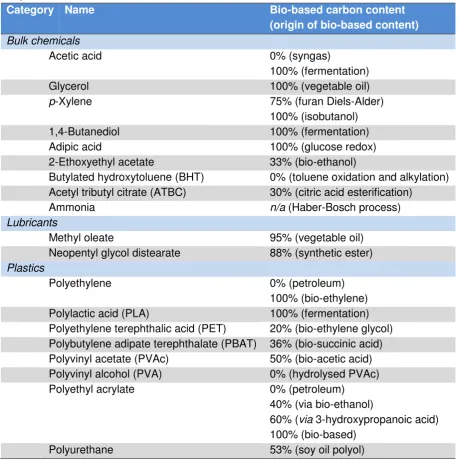
The example of poly(ethylene terephthalate), PET, is useful to demonstrate the differ-ent conclusions of the indirect calculation methods. It is currdiffer-ently produced as a partially bio-based material made from bio-ethanol and contains 20% bio-bio-based carbon content (Figure 1-1). Of the atoms incorporated into the product, those that were originally contained within the bio-ethanol feedstock amount to 15% of its total mass. If assuming that atoms bonded to bio-based carbon atoms are themselves also bio-based the calculated bio-based content increases to over 30%. This value is more representative of the balance between fossil re-source feedstock and biomass feedstock in the production chain, which is often skewed by the presence of mineral and inorganic feedstocks such as water and oxygen. If mineral feed-stocks are included in the contribution towards the calculation of total bio-based content the value approaches 50%.
Figure 1-1 A reaction schematic for the production of poly(ethylene terephthalate from bio-ethanol.
44
2 Introduction
2.1 Aims and objectives
Analysis based on 14C radiocarbon methods is expressed as a fraction of bio-based carbon relative to the total organic carbon (as in ASTM D6866) or alternatively as a function of the total carbon content in the sample (as in European standard CEN/TS 16640), but in some cases the whole biomass weight fraction can differ substantially from the bio-based carbon weight fraction of a product. Biomass itself is generally oxidised whereas petrochemi-cals are hydrocarbons. Thus complimentary approaches to bio-based content determination are desirable. Direct determination of bio-based carbon content is also restricted to products that consistently contain the same quantity of bio-based carbon content, otherwise the analy-sis is unrepresentative.
The biomass derived content of a particular product is not a simple measurement that only concerns the final article, as it may be that significant non-biomass (typically petroleum) derived resources are utilised elsewhere in the supply chain. These chemicals, or at least their by-products, may not actually end up in the final formulation.
Application of a standard test method and testing scheme for the determination of bi-omass content that is not solely dependent on 14C analysis and applicable to, for example, bio-polymers presents another possibility. There are issues around functionality bottlenecks and as such it may be a better option to assess the biomass content based on that function-ality rather than based on composition alone. A robust calculation based methodology based on the functionality of a product will be developed to ensure standardisation and acceptance of a protocol.
45
2.2 The concept of bio-based content
The motivation of an EU mandated drive towards a bio-based economy is the promo-tion of a sustainable basis to chemical product manufacturing in Europe [EU M/429, EU M/492]. This is a concern because of the inherent unsustainability of the competing petrole-um chemical industry, which is the only other resource for the production of organic com-pounds. It is intended that the application of standards and certification systems in the Euro-pean bio-based product industry will have positive long-term effects on the overall develop-ment of bio-based product markets. The KBBPPS project aims at increasing the uptake speed of standards and certification systems for bio-based products by producing pre-normative research.
The definition of the term bio-based, and the initiative to enhance the bio-based economy, has established a distinction between biomass sources of chemicals and other sources of the elements, presumed to be fossil based and undesirable. Both EU mandates do not mention fossil feedstocks, with a statement by the EC competitiveness council, calling for the “fostering emergence of markets with high economic and societal value”, providing the rationale for a bio-based economy on the basis of jobs, sales, and monetary value [EU M/429].
As for the analytical measurement of bio-based content, only for carbon is the distinc-tion between bio-based atoms and fossil derived atoms made unambiguous. For this pur-pose radioisotope analysis analogous to the radiocarbon dating techniques used by archae-ologists can be used [Norton 2006, Norton 2007]. This is known as direct bio-based content analysis. Beyond carbon, the other elements used in the synthesis of commodity chemicals and speciality formulations alike come from a variety of sources, but most are absent from fossil based hydrocarbon feedstocks. Nevertheless, there is an interest and a perceived de-mand from suppliers and business consumers alike in calculating bio-based content on a total mass basis. In order to do this a number of calculation methods are in development that address bio-based content on a mass basis or by using attribution units. This is achieved either by monitoring the mass flow inputs and outputs of a manufacturing process to track biomass feedstocks as they are incorporated into end products, or through a means of as-signing the atoms within a molecule (the product) as bio-based origin where appropriate.
meth-46
ods described this report. Application of these methods in certification schemes is addressed in the following section. The calculation of total bio-based content forms the basis of much of this report, with greater considerations dedicated to renewability entertained in the conclud-ing arguments.
2.2.1 Radiocarbon analysis
The determination of the bio-based carbon content of products using the radiocarbon method has been described in detail in a new European technical specification CEN/TS
16640. Refer to this document for information on the methods and equipment used for this
analysis. This follows the standard ASTM D6866 on the same topic.
The amount of 14C in an article (expressed as a ratio relative to the more common 12C isotope) is proportional to its bio-based carbon content. The proportion of this unstable iso-tope found in the atmosphere is translated into biomass by photosynthetic processes. With a half-life of 5730 years there is no 14C present in fossil resources. This exact same analysis is not applicable to any other elements, not least because none of the other elements prevalent in biomass (O, H, N, S, etc.) possess unstable isotopes with measurable half-lives to act as an indicator of age. There is virtually no oxygen and very little nitrogen found in fossil re-sources which makes this type of analysis redundant for most elements anyway.
Standard test method ASTM D6866 specifies that calculations are based on organic carbon content, with carbonates removed with an acid pre-treatment akin to archaeological sample pre-treatments. The equivalent European documentation allows for bio-based carbon content to be calculated on the basis of total carbon content. This way speciality products such as graphene and carbon fibre can be considered if made (partially or completely) from biomass. Reporting of values for bio-based carbon content is done as a percentage of total organic carbon or total carbon. In this report total bio-based content will also be examined by including and excluding inorganic content and comparing the difference.
To obtain a value of bio-based carbon content, complete combustion of the sample is carried out to provide quantitative recovery of all carbon present in the form of carbon diox-ide. Analysis of the 14C/12C isotope ratio can be performed using one of the following tech-niques (Figure 2-1). Also refer to KBBPPS deliverable report D3.1. Radiocarbon analysis and its role in complimentary bio-based content calculations is covered in overview in the following chapter.
47
Beta-ionisation (BI): Indirect determination of the 14C isotope abundance of the sam-ple through the emission of particles using a Geiger-Müller detector (ISO 13833).
[image:48.595.75.518.242.515.2] Accelerator mass spectrometry (AMS): direct determination of the isotope abundance of 14C relative to 12C [Brock 2010].
Figure 2-1 A schematic of the radiocarbon method principle of bio-based carbon content determina-tion.
2.2.2 Elemental analysis
Radiocarbon analysis can only return a value for bio-based content derived from the carbon atoms present in the sample. This limits the value of the information obtained to just one of the different elements that bio-based products are comprised of. The perspective that chemicals (bio-based or otherwise) are the sum of their elemental parts is useful, because certain attributes of elements can be analysed in ways that reveal their origin (not just radio-dating).
Elemental analysis returns data on the mass contribution of carbon, hydrogen and ni-trogen atoms contained within the sample (CHN analysis). Oxygen content is performed separately, for the method of CHN analysis uses excess oxygen to combust the sample. Us-ing less conventional apparatus, more elements can also be detected such as sulphur and
Acid pre-treatment
Combustion
Chemical Reduction to graphite (or benzene) Analy
sis
48
chlorine, but usually simultaneous detection of elements (at least of carbon, hydrogen, and nitrogen) is used [Kirsten 1983].
A small quantity of sample, usually of the order of 2 mg of material, is placed in a tin vessel and sealed. Inside the elemental analyser, temperatures exceeding 1250 K in an oxy-gen enriched atmosphere combusts the sample [University of York 2013]. To ensure com-plete combustion, a tungsten oxide catalyst is present to yield carbon dioxide, water, and nitrogen oxides deriving from the sample. A reducing oven consisting of a column packed with copper at 893 K reduces nitrogen oxides to dinitrogen gas. So that only carbon dioxide, water, and nitrogen proceed onto the chromatographic stage, chemical traps that remove corrosive sulphurous oxides and HCl are required. Gas chromatography is performed on the mixture of combustion products to obtain the corresponding amounts of carbon, hydrogen, and nitrogen originally present in the sample. The detection of the gases can be performed by detecting changes in thermal conductivity compared to the carrier gas (helium), and that is proportional to the amount of the component present [Kirsten 1983]. The sensitivity of the apparatus when assessing a sample of 2 mg is sufficient enough to result in an error of only 0.3 wt% in most cases.
For the determination of oxygen up to 5 mg of sample is required, but a silver vessel is used and not the more routine tin capsule. A helium atmosphere replaces the more usual oxygen atmosphere for obvious reasons. The oxygen present in the sample is converted to carbon monoxide through a reaction with a nickel-carbon composite [Preston 1992]. Gas chromatography is required to separate CO from nitrogen gas which may be evolved de-pending on the composition of the sample. The separation of these two gases is important because the consequence of not chromatographically resolving the nitrogen is the over-estimation of the oxygen content. This is because the molecular mass of nitrogen gas and carbon monoxide are the same (28 gmol-1). Detection is once again by thermal conductivity measurements.
49
theoretical elemental analysis of 62.5% carbon and 4.2% hydrogen, and a measured bio-based carbon content of 20%. The link between this data and a value of total bio-bio-based con-tent can be arrived at if the mechanism of chemical synthesis for the bio-based product in question is understood. That way the source of each atom (fossil resources, biomass, etc.) can be traced through to the final product. Results must be consistent with the radiocarbon analysis of bio-based carbon content while elemental analysis is used as a type of verifica-tion. This principle has been adopted by ACDV as a certification scheme for total bio-based content determination [ACDV 2013]. The calculation technique is known as atom connectivi-ty, in which the association of each heteroatom to its nearest bonded carbon atom is used to assign a total bio-based content. Knowledge of the exact manufacturing process is not re-quired although the chemical composition of each chemical component in the article is need-ed, as are the general rules of chemical reactivity. From the bio-based carbon content each carbon atom must be assigned as bio-based or otherwise for the remaining elements to be able to adopt the origin of their neighbouring carbon atoms. Sometimes an understanding of the chemical synthesis (if relevant) helps the assignment. The elemental analysis is needed to verify the composition. How the ACDV certification scheme for the calculation of bio-based content is applied is fully described in the next section. A greater variety of atom connectivity methods are also presented later on in this work.
2.2.3 Stable isotope analysis
The application of elemental analysis in the context of bio-based content determina-tion does not afford a definitive result in the same way that the direct method of radiocarbon analysis does. A different result is achieved depending on the consensus adopted, as is true of all indirect methods of bio-based content calculation. Instead, a characteristic of each ele-ment dependant on its source could be employed for a direct biomass content analysis as is the case for carbon. Stable isotopic ratio analysis may become useful in this regard. The ratios of naturally occurring and non-decaying isotopes that exist for many elements differ under natural influences, making the identification of their geographical origin or source pos-sible [Ehleringer 1989]. The relative ratio of the oxygen isotopes 16O and 18O is dependent on the effect of temperature on the water cycle. Ratios of the stable carbon isotopes (12C and 13C) in atmospheric carbon dioxide are changed during photosynthesis and can be measured
50
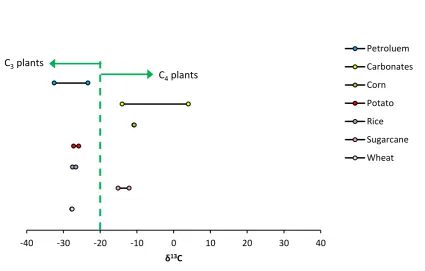
Figure 2-2 Carbon isotopic composition ranges for samples of material from different feedstocks.
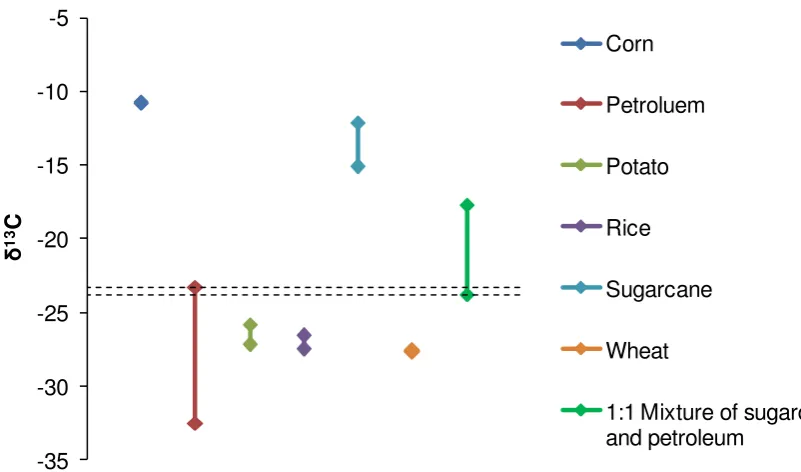
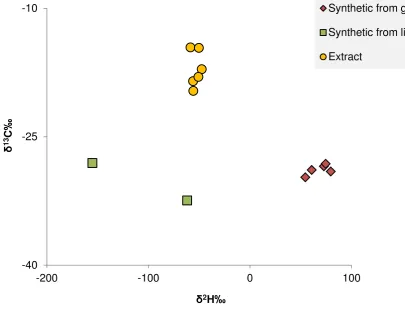
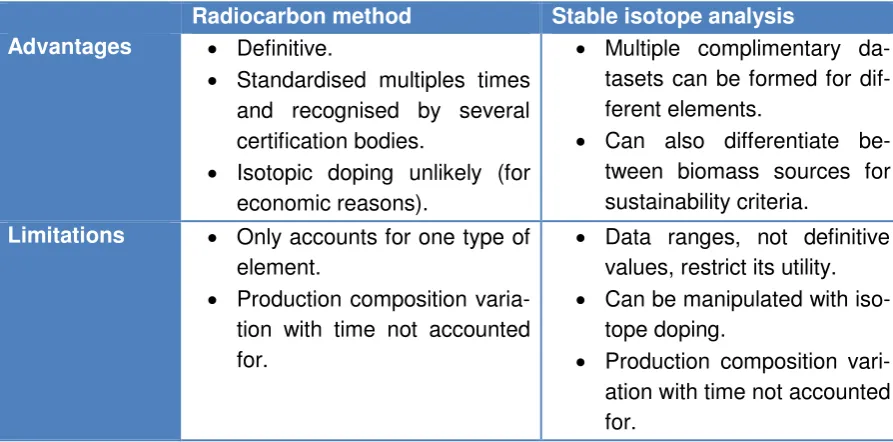
Even if 14C isotope analysis remains the cornerstone of analytical bio-based content determination methods, stable isotope ratios may act as at least a supplementary means of providing further information about the other elements rather than solely relying on indirect methods. Coupled with elemental analysis to determine the amount of each element in a bio-based product, stable isotope analysis could allow for a total bio-bio-based content calculation (or at least a verification). The feasibility of this approach is limited somewhat by the broad ranges of stable isotope ratios, rather than precise values, which define the possible origin of that element. However the combination of different stable isotope analyses increases the precision of this method for single component articles, e.g. distinguishing bio-ethanol (C3 and C4 plants) from synthetic ethanol made by the hydration of ethylene (Figure 2-3) [Ishida-Fujii 2005].
-40 -30 -20 -10 0 10 20 30 40
13C
Petroluem Carbonates Corn Potato Rice Sugarcane Wheat
C3plants
51
Figure 2-3 The distribution of stable isotopes found in ethanol samples.
Stable isotopes are determined using a sensitive mass spectrometry technique known as isotopic ratio mass spectrometry (IRMS) [Meier-Augenstein 1999, Schmidt 2004]. Research into the application of stable isotope analysis for the biogenic analysis bio-based products is underway within the KBBPPS project, and is expected to be published privately alongside this report (KBBPPS deliverable report D4.4).
2.2.4 Mass balance approach
Bio-based feedstocks and ingredients are now used to produce and formulate articles that are wholly or partly bio-based. With the growth in volume of bio-based resource con-sumption for chemical and fuel production, and the associated increase in feedstock diversi-ty, chain of custody approaches risk becoming impractical. This is due to the challenges as-sociated with the segregation of bio-based and fossil derived feedstocks, and the limitations of this system with regard to creating an association with the properties expressed by articles (such as bio-based content), and not just following the location of goods.
-30 -25 -20 -15 -10
-5 0 5 10 15 20 25 30
13C
‰
18O‰
52
Direct methods of determining a bio-based content for an article address the propor-tion of bio-based material that is physically contained within the final product (i.e. radiocarbon analysis to give a measure of bio-carbon content). Direct analysis is the optimal solution for analysing bio-based products where possible. For articles produced in dedicated facilities using dedicated supply chains this is feasible. This is likely to be the case for high value arti-cles produced at small scale and sometimes for processes utilising technologies that are incompatible with the petrochemical industry (e.g. fermentation) where the only option is to develop new facilities. However in the emerging bio-based economy, existing capital equip-ment for use in bulk manufacturing processes is likely to continue to be used, with biomass gradually supplanting the conventional fossil based feedstocks. Therefore, with a mixed feed of biomass and petroleum feedstocks, direct determination of the bio-based content in a product is not always valid. Feedstock variability is one concern, and co-products will incor-porate the biomass feedstock input to different extents. The relative proportions of the mixed feedstock used in many manufacturing processes will fluctuate to match the variable price of the feedstocks and accommodate seasonal biomass availability. The use of existing infra-structure within production systems improves economic sustainability through savings in op-erational and capital expenditure. By lowering the risk for any potential investment in the emerging sector of bio-based products, and co-producing articles in existing installations (maximising economies of scale) the basis and future prospects for the bio-based economy are hopefully safeguarded. Standards should then encourage this growth by recognising these products.
Mass balance is the identification of equal material input and output for a process. Sometimes material loss during the process will mean the total mass of the product and any by-products and waste streams will be less than the feedstock use (Figure 2-4). An overview of mass balance approaches, in combination with allocation and ‘book-and-claim’ devices, has been prepared (CEN/TC 411/WG 3 document N110b). Mass balance can provide in-formation of the proportion of biomass used in the production of a bio-based product, and provide complimentary information to analytical bio-based content methods. These methods can be used to establish a footing for various claims (e.g. calculating the fossil feedstock saving). Mass balance methods are especially applicable in integrated production facilities and in complex global supply where calculating the bio-based content of chemical products with precision is difficult. Definitions of the key terms used in this paragraph are provided below for clarification (also see CEN/TC 411/WG 3 document N110b).
53
Allocation: Partitioning the input flows of a process between output flows within physi-cal limits. The use of this term has evolved with time to become distinct from attribu-tion.
Attribution: Partitioning the output of biomass derived material from a process be-tween products without justification derived from the physical mass flow.
Book-and-claim: A method to transfer, by means of certificates, a defined chemical product claim from that product at one location to the same chemical product at a dif-ferent location, without any material transport or other physical connection.
Figure 2-4 A schematic of the mass balance principle.
Depending on the consensus adopted, mass balances can be performed to calculate results with a number of possible data outputs, but should complement and enhance the use of analytical approaches of bio-based content determination when applicable and not cause any conflict or confusion. When analysis is not appropriate (e.g. there is variable bio-based content) mass balance should be able to compensate for this. The different varieties of mass balance methods are summarised here briefly, and put into practice in Chapter 5 with the use of a series of case studies. Other possibilities regarding the framework for alternative mass balance approaches are also considered elsewhere in this report.
Fossil resource savings (mass balance Method A). The allocation of the average bio-based content within a predefined time period can be used to make various claims essentially describing the extent that material fossil resources have been replaced, e.g. fossil resource and carbon dioxide savings. This is not applicable to energy us-age.
The determination of the average bio-based content and the average bio-based car-bon content within a predefined time period (mass balance Method B). Claims of allo-cated bio-based content are derived from a bio-based carbon mass balance supple-mented by atom connectivity. The rules of this method are developed from those
out-Resource Products
Process losses
Process system boundary
Min Mout
54
lined in the ‘material balance’ working draft of WG 3 (CEN/TC 411/WG 3 document
N104).
Fossil carbon savings (mass balance Method C). This mass balance method deter-mines the mass of bio-based carbon and hence the mass of fossil carbon savings in consecutive chemical reaction routes based on input/output quantities in global pro-duction systems using stoichiometric chemical reaction pathways and proven yields.
Qualities shared by mass balance Method B and Method C have been reimagined for mass balance Method D. This is a material balance derived from actual mass flows, using allocation techniques if needed but primarily relying on reaction pathways and yields. Feedstocks are traced upstream until they can be considered wholly bio-based or fossil derived or inorganic (the latter meaning not containing carbon). The propor-tion of each feedstock present within the product indicates the average bio-based content.
In addition, the ‘book-and-claim’ methodology uses results of the mass balance methods to assign and transfer certificates for customer communication. Certificates can be issued based on fossil feedstock savings, calculated based content, bio-based carbon content or the fossil carbon savings of products.
It should be noted that both analytical and mass balance approaches are not applica-ble to describe the sustainability of bio-based products within the context of this report, un-less the applicant has performed separate sustainability assessments. ‘Book-and-claim’ for the purpose of sustainability is already in use for the palm oil industry but is orthogonal in its usage to the types of bio-based content mass balance described here [GreenPalm 2014]. Mass balance systems utilising ‘allocation’ and ‘book-and-claim’ are performed within a de-fined time interval and pre-dede-fined geographical boundaries. These claims derived from mass balance approaches do not provide information on the actual physical properties of products, but rather represent the biomass incorporated into the production input of an arti-cle. Mass balance methods for calculation of the amount of biomass used in the production of articles within a defined time interval should be standardised for quality control and com-parability.
For the purpose of this report (in the context of the KBBPPS project) attribution and ‘book-and-claim’ tools will receive less attention and the focus is placed on the calculation of the intrinsic bio-based content of an article. Approaches to the calculation of total bio-based content that do not reflect the actual amount of biomass incorporated into the product are currently under scrutiny within the relevant standardisation committee and working groups
55
(Figure 2-6) follow. A ‘book-and-claim’ system allows for a property to be changed from one batch to another (equal sized) batch of the same chemical. This is currently done for sustain-able palm oil amongst other products through the transfer of certificates [GreenPalm 2014]. Attribution is less strict in terms of the swapping of bio-based content from one product to any other product, but they should originate from the same production facility. Attribution has uses when the production chain is complex and the final distribution of biomass between various product streams is unknown.
Figure 2-5 A demonstration of ‘book-and-claim’ where certificates are traded between equal amounts of the same product in different locations.
A
A
A
A
A
A
A
A
56
Figure 2-6 A demonstration of ‘attribution’ where a quantity of biomass derived content is spread across different products of a biorefinery and redistributed to a favoured product stream.
Another reason for focusing on the intrinsic total bio-based content is so the extension of these methods into renewability and sustainability assessments can be investigated in complete life cycles, as will be attempted in a future Open-Bio project deliverables ( Open-Bio deliverable report D3.5). If this proves successful than the role of ‘attribution’ and ‘book-and-claim’ tools could be studied at a later date.
B
A
C
B
C
57
2.3 Standardisation and certification schemes relating to bio-based content
Certification schemes and the standards they are based on establish a consensus re-garding bio-based content claims, and facilitate market growth with improved consumer con-fidence. The principal bio-based content standard is ASTM D6866. It contains the test meth-od for bio-based carbon content as a percentage of organic carbon. Built around this test method is the USA Department of Agriculture certification scheme known as ‘BioPreferred’ [BioPreferred 2014]. European certification schemes for organic products also designed pri-marily around bio-based carbon content have been developed by Vinçotte in Belgium [Vinçotte 2013], and TÜV Rheinland DIN CERTCO in Germany [DIN CERTCO 2014]. The Association Chimie du Végétal (ACDV) of France has developed a different approach that complements radiocarbon analysis with elemental analysis and atom connectivity assign-ments to offer an indirect calculation of bio-based content [ACDV 2013]. This latter approach is being scrutinised by a technical group of the European standardisation committee for bio-based products with the intention of developing it into a test method (prEN 16785).
Mass balance claims are being used by different companies with different intentions. As far as bio-based content is concerned, the first certification scheme has been developed by TÜV SÜD and implemented by BASF to calculate fossil resource savings with a mass balance methodology [TÜV SÜD 2013]. This allocation approach is examined in greater de-tail within this report as part of a pre-normative research effort to assist the development of bio-based content standards with CEN. Although the method has been met with resistance thus far (for it permits attribution) it is helpful here for the comparison.
2.3.1 BioPreferred
58
Table 2-1 Minimum bio-based content by class for the USDA BioPreferred programme as of June 2013.
Product category Minimum bio-based carbon content
Construction
Carpet 7%
Insulating foam 7%
Plastic lumber 23%
Structural wall panels 94% Food service
Disposable cutlery 48%
Groundskeeping
Fertiliser 71%
Sorbents 89%
Industrial fluids
Penetrating lubricants 68% Slide way lubricants 74%
Penetrating liquids 79%
Janitorial
Spot remover 7%
Floor strippers 78%
Personal care
Cuts, burns, and abrasions ointment 84%
Shaving products 92%
Miscellaneous
Bedding, bed linens and towels 12%
2.3.2 OK biobased
59
Figure 2-7 An example of a Vinçotte certificate of bio-based content.
In addition to a minimum bio-based carbon content of 20%, the total organic carbon content of the article must equal or exceed 30%. Measurement of bio-based carbon content is conducted under the rules of ASTM D6866. Fuels are not covered by this certification scheme.
2.3.3 DIN Biobasiert
The DIN ‘Biobasiert’ (bio-based) certification scheme is essentially of the same format as ‘OK bio-based’. The minimum bio-based carbon content is specified as 20% of total or-ganic carbon and the amount of oror-ganic carbon should at least equal that of inoror-ganic carbon (i.e. 50% organic carbon) [DIN CERTCO 2014]. Classification is also used, with articles containing 20-50% bio-based carbon content covered the lowest class, those with between 50% and 85% bio-based carbon in the intermediate class, and finally bio-based products exceeding 85% bio-based carbon content able to carry the label shown in Figure 2-8.
Figure 2-8 The DIN Biobasiert label for articles of greater than 85% bio-based carbon content.
2.3.4 Association Chimie du Végétal (ACDV)
60
Typical elemental analysis records carbon, hydrogen, and nitrogen (CHN) content but spe-cialised equipment is also capable of determining oxygen or sulphur.
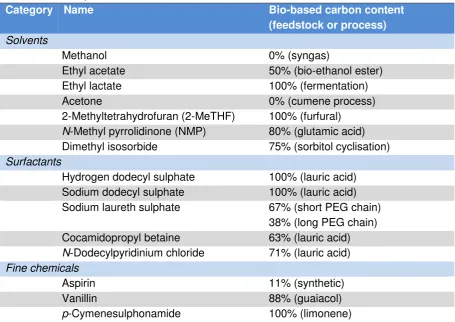
The certification scheme devised by ACDV (Association Chimie du Végétal, France) uses the direct analysis of bio-based carbon through radioisotope analysis, and elemental analysis to verify the composition of bio-based products [ACDV 2013]. Because elemental analysis does not differentiate between the possible sources of each element, the combina-tion of bio-based carbon content measurements using 14C isotope analysis and (CHNO) el-emental analysis does not directly give the total bio-based content of a sample. Radiocarbon analysis is preferably performed using the standard test method described in CEN/TS 16640, although the equivalent tests in CEN/TS 16137 (specific to plastics) and ASTM D6866 are also acceptable. An allocation of the number of hydrogen, oxygen, and nitrogen atoms origi-nating from biomass is decided by the supplier (the declaration) using a process of calcula-tion called atom connectivity, from which a total bio-based content by mass is calculated for the article. This method can be applied to synthetic chemicals and formulations.
61
Figure 2-9 Rules of atom connectivity.
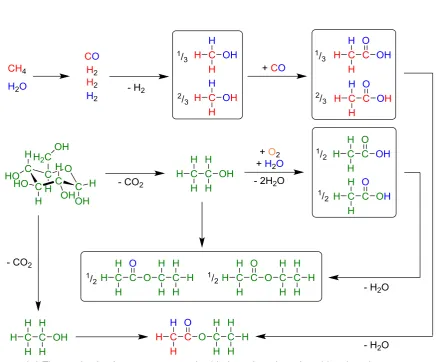
The test example given by ACDV in their documentation is of esterification, where es-ters derived from the condensation of an acid with an alcohol retain the oxygen atom once belonging to the alcohol (Figure 2-10) [ACDV 2013]. Note that this is true of the most regular-ly occurring AAC2 mechanism but not of the less common alkylation mechanisms of esterifi-cation, which would obviously change the real bio-based content of the product. An example of the calculation for ethyl acetate made from bio-ethanol and acetic acid is tabulated below (Table 2-2). The elemental analysis for carbon, hydrogen and oxygen must be consistent with the molecule in question. Then the atom connectivity assignment of bio-based content is reported as a mass percentage of the total molecule. Results need to be reported on a dry basis to permit consistency in verification and produce a useful value of bio-based content not diluted by water. For the ACDV example of bio-ethanol reacting with acetic acid, a result of 51% total bio-based content is arrived at. Conveniently the bio-based carbon content should be 50% (two of the four carbon atoms originate in bio-ethanol) but the closeness of the two values is not guaranteed in other bio-based products.
Figure 2-10 The synthesis of ethyl acetate from bio-ethanol (red atoms are assumed to originate from fossil sources, green atoms are assumed to be from biomass).
This oxygen is bound to a fossil derived carbon –therefore it too is
regarded as fossil derived
This oxygen is bound to both fossil and
bio-derived carbon atoms –standard
chemcial rules of reactivity used to assign its parent carbon atom (in this
62
Table 2-2 The assignment of bio-based content from elemental analysis and atom connectivity for a partially bio-based ethyl acetate product.
Fraction C H O Total
Fossil fraction (from acetic acid) 27.3% 3.4% 18.2% 48.9% Bio-based fraction (from ethanol) 27.3% 5.7% 18.2% 51.1%
Total 54.5% 9.1% 36.4% 100.0%
For products obtained by formulation, this method is applicable provided that each of the constituents of the product have first been analysed according to the method above and the statement declaring the total bio-based content of each constituent has been validated. The bio-based content of each ingredient is scaled according to its weighting in the formula-tion to give the total bio-based content of the formulaformula-tion. Carbon radioisotope analysis is equally applicable to mixtures as it is to pure compounds and this part of the certification pro-cess remains.
The results obtained by the analytical methods can differ from the stated values in the declaration for several reasons, including natural variation in biomass and analytical error. Accordingly the results are reported according to pre-set confidence levels. The determina-tion of the bio-based carbon content of the sample, according to the method specified in
CEN/TS 16640, can produce an error of ±3%. Elemental analysis errors are typically of the