International Journal of Innovative Technology and Exploring Engineering (IJITEE) ISSN: 2278-3075, Volume-8 Issue-8S2, June 2019
Abstract Background/Objectives: This study was to examine the female college students’ knowledge and intent of implement related to breast-milk storage according to internal breast-milk storage locus of control
Methods/Statistical analysis: This study is a research study applying a cross-sectional design using a structured questionnaire. The subjects of the study were 485 nursing school students in 2 cities in Korea. Data were collected after explaining the content of structured questionnaires and the purpose of this study. Collected data were analyzed by descriptive statistics and, Pearson’s correlation coefficient and regression analysis through the SPSS 23.0 version
Findings: Students with high level of knowledge report significantly higher levels of Intention of Implement. Relationship became significant with the addition of interaction terms in step3. It means that there is a moderating effect of internal locus of control on relationship between knowledge and intention of implement (β = .185, p <.001). Results showed that three steps were significant (p <.001) and the explanatory power of the variables was 86.1%.
Improvements/Applications: To improve the intention to implement breast milk storage, it is necessary to develop an education program to provide information about storage. Also, effective cognitive approach to increase internal locus of control is needed that can change wrong behavior and emotions
Keywords: Breast, Milk, Breastfeeding, Storage, Locus of Control, Intention
I.INTRODUCTION
Feeding Breast milk is a major concern of the public and deciding on breastfeeding contributes to the health of infants, development and motherhood. Absolute Breastfeeding is a physiologically appropriate approach to nutrition during the first half of the infant stage[1]. Commercialized formulas include baby constipation, infection, and the risk of long-term diseases such as adult diseases and cancer when a baby grows up [2].Studies have explained the decrease in maternal complications and reproductive organ cancer. For a baby, the health benefits of breastfeeding include the reduction of respiratory diseases and the development of intelligence. [3][4]. Considering the fact that breast milk is the most optimal source of nutrients and an unmatched source of indispensable anti-microbial and other protective
Revised Manuscript Received on May 22, 2019.
Yeon Ran Hong, Associate professor, Dept. of Nursing, Sunchon National University, 255 Jungang-no, Jeollanam-do, 57922, Rep of KOREA.
Eunyoung Do Associate professor, Dept. of Nursing, Kwangju Women’s University, 165Sanjung-dong, Gwangsan-gu,Gwangju, Jeollanam-do, 62396, Rep of KOREA. corresponding author
E-mail :[email protected]
substances, the need to store breast milk for at least limited periods of time is unavoidable in a neonatal unit taking care of sick babies [5].
Regardless of the findings of the above breast-feeding related research and evidence of national priorities on this topic, Korea maintains a relatively low breast-feeding rate compared to developed country. For example, Germany and Italy had initial breastfeeding rates of96% and 89%, each[6] , compared to57.2% in the Korea. Breastfeeding rates 6 months post-partum were 48%, 62%, and 18.3% for Germany, Italy, and Korea, each[7].
The central concept of locus-of-control theory is that individuals differ in the extent to which they attribute reinforcement to their own (internal) or outside (external) forces. People with the inner locus of control know that their actions produce the result of their lives and believe that they can change his or her destiny by changing their behavior. Locus of control was utilized as a moderator variable in investigating the relationship between intention to achieve and several dependent variables[8].
There are many obstacles that make it difficult for mothers to start or maintain breastfeeding. In particular, mothers who work full-time were less likely to continue breastfeeding than mothers who worked part-time. [9]. Aswomen are rating breastfeeding as important and having a belief that babies should be breastfed at least for some time, Education may have accounted for statistically significant associations in breastfeeding perceptions.[10,11].
Given these facts, one's beliefs, especially the internal locus of control can be understood as a very important factor in implementation as well as knowledge. To the best of our knowledge, there are no studies that examine the relationship between knowledge and intent of implement related to breast-milk storage according to internal breast-milk storage locus of control as a moderating factor.
A number of enabling factors should be taken into consideration when planning interventions to increase breastfeeding practices. Therefore, this study was conducted to provide basic data on the establishment of education and cognitive programs for the success of exclusive breastfeeding.
II.METHODS 2.1. Study design and sample
This study is a research
study applying a
cross-sectional design using a structured questionnaire.
Knowledge and Intention of breast-milk Storage:
the Moderating role of Internal Locus of Control
The subjects of the study were 485 nursing school students in 2 cities in Korea. Data were collected after explaining the content of structured questionnaires and the purpose of this study. Collected data was analyzed by descriptive statistics and, Pearson’s correlation coefficient and regression analysis through the SPSS 23.0 version.
2.2. Instruments
The tools in this study consist of general characteristics breast milk storage knowledge, Intention to implement breast milk storage and Internal locus of control to breast milk storage. The general characteristics are seven questions, including Class year, Family type,Smoking experience, Religion, Monthly Family income, Information for Breast milk storageand Ideal education time for breast milk storage,Breast-milk storage knowledge, internal breast milk storage behavior locus of control and intention to implement breast milk storage wascomposed of 20, 5, 3 questions respectively. These tools are consisted of self-reported 5-point scale. Each answer was rated from 1 to 5 point. The reliability of these each tools was chronbach's α= .80, chronbach's =.83 andchronbach's =.86in this study.
The breast-milk storage knowledge tool was developed using the three-round delphi method by four pediatricians and four obstetrics specialists from obstetrics and obstetrics. Intention to implement breast milk storage and Internal locus of control to breast milk storage tool is organized by two nursing professors.
The higher the score, the more positive they are.
[image:2.595.314.540.49.305.2]III.RESULTS General characteristics of the subjects
Table 1 lists the general characteristics of the subjects. In this study, 32.4% were sophomore. Nuclear family accounted for 79.2%. 94% of subjects didn’t have smoking experience. 50.5% of subjects had no religion. The proportion of household income per month over five million won was 27.0%. Information for Breast milk storage was 28.7% from broadcasting. 34.8%% of the participants answered “Around childbirth” was an ideal education time for breast milk storage.
Table 1. General characteristics of the subjects (N=485)
Variables N %
Class year Freshman Sophomore Junior Senior 111 157 115 102 22.9 32.4 23.7 21.0 Family type Large family
Nuclear family Lone father Lone mother Grandparents only Others 33 384 50 6 2 10 6.8 79.2 10.3 1.2 .4 2.1 Smoking experience
Smoking in the past Currently smoking No smoking 17 12 456 3.5 2.5 94.0
Religion Yes 240 49.5
No 245 50.5
Monthly Family income (10,000won ) ≧500 400-499 300-399 200-299 <200 131 87 129 90 48 27.0 17.9 26.6 18.6 9.9 Information
for Breast milk storage from Newspapers, magazines Broadcasting Books Friends Nursing-related classes Internet Others No 40 139 19 4 118 32 39 94 8.2 28.7 3.9 .8 24.3 6.6 8.0 19.4 Ideal education
time for
breast milk storage
Primary to high school College Before Marriage Around childbirth 126 114 76 169 26.0 23.5 15.7 34.8
Knowledge for Breast milk storage, Internal breast milk storage behavior locus of control, Intention to implement breast milk storage
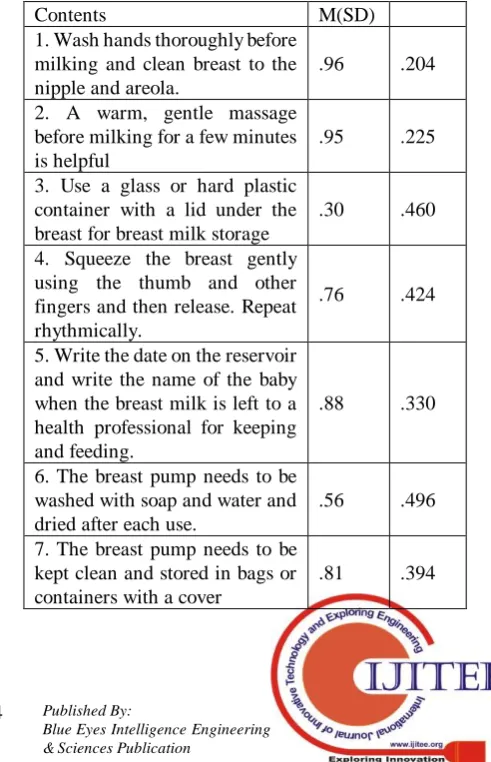
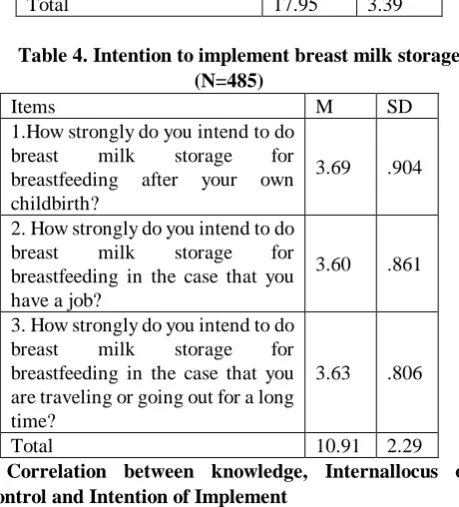
[image:2.595.304.550.457.838.2]As shown in Table 2, Table3 & Table4,the average score of“Knowledge for Breast milk storage”was 11.80 out of 20 points, demonstrating rather poor understanding of breast milk storage.Internal breast milk storage behavior locus of control was 17.95 out of 25 points and “Intention to implement breast milk storage” was 10.91 on average out of 15 points.
Table 2. Knowledge for Breast milk storage (N=485)
Contents M(SD)
1. Wash hands thoroughly before milking and clean breast to the nipple and areola.
.96 .204
2. A warm, gentle massage before milking for a few minutes is helpful
.95 .225
3. Use a glass or hard plastic container with a lid under the breast for breast milk storage
.30 .460
4. Squeeze the breast gently using the thumb and other fingers and then release. Repeat rhythmically.
.76 .424
5. Write the date on the reservoir and write the name of the baby when the breast milk is left to a health professional for keeping and feeding.
.88 .330
6. The breast pump needs to be washed with soap and water and dried after each use.
.56 .496
7. The breast pump needs to be kept clean and stored in bags or containers with a cover
[image:2.595.55.284.593.790.2]International Journal of Innovative Technology and Exploring Engineering (IJITEE) ISSN: 2278-3075, Volume-8 Issue-8S2, June 2019
8. The breast milk containers
must be sterilized .89 .312
9. Milking can be done either by
hand or using a breast pump .84 .601
10. The first few drops of milk need to be discarded during milking
.48 .500
11. Fresh breast milk may be
stored for 3-4 hours at 19 ~ 26 ℃ .36 .486 12. Fresh breast milk may be
stored up to 72 hours at below
4 ℃.
.38 .490
13. For easy access, breast milk may be kept on the door side of a refrigerator.
.21 .409
14. Fresh breast milk can be stored at least for 24 hours at a
temperature below -4 ℃ .
.25 .436
15. The containers for frozen storage of breast milk should not be completely filled due to the expansion during freezing.
.63 .483
16. Thawed milk can be kept for
up to two hours at 16 ~ 29 ℃. .34 .475 17. Breast milk thawed inside a
refrigerator can be kept for up to 24 hours from the moment being thawed in the refrigerator.
.34 .474
18.Once the breast milk is
thawed, it cannot be re-frozen. .59 .493 19. All stored breast milk must
have the date of storage and the oldest one should be used first.
.71 .453
20. Fresh frozen breast milk should not be thawed in a microwave oven or a gas oven.
.54 .499
[image:3.595.58.282.47.549.2]Total 11.80 4.54
Table 3. Internal breast milk storage behavior locus of control (N=485)
Items M SD
1 Putting the breast milk storage in action depends on the willingness of women in spite of acknowledging the difficulties.
3.74 .852
2. Putting the breast milk storage in action depends on the willingness of women in spite of physical difficulties.
3.52 .931
3. Putting the breast milk storage in action depends on the willingness of women even in the case of working women.
3.66 .858
4. Putting the breast milk storage in action depends on the willingness of women even in the case of going out
3.69 .815
and traveling long time. 5. I am sure that I can do breast milk storage in the case of my own childbirth.
3.35 .867
[image:3.595.312.542.104.358.2]Total 17.95 3.39
Table 4. Intention to implement breast milk storage (N=485)
Items M SD
1.How strongly do you intend to do
breast milk storage for
breastfeeding after your own childbirth?
3.69 .904
2. How strongly do you intend to do
breast milk storage for
breastfeeding in the case that you have a job?
3.60 .861
3. How strongly do you intend to do
breast milk storage for
breastfeeding in the case that you are traveling or going out for a long time?
3.63 .806
Total 10.91 2.29
Correlation between knowledge, Internallocus of control and Intention of Implement
Table 5 shows the relationship betweenIntention of Implementand variables. The correlation between the knowledge of breast milk storage and the attitude toward breast milk storage was analyzed to be positive by Pearson’s correlation analysis with (r = .237, p <.001). Higher level of knowledge (r = .333, p <.001) and Higher level of Internal locus of control(r = .433, p <.001) were associated with higher Intention of Implement.
Table 5. Correlation between knowledge, Internal locus of control and Intention of Implement (N=485)
Knowledge for Breast milk storage
Internal locus of control
Intention of Implemen t
Knowledge of breast milk storage
1 .237** .333**
Internal locus
of control .237
**
1 .433**
Intent of
Implement .333
**
.433** 1
** p〱0.001
Regression table showing moderating effects of Internal breast milk storage behavior locus of control
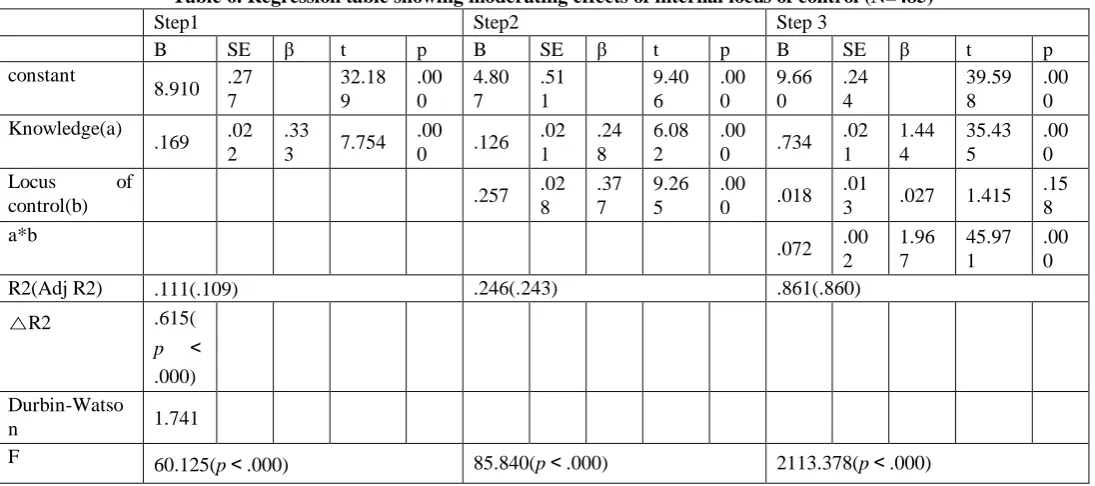
Aim of the study was to test for the moderating effect of the internal locus of control on the relationship between knowledge and intention of
locus of control. Results show students with high level of knowledge to report significantly higher levels of Intention of Implement. Relationship became significant with the addition of interaction terms in step3. It means that there is a moderating effect of internal locus of control on relationship
[image:4.595.26.574.148.391.2]between knowledge and intention of implement (β = .185, p <.001). The analysis results showed that three steps were significant (p= 0.000) and the explanatory power of the variables was 86.1%.
Table 6. Regression table showing moderating effects of internal locus of control (N=485)
Step1 Step2 Step 3
B SE β t p B SE β t p B SE β t p
constant
8.910 .27 7
32.18 9
.00 0
4.80 7
.51 1
9.40 6
.00 0
9.66 0
.24 4
39.59 8
.00 0 Knowledge(a)
.169 .02
2 .33
3 7.754
.00
0 .126
.02 1
.24 8
6.08 2
.00
0 .734
.02 1
1.44 4
35.43 5
.00 0
Locus of
control(b) .257
.02 8
.37 7
9.26 5
.00
0 .018
.01
3 .027 1.415
.15 8 a*b
.072 .00
2
1.96 7
45.97 1
.00 0
R2(Adj R2) .111(.109) .246(.243) .861(.860)
△R2 .615(
p <
.000) Durbin-Watso
n 1.741
F 60.125(p<.000) 85.840(p<.000) 2113.378(p<.000)
IV.DISCUSSION
Results of this study indicated a main effect of knowledge and an interaction effect of knowledge and Internal breast milk storage behavior locus of control. The more she or he knows, the more she/he has intention to carry out breast milk storage. In step 2, when Internal breast milk storage behavior locus of control is injected as aindependent variable.In the end, moderating effect of Internal breast milk storage behavior locus of control on the relationship knowledge and intention to implement breast milk storage is significant and obvious.
The score of knowledge level of the subjects about breast milk storage was 11.80 ± 4.54out of 20 point scale, a little higher than the median value of 10. Few previous studies exist on the storage of breast milk that directly compare the results of current studies.
Economic constraints force large numbers of women to return to work while still breastfeeding their infants. The ability, that is to say knowledge, to express and store breast milk for later feeding, when away from the infant, might strongly influence mothers’ decision to continue breastfeeding even after they have returned to work[12]. In this respect, breast milk storage knowledge is considered to be a very important element toimplement storage for absolute breastfeeding and the results of this study can be seen as evidence.
Among the 20 questions related to breast milk storage, the correct answer rate for “NO 13. For easy access, breast milk may be kept on the door side of a refrigerator” was the lowest.The need for education on overall breast milk
storageknowledge has been demonstrated by the results of this study, but it should be focused on education on knowledge, particularly in relation to statements with high rates of error.
A study shows a considerable difference betweenfirst-time pregnant women’s intention to exclusively breastfeed(70%) and their actual rate of exclusivebreastfeeding 1 week after (50%). These declining tendency between intention and behavior represent a huge lost opportunity to encourage and support breastfeeding. Experiencing hospital practices that inhibitabsolute breastfeeding (providing commercial milk formula) was significantly prevented mother from practicing their intention to absolute breastfeeding[13].
On the other hand, factors related to the past breastfeeding experience in which women are raised as babies and others around them provide breast milk to their children are positively correlated with the beginning and maintenance of breastfeeding.
[14]. Studies explain that mothers often decide how to nourish their children before they become pregnant[
15].Thus, the intent of breastfeeding can be identified as an important factor in the onset of breastfeeding and storage of breast milk.
.[16].Several previous studies have explained that relevant variables of breast-feeding behavior and breast-feeding behavior are determined before conception. Therefore, it may be most effective to intervene
International Journal of Innovative Technology and Exploring Engineering (IJITEE) ISSN: 2278-3075, Volume-8 Issue-8S2, June 2019
It is similar to our research that women with a strong will and receptive attitude to breastfeeding behavior are more likely to start breast-feeding than women with lower level of intent and attitude [17].
Therefore, this study makes a significant contribution by suggesting that efforts by health professionals to enhance their willingness to breastfeed should be centered as much as consideration of social norms, health and economic benefits associated with breastfeeding in women. In addition, the finding also suggests that increased willpower, receptive attitudes, and breastfeeding storage knowledge for maintain breastfeeding can lead to an increase in the start of breastfeeding and the maintenance rate. Evidence is growing for the important role of emotional and cognitive attitudes and the locus of control to make a prediction for health promotion behaviors. [18].
The belief that individuals can have a special control over their health (internal control) automatically has a positive psychological and behavioral effect on them.The fact that locus of control plays an important role in health related behaviors and is seen as a mediator or part of the route between individual status, social status, and health forms[19] is thought to be similar to the present study. Also, this data support that a recognition of internal locus of control along with achievement or motivation related variables can substantially increase prediction concerning many of the variables which considered to be important.
Wolk&Ducette(1971) mentions achievement-motivation theory and locus of control theory, both theories make very similar predictions about the performance of certain subjects on these dependent variables[8].
Comprehensively, consideringthe results of this study as the moderating role of the internalbreast milk storage behavior locus control and relevance between knowledge and intention of implementation were verified, the education program including breast milk storage knowledge related contents should be developed to enhance exclusive breastfeeding. Also, in terms of the importance of internal breast milk storage behavior locus control,effective cognitive approach that can change wrong behavior and emotions so that the subject is aware of, responsible and interested in solving his or her own problemsis needed. For example, Motivational interviewingcould be suit to provision of knowledge of breast milk storage support bynurses, whose role increasingly includeslifestyle guidance.More comprehensive intervention may be required to achieve a changein future outcomes that is “implementation of breast milk storage”.
Other identified constraints on breast-feeding continuation include inadequate industry supportfor
employed women, broad community disapproval
ofbreastfeeding in public and minimal breastfeeding education during schooling. In addition to breast milk storage, these constraints should be considered in order to practice exclusive breastfeeding.
We should admit that the subjects of this study are limited to female college students. This means it is not possible to generalize these findings to other women of childbearing age
inother regions or cultures. This can be the empirical reason deserving of further study.
V.CONCLUSION
This study has provided evidence to supportthat locus of control was effective as a moderatorvariable in investigation the relationship between breast milk storage knowledge and intention to implement breast milk storage.
In addition, higher level of breast milk storage knowledge was found to be a positive factor for improving their intention to implement breast milk storage.
These variables accounted for 86.1% of the intention to implement breast milk storage.
Therefore, to improve the intention to implement breast milk storage, it is necessary to develop an intervention program to provide information and knowledge about storage. Also effective cognitive approach is needed that can change wrong behavior and emotions so that the subject is aware of, responsible and interested in solving his or her own problems. In addition, more research with a larger number of child baring women and various regions will be needed to generalize the results of this study.
REFERENCES
1. Kramer MS, Kakuma R. The optimal duration of exclusive breastfeeding a systematic review. AdvExp Med Biol.2004 ;554: 63-77.
2. Jones G,SteketeeRW, Black RE,BhuttaZA, Morris SS: Bellagio Child Survival Study Group. How many child deaths can we prevent this year?
Lancet. 2003;362:65-71.
https://doi.org/10.1016/S0140-6736(03)13811-1.
3. Fishman A. The effects of parity, breastfeeding, and infertility treatment on the risk of hereditary breast and ovarian cancer: a review. Int JGynecol Cancer. 2010;20:S31–S33.
4. Oddy WH, Robinson M, Kendall GE, Li J, Zubrick SR, Stanley FJ. Breastfeeding and early child development: a prospective cohort study. ActaPaediatr. 2011;100:992–999.
5. Quigley MA, Kelly YJ, Sacker A. Breastfeeding and hospitalization for diarrhealand respiratory infection in the United Kingdom Millennium Cohort Study. Pediatrics, 2007;119:e837–e842.
6. Cattaneo, A, Yngve A, Koletzko B, Guzman LR. Protection, promotion and supportof breastfeeding in Europe: Current situation. Public Health Nutrition, 2005;8(1):39–46.
7. Bolling K, Grant C, Hamlyn B, Thornton A.Infant feeding 2005. London: TheInformation Centre;2007.
8. Stephen W, Joseph D. The moderating effect of locus of control in relation to achievement-motivation variables. Journal of Personality. 1973;41(1):59-70. https://doi.org/10.1111/j.1467-6494.1973.tb00660.x. 9. Ryan AS, Zhou W, Arensherg, MB. The effect of employment status on breastfeeding in the United States. Women’s Health Issues, 2006;16(5);243-251.
10. Scott JA, Aitkin I, Binns CW, Aroni RA. Factors associated with the duration of breastfeeding amongst women in Perth, Australia. ActaPaediatrica. 1999;88: 416–421.
11. Cattaneo A, Yngve A, Koletzko B, Guzman LR. Protection, promotionand support of breast-feeding in Europe: current situation. Public Health Nutr. 2005;8:39–46..
12. Gielen AC, Faden RR, O’Campo P. Maternal employment during the early postpartum period: effects of initiation and continuation of breastfeeding, Pediatrics. 1991;87;298-305.
13. Declercq E, Labbok MH, Sakala C, O'Hara MA. Hospital Practices and Women's Likelihood of Fulfilling Their Intention to Exclusively Breastfeed. Am J Public Health. 2009 May; 99(5): 929–935. doi:10.2105/AJPH.2008.135236.
15. Chambers J, McInnesR. On behalf of the Breastfeeding Expert Group (BEG) convenedby NHS Health Scotland in partnership with the Health Improvement Strategy Division, Scottish Executive. Psychosocial factors associated with breastfeeding: A review of breastfeeding publications between 1990–2005. Edinburgh: NHS Health Scotland;2006.
16. DiGirolamo A, Thompson N, Martorell R, Fein, S, Grummer-Strawn L. Intentionor experience? Predictors of continued breastfeeding. Health Education and Behaviour, 2005;32:208–226.
17. Lawton R, Ashley L, Dawson S. Waiblinger D, Conner M. Employing an extended Theory of PlannedBehaviour to predict breastfeeding intention,initiation, and maintenance in White British andSouth-Asian mothers living in Bradford British Journal of Health Psychology. 2012;17:854-871.
18. Lawton RJ, Conner MT, McEachan RRC. Desire or reason: Predicting healthbehaviors from affective and cognitive attitudes. Health Psychology. 2009;28:56–65.