Scientific
and
technical
development
of
Russia’s high-tech companies in the context of
introducing the conception
“Industry 4.0” and
the digital economy development
Arutyun Khachaturyan1,*, and Svetlana Ponomareva1
1Market Economy Institute of the Russian Academy of Sciences, 117418, 47 Nakhimovskij ave., Moscow, Russia
2Perm National Research Polytechnic University, 614990, 29 Komsomolskiy ave., Perm, Russia
Abstract. The research paper focuses on a complex study of scientific and technological development of high-tech companies of the Russian Federation in the context of introducing the conception “INDUSTRY 4.0”, which involves six main phases: 1) Computerisation; 2) Connectivity; 3) Visibility; 4) Transparency; 5) Predictive capacity; 6) Аdaptability. The article describes external factors – with the help of such marketing tool as the STEP-analysis – that have an impact on scientific and technological development of Russia’s high-tech companies in the context of introducing the digital economy and conception “INDUSTRY 4.0.” The authors of the research paper present the scheme for cooperation components of scientific and technological development of industrial enterprises in the Russian Federation which includes such important aspects as the forming process a progressive technological base; development methods of objective assessment for the technical development prospects; using of artificial intelligence and neural network; making more efficient use of industrial enterprises; searching for new energy sources and their using; accelerate biotechnologies; research on the new breakthrough technologies; application of achievements in science and technology; development of new design solutions; development of aerospace industry in the military-industrial complex; development of new kinds of materials and their using in the production process and others. The authors present data indicating the number of organizations which perform research and developments. The authors’ research perspectives present practical aspects of scientific and technical development of military-industrial complex as a whole and aerospace industry of the Russian Federation in general.
1 Introduction
The modern productive-economic system, functioning on the territory of the Russian Federation, aims to implement a digital transformation and adaptation to technologies in
collaboration with the environment. Research shows that scientific and technological progress (which does not stand) still presents new challenges dictated by active promotion of the concept «INDUSTRIE 4.0». The purpose of the research is to present the STEP-analysis and the scheme of cooperation components of scientific and technological development of high-tech companies of the Russian Federation on the basis of the conducted studies. The object of the research is the advanced industrial enterprises, which include high-tech companies. The subject of the research is the scientific and technical development of industrial enterprises in the context of adaptation of the concept "INDUSTRY 4.0" and the development of the digital economy in the Russian Federation.
2 Materials and methods
The study is based on a general scientific methodology that applies a systematic approach to the solution of the problem of introducing the concept of "INDUSTRY 4.0" into the activities of high-tech companies of the Russian Federation. It is worthwhile to note that recently, scientists around the world are actively engaged in the problems of introducing the digital economy and the concept of "INDUSTRY 4.0" into the activities of industrial enterprises. Among the active supporters of the concept should be noted the following scientists: A. Cerezo-Narváez, M. Otero-Mateo, F. Rodríguez-Pecci, A. Pastor-Fernández [1]; A. A. Gohar, A. Cashman [2]; B. Chen, J. Wan, L. Shu, P. Li, M. Mukherjee, B. Yin [3]; C. F. Chien, T. W. Liao, R. Dou [4]; D. Mourtzis, S. Fotia, N. Boli, P. Pittaro [5]; de A. B. L. Sousa Jabbour, C. J. C. Jabbour, C. Foropon, M. G. Filho [6]; G. Reischauer [7]; H. G. Lee, J. H. Huh [8]; J. Horrillo-Tello, J. Triado-Aymerich [9]; J.A. Gobbo, C.M. Junior, Busso, S. C. O. Gobbo, H. Carreão [10]; J.M. Müller, O. Buliga, K. I. Voigt [11]; L. Feng, X. Zhang, K. Zhou [12]; M. Faheem, V. C. Gungor [13]; M. Khakifirooz, C. F. Chien, Y. J. Chen [14]; M. Lewin, S. Voigtlander, A. Fay [15]; P. Dallasega, E. Rauch, C. Linder [16];
P. Macurová, L. Ludvík, M. Žwakova [17]; P. Schneider [18]; S. Luthra, S. K. Mangla [19]; S.S. Kamble, A. Gunasekaran, S. A. Gawankar [20]; T. K. Sung [21]; U. Topal, M. C. Cens [22]; V. C. Coffey [23]; W. Bodrow [24]; Y. Wang, H. S. Ma, J. H. Yang, K. S. Wang [25]; Y. Young, P. Loebach, K. Korinek [26]; Z. Li, Y. Wang, K.-S. Wang [27]; Z. Nie, P. Wang, P. Zeng, H. Yu [28]. Earlier the authors of the research paper studied the impact of digitalization and industrialization on asset planning and scientific and technological development of the production and economic system of the Russian Federation [29], and also carried out long-term planning and scientific and technological development of the Russian economy in the field of industrial markets under digitalization conditions [30].
3 Equations and mathematics
Table 1. STEP-analysis of scientific and technical development of industrial enterprises in Russia in conditions of “INDUSTRY 4.0”.
1 Social 3 Economic
1.1 Changes in the organization of
production 3.1
Reduction of energy costs
1.2 Improvement of working conditions
for employees and employees 3.2
Economical, rational use of material resources
1.3 Organization of new jobs 3.3 Improving the quality of finished products
1.4 Increase in wages of employees and
employees 3.4
Efficiency of innovative (scientific and technical) development
2 Тechnological 4 Political
2.1 Introduction of new technologies in
the activities of industrial enterprises 4.1
Inflow of investments
2.2 Improvement of existing technologies 4.2 Leading positions in the market
2.3 The use of breakthrough technologies, including artificial intelligence 4.3
Competitiveness of finished products in the world market
2.4 Use of energy-saving technologies 4.4 Increase in exports of finished products
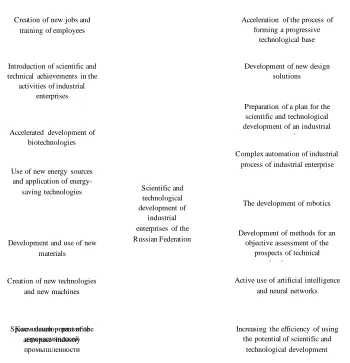
From the data presented in Table 1, it follows that the most important social factors for Russian companies are: improving the working conditions of employees and employees. With regard to technological factors that affect the development of high-tech companies, it is worthwhile to note the introduction of new and the use of breakthrough technologies, as well as the use of energy-saving technologies. Reduction of energy costs; economical, rational use of material resources; Increasing the efficiency of innovative (scientific and technical) development are economic factors. The main political factors include the inflow of investment; advanced positions in the market; competitiveness of finished products in the world market; increase in exports of finished products. In Figure 1, we present a scheme for the interaction of the components of the scientific and technological development of industrial enterprises in the Russian Federation.
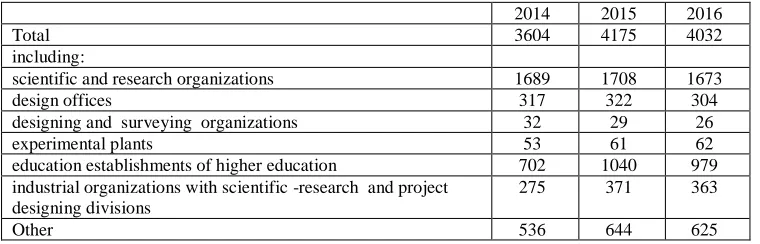
It follows from Figure 1 that the scientific and technological development of industrial enterprises in the Russian Federation includes a number of important components. Table 2 shows the number of organizations performing research and development in the Russian Federation.
[image:3.482.56.436.512.634.2]Also, Table 2 demonstrates that the largest number of organizations engaged in research and development in 2016 scientific and research organizations - 1673, the second position is occupied by education establishments of higher education - 979.
Table 2. Research and development organizations.
2014 2015 2016
Total 3604 4175 4032
including:
scientific and research organizations 1689 1708 1673
design offices 317 322 304
designing and surveying organizations 32 29 26
experimental plants 53 61 62
education establishments of higher education 702 1040 979
industrial organizations with scientific -research and project designing divisions
275 371 363
Acceleration of the process of forming a progressive
technological base
Development of new design solutions
Preparation of a plan for the scientific and technological development of an industrial
enterprise
The development of robotics Complex automation of industrial
process of industrial enterprise
Development of methods for an objective assessment of the
prospects of technical development Active use of artificial intelligence
and neural networks
Increasing the efficiency of using the potential of scientific and
technological development Scientific and
technological development of
industrial enterprises of the Russian Federation
Космизация – развитие аэрокосмической промышленности Creation of new technologies
and new machines Development and use of new
materials
Space - development of the aerospace industry Use of new energy sources
and application of energy-saving technologies Accelerated development of
biotechnologies Introduction of scientific and technical achievements in the
activities of industrial enterprises Creation of new jobs and
[image:4.482.71.421.70.433.2]training of employees
Fig. 1. Scheme of interaction of components of scientific and technological development of industrial enterprises.
4 Conclusion
In conclusion of the study it should be noted that the scientific and technical development of industrial enterprises in Russia in the key of the concept "INDUSTRY 4.0" includes a number of important areas of knowledge, such as robotics, space, biotechnology, automation of production processes, etc. Introduction of high-tech companies in scientific and technological achievements will help domestic enterprises take the leading positions in the world market and produce competitive finished products. Prospects for the authors' research are related to the practical aspects of the scientific and technological development of the defense industry complex in general and the aerospace industry of the Russian Federation in particular.
The authors of the research paper are grateful for the assistance to the Market Economy Institute of the Russian Academy of Sciences. The research is conducted as part of the
research work is “Scientific and technological development of industrial markets economics”.
References
1. A. Cerezo-Narváez, M. Otero-Mateo, F. Rodríguez-Pecci, A. Pastor-Fernández, Dyna (Spain), 93, 4, pp. 448-456 (2018)
2. A. A. Gohar, A. Cashman, Water Resources Management, 32, 12, 3903-18 (2018) 3. B. Chen, J. Wan, L. Shu, P. Li, M. Mukherjee, B. Yin, IEEE Access, 6, pp. 6505-19
(2017)
4. C. F. Chien, T.W. Liao, R. Dou, Applied Soft Computing Journal, 68, pp. 833-834 (2018)
5. D. Mourtzis, S. Fotia, N. Boli, P. Pittaro, International Journal of Advanced Manufacturing Technology, 97 (1-4), pp. 91-103 (2018)
6. A. B. L. de Sousa Jabbour, C. J. C. Jabbour, C. Foropon, M. G. Filho, Technological Forecasting and Social Change, 132, 18-25 (2018)
7. G. Reischauer, Technological Forecasting and Social Change, 132, pp. 26-33 (2018) 8. H. G. Lee, J.-H. Huh. A cost-effective redundant digital excitation control system and
Test Bed Experiment for safe power supply for process industry 4.Processes, 6 (7), (2018)
9. J. Horrillo-Tello, J. Triadó-Aymerich, Dyna, 93, 4, pp. 365-369 (2018)
10. J. A. Gobbo, C. M. Junior, Busso, S.C.O. Gobbo, H. Carreão, Process Safety and Environmental Protection, 117, pp. 372-382 (2018)
11. J.M. Müller, O. Buliga, K.-I. Voigt, Technological Forecasting and Social Change, 132, pp. 2-17 (2018)
12. L. Feng, X. Zhang, K. Zhou, Eurasip Journal on Wireless Communications and Networking, 90 (2018)
13. M. Faheem, V. C. Gungor, Applied Soft Computing Journal, 68, pp. 910-22 (2018) 14. M. Khakifirooz, C. F. Chien, Y.-J. Chen, Applied Soft Computing Journal, 68, pp.
990-99 (2018)
15. M. Lewin, S. Voigtlander, A. Fay, Proceedings IECON 2017 - 43rd Annual Conference of the IEEE Industrial Electronics Society, 6, pp. 3957-3962 (2017) 16. P. Dallasega, E. Rauch, C. Linder, Computers in Industry, 99, pp. 205-225 (2018) 17. P. Macurová, L. Ludvík, M. Žwaková, Journal of Applied Economic Sciences, 12, 7,
pp. 2003-11 (2017)
18. P. Schneider, Review of Managerial Science, 12, 3, pp. 803-48 (2018)
19. S. Luthra, S. K. Mangla, Process Safety and Environmental Protection, 117, pp. 168-179 (2018)
20. S. S. Kamble, A. Gunasekaran, S.A. Gawankar, Process Safety and Environmental Protection, 117, pp. 408-425 (2018)
21. T.K. Sung, Technological Forecasting and Social Change, 132, pp. 40-45 (2018) 22. U. Topal, M.-C.Cens, Glass International, 40, 1, pp. 44-45 (2017)
25. Y. Wang, H.-S. Ma, J.-H.Yang, K.-S. Wang, Advances in Manufacturing, 5, 4, pp. 311-20 (2017)
26. Y. Young, P. Loebach, K. Korinek, Social Science Research, 75, pp. 83-95 (2018) 27. Z. Li, Y. Wang, K.-S.Wang, Advances in Manufacturing, 5, 4, pp. 377-387 (2017) 28. Z. Nie, P. Wang, P. Zeng, H. Yu., Proceedings IECON 2017 - 43rd Annual
Conference of the IEEE Industrial Electronics Society, 6, pp. 5471-5476 (2017) 29. S. V. Ponomareva, A. A. Khachaturyan, A. S. Melnikova, St. Petersburg State
Polytechnical University Journal: Economics, 11, 4, pp. 60-69. DOI: 10.18721/JE.11404 (2018)