International Journal of Innovative Technology and Exploring Engineering (IJITEE) ISSN: 2278-3075, Volume-8 Issue-10, August 2019
Abstract: While hosting various cloud based information technology facilities by handling various assets on the internet, Cloud service accessibility has remained one of the chief concerns of cloud service providers (CSP). Several security concerns associated to cloud computing service simulations, and cloud’s major qualities contribute towards its susceptibility of security threats related with cloud service availability, the liability of internet, and the dispense behavior of cloud computing. Distributed Denial of Service (DDoS) attacks is one of the main advanced threats that occur to be extremely problematic and stimulating to stand owing towards its dispersed behavior and resulted in cloud service interruption. Although there exist amount of interruption recognition resolutions anticipated by various investigation groups, there exists not at all such a faultless result that avoids the DDoS attack and cloud service providers (CSP) are presently consuming various detection resolutions by assuring that their product stays well protected. The features of DDoS attack consuming various forms with dissimilar scenarios make it problematic to identify. Inspecting and analyzing various surviving DDoS detecting methods contrary to several factors is accomplished by this paper. To enhance the system performance further, sparse based data optimization is proposed to remove the redundant data. This enhancement reduced the execution time of the system by0.2%.
Index Terms: Cloud Security, Cloud Service Availability, Co-Variance Matrix, DDoS attacks, Entropy.
I. INTRODUCTION
Preceding the obtainability of amenities of a swarm server (request server, storing, file Server, or Domain Name Space server) otherwise web source, propelled incidentally over several conceded schemes termed as botnets in Internet, a Distributed Denial of Service (DDoS) outbreak remains a dispersed as well as synchronized outbreak. Subsequently the
aforementioned commencement, distributed
denial-of-service (DDoS) outbreaks ought to progress above the centuries. DDoS outbreaks have stood a key trial to the investigators as well as great safety concern towards the cloud calculating nature as stated overhead. In supposing numerous objectives happening the cloud properties, presentations or web, hackers practice numerous courses as well as do not yield a few threat of losing their objective cloud properties on a solitary outbreak operation in current advanced methodologies. Commencing modest web
Revised Manuscript Received on August 03, 2019.
Bhargavi Goparaju, Research Scholar, Department of CSE, Acharya Nagarjuna University, NH16, Nagarjuna Nagar, Guntur, (Andhra Pradesh), India.
Dr.Bandla Srinivasrao, Research Guide, Department of CSE, Acharya Nagarjuna University, NH16, Nagarjuna Nagar, Guntur, (Andhra Pradesh),
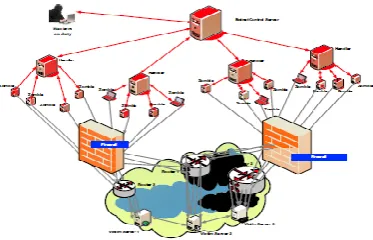
[image:1.595.329.516.318.438.2]outbreaks towards whole cloud properties outbreaks, DDoS outbreaks can sort. Aiming a precise provision in the host, they can remain volumetric and intended just before distracting a host provision also sorts the aforementioned inaccessible, otherwise outbreak solicitation deposits. En route for preventing otherwise to dash back the hackers [1], DDoS usage of numerous botnet machineries towards strengthening outbreaks can sort the aforementioned more stimulating and represented in figure 1.
Figure 1: Typical DDoS attack organization.
Preceding CSP’s professional, DDoS outbreaks ensure incredible influences. Reliant on capacity of possessions accommodated through suppliers, such impression remains dissimilar as well as the stage is inflated using the provision distraction. The greater will be the coincidence that consumer corrosion tracks, as additional cloud provision remains interrupted. A lawful ensemble will track, that carries around extra economic damage towards CSP plus enormous standing damage if the consumer follows some economic compensation. Hereafter consuming whole obtainable resources, the aforementioned remains continuously significant en route for preventing or alleviate DDoS outbreaks. The twofold leading categories of DDoS outbreaks are Reserve plus bandwidth reduction outbreaks The appropriate consumers might remain repudiated admission towards the aforementioned as a result Reserve outbreaks aim plus submerged the directed cloud properties. Using circulation approaching after dissimilar confronting foundation schemes entitled botnets avoids normal circulation after accomplishment of anticipated target scheme [2] and the bandwidth outbreaks aims as well as overflows the target web properties. Beside their categories and performance befalling in the cloud calculating exemplary, dissimilar kinds of DDoS
outbreaks are scheduled in [3].
Improved DDoS Attacks detection using Hybrid
Statistical Model and sparse representation for
Cloud Computing
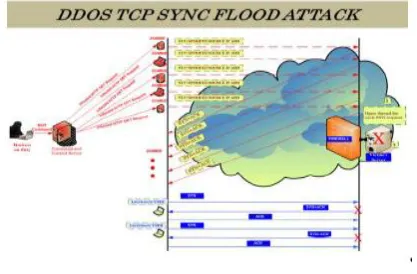
Aiming submissions comprising DNS overflow outbreaks, HTTP overflow outbreaks, Short and Sluggish outbreaks, as well as HTTPS overflow outbreaks are amongst these main forms of DDoS outbreaks and represented in figure 2.
[image:2.595.64.273.283.412.2]Figure. 2: Sample DDoS Flood attacks that target the network
Figure. 3: Sample DDoS Flood attacks that target applications.
UDP overflow outbreaks, ICMP (Ping) outbreaks, TCP-SYN Overflow outbreaks, TCP-PUSH-ACK outbreak TCP PSH+ACK Overflow outbreaks remain the additional DDoS outbreaks which aim the system. Extensive assortments of DDoS outbreak implements are prevailing nowadays. Besides them Agent-Handler offensive implements [4, 5] as well as IRC-Centered offensive implements [7, 8] are prevailing. The alternative customs of DDoS outbreak implements resembling Agobot [9], Mstream [10] as well as Trinoo [11] remain quiet employed by assailant currently. Here exist numerous derived DDoS outbreaks which are produced commencing the former implements as well as the fundamental system and therefore these implements are frequently occupied by invaders as well as they are altered faintly and represented in figure 3.
II. LITERATUREREVIEW
For instance numerous amounts of dissimilar DDoS recognition procedures have remained anticipated as well as several investigates have remained accompanied. Aimed at host centered variance interference recognition [12], amongst these existed a modest as well as well-organized concealed markov ideal structure. Towards preventing DDoS outbreaks in cloud stood appraised, discovered, inspected as well as anticipated by means of an unconventional result [13], an entropy centered irregularity recognition scheme remains used. A covariance-Matrix is demonstrating along with noticing numerous flooding outbreaks remained anticipated
[14] later inspecting the correlativity variations of observed system structures throughout flood outbreaks. Towards supporting an exemplary that remained influential to recommend an exemplary towards discovering flood grounded DDoS outbreak in cloud surroundings, an investigated outcome stood investigated as well as offered. The aforementioned delivered investigation outcomes which upkeep by what means efficiently the flood outbreaks stand discovered [15]. In relating data concept limitation named entropy level [16], Investigators too deliberated by what means entropy centered cooperative recognition of DDoS outbreaks on communal systems might efficiently practices in concept. Preceding cloud atmosphere [17], dissimilar categories of DDoS outbreaks at dissimilar deposits of OSI exemplary remained deliberated as well as offered, and in conclusion, investigated the influence of DDoS outbreaks. The investigators defined by what means the scheme can efficiently distinguish the circulation amongst the usual as well as outbreak circulation in addition investigation of covariance exemplary aimed at DDoS Recognition remained deliberated. The production of rectilinear convolution of the scheme as well as the aforementioned actual period recognition real is also presented in [18]. In consuming concealed markov exemplary, additional identifying resolution structure towards forecasting multi-stage outbreaks afore they stance a severe safety threat is employed. Meanwhile forewarns connections show an acute part in forecast [19], the training centered the actual period interruption forecast happening enhanced warnings. En route for relating the surfing conducts of network seekers as well as discovering DDoS outbreaks remained deliberated in addition to inspected [20] as well as the proposal of twofold self-governing designs aimed at HTTP as well as FTP that practices a comprehensive concealed semi-markov classic.
International Journal of Innovative Technology and Exploring Engineering (IJITEE) ISSN: 2278-3075, Volume-8 Issue-10, August 2019
Entropy of requirements for each term as well as the conviction tally aimed at every single consumer remains designed [24], centered on the surveillance. By means of the request of Dempster Shafer Concept, DDoS outbreaks can remain identified. Towards identifying DDoS hazard in cloud atmosphere, the concept remained realistic. Happening outbreak circumstances [6], it is a methodology for conjoining indication. Preceding exactness of threshold significance situation, the efficiency of an irregularity grounded recognition as well as representation scheme remains extremely reliant on. A novel structure allocating through the recognition of selection of DDoS outbreaks [25] remains designated by means of this methodology. A security appliance in contradiction of the DDoS outbreaks stayed anticipated as well as defined in the Cloud definite Interference Recognition Scheme. Afore it prospers [26] this security tool deliberates by what means towards discovering the DDoS outbreak. To identify the DDOS outbreaks arising [27] presently, the efficiently identifying the bandwidths margin of a cloud system in addition to the bandwidth presently in practice supports it. Aimed at identifying dispersed denial of service (DDoS) outbreaks, a methodology is defined founded on essentials of data concept precisely Kolmogorov complication remained anticipated. The system assisted initial recognition [28] regardless of its complication.
III.
S
YSTEMA
NALYSISGrounded on dissimilar planning specifically, object-termination, basis-termination, as well as in-system [29], dissimilar categories of DDoS recognition procedures have remained anticipated. Arithmetical approaches, easy calculating approaches, information grounded approaches, and statistics excavating as well as instrument knowledge approaches are the approaches comprised. Individual customary interference recognition schemes ensure not modified towards different technical standards resembling mobile as well as wireless systems [22] even though the significant feature of these recognition systems remains towards preserving that one commencing outbreaks. Using these recognition devices, dissimilar systems have remained employed. The profits as well as hindrances of dissimilar recognition systems are deliberated using the succeeding tabulation. The covariance matrix centered as well as the entropy grounded scheme are experimentally comparable in that equally categorizing a DDoS outbreak by computing intensified reliance on the information stays anticipated using a cross exemplary in detecting the dualistic methods. Consider X as a p x T multivariate course where p is sum of system 'types' or else adjustable in addition T is the sum of (distinct time interval) explanations. When founding standard dependency, to recognize the occurrence of a distinctive dependency on a section remains as the elementary knowledge and at that time categorizes an occurrence. We calculate the reliance amongst X aimed at a conventional, non-occurrence, system - let's appeal it T_0=T(X), where T remains specific measurement of the multivariate information besides X is the standard or else non-outbreak, exercise, information in arithmetical expressions. At that time, the `distance', through this measurement, amongst the
exercise information as well as `new' information and huge standards of this expanse specify an `attack' in representation remains the charge to estimate. At this point, by means of the covariance matrix p <p* system structures, we consider T(X). Wherever not any outbreaks stay exists, utmost credentials evaluate this covariance matrix aimed at t interpretations, specifically the exercise lot. Happening periods of distrusted outbreaks, this matrix remains paralleled by (example) covariance matrices. Away from the original covariance matrices, these assessments comprise arresting a variance inception. The assessments remain section wise as well as an original 0-1 matrix is designed section by section from the core broadsheet we've delivered. Aimed at bivariate association as well as numerous connections, we add Kendall's tau, an amount of possibility reliance on behalf of connection which remains a degree of rectilinear dependency. The identical thresholding, etc. can be through in correspondence by means of the alteration
Concluded entire structures of the information in relations of the exemplary as well as through the complete measurement of multivariate direction, we can practice the entropy. Representing guided dependency on the covariance as well as Kendall’s tau matrices, at this time we aspect aimed at a great expanse amongst the standard entropy as well as entropy of the information (i.e. premeditated through particular time periods) by means of the indication aimed at an outbreak. This scheme is extra `complete' as well as the quantity commencing the complete possibility circulation (via the model and estimator) remains employed besides not fair the expectancy in practicality.
A. Sparse matrix application to reduce data redundancy
Operations utilizing the criterion arrangements of dense-matrix and algorithms are sluggish and incompetent when applied to heavy matrices of sparse as processing & the memory have been wasted on the zeroes. The data which is sparse by nature compressed effortlessly and hence would entail importantly less storage space. Some heavy matrices of sparse are infeasible for manipulating by utilizing the standard algorithms of the dense-matrix. A matrix is characteristically saved as a 2 dimensional array. Every access in the array would represent an aspect ai, j of the matrix & is accessed by the 2 indices i and j. i is the row index numbered from top to bottom and j is the column index numbered from left to right typically. For an m × n matrix, the quantity of memory needed to save the matrix in this format is proportional to m × n (disregard to the fact that the dimensions of the matrix also required to be saved).
In the sparse matrix case, the requirement of substantial memory diminutions could be realized by saving only the entries of non-zero. Relying on the quantity and allocation of the non-zero entries, dissimilar structures of the data could be utilized and acquiesce heavy savings in the memory when it is compared to the basic approach. The trade-off is that contacting the creature aspects would become more difficult and further configurations are required to be competent for recovering the unique matrix absolutely.
Formats could be partitioned into 2 groups:
Those that sustain the adaptation of efficiency, like DOK (Dictionary of keys), LIL (List of lists), or COO (Coordinate list). These are utilized classically for building the matrices.
Those that carry efficient access & operations of matrix, like CSR (Compressed Sparse Row) or CSC (Compressed Sparse Column)
The advantages of using Sparse Matrix instead of simple matrix are
Storage: There are slighter non-zero aspects than zeros and hence smaller memory could be utilized for saving only those factors.
Computing time: The time of computing could be saved by designing logically a structure of data traversing only the elements of non-zero
IV. RESULTS
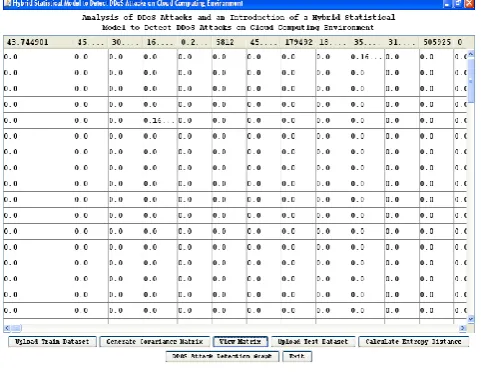
[image:4.595.307.548.62.249.2]The training data is first uploaded to train the DDOS features. Then the Covariance Matrix is generated with the matrix features.
Figure. 4: covariance matrix
In figure 4, if feature contains in dataset then average value will appear and if not contains then 0 will appear. After uploading the test data set, calculate entropy distance to compare train and test features to detect DDoS attack. See train and test dataset sample
15,24.15,201196,23,24,tcp,1540,---,16,6274,16092,2478 1700,Router,server1,20.176725,20.176725,20.186848,0,328 .205808,505437,1540,0.236337,0,20.156478,20.186848,1,5 0.030211,Normal
24.15,15,61905,23,22,ack,55,---,16,1930,16092,885060, Router,Switch2,7.049955,7.049955,7.059958,0,328.206042, 18051.3,55,0.008441,0,7.039952,7.069962,1.030045,50.060 221,UDP-Flood
In above two records we can see first record is Normal and second record is having ‘UDP-Flood’ attack
Now see two records from test dataset
24.11,11,356924,23,22,ack,55,---,12,10505,16103,88566 5,Router,Switch2,33.015317,33.015317,33.02532,0,328.522 947,18068.8,55,0.008446,0,33.005314,33.035323,1.030019, 50.046382
2,24.2,393608,2,21,tcp,1540,---,3,11438,16091,2478010 0,clien-2,Switch1,35.819479,35.819479,35.829602,0,328.26 404,505526,1540,0.236321,0.000216,35.819479,35.850064, 1,50.018467
International Journal of Innovative Technology and Exploring Engineering (IJITEE) ISSN: 2278-3075, Volume-8 Issue-10, August 2019
Figure. 5: Query result
[image:5.595.305.549.49.216.2]In figure 5, first column contains training records and second column contains test record and third column showing similarity distance between train and test record and fourth column showing weather test record is normal or contain attack Now click on ‘DDoS Attack Detection Graph’ which display count of various attack in graph
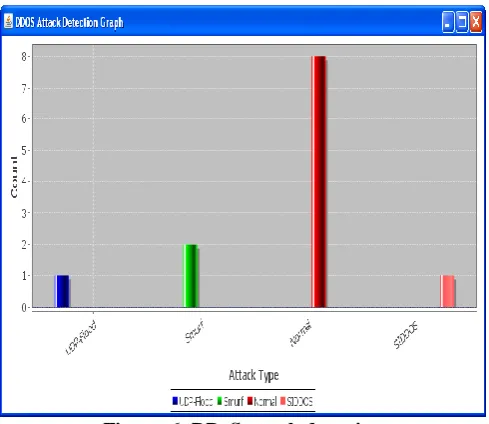
Figure. 6: DDoS attack detection
[image:5.595.47.292.379.591.2]In figure 6, graph x-axis represents attack name and y-axis represents no of attacks of that attack type.After running sparse matrix the iteration size is 97 and before running it was 99. There is no difference between train and test data classification on plain and sparse matrix.
Figure. 7: No.of iterations in existing and proposed method
In figure 7, Left side screen result generated on plain matrix and right side result generated on sparse matrix and we can see no change in output but iteration counts drops due to which system performance will increase and shows in figure 7.
V. CONCLUSION
Grounded on Entropy plus Covariance Matrices, we anticipated an operative substitute cross pattern contrary to DDoS outbreaks in this broadsheet. By a complete cross recognition pattern by both the system as well as congregation equal, we are watching presumptuous en route for relating a dissimilar method. The situation stimulates the actual necessity of partaking in a complete result, since numerous existing DDoS recognition systems presentation institute to exist underneath the equivalence besides DDoS outbreaks remain developing progressively. We consider that, enroute for being an enhanced unconventional result in modifying the threat considerably in generating an enhanced outcome, this anticipated system using paired check details remains anticipated.
REFERENCES
1. An NTT Communications, “Successfully combating DDoS Attacks”, White Paper, August 2012
2. Amit Khajuria1, Roshan Srivastava, “Analysis of the DDoS Defense Strategies in Cloud Computing”, international journal of enhanced research in management & computer applications vol. 2, issue 2, February 2013
3. Radware Ltd, “The Ultimate Guide to Everything You Need To Know About DDoS Attacks”, 2013
4. David Dittrich. “The “Stacheldraht” Distributed Denial of Service Attack Tool”. University of Washington, December 31, 1999, http://staff.washington.edu/dittrich/misc/stacheldraht.analy sis.txt (8 April 2003).
5. Sven Dietrich, Neil Long, and David Dittrich, “Analyzing Distributed Denial of Service Tools: The Shaft Case”, USENIX Association, Proceedings of the 14th Systems Administration Conference (LISA 2000), New Orleans, Louisiana, 2000
6. A.M. Lonea, D.E. Popescu, H. Tianfield, “Detecting DDoS Attacks in Cloud Computing Environment”, International Journal of Computing and communication, ISSN 1841-9836 8(1):70-78, February, 2013. 7. CERT Coordination Center, Carnegie Mellon Software Engineering
8. “CERT® Advisory CA-2001-20 Continuing Threats to Home Users”, CERT Coordination Center, Carnegie Mellon Software Engineering
Institute. July 23, 2001.
http://www.cert.org/advisories/CA-2001-20.html. (14 March 2003). 9. F-Secure.F-SecureVirusDescriptions: Agobot. http://www.f
secure.com/v-descs/ agobot.shtmlS, 2003.
10.Dittrich D. “The ‘‘mstream’’ distributed denial of service attack tool”,
University of Washington,
http://staff.washington.edu/dittrich/misc/mstream.analysis .txtS, 2000. 11.Dittrich D. “The DoS Project’s ‘‘trinoo’’ distributed denial of service
attack tool”, University of Washington, http://staff.washington.edu/dittrich/misc/trinoo.ana lysis, 1999 12.Jiankun Hu, Xinghuo Yu, D. Qiu, Hsiao-Hwa Chen, “A Simple and
Efficient Hidden Markov Model Scheme for Host-based Anomaly Intrusion Detection”, IEEE network, February 2009
13.A.S. Syed Navaz, V. Sangeetha, C. Prabhadevi, “Entropy Based Anomaly Detection System to Prevent DDoS Attacks in Cloud”, International journal of computer applications (0975-8887), January 2013
14.Daniel S. Yeung, Xizhao Wang, “Covariance-Matrix Modeling and detecting Various Flooding Attacks”, IEEE Transactions on Systems, MAN, Cybernetics- Part A: Systems and Humans, Vol. 37. No. 2, March 2007
15.Mohd Nazir Ismail, AbdulazizAborujilah, Shahrulniza Musa, AamirShahzad, “Detecting Flooding based DoS attack in cloud computing environment using covariance matrix approach”, ICUIMC (IMCOM), 2013
16.Shui Yu and Wanlei Zhou, “Entropy-Based Collaborative detection of DDoS attacks on community networks”, Sixth annual IEEE international conference on pervasive computing and communications, 2008.
17.J.J. Sha and L.G.Malik, “Impact of DDoS Attacks on Cloud Environment”, International Journal of Research in Computer and Communication Journal Vol2, issue 7, July 2013.
18.ShuyanJin and Daniel S. Yeung, “A Covariance Analysis Model for DDoS Attack Detection”, IEEE communications society, 2004. 19.AlirezaShameliSendi, Michael Dagenais, MasoumeJabbarifar, “Real
time Intrusion prediction based on optimized alerts with hidden markov model”, Journal of networks, Vol 7, no.2, February 2012
20.Sanjay B Ankali and D.V Ashoka, “Detection Architecture of Application Layer DDoS Attack for Internet”, Advanced Networking and Applications, volume 03, issue 01, Pages 984-990, 2011.
21.Er. SakshiKakkar, Er. Dinesh Kumar, “A survey on distributed denial of services (DDoS)”, International journal of computer science and information technologies Vol. 5(3), 2014.
22.AnimeshPatcha, Jung-Min Park, “An Overview of Anomaly Detection Techniques: Existing Solutions and Latest Technological Trends”, Science Direct, Computer Networks 51, 2007
23.Monowar H. Bhuyan, H.J. Kashyap, D.K. Bhattacharyya, J. K. Kalita, “Detecting Distributed Denial of Service Attacks: Methods, Tools and Future Directions”, http://www.garykessler.net/library/ddos.html, December 2012.
24.S. Renuka Devi and P. Yogesh “Detection Of Application Layer DDoS Attacks Using Information Theory Based Metrics”, CS & IT-CSCP pp. 217–223, 2012
25.B.B. Gupta, ManojMisra, and R.C. Joshi, “An ISP Level Solution to Combat DDoS Attacks Using Combined Statistical Based Approach”, Journal of Assurance and Security, Volume 2, Pages 102-110, June 2008.
26.Upma Goyal, Gayatri Bhatti, and Sandeep Mehmt, “A Dual Mechanism for Defeating DDoS Attacks in Cloud Computing Model”, Vol. 2, Issue 3, March 2013.
27.Biswajit Panda, Bharat Bhargava, SouravPati, Dayton Paul, Leszek T. Lilien, and Priyanka Meharia, “Monitoring and Managing Cloud Computing Security Using Denial of Service Bandwidth Allowance”, 2012.
28.A.B. Kulkarni, S.F.Bush, and S.C. Evans, “Detecting Distributed Denial-of-Service Attacks Using Kolmogorov Complexity Metrics”, GE Research & Development Center, February 2002