International Journal of Innovative Technology and Exploring Engineering (IJITEE) ISSN: 2278-3075, Volume-8 Issue-9, July 2019
Abstract: The Indian higher education system is one of the largest in world. With due contributions from the government, public and private bodies, higher education of India boasts an enormous increase in institutional capacity. The multiplicity exists in both type of institutions and regulatory agencies as well. The institutions are controlled through multiple agencies and councils at the federal level, for approvals, infrastructure, admission procedures, teaching qualifications etc The study focuses on the existing Institutional and Regulatory structure of Indian Higher Education System and recommends the simplified structure to meet the demands.
Index Terms: University Framework, Institutions of National Importance, College Framework, UGC, MHRD
.
I. INTRODUCTION
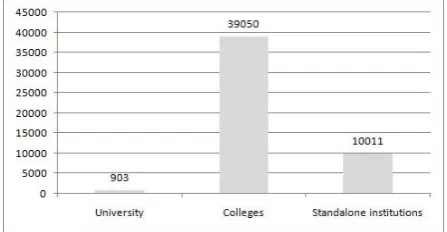
[image:1.595.56.280.534.650.2]As per the All India Survey of Higher Education (AISHE, 2018), there are 49964 institutions and broadly categorized as shown in Figure 1. The universities are overburdened to administer affiliating colleges as the high ratio of affiliation, which necessitate to start more universities (Sharma, 2018). The current Gross Enrollment Ratio (GER) is 25.8 % which accommodates 36.6 million students. The immediate expectations is to meet GER as 30 % by 2020 and will be exponential growth. However, there is a large disparity in terms of quality, geographic / gender / enrollment ratio (UGC, 2011). The complexity exists in regulations which extend the approval time. There is a need of improving autonomy and governance.
Figure 1. Higher education institutions in India
Revised Manuscript Received on July 05, 2019
Srimathi H, Assistant Director Admissions, SRM Institute of Science and Technology, India
Krishnamoorthy A, Associate Dean, E&I SASTRA Deemed University, India.
II. KEY GOVERNMENTAL PLAYERS OF HIGHER EDUCATION
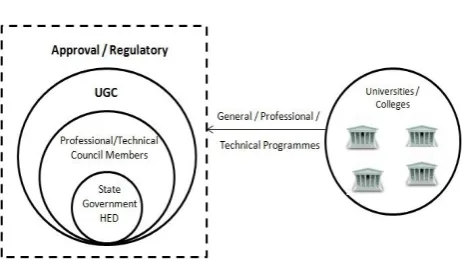
The higher education of the nation is controlled through multiple agencies and councils at the federal level, for approvals, infrastructure, admission procedures, teaching qualifications etc., (see Figure 2). In addition, the institutions must obtain No Objection Certificate (NOC) from state government and also fulfill the minimum land requirement mandatory. The responsibilities of agencies are listed herewith.
University Grants Commission (UGC) established in year 1953 as an apex body, providing funds and that coordinates, determines and maintains standards in institution.
Ministry of Human Resource Development (MHRD) created in the year 1985, concentrate in both school and higher education. The Ministry focus on formulation of national policies, quality of education and development. All India Council for Technical Education constituted in
the year 1945, act as an approval and advisory board related to technical education such as engineering & technology, architecture, town planning, management, pharmacy, hotel management & catering technology and applied arts & crafts. .
Council of Architecture (COA) governs The standards of architectural education being imparted.
Bar Council of India (BCI) regulates the legal practice and legal education.
National Council for Teacher Education (NCTE) is primarily to achieve planned and coordinated development of the teacher education system.
Indian Council of Agricultural Research (ICAR) regulates education and research in agriculture, horticulture, fisheries and animal sciences.
National Council for Hotel Management and Catering Technology (NCHMCT) regulates the academic of hospitality education and training that is imparted. The Medical Council of India (MCI) ensures standards of
medical education. It also recognize medical qualifications and permit medical Practitioners to register prior practicing.
The Dental Council of India (DCI), ensures uniform standards of dental education, granting permission to start dental colleges and increase of seats, prescribe standard curricula, recognition of qualification and prescribe the standards for practice.
Pharmacy Council of India (PCI) regulates the pharmacy education and permits
registration of pharmacist.
The Complex Structure of Higher Education
System in India
The Indian Nursing Council (INC) takes care of training for nurses, midwifes and health visitors.
Central Council of Homeopathy (CCH) evolves standards requirements of Homoeopathic colleges and attached hospital to maintain necessary infrastructure, intake and new course approval.
Central Council for Indian Medicine (CCIM) implement various regulations including the curricula and syllabi of. Ayurvedha, Siddha, Unani-Tibb and Sowa Rigpa System of Medicines.
Rehabilitation Council of India (RCI), regulates services given to persons with disability, to standardize syllabi in the field of rehabilitation and special education. Distance Education Bureau (DEB) is to regulate the the
distance programmes offered in India in correspondence, distance and online mode. The candidates are eligible for employment only when the degree course is approved by the council.
National Council of Rural Institutes (NCRI) helps rural institutions, Gandhian organizations, non-governmental organizations (NGOs), universities and state government agencies related to promotion of rural higher education. Sports Authority of India (SAI) implements sports education in different disciplines at international level, produce caliber coaches, teachers and sports scientists. Veterinary Council of India (VCI) takes care of
regulation and admission pertaining to veterinary sciences.
Central Advisory Board of Education (CABE) is established as the government advisory in the field of education.
National Knowledge Commission (NKC) was established as think-tank to analyse policies and plans in the knowledge sectors.
The higher education & human resource departments of the state government focus skill development, quality higher education and improve socio-economic development of the state. Some of the state governments have named the same as State council for higher education..
National Accreditation Association Council of India (NAAC) and National Board of Accreditation (NBA) are the two government accreditation agencies. NAAC follows institutional grading approach and NBA follows programme level grading.
Figure 2. Higher Education Agencies
III. TYPES OF UNIVERSITIES
Universities are autonomous spaces concerned centrally with higher education and research and classified as shown in
Figure 3. The universities which are supported by Government of India (GOI) and state governments are called public universities. The private universities are supported by non-profitable private trusts.
(a) Classification
(b) Universities type
[image:2.595.316.541.103.539.2](c)Number of Universities in each type (AISHE 2018)
Figure 3. University Framework
Central universities are established by an act of Parliament. The UGC is the agency that provides funds for central universities. State universities are established by respective states and funded by them. Some of the state universities receive budget from UGC. The state universities established prior to 1972, will only be eligible to receive grant from central or UGC unless the UGC makes an exception for any special case (Tilak, 2017). Based on specific requirements, state legislation act was passed to establish some institutions on parallel with central universities / Institutes of National Importance. Private universities are established either through a state or central act. They must further obtain approvals from the regulatory body to recognize the degree awarded by them.. Some of
[image:2.595.78.257.600.711.2]International Journal of Innovative Technology and Exploring Engineering (IJITEE) ISSN: 2278-3075, Volume-8 Issue-9, July 2019
Private Partnership (PPP) model.
Deemed universities are Institutions of higher learning, granted the status of a university recognizing the high caliber of education. The deemed status enables autonomy to the institution for setting up guidelines in admission, fee structure, curriculum and syllabi. The deemed institutions are further classified into government and private. Affiliating universities approve colleges and institutions to function under them in which provision is made for the preparation of students for titles or diplomas of the university.
Some of the institutions which are not universities but autonomously award degrees, are called as university level institutions. Keeping in mind the interest of the public, UGC has also listed fake universities which do not have to confer degree and updates the list as and when required.
Open Universities cater to the needs of students who would like to pursue higher education through Open and Distance Learning (ODL) mode. In a vast and thickly populated country like India there may be a chance that the formal conventional university system not exists for all the aspirants. The ODL institutions provide opportunities to the bulk of the aspiring learners. The Indira Gandhi National Open University (IGNOU), State open universities, Distance education institutions, Directorate of Distance Education in existing universities offer ODL programmes to 11 percent of total enrollment. The government is currently in the process of inviting institutions to offer online education on par with campus education.
IV. INSTITUTES OF NATIONAL IMPORTANCE & EMINENCE
Some of the universities and university level institutions are recognized as Institutes of National Importance. They focus on developing highly skilled personnel and excel in research. All India Institute of Medical Sciences (AIIMS), Indian Institute of Technologies (IITs), Indian Institute of Information Technologies (IIITs), National Institute of Technologies (NITs), Post Graduate Institute of Medical Education & Research, Indian Statistical Institute, Dakshina Bharat Hindi Prachar Sabha, and National Institute of Pharmaceutical Education & Research are a few in the list.
The institutes would be given privileges under institute of eminence (IOE) to determine course structure, admit foreign students, fee structure, recruit foreign faculty and establish academic collaborations. They are expected to excel world ranking in the next 10 years.
V. TYPES OF COLLEGES
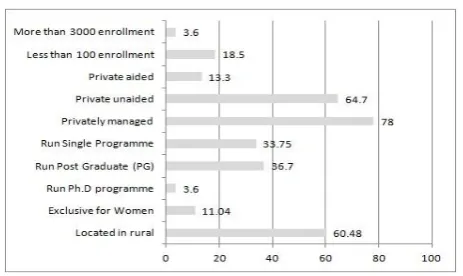
Colleges are classified in terms of affiliation, autonomy, administration; funding, fee structure and faculty offered as ‘3FA’ model (see Figure 4). Some of the interesting facts of colleges are given in Figure 5. Colleges may be a combination of more than one classification (Nordic, 2006). For example the college may be affiliated to a particular university with autonomous status, which is privately managed and funded by government, in which a student can study under self-supported mode in science discipline.
Constituent colleges are functioning as a part of the university, almost similar to the university. Most of them are autonomous in nature. These colleges may function at the seat of the university or in some other centres. The curriculum, syllabi and examination are unique in these colleges and are
[image:3.595.314.535.101.245.2]not common with other affiliated colleges of the university. For some of the constituent colleges, students may take the common syllabi and examinations along with affiliated colleges.
Figure 4. College Framework: The ‘3(FA)’ model
Figure 5. Key results of Colleges in Percentage (AISHE 2018)
Affiliated colleges are not a part of the university. They manage the functions independently under the guidance of government / university in imparting teaching-learning process. However, the examinations are conducted and awarded by the affiliating university. Autonomous colleges have own curriculum and examination system, Degree is jointly awarded by university and the colleges which enjoy the autonomous status. However, some of the aspects such as fees, sanctioned intake, programmes offered etc., are entirely decided, controlled and monitored by the university. Non-autonomous colleges follow the university curriculum, syllabi and examination system.
The colleges can be operated by government or private. The private colleges can be run by private management trust or society. Further, the private colleges may be funded by government fully or partially or privately funded through trust.
Colleges may be classified according to the degree awarded such as Arts and Science colleges, Professional Colleges (offering degree in Engineering, Medical, and Law etc.) and Community colleges to promote skill based education to meet the local demands.
The Community colleges are established through community initiatives primarily to impart skill development courses to offer Certificates /
[image:3.595.313.545.278.416.2]These colleges generally give training and education in those areas that are absolutely essential to the local society and help the learners achieve skills for earning bread. There are few programmes offered in self-supporting mode in the government and government-aided colleges. There is no differentiation in the programme structure and degree awarded, but the fee structure will be high for self supporting programmes.
The universities and colleges who have excelled in the chosen focal area have been recognized for the good work and are acknowledged by the UGC. They are tagged as Institutions of ‘Potential Excellence’ and they are entitled to receive more funds. The financial support helps institutions to improve their academic, physical infrastructure and introduce modern pedagogy and research. UGC has a plan to extend such awards to private institutions also which are not under sections 2(f) or 12(b), but without any financial assistance.
VI. INSTITUTES NOT AFFILIATED TO UNIVERSITY
There are some institutions providing Diploma / Post Graduate Diploma and certifications but they are not affiliated to any university. The classification is given in Figure 6. However, they must get prior approvals from respective councils or statutory bodies.
Polytechnics which offer diploma programmes should get prior approval from AICTE and the state government.
Industrial Training Institutes (ITI) and Industrial Training Centres (ITC) which offer certificate programmes recognized by National or State Council on Vocational Training (NCVT/ SCVT).
Teacher training institutes which offer various diplomas should be approved by NCTE.
Diploma and Post graduate diploma offered by technical institutions should be recognized by AICTE, but not required affiliation from university.
The General Nursing and Midwife (GNM) courses have to be approved by Indian Nursing Council (INC). The Institute of Charted Accountants of India (ICAI)
emphasize standards and conduct exams for charted accountants.
The Institute of Company Secretaries of India (ICSI) is a statutory to offer company secretary programme. The Institutes of Actuaries of India (IAI) is for
regulation of profession of actuaries in India to conduct fellowship level examination and enforce standards.
The Institute of Cost Accountants of India is the licensing body for promoting and developing the Cost Accountancy profession.
The Institute of Engineers (IEI) India established in 1920 offers engineering diplomas and post graduate diplomas and AMIE (Associate member of Institution of Engineers) examinations throughout the country. The National Institute of Electronics & Information
Technology (NIELIT), GOI, (formerly, DOEACC – Department of Electronics Accreditation of Computer Courses) conducts various O/A/B/C level courses in the recent trends.
National Board of Examination (NBE) an autonomous body conducts graduate and postdoctoral examination in Medical education.
Figure 6. Stand alone institutions (AISHE 2018)
VII. THE COMPLEX REGULATORY STRUCTURE
The higher education system prevalent in India is both voluminous and complex. In the mid of 19th century, it had the image of British Universities and now acquired a more hybrid form, influenced by other developed countries (Agarwal, 2006). Complexities exist in the processes and procedures pertaining to Approval, Affiliation, Academic and Accreditation (4A model) of higher education system as presented in Figure 7.
International Journal of Innovative Technology and Exploring Engineering (IJITEE) ISSN: 2278-3075, Volume-8 Issue-9, July 2019
[image:5.595.57.289.82.213.2]Figure 7. Four ‘A’ model of higher education institutions
.
Figure 8. Simplified Regulatory Expectations
The new draft higher education policy 2019 proposed to establish National Higher Education Regulatory Authority (NHERA) and assured that it will be single point of contact for all higher education regulations including professional courses. It is planning to make a move towards multidisciplinary universities and colleges, institutional autonomy and promises light but tight regulations. It is also has a plan to do institutional restricting with the simplified classification of
public / private / private-aided Three types of institutions :
(i) Research University, (ii) Teaching University, (iii) Colleges
Multidisciplinary institution which combines vocational and professional education
CONCLUSION
The higher education system of India is expected to have exponential growth in terms of enrollment and institutional capacity. The existing barrier of establishment must be simplified. The proposed NHERA shall ensure governance and transparency. The higher education institutions must be given full autonomy in academic and administration on top of the existing regulations to achieve global standards. The institutions are also expected to maintain integrity and not to misuse the freedom.
REFERENCES
1. Agarwal P, Higher education in India: The need for change,(2006), Indian Council for Research on International Economic Relations, http://www.icrier.org/pdf/ICRIER_WP180_HigherEducationinIndia.p df
2. All India Survey on Higher Education 2 017-18, (2018), Government of India, Ministry of Human Resource Development, Department of Higher education, http://aishe.nic.in/aishe/viewDocument.action ?documentId =245
3. Draft National Education policy, 2019 , Ministry of Human Resource Development,
https://mhrd.gov.in/sites/upload_files/mhrd/files/Draft_ NEP_2019 _EN.pdf
4. India’s Education Policy, Submission to Ministry of Human Resource Development, (2018), UK India Business Council,
https://www.ukibc.com/wp-content/uploads/2018/03/2018-06-14-Ind ia-Education-Policy-Web-version.pdf
5. Nordic . (2006). The System of Education in India, Nordic Recognition Information Centres, Retrieved on October 17 2018 from https://norric.org/files/education-systems/India-2006.pdf
6. Sharma SC 2018, There is a need to start more universities in the country,
https://www.thehindu.com/news/national/karnataka/indias-gross-enro lment-ratio-in-higher-education-very-low-naac/article24597284.ece 7. Tilak BG J. (2017) Union-State Relations in India’s Higher
Education, Occasional Paper 50, National University of Educational Planning and Administration (Unpublished), Retrieved on August 4 2018 http://www.nuepa.org/New/OCASSIONAL%20 PAPERS.aspx 8. UGC, Inclusive and qualitative expansion of higher education, 12th
Five year plan, 2012-17, 2011,https://www.ugc.ac.in /ugcpdf /740315_12FYP.pd
9.AICTE, www.aicte-india.org
10. BCI, www.barcouncilofindia.org 11. COA, www.coa.gov.in 12. CCH, www.cchindia.com 13. CCIM, www.ccimindia.org 14. ICAR, www.icar.org.in
15. INC, www.indiannursingcouncil.org 16. VCI, www.vci.nic.in
17. MCI, www.mciindia.org 18. MHRD, www.mhrd.gov.in 19. NAAC, www.naac.gov.in 20. NBA, www.nbaind.com 21. NCHM, www.nchm.nic.in 22. NCTE, www.ncte-india.org 23. PCI, www.pci.nicin
24. RCI, www.rehabcouncil.nic.in 25. SOI, www.sportsauthorityofindia.nic.in 26. UGC, www.ugc.ac.in
Prof. H. Srimathi has two decades of experience in higher education and services. She is employed at SRM Institute of Science and Technology since 1999 and served in various domains such as academics and administration. She is passionate about the studies on higher education systems, qualification framework, and academic mobility.